5 Maps That
Explain China’s
Strategy
The People’s Republic of China
has always been portrayed as
an increasingly aggressive
country prepared to challenge
the United States.
At the same time, China has
avoided significant involvement
in the troubles roiling in the
rest of Eurasia.
In other words, there is a gap
between what is generally
expected of China and what
China actually does.
To understand what China’s
actual national strategy is, let’s
look at the following five maps.
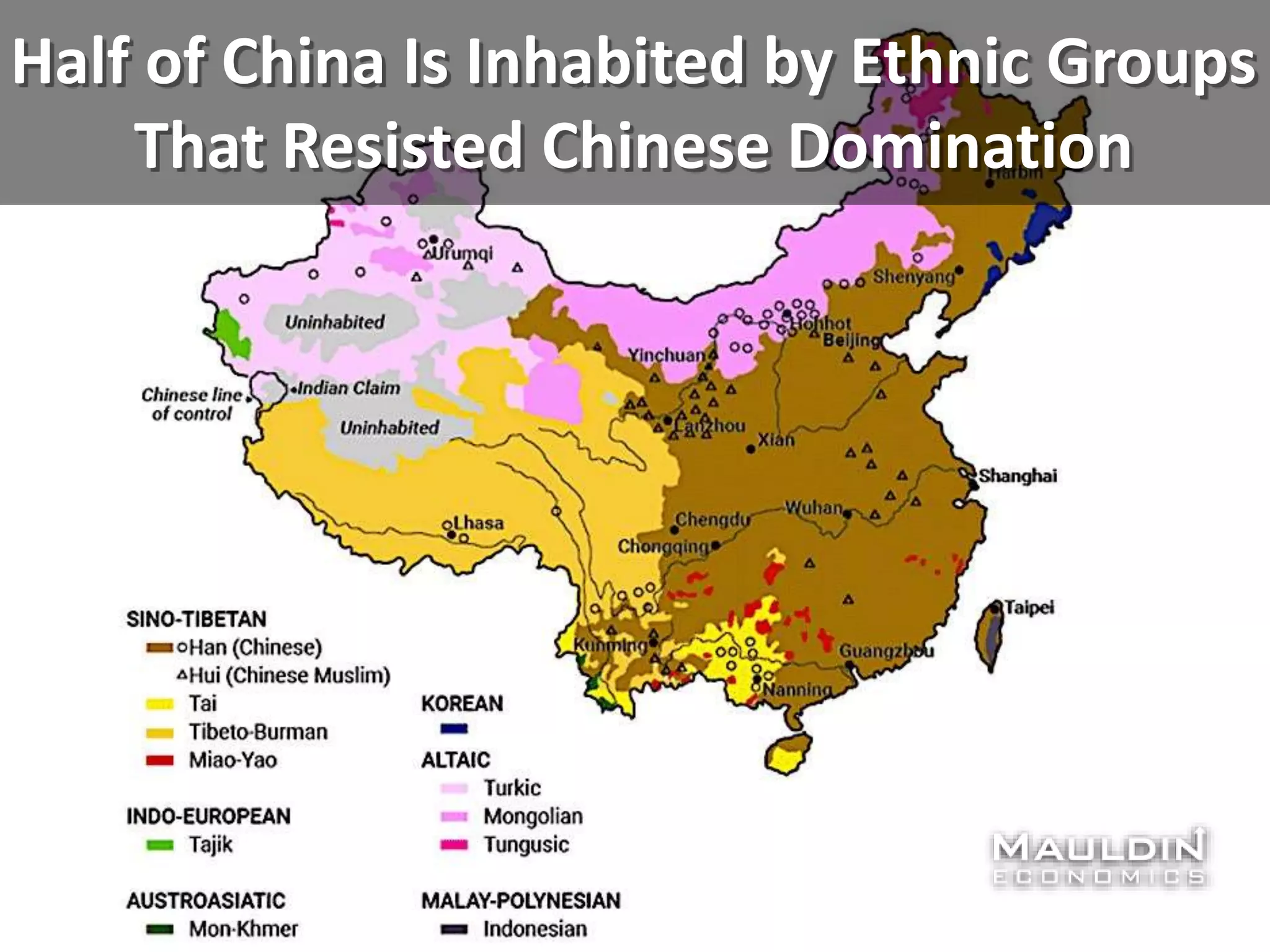
Half of China Is Inhabited by Ethnic Groups
That Resisted Chinese Domination
First, we need to make a
distinction between two
Chinas.
There is the China—with its
international borders—we see
on maps.
But there is also the China
inhabited by the Han Chinese,
the main Chinese ethnic group.
Han China is surrounded within
China by regions populated by
other nations, including Tibet,
Xinjiang, Inner Mongolia, and
Manchuria.
These four regions are a buffer
around China, providing
strategic depth to repel
invaders.
All four, however, resisted
Chinese domination, as Tibet
and Xinjiang still do today.
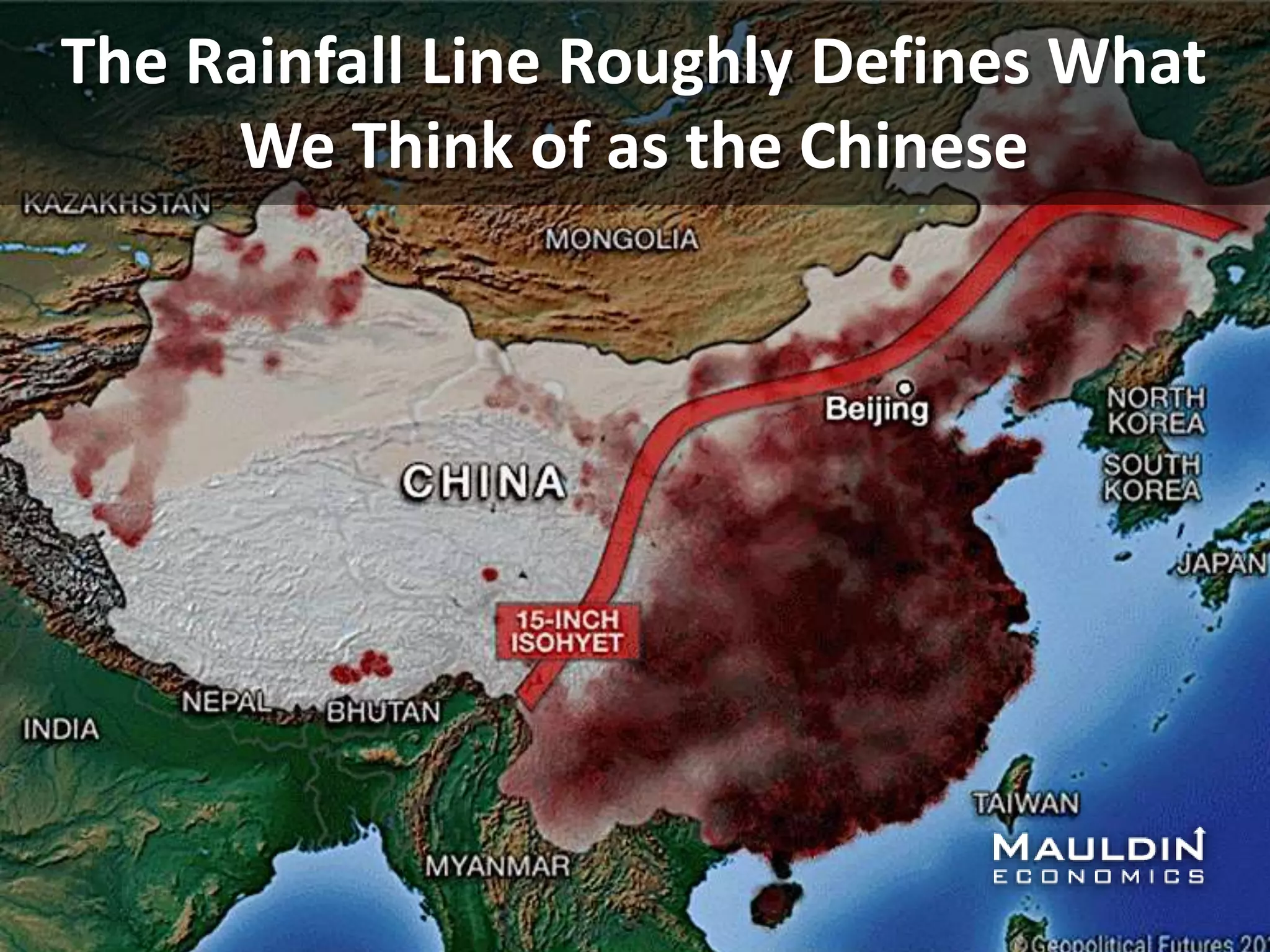
The Rainfall Line Roughly Defines What
We Think of as the Chinese
A very similar geography
emerges when we look at
rainfall patterns.
The line, called the 15-inch
Isohyet, separates the area in
the east that receives enough
rainfall to maintain an
agricultural economy.
As a result, the majority of
Chinese live in this area, while
non-Han Chinese regions in the
west are lightly inhabited or
uninhabited.
That means the Chinese
population is crowded into a
much smaller area and is
farther from its neighbors.
SUBSCRIBE
George Friedman provides unbiased assessment of the global
outlook in his free publication, This Week in Geopolitics.
Subscribe now and get an in-depth view of the forces that
will drive events and investors in the next year, decade, or
even a century from now.
Subscribe here
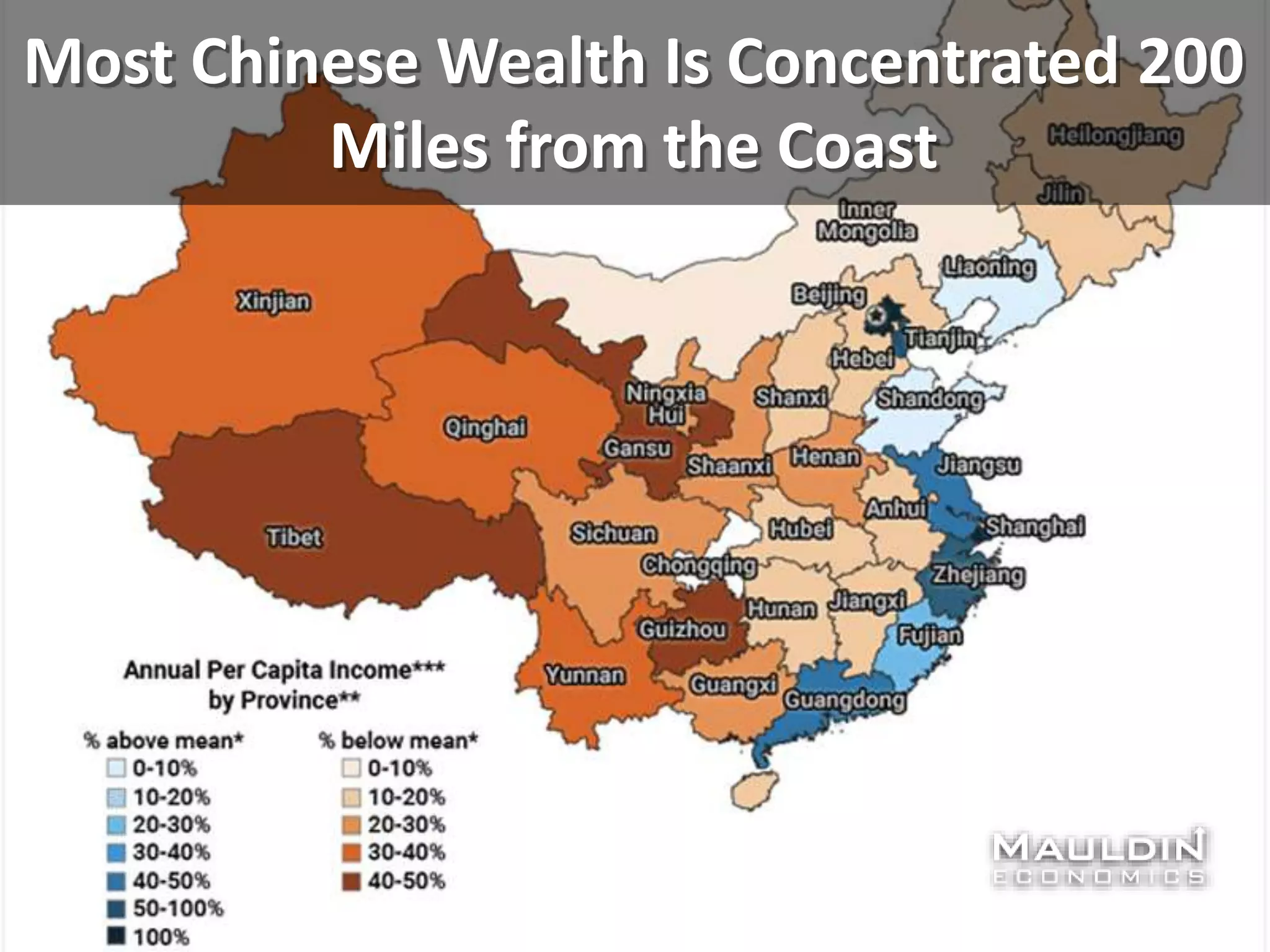
Most Chinese Wealth Is Concentrated 200
Miles from the Coast
The economic difference
between China’s coastal region
and the rest of China is striking.
Economically, only the coast is
above the median. Every other
area is below it.
Over 650 million Chinese
citizens live in households
earning less than $4 a day,
according to World Bank data.
Obviously, the overwhelming
majority of these people live
outside the coastal region.
The China that most
Westerners think about is the
thin strip along the coast.
The rest (500–1,000 miles
west), however, is a land of Han
Chinese living in Third World
poverty.
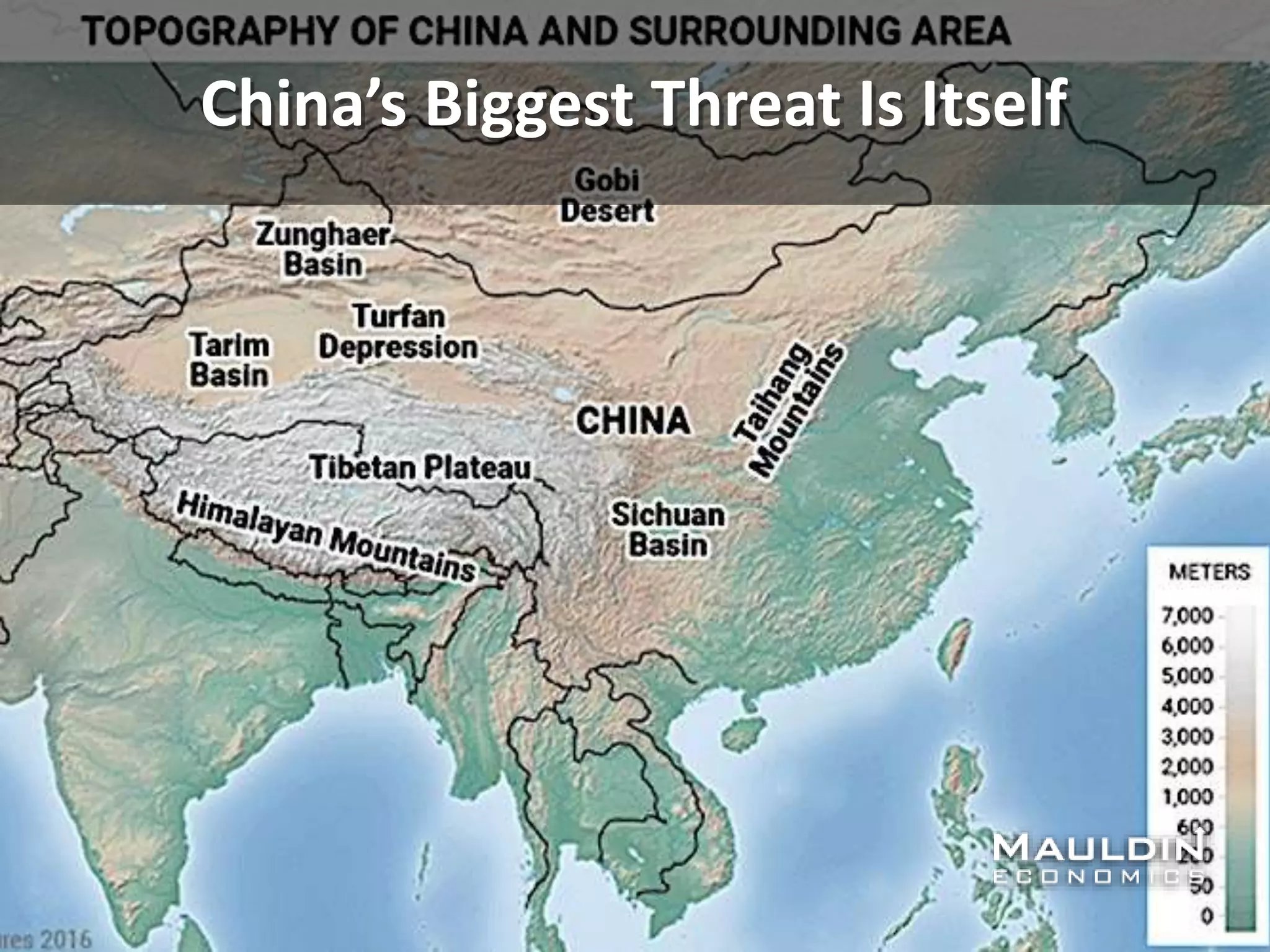
China’s Biggest Threat Is Itself
China’s southern border
consists of the Himalayas in the
west and hilly jungle country in
the east.
It is impossible to conduct
major military operations in the
Himalayas and a nightmare to
fight in hilly jungles of
southeast Asia.
To the north, China is bordered
by Siberia, which no country
has ever tried to invade or
mount an invasion from.
Except for the Pacific Coast,
China is secure and contained.
Therefore, China’s primary
strategic interest is maintaining
the territorial integrity of China
from internal threats.
If it lost control of Tibet or
Xinjiang, China’s borders would
move far east, the buffer for
Han China would disappear,
and then China would face a
strategic crisis.
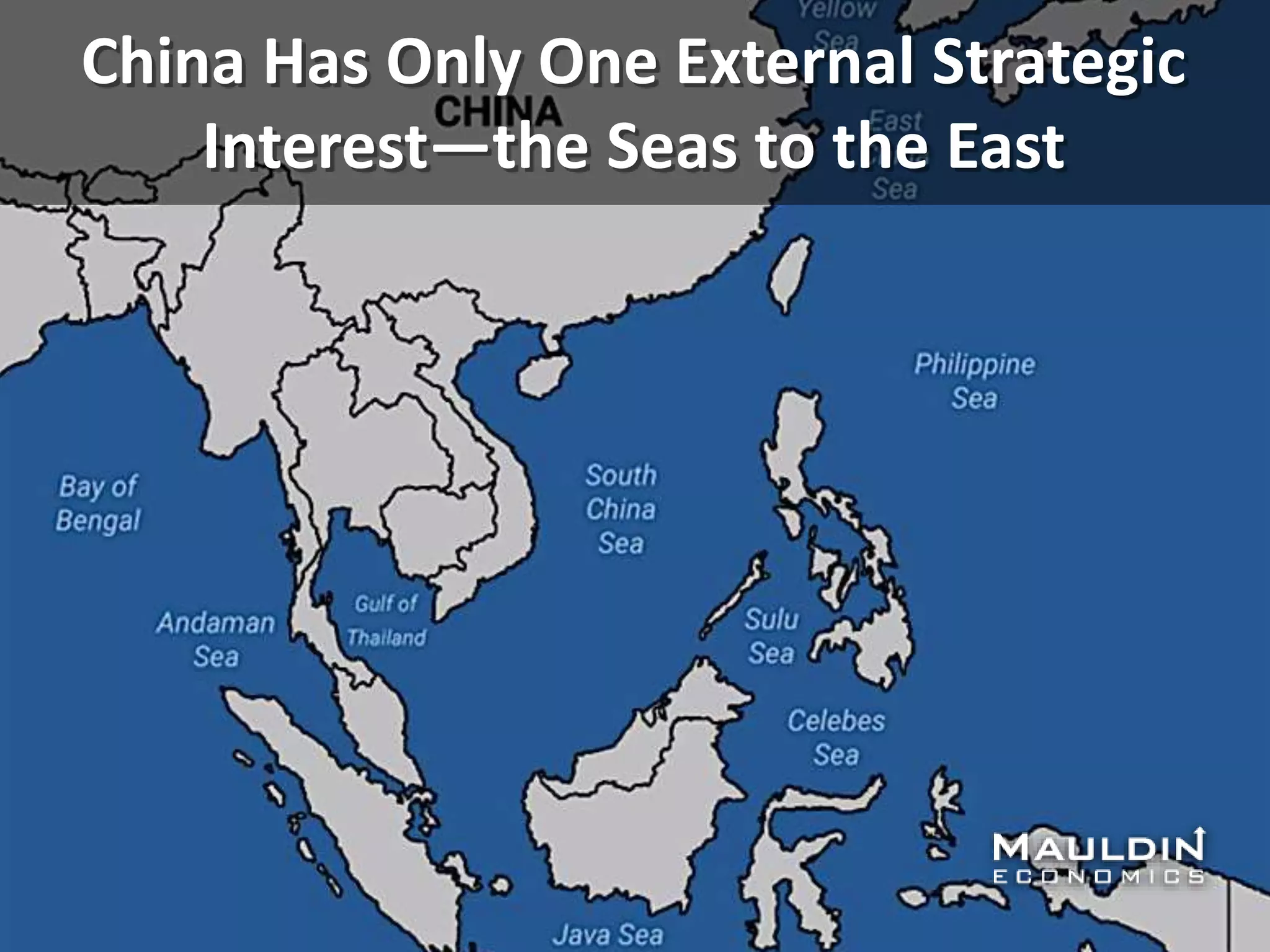
China Has Only One External Strategic
Interest—the Seas to the East
China has vital maritime
interests built around global
trade, but the problem is the
sea lanes are under
American control.
China’s coastal seas are
surrounded by archipelagos of
island states with narrow
passages between them.
These passages could be easily
closed at will by the US Navy.
China currently lacks resources
to build a navy that could
match the US, so the country is
buying time by trying to appear
more capable than it is.
The Chinese will maintain this
posture until it has the time
and resources to close the gap.
In summary, China has three
strategic imperatives. Two
internal and one external.
First, it must maintain control
over Xinjiang and Tibet. Second,
it must preserve the regime and
prevent regionalism.
And last, it must find a solution
to its enclosure in the East and
South China Seas.
China’s strategic priority now,
however, is internal stability.
And that defines everything
else China does.
SUBSCRIBE
George Friedman provides unbiased assessment of the global
outlook in his free publication, This Week in Geopolitics.
Subscribe now and get an in-depth view of the forces that
will drive events and investors in the next year, decade, or
even a century from now.
Subscribe here

5 Maps That Explain China's Strategy

  • 1.
    5 Maps That ExplainChina’s Strategy
  • 2.
    The People’s Republicof China has always been portrayed as an increasingly aggressive country prepared to challenge the United States.
  • 3.
    At the sametime, China has avoided significant involvement in the troubles roiling in the rest of Eurasia.
  • 4.
    In other words,there is a gap between what is generally expected of China and what China actually does.
  • 5.
    To understand whatChina’s actual national strategy is, let’s look at the following five maps.
  • 6.
    Half of ChinaIs Inhabited by Ethnic Groups That Resisted Chinese Domination
  • 7.
    First, we needto make a distinction between two Chinas.
  • 8.
    There is theChina—with its international borders—we see on maps.
  • 9.
    But there isalso the China inhabited by the Han Chinese, the main Chinese ethnic group.
  • 10.
    Han China issurrounded within China by regions populated by other nations, including Tibet, Xinjiang, Inner Mongolia, and Manchuria.
  • 11.
    These four regionsare a buffer around China, providing strategic depth to repel invaders.
  • 12.
    All four, however,resisted Chinese domination, as Tibet and Xinjiang still do today.
  • 13.
    The Rainfall LineRoughly Defines What We Think of as the Chinese
  • 14.
    A very similargeography emerges when we look at rainfall patterns.
  • 15.
    The line, calledthe 15-inch Isohyet, separates the area in the east that receives enough rainfall to maintain an agricultural economy.
  • 16.
    As a result,the majority of Chinese live in this area, while non-Han Chinese regions in the west are lightly inhabited or uninhabited.
  • 17.
    That means theChinese population is crowded into a much smaller area and is farther from its neighbors.
  • 18.
    SUBSCRIBE George Friedman providesunbiased assessment of the global outlook in his free publication, This Week in Geopolitics. Subscribe now and get an in-depth view of the forces that will drive events and investors in the next year, decade, or even a century from now. Subscribe here
  • 19.
    Most Chinese WealthIs Concentrated 200 Miles from the Coast
  • 20.
    The economic difference betweenChina’s coastal region and the rest of China is striking.
  • 21.
    Economically, only thecoast is above the median. Every other area is below it.
  • 22.
    Over 650 millionChinese citizens live in households earning less than $4 a day, according to World Bank data.
  • 23.
    Obviously, the overwhelming majorityof these people live outside the coastal region.
  • 24.
    The China thatmost Westerners think about is the thin strip along the coast.
  • 25.
    The rest (500–1,000miles west), however, is a land of Han Chinese living in Third World poverty.
  • 26.
  • 27.
    China’s southern border consistsof the Himalayas in the west and hilly jungle country in the east.
  • 28.
    It is impossibleto conduct major military operations in the Himalayas and a nightmare to fight in hilly jungles of southeast Asia.
  • 29.
    To the north,China is bordered by Siberia, which no country has ever tried to invade or mount an invasion from.
  • 30.
    Except for thePacific Coast, China is secure and contained.
  • 31.
    Therefore, China’s primary strategicinterest is maintaining the territorial integrity of China from internal threats.
  • 32.
    If it lostcontrol of Tibet or Xinjiang, China’s borders would move far east, the buffer for Han China would disappear, and then China would face a strategic crisis.
  • 33.
    China Has OnlyOne External Strategic Interest—the Seas to the East
  • 34.
    China has vitalmaritime interests built around global trade, but the problem is the sea lanes are under American control.
  • 35.
    China’s coastal seasare surrounded by archipelagos of island states with narrow passages between them.
  • 36.
    These passages couldbe easily closed at will by the US Navy.
  • 37.
    China currently lacksresources to build a navy that could match the US, so the country is buying time by trying to appear more capable than it is.
  • 38.
    The Chinese willmaintain this posture until it has the time and resources to close the gap.
  • 39.
    In summary, Chinahas three strategic imperatives. Two internal and one external.
  • 40.
    First, it mustmaintain control over Xinjiang and Tibet. Second, it must preserve the regime and prevent regionalism.
  • 41.
    And last, itmust find a solution to its enclosure in the East and South China Seas.
  • 42.
    China’s strategic prioritynow, however, is internal stability. And that defines everything else China does.
  • 43.
    SUBSCRIBE George Friedman providesunbiased assessment of the global outlook in his free publication, This Week in Geopolitics. Subscribe now and get an in-depth view of the forces that will drive events and investors in the next year, decade, or even a century from now. Subscribe here

Editor's Notes