Intercultural Management
& Negotiations
China country profile
Olivier PERBET
2009
I CHINA’S COUNTRY PRESENTATION
A. BASIC STATS
Location: The people’s republic of China is the third largest country in the world in terms of
area. It is situated in eastern Asia on the western shore of the Pacific Ocean, with an area of
9.6 million square kilometers. China's continental coastline extends for about 18,000
kilometers, and its vast sea surface is studded with more than 5,000 islands, of which Taiwan
and Hainan are the largest. China has shared borders for centuries with Korea, the formerly
Soviet Union, Afghanistan, Pakistan, India, Nepal, Sikkim, Bhutan, Burma, Laos and
Vietnam.
Eastern Asia bordering Afghanistan 76 km, Bhutan 470 km, Burma 2,185 km, India 3,380
km, Kazakhstan 1,533 km, North Korea 1,416 km, Kyrgyzstan 858 km, Laos 423 km,
Mongolia 4,677 km, Nepal 1,236 km, Pakistan 523 km, Russia (northeast) 3,605 km, Russia
(northwest) 40 km, Tajikistan 414 km, Vietnam 1,281 km
Capital: Beijing
Climate: extremely diverse; tropical in south to subarctic in north
Population: 1,298,847,624 (July 2004 est.)
Ethnic Make-up: Han Chinese 91.9%, Zhuang, Uygur, Hui, Yi, Tibetan, Miao, Manchu,
Mongol, Buyi, Korean, and other nationalities 8.1%
Religions: Daoist (Taoist), Buddhist, Muslim 1%-2%, Christian 3%-4%
Government: Communist state
B. GEOGRAPHY AND CLIMATE
China's land drops off in the escarpments eastward to the ocean,letting in humid air currents and
leading many rivers eastward. Among the rivers totalling 220,000 kilometres in length in China; the
Yangtze and the Yellow are the two major ones. China has a diversity of land formations including
mountains, hills, highlands, plains and basins. The highlands and hill regions account for 65 percent of
the country's land mass. The highest mountain peak is Qomolangma (Everest),8,848 metres above sea
level; the lowest point is the Turpan Basin, 154 metres below sea level.
Sitting on the Pacific Rim at 35 degrees North and 105 degrees East is the People’s Republic of China.
Along with Japan and Korea,China is often considered part of Northeast Asia as it borders North
Korea and shares a maritime border with Japan. But the country also shares land borders with 13 other
nations in Central, South and Southeast Asia – including Afghanistan, Bhutan, Burma, India,
Kazakhstan, Kyrgyzstan, Laos, Mongolia, Nepal, Pakistan, Russia, Tajikistan and Vietnam.
With 3.7 million square miles (9.6 sq. km) of terrain, China’s landscape is diverse and
expansive. Hainan Province, China’s southernmost region is in the tropics, while
Heilongjiang Province which borders Russia, can dip to below freezing.
There are also the western desert and plateau regions of Xinjiang and Tibet, and to the north
lies the vast grasslands of Inner Mongolia. Just about every physical landscape can be found
in China.
Mountains and Rivers:
Major mountain ranges in China include the Himalayas along the India and Nepal border, the
Kunlun Mountains in the center west region, the Tianshan Mountains in the northwest
Xinjiang Uygur Autonomous Region, the Qinling Mountains that separates north and south
China, the Greater Hinggan Mountains in the northeast, the Tiahang Mountains in north
central China, and the Hengduan Mountains in the southeast where Tibet, Sichuan and
Yunnan meet.
The rivers in China include the 4,000-mile (6,300 km) Yangzi River, also known as the
Changjiang or the Yangzte, that begins in Tibet and cuts trough the middle of country, before
emptying into the East China Sea near Shanghai. It is the third longest river in the world after
the Amazon and the Nile.
The 1,200-mile (1900 km) Huanghe or Yellow River begins in the western Qinghai Province
and travels a meandering route through North China to the Bohai Sea in Shangdong Province.
The Heilongjiang or Black Dragon River runs along the Northeast marking China’s border
with Russia. Southern China has the Zhujiang or Pearl River whose tributaries make a delta
emptying into the South China Sea near Hong Kong.
Difficult Land:
While China is fourth largest country in the world, behind Russia, Canada and the United
States in terms of landmass, only about 15 percent of it is arable, as most of the country is
made of mountains, hills and highlands.
Throughout history this has proven a challenge to grow enough food to feed China's large
population. Farmers have practiced intensive agriculture methods, some of which have led to
great erosion of its mountains.
For centuries China has also struggled with earthquakes, droughts, floods, typhoons, tsunamis
and sandstorms. It is no surprise then that much of Chinese development has been shaped by
the land.
Because so much of western China is not as fertile as other regions, most of the population
lives in the eastern third of the country. This has resulted in uneven development where
eastern cities are heavily populated and more industrial and commercial while the western
regions are less populated and have little industry.
Located on the Pacific Rim, China's earthquakes have been severe. The 1976 Tangshan
earthquake in northeast China is said to have killed more than 200,000 people. In May 2008,
an earthquake in southwestern Sichuan province killed nearly 87,000 people and left millions
homeless.
While the nation is just a bit smaller than the United States, China uses only one time zone,
China Standard Time, which is eight hours ahead of GMT.
For centuries the diverse landscape of China has inspired artists and poets. Tang Dynasty poet
Wang Zhihuan’s (688-742) poem “At Heron Lodge” romanticizes the land, and also shows an
appreciation of perspective:
Local political boundaries in China include 22 provinces, five autonomous regions and four
municipalities. There are also two special administrative regions and one "renegade" province. (Guess
which one that is).
The provinces:
Anhui (安徽): Located in east China to the west of Zhejiang Province in the Yangtze River
Delta. Size: 53,800 square miles (139,600 sq. km). Population: 65 million as of 2004. Major
cities: Hefei (capital), Huaibei, Suzhou, Bozhou, Bengbu, Fuyang. Economy: 2007 GDP: 735
billion yuan ($109 billion), up 14 percent over 2006. Major Crops/Industry: Rice, wheat,
cotton, vegetable oil crops, tea, iron and copper ore. Historical Note: Created in the Qing
Dynasty in 1667 Anhui’s name is a combination of the first character of two prefectures at the
time: Anqing and Huizhou. It is also referred to as “Wan” for a mountain and an ancient
nation that was located in the area during the Spring and Autumn period (722-481 BCE).
Official Chinese Website: http://www.ah.gov.cn/
Fujian (福建): Located on the southeastern China coast, just north of Guangdong Province
and directly parallel to Taiwan. Size: 46,900 square miles (121,400 sq km). Population: 35
million as of 2005. Major Cities: Fuzhou (capital), Xiamen, Quanzhou, Zhangzhou, Putian.
Economy: 2007 GDP: 916 billion yuan ($134 billion), up 11 percent from 2004. Major
Crops/Industry: Rice, sweet potatoes, wheat, tea, machine, electrical, food, chemical, leather
goods. Historical Note: An old region of China, Fujian was known as Minyue in the Spring
and Autumn period (722-481 BCE). Min is the name of an important river in the province. It
was named Fujian in the Tang Dynasty. Because of its place as a sea navigation hub,
Fujianese have been migrating overseas for centuries. Many overseas Chinese trace their roots
to Fujian. Official Chinese Website: http://www.fujian.gov.cn/
Gansu (甘肃): Located in northwest China in the upper reaches of the Yellow and Yangtze
River and southwest of Inner Mongolia. Size: 176,000 square miles (455,000 sq km)
Population: 26 million in 2004. Major Cities: Lanzhou (capital), Tianshui, Baiying,
Jinchang, Qingyang. Economy: 2007 GDP: 270 billion yuan ($40 billion), up 12 percent
from the previous year. Major Crops/Industry: Melons, vegetables, hops, barley, traditional
Chinese medicines, animal husbandry. Historical Note: A main stop on the Silk Road, Gansu
has long held a place in ancient Chinese nation building. It has served as a province for more
than 700 years and is also rich in ancient Buddhist temples carved inside caves. The province
also has a significant ethic minority population which accounts for about 2.2 million people.
Official Chinese Website: http://www.gansu.gov.cn/
Guangdong (广东): Located at the southern tip of China, just below Fujian, Guangdong has
long been a site for international trade. Today it is one of China’s most developed provinces.
Size: 68,600 square miles (177,600 sq. km.) Population: 92 million in 2005. Major Cities:
Guangzhou (capital), Chaozhou, Dongguan, Shenzhen, Shantou, Zhuhai. Economy: 2007
GDP: 3 trillion yuan ($440 billion). Major Crops/Industry food processing, textiles, sugar
refining, silk processing, metal processing, manufacture of machinery, shipbuilding, rice.
Historical Note: Guangdong has been an established administrative region of China for over
2,000 years. Its name was given in the Ming Dynasty. In the 1800s, thousands of Chinese
laborers migrated from Guangdong to the United States to participate in the gold rush and
build the trans-continental railroad.
China has some of the largest cities in the world, including Shanghai with 19 million people and the
Chinese capital city of Beijing, with more than 17 million people. Learn more about these cities as
well as the smaller communities and villages in China.
Location and Geography:
Located on the northern edge of the North China Plain, China’s capital city Beijing has long
been a hub of government and culture. The plain is built from the silt from the Yellow River
and is the largest alluvial plain in East Asia. Beijing is 90 miles inland from the Bohai Sea and
covers an area of about 6,300 square miles. Beijing has four distinct seasons. Autumn is a
great time to visit the city, as the spring is temperate and short, the summers tend to get rainy
and the winters are cold and snowy. Average temperatures range from the 90s Fahrenheit in
the summer to the 30s in the winter.
Name:
Beijing or 北京 literally means northern capital. The term for
capital or jing (京) is also found in Nanjing or southern capital, and
Dongjing or eastern capital – which is the Chinese word for Tokyo.
There was also once a western capital that referred to the current
city of Datong.
Architecture:
The urban landscape of the city includes traditional Chinese ping fang or “flat homes” which
are one-story adjoining homes tucked inside winding cobblestone alleyways known as
hutongs and modern sky rises and architecture marvels. In the last few years, the capital has
seen a flurry of building for the 2008 Beijing Olympics, including the Bird’s Nest stadium
and Aquatics Center. China Central Television’s new headquarters will add an even more
unique look. The building is a continuous loop instead of free-standing towers. Beijing’s
concert hall, known colloquially as “The Egg” is also unusual, it's an ellipsoid dome.
China is characterized by a continental climate. The latitudes span nearly 50 degrees, its
southern part is in the tropical and subtropical zones, and its northern part near the frigid
zones. The northern part of Heilongjiang province has long winters but no summers; while
Hainan Island has long summers but no winters. The Huaihe River valley is marked by
distinctive seasonal changes, but it is spring all year round in the south of the Yunnan-
Guizhou Plateau. China's high tundra zone is situated in Qinghai-Tibet, where the temperature
is low in all four seasons.
C HISTORY
The ancient Zhoukoudian village site where bones of a Homo erectus, known as Peking Man,
was found near Beijing, signaled that the region was populated as early as 250,000 years ago.
The city has been documented as early as the Warring States Period (473-221 BC) and was
established as China’s capital in the Jurchen Jin Dynasty (1115-1234). When the Mongol
Yuan Dynasty defeated the Jin, it remained the capital, all the way through the subsequent
Ming and Qing Dynasties, with some brief exceptions.. Today, Beijing continues to serve as
the head of government, the military, the courts and the National People’s Congress.
The strength of the military has always played the major role in determining the political
outcome of China.
The Early Chinese Republic:
In the late Qing Dynasty (1644-1911), many civilian protests emerged against the imperial
regime. Qing leaders needed the support of regional warlord generals throughout the country
to defeat these groups, such as the Nian Rebels, the White Lotus Rebels and rebels from the
Taiping Army.
One of these military leaders was Yuan Shikai, who would align with the Qing, then turn
against them to broker an alliance with the revolutionaries to become the first President of
China. The 1911 Revolution would create the first republican government in China, but
increasing factionalism by warlord infighting continued to weaken the newfound Chinese
Republic.
Sun Yatsen and General Chiang Consolidate Power:
Military power continued to play a vital role after Chinese Republican leader Sun Yatsen
consolidated power and established the Whampoa Military Academy to train a new army in
1924. In charge of the cadets was General Chiang Kai-shek. Chiang would use his power over
the cadets and those loyal to him in coercive acts and intelligence gathering. Chiang took
control of the Nationalist Party following the death of Sun in 1925.
But Chiang would still need warlord military support in north China to fight off the
communists, and enlisted the help of warlord and ruler Zhang Xue Liang in North China.
Zhang was a strong leader, but felt the more important threat towards China wasn’t the
communists, but invaders from Japan. Zhang would use his role as a general in the Nationalist
Army to stage a coup and force Chiang into a truce with the communists to fight off the
Japanese.
Under the truce, the Chinese Communist Party would align with the Nationalists to form the
8th Route Army, a well trained guerilla force that was able to severely undermine Japanese
militarization of North China. But after the war with Japan ended, Chiang, still bent on
defeating the communists, again aligned with warlords in the south in his Northern Expedition
to force the communists into a retreat.
Eventually, a stronger CCP army, trained in fighting the Japanese alongside the Nationalists,
would emerge to defeat the Nationalists.
The People’s Republic of China:
Armies continued to play a significant role in the formation of the People’s Liberation Army.
Mao Zedong purged Defense Minister Peng Dehuai after he criticized Mao’s Great Leap
Forward policy in 1959. The possibility that the People’s Liberation Army would oppose
Mao’s leadership was too great.
Peng was replaced by Lin Biao who then instituted propaganda policies aimed at soldiers and
the public including the carrying of Mao’s Little Red Book of quotations and the campaign to
learn form Lei Feng, a famed -- and possibly fictional -- PLA soldier known for doing
altruistic deeds. Through these means, Mao was able to consolidate military power and take
back control from party bureaucrats. Having military support was vital for Mao in the Cultural
Revolution.
Modern China:
After Mao’s death in 1976, it was Deng Xiaoping’s alignment with the PLA that allowed him
to defeat the Gang of Four and emerge as Mao’s successor. Control of the military allowed
Deng to order tanks into Tiananmen Square to squash protests in 1989.
China’s history has shown that whoever could control the military, would control China. Yet
this power has continued to prove a double-edged sword, as maintaining that power often
alienates those that are needed to retain it. It’s a precarious balance that all of China’s leaders
have tried to maneuver.
Beijing Cuisine:
While Beijing is known for its delicious roasted duck of the same name, its northern location
means that it’s also known for its noodles, including hot pot, a communal eating experience.
Also popular are handmade dumplings, fried and boiled. Street-side vendors hawk everything
from mutton kebabs (from the Xinjiang Region of Northwest China) to candied hawthorn
fruit, which taste a little like a mix between a crab apple and a cranberry. The key to
understanding the local fare is to be willing to try anything.
Recommendations:
Some tourist traps are unavoidable must-sees, including Tiananmen Square and the Forbidden
City. But there are great ways to experience Bejing off the tourist-bus path. Visit lesser-
known parts of the Great Wall, where you can find a spot for an overnight camp-out. The city
also has a strong hiking community that plans trips. The China Culture Center offers hands-on
activities such as dumpling making and talks by local experts. For the best selection of
English-language books visit the Bookworm library and bookstore. Of course, the best way to
experience the city is to walk through its magical bailiwicks.
II .CHINA ACTUAL SITUATION
A DEMOGRAPHY
With more than 1.3 billion people, roughly one-fifth of the world's population is Chinese. Learn more
about the Chinese people, the ethnic minorities in China, and the roughly 40,000,000 "overseas
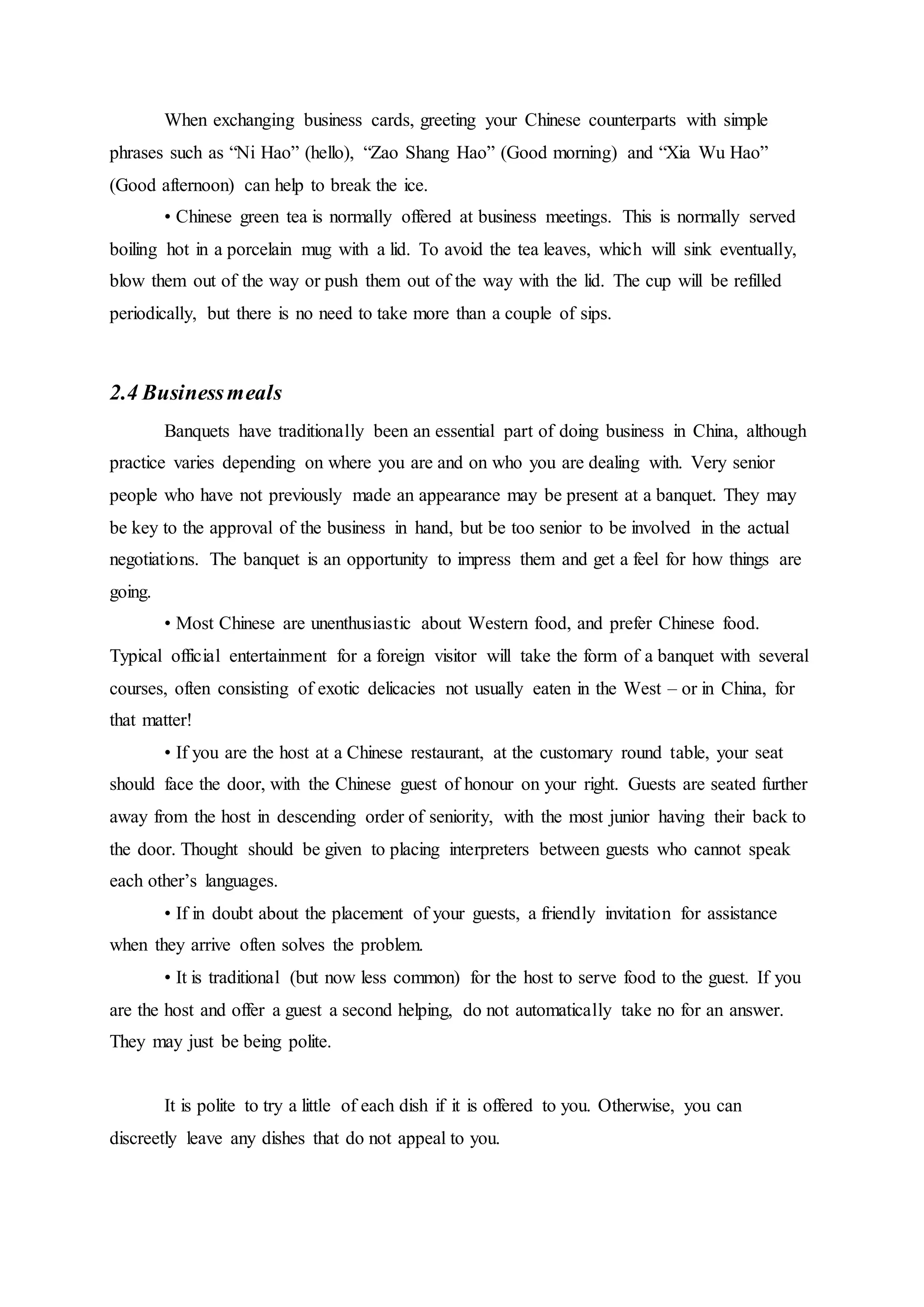
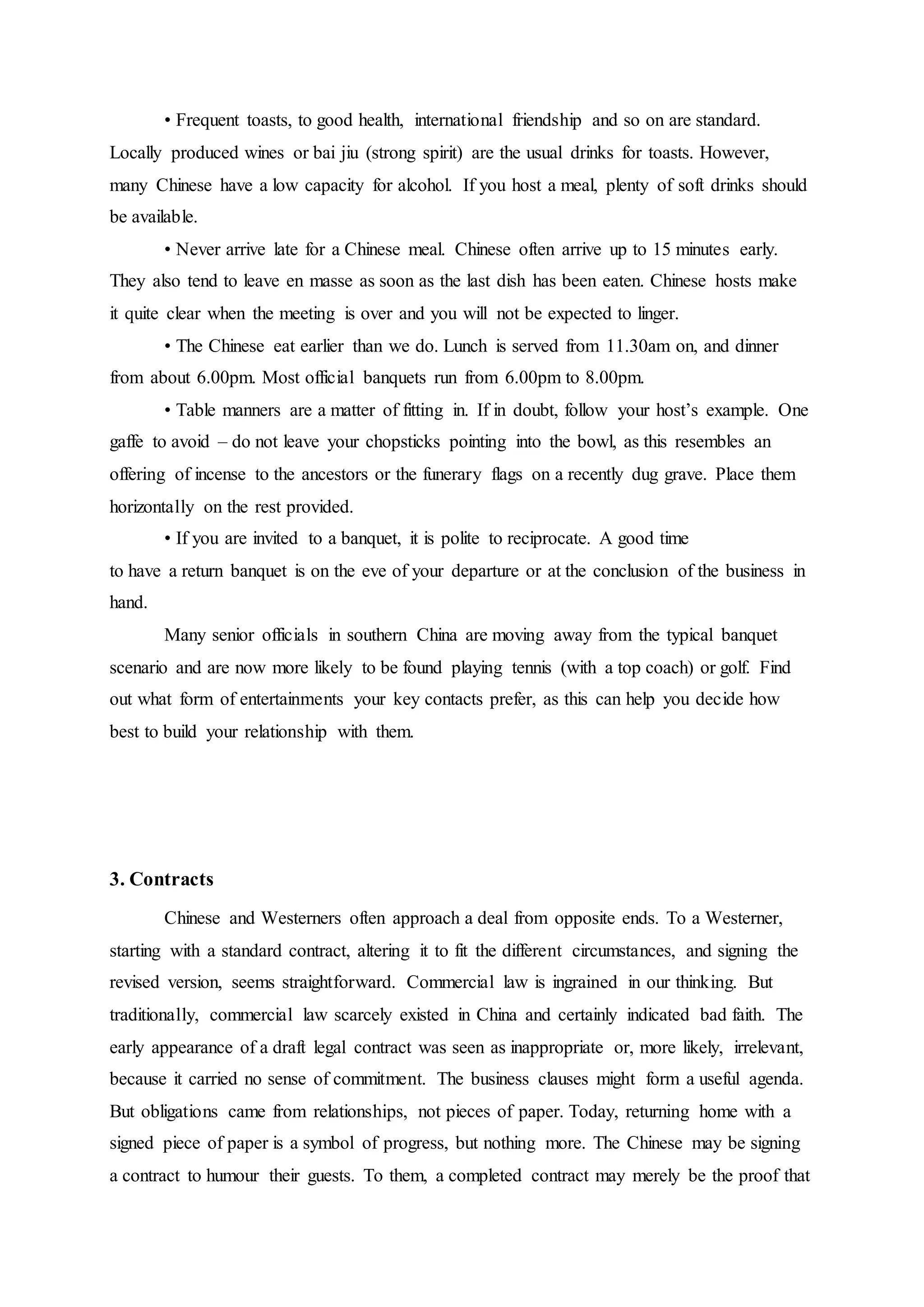
Chinese" who live in communities across the globe. The Uyghur people are a centralAsian ethnic
group with a population of 8.4 million in 2005. They are located mainly in the Xinjiang Uyghur
Autonomous Region of China and are one of China's largest ethnic minorities. There are also Uyghurs
in neighboring Kazakhstan,Kyrgyzstan, Mongolia and Uzbekistan. Many Uyghurs also live in
Turkey. The Uyghur (also spelled Uighur or Uigur) language is a Turkic language very similar to
Turkish. The term Uyghur means "united" or "allied" and is synonymous with the Turkish name
"Tokuz-Oguz", which means "nine tribes".
Ancient Tribes:
In ancient times, the region was populated by nomadic tribes. During the Han Dynasty (206
B.C. - 220 A.D.) the Chinese documented fighting with the Xiongnu tribe who originated
from current-day Mongolia. The two groups struggled for years over the region with the
Chinese finally winning in 60 B.C. Subsequent Chinese dynasties documented relations with
the Uyghurs. During a period of decline in the late Tang Dynasty, in the 700s, the Chinese
appealed to the Uyghurs for military aid which the Chinese paid for in trade and marriages
between Chinese nobility and Uyghur leaders. At this time, the Uyghur empire was at its
military height, but that empire would decline by the mid 800s.
Conversion to Islam:
Uyghurs began converting from Buddhism and shamanism to Islam in the 900s. There is still
a group of them who maintained their Buddhist beliefs, they are known as the "Yellow
Uyghurs" or Yugurs. During the Qing Dynasty, which was the last dynasty of China and was
led by the Manchus, Chinese forces invaded the region and named it Xinjiang in 1884.
After the birth of the Chinese Republic in 1911, the Uyghurs staged several uprisings against
the Chinese establishing an Eastern Turkestan Republic in 1933 and 1944. These republics
were then overthrown by the Soviet Union.
Under the People's Republic of China:
The region came under Chinese Communist control after the Chinese civil war. Tensions
between the two groups remained and several Uyghur uprisings have taken place. Most
recently, Uyghur protesters have used more violent forms of terrorism to make their views
known, including bus bombings. This has led China to respond with harsh crackdowns on the
population, calling such incidents acts of terrorism. China has said that hundreds of Uyghurs
have been trained by the Al-Qaeda terrorist network in Afghanistan. Uyghur groups have
criticized China for manufacturing a connection between the global war on terror and the
Uyghur fight for independence. Many also criticize China for religious repression and
Chinese economic policies that have led to an influx of Han Chinese to the region in the last
20 years.
B GOVERNMENTAND POLITICS
With a population of 1.3 billion people, direct elections of national leaders in China would likely be a
task of Herculean proportions. Chinese election procedures for its highest leaders are essentially based
on a series of representative elections that begin with a direct vote of the people for local and village
elections performed by local election committees. In cities, the local elections are broken down by
residential area or work units. Citizens 18 and older vote for village and local people’s congresses;
those congresses in turn elect the representatives to provincial people’s congresses. The provincial
congresses in China’s 23 provinces, five autonomous regions, four municipalities directly ruled by the
Central Government, special administrative regions of Hong Kong and Macao,and armed forces,then
elect the roughly 3,000 delegates to the National People’s Congress. The National People’s Congress
is empowered to elect China’s President, Premier, Vice President and Chair of the Central Military
Commission as well as the President of the Supreme People’s Court and the Procurator-Generalof the
Supreme People’s Procuratorate. The NPC also elects the NPC Standing Committee, a 175-member
body made up of NPC representatives which meets year-round to approve routine and administrative
issues. The NPC also has to power to remove any of the above-listed positions.
On the first day of the Legislative Session, the NPC also elects the NPC Presidium, made up
of 171 of its members. The Presidium determines the session’s agenda, voting procedures on
bills and a list of non-voting delegates that can attend the NPC session.
The 2009 NPC Presidium is made up of 171 members and headed by the Secretary General of
the NPC legislative session. Prior to the start of each annual legislative session, the full body
of the NPC elects the presidium and secretary general. The Presidium then sets the agenda for
the upcoming session as well as the voting procedures for each bill. Members of the
Presidium also take turns to chair the many plenary sessions of the NPC. The Presidium plays
a leading role in organizing the work of the NPC as it determines which bills will receive a
full vote of the NPC, and which will be sent to a committee for further review.
Makeup of the Presidium:
Candidates for the Presidium are first nominated by the NPC Standing Committee, and are
then considered by various delegations and NPC chairmen. The list is then amended before it
is submitted to the entire NPC for a vote. Typically the Presidium includes leaders from the
Communist Party of China and the state, leaders from the central committees of non-
Communist parties and citizens without party affiliations. Other Presidium members typically
include: leaders from the All-China Federation of Industry and Commerce, leaders from the
army and mass organizations, representatives from Hong Kong and Macao, representatives
from the armed forces, members of large ethnic minorities, heads of delegations,
representatives from all sectors of society, religious leaders, overseas Chinese, and model
workers.
Duties of the Presidium:
The Presidium selects deputy secretary-generals of the NPC, votes on meeting agendas and
procedural items for bills. It also sets the deadline for deputies to submit bills and proposals
and it approves a list of the non-voting delegates who can attend the NPC. Bills can be
brought to the NPC by the Presidium itself, the NPC Standing Committee, any special
committee of the NPC, China’s State Council or cabinet, it’s military, courts, NPC
delegations, or by an a petition of 30 or more NPC deputies. Other issues that the Presidium
decides is determining the procedure for NPC proposals relating to dismissals from office. It
also decides on election procedures. The Presidium is also tasked with nominating the
candidates for China’s top state offices, including President and Vice President of China.
A special meeting of the Presidium must also be held to decide if an NPC session can be held
in a closed meeting and on matters relating to the arrest and trial of a deputy while the NPC is
in session.
The 2009 NPC Presidium:
On March 4, 2009, the NPC elected Wang Zhaoguo to the position of Secretary General of
the NPC session. Wang has served as a Vice-Chairman to the NPC Standing Committee since
2003. Prior to that, he was the Governor of Fujian Province from 1987-1990. He is also the
Chairman of the All-China Federation of Trade Unions. The NPC also elected Gao Qiang,
former Party chief of the Ministry of Health, to the Presidium. Gao replaced Zhu Zhigang,
who was expelled in December 2008 after being accused of breaking the law and was under
investigation for helping his close relatives buy property at discounted prices. The Presidium
also determined that the NPC will hear and deliberate on government work report, reports
from the NPC Standing Committee, the Supreme People's Court, and the Supreme People's
Procuratorate. The NPC will also vote on a plan for national economic and social
development and the central budget for 2009. After the annual NPC meeting is over, the
Presidium is dissolved.
C Economy
Chinese currency
Literally translated as "the people's currency" the renminbi (RMB) has been the currency of
China for over 50 years. It is also known as the Chinese yuan (CNY) and by the symbol '¥'.
For many years, the renminbi was pegged to the U.S. dollar. In 2005, it was officially
unpegged and as of April 2009, had an exchange rate of 6.8 RMB to $1 U.S. dollar.
Renminbi's Beginnings:
The renminbi was first issued on December 1, 1948 by the Chinese Communist Party's
People's Bank of China. At that time, the CCP was deep into the civil war with the Chinese
Nationalist Party, which had its own curency, and the first issuance of the renminbi was used
to stabilize Communist held areas which assisted in a CCP victory. After the defeat of the
Nationalists in 1949, China's new government addressed the extreme inflation that plagued
the old regime by streamlining its financial system and centralizing foreign exchange
management.
Second Issue:
In 1955, the People's Bank of China, now China's central bank, issued it's second series of the
renminbi that replaced the first at a rate of one new RMB to 10,000 old RMB, which has
remained unchanged since. A third series of RMB was issued in 1962 which used multi-color
printing technology and used hand-engraved printing plates for the first time. In this period,
the RMB's exchange value was unrealistically set with many western currencies which
created a large underground market for foreign exchange transactions. With China's economic
reforms in the 1980s, the RMB was devalued and became more easily traded, creating a more
realistic exchange rate. In 1987, a fourth series of RMB was issued featuring a watermark,
magnetic ink and fluorescent ink. In 1999, a fifth series of RMB was issued, featuring Mao
Zedong on all notes.
Un-pegging the Renminbi:
From 1997 to 2005, the Chinese government pegged the RMB to the United States currency
at about 8.3 RMB per dollar, despite criticisms from the United States. On July 21, 2005, the
People's Bank of China announced that it would lift the peg to the dollar and phase in a
flexible mechanism of exchange rates. Following the announcement the RMB was
reevaluated to 8.1 RMB per dollar.
D CHINA RESPONSES TO GLOBAL CRISIS
The global financial crisis has Chinese leaders and citizens worried as the ripple effect from U.S.
markets has exacerbated already slumping Chinese markets. Worldwide demand for the Chinese
exports has already decreased,leading to a stall in domestic industrial production. Factory closures
and layoffs in southern China have also led to protests as the unemployment rate climbs. On
November 10, 2008, China announced a historic $586 billion stimulus package aimed at encouraging
growth and domestic consumption in ten areas of Chinese society ranging from infrastructure
investment to environmental protection and disaster rebuilding. The package would aid cement, iron
and steelproducers through its investment in infrastructure and encourage growth by removing loan
quotas on lenders and increasing credit for major projects that help rural areas and small businesses,
the government announced. Prior to this China had also instituted cuts in interest rates,set aside funds
for infrastructure construction, and instituted measures to boost real estate sales. It has also announced
greater rebates on taxes charged to exporters.
Effect of the Crisis on China
In many ways, China is currently less affected by the financial crisis than other countries, due
to its more closed financial system. This has led other nations to urge China to lend a greater
financial hand such as increasing its own imports.
But any slowdown in China's growth can have significant effects. Some economists, such as
Nouriel Roubini, have cautioned that China could face a recession if it's growth rate were to
slow to even as high as 6 percent. Roubini argues that China needs to maintain at least a 9
percent growth rate just to handle it's growing labor force and move farmers to the urban
sector. China may be in for a hard landing, Roubini writes. China's growth rate for the third
quarter of 2008 was 9 percent, the slowest rate that China has seen in five years. For months,
China has also seen consecutive drops in housing prices. Other industrial sectors such as
electricity production, textiles, non-ferrous materials and information technology have also
seen heavy losses.
Current Chinese Policy to Stem the Crisis
According to a statement on the Chinese government's Web Site, the latest financial stimulus
package covers ten areas including: housing, rural infrastructure, transportation, health and
education, environment, industry, disaster rebuilding, incomes, taxes, finance. The measures
will loosen credit restrictions, cut taxes and begin massive infrastructure spending. The
cabinet, known in China as the State Council, had gathered in an executive meeting in early
November, headed by Chinese Premier Wen Jiabao to address China's response to the global
financial crisis. After the two-year package was announced on Nov. 10, the cabinet issued the
following statement: "As long as we take the right measures in a resolute and timely way to
grasp the chance and rise to the challenges, we will surely secure steady and relative fast
economic growth." Some critics have said that the stimulus package is unclear, as some of the
funding plans had already been announced in the works. China has previously enacted a series
of new measures to boost the domestic real estate market by exempting taxes on properties
and land. In late October, China also cut interest rates - the second time it did so that month.
Leaders have also pushed for increased industrial restructuring and greater support to export-
oriented companies and farmers.
Lessons from the 1997 Asian Financial Crisis
China had a similar, though much smaller package passed during the 1997 Asian financial
Crisis, where it spent large sums to build up its domestic road system to keep the economy
growing. China was able to remain relatively unscathed from the 1997 crisis while many of its
neighbors fell into a recession. Because Chinese investments didn't center on securities, the
country was also relatively insulated. The crisis also forced China to look at fixing the many
of its financial weaknesses such as its many non-performing loans, it's antiquated banking
system, and its reliance on U.S. trade. During the crisis, China also chose not to devalue its
currency, allowing for an anchor of stability, which aided the recovery of its neighbors. The
Chinese currency had a fixed exchange rate that was tied to the U.S. dollar for many years. In
2005, the peg was lifted and the yuan was now subject to a managed floating exchange rate
based on supply and demand, within certain limits. Some nations have argued that it has not
been devalued enough.
III China travel information
China is forever linked to its ancient civilization, friendly people, and many of the world’s most
revered treasures,such as The Great Wall, Terra-Cotta Warriors & Horses and the Yangtze River.
Today, one can also find spectacular architecture and towering skylines in Shanghai and Beijing (site
of the 2008 Summer Olympics), a wealth of luxury accommodationsand as always exquisite cuisine.
Come and see why China is drawing millions of visitors from all over the world. And, why each and
everyone of them returns home smiling :)
A A GUIDE TO APPLY A VISA TO CHINA
In accordance with "the Law of the People's Republic of China on Entry and Exit of Aliens"
and other relevant regulations, the aliens who apply for the Chinese visa shall fulfill the
following procedures and provide the pertinent documents.
Basic Requirements
One completed application Visa Form (requires Adobe Acrobat).(please go to Adobe to
download the Acrobat Reader in order to view the visa form). One recently taken 2 inch half-
length, bareheaded, full-faced photo. A valid passport with enough blank pages.
Pertinent Documents
The pertinent documents required for applications for visas of different types are as follow
(except the applications on which the mutual agreement has been reached between China and
foreign countries)
Other Requirements
For the first visa application of the foreign-born children of Chinese descent, please provide
their birth certificates and one of their parents' foreign passport or foreign permanent
residence identity card (for example: the US green card) in addition to the relevant documents
required for by the above regulations. Applicants who were born in China, applying for the
Chinese visa for the first time must aslo provide their Chinese passports or their previous
foreign passports along with the above mentioned documents/materials.
Pick-Up Visa and Visa Fee
Normally visa may be picked up on the fourth working day since the date of the application.
Only with the consent of the consul could it sometimes be expedited by paying rush service
fee. The rush fees are: US$30 for the same-day pick-up (application must be submitted before
12 noon), US$20 for the next-day and the third-day pick-up. With your receipt, visa shall be
picked up in person or by someone entrusted.For visa fees, please check with the Chinese
Embassy or Chinese Consulate-General in the United States of AmericaPlease pay in cash or
Money Order (made payable to Consulate General of P.R. China). Personal check is
unacceptable.Attention: the governing guidelines on the issuance of visa are the pertinent laws
of the P.R.C., the international practices and bilateral agreements, etc. Upon receiving the
visa, it is the responsibility of the applicant to study and learn the information on visa, thus
making the travel plan accordingly. Should any adjustment be made to the visa information,
please report to the consul immediately. This Consulate General is not responsible for any
inconvience or loss arose from the negligence or the misunderstanding of the visa
information. By Mail Only For China Passport Renewal, Amendment, and Document
Authentication From May 1, 2003, we now only accept visa application by mail for China
passport renewal, amendment and document authentication. Applications must send to the
local Consulate Office.
If applicants applying the China Visa for the first time, please contact and visit the local
Consulate Office. The Chinese Embassy and Consulates do not take visa applications sent by mail.
Applicants are required to come to the visa office for visa application. If an applicant cannot come
personally, he/she may entrust a relative or friend or travel/visa agent to come to the visa
office for application process. In addition to the pertinent document and payment for visa
application, the applicant should also send one self-addressed and fully prepaid Express Mail
label and envelop for the return mail. An additional US$5 will be charged for the handling
(Please Send Money Order for all payments). Normally, postage of your returned envelope
should not be less than your first mail. Postage for authentication should be more than your
first mail. A Visa should be applied for one month before the applicant departs from USA in
order to avoid any delay or loss during the delivery. We do not offer rush service for
application by mail. The Passport and Visa Office of the Consulate General only accepts
Express Mail, Priority Mail, FedEx, UPS, DHL and Airborne as the returned post or delivery
service. Any other returned services, including Register Mail, will not be accepted.
Applications using other mail or delivery service than the above-stated service, and
applications with insufficient postage will be delayed or rejected. All the responsibilities
aroused should be taken by the applicants. Rush service is not available for mail application.
It will take about 20 days to hand your application. If you want to use your document in the
next 20 days, please come to our office to apply in person. You may also ask for help form
your relative or visa agents. Application for Visa / Entry Permit to Hong Kong / MACAO
SAR of China US citizens to visit Hong Kong SAR for short-time tour, business visit can
stay in Hong Kong for 90 days without applying visas. But the following US citizens to visit
Hong Kong are required to apply visas in advance: US citizens intend to stay in Hong Kong
longer than 90 days; US citizens intend to enter Hong Kong for employment, investment,
education, training or residence. Currently there are 36 countries from which citizens can
visit Macao free of visa; citizens from other countries can apply for the visa to enter Macao at
the airport when they arrive at Macao.In accordance with the relevant Law of the People's
Republic of China and the international practices, the consul is entitled to request other
documents from the applicant, and the consul is also entitled to reject the application.
B. TRAVEL INOFRMATION
Hotel Accomodation
A new generation of Chinese managed hotels is the cornerstone of a highly developed,
traveler-friendly tourism infrastructure. China now has a complete range of hotel choices in
all price categories, from luxurious five-star suites to deluxe mid-priced hotels and clean,
comfortable rooms even in the budget category. Today, every major city in China can provide
discriminating travelers with a wide selection of modern, world-class properties that meet,
and often exceed, international standards. Hotels such as the famous Peace Hotel (on the
Bund) in Shanghai, the Palace Hotel in Beijing (close to the Forbidden City), and the White
Swan in Guangzhou have gained international reputations for their exquisite decor,
international gourmet dining, and first-class service. Familiar chains such as Sheraton,
Holiday Inn, Hyatt, Hilton, and Ramada now operate deluxe hotels throughout China as well.
Business travelers note that China has come a long way even since the early 1990's in terms
of 16 service, management, and facilities. All 4 & 5-star hotels have complete business
centers with computer and secretarial services available.
Transportation
During the last few years, China has modernized its domestic air, train, and highway systems
to meet the influx and demands of foreign travelers. There has been a vast improvement in
ease of travel throughout the country. Virtually all of China is linked by one of the new
domestic airlines since the de-regulation of the national carrier system, and the creation of
these new regional carriers has greatly improved domestic airline service. Modernization of
the airlines and airport facilities is a boon for travelers, creating a more efficient and
competitive airline system. New Boeing, McDonnell Douglas, and Airbus aircraft are used on
almost all routes within the country.
Passengers flying from the US to China via Air China, China Eastern Airlines, and China
Southern (or other international carriers) may book flights within China as part of their trans-
Pacific ticket. If you need to make domestic flight reservations during your trip, they can be
easily arranged through the hotel travel desk or at one of the many new travel agency services
that have opened in China (a passport is required to make reservations). Some routes are
heavily trafficked, so it is wise to book as far in advance as possible. All flights are
nonsmoking.
Travel by rail is an enjoyable, relaxing, and inexpensive way to see China's countryside. New
or modernized equipment has replaced the old train systems in most areas. Travelers who lack
the time to cover vast distances by train can still get a delightful taste of rail travel by
journeying on popular short distance routes from Shanghai to the nearby cities of Suzhou,
Wuxi, Nanjing, or Hangzhou; or from Beijing to Tianjin. Amenities have been added to first-
class train travel (known as "soft seat"), including comfortable waiting lounges at some train
stations. Tardy travelers should note that the trains are consistently punctual.
New freeway systems have been built (and many more are under construction), making it easy
to travel around and explore the metropolitan areas of Beijing, Shanghai, Guangzhou, and
Hong Kong quickly and inexpensively. Traffic is quite light on some highways. Metered taxis
are readily available at all hotels and shopping districts, and are permitted to stop at your
signal. Travelers may find it convenient to hire a taxi for a whole or half day, but be sure to
agree on a price first. Some taxi drivers speak English, but most don't. Always take along
written directions and a map to point to the location of your destination). Beijing and
Shanghai have modern subways for fast travel around the cities. If you're in a hurry, this is the
way to go. Signs and schedules are in English, and transfers between lines are free. If you
prefer a slower pace, bicycles are available to rent everywhere in China. Bicycling is an
excellent way to see the countryside and get the maximum smiles per mile.
Cuisine
No other people take their food as seriously as Chinese. Authentic Chinese food is delectable in flavor
and astounding in its sheer variety. With 56 ethnic minority groups contributing recipes cultivated
over centuries from the farthest corners of the country, China is justifiably famous for its claim as
home to the most popular cuisine in the world.
You would be remiss if you didn't sample as many of China's regional cuisine as possible during the
trip. For a real change of pace,stop by one of the food stalls at the local "night market", and join
neighborhood residents in sampling delicious fresh local foods; it will be an evening to remember, and
the prices are great too. You are always welcome to join diners at local restaurants and teahouses in
any city or town.
(Note: hygiene is quite good in China, even at food vendor stalls on the street. The possibility of an
upset stomach is the exception, not the rule.)
Those who prefer a meal more familiar to their tastes may be surprised to discover the quality and
variety of international dishes available in China today. American, Italian, Japanese,Thai, Indian,
Korean, German, and French restaurants can be found at many 4 & 5-star hotels, and in shopping areas
around Beijing, Shanghai, Guangzhou, and Hong Kong. Travelers with special dietary requests can
make advance arrangements with most 4 & 5-star (or international chain operated) hotels for
vegetarian or special dishes.
Entertainment and Nightlife
The wide variety of nighttime cultural activities available throughout China can be a source of
frustration to travelers, since there are so many exciting performances to see and not enough
time.One of the highlights of any trip to China is a night at the Chinese Classical Opera, a
feast for the senses with its magnificent costumes and intriguing plots (even if you don't
understand what's happening). Performances by the astonishing Chinese acrobats and
delightful per forming pandas, dogs, and cats are also "must see" events. Other cultural
favorites include colorful folk dancing, classical Chinese dance, and "wushu," the traditional
form of martial arts.In larger tourist towns, you'll also find modern dance, jazz, classical and
rock music. If you like movies, you're in luck, so do the Chinese. Most towns host dozens of
cinemas, and seeing a Chinese film is fun even if you don't understand the language. And of
course there's karaoke, and discos, the most popular evening entertainment in China. Drop in
for a "pijiu" (beer), muster up your courage, and try signing a song (in English). You're sure
to make some new Chinese friends. Just outside of some tourist cities are large folklore and
cultural centers where you have an opportunity to observe and participate in traditional ethnic
minority folk dancing, and craft making activities. There are usually half day or evening
activities that are often included in tour itineraries.
Shopping
You will have fun shopping in China today. There is an incredible choice of boutique shops,
department stores, and hotel shopping arcades to browse through. Or you can try bargain
hunting at one of the new "free markets" that are springing up all over the country. You're
sure to be dazzled by the unique array of aesthetic and practical gifts available in China. You
will find everything from high quality silks and porcelains to antique screens and traditional
Chinese herbal medicines. Throughout China shops offer unique ceramics, paintings, stone
rubbings, embroideries, carpets, furniture, jade carvings, custom-carved signature chops,
antiques, books, and much more. Shop personnel will often pack and arrange for shipping
bulky purchases back home. Prices are usually clearly marked in stores and shops, and
English is spoken in most tourist areas. Don't miss browsing through one of the state run
Friendship Stores; they are still some of the best places to find an excellent selection of
quality merchandise, plus you'll find a complete supermarket of Chinese delicacies to bring to
friends back home
IV Chinese basic customs
Chinese Society & Culture
The Importance of "Face"
. The concept of 'face' roughly translates as 'honour', 'good reputation' or 'respect'.
. There are four types of 'face':
1) Diu-mian-zi: this is when one's actions or deeds have been exposed to people.
2) Gei-mian-zi: involves the giving of face to others through showing respect.
3) Liu-mian-zi: this is developed by avoiding mistakes and showing wisdom in action.
4) Jiang-mian-zi: this is when face is increased through others, i.e. someone complementing
you to an associate.
. It is critical you avoid losing face or causing the loss of face at all times.
Confucianism
Confucianism is a system of behaviours and ethics that stress the obligations of people
towards one another based upon their relationship. The basic tenets are based upon five
different relationships:
Ruler and subject
Husband and wife
Parents and children
.Brothers and sisters
.Friend and friend
Confucianism stresses duty, sincerity, loyalty, honour, filial piety, respect for age and
seniority. Through maintaing harmonious relations as individuals, society itself becomes
stable.
Collectivism vs. Individualism
In general, the Chinese are a collective society with a need for group affiliation, whether to
their family, school, work group, or country.
In order to maintain a sense of harmony, they will act with decorum at all times and will not
do anything to cause someone else public embarrassment.
They are willing to subjugate their own feelings for the good of the group. This is often
observed by the use of silence in very structured meetings. If someone disagrees with what
another person says, rather than disagree publicly, the person will remain quiet. This gives
face to the other person, while speaking up would make both parties lose face.
Non-Verbal Communication
The Chinese' Non-verbal communication speaks volumes.
Since the Chinese strive for harmony and are group dependent, they rely on facial expression,
tone of voice and posture to tell them what someone feels.
Frowning while someone is speaking is interpreted as a sign of disagreement. Therefore, most
Chinese maintain an impassive expression when speaking. It is considered disrespectful to
stare into another person's eyes. In crowded situations the Chinese avoid eye contact to give
themselves privacy.
Meeting Etiquette
Greetings are formal and the oldest person is always greeted first.
Handshakes are the most common form of greeting with foreigners.
Many Chinese will look towards the ground when greeting someone.
Address the person by an honorific title and their surname. If they want to move to a first-
name basis, they will advise you which name to use.
The Chinese have a terrific sense of humour. They can laugh at themselves most readily if
they have a comfortable relationship with the other person. Be ready to laugh at yourself
given the proper circumstances.
Gift Giving Etiquette
In general, gifts are given at Chinese New Year, weddings, births and more recently (because
of marketing), birthdays.
The Chinese like food and a nice food basket will make a great gift.
Do not give scissors, knives or other cutting utensils as they indicate the severing of the
relationship.
Do not give clocks, handkerchiefs or straw sandals as they are associated with funerals and
death.
Do not give flowers, as many Chinese associate these with funerals.
Do not wrap gifts in white, blue or black paper.
Four is an unlucky number so do not give four of anything. Eight is the luckiest number, so
giving eight of something brings luck to the recipient.
Always present gifts with two hands.
Gifts are not opened when received.
Gifts may be refused three times before they are accepted.
Dining Etiquette
The Chinese prefer to entertain in public places rather than in their homes, especially when
entertaining foreigners.
If you are invited to their house, consider it a great honour. If you must turn down such an
honour, it is considered polite to explain the conflict in your schedule so that your actions are
not taken as a slight.
Arrive on time.
Remove your shoes before entering the house.
Bring a small gift to the hostess.
Eat well to demonstrate that you are enjoying the food!
Table manners:
Learn to use chopsticks.
Wait to be told where to sit. The guest of honour will be given a seat facing the door.
The host begins eating first.
You should try everything that is offered to you.
Never eat the last piece from the serving tray.
Be observant to other peoples' needs.
Chopsticks should be returned to the chopstick rest after every few bites and when you drink
or stop to speak.
The host offers the first toast.
Do not put bones in your bowl. Place them on the table or in a special bowl for that purpose.
Hold the rice bowl close to your mouth while eating.
Do not be offended if a Chinese person makes slurping or belching sounds; it merely indicates
that they are enjoying their food.
There are no strict rules about finishing all the food in your bowl.
Tipping Etiquette: Tipping is becoming more commonplace, especially with younger
workers although older workers still consider it an insult. Leaving a few coins is usually
sufficient.
CHINESE CUSTOMS
Westerners have a hard time figuring out all the customs and formalities in China, especially
because they are so different from the customs and formalities in other Asian countries. It is a
mistake, for example, to assume that Chinese customs are like Japanese ones. The two
countries are very different and Chinese will be quite insulted if you assume their culture is
like Japanese culture.
When in doubt about unfamiliar customs simply watch what the Chinese people do. And don't
worry too much. Westerners aren't expected to know all Chinese customs and if mistakes are
made or a custom is forgotten it usually no big deal.
Primary Source: The Traveler's Guide to Asian Customs & Manners by Elizabeth Devine and
Nancy L. Braganti. Also check Chinese Business Etiquette, Manners and Culture in the People’s
Republic of China by Scott Seligman (Warner Books, 1999). International etiquette expert:
Mary Kay Metcalf of Creative Marketing Alliance in New Jersey.
Greetings in China
Greeting gesture In China it is rude to call someone by their first name unless you've known
them since childhood. In work-related situations people address each other by their title; in
social situations "Mr.," Mrs.," and "Miss" are used; at home people often refer to each other
by nicknames or terms of kinship. Remember, in China, the family name is first. Terms of
kinship are often used for close non-relatives. A younger man often calls a man who is five
years older than him "big brother" and someone who is considerably older "uncle." Chinese
often address their friends as juniors and seniors even if they are just a few months younger or
older. When a Chinese person asks someone their age they often do this so they know how to
address the person. Chinese sometimes don't smile or exchange greeting with strangers.
Smiling or being friendly to someone you don't know well is sometimes considered rude and
too familiar. When saying goodby it is considered appropriate to give a quick bow or nod to
everyone present and go. Beijingers often say goodbye to one another by saying Ju-i, which is
translated both as "Take it slow" and "as one desires." The Chinese are not big on drawn out
goodbyes. After finishing a meal, they often get up, thank each other, say goodbye and leave
abruptly. When the Chinese say farewell after a visit or journey together, they simply go;
there is "no lingering, no swapping of addresses, no reminiscences, nothing sentimental."
Bowing, Touching, Clapping and Shaking Hands in China
Thank you gesture Unlike Japanese, Chinese do not necessarily bow to one another as a
greeting, a parting gesture or an alternative to waving or saying "Hi." But they sometimes do.
Bowing is generally reserved as a sign of respect for elders and ancestors, especially on on
special holidays. When Chinese bow they make a fist with their right hand and hold it in the
palm of the left at stomach level and bow slightly to deeply depending on how much respect
they want to convey. In imperial times, visitors to the emperor were expected to drop to the
floor and knock their foreheads on the floor nine times to show respect. Such kowtowing
gestures are still displayed when Chinese worship at temples. Kowtowing is a powerful
gesture reserved mainly for honoring the dead or offering deep respect at a temple. In the
Cultural Revolution as a tool of humiliation against those who committed political crimes.”
The Chinese have traditionally not been big hand shakers but the custom is now widely
practiced among men, especially when greeting Westerners and other foreigners. Sometimes
Chinese shake for too long for Western tastes and have a limp rather than firm grip. A limp
handshake is regarded as a gesture of humility and respect. When a Western man meets a
Chinese person, especially a woman, he should wait for the other person to offers his or her
hand first, before offering to shake hands. With Chinese, avoid, hugs, backslapping or
touching other than a handshake. Sometimes when entering a school, a meeting or a banquet,
Chinese clap as a greeting. It is customary to clap in return. A soft clap, with you hands
horizontal to the floor is best. Introductions are usually made with a third party. It is
considered unusual for a person to walk up to a stranger and introduce himself.
Respect for Older People in China
Many codes of behavior revolve around young people showing respect to older people.
Younger people are expected to defer to older people, let them speak first, sit down after them
and not contradict them. Sometime when an older person enters a room, everyone stands.
People are often introduced from oldest to youngest. Sometimes people go out their way to
open doors for older people and not cross their legs in front of them. When offering a book or
paper to someone older than you, you should show respect by using two hands to present the
object. On a crowded subway or bus, you should give up your seat to an elderly person.
Sometimes a comment based on age meant to be complimentary can turn out to be an insult.
The New York Times described a businessmen who was meeting with some high-ranking
government officials and told one them he was “probably too young to remember.” The
comment was intended to be a compliment:—that the official looked young for his age—but
it was taken as insult—that the officials was not old enough to be treated with respect.
Chinese and Foreigners
Chinese often stare at foreigners. Sometimes childrencall out various things at them, particularly "Hello,"shoutedin anannoying way,and
laowai, the most polite word for "foreigner." Chinese sometimes look over the shoulders of foreigntourist to see what they are reading.
Sometimes they will even yank a book or a newspaper out of thetourist’s hand toget a closer look. One Chinese tourist guide gave Chinese
tourists the following advise whenmeetingforeigners:"Do not follow, encircle or stare at them when you meet.Refrainfrom pointingat
their clothing in front of their faces or making frivolous remarks...if foreign guests takethe initiative to make contact be courteous and
poised. Do not beflusteredandinsult them by walkingoff immediately."The same guide advised:"Refrain from askingforeignguests about
age, salary, income,clothingcosts and similar privatematters...Donot accept gifts at will from foreignguests. When partingyoushouldpeel
off your gloves andthenproffer you hand.If youare partingfrom a femaleforeignguest and she does not proffer her handfirst, it is also
adequate to nod youheadas a farewell greeting."
Gestures in China
Chinese don’t gesture very much and regard a lot of hand movement as excessive. Winking
and whistling are considered rude. Eye contact tends to be indirect.
Both the thumbs up sign and tugging on the earlobe are signs of excellence. An outward
pointing and raised pinky means you are nothing, poor quality or not very good at something.
Some Chinese point with their middle finger without realizing that it has a vulgar meaning in
the West. Conversely, a thumb placed between the middle and index fingers (the "nose
stealing" gesture) is on obscene gesture in some parts of China.
Don't point or use your finger to beckon someone (this gesture is used for dogs). To get
someone's attention and tell them to “come here” place your palm down and move your
fingers towards you. This gesture is used with children, taxis or waiters but is considered very
rude when directed at an older person. The most polite way to attract someone's attention is to
make eye contact and bow slightly. Holding your fist up is an obscene gesture in Hong Kong
and some parts of southern China. Also in southern China, people say thank you by tapping
two fingers on the table. Many people in the north, however, are not familiar with this gesture.
Displays of Affection in China
Public displays of affection between members of the opposite sex—such as kissing, hugging
and holding hands—are considered rude, while holding hands and hugging among members
of the same sex are perfectly acceptable. Many university students and young people in their
twenties have never kissed a member of the opposite sex and never even seen their parents
kiss. Kissing is regarded as just one step shy of sex. French kissing is seen as some kind of
exotic, forbidden experience. In secondary schools there are rules that state that students can
not "touch, embrace or kiss."Because there is little privacy at home and young lovers often
can't afford a hotel, couples that do display their affection go to smooch behind trees at public
parks, or inside bomb shelters built during the Cultural Revolution "for the coming war."
After the discos close young lovers go to special bars and restaurants were they can make out.
In some places it is not unusual to see couples kissing and embracing in public places around
breakfast time. "The Chinese." wrote Theroux, "were so desperate in their courtships that they
went on tourists outing in order to hide and canoodle. Every holy mountain and famous
pagoda had more than its share of motionless couples hugging and (sometimes)
smooching...the Chinese do it standing up, usually behind a rock or a building, and they hug
each other very tightly."
Social Customs in China
gesture for agreement Chinese consider it rude to look someone directly in the eye, cross your
arms or legs, or have your hands in your pocket when you are speaking to someone. Chinese
usually focus their eyes on the lower neck of the person they are talking to, stand very close to
them, and try to avoid staring. Chinese also don't like it when Westerners point at people;
wear strong colognes or perfumes; put their feet or sit on desks; don't use titles or show proper
respect to elders and superiors; boast and offer their opinions to readily; want immediate
answers; and show a lack of patience. Chinese are very punctual. They are expected to arrive
exactly on time for a party or a dinner engagement. Westerners are sometimes get caught
unprepared with Chinese guests at their door or are chided for being late. It is also considered
rude not to be patient and wait even when someone is really late. Showing up on time is
regarded as an expression of respect to other people. In the rural areas these rules are less
rigid as people are less tied to the clock and often more closely tied to immediate matters
around them. Chinese generally don’t make compliments. When Westerners do the response
is either denial, self deprecation or saying the opposite of the compliment is true. If you say a
young girl is cute it is not unusual for Chinese to say she is ugly. If you say a meal is good,
they will say something didn’t turn out right.
Talking and Conversation in China
When meeting a foreigner Chinese usually ask the same questions and make the same
comments: "Where are you from?" Where did you learn to use chopsticks?" What is favorite
place in China?" It is not unusual for foreigners to get assaulted by 40 or 50 people all asking
questions in English at once.
People often ask foreigners a lot of personal questions, especially about their families and
marriage. If you are over 30 and single and are asked if your married it is best to lie and say
yes, otherwise people will feel sorry for you. Not having a wife and children is considered
unfortunate and even bad luck. Sometimes Chinese can be uncomfortably frank. It is not
unusual for Chinese to make a comment on the beauty of large Western noses.
Westerners are advised to avoid conversations about politics and sex and refrain from making
any comments that could be construed as a negative comment about China. Mainland China
should be referred to as the "People's Republic of China." Don't confuse it with Taiwan or
imply that Taiwan is not part of China. The Tibet issue is also quite sensitive. Don't make
comments about Chinese customs: innocent observations can often be taken in a negative
way. At teh same time expect uniformed comments about your home country and culture.
Good, safe topics include food and family. For Chinese it is said, the purpose of conservation
is to create a harmonious atmosphere.
Confusion Over Yes and No
As is true with many Asian people, the Chinese will do anything they can to save face and
make foreign visitors happy even if it means misleading them. Instead of telling you the
unpleasant truth they would rather tell you what you want to hear. In the mid-1990s, a bank in
Jinan informed their tellers to stop using "I don't know" and 90 other "uncivilized sentences."
Chinese consider it rude to say "no" directly. They often say something like "maybe," "I am
busy," or even "yes" when they really mean "no," or convey a no answer in way that
foreigners don't understand. This behavior sometimes causes confusion with Westerners who
like a yes-or-no answer, and who tend to believe there is a possibility of a "yes" unless they
are told "no" straight out. Chinese consider it rude, kind of mean and too direct to say "no." A
typical confused situation goes something like this. A Westerner takes his car to a Chinese
mechanic to have it fixed. He asks will it be ready tomorrow. The mechanic says "yes"
because he doesn't want to be rude and say no. The Westerners shows up the next and is angry
because his car isn't ready. The mechanic doesn't understand why he is angry: the day before
he was only trying to be polite and telling the Westerner what he wanted to hear. The
Westerner should have asked, "When will my car be ready?"
Gift Giving in China
Chinese are not as big on gift-giving as Japanese and Koreans. Gifts exchanged in business
and social situations include fruit, pens, handkerchiefs, chocolates, whiskey, wine, Scotch, or
pictures from your home country or city. Don’s give anything that is green. Green ss a symbol
of cuckoldry. Avoid white. It is associated with death and funerals. Don’t give a clock. In
Chinese, to “give a clock” sound like “seeing someone off to his end.” Don’t give a book
because “giving a book" sound like “delivering defeat.” Don’t give an umbrella because doing
so implies homonymously that the family of the gift receiver is going to be dispersed. The
recipient of a gift should make sure to shower the gift giver with thanks, smiles and
compliments. When receiving a gift don't open it immediately unless requested to do so. In
China, gifts are meant to be opened in private. Don't give to much attention to an object when
visiting someone' house. The host may feel obligated to give it to you. In business and
politics, there is a fuzzy line between gift giving and corruption. The issue becomes even
more complicated when factoring in the fact that refusing a gift is considered very rude.
Singing, Dancing and Partying Customs in China
Chinese love to sing. They sing in karaokes and singing rooms, bring portable karaokes to
parks and beaches, ask guests to "sing-a-song" at parties, and watch entertainers and actors
sing karaoke songs on television. Guests at parties and on bus trips are often asked to sing a
song. Chinese generally are shyer about dancing than singing, whereas the reverse is true
about many Westerners. Chinese children generally have few opportunities to dance when
they grow up and feel awkward doing it, but they do a lot of singing in school and tend to
regard it as a fun activity like recess or sports. Among Chinese adults karaoke is very popular.
In parks, people often sit in groups of twenty or thirty and sing songs or put on plays or
operas. Chinese singers with good voices of course are admired more than those with bad
voices but even bad singers are applauded for their effort. Discos are becoming increasingly
popular in China. Men and women usually don't dance as couples. Friends usually dance in a
group. Women often dance together and men sometimes dance with each other. Often you are
more likely to see people of the same sex dancing together than people of the opposite sex.
Sometimes men even slow dance together.
Chinese like to party in one big group rather than breaking up into small groups and
circulating like Westerners do at a cocktail party. When Chinese do divide into groups they
tend to divide into separate groups of men and women. Taking turns singing is a popular
activity, with one person playing the role of "emcee" and calling on the others to participate
one by one. If you attend a party like this it is a good idea to have a song ready in the case you
are called upon to sing.
Women Customs in China
Many Chinese women cover their mouth when the laugh. Traditionally, a woman that laughed
too loud or openly was considered uncouth and ill bred. Many Chinese men look upon women
smokers with disgust and consider smoking a very unladylike thing to do. Over the past
couple decades smoking and drinking have increased dramatically among women.
Home Customs in China
Unlike Japanese and Koreans, Chinese usually keep their shoes on when entering a house.
More and more, though, Chinese are leaving their shoes at the door Japanese style.
Unlike Japanese and Koreans, who spend a lot of time sitting on the floor, Chinese prefer
chairs. Chairs were reportedly introduced the Mongols around 700 years ago. The first
Chinese to sit in chair were noblemen who wanted to be higher than the people around them
to show their superior position over the people they ruled. The preference for chairs goes hand
in hand with wearing shoes in the house. Japanese and Koreans don't want to sit on a floor
dirtied by people's shoes but if you sit in a chair it doesn't make as much difference if the floor
has a little dirt on it.
Most Chinese are happy to have tourists visit their home although they often embarrassed by
their basic living conditions. Their best food and liquor are usually reserved for guests. House
guests are expect to bring a present. A bottle of imported whiskey or wine is usually a safe
gift.
Part 2 – Business in China
Section 1 - General business behaviour
1. Introduction
Why China? China is the great economic success story of the past 25 years. In 1978,
when economic reforms began, China was primarily an agrarian economy with virtually no
private sector to speak of. Today, China makes 25 per cent of the world’s washing machines,
50 per cent of the world’s cameras and 90 per cent of the world’s toys. Since reforms began,
China has lifted two-thirds of its people out of poverty and in the last decade it has built
enough roads to loop around the equator 16 times!
Not so long ago, doing business with China was seen as the preserve of large
international companies or specialist operators. However, the past five years have seen an
increasing number of UK companies of all sizes and in virtually every sector successfully
exporting to, and investing in, China. But manufacturing is no longer the only game in town.
Chinese companies are moving up the value chain in sectors such as computer gaming and
software outsourcing, with some of the top companies growing from zero to international
listings in under five years. This trend is leading to increased opportunities for UK services in
areas such as listings on the London Stock Exchange’s Alternative Investments Market (AIM)
and industrial design. And in a sign that the principal cities on the East Coast are maturing,
multinationals are now investing in their first China R&D centres, principally in Beijing and
Shanghai.
These trends don’t mean that the risks of doing business in China have changed –
strategies for Intellectual Property Rights (IPR) protection and due diligence are still the
building blocks for success.
Assuming that you can simply walk in and start sifting out business opportunities in
China is a potential recipe for disaster. Advance research and planning is vital before you
even think about booking an airline ticket. Understanding the target market, having a focused
business plan and keeping very current with the rapid market movements, economic
developments and regulatory changes being experienced in this country are vital tools of the
China trade. Anyone looking at China is advised to budget between $30,000 and $50,000 to
carry out the due diligence before entering the country.
What is the right approach to China?
The following points illustrate the type of approach that companies doing business
successfully in China often take.
• Leave your preconceptions at home.
• It’s all too easy to be dazzled or overawed by China, but keep hold of your business
sense as tightly as you would anywhere else.
• Do your homework on the market and on potential partners.
• Patience is a virtue. Some things may take longer to set up than you think (especially
if they involve bureaucracy), so allow for this in your preparations.
• Take a long-term approach, but don’t stick rigidly to your plans. Things often change
rapidly and unexpectedly in China.
• Obtaining good quality independent legal and professional advice is essential.
• If your product is in danger of being copied or counterfeited, seek specialist legal
advice on how best to protect your intellectual property rights (IPR).
• Don’t forget to carry out due diligence.
One point that is essential before going any further: always seek good quality
independent legal and professional advice before starting or signing anything that could have
legal implications for your company, such as a contract. Specialist legal advice on IPR
protection is also available. Good quality legal and professional advice can be expensive, but
is money well spent. It is far better to ensure that your interests in China are fully protected
than to have to leave yourself vulnerable to untoward consequences – which can be even more
expensive to sort out!
2. Etiquette
As with any culture, understanding specific etiquette requirements is important. For
instance, a lot of business is conducted over the banquet table in China, so make it part of
your forward research to understand the protocols that are required for this common practice.
It is common for this dining process to be mistaken for the formation of a trusting
business relationship. While it is often part of the process, any negotiations are unlikely to
take place in this setting. Punctuality for any business meetings is vital
In general, the Chinese set great store by building good personal relationships before
entering into a business partnership. Getting to know someone face-to-face was, until
recently, the only way of finding out whether they were trustworthy and whether you wanted
to work with them. You can expect your first, and possibly your second, visit to China to
achieve nothing other than getting to know several possible candidates for business
partnerships. This may seem a slow and costly way of getting started, but it is worth
remembering that taking time to cultivate personal connections as the Chinese do is an
excellent opportunity to get to know the people you will be working with. You will
undoubtedly encounter delays and frustrations when doing business in China. Keeping your
temper (equated in Chinese terms with maintaining “face”), even when things go wrong, can
pay disproportionate dividends. If you are not sure what to do in any given situation, it is best
to err on the side of patience and politeness..
2.1 Meeting & Greeting
Doing business always involves meeting and greeting people. In China, meetings start
with the shaking of hands and a slight nod of the head. Be sure not to be overly vigorous
when shaking hands as the Chinese will interpret this as aggressive. The Chinese are not keen
on physical contact - especially when doing business. The only circumstance in which it may
take place is when a host is guiding a guest. Even then contact will only be made by holding a
cuff or sleeve. Be sure not to slap, pat or put your arm around someone's shoulders. Body
language and movement are both areas you should be conscious of when doing business in
China. You should always be calm, collected and controlled. Body posture should always be
formal and attentive as this shows you have self-control and are worthy of respect.
2.2 MakingConversation
Most people should be addressed by a title and their last name. You can address
people by professional titles such as General Committee Member or Bureau Chief or,
alternatively, if a person does not have a professional title, use Mr, Madame or Miss, plus the
last name.
• Stick to safe subjects such as hobbies, your hometown, the Chinese landscape and
Chinese culture. The Chinese often ask apparently intrusive questions about your age, income
or marital status. These questions are not meant to offend, but if you don’t want to answer,
remain polite and give an unspecific answer.
• Avoid talking politics unless you know the person very well. Chinese people are
more nervous having political discussions when other Chinese are around. In any case, do not
criticise China or Chinese leaders. Do not refer to Hong Kong as if it was still run by another
administration or Taiwan or Tibet as a separate entity.
• It is fine to tell jokes in informal situations, but they are best avoided when speaking
to a group. Sexual jokes are taboo. Also, be aware that cross-cultural jokes are hard to find,
and often the point of a joke will be lost in translation.
• The Chinese do not like to say no. Doing so causes embarrassment and loss of face.
If a request cannot be met, you might be told that it is inconvenient or under consideration.
Alternatively, you might be told “yes, but it will be difficult”. This might seem like a positive
response, but in reality means “no”or “probably not”.
2.3 Meetings
• When arranging a meeting, it is advisable to provide the Chinese company with
details of the objectives of the meeting, names and ranks of participants and specific areas of
interest in advance. Otherwise, it is likely that the Chinese side will issue a long and general
report which is unlikely to provide you with the information you require.
• Business meetings start on time and it is good practice to arrive at the location early.
Formal introductions are standard and it is usual to be introduced to the most senior person
first, followed by the rest of the group in descending order of seniority.
• There may be people from several organisations present at the business meeting. If it
is not immediately apparent who is the most senior person in the room, it is a good idea to try
to discover this by asking about the relative roles of those present in the organisation and then
to address remarks to that person. Another pointer is that the person opposite you at the
meeting table will normally be the most senior Chinese person present.
• Business cards are essential. At the beginning of meetings where those present have
not met before, it is customary to exchange business cards when being introduced. It’s
advisable to take a good supply.
• It is a sign of courtesy to have your card translated into Chinese. Many Chinese do
not read English. Present your card with both hands with the Chinese side face up. Spend a
few seconds examining the cards you receive. This shows respect for the card’s owner.
However, whatever you do, don’t write on the card, as this shows disrespect to the owner.
When exchanging business cards, greeting your Chinese counterparts with simple
phrases such as “Ni Hao” (hello), “Zao Shang Hao” (Good morning) and “Xia Wu Hao”
(Good afternoon) can help to break the ice.
• Chinese green tea is normally offered at business meetings. This is normally served
boiling hot in a porcelain mug with a lid. To avoid the tea leaves, which will sink eventually,
blow them out of the way or push them out of the way with the lid. The cup will be refilled
periodically, but there is no need to take more than a couple of sips.
2.4 Businessmeals
Banquets have traditionally been an essential part of doing business in China, although
practice varies depending on where you are and on who you are dealing with. Very senior
people who have not previously made an appearance may be present at a banquet. They may
be key to the approval of the business in hand, but be too senior to be involved in the actual
negotiations. The banquet is an opportunity to impress them and get a feel for how things are
going.
• Most Chinese are unenthusiastic about Western food, and prefer Chinese food.
Typical official entertainment for a foreign visitor will take the form of a banquet with several
courses, often consisting of exotic delicacies not usually eaten in the West – or in China, for
that matter!
• If you are the host at a Chinese restaurant, at the customary round table, your seat
should face the door, with the Chinese guest of honour on your right. Guests are seated further
away from the host in descending order of seniority, with the most junior having their back to
the door. Thought should be given to placing interpreters between guests who cannot speak
each other’s languages.
• If in doubt about the placement of your guests, a friendly invitation for assistance
when they arrive often solves the problem.
• It is traditional (but now less common) for the host to serve food to the guest. If you
are the host and offer a guest a second helping, do not automatically take no for an answer.
They may just be being polite.
It is polite to try a little of each dish if it is offered to you. Otherwise, you can
discreetly leave any dishes that do not appeal to you.
• Frequent toasts, to good health, international friendship and so on are standard.
Locally produced wines or bai jiu (strong spirit) are the usual drinks for toasts. However,
many Chinese have a low capacity for alcohol. If you host a meal, plenty of soft drinks should
be available.
• Never arrive late for a Chinese meal. Chinese often arrive up to 15 minutes early.
They also tend to leave en masse as soon as the last dish has been eaten. Chinese hosts make
it quite clear when the meeting is over and you will not be expected to linger.
• The Chinese eat earlier than we do. Lunch is served from 11.30am on, and dinner
from about 6.00pm. Most official banquets run from 6.00pm to 8.00pm.
• Table manners are a matter of fitting in. If in doubt, follow your host’s example. One
gaffe to avoid – do not leave your chopsticks pointing into the bowl, as this resembles an
offering of incense to the ancestors or the funerary flags on a recently dug grave. Place them
horizontally on the rest provided.
• If you are invited to a banquet, it is polite to reciprocate. A good time
to have a return banquet is on the eve of your departure or at the conclusion of the business in
hand.
Many senior officials in southern China are moving away from the typical banquet
scenario and are now more likely to be found playing tennis (with a top coach) or golf. Find
out what form of entertainments your key contacts prefer, as this can help you decide how
best to build your relationship with them.
3. Contracts
Chinese and Westerners often approach a deal from opposite ends. To a Westerner,
starting with a standard contract, altering it to fit the different circumstances, and signing the
revised version, seems straightforward. Commercial law is ingrained in our thinking. But
traditionally, commercial law scarcely existed in China and certainly indicated bad faith. The
early appearance of a draft legal contract was seen as inappropriate or, more likely, irrelevant,
because it carried no sense of commitment. The business clauses might form a useful agenda.
But obligations came from relationships, not pieces of paper. Today, returning home with a
signed piece of paper is a symbol of progress, but nothing more. The Chinese may be signing
a contract to humour their guests. To them, a completed contract may merely be the proof that
both sides have grown close enough to develop a trusting relationship. Further concessions
may then be requested – a difficult prospect for the Westerner who has shaved his margin.
3.1 Key terms and conditionsin an importcontract
Chinese importers tend to use standard form contracts in their transactions. Foreign
contracts are seldom accepted for fear of being trapped by unfamiliar contract stipulations.
Adding special provisions to the contract form is normally acceptable.
3.2 Termsof price and shipment
Chinese import businesses often conduct transactions at FOB prices in consideration
for using Chinese shipping companies. C&F and CIF terms are accepted only if the freight is
proved to be cost-effective. Terms of payment are normally done by letter of credit.
3.3 Insurance
Chinese importers generally have “open insurance” for their import cargoes – ie
importing companies submit notifications of import cargo shipments and other relevant
documents which are then acknowledged by the insurance company as insurance orders, and
against which the insurance premium will be settled with the insured.
3.4 Inspection
Certificates of quality, quantity or weight issued by manufacturers or public assessors
are normally required as part of the process of setting up a letter of credit. However, if the
goods are discovered not to be in conformity with the certificates after re-inspection by
Chinese inspection authorities, the buyer will either return the goods to the seller or lodge
claims against the seller for compensation on losses on the strength of inspection at the port of
destination.
3.5 Dispute resolution
In cases of dispute, the formal contract has a provision that a solution must be sought
through friendly consultation. If this does not work, arbitration is then adopted to settle the
dispute. Litigation is only used a last resort.
4. Cultural issues relating to marketing
The concepts of good and bad luck, or auspicious and inauspicious symbols, are
emotionally important to many people in China. Therefore, in order to maximise the success
of your products, make use of positive symbols and avoid those with negative connotations.
• 4 is regarded as unlucky, as “four” it sounds similar to the word for death. 7 also has
negative connotations.
• 8 is regarded as very lucky, as “eight” sounds similar to the words for prosperity and
wealth. 3 is also lucky, as it sounds similar to the word for “life” in Cantonese.
• 9 is also positive as it sounds like the word for “eternity” or “long term”, while 6
sounds similar to “good progress.”
• Red and yellow/gold are regarded as lucky, but avoid white, which is associated with
mourning.
• Use images of auspicious animals: dragon, phoenix, unicorn, tortoise (the Buddhist
symbol of learning), crane and fish.
• Images of the Great Wall indicate stability and reliability.
• Avoid name plaques for opening ceremonies, as these are equivalent to your standing
next to your tomb!
• Also avoid black borders around names or photos of people, since this is also
associated with death.
5. Due Diligence
China formally launched its national Personal Credit Information Database on 1
January 2006, following a one-year pilot project in selected cities. The database, whilst not
fully complete, contains the personal records of over 340 million individuals and is now used
by financial institutions in China to make personal credit checks on loan applicants. On 30
June 2006, China's National Corporate Credit Databank went live, making the process of
carrying out due diligence on registered Chinese companies much easier.
There are different levels of due diligence that are appropriate for different situations.
If your sole interest is in exporting, the best proof of a Chinese company’s ability to pay is
whether it is able to raise a letter of credit from the bank. If so, you do not need to check the
company’s financial standing as the bank will have already done so, although the reliability of
this may depend on who their bankers are.
If you want to establish a business relationship that goes beyond exporting, you will
need to carry out further research. A thorough evaluation of your potential partner may be
time-consuming and expensive, but doing so will greatly reduce the risk of serious problems
in the future. It is not enough to obtain a basic search of public records, which may not be
accurate. Accounts are unlikely to be audited to the standards routinely expected in Europe,
and companies may have different sets of accounts for different audiences, so it is advisable
to use such data in conjunction with information obtained elsewhere. There are a number of
private consultancies that specialise in carrying out due diligence checks on Chinese
companies typically by looking at the actual operation of the business, and building up a
more accurate picture by carefully interviewing people who work in and with the company. A
particular obstacle that British companies must overcome is the reluctance of many Chinese
business partners to agree to thorough due diligence investigations. Failure to gain a full
understanding of a potential partner’s credit and professional backgrounds can spell serious
trouble and financial loss. It is possible to reduce local concerns over due diligence checks
through a patient and polite business approach and by stressing the reciprocality of the
arrangement, but you should expect this stage of negotiations to be lengthy and at times
difficult.
Finally, do as the Chinese do. Expect to spend a lot of time at meetings and banquets
with your potential Chinese partners. You might think this is slow progress, but the Chinese
are using this time to establish whether you will make a suitable and trustworthy partner and
whether they want to enter into a long-term business relationship with you. It is wise to do the
same.
6. Intellectual PropertyRights
The risk of IPR abuse is commonly cited by UK companies as one of the main
deterrents to doing business in China. It is therefore advisable to explore the potential risk to
your company’s products before entering the market. Virtually all businesses in China –
whether domestic or foreign – are at risk of some form of IPR abuse such as piracy,
counterfeiting or industrial espionage.
If you are thinking about doing business in China you should investigate the threat of
IPR abuse of your products. You will need to establish how you can protect your rights, how
much it will cost and what other steps you could take, such as including IPR in due diligence
checks or finding ways to monitor the market for counterfeits of your products. An
experienced independent IPR lawyer is invaluable in helping you to establish the best strategy
for your company. There are a number of such experts in Hong Kong who have extensive
knowledge of this aspect of doing business in China.
China has comprehensive IPR legislation in place, and companies should ensure that
they are protected under these laws. Unlike many other countries, the first person to register
IPR in China is the legal owner, and if you have been pre-empted, then lengthy cancellation
and court proceedings will be necessary. Unless a company has taken steps to protect its
patent, copyright or trademark, then it is not in a position to use Chinese law in order to
protect its IPR.
The Chinese Government recognises the problem at the highest level and is committed
to improving the situation through a programme of training, awareness-raising and
crackdowns. However, enforcement remains a problem. China is a large country with a strong
regional government system (regional and local authorities may not be as committed to
protecting IPR as central government, particularly if a factory producing counterfeit goods is
a major employer in an area of high unemployment) and a very young IPR history.
Tremendous progress has been made in recent years, especially with the rise of ‘home grown’
IPR developed and owned by Chinese companies themselves. However, it will take time until
the system is perfect.
7. Some GoldenHints
7.1 All the timein the world
Western business visitors are often deadline-driven and unwilling to slow down to the
Chinese pace when discussing business. But in China the pace can be fast and slow
simultaneously. Those involved in negotiations know how long they can drag on when the
Chinese side is consulting internally or has other reasons for delay. But Chinese negotiators
can move with lightning speed on other occasions and exhaust Western business visitors and
local partners in consecutive midnight meetings when a deadline is looming. Speedy
conclusion of business like this always results in extremely tight equipment/service delivery
dates. Part of this feeling is subjective. Any chess player knows how long one has to wait for
the other player and yet how fast one must move oneself. Nevertheless, Chinese negotiators
use time more consciously than do their Western counterparts.
7.2 Separatingfactfrom fiction
“Virtually everything you hear about China is true, and so is the opposite” (John
Frankenstein, University of Hong Kong). Western thought is dominated by linear logic
whereas Chinese thinking is influenced by early philosophers, who saw a paradoxical balance
of opposites in all things. Where Westerners tend to look for clear alternatives, Easterners
may examine ways to combine both options. For example, a Chinese panel may feel that a
supplier who combines best quality with a low price may either raise the price during the
contract or fail to implement the contract. They will therefore often prefer to choose a supplier
whose price is neither the cheapest nor the most expensive. In addition, a Chinese panel may
avoid awarding each supplier more than one contract each in order to minimise dependence
on a single supplier. This difference in approach may make a Westerner think that a Chinese
negotiator is being illogical, evasive or devious, when he believes he is being quite
straightforward.
7.3 Relationships
Westerners normally build transactions and, if they are successful, a relationship will
ensue. However, the Chinese believe that prospective business partners should build a
relationship and, if successful, commercial transactions will follow. This difference underlies
many misunderstandings arising from business negotiations. Virtually all successful
transactions in China result from careful cultivation of the Chinese partner by the foreign one,
until a relationship of trust evolves.
7.4 Appearance
● Conservative suits for men with subtle colors are the norm.
● Women should avoid high heels and short sleeved blouses. The Chinese frown on
women who display too much.
● Subtle, neutral colors should be worn by both men and women.
● Casual dress should be conservative as well.
● Men and women can wear jeans. However, jeans are not acceptable for business
meetings.
● Revealing clothing for women is considered offensive to Chinese businessmen.
7.5 Gifts
• The Chinese like to give gifts, which are used to express friendship, the successful
conclusion of an endeavour or appreciation for a favour done. Often, the symbolic value of
the gift is of more importance than the material value.
• It is a good idea to bring along small gifts for your hosts (books, pens, ties, or a
memento of your company). Wrap them in a colour traditionally regarded as lucky, such as
gold or red. It is not customary to open presents in front of the giver, unless encouraged to do
so.
7.6 Bribery And Corruption
Anyone doing business in China is likely to encounter or hear of corruption in one
form or another. Historically, practices such as facilitation payments, bribes and giving and
receiving expensive gifts in order to develop relationships were often regarded as a normal
part of doing business. This is still the case in some areas, although the level of corruption
varies according to sector, type of business and region. However, the general perception is
that the situation is improving. Our advice to companies encountering corruption is simple –
don’t get involved. Not only are there issues of business integrity to bear in mind, but it is
also, of course, illegal. The Chinese Government is keen to crack down on corruption and
penalties can be severe.
7.7 Guanxi
The logical development of close relationships is the Chinese concept of guanxi
(pronounced gwan shee). According to the business analyst Tim Ambler of the London
Business School, the kernel of guanxi is doing business through value-laden relationships. In
a highly centralised, bureaucratic state, the use of personal contacts was the only way to get
things done.
Guanxi is the counterpart of a commercial legal system. Where the latter is relatively
weak (as in China), the need to rely on guanxi will be strong. As long as the relationship is
more valuable than the transaction, it is logical to honour it. It is best to think of guanxi as a
two-way business relationship, as opposed to a friendship leading to business. The obligations
of guanxi are very real. In the wrong place, at an inappropriate time, with unsuitable people,
the obligations can become a trap which is hard to escape.
7.8 Mobiliselocal assets
The challenge of learning to speak Chinese fluently, the complexities of the Chinese
way of doing business, and a strong sense of national pride mean that a foreigner will only
extremely rarely be accepted by Chinese interlocutors on equal terms. The solution is to find a
reliable Chinese ally to work with you. An effective Chinese colleague will often be able to
analyse body language at meetings, work out who in the other negotiating team holds real
power (not always the boss), and help smooth out any inadvertent wrinkles. Conversely, the
presence of a Westerner should be exploited to the full. Chinese interlocutors will often see a
visit by a foreigner as an indication of sincerity and commitment by the Western company.
Perversely, they often do not accord mainland Chinese or Hong Kong representatives
the same status as a foreigner. The ideal sales team, therefore, is often a Chinese to take care
of the working level contacts and a foreigner to do honour to the higher echelons.
7.9 Face-to-face
Face is an essential component of the Chinese national psyche. Having face means
having a high status in the eyes of one’s peers, and is a mark of personal dignity. The Chinese
are acutely sensitive to gaining and maintaining face in all aspects of social and business life.
Face is a prized commodity, which can be given, lost, taken away or earned. Causing
someone to lose face could ruin business prospects or even invite recrimination. The easiest
way to cause someone to lose face is to insult an individual or criticise them in front of others.
Westerners can unintentionally offend Chinese by making fun of them in a good-natured way.
Another error can be to treat someone as a subordinate when their status in an organisation is
high. Just as face can be lost, it can also be given by praising someone for good work before
their colleagues. Giving face earns respect and loyalty. But praise should be used sparingly.
Over-use suggests insincerity on the part of the giver.
8. The role of the State
It is easy to underestimate the role that the State continues to play in Chinese business.
Despite the rapid expansion of the private sector, many large Chinese businesses in strategic
sectors remain under State control, and in addition, apparently private firms also often turn
out to have an element of State control. The State factor can have a significant influence on
the way a company does business, so you should make yourself aware of the wider
environment that your Chinese partner or customer operates in.
On a related point, city mayors and other local officials in China often wield far more
power than do their counterparts in Europe. Good personal relationships are key to successful
business in China, and taking the time to get to know key officials is likely to make doing
business much smoother. However, a change of local government officials might affect the
incentives or agreements offered by the previous administration. Officials are also
occasionally arrested for corruption.
All foreign investments need to be registered with the appropriate local and State
authorities, a process that can be bureaucratic and time-consuming. Establishing a permanent
presence in China will bring you into contact with Chinese tax, accountancy and employment
law. You can expect to encounter a wide range of practical problems, such as how to retain
local staff with the right mix of skills or grappling with China's variable local interpretations
of laws and regulations, immature commercial legal system and fragmented distribution
system.
9. Survival Tips
● Bring a large supply of business cards. You may meet many more people than
anticipated.
● Keep in mind that in China, and virtually all other countries, that 3/6/00 means
June 3, 2000. When sending correspondence, avoid confusion by writing your date
in full.
● As a health precaution, it is advisable for international visitors to drink bottled
water, even in hotels and restaurants.
● Bring basic cold and anti-diarrhea medicines and your own prescription drugs.
● If a Chinese person gives you a compliment, it is polite to deny it graciously.
Modesty is highly valued in China.
● The Chinese point at objects with an open hand instead of the index finger.
Beckoning to someone is done with a palm facing down. Avoid beckoning with
your index finger facing up.
● Do not try too hard to "go Chinese." Chinese do not expect you to know all of their
etiquette, and they make allowances for foreigners. Keep the above guidelines in
mind, but above all, be yourself.
● Do learn a few words of Chinese. This shows an interest in your host's language
and culture. It also is a very good icebreaker.
Section 2 - Business negotiations
I) The New Chinese Negotiator: Dealing With It.
Dealing with the new Chinese negotiator.
If you’ve been making deals in China for a year or so, you may feel that the mood is getting
frosty and a bit tense. Those that have been in the game a little longer should be familiar with
the attitude since it is a return to the ‘old days’ of the mid-90s when international business in
China was more exception than rule. Beijing was extremely accommodating to both domestic
entrepreneurs and foreign friends for most of the last decade, but now the policy people seem
to have declared victory and moved on.
China Inc is maturing and the time has come to put away childish things and start getting
down to real business of wielding the Mandate of Heaven. It is time for the foreign friends to
either play quietly or go home.
Negotiation in China has always been adversarial – but now at least we can stop pretending in
all that ‘everybody love everybody’ nonsense. Here are 10 rules for doing deals in New
China.
A) This may not get better soon.
Cordial relations between China and the West is a fairly recent construct. Many tried to
convince themselves that friendly cooperation & win-win business was the status quo for
China deal-making, but it is simply not historically accurate. You may want to get along with
everyone but US-China rivalry is written in the DNA of both governments. Look for both
sides to slide into old patterns of zero-sum competition.
B) Know your counter-party.
The guy your are dealing with either represents the bureaucracy, an SOE or a private business
but they are all working off the same playbook. Every local is following both the stated and
unstated policy directed by Beijing. This is trickle-down cuthroat competition, and you should
beware of ‘good-cop’ partners who offer to manage the pesky bureaucrats for you.
Most negotiating problems of the past were a result of misunderstanding, incompetence or
flat-out dishonesty. Those are walks in the park compared to ideological disputes. If you have
been working with a local partner, agent or service provider who has been talking up his
powerful connections and guanxi with officialdom, you have to understand that those are the
relationships he will work to preserve– not the short-term commercial relationship he has with
you.
C) Every Chinese deal has 2 negotiations.
You negotiate twice in China – once to get the deal and once to do the business. If you are not
budgeting time and resources for the second negotiation, then you are committing a serious
tactical blunder.
D) Double standards and unequal treatment are institutionalized.
Obama sees Dolly – and suddenly your regulatory and bureaucratic procedures become more
of a hassle. The rule of law never really caught on in China, and we may have already passed
the high-water mark for equitable treatment of WOFEs and FIEs. Compliance with
regulations and loose timetables aren’t just best practice in China anymore – they are
immutable laws of nature. Plan on competing with locals who have much lower hurdles to
cross.
E) Staff up and pay up.
Buy friends to influence people. That means having a lawyer, an accountant, and access to
knowledgeable consultants who are answerable to you and you alone. I love “Mr. China” type
stories about smart guys learning the hard way, but they are anachronisms. The cost of failure
is rising rapidly. I know that no one likes to pay for professional advice, but the ground is
shifting. Local counter-parties and suppliers are no longer valid sources of information (if
they ever were). Make sure you have access to reliable, timely information. If that means
spending money, time or bandwidth, then budget for it.
Oh yeah — more bad news. Paying for expert advice is only the beginning. Then you have to
actually follow it.
F) Lock in gains
The relationships you have are the relationships you want to keep. The Chinese are serious
about the value of relationships – but that cuts both ways. Yes, the people you’ve known and
worked with for years will be loyal to you (maybe). Building new relationships, however, will
be much harder in this environment. Vet new partners and suppliers carefully, and make sure
that you are worthy of any trust and loyalty you’ve built up with locals over the last few years.
G) Have a plan B
You need an alternative course of action that doesn’t have the same risk profile as your main
game. That might mean structuring your China operation differently — or maybe creating a
scenario that doesn’t include China at all. Ask yourself a simple question – what if you and/or
your key people can’t get a visa to enter China? Is it an inconvenience or a train wreck?
II ) How much China do you want?
We used to ask, “How much do you need to be in China?” Now we’ll be asking, “How much
China do you need to be in?” The days of growing an “organic” (i.e.: unplanned, seat-of-your-
pants) China organization are over. China is now too expensive, competitive and risky to fly
blind. How much money, personnel and bandwidth do you plan on investing, and what do you
plan on getting in return? If you can’t answer those questions then you haven’t planned
enough.
A) Stop reinventing the wheel.
Look for people you know who have already done this (i.e.: other expats) to partner with or
hire as management consultants. An ideal partner is someone with a good reputation, a similar
or complementary business, and has been through all the regulatory and licensing procedures.
This can be a great way for newcomers and expanders to get exposure to China without taking
on too much risk.
B) You only get to play hardball once in China.
Chinese negotiators tend to be passive-aggressive and are highly sensitive to perceived slights
and insults. Two Americans can curse each others’ mothers in the heat of negotiations and
still end up lifelong buddies and partners. This isn’t going to happen in China. If you feel that
you have no choice but to issue an ultimatum or lay down the law, make sure it’s worth it.
You may just trash your relationship – even if you were right about the facts.
China is becoming less cheap, more risky and decidedly less friendly. That’s not to say that
business can’t be done or that you can’t make friends and have a wonderful life in China. But
if the US and China slide into a trade war there is no neutrality.
China’s international negotiating style has been changing over the last 2 years, and those of us
with commercial interests here have already glimpsed what the future will bring. China’s
fortunes have been rising just the West’s have been falling – and in the new decade we will
confront a more confident, assertive and monolithic China.
When it comes to China’s negotiating style, what’s new is what’s old. In many ways Chinese
negotiating is shifting back to a more traditional style where the power of the state is
paramount and the main job of rulers is to defend Chinese territory (be it physical, financial or
symbolic) & keep the barbarians outside the gate. There is a new feeling in China – not
isolated to Beijing – that the Deng Xiaoping’s grand experiment has accomplished its
mission. International cooperation has served its purpose – now Beijing can get back to
business as usual. Policymakers seem to believe that multinationals and local entrepreneurs
were important steps in China’s development, but now they have outlived their usefulness.
What’s good for the Party is good for China, and vice versa.
Look for 5 big trends to characterize Chinese negotiation in the coming decade. Most are
already evident on the national stage, but dealmakers at every level will quickly find that
Beijing sets the tone for the rest of the country.
C) China steps up to superpower status.
We’ve been tiptoeing around this for years, but Wen Jiabao’s Copenhagen gambit seems to
confirm that Beijing is through playing coy about its status in the world. For years local
Chinese would feign astonishment when asked if the PRC counted as a Super – hemming &
hawing awkwardly before finally admitting to being “important economically – but certainly
not a military or political force in the world”. But while an emergent 1960s USSR blustered
and threatened, rising China will initially take a softer, more passive-aggressive approach.
Khrushchev banged on a table with his shoe – Wen Jiabao convened a press conference to
publicly worry about the integrity of US Treasury Bonds.
D) Head-to-head, zero-sum competition with the US
China’s default negotiation position is zero-sum game/ competitive – and there doesn’t seem
to be a crisis big enough to get the US and China pulling in the same direction. In the last 2
years we’ve witnessed a financial crisis, a climate showdown, terrorist threats and the
emergence of rogue nuclear states – and in each instance China and the US have been at odds
with one another. If the two can’t agree on the scary but simple stuff (nuclear Iran, reduction
of greenhouse gases, a functioning global banking system) then it seems unlikely that we’ll
find a way to cooperate on more complex issues that don’t threaten the survival of humanity.
China is reverting to the pre-Deng doctrine that what is bad for America is good for China –
and vice versa. Look for China to continue to find opportunities in American & Western
challenges.
E) State-control of all negotiation agendas
Not long ago, Western pundits were positing a China where entrepreneurs and an emerging
middle class would exert greater influence on the CCP and bring about a kinder, gentler PRC.
Well, just the opposite is occurring. The party has co-opted (or arrested) successful
entrepreneurs and glamoured the urban middle class to the point where there is only one voice
in China – the official one. Xinhua has done a phenomenal job of taking charge of the internet
and the rest of the media, expertly using 21st Century technology to deliver an old Imperial
message – that the fortunes of the Chinese people and the Chinese leadership are as one. In
the last few years Beijing has learned that the party need not own the means of production to
control them. State Owned Enterprises are a burden, but policy directed enterprises are the
assets that keep on giving. Scratch a private Chinese business and you’ll find a policy-driven
organ of the bureaucracy
F) RMB hegemony from Harmony to Our Money
Beijing goes out of its way to promise that it will never resort to the sort of brutal hegemony
practices by Western colonial powers at every Chinese military parade and naval exercise.
But it’s not the gunboats or even the cyber-squads – that should raise alarms. The new
projection of Chinese power will be infrastructure projects and commercial deals. China’s
foreign policy is driven by a need for raw materials, and it isn’t squeamish about who it has to
get in bed with to obtain them. Sudan, Iran, Sri Lanka, Afghanistan and Myanmar/Burma are
just a few of China’s most favored nations, and for now Chinese policymakers don’t see a
downside to enriching warlords, dictators and tyrants. China favors a dual purpose string-of-
pearls approach that is already well developed – and expanding steadily.
G) Its not about the economy, stupid.
Non-economic considerations drive Chinese organizations, as long-term policy concerns ace
short-term profit/loss decision. For years Western dealmakers were driven to distraction by
Chinese counter-parties that seemed blind to their own self-interest. It’s not that the Chinese
side was dim or daft – rather they were driven by non-economic factors like policy,
bureaucracy, relationship, technology and access to intellectual property. For a while it
seemed that all of those returning MBAs and MNC-trained local managers would influence
Chinese negotiating practices and usher in a more ‘rational’ decision-making process.
Beijing’s stimulus program, however, has once again made central policy the 600 pound
panda in the room. This is why the rationalistic arguments about the RMB-USD exchange rate
eventually conforming to market forces at best unrealistic – and at worst, completely
irrelevant.
What does all of this mean to US negotiators in China? The bad news is that Beijing sets the
tone – and in many cases the substance – for Chinese dealmakers all the way down the line.
The good news is that now you know the bad news (as is often the case in China).
III. Know Your Counter-party: The Chinese Bureaucrat
Don’t assume that all Chinese counter-parties negotiate the same way. Americans in China
have a tendency to seek out primary decision-makers at private Chinese firms – but current
trends favor Chinese entities that are either state owned or heavily influenced by government
policy. A Chinese firm’s parentage or ownership structure isn’t as readily apparent as it once
was, but if you have reason to believe that your counter-party is following an official state
agenda then you have to adjust your negotiating approach.
What is the profile of a bureaucrat-negotiator in China?
A) Adversarial, Win-Lose & Competitive.
Bureaucratic negotiators in China take their cues from pre-reform managers who operated in
an environment of shortage and opacity. Expect your official relationship to be a bit more
adversarial and competitive than your dealings with pure-private Chinese firms. These are
zero-sum-gamers – any gain of yours is perceived as a loss to them. They tend to be more
suspicious and nationalistic than sole-owners, and will end up following the official agenda
very closely. These negotiators firmly believe that the balance of power favors them – so
don’t be surprised if they negotiate “down” to you. No matter what the title on their business-
card, you can expect SOE or bureaucratic Chinese negotiators to behave like executives at a
monopoly – representatives of a powerful firm who are carrying out the goals and strategies
of a committee.
B) Adjust your variables
Time has less value to Chinese bureaucrats than it does to private negotiators. Information has
more – and they will tend to play their cards very close to their vest. Chinese bureaucratic
negotiators view ‘relationship’ as both a negotiating tool and a bargaining point. This is the
kind of counter-party that expects to be banqueted and entertained. The key here is that he
believes you are scoring points when he agrees to your invitations, so behave accordingly. His
attitude is that by allowing you to develop a relationship he is making a concession.
C) Goals are not flexible
Their goals have been developed somewhere higher up the ladder, so you are best off
determining their true objectives early and then making a decision about whether or not it is
worthwhile to continue. You are not going to get them to change their goals at the table –
even if they lead you to believe that it is possible. This kind of Chinese negotiator is difficult
– but surprisingly honest. They will stay true to their initial position – even if during your
discussions they suggest options or lead you to believe that they have the power to change
deal fundamentals. The only real negotiation about goals is INTERNAL – and it won’t
involve you. If you can’t live with their initial statement of goals, then consider breaking off
discussions early.
D) Negotiating styles: Avoidance and Competitiveness
They tend to believe that they are the only game in town – which is their main weakness. You
may not be able to directly force or pressure these guys to do anything, but you can win major
concessions by playing off their fear of loss RELATIVE TO OTHER SOEs or Chinese
bureaucracies. This type of negotiator doesn’t want to see you win – but he lives in mortal
terror that another Chinese competitor (from a different bureaucracy or network) will gain an
advantage. Don’t overplay a weak hand, though. Chinese bureaucrats have incredibly long
memories.
E) Tactics and counter-tactics.
Bureaucrats will attempt to intimidate with the brute force of their organization and wear you
down using ‘broken record’ techniques. (For those of you who don’t know what a vinyl
record is, the expression “broken record” means to keep saying the same thing over and over).
They will frequently appeal to a higher authority – but you will never meet the real decision-
maker or even know who it is.
There are a few effective counter-tactics that you may employ. The first is to make your initial
negotiation about information – not the final deal terms. Learn as much as you can about
market conditions, pricing, organizational structure, competitors (both yours and theirs) and
what they consider to be key variables. Once you have learned a bit more about the lay of the
land, try your best to develop a second (or even third) counter-party. If you can play one side
off the other, then a viable counter-tactic is the ‘take-away’ where you apply pressure by
subtly threatening to take your deal elsewhere.
IV) Chinese Negotiating Styles
Management consultants and academics who look at negotiation sometimes place
counterparties on a matrix of 2 dimensions – concern for others’ goals and concern for
one’s own goal.
Competitive negotiators care only about their own needs and nothing for the counterparties.
They are Win-Lose negotiators.
Accommodators are those that care more about their counterparty’s needs than their own.
Salesmen with important clients fit into this category of Lose-Win negotiators.
Compromisers are the ones that try to work out differences and arrive at an equitable
distribution of scarce resources. They look Win-Win, but many negotiators consider them
Lose-Lose.
Avoiders are those that prefer not to negotiate at all. Anyone who has told you that your idea
violates company policy or that the boss who makes that decision is out of town for the next 6
weeks may be a great example of an Avoider.
Collaborators make up the last category – and these are the guys who want to push
envelopes and think outside of boxes to build new business. If you want to buy a couple of
household items and the counterparty wants to start a manufacturing JV with an R&D center,
then he is probably collaborative in his approach. They talk Win-Win but if they don’t have
the resources or capacity to follow through they can actually be huge drains of time, cash and
patience.
You will meet each of these negotiating archetypes in China – but things will not be quite
what they seem. Two cultural factors influence how each negotiating style will appear in
China:
1) Relationships are currency to Chinese negotiators, and the banquets, dinners, KTVs and
visits are not just meeting places – they are deal points. Refusing to participate is insulting –
but letting them make the arrangements all the time reinforces the notion that you are playing
on their home court (i.e.: weak, ignorant and vulnerable).
2) They all had read Sun Tzu’s “Art of War” in junior high and now swear that it governs the
placement of every delicate strand of their grand strategy. In fact the only thing many of them
remember from the book is the part about deception being a good tactic.
What impact does this have on Chinese negotiating style?
Competitors will often appear to be very accommodative – offering to bend over backwards
to help you. They may even be very flexible on certain issues – particularly schedules,
timetables, sales targets and other things that can’t be easily enforced later. Don’t fall into the
trap of negotiating solely on price with competitive counterparties – access to information and
audited financial data, quality standards, supply chain and personnel issues are what will
make or break your deal with these sharks.
Accommodators exist in China, but you have to be doubly careful here. Beware of
counterparties who look helpful but are really plotting to slaughter you for your gold fillings.
But wolves in sheep’s clothing aren’t your only problem here. In China kindness can kill as
passive colleagues and counterparties smile and nod as you blunder into disaster. In Shanghai
and Shenzhen the situation has gotten better, but you still shouldn’t assume that people will
warn you about mistakes and dangers that are obvious to everyone else.
Compromise is an integral part of China’s consensus-oriented culture and your counterparty
may look like he’s really searching for a fair solution. It’s possible – but he also may have
anticipated your naïve willingness to sign a deal and will employ the meet- in-the-middle”
technique more commonly seen at one of China’s many ‘fake markets’. Here they set a price
400% above their real target, and will try to compromise you down to a mere 200%
overcharge. Don’t start negotiating when they call out a number. Learn the market and control
the parameters of the discussion at the start. (I.e.: Just because they say 500 doesn’t mean you
are required to shout back a counter offer.)
Avoiders are common in China, and are most likely to show up in the middle of modern
international corporations and the heads of State Owned Enterprises. China’s Imperial legacy
lives on in its bureaucracy, and you may find it extremely difficult to meet the real decision-
maker face-to-face. Every situation is unique and it may be worthwhile for you to pursue
some long-shots…BUT if you can’t get a satisfactory answer to basic questions before you
sign a deal you’re probably going to have a lot more trouble afterwards.
Collaborative negotiators are your greatest hope and your worst fear in China. On the one
hand a true value-adding partner can open doors and supply vital market information. The
problem is that lots of Chinese counterparties like to talk like the boss even if they don’t have
the power to back it up. The result is a lot of big plans that don’t ever amount to anything.
China novices have been known to build these optimistic notions into internal business plans
and later face disappointed senior managers who want to know what happened to the budding
China JV. Beware.
V) China: How to negotiate and other Chinese business practices
Old China hands and any Chinese will tell you to invest in relationships. Chinese culture is
relationship-driven (guan xi) and people-oriented. Friendship first, then business will follow.
Relationships in China are based on mutual trust and respect; equality, commitment and
common goals, communication and compromise. It takes time and effort to build
relationships, which Western companies (Motorola, Vodaphone, Intel to name a few) have
found to be the case.
In Chinese culture, communication is a continuous process, critical for building relationships,
in addition to the exchange of information.
Below are insights that successful expatriate managing directors; leaders of global teams, and
explorers of business opportunities follow to build business in China.
A) Communication strategies
● Persuasion - There may be sensible and intellectual discussions, but individuals know
their place in the team or organization (hierarchy), e.g., contributing or deciding role.
They know when to stop or when pushing too hard may be offensive or
counterproductive.
● Feedback - Chinese generally do not volunteer information or give feedback. If you
want feedback, ask persistently and politely.
o Negative feedback - Chinese do not want to convey bad news. Giving negative
feedback is perceived as confrontation that causes loss of face.
o Positive feedback - This is well received if done in a low-key way and shared
by the team. Chinese prefer to receive praise privately. Similarly, Chinese are
not comfortable giving praise.
● Self-glorification or promotion - Expressing one's attributes or accomplishments
runs contrary to Chinese values of modesty and humility. The norm is to be self-
deprecating, and any praise should come from others.
Sending a company letter ahead of your meeting that gives bio data with
accomplishments (academic titles, positions held, major deals or projects completed)
of the visiting team members is appropriate.
● Confrontation - Chinese avoid confrontation altogether. This is done to save face and
preserve group harmony (as confronting can translate to there being a winner and a
loser). Individuals should discuss different viewpoints and try to build consensus.
This holistic culture does not compartmentalize work and personal feelings. Its
important to note everything is personal.
B) Negotiation strategies
● Chinese negotiating style - While Westerners are generally results-oriented (focusing
on tasks at hand, specific terms and conditions, and time efficiency) Chinese are
relationship-oriented. They focus on harmony and flexibility, and are patient in getting
the job done.
They do all they can to avoid 'tong chuan yi meng' which translates to 'same bed,
different dreams'. Chinese are known to be tough negotiators.
● Building trust - Begin to build trust based on mutual respect, modesty, equality and
harmony. Chinese are not comfortable being rushed, or jumping right into business
discussions without proper introduction. They believe getting to know each other and
building trust is necessary in negotiations.
● Rationale - Chinese take time to understand the reason, logic and motivating factors
in a holistic manner - connecting the dots. They must be convinced there's a win-win
deal to be made. They think long term. A bottom line approach or a quick fix may be
perceived as simplistic and short-term thinking.
● Cultural priorities - In negotiations, Chinese cultural priorities are relationship first
followed by rationale, and legal. Check your cultural assumptions in relation to these
priorities - they may be in reverse order.
● Style - Chinese listen more than they talk. They may appear to be delaying, but they
are gathering pertinent details on issues and personalities. The indirect, unemotional
style accompanied by vagueness allows room for maneuverability and outs. Silence is
‘constructive ambiguity'. It is rude to interrupt. To build a productive relationship each
side must accept different styles of team building and group dynamics.
● Compromise - Chinese know what they want and are willing to compromise. ‘Give
and take' is a means to achieve harmony in Chinese culture. As such, compromise is
not considered weak or giving in.
● Revisiting agreed items or terms - It is not unusual for Chinese to revisit items
previously discussed and agreed upon, and try to renegotiate. If this happens,
graciously enter into talks, be flexible and well prepared for what you are willing and
unwilling to do, and prepare your organization that there may have to be changes.
C) Subtleties matter
● Attitude matters and yours will be constantly read by the Chinese. Your patience,
professionalism, and courtesy are sending messages of your personal integrity.
Understand that you must take many small steps before taking a larger steps. Focus on
developing a consensus.
● Know and stick with your company's policy on ethics. Major Chinese businesses are
familiar with the U.S. Foreign Corrupt Practices Act. You may be tested, but in the
words of Professor Baocheng Liu, "Do not be a loose girl; be a fine lady" with
consistent ethical practices.
● Listen empathetically and observe. Pay attention to details. Note Chinese body
language and hidden meanings.
● Understand cross-cultural communication barriers such as cultural frames, traditions,
etiquette, time and place, status and power, English comprehension level.
● Always bring your own interpreter, even when the Chinese offer to provide one for
you.
● The one who speaks least in a meeting may actually be the most powerful. Be sure to
know the position and affiliation (company, Communist party) of those you're dealing
with.
● Don't rush to give your opinion or advice. Take the time to diagnose and understand
the problem first. Respect viewpoints of others.
● Make your ‘self' easy to understand. Speak clearly, concisely, and slowly. Avoid
asking ‘or' questions (you may get a ‘both' answer). Ask questions and clarify politely.
● Focus on issues. Take the blame out of discussions. Don't insist you are right even if
you are. Leave room for ‘outs' (face-saving maneuvers).
● Be tactful when you must say no. A direct and blunt no may be perceived as a slap in
the face. Use wording such as like "It's very difficult for me to.....", "It's really not
possible to...."
● Try not to overuse the word ‘you'; instead use the third person ‘one'. Pronouns aren't
used as much in Mandarin as in English, and as the listener, hearing ‘you' could be
taken personally. For example, instead of "You should not jump to conclusions
without all of the facts...", say, "One should not jump to conclusions..."
● Err on the side of being more formal in meetings. Sit straight and be attentive.
Slouching and relaxing postures are considered bad manners. It's impolite to cause
disruptions such as standing up to stretch and walking around the room. Do not
interrupt. Unless the presenter or the leader makes a point to allow so, asking
questions during a presentation is considered interrupting and rude. Whenever
possible, use laser pointers. Avoid pointing with any one finger; use whole-hand
gestures instead.
However your meetings go with your Chinese counterparts, focus on building the relationship
for the long term, and extending your guan-xi network. Patience, politeness and persistence
will bring opportunities for you and your Chinese customers, suppliers or coworkers.
Recognize that social-personal relationships drive business culture in a holistic way. They're
cultivated over time. Remember, relationships first and results will follow.
D) How to negotiate successfully in China
Patience, perseverance and a long-term approach are the keys to success in China.
Negotiations can take years, due to the number of people involved and the complicated
government system. It took Marco Polo, the Venetian merchant, seventeen years to gain the
trust if Kublai, the Great Khan of the Mongol Empire, the most important empire in the
Middle Ages.
✔ Negotiation tips
Personal and professional relations intertwine. Each Chinese executive has a network of
contacts (guanxi) that works on the basis of personal favours and commitments. It is essential
in order to negotiate to hire an agent or look for a partner with the right connections.
The Chinese are extremely suspicious. They will request a lot of information from the other
party. However, the foreign negotiator must also be wary of what his/her Chinese counterparts
may do with the information. Do not give any confidential information, since sooner or later
some Chinese business competitor will use it.
● Be prepared for a barrage of questions; sometimes the same questions will be asked over and
over again. It is a tactic that they use to check the truthfulness and commitment of the
proposals they receive.
✔ Etiquette tips
For the Chinese, honour (mianzi) is more important than power or money. You should avoid
comments or arguments that show them up to the rest of the group, and always give them an
opportunity to correct what they have said if they have made a mistake. Face-saving is vital
when negotiating in China.
VI) How to negotiate with the Chinese
The Chinese are famous for their negotiation skills. China-expert Henning Kristoffersen at BI
Norwegian School of Management shares some tips on how to succeed in business in China.
During the last years, the Chinese economy has gone through a rapid development with an
impressive growth rate and increase in international trade. Norwegian companies are very
much aware of the huge business potential China represents.
At the same time however, Norwegian managers and directors in China have experienced that
it is not an easy task to do business in China. The Chinese are experienced negotiators who
know how to cut corners at every turn. Tough negotiators.There is no need to be “Mr. Nice
Guy” when negotiating in China. The Chinese are tough negotiators but they highly respect a
counterpart who also knows the tricks of the trade, states Henning Kristoffersen.
Kristoffersen has, from his background as of a social anthropologist, studied negotiation
tactics and business culture in China for years. He has more than 20 years of experience
working in China and with the Chinese. Altogether, he lived in Shanghai for 4 years
subsequently managing the Nordic Centre at Fudan University and BI’s Liaison Office taking
care of BI's part-time MBA programme.
The BI Norwegian School of Management China-expert has recently published his book
”Modern China” (“Det nye Kina” for the time being available in Norwegian only) that gives a
practice-oriented introduction on how to do business in China, Chinese economy, culture and
politics.
✔ Rapid changes
When it comes to doing business in China one is usually told one has to be patient. Things
take time. At the same time there are few people returning from China with the impression
that the Chinese work slowly.
In the course of last 12 years more than 4000 buildings of more than 20 floors were raised in
Shanghai.
It’s hard to find similar examples of high-paced development elsewhere, states Kristoffersen
The Chinese market is rapidly changing and viable business-concepts have to be implemented
quickly. Nobody knows this better than the Chinese.
✔ Chinese etiquette and culture
According to Kristoffersen it is useful to know Chinese tradition and etiquette when doing
business in China such as mastering your chopsticks, greeting people correctly with the use of
business cards and knowing when and how to give gifts
It shows that you are interested in Chinese culture, and this will be appreciated. Making
mistakes however, is rarely fatal.
Kristoffersen claims that most Chinese are very lenient when it comes to forgiving foreigners
who sin against Chinese customs. It is potentially a big advantage to exhibit knowledge of
Chinese etiquette, but there is a very small risk involved if one should make mistakes.
✔ Negotiations in China
Kristoffersen has developed 11 useful tips to increase the probability of succeeding when
negotiating with the Chinese:
1. Be patient and spend time building relations. In the meantime one should not
forget how fast things can shift in China. Be prepared to to act quickly if
opportunity knocks
2. Take the Chinese bargaining culture into consideration. Make sure you always
have something more to bring to the table.
3. Always remember the ‘home’ advantage. Invite your Chinese partners to your
country.
4. Focus on the informal negotiations that go on all the time. Do not use up all of
your energy on what’s goin on during for formal negotiations. Remember that
most things can be negotiated and re-negotiated.
5. Use social settings to gather information. Do not spend all of your time
worrying about all the potential landmines one can stomp on when it comes to
Chinese etiquette.
6. Double-check all the information you receive with your own Chinese
connections. It is not always true when someone says that “this is impossible in
China”.
7. Look at the contract as an agreement of intention that needs continuous follow
up.
8. Make sure you are communicating with the right person – the one who makes
the decisions. If you fail to do so you might risk that while you think you are
negotiating, you are actually just giving out information.
9. Keep in mind the Chinese notion of “Face”. Do not embarrass your Chinese
relations. Focus on ”Giving face”
10. Keep in mind that your temper is an efficient tool when you feel the need to
draw your line.
11. Before you do business in China you need to get at least one Chinese contact
that you trust 100% and who is willing to help you.
✔ The Chinese Negotiator
When negotiating with the Chinese, there are many factors that can influence the chance of a
successful outcome. If you are preparing to negotiate with the Chinese and want to do it in a
culturally appropriate way, it is helpful to first understand how they negotiate with one
another.
The degree to which the Chinese trust each other is the key factor dictating the outcome of
their negotiations. Transactions conducted between Chinese parties who completely trust one
another show that what one side proposes, the other accepts with little or no adjustment.
VII) Complete Trust
When there is complete trust in China, the need to negotiate disappears. When one family
member (or a friend with similar status) asks another to supply a good or service, the quality,
price and delivery may be specified – but there will be no bargaining. Based on past
experience, the buyer will assume that the relative or friend will do everything possible to
supply the best-quality goods or service at the best-possible price.
"Most Chinese consider themselves careful thinkers and patient negotiators, who are friendly,
hospitable and helpful."
The Chinese put demands from long-time friends ahead of their own. Moreover, they are
reluctant to ask for or accept money from friends for minor services. Genuine friends, most
Chinese believe, bind themselves to one another by doing favours or giving small gifts in the
spirit of reciprocity, which to many is the essence of Chinese culture. Receiving payment for
performing a service for a friend is thought to destroy the basis of the relationship by making
it commercial.
The stranger – whether Chinese or foreign – occupies an ambiguous place in a low-trust
society such as that of China. The people closest to you are family and friends; the rest are
strangers (shuren; literally, 'raw' people). Since strangers are thought cold and distant, the
Chinese are not known for public courtesy to them. Negotiations will not be able to begin
until strangers have developed a rapport that allows mutual trust to develop.
VIII) Confucian Values In Negotiation
Members of the well-educated and cultivated middle and professional classes display many
aspects of Confucian morality. They have a sound knowledge of Chinese history, its
anecdotes and lessons, as well as the legends illustrating many of the moral maxims of
Confucius and other sages.
In contrast, those Chinese who neither respect and obey their parents and elders or their
surrogates, nor accept the moral and ethical precepts of Confucian values, will not fit
comfortably into mainstream society.
Most Chinese government officials and businesspeople, especially in the coastal regions and
cities, recognise that if they are to do business successfully over the long term with other
Chinese whom they have not met or with whom they have not done business before, it is first
necessary to develop a friendly working relationship in which all parties are comfortable.
This, in turn, leads to trust and respect.
✔ RECIPROCITY IS KEY
The Chinese do business with you as a person, not as an organisation: hence the belief that
friendship between organisations derives from friendship between individuals.
Moreover, as the Confucian ethic bases relationships on reciprocity, the junior's loyalty, filial
piety, obedience, and respect for the senior party are expected traits. In turn, the senior
individual must be righteous, benevolent, charismatic, and loving; otherwise the junior party
can disobey and even choose a better senior.
✔ NOT A TEAM SPORT
Since Chinese negotiators are person-oriented, rather than team- or system-oriented, they
believe themselves accountable only to their own constituencies or their immediate bosses.
Thus they are not good team players.
"Chinese negotiators are person-oriented, rather than team- or system-oriented."
Moreover, although most Chinese think carefully before making or rejecting an offer, the fact
that they do not always function well as teams can make them seem unorganised and chaotic,
as they play power games while trying to gain personal benefits or recognition from their
superiors or the other side. Chinese negotiators can also be flexible on some matters (such as
agenda and documentation) but stubborn on others (firm price offers).
Nearly half the businesspeople living in coastal regions (especially in Beijing, Shanghai,
Guangzhou and Tianjin) see themselves as systematic negotiators who abide by international
conventions. The remainder tend to consider their negotiating strategies unsystematic and
unplanned.
Team design and functioning can thus be problematic when, for example, Communist party
cadres are included in negotiating teams: role allocation is lacking, members confuse their job
titles with their negotiating roles, and everyone talks at the same time. The fact that one side's
position, or its final decision, is non-negotiable because it came from the top administrator,
who is often not the chief negotiator, and not even present at meetings, can intensify discord
within the team.
✔ INDIVIDUAL NEGOTIATORS
On a positive note, some veteran negotiators maintain that they use rational and principled
negotiation strategies. They take the initiative, give in on minor issues without sacrificing
their principles, and present justified counter-proposals.
Technology transfer and joint venture negotiations see more professional, expert and
responsible negotiators than do trade talks. The former draw more on systematic strategies,
and exhibit better business ethics and teamwork.
The quality of players in business negotiations has changed over the past ten years, and their
negotiating competence has improved. Previously, negotiators were often communist party
cadres, sloppy in appearance, with approaches to negotiating that were clouded by politics and
ideology. Today we can see that China's businesspeople are becoming increasingly
professional in their dealings with one another, and communist cadres, when they appear, are
better educated and more sophisticated.
"When there is complete trust in China, the need to negotiate disappears."
Most Chinese consider themselves careful thinkers, patient negotiators, friendly, hospitable
and helpful. At the same time, they also see themselves as tough, clever, confident, profound,
wise, and sometimes difficult negotiators. They are, thus, particularly cautious when dealing
with other Chinese whom they do not know well, in the knowledge that, should matters not go
smoothly, they may have a monumental fight on their hands – something to be avoided at all
costs.
✔ OUTWARD APPEARANCE
Chinese negotiators vary widely in their dress, speech and manners. Those from coastal cities
consider their appearance acceptable, while those from inland areas hold a negative view of
their own appearance and manners. Coastal people say that many of their associates and
buyers from the country lack fashion sense, cannot coordinate clothes, have poor posture and
lack social manners. Some, they say, look like farmers (because of their deeply tanned faces),
and indeed many are part-time farmers.
Inland negotiators, believing themselves to lack social skills, arrange many ceremonial
activities as part of the negotiating process, for example, taking visitors sightseeing and
inviting government officials to give speeches at banquets. The implication seems to be that
they lack the confidence to develop personal, one-on-one relationships with the more
sophisticated people from coastal areas.
✔ BANQUETS AND FRIENDSHIP
Banquets, which feature in all Chinese relationship building, have deep cultural
underpinnings. Eating together has long been considered the best, most civilised way of
creating an atmosphere that will foster friendship and good humour. Shared meals are central
to Chinese life because they are seen as reinforcing human relationships. In business, they
also provide an opportunity to discuss issues that have proved intractable at ordinary
meetings.
Banquets can be daily events, organised at the personal, official, governmental, company or
factory level. The Chinese will find any number of reasons to hold a banquet, including
birthdays, weddings, promotions and moving into a new house.
✔ “GETTING TO KNOW YOU”
Groups that are considering doing business together devote their initial meetings to becoming
better acquainted.
"Negotiations will not be able to begin until strangers have developed a rapport that allows
mutual trust."
The initial encounters are likely to involve a number of dinners or banquets that are also
business meetings. Alcoholic beverages will flow freely – cognac in the largest cities; and
inland, beer or baijiu (a potent white liquor, with an alcohol content of between 55% and
65%, that is sometimes referred to as the national drink). It is regarded as rude to turn down
the offer of a drink, so one must be prepared to deal with the consequences of drinking large
quantities of liquor. Note that baijiu is not regarded as a drink for women, and those who do
drink it may be derided.
Toasting is de rigueur at any banquet or party. All parties will make many small toasts
throughout the night, always drinking with others and never alone.
When companions' glasses are empty, etiquette requires that one fill them, starting with
whoever has the most seniority and always pouring for oneself last. When someone pours a
drink, the recipient should hold the glass up with both hands (placing one hand on the bottom
of the glass) and stand to acknowledge that a gift is being received. Even if there is no one to
be toasted, there is pleasure to be had in drinking together.
Two sayings in particular epitomise this culture of drinking and conviviality: "The truth
[about you] comes out when you drink" (Jiu hou tu zhen yan) and, "Don't pretend [be
yourself]" (Tan cheng xiang dui). Threaded through all convivial drinking scenes will be
many occasions when both sides seek mutual opportunities to give face. Such details as
hometown, alma mater, successes, and achievements – the focal points of one's Chinese
identity – will be noted and praised to those assembled.
As the friendship begins to develop, there will probably be a series of parties or banquets with
a similar atmosphere of goodwill, and all the while business will be discussed and, perhaps,
deals struck.
The CEOs – the company decision makers, or vice-mayors of cities who are one-man
managers of the local economy – will stay out of sight but may come together at the final
dinner, in a private room over cigars and cognac, to reach agreement on future cooperation.
They will then pass over to their team of managers the tasks of working out the details and
plans. CEOs keep out of sight so that their managers can relax, be themselves, and better
enjoy the event.
✔ COMMUNICATION
Goodwill and good humour greatly depend on harmonious, friction-free, argument-free
conversation, which is usually loud and boisterous, cheery and manly.
No one will be interrupted; everyone is permitted to finish their remarks and is given due
respect. This is possible because there is a definite culture of listening, rather than talking,
among the Chinese. The essence is to focus on the speaker, show interest, and never interrupt.
"The degree to which the Chinese trust each other is the key factor dictating the outcome of
their negotiations."
✔ SPIRIT OF RECIPROCITY
Negotiations among the Chinese depend on the degree to which they trust each other. It is
standard policy for long-time friends to put the other party's demands ahead of their own.
People are reluctant to ask for or accept money from friends for minor services. Friends make
binding ties by doing favours or giving small gifts in the spirit of reciprocity, which many
believe to be the heart of Chinese culture.
When there is no mutual trust, some may use fraud, bribery, threats, intimidation and other
forms of deception to achieve a goal they would have tried to achieve by negotiation had the
other party been a friend.
The Chinese do business with you as a person, not as an organisation; hence the belief that
friendship between organisations derives from friendship between individuals. When
considering negotiation with the Chinese, it is most important to be friendly and get along
comfortably with others.
Part 3 - Chocolate Business in China
Section1- The competitors
a- China's Chocolate Market Dominated by Foreign Brands
Submitted by Marcel on Fri, 03/28/2008 - 08:56.
Foreign chocolate brands such as Dove, Cadbury and Hershey's have now captured about
70% of the Chinese chocolate market. As Barry Callebaut, the world's largest chocolate
manufacturer with 25% of the global market, recently opened its first chocolate factory in
China in Suzhou City, the top 20 chocolate companies in the world have now all entered the
Chinese market. But in the face of global competition, China's local chocolate companies
have been further suppressed down the value chain.
Second largest chocolate market
As the CHF 4 billion-revenue-per-year Barry Callebaut set up its first production line in
Suzhou, a complete multinational chocolate industry chain is also emerging. Industry insiders
suggested that this would be a blow to local Chinese chocolate companies in this globalized
competition. It further indicated that keeping up with international competition is particularly
important, or the Chinese industry chain will become even more vulnerable.
In recent years, the global chocolate market has notably slowed down, with only 2-3% growth
per annum. This is mainly because per capita chocolate consumption in developed countries is
already at a high level, averaging 11 kg. On the other hand, China's per capita chocolate
consumption is only 0.1 kg, and its domestic chocolate market has been growing at a
staggering 10-15% per year, with an estimated market potential of US$2.7 billion. Thus China
has become the world's second biggest chocolate market only behind the US. The world's top
20 chocolate companies have all entered China, and there are more than 70 imported or JV
chocolate brands in today's Chinese market.
Barry Callebaut has made it clear that they are coming to share and participate in China's
economic growth. It plans to build the Suzhou factory into the largest among its 38 factories
globally, and achieve a 6-fold sales increase in the next five years via the Suzhou factory's
high capacity. "We hope we can fully utilise this factory's capacity to rapidly increase output
from 25,000 tons to 75,000 tons, making it the world's largest chocolate factory," said Barry
Callebaut CEO Patrick De Maeseneire.
Multinational ambitions
It is understood that Barry Callebaut's new plant in Suzhou will become the company's Asia-
Pacific headquarter, as well as a sales network centre for serving China and multinational
food manufacturers and specialised customers. Major brands, such as Cadbury, Hershey's and
Nestle, all currently have large quantity of outsourcing manufacturing contracts with Barry
Callebaut, whose OEM output of cocoa liquor and chocolate products amounts to 15-20% of
each of the three major brands' annual output. So the Swiss Barry Callebaut is indeed the Big
Brother of the global chocolate industry.
In fact, even before the arrival of Barry Callebaut, China's local chocolate companies had
already been losing market shares to multinational competitors. The US Hershey's has
determined to plough the Chinese market, planning to achieve 23% share of the local market
by 2010 and the runner-up position in China. Meanwhile, Korean and Japanese chocolate
producers are also accelerating their entry into the Chinese market.
Local companies not in the local market
Although the rapidly growing Chinese chocolate market is good news for its local chocolate
companies, Chinese consumers today are frequently referring to foreign brands such as Dove,
Cadbury, Hershey's and Ferrero but seldom mentioning local brands.
As a foreign product, China only has a chocolate manufacturing history of less than 50 years,
so there is inevitable gap behind foreign brands in terms of production techniques and
technologies. Due to inappropriate processing equipment and incomplete production facilities,
product quality assurance is difficult for many local chocolate companies. Furthermore, most
Chinese chocolate companies are weak in product R&D, resulting in slow product changes
and updates. At present, most local chocolate companies are stuck in an embarrassing
situation of low product quality.
The above industry issues have costed local companies' opportunities to participate in the
competition for the Chinese chocolate market. Multinational chocolate brands have come to
the Chinese market one by one since the 1990s, and now they are in a dominant market
position. With their considerable financial power, multinationals can play their technological
and cultural cards, as well as promoting their premium quality and unique tastes, to rapidly
capture the Chinese market.
As Barry Callebaut finally entered the Chinese market, its Suzhou factory will make
chocolate production even cheaper for multinational brands. For local Chinese companies that
are mostly in the low-end market, they may no longer hold this market segment firm.
Keep up with the globalization
Statistics showed that there are about 63 large-scale local chocolate companies in China, with
annual production of 150,000 tons. Statistics from industry associations also revealed that
China currently has about 250 chocolate companies in total.
Industry insiders pointed out that the Chinese food and beverage industry is a highly and
internationally competitive market. The vast potential of China's chocolate market is not only
for foreign brands, but is also laid in front of local chocolate producers. The local chocolate
industry is now in a structural change and survival-of-the-fittest stage, and no doubt the entry
of foreign brands will present challenges to the local industry. But if local chocolate
companies can participate in this international competition, it could not only drive the
chocolate demand from Chinese consumers, but also promote development of China's
chocolate market.
Local Chinese chocolate companies need to constantly improve their product quality, select
finer raw ingredients, upgrade production facilities, adopt international technologies, enhance
product innovation and brand management. Only then can they compete with multinational
companies on a level-playing field, and make a breakthrough in this foreign-dominated
Chinese chocolate market.
Lawrence Allen on Chocolate in China
Lawrence Allen gets part of the credit for bringing kisses to China — the chocolate kind.
After several years working in Taiwan and Hong Kong on behalf of familiar brands —
Schick, Listerine, Conair — Allen started working for Hershey. He brought the famous bite-
size treat to the mainland before moving on to work for Nestle. His experience was the fodder
for Chocolate Fortunes: The Battle for the Hearts, Minds, and Wallets of China’s Consumers.
He spoke with Swati Pandey of Zócalo on what chocolate means to the Chinese and how five
global chocolate companies struggled to sell it to them.
Q. What is it about chocolate? How did it come to symbolize luxury and indulgence, and why
choose it over other luxury products for your book?
A. Chocolate as you know has a long and glorious history with humanity. The cocoa bean has
been cultivated for thousands of years in pre-Colombian Meso-America. It was a beverage
consumed by the privileged classes, by the royalty, in that society. Even after it moved to
Europe, with the Spanish conquest in the 1500s, it was still a beverage for the aristocratic
class, and it was experienced as an exotic luxury. It took on this mystique of being a rare
indulgence. It more or less stayed that way until the end of the 19th century, when solid milk
chocolate was invented. Then it was packaged for the masses in the 20th century. But the
mystique of chocolate as foreign, exotic, and indulgent stuck. When it arrived in China in the
1980s, some chocolate companies tried and failed to sell it as a snack food. Like everywhere
else, it became a symbol of foreign, exotic indulgence, too.
I can’t explain why chocolate has been perceived this way by humanity, but it has to do with
the deep emotional involvement people have with chocolate. It’s not a necessity, but a treat.
That is really how chocolate is viewed around the world, China included.
To answer why I chose chocolate over other luxury food and drink, the main reason is I spent
eight years in the industry in China with two companies, Hershey and Nestlé. So I had enough
first-hand knowledge to write an entire book. That said, chocolate was a perfect choice. It had
virtually no history or tradition in China. It was totally foreign. It might as well have been
from Mars (the planet, not the company, of course). Chinese consumers were a clean slate
when it came to chocolate. The big five chocolate companies — Hershey, Nestlé, Cadbury,
Ferrero Rocher, and Mars — began to enter the market at about the same time and with zero
brand awareness among Chinese consumers. It really was a level playing field — no one had
any inherent advantage. These five companies obliged by taking different approaches, which
resulted in different outcomes and made not only for an interesting story but offered practical
business lessons about doing business in China. Exploring this stark contrast between Chinese
austerity and chocolate indulgence demands that readers develop an understanding about
Chinese consumers and the Chinese market in general.
Q. What were some of the early success or failures when the five companies first entered the
Chinese market?
A. It depends on how you measure a success of failure. I suppose I can address the first real
success, Ferrero Rocher. It’s a big global product, though it’s not too big in the States. It was
invented in 1982. China opened its doors in 1978, but really nothing came in till the mid
1980s. It was difficult to even visit and get around in China, let alone begin building brands or
selling products. But you look at a Ferrero Rocher gift box: there’s gold foil, and it’s very
premium looking. That took off in Hong Kong, where people were into conspicuous
consumption and brand images. As China began to open up more, people in Hong Kong who
had family in China would come back for the Chinese New Year, and they would bring gifts.
One of the popular gifts, almost by accident, was Ferrero Rocher. I do call them the accidental
hero of the chocolate business in China. That was really the first impression consumers had of
foreign chocolate, and what a great image to establish: foreign, exotic, indulgent, high-priced.
I’d say the first misstep of note would be Mars’s. In the late 1980s, they came to China. Their
big brands are Snickers and M&Ms — M&Ms is a great product and everybody knows that it
“melts in your mouth, not in your hands.” In China, we didn’t have air-conditioned stores or
distribution, so M&Ms really fit the bill intellectually. It wouldn’t melt, and they could
distribute it easily, it seemed the perfect product. Mars sponsored the 1990 Beijing Asian
Games and promoted M&Ms. But consumers already had an impression of chocolate, and
[M&Ms] looked like kids’ candy. They’re thinking, “I want this indulgent high-end
experience,” and M&Ms weren’t it. From that initial misstep, the marketing director and
country manager wondered what they had that consumers wanted. Coincidentally, the Dove
chocolate bar — which is a derivative of Dove ice cream — had just become available. Mars
had bought the ice cream brand in 1986. So they launched the Dove chocolate bar in China
and that set them on the course to becoming the market leader.
Q. Which is the top brand in the U.S.? And are chocolates that seem more casual, like a
Snickers, becoming more popular in China today?
A. You’d be surprised how hard it is to get accurate information on the chocolate industry.
Each company phrases things in certain ways so they end up being leaders in one form or
another. Mars, for example, has the number one candy bar in the world — Snickers is a $2
billion product. If you’re talking about pure chocolate bars, or chocolate with nuts, it’s
certainly Hershey in the U.S. I’ve spent a lot of time watching consumers. I’ve literally stood
in hundreds of retail stores in the U.S. and in China, you just stand there and watch how
consumers buy. In the U.S., people walk past the chocolate aisle and grab their favorite
without even thinking, or they’re at the cash register reading a magazine and they just grab
some bars and throw them on the conveyor. In the U.S. it’s a regular, daily item. I think
Americans are passionate about it, but still it’s an everyday thing. In China, it’s still largely a
foreign treat. When you spend your life eating mainly fresh foods and not being too into
dessert, you think about a chocolate bar, there’s no place for it in the cuisine. It has to be
external, an occasional thing.
Q. How do you market a product to consumers that have never seen it, and perhaps don’t
have a taste for it the way Americans might?
A. Again consumers here had a clean palate, there was no heritage of it in Chinese cuisine.
That meant there was no taste preference — all products, from Cadbury Dairy Milk to
Hershey’s Nuggets — were equal. In other markets tastes are pretty defined. Americans like
Hershey, in the U.K., they prefer Cadbury. Once taste preferences are established, it’s really
hard to get people to switch. As I described, chocolate was this exotic, foreign symbol of
wealth. It’s only practical market entry point was as a gift and a novelty. In the late 1980s and
early 1990s, chocolate was the fruitcake of China. Chocolate gift boxes were given and re-
given until people became accustomed to eating it. Still, it was something to give, not to
consume. But, the generation that grew up in the 1980s had a different culinary experience.
Younger generations have now grown up eating KFC and McDonald’s, and have a broader
palate and familiarity with more products. In the mid-1990s, self-consumption began to grow,
with Mars and Cadbury driving it through the launch of chocolate bars. That’s when the
chocolate market took off here. And Hershey actually hit on a very big thing by accident. If
you came to a supermarket in China in the mid-1990s, you’d see Dove and Cadbury bars right
next to the gift section. Hershey’s came in and said, this is a bar market. But these are 40 to 50
gram chocolate bars, and Chinese consumers don’t eat that much chocolate in a sitting. They
nibble on a bar over a day or two. These chocolate bars were not “right sized” for Chinese
consumers. So Hershey’s brought in Kisses, and they were flying off the shelves within a
year. They read the market well. We were all in the dark in those days. In the U.S. you get
these massive decks of research from Nielson and you know what’s moving in which stores
and where, but in China it was really flying by the seat of our pants.
Q. Are there any native chocolate company rivals today?
A. Yes, but among consumers, they’re really not credible. If it’s tea, for instance, Chinese
companies of course have credibility. A foreign company coming in and saying, “We’re tea
experts,” it wouldn’t fly since they wouldn’t have the credibility. So for a domestic company
to say, “We’re chocolate experts,” it’s not part of the chocolate experience — of foreign
indulgence.
Q. What challenges have these companies faced when trying to get a foothold in this market?
A. I’d say the biggest challenge was certainly discerning a route to commercial success in
China. What I mean by that is you had to deal with hardware problems and software
problems. Hardware problems are those associated with China’s antiquated infrastructure and
government bureaucracy. A phone call in the 1980s was a huge challenge. You had to write
your number down and give it to a full-time phone dialer, who would sit and dial and redial
until they got a line through. Today of course there are 400 million cell phones in use in
China, so things have changed a little bit! But the big hardware problem for chocolate
companies is the non-air-conditioned supply chain, just getting it to arrive not melted. A
friend of mine would say that in India, chocolate means a half-melted Cadbury bar….
The software challenges were more difficult. I’ll give you an example. Some Chinese
consumers believe that you can balance your body’s yin (cool) and yang (heat) with various
foods. The body is said to have extra yin when you have a cold, when you’re menstruating,
when you’re pregnant, so on. Foods that are thought to increase yin, like melons and cold
drinks, are to be avoided. You eat foods with yang, like lamb, pepper, and chocolate.
Conversely those afflicted with hypertension, acne, rashes, have excess yang and are not
supposed to eat yang food. The west has something similar — people are told chocolate
causes acne, and some recommend chocolate as a comfort food for menstrual cramps. There
is something there. So in summer months, Chinese tend to consume less chocolate. These are
the software things that executives had to understand—the most important issue was meeting
these consumer expectations, important in any market, and more difficult in China because of
lack of information and a rapidly evolving consumer. The companies’ biggest problem was
internal, however. They had to be willing to sustain an investment in the Chinese market, not
expect to turn a profit in two to three years. And they needed competent, consistent
leadership. In one case, a company had six country managers in six years — it was chaos,
people left in droves, and consumers took a back seat to all those issues. And they did not
succeed with their chocolate business in China by any measure.
b- China Confectioneries and Chocolate Manufacturing Industry ResearchReport
Chocolate strives for standard (China Daily)
Updated: 2004-12-24 09:02
A new national standard on chocolate was carried out in August this year. How will the
standard affect the chocolate we eat? And how will it affect the current market?
Buyers are atttracted by the chocolate counter
at a department store in Nanjing, East China's
Jiangsu Province. [newsphoto]
Sinomonitor International, a Sino-Japanese independent market monitoring company
established in 1997, recently released a report offering a vivid picture of China's chocolate
market and an analysis of the new standard's potential impact on the sector.
The report is based on a database of the China Marketing and Media Study (CMMS), which
has been following over 70,000 Chinese consumers, between the ages of 15 and 64, in 30
major cities.
The report was compiled by Sinomonitor's analyst Liu Fan. Excerpts follow:
Chocolate, with its special meaning in Western culture, is becoming more and more
fashionable in China.
However, per capita chocolate consumption in China is still much lower than the world's
average.
Statistics indicate Chinese citizens annually consume less than 50 grams of chocolate per
person.
While in Western Europe, the per capita chocolate consumption is 8 kilograms per year.
The Swiss are the world's largest consumers of chocolate, with an annual per capita
consumption of 10 kilograms.
Even in China's neighbouring countries such as Japan and South Korea, average per capita
chocolate consumption is more than 1.4 kilograms a year, much higher than that of China.
But with a population of more than 1.3 billion, China is widely regarded as a potentially huge
market for world chocolate makers.
During the first China International Forum on Cocoa and Chocolate Products, president of the
International Association of Cocoa, Chocolate and Confectioners Tom Harrison said rapid
economic growth, increasing incomes, as well as manufacturers' efforts to develop new
products, will all trigger fast growth in China's chocolate market.
The market is in fact growing. CMMS 2004 data shows 37.8 per cent of urban residents
purchased and consumed chocolate over the past year, indicating there are about 26.48 million
chocolate fans in the country's urban areas.
Chocolate makers from around the world all have their eyes on and focus set on China's huge
potential sweet tooth.
CMMS data shows foreign and joint venture brands are currently controlling the market.
In terms of market share, Dove is the top brand and holds 38.61 per cent of the total market.
Following Dove are Cadbury, Le Conte, Nestle, Hershey's, Golden Monkey, Ferrero Rocher,
M&M's, Tresor Dore and Shenfeng.
The top 10 brands hold nearly 90 per cent of China's total chocolate market.
And the three leading brands Dove, Cadbury and Le Conte control nearly two-thirds of the
market share.
But out of the 10, only two are domestic brands. Golden Monkey holds 2.94 per cent of the
market and Shenfeng controls 1.58 per cent.
In terms of brand loyalty, the other major factor weighing a brand's popularity in the market,
foreign and joint venture brands are also more competitive than Chinese brands.
Dove remains on top with 72.4 per cent of the market in loyal customers.
The figures illustrating market share and brand loyalty are clear evidence that Chinese
chocolate producers are struggling in the competitive field.
CMMS data shows some 52.4 per cent of chocolate consumed in the Chinese market was
used as gifts.
In the chocolate gift market, Dove still ranks first, with 40.2 per cent of consumers purchasing
Dove products as gifts.
The success of foreign and joint venture brands is mainly due to product recognition.
Lindt, for example, is the most famous chocolate brand from Switzerland and is seen as a
premiere chocolate brand around the world.
Lindt's products contain more than 170 ingredients. They use first-class cocoa beans and
cocoa butter to maintain an original chocolate flavour.
Tresor Dore and Ferrero Rocher, two well-known chocolate brands from the Italian Ferrero
company, tout a unique sense of product values.
The Italian brands pay more attention to the mental needs of consumers rather than the real
value consumers hope to pay for the products. They believe product prices are heavily related
to brand image.
Despite their higher prices, the brands have recognition in China and succeed on that
recognition.
Product quality and brand image prove much more important than price, especially when
consumers buy chocolate as gifts.
CMMS's study on consumer living patterns shows that frequent consumers, those who bought
chocolate at least once a week, follow fashion, buy fine quality goods and strive for high
social status.
More than half of the frequent consumers say they love things in vogue. And 44.1 per cent
choose fashionable goods over those of practical usage.
Nearly 60 per cent of the frequent chocolate consumers admit they are willing and even enjoy
paying more for their purchases and 57.6 per cent believe the use of famous brands
symbolizes one's social status.
In a market where consumers prefer foreign brands, the implementation of the new standard
will not have a major impact.
Foreign chocolate brands have all adopted international standards, so there is no problem for
them to meet the Chinese requirements.
But the new standard will put great pressure on domestic chocolate makers who are already in
a weak position.
The standard regulates that the content of fat in non-cocoa butter cannot exceed 5 per cent.
The content of cocoa butter must be no less than 20 per cent in white chocolate and no less
than 18 per cent in dark chocolate.
China is estimated to be home to 30 chocolate companies, which produce over 100 types of
chocolate products.
However, more than 80 per cent of the total will not meet the requirements of the new
standard.
Currently, domestic producers mainly use non-cocoa butter such as species of cocoa fat and
cocoa butter substitutes as raw materials.
Compared with natural cocoa butter, the ingredients cost much less but also have inferior
flavour.
Information about inferior ingredients could deter consumers from buying specific brands.
Consumer decisions are likely to determine the fate of a chocolate brand or even a chocolate
company.
This fact should push Chinese firms to improve product quality, upgrade production
technologies and increase investment in research and development, in a bid to survive in the
highly competitive market.
In 2007, total market size of confectioneries and chocolate manufacturing industry in China
were USD 4988 million, an increase of 31% over 2006, there were 69249 employees working
in this industry in 2007.
Total value of finished goods of China confectioneries and chocolate manufacturing industry
were USD 307 million in 2007, an increase of 31% over 2006; exported value of
confectioneries and chocolate manufacturing industry were USD 447 million, an increase of
13% over 2006.
Cost of Goods Sold (COGS) of confectioneries and chocolate manufacturing industry were
USD 3457 million in 2007. With its increase of 31% of COGS, confectioneries and chocolate
manufacturing industry achieved net profits of USD 495 million in 2007, an increase of 56%
over 2006.
Total paid-up capital in China confectioneries and chocolate manufacturing industry were
USD 1476 million in 2007, an increase of 22% over 2006. Total assets were USD 3678
million in 2007, an increase of 14% over 2006; whilst total liabilities were USD 2047 million
in 2007, an increase of 9% over 2006.
Section 2- The consumers
a- Chocolate Fortunes. China's Consumer Market Writ Large And It Ain't Easy....
Posted by Dan on October 31, 2009 at 07:48 PM
It is about the competition between Hershey's, Mars, Ferraro Rocher, Nestle and Cadbury for
the Chinese consumer. But it is really more about is what it takes to succeed in the consumer
products business in China. And lest anyone ever thought China consumer sales would be
easy, Chocolate Fortunes thoroughly dispels that notion while explaining exactly what it does
take to succeed or fail in China. Lawrence Allen was himself an executive with both Hershey
and Nestle and he clearly knows whereof he speaks in describing who among the Chocolate
titans did well and why.
For anyone who is thinking of going into consumer products or food or retail in China (and
who out there is willing to ignore 1.3 billion customers?) this book is a must read.
Based on my firm's experience in handling the legal aspects for all sorts of businesses going
into China, I see the legal side of China consumer products/retail as relatively straightforward.
But the "making money side of retail in China is no mean feat. For the most part, our
manufacturing clients go into China, start making a product and then start making a profit
relatively quickly. Our service sector clients go into China, get an office, and then start
making money relatively quickly. Now I know it has to be more difficult than that, but from
my perspective as a lawyer, it does seem that the call I get from these clients 3-6 months after
we have set them all up usually involves them telling me how well things are going and how
well they expect things to keep going.
Not so on the consumer products and retail side. Issues like where to sell in China,
distribution, and marketing (all of which Chocolate Fortunes extensively discusses) are
intensely complicated and can be fraught with peril. And then there is the issue of costs.
Getting good retail space (either through renting one's own store or through distribution
through existing stores can be shockingly high in China. We have had a number of very well
funded clients decide to test out retail concept in a second tier city like Qingdao or Suzhou
after finding out how much it would cost to do so in Shanghai or Beijing. Indeed, these days,
places like Qingdao and Suzhou are not really bargains either. And my 3-6 month calls from
our retail/consumer goods clients who are seeking to sell into china usually involve them
muttering about how they had no idea "gaining traction" in China would be so difficult.
b- China's taste for chocolate
Life is sweet for people who work in the confectionery industry.
Now it can be even sweeter in China, where market potential and a better understanding of
confectionery culture is leading to a new bonanza of sweets and chocolates.
"Chinese people in the past only considered chocolate as something with a sweet taste and
brown color," said Elvin Ho, Asian Pacific regional sales and marketing director of Barry
Callebaut, the world's biggest chocolate maker.
"Now they are beginning to realize that chocolate can represent more than just snacks and
fashionable assortments."
Lured by growing market demand, Barry Callebaut opened its first Chinese plant in Suzhou,
Jiangshu Province in east China and moved its Asian headquarters from Singapore to China in
January to focus its development on the world's fastest growing consumer market.
High-end market
Sales of China's chocolate and confectionery boomed over the past five years after a handful
of western brands began entering the country in the 1980s. Major brands such as Mars,
Hershey's and Cadbury have snapped up the high-end market in China.
"The maturing chocolate culture has prompted Chinese consumers to begin asking for a
greater variety of premier products," said Jason Foo, business development director of Aslst
Chocolate, a Singapore-based manufacturer.
"The coming five to 10 years will see steady growth of chocolate consumption in China.
High-end chocolates are expected to see the fastest growth in the next few years, which is also
in line with the global trend," Foo added.
The chocolate supplier entered the Chinese market three years ago, and Foo said China sales
had grown to account for 10 percent of its total. He is confident market demand can increase
four times within two years.
China's chocolate consumption is increasing 10 to 15 percent a year as living standards rise
and there's a growing acceptance of Western styles, compared with 1 to 2 percent in Europe,
according to Sinomonitor International.
Low consumption
A report from Euromonitor showed the value of sales of chocolate confectionery grew 11
percent to reach 6,456 million yuan (US$944) last year.
But China's current per capita chocolate consumption is very low at about 100 grams a
person, compared with more than 10 kilograms in Europe. Even in Japan and South Korea,
the figure is close to 2kg.
Although this low consumption figure leaves plenty of room for business growth in China,
most manufacturers say it takes time for local companies and consumers to catch up with the
global trend.
Milk chocolate is still the favorite flavor with Chinese consumers, accounting for 38 percent
of value sales of chocolates in 2007, a survey from Euromonitor International said. The study
also found that in some developed regions of China, such as in the east, sophisticated
customers were more likely to choose dark chocolate as it had an image of being healthier.
Chocolates are also becoming more popular among Chinese consumers, accounting for 24
percent of total value sales in 2007. Of all the chocolate fillings, nuts are the most popular.
Domestic players find themselves struggling against intensified competition from foreign
rivals.
Four players, Mars, Cadbury, Nestle and Ferrero, controlled 41.3 percent of the China market
in 2006, according to Euromonitor International.
Local competitors such as Golden Monkey and Leconte were still finding it hard to set up a
premier brand recognition among Chinese consumers and adopted cheaper compounds to
secure price competitiveness.
"Local chocolate makers could not compete with their foreign counterparts in terms of
advanced technology, research and development and high-quality raw materials. They are
reluctant to make investment due to the lack of sufficient knowledge," Foo said,
Higher prices of global players also scare away Chinese customers, who do not have the
purchasing power of their Western counterparts.
There is still room for growth in second-tier cities dominated by these lower-end products.
Ho said all segments would see steady growth in the coming years and local companies
should be stronger in marketing and brand-building.
"They must create different products such as the traditional green tea flavor to attract
customers and compete with international rivals."
Major potential
It's the same situation for sweet makers. One of those companies trying to encourage China to
find its sweet tooth is America's Jelly Belly Candy Co.
The company's international business Vice President Sharon Duncan said Jelly Belly plans to
use its new Thailand operation to supply the Asian market.
The factory, set to have beans rolling off its production line before the end of the year, is
expected to produce 2.27 million kilos of beans a year, with China targeted as a major source
of potential growth.
Duncan said the company has focused on grassroots distribution, holding a number of tastings
for distributors and members of the public and have positioned the product in high visibility
retail in premium retailers.
They distribute to 600 different locations, mainly in and around the cities of Shanghai, Beijing
and Guangzhou.
The tastings have proven a vital source of information, according to Duncan.
Jelly Belly is developing new flavors for the Chinese market with a green tea and red bean
flavored jelly bean testing well.
"In the United States each American eats 37 of our beans a person each year, in China this is
less than one but it is early days and we aim to change that," he said.
(Shanghai Daily September 16, 2008)
c- Eating Chocolate in China
Romance or Health. Sometimes There’s More in Chocolate Than Expected
Feb 28, 2007 Peter Luca
It doesn't have to be Valentine's Day to give your sweetheart a box of chocolate. But are those
miniature chocolates always healthy?
What’s chocolate have to do with traveling in China? The Chinese are not chocolate eaters. A
chocolatier would starve in China. But, then, how would a foreigner traveling in China know
this. Why would a stranger have chocolate on his mind in a land filled with vegetables, pork,
noodles and rice? Amore! But that’s Italian and we are in China. Ah, but love is universal and
doesn’t need a visa. So, where’s an expatriate going when he is walking along a crowded
street in a small Guangdong town with flowers in one hand and a box of chocolate purchased
in Hongkong in the other.
A gentleman caller bearing gifts
In China, if you want to get into the kitchen you must go through the mother first. And you
most certainly can’t get through with a box of chocolate or a bouquet of flowers. A bag of
fruit is the best way to go. But he didn’t know this yet. Anyway, our gentleman met the
family, had dinner and the chocolates were politely appreciated by the host.
Jumping forward to real time, the two are now wed and living in Western society. On the first
Valentine’s Day, the husband swooned his bride with chocolate and flowers. But this time, the
sweets were purchased from a New York chocolatier. Imported of course, from Europe. His
wife was delighted. Flowers with a little card and a box of 30 chocolate sweets, how sweet.
She felt like a queen albeit in a foreign land.
By this time, she had grown accustomed to chocolate, it was almost a habit. Displayed in the
box, they looked so good. She quickly popped one delicately into her mouth. It reminded her
of the first time in China. She placed them on the kitchen counter, just looking at them, made
her happy. She picked another one, then another. No doubt, every time she walked by the
counter she popped one into her mouth. All day long between this errand and that, she nibbled
on the sweets.
As the day drew on, strange sensations began invading her body. A moment of giddiness
would be followed by a spell of no energy. She would go from walking on a cloud to
staggering and stumbling. She later said that her brain and eyes felt very strange. Everything
was foggy, not clear. She thought she was dreaming. She felt sick.
New regulations back drive for quality chocolate in China
By Dominique Patton, 09-Nov-2006
Related topics: Formulation, Product & Supplier news in Asia Pacific
China's increasingly savvy chocolate consumers will be better equipped to choose higher
quality chocolate if new regulations entering into force next month are properly enforced.
China's ministry of commerce has said that the fat content in chocolate must be made up of at
least 95 per cent cocoa butter. Any products containing more than 5 per cent cocoa butter
replacement cannot be labelled as chocolate after 1 December.
Currently only black and white chocolate must be labelled with the proportion of cocoa
content, which must be a minimum of 18 per cent and 20 per cent respectively. Under the new
regulation, to be policed by the quality and safety body AQSIQ, manufacturers must specify
the proportion of cocoa substitute and type.
The law could significantly shake up the domestic confectionery sector. Only about a quarter
of chocolate products on the market are made with pure cocoa butter, according to Chen
Guoxing from the confectionery committee of China's Food Industry Association.
Others estimate that 90 per cent of Chinese chocolate makers rely on cocoa butter substitutes.
This is a result of the significant price differential - a ton of cocoa costs around RMB30,000
while cocoa substitutes range from 6,000-15,000 depending on its quality and type.
Some in the industry are sceptical about how well the regulation will be enforced, particularly
given its impact on the domestic industry.
Jimmy Yang of Palsgaard, an emulsifier supplier to chocolate makers, adds that it will be a
difficult standard to police.
"It's not so easy to analyse cocoa butter content in a chocolate product," he told AP-
Foodtechnology.com.
However many feel that China's confectionery industry is already moving towards higher
quality products, independently of government regulation. The world's biggest chocolate
maker, Barry Callebaut, says the Chinese market has been buying increasing amounts of
higher quality product for some time.
"This [the new regulation] is a positive move towards quality but it is the market that is
driving this trend ahead of any regulations," Maurizio Decio, the firm's vice president of Asia,
told AP-Foodtechnology.com in a recent interview.
He added that the firm's gourmet business - selling chocolate to artisans, hotels and
restaurants - is growing 'really, really strongly', another indication of the good demand for
higher end products.
Others in the industry agree.
"Chinese customers are more and more concerned about quality as well as price. As a result,
in order to better satisfy people's taste, more producers will use pure cocoa butter instead of
substitute which has been adopted by most local companies," Chen from the food industry
association said.
Shanghai-based confectionery firm Jinsihou says all of its new products are made with pure
cocoa butter.
"We used to use substitute for most of our chocolates, like many Chinese companies. But the
new types of our products are made of pure cocoa butter, which is becoming more and more
trendy," said company spokesman Mr Zinghong.
He acknowledged that ingredient costs have since doubled but that Jinsihou does not want to
be confined to a small section of the market.
"We believe it is the trend that customers will prefer better quality products as they get rich,"
he told AP-Foodtechnology.com.
The new regulations will be one of many topics under discussion at the Confectionery
Manufacturing Expo running in Shanghai this week.
Additional reporting by Pan Yan
87
Bibliography:
● http://www.chinesenegotiation.com/
● http://www.chinasuccessstories.com/2008/06/12/negotiators-china/fr/ By Andrew Hupert,
Chinese Negotiation
● www.ventureoutsource.com/.../china-how-to-negotiate-and-other-chinese-business-
practice -
● http://www.globalnegotiator.com
● Kristoffersen, Henning (2008): ”Modern China”, Universitetsforlaget
● The Chinese Negotiator: How to Succeed in the World's Largest Market, Robert M March
and Su-Hua Wu.
● China-Britain Business Council, “China Business Guide, Second edition”
● China Window (www.china-window.com)
● http://chineseculture.about.com/msub30-1.htm
● http://www.kwintessential.co.uk/resources/global-etiquette/china-country-profile.html
● http://newton.uor.edu/Departments&Programs/AsianStudiesDept/china-cul_gen.html
● http://chineseculture.about.com/od/thechinesegovernment/u/IntrotoChina.htm
● http://en.wikipedia.org/wiki/China
● http://www.chinesetime.cn/learn/chinese/forum/tabid/119/forumid/29/postid/2747/scope/p
osts/language/en-US/Default.aspx
● http://www.chinatoday.com/law/a.htm
● http://www.mfa.gr/www.mfa.gr/en-US/Policy/Geographic+Regions/Asia+-
+Oceania/Bilateral+Relations/China/info.htm
● http://factsanddetails.com/china.php?itemid=114&catid=4&subcatid=19
● http://www.jobmonkey.com/teaching/asia/html/customs_in_china.html

China country profile | Intercultural management and negotiations

  • 1.
    Intercultural Management & Negotiations Chinacountry profile Olivier PERBET 2009
  • 2.
    I CHINA’S COUNTRYPRESENTATION A. BASIC STATS Location: The people’s republic of China is the third largest country in the world in terms of area. It is situated in eastern Asia on the western shore of the Pacific Ocean, with an area of 9.6 million square kilometers. China's continental coastline extends for about 18,000 kilometers, and its vast sea surface is studded with more than 5,000 islands, of which Taiwan and Hainan are the largest. China has shared borders for centuries with Korea, the formerly Soviet Union, Afghanistan, Pakistan, India, Nepal, Sikkim, Bhutan, Burma, Laos and Vietnam. Eastern Asia bordering Afghanistan 76 km, Bhutan 470 km, Burma 2,185 km, India 3,380 km, Kazakhstan 1,533 km, North Korea 1,416 km, Kyrgyzstan 858 km, Laos 423 km, Mongolia 4,677 km, Nepal 1,236 km, Pakistan 523 km, Russia (northeast) 3,605 km, Russia (northwest) 40 km, Tajikistan 414 km, Vietnam 1,281 km Capital: Beijing Climate: extremely diverse; tropical in south to subarctic in north Population: 1,298,847,624 (July 2004 est.) Ethnic Make-up: Han Chinese 91.9%, Zhuang, Uygur, Hui, Yi, Tibetan, Miao, Manchu, Mongol, Buyi, Korean, and other nationalities 8.1% Religions: Daoist (Taoist), Buddhist, Muslim 1%-2%, Christian 3%-4% Government: Communist state
  • 3.
    B. GEOGRAPHY ANDCLIMATE China's land drops off in the escarpments eastward to the ocean,letting in humid air currents and leading many rivers eastward. Among the rivers totalling 220,000 kilometres in length in China; the Yangtze and the Yellow are the two major ones. China has a diversity of land formations including mountains, hills, highlands, plains and basins. The highlands and hill regions account for 65 percent of the country's land mass. The highest mountain peak is Qomolangma (Everest),8,848 metres above sea level; the lowest point is the Turpan Basin, 154 metres below sea level. Sitting on the Pacific Rim at 35 degrees North and 105 degrees East is the People’s Republic of China. Along with Japan and Korea,China is often considered part of Northeast Asia as it borders North Korea and shares a maritime border with Japan. But the country also shares land borders with 13 other nations in Central, South and Southeast Asia – including Afghanistan, Bhutan, Burma, India, Kazakhstan, Kyrgyzstan, Laos, Mongolia, Nepal, Pakistan, Russia, Tajikistan and Vietnam. With 3.7 million square miles (9.6 sq. km) of terrain, China’s landscape is diverse and expansive. Hainan Province, China’s southernmost region is in the tropics, while Heilongjiang Province which borders Russia, can dip to below freezing. There are also the western desert and plateau regions of Xinjiang and Tibet, and to the north lies the vast grasslands of Inner Mongolia. Just about every physical landscape can be found in China. Mountains and Rivers: Major mountain ranges in China include the Himalayas along the India and Nepal border, the Kunlun Mountains in the center west region, the Tianshan Mountains in the northwest Xinjiang Uygur Autonomous Region, the Qinling Mountains that separates north and south China, the Greater Hinggan Mountains in the northeast, the Tiahang Mountains in north central China, and the Hengduan Mountains in the southeast where Tibet, Sichuan and Yunnan meet. The rivers in China include the 4,000-mile (6,300 km) Yangzi River, also known as the Changjiang or the Yangzte, that begins in Tibet and cuts trough the middle of country, before emptying into the East China Sea near Shanghai. It is the third longest river in the world after the Amazon and the Nile. The 1,200-mile (1900 km) Huanghe or Yellow River begins in the western Qinghai Province and travels a meandering route through North China to the Bohai Sea in Shangdong Province.
  • 4.
    The Heilongjiang orBlack Dragon River runs along the Northeast marking China’s border with Russia. Southern China has the Zhujiang or Pearl River whose tributaries make a delta emptying into the South China Sea near Hong Kong. Difficult Land: While China is fourth largest country in the world, behind Russia, Canada and the United States in terms of landmass, only about 15 percent of it is arable, as most of the country is made of mountains, hills and highlands. Throughout history this has proven a challenge to grow enough food to feed China's large population. Farmers have practiced intensive agriculture methods, some of which have led to great erosion of its mountains. For centuries China has also struggled with earthquakes, droughts, floods, typhoons, tsunamis and sandstorms. It is no surprise then that much of Chinese development has been shaped by the land. Because so much of western China is not as fertile as other regions, most of the population lives in the eastern third of the country. This has resulted in uneven development where eastern cities are heavily populated and more industrial and commercial while the western regions are less populated and have little industry. Located on the Pacific Rim, China's earthquakes have been severe. The 1976 Tangshan earthquake in northeast China is said to have killed more than 200,000 people. In May 2008, an earthquake in southwestern Sichuan province killed nearly 87,000 people and left millions homeless. While the nation is just a bit smaller than the United States, China uses only one time zone, China Standard Time, which is eight hours ahead of GMT. For centuries the diverse landscape of China has inspired artists and poets. Tang Dynasty poet Wang Zhihuan’s (688-742) poem “At Heron Lodge” romanticizes the land, and also shows an appreciation of perspective:
  • 5.
    Local political boundariesin China include 22 provinces, five autonomous regions and four municipalities. There are also two special administrative regions and one "renegade" province. (Guess which one that is). The provinces: Anhui (安徽): Located in east China to the west of Zhejiang Province in the Yangtze River Delta. Size: 53,800 square miles (139,600 sq. km). Population: 65 million as of 2004. Major cities: Hefei (capital), Huaibei, Suzhou, Bozhou, Bengbu, Fuyang. Economy: 2007 GDP: 735 billion yuan ($109 billion), up 14 percent over 2006. Major Crops/Industry: Rice, wheat, cotton, vegetable oil crops, tea, iron and copper ore. Historical Note: Created in the Qing Dynasty in 1667 Anhui’s name is a combination of the first character of two prefectures at the time: Anqing and Huizhou. It is also referred to as “Wan” for a mountain and an ancient nation that was located in the area during the Spring and Autumn period (722-481 BCE). Official Chinese Website: http://www.ah.gov.cn/ Fujian (福建): Located on the southeastern China coast, just north of Guangdong Province and directly parallel to Taiwan. Size: 46,900 square miles (121,400 sq km). Population: 35 million as of 2005. Major Cities: Fuzhou (capital), Xiamen, Quanzhou, Zhangzhou, Putian. Economy: 2007 GDP: 916 billion yuan ($134 billion), up 11 percent from 2004. Major Crops/Industry: Rice, sweet potatoes, wheat, tea, machine, electrical, food, chemical, leather goods. Historical Note: An old region of China, Fujian was known as Minyue in the Spring and Autumn period (722-481 BCE). Min is the name of an important river in the province. It was named Fujian in the Tang Dynasty. Because of its place as a sea navigation hub, Fujianese have been migrating overseas for centuries. Many overseas Chinese trace their roots to Fujian. Official Chinese Website: http://www.fujian.gov.cn/ Gansu (甘肃): Located in northwest China in the upper reaches of the Yellow and Yangtze River and southwest of Inner Mongolia. Size: 176,000 square miles (455,000 sq km) Population: 26 million in 2004. Major Cities: Lanzhou (capital), Tianshui, Baiying, Jinchang, Qingyang. Economy: 2007 GDP: 270 billion yuan ($40 billion), up 12 percent from the previous year. Major Crops/Industry: Melons, vegetables, hops, barley, traditional Chinese medicines, animal husbandry. Historical Note: A main stop on the Silk Road, Gansu has long held a place in ancient Chinese nation building. It has served as a province for more than 700 years and is also rich in ancient Buddhist temples carved inside caves. The province
  • 6.
    also has asignificant ethic minority population which accounts for about 2.2 million people. Official Chinese Website: http://www.gansu.gov.cn/ Guangdong (广东): Located at the southern tip of China, just below Fujian, Guangdong has long been a site for international trade. Today it is one of China’s most developed provinces. Size: 68,600 square miles (177,600 sq. km.) Population: 92 million in 2005. Major Cities: Guangzhou (capital), Chaozhou, Dongguan, Shenzhen, Shantou, Zhuhai. Economy: 2007 GDP: 3 trillion yuan ($440 billion). Major Crops/Industry food processing, textiles, sugar refining, silk processing, metal processing, manufacture of machinery, shipbuilding, rice. Historical Note: Guangdong has been an established administrative region of China for over 2,000 years. Its name was given in the Ming Dynasty. In the 1800s, thousands of Chinese laborers migrated from Guangdong to the United States to participate in the gold rush and build the trans-continental railroad. China has some of the largest cities in the world, including Shanghai with 19 million people and the Chinese capital city of Beijing, with more than 17 million people. Learn more about these cities as well as the smaller communities and villages in China. Location and Geography: Located on the northern edge of the North China Plain, China’s capital city Beijing has long been a hub of government and culture. The plain is built from the silt from the Yellow River and is the largest alluvial plain in East Asia. Beijing is 90 miles inland from the Bohai Sea and covers an area of about 6,300 square miles. Beijing has four distinct seasons. Autumn is a great time to visit the city, as the spring is temperate and short, the summers tend to get rainy and the winters are cold and snowy. Average temperatures range from the 90s Fahrenheit in the summer to the 30s in the winter. Name: Beijing or 北京 literally means northern capital. The term for capital or jing (京) is also found in Nanjing or southern capital, and Dongjing or eastern capital – which is the Chinese word for Tokyo. There was also once a western capital that referred to the current city of Datong.
  • 7.
    Architecture: The urban landscapeof the city includes traditional Chinese ping fang or “flat homes” which are one-story adjoining homes tucked inside winding cobblestone alleyways known as hutongs and modern sky rises and architecture marvels. In the last few years, the capital has seen a flurry of building for the 2008 Beijing Olympics, including the Bird’s Nest stadium and Aquatics Center. China Central Television’s new headquarters will add an even more unique look. The building is a continuous loop instead of free-standing towers. Beijing’s concert hall, known colloquially as “The Egg” is also unusual, it's an ellipsoid dome. China is characterized by a continental climate. The latitudes span nearly 50 degrees, its southern part is in the tropical and subtropical zones, and its northern part near the frigid zones. The northern part of Heilongjiang province has long winters but no summers; while Hainan Island has long summers but no winters. The Huaihe River valley is marked by distinctive seasonal changes, but it is spring all year round in the south of the Yunnan- Guizhou Plateau. China's high tundra zone is situated in Qinghai-Tibet, where the temperature is low in all four seasons. C HISTORY The ancient Zhoukoudian village site where bones of a Homo erectus, known as Peking Man, was found near Beijing, signaled that the region was populated as early as 250,000 years ago. The city has been documented as early as the Warring States Period (473-221 BC) and was established as China’s capital in the Jurchen Jin Dynasty (1115-1234). When the Mongol Yuan Dynasty defeated the Jin, it remained the capital, all the way through the subsequent Ming and Qing Dynasties, with some brief exceptions.. Today, Beijing continues to serve as the head of government, the military, the courts and the National People’s Congress. The strength of the military has always played the major role in determining the political outcome of China.
  • 8.
    The Early ChineseRepublic: In the late Qing Dynasty (1644-1911), many civilian protests emerged against the imperial regime. Qing leaders needed the support of regional warlord generals throughout the country to defeat these groups, such as the Nian Rebels, the White Lotus Rebels and rebels from the Taiping Army. One of these military leaders was Yuan Shikai, who would align with the Qing, then turn against them to broker an alliance with the revolutionaries to become the first President of China. The 1911 Revolution would create the first republican government in China, but increasing factionalism by warlord infighting continued to weaken the newfound Chinese Republic. Sun Yatsen and General Chiang Consolidate Power: Military power continued to play a vital role after Chinese Republican leader Sun Yatsen consolidated power and established the Whampoa Military Academy to train a new army in 1924. In charge of the cadets was General Chiang Kai-shek. Chiang would use his power over the cadets and those loyal to him in coercive acts and intelligence gathering. Chiang took control of the Nationalist Party following the death of Sun in 1925. But Chiang would still need warlord military support in north China to fight off the communists, and enlisted the help of warlord and ruler Zhang Xue Liang in North China. Zhang was a strong leader, but felt the more important threat towards China wasn’t the communists, but invaders from Japan. Zhang would use his role as a general in the Nationalist Army to stage a coup and force Chiang into a truce with the communists to fight off the Japanese. Under the truce, the Chinese Communist Party would align with the Nationalists to form the 8th Route Army, a well trained guerilla force that was able to severely undermine Japanese militarization of North China. But after the war with Japan ended, Chiang, still bent on defeating the communists, again aligned with warlords in the south in his Northern Expedition to force the communists into a retreat. Eventually, a stronger CCP army, trained in fighting the Japanese alongside the Nationalists, would emerge to defeat the Nationalists. The People’s Republic of China:
  • 9.
    Armies continued toplay a significant role in the formation of the People’s Liberation Army. Mao Zedong purged Defense Minister Peng Dehuai after he criticized Mao’s Great Leap Forward policy in 1959. The possibility that the People’s Liberation Army would oppose Mao’s leadership was too great. Peng was replaced by Lin Biao who then instituted propaganda policies aimed at soldiers and the public including the carrying of Mao’s Little Red Book of quotations and the campaign to learn form Lei Feng, a famed -- and possibly fictional -- PLA soldier known for doing altruistic deeds. Through these means, Mao was able to consolidate military power and take back control from party bureaucrats. Having military support was vital for Mao in the Cultural Revolution. Modern China: After Mao’s death in 1976, it was Deng Xiaoping’s alignment with the PLA that allowed him to defeat the Gang of Four and emerge as Mao’s successor. Control of the military allowed Deng to order tanks into Tiananmen Square to squash protests in 1989. China’s history has shown that whoever could control the military, would control China. Yet this power has continued to prove a double-edged sword, as maintaining that power often alienates those that are needed to retain it. It’s a precarious balance that all of China’s leaders have tried to maneuver. Beijing Cuisine: While Beijing is known for its delicious roasted duck of the same name, its northern location means that it’s also known for its noodles, including hot pot, a communal eating experience. Also popular are handmade dumplings, fried and boiled. Street-side vendors hawk everything from mutton kebabs (from the Xinjiang Region of Northwest China) to candied hawthorn fruit, which taste a little like a mix between a crab apple and a cranberry. The key to understanding the local fare is to be willing to try anything. Recommendations:
  • 10.
    Some tourist trapsare unavoidable must-sees, including Tiananmen Square and the Forbidden City. But there are great ways to experience Bejing off the tourist-bus path. Visit lesser- known parts of the Great Wall, where you can find a spot for an overnight camp-out. The city also has a strong hiking community that plans trips. The China Culture Center offers hands-on activities such as dumpling making and talks by local experts. For the best selection of English-language books visit the Bookworm library and bookstore. Of course, the best way to experience the city is to walk through its magical bailiwicks.
  • 11.
    II .CHINA ACTUALSITUATION A DEMOGRAPHY With more than 1.3 billion people, roughly one-fifth of the world's population is Chinese. Learn more about the Chinese people, the ethnic minorities in China, and the roughly 40,000,000 "overseas Chinese" who live in communities across the globe. The Uyghur people are a centralAsian ethnic group with a population of 8.4 million in 2005. They are located mainly in the Xinjiang Uyghur Autonomous Region of China and are one of China's largest ethnic minorities. There are also Uyghurs in neighboring Kazakhstan,Kyrgyzstan, Mongolia and Uzbekistan. Many Uyghurs also live in Turkey. The Uyghur (also spelled Uighur or Uigur) language is a Turkic language very similar to Turkish. The term Uyghur means "united" or "allied" and is synonymous with the Turkish name "Tokuz-Oguz", which means "nine tribes". Ancient Tribes: In ancient times, the region was populated by nomadic tribes. During the Han Dynasty (206 B.C. - 220 A.D.) the Chinese documented fighting with the Xiongnu tribe who originated from current-day Mongolia. The two groups struggled for years over the region with the Chinese finally winning in 60 B.C. Subsequent Chinese dynasties documented relations with the Uyghurs. During a period of decline in the late Tang Dynasty, in the 700s, the Chinese appealed to the Uyghurs for military aid which the Chinese paid for in trade and marriages between Chinese nobility and Uyghur leaders. At this time, the Uyghur empire was at its military height, but that empire would decline by the mid 800s. Conversion to Islam: Uyghurs began converting from Buddhism and shamanism to Islam in the 900s. There is still a group of them who maintained their Buddhist beliefs, they are known as the "Yellow Uyghurs" or Yugurs. During the Qing Dynasty, which was the last dynasty of China and was led by the Manchus, Chinese forces invaded the region and named it Xinjiang in 1884. After the birth of the Chinese Republic in 1911, the Uyghurs staged several uprisings against the Chinese establishing an Eastern Turkestan Republic in 1933 and 1944. These republics were then overthrown by the Soviet Union. Under the People's Republic of China: The region came under Chinese Communist control after the Chinese civil war. Tensions between the two groups remained and several Uyghur uprisings have taken place. Most recently, Uyghur protesters have used more violent forms of terrorism to make their views known, including bus bombings. This has led China to respond with harsh crackdowns on the population, calling such incidents acts of terrorism. China has said that hundreds of Uyghurs
  • 12.
    have been trainedby the Al-Qaeda terrorist network in Afghanistan. Uyghur groups have criticized China for manufacturing a connection between the global war on terror and the Uyghur fight for independence. Many also criticize China for religious repression and Chinese economic policies that have led to an influx of Han Chinese to the region in the last 20 years. B GOVERNMENTAND POLITICS With a population of 1.3 billion people, direct elections of national leaders in China would likely be a task of Herculean proportions. Chinese election procedures for its highest leaders are essentially based on a series of representative elections that begin with a direct vote of the people for local and village elections performed by local election committees. In cities, the local elections are broken down by residential area or work units. Citizens 18 and older vote for village and local people’s congresses; those congresses in turn elect the representatives to provincial people’s congresses. The provincial congresses in China’s 23 provinces, five autonomous regions, four municipalities directly ruled by the Central Government, special administrative regions of Hong Kong and Macao,and armed forces,then elect the roughly 3,000 delegates to the National People’s Congress. The National People’s Congress is empowered to elect China’s President, Premier, Vice President and Chair of the Central Military Commission as well as the President of the Supreme People’s Court and the Procurator-Generalof the Supreme People’s Procuratorate. The NPC also elects the NPC Standing Committee, a 175-member body made up of NPC representatives which meets year-round to approve routine and administrative issues. The NPC also has to power to remove any of the above-listed positions. On the first day of the Legislative Session, the NPC also elects the NPC Presidium, made up of 171 of its members. The Presidium determines the session’s agenda, voting procedures on bills and a list of non-voting delegates that can attend the NPC session. The 2009 NPC Presidium is made up of 171 members and headed by the Secretary General of the NPC legislative session. Prior to the start of each annual legislative session, the full body of the NPC elects the presidium and secretary general. The Presidium then sets the agenda for the upcoming session as well as the voting procedures for each bill. Members of the Presidium also take turns to chair the many plenary sessions of the NPC. The Presidium plays a leading role in organizing the work of the NPC as it determines which bills will receive a full vote of the NPC, and which will be sent to a committee for further review. Makeup of the Presidium: Candidates for the Presidium are first nominated by the NPC Standing Committee, and are then considered by various delegations and NPC chairmen. The list is then amended before it is submitted to the entire NPC for a vote. Typically the Presidium includes leaders from the
  • 13.
    Communist Party ofChina and the state, leaders from the central committees of non- Communist parties and citizens without party affiliations. Other Presidium members typically include: leaders from the All-China Federation of Industry and Commerce, leaders from the army and mass organizations, representatives from Hong Kong and Macao, representatives from the armed forces, members of large ethnic minorities, heads of delegations, representatives from all sectors of society, religious leaders, overseas Chinese, and model workers. Duties of the Presidium: The Presidium selects deputy secretary-generals of the NPC, votes on meeting agendas and procedural items for bills. It also sets the deadline for deputies to submit bills and proposals and it approves a list of the non-voting delegates who can attend the NPC. Bills can be brought to the NPC by the Presidium itself, the NPC Standing Committee, any special committee of the NPC, China’s State Council or cabinet, it’s military, courts, NPC delegations, or by an a petition of 30 or more NPC deputies. Other issues that the Presidium decides is determining the procedure for NPC proposals relating to dismissals from office. It also decides on election procedures. The Presidium is also tasked with nominating the candidates for China’s top state offices, including President and Vice President of China. A special meeting of the Presidium must also be held to decide if an NPC session can be held in a closed meeting and on matters relating to the arrest and trial of a deputy while the NPC is in session. The 2009 NPC Presidium: On March 4, 2009, the NPC elected Wang Zhaoguo to the position of Secretary General of the NPC session. Wang has served as a Vice-Chairman to the NPC Standing Committee since 2003. Prior to that, he was the Governor of Fujian Province from 1987-1990. He is also the Chairman of the All-China Federation of Trade Unions. The NPC also elected Gao Qiang, former Party chief of the Ministry of Health, to the Presidium. Gao replaced Zhu Zhigang, who was expelled in December 2008 after being accused of breaking the law and was under investigation for helping his close relatives buy property at discounted prices. The Presidium also determined that the NPC will hear and deliberate on government work report, reports from the NPC Standing Committee, the Supreme People's Court, and the Supreme People's Procuratorate. The NPC will also vote on a plan for national economic and social
  • 14.
    development and thecentral budget for 2009. After the annual NPC meeting is over, the Presidium is dissolved. C Economy Chinese currency Literally translated as "the people's currency" the renminbi (RMB) has been the currency of China for over 50 years. It is also known as the Chinese yuan (CNY) and by the symbol '¥'. For many years, the renminbi was pegged to the U.S. dollar. In 2005, it was officially unpegged and as of April 2009, had an exchange rate of 6.8 RMB to $1 U.S. dollar. Renminbi's Beginnings: The renminbi was first issued on December 1, 1948 by the Chinese Communist Party's People's Bank of China. At that time, the CCP was deep into the civil war with the Chinese Nationalist Party, which had its own curency, and the first issuance of the renminbi was used to stabilize Communist held areas which assisted in a CCP victory. After the defeat of the Nationalists in 1949, China's new government addressed the extreme inflation that plagued the old regime by streamlining its financial system and centralizing foreign exchange management. Second Issue: In 1955, the People's Bank of China, now China's central bank, issued it's second series of the renminbi that replaced the first at a rate of one new RMB to 10,000 old RMB, which has remained unchanged since. A third series of RMB was issued in 1962 which used multi-color printing technology and used hand-engraved printing plates for the first time. In this period, the RMB's exchange value was unrealistically set with many western currencies which created a large underground market for foreign exchange transactions. With China's economic reforms in the 1980s, the RMB was devalued and became more easily traded, creating a more realistic exchange rate. In 1987, a fourth series of RMB was issued featuring a watermark, magnetic ink and fluorescent ink. In 1999, a fifth series of RMB was issued, featuring Mao Zedong on all notes. Un-pegging the Renminbi:
  • 15.
    From 1997 to2005, the Chinese government pegged the RMB to the United States currency at about 8.3 RMB per dollar, despite criticisms from the United States. On July 21, 2005, the People's Bank of China announced that it would lift the peg to the dollar and phase in a flexible mechanism of exchange rates. Following the announcement the RMB was reevaluated to 8.1 RMB per dollar. D CHINA RESPONSES TO GLOBAL CRISIS The global financial crisis has Chinese leaders and citizens worried as the ripple effect from U.S. markets has exacerbated already slumping Chinese markets. Worldwide demand for the Chinese exports has already decreased,leading to a stall in domestic industrial production. Factory closures and layoffs in southern China have also led to protests as the unemployment rate climbs. On November 10, 2008, China announced a historic $586 billion stimulus package aimed at encouraging growth and domestic consumption in ten areas of Chinese society ranging from infrastructure investment to environmental protection and disaster rebuilding. The package would aid cement, iron and steelproducers through its investment in infrastructure and encourage growth by removing loan quotas on lenders and increasing credit for major projects that help rural areas and small businesses, the government announced. Prior to this China had also instituted cuts in interest rates,set aside funds for infrastructure construction, and instituted measures to boost real estate sales. It has also announced greater rebates on taxes charged to exporters. Effect of the Crisis on China In many ways, China is currently less affected by the financial crisis than other countries, due to its more closed financial system. This has led other nations to urge China to lend a greater financial hand such as increasing its own imports. But any slowdown in China's growth can have significant effects. Some economists, such as Nouriel Roubini, have cautioned that China could face a recession if it's growth rate were to slow to even as high as 6 percent. Roubini argues that China needs to maintain at least a 9 percent growth rate just to handle it's growing labor force and move farmers to the urban sector. China may be in for a hard landing, Roubini writes. China's growth rate for the third
  • 16.
    quarter of 2008was 9 percent, the slowest rate that China has seen in five years. For months, China has also seen consecutive drops in housing prices. Other industrial sectors such as electricity production, textiles, non-ferrous materials and information technology have also seen heavy losses. Current Chinese Policy to Stem the Crisis According to a statement on the Chinese government's Web Site, the latest financial stimulus package covers ten areas including: housing, rural infrastructure, transportation, health and education, environment, industry, disaster rebuilding, incomes, taxes, finance. The measures will loosen credit restrictions, cut taxes and begin massive infrastructure spending. The cabinet, known in China as the State Council, had gathered in an executive meeting in early November, headed by Chinese Premier Wen Jiabao to address China's response to the global financial crisis. After the two-year package was announced on Nov. 10, the cabinet issued the following statement: "As long as we take the right measures in a resolute and timely way to grasp the chance and rise to the challenges, we will surely secure steady and relative fast economic growth." Some critics have said that the stimulus package is unclear, as some of the funding plans had already been announced in the works. China has previously enacted a series of new measures to boost the domestic real estate market by exempting taxes on properties and land. In late October, China also cut interest rates - the second time it did so that month. Leaders have also pushed for increased industrial restructuring and greater support to export- oriented companies and farmers.
  • 17.
    Lessons from the1997 Asian Financial Crisis China had a similar, though much smaller package passed during the 1997 Asian financial Crisis, where it spent large sums to build up its domestic road system to keep the economy growing. China was able to remain relatively unscathed from the 1997 crisis while many of its neighbors fell into a recession. Because Chinese investments didn't center on securities, the country was also relatively insulated. The crisis also forced China to look at fixing the many of its financial weaknesses such as its many non-performing loans, it's antiquated banking system, and its reliance on U.S. trade. During the crisis, China also chose not to devalue its currency, allowing for an anchor of stability, which aided the recovery of its neighbors. The Chinese currency had a fixed exchange rate that was tied to the U.S. dollar for many years. In 2005, the peg was lifted and the yuan was now subject to a managed floating exchange rate based on supply and demand, within certain limits. Some nations have argued that it has not been devalued enough.
  • 18.
    III China travelinformation China is forever linked to its ancient civilization, friendly people, and many of the world’s most revered treasures,such as The Great Wall, Terra-Cotta Warriors & Horses and the Yangtze River. Today, one can also find spectacular architecture and towering skylines in Shanghai and Beijing (site of the 2008 Summer Olympics), a wealth of luxury accommodationsand as always exquisite cuisine. Come and see why China is drawing millions of visitors from all over the world. And, why each and everyone of them returns home smiling :) A A GUIDE TO APPLY A VISA TO CHINA In accordance with "the Law of the People's Republic of China on Entry and Exit of Aliens" and other relevant regulations, the aliens who apply for the Chinese visa shall fulfill the following procedures and provide the pertinent documents. Basic Requirements One completed application Visa Form (requires Adobe Acrobat).(please go to Adobe to download the Acrobat Reader in order to view the visa form). One recently taken 2 inch half- length, bareheaded, full-faced photo. A valid passport with enough blank pages. Pertinent Documents The pertinent documents required for applications for visas of different types are as follow (except the applications on which the mutual agreement has been reached between China and foreign countries) Other Requirements For the first visa application of the foreign-born children of Chinese descent, please provide their birth certificates and one of their parents' foreign passport or foreign permanent residence identity card (for example: the US green card) in addition to the relevant documents
  • 19.
    required for bythe above regulations. Applicants who were born in China, applying for the Chinese visa for the first time must aslo provide their Chinese passports or their previous foreign passports along with the above mentioned documents/materials. Pick-Up Visa and Visa Fee Normally visa may be picked up on the fourth working day since the date of the application. Only with the consent of the consul could it sometimes be expedited by paying rush service fee. The rush fees are: US$30 for the same-day pick-up (application must be submitted before 12 noon), US$20 for the next-day and the third-day pick-up. With your receipt, visa shall be picked up in person or by someone entrusted.For visa fees, please check with the Chinese Embassy or Chinese Consulate-General in the United States of AmericaPlease pay in cash or Money Order (made payable to Consulate General of P.R. China). Personal check is unacceptable.Attention: the governing guidelines on the issuance of visa are the pertinent laws of the P.R.C., the international practices and bilateral agreements, etc. Upon receiving the visa, it is the responsibility of the applicant to study and learn the information on visa, thus making the travel plan accordingly. Should any adjustment be made to the visa information, please report to the consul immediately. This Consulate General is not responsible for any inconvience or loss arose from the negligence or the misunderstanding of the visa information. By Mail Only For China Passport Renewal, Amendment, and Document Authentication From May 1, 2003, we now only accept visa application by mail for China passport renewal, amendment and document authentication. Applications must send to the local Consulate Office. If applicants applying the China Visa for the first time, please contact and visit the local Consulate Office. The Chinese Embassy and Consulates do not take visa applications sent by mail. Applicants are required to come to the visa office for visa application. If an applicant cannot come personally, he/she may entrust a relative or friend or travel/visa agent to come to the visa
  • 20.
    office for applicationprocess. In addition to the pertinent document and payment for visa application, the applicant should also send one self-addressed and fully prepaid Express Mail label and envelop for the return mail. An additional US$5 will be charged for the handling (Please Send Money Order for all payments). Normally, postage of your returned envelope should not be less than your first mail. Postage for authentication should be more than your first mail. A Visa should be applied for one month before the applicant departs from USA in order to avoid any delay or loss during the delivery. We do not offer rush service for application by mail. The Passport and Visa Office of the Consulate General only accepts Express Mail, Priority Mail, FedEx, UPS, DHL and Airborne as the returned post or delivery service. Any other returned services, including Register Mail, will not be accepted. Applications using other mail or delivery service than the above-stated service, and applications with insufficient postage will be delayed or rejected. All the responsibilities aroused should be taken by the applicants. Rush service is not available for mail application. It will take about 20 days to hand your application. If you want to use your document in the next 20 days, please come to our office to apply in person. You may also ask for help form your relative or visa agents. Application for Visa / Entry Permit to Hong Kong / MACAO SAR of China US citizens to visit Hong Kong SAR for short-time tour, business visit can stay in Hong Kong for 90 days without applying visas. But the following US citizens to visit Hong Kong are required to apply visas in advance: US citizens intend to stay in Hong Kong longer than 90 days; US citizens intend to enter Hong Kong for employment, investment, education, training or residence. Currently there are 36 countries from which citizens can visit Macao free of visa; citizens from other countries can apply for the visa to enter Macao at the airport when they arrive at Macao.In accordance with the relevant Law of the People's Republic of China and the international practices, the consul is entitled to request other documents from the applicant, and the consul is also entitled to reject the application.
  • 21.
    B. TRAVEL INOFRMATION HotelAccomodation A new generation of Chinese managed hotels is the cornerstone of a highly developed, traveler-friendly tourism infrastructure. China now has a complete range of hotel choices in all price categories, from luxurious five-star suites to deluxe mid-priced hotels and clean, comfortable rooms even in the budget category. Today, every major city in China can provide discriminating travelers with a wide selection of modern, world-class properties that meet, and often exceed, international standards. Hotels such as the famous Peace Hotel (on the Bund) in Shanghai, the Palace Hotel in Beijing (close to the Forbidden City), and the White Swan in Guangzhou have gained international reputations for their exquisite decor, international gourmet dining, and first-class service. Familiar chains such as Sheraton, Holiday Inn, Hyatt, Hilton, and Ramada now operate deluxe hotels throughout China as well. Business travelers note that China has come a long way even since the early 1990's in terms of 16 service, management, and facilities. All 4 & 5-star hotels have complete business centers with computer and secretarial services available. Transportation During the last few years, China has modernized its domestic air, train, and highway systems to meet the influx and demands of foreign travelers. There has been a vast improvement in ease of travel throughout the country. Virtually all of China is linked by one of the new domestic airlines since the de-regulation of the national carrier system, and the creation of these new regional carriers has greatly improved domestic airline service. Modernization of the airlines and airport facilities is a boon for travelers, creating a more efficient and competitive airline system. New Boeing, McDonnell Douglas, and Airbus aircraft are used on almost all routes within the country. Passengers flying from the US to China via Air China, China Eastern Airlines, and China Southern (or other international carriers) may book flights within China as part of their trans- Pacific ticket. If you need to make domestic flight reservations during your trip, they can be easily arranged through the hotel travel desk or at one of the many new travel agency services that have opened in China (a passport is required to make reservations). Some routes are heavily trafficked, so it is wise to book as far in advance as possible. All flights are nonsmoking.
  • 22.
    Travel by railis an enjoyable, relaxing, and inexpensive way to see China's countryside. New or modernized equipment has replaced the old train systems in most areas. Travelers who lack the time to cover vast distances by train can still get a delightful taste of rail travel by journeying on popular short distance routes from Shanghai to the nearby cities of Suzhou, Wuxi, Nanjing, or Hangzhou; or from Beijing to Tianjin. Amenities have been added to first- class train travel (known as "soft seat"), including comfortable waiting lounges at some train stations. Tardy travelers should note that the trains are consistently punctual. New freeway systems have been built (and many more are under construction), making it easy to travel around and explore the metropolitan areas of Beijing, Shanghai, Guangzhou, and Hong Kong quickly and inexpensively. Traffic is quite light on some highways. Metered taxis are readily available at all hotels and shopping districts, and are permitted to stop at your signal. Travelers may find it convenient to hire a taxi for a whole or half day, but be sure to agree on a price first. Some taxi drivers speak English, but most don't. Always take along written directions and a map to point to the location of your destination). Beijing and Shanghai have modern subways for fast travel around the cities. If you're in a hurry, this is the way to go. Signs and schedules are in English, and transfers between lines are free. If you prefer a slower pace, bicycles are available to rent everywhere in China. Bicycling is an excellent way to see the countryside and get the maximum smiles per mile. Cuisine No other people take their food as seriously as Chinese. Authentic Chinese food is delectable in flavor and astounding in its sheer variety. With 56 ethnic minority groups contributing recipes cultivated over centuries from the farthest corners of the country, China is justifiably famous for its claim as home to the most popular cuisine in the world. You would be remiss if you didn't sample as many of China's regional cuisine as possible during the trip. For a real change of pace,stop by one of the food stalls at the local "night market", and join neighborhood residents in sampling delicious fresh local foods; it will be an evening to remember, and the prices are great too. You are always welcome to join diners at local restaurants and teahouses in any city or town. (Note: hygiene is quite good in China, even at food vendor stalls on the street. The possibility of an upset stomach is the exception, not the rule.) Those who prefer a meal more familiar to their tastes may be surprised to discover the quality and variety of international dishes available in China today. American, Italian, Japanese,Thai, Indian, Korean, German, and French restaurants can be found at many 4 & 5-star hotels, and in shopping areas around Beijing, Shanghai, Guangzhou, and Hong Kong. Travelers with special dietary requests can make advance arrangements with most 4 & 5-star (or international chain operated) hotels for vegetarian or special dishes. Entertainment and Nightlife
  • 23.
    The wide varietyof nighttime cultural activities available throughout China can be a source of frustration to travelers, since there are so many exciting performances to see and not enough time.One of the highlights of any trip to China is a night at the Chinese Classical Opera, a feast for the senses with its magnificent costumes and intriguing plots (even if you don't understand what's happening). Performances by the astonishing Chinese acrobats and delightful per forming pandas, dogs, and cats are also "must see" events. Other cultural favorites include colorful folk dancing, classical Chinese dance, and "wushu," the traditional form of martial arts.In larger tourist towns, you'll also find modern dance, jazz, classical and rock music. If you like movies, you're in luck, so do the Chinese. Most towns host dozens of cinemas, and seeing a Chinese film is fun even if you don't understand the language. And of course there's karaoke, and discos, the most popular evening entertainment in China. Drop in for a "pijiu" (beer), muster up your courage, and try signing a song (in English). You're sure to make some new Chinese friends. Just outside of some tourist cities are large folklore and cultural centers where you have an opportunity to observe and participate in traditional ethnic minority folk dancing, and craft making activities. There are usually half day or evening activities that are often included in tour itineraries. Shopping You will have fun shopping in China today. There is an incredible choice of boutique shops, department stores, and hotel shopping arcades to browse through. Or you can try bargain hunting at one of the new "free markets" that are springing up all over the country. You're sure to be dazzled by the unique array of aesthetic and practical gifts available in China. You will find everything from high quality silks and porcelains to antique screens and traditional Chinese herbal medicines. Throughout China shops offer unique ceramics, paintings, stone rubbings, embroideries, carpets, furniture, jade carvings, custom-carved signature chops, antiques, books, and much more. Shop personnel will often pack and arrange for shipping bulky purchases back home. Prices are usually clearly marked in stores and shops, and English is spoken in most tourist areas. Don't miss browsing through one of the state run Friendship Stores; they are still some of the best places to find an excellent selection of quality merchandise, plus you'll find a complete supermarket of Chinese delicacies to bring to friends back home
  • 24.
    IV Chinese basiccustoms Chinese Society & Culture The Importance of "Face" . The concept of 'face' roughly translates as 'honour', 'good reputation' or 'respect'. . There are four types of 'face': 1) Diu-mian-zi: this is when one's actions or deeds have been exposed to people. 2) Gei-mian-zi: involves the giving of face to others through showing respect. 3) Liu-mian-zi: this is developed by avoiding mistakes and showing wisdom in action. 4) Jiang-mian-zi: this is when face is increased through others, i.e. someone complementing you to an associate. . It is critical you avoid losing face or causing the loss of face at all times. Confucianism Confucianism is a system of behaviours and ethics that stress the obligations of people towards one another based upon their relationship. The basic tenets are based upon five different relationships: Ruler and subject Husband and wife Parents and children .Brothers and sisters .Friend and friend Confucianism stresses duty, sincerity, loyalty, honour, filial piety, respect for age and seniority. Through maintaing harmonious relations as individuals, society itself becomes stable. Collectivism vs. Individualism In general, the Chinese are a collective society with a need for group affiliation, whether to their family, school, work group, or country. In order to maintain a sense of harmony, they will act with decorum at all times and will not
  • 25.
    do anything tocause someone else public embarrassment. They are willing to subjugate their own feelings for the good of the group. This is often observed by the use of silence in very structured meetings. If someone disagrees with what another person says, rather than disagree publicly, the person will remain quiet. This gives face to the other person, while speaking up would make both parties lose face. Non-Verbal Communication The Chinese' Non-verbal communication speaks volumes. Since the Chinese strive for harmony and are group dependent, they rely on facial expression, tone of voice and posture to tell them what someone feels. Frowning while someone is speaking is interpreted as a sign of disagreement. Therefore, most Chinese maintain an impassive expression when speaking. It is considered disrespectful to stare into another person's eyes. In crowded situations the Chinese avoid eye contact to give themselves privacy. Meeting Etiquette Greetings are formal and the oldest person is always greeted first. Handshakes are the most common form of greeting with foreigners. Many Chinese will look towards the ground when greeting someone. Address the person by an honorific title and their surname. If they want to move to a first- name basis, they will advise you which name to use. The Chinese have a terrific sense of humour. They can laugh at themselves most readily if they have a comfortable relationship with the other person. Be ready to laugh at yourself given the proper circumstances. Gift Giving Etiquette In general, gifts are given at Chinese New Year, weddings, births and more recently (because of marketing), birthdays. The Chinese like food and a nice food basket will make a great gift. Do not give scissors, knives or other cutting utensils as they indicate the severing of the relationship. Do not give clocks, handkerchiefs or straw sandals as they are associated with funerals and death.
  • 26.
    Do not giveflowers, as many Chinese associate these with funerals. Do not wrap gifts in white, blue or black paper. Four is an unlucky number so do not give four of anything. Eight is the luckiest number, so giving eight of something brings luck to the recipient. Always present gifts with two hands. Gifts are not opened when received. Gifts may be refused three times before they are accepted. Dining Etiquette The Chinese prefer to entertain in public places rather than in their homes, especially when entertaining foreigners. If you are invited to their house, consider it a great honour. If you must turn down such an honour, it is considered polite to explain the conflict in your schedule so that your actions are not taken as a slight. Arrive on time. Remove your shoes before entering the house. Bring a small gift to the hostess. Eat well to demonstrate that you are enjoying the food! Table manners: Learn to use chopsticks. Wait to be told where to sit. The guest of honour will be given a seat facing the door. The host begins eating first. You should try everything that is offered to you. Never eat the last piece from the serving tray. Be observant to other peoples' needs. Chopsticks should be returned to the chopstick rest after every few bites and when you drink or stop to speak. The host offers the first toast. Do not put bones in your bowl. Place them on the table or in a special bowl for that purpose. Hold the rice bowl close to your mouth while eating. Do not be offended if a Chinese person makes slurping or belching sounds; it merely indicates
  • 27.
    that they areenjoying their food. There are no strict rules about finishing all the food in your bowl. Tipping Etiquette: Tipping is becoming more commonplace, especially with younger workers although older workers still consider it an insult. Leaving a few coins is usually sufficient. CHINESE CUSTOMS Westerners have a hard time figuring out all the customs and formalities in China, especially because they are so different from the customs and formalities in other Asian countries. It is a mistake, for example, to assume that Chinese customs are like Japanese ones. The two countries are very different and Chinese will be quite insulted if you assume their culture is like Japanese culture. When in doubt about unfamiliar customs simply watch what the Chinese people do. And don't worry too much. Westerners aren't expected to know all Chinese customs and if mistakes are made or a custom is forgotten it usually no big deal. Primary Source: The Traveler's Guide to Asian Customs & Manners by Elizabeth Devine and Nancy L. Braganti. Also check Chinese Business Etiquette, Manners and Culture in the People’s Republic of China by Scott Seligman (Warner Books, 1999). International etiquette expert: Mary Kay Metcalf of Creative Marketing Alliance in New Jersey. Greetings in China Greeting gesture In China it is rude to call someone by their first name unless you've known them since childhood. In work-related situations people address each other by their title; in social situations "Mr.," Mrs.," and "Miss" are used; at home people often refer to each other by nicknames or terms of kinship. Remember, in China, the family name is first. Terms of kinship are often used for close non-relatives. A younger man often calls a man who is five years older than him "big brother" and someone who is considerably older "uncle." Chinese often address their friends as juniors and seniors even if they are just a few months younger or older. When a Chinese person asks someone their age they often do this so they know how to address the person. Chinese sometimes don't smile or exchange greeting with strangers. Smiling or being friendly to someone you don't know well is sometimes considered rude and
  • 28.
    too familiar. Whensaying goodby it is considered appropriate to give a quick bow or nod to everyone present and go. Beijingers often say goodbye to one another by saying Ju-i, which is translated both as "Take it slow" and "as one desires." The Chinese are not big on drawn out goodbyes. After finishing a meal, they often get up, thank each other, say goodbye and leave abruptly. When the Chinese say farewell after a visit or journey together, they simply go; there is "no lingering, no swapping of addresses, no reminiscences, nothing sentimental." Bowing, Touching, Clapping and Shaking Hands in China Thank you gesture Unlike Japanese, Chinese do not necessarily bow to one another as a greeting, a parting gesture or an alternative to waving or saying "Hi." But they sometimes do. Bowing is generally reserved as a sign of respect for elders and ancestors, especially on on special holidays. When Chinese bow they make a fist with their right hand and hold it in the palm of the left at stomach level and bow slightly to deeply depending on how much respect they want to convey. In imperial times, visitors to the emperor were expected to drop to the floor and knock their foreheads on the floor nine times to show respect. Such kowtowing gestures are still displayed when Chinese worship at temples. Kowtowing is a powerful gesture reserved mainly for honoring the dead or offering deep respect at a temple. In the Cultural Revolution as a tool of humiliation against those who committed political crimes.” The Chinese have traditionally not been big hand shakers but the custom is now widely practiced among men, especially when greeting Westerners and other foreigners. Sometimes Chinese shake for too long for Western tastes and have a limp rather than firm grip. A limp handshake is regarded as a gesture of humility and respect. When a Western man meets a Chinese person, especially a woman, he should wait for the other person to offers his or her hand first, before offering to shake hands. With Chinese, avoid, hugs, backslapping or touching other than a handshake. Sometimes when entering a school, a meeting or a banquet, Chinese clap as a greeting. It is customary to clap in return. A soft clap, with you hands horizontal to the floor is best. Introductions are usually made with a third party. It is considered unusual for a person to walk up to a stranger and introduce himself. Respect for Older People in China Many codes of behavior revolve around young people showing respect to older people. Younger people are expected to defer to older people, let them speak first, sit down after them and not contradict them. Sometime when an older person enters a room, everyone stands.
  • 29.
    People are oftenintroduced from oldest to youngest. Sometimes people go out their way to open doors for older people and not cross their legs in front of them. When offering a book or paper to someone older than you, you should show respect by using two hands to present the object. On a crowded subway or bus, you should give up your seat to an elderly person. Sometimes a comment based on age meant to be complimentary can turn out to be an insult. The New York Times described a businessmen who was meeting with some high-ranking government officials and told one them he was “probably too young to remember.” The comment was intended to be a compliment:—that the official looked young for his age—but it was taken as insult—that the officials was not old enough to be treated with respect. Chinese and Foreigners Chinese often stare at foreigners. Sometimes childrencall out various things at them, particularly "Hello,"shoutedin anannoying way,and laowai, the most polite word for "foreigner." Chinese sometimes look over the shoulders of foreigntourist to see what they are reading. Sometimes they will even yank a book or a newspaper out of thetourist’s hand toget a closer look. One Chinese tourist guide gave Chinese tourists the following advise whenmeetingforeigners:"Do not follow, encircle or stare at them when you meet.Refrainfrom pointingat their clothing in front of their faces or making frivolous remarks...if foreign guests takethe initiative to make contact be courteous and poised. Do not beflusteredandinsult them by walkingoff immediately."The same guide advised:"Refrain from askingforeignguests about age, salary, income,clothingcosts and similar privatematters...Donot accept gifts at will from foreignguests. When partingyoushouldpeel off your gloves andthenproffer you hand.If youare partingfrom a femaleforeignguest and she does not proffer her handfirst, it is also adequate to nod youheadas a farewell greeting." Gestures in China Chinese don’t gesture very much and regard a lot of hand movement as excessive. Winking and whistling are considered rude. Eye contact tends to be indirect. Both the thumbs up sign and tugging on the earlobe are signs of excellence. An outward pointing and raised pinky means you are nothing, poor quality or not very good at something. Some Chinese point with their middle finger without realizing that it has a vulgar meaning in the West. Conversely, a thumb placed between the middle and index fingers (the "nose stealing" gesture) is on obscene gesture in some parts of China. Don't point or use your finger to beckon someone (this gesture is used for dogs). To get someone's attention and tell them to “come here” place your palm down and move your fingers towards you. This gesture is used with children, taxis or waiters but is considered very rude when directed at an older person. The most polite way to attract someone's attention is to make eye contact and bow slightly. Holding your fist up is an obscene gesture in Hong Kong and some parts of southern China. Also in southern China, people say thank you by tapping two fingers on the table. Many people in the north, however, are not familiar with this gesture.
  • 30.
    Displays of Affectionin China Public displays of affection between members of the opposite sex—such as kissing, hugging and holding hands—are considered rude, while holding hands and hugging among members of the same sex are perfectly acceptable. Many university students and young people in their twenties have never kissed a member of the opposite sex and never even seen their parents kiss. Kissing is regarded as just one step shy of sex. French kissing is seen as some kind of exotic, forbidden experience. In secondary schools there are rules that state that students can not "touch, embrace or kiss."Because there is little privacy at home and young lovers often can't afford a hotel, couples that do display their affection go to smooch behind trees at public parks, or inside bomb shelters built during the Cultural Revolution "for the coming war." After the discos close young lovers go to special bars and restaurants were they can make out. In some places it is not unusual to see couples kissing and embracing in public places around breakfast time. "The Chinese." wrote Theroux, "were so desperate in their courtships that they went on tourists outing in order to hide and canoodle. Every holy mountain and famous pagoda had more than its share of motionless couples hugging and (sometimes) smooching...the Chinese do it standing up, usually behind a rock or a building, and they hug each other very tightly." Social Customs in China gesture for agreement Chinese consider it rude to look someone directly in the eye, cross your arms or legs, or have your hands in your pocket when you are speaking to someone. Chinese usually focus their eyes on the lower neck of the person they are talking to, stand very close to them, and try to avoid staring. Chinese also don't like it when Westerners point at people; wear strong colognes or perfumes; put their feet or sit on desks; don't use titles or show proper respect to elders and superiors; boast and offer their opinions to readily; want immediate answers; and show a lack of patience. Chinese are very punctual. They are expected to arrive exactly on time for a party or a dinner engagement. Westerners are sometimes get caught unprepared with Chinese guests at their door or are chided for being late. It is also considered rude not to be patient and wait even when someone is really late. Showing up on time is regarded as an expression of respect to other people. In the rural areas these rules are less rigid as people are less tied to the clock and often more closely tied to immediate matters around them. Chinese generally don’t make compliments. When Westerners do the response is either denial, self deprecation or saying the opposite of the compliment is true. If you say a
  • 31.
    young girl iscute it is not unusual for Chinese to say she is ugly. If you say a meal is good, they will say something didn’t turn out right. Talking and Conversation in China When meeting a foreigner Chinese usually ask the same questions and make the same comments: "Where are you from?" Where did you learn to use chopsticks?" What is favorite place in China?" It is not unusual for foreigners to get assaulted by 40 or 50 people all asking questions in English at once. People often ask foreigners a lot of personal questions, especially about their families and marriage. If you are over 30 and single and are asked if your married it is best to lie and say yes, otherwise people will feel sorry for you. Not having a wife and children is considered unfortunate and even bad luck. Sometimes Chinese can be uncomfortably frank. It is not unusual for Chinese to make a comment on the beauty of large Western noses. Westerners are advised to avoid conversations about politics and sex and refrain from making any comments that could be construed as a negative comment about China. Mainland China should be referred to as the "People's Republic of China." Don't confuse it with Taiwan or imply that Taiwan is not part of China. The Tibet issue is also quite sensitive. Don't make comments about Chinese customs: innocent observations can often be taken in a negative way. At teh same time expect uniformed comments about your home country and culture. Good, safe topics include food and family. For Chinese it is said, the purpose of conservation is to create a harmonious atmosphere. Confusion Over Yes and No As is true with many Asian people, the Chinese will do anything they can to save face and make foreign visitors happy even if it means misleading them. Instead of telling you the unpleasant truth they would rather tell you what you want to hear. In the mid-1990s, a bank in Jinan informed their tellers to stop using "I don't know" and 90 other "uncivilized sentences." Chinese consider it rude to say "no" directly. They often say something like "maybe," "I am busy," or even "yes" when they really mean "no," or convey a no answer in way that foreigners don't understand. This behavior sometimes causes confusion with Westerners who like a yes-or-no answer, and who tend to believe there is a possibility of a "yes" unless they are told "no" straight out. Chinese consider it rude, kind of mean and too direct to say "no." A typical confused situation goes something like this. A Westerner takes his car to a Chinese
  • 32.
    mechanic to haveit fixed. He asks will it be ready tomorrow. The mechanic says "yes" because he doesn't want to be rude and say no. The Westerners shows up the next and is angry because his car isn't ready. The mechanic doesn't understand why he is angry: the day before he was only trying to be polite and telling the Westerner what he wanted to hear. The Westerner should have asked, "When will my car be ready?" Gift Giving in China Chinese are not as big on gift-giving as Japanese and Koreans. Gifts exchanged in business and social situations include fruit, pens, handkerchiefs, chocolates, whiskey, wine, Scotch, or pictures from your home country or city. Don’s give anything that is green. Green ss a symbol of cuckoldry. Avoid white. It is associated with death and funerals. Don’t give a clock. In Chinese, to “give a clock” sound like “seeing someone off to his end.” Don’t give a book because “giving a book" sound like “delivering defeat.” Don’t give an umbrella because doing so implies homonymously that the family of the gift receiver is going to be dispersed. The recipient of a gift should make sure to shower the gift giver with thanks, smiles and compliments. When receiving a gift don't open it immediately unless requested to do so. In China, gifts are meant to be opened in private. Don't give to much attention to an object when visiting someone' house. The host may feel obligated to give it to you. In business and politics, there is a fuzzy line between gift giving and corruption. The issue becomes even more complicated when factoring in the fact that refusing a gift is considered very rude. Singing, Dancing and Partying Customs in China Chinese love to sing. They sing in karaokes and singing rooms, bring portable karaokes to parks and beaches, ask guests to "sing-a-song" at parties, and watch entertainers and actors sing karaoke songs on television. Guests at parties and on bus trips are often asked to sing a song. Chinese generally are shyer about dancing than singing, whereas the reverse is true about many Westerners. Chinese children generally have few opportunities to dance when they grow up and feel awkward doing it, but they do a lot of singing in school and tend to regard it as a fun activity like recess or sports. Among Chinese adults karaoke is very popular. In parks, people often sit in groups of twenty or thirty and sing songs or put on plays or operas. Chinese singers with good voices of course are admired more than those with bad voices but even bad singers are applauded for their effort. Discos are becoming increasingly popular in China. Men and women usually don't dance as couples. Friends usually dance in a group. Women often dance together and men sometimes dance with each other. Often you are
  • 33.
    more likely tosee people of the same sex dancing together than people of the opposite sex. Sometimes men even slow dance together. Chinese like to party in one big group rather than breaking up into small groups and circulating like Westerners do at a cocktail party. When Chinese do divide into groups they tend to divide into separate groups of men and women. Taking turns singing is a popular activity, with one person playing the role of "emcee" and calling on the others to participate one by one. If you attend a party like this it is a good idea to have a song ready in the case you are called upon to sing. Women Customs in China Many Chinese women cover their mouth when the laugh. Traditionally, a woman that laughed too loud or openly was considered uncouth and ill bred. Many Chinese men look upon women smokers with disgust and consider smoking a very unladylike thing to do. Over the past couple decades smoking and drinking have increased dramatically among women. Home Customs in China Unlike Japanese and Koreans, Chinese usually keep their shoes on when entering a house. More and more, though, Chinese are leaving their shoes at the door Japanese style. Unlike Japanese and Koreans, who spend a lot of time sitting on the floor, Chinese prefer chairs. Chairs were reportedly introduced the Mongols around 700 years ago. The first Chinese to sit in chair were noblemen who wanted to be higher than the people around them to show their superior position over the people they ruled. The preference for chairs goes hand in hand with wearing shoes in the house. Japanese and Koreans don't want to sit on a floor dirtied by people's shoes but if you sit in a chair it doesn't make as much difference if the floor has a little dirt on it. Most Chinese are happy to have tourists visit their home although they often embarrassed by their basic living conditions. Their best food and liquor are usually reserved for guests. House guests are expect to bring a present. A bottle of imported whiskey or wine is usually a safe gift.
  • 34.
    Part 2 –Business in China Section 1 - General business behaviour 1. Introduction Why China? China is the great economic success story of the past 25 years. In 1978, when economic reforms began, China was primarily an agrarian economy with virtually no private sector to speak of. Today, China makes 25 per cent of the world’s washing machines, 50 per cent of the world’s cameras and 90 per cent of the world’s toys. Since reforms began, China has lifted two-thirds of its people out of poverty and in the last decade it has built enough roads to loop around the equator 16 times! Not so long ago, doing business with China was seen as the preserve of large international companies or specialist operators. However, the past five years have seen an increasing number of UK companies of all sizes and in virtually every sector successfully exporting to, and investing in, China. But manufacturing is no longer the only game in town. Chinese companies are moving up the value chain in sectors such as computer gaming and software outsourcing, with some of the top companies growing from zero to international listings in under five years. This trend is leading to increased opportunities for UK services in areas such as listings on the London Stock Exchange’s Alternative Investments Market (AIM) and industrial design. And in a sign that the principal cities on the East Coast are maturing, multinationals are now investing in their first China R&D centres, principally in Beijing and Shanghai. These trends don’t mean that the risks of doing business in China have changed – strategies for Intellectual Property Rights (IPR) protection and due diligence are still the building blocks for success. Assuming that you can simply walk in and start sifting out business opportunities in China is a potential recipe for disaster. Advance research and planning is vital before you even think about booking an airline ticket. Understanding the target market, having a focused business plan and keeping very current with the rapid market movements, economic developments and regulatory changes being experienced in this country are vital tools of the
  • 35.
    China trade. Anyonelooking at China is advised to budget between $30,000 and $50,000 to carry out the due diligence before entering the country. What is the right approach to China? The following points illustrate the type of approach that companies doing business successfully in China often take. • Leave your preconceptions at home. • It’s all too easy to be dazzled or overawed by China, but keep hold of your business sense as tightly as you would anywhere else. • Do your homework on the market and on potential partners. • Patience is a virtue. Some things may take longer to set up than you think (especially if they involve bureaucracy), so allow for this in your preparations. • Take a long-term approach, but don’t stick rigidly to your plans. Things often change rapidly and unexpectedly in China. • Obtaining good quality independent legal and professional advice is essential. • If your product is in danger of being copied or counterfeited, seek specialist legal advice on how best to protect your intellectual property rights (IPR). • Don’t forget to carry out due diligence. One point that is essential before going any further: always seek good quality independent legal and professional advice before starting or signing anything that could have legal implications for your company, such as a contract. Specialist legal advice on IPR protection is also available. Good quality legal and professional advice can be expensive, but is money well spent. It is far better to ensure that your interests in China are fully protected than to have to leave yourself vulnerable to untoward consequences – which can be even more expensive to sort out! 2. Etiquette As with any culture, understanding specific etiquette requirements is important. For instance, a lot of business is conducted over the banquet table in China, so make it part of your forward research to understand the protocols that are required for this common practice.
  • 36.
    It is commonfor this dining process to be mistaken for the formation of a trusting business relationship. While it is often part of the process, any negotiations are unlikely to take place in this setting. Punctuality for any business meetings is vital In general, the Chinese set great store by building good personal relationships before entering into a business partnership. Getting to know someone face-to-face was, until recently, the only way of finding out whether they were trustworthy and whether you wanted to work with them. You can expect your first, and possibly your second, visit to China to achieve nothing other than getting to know several possible candidates for business partnerships. This may seem a slow and costly way of getting started, but it is worth remembering that taking time to cultivate personal connections as the Chinese do is an excellent opportunity to get to know the people you will be working with. You will undoubtedly encounter delays and frustrations when doing business in China. Keeping your temper (equated in Chinese terms with maintaining “face”), even when things go wrong, can pay disproportionate dividends. If you are not sure what to do in any given situation, it is best to err on the side of patience and politeness.. 2.1 Meeting & Greeting Doing business always involves meeting and greeting people. In China, meetings start with the shaking of hands and a slight nod of the head. Be sure not to be overly vigorous when shaking hands as the Chinese will interpret this as aggressive. The Chinese are not keen on physical contact - especially when doing business. The only circumstance in which it may take place is when a host is guiding a guest. Even then contact will only be made by holding a cuff or sleeve. Be sure not to slap, pat or put your arm around someone's shoulders. Body language and movement are both areas you should be conscious of when doing business in China. You should always be calm, collected and controlled. Body posture should always be formal and attentive as this shows you have self-control and are worthy of respect. 2.2 MakingConversation Most people should be addressed by a title and their last name. You can address people by professional titles such as General Committee Member or Bureau Chief or, alternatively, if a person does not have a professional title, use Mr, Madame or Miss, plus the last name. • Stick to safe subjects such as hobbies, your hometown, the Chinese landscape and Chinese culture. The Chinese often ask apparently intrusive questions about your age, income
  • 37.
    or marital status.These questions are not meant to offend, but if you don’t want to answer, remain polite and give an unspecific answer. • Avoid talking politics unless you know the person very well. Chinese people are more nervous having political discussions when other Chinese are around. In any case, do not criticise China or Chinese leaders. Do not refer to Hong Kong as if it was still run by another administration or Taiwan or Tibet as a separate entity. • It is fine to tell jokes in informal situations, but they are best avoided when speaking to a group. Sexual jokes are taboo. Also, be aware that cross-cultural jokes are hard to find, and often the point of a joke will be lost in translation. • The Chinese do not like to say no. Doing so causes embarrassment and loss of face. If a request cannot be met, you might be told that it is inconvenient or under consideration. Alternatively, you might be told “yes, but it will be difficult”. This might seem like a positive response, but in reality means “no”or “probably not”. 2.3 Meetings • When arranging a meeting, it is advisable to provide the Chinese company with details of the objectives of the meeting, names and ranks of participants and specific areas of interest in advance. Otherwise, it is likely that the Chinese side will issue a long and general report which is unlikely to provide you with the information you require. • Business meetings start on time and it is good practice to arrive at the location early. Formal introductions are standard and it is usual to be introduced to the most senior person first, followed by the rest of the group in descending order of seniority. • There may be people from several organisations present at the business meeting. If it is not immediately apparent who is the most senior person in the room, it is a good idea to try to discover this by asking about the relative roles of those present in the organisation and then to address remarks to that person. Another pointer is that the person opposite you at the meeting table will normally be the most senior Chinese person present. • Business cards are essential. At the beginning of meetings where those present have not met before, it is customary to exchange business cards when being introduced. It’s advisable to take a good supply. • It is a sign of courtesy to have your card translated into Chinese. Many Chinese do not read English. Present your card with both hands with the Chinese side face up. Spend a few seconds examining the cards you receive. This shows respect for the card’s owner. However, whatever you do, don’t write on the card, as this shows disrespect to the owner.
  • 38.
    When exchanging businesscards, greeting your Chinese counterparts with simple phrases such as “Ni Hao” (hello), “Zao Shang Hao” (Good morning) and “Xia Wu Hao” (Good afternoon) can help to break the ice. • Chinese green tea is normally offered at business meetings. This is normally served boiling hot in a porcelain mug with a lid. To avoid the tea leaves, which will sink eventually, blow them out of the way or push them out of the way with the lid. The cup will be refilled periodically, but there is no need to take more than a couple of sips. 2.4 Businessmeals Banquets have traditionally been an essential part of doing business in China, although practice varies depending on where you are and on who you are dealing with. Very senior people who have not previously made an appearance may be present at a banquet. They may be key to the approval of the business in hand, but be too senior to be involved in the actual negotiations. The banquet is an opportunity to impress them and get a feel for how things are going. • Most Chinese are unenthusiastic about Western food, and prefer Chinese food. Typical official entertainment for a foreign visitor will take the form of a banquet with several courses, often consisting of exotic delicacies not usually eaten in the West – or in China, for that matter! • If you are the host at a Chinese restaurant, at the customary round table, your seat should face the door, with the Chinese guest of honour on your right. Guests are seated further away from the host in descending order of seniority, with the most junior having their back to the door. Thought should be given to placing interpreters between guests who cannot speak each other’s languages. • If in doubt about the placement of your guests, a friendly invitation for assistance when they arrive often solves the problem. • It is traditional (but now less common) for the host to serve food to the guest. If you are the host and offer a guest a second helping, do not automatically take no for an answer. They may just be being polite. It is polite to try a little of each dish if it is offered to you. Otherwise, you can discreetly leave any dishes that do not appeal to you.
  • 39.
    • Frequent toasts,to good health, international friendship and so on are standard. Locally produced wines or bai jiu (strong spirit) are the usual drinks for toasts. However, many Chinese have a low capacity for alcohol. If you host a meal, plenty of soft drinks should be available. • Never arrive late for a Chinese meal. Chinese often arrive up to 15 minutes early. They also tend to leave en masse as soon as the last dish has been eaten. Chinese hosts make it quite clear when the meeting is over and you will not be expected to linger. • The Chinese eat earlier than we do. Lunch is served from 11.30am on, and dinner from about 6.00pm. Most official banquets run from 6.00pm to 8.00pm. • Table manners are a matter of fitting in. If in doubt, follow your host’s example. One gaffe to avoid – do not leave your chopsticks pointing into the bowl, as this resembles an offering of incense to the ancestors or the funerary flags on a recently dug grave. Place them horizontally on the rest provided. • If you are invited to a banquet, it is polite to reciprocate. A good time to have a return banquet is on the eve of your departure or at the conclusion of the business in hand. Many senior officials in southern China are moving away from the typical banquet scenario and are now more likely to be found playing tennis (with a top coach) or golf. Find out what form of entertainments your key contacts prefer, as this can help you decide how best to build your relationship with them. 3. Contracts Chinese and Westerners often approach a deal from opposite ends. To a Westerner, starting with a standard contract, altering it to fit the different circumstances, and signing the revised version, seems straightforward. Commercial law is ingrained in our thinking. But traditionally, commercial law scarcely existed in China and certainly indicated bad faith. The early appearance of a draft legal contract was seen as inappropriate or, more likely, irrelevant, because it carried no sense of commitment. The business clauses might form a useful agenda. But obligations came from relationships, not pieces of paper. Today, returning home with a signed piece of paper is a symbol of progress, but nothing more. The Chinese may be signing a contract to humour their guests. To them, a completed contract may merely be the proof that
  • 40.
    both sides havegrown close enough to develop a trusting relationship. Further concessions may then be requested – a difficult prospect for the Westerner who has shaved his margin. 3.1 Key terms and conditionsin an importcontract Chinese importers tend to use standard form contracts in their transactions. Foreign contracts are seldom accepted for fear of being trapped by unfamiliar contract stipulations. Adding special provisions to the contract form is normally acceptable. 3.2 Termsof price and shipment Chinese import businesses often conduct transactions at FOB prices in consideration for using Chinese shipping companies. C&F and CIF terms are accepted only if the freight is proved to be cost-effective. Terms of payment are normally done by letter of credit. 3.3 Insurance Chinese importers generally have “open insurance” for their import cargoes – ie importing companies submit notifications of import cargo shipments and other relevant documents which are then acknowledged by the insurance company as insurance orders, and against which the insurance premium will be settled with the insured. 3.4 Inspection Certificates of quality, quantity or weight issued by manufacturers or public assessors are normally required as part of the process of setting up a letter of credit. However, if the goods are discovered not to be in conformity with the certificates after re-inspection by Chinese inspection authorities, the buyer will either return the goods to the seller or lodge claims against the seller for compensation on losses on the strength of inspection at the port of destination.
  • 41.
    3.5 Dispute resolution Incases of dispute, the formal contract has a provision that a solution must be sought through friendly consultation. If this does not work, arbitration is then adopted to settle the dispute. Litigation is only used a last resort. 4. Cultural issues relating to marketing The concepts of good and bad luck, or auspicious and inauspicious symbols, are emotionally important to many people in China. Therefore, in order to maximise the success of your products, make use of positive symbols and avoid those with negative connotations. • 4 is regarded as unlucky, as “four” it sounds similar to the word for death. 7 also has negative connotations. • 8 is regarded as very lucky, as “eight” sounds similar to the words for prosperity and wealth. 3 is also lucky, as it sounds similar to the word for “life” in Cantonese. • 9 is also positive as it sounds like the word for “eternity” or “long term”, while 6 sounds similar to “good progress.” • Red and yellow/gold are regarded as lucky, but avoid white, which is associated with mourning. • Use images of auspicious animals: dragon, phoenix, unicorn, tortoise (the Buddhist symbol of learning), crane and fish. • Images of the Great Wall indicate stability and reliability. • Avoid name plaques for opening ceremonies, as these are equivalent to your standing next to your tomb! • Also avoid black borders around names or photos of people, since this is also associated with death. 5. Due Diligence China formally launched its national Personal Credit Information Database on 1 January 2006, following a one-year pilot project in selected cities. The database, whilst not fully complete, contains the personal records of over 340 million individuals and is now used by financial institutions in China to make personal credit checks on loan applicants. On 30 June 2006, China's National Corporate Credit Databank went live, making the process of carrying out due diligence on registered Chinese companies much easier.
  • 42.
    There are differentlevels of due diligence that are appropriate for different situations. If your sole interest is in exporting, the best proof of a Chinese company’s ability to pay is whether it is able to raise a letter of credit from the bank. If so, you do not need to check the company’s financial standing as the bank will have already done so, although the reliability of this may depend on who their bankers are. If you want to establish a business relationship that goes beyond exporting, you will need to carry out further research. A thorough evaluation of your potential partner may be time-consuming and expensive, but doing so will greatly reduce the risk of serious problems in the future. It is not enough to obtain a basic search of public records, which may not be accurate. Accounts are unlikely to be audited to the standards routinely expected in Europe, and companies may have different sets of accounts for different audiences, so it is advisable to use such data in conjunction with information obtained elsewhere. There are a number of private consultancies that specialise in carrying out due diligence checks on Chinese companies typically by looking at the actual operation of the business, and building up a more accurate picture by carefully interviewing people who work in and with the company. A particular obstacle that British companies must overcome is the reluctance of many Chinese business partners to agree to thorough due diligence investigations. Failure to gain a full understanding of a potential partner’s credit and professional backgrounds can spell serious trouble and financial loss. It is possible to reduce local concerns over due diligence checks through a patient and polite business approach and by stressing the reciprocality of the arrangement, but you should expect this stage of negotiations to be lengthy and at times difficult. Finally, do as the Chinese do. Expect to spend a lot of time at meetings and banquets with your potential Chinese partners. You might think this is slow progress, but the Chinese are using this time to establish whether you will make a suitable and trustworthy partner and whether they want to enter into a long-term business relationship with you. It is wise to do the same. 6. Intellectual PropertyRights The risk of IPR abuse is commonly cited by UK companies as one of the main deterrents to doing business in China. It is therefore advisable to explore the potential risk to your company’s products before entering the market. Virtually all businesses in China – whether domestic or foreign – are at risk of some form of IPR abuse such as piracy, counterfeiting or industrial espionage.
  • 43.
    If you arethinking about doing business in China you should investigate the threat of IPR abuse of your products. You will need to establish how you can protect your rights, how much it will cost and what other steps you could take, such as including IPR in due diligence checks or finding ways to monitor the market for counterfeits of your products. An experienced independent IPR lawyer is invaluable in helping you to establish the best strategy for your company. There are a number of such experts in Hong Kong who have extensive knowledge of this aspect of doing business in China. China has comprehensive IPR legislation in place, and companies should ensure that they are protected under these laws. Unlike many other countries, the first person to register IPR in China is the legal owner, and if you have been pre-empted, then lengthy cancellation and court proceedings will be necessary. Unless a company has taken steps to protect its patent, copyright or trademark, then it is not in a position to use Chinese law in order to protect its IPR. The Chinese Government recognises the problem at the highest level and is committed to improving the situation through a programme of training, awareness-raising and crackdowns. However, enforcement remains a problem. China is a large country with a strong regional government system (regional and local authorities may not be as committed to protecting IPR as central government, particularly if a factory producing counterfeit goods is a major employer in an area of high unemployment) and a very young IPR history. Tremendous progress has been made in recent years, especially with the rise of ‘home grown’ IPR developed and owned by Chinese companies themselves. However, it will take time until the system is perfect. 7. Some GoldenHints 7.1 All the timein the world Western business visitors are often deadline-driven and unwilling to slow down to the Chinese pace when discussing business. But in China the pace can be fast and slow simultaneously. Those involved in negotiations know how long they can drag on when the Chinese side is consulting internally or has other reasons for delay. But Chinese negotiators can move with lightning speed on other occasions and exhaust Western business visitors and local partners in consecutive midnight meetings when a deadline is looming. Speedy
  • 44.
    conclusion of businesslike this always results in extremely tight equipment/service delivery dates. Part of this feeling is subjective. Any chess player knows how long one has to wait for the other player and yet how fast one must move oneself. Nevertheless, Chinese negotiators use time more consciously than do their Western counterparts. 7.2 Separatingfactfrom fiction “Virtually everything you hear about China is true, and so is the opposite” (John Frankenstein, University of Hong Kong). Western thought is dominated by linear logic whereas Chinese thinking is influenced by early philosophers, who saw a paradoxical balance of opposites in all things. Where Westerners tend to look for clear alternatives, Easterners may examine ways to combine both options. For example, a Chinese panel may feel that a supplier who combines best quality with a low price may either raise the price during the contract or fail to implement the contract. They will therefore often prefer to choose a supplier whose price is neither the cheapest nor the most expensive. In addition, a Chinese panel may avoid awarding each supplier more than one contract each in order to minimise dependence on a single supplier. This difference in approach may make a Westerner think that a Chinese negotiator is being illogical, evasive or devious, when he believes he is being quite straightforward. 7.3 Relationships Westerners normally build transactions and, if they are successful, a relationship will ensue. However, the Chinese believe that prospective business partners should build a relationship and, if successful, commercial transactions will follow. This difference underlies many misunderstandings arising from business negotiations. Virtually all successful transactions in China result from careful cultivation of the Chinese partner by the foreign one, until a relationship of trust evolves. 7.4 Appearance ● Conservative suits for men with subtle colors are the norm. ● Women should avoid high heels and short sleeved blouses. The Chinese frown on women who display too much. ● Subtle, neutral colors should be worn by both men and women. ● Casual dress should be conservative as well.
  • 45.
    ● Men andwomen can wear jeans. However, jeans are not acceptable for business meetings. ● Revealing clothing for women is considered offensive to Chinese businessmen. 7.5 Gifts • The Chinese like to give gifts, which are used to express friendship, the successful conclusion of an endeavour or appreciation for a favour done. Often, the symbolic value of the gift is of more importance than the material value. • It is a good idea to bring along small gifts for your hosts (books, pens, ties, or a memento of your company). Wrap them in a colour traditionally regarded as lucky, such as gold or red. It is not customary to open presents in front of the giver, unless encouraged to do so. 7.6 Bribery And Corruption Anyone doing business in China is likely to encounter or hear of corruption in one form or another. Historically, practices such as facilitation payments, bribes and giving and receiving expensive gifts in order to develop relationships were often regarded as a normal part of doing business. This is still the case in some areas, although the level of corruption varies according to sector, type of business and region. However, the general perception is that the situation is improving. Our advice to companies encountering corruption is simple – don’t get involved. Not only are there issues of business integrity to bear in mind, but it is also, of course, illegal. The Chinese Government is keen to crack down on corruption and penalties can be severe. 7.7 Guanxi The logical development of close relationships is the Chinese concept of guanxi (pronounced gwan shee). According to the business analyst Tim Ambler of the London Business School, the kernel of guanxi is doing business through value-laden relationships. In a highly centralised, bureaucratic state, the use of personal contacts was the only way to get things done. Guanxi is the counterpart of a commercial legal system. Where the latter is relatively weak (as in China), the need to rely on guanxi will be strong. As long as the relationship is more valuable than the transaction, it is logical to honour it. It is best to think of guanxi as a two-way business relationship, as opposed to a friendship leading to business. The obligations
  • 46.
    of guanxi arevery real. In the wrong place, at an inappropriate time, with unsuitable people, the obligations can become a trap which is hard to escape. 7.8 Mobiliselocal assets The challenge of learning to speak Chinese fluently, the complexities of the Chinese way of doing business, and a strong sense of national pride mean that a foreigner will only extremely rarely be accepted by Chinese interlocutors on equal terms. The solution is to find a reliable Chinese ally to work with you. An effective Chinese colleague will often be able to analyse body language at meetings, work out who in the other negotiating team holds real power (not always the boss), and help smooth out any inadvertent wrinkles. Conversely, the presence of a Westerner should be exploited to the full. Chinese interlocutors will often see a visit by a foreigner as an indication of sincerity and commitment by the Western company. Perversely, they often do not accord mainland Chinese or Hong Kong representatives the same status as a foreigner. The ideal sales team, therefore, is often a Chinese to take care of the working level contacts and a foreigner to do honour to the higher echelons. 7.9 Face-to-face Face is an essential component of the Chinese national psyche. Having face means having a high status in the eyes of one’s peers, and is a mark of personal dignity. The Chinese are acutely sensitive to gaining and maintaining face in all aspects of social and business life. Face is a prized commodity, which can be given, lost, taken away or earned. Causing someone to lose face could ruin business prospects or even invite recrimination. The easiest way to cause someone to lose face is to insult an individual or criticise them in front of others. Westerners can unintentionally offend Chinese by making fun of them in a good-natured way. Another error can be to treat someone as a subordinate when their status in an organisation is high. Just as face can be lost, it can also be given by praising someone for good work before their colleagues. Giving face earns respect and loyalty. But praise should be used sparingly. Over-use suggests insincerity on the part of the giver. 8. The role of the State It is easy to underestimate the role that the State continues to play in Chinese business. Despite the rapid expansion of the private sector, many large Chinese businesses in strategic
  • 47.
    sectors remain underState control, and in addition, apparently private firms also often turn out to have an element of State control. The State factor can have a significant influence on the way a company does business, so you should make yourself aware of the wider environment that your Chinese partner or customer operates in. On a related point, city mayors and other local officials in China often wield far more power than do their counterparts in Europe. Good personal relationships are key to successful business in China, and taking the time to get to know key officials is likely to make doing business much smoother. However, a change of local government officials might affect the incentives or agreements offered by the previous administration. Officials are also occasionally arrested for corruption. All foreign investments need to be registered with the appropriate local and State authorities, a process that can be bureaucratic and time-consuming. Establishing a permanent presence in China will bring you into contact with Chinese tax, accountancy and employment law. You can expect to encounter a wide range of practical problems, such as how to retain local staff with the right mix of skills or grappling with China's variable local interpretations of laws and regulations, immature commercial legal system and fragmented distribution system. 9. Survival Tips ● Bring a large supply of business cards. You may meet many more people than anticipated. ● Keep in mind that in China, and virtually all other countries, that 3/6/00 means June 3, 2000. When sending correspondence, avoid confusion by writing your date in full. ● As a health precaution, it is advisable for international visitors to drink bottled water, even in hotels and restaurants. ● Bring basic cold and anti-diarrhea medicines and your own prescription drugs. ● If a Chinese person gives you a compliment, it is polite to deny it graciously. Modesty is highly valued in China. ● The Chinese point at objects with an open hand instead of the index finger. Beckoning to someone is done with a palm facing down. Avoid beckoning with your index finger facing up.
  • 48.
    ● Do nottry too hard to "go Chinese." Chinese do not expect you to know all of their etiquette, and they make allowances for foreigners. Keep the above guidelines in mind, but above all, be yourself. ● Do learn a few words of Chinese. This shows an interest in your host's language and culture. It also is a very good icebreaker.
  • 49.
    Section 2 -Business negotiations I) The New Chinese Negotiator: Dealing With It. Dealing with the new Chinese negotiator. If you’ve been making deals in China for a year or so, you may feel that the mood is getting frosty and a bit tense. Those that have been in the game a little longer should be familiar with the attitude since it is a return to the ‘old days’ of the mid-90s when international business in China was more exception than rule. Beijing was extremely accommodating to both domestic entrepreneurs and foreign friends for most of the last decade, but now the policy people seem to have declared victory and moved on. China Inc is maturing and the time has come to put away childish things and start getting down to real business of wielding the Mandate of Heaven. It is time for the foreign friends to either play quietly or go home. Negotiation in China has always been adversarial – but now at least we can stop pretending in all that ‘everybody love everybody’ nonsense. Here are 10 rules for doing deals in New China. A) This may not get better soon. Cordial relations between China and the West is a fairly recent construct. Many tried to convince themselves that friendly cooperation & win-win business was the status quo for China deal-making, but it is simply not historically accurate. You may want to get along with everyone but US-China rivalry is written in the DNA of both governments. Look for both sides to slide into old patterns of zero-sum competition. B) Know your counter-party. The guy your are dealing with either represents the bureaucracy, an SOE or a private business but they are all working off the same playbook. Every local is following both the stated and unstated policy directed by Beijing. This is trickle-down cuthroat competition, and you should beware of ‘good-cop’ partners who offer to manage the pesky bureaucrats for you.
  • 50.
    Most negotiating problemsof the past were a result of misunderstanding, incompetence or flat-out dishonesty. Those are walks in the park compared to ideological disputes. If you have been working with a local partner, agent or service provider who has been talking up his powerful connections and guanxi with officialdom, you have to understand that those are the relationships he will work to preserve– not the short-term commercial relationship he has with you. C) Every Chinese deal has 2 negotiations. You negotiate twice in China – once to get the deal and once to do the business. If you are not budgeting time and resources for the second negotiation, then you are committing a serious tactical blunder. D) Double standards and unequal treatment are institutionalized. Obama sees Dolly – and suddenly your regulatory and bureaucratic procedures become more of a hassle. The rule of law never really caught on in China, and we may have already passed the high-water mark for equitable treatment of WOFEs and FIEs. Compliance with regulations and loose timetables aren’t just best practice in China anymore – they are immutable laws of nature. Plan on competing with locals who have much lower hurdles to cross. E) Staff up and pay up. Buy friends to influence people. That means having a lawyer, an accountant, and access to knowledgeable consultants who are answerable to you and you alone. I love “Mr. China” type stories about smart guys learning the hard way, but they are anachronisms. The cost of failure is rising rapidly. I know that no one likes to pay for professional advice, but the ground is shifting. Local counter-parties and suppliers are no longer valid sources of information (if they ever were). Make sure you have access to reliable, timely information. If that means spending money, time or bandwidth, then budget for it. Oh yeah — more bad news. Paying for expert advice is only the beginning. Then you have to actually follow it.
  • 51.
    F) Lock ingains The relationships you have are the relationships you want to keep. The Chinese are serious about the value of relationships – but that cuts both ways. Yes, the people you’ve known and worked with for years will be loyal to you (maybe). Building new relationships, however, will be much harder in this environment. Vet new partners and suppliers carefully, and make sure that you are worthy of any trust and loyalty you’ve built up with locals over the last few years. G) Have a plan B You need an alternative course of action that doesn’t have the same risk profile as your main game. That might mean structuring your China operation differently — or maybe creating a scenario that doesn’t include China at all. Ask yourself a simple question – what if you and/or your key people can’t get a visa to enter China? Is it an inconvenience or a train wreck? II ) How much China do you want? We used to ask, “How much do you need to be in China?” Now we’ll be asking, “How much China do you need to be in?” The days of growing an “organic” (i.e.: unplanned, seat-of-your- pants) China organization are over. China is now too expensive, competitive and risky to fly blind. How much money, personnel and bandwidth do you plan on investing, and what do you plan on getting in return? If you can’t answer those questions then you haven’t planned enough. A) Stop reinventing the wheel. Look for people you know who have already done this (i.e.: other expats) to partner with or hire as management consultants. An ideal partner is someone with a good reputation, a similar or complementary business, and has been through all the regulatory and licensing procedures. This can be a great way for newcomers and expanders to get exposure to China without taking on too much risk. B) You only get to play hardball once in China. Chinese negotiators tend to be passive-aggressive and are highly sensitive to perceived slights and insults. Two Americans can curse each others’ mothers in the heat of negotiations and
  • 52.
    still end uplifelong buddies and partners. This isn’t going to happen in China. If you feel that you have no choice but to issue an ultimatum or lay down the law, make sure it’s worth it. You may just trash your relationship – even if you were right about the facts. China is becoming less cheap, more risky and decidedly less friendly. That’s not to say that business can’t be done or that you can’t make friends and have a wonderful life in China. But if the US and China slide into a trade war there is no neutrality. China’s international negotiating style has been changing over the last 2 years, and those of us with commercial interests here have already glimpsed what the future will bring. China’s fortunes have been rising just the West’s have been falling – and in the new decade we will confront a more confident, assertive and monolithic China. When it comes to China’s negotiating style, what’s new is what’s old. In many ways Chinese negotiating is shifting back to a more traditional style where the power of the state is paramount and the main job of rulers is to defend Chinese territory (be it physical, financial or symbolic) & keep the barbarians outside the gate. There is a new feeling in China – not isolated to Beijing – that the Deng Xiaoping’s grand experiment has accomplished its mission. International cooperation has served its purpose – now Beijing can get back to business as usual. Policymakers seem to believe that multinationals and local entrepreneurs were important steps in China’s development, but now they have outlived their usefulness. What’s good for the Party is good for China, and vice versa. Look for 5 big trends to characterize Chinese negotiation in the coming decade. Most are already evident on the national stage, but dealmakers at every level will quickly find that Beijing sets the tone for the rest of the country. C) China steps up to superpower status. We’ve been tiptoeing around this for years, but Wen Jiabao’s Copenhagen gambit seems to confirm that Beijing is through playing coy about its status in the world. For years local Chinese would feign astonishment when asked if the PRC counted as a Super – hemming & hawing awkwardly before finally admitting to being “important economically – but certainly not a military or political force in the world”. But while an emergent 1960s USSR blustered and threatened, rising China will initially take a softer, more passive-aggressive approach.
  • 53.
    Khrushchev banged ona table with his shoe – Wen Jiabao convened a press conference to publicly worry about the integrity of US Treasury Bonds. D) Head-to-head, zero-sum competition with the US China’s default negotiation position is zero-sum game/ competitive – and there doesn’t seem to be a crisis big enough to get the US and China pulling in the same direction. In the last 2 years we’ve witnessed a financial crisis, a climate showdown, terrorist threats and the emergence of rogue nuclear states – and in each instance China and the US have been at odds with one another. If the two can’t agree on the scary but simple stuff (nuclear Iran, reduction of greenhouse gases, a functioning global banking system) then it seems unlikely that we’ll find a way to cooperate on more complex issues that don’t threaten the survival of humanity. China is reverting to the pre-Deng doctrine that what is bad for America is good for China – and vice versa. Look for China to continue to find opportunities in American & Western challenges. E) State-control of all negotiation agendas Not long ago, Western pundits were positing a China where entrepreneurs and an emerging middle class would exert greater influence on the CCP and bring about a kinder, gentler PRC. Well, just the opposite is occurring. The party has co-opted (or arrested) successful entrepreneurs and glamoured the urban middle class to the point where there is only one voice in China – the official one. Xinhua has done a phenomenal job of taking charge of the internet and the rest of the media, expertly using 21st Century technology to deliver an old Imperial message – that the fortunes of the Chinese people and the Chinese leadership are as one. In the last few years Beijing has learned that the party need not own the means of production to control them. State Owned Enterprises are a burden, but policy directed enterprises are the assets that keep on giving. Scratch a private Chinese business and you’ll find a policy-driven organ of the bureaucracy F) RMB hegemony from Harmony to Our Money Beijing goes out of its way to promise that it will never resort to the sort of brutal hegemony practices by Western colonial powers at every Chinese military parade and naval exercise. But it’s not the gunboats or even the cyber-squads – that should raise alarms. The new projection of Chinese power will be infrastructure projects and commercial deals. China’s
  • 54.
    foreign policy isdriven by a need for raw materials, and it isn’t squeamish about who it has to get in bed with to obtain them. Sudan, Iran, Sri Lanka, Afghanistan and Myanmar/Burma are just a few of China’s most favored nations, and for now Chinese policymakers don’t see a downside to enriching warlords, dictators and tyrants. China favors a dual purpose string-of- pearls approach that is already well developed – and expanding steadily. G) Its not about the economy, stupid. Non-economic considerations drive Chinese organizations, as long-term policy concerns ace short-term profit/loss decision. For years Western dealmakers were driven to distraction by Chinese counter-parties that seemed blind to their own self-interest. It’s not that the Chinese side was dim or daft – rather they were driven by non-economic factors like policy, bureaucracy, relationship, technology and access to intellectual property. For a while it seemed that all of those returning MBAs and MNC-trained local managers would influence Chinese negotiating practices and usher in a more ‘rational’ decision-making process. Beijing’s stimulus program, however, has once again made central policy the 600 pound panda in the room. This is why the rationalistic arguments about the RMB-USD exchange rate eventually conforming to market forces at best unrealistic – and at worst, completely irrelevant. What does all of this mean to US negotiators in China? The bad news is that Beijing sets the tone – and in many cases the substance – for Chinese dealmakers all the way down the line. The good news is that now you know the bad news (as is often the case in China). III. Know Your Counter-party: The Chinese Bureaucrat Don’t assume that all Chinese counter-parties negotiate the same way. Americans in China have a tendency to seek out primary decision-makers at private Chinese firms – but current trends favor Chinese entities that are either state owned or heavily influenced by government policy. A Chinese firm’s parentage or ownership structure isn’t as readily apparent as it once was, but if you have reason to believe that your counter-party is following an official state agenda then you have to adjust your negotiating approach. What is the profile of a bureaucrat-negotiator in China? A) Adversarial, Win-Lose & Competitive.
  • 55.
    Bureaucratic negotiators inChina take their cues from pre-reform managers who operated in an environment of shortage and opacity. Expect your official relationship to be a bit more adversarial and competitive than your dealings with pure-private Chinese firms. These are zero-sum-gamers – any gain of yours is perceived as a loss to them. They tend to be more suspicious and nationalistic than sole-owners, and will end up following the official agenda very closely. These negotiators firmly believe that the balance of power favors them – so don’t be surprised if they negotiate “down” to you. No matter what the title on their business- card, you can expect SOE or bureaucratic Chinese negotiators to behave like executives at a monopoly – representatives of a powerful firm who are carrying out the goals and strategies of a committee. B) Adjust your variables Time has less value to Chinese bureaucrats than it does to private negotiators. Information has more – and they will tend to play their cards very close to their vest. Chinese bureaucratic negotiators view ‘relationship’ as both a negotiating tool and a bargaining point. This is the kind of counter-party that expects to be banqueted and entertained. The key here is that he believes you are scoring points when he agrees to your invitations, so behave accordingly. His attitude is that by allowing you to develop a relationship he is making a concession. C) Goals are not flexible Their goals have been developed somewhere higher up the ladder, so you are best off determining their true objectives early and then making a decision about whether or not it is worthwhile to continue. You are not going to get them to change their goals at the table – even if they lead you to believe that it is possible. This kind of Chinese negotiator is difficult – but surprisingly honest. They will stay true to their initial position – even if during your discussions they suggest options or lead you to believe that they have the power to change deal fundamentals. The only real negotiation about goals is INTERNAL – and it won’t involve you. If you can’t live with their initial statement of goals, then consider breaking off discussions early. D) Negotiating styles: Avoidance and Competitiveness They tend to believe that they are the only game in town – which is their main weakness. You may not be able to directly force or pressure these guys to do anything, but you can win major
  • 56.
    concessions by playingoff their fear of loss RELATIVE TO OTHER SOEs or Chinese bureaucracies. This type of negotiator doesn’t want to see you win – but he lives in mortal terror that another Chinese competitor (from a different bureaucracy or network) will gain an advantage. Don’t overplay a weak hand, though. Chinese bureaucrats have incredibly long memories. E) Tactics and counter-tactics. Bureaucrats will attempt to intimidate with the brute force of their organization and wear you down using ‘broken record’ techniques. (For those of you who don’t know what a vinyl record is, the expression “broken record” means to keep saying the same thing over and over). They will frequently appeal to a higher authority – but you will never meet the real decision- maker or even know who it is. There are a few effective counter-tactics that you may employ. The first is to make your initial negotiation about information – not the final deal terms. Learn as much as you can about market conditions, pricing, organizational structure, competitors (both yours and theirs) and what they consider to be key variables. Once you have learned a bit more about the lay of the land, try your best to develop a second (or even third) counter-party. If you can play one side off the other, then a viable counter-tactic is the ‘take-away’ where you apply pressure by subtly threatening to take your deal elsewhere. IV) Chinese Negotiating Styles Management consultants and academics who look at negotiation sometimes place counterparties on a matrix of 2 dimensions – concern for others’ goals and concern for one’s own goal. Competitive negotiators care only about their own needs and nothing for the counterparties. They are Win-Lose negotiators. Accommodators are those that care more about their counterparty’s needs than their own. Salesmen with important clients fit into this category of Lose-Win negotiators.
  • 57.
    Compromisers are theones that try to work out differences and arrive at an equitable distribution of scarce resources. They look Win-Win, but many negotiators consider them Lose-Lose. Avoiders are those that prefer not to negotiate at all. Anyone who has told you that your idea violates company policy or that the boss who makes that decision is out of town for the next 6 weeks may be a great example of an Avoider. Collaborators make up the last category – and these are the guys who want to push envelopes and think outside of boxes to build new business. If you want to buy a couple of household items and the counterparty wants to start a manufacturing JV with an R&D center, then he is probably collaborative in his approach. They talk Win-Win but if they don’t have the resources or capacity to follow through they can actually be huge drains of time, cash and patience. You will meet each of these negotiating archetypes in China – but things will not be quite what they seem. Two cultural factors influence how each negotiating style will appear in China: 1) Relationships are currency to Chinese negotiators, and the banquets, dinners, KTVs and visits are not just meeting places – they are deal points. Refusing to participate is insulting – but letting them make the arrangements all the time reinforces the notion that you are playing on their home court (i.e.: weak, ignorant and vulnerable). 2) They all had read Sun Tzu’s “Art of War” in junior high and now swear that it governs the placement of every delicate strand of their grand strategy. In fact the only thing many of them remember from the book is the part about deception being a good tactic. What impact does this have on Chinese negotiating style? Competitors will often appear to be very accommodative – offering to bend over backwards to help you. They may even be very flexible on certain issues – particularly schedules, timetables, sales targets and other things that can’t be easily enforced later. Don’t fall into the trap of negotiating solely on price with competitive counterparties – access to information and audited financial data, quality standards, supply chain and personnel issues are what will make or break your deal with these sharks.
  • 58.
    Accommodators exist inChina, but you have to be doubly careful here. Beware of counterparties who look helpful but are really plotting to slaughter you for your gold fillings. But wolves in sheep’s clothing aren’t your only problem here. In China kindness can kill as passive colleagues and counterparties smile and nod as you blunder into disaster. In Shanghai and Shenzhen the situation has gotten better, but you still shouldn’t assume that people will warn you about mistakes and dangers that are obvious to everyone else. Compromise is an integral part of China’s consensus-oriented culture and your counterparty may look like he’s really searching for a fair solution. It’s possible – but he also may have anticipated your naïve willingness to sign a deal and will employ the meet- in-the-middle” technique more commonly seen at one of China’s many ‘fake markets’. Here they set a price 400% above their real target, and will try to compromise you down to a mere 200% overcharge. Don’t start negotiating when they call out a number. Learn the market and control the parameters of the discussion at the start. (I.e.: Just because they say 500 doesn’t mean you are required to shout back a counter offer.) Avoiders are common in China, and are most likely to show up in the middle of modern international corporations and the heads of State Owned Enterprises. China’s Imperial legacy lives on in its bureaucracy, and you may find it extremely difficult to meet the real decision- maker face-to-face. Every situation is unique and it may be worthwhile for you to pursue some long-shots…BUT if you can’t get a satisfactory answer to basic questions before you sign a deal you’re probably going to have a lot more trouble afterwards. Collaborative negotiators are your greatest hope and your worst fear in China. On the one hand a true value-adding partner can open doors and supply vital market information. The problem is that lots of Chinese counterparties like to talk like the boss even if they don’t have the power to back it up. The result is a lot of big plans that don’t ever amount to anything. China novices have been known to build these optimistic notions into internal business plans and later face disappointed senior managers who want to know what happened to the budding China JV. Beware. V) China: How to negotiate and other Chinese business practices Old China hands and any Chinese will tell you to invest in relationships. Chinese culture is relationship-driven (guan xi) and people-oriented. Friendship first, then business will follow.
  • 59.
    Relationships in Chinaare based on mutual trust and respect; equality, commitment and common goals, communication and compromise. It takes time and effort to build relationships, which Western companies (Motorola, Vodaphone, Intel to name a few) have found to be the case. In Chinese culture, communication is a continuous process, critical for building relationships, in addition to the exchange of information. Below are insights that successful expatriate managing directors; leaders of global teams, and explorers of business opportunities follow to build business in China. A) Communication strategies ● Persuasion - There may be sensible and intellectual discussions, but individuals know their place in the team or organization (hierarchy), e.g., contributing or deciding role. They know when to stop or when pushing too hard may be offensive or counterproductive. ● Feedback - Chinese generally do not volunteer information or give feedback. If you want feedback, ask persistently and politely. o Negative feedback - Chinese do not want to convey bad news. Giving negative feedback is perceived as confrontation that causes loss of face. o Positive feedback - This is well received if done in a low-key way and shared by the team. Chinese prefer to receive praise privately. Similarly, Chinese are not comfortable giving praise. ● Self-glorification or promotion - Expressing one's attributes or accomplishments runs contrary to Chinese values of modesty and humility. The norm is to be self- deprecating, and any praise should come from others. Sending a company letter ahead of your meeting that gives bio data with accomplishments (academic titles, positions held, major deals or projects completed) of the visiting team members is appropriate. ● Confrontation - Chinese avoid confrontation altogether. This is done to save face and preserve group harmony (as confronting can translate to there being a winner and a loser). Individuals should discuss different viewpoints and try to build consensus.
  • 60.
    This holistic culturedoes not compartmentalize work and personal feelings. Its important to note everything is personal. B) Negotiation strategies ● Chinese negotiating style - While Westerners are generally results-oriented (focusing on tasks at hand, specific terms and conditions, and time efficiency) Chinese are relationship-oriented. They focus on harmony and flexibility, and are patient in getting the job done. They do all they can to avoid 'tong chuan yi meng' which translates to 'same bed, different dreams'. Chinese are known to be tough negotiators. ● Building trust - Begin to build trust based on mutual respect, modesty, equality and harmony. Chinese are not comfortable being rushed, or jumping right into business discussions without proper introduction. They believe getting to know each other and building trust is necessary in negotiations. ● Rationale - Chinese take time to understand the reason, logic and motivating factors in a holistic manner - connecting the dots. They must be convinced there's a win-win deal to be made. They think long term. A bottom line approach or a quick fix may be perceived as simplistic and short-term thinking. ● Cultural priorities - In negotiations, Chinese cultural priorities are relationship first followed by rationale, and legal. Check your cultural assumptions in relation to these priorities - they may be in reverse order. ● Style - Chinese listen more than they talk. They may appear to be delaying, but they are gathering pertinent details on issues and personalities. The indirect, unemotional style accompanied by vagueness allows room for maneuverability and outs. Silence is ‘constructive ambiguity'. It is rude to interrupt. To build a productive relationship each side must accept different styles of team building and group dynamics. ● Compromise - Chinese know what they want and are willing to compromise. ‘Give and take' is a means to achieve harmony in Chinese culture. As such, compromise is not considered weak or giving in.
  • 61.
    ● Revisiting agreeditems or terms - It is not unusual for Chinese to revisit items previously discussed and agreed upon, and try to renegotiate. If this happens, graciously enter into talks, be flexible and well prepared for what you are willing and unwilling to do, and prepare your organization that there may have to be changes. C) Subtleties matter ● Attitude matters and yours will be constantly read by the Chinese. Your patience, professionalism, and courtesy are sending messages of your personal integrity. Understand that you must take many small steps before taking a larger steps. Focus on developing a consensus. ● Know and stick with your company's policy on ethics. Major Chinese businesses are familiar with the U.S. Foreign Corrupt Practices Act. You may be tested, but in the words of Professor Baocheng Liu, "Do not be a loose girl; be a fine lady" with consistent ethical practices. ● Listen empathetically and observe. Pay attention to details. Note Chinese body language and hidden meanings. ● Understand cross-cultural communication barriers such as cultural frames, traditions, etiquette, time and place, status and power, English comprehension level. ● Always bring your own interpreter, even when the Chinese offer to provide one for you. ● The one who speaks least in a meeting may actually be the most powerful. Be sure to know the position and affiliation (company, Communist party) of those you're dealing with. ● Don't rush to give your opinion or advice. Take the time to diagnose and understand the problem first. Respect viewpoints of others. ● Make your ‘self' easy to understand. Speak clearly, concisely, and slowly. Avoid asking ‘or' questions (you may get a ‘both' answer). Ask questions and clarify politely.
  • 62.
    ● Focus onissues. Take the blame out of discussions. Don't insist you are right even if you are. Leave room for ‘outs' (face-saving maneuvers). ● Be tactful when you must say no. A direct and blunt no may be perceived as a slap in the face. Use wording such as like "It's very difficult for me to.....", "It's really not possible to...." ● Try not to overuse the word ‘you'; instead use the third person ‘one'. Pronouns aren't used as much in Mandarin as in English, and as the listener, hearing ‘you' could be taken personally. For example, instead of "You should not jump to conclusions without all of the facts...", say, "One should not jump to conclusions..." ● Err on the side of being more formal in meetings. Sit straight and be attentive. Slouching and relaxing postures are considered bad manners. It's impolite to cause disruptions such as standing up to stretch and walking around the room. Do not interrupt. Unless the presenter or the leader makes a point to allow so, asking questions during a presentation is considered interrupting and rude. Whenever possible, use laser pointers. Avoid pointing with any one finger; use whole-hand gestures instead. However your meetings go with your Chinese counterparts, focus on building the relationship for the long term, and extending your guan-xi network. Patience, politeness and persistence will bring opportunities for you and your Chinese customers, suppliers or coworkers. Recognize that social-personal relationships drive business culture in a holistic way. They're cultivated over time. Remember, relationships first and results will follow. D) How to negotiate successfully in China Patience, perseverance and a long-term approach are the keys to success in China. Negotiations can take years, due to the number of people involved and the complicated government system. It took Marco Polo, the Venetian merchant, seventeen years to gain the trust if Kublai, the Great Khan of the Mongol Empire, the most important empire in the Middle Ages. ✔ Negotiation tips
  • 63.
    Personal and professionalrelations intertwine. Each Chinese executive has a network of contacts (guanxi) that works on the basis of personal favours and commitments. It is essential in order to negotiate to hire an agent or look for a partner with the right connections. The Chinese are extremely suspicious. They will request a lot of information from the other party. However, the foreign negotiator must also be wary of what his/her Chinese counterparts may do with the information. Do not give any confidential information, since sooner or later some Chinese business competitor will use it. ● Be prepared for a barrage of questions; sometimes the same questions will be asked over and over again. It is a tactic that they use to check the truthfulness and commitment of the proposals they receive. ✔ Etiquette tips For the Chinese, honour (mianzi) is more important than power or money. You should avoid comments or arguments that show them up to the rest of the group, and always give them an opportunity to correct what they have said if they have made a mistake. Face-saving is vital when negotiating in China. VI) How to negotiate with the Chinese The Chinese are famous for their negotiation skills. China-expert Henning Kristoffersen at BI Norwegian School of Management shares some tips on how to succeed in business in China. During the last years, the Chinese economy has gone through a rapid development with an impressive growth rate and increase in international trade. Norwegian companies are very much aware of the huge business potential China represents. At the same time however, Norwegian managers and directors in China have experienced that it is not an easy task to do business in China. The Chinese are experienced negotiators who know how to cut corners at every turn. Tough negotiators.There is no need to be “Mr. Nice Guy” when negotiating in China. The Chinese are tough negotiators but they highly respect a counterpart who also knows the tricks of the trade, states Henning Kristoffersen.
  • 64.
    Kristoffersen has, fromhis background as of a social anthropologist, studied negotiation tactics and business culture in China for years. He has more than 20 years of experience working in China and with the Chinese. Altogether, he lived in Shanghai for 4 years subsequently managing the Nordic Centre at Fudan University and BI’s Liaison Office taking care of BI's part-time MBA programme. The BI Norwegian School of Management China-expert has recently published his book ”Modern China” (“Det nye Kina” for the time being available in Norwegian only) that gives a practice-oriented introduction on how to do business in China, Chinese economy, culture and politics. ✔ Rapid changes When it comes to doing business in China one is usually told one has to be patient. Things take time. At the same time there are few people returning from China with the impression that the Chinese work slowly. In the course of last 12 years more than 4000 buildings of more than 20 floors were raised in Shanghai. It’s hard to find similar examples of high-paced development elsewhere, states Kristoffersen The Chinese market is rapidly changing and viable business-concepts have to be implemented quickly. Nobody knows this better than the Chinese. ✔ Chinese etiquette and culture According to Kristoffersen it is useful to know Chinese tradition and etiquette when doing business in China such as mastering your chopsticks, greeting people correctly with the use of business cards and knowing when and how to give gifts It shows that you are interested in Chinese culture, and this will be appreciated. Making mistakes however, is rarely fatal. Kristoffersen claims that most Chinese are very lenient when it comes to forgiving foreigners who sin against Chinese customs. It is potentially a big advantage to exhibit knowledge of Chinese etiquette, but there is a very small risk involved if one should make mistakes.
  • 65.
    ✔ Negotiations inChina Kristoffersen has developed 11 useful tips to increase the probability of succeeding when negotiating with the Chinese: 1. Be patient and spend time building relations. In the meantime one should not forget how fast things can shift in China. Be prepared to to act quickly if opportunity knocks 2. Take the Chinese bargaining culture into consideration. Make sure you always have something more to bring to the table. 3. Always remember the ‘home’ advantage. Invite your Chinese partners to your country. 4. Focus on the informal negotiations that go on all the time. Do not use up all of your energy on what’s goin on during for formal negotiations. Remember that most things can be negotiated and re-negotiated. 5. Use social settings to gather information. Do not spend all of your time worrying about all the potential landmines one can stomp on when it comes to Chinese etiquette. 6. Double-check all the information you receive with your own Chinese connections. It is not always true when someone says that “this is impossible in China”. 7. Look at the contract as an agreement of intention that needs continuous follow up. 8. Make sure you are communicating with the right person – the one who makes the decisions. If you fail to do so you might risk that while you think you are negotiating, you are actually just giving out information. 9. Keep in mind the Chinese notion of “Face”. Do not embarrass your Chinese relations. Focus on ”Giving face” 10. Keep in mind that your temper is an efficient tool when you feel the need to draw your line. 11. Before you do business in China you need to get at least one Chinese contact that you trust 100% and who is willing to help you. ✔ The Chinese Negotiator
  • 66.
    When negotiating withthe Chinese, there are many factors that can influence the chance of a successful outcome. If you are preparing to negotiate with the Chinese and want to do it in a culturally appropriate way, it is helpful to first understand how they negotiate with one another. The degree to which the Chinese trust each other is the key factor dictating the outcome of their negotiations. Transactions conducted between Chinese parties who completely trust one another show that what one side proposes, the other accepts with little or no adjustment. VII) Complete Trust When there is complete trust in China, the need to negotiate disappears. When one family member (or a friend with similar status) asks another to supply a good or service, the quality, price and delivery may be specified – but there will be no bargaining. Based on past experience, the buyer will assume that the relative or friend will do everything possible to supply the best-quality goods or service at the best-possible price. "Most Chinese consider themselves careful thinkers and patient negotiators, who are friendly, hospitable and helpful." The Chinese put demands from long-time friends ahead of their own. Moreover, they are reluctant to ask for or accept money from friends for minor services. Genuine friends, most Chinese believe, bind themselves to one another by doing favours or giving small gifts in the spirit of reciprocity, which to many is the essence of Chinese culture. Receiving payment for performing a service for a friend is thought to destroy the basis of the relationship by making it commercial. The stranger – whether Chinese or foreign – occupies an ambiguous place in a low-trust society such as that of China. The people closest to you are family and friends; the rest are strangers (shuren; literally, 'raw' people). Since strangers are thought cold and distant, the Chinese are not known for public courtesy to them. Negotiations will not be able to begin until strangers have developed a rapport that allows mutual trust to develop. VIII) Confucian Values In Negotiation
  • 67.
    Members of thewell-educated and cultivated middle and professional classes display many aspects of Confucian morality. They have a sound knowledge of Chinese history, its anecdotes and lessons, as well as the legends illustrating many of the moral maxims of Confucius and other sages. In contrast, those Chinese who neither respect and obey their parents and elders or their surrogates, nor accept the moral and ethical precepts of Confucian values, will not fit comfortably into mainstream society. Most Chinese government officials and businesspeople, especially in the coastal regions and cities, recognise that if they are to do business successfully over the long term with other Chinese whom they have not met or with whom they have not done business before, it is first necessary to develop a friendly working relationship in which all parties are comfortable. This, in turn, leads to trust and respect. ✔ RECIPROCITY IS KEY The Chinese do business with you as a person, not as an organisation: hence the belief that friendship between organisations derives from friendship between individuals. Moreover, as the Confucian ethic bases relationships on reciprocity, the junior's loyalty, filial piety, obedience, and respect for the senior party are expected traits. In turn, the senior individual must be righteous, benevolent, charismatic, and loving; otherwise the junior party can disobey and even choose a better senior. ✔ NOT A TEAM SPORT Since Chinese negotiators are person-oriented, rather than team- or system-oriented, they believe themselves accountable only to their own constituencies or their immediate bosses. Thus they are not good team players. "Chinese negotiators are person-oriented, rather than team- or system-oriented." Moreover, although most Chinese think carefully before making or rejecting an offer, the fact that they do not always function well as teams can make them seem unorganised and chaotic, as they play power games while trying to gain personal benefits or recognition from their
  • 68.
    superiors or theother side. Chinese negotiators can also be flexible on some matters (such as agenda and documentation) but stubborn on others (firm price offers). Nearly half the businesspeople living in coastal regions (especially in Beijing, Shanghai, Guangzhou and Tianjin) see themselves as systematic negotiators who abide by international conventions. The remainder tend to consider their negotiating strategies unsystematic and unplanned. Team design and functioning can thus be problematic when, for example, Communist party cadres are included in negotiating teams: role allocation is lacking, members confuse their job titles with their negotiating roles, and everyone talks at the same time. The fact that one side's position, or its final decision, is non-negotiable because it came from the top administrator, who is often not the chief negotiator, and not even present at meetings, can intensify discord within the team. ✔ INDIVIDUAL NEGOTIATORS On a positive note, some veteran negotiators maintain that they use rational and principled negotiation strategies. They take the initiative, give in on minor issues without sacrificing their principles, and present justified counter-proposals. Technology transfer and joint venture negotiations see more professional, expert and responsible negotiators than do trade talks. The former draw more on systematic strategies, and exhibit better business ethics and teamwork. The quality of players in business negotiations has changed over the past ten years, and their negotiating competence has improved. Previously, negotiators were often communist party cadres, sloppy in appearance, with approaches to negotiating that were clouded by politics and ideology. Today we can see that China's businesspeople are becoming increasingly professional in their dealings with one another, and communist cadres, when they appear, are better educated and more sophisticated. "When there is complete trust in China, the need to negotiate disappears." Most Chinese consider themselves careful thinkers, patient negotiators, friendly, hospitable and helpful. At the same time, they also see themselves as tough, clever, confident, profound,
  • 69.
    wise, and sometimesdifficult negotiators. They are, thus, particularly cautious when dealing with other Chinese whom they do not know well, in the knowledge that, should matters not go smoothly, they may have a monumental fight on their hands – something to be avoided at all costs. ✔ OUTWARD APPEARANCE Chinese negotiators vary widely in their dress, speech and manners. Those from coastal cities consider their appearance acceptable, while those from inland areas hold a negative view of their own appearance and manners. Coastal people say that many of their associates and buyers from the country lack fashion sense, cannot coordinate clothes, have poor posture and lack social manners. Some, they say, look like farmers (because of their deeply tanned faces), and indeed many are part-time farmers. Inland negotiators, believing themselves to lack social skills, arrange many ceremonial activities as part of the negotiating process, for example, taking visitors sightseeing and inviting government officials to give speeches at banquets. The implication seems to be that they lack the confidence to develop personal, one-on-one relationships with the more sophisticated people from coastal areas. ✔ BANQUETS AND FRIENDSHIP Banquets, which feature in all Chinese relationship building, have deep cultural underpinnings. Eating together has long been considered the best, most civilised way of creating an atmosphere that will foster friendship and good humour. Shared meals are central to Chinese life because they are seen as reinforcing human relationships. In business, they also provide an opportunity to discuss issues that have proved intractable at ordinary meetings. Banquets can be daily events, organised at the personal, official, governmental, company or factory level. The Chinese will find any number of reasons to hold a banquet, including birthdays, weddings, promotions and moving into a new house. ✔ “GETTING TO KNOW YOU” Groups that are considering doing business together devote their initial meetings to becoming better acquainted.
  • 70.
    "Negotiations will notbe able to begin until strangers have developed a rapport that allows mutual trust." The initial encounters are likely to involve a number of dinners or banquets that are also business meetings. Alcoholic beverages will flow freely – cognac in the largest cities; and inland, beer or baijiu (a potent white liquor, with an alcohol content of between 55% and 65%, that is sometimes referred to as the national drink). It is regarded as rude to turn down the offer of a drink, so one must be prepared to deal with the consequences of drinking large quantities of liquor. Note that baijiu is not regarded as a drink for women, and those who do drink it may be derided. Toasting is de rigueur at any banquet or party. All parties will make many small toasts throughout the night, always drinking with others and never alone. When companions' glasses are empty, etiquette requires that one fill them, starting with whoever has the most seniority and always pouring for oneself last. When someone pours a drink, the recipient should hold the glass up with both hands (placing one hand on the bottom of the glass) and stand to acknowledge that a gift is being received. Even if there is no one to be toasted, there is pleasure to be had in drinking together. Two sayings in particular epitomise this culture of drinking and conviviality: "The truth [about you] comes out when you drink" (Jiu hou tu zhen yan) and, "Don't pretend [be yourself]" (Tan cheng xiang dui). Threaded through all convivial drinking scenes will be many occasions when both sides seek mutual opportunities to give face. Such details as hometown, alma mater, successes, and achievements – the focal points of one's Chinese identity – will be noted and praised to those assembled. As the friendship begins to develop, there will probably be a series of parties or banquets with a similar atmosphere of goodwill, and all the while business will be discussed and, perhaps, deals struck. The CEOs – the company decision makers, or vice-mayors of cities who are one-man managers of the local economy – will stay out of sight but may come together at the final dinner, in a private room over cigars and cognac, to reach agreement on future cooperation. They will then pass over to their team of managers the tasks of working out the details and
  • 71.
    plans. CEOs keepout of sight so that their managers can relax, be themselves, and better enjoy the event. ✔ COMMUNICATION Goodwill and good humour greatly depend on harmonious, friction-free, argument-free conversation, which is usually loud and boisterous, cheery and manly. No one will be interrupted; everyone is permitted to finish their remarks and is given due respect. This is possible because there is a definite culture of listening, rather than talking, among the Chinese. The essence is to focus on the speaker, show interest, and never interrupt. "The degree to which the Chinese trust each other is the key factor dictating the outcome of their negotiations." ✔ SPIRIT OF RECIPROCITY Negotiations among the Chinese depend on the degree to which they trust each other. It is standard policy for long-time friends to put the other party's demands ahead of their own. People are reluctant to ask for or accept money from friends for minor services. Friends make binding ties by doing favours or giving small gifts in the spirit of reciprocity, which many believe to be the heart of Chinese culture. When there is no mutual trust, some may use fraud, bribery, threats, intimidation and other forms of deception to achieve a goal they would have tried to achieve by negotiation had the other party been a friend. The Chinese do business with you as a person, not as an organisation; hence the belief that friendship between organisations derives from friendship between individuals. When considering negotiation with the Chinese, it is most important to be friendly and get along comfortably with others.
  • 72.
    Part 3 -Chocolate Business in China Section1- The competitors a- China's Chocolate Market Dominated by Foreign Brands Submitted by Marcel on Fri, 03/28/2008 - 08:56. Foreign chocolate brands such as Dove, Cadbury and Hershey's have now captured about 70% of the Chinese chocolate market. As Barry Callebaut, the world's largest chocolate manufacturer with 25% of the global market, recently opened its first chocolate factory in China in Suzhou City, the top 20 chocolate companies in the world have now all entered the Chinese market. But in the face of global competition, China's local chocolate companies have been further suppressed down the value chain. Second largest chocolate market As the CHF 4 billion-revenue-per-year Barry Callebaut set up its first production line in Suzhou, a complete multinational chocolate industry chain is also emerging. Industry insiders suggested that this would be a blow to local Chinese chocolate companies in this globalized competition. It further indicated that keeping up with international competition is particularly important, or the Chinese industry chain will become even more vulnerable. In recent years, the global chocolate market has notably slowed down, with only 2-3% growth per annum. This is mainly because per capita chocolate consumption in developed countries is already at a high level, averaging 11 kg. On the other hand, China's per capita chocolate consumption is only 0.1 kg, and its domestic chocolate market has been growing at a staggering 10-15% per year, with an estimated market potential of US$2.7 billion. Thus China has become the world's second biggest chocolate market only behind the US. The world's top 20 chocolate companies have all entered China, and there are more than 70 imported or JV chocolate brands in today's Chinese market. Barry Callebaut has made it clear that they are coming to share and participate in China's economic growth. It plans to build the Suzhou factory into the largest among its 38 factories globally, and achieve a 6-fold sales increase in the next five years via the Suzhou factory's high capacity. "We hope we can fully utilise this factory's capacity to rapidly increase output
  • 73.
    from 25,000 tonsto 75,000 tons, making it the world's largest chocolate factory," said Barry Callebaut CEO Patrick De Maeseneire. Multinational ambitions It is understood that Barry Callebaut's new plant in Suzhou will become the company's Asia- Pacific headquarter, as well as a sales network centre for serving China and multinational food manufacturers and specialised customers. Major brands, such as Cadbury, Hershey's and Nestle, all currently have large quantity of outsourcing manufacturing contracts with Barry Callebaut, whose OEM output of cocoa liquor and chocolate products amounts to 15-20% of each of the three major brands' annual output. So the Swiss Barry Callebaut is indeed the Big Brother of the global chocolate industry. In fact, even before the arrival of Barry Callebaut, China's local chocolate companies had already been losing market shares to multinational competitors. The US Hershey's has determined to plough the Chinese market, planning to achieve 23% share of the local market by 2010 and the runner-up position in China. Meanwhile, Korean and Japanese chocolate producers are also accelerating their entry into the Chinese market. Local companies not in the local market Although the rapidly growing Chinese chocolate market is good news for its local chocolate companies, Chinese consumers today are frequently referring to foreign brands such as Dove, Cadbury, Hershey's and Ferrero but seldom mentioning local brands. As a foreign product, China only has a chocolate manufacturing history of less than 50 years, so there is inevitable gap behind foreign brands in terms of production techniques and technologies. Due to inappropriate processing equipment and incomplete production facilities, product quality assurance is difficult for many local chocolate companies. Furthermore, most Chinese chocolate companies are weak in product R&D, resulting in slow product changes and updates. At present, most local chocolate companies are stuck in an embarrassing situation of low product quality. The above industry issues have costed local companies' opportunities to participate in the competition for the Chinese chocolate market. Multinational chocolate brands have come to the Chinese market one by one since the 1990s, and now they are in a dominant market
  • 74.
    position. With theirconsiderable financial power, multinationals can play their technological and cultural cards, as well as promoting their premium quality and unique tastes, to rapidly capture the Chinese market. As Barry Callebaut finally entered the Chinese market, its Suzhou factory will make chocolate production even cheaper for multinational brands. For local Chinese companies that are mostly in the low-end market, they may no longer hold this market segment firm. Keep up with the globalization Statistics showed that there are about 63 large-scale local chocolate companies in China, with annual production of 150,000 tons. Statistics from industry associations also revealed that China currently has about 250 chocolate companies in total. Industry insiders pointed out that the Chinese food and beverage industry is a highly and internationally competitive market. The vast potential of China's chocolate market is not only for foreign brands, but is also laid in front of local chocolate producers. The local chocolate industry is now in a structural change and survival-of-the-fittest stage, and no doubt the entry of foreign brands will present challenges to the local industry. But if local chocolate companies can participate in this international competition, it could not only drive the chocolate demand from Chinese consumers, but also promote development of China's chocolate market. Local Chinese chocolate companies need to constantly improve their product quality, select finer raw ingredients, upgrade production facilities, adopt international technologies, enhance product innovation and brand management. Only then can they compete with multinational companies on a level-playing field, and make a breakthrough in this foreign-dominated Chinese chocolate market. Lawrence Allen on Chocolate in China Lawrence Allen gets part of the credit for bringing kisses to China — the chocolate kind. After several years working in Taiwan and Hong Kong on behalf of familiar brands — Schick, Listerine, Conair — Allen started working for Hershey. He brought the famous bite- size treat to the mainland before moving on to work for Nestle. His experience was the fodder for Chocolate Fortunes: The Battle for the Hearts, Minds, and Wallets of China’s Consumers.
  • 75.
    He spoke withSwati Pandey of Zócalo on what chocolate means to the Chinese and how five global chocolate companies struggled to sell it to them. Q. What is it about chocolate? How did it come to symbolize luxury and indulgence, and why choose it over other luxury products for your book? A. Chocolate as you know has a long and glorious history with humanity. The cocoa bean has been cultivated for thousands of years in pre-Colombian Meso-America. It was a beverage consumed by the privileged classes, by the royalty, in that society. Even after it moved to Europe, with the Spanish conquest in the 1500s, it was still a beverage for the aristocratic class, and it was experienced as an exotic luxury. It took on this mystique of being a rare indulgence. It more or less stayed that way until the end of the 19th century, when solid milk chocolate was invented. Then it was packaged for the masses in the 20th century. But the mystique of chocolate as foreign, exotic, and indulgent stuck. When it arrived in China in the 1980s, some chocolate companies tried and failed to sell it as a snack food. Like everywhere else, it became a symbol of foreign, exotic indulgence, too. I can’t explain why chocolate has been perceived this way by humanity, but it has to do with the deep emotional involvement people have with chocolate. It’s not a necessity, but a treat. That is really how chocolate is viewed around the world, China included. To answer why I chose chocolate over other luxury food and drink, the main reason is I spent eight years in the industry in China with two companies, Hershey and Nestlé. So I had enough first-hand knowledge to write an entire book. That said, chocolate was a perfect choice. It had virtually no history or tradition in China. It was totally foreign. It might as well have been from Mars (the planet, not the company, of course). Chinese consumers were a clean slate when it came to chocolate. The big five chocolate companies — Hershey, Nestlé, Cadbury, Ferrero Rocher, and Mars — began to enter the market at about the same time and with zero brand awareness among Chinese consumers. It really was a level playing field — no one had any inherent advantage. These five companies obliged by taking different approaches, which resulted in different outcomes and made not only for an interesting story but offered practical business lessons about doing business in China. Exploring this stark contrast between Chinese austerity and chocolate indulgence demands that readers develop an understanding about Chinese consumers and the Chinese market in general.
  • 76.
    Q. What weresome of the early success or failures when the five companies first entered the Chinese market? A. It depends on how you measure a success of failure. I suppose I can address the first real success, Ferrero Rocher. It’s a big global product, though it’s not too big in the States. It was invented in 1982. China opened its doors in 1978, but really nothing came in till the mid 1980s. It was difficult to even visit and get around in China, let alone begin building brands or selling products. But you look at a Ferrero Rocher gift box: there’s gold foil, and it’s very premium looking. That took off in Hong Kong, where people were into conspicuous consumption and brand images. As China began to open up more, people in Hong Kong who had family in China would come back for the Chinese New Year, and they would bring gifts. One of the popular gifts, almost by accident, was Ferrero Rocher. I do call them the accidental hero of the chocolate business in China. That was really the first impression consumers had of foreign chocolate, and what a great image to establish: foreign, exotic, indulgent, high-priced. I’d say the first misstep of note would be Mars’s. In the late 1980s, they came to China. Their big brands are Snickers and M&Ms — M&Ms is a great product and everybody knows that it “melts in your mouth, not in your hands.” In China, we didn’t have air-conditioned stores or distribution, so M&Ms really fit the bill intellectually. It wouldn’t melt, and they could distribute it easily, it seemed the perfect product. Mars sponsored the 1990 Beijing Asian Games and promoted M&Ms. But consumers already had an impression of chocolate, and [M&Ms] looked like kids’ candy. They’re thinking, “I want this indulgent high-end experience,” and M&Ms weren’t it. From that initial misstep, the marketing director and country manager wondered what they had that consumers wanted. Coincidentally, the Dove chocolate bar — which is a derivative of Dove ice cream — had just become available. Mars had bought the ice cream brand in 1986. So they launched the Dove chocolate bar in China and that set them on the course to becoming the market leader. Q. Which is the top brand in the U.S.? And are chocolates that seem more casual, like a Snickers, becoming more popular in China today? A. You’d be surprised how hard it is to get accurate information on the chocolate industry. Each company phrases things in certain ways so they end up being leaders in one form or another. Mars, for example, has the number one candy bar in the world — Snickers is a $2 billion product. If you’re talking about pure chocolate bars, or chocolate with nuts, it’s
  • 77.
    certainly Hershey inthe U.S. I’ve spent a lot of time watching consumers. I’ve literally stood in hundreds of retail stores in the U.S. and in China, you just stand there and watch how consumers buy. In the U.S., people walk past the chocolate aisle and grab their favorite without even thinking, or they’re at the cash register reading a magazine and they just grab some bars and throw them on the conveyor. In the U.S. it’s a regular, daily item. I think Americans are passionate about it, but still it’s an everyday thing. In China, it’s still largely a foreign treat. When you spend your life eating mainly fresh foods and not being too into dessert, you think about a chocolate bar, there’s no place for it in the cuisine. It has to be external, an occasional thing. Q. How do you market a product to consumers that have never seen it, and perhaps don’t have a taste for it the way Americans might? A. Again consumers here had a clean palate, there was no heritage of it in Chinese cuisine. That meant there was no taste preference — all products, from Cadbury Dairy Milk to Hershey’s Nuggets — were equal. In other markets tastes are pretty defined. Americans like Hershey, in the U.K., they prefer Cadbury. Once taste preferences are established, it’s really hard to get people to switch. As I described, chocolate was this exotic, foreign symbol of wealth. It’s only practical market entry point was as a gift and a novelty. In the late 1980s and early 1990s, chocolate was the fruitcake of China. Chocolate gift boxes were given and re- given until people became accustomed to eating it. Still, it was something to give, not to consume. But, the generation that grew up in the 1980s had a different culinary experience. Younger generations have now grown up eating KFC and McDonald’s, and have a broader palate and familiarity with more products. In the mid-1990s, self-consumption began to grow, with Mars and Cadbury driving it through the launch of chocolate bars. That’s when the chocolate market took off here. And Hershey actually hit on a very big thing by accident. If you came to a supermarket in China in the mid-1990s, you’d see Dove and Cadbury bars right next to the gift section. Hershey’s came in and said, this is a bar market. But these are 40 to 50 gram chocolate bars, and Chinese consumers don’t eat that much chocolate in a sitting. They nibble on a bar over a day or two. These chocolate bars were not “right sized” for Chinese consumers. So Hershey’s brought in Kisses, and they were flying off the shelves within a year. They read the market well. We were all in the dark in those days. In the U.S. you get these massive decks of research from Nielson and you know what’s moving in which stores and where, but in China it was really flying by the seat of our pants.
  • 78.
    Q. Are thereany native chocolate company rivals today? A. Yes, but among consumers, they’re really not credible. If it’s tea, for instance, Chinese companies of course have credibility. A foreign company coming in and saying, “We’re tea experts,” it wouldn’t fly since they wouldn’t have the credibility. So for a domestic company to say, “We’re chocolate experts,” it’s not part of the chocolate experience — of foreign indulgence. Q. What challenges have these companies faced when trying to get a foothold in this market? A. I’d say the biggest challenge was certainly discerning a route to commercial success in China. What I mean by that is you had to deal with hardware problems and software problems. Hardware problems are those associated with China’s antiquated infrastructure and government bureaucracy. A phone call in the 1980s was a huge challenge. You had to write your number down and give it to a full-time phone dialer, who would sit and dial and redial until they got a line through. Today of course there are 400 million cell phones in use in China, so things have changed a little bit! But the big hardware problem for chocolate companies is the non-air-conditioned supply chain, just getting it to arrive not melted. A friend of mine would say that in India, chocolate means a half-melted Cadbury bar…. The software challenges were more difficult. I’ll give you an example. Some Chinese consumers believe that you can balance your body’s yin (cool) and yang (heat) with various foods. The body is said to have extra yin when you have a cold, when you’re menstruating, when you’re pregnant, so on. Foods that are thought to increase yin, like melons and cold drinks, are to be avoided. You eat foods with yang, like lamb, pepper, and chocolate. Conversely those afflicted with hypertension, acne, rashes, have excess yang and are not supposed to eat yang food. The west has something similar — people are told chocolate causes acne, and some recommend chocolate as a comfort food for menstrual cramps. There is something there. So in summer months, Chinese tend to consume less chocolate. These are the software things that executives had to understand—the most important issue was meeting these consumer expectations, important in any market, and more difficult in China because of lack of information and a rapidly evolving consumer. The companies’ biggest problem was internal, however. They had to be willing to sustain an investment in the Chinese market, not expect to turn a profit in two to three years. And they needed competent, consistent leadership. In one case, a company had six country managers in six years — it was chaos,
  • 79.
    people left indroves, and consumers took a back seat to all those issues. And they did not succeed with their chocolate business in China by any measure. b- China Confectioneries and Chocolate Manufacturing Industry ResearchReport Chocolate strives for standard (China Daily) Updated: 2004-12-24 09:02 A new national standard on chocolate was carried out in August this year. How will the standard affect the chocolate we eat? And how will it affect the current market? Buyers are atttracted by the chocolate counter at a department store in Nanjing, East China's Jiangsu Province. [newsphoto] Sinomonitor International, a Sino-Japanese independent market monitoring company established in 1997, recently released a report offering a vivid picture of China's chocolate market and an analysis of the new standard's potential impact on the sector. The report is based on a database of the China Marketing and Media Study (CMMS), which has been following over 70,000 Chinese consumers, between the ages of 15 and 64, in 30 major cities. The report was compiled by Sinomonitor's analyst Liu Fan. Excerpts follow:
  • 80.
    Chocolate, with itsspecial meaning in Western culture, is becoming more and more fashionable in China. However, per capita chocolate consumption in China is still much lower than the world's average. Statistics indicate Chinese citizens annually consume less than 50 grams of chocolate per person. While in Western Europe, the per capita chocolate consumption is 8 kilograms per year. The Swiss are the world's largest consumers of chocolate, with an annual per capita consumption of 10 kilograms. Even in China's neighbouring countries such as Japan and South Korea, average per capita chocolate consumption is more than 1.4 kilograms a year, much higher than that of China. But with a population of more than 1.3 billion, China is widely regarded as a potentially huge market for world chocolate makers. During the first China International Forum on Cocoa and Chocolate Products, president of the International Association of Cocoa, Chocolate and Confectioners Tom Harrison said rapid economic growth, increasing incomes, as well as manufacturers' efforts to develop new products, will all trigger fast growth in China's chocolate market. The market is in fact growing. CMMS 2004 data shows 37.8 per cent of urban residents purchased and consumed chocolate over the past year, indicating there are about 26.48 million chocolate fans in the country's urban areas. Chocolate makers from around the world all have their eyes on and focus set on China's huge potential sweet tooth. CMMS data shows foreign and joint venture brands are currently controlling the market. In terms of market share, Dove is the top brand and holds 38.61 per cent of the total market. Following Dove are Cadbury, Le Conte, Nestle, Hershey's, Golden Monkey, Ferrero Rocher, M&M's, Tresor Dore and Shenfeng. The top 10 brands hold nearly 90 per cent of China's total chocolate market.
  • 81.
    And the threeleading brands Dove, Cadbury and Le Conte control nearly two-thirds of the market share. But out of the 10, only two are domestic brands. Golden Monkey holds 2.94 per cent of the market and Shenfeng controls 1.58 per cent. In terms of brand loyalty, the other major factor weighing a brand's popularity in the market, foreign and joint venture brands are also more competitive than Chinese brands. Dove remains on top with 72.4 per cent of the market in loyal customers. The figures illustrating market share and brand loyalty are clear evidence that Chinese chocolate producers are struggling in the competitive field. CMMS data shows some 52.4 per cent of chocolate consumed in the Chinese market was used as gifts. In the chocolate gift market, Dove still ranks first, with 40.2 per cent of consumers purchasing Dove products as gifts. The success of foreign and joint venture brands is mainly due to product recognition. Lindt, for example, is the most famous chocolate brand from Switzerland and is seen as a premiere chocolate brand around the world. Lindt's products contain more than 170 ingredients. They use first-class cocoa beans and cocoa butter to maintain an original chocolate flavour. Tresor Dore and Ferrero Rocher, two well-known chocolate brands from the Italian Ferrero company, tout a unique sense of product values. The Italian brands pay more attention to the mental needs of consumers rather than the real value consumers hope to pay for the products. They believe product prices are heavily related to brand image. Despite their higher prices, the brands have recognition in China and succeed on that recognition. Product quality and brand image prove much more important than price, especially when consumers buy chocolate as gifts.
  • 82.
    CMMS's study onconsumer living patterns shows that frequent consumers, those who bought chocolate at least once a week, follow fashion, buy fine quality goods and strive for high social status. More than half of the frequent consumers say they love things in vogue. And 44.1 per cent choose fashionable goods over those of practical usage. Nearly 60 per cent of the frequent chocolate consumers admit they are willing and even enjoy paying more for their purchases and 57.6 per cent believe the use of famous brands symbolizes one's social status. In a market where consumers prefer foreign brands, the implementation of the new standard will not have a major impact. Foreign chocolate brands have all adopted international standards, so there is no problem for them to meet the Chinese requirements. But the new standard will put great pressure on domestic chocolate makers who are already in a weak position. The standard regulates that the content of fat in non-cocoa butter cannot exceed 5 per cent. The content of cocoa butter must be no less than 20 per cent in white chocolate and no less than 18 per cent in dark chocolate. China is estimated to be home to 30 chocolate companies, which produce over 100 types of chocolate products. However, more than 80 per cent of the total will not meet the requirements of the new standard. Currently, domestic producers mainly use non-cocoa butter such as species of cocoa fat and cocoa butter substitutes as raw materials. Compared with natural cocoa butter, the ingredients cost much less but also have inferior flavour. Information about inferior ingredients could deter consumers from buying specific brands.
  • 83.
    Consumer decisions arelikely to determine the fate of a chocolate brand or even a chocolate company. This fact should push Chinese firms to improve product quality, upgrade production technologies and increase investment in research and development, in a bid to survive in the highly competitive market. In 2007, total market size of confectioneries and chocolate manufacturing industry in China were USD 4988 million, an increase of 31% over 2006, there were 69249 employees working in this industry in 2007. Total value of finished goods of China confectioneries and chocolate manufacturing industry were USD 307 million in 2007, an increase of 31% over 2006; exported value of confectioneries and chocolate manufacturing industry were USD 447 million, an increase of 13% over 2006. Cost of Goods Sold (COGS) of confectioneries and chocolate manufacturing industry were USD 3457 million in 2007. With its increase of 31% of COGS, confectioneries and chocolate manufacturing industry achieved net profits of USD 495 million in 2007, an increase of 56% over 2006. Total paid-up capital in China confectioneries and chocolate manufacturing industry were USD 1476 million in 2007, an increase of 22% over 2006. Total assets were USD 3678 million in 2007, an increase of 14% over 2006; whilst total liabilities were USD 2047 million in 2007, an increase of 9% over 2006. Section 2- The consumers a- Chocolate Fortunes. China's Consumer Market Writ Large And It Ain't Easy.... Posted by Dan on October 31, 2009 at 07:48 PM It is about the competition between Hershey's, Mars, Ferraro Rocher, Nestle and Cadbury for the Chinese consumer. But it is really more about is what it takes to succeed in the consumer
  • 84.
    products business inChina. And lest anyone ever thought China consumer sales would be easy, Chocolate Fortunes thoroughly dispels that notion while explaining exactly what it does take to succeed or fail in China. Lawrence Allen was himself an executive with both Hershey and Nestle and he clearly knows whereof he speaks in describing who among the Chocolate titans did well and why. For anyone who is thinking of going into consumer products or food or retail in China (and who out there is willing to ignore 1.3 billion customers?) this book is a must read. Based on my firm's experience in handling the legal aspects for all sorts of businesses going into China, I see the legal side of China consumer products/retail as relatively straightforward. But the "making money side of retail in China is no mean feat. For the most part, our manufacturing clients go into China, start making a product and then start making a profit relatively quickly. Our service sector clients go into China, get an office, and then start making money relatively quickly. Now I know it has to be more difficult than that, but from my perspective as a lawyer, it does seem that the call I get from these clients 3-6 months after we have set them all up usually involves them telling me how well things are going and how well they expect things to keep going. Not so on the consumer products and retail side. Issues like where to sell in China, distribution, and marketing (all of which Chocolate Fortunes extensively discusses) are intensely complicated and can be fraught with peril. And then there is the issue of costs. Getting good retail space (either through renting one's own store or through distribution through existing stores can be shockingly high in China. We have had a number of very well funded clients decide to test out retail concept in a second tier city like Qingdao or Suzhou after finding out how much it would cost to do so in Shanghai or Beijing. Indeed, these days, places like Qingdao and Suzhou are not really bargains either. And my 3-6 month calls from our retail/consumer goods clients who are seeking to sell into china usually involve them muttering about how they had no idea "gaining traction" in China would be so difficult. b- China's taste for chocolate Life is sweet for people who work in the confectionery industry. Now it can be even sweeter in China, where market potential and a better understanding of confectionery culture is leading to a new bonanza of sweets and chocolates.
  • 85.
    "Chinese people inthe past only considered chocolate as something with a sweet taste and brown color," said Elvin Ho, Asian Pacific regional sales and marketing director of Barry Callebaut, the world's biggest chocolate maker. "Now they are beginning to realize that chocolate can represent more than just snacks and fashionable assortments." Lured by growing market demand, Barry Callebaut opened its first Chinese plant in Suzhou, Jiangshu Province in east China and moved its Asian headquarters from Singapore to China in January to focus its development on the world's fastest growing consumer market. High-end market Sales of China's chocolate and confectionery boomed over the past five years after a handful of western brands began entering the country in the 1980s. Major brands such as Mars, Hershey's and Cadbury have snapped up the high-end market in China. "The maturing chocolate culture has prompted Chinese consumers to begin asking for a greater variety of premier products," said Jason Foo, business development director of Aslst Chocolate, a Singapore-based manufacturer. "The coming five to 10 years will see steady growth of chocolate consumption in China. High-end chocolates are expected to see the fastest growth in the next few years, which is also in line with the global trend," Foo added. The chocolate supplier entered the Chinese market three years ago, and Foo said China sales had grown to account for 10 percent of its total. He is confident market demand can increase four times within two years. China's chocolate consumption is increasing 10 to 15 percent a year as living standards rise and there's a growing acceptance of Western styles, compared with 1 to 2 percent in Europe, according to Sinomonitor International. Low consumption A report from Euromonitor showed the value of sales of chocolate confectionery grew 11 percent to reach 6,456 million yuan (US$944) last year.
  • 86.
    But China's currentper capita chocolate consumption is very low at about 100 grams a person, compared with more than 10 kilograms in Europe. Even in Japan and South Korea, the figure is close to 2kg. Although this low consumption figure leaves plenty of room for business growth in China, most manufacturers say it takes time for local companies and consumers to catch up with the global trend. Milk chocolate is still the favorite flavor with Chinese consumers, accounting for 38 percent of value sales of chocolates in 2007, a survey from Euromonitor International said. The study also found that in some developed regions of China, such as in the east, sophisticated customers were more likely to choose dark chocolate as it had an image of being healthier. Chocolates are also becoming more popular among Chinese consumers, accounting for 24 percent of total value sales in 2007. Of all the chocolate fillings, nuts are the most popular. Domestic players find themselves struggling against intensified competition from foreign rivals. Four players, Mars, Cadbury, Nestle and Ferrero, controlled 41.3 percent of the China market in 2006, according to Euromonitor International. Local competitors such as Golden Monkey and Leconte were still finding it hard to set up a premier brand recognition among Chinese consumers and adopted cheaper compounds to secure price competitiveness. "Local chocolate makers could not compete with their foreign counterparts in terms of advanced technology, research and development and high-quality raw materials. They are reluctant to make investment due to the lack of sufficient knowledge," Foo said, Higher prices of global players also scare away Chinese customers, who do not have the purchasing power of their Western counterparts. There is still room for growth in second-tier cities dominated by these lower-end products. Ho said all segments would see steady growth in the coming years and local companies should be stronger in marketing and brand-building.
  • 87.
    "They must createdifferent products such as the traditional green tea flavor to attract customers and compete with international rivals." Major potential It's the same situation for sweet makers. One of those companies trying to encourage China to find its sweet tooth is America's Jelly Belly Candy Co. The company's international business Vice President Sharon Duncan said Jelly Belly plans to use its new Thailand operation to supply the Asian market. The factory, set to have beans rolling off its production line before the end of the year, is expected to produce 2.27 million kilos of beans a year, with China targeted as a major source of potential growth. Duncan said the company has focused on grassroots distribution, holding a number of tastings for distributors and members of the public and have positioned the product in high visibility retail in premium retailers. They distribute to 600 different locations, mainly in and around the cities of Shanghai, Beijing and Guangzhou. The tastings have proven a vital source of information, according to Duncan. Jelly Belly is developing new flavors for the Chinese market with a green tea and red bean flavored jelly bean testing well. "In the United States each American eats 37 of our beans a person each year, in China this is less than one but it is early days and we aim to change that," he said. (Shanghai Daily September 16, 2008) c- Eating Chocolate in China Romance or Health. Sometimes There’s More in Chocolate Than Expected Feb 28, 2007 Peter Luca
  • 88.
    It doesn't haveto be Valentine's Day to give your sweetheart a box of chocolate. But are those miniature chocolates always healthy? What’s chocolate have to do with traveling in China? The Chinese are not chocolate eaters. A chocolatier would starve in China. But, then, how would a foreigner traveling in China know this. Why would a stranger have chocolate on his mind in a land filled with vegetables, pork, noodles and rice? Amore! But that’s Italian and we are in China. Ah, but love is universal and doesn’t need a visa. So, where’s an expatriate going when he is walking along a crowded street in a small Guangdong town with flowers in one hand and a box of chocolate purchased in Hongkong in the other. A gentleman caller bearing gifts In China, if you want to get into the kitchen you must go through the mother first. And you most certainly can’t get through with a box of chocolate or a bouquet of flowers. A bag of fruit is the best way to go. But he didn’t know this yet. Anyway, our gentleman met the family, had dinner and the chocolates were politely appreciated by the host. Jumping forward to real time, the two are now wed and living in Western society. On the first Valentine’s Day, the husband swooned his bride with chocolate and flowers. But this time, the sweets were purchased from a New York chocolatier. Imported of course, from Europe. His wife was delighted. Flowers with a little card and a box of 30 chocolate sweets, how sweet. She felt like a queen albeit in a foreign land. By this time, she had grown accustomed to chocolate, it was almost a habit. Displayed in the box, they looked so good. She quickly popped one delicately into her mouth. It reminded her of the first time in China. She placed them on the kitchen counter, just looking at them, made her happy. She picked another one, then another. No doubt, every time she walked by the counter she popped one into her mouth. All day long between this errand and that, she nibbled on the sweets. As the day drew on, strange sensations began invading her body. A moment of giddiness would be followed by a spell of no energy. She would go from walking on a cloud to staggering and stumbling. She later said that her brain and eyes felt very strange. Everything was foggy, not clear. She thought she was dreaming. She felt sick.
  • 89.
    New regulations backdrive for quality chocolate in China By Dominique Patton, 09-Nov-2006 Related topics: Formulation, Product & Supplier news in Asia Pacific China's increasingly savvy chocolate consumers will be better equipped to choose higher quality chocolate if new regulations entering into force next month are properly enforced. China's ministry of commerce has said that the fat content in chocolate must be made up of at least 95 per cent cocoa butter. Any products containing more than 5 per cent cocoa butter replacement cannot be labelled as chocolate after 1 December. Currently only black and white chocolate must be labelled with the proportion of cocoa content, which must be a minimum of 18 per cent and 20 per cent respectively. Under the new regulation, to be policed by the quality and safety body AQSIQ, manufacturers must specify the proportion of cocoa substitute and type. The law could significantly shake up the domestic confectionery sector. Only about a quarter of chocolate products on the market are made with pure cocoa butter, according to Chen Guoxing from the confectionery committee of China's Food Industry Association. Others estimate that 90 per cent of Chinese chocolate makers rely on cocoa butter substitutes. This is a result of the significant price differential - a ton of cocoa costs around RMB30,000 while cocoa substitutes range from 6,000-15,000 depending on its quality and type. Some in the industry are sceptical about how well the regulation will be enforced, particularly given its impact on the domestic industry. Jimmy Yang of Palsgaard, an emulsifier supplier to chocolate makers, adds that it will be a difficult standard to police. "It's not so easy to analyse cocoa butter content in a chocolate product," he told AP- Foodtechnology.com. However many feel that China's confectionery industry is already moving towards higher quality products, independently of government regulation. The world's biggest chocolate maker, Barry Callebaut, says the Chinese market has been buying increasing amounts of higher quality product for some time.
  • 90.
    "This [the newregulation] is a positive move towards quality but it is the market that is driving this trend ahead of any regulations," Maurizio Decio, the firm's vice president of Asia, told AP-Foodtechnology.com in a recent interview. He added that the firm's gourmet business - selling chocolate to artisans, hotels and restaurants - is growing 'really, really strongly', another indication of the good demand for higher end products. Others in the industry agree. "Chinese customers are more and more concerned about quality as well as price. As a result, in order to better satisfy people's taste, more producers will use pure cocoa butter instead of substitute which has been adopted by most local companies," Chen from the food industry association said. Shanghai-based confectionery firm Jinsihou says all of its new products are made with pure cocoa butter. "We used to use substitute for most of our chocolates, like many Chinese companies. But the new types of our products are made of pure cocoa butter, which is becoming more and more trendy," said company spokesman Mr Zinghong. He acknowledged that ingredient costs have since doubled but that Jinsihou does not want to be confined to a small section of the market. "We believe it is the trend that customers will prefer better quality products as they get rich," he told AP-Foodtechnology.com. The new regulations will be one of many topics under discussion at the Confectionery Manufacturing Expo running in Shanghai this week. Additional reporting by Pan Yan
  • 91.
  • 92.
    Bibliography: ● http://www.chinesenegotiation.com/ ● http://www.chinasuccessstories.com/2008/06/12/negotiators-china/fr/By Andrew Hupert, Chinese Negotiation ● www.ventureoutsource.com/.../china-how-to-negotiate-and-other-chinese-business- practice - ● http://www.globalnegotiator.com ● Kristoffersen, Henning (2008): ”Modern China”, Universitetsforlaget ● The Chinese Negotiator: How to Succeed in the World's Largest Market, Robert M March and Su-Hua Wu. ● China-Britain Business Council, “China Business Guide, Second edition” ● China Window (www.china-window.com) ● http://chineseculture.about.com/msub30-1.htm ● http://www.kwintessential.co.uk/resources/global-etiquette/china-country-profile.html ● http://newton.uor.edu/Departments&Programs/AsianStudiesDept/china-cul_gen.html ● http://chineseculture.about.com/od/thechinesegovernment/u/IntrotoChina.htm ● http://en.wikipedia.org/wiki/China ● http://www.chinesetime.cn/learn/chinese/forum/tabid/119/forumid/29/postid/2747/scope/p osts/language/en-US/Default.aspx ● http://www.chinatoday.com/law/a.htm ● http://www.mfa.gr/www.mfa.gr/en-US/Policy/Geographic+Regions/Asia+- +Oceania/Bilateral+Relations/China/info.htm ● http://factsanddetails.com/china.php?itemid=114&catid=4&subcatid=19 ● http://www.jobmonkey.com/teaching/asia/html/customs_in_china.html