MAJOR GEOGRAPHIC QUALITIES  OF EAST ASIA Physical Geography dominated by extremes One of the world’s earliest culture hearths; China’s long coherent history. Rapid  Economic Growth Influence of ideas from traditional Chinese Thought World’s most populace realm :  Population Concentration on Coasts and Lowlands Environmental Stress Urban-Rural disparities Increasing energy demands POLITICAL AND ECONOMIC FORCES CONTINUE TO TRANSFORM TRADITIONAL CULTURAL LANDSCAPES. Flashpoints: Taiwan-China, North & South Korea, disputed islands in the South China Sea
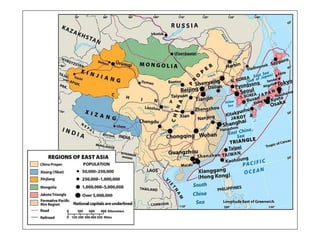
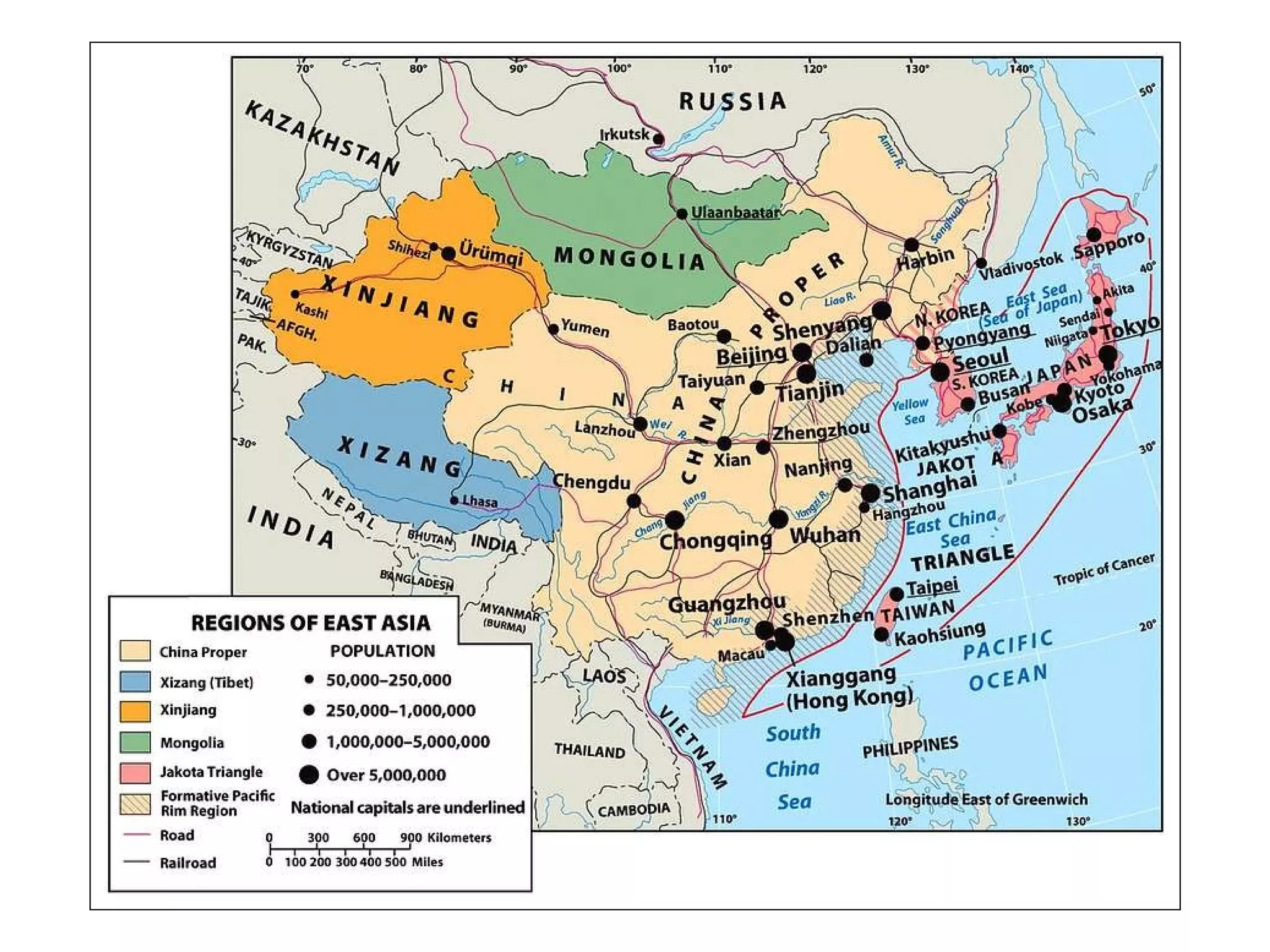
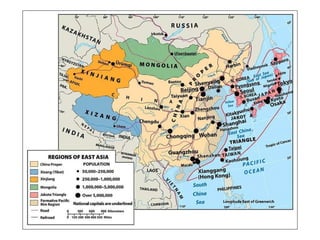
Regions of the Realm China Proper  —   eastern half;  the  core   Xizang  (Tibet) — tall mountains and high plateaus;  sparsely populated Xinjiang  —   vast desert basin and mountain rims; a cultural contact zone Mongolia  —   a desert,  buffer state The  JaKoTa triangle Japan, South Korea, Taiwan Rapid economic development
 
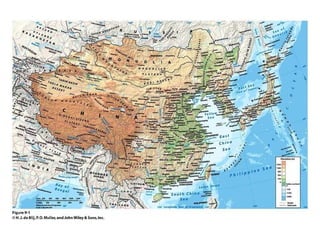
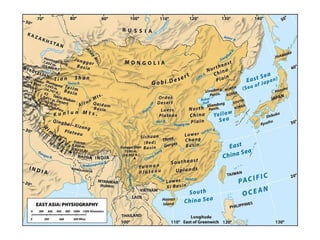
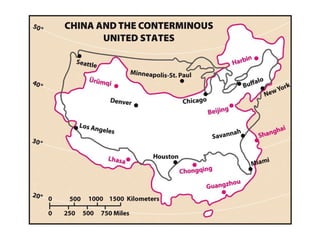
Physiography Total area  is about 9.3 million sq. km (3.6 million sq. mi.)  Longitudinal  extent is comparable to the United States;  Latitudinal  range from northern Quebec to central Caribbean Mainland bordered (surrounded)  by ocean, high mountains, steppe country, and desert Vast  and  varied topography: High plateaus  and  mountains  in the west Lower mountains  and  plains  in the east Vulnerable to  earthquakes
 
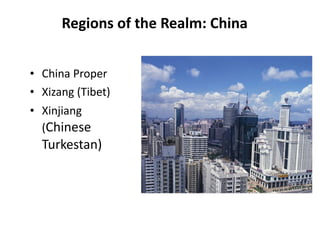
Regions of the Realm: China China Proper Xizang (Tibet) Xinjiang ( Chinese Turkestan)
 
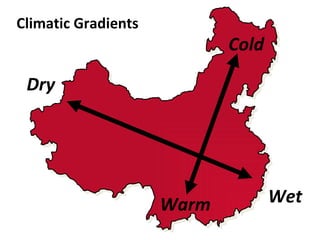
Warm Cold Wet Dry Climatic Gradients
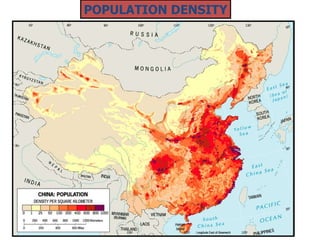
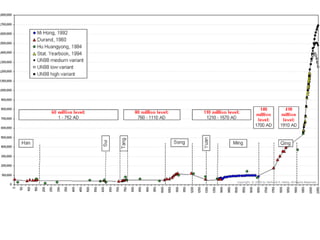
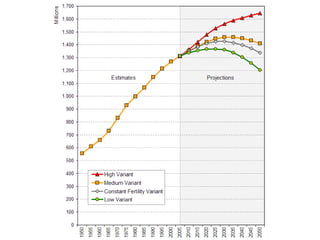
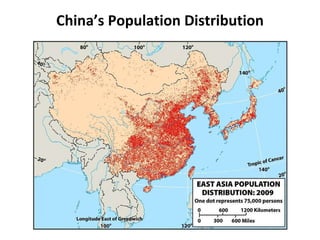
POPULATION DENSITY


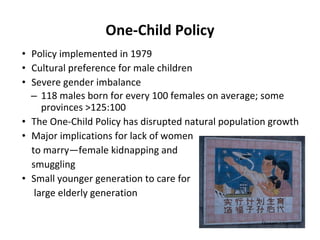
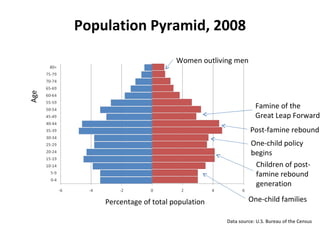
One-Child Policy Policy implemented in 1979 Cultural preference for male children Severe gender imbalance 118 males born for every 100 females on average; some provinces >125:100 The One-Child Policy has disrupted natural population growth Major implications for lack of women  to marry—female kidnapping and  smuggling Small younger generation to care for  large elderly generation Elizabeth J. Leppman
Population Pyramid, 2008 Percentage of total population Age Data source: U.S. Bureau of the Census Famine of the Great Leap Forward Post-famine rebound One-child policy begins Children of post- famine rebound generation One-child families Women outliving men
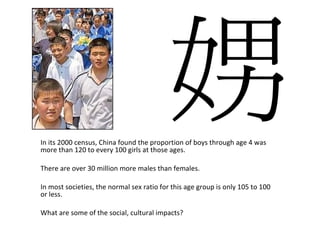
In its 2000 census, China found the proportion of boys through age 4 was more than 120 to every 100 girls at those ages.  There are over 30 million more males than females. In most societies, the normal sex ratio for this age group is only 105 to 100 or less. What are some of the social, cultural impacts?
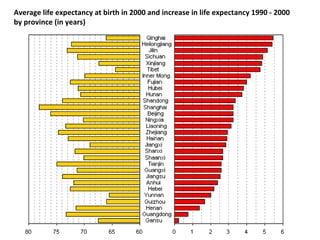
Average life expectancy at birth in 2000 and increase in life expectancy 1990 - 2000 by province (in years)
 
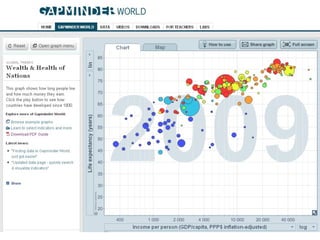
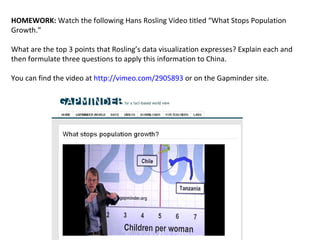
HOMEWORK:  Watch the following Hans Rosling Video titled “What Stops Population Growth.” What are the top 3 points that Rosling’s data visualization expresses? Explain each and then formulate three questions to apply this information to China.  You can find the video at  http://vimeo.com/2905893  or on the Gapminder site.
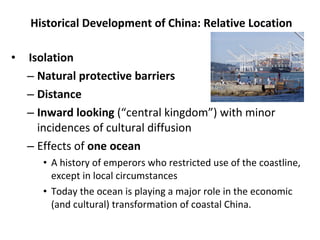
Historical Development of China: Relative Location Isolation Natural protective barriers Distance Inward looking  (“central kingdom”) with minor incidences of cultural diffusion Effects of  one ocean A history of emperors who restricted use of the coastline, except in local circumstances Today the ocean is playing a major role in the economic (and cultural) transformation of coastal China.
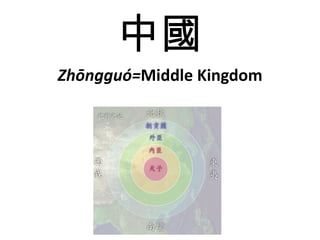
中國 Zhōngguó= Middle Kingdom
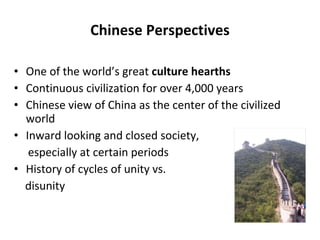
Chinese Perspectives One of the world’s great  culture hearths Continuous civilization for over 4,000 years Chinese view of China as the center of the civilized world Inward looking and closed society,  especially at certain periods History of cycles of unity vs. disunity A. WinklerPrins
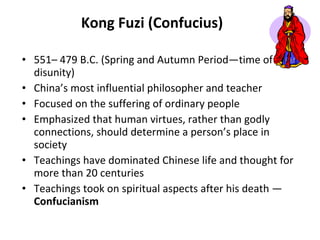
Kong Fuzi (Confucius) 551– 479 B.C. (Spring and Autumn Period—time of disunity) China’s most influential philosopher and teacher Focused on the suffering of ordinary people Emphasized that human virtues, rather than godly connections, should determine a person’s place in society Teachings have dominated Chinese life and thought for more than 20 centuries Teachings took on spiritual aspects after his death —  Confucianism
 
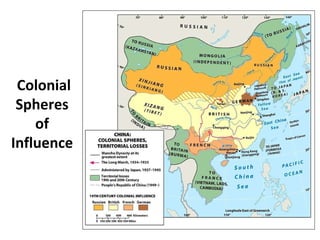
Colonial Spheres  of  Influence
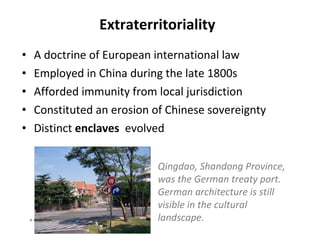
Extraterritoriality A doctrine of European international law Employed in China during the late 1800s Afforded immunity from local jurisdiction Constituted an erosion of Chinese sovereignty Distinct  enclaves   evolved Qingdao, Shandong Province, was the German treaty port.  German architecture is still visible in the cultural landscape. A. WinklerPrins
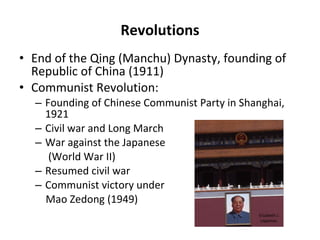
Revolutions End of the Qing (Manchu) Dynasty, founding of Republic of China (1911) Communist Revolution: Founding of Chinese Communist Party in Shanghai, 1921 Civil war and Long March War against the Japanese  (World War II) Resumed civil war Communist victory under  Mao Zedong (1949) Elizabeth J. Leppman
 
 
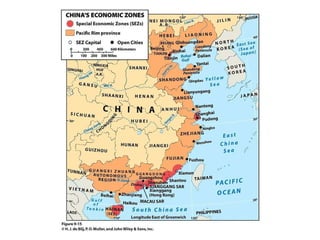
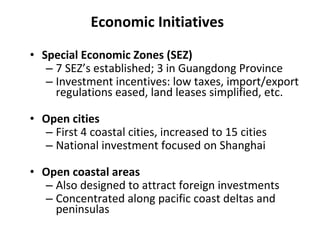
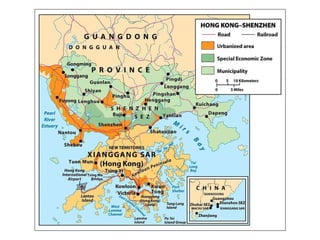
Economic Initiatives Special Economic Zones (SEZ) 7 SEZ’s established; 3 in Guangdong Province Investment incentives: low taxes, import/export regulations eased, land leases simplified, etc. Open cities First 4 coastal cities, increased to 15 cities National investment focused on Shanghai Open coastal areas Also designed to attract foreign investments Concentrated along pacific coast deltas and peninsulas
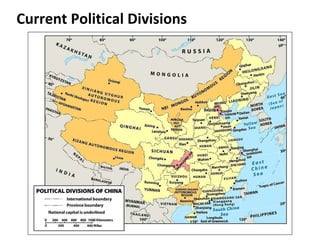
Current Political Divisions
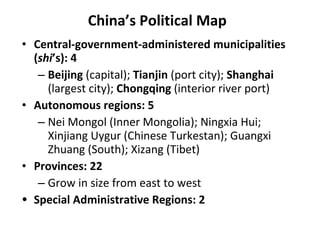
China’s Political Map Central-government-administered municipalities ( shi ’s): 4 Beijing  (capital);  Tianjin  (port city);  Shanghai  (largest city);  Chongqing  (interior river port) Autonomous regions: 5 Nei Mongol (Inner Mongolia); Ningxia Hui; Xinjiang Uygur (Chinese Turkestan); Guangxi Zhuang (South); Xizang (Tibet) Provinces: 22 Grow in size from east to west Special Administrative Regions: 2
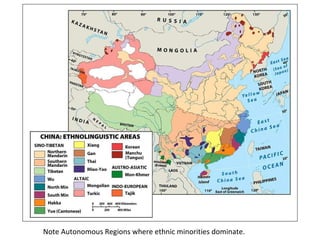
Note Autonomous Regions where ethnic minorities dominate.
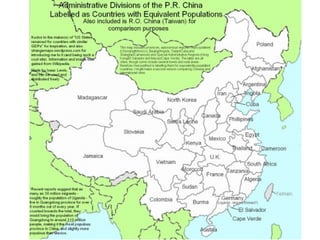
China’s Population Distribution
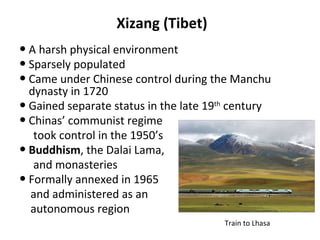
Xizang (Tibet) A harsh physical environment Sparsely populated Came under Chinese control during the Manchu dynasty in 1720 Gained separate status in the late 19 th  century Chinas’ communist regime  took control in the 1950’s Buddhism , the Dalai Lama, and monasteries Formally annexed in 1965  and administered as an  autonomous region Train to Lhasa
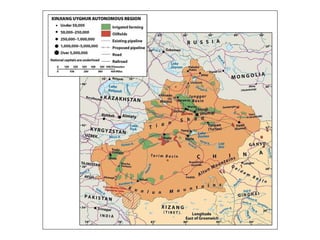
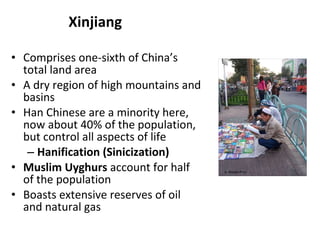
Xinjiang Comprises one-sixth of China’s total land area A dry region of high mountains and basins Han Chinese are a minority here, now about 40% of the population, but control all aspects of life Hanification (Sinicization) Muslim Uyghurs  account for half of the population Boasts extensive reserves of oil and natural gas A. WinklerPrins
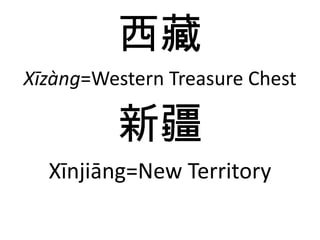
西藏 Xīzàng =Western Treasure Chest 新疆 Xīnjiāng= New Territory
 
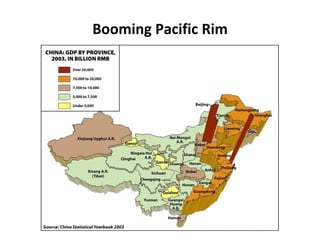
Booming Pacific Rim
 
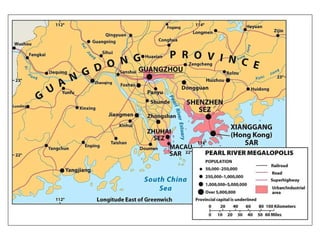
Hong Kong Means “ fragrant harbor”:  an excellent deep water port Boomed during the Korean war 7 million people within  1,036 sq. km  (400 sq. mi.) Economy is larger than half of the world’s countries July 1, 1997: British transferred control to China Hong Kong renamed  Xianggang  (same meaning but in Mandarin pronunciation) Acquired a new status as special administrative region  (SAR) , with Macau following suit in 1999
 
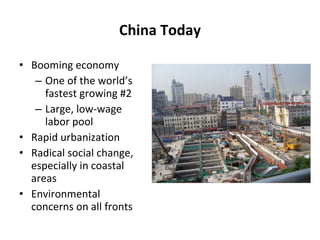
China Today Booming economy One of the world’s fastest growing #2 Large, low-wage labor pool Rapid urbanization Radical social change, especially in coastal areas Environmental concerns on all fronts
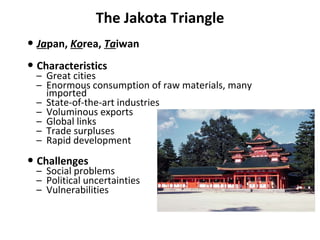
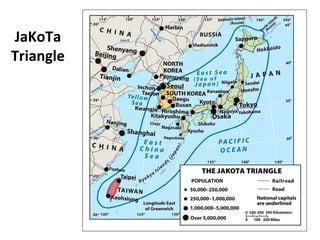
The Jakota Triangle Ja pan,  Ko rea,  Ta iwan Characteristics Great cities Enormous consumption of raw materials, many imported State-of-the-art industries Voluminous exports Global links Trade surpluses Rapid development Challenges Social problems Political uncertainties Vulnerabilities
GEOPOLITICAL RISKS (ISSUES AND CONCERNS) Taiwan’s  political status China’s  rising power Japan’s  waning power The  Korea  issue US  role and relations in the realm
JaKoTa Triangle
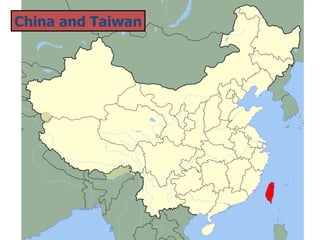
China and Taiwan
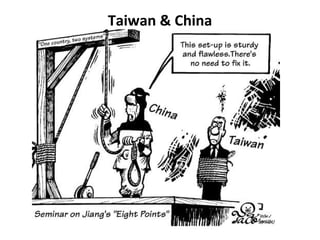
Taiwan & China
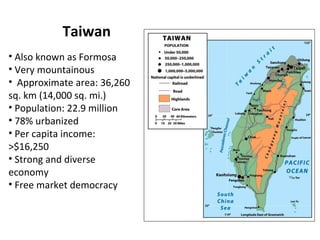
Taiwan Also known as Formosa Very mountainous Approximate area: 36,260 sq. km (14,000 sq. mi.) Population: 22.9 million 78% urbanized Per capita income: >$16,250 Strong and diverse economy Free market democracy
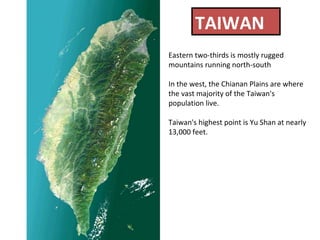
TAIWAN Eastern two-thirds is mostly rugged mountains running north-south In the west, the Chianan Plains are where the vast majority of the Taiwan's population live.  Taiwan's highest point is Yu Shan at nearly 13,000 feet.
TAIWAN Historical background: A Chinese province for centuries ????? Colonized by Japan in 1895 Returned to China (Nationalists) after WWII 1949 – Chinese Nationalists (supported by the US) fled from the mainland and established the Republic of China (ROC) The Future of Taiwan Regarded by China as a “wayward” province Possible flashpoint Trade as integrating force
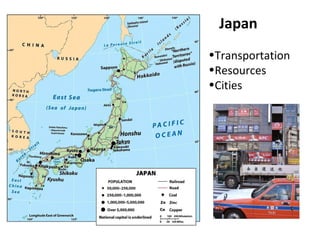
Transportation  Resources Cities Japan A. WinklerPrins
OUTLINE OF JAPANESE HISTORY 600 - 800 Chinese cultural influence 1000 -1300 War, Medieval society arises, shoguns evolve 1600 -1867 Tokugawa Shogunate: isolation, foreigners and Christianity expelled, individualistic culture, emphasis on Shinto belief system 1853 - Commodore Perry acquires new treaties with the outside
MEIJI RESTORATION 1868 Rebellion brought in reformers Reinstated the emperor and began to transform Japan from a Feudal society with pre-machine age technology to an industrial power Adopted aspects of the British model Launched a systematic study of the industrialized world Very different approach than China during the same period.  Focus was on industrialization and education system
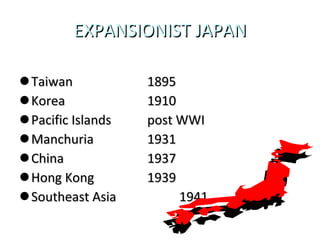
EXPANSIONIST JAPAN Taiwan 1895 Korea 1910 Pacific Islands post WWI Manchuria 1931 China 1937 Hong Kong 1939 Southeast Asia 1941
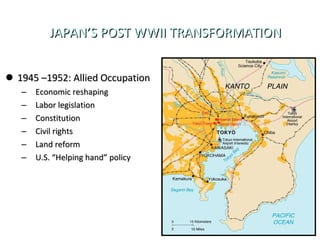
JAPAN’S POST WWII TRANSFORMATION 1945 –1952: Allied Occupation Economic reshaping Labor legislation Constitution Civil rights Land reform U.S. “Helping hand” policy
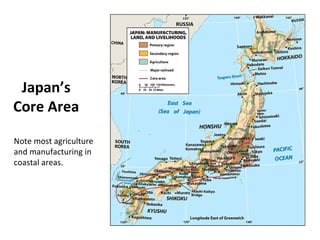
Japan’s Core Area Note most agriculture and manufacturing in coastal areas.
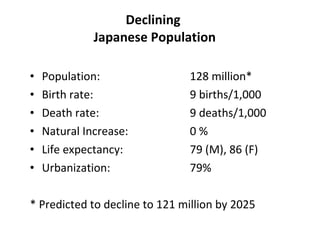
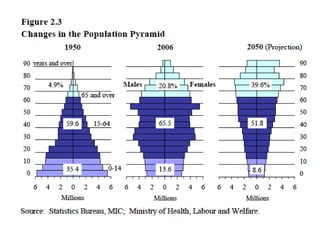
Declining  Japanese Population Population: 128 million* Birth rate:  9 births/1,000 Death rate: 9 deaths/1,000 Natural Increase: 0 % Life expectancy: 79 (M), 86 (F) Urbanization: 79% * Predicted to decline to 121 million by 2025
 
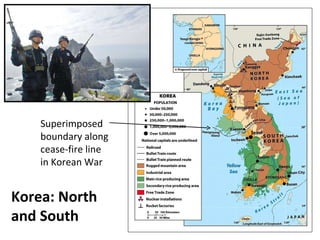
Korea: North and South Superimposed boundary along cease-fire line in Korean War
 
KOREA The size of “Idaho” but with a population of 72 million ( Idaho, 1.5 million ) Turbulent political history : A  dependency  of China A  colony  of Japan’s Divided  along the 38 th  parallel by Allied Powers > WWII (1945)  Korean Demilitarized Zone Cease-fire line established in1953
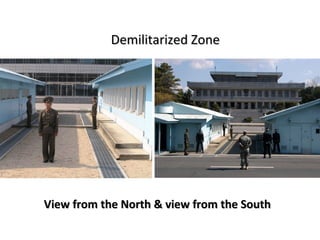
Demilitarized Zone View from the North & view from the South
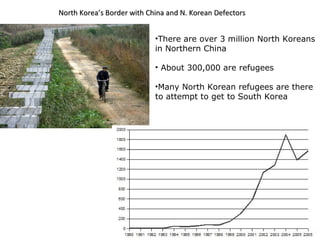
North Korea’s Border with China and N. Korean Defectors There are over 3 million North Koreans in Northern China About 300,000 are refugees Many North Korean refugees are there to attempt to get to South Korea
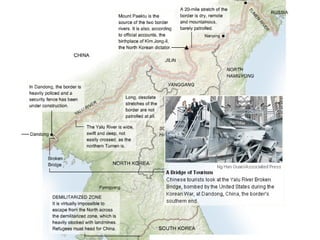
North Korea’s Border with China View from the North & view from the South
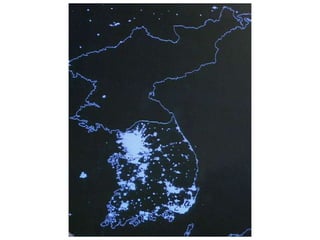
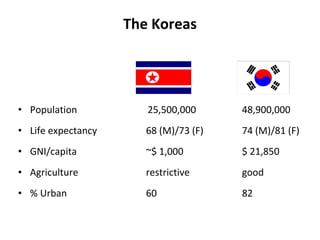
The Koreas Population    25,500,000 48,900,000 Life expectancy 68 (M)/73 (F) 74 (M)/81 (F) GNI/capita   ~$ 1,000 $ 21,850 Agriculture restrictive good  % Urban 60 82
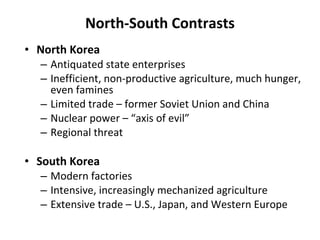
North-South Contrasts North Korea Antiquated state enterprises Inefficient, non-productive agriculture, much hunger, even famines Limited trade – former Soviet Union and China Nuclear power – “axis of evil” Regional threat South Korea Modern factories Intensive, increasingly mechanized agriculture Extensive trade – U.S., Japan, and Western Europe
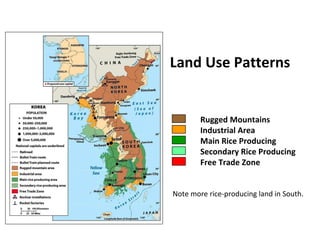
Land   Use   Patterns Rugged Mountains Industrial Area Main Rice Producing Secondary Rice Producing Free Trade Zone Note more rice-producing land in South.
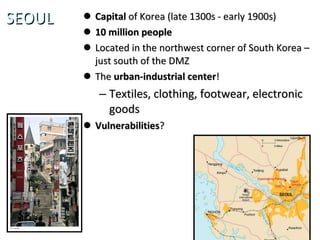
SEOUL Capital  of Korea (late 1300s - early 1900s) 10 million people Located in the northwest corner of South Korea – just south of the DMZ The  urban-industrial center ! Textiles, clothing, footwear, electronic goods Vulnerabilities ?
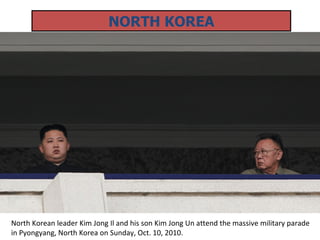
NORTH KOREA North Korean leader Kim Jong Il and his son Kim Jong Un attend the massive military parade in Pyongyang, North Korea on Sunday, Oct. 10, 2010.
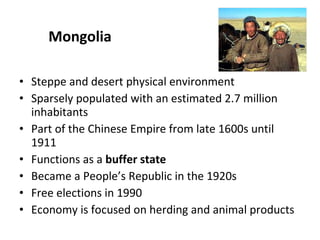
Mongolia Steppe and desert physical environment Sparsely populated with an estimated 2.7 million inhabitants Part of the Chinese Empire from late 1600s until 1911 Functions as a  buffer state Became a People’s Republic in the 1920s Free elections in 1990 Economy is focused on herding and animal products

Chapter9 East Asia

  • 1.
  • 2.
  • 3.
    MAJOR GEOGRAPHIC QUALITIES OF EAST ASIA Physical Geography dominated by extremes One of the world’s earliest culture hearths; China’s long coherent history. Rapid Economic Growth Influence of ideas from traditional Chinese Thought World’s most populace realm : Population Concentration on Coasts and Lowlands Environmental Stress Urban-Rural disparities Increasing energy demands POLITICAL AND ECONOMIC FORCES CONTINUE TO TRANSFORM TRADITIONAL CULTURAL LANDSCAPES. Flashpoints: Taiwan-China, North & South Korea, disputed islands in the South China Sea
  • 4.
    Regions of theRealm China Proper — eastern half; the core Xizang (Tibet) — tall mountains and high plateaus; sparsely populated Xinjiang — vast desert basin and mountain rims; a cultural contact zone Mongolia — a desert, buffer state The JaKoTa triangle Japan, South Korea, Taiwan Rapid economic development
  • 5.
  • 6.
    Physiography Total area is about 9.3 million sq. km (3.6 million sq. mi.) Longitudinal extent is comparable to the United States; Latitudinal range from northern Quebec to central Caribbean Mainland bordered (surrounded) by ocean, high mountains, steppe country, and desert Vast and varied topography: High plateaus and mountains in the west Lower mountains and plains in the east Vulnerable to earthquakes
  • 7.
  • 8.
    Regions of theRealm: China China Proper Xizang (Tibet) Xinjiang ( Chinese Turkestan)
  • 9.
  • 10.
    Warm Cold WetDry Climatic Gradients
  • 11.
  • 12.
  • 13.
  • 14.
  • 15.
    One-Child Policy Policyimplemented in 1979 Cultural preference for male children Severe gender imbalance 118 males born for every 100 females on average; some provinces >125:100 The One-Child Policy has disrupted natural population growth Major implications for lack of women to marry—female kidnapping and smuggling Small younger generation to care for large elderly generation Elizabeth J. Leppman
  • 16.
    Population Pyramid, 2008Percentage of total population Age Data source: U.S. Bureau of the Census Famine of the Great Leap Forward Post-famine rebound One-child policy begins Children of post- famine rebound generation One-child families Women outliving men
  • 17.
    In its 2000census, China found the proportion of boys through age 4 was more than 120 to every 100 girls at those ages. There are over 30 million more males than females. In most societies, the normal sex ratio for this age group is only 105 to 100 or less. What are some of the social, cultural impacts?
  • 18.
    Average life expectancyat birth in 2000 and increase in life expectancy 1990 - 2000 by province (in years)
  • 19.
  • 20.
    HOMEWORK: Watchthe following Hans Rosling Video titled “What Stops Population Growth.” What are the top 3 points that Rosling’s data visualization expresses? Explain each and then formulate three questions to apply this information to China. You can find the video at http://vimeo.com/2905893 or on the Gapminder site.
  • 21.
    Historical Development ofChina: Relative Location Isolation Natural protective barriers Distance Inward looking (“central kingdom”) with minor incidences of cultural diffusion Effects of one ocean A history of emperors who restricted use of the coastline, except in local circumstances Today the ocean is playing a major role in the economic (and cultural) transformation of coastal China.
  • 22.
  • 23.
    Chinese Perspectives Oneof the world’s great culture hearths Continuous civilization for over 4,000 years Chinese view of China as the center of the civilized world Inward looking and closed society, especially at certain periods History of cycles of unity vs. disunity A. WinklerPrins
  • 24.
    Kong Fuzi (Confucius)551– 479 B.C. (Spring and Autumn Period—time of disunity) China’s most influential philosopher and teacher Focused on the suffering of ordinary people Emphasized that human virtues, rather than godly connections, should determine a person’s place in society Teachings have dominated Chinese life and thought for more than 20 centuries Teachings took on spiritual aspects after his death — Confucianism
  • 25.
  • 26.
    Colonial Spheres of Influence
  • 27.
    Extraterritoriality A doctrineof European international law Employed in China during the late 1800s Afforded immunity from local jurisdiction Constituted an erosion of Chinese sovereignty Distinct enclaves evolved Qingdao, Shandong Province, was the German treaty port. German architecture is still visible in the cultural landscape. A. WinklerPrins
  • 28.
    Revolutions End ofthe Qing (Manchu) Dynasty, founding of Republic of China (1911) Communist Revolution: Founding of Chinese Communist Party in Shanghai, 1921 Civil war and Long March War against the Japanese (World War II) Resumed civil war Communist victory under Mao Zedong (1949) Elizabeth J. Leppman
  • 29.
  • 30.
  • 31.
    Economic Initiatives SpecialEconomic Zones (SEZ) 7 SEZ’s established; 3 in Guangdong Province Investment incentives: low taxes, import/export regulations eased, land leases simplified, etc. Open cities First 4 coastal cities, increased to 15 cities National investment focused on Shanghai Open coastal areas Also designed to attract foreign investments Concentrated along pacific coast deltas and peninsulas
  • 32.
  • 33.
    China’s Political MapCentral-government-administered municipalities ( shi ’s): 4 Beijing (capital); Tianjin (port city); Shanghai (largest city); Chongqing (interior river port) Autonomous regions: 5 Nei Mongol (Inner Mongolia); Ningxia Hui; Xinjiang Uygur (Chinese Turkestan); Guangxi Zhuang (South); Xizang (Tibet) Provinces: 22 Grow in size from east to west Special Administrative Regions: 2
  • 34.
    Note Autonomous Regionswhere ethnic minorities dominate.
  • 35.
  • 36.
    Xizang (Tibet) Aharsh physical environment Sparsely populated Came under Chinese control during the Manchu dynasty in 1720 Gained separate status in the late 19 th century Chinas’ communist regime took control in the 1950’s Buddhism , the Dalai Lama, and monasteries Formally annexed in 1965 and administered as an autonomous region Train to Lhasa
  • 37.
    Xinjiang Comprises one-sixthof China’s total land area A dry region of high mountains and basins Han Chinese are a minority here, now about 40% of the population, but control all aspects of life Hanification (Sinicization) Muslim Uyghurs account for half of the population Boasts extensive reserves of oil and natural gas A. WinklerPrins
  • 38.
    西藏 Xīzàng =WesternTreasure Chest 新疆 Xīnjiāng= New Territory
  • 39.
  • 40.
  • 41.
  • 42.
    Hong Kong Means“ fragrant harbor”: an excellent deep water port Boomed during the Korean war 7 million people within 1,036 sq. km (400 sq. mi.) Economy is larger than half of the world’s countries July 1, 1997: British transferred control to China Hong Kong renamed Xianggang (same meaning but in Mandarin pronunciation) Acquired a new status as special administrative region (SAR) , with Macau following suit in 1999
  • 43.
  • 44.
    China Today Boomingeconomy One of the world’s fastest growing #2 Large, low-wage labor pool Rapid urbanization Radical social change, especially in coastal areas Environmental concerns on all fronts
  • 45.
    The Jakota TriangleJa pan, Ko rea, Ta iwan Characteristics Great cities Enormous consumption of raw materials, many imported State-of-the-art industries Voluminous exports Global links Trade surpluses Rapid development Challenges Social problems Political uncertainties Vulnerabilities
  • 46.
    GEOPOLITICAL RISKS (ISSUESAND CONCERNS) Taiwan’s political status China’s rising power Japan’s waning power The Korea issue US role and relations in the realm
  • 47.
  • 48.
  • 49.
  • 50.
    Taiwan Also knownas Formosa Very mountainous Approximate area: 36,260 sq. km (14,000 sq. mi.) Population: 22.9 million 78% urbanized Per capita income: >$16,250 Strong and diverse economy Free market democracy
  • 51.
    TAIWAN Eastern two-thirdsis mostly rugged mountains running north-south In the west, the Chianan Plains are where the vast majority of the Taiwan's population live. Taiwan's highest point is Yu Shan at nearly 13,000 feet.
  • 52.
    TAIWAN Historical background:A Chinese province for centuries ????? Colonized by Japan in 1895 Returned to China (Nationalists) after WWII 1949 – Chinese Nationalists (supported by the US) fled from the mainland and established the Republic of China (ROC) The Future of Taiwan Regarded by China as a “wayward” province Possible flashpoint Trade as integrating force
  • 53.
    Transportation ResourcesCities Japan A. WinklerPrins
  • 54.
    OUTLINE OF JAPANESEHISTORY 600 - 800 Chinese cultural influence 1000 -1300 War, Medieval society arises, shoguns evolve 1600 -1867 Tokugawa Shogunate: isolation, foreigners and Christianity expelled, individualistic culture, emphasis on Shinto belief system 1853 - Commodore Perry acquires new treaties with the outside
  • 55.
    MEIJI RESTORATION 1868Rebellion brought in reformers Reinstated the emperor and began to transform Japan from a Feudal society with pre-machine age technology to an industrial power Adopted aspects of the British model Launched a systematic study of the industrialized world Very different approach than China during the same period. Focus was on industrialization and education system
  • 56.
    EXPANSIONIST JAPAN Taiwan1895 Korea 1910 Pacific Islands post WWI Manchuria 1931 China 1937 Hong Kong 1939 Southeast Asia 1941
  • 57.
    JAPAN’S POST WWIITRANSFORMATION 1945 –1952: Allied Occupation Economic reshaping Labor legislation Constitution Civil rights Land reform U.S. “Helping hand” policy
  • 58.
    Japan’s Core AreaNote most agriculture and manufacturing in coastal areas.
  • 59.
    Declining JapanesePopulation Population: 128 million* Birth rate: 9 births/1,000 Death rate: 9 deaths/1,000 Natural Increase: 0 % Life expectancy: 79 (M), 86 (F) Urbanization: 79% * Predicted to decline to 121 million by 2025
  • 60.
  • 61.
    Korea: North andSouth Superimposed boundary along cease-fire line in Korean War
  • 62.
  • 63.
    KOREA The sizeof “Idaho” but with a population of 72 million ( Idaho, 1.5 million ) Turbulent political history : A dependency of China A colony of Japan’s Divided along the 38 th parallel by Allied Powers > WWII (1945) Korean Demilitarized Zone Cease-fire line established in1953
  • 64.
    Demilitarized Zone Viewfrom the North & view from the South
  • 65.
    North Korea’s Borderwith China and N. Korean Defectors There are over 3 million North Koreans in Northern China About 300,000 are refugees Many North Korean refugees are there to attempt to get to South Korea
  • 66.
    North Korea’s Borderwith China View from the North & view from the South
  • 67.
    The Koreas Population 25,500,000 48,900,000 Life expectancy 68 (M)/73 (F) 74 (M)/81 (F) GNI/capita ~$ 1,000 $ 21,850 Agriculture restrictive good % Urban 60 82
  • 68.
    North-South Contrasts NorthKorea Antiquated state enterprises Inefficient, non-productive agriculture, much hunger, even famines Limited trade – former Soviet Union and China Nuclear power – “axis of evil” Regional threat South Korea Modern factories Intensive, increasingly mechanized agriculture Extensive trade – U.S., Japan, and Western Europe
  • 69.
    Land Use Patterns Rugged Mountains Industrial Area Main Rice Producing Secondary Rice Producing Free Trade Zone Note more rice-producing land in South.
  • 70.
    SEOUL Capital of Korea (late 1300s - early 1900s) 10 million people Located in the northwest corner of South Korea – just south of the DMZ The urban-industrial center ! Textiles, clothing, footwear, electronic goods Vulnerabilities ?
  • 71.
    NORTH KOREA NorthKorean leader Kim Jong Il and his son Kim Jong Un attend the massive military parade in Pyongyang, North Korea on Sunday, Oct. 10, 2010.
  • 72.
    Mongolia Steppe anddesert physical environment Sparsely populated with an estimated 2.7 million inhabitants Part of the Chinese Empire from late 1600s until 1911 Functions as a buffer state Became a People’s Republic in the 1920s Free elections in 1990 Economy is focused on herding and animal products

Editor's Notes

  • #16 Translation of the Chinese caption: “Follow the birth policy. Build a good future for your children and grandchildren.”
  • #17 http://www.census.gov/cgi-bin/ipc/idbagg