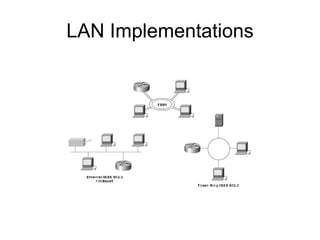
A LAN is a high-speed network covering a small geographic area that connects devices like computers and printers. It allows shared access to devices, file sharing, and communication via email. LANs use protocols like Ethernet and Token Ring and media access methods like CSMA/CD and token passing to allow devices to communicate on the shared network medium. Common LAN devices include hubs, switches, bridges, and routers that operate at the data link layer and network layer to connect, segment, and route traffic between LAN segments.
What Is aLAN? A LAN is a high-speed data network that covers a relatively small geographic area. It typically connects workstations, personal computers, printers, servers, and other devices. LANs offer computer users many advantages, shared access to devices and applications, file exchange between connected users, communication between users via electronic mail and other applications.
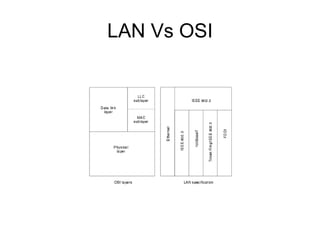
LAN Protocols &specifications LAN protocols function at the lowest two layers of the OSI reference model Between the physical layer and the data link layer Data link layer LLC sub layer MAC sub layer LAN specifications IEEE 802.2 (LLC) IEEE 802.3 (Ethernet) 10 BaseT,100BaseT Token Ring/802.5 FDI
LAN media accessmethods Carrier Sense Multiple Access Collision Detect (CSMA/CD) Token passing Purpose to allow one device access to the network media at a time
7.
CSMA/CD When adevice has data to send, it first listens to see if any other device is currently using the network If not, it starts sending its data. After finishing its transmission, it listens again to see if a collision occurred. A collision occurs when two devices send data simultaneously. When a collision happens, each device waits a random length of time before resending its data. In most cases, a collision will not occur again between the two devices. Because of this type of network contention, the busier a network becomes, the more collisions occur. This is why performance of Ethernet degrades rapidly as the number of devices on a single network increases.
8.
CSMA/CD For CSMA/CDnetworks, switches segment the network into multiple collision domains. This reduces the number of devices per network segment that must contend for the media. By creating smaller collision domains, the performance of a network can be increased significantly without requiring addressing changes.
9.
CSMA/CD Normally CSMA/CDnetworks are half-duplex This is much like a walkie-talkie With switches full-duplex operation is possible works much like a telephone
10.
Token-passing In token-passing networks such as Token Ring and FDDI, a special network frame called a token is passed around the network from device to device. When a device has data to send, it must wait until it has the token and then sends its data. When the data transmission is complete, the token is released so that other devices may use the network media. The main advantage of token-passing networks is that they are deterministic. In other words, it is easy to calculate the maximum time that will pass before a device has the opportunity to send data. This explains the popularity of token-passing networks in some real-time environments such as factories, where machinery must be capable of communicating at a determinable interval.
11.
Token-passing Token-passing networkssuch as Token Ring can also benefit from network switches. In large networks, the delay between turns to transmit may be significant because the token is passed around the network.
12.
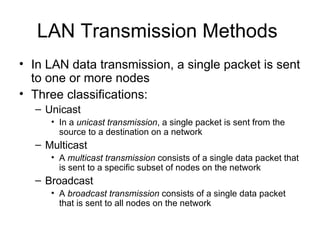
LAN Transmission Methods In LAN data transmission, a single packet is sent to one or more nodes Three classifications: Unicast In a unicast transmission , a single packet is sent from the source to a destination on a network Multicast A multicast transmission consists of a single data packet that is sent to a specific subset of nodes on the network Broadcast A broadcast transmission consists of a single data packet that is sent to all nodes on the network
13.
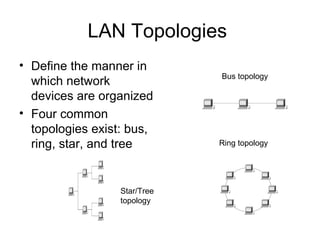
LAN Topologies Define the manner in which network devices are organized Four common topologies exist: bus, ring, star, and tree Bus topology Ring topology Star/Tree topology
14.
LAN Devices Devices commonly used in LANs include Repeaters, Hubs, LAN extenders, Bridges, LAN switches Routers.
15.
Repeater A repeater is a physical layer device ( Layer 1) Used to interconnect the media segments of an extended network. A repeater essentially enables a series of cable segments to be treated as a single cable. Repeaters receive signals from one network segment and amplify, retime, and retransmit those signals to another network segment. These actions prevent signal deterioration caused by long cable lengths and large numbers of connected devices. Repeaters are incapable of performing complex filtering and other traffic processing. In addition, all electrical signals, including electrical disturbances and other errors, are repeated and amplified. The total number of repeaters and network segments that can be connected is limited due to timing and other issues.
16.
HUB A hub is a physical layer device that connects multiple user stations, each via a dedicated cable. Electrical interconnections are established inside the hub. Hubs are used to create a physical star network while maintaining the logical bus or ring configuration of the LAN. In some respects, a hub functions as a multiport repeater.
17.
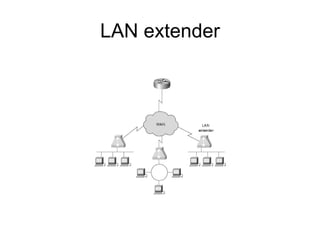
LAN extender A LAN extender is a remote-access multilayer switch that connects to a host router. LAN extenders forward traffic from all the standard network layer protocols (such as IP, IPX, and AppleTalk) and filter traffic based on the MAC address or network layer protocol type. LAN extenders scale well because the host router filters out unwanted broadcasts and multicasts. However, LAN extenders are not capable of segmenting traffic or creating security firewalls.
Bridges & SwitchesThey are data communications devices that operate principally at Layer 2 of the OSI reference model As such, they are widely referred to as data link layer devices Controls data flow, handles transmission errors, provides physical (as opposed to logical) addressing, and manages access to the physical medium. Bridges provide these functions by using various link layer protocols Examples of popular link layer protocols include Ethernet, Token Ring, and FDDI.
20.
Bridges & SwitchesTransparent bridging is found primarily in Ethernet environments source-route bridging occurs primarily in Token Ring environments. Translational bridging provides translation between the formats and transit principles of different media types (usually Ethernet and Token Ring). Source-route transparent bridging combines the algorithms of transparent bridging and source-route bridging to enable communication in mixed Ethernet/Token Ring environments.
21.
Bridges & SwitchesUpper-layer protocol transparency is a primary advantage of both bridging and switching Bridges are capable of filtering frames based on any Layer 2 fields Divide large networks into self-contained units
22.
Bridges & SwitchesBridges are generally used to segment a LAN into a couple of smaller segments. Switches are generally used to segment a large LAN into many smaller segments. Bridges generally have only a few ports for LAN connectivity, whereas switches generally have many. Switches can also be used to connect LANs with different media—for example, a 10-Mbps Ethernet LAN and a 100-Mbps Ethernet LAN can be connected using a switch. Some switches support cut-through switching, which reduces latency and delays in the network Bridges support only store-and-forward traffic switching. Switches reduce collisions on network segments because they provide dedicated bandwidth to each network segment.
23.
Routers A router is a computer networking device that forwards data packets across a network toward their destinations, through a process known as routing. Routing occurs at layer 3 (the Network layer e.g. IP) of the OSI seven-layer protocol stack. A router acts as a junction between two or more networks to transfer data packets among them. A router is different from a switch. A switch connects devices to form a Local area network (LAN).
24.
Routers A routerconnects the Internet Service Provider's (ISP) network to a LAN The switch connects devices together to form the LAN. Sometimes the switch and the router are combined together in one single package sold as a multiple port router. In order to route packets, a router communicates with other routers using routing protocols and using this information creates and maintains a routing table