Module 2
Cloud Computing
Architecture
Prepared by:
Dr. Saba Fatima
Assistant Professor
Department of Electronics and Communication Engineering
SECAB Institute of Engineering and Technology, Vijayapura
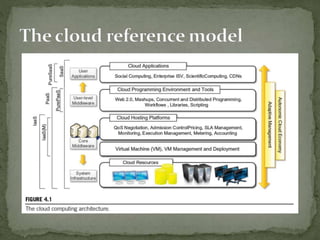
 Utility-oriented data centers are the first outcome of
cloud computing
 They serve as the infrastructure through which the
services are implemented and delivered.
 A broad definition of the phenomenon could be as
follows:
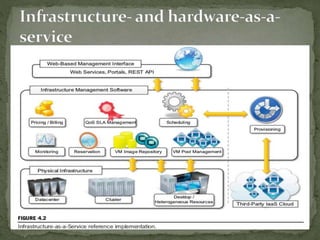
“Cloud computing is a utility-oriented and Internet-
centric way of delivering IT services on demand. These
services cover the entire computing stack: from the
hardware infrastructure packaged as a set of virtual
machines to software services such as development
platforms and distributed applications.”
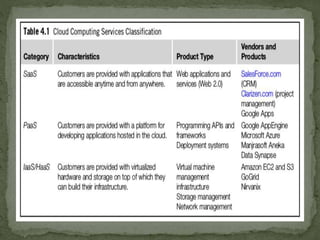
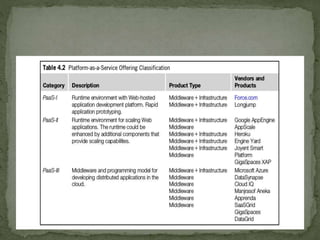
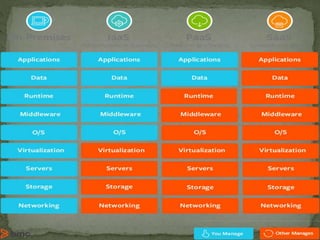
 Table summarizes the characteristics of the three
major categories used to classify cloud computing
solutions. In the following section, we briefly discuss
these characteristics along with some references to
practical implementations.
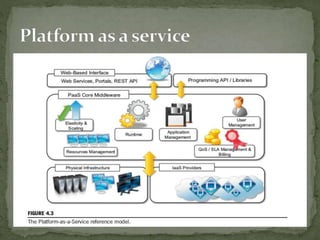
 1. Runtime framework. This framework represents
the “software stack” of the PaaS model. The runtime
framework executes end-user code according to the
policies set by the user and the provider.
 2. Abstraction. PaaS solutions are distinguished by
the higher level of abstraction that they provide.In
the case of PaaS the focus is on the applications the
cloud must support. PaaS solutions offer a way to
deploy and manage applications on the cloud rather
than a bunch of virtual machines on top of which the
IT infrastructure is built and configured.
 3. Automation. PaaS environments automate the
process of deploying applications to the infrastructure,
scaling them by provisioning additional resources
when needed. This process is performed automatically
and according to the SLA made between the
customers and the provider.
 4. Cloud services. PaaS offerings provide developers
and architects with services and APIs, helping them to
simplify the creation and delivery of elastic and highly
available cloud applications.
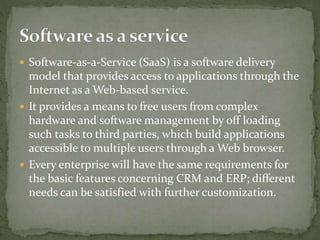
 Software-as-a-Service (SaaS) is a software delivery
model that provides access to applications through the
Internet as a Web-based service.
 It provides a means to free users from complex
hardware and software management by off loading
such tasks to third parties, which build applications
accessible to multiple users through a Web browser.
 Every enterprise will have the same requirements for
the basic features concerning CRM and ERP; different
needs can be satisfied with further customization.
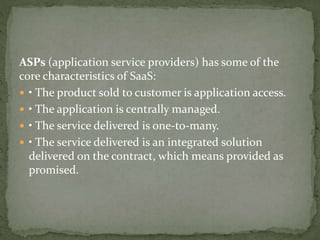
ASPs (application service providers) has some of the
core characteristics of SaaS:
 • The product sold to customer is application access.
 • The application is centrally managed.
 • The service delivered is one-to-many.
 • The service delivered is an integrated solution
delivered on the contract, which means provided as
promised.
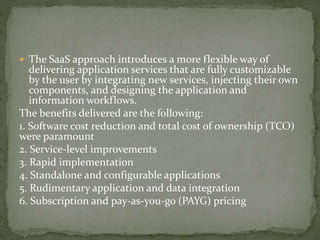
 The SaaS approach introduces a more flexible way of
delivering application services that are fully customizable
by the user by integrating new services, injecting their own
components, and designing the application and
information workflows.
The benefits delivered are the following:
1. Software cost reduction and total cost of ownership (TCO)
were paramount
2. Service-level improvements
3. Rapid implementation
4. Standalone and configurable applications
5. Rudimentary application and data integration
6. Subscription and pay-as-you-go (PAYG) pricing
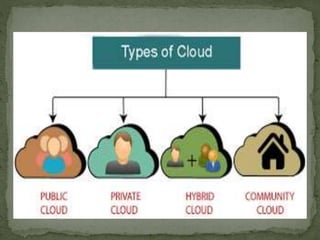
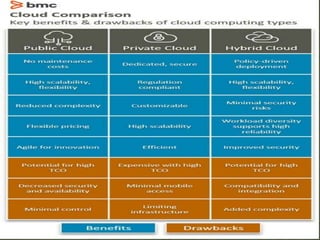
 A more useful classification is given according to the
administrative domain of a cloud. It is then possible to
differentiate four different types of cloud:
1. Public clouds. The cloud is open to the wider public.
2. Private clouds. The cloud is implemented within the private
premises of an institution and generally made accessible to the
members of the institution or a subset of them.
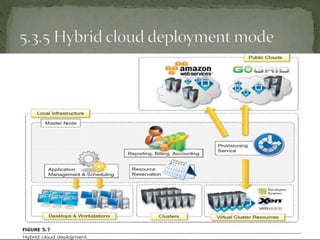
3. Hybrid or heterogeneous clouds. The cloud is a combination
of the two previous solutions and most likely identifies a private
cloud that has been augmented with resources or services hosted
in a public cloud.
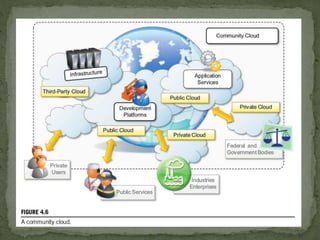
4. Community clouds. The cloud is characterized by a multi-
administrative domain involving different deployment models
(public, private, and hybrid), and it is specifically designed to
address the needs of a specific industry.
Candidate sectors for community clouds are as follows:
1. Media industry - looking for low-cost, agile, and simple solutions to improve the
efficiency of content production.
2. Healthcare industry - In the healthcare industry, there are different scenarios in which
community clouds could be of use. In particular, community clouds can provide a global
platform on which to share information and knowledge without revealing sensitive data
maintained within the private infrastructure.
3. Energy and other core industries - In these sectors, community clouds can bundle the
comprehensive set of solutions that together vertically address management, deployment,
and
orchestration of services and operations.
4. Public sector - Legal and political restrictions in the public sector can limit the adoption
of public cloud offerings. Moreover, governmental processes involve several institutions and
agencies and are aimed at providing strategic solutions at local, national, and international
administrative levels.
5. Scientific research - Science clouds are an interesting example of community clouds. In
this case, the common interest driving different organizations sharing a large distributed
infrastructure is scientific computing.
The benefits of these community clouds are the
following:
1. Openness. By removing the dependency on cloud
vendors, community clouds are open systems in which
fair competition between different solutions can happen.
2. Community. Being based on a collective that
provides resources and services, the infrastructure turns
out to be more scalable because the system can grow
simply by expanding its user base.
3. Graceful failures. Since there is no single provider or
vendor in control of the infrastructure, there is no single
point of failure.
4. Convenience and control. Within a community
cloud there is no conflict between convenience and
control because the cloud is shared and owned by the
community, which makes all the decisions through a
collective democratic process.
5. Environmental sustainability. The community
cloud is supposed to have a smaller carbon footprint
because it harnesses underutilized resources. Moreover,
these clouds tend to be more organic by growing and
shrinking in
In particular, cloud computing allows:
1. Reducing the capital costs associated to the IT
infrastructure
2. Eliminating the depreciation or lifetime costs
associated with IT capital assets
3. Replacing software licensing with subscriptions
4. Cutting the maintenance and administrative costs of
IT resources.
In terms of the pricing models introduced by cloud computing, we can
distinguish three different strategies that are adopted by the providers:
1. Tiered pricing. In this model, cloud services are offered in several tiers, each of
which offers a
fixed computing specification and SLA at a specific price per unit of time. This
model is used by Amazon for pricing the EC2 service.
2. Per-unit pricing. This model is more suitable to cases where the principal
source of revenue for the cloud provider is determined in terms of units of specific
services, such as data transfer and memory allocation. In this scenario customers
can configure their systems more efficiently according to the application needs.
This model is used, for example, by GoGrid, which makes customers pay
according to RAM/hour units for the servers deployed in the GoGrid cloud.
3. Subscription-based pricing. This is the model used mostly by SaaS providers
in which users pay a periodic subscription fee for use of the software or the
specific component services that are integrated in their applications.
1 Cloud definition
2 Cloud interoperability and standards:
Cloud Computing Interoperability Forum (CCIF), the Open
Cloud Consortium, and the DMTF Cloud Standards Incubator,
Open Cloud Manifesto, Open Virtualization Format (OVF)
3 Scalability and fault tolerance
4 Security, trust, and privacy
5 Organizational aspects
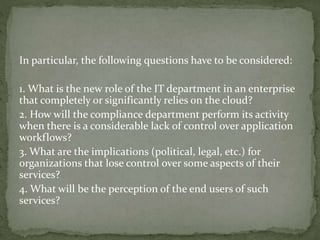
In particular, the following questions have to be considered:
1. What is the new role of the IT department in an enterprise
that completely or significantly relies on the cloud?
2. How will the compliance department perform its activity
when there is a considerable lack of control over application
workflows?
3. What are the implications (political, legal, etc.) for
organizations that lose control over some aspects of their
services?
4. What will be the perception of the end users of such
services?
Cloud ApplicationPlatform
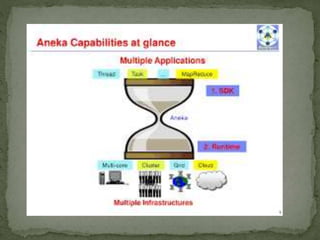
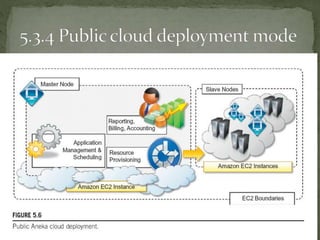
 Aneka is Manjrasoft Pty. Ltd.’ (Proprietary Limited Companies)is
solution for developing, deploying, and managing cloud applications.
 Aneka consists of a scalable cloud middleware that can be deployed on
top of heterogeneous computing resources.
 It offers an extensible collection of services coordinating the execution
of applications, helping administrators monitor the status of the cloud,
and providing integration with existing cloud technologies.
 One of Aneka’s key advantages is its extensible set of application pro-
gramming interfaces (APIs) associated with different types of
programming models—such as Task, Thread, and MapReduce—used
for developing distributed applications, integrating new capabilities
into the cloud, and supporting different types of cloud deployment
models: public, private, and hybrid.
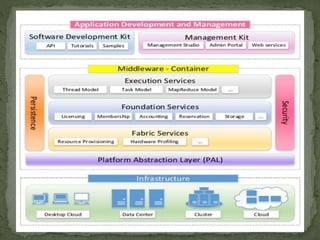
 The services stack resides on top of the Platform
Abstraction Layer(PAL), representing the interface to
the underlying operating system and hardware.
 It provides a uniform view of the software and
hardware environment in which the container is
running.
 Application management: A specific subset of
services is devoted to managing applications. These
services include scheduling, execution, monitoring,
and storage management.
 Elasticity and scaling: By means of the dynamic
provisioning service, Aneka supports dynamically
upsizing and downsizing of the infrastructure
available for applications.
 Runtime management: The runtime machinery is
responsible for keeping the infrastructure up and
running and serves as a hosting environment for
services.
 Resource management: Aneka is an elastic
infrastructure in which resources are added and
removed dynamically according to application needs
and user requirements.
 User management: Aneka is a multi tenant
distributed environment in which multiple
applications, potentially belonging to different users,
are executed.
 The framework provides an extensible user system via
which it is possible to define users, groups, and
permissions.
 QoS/SLA management and billing:
Within a cloud environment, application execution is
metered and billed.
Aneka provides a collection of services that coordinate
together to take into account the usage of resources by
each application and to bill the owning user accordingly.
The Aneka container constitutes the building blocks of
Aneka Clouds and represents the runtime machinery
available to services and applications.
The services installed in the Aneka container can be
classified into three major categories:
• Fabric Services
• Foundation Services
• Application Services
 The core infrastructure of the system is based on the .NET
technology and allows the Aneka container to be portable
over different platforms and operating systems.
 Any platform featuring an ECMA-334 [52] and ECMA-335
[53] compatible environment can host and run an instance
of the Aneka container
 The Common Language Infrastructure (CLI), which is the
specification introduced in the ECMA-334 standard,
defines a common runtime environment and application
model for executing programs but does not provide any
interface to access the hardware or to collect performance
data from the hosting operating system.
 The Platform Abstraction Layer(PAL) addresses this
heterogeneity and provides the container with a
uniform interface for accessing the relevant hardware
and operating system information, thus allowing the
rest of the container to run unmodified on any
supported platform.
The PAL pro- vides the following features:
 Uniform and platform-independent implementation
interface for accessing the hosting platform
 Uniform access to extended and additional properties
of the hosting platform
 Uniform and platform-independent access to remote
nodes
 Uniform and platform-independent management
interfaces
The collectible data that are exposed by the PAL are the
following:
 Number of cores, frequency, and CPU usage
 Memory size and usage
 Aggregate available disk space
 Network addresses and devices attached to the node
 Fabric Services define the lowest level of the software
stack representing the Aneka Container.
 They provide access to the resource-provisioning
subsystem and to the monitoring facilities
implemented in Aneka.
 Resource-provisioning services are in charge of
dynamically providing new nodes on demand by
relying on virtualization technologies.
 Monitoring services allow for hardware profiling and
implement a basic monitoring infrastructure that can
be used by all the services installed in the container.
Profiling and monitoring services are mostly exposed
through the Heartbeat, Monitoring, and Reporting
Services.
The Heartbeat Service periodically collects the dynamic
performance information about the node and publishes
this information to the membership service in the Aneka
Cloud.
A specific component called Node Resolver is in-charge
of collecting these data and making them available to
the Heartbeat Service.
 The Reporting Service manages the store for
monitored data and makes them accessible to other
services or external applications for analysis purposes.
 On each node, an instance of the Monitoring Service
acts as a gateway to the Reporting Service and
forwards to it all the monitored data that has been
collected on the node
Currently several built-in services provide information
through this channel:
 The Membership Catalogue tracks the performance
information of nodes.
 The Execution Service monitors several time intervals for
the execution of jobs.
 The Scheduling Service tracks the state transitions of
jobs.
 The Storage Service monitors and makes available
information about data transfer such as upload and
download times, filenames,and sizes.
 The Resource Provisioning Service tracks the
provisioning and lifetime information of virtual nodes.
It comprises several tasks:
 resource membership:
track of the basic node information for all the nodes that
are connected or disconnected.
is also the collector of the dynamic performance data of
each node
 resource reservation
 resource provisioning
allows the integration and management of virtual
resources leased from IaaS providers into the Aneka
Cloud
related to the logical management of the distributed
system built on top of the infrastructure and provide
supporting services for the execution of distributed
applications
services cover:
• Storage management for applications
• Accounting, billing, and resource pricing
• Resource reservation
 • Files are huge by traditional standards (multi-
gigabytes).
 Files are modified by appending new data rather than
rewriting existing data.
 There are two kinds of major workloads: large
streaming reads and small random reads.
 It is more important to have a sustained bandwidth
than a low latency.
 The collected information provides a detailed
breakdown of the distributed infrastructure usage and
is vital for the proper management of resources.
 supports the execution of distributed applications and
allows for reserving resources for exclusive use by specific
applications
 two different kinds of services: Resource Reservation and
the Allocation Service
 Resource Reservation keeps track of all the reserved time
slots in the Aneka Cloud and provides a unified view of the
system.
 The Allocation Service is installed on each node that
features execution services and manages the database of
information regarding the allocated slots on the local node.
 the framework supports three different implementations:
Basic Reservation: Features the basic capability to reserve
execution slots on nodes and implements the alternate offers
protocol, which provides alternative options in case the
initial reservation requests cannot be satisfied. •
Libra Reservation: Represents a variation of the previous
implementation that features the ability to price nodes
differently according to their hardware capabilities.
Relay Reservation: Constitutes a very thin implementation
that allows are source broker to reserve nodes in Aneka
Clouds and control the logic with which these nodes are
reserved
 manage the execution of applications and constitute a
layer that differentiates according to the specific
programming model used for developing distributed
applications on top of Aneka.
 Aneka defines a reference model for implementing the
runtime support for programming models that
abstracts these two activities in corresponding
services: the Scheduling Service and the Execution
Service.
 Scheduling Services are in charge of planning the
execution of distributed applications on top of Aneka
and governing the allocation of jobs composing an
application to nodes.
 Common tasks that are performed by the scheduling
component are the following:
Job to node mapping
Rescheduling of failed jobs
Job status monitoring
 Application status monitoring
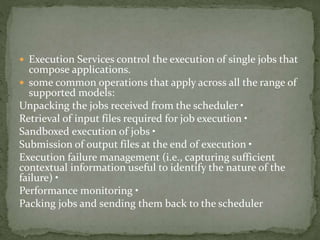
 Execution Services control the execution of single jobs that
compose applications.
 some common operations that apply across all the range of
supported models:
Unpacking the jobs received from the scheduler •
Retrieval of input files required for job execution •
Sandboxed execution of jobs •
Submission of output files at the end of execution •
Execution failure management (i.e., capturing sufficient
contextual information useful to identify the nature of the
failure) •
Performance monitoring •
Packing jobs and sending them back to the scheduler
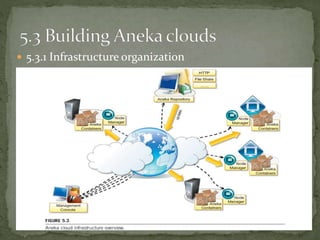
 5.3.1 Infrastructure organization
 The APIs for development are mostly concentrated in
the Aneka SDK; management tools are exposed
through the Management Console
 5.4.1 Aneka SDK
The SDK provides support for both programming
models and services by means of the Application
Model and the Service Model.
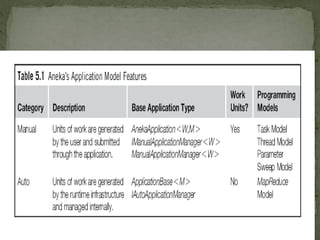
 The Application Model represents the minimum set of
APIs that is common to all the programming models
for representing and programming distributed
applications on top of Aneka.
 Refer diagram in text
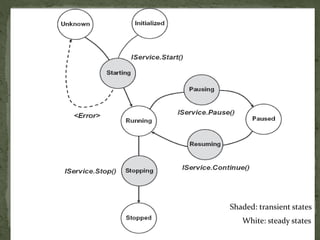
 Each service that is hosted in the container must be
compliant with the IService interface, which exposes
the following methods and properties:
 • Name and status
 • Control operations such as Start, Stop, Pause, and
Continue methods
 • Message handling by means of the HandleMessage
method
Shaded: transient states
White: steady states
 5.4.2.1 Infrastructure management
 5.4.2.2 Platform management
 5.4.2.3 Application management

Module 2-Cloud Computing Architecture.pptx

  • 1.
    Module 2 Cloud Computing Architecture Preparedby: Dr. Saba Fatima Assistant Professor Department of Electronics and Communication Engineering SECAB Institute of Engineering and Technology, Vijayapura
  • 2.
     Utility-oriented datacenters are the first outcome of cloud computing  They serve as the infrastructure through which the services are implemented and delivered.
  • 3.
     A broaddefinition of the phenomenon could be as follows: “Cloud computing is a utility-oriented and Internet- centric way of delivering IT services on demand. These services cover the entire computing stack: from the hardware infrastructure packaged as a set of virtual machines to software services such as development platforms and distributed applications.”
  • 5.
     Table summarizesthe characteristics of the three major categories used to classify cloud computing solutions. In the following section, we briefly discuss these characteristics along with some references to practical implementations.
  • 10.
     1. Runtimeframework. This framework represents the “software stack” of the PaaS model. The runtime framework executes end-user code according to the policies set by the user and the provider.  2. Abstraction. PaaS solutions are distinguished by the higher level of abstraction that they provide.In the case of PaaS the focus is on the applications the cloud must support. PaaS solutions offer a way to deploy and manage applications on the cloud rather than a bunch of virtual machines on top of which the IT infrastructure is built and configured.
  • 11.
     3. Automation.PaaS environments automate the process of deploying applications to the infrastructure, scaling them by provisioning additional resources when needed. This process is performed automatically and according to the SLA made between the customers and the provider.  4. Cloud services. PaaS offerings provide developers and architects with services and APIs, helping them to simplify the creation and delivery of elastic and highly available cloud applications.
  • 12.
     Software-as-a-Service (SaaS)is a software delivery model that provides access to applications through the Internet as a Web-based service.  It provides a means to free users from complex hardware and software management by off loading such tasks to third parties, which build applications accessible to multiple users through a Web browser.  Every enterprise will have the same requirements for the basic features concerning CRM and ERP; different needs can be satisfied with further customization.
  • 13.
    ASPs (application serviceproviders) has some of the core characteristics of SaaS:  • The product sold to customer is application access.  • The application is centrally managed.  • The service delivered is one-to-many.  • The service delivered is an integrated solution delivered on the contract, which means provided as promised.
  • 15.
     The SaaSapproach introduces a more flexible way of delivering application services that are fully customizable by the user by integrating new services, injecting their own components, and designing the application and information workflows. The benefits delivered are the following: 1. Software cost reduction and total cost of ownership (TCO) were paramount 2. Service-level improvements 3. Rapid implementation 4. Standalone and configurable applications 5. Rudimentary application and data integration 6. Subscription and pay-as-you-go (PAYG) pricing
  • 17.
     A moreuseful classification is given according to the administrative domain of a cloud. It is then possible to differentiate four different types of cloud: 1. Public clouds. The cloud is open to the wider public. 2. Private clouds. The cloud is implemented within the private premises of an institution and generally made accessible to the members of the institution or a subset of them. 3. Hybrid or heterogeneous clouds. The cloud is a combination of the two previous solutions and most likely identifies a private cloud that has been augmented with resources or services hosted in a public cloud. 4. Community clouds. The cloud is characterized by a multi- administrative domain involving different deployment models (public, private, and hybrid), and it is specifically designed to address the needs of a specific industry.
  • 22.
    Candidate sectors forcommunity clouds are as follows: 1. Media industry - looking for low-cost, agile, and simple solutions to improve the efficiency of content production. 2. Healthcare industry - In the healthcare industry, there are different scenarios in which community clouds could be of use. In particular, community clouds can provide a global platform on which to share information and knowledge without revealing sensitive data maintained within the private infrastructure. 3. Energy and other core industries - In these sectors, community clouds can bundle the comprehensive set of solutions that together vertically address management, deployment, and orchestration of services and operations. 4. Public sector - Legal and political restrictions in the public sector can limit the adoption of public cloud offerings. Moreover, governmental processes involve several institutions and agencies and are aimed at providing strategic solutions at local, national, and international administrative levels. 5. Scientific research - Science clouds are an interesting example of community clouds. In this case, the common interest driving different organizations sharing a large distributed infrastructure is scientific computing.
  • 23.
    The benefits ofthese community clouds are the following: 1. Openness. By removing the dependency on cloud vendors, community clouds are open systems in which fair competition between different solutions can happen. 2. Community. Being based on a collective that provides resources and services, the infrastructure turns out to be more scalable because the system can grow simply by expanding its user base. 3. Graceful failures. Since there is no single provider or vendor in control of the infrastructure, there is no single point of failure.
  • 24.
    4. Convenience andcontrol. Within a community cloud there is no conflict between convenience and control because the cloud is shared and owned by the community, which makes all the decisions through a collective democratic process. 5. Environmental sustainability. The community cloud is supposed to have a smaller carbon footprint because it harnesses underutilized resources. Moreover, these clouds tend to be more organic by growing and shrinking in
  • 25.
    In particular, cloudcomputing allows: 1. Reducing the capital costs associated to the IT infrastructure 2. Eliminating the depreciation or lifetime costs associated with IT capital assets 3. Replacing software licensing with subscriptions 4. Cutting the maintenance and administrative costs of IT resources.
  • 26.
    In terms ofthe pricing models introduced by cloud computing, we can distinguish three different strategies that are adopted by the providers: 1. Tiered pricing. In this model, cloud services are offered in several tiers, each of which offers a fixed computing specification and SLA at a specific price per unit of time. This model is used by Amazon for pricing the EC2 service. 2. Per-unit pricing. This model is more suitable to cases where the principal source of revenue for the cloud provider is determined in terms of units of specific services, such as data transfer and memory allocation. In this scenario customers can configure their systems more efficiently according to the application needs. This model is used, for example, by GoGrid, which makes customers pay according to RAM/hour units for the servers deployed in the GoGrid cloud. 3. Subscription-based pricing. This is the model used mostly by SaaS providers in which users pay a periodic subscription fee for use of the software or the specific component services that are integrated in their applications.
  • 27.
    1 Cloud definition 2Cloud interoperability and standards: Cloud Computing Interoperability Forum (CCIF), the Open Cloud Consortium, and the DMTF Cloud Standards Incubator, Open Cloud Manifesto, Open Virtualization Format (OVF) 3 Scalability and fault tolerance 4 Security, trust, and privacy 5 Organizational aspects
  • 28.
    In particular, thefollowing questions have to be considered: 1. What is the new role of the IT department in an enterprise that completely or significantly relies on the cloud? 2. How will the compliance department perform its activity when there is a considerable lack of control over application workflows? 3. What are the implications (political, legal, etc.) for organizations that lose control over some aspects of their services? 4. What will be the perception of the end users of such services?
  • 29.
  • 30.
     Aneka isManjrasoft Pty. Ltd.’ (Proprietary Limited Companies)is solution for developing, deploying, and managing cloud applications.  Aneka consists of a scalable cloud middleware that can be deployed on top of heterogeneous computing resources.  It offers an extensible collection of services coordinating the execution of applications, helping administrators monitor the status of the cloud, and providing integration with existing cloud technologies.  One of Aneka’s key advantages is its extensible set of application pro- gramming interfaces (APIs) associated with different types of programming models—such as Task, Thread, and MapReduce—used for developing distributed applications, integrating new capabilities into the cloud, and supporting different types of cloud deployment models: public, private, and hybrid.
  • 33.
     The servicesstack resides on top of the Platform Abstraction Layer(PAL), representing the interface to the underlying operating system and hardware.  It provides a uniform view of the software and hardware environment in which the container is running.  Application management: A specific subset of services is devoted to managing applications. These services include scheduling, execution, monitoring, and storage management.
  • 34.
     Elasticity andscaling: By means of the dynamic provisioning service, Aneka supports dynamically upsizing and downsizing of the infrastructure available for applications.  Runtime management: The runtime machinery is responsible for keeping the infrastructure up and running and serves as a hosting environment for services.  Resource management: Aneka is an elastic infrastructure in which resources are added and removed dynamically according to application needs and user requirements.
  • 35.
     User management:Aneka is a multi tenant distributed environment in which multiple applications, potentially belonging to different users, are executed.  The framework provides an extensible user system via which it is possible to define users, groups, and permissions.
  • 36.
     QoS/SLA managementand billing: Within a cloud environment, application execution is metered and billed. Aneka provides a collection of services that coordinate together to take into account the usage of resources by each application and to bill the owning user accordingly.
  • 37.
    The Aneka containerconstitutes the building blocks of Aneka Clouds and represents the runtime machinery available to services and applications. The services installed in the Aneka container can be classified into three major categories: • Fabric Services • Foundation Services • Application Services
  • 38.
     The coreinfrastructure of the system is based on the .NET technology and allows the Aneka container to be portable over different platforms and operating systems.  Any platform featuring an ECMA-334 [52] and ECMA-335 [53] compatible environment can host and run an instance of the Aneka container  The Common Language Infrastructure (CLI), which is the specification introduced in the ECMA-334 standard, defines a common runtime environment and application model for executing programs but does not provide any interface to access the hardware or to collect performance data from the hosting operating system.
  • 39.
     The PlatformAbstraction Layer(PAL) addresses this heterogeneity and provides the container with a uniform interface for accessing the relevant hardware and operating system information, thus allowing the rest of the container to run unmodified on any supported platform. The PAL pro- vides the following features:  Uniform and platform-independent implementation interface for accessing the hosting platform  Uniform access to extended and additional properties of the hosting platform
  • 40.
     Uniform andplatform-independent access to remote nodes  Uniform and platform-independent management interfaces The collectible data that are exposed by the PAL are the following:  Number of cores, frequency, and CPU usage  Memory size and usage  Aggregate available disk space  Network addresses and devices attached to the node
  • 41.
     Fabric Servicesdefine the lowest level of the software stack representing the Aneka Container.  They provide access to the resource-provisioning subsystem and to the monitoring facilities implemented in Aneka.  Resource-provisioning services are in charge of dynamically providing new nodes on demand by relying on virtualization technologies.  Monitoring services allow for hardware profiling and implement a basic monitoring infrastructure that can be used by all the services installed in the container.
  • 42.
    Profiling and monitoringservices are mostly exposed through the Heartbeat, Monitoring, and Reporting Services. The Heartbeat Service periodically collects the dynamic performance information about the node and publishes this information to the membership service in the Aneka Cloud. A specific component called Node Resolver is in-charge of collecting these data and making them available to the Heartbeat Service.
  • 43.
     The ReportingService manages the store for monitored data and makes them accessible to other services or external applications for analysis purposes.  On each node, an instance of the Monitoring Service acts as a gateway to the Reporting Service and forwards to it all the monitored data that has been collected on the node
  • 44.
    Currently several built-inservices provide information through this channel:  The Membership Catalogue tracks the performance information of nodes.  The Execution Service monitors several time intervals for the execution of jobs.  The Scheduling Service tracks the state transitions of jobs.  The Storage Service monitors and makes available information about data transfer such as upload and download times, filenames,and sizes.  The Resource Provisioning Service tracks the provisioning and lifetime information of virtual nodes.
  • 45.
    It comprises severaltasks:  resource membership: track of the basic node information for all the nodes that are connected or disconnected. is also the collector of the dynamic performance data of each node  resource reservation  resource provisioning allows the integration and management of virtual resources leased from IaaS providers into the Aneka Cloud
  • 46.
    related to thelogical management of the distributed system built on top of the infrastructure and provide supporting services for the execution of distributed applications services cover: • Storage management for applications • Accounting, billing, and resource pricing • Resource reservation
  • 47.
     • Filesare huge by traditional standards (multi- gigabytes).  Files are modified by appending new data rather than rewriting existing data.  There are two kinds of major workloads: large streaming reads and small random reads.  It is more important to have a sustained bandwidth than a low latency.
  • 48.
     The collectedinformation provides a detailed breakdown of the distributed infrastructure usage and is vital for the proper management of resources.
  • 49.
     supports theexecution of distributed applications and allows for reserving resources for exclusive use by specific applications  two different kinds of services: Resource Reservation and the Allocation Service  Resource Reservation keeps track of all the reserved time slots in the Aneka Cloud and provides a unified view of the system.  The Allocation Service is installed on each node that features execution services and manages the database of information regarding the allocated slots on the local node.
  • 50.
     the frameworksupports three different implementations: Basic Reservation: Features the basic capability to reserve execution slots on nodes and implements the alternate offers protocol, which provides alternative options in case the initial reservation requests cannot be satisfied. • Libra Reservation: Represents a variation of the previous implementation that features the ability to price nodes differently according to their hardware capabilities. Relay Reservation: Constitutes a very thin implementation that allows are source broker to reserve nodes in Aneka Clouds and control the logic with which these nodes are reserved
  • 51.
     manage theexecution of applications and constitute a layer that differentiates according to the specific programming model used for developing distributed applications on top of Aneka.  Aneka defines a reference model for implementing the runtime support for programming models that abstracts these two activities in corresponding services: the Scheduling Service and the Execution Service.
  • 52.
     Scheduling Servicesare in charge of planning the execution of distributed applications on top of Aneka and governing the allocation of jobs composing an application to nodes.  Common tasks that are performed by the scheduling component are the following: Job to node mapping Rescheduling of failed jobs Job status monitoring  Application status monitoring
  • 53.
     Execution Servicescontrol the execution of single jobs that compose applications.  some common operations that apply across all the range of supported models: Unpacking the jobs received from the scheduler • Retrieval of input files required for job execution • Sandboxed execution of jobs • Submission of output files at the end of execution • Execution failure management (i.e., capturing sufficient contextual information useful to identify the nature of the failure) • Performance monitoring • Packing jobs and sending them back to the scheduler
  • 54.
  • 59.
     The APIsfor development are mostly concentrated in the Aneka SDK; management tools are exposed through the Management Console  5.4.1 Aneka SDK The SDK provides support for both programming models and services by means of the Application Model and the Service Model.
  • 60.
     The ApplicationModel represents the minimum set of APIs that is common to all the programming models for representing and programming distributed applications on top of Aneka.  Refer diagram in text
  • 62.
     Each servicethat is hosted in the container must be compliant with the IService interface, which exposes the following methods and properties:  • Name and status  • Control operations such as Start, Stop, Pause, and Continue methods  • Message handling by means of the HandleMessage method
  • 63.
  • 64.
     5.4.2.1 Infrastructuremanagement  5.4.2.2 Platform management  5.4.2.3 Application management