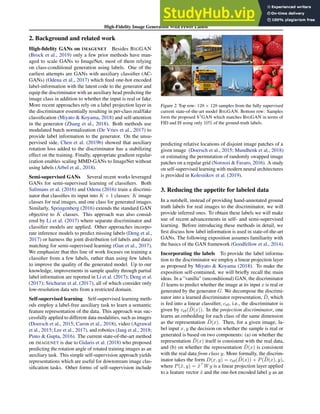
5 Important Deep Learning Research Papers You Must Read In 2020
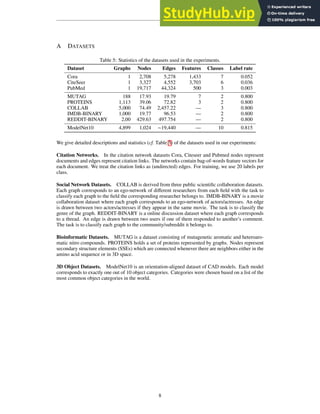
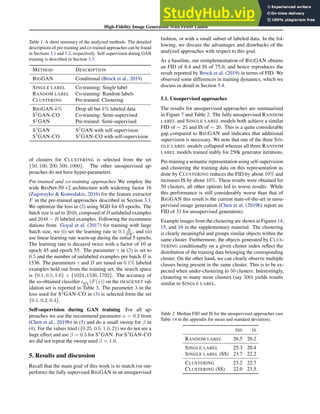
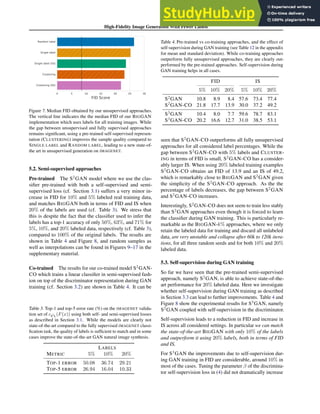
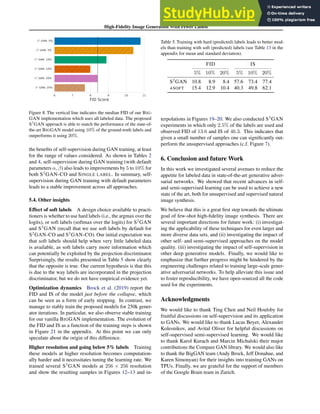
These papers provide a breadth of information about Deep Learning that is generally useful and interesting from a
data science perspective.
Contents
 Human-level control through deep reinforcement learning
 DeepFashion2: A Versatile Benchmark for Detection, Pose Estimation,
Segmentation and Re-Identification of Clothing Images
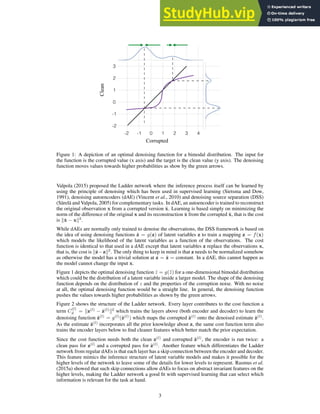
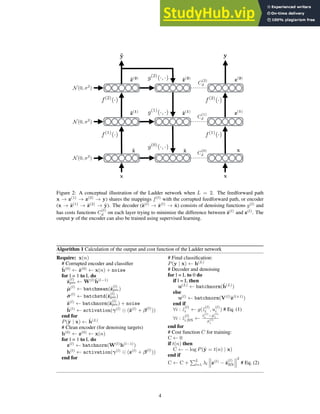
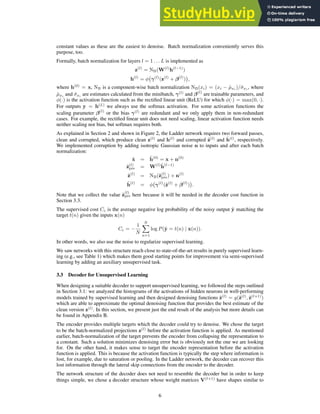
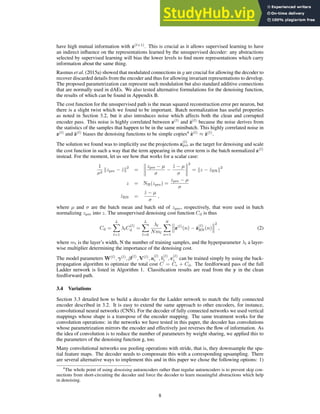
 Semi-Supervised Learning with Ladder Network
 Fast Graph Representation Learning With Pytorch Geometric
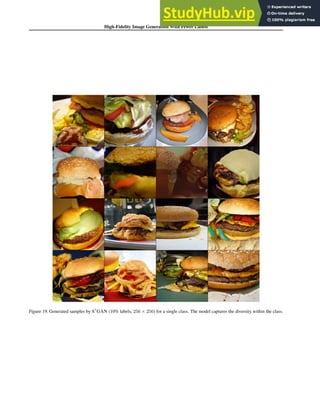
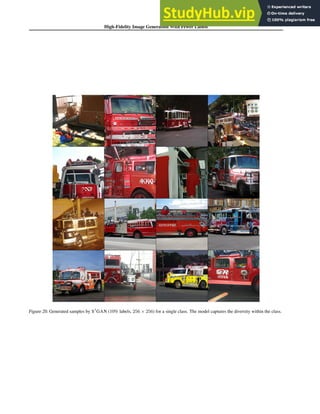
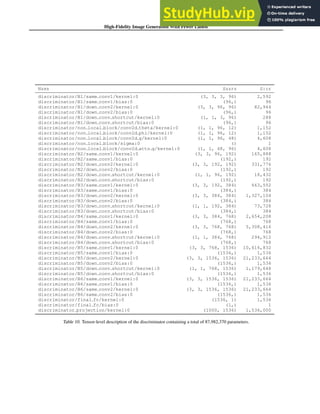
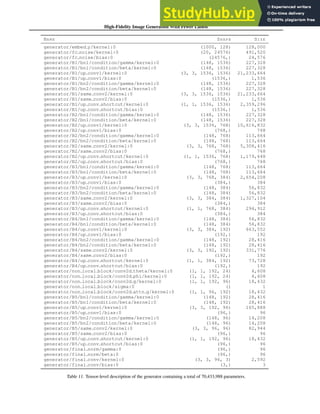
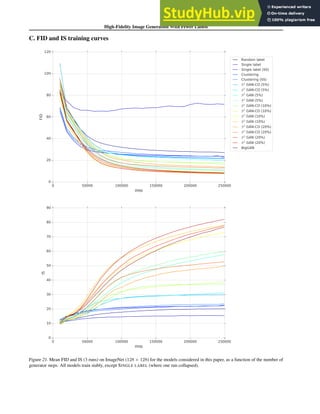
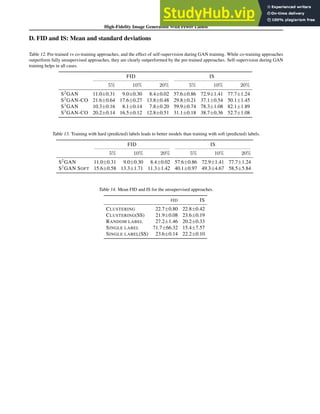
 High-Fidelity Image GenerationWith Fewer Labels
LETTER doi:10.1038/nature14236
Human-level control through deep reinforcement
learning
Volodymyr Mnih1
*, Koray Kavukcuoglu1
*, David Silver1
*, Andrei A. Rusu1
, Joel Veness1
, Marc G. Bellemare1
, Alex Graves1
,
Martin Riedmiller1
, Andreas K. Fidjeland1
, Georg Ostrovski1
, Stig Petersen1
, Charles Beattie1
, Amir Sadik1
, Ioannis Antonoglou1
,
Helen King1
, Dharshan Kumaran1
, Daan Wierstra1
, Shane Legg1
& Demis Hassabis1
Thetheoryofreinforcementlearningprovidesanormativeaccount1
,
deeply rooted in psychological2
and neuroscientific3
perspectives on
animal behaviour, of how agents may optimize their control of an
environment.Tousereinforcementlearningsuccessfullyinsituations
approaching real-worldcomplexity, however, agentsareconfronted
with a difficult task: theymust deriveefficientrepresentations ofthe
environment from high-dimensional sensory inputs, and use these
togeneralizepastexperiencetonewsituations.Remarkably,humans
andotheranimals seemtosolvethisproblemthrougha harmonious
combinationofreinforcementlearningandhierarchicalsensorypro-
cessing systems4,5
, the former evidenced by a wealth of neural data
revealingnotableparallelsbetweenthephasicsignalsemittedbydopa-
minergic neurons and temporal difference reinforcement learning
algorithms3
.Whilereinforcementlearningagentshaveachievedsome
successesinavarietyofdomains6–8
,theirapplicabilityhaspreviously
beenlimitedtodomainsinwhichusefulfeaturescanbehandcrafted,
or to domains with fully observed, low-dimensional state spaces.
Here we use recent advances in training deep neural networks9–11
to
develop a novel artificial agent, termed a deep Q-network, that can
learnsuccessfulpoliciesdirectlyfromhigh-dimensionalsensoryinputs
using end-to-end reinforcement learning. We tested this agent on
the challenging domain of classic Atari 2600 games12
. We demon-
strate that the deep Q-network agent, receiving only the pixels and
the game score as inputs, was able to surpass the performance of all
previous algorithms and achieve a level comparable to that of a pro-
fessionalhumangamestesteracrossasetof49games,usingthesame
algorithm, network architecture and hyperparameters. This work
bridges the divide between high-dimensional sensory inputs and
actions, resulting in the first artificial agent that is capable of learn-
ing to excel at a diverse array of challenging tasks.
We set out to create a single algorithm that would be able to develop
a wide range of competencies on a varied range of challenging tasks—a
central goal of general artificial intelligence13
that has eluded previous
efforts8,14,15
.Toachievethis,wedevelopedanovelagent,adeepQ-network
(DQN), which is able to combine reinforcement learning with a class
of artificial neural network16
known as deep neural networks. Notably,
recent advances in deep neural networks9–11
, in which several layers of
nodes are used to build up progressively more abstract representations
of the data, have made it possible for artificial neural networks to learn
concepts such as object categories directly from raw sensory data. We
use one particularly successful architecture, the deep convolutional
network17
, which uses hierarchical layers of tiled convolutional filters
to mimic the effects of receptive fields—inspired byHubel and Wiesel’s
seminalworkonfeedforwardprocessinginearlyvisualcortex18
—thereby
exploitingthe localspatial correlations present in images, and building
in robustness to natural transformations such as changes of viewpoint
or scale.
We consider tasks in which the agent interacts with an environment
throughasequenceofobservations,actionsandrewards.Thegoalofthe
agent is to select actions in a fashion that maximizes cumulative future
reward. More formally, we use a deep convolutional neural network to
approximate the optimal action-value function
Q!
s,a
ð Þ~ max
p
rtzcrtz1zc2
rtz2z . . . jst~s, at~a, p
! "
,
which is the maximum sum of rewards rt discounted by c at each time-
step t, achievable by a behaviour policy p 5 P(ajs), after making an
observation (s) and taking an action (a) (see Methods)19
.
Reinforcement learning is known to be unstable or even to diverge
when a nonlinear function approximator such as a neural network is
used to represent the action-value (also known as Q) function20
. This
instability has several causes: the correlations present in the sequence
ofobservations,thefactthatsmallupdatestoQ maysignificantlychange
thepolicyandthereforechangethedatadistribution,andthecorrelations
betweentheaction-values(Q)andthe target valuesrzc max
a0
Q s0
, a0
ð Þ.
We address these instabilities with a novel variantof Q-learning, which
uses two key ideas. First, we used a biologically inspired mechanism
termed experience replay21–23
that randomizes over the data, thereby
removing correlationsintheobservationsequenceandsmoothing over
changes in the data distribution(see below for details). Second, we used
an iterative update that adjusts the action-values (Q) towards target
values thatareonlyperiodicallyupdated,therebyreducingcorrelations
with the target.
While other stable methods exist for training neural networks in the
reinforcement learning setting, such as neural fitted Q-iteration24
, these
methodsinvolvetherepeatedtrainingofnetworksdenovoonhundreds
of iterations. Consequently, these methods, unlike our algorithm, are
too inefficient to be used successfully with large neural networks. We
parameterize an approximate value function Q(s,a;hi) using the deep
convolutionalneuralnetworkshowninFig.1,inwhichhi aretheparam-
eters (that is, weights) of the Q-network at iteration i. To perform
experience replay we store the agent’s experiences et 5 (st,at,rt,st 1 1)
at each time-step t in a data set Dt 5 {e1,…,et}. During learning, we
apply Q-learning updates, on samples (or minibatches) of experience
(s,a,r,s9) , U(D), drawn uniformly at random from the pool of stored
samples. The Q-learning update at iteration i uses the following loss
function:
Li hi
ð Þ~ s,a,r,s0
ð Þ*U D
ð Þ rzc max
a0
Q(s0
,a0
; h{
i ){Q s,a; hi
ð Þ
# $2
" #
in which c is the discountfactordetermining the agent’s horizon, hi are
the parameters of the Q-network at iteration i and h{
i are the network
parameters used to compute the target at iteration i. The target net-
work parameters h{
i are only updated with the Q-network parameters
(hi) every C steps and are held fixed between individual updates (see
Methods).
To evaluate our DQN agent, we took advantage of the Atari 2600
platform, which offers a diverse array of tasks (n 5 49) designed to be
*These authors contributed equally to this work.
1
Google DeepMind, 5 New Street Square, London EC4A 3TW, UK.
2 6 F E B R U A R Y 2 0 1 5 | V O L 5 1 8 | N A T U R E | 5 2 9
Macmillan Publishers Limited. All rights reserved
©2015
difficult and engaging for human players. We used the same network
architecture, hyperparameter values (see Extended Data Table 1) and
learningprocedurethroughout—takinghigh-dimensionaldata(210|160
colour video at 60 Hz) as input—to demonstrate that our approach
robustly learns successful policies over a variety of games based solely
onsensoryinputswithonlyveryminimalpriorknowledge(thatis,merely
the input data were visual images, and the number of actions available
in each game, but not their correspondences; see Methods). Notably,
our method was able to train large neural networks using a reinforce-
mentlearningsignalandstochasticgradientdescentinastablemanner—
illustrated by the temporal evolution of two indices of learning (the
agent’s average score-per-episode and average predicted Q-values; see
Fig. 2 and Supplementary Discussion for details).
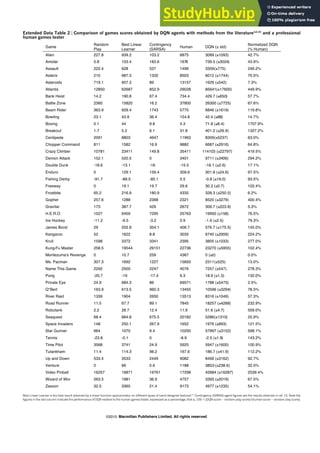
We compared DQN with the best performing methods from the
reinforcement learning literature on the 49 games where results were
available12,15
. In addition to the learned agents, we alsoreport scores for
aprofessionalhumangamestesterplayingundercontrolledconditions
and a policy that selects actions uniformly at random (Extended Data
Table 2 and Fig. 3, denoted by 100% (human) and 0% (random) on y
axis; see Methods). Our DQN method outperforms the best existing
reinforcement learning methods on 43 of the games without incorpo-
rating any of the additional prior knowledge about Atari 2600 games
used by other approaches (for example, refs 12, 15). Furthermore, our
DQN agent performed at a level that was comparable to that of a pro-
fessionalhumangamestesteracrossthesetof49games,achievingmore
than75%ofthe humanscore onmorethanhalfofthegames(29 games;
Convolution Convolution Fully connected Fully connected
No input
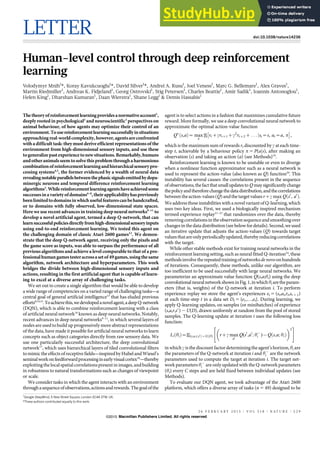
Figure 1 | Schematic illustration of the convolutional neural network. The
details of the architecture are explained in the Methods. The input to the neural
network consists of an 843 843 4 image produced by the preprocessing
map w, followed by three convolutional layers (note: snaking blue line
symbolizes sliding of each filter across input image) and two fully connected
layers with a single output for each valid action. Each hidden layer is followed
by a rectifier nonlinearity (that is, max 0,x
ð Þ).
a b
c d
0
200
400
600
800
1,000
1,200
1,400
1,600
1,800
2,000
2,200
0 20 40 60 80 100 120 140 160 180 200
Average
score
per
episode
Training epochs
0
1
2
3
4
5
6
7
8
9
10
11
0 20 40 60 80 100 120 140 160 180 200
Average
action
value
(Q)
Training epochs
0
1,000
2,000
3,000
4,000
5,000
6,000
0 20 40 60 80 100 120 140 160 180 200
Average
score
per
episode
Training epochs
0
1
2
3
4
5
6
7
8
9
10
0 20 40 60 80 100 120 140 160 180 200
Average
action
value
(Q)
Training epochs
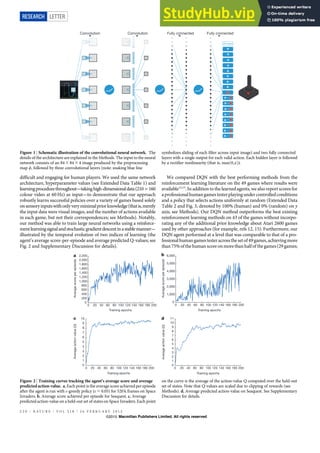
Figure 2 | Training curves tracking the agent’s average score and average
predicted action-value. a, Each point is the average score achieved per episode
after the agent is run with e-greedy policy (e 5 0.05) for 520k frames on Space
Invaders. b, Average score achieved per episode for Seaquest. c, Average
predicted action-value on a held-out set of states on Space Invaders. Each point
on the curve is the average of the action-value Q computed over the held-out
set of states. Note that Q-values are scaled due to clipping of rewards (see
Methods). d, Average predicted action-value on Seaquest. See Supplementary
Discussion for details.
RESEARCH LETTER
5 3 0 | N A T U R E | V O L 5 1 8 | 2 6 F E B R U A R Y 2 0 1 5
Macmillan Publishers Limited. All rights reserved
©2015
see Fig. 3, Supplementary Discussion and Extended Data Table 2). In
additional simulations (see Supplementary Discussion and Extended
Data Tables 3 and 4), we demonstrate the importance of the individual
corecomponentsoftheDQNagent—thereplaymemory,separatetarget
Q-network and deepconvolutionalnetwork architecture—bydisabling
them and demonstrating the detrimental effects on performance.
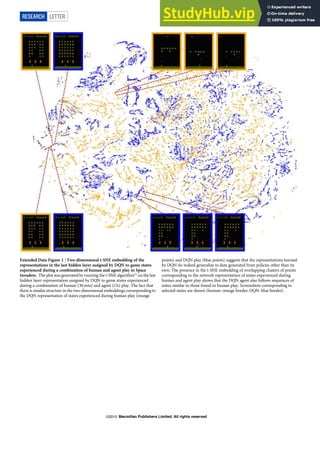
We next examined the representations learned by DQN that under-
pinnedthesuccessfulperformanceoftheagentinthecontextofthegame
Space Invaders (see Supplementary Video 1 for a demonstration of the
performance of DQN), by using a technique developed for the visual-
ization of high-dimensional data called ‘t-SNE’25
(Fig. 4). As expected,
the t-SNE algorithm tends to map the DQN representation of percep-
tuallysimilarstatestonearbypoints.Interestingly,wealsofoundinstances
in which the t-SNE algorithm generated similar embeddings for DQN
representations of states that are close in terms of expected reward but
perceptually dissimilar (Fig. 4, bottom right, top left and middle), con-
sistent with the notion that the network is able to learn representations
thatsupportadaptivebehaviourfromhigh-dimensionalsensoryinputs.
Furthermore, we also show that the representations learned by DQN
are able to generalize to data generated from policies other than its
own—in simulations where we presented as input to the networkgame
states experienced during human and agent play, recorded the repre-
sentations of the last hidden layer, and visualized the embeddings gen-
eratedbythet-SNEalgorithm(ExtendedDataFig.1andSupplementary
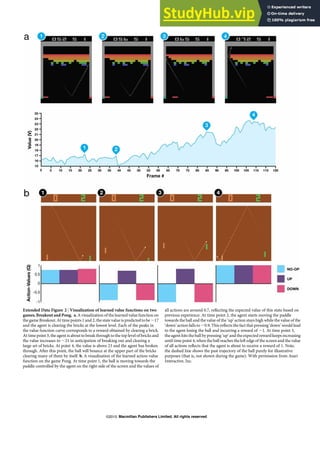
Discussion). Extended Data Fig. 2 provides an additional illustrationof
how the representations learned by DQN allow it to accurately predict
state and action values.
It is worth noting that the games in which DQN excels are extremely
varied in their nature, from side-scrolling shooters (River Raid) to box-
inggames(Boxing)andthree-dimensionalcar-racinggames(Enduro).
Montezuma's Revenge
Private Eye
Gravitar
Frostbite
Asteroids
Ms. Pac-Man
Bowling
Double Dunk
Seaquest
Venture
Alien
Amidar
River Raid
Bank Heist
Zaxxon
Centipede
Chopper Command
Wizard of Wor
Battle Zone
Asterix
H.E.R.O.
Q*bert
Ice Hockey
Up and Down
Fishing Derby
Enduro
Time Pilot
Freeway
Kung-Fu Master
Tutankham
Beam Rider
Space Invaders
Pong
James Bond
Tennis
Kangaroo
Road Runner
Assault
Krull
Name This Game
Demon Attack
Gopher
Crazy Climber
Atlantis
Robotank
Star Gunner
Breakout
Boxing
Video Pinball
At human-level or above
Below human-level
0 100 200 300 400 4,500%
500 1,000
600
Best linear learner
DQN
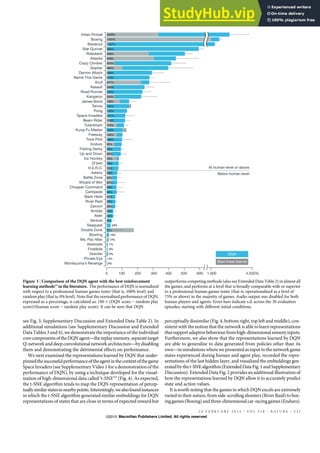
Figure 3 | Comparison of the DQN agent with the best reinforcement
learning methods15
in the literature. The performance of DQN is normalized
with respect to a professional human games tester (that is, 100% level) and
random play (that is, 0% level). Note that the normalized performance of DQN,
expressed as a percentage, is calculated as: 1003 (DQN score 2 random play
score)/(human score 2 random play score). It can be seen that DQN
outperforms competing methods (also see Extended Data Table 2) in almost all
the games, and performs at a level that is broadly comparable with or superior
to a professional human games tester (that is, operationalized as a level of
75% or above) in the majority of games. Audio output was disabled for both
human players and agents. Error bars indicate s.d. across the 30 evaluation
episodes, starting with different initial conditions.
LETTER RESEARCH
2 6 F E B R U A R Y 2 0 1 5 | V O L 5 1 8 | N A T U R E | 5 3 1
Macmillan Publishers Limited. All rights reserved
©2015
Indeed, in certain games DQN is able to discover a relatively long-term
strategy (for example, Breakout: the agent learns the optimal strategy,
which is to first dig a tunnel around the side of the wall allowing the ball
to be sent around the back to destroy a large number of blocks; see Sup-
plementary Video 2 for illustration of development of DQN’s perfor-
manceoverthecourseoftraining).Nevertheless,gamesdemandingmore
temporally extended planning strategies still constitute a major chal-
lengeforallexistingagentsincludingDQN(forexample,Montezuma’s
Revenge).
In this work, we demonstrate that a single architecture can success-
fullylearncontrolpoliciesinarangeofdifferentenvironmentswithonly
very minimal prior knowledge, receiving only the pixels and the game
scoreasinputs,andusingthesamealgorithm,networkarchitectureand
hyperparametersoneachgame,privyonlytotheinputsahumanplayer
would have. In contrast to previous work24,26
, our approach incorpo-
rates ‘end-to-end’ reinforcement learning that uses reward to continu-
ously shape representations within the convolutional network towards
salient featuresof the environmentthat facilitate value estimation.This
principledrawsonneurobiological evidencethatreward signalsduring
perceptuallearningmayinfluencethecharacteristicsofrepresentations
within primate visual cortex27,28
. Notably, the successful integration of
reinforcement learning with deep network architectures was critically
dependentonourincorporationofareplayalgorithm21–23
involvingthe
storageand representationofrecently experienced transitions.Conver-
gentevidencesuggeststhatthe hippocampusmay supportthe physical
realization of such a process in the mammalian brain, with the time-
compressed reactivation of recently experienced trajectories during
offline periods21,22
(for example, waking rest) providing a putative mech-
anism by which value functions may be efficiently updated through
interactions with the basal ganglia22
. In the future, it will be important
to explore the potential use of biasing the content of experience replay
towards salient events, a phenomenon that characterizes empirically
observed hippocampal replay29
, and relates to the notion of ‘prioritized
sweeping’30
in reinforcement learning. Taken together, our work illus-
trates the power of harnessing state-of-the-art machine learning tech-
niques with biologically inspired mechanisms to create agents that are
capable of learning to master a diverse array of challenging tasks.
Online Content Methods, along with any additional Extended Data display items
andSource Data, are available in the onlineversion of the paper; references unique
to these sections appear only in the online paper.
Received 10 July 2014; accepted 16 January 2015.
1. Sutton, R. & Barto, A. Reinforcement Learning: An Introduction (MIT Press, 1998).
2. Thorndike, E. L. Animal Intelligence: Experimental studies (Macmillan, 1911).
3. Schultz, W., Dayan, P. & Montague, P. R. A neural substrate of prediction and
reward. Science 275, 1593–1599 (1997).
4. Serre, T., Wolf, L. & Poggio, T. Object recognition with features inspired by visual
cortex. Proc. IEEE. Comput. Soc. Conf. Comput. Vis. Pattern. Recognit. 994–1000
(2005).
5. Fukushima, K. Neocognitron: A self-organizing neural network model for a
mechanism of pattern recognition unaffected by shift in position. Biol.Cybern.36,
193–202 (1980).
V
Figure 4 | Two-dimensional t-SNE embedding of the representations in the
last hidden layer assigned by DQN to game states experienced while playing
Space Invaders. The plot was generated by letting the DQN agent play for
2 h ofreal game time andrunningthet-SNEalgorithm25
on the lasthiddenlayer
representations assigned by DQN to each experienced game state. The
points are coloured according to the state values (V, maximum expected reward
of a state) predicted by DQN for the corresponding game states (ranging
from dark red (highest V) to dark blue (lowest V)). The screenshots
corresponding to a selected number of points are shown. The DQN agent
predicts high state values for both full (top right screenshots) and nearly
complete screens (bottom left screenshots) because it has learned that
completing a screen leads to a new screen full of enemy ships. Partially
completed screens (bottom screenshots) are assigned lower state values because
less immediate reward is available. The screens shown on the bottom right
andtopleft andmiddleareless perceptually similar than the other examples but
are still mapped to nearby representations and similar values because the
orange bunkers do not carry great significance near the end of a level. With
permission from Square Enix Limited.
RESEARCH LETTER
5 3 2 | N A T U R E | V O L 5 1 8 | 2 6 F E B R U A R Y 2 0 1 5
Macmillan Publishers Limited. All rights reserved
©2015
6. Tesauro, G. Temporal difference learning and TD-Gammon. Commun. ACM 38,
58–68 (1995).
7. Riedmiller, M., Gabel, T., Hafner, R. & Lange, S. Reinforcement learning for robot
soccer. Auton. Robots 27, 55–73 (2009).
8. Diuk, C., Cohen, A. & Littman, M. L. An object-oriented representation for efficient
reinforcement learning. Proc. Int. Conf. Mach. Learn. 240–247 (2008).
9. Bengio, Y. Learning deep architectures for AI. Foundations and Trends in Machine
Learning 2, 1–127 (2009).
10. Krizhevsky, A., Sutskever, I. & Hinton, G. ImageNet classification with deep
convolutional neural networks. Adv.Neural Inf.Process.Syst.25,1106–1114 (2012).
11. Hinton, G. E. & Salakhutdinov, R. R. Reducing the dimensionality of data with
neural networks. Science 313, 504–507 (2006).
12. Bellemare, M. G., Naddaf, Y., Veness, J. & Bowling, M. The arcade learning
environment: An evaluation platform for general agents. J. Artif. Intell. Res. 47,
253–279 (2013).
13. Legg, S. & Hutter, M. Universal Intelligence: a definition of machine intelligence.
Minds Mach. 17, 391–444 (2007).
14. Genesereth, M., Love, N. & Pell, B. General game playing: overview of the AAAI
competition. AI Mag. 26, 62–72 (2005).
15. Bellemare, M. G., Veness, J. & Bowling, M. Investigating contingency awareness
using Atari 2600 games. Proc. Conf. AAAI. Artif. Intell. 864–871 (2012).
16. McClelland, J. L., Rumelhart, D. E. & Group, T. P. R. Parallel Distributed Processing:
Explorations in the Microstructure of Cognition (MIT Press, 1986).
17. LeCun, Y., Bottou, L., Bengio, Y. & Haffner, P. Gradient-based learning applied to
document recognition. Proc. IEEE86, 2278–2324 (1998).
18. Hubel, D. H. & Wiesel, T. N. Shape and arrangement of columns in cat’s striate
cortex. J. Physiol. 165, 559–568 (1963).
19. Watkins, C. J. & Dayan, P. Q-learning. Mach. Learn. 8, 279–292 (1992).
20. Tsitsiklis, J. & Roy, B. V. An analysis of temporal-difference learning with function
approximation. IEEETrans. Automat. Contr. 42, 674–690 (1997).
21. McClelland, J. L., McNaughton, B. L. & O’Reilly, R. C. Why there are complementary
learning systems in the hippocampus and neocortex: insights from the successes
and failures of connectionist models of learning and memory. Psychol. Rev. 102,
419–457 (1995).
22. O’Neill, J., Pleydell-Bouverie, B., Dupret, D. & Csicsvari, J. Play it again: reactivation
of waking experience and memory. Trends Neurosci. 33, 220–229 (2010).
23. Lin, L.-J. Reinforcement learning for robots using neural networks. Technical
Report, DTIC Document (1993).
24. Riedmiller, M. Neural fitted Q iteration - first experiences with a data efficient
neural reinforcement learning method. Mach. Learn.: ECML, 3720, 317–328
(Springer, 2005).
25. Van der Maaten, L. J. P. & Hinton, G. E. Visualizing high-dimensional data using
t-SNE. J. Mach. Learn. Res. 9, 2579–2605 (2008).
26. Lange, S. & Riedmiller, M. Deep auto-encoder neural networks in reinforcement
learning. Proc. Int. Jt. Conf. Neural. Netw. 1–8 (2010).
27. Law, C.-T. & Gold, J. I. Reinforcement learning can account for associative
and perceptual learning on a visual decision task. Nature Neurosci. 12, 655
(2009).
28. Sigala, N. & Logothetis, N. K. Visual categorization shapes feature selectivity in the
primate temporal cortex. Nature 415, 318–320 (2002).
29. Bendor, D. & Wilson, M. A. Biasing the content of hippocampal replay during sleep.
Nature Neurosci. 15, 1439–1444 (2012).
30. Moore, A. & Atkeson, C. Prioritized sweeping: reinforcementlearning with lessdata
and less real time. Mach. Learn. 13, 103–130 (1993).
Supplementary Information is available in the online version of the paper.
Acknowledgements We thank G. Hinton, P. Dayan and M. Bowling for discussions,
A. Cain and J. Keene for work on the visuals, K. Keller and P. Rogers for help with the
visuals, G. Wayne for comments on an earlier version of the manuscript, and the rest of
the DeepMind team for their support, ideas and encouragement.
Author Contributions V.M., K.K., D.S., J.V., M.G.B., M.R., A.G., D.W., S.L. and D.H.
conceptualized the problem and the technical framework. V.M., K.K., A.A.R. and D.S.
developed and tested the algorithms. J.V., S.P., C.B., A.A.R., M.G.B., I.A., A.K.F., G.O. and
A.S. created the testing platform. K.K., H.K., S.L. and D.H. managed the project. K.K., D.K.,
D.H., V.M., D.S., A.G., A.A.R., J.V. and M.G.B. wrote the paper.
Author Information Reprints and permissions information is available at
www.nature.com/reprints. The authors declare no competing financial interests.
Readers are welcome to comment on the online version of the paper. Correspondence
and requests for materials should be addressed to K.K. (korayk@google.com) or
D.H. (demishassabis@google.com).
LETTER RESEARCH
2 6 F E B R U A R Y 2 0 1 5 | V O L 5 1 8 | N A T U R E | 5 3 3
Macmillan Publishers Limited. All rights reserved
©2015
METHODS
Preprocessing. Workingdirectlywith rawAtari2600 frames, whichare2103 160
pixel images with a 128-colour palette, can be demanding in terms of computation
and memory requirements. We apply a basic preprocessing step aimed at reducing
the input dimensionality and dealing with some artefacts of the Atari 2600 emu-
lator.First,toencodeasingleframewetakethemaximumvalueforeachpixelcolour
value over the frame being encoded and the previous frame. This was necessary to
remove flickering that is present in games where some objects appear only in even
frames while other objects appear only in odd frames, an artefact caused by the
limited number of sprites Atari 2600 can display at once. Second, we then extract
the Y channel, also known as luminance, from the RGB frame and rescale it to
84 3 84.The functionw fromalgorithm1 described belowappliesthispreprocess-
ing to the m most recent frames and stacks them to produce the input to the
Q-function, in which m 5 4, although the algorithm is robust to different values of
m (for example, 3 or 5).
Code availability. The source code can be accessed at https://sites.google.com/a/
deepmind.com/dqn for non-commercial uses only.
Model architecture. There are several possible ways of parameterizing Q using a
neural network. Because Q maps history–action pairs to scalar estimates of their
Q-value, the history and the action have been used as inputs to the neural network
by some previous approaches24,26
. The main drawback of this type of architecture
is that a separate forward pass is required to compute the Q-value of each action,
resulting in a cost thatscales linearly with thenumber ofactions. We instead usean
architecture in which there is a separate output unit for each possible action, and
only the state representation is an input to the neural network. The outputs cor-
respond to the predicted Q-values of the individual actions for the input state. The
main advantageof this type of architecture is the ability tocompute Q-valuesforall
possibleactionsinagivenstatewithonlyasingleforwardpassthroughthenetwork.
The exact architecture, shown schematically in Fig. 1, is as follows. The input to
the neural network consists of an 843 843 4 image produced by the preprocess-
ing map w. The first hidden layer convolves 32 filters of 83 8 with stride 4 with the
input image and applies a rectifier nonlinearity31,32
. The second hidden layer con-
volves 64 filters of 43 4 with stride 2, again followed by a rectifier nonlinearity.
Thisisfollowedbyathirdconvolutionallayerthatconvolves64filtersof33 3with
stride 1 followed by a rectifier. The final hidden layer is fully-connected and con-
sists of 512 rectifier units. The output layer is a fully-connected linear layer with a
single output for each valid action. The number of valid actions varied between 4
and 18 on the games we considered.
Training details.Weperformedexperimentson49Atari2600gameswhereresults
were available for all other comparable methods12,15
. A different network was trained
on each game: the same network architecture, learning algorithm and hyperpara-
metersettings(seeExtended Data Table1)wereusedacross allgames, showing that
our approach is robust enough to work on a variety of games while incorporating
onlyminimalpriorknowledge(seebelow).Whileweevaluatedouragentsonunmodi-
fied games, we made one change to the reward structure of the games during training
only. As the scale of scores varies greatly from game to game, we clipped all posi-
tive rewards at 1 and all negative rewards at 21, leaving 0 rewards unchanged.
Clipping the rewards in this manner limits the scale of the error derivatives and
makesiteasierto use thesamelearningrateacrossmultiplegames. At the same time,
it could affect the performance of our agent since it cannot differentiate between
rewards of different magnitude. For games where there is a life counter, the Atari
2600 emulator alsosends the number of lives left in the game, which is then used to
mark the end of an episode during training.
In these experiments, we used the RMSProp (see http://www.cs.toronto.edu/
,tijmen/csc321/slides/lecture_slides_lec6.pdf ) algorithmwith minibatches ofsize
32. The behaviour policy during training was e-greedy with e annealed linearly
from 1.0 to 0.1 over the first million frames, and fixed at 0.1 thereafter. We trained
for a total of 50 million frames (that is, around 38 days of game experience in total)
and used a replay memory of 1 million most recent frames.
FollowingpreviousapproachestoplayingAtari2600games,wealsouseasimple
frame-skipping technique15
. More precisely, the agent sees and selects actions on
every kth frame instead of every frame, and its last action is repeated on skipped
frames. Because running the emulator forward for one step requires much less
computationthan having the agent select an action, this technique allows the agent
to play roughly k times more games without significantly increasing the runtime.
We use k 5 4 for all games.
Thevaluesofallthehyperparametersandoptimizationparameterswereselected
by performing an informal search on the games Pong, Breakout, Seaquest, Space
Invaders and Beam Rider. We did not perform a systematic grid search owing to
the highcomputationalcost.Theseparameterswere thenheldfixedacrossallother
games.ThevaluesanddescriptionsofallhyperparametersareprovidedinExtended
Data Table 1.
Our experimental setup amounts to using the following minimal prior know-
ledge: that the input data consisted of visual images (motivating our use of a con-
volutional deep network), the game-specific score (with no modification), number
of actions, although not their correspondences (for example, specification of the
up ‘button’) and the life count.
Evaluation procedure. The trained agents were evaluated by playing each game
30 times for up to 5 min each time with different initial random conditions (‘no-
op’; see Extended Data Table 1) and an e-greedy policy with e 5 0.05. This pro-
cedure is adopted to minimize the possibility of overfitting during evaluation. The
random agent served as a baseline comparison and chose a random actionat 10 Hz
which is every sixth frame, repeating its last action on intervening frames. 10 Hz is
about the fastest that a human player can select the ‘fire’ button, and setting the
random agent to this frequency avoids spurious baseline scores in a handful of the
games.Wedidalsoassesstheperformanceofarandomagentthatselectedanaction
at 60 Hz (that is, every frame). This had a minimal effect: changing the normalized
DQN performance by more than 5% in only six games (Boxing, Breakout, Crazy
Climber, Demon Attack, Krull and Robotank), and in all these games DQN out-
performed the expert human by a considerable margin.
The professional human tester used the sameemulator engine as the agents, and
played under controlled conditions. The human tester was not allowed to pause,
save or reload games. As in the original Atari 2600 environment, the emulator was
run at 60 Hz and the audio output was disabled: as such, the sensory input was
equated between humanplayer andagents. The human performance is theaverage
rewardachievedfromaround20episodesofeachgamelastingamaximumof5 min
each, following around 2 h of practice playing each game.
Algorithm. We consider tasks in which an agent interacts with an environment,
in this case the Atari emulator, in a sequence of actions, observations and rewards.
At each time-step the agent selects an action at from the set of legal game actions,
A~ 1, . . . ,K
f g. The action is passed to the emulator and modifies its internal state
and the game score. In general the environment may be stochastic. The emulator’s
internal state is not observed by the agent; instead the agent observes an image
xt[ Rd
from the emulator, which is a vector of pixel values representing the current
screen. In addition it receives a reward rt representing the change in game score.
Note that in general thegame score maydependon the whole previoussequence of
actions andobservations;feedbackabout anactionmayonlybereceivedaftermany
thousands of time-steps have elapsed.
Becausetheagentonlyobservesthecurrentscreen,thetask ispartiallyobserved33
and many emulator states are perceptually aliased (that is, it is impossible to fully
understand the current situation from only the current screen xt). Therefore,
sequences of actions and observations, st~x1,a1,x2,:
:
:
,at{1,xt, are input to the
algorithm, which then learnsgame strategies depending uponthese sequences. All
sequences in the emulator are assumed to terminate in a finite number of time-
steps.ThisformalismgivesrisetoalargebutfiniteMarkovdecisionprocess(MDP)
in which each sequence is a distinct state. As a result, we can apply standard rein-
forcement learning methods for MDPs, simply by using the complete sequence st
as the state representation at time t.
The goal ofthe agent isto interactwith the emulatorby selectingactionsin a way
thatmaximizesfuturerewards.Wemakethestandardassumptionthatfuturerewards
are discounted by a factor of c per time-step (c was set to 0.99 throughout), and
define the future discounted return at time t as Rt~
X
T
t0~t
ct0
{t
rt0 , in which T is the
time-step at which the game terminates. We define the optimal action-value
function Q!
s,a
ð Þ as the maximum expected return achievable by following any
policy, after seeing some sequence s and then taking some action a, Q!
s,a
ð Þ~
maxp RtD
st~s,at~a,p
½ % in which p is a policy mapping sequences to actions (or
distributions over actions).
The optimal action-value function obeys an important identity known as the
Bellman equation. This is based on the following intuition: if the optimal value
Q!
s0
,a0
ð Þ of the sequence s9 at the next time-step was known for all possible actions
a9, thentheoptimalstrategy istoselecttheaction a9 maximizingtheexpectedvalue
of rzcQ!
s0
,a0
ð Þ:
Q!
s,a
ð Þ ~ s0 rzc max
a0
Q!
s0
,a0
ð ÞD
s,a
% &
The basic idea behind many reinforcement learning algorithms is to estimate
the action-value function by using the Bellman equation as an iterative update,
Qiz1 s,a
ð Þ~ s0 rzc maxa0 Qi s0
,a0
ð ÞD
s,a
½ %. Such value iteration algorithms converge
totheoptimalaction-valuefunction,Qi? Q!
asi? ?.Inpractice,thisbasicapproach
is impractical, because the action-value function is estimated separately for each
sequence,withoutanygeneralization.Instead,itiscommontouseafunctionapprox-
imator to estimate the action-value function, Q s,a; h
ð Þ<Q!
s,a
ð Þ. In the reinforce-
ment learning community this is typically a linear function approximator, but
RESEARCH LETTER
Macmillan Publishers Limited. All rights reserved
©2015
sometimes a nonlinear function approximator is used instead, such as a neural
network. We refer to a neural network function approximator with weights h as a
Q-network.AQ-network canbe trainedby adjusting theparameters hi at iteration
i to reduce the mean-squared error in the Bellman equation, where the optimal
target values rzc maxa0 Q!
s0
,a0
ð Þ are substituted with approximate target values
y~rzc maxa0 Q s0
,a0
; h{
i
' (
, using parameters h{
i from some previous iteration.
This leads to a sequence of loss functions Li(hi) that changes at each iteration i,
Li hi
ð Þ~ s,a,r Es0 yD
s,a
½ %{Q s,a; hi
ð Þ
ð Þ2
! "
~ s,a,r,s0 y{Q s,a; hi
ð Þ
ð Þ2
! "
zEs,a,r Vs0 y
½ %
½ %:
Note that the targets depend on the network weights; this is in contrast with the
targets used for supervised learning, which are fixed before learning begins. At
each stage of optimization, we hold the parameters from the previous iteration hi
2
fixed when optimizing the ith loss function Li(hi), resulting in a sequence of well-
defined optimization problems. The final term is the variance of the targets, which
does not depend on the parameters hi that we are currently optimizing, and may
therefore be ignored. Differentiating the loss function with respect to the weights
we arrive at the following gradient:
+hi
L hi
ð Þ ~ s,a,r,s0 rzc max
a0
Q s0
,a0
; h{
i
' (
{Q s,a; hi
ð Þ
# $
+hi
Q s,a; hi
ð Þ
% &
:
Rather than computing the full expectations in the above gradient, it is often
computationally expedient to optimize the loss function by stochastic gradient
descent. The familiar Q-learning algorithm19
can be recovered in this framework
by updating the weights after every time step, replacing the expectations using
single samples, and setting h{
i ~hi{1.
Note that this algorithm is model-free: it solves the reinforcement learning task
directly using samples from the emulator, without explicitly estimating the reward
and transition dynamics P r,s0
D
s,a
ð Þ. It is also off-policy: it learns about the greedy
policya~argmaxa0 Q s,a0
; h
ð Þ,whilefollowingabehaviourdistributionthatensures
adequate exploration of the state space. In practice, the behaviour distribution is
often selected by an e-greedy policy that follows the greedy policy with probability
1 2 e and selects a random action with probability e.
Training algorithm for deep Q-networks. The full algorithm for training deep
Q-networks is presented in Algorithm 1. The agent selects and executes actions
according to an e-greedy policy based on Q. Because using histories of arbitrary
length as inputs to a neural network can be difficult, our Q-function instead works
on a fixed length representation of histories produced by the function w described
above. The algorithm modifies standard online Q-learning in two ways to make it
suitable for training large neural networks without diverging.
First, we use a technique known as experience replay23
in which we store the
agent’s experiences at each time-step, et 5(st,at, rt,st 1 1), in a data set Dt 5{e1,…,et},
pooled over many episodes (where the end of an episode occurs when a termi-
nal state is reached) into a replay memory. During the inner loop of the algorithm,
we apply Q-learning updates, or minibatch updates, to samples of experience,
(s, a, r, s9) ,U(D), drawn atrandom from the pool of stored samples. This approach
hasseveraladvantagesoverstandardonlineQ-learning.First,eachstepofexperience
is potentiallyused inmany weight updates, whichallowsforgreater data efficiency.
Second, learning directly from consecutive samplesis inefficient, owing to the strong
correlations between the samples; randomizing the samples breaks these correla-
tions and therefore reduces the variance of the updates. Third, when learning on-
policy the current parameters determine the next data sample that the parameters
are trainedon. For example, if the maximizing actionis to moveleft then the train-
ing samples will be dominated by samples from the left-hand side; if the maximiz-
ing action then switches to the right then the training distribution will also switch.
Itiseasytoseehowunwantedfeedbackloopsmayariseandtheparameterscouldget
stuckinapoorlocalminimum,orevendivergecatastrophically20
.Byusingexperience
replay the behaviour distribution is averaged over many of its previous states,
smoothing out learning and avoiding oscillations or divergence in the parameters.
Note that when learning by experience replay, it is necessary to learn off-policy
(because our current parameters are different to those used to generate the sam-
ple), which motivates the choice of Q-learning.
In practice, our algorithm only stores the last N experience tuples in the replay
memory,andsamplesuniformlyat randomfrom Dwhenperforming updates. This
approach is in some respects limited because the memory buffer does not differ-
entiate important transitions and always overwrites with recent transitions owing
to the finite memory size N. Similarly, the uniform sampling gives equal impor-
tance to all transitions in the replaymemory. A moresophisticatedsampling strat-
egy might emphasize transitions from which we can learn the most, similar to
prioritized sweeping30
.
The second modification to online Q-learning aimed at further improving the
stability of our method with neural networks is to use a separate network for gen-
erating the targets yj in the Q-learning update. More precisely, every C updates we
clone the network Q to obtain a target network ^
Q and use ^
Q for generating the
Q-learning targets yj forthe followingC updates to Q. This modificationmakes the
algorithm more stable compared to standard online Q-learning, where an update
thatincreasesQ(st,at)oftenalsoincreasesQ(st 1 1,a)forallaandhencealsoincreases
the target yj, possibly leading to oscillations or divergence of the policy. Generating
the targetsusinganoldersetofparametersaddsadelay betweenthe timeanupdate
to Q is made and the time the update affects the targets yj, making divergence or
oscillations much more unlikely.
We also found it helpful to clip the error term from the update rzc maxa0 Q
s0
,a0
; h{
i
' (
{Q s,a; hi
ð Þ to be between 21 and 1. Because the absolute value loss
function jxj has a derivative of 21 for all negative values of x and a derivative of 1
for all positive values of x, clipping the squared error to be between 21 and 1 cor-
responds to using an absolute value loss function for errors outside of the (21,1)
interval.This formoferrorclippingfurtherimproved the stability ofthe algorithm.
Algorithm 1: deep Q-learning with experience replay.
Initialize replay memory D to capacity N
Initialize action-value function Q with random weights h
Initialize target action-value function ^
Q with weights h2
5 h
For episode 5 1, M do
Initialize sequence s1~ x1
f g and preprocessed sequence w1~w s1
ð Þ
For t 5 1,T do
With probability e select a random action at
otherwise select at~argmaxaQ w st
ð Þ,a; h
ð Þ
Execute action at in emulator and observe reward rt and image xt 1 1
Set stz1~st,at,xtz1 and preprocess wtz1~w stz1
ð Þ
Store transition wt,at,rt,wtz1
' (
in D
Sample random minibatch of transitions wj,aj,rj,wjz1
) *
from D
Set yj~
rj if episode terminates at step jz1
rjzc maxa0 ^
Q wjz1,a0
; h{
) *
otherwise
(
Perform a gradient descent step on yj{Q wj,aj; h
) *
) *2
with respect to the
network parameters h
Every C steps reset ^
Q~Q
End For
End For
31. Jarrett,K.,Kavukcuoglu,K.,Ranzato,M.A.&LeCun,Y.Whatisthebestmulti-stage
architecture for object recognition? Proc.IEEE.Int.Conf.Comput.Vis.2146–2153
(2009).
32. Nair, V. & Hinton, G. E. Rectified linear units improve restricted Boltzmann
machines. Proc. Int. Conf. Mach. Learn. 807–814 (2010).
33. Kaelbling, L. P., Littman, M. L. & Cassandra, A. R. Planning and acting in partially
observable stochastic domains. Artificial Intelligence 101, 99–134 (1994).
LETTER RESEARCH
Macmillan Publishers Limited. All rights reserved
©2015
Extended Data Figure 1 | Two-dimensional t-SNE embedding of the
representations in the last hidden layer assigned by DQN to game states
experienced during a combination of human and agent play in Space
Invaders. The plot was generated by running the t-SNE algorithm25
on the last
hidden layer representation assigned by DQN to game states experienced
during a combination of human (30 min) and agent (2 h) play. The fact that
there is similar structure in the two-dimensional embeddings corresponding to
the DQN representation of states experienced during human play (orange
points) and DQN play (blue points) suggests that the representations learned
by DQN do indeed generalize to data generated from policies other than its
own. The presence in the t-SNE embedding of overlapping clusters of points
corresponding to the network representation of states experienced during
human and agent play shows that the DQN agent also follows sequences of
states similar to those found in human play. Screenshots corresponding to
selected states are shown (human: orange border; DQN: blue border).
RESEARCH LETTER
Macmillan Publishers Limited. All rights reserved
©2015
Extended Data Figure 2 | Visualization of learned value functions on two
games, Breakout and Pong. a, A visualization of the learned value function on
the game Breakout.At time points 1 and 2, the state value is predicted to be ,17
and the agent is clearing the bricks at the lowest level. Each of the peaks in
the value function curve corresponds to a reward obtained by clearing a brick.
At time point 3, the agent is about to break through to the top level of bricks and
the value increases to ,21 in anticipation of breaking out and clearing a
large set of bricks. At point 4, the value is above 23 and the agent has broken
through. After this point, the ball will bounce at the upper part of the bricks
clearing many of them by itself. b, A visualization of the learned action-value
function on the game Pong. At time point 1, the ball is moving towards the
paddle controlled by the agent on the right side of the screen and the values of
all actions are around 0.7, reflecting the expected value of this state based on
previous experience. At time point 2, the agent starts moving the paddle
towards the ball and the value of the ‘up’ action stays high while the value of the
‘down’ action falls to 20.9. This reflects the fact that pressing ‘down’ would lead
to the agent losing the ball and incurring a reward of 21. At time point 3,
the agent hits the ball by pressing ‘up’ and the expected reward keeps increasing
until time point 4, when the ball reaches the left edge of the screen and the value
of all actions reflects that the agent is about to receive a reward of 1. Note,
the dashed line shows the past trajectory of the ball purely for illustrative
purposes (that is, not shown during the game). With permission from Atari
Interactive, Inc.
LETTER RESEARCH
Macmillan Publishers Limited. All rights reserved
©2015
Extended Data Table 1 | List of hyperparameters and their values
The values of all the hyperparameters were selected by performing an informal search on the games Pong, Breakout, Seaquest, Space Invaders and Beam Rider. We did not perform a systematic grid search owing
to the high computational cost, although it is conceivable that even better results could be obtained by systematically tuning the hyperparameter values.
RESEARCH LETTER
Macmillan Publishers Limited. All rights reserved
©2015
Extended Data Table 2 | Comparison of games scores obtained by DQN agents with methods from the literature12,15
and a professional
human games tester
Best Linear Learner is the best result obtained by a linear function approximator on different types of hand designed features12
. Contingency (SARSA) agent figures are the results obtained in ref. 15. Note the
figures in the last column indicate the performance of DQN relative to the human games tester, expressed as a percentage, that is, 100 3 (DQN score 2 random play score)/(human score 2 random play score).
LETTER RESEARCH
Macmillan Publishers Limited. All rights reserved
©2015
Extended Data Table 3 | The effects of replay and separating the target Q-network
DQN agents were trained for 10 million frames using standard hyperparameters for all possible combinations of turning replay on or off, using or not using a separate target Q-network, and three different learning
rates. Each agent was evaluated every 250,000 training frames for 135,000 validation frames and the highest average episode score is reported. Note that these evaluation episodes were not truncated at 5 min
leading to higher scores on Enduro than the ones reported in Extended Data Table 2. Note also that the number of training frames was shorter (10 million frames) as compared to the main results presented in
Extended Data Table 2 (50 million frames).
RESEARCH LETTER
Macmillan Publishers Limited. All rights reserved
©2015
Extended Data Table 4 | Comparison of DQN performance with lin-
ear function approximator
The performance of the DQN agent is compared with the performance of a linear function approximator
on the 5 validation games (that is, where a single linear layer was used instead of the convolutional
network, in combination with replay and separate target network). Agents were trained for 10 million
frames using standard hyperparameters, and three different learning rates. Each agent was evaluated
every 250,000 training frames for 135,000 validation frames and the highest average episode score is
reported. Note that these evaluation episodes were not truncated at 5 min leading to higher scores on
Enduro than the ones reported in Extended Data Table 2. Note also that the number of training frames
was shorter (10 million frames) as compared to the main results presented in Extended Data Table 2
(50 million frames).
LETTER RESEARCH
Macmillan Publishers Limited. All rights reserved
©2015
DeepFashion2: A Versatile Benchmark for Detection, Pose Estimation,
Segmentation and Re-Identification of Clothing Images
Yuying Ge1
, Ruimao Zhang1
, Lingyun Wu2
, Xiaogang Wang1
, Xiaoou Tang1
, and Ping Luo1
1
The Chinese University of Hong Kong
2
SenseTime Research
Abstract
Understanding fashion images has been advanced by
benchmarks with rich annotations such as DeepFashion,
whose labels include clothing categories, landmarks, and
consumer-commercial image pairs. However, DeepFash-
ion has nonnegligible issues such as single clothing-item
per image, sparse landmarks (4∼8 only), and no per-pixel
masks, making it had significant gap from real-world sce-
narios. We fill in the gap by presenting DeepFashion2 to
address these issues. It is a versatile benchmark of four
tasks including clothes detection, pose estimation, segmen-
tation, and retrieval. It has 801K clothing items where
each item has rich annotations such as style, scale, view-
point, occlusion, bounding box, dense landmarks (e.g. 39
for ‘long sleeve outwear’ and 15 for ‘vest’), and masks.
There are also 873K Commercial-Consumer clothes pairs.
The annotations of DeepFashion2 are much larger than
its counterparts such as 8× of FashionAI Global Chal-
lenge. A strong baseline is proposed, called Match R-
CNN, which builds upon Mask R-CNN to solve the above
four tasks in an end-to-end manner. Extensive evalu-
ations are conducted with different criterions in Deep-
Fashion2. DeepFashion2 Dataset will be released at :
https://github.com/switchablenorms/DeepFashion2
1. Introduction
Fashion image analyses are active research topics in re-
cent years because of their huge potential in industry. With
the development of fashion datasets [20, 5, 7, 3, 14, 12, 21,
1], significant progresses have been achieved in this area
[2, 19, 17, 18, 9, 8].
However, understanding fashion images remains a chal-
lenge in real-world applications, because of large deforma-
tions, occlusions, and discrepancies of clothes across do-
mains between consumer and commercial images. Some
DeepFashion
DeepFashion2
(a)
(b)
tank top
cardigan
tank top
cardigan
vest
vest
skirt
long sleeve
top
long sleeve
outwear
trousers
shorts
shorts
long sleeve
outwear
Figure 1. Comparisons between (a) DeepFashion and (b) Deep-
Fashion2. (a) only has single item per image, which is annotated
with 4 ∼ 8 sparse landmarks. The bounding boxes are estimated
from the labeled landmarks, making them noisy. In (b), each im-
age has minimum single item while maximum 7 items. Each item
is manually labeled with bounding box, mask, dense landmarks
(20 per item on average), and commercial-customer image pairs.
challenges can be rooted in the gap between the recent
benchmark and the practical scenario. For example, the
existing largest fashion dataset, DeepFashion [14], has its
own drawbacks such as single clothing item per image,
sparse landmark and pose definition (every clothing cate-
gory shares the same definition of 4 ∼ 8 keypoints), and no
per-pixel mask annotation as shown in Fig.1(a).
To address the above drawbacks, this work presents
DeepFashion2, a large-scale benchmark with comprehen-
sive tasks and annotations of fashion image understanding.
DeepFashion2 contains 491K images of 13 popular cloth-
ing categories. A full spectrum of tasks are defined on
them including clothes detection and recognition, landmark
and pose estimation, segmentation, as well as verification
and retrieval. All these tasks are supported by rich annota-
1
arXiv:1901.07973v1
[cs.CV]
23
Jan
2019
tions. For instance, DeepFashion2 totally has 801K cloth-
ing items, where each item in an image is labeled with scale,
occlusion, zooming, viewpoint, bounding box, dense land-
marks, and per-pixel mask, as shown in Fig.1(b). These
items can be grouped into 43.8K clothing identities, where
a clothing identity represents the clothes that have almost
the same cutting, pattern, and design. The images of the
same identity are taken by both customers and commercial
shopping stores. An item from the customer and an item
from the commercial store forms a pair. There are 873K
pairs that are 3.5 times larger than DeepFashion. The above
thorough annotations enable developments of strong algo-
rithms to understand fashion images.
This work has three main contributions. (1) We build
a large-scale fashion benchmark with comprehensive tasks
and annotations, to facilitate fashion image analysis. Deep-
Fashion2 possesses the richest definitions of tasks and the
largest number of labels. Its annotations are at least 3.5× of
DeepFashion [14], 6.7× of ModaNet [21], and 8× of Fash-
ionAI [1]. (2) A full spectrum of tasks is carefully defined
on the proposed dataset. For example, to our knowledge,
clothing pose estimation is presented for the first time in the
literature by defining landmarks and poses of 13 categories
that are more diverse and fruitful than human pose. (3) With
DeepFashion2, we extensively evaluate Mask R-CNN [6]
that is a recent advanced framework for visual perception.
A novel Match R-CNN is also proposed to aggregate all the
learned features from clothes categories, poses, and masks
to solve clothing image retrieval in an end-to-end manner.
DeepFashion2 and implementations of Match R-CNN will
be released.
1.1. Related Work
Clothes Datasets. Several clothes datasets have been
proposed such as [20, 5, 7, 14, 21, 1] as summarized in
Table 1. They vary in size as well as amount and type of
annotations. For example, WTBI [5] and DARN [7] have
425K and 182K images respectively. They scraped cat-
egory labels from metadata of the collected images from
online shopping websites, making their labels noisy. In
contrast, CCP [20], DeepFashion [14], and ModaNet [21]
obtain category labels from human annotators. Moreover,
different kinds of annotations are also provided in these
datastes. For example, DeepFashion labels 4∼8 landmarks
(keypoints) per image that are defined on the functional re-
gions of clothes (e.g. ‘collar’). The definitions of these
sparse landmarks are shared across all categories, making
them difficult to capture rich variations of clothing images.
Furthermore, DeepFashion does not have mask annotations.
By comparison, ModaNet [21] has street images with masks
(polygons) of single person but without landmarks. Unlike
existing datasets, DeepFashion2 contains 491K images and
801K instances of landmarks, masks, and bounding boxes,
WTBI
DARN
DeepFashion
ModaNet
FashionAI
DeepFashion2
year 2015[5] 2015[7] 2016[14] 2018[21] 2018[1] now
#images 425K 182K 800K 55K 357K 491K
#categories 11 20 50 13 41 13
#bboxes 39K 7K × × × 801K
#landmarks × × 120K × 100K 801K
#masks × × × 119K × 801K
#pairs 39K 91K 251K × × 873K
Table 1. Comparisons of DeepFashion2 with the other clothes
datasets. The rows represent number of images, bounding boxes,
landmarks, per-pixel masks, and consumer-to-shop pairs respec-
tively. Bounding boxes inferred from other annotations are not
counted.
as well as 873K pairs. It is the most comprehensive bench-
mark of its kinds to date.
Fashion Image Understanding. There are various
tasks that analyze clothing images such as clothes detec-
tion [2, 14], landmark prediction [15, 19, 17], clothes seg-
mentation [18, 20, 13], and retrieval [7, 5, 14]. However,
a unify benchmark and framework to account for all these
tasks is still desired. DeepFashion2 and Match R-CNN fill
in this blank. We report extensive results for the above
tasks with respect to different variations, including scale,
occlusion, zoom-in, and viewpoint. For the task of clothes
retrieval, unlike previous methods [5, 7] that performed
image-level retrieval, DeepFashion2 enables instance-level
retrieval of clothing items. We also present a new fashion
task called clothes pose estimation, which is inspired by
human pose estimation to predict clothing landmarks and
skeletons for 13 clothes categories. This task helps improve
performance of fashion image analysis in real-world appli-
cations.
2. DeepFashion2 Dataset and Benchmark
Overview. DeepFashion2 has four unique characteris-
tics compared to existing fashion datasets. (1) Large Sam-
ple Size. It contains 491K images of 43.8K clothing iden-
tities of interest (unique garment displayed by shopping
stores). On average, each identity has 12.7 items with dif-
ferent styles such as color and printing. DeepFashion2 con-
tained 801K items in total. It is the largest fashion database
to date. Furthermore, each item is associated with various
annotations as introduced above.
(2) Versatility. DeepFashion2 is developed for multiple
tasks of fashion understanding. Its rich annotations support
clothes detection and classification, dense landmark and
pose estimation, instance segmentation, and cross-domain
instance-level clothes retrieval.
(3) Expressivity. This is mainly reflected in two aspects.
First, multiple items are present in a single image, unlike
DeepFashion where each image is labeled with at most one
item. Second, we have 13 different definitions of landmarks
and poses (skeletons) for 13 different categories. There is
2
Short sleeve top
Shorts
Long sleeve dress
Long sleeve outwear
Commercial Customer
(1)
(2)
(3)
Scale
Occlusion
Zoom-in
1
2
3
4
5
6
7
8
9
10
11 12
13
14
15
16
17
18
19
20
21 23
24
25
26
27
28
29
30
31
32 33
34
35
36
37
22
(4)
Viewpoint
Figure 2. Examples of DeepFashion2. The first column shows definitions of dense landmarks and skeletons of four categories. From (1)
to (4), each row represents clothes images with different variations including ‘scale’, ‘occlusion’, ‘zoom-in’, and ‘viewpoint’. At each row,
we partition the images into two groups, the left three columns represent clothes from commercial stores, while the right three columns are
from customers. In each group, the three images indicate three levels of difficulty with respect to the corresponding variation, including (1)
‘small’, ‘moderate’, ‘large’ scale, (2) ‘slight’, ‘medium’, ‘heavy’ occlusion, (3) ‘no’, ‘medium’, ‘large’ zoom-in, (4) ‘not on human’, ‘side’,
‘back’ viewpoint. Furthermore, at each row, the items in these two groups of images are from the same clothing identity but from two
different domains, that is, commercial and customer. The items of the same identity may have different styles such as color and printing.
Each item is annotated with landmarks and masks.
23 defined landmarks for each category on average. Some
definitions are shown in the first column of Fig.2. These
representations are different from human pose and are not
presented in previous work. They facilitate learning of
strong clothes features that satisfy real-world requirements.
(4) Diversity. We collect data by controlling their vari-
ations in terms of four properties including scale, occlu-
sion, zoom-in, and viewpoint as illustrated in Fig.2, making
DeepFashion2 a challenging benchmark. For each property,
each clothing item is assigned to one of three levels of dif-
ficulty. Fig.2 shows that each identity has high diversity
where its items are from different difficulties.
Data Collection and Cleaning. Raw data of DeepFash-
ion2 are collected from two sources including DeepFashion
[14] and online shopping websites. In particular, images
of each consumer-to-shop pair in DeepFashion are included
in DeepFashion2, while the other images are removed. We
further crawl a large set of images on the Internet from both
commercial shopping stores and consumers. To clean up
the crawled set, we first remove shop images with no corre-
sponding consumer-taken photos. Then human annotators
are asked to clean images that contain clothes with large oc-
clusions, small scales, and low resolutions. Eventually we
have 491K images of 801K items and 873K commercial-
consumer pairs.
Variations. We explain the variations in DeepFashion2.
Their statistics are plotted in Fig.3. (1) Scale. We divide all
clothing items into three sets, according to the proportion
of an item compared to the image size, including ‘small’
(< 10%), ‘moderate’ (10% ∼ 40%), and ‘large’ (> 40%).
Fig.3(a) shows that only 50% items have moderate scale.
(2) Occlusion. An item with occlusion means that its re-
gion is occluded by hair, human body, accessory or other
items. Note that an item with its region outside the im-
3
Cardigan Coat Joggers Sweatpants
(a)
(b) (c)
(d)
0
50000
100000
150000
200000
Instance
Number
100
67%
21%
12%
no
medium
large
7%
78%
8%
7% no wear
frontal
side
back
(1) Scale (2) Occlusion (3) Zoom-in (4) Viewpoint
26%
50%
24%
small
moderate
large
47%
47%
6%
slight
medium
heavy
Figure 3. (a) shows the statistics of different variations in DeepFashion2. (b) is the numbers of items of the 13 categories in DeepFashion2.
(c) shows that categories in DeepFashion [14] have ambiguity. For example, it is difficult to distinguish between ‘cardigan’ and ‘coat’, and
between ‘joggers’ and ‘sweatpants’. They result in ambiguity when labeling data. (d) Top: masks may be inaccurate when complex poses
are presented. Bottom: the masks will be refined by human.
age does not belong to this case. Each item is categorized
by the number of its landmarks that are occluded, includ-
ing ‘partial occlusion’(< 20% occluded keypoints), ‘heavy
occlusion’ (> 50% occluded keypoints), ‘medium occlu-
sion’ (otherwise). More than 50% items have medium or
heavy occlusions as summarized in Fig.3. (3) Zoom-in. An
item with zoom-in means that its region is outside the im-
age. This is categorized by the number of landmarks out-
side image. We define ‘no’, ‘large’ (> 30%), and ‘medium’
zoom-in. We see that more than 30% items are zoomed in.
(4) Viewpoint. We divide all items into four partitions in-
cluding 7% clothes that are not on people, 78% clothes on
people from frontal viewpoint, 15% clothes on people from
side or back viewpoint.
2.1. Data Labeling
Category and Bounding Box. Human annotators are
asked to draw a bounding box and assign a category label
for each clothing item. DeepFashion [14] defines 50 cat-
egories but half of them contain less than 5‰ number of
images. Also, ambiguity exists between 50 categories mak-
ing data labeling difficult as shown in Fig.3(c). By grouping
categories in DeepFashion, we derive 13 popular categories
without ambiguity. The numbers of items of 13 categories
are shown in Fig.3(b).
Clothes Landmark, Contour, and Skeleton. As differ-
ent categories of clothes (e.g. upper- and lower-body gar-
ment) have different deformations and appearance changes,
we represent each category by defining its pose, which is a
set of landmarks as well as contours and skeletons between
landmarks. They capture shapes and structures of clothes.
Pose definitions are not presented in previous work and are
significantly different from human pose. For each clothing
item of a category, human annotations are asked to label
landmarks following these instructions.
Moreover, each landmark is assigned one of the two
modes, ‘visible’ or ‘occluded’. We then generate contours
and skeletons automatically by connecting landmarks in a
certain order. To facilitate this process, annotators are also
asked to distinguish landmarks into two types, that is, con-
tour point or junction point. The former one refers to key-
points at the boundary of an item, while the latter one is
assigned to keypoints in conjunction e.g. ‘endpoint of strap
on sling’. The above process controls the labeling quality,
because the generated skeletons help the annotators reex-
amine whether the landmarks are labeled with good quality.
In particular, only when the contour covers the entire item,
the labeled results are eligible, otherwise keypoints will be
refined.
Mask. We label per-pixel mask for each item in a semi-
automatic manner with two stages. The first stage automat-
ically generates masks from the contours. In the second
stage, human annotators are asked to refine the masks, be-
cause the generated masks may be not accurate when com-
plex human poses are presented. As shown in Fig.3(d), the
mark is inaccurate when an image is taken from side-view
of people crossing legs. The masks will be refined by hu-
man.
Style. As introduced before, we collect 43.8K different
clothing identities where each identity has 13 items on av-
erage. These items are further labeled with different styles
such as color, printing, and logo. Fig.2 shows that a pair
of clothes that have the same identity could have different
styles.
2.2. Benchmarks
We build four benchmarks by using the images and la-
bels from DeepFashion2. For each benchmark, there are
4
391K images for training, 34K images for validation and
67K images for test.
Clothes Detection. This task detects clothes in an im-
age by predicting bounding boxes and category labels. The
evaluation metrics are the bounding box’s average preci-
sion APbox, APIoU=0.50
box , and APIoU=0.75
box by following
COCO [11].
Landmark Estimation. This task aims to predict land-
marks for each detected clothing item in an each image.
Similarly, we employ the evaluation metrics used by COCO
for human pose estimation by calculating the average pre-
cision for keypoints APpt, APOKS=0.50
pt , and APOKS=0.75
pt ,
where OKS indicates the object landmark similarity.
Segmentation. This task assigns a category label
(including background label) to each pixel in an item.
The evaluation metrics is the average precision includ-
ing APmask, APIoU=0.50
mask , and APIoU=0.75
mask computed over
masks.
Commercial-Consumer Clothes Retrieval. Given a
detected item from a consumer-taken photo, this task aims
to search the commercial images in the gallery for the items
that are corresponding to this detected item. This setting
is more realistic than DeepFashion [14], which assumes
ground-truth bounding box is provided. In this task, top-k
retrieval accuracy is employed as the evaluation metric. We
emphasize the retrieval performance while still consider the
influence of detector. If a clothing item fails to be detected,
this query item is counted as missed. In particular, we have
more than 686K commercial-consumer clothes pairs in the
training set. In the validation set, there are 10, 990 con-
sumer images with 12, 550 items as a query set, and 21, 438
commercial images with 37, 183 items as a gallery set. In
the test set, there are 21, 550 consumer images with 24, 402
items as queries, while 43, 608 commercial images with
75, 347 items in the gallery.
3. Match R-CNN
We present a strong baseline model built upon Mask R-
CNN [6] for DeepFashion2, termed Match R-CNN, which
is an end-to-end training framework that jointly learns
clothes detection, landmark estimation, instance segmenta-
tion, and consumer-to-shop retrieval. The above tasks are
solved by using different streams and stacking a Siamese
module on top of these streams to aggregate learned fea-
tures.
As shown in Fig.4, Match R-CNN employs two images
I1 and I2 as inputs. Each image is passed through three
main components including a Feature Network (FN), a Per-
ception Network (PN), and a Matching Network (MN). In
the first stage, FN contains a ResNet-FPN [10] backbone,
a region proposal network (RPN) [16] and RoIAlign mod-
ule. An image is first fed into ResNet50 to extract features,
which are then fed into a FPN that uses a top-down architec-
ResNet
FPN
7x7x
256 1024
class
box
1024
RoIAlign
14x14
x256
RoIAlign
RoIAlign
14x14
x256
28x28
x256 mask
14x14
x256
14x14
x512
28x28
x32
landmark
NxN
x256
1024
NxNx
1024
matching score
256
z
256
Sub Square FC
not matching score
FN
𝐼"
𝐼#
FN PN
PN
NxN
x256
1024
NxNx
1024
𝐼"
MN
𝑣"
𝑣#
Figure 4. Diagram of Match R-CNN that contains three main
components including a feature extraction network (FN), a per-
ception network (PN), and a match network (MN).
ture with lateral connections to build a pyramid of feature
maps. RoIAlign extracts features from different levels of
the pyramid map.
In the second stage, PN contains three streams of net-
works including landmark estimation, clothes detection,
and mask prediction as shown in Fig.4. The extracted RoI
features after the first stage are fed into three streams in
PN separately. The clothes detection stream has two hidden
fully-connected (fc) layers, one fc layer for classification,
and one fc layer for bounding box regression. The stream of
landmark estimation has 8 ‘conv’ layers and 2 ‘deconv’ lay-
ers to predict landmarks. Segmentation stream has 4 ‘conv’
layers, 1 ‘deconv’ layer, and another ‘conv’ layer to predict
masks.
In the third stage, MN contains a feature extractor and
a similarity learning network for clothes retrieval. The
learned RoI features after the FN component are highly
discriminative with respect to clothes category, pose, and
mask. They are fed into MN to obtain features vectors
for retrieval, where v1 and v2 are passed into the similar-
ity learning network to obtain the similarity score between
the detected clothing items in I1 and I2. Specifically, the
feature extractor has 4 ‘conv’ layers, one pooling layer, and
one fc layer. The similarity learning network consists of
subtraction and square operator and a fc layer, which esti-
mates the probability of whether two clothing items match
or not.
Loss Functions. The parameters Θ of the Match R-CNN
are optimized by minimizing five loss functions, which are
formulated as minΘ L = λ1Lcls + λ2Lbox + λ3Lpose +
λ4Lmask + λ5Lpair, including a cross-entropy (CE) loss
Lcls for clothes classification, a smooth loss [4] Lbox for
bounding box regression, a CE loss Lpose for landmark es-
5
scale occlusion zoom-in viewpoint overall
small moderate large slight medium heavy no medium large no wear frontal side or back
APbox 0.604 0.700 0.660 0.712 0.654 0.372 0.695 0.629 0.466 0.624 0.681 0.641 0.667
APIoU=0.50
box 0.780 0.851 0.768 0.844 0.810 0.531 0.848 0.755 0.563 0.713 0.832 0.796 0.814
APIoU=0.75
box 0.717 0.809 0.744 0.812 0.768 0.433 0.806 0.718 0.525 0.688 0.791 0.744 0.773
Table 2. Clothes detection of Mask R-CNN [6] on different validation subsets, including scale, occlusion, zoom-in, and viewpoint. The
evaluation metrics are APbox, APIoU=0.50
box , and APIoU=0.75
box . The best performance of each subset is bold.
long sleeve dress 0.80
(a)
(b)
short sleeve dress
long sleeve outwear
long sleeve dress
shorts
long sleeve top
long sleeve outwear
vest
outwear sling
skirt vest dress
vest
long sleeve top
Figure 5. (a) shows failure cases in clothes detection while (b) shows failure cases in clothes segmentation. In (a) and (b), the missing
bounding boxes are drawn in red while the correct category labels are also in red. Inaccurate masks are also highlighted by arrows in (b).
For example, clothes fail to be detected or segmented in too small scale, too large scale, large non-rigid deformation, heavy occlusion, large
zoom-in, side or back viewpoint.
timation, a CE loss Lmask for clothes segmentation, and a
CE loss Lpair for clothes retrieval. Specifically, Lcls, Lbox,
Lpose, and Lmask are identical as defined in [6]. We have
Lpair = − 1
n
Pn
i=1[yilog(ŷi) + (1 − yi)log(1 − ŷi)], where
yi = 1 indicates the two items of a pair are matched, other-
wise yi = 0.
Implementations. In our experiments, each training im-
age is resized to its shorter edge of 800 pixels with its longer
edge that is no more than 1333 pixels. Each minibatch has
two images in a GPU and 8 GPUs are used for training.
For minibatch size 16, the learning rate (LR) schedule starts
at 0.02 and is decreased by a factor of 0.1 after 8 epochs
and then 11 epochs, and finally terminates at 12 epochs.
This scheduler is denoted as 1x. Mask R-CNN adopts 2x
schedule for clothes detection and segmentation where ‘2x’
is twice as long as 1x with the LR scaled proportionally.
Then It adopts s1x for landmark and pose estimation where
s1x scales the 1x schedule by roughly 1.44x. Match R-
CNN uses 1x schedule for consumer-to-shop clothes re-
trieval. The above models are trained by using SGD with
a weight decay of 10−5
and momentum of 0.9.
In our experiments, the RPN produces anchors with 3 as-
pect rations on each level of the FPN pyramid. In clothes
detection stream, an RoI is considered positive if its IoU
with a ground truth box is larger than 0.5 and negative oth-
erwise. In clothes segmentation stream, positive RoIs with
foreground label are chosen while in landmark estimation
stream, positive RoIs with visible landmarks are selected.
We define ground truth box of interest as clothing items
whose style number is > 0 and can constitute matching
pairs. In clothes retrieval stream, RoIs are selected if their
IoU with a ground truth box of interest is larger than 0.7. If
RoI features are extracted from landmark estimation stream,
RoIs with visible landmarks are also selected.
Inference. At testing time, images are resized in the
same way as the training stage. The top 1000 proposals with
detection probabilities are chosen for bounding box classi-
fication and regression. Then non-maximum suppression is
applied to these proposals. The filtered proposals are fed
into the landmark branch and the mask branch separately.
For the retrieval task, each unique detected clothing item in
consumer-taken image with highest confidence is selected
as query.
4. Experiments
We demonstrate the effectiveness of DeepFashion2 by
evaluating Mask R-CNN [6] and Match R-CNN in multiple
tasks including clothes detection and classification, land-
mark estimation, instance segmentation, and consumer-to-
6
scale occlusion zoom-in viewpoint overall
small moderate large slight medium heavy no medium large no wear frontal side or back
APpt
0.587 0.687 0.599 0.669 0.631 0.398 0.688 0.559 0.375 0.527 0.677 0.536 0.641
0.497 0.607 0.555 0.643 0.530 0.248 0.616 0.489 0.319 0.510 0.596 0.456 0.563
APOKS=0.50
pt
0.780 0.854 0.782 0.851 0.813 0.534 0.855 0.757 0.571 0.724 0.846 0.748 0.820
0.764 0.839 0.774 0.847 0.799 0.479 0.848 0.744 0.549 0.716 0.832 0.727 0.805
APOKS=0.75
pt
0.671 0.779 0.678 0.760 0.718 0.440 0.786 0.633 0.390 0.571 0.771 0.610 0.728
0.551 0.703 0.625 0.739 0.600 0.236 0.714 0.537 0.307 0.550 0.684 0.506 0.641
Table 3. Landmark estimation of Mask R-CNN [6] on different validation subsets, including scale, occlusion, zoom-in, and viewpoint.
Results of evaluation on visible landmarks only and evaluation on both visible and occlusion landmarks are separately shown in each row.
The evaluation metrics are APpt, APOKS=0.50
pt , and APOKS=0.75
pt . The best performance of each subset is bold.
(b)
(c)
(d)
(1) (2)
0
0.2
0.4
0.6
1 5 10 15 20
Retrieval
Accuracy
Retrieved Instance
class pose mask
pose+class mask+class
0
0.2
0.4
0.6
1 5 10 15 20
Retrieval
Accuracy
Retrieved Instance
class pose mask
pose+class mask+class
(a)
Figure 6. (a) shows results of landmark and pose estimation. (b)
shows results of clothes segmentation. (c) shows queries with top-
5 retrieved clothing items. The first column is the image from the
customer with bounding box predicted by detection module, and
the second to the sixth columns show the retrieval results from the
store. (d) is the retrieval accuracy of overall query validation set
with (1) detected box (2) ground truth box. Evaluation metrics are
top-1, -5, -10, -15, and -20 retrieval accuracy.
shop clothes retrieval. To further show the large variations
of DeepFashion2, the validation set is divided into three
subsets according to their difficulty levels in scale, occlu-
sion, zoom-in, and viewpoint. The settings of Mask R-CNN
and Match R-CNN follow Sec.3. All models are trained in
the training set and evaluated in the validation set.
The following sections from 4.1 to 4.4 report results for
different tasks, showing that DeepFashion2 imposes signif-
icant challenges to both Mask R-CNN and Match R-CNN,
which are the recent state-of-the-art systems for visual per-
ception.
4.1. Clothes Detection
Table 2 summarizes the results of clothes detection on
different difficulty subsets. We see that the clothes of mod-
erate scale, slight occlusion, no zoom-in, and frontal view-
point have the highest detection rates. There are several
observations. First, detecting clothes with small or large
scale reduces detection rates. Some failure cases are pro-
vided in Fig.5(a) where the item could occupy less than 2%
of the image while some occupies more than 90% of the
image. Second, in Table 2, it is intuitively to see that heavy
occlusion and large zoom-in degenerate performance. In
these two cases, large portions of the clothes are invisible
as shown in Fig.5(a). Third, it is seen in Table 2 that the
clothing items not on human body also drop performance.
This is because they possess large non-rigid deformations as
visualized in the failure cases of Fig.5(a). These variations
are not presented in previous object detection benchmarks
such as COCO. Fourth, clothes with side or back viewpoint,
are much more difficult to detect as shown in Fig.5(a).
4.2. Landmark and Pose Estimation
Table 3 summarizes the results of landmark estimation.
The evaluation of each subset is performed in two settings,
including visible landmark only (the occluded landmarks
are not evaluated), as well as both visible and occluded
landmarks. As estimating the occluded landmarks is more
difficult than visible landmarks, the second setting generally
provides worse results than the first setting.
In general, we see that Mask R-CNN obtains an overall
7
scale occlusion zoom-in viewpoint overall
small moderate large slight medium heavy no medium large no wear frontal side or back
APmask 0.634 0.700 0.669 0.720 0.674 0.389 0.703 0.627 0.526 0.695 0.697 0.617 0.680
APIoU=0.50
mask 0.831 0.900 0.844 0.900 0.878 0.559 0.899 0.815 0.663 0.829 0.886 0.843 0.873
APIoU=0.75
mask 0.765 0.838 0.786 0.850 0.813 0.463 0.842 0.740 0.613 0.792 0.834 0.732 0.812
Table 4. Clothes segmentation of Mask R-CNN [6] on different validation subsets, including scale, occlusion, zoom-in, and viewpoint.
The evaluation metrics are APmask, APIoU=0.50
mask , and APIoU=0.75
mask . The best performance of each subset is bold.
scale occlusion zoom-in viewpoint overall
small moderate large slight medium heavy no medium large no wear frontal side or back top-1 top-10 top-20
class
0.513 0.619 0.547 0.580 0.556 0.503 0.608 0.557 0.441 0.555 0.580 0.533 0.122 0.363 0.464
0.445 0.558 0.515 0.542 0.514 0.361 0.557 0.514 0.409 0.508 0.529 0.519 0.104 0.321 0.417
pose
0.695 0.775 0.729 0.752 0.729 0.698 0.769 0.742 0.618 0.725 0.755 0.705 0.255 0.555 0.647
0.619 0.695 0.688 0.704 0.668 0.559 0.700 0.693 0.572 0.682 0.690 0.654 0.234 0.495 0.589
mask
0.641 0.705 0.663 0.688 0.656 0.645 0.708 0.670 0.556 0.650 0.690 0.653 0.187 0.471 0.573
0.584 0.656 0.632 0.657 0.619 0.512 0.663 0.630 0.541 0.628 0.645 0.602 0.175 0.421 0.529
pose+class
0.752 0.786 0.733 0.754 0.750 0.728 0.789 0.750 0.620 0.726 0.771 0.719 0.268 0.574 0.665
0.691 0.730 0.705 0.725 0.706 0.605 0.746 0.709 0.582 0.699 0.723 0.684 0.244 0.522 0.617
mask+class
0.679 0.738 0.685 0.711 0.695 0.651 0.742 0.699 0.569 0.677 0.719 0.678 0.214 0.510 0.607
0.623 0.696 0.661 0.685 0.659 0.568 0.708 0.667 0.566 0.659 0.676 0.657 0.200 0.463 0.564
Table 5. Consumer-to-Shop Clothes Retrieval of Match R-CNN on different subsets of some validation consumer-taken images. Each
query item in these images has over 5 identical clothing items in validation commercial images. Results of evaluation on ground truth box
and detected box are separately shown in each row. The evaluation metrics are top-20 accuracy. The best performance of each subset is
bold.
AP of just 0.563, showing that clothes landmark estimation
could be even more challenging than human pose estima-
tion in COCO. In particular, Table 3 exhibits similar trends
as those from clothes detection. For example, the cloth-
ing items with moderate scale, slight occlusion, no zoom-
in, and frontal viewpoint have better results than the others
subsets. Moreover, heavy occlusion and zoom-in decreases
performance a lot. Some results are given in Fig.6(a).
4.3. Clothes Segmentation
Table 4 summarizes the results of segmentation. The
performance declines when segmenting clothing items with
small and large scale, heavy occlusion, large zoom-in, side
or back viewpoint, which is consistent with those trends in
the previous tasks. Some results are given in Fig.6(b). Some
failure cases are visualized in Fig.5(b).
4.4. Consumer-to-Shop Clothes Retrieval
Table 5 summarizes the results of clothes retrieval. The
retrieval accuracy is reported in Fig. 6(d), where top-1, -
5, -10, and -20 retrieval accuracy are shown. We evaluate
two settings in (c.1) and (c.2), when the bounding boxes
are predicted by the detection module in Match R-CNN and
are provided as ground truths. Match R-CNN achieves a
top-20 accuracy of less than 0.7 with ground-truth bounding
boxes provided, indicating that the retrieval benchmark is
challenging. Furthermore, retrieval accuracy drops when
using detected boxes, meaning that this is a more realistic
setting.
In Table 5, different combinations of the learned features
are also evaluated. In general, the combination of features
increases the accuracy. In particular, the learned features
from pose and class achieve better results than the other
features. When comparing learned features from pose and
mask, we find that the former achieves better results, indi-
cating that landmark locations can be more robust across
scenarios.
As shown in Table 5, the performance declines when
small scale, heavily occluded clothing items are presented.
Clothes with large zoom-in achieved the lowest accuracy
because only part of clothes are displayed in the image and
crucial distinguishable features may be missing. Compared
with clothes on people from frontal view, clothes from side
or back viewpoint perform worse due to lack of discrim-
inative features like patterns on the front of tops. Exam-
ple queries with top-5 retrieved clothing items are shown in
Fig.6(c).
5. Conclusions
This work represented DeepFashion2, a large-scale fash-
ion image benchmark with comprehensive tasks and an-
notations. DeepFashion2 contains 491K images, each of
which is richly labeled with style, scale, occlusion, zoom-
ing, viewpoint, bounding box, dense landmarks and pose,
pixel-level masks, and pair of images of identical item from
consumer and commercial store. We establish benchmarks
covering multiple tasks in fashion understanding, including
clothes detection, landmark and pose estimation, clothes
segmentation, consumer-to-shop verification and retrieval.
A novel Match R-CNN framework that builds upon Mask
R-CNN is proposed to solve the above tasks in end-to-end
manner. Extensive evaluations are conducted in DeepFash-
8
ion2.
The rich data and labels of DeepFashion2 will defi-
nitely facilitate the developments of algorithms to under-
stand fashion images in future work. We will focus on
three aspects. First, more challenging tasks will be explored
with DeepFashion2, such as synthesizing clothing images
by using GANs. Second, it is also interesting to explore
multi-domain learning for clothing images, because fashion
trends of clothes may change frequently, making variations
of clothing images changed. Third, we will introduce more
evaluation metrics into DeepFashion2, such as size, run-
time, and memory consumptions of deep models, towards
understanding fashion images in real-world scenario.
References
[1] Fashionai dataset. http://fashionai.alibaba.
com/datasets/.
[2] H. Chen, A. Gallagher, and B. Girod. Describing clothing by
semantic attributes. In ECCV, 2012.
[3] Q. Chen, J. Huang, R. Feris, L. M. Brown, J. Dong, and
S. Yan. Deep domain adaptation for describing people based
on fine-grained clothing attributes. In CVPR, 2015.
[4] R. Girshick. Fast r-cnn. In ICCV, 2015.
[5] M. Hadi Kiapour, X. Han, S. Lazebnik, A. C. Berg, and T. L.
Berg. Where to buy it: Matching street clothing photos in
online shops. In ICCV, 2015.
[6] K. He, G. Gkioxari, P. Dollár, and R. Girshick. Mask r-cnn.
In ICCV, 2017.
[7] J. Huang, R. S. Feris, Q. Chen, and S. Yan. Cross-domain
image retrieval with a dual attribute-aware ranking network.
In ICCV, 2015.
[8] X. Ji, W. Wang, M. Zhang, and Y. Yang. Cross-domain image
retrieval with attention modeling. In ACM Multimedia, 2017.
[9] L. Liao, X. He, B. Zhao, C.-W. Ngo, and T.-S. Chua. Inter-
pretable multimodal retrieval for fashion products. In ACM
Multimedia, 2018.
[10] T.-Y. Lin, P. Dollár, R. B. Girshick, K. He, B. Hariharan, and
S. J. Belongie. Feature pyramid networks for object detec-
tion. In CVPR, 2017.
[11] T.-Y. Lin, M. Maire, S. Belongie, J. Hays, P. Perona, D. Ra-
manan, P. Dollár, and C. L. Zitnick. Microsoft coco: Com-
mon objects in context. In ECCV, 2014.
[12] K.-H. Liu, T.-Y. Chen, and C.-S. Chen. Mvc: A dataset for
view-invariant clothing retrieval and attribute prediction. In
ACM Multimedia, 2016.
[13] S. Liu, X. Liang, L. Liu, K. Lu, L. Lin, X. Cao, and S. Yan.
Fashion parsing with video context. IEEE Transactions on
Multimedia, 17(8):1347–1358, 2015.
[14] Z. Liu, P. Luo, S. Qiu, X. Wang, and X. Tang. Deepfashion:
Powering robust clothes recognition and retrieval with rich
annotations. In CVPR, 2016.
[15] Z. Liu, S. Yan, P. Luo, X. Wang, and X. Tang. Fashion land-
mark detection in the wild. In ECCV, 2016.
[16] S. Ren, K. He, R. Girshick, and J. Sun. Faster r-cnn: Towards
real-time object detection with region proposal networks. In
NIPS, 2015.
[17] W. Wang, Y. Xu, J. Shen, and S.-C. Zhu. Attentive fashion
grammar network for fashion landmark detection and cloth-
ing category classification. In CVPR, 2018.
[18] K. Yamaguchi, M. Hadi Kiapour, and T. L. Berg. Paper doll
parsing: Retrieving similar styles to parse clothing items. In
ICCV, 2013.
[19] S. Yan, Z. Liu, P. Luo, S. Qiu, X. Wang, and X. Tang. Un-
constrained fashion landmark detection via hierarchical re-
current transformer networks. In ACM Multimedia, 2017.
[20] W. Yang, P. Luo, and L. Lin. Clothing co-parsing by joint
image segmentation and labeling. In CVPR, 2014.
[21] S. Zheng, F. Yang, M. H. Kiapour, and R. Piramuthu.
Modanet: A large-scale street fashion dataset with polygon
annotations. In ACM Multimedia, 2018.
9
Semi-Supervised Learning with Ladder Network
Antti Rasmus
Nvidia, Finland
Harri Valpola
ZenRobotics, Finland
Mikko Honkala
Nokia Technologies, Finland
Mathias Berglund
Aalto University, Finland
Tapani Raiko
Aalto University, Finland
Abstract
We combine supervised learning with unsupervised learning in deep neural net-
works. The proposed model is trained to simultaneously minimize the sum of su-
pervised and unsupervised cost functions by backpropagation, avoiding the need
for layer-wise pretraining. Our work builds on top of the Ladder network pro-
posed by Valpola (2015) which we extend by combining the model with super-
vision. We show that the resulting model reaches state-of-the-art performance in
various tasks: MNIST and CIFAR-10 classification in a semi-supervised setting
and permutation invariant MNIST in both semi-supervised and full-labels setting.
1 Introduction
In this paper, we introduce an unsupervised learning method that fits well with supervised learning.
The idea of using unsupervised learning to complement supervision is not new. Combining an
auxiliary task to help train a neural network was proposed by Suddarth and Kergosien (1990). By
sharing the hidden representations among more than one task, the network generalizes better. There
are multiple choices for the unsupervised task, for example, reconstructing the inputs at every level
of the model (e.g., Ranzato and Szummer, 2008) or classification of each input sample into its own
class (Dosovitskiy et al., 2014).
Although some methods have been able to simultaneously apply both supervised and unsupervised
learning (Ranzato and Szummer, 2008; Goodfellow et al., 2013a), often these unsupervised auxil-
iary tasks are only applied as pre-training, followed by normal supervised learning (e.g., Hinton and
Salakhutdinov, 2006). In complex tasks there is often much more structure in the inputs than can
be represented, and unsupervised learning cannot, by definition, know what will be useful for the
task at hand. Consider, for instance, the autoencoder approach applied to natural images: an aux-
iliary decoder network tries to reconstruct the original input from the internal representation. The
autoencoder will try to preserve all the details needed for reconstructing the image at pixel level,
even though classification is typically invariant to all kinds of transformations which do not preserve
pixel values. Most of the information required for pixel-level reconstruction is irrelevant and takes
space from the more relevant invariant features which, almost by definition, cannot alone be used
for reconstruction.
Our approach follows Valpola (2015) who proposed a Ladder network where the auxiliary task is
to denoise representations at every level of the model. The model structure is an autoencoder with
skip connections from the encoder to decoder and the learning task is similar to that in denoising
autoencoders but applied to every layer, not just inputs. The skip connections relieve the pressure to
represent details at the higher layers of the model because, through the skip connections, the decoder
can recover any details discarded by the encoder. Previously the Ladder network has only been
demonstrated in unsupervised learning (Valpola, 2015; Rasmus et al., 2015a) but we now combine
it with supervised learning.
1
arXiv:1507.02672v1
[cs.NE]
9
Jul
2015
The key aspects of the approach are as follows:
Compatibility with supervised methods. The unsupervised part focuses on relevant details found
by supervised learning. Furthermore, it can be added to existing feedforward neural networks, for
example multi-layer perceptrons (MLPs) or convolutional neural networks (Section 3). We show
that we can take a state-of-the-art supervised learning method as a starting point and improve the
network further by adding simultaneous unsupervised learning (Section 4).
Scalability due to local learning. In addition to supervised learning target at the top layer, the
model has local unsupervised learning targets on every layer making it suitable for very deep neural
networks. We demonstrate this with two deep supervised network architectures.
Computational efficiency. The encoder part of the model corresponds to normal supervised learn-
ing. Adding a decoder, as proposed in this paper, approximately triples the computation during train-
ing but not necessarily the training time since the same result can be achieved faster due to better
utilization of available information. Overall, computation per update scales similarly to whichever
supervised learning approach is used, with a small multiplicative factor.
As explained in Section 2, the skip connections and layer-wise unsupervised targets effectively turn
autoencoders into hierarchical latent variable models which are known to be well suited for semi-
supervised learning. Indeed, we obtain state-of-the-art results in semisupervised learning in MNIST,
permutation invariant MNIST and CIFAR-10 classification tasks (Section 4). However, the improve-
ments are not limited to semi-supervised settings: for the permutation invariant MNIST task, we also
achieve a new record with the normal full-labeled setting.1
2 Derivation and justification
Latent variable models are an attractive approach to semi-supervised learning because they can
combine supervised and unsupervised learning in a principled way. The only difference is whether
the class labels are observed or not. This approach was taken, for instance, by Goodfellow et al.
(2013a) with their multi-prediction deep Boltzmann machine. A particularly attractive property of
hierarchical latent variable models is that they can, in general, leave the details for the lower levels
to represent, allowing higher levels to focus on more invariant, abstract features that turn out to be
relevant for the task at hand.
The training process of latent variable models can typically be split into inference and learning, that
is, finding the posterior probability of the unobserved latent variables and then updating the under-
lying probability model to better fit the observations. For instance, in the expectation-maximization
(EM) algorithm, the E-step corresponds to finding the expectation of the latent variables over the
posterior distribution assuming the model fixed and M-step then maximizes the underlying proba-
bility model assuming the expectation fixed.
In general, the main problem with latent variable models is how to make inference and learning
efficient. Suppose there are layers l of latent variables z(l)
. Typically latent variable models represent
the probability distribution of all the variables explicitly as a product of terms, such as p(z(l)
|
z(l+1)
) in directed graphical models. The inference process and model updates are then derived
from Bayes’ rule, typically as some kind of approximation. Often the inference is iterative as it is
generally impossible to solve the resulting equations in a closed form as a function of the observed
variables.
There is a close connection between denoising and probabilistic modeling. On the one hand, given
a probabilistic model, you can compute the optimal denoising. Say you want to reconstruct a latent
z using a prior p(z) and an observation z̃ = z + noise. We first compute the posterior distribution
p(z | z̃), and use its center of gravity as the reconstruction ẑ. One can show that this minimizes
the expected denoising cost (ẑ − z)2
. On the other hand, given a denoising function, one can draw
samples from the corresponding distribution by creating a Markov chain that alternates between
corruption and denoising (Bengio et al., 2013).
1
Preliminary results on the full-labeled setting on permutation invariant MNIST task were reported in a
short early version of this paper (Rasmus et al., 2015b). Compared to that, we have added noise to all layers of
the model and further simplified the denoising function g. This further improved the results.
2
0
0 1 2 3
-1
-1
1
2
3
-2 4
-2
Corrupted
Clean
Figure 1: A depiction of an optimal denoising function for a bimodal distribution. The input for
the function is the corrupted value (x axis) and the target is the clean value (y axis). The denoising
function moves values towards higher probabilities as show by the green arrows.
Valpola (2015) proposed the Ladder network where the inference process itself can be learned by
using the principle of denoising which has been used in supervised learning (Sietsma and Dow,
1991), denoising autoencoders (dAE) (Vincent et al., 2010) and denoising source separation (DSS)
(Särelä and Valpola, 2005) for complementary tasks. In dAE, an autoencoder is trained to reconstruct
the original observation x from a corrupted version x̃. Learning is based simply on minimizing the
norm of the difference of the original x and its reconstruction x̂ from the corrupted x̃, that is the cost
is kx̂ − xk2
.
While dAEs are normally only trained to denoise the observations, the DSS framework is based on
the idea of using denoising functions ẑ = g(z) of latent variables z to train a mapping z = f(x)
which models the likelihood of the latent variables as a function of the observations. The cost
function is identical to that used in a dAE except that latent variables z replace the observations x,
that is, the cost is kẑ−zk2
. The only thing to keep in mind is that z needs to be normalized somehow
as otherwise the model has a trivial solution at z = ẑ = constant. In a dAE, this cannot happen as
the model cannot change the input x.
Figure 1 depicts the optimal denoising function ẑ = g(z̃) for a one-dimensional bimodal distribution
which could be the distribution of a latent variable inside a larger model. The shape of the denoising
function depends on the distribution of z and the properties of the corruption noise. With no noise
at all, the optimal denoising function would be a straight line. In general, the denoising function
pushes the values towards higher probabilities as shown by the green arrows.
Figure 2 shows the structure of the Ladder network. Every layer contributes to the cost function a
term C
(l)
d = kz(l)
− ẑ(l)
k2
which trains the layers above (both encoder and decoder) to learn the
denoising function ẑ(l)
= g(l)
(z̃(l)
) which maps the corrupted z̃(l)
onto the denoised estimate ẑ(l)
.
As the estimate ẑ(l)
incorporates all the prior knowledge about z, the same cost function term also
trains the encoder layers below to find cleaner features which better match the prior expectation.
Since the cost function needs both the clean z(l)
and corrupted z̃(l)
, the encoder is run twice: a
clean pass for z(l)
and a corrupted pass for z̃(l)
. Another feature which differentiates the Ladder
network from regular dAEs is that each layer has a skip connection between the encoder and decoder.
This feature mimics the inference structure of latent variable models and makes it possible for the
higher levels of the network to leave some of the details for lower levels to represent. Rasmus et al.
(2015a) showed that such skip connections allow dAEs to focus on abstract invariant features on the
higher levels, making the Ladder network a good fit with supervised learning that can select which
information is relevant for the task at hand.
3
y
ỹ
g(1)
(·, ·)
g(0)
(·, ·)
f(1)
(·)
f(1)
(·)
f(2)
(·)
f(2)
(·)
N(0, σ2
)
N(0, σ2
)
N(0, σ2
)
C
(2)
d
C
(1)
d
C
(0)
d
z̃(1)
z̃(2)
ẑ(2)
ẑ(1)
z(1)
z(2)
x̃ x̂ x
x
x
g(2)
(·, ·)
Figure 2: A conceptual illustration of the Ladder network when L = 2. The feedforward path
x → z(1)
→ z(2)
→ y) shares the mappings f(l)
with the corrupted feedforward path, or encoder
(x → z̃(1)
→ z̃(2)
→ ỹ). The decoder (z̃(l)
→ ẑ(l)
→ x̂) consists of denoising functions g(l)
and
has costs functions C
(l)
d on each layer trying to minimize the difference between ẑ(l)
and z(l)
. The
output y of the encoder can also be trained using supervised learning.
Algorithm 1 Calculation of the output and cost function of the Ladder network
Require: x(n)
# Corrupted encoder and classifier
h̃(0)
← z̃(0)
← x(n) + noise
for l = 1 to L do
z̃
(l)
pre ← W(l)
h̃(l−1)
µ̃(l)
← batchmean(z̃
(l)
pre)
σ̃(l)
← batchstd(z̃
(l)
pre)
z̃(l)
← batchnorm(z̃
(l)
pre) + noise
h̃(l)
← activation(γ(l)
⊙ (z̃(l)
+ β(l)
))
end for
P(ỹ | x) ← h̃(L)
# Clean encoder (for denoising targets)
h(0)
← z(0)
← x(n)
for l = 1 to L do
z(l)
← batchnorm(W(l)
h(l−1)
)
h(l)
← activation(γ(l)
⊙ (z(l)
+ β(l)
))
end for
# Final classification:
P(y | x) ← h(L)
# Decoder and denoising
for l = L to 0 do
if l = L then
u(L)
← batchnorm(h̃(L)
)
else
u(l)
← batchnorm(V(l)
ẑ(l+1)
)
end if
∀i : ẑ
(l)
i ← g(z̃
(l)
i , u
(l)
i ) # Eq. (1)
∀i : ẑ
(l)
i,BN ←
ẑ
(l)
i
−µ̃
(l)
i
σ̃
(l)
i
end for
# Cost function C for training:
C ← 0
if t(n) then
C ← − log P(ỹ = t(n) | x)
end if
C ← C +
PL
l=1 λl z(l)
− ẑ
(l)
BN
2
# Eq. (2)
4
One way to picture the Ladder network is to consider it as a collection of nested denoising autoen-
coders which share parts of the denoising machinery between each other. From the viewpoint of the
autoencoder at layer l, the representations on the higher layers can be treated as hidden neurons. In
other words, there is no particular reason why ẑ(l+i)
produced by the decoder should resemble the
corresponding representations z(l+i)
produced by the encoder. It is only the cost function C
(l+i)
d
that ties these together and forces the inference to proceed in a reverse order in the decoder. This
sharing helps a deep denoising autoencoder to learn the denoising process as it splits the task into
meaningful sub-tasks of denoising intermediate representations.
3 Implementation of the Model
The steps to implement the Ladder network (Section 3.1) are typically as follows: 1) take a feed-
forward model which serves supervised learning and as the encoder (Section 3.2), 2) add a decoder
which can invert the mappings on each layer of the encoder and supports unsupervised learning
(Section 3.3), and 3) train the whole Ladder network by minimizing a sum of all the cost function
terms.
In this section, we will go through these steps in detail for a fully connected MLP network and
briefly outline the modifications required for convolutional networks, both of which are used in our
experiments (Section 4).
3.1 General Steps for Implementing the Ladder Network
Consider training a classifier2
, or a mapping from input x to output y with targets t, from a training
set of pairs {x(n), t(n) | 1 ≤ n ≤ N}. Semi-supervised learning (Chapelle et al., 2006) studies
how auxiliary unlabeled data {x(n) | N + 1 ≤ n ≤ M} can help in training a classifier. It is often
the case that labeled data is scarce whereas unlabeled data is plentiful, that is N ≪ M.
The Ladder network can improve results even without auxiliary unlabeled data but the original
motivation was to make it possible to take well-performing feedforward classifiers and augment
them with an auxiliary decoder as follows:
1. Train any standard feedforward neural network. The network type is not limited to stan-
dard MLPs, but the approach can be applied, for example, to convolutional or recurrent
networks. This will be the encoder part of the Ladder network.
2. For each layer, analyze the conditional distribution of representations given the layer above,
p(z(l)
| z(l+1)
). The observed distributions could resemble for example Gaussian distri-
butions where the mean and variance depend on the values z(l+1)
, bimodal distributions
where the relative probability masses of the modes depend on the values z(l+1)
, and so on.
3. Define a function ẑ(l)
= g(z̃(l)
, ẑ(l+1)
) which can approximate the optimal denoising func-
tion for the family of observed distributions. The function g is therefore expected to form
a reconstruction ẑ(l)
that resembles the clean z(l)
given the corrupted z̃(l)
and the higher
level reconstruction ẑ(l+1)
.
4. Train the whole network in a full-labeled or semi-supervised setting using standard opti-
mization techniques such as stochastic gradient descent.
3.2 Fully Connected MLP as Encoder
As a starting point we use a fully connected MLP network with rectified linear units. We follow
Ioffe and Szegedy (2015) to apply batch normalization to each preactivation including the topmost
layer in the L-layer network. This serves two purposes. First, it improves convergence due to
reduced covariate shift as originally proposed by Ioffe and Szegedy (2015). Second, as explained
in Section 2, DSS-type cost functions for all but the input layer require some type of normalization
to prevent the denoising cost from encouraging the trivial solution where the encoder outputs just
2
Here we only consider the case where the output t(n) is a class label but it is trivial to apply the same
approach to other regression tasks.
5
constant values as these are the easiest to denoise. Batch normalization conveniently serves this
purpose, too.
Formally, batch normalization for layers l = 1 . . . L is implemented as
z(l)
= NB(W(l)
h(l−1)
)
h(l)
= φ γ(l)
(z(l)
+ β(l)
)

,
where h(0)
= x, NB is a component-wise batch normalization NB(xi) = (xi − µ̂xi )/σ̂xi , where
µ̂xi and σ̂xi are estimates calculated from the minibatch, γ(l)
and β(l)
are trainable parameters, and
φ(·) is the activation function such as the rectified linear unit (ReLU) for which φ(·) = max(0, ·).
For outputs y = h(L)
we always use the softmax activation. For some activation functions the
scaling parameter β(l)
or the bias γ(l)
are redundant and we only apply them in non-redundant
cases. For example, the rectified linear unit does not need scaling, linear activation function needs
neither scaling nor bias, but softmax requires both.
As explained in Section 2 and shown in Figure 2, the Ladder network requires two forward passes,
clean and corrupted, which produce clean z(l)
and h(l)
and corrupted z̃(l)
and h̃(l)
, respectively.
We implemented corruption by adding isotropic Gaussian noise n to inputs and after each batch
normalization:
x̃ = h̃(0)
= x + n(0)
z̃(l)
pre = W(l)
h̃(l−1)
z̃(l)
= NB(z̃(l)
pre) + n(l)
h̃(l)
= φ γ(l)
(z̃(l)
+ β(l)
)

.
Note that we collect the value z̃
(l)
pre here because it will be needed in the decoder cost function in
Section 3.3.
The supervised cost Cc is the average negative log probability of the noisy output ỹ matching the
target t(n) given the inputs x(n)
Cc = −
1
N
N
X
n=1
log P(ỹ = t(n) | x(n)).
In other words, we also use the noise to regularize supervised learning.
We saw networks with this structure reach close to state-of-the-art results in purely supervised learn-
ing (e.g., see Table 1) which makes them good starting points for improvement via semi-supervised
learning by adding an auxiliary unsupervised task.
3.3 Decoder for Unsupervised Learning
When designing a suitable decoder to support unsupervised learning, we followed the steps outlined
in Section 3.1: we analyzed the histograms of the activations of hidden neurons in well-performing
models trained by supervised learning and then designed denoising functions ẑ(l)
= g(z̃(l)
, ẑ(l+1)
)
which are able to approximate the optimal denoising function that provides the best estimate of the
clean version z(l)
. In this section, we present just the end result of the analysis but more details can
be found in Appendix B.
The encoder provides multiple targets which the decoder could try to denoise. We chose the target
to be the batch-normalized projections z(l)
before the activation function is applied. As mentioned
earlier, batch-normalization of the target prevents the encoder from collapsing the representation to
a constant. Such a solution minimizes denoising error but is obviously not the one we are looking
for. On the other hand, it makes sense to target the encoder representation before the activation
function is applied. This is because the activation function is typically the step where information is
lost, for example, due to saturation or pooling. In the Ladder network, the decoder can recover this
lost information through the lateral skip connections from the encoder to the decoder.
The network structure of the decoder does not need to resemble the decoder but in order to keep
things simple, we chose a decoder structure whose weight matrices V(l+1)
have shapes similar to
6
Figure 3: Each hidden neuron is denoised using a miniature MLP network with two inputs, ui and
z̃i and a single output ẑi. The network has a single sigmoidal unit, skip connections from input to
output and input augmented by the product uiẑi. The total number of parameters is therefore 9 per
each hidden neuron
the weight matrices W(l)
of the encoder, except being transposed, and which performs the denois-
ing neuron-wise. This keeps the number of parameters of the decoder in check but still allows the
network to represent any distributions: any dependencies between hidden neurons can still be repre-
sented through the higher levels of the network which effectively implement a higher-level denoising
autoencoder.
In practice the neuron-wise denoising function g is implemented by first computing a vertical map-
ping from ẑ(l+1)
and then batch normalizing the resulting projections:
u(l)
= NB(V(l+1)
ẑ(l+1)
) ,
where the matrix V(l)
has the same dimension as the transpose of W(l)
on the encoder side. The
projection vector u(l)
has the same dimensionality as z(l)
which means that the final denoising can
be applied neuro-wise with a miniature MLP network that takes two inputs, z̃
(l)
i and u
(l)
i , and outputs
the denoised estimate ẑ
(l)
i :
ẑ
(l)
i = g
(l)
i (z̃
(l)
i , u
(l)
i ) .
Note the slight abuse of notation here since g
(l)
i is now a function of scalars z̃
(l)
i and u
(l)
i rather than
the full vectors z̃(l)
and ẑ(l+1)
.
Figure 3 illustrates the structure of the miniature MLPs which are parametrized as follows:
ẑ
(l)
i = g
(l)
i (z̃
(l)
i , u
(l)
i ) = a
(l)
i ξ
(l)
i + b
(l)
i sigmoid(c
(l)
i ξ
(l)
i ) (1)
where ξ
(l)
i = [1, z̃
(l)
i , u
(l)
i , z̃
(l)
i u
(l)
i ]T
is the augmented input, a
(l)
i and c
(l)
i are trainable 1 × 4 weight
vectors, and b
(l)
i is a trainable weight. In other words, each hidden neuron of the network has its
own miniature MLP network with 9 parameters. While this makes the number of parameters in the
decoder slightly higher than in the encoder, the difference is insignificant as most of the parameters
are in the vertical projection mappings W(l)
and V(l)
which have the same dimensions (apart from
transposition).
For the lowest layer, x̂ = ẑ(0)
and x̃ = z̃(0)
by definition, and for the highest layer we chose
u(L)
= ỹ. This allows the highest-layer denoising function to utilize prior information about the
classes being mutually exclusive which seems to improve convergence in cases where there are very
few labeled samples.
The proposed parametrization is capable of learning denoising of several different distributions in-
cluding sub- and super-Gaussian and bimodal distributions. This means that the decoder supports
sparse coding and independent component analysis.3
The parametrization also allows the distribu-
tion to be modulated by z(l+1)
through u(l)
, encouraging the decoder to find representations z(l)
that
3
For more details on how denoising functions represent corresponding distributions see Valpola (2015,
Section 4.1).
7
have high mutual information with z(l+1)
. This is crucial as it allows supervised learning to have
an indirect influence on the representations learned by the unsupervised decoder: any abstractions
selected by supervised learning will bias the lower levels to find more representations which carry
information about the same thing.
Rasmus et al. (2015a) showed that modulated connections in g are crucial for allowing the decoder to
recover discarded details from the encoder and thus for allowing invariant representations to develop.
The proposed parametrization can represent such modulation but also standard additive connections
that are normally used in dAEs. We also tested alternative formulations for the denoising function,
the results of which can be found in Appendix B.
The cost function for the unsupervised path is the mean squared reconstruction error per neuron, but
there is a slight twist which we found to be important. Batch normalization has useful properties
as noted in Section 3.2, but it also introduces noise which affects both the clean and corrupted
encoder pass. This noise is highly correlated between z(l)
and z̃(l)
because the noise derives from
the statistics of the samples that happen to be in the same minibatch. This highly correlated noise in
z(l)
and z̃(l)
biases the denoising functions to be simple copies4
ẑ(l)
≈ z̃(l)
.
The solution we found was to implicitly use the projections z
(l)
pre as the target for denoising and scale
the cost function in such a way that the term appearing in the error term is the batch normalized z(l)
instead. For the moment, let us see how that works for a scalar case:
1
σ2
kzpre − ẑk
2
=
zpre − µ
σ
−
ẑ − µ
σ
2
= kz − ẑBNk
2
z = NB(zpre) =
zpre − µ
σ
ẑBN =
ẑ − µ
σ
,
where µ and σ are the batch mean and batch std of zpre, respectively, that were used in batch
normalizing zpre into z. The unsupervised denoising cost function Cd is thus
Cd =
L
X
l=1
λlC
(l)
d =
L
X
l=0
λl
Nml
N
X
n=1
z(l)
(n) − ẑ
(l)
BN(n)
2
, (2)
where ml is the layer’s width, N the number of training samples, and the hyperparameter λl a layer-
wise multiplier determining the importance of the denoising cost.
The model parameters W(l)
, γ(l)
, β(l)
, V(l)
, a
(l)
i , b
(l)
i , c
(l)
i can be trained simply by using the back-
propagation algorithm to optimize the total cost C = Cc + Cd. The feedforward pass of the full
Ladder network is listed in Algorithm 1. Classification results are read from the y in the clean
feedforward path.
3.4 Variations
Section 3.3 detailed how to build a decoder for the Ladder network to match the fully connected
encoder described in 3.2. It is easy to extend the same approach to other encoders, for instance,
convolutional neural networks (CNN). For the decoder of fully connected networks we used vertical
mappings whose shape is a transpose of the encoder mapping. The same treatment works for the
convolution operations: in the networks we have tested in this paper, the decoder has convolutions
whose parametrization mirrors the encoder and effectively just reverses the flow of information. As
the idea of convolution is to reduce the number of parameters by weight sharing, we applied this to
the parameters of the denoising function g, too.
Many convolutional networks use pooling operations with stride, that is, they downsample the spa-
tial feature maps. The decoder needs to compensate this with a corresponding upsampling. There
are several alternative ways to implement this and in this paper we chose the following options: 1)
4
The whole point of using denoising autoencoders rather than regular autoencoders is to prevent skip con-
nections from short-circuiting the decoder and force the decoder to learn meaningful abstractions which help
in denoising.
8
on the encoder side, pooling operations are treated as separate layers with their own batch normal-
ization and linear activations function and 2) the downsampling of the pooling on the encoder side
is compensated by upsampling with copying on the decoder side. This provides multiple targets for
the decoder to match, helping the decoder to recover the information lost on the encoder side.
It is worth noting that a simple special case of the decoder is a model where λl = 0 when l  L.
This corresponds to a denoising cost only on the top layer and means that most of the decoder can
be omitted. This model, which we call the Γ-model due to the shape of the graph, is useful as it can
easily be plugged into any feedforward network without decoder implementation. In addition, the
Γ-model is the same for MLPs and convolutional neural networks. The encoder in the Γ-model still
includes both the clean and the corrupted paths as in the full ladder.
4 Experiments
With the experiments with MNIST and CIFAR-10 dataset, we wanted to compare our method to
other semi-supervised methods but also to show that we can attach the decoder both to a fully-
connected MLP network and to a convolutional neural network, both of which were described in
Section 3. We also wanted to compare the performance of the simpler Γ-model (Sec. 3.4) to the
full Ladder network and experimented with only having a cost function on the input layer. With
CIFAR-10, we only tested the Γ-model.
We also measured the performance of the supervised baseline models which only included the en-
coder and the supervised cost function. In all cases where we compared these directly with Ladder
networks, we did our best to optimize the hyperparameters and regularization of the baseline super-
vised learning models so that any improvements could not be explained, for example, by the lack of
suitable regularization which would then have been provided by the denoising costs.
With the convolutional networks, our focus was exclusively on semi-supervised learning. The su-
pervised baselines for all labels only intend to show that the performance of the selected network
architectures are in line with the ones reported in the literature. We make claims neither about the
optimality nor the statistical significance of these baseline results.
We used the Adam optimization algorithm (Kingma and Ba, 2015) for weight updates. The learning
rate was 0.002 for the first part of learning, followed by an annealing phase during which the learning
rate was linearly decreased to zero. Minibatch size was 100. The source code for all the experiments
is available at https://github.com/arasmus/ladder unless explicitly noted in the text.
4.1 MNIST dataset
For evaluating semi-supervised learning, we used the standard 10 000 test samples as a held-out test
set and randomly split the standard 60 000 training samples into 10 000-sample validation set and
used M = 50 000 samples as the training set. From the training set, we randomly chose N = 100,
1000, or all labels for the supervised cost.5
All the samples were used for the decoder which does not
need the labels. The validation set was used for evaluating the model structure and hyperparameters.
We also balanced the classes to ensure that no particular class was over-represented. We repeated
each training 10 times varying the random seed that was used for the splits.
After optimizing the hyperparameters, we performed the final test runs using all the M = 60 000
training samples with 10 different random initializations of the weight matrices and data splits. We
trained all the models for 100 epochs followed by 50 epochs of annealing. With minibatch size of
100, this amounts to 75 000 weight updates for the validation runs and 90 000 for the final test runs.
5
In all the experiments, we were careful not to optimize any parameters, hyperparameters, or model choices
based on the results on the held-out test samples. As is customary, we used 10 000 labeled validation samples
even for those settings where we only used 100 labeled samples for training. Obviously this is not something
that could be done in a real case with just 100 labeled samples. However, MNIST classification is such an easy
task even in the permutation invariant case that 100 labeled samples there correspond to a far greated number
of labeled samples in many other datasets.
9
Test error % with # of used labels 100 1000 All
Semi-sup. Embedding (Weston et al., 2012) 16.86 5.73 1.5
Transductive SVM (from Weston et al., 2012) 16.81 5.38 1.40*
MTC (Rifai et al., 2011b) 12.03 3.64 0.81
Pseudo-label (Lee, 2013) 10.49 3.46
AtlasRBF (Pitelis et al., 2014) 8.10 (± 0.95) 3.68 (± 0.12) 1.31
DGN (Kingma et al., 2014) 3.33 (± 0.14) 2.40 (± 0.02) 0.96
DBM, Dropout (Srivastava et al., 2014) 0.79
Adversarial (Goodfellow et al., 2015) 0.78
Virtual Adversarial (Miyato et al., 2015) 2.66 1.50 0.64 (± 0.03)
Baseline: MLP, BN, Gaussian noise 21.74 (± 1.77) 5.70 (± 0.20) 0.80 (± 0.03)
Γ-model (Ladder with only top-level cost) 4.34 (± 2.31) 1.71 (± 0.07) 0.79 (± 0.05)
Ladder, only bottom-level cost 1.38 (±0.49) 1.07 (± 0.06) 0.61 (± 0.05)
Ladder, full 1.13 (± 0.04) 1.00 (± 0.06)
Table 1: A collection of previously reported MNIST test errors in the permutation invariant setting
followed by the results with the Ladder network. * = SVM. Standard deviation in parenthesis.
4.1.1 Fully-connected MLP
A useful test for general learning algorithms is the permutation invariant MNIST classification task.
Permutation invariance means that the results need to be invariant with respect to permutation of the
elements of the input vector. In other words, one is not allowed to use prior information about the
spatial arrangement of the input pixels. This excludes, among others, convolutional networks and
geometric distortions of the input images.
We chose the layer sizes of the baseline model somewhat arbitrarily to be 784-1000-500-250-250-
250-10. The network is deep enough to demonstrate the scalability of the method but not yet an
overkill for MNIST.
The hyperparameters we tuned for each model are the noise level that is added to the inputs and
to each layer, and denoising cost multipliers λ(l)
. We also ran the supervised baseline model with
various noise levels. For models with just one cost multiplier, we optimized them with a search
grid {. . ., 0.1, 0.2, 0.5, 1, 2, 5, 10, . . .}. Ladder networks with cost function on all layers have a
much larger search space and we explored it much more sparsely. For instance, the optimal model
we found for N = 100 labels had λ(0)
= 1000, λ(1)
= 10 and λ(≥2)
= 0.1. A good value for
the std of Gaussian corruption noise n(l)
was mostly 0.3 but with N = 1000 labels, a better value
was 0.2. According to validation data, denoising costs above the input layer were not helpful with
N = 50 000 labels so we only tested the bottom model with all N = 60 000 labels. For the complete
set of selected denoising cost multipliers and other hyperparameters, please refer to the code.
The results presented in Table 1 show that the proposed method outperforms all the previously
reported results. The improvement is most significant in the most difficult 100-label case where
denoising targets on all layers provides the greatest benefit over having a denoising target only
on the input layer. This suggests that the improvement can be attributed to efficient unsupervised
learning on all the layers of the Ladder network. Encouraged by the good results, we also tested
with N = 50 labels and got a test error of 1.39 % (± 0.55 %).
The simple Γ-model also performed surprisingly well, particularly for N = 1000 labels. The de-
noising cost at the highest layer turns out to encourage distributions with two sharp peaks. While
this clearly allows the model to utilize information in unlabeled samples, effectively self-labeling
them, it also seems to suffer from confirmation bias, particularly with less labels. While the median
error with N = 100 labels is 2.61 %, the average is significantly worse due to some runs in which
the model seems to get stuck with its inital misconception about the classes. The Ladder network
with denoising targets on every layer converges much more reliably as can be seen from the low
standard deviation of the results.
10
Test error without data augmentation % with # of used labels 100 all
EmbedCNN (Weston et al., 2012) 7.75
SWWAE (Zhao et al., 2015) 9.17 0.71
Baseline: Conv-Small, supervised only 6.43 (± 0.84) 0.36
Conv-FC 0.91 (± 0.14)
Conv-Small, Γ-model 0.86 (± 0.41)
Table 2: CNN results for MNIST
4.1.2 Convolutional networks
We tested two convolutional networks for the general MNIST classification task but omitted data
augmentation such as geometric distortions. We focused on the 100-label case since with more
labels the results were already so good even in the more difficult permutation invariant task.
The first network was a straight-forward extension of the fully-connected network tested in the
permutation invariant case. We turned the first fully connected layer into a convolution with 26-
by-26 filters, resulting in a 3-by-3 spatial map of 1000 features. Each of the 9 spatial locations
was processed independently by a network with the same structure as in the previous section, finally
resulting in a 3-by-3 spatial map of 10 features. These were pooled with a global mean-pooling layer.
Essentially we thus convolved the image with the complete fully-connected network. Depooling
on the top-most layer and deconvolutions on the layers below were implemented as described in
Section 3.4. Since the internal structure of each of the 9 almost independent processing paths was
the same as in the permutation invariant task, we used the same hyperparameters that were optimal
for the permutation invariant task. In Table 2, this model is referred to as Conv-FC.
With the second network, which was inspired by ConvPool-CNN-C from Springenberg et al. (2014),
we only tested the Γ-model. The MNIST classification task can typically be solved with a smaller
number of parameters than CIFAR-10 for which this topology was originally developed, so we
modified the network by removing layers and reducing the amount of parameters in the remaining
layers. In addition, we observed that adding a small fully connected layer having 10 neurons on top
of the global mean pooling layer improved the results in the semi-supervised task. We did not tune
other parameters than the noise level, which was chosen from {0.3, 0.45, 0.6} using the validation
set. The exact architecture of this network is detailed in Table 4 in Appendix A. It is referred to as
Conv-Small since it is a smaller version of the network used for CIFAR-10 dataset.
The results in Table 2 confirm that even the single convolution on the bottom level improves the
results over the fully connected network. More convolutions improve the Γ-model significantly
although the high variance of the results suggests that the model still suffers from confirmation bias.
The Ladder network with denoising targets on every level converges much more reliably. Taken
together, these results suggest that combining the generalization ability of convolutional networks6
and efficient unsupervised learning of the full Ladder network would have resulted in even better
performance but this was left for future work.
4.2 Convolutional networks on CIFAR-10
CIFAR-10 dataset consists of small 32-by-32 RGB images from 10 classes. There are 50 000 labeled
samples for training and 10 000 for testing. Like the MNIST dataset, it has been used for testing
semi-supervised learning so we decided to test the simple Γ-model with a convolutional network that
has reported to perform well in the standard supervised setting with all labels. We tested a few model
architectures and selected ConvPool-CNN-C by Springenberg et al. (2014). We also evaluated the
strided convolutional version by Springenberg et al. (2014), and while it performed well with all
labels, we found that the max-pooling version overfitted less with fewer labels, and thus used it.
The main differences to ConvPool-CNN-C are the use of Gaussian noise instead of dropout and the
convolutional per-channel batch normalization following Ioffe and Szegedy (2015). While dropout
6
In general, fully convolutional networks excel in MNIST classification task. The performance of the fully
supervised Conv-Small with all labels is in line with the literature and is provided as a rough reference only
(only one run, no attempts to optimize, not available in the code package).
11
Test error % with # of used labels 4 000 All
All-Convolutional ConvPool-CNN-C (Springenberg et al., 2014) 9.31
Spike-and-Slab Sparse Coding (Goodfellow et al., 2012) 31.9
Baseline: Conv-Large, supervised only 23.33 (± 0.61) 9.27
Conv-Large, Γ-model 20.09 (± 0.46)
Table 3: Test results for CNN on CIFAR-10 dataset without data augmentation
was useful with all labels, it did not seem to offer any advantage over additive Gaussian noise with
less labels. For a more detailed description of the model, please refer to model Conv-Large in
Table 4.
While testing the model performance with a limited number of labeled samples (N = 4 000), we
found out that the model over-fitted quite severely: training error for most samples decreased so
much that the network did not effectively learn anything from them as the network was already very
confident about their classification. The network was equally confident about validation samples
even when they were misclassified. We noticed that we could regularize the network by stripping
away the scaling parameter β(L)
from the last layer. This means that the variance of the input to the
softmax is restricted to unity. We also used this setting with the corresponding Γ-model although
the denoising target already regularizes the network significantly and the improvement was not as
pronounced.
The hyperparameters (noise level, denoising cost multipliers and number of epochs) for all models
were optimized using M = 40 000 samples for training and the remaining 10 000 samples for
validation. After the best hyperparameters were selected, the final model was trained with these
settings on all the M = 50 000 samples. All experiments were run with with 5 different random
initializations of the weight matrices and data splits. We applied global contrast normalization and
whitening following Goodfellow et al. (2013b), but no data augmentation was used.
The results are shown in Table 3. The supervised reference was obtained with a model closer to the
original ConvPool-CNN-C in the sense that dropout rather than additive Gaussian noise was used
for regularization.7
We spent some time in tuning the regularization of our fully supervised baseline
model for N = 4 000 labels and indeed, its results exceed the previous state of the art. This tuning
was important to make sure that the improvement offered by the denoising target of the Γ-model is
not a sign of poorly regularized baseline model. Although the improvement is not as dramatic as
with MNIST experiments, it came with a very simple addition to standard supervised training.
5 Related Work
Early works in semi-supervised learning (McLachlan, 1975; Titterington et al., 1985) proposed an
approach where inputs x are first assigned to clusters, and each cluster has its class label. Unlabeled
data would affect the shapes and sizes of the clusters, and thus alter the classification result. This
approach can be reinterpreted as input vectors being corrupted copies x̃ of the ideal input vectors x
(the cluster centers), and the classification mapping being split into two parts: first denoising x̃ into
x (possibly probabilistically), and then labeling x.
It is well known (see, e.g., Zhang and Oles, 2000) that when training a probabilistic model that
directly estimates P(y | x), unlabeled data cannot help. One way to study this is to assign proba-
bilistic labels q(yt) = P(yt | xt) to unlabeled inputs xt and try to train P(y | x) using those labels:
It can be shown (see, e.g., Raiko et al., 2015, Eq. (31)) that the gradient will vanish. There are
different ways of circumventing that phenomenon by adjusting the assigned labels q(yt). These are
all related to the Γ-model.
Label propagation methods (Szummer and Jaakkola, 2003) estimate P(y | x), but adjust probabilis-
tic labels q(yt) based on the assumption that nearest neighbors are likely to have the same label. The
labels start to propagate through regions with high density P(x). The Γ-model implicitly assumes
7
Same caveats hold for this fully supervised reference result for all labels as with MNIST: only one run, no
attempts to optimize, not available in the code package.
12
that the labels are uniform in the vicinity of a clean input since corrupted inputs need to produce the
same label. This produces a similar effect: The labels start to propagate through regions with high
density P(x). Weston et al. (2012) explored deep versions of label propagation.
Co-training (Blum and Mitchell, 1998) assumes we have multiple views on x, say x = (x(1)
, x(2)
).
When we train classifiers for the different views, we know that even for the unlabeled data, the true
label is the same for each view. Each view produces its own probabilistic labeling q(j)
(yt) = P(yt |
x
(j)
t ) and their combination q(yt) can be fed to train the individual classifiers. If we interpret having
several corrupted copies of an input as different views on it, we see the relationship to the proposed
method.
Lee (2013) adjusts the assigned labels q(yt) by rounding the probability of the most likely class
to one and others to zero. The training starts by trusting only the true labels and then gradually
increasing the weight of the so called pseudo-labels. Similar scheduling could be tested with our
Γ-model as it seems to suffer from confirmation bias. It may well be that the denoising cost which
is optimal in the beginning of the learning is smaller than the optimal at later stages of learning.
Dosovitskiy et al. (2014) pre-train a convolutional network with unlabeled data by treating each
clean image as its own class. During training, the image is corrupted by transforming its location,
scaling, rotation, contrast, and color. This helps to find features that are invariant to the used trans-
formations. Discarding the last classification layer and replacing it with a new classifier trained on
real labeled data leads to surprisingly good experimental results.
There is an interesting connection between our Γ-model and the contractive cost used by Rifai et al.
(2011a): a linear denoising function ẑ
(L)
i = aiz̃
(L)
i + bi, where ai and bi are parameters, turns the
denoising cost into a stochastic estimate of the contractive cost. In other words, our Γ-model seems
to combine clustering and label propagation with regularization by contractive cost.
Recently Miyato et al. (2015) achieved impressive results with a regularization method that is similar
to the idea of contractive cost. They required the output of the network to change as little as possible
close to the input samples. As this requires no labels, they were able to use unlabeled samples for
regularization. While their semi-supervised results were not as good as ours with a denoising target
at the input layer, their results with full labels come very close. Their cost function is at the last layer
which suggests that the approaches are complementary and could be combined, potentially further
improving the results.
So far we have reviewed semi-supervised methods which have an unsupervised cost function at
the output layer only and therefore are related to our Γ-model. We will now move to other semi-
supervised methods that concentrate on modeling the joint distribution of the inputs and the labels.
The Multi-prediction deep Boltzmann machine (MP-DBM) (Goodfellow et al., 2013a) is a way
to train a DBM with backpropagation through variational inference. The targets of the inference
include both supervised targets (classification) and unsupervised targets (reconstruction of missing
inputs) that are used in training simultaneously. The connections through the inference network
are somewhat analogous to our lateral connections. Specifically, there are inference paths from
observed inputs to reconstructed inputs that do not go all the way up to the highest layers. Compared
to our approach, MP-DBM requires an iterative inference with some initialization for the hidden
activations, whereas in our case, the inference is a simple single-pass feedforward procedure.
The Deep AutoRegressive Network (Gregor et al., 2014) is an unsupervised method for learning
representations that also uses lateral connections in the hidden representations. The connectivity
within the layer is rather different from ours, though: Each unit hi receives input from the preceding
units h1 . . . hi−1, whereas in our case each unit ẑi receives input only from zi. Their learning
algorithm is based on approximating a gradient of a description length measure, whereas we use a
gradient of a simple loss function.
Kingma et al. (2014) proposed deep generative models for semi-supervised learning, based on varia-
tional autoencoders. Their models can be trained either with the variational EM algorithm, stochastic
gradient variational Bayes, or stochastic backpropagation. They also experimented on a stacked ver-
sion (called M1+M2) where the bottom autoencoder M1 reconstructs the input data, and the top
autoencoder M2 can concentrate on classification and on reconstructing only the hidden represen-
tation of M1. The stacked version performed the best, hinting that it might be important not to
13
carry all the information up to the highest layers. Compared with the Ladder network, an interesting
point is that the variational autoencoder computes the posterior estimate of the latent variables with
the encoder alone while the Ladder network uses the decoder, too, to compute an implicit posterior
approximate (encoder provides the likelihood part which gets combined with the prior). It will be
interesting to see whether the approaches can be combined. A Ladder-style decoder might provide
the posterior and another decoder could then act as the generative model of variational autoencoders.
Zeiler et al. (2011) train deep convolutional autoencoders in a manner comparable to ours. They
define max-pooling operations in the encoder to feed the max function upwards to the next layer,
while the argmax function is fed laterally to the decoder. The network is trained one layer at a
time using a cost function that includes a pixel-level reconstruction error, and a regularization term
to promote sparsity. Zhao et al. (2015) use a similar structure and call it the stacked what-where
autoencoder (SWWAE). Their network is trained simultaneously to minimize a combination of the
supervised cost and reconstruction errors on each level, just like ours.
Recently Bengio (2014) proposed target propagation as an alternative to backpropagation. The idea
is to base learning not on errors and gradients but on expectations. This is very similar to the
idea of denoising source separation and therefore resembles the propagation of expectations in the
decoder of the Ladder network. In the Ladder network, the additional lateral connections between
the encoder and the decoder play an important role and it will remain to be seen whether the lateral
connections are compatible with target propagation. Nevertheless, it is an interesting possibility that
while the Ladder network includes two mechanisms for propagating information, backpropagation
of gradients and forward propagation of expectations in the decoder, it may be possible to rely
solely on the latter, avoiding problems related to propagation of gradients through many layers, such
as exploding gradients.
6 Discussion
We showed how a simultaneous unsupervised learning task improves CNN and MLP networks
reaching the state-of-the-art in various semi-supervised learning tasks. Particularly the performance
obtained with very small numbers of labels is much better than previous published results which
shows that the method is capable of making good use of unsupervised learning. However, the same
model also achieves state-of-the-art results and a significant improvement over the baseline model
with full labels in permutation invariant MNIST classification which suggests that the unsupervised
task does not disturb supervised learning.
The proposed model is simple and easy to implement with many existing feedforward architectures,
as the training is based on backpropagation from a simple cost function. It is quick to train and the
convergence is fast, especially with batch normalization.
Not surprisingly, largest improvements in performance were observed in models which have a large
number of parameters relative to the number of available labeled samples. With CIFAR-10, we
started with a model which was originally developed for a fully supervised task. This has the benefit
of building on existing experience but it may well be that the best results will be obtained with
models which have far more parameters than fully supervised approaches could handle.
An obvious future line of research will therefore be to study what kind of encoders and decoders are
best suited for the Ladder network. In this work, we made very little modifications to the encoders
whose structure has been optimized for supervised learning and we designed the parametrization of
the vertical mappings of the decoder to mirror the encoder: the flow of information is just reversed.
There is nothing preventing the decoder to have a different structure than the encoder. Also, there
were lateral connections from the encoder to the decoder on every layer and on every pooling oper-
ation. The miniature MLP used for every denoising function g gives the decoder enough capacity to
invert the mappings but the same effect could have been accomplished by not requiring the decoder
to match the activations of the encoder on every layer.
A particularly interesting future line of research will be the extension of the Ladder networks to the
temporal domain. While there exist datasets with millions of labeled samples for still images, it is
prohibitively costly to label thousands of hours of video streams. The Ladder network can be scaled
up easily and therefore offers an attractive approach for semi-supervised learning in such large-scale
problems.
14
Acknowledgements
We have received comments and help from a number of colleagues who would all deserve to be
mentioned but we wish to thank especially Yann LeCun, Diederik Kingma, Aaron Courville and Ian
Goodfellow for their helpful comments and suggestions. The software for the simulations for this
paper was based on Theano (Bastien et al., 2012; Bergstra et al., 2010) and Blocks (van Merriënboer
et al., 2015). We also acknowledge the computational resources provided by the Aalto Science-IT
project. The Academy of Finland has supported Tapani Raiko.
References
Bastien, F., Lamblin, P., Pascanu, R., Bergstra, J., Goodfellow, I. J., Bergeron, A., Bouchard, N.,
and Bengio, Y. (2012). Theano: new features and speed improvements. Deep Learning and
Unsupervised Feature Learning NIPS 2012 Workshop.
Bengio, Y. (2014). How auto-encoders could provide credit assignment in deep networks via target
propagation. arXiv:1407.7906.
Bengio, Y., Yao, L., Alain, G., and Vincent, P. (2013). Generalized denoising auto-encoders as gen-
erative models. In C. J. C. Burges, L. Bottou, M. Welling, Z. Ghahramani, and K. Q. Weinberger,
editors, Advances in Neural Information Processing Systems 26 (NIPS 2013), pages 899–907.
Bergstra, J., Breuleux, O., Bastien, F., Lamblin, P., Pascanu, R., Desjardins, G., Turian, J., Warde-
Farley, D., and Bengio, Y. (2010). Theano: a CPU and GPU math expression compiler. In
Proceedings of the Python for Scientific Computing Conference (SciPy 2010). Oral Presentation.
Blum, A. and Mitchell, T. (1998). Combining labeled and unlabeled data with co-training. In Proc.
of the eleventh annual conference on Computational learning theory (COLT ’98), pages 92–100.
Chapelle, O., Schölkopf, B., Zien, A., et al. (2006). Semi-supervised learning. MIT press.
Dosovitskiy, A., Springenberg, J. T., Riedmiller, M., and Brox, T. (2014). Discriminative unsuper-
vised feature learning with convolutional neural networks. In Advances in Neural Information
Processing Systems 27 (NIPS 2014), pages 766–774.
Goodfellow, I., Bengio, Y., and Courville, A. C. (2012). Large-scale feature learning with spike-
and-slab sparse coding. In Proc. of ICML 2012, pages 1439–1446.
Goodfellow, I., Mirza, M., Courville, A., and Bengio, Y. (2013a). Multi-prediction deep Boltzmann
machines. In Advances in Neural Information Processing Systems 26 (NIPS 2013), pages 548–
556.
Goodfellow, I., Shlens, J., and Szegedy, C. (2015). Explaining and harnessing adversarial examples.
In the International Conference on Learning Representations (ICLR 2015). arXiv:1412.6572.
Goodfellow, I. J., Warde-Farley, D., Mirza, M., Courville, A., and Bengio, Y. (2013b). Maxout
networks. In Proc. of ICML 2013.
Gregor, K., Danihelka, I., Mnih, A., Blundell, C., and Wierstra, D. (2014). Deep autoregressive
networks. In Proc. of ICML 2014, Beijing, China.
Hinton, G. E. and Salakhutdinov, R. R. (2006). Reducing the dimensionality of data with neural
networks. Science, 313(5786), 504–507.
Ioffe, S. and Szegedy, C. (2015). Batch normalization: Accelerating deep network training by
reducing internal covariate shift. arXiv:1502.03167.
Kingma, D. and Ba, J. (2015). Adam: A method for stochastic optimization. In the International
Conference on Learning Representations (ICLR 2015), San Diego. arXiv:1412.6980.
Kingma, D. P., Mohamed, S., Rezende, D. J., and Welling, M. (2014). Semi-supervised learning
with deep generative models. In Advances in Neural Information Processing Systems 27 (NIPS
2014), pages 3581–3589.
Lee, D.-H. (2013). Pseudo-label: The simple and efficient semi-supervised learning method for
deep neural networks. In Workshop on Challenges in Representation Learning, ICML 2013.
McLachlan, G. (1975). Iterative reclassification procedure for constructing an asymptotically opti-
mal rule of allocation in discriminant analysis. J. American Statistical Association, 70, 365–369.
15
Miyato, T., ichi Maeda, S., Koyama, M., Nakae, K., and Ishii, S. (2015). Distributional smoothing
by virtual adversarial examples. arXiv:1507.00677.
Pitelis, N., Russell, C., and Agapito, L. (2014). Semi-supervised learning using an unsupervised
atlas. In Machine Learning and Knowledge Discovery in Databases (ECML PKDD 2014), pages
565–580. Springer.
Raiko, T., Berglund, M., Alain, G., and Dinh, L. (2015). Techniques for learning binary stochastic
feedforward neural networks. In ICLR 2015, San Diego.
Ranzato, M. A. and Szummer, M. (2008). Semi-supervised learning of compact document repre-
sentations with deep networks. In Proc. of ICML 2008, pages 792–799. ACM.
Rasmus, A., Raiko, T., and Valpola, H. (2015a). Denoising autoencoder with modulated lateral
connections learns invariant representations of natural images. arXiv:1412.7210.
Rasmus, A., Valpola, H., and Raiko, T. (2015b). Lateral connections in denoising autoencoders
support supervised learning. arXiv:1504.08215.
Rifai, S., Mesnil, G., Vincent, P., Muller, X., Bengio, Y., Dauphin, Y., and Glorot, X. (2011a).
Higher order contractive auto-encoder. In ECML PKDD 2011.
Rifai, S., Dauphin, Y. N., Vincent, P., Bengio, Y., and Muller, X. (2011b). The manifold tangent
classifier. In Advances in Neural Information Processing Systems 24 (NIPS 2011), pages 2294–
2302.
Särelä, J. and Valpola, H. (2005). Denoising source separation. JMLR, 6, 233–272.
Sietsma, J. and Dow, R. J. (1991). Creating artificial neural networks that generalize. Neural
networks, 4(1), 67–79.
Springenberg, J. T., Dosovitskiy, A., Brox, T., and Riedmiller, M. A. (2014). Striving for simplicity:
The all convolutional net. arxiv:1412.6806.
Srivastava, N., Hinton, G., Krizhevsky, A., Sutskever, I., and Salakhutdinov, R. (2014). Dropout: A
simple way to prevent neural networks from overfitting. JMLR, 15(1), 1929–1958.
Suddarth, S. C. and Kergosien, Y. (1990). Rule-injection hints as a means of improving network per-
formance and learning time. In Proceedings of the EURASIP Workshop 1990 on Neural Networks,
pages 120–129. Springer.
Szummer, M. and Jaakkola, T. (2003). Partially labeled classification with Markov random walks.
Advances in Neural Information Processing Systems 15 (NIPS 2002), 14, 945–952.
Titterington, D., Smith, A., and Makov, U. (1985). Statistical analysis of finite mixture distributions.
In Wiley Series in Probability and Mathematical Statistics. Wiley.
Valpola, H. (2015). From neural PCA to deep unsupervised learning. In Adv. in Independent Com-
ponent Analysis and Learning Machines, pages 143–171. Elsevier. arXiv:1411.7783.
van Merriënboer, B., Bahdanau, D., Dumoulin, V., Serdyuk, D., Warde-Farley, D., Chorowski, J.,
and Bengio, Y. (2015). Blocks and fuel: Frameworks for deep learning. CoRR, abs/1506.00619.
Vincent, P., Larochelle, H., Lajoie, I., Bengio, Y., and Manzagol, P.-A. (2010). Stacked denoising
autoencoders: Learning useful representations in a deep network with a local denoising criterion.
JMLR, 11, 3371–3408.
Weston, J., Ratle, F., Mobahi, H., and Collobert, R. (2012). Deep learning via semi-supervised
embedding. In Neural Networks: Tricks of the Trade, pages 639–655. Springer.
Zeiler, M. D., Taylor, G. W., and Fergus, R. (2011). Adaptive deconvolutional networks for mid and
high level feature learning. In ICCV 2011, pages 2018–2025. IEEE.
Zhang, T. and Oles, F. (2000). The value of unlabeled data for classification problems. In Proc. of
ICML 2000, pages 1191–1198.
Zhao, J., Mathieu, M., Goroshin, R., and Lecun, Y. (2015). Stacked what-where auto-encoders.
arXiv:1506.02351.
16
A Specification of the convolutional models
Table 4: Description ConvPool-CNN-C by Springenberg et al. (2014) and our networks based on it.
Model
ConvPool-CNN-C Conv-Large (for CIFAR-10) Conv-Small (for MNIST)
Input 32 × 32 or 28 × 28 RGB or monochrome image
3 × 3 conv. 96 ReLU 3 × 3 conv. 96 BN LeakyReLU 5 × 5 conv. 32 ReLU
3 × 3 conv. 96 ReLU 3 × 3 conv. 96 BN LeakyReLU
3 × 3 max-pooling stride 2 2 × 2 max-pooling stride 2 BN 2 × 2 max-pooling stride 2 BN
3 × 3 conv. 192 ReLU 3 × 3 conv. 192 BN LeakyReLU 3 × 3 conv. 64 BN ReLU
3 × 3 conv. 192 ReLU 3 × 3 conv. 192 BN LeakyReLU
3 × 3 max-pooling stride 2 2 × 2 max-pooling stride 2 BN 2 × 2 max-pooling stride 2 BN
3 × 3 conv. 192 ReLU 3 × 3 conv. 192 BN LeakyReLU 3 × 3 conv. 128 BN ReLU
1 × 1 conv. 192 ReLU 1 × 1 conv. 192 BN LeakyReLU
1 × 1 conv. 10 ReLU 1 × 1 conv. 10 BN LeakyReLU 1 × 1 conv. 10 BN ReLU
global meanpool global meanpool BN global meanpool BN
fully connected 10 BN
10-way softmax
Here we describe two model structures, Conv-Small and Conv-Large, that were used for MNIST and
CIFAR-10 datasets, respectively. They were both inspired by ConvPool-CNN-C by Springenberg
et al. (2014). Table 4 details the model architectures and differences between the models in this
work and ConvPool-CNN-C. It is noteworthy that this architecture does not use any fully connected
layers, but replaces them with a global mean pooling layer just before the softmax function. The
main differences between our models and ConvPool-CNN-C are the use of Gaussian noise instead of
dropout and the convolutional per-channel batch normalization following Ioffe and Szegedy (2015).
We also used 2x2 stride 2 max-pooling instead of 3x3 stride 2 max-pooling. LeakyReLU was used
to speed up training, as mentioned by Springenberg et al. (2014). We utilized batch normalization in
all layers, including pooling layers. Gaussian noise was also added to all layers, instead of applying
dropout in only some of the layers as with ConvPool-CNN-C.
B Formulation of the Denoising Function
The denoising function g tries to map the clean z(l)
to the reconstructed ẑ(l)
, where ẑ(l)
=
g(z̃(l)
, ẑ(l+1)
). The reconstruction is therefore based on the corrupted value, and the reconstruc-
tion of the layer above.
An optimal functional form of g depends on the conditional distribution p(z(l)
| z(l+1)
). For exam-
ple, if the distribution p(z(l)
| z(l+1)
) is Gaussian, the optimal function g, that is the function that
achieves the lowest reconstruction error, is going to be linear with respect to z̃(l)
(Valpola, 2015,
Section 4.1).
When analyzing the distribution p(z(l)
| z(l+1)
) learned by a purely supervised network, it would
therefore be desirable to parametrize g in such a way as to be able to optimally denoise the kinds of
distributions the network has found for the hidden activations.
In our preliminary analyses of the distributions learned by the hidden layers, we found many dif-
ferent very non-Gaussian distributions that we wanted the g-function to be able to denoise. One
example were bimodal distributions, that were often observed in the layer below the final classi-
fication layer. We could also observe that in many cases, the value of z(l+1)
had an impact on
p(z(l)
| z(l+1)
) beyond shifting the mean of the distribution, which led us to propose a form where
the vertical connections from ẑ(l+1)
could modulate the horizontal connections from z̃(l)
instead of
only additively shifting the distribution defined by g. This corresponds to letting the variance and
other higher-order cumulants of z(l)
depend on ẑ(l+1)
.
17
Based on this analysis, we proposed the following parametrization for g:
ẑ = g(z̃, u) = aξ + bsigmoid(cξ) (3)
where ξ = [1, z̃, u, z̃u]T
is the augmented input, a and c are trainable weight vectors, b is a train-
able scalar weight. We have left out the superscript (l) and subscript i in order not to clutter the
equations8
. This corresponds to a miniature MLP network as explained in Section 3.3.
In order to test whether the elements of the proposed function g were necessary, we systematically
removed components from g or changed g altogether and compared to the results obtained with the
original parametrization. We tuned the hyperparameters of each comparison model separately using
a grid search over some of the relevant hyperparameters. However, the std of additive Gaussian
corruption noise was set to 0.3. This means that with N = 1000 labels, the comparison does not
include the best-performing model reported in Table 1.
As in the proposed function g, all comparison denoising functions mapped neuron-wise the cor-
rupted hidden layer pre-activation z̃(l)
to the reconstructed hidden layer activation given one projec-
tion from the reconstruction of the layer above: ẑ
(l)
i = g(z̃
(l)
i , u
(l)
i ).
Test error % with # of used labels 100 1000
Proposed function g: miniature MLP with z̃u 1.11 (± 0.07) 1.11 (± 0.06)
Comparison g2: No augmented term z̃u 2.03 (± 0.09) 1.70 (± 0.08)
Comparison g3: Linear g but with z̃u 1.49 (± 0.10) 1.30 (± 0.08)
Comparison g4: Only the mean depends on u 2.90 (± 1.19) 2.11 (± 0.45)
Comparison g5: Gaussian z 1.06 (± 0.07) 1.03 (± 0.06)
Table 5: Semi-supervised results from the MNIST dataset. The proposed function g is compared to
alternative parametrizations
The comparison functions g2...5 are parametrized as follows:
Comparison g2: No augmented term
g2(z̃, u) = aξ′
+ bsigmoid(cξ′
) (4)
where ξ′
= [1, z̃, u]T
. g2 therefore differs from g in that the input lacks the augmented term z̃u. In
the original formulation, the augmented term was expected to increase the freedom of the denoising
to modulate the distribution of z by u. However, we wanted to test the effect on the results.
Comparison g3: Linear g
g3(z̃, u) = aξ. (5)
g3 differs from g in that it is linear and does not have a sigmoid term. As this formulation is linear,
it only supports Gaussian distributions. Although the parametrization has the augmented term that
lets u modulate the slope and shift of the distribution, the scope of possible denoising functions is
still fairly limited.
Comparison g4: u affects only the mean of p(z | u)
g4(z̃, u) = a1u + a2sigmoid(a3u + a4) + a5z̃ + a6sigmoid(a7z̃ + a8) + a9 (6)
g4 differs from g in that the inputs from u are not allowed to modulate the terms that depend on z̃,
but that the effect is additive. This means that the parametrization only supports optimal denoising
functions for a conditional distribution p(z | u) where u only shifts the mean of the distribution of z
but otherwise leaves the shape of the distribution intact.
Comparison g5: Gaussian z As reviewed by Valpola (2015, Section 4.1), assuming z is Gaussian
given u, the optimal denoising can be represented as
g5(z̃, u) = (z̃ − µ(u)) υ(u) + µ(u) . (7)
We modeled both µ(u) and υ(u) with a miniature MLP network: µ(u) = a1sigmoid(a2u + a3) +
a4u + a5 and υ(u) = a6sigmoid(a7u + a8) + a9u + a10. Given u, this parametrization is linear
with respect to z̃, and both the slope and the bias depended nonlinearly on u.
8
For the exact definition, see Eq. (1).
18
Results All models were tested in a similar setting as the semi-supervised fully connected MNIST
task using N = 1000 labeled samples. We also reran the best comparison model on N = 100 labels.
The results of the analyses are presented in Table 5.
As can be seen from the table, the alternative parametrizations of g are mostly inferior to the pro-
posed parametrizations at least in the model structure we use. A notable exception is the denoising
function g5 which corresponds to a Gaussian model of z. Although the difference is small, it actually
achieved the best performance with both N = 100 labels and N = 1000 labels. It therefore looks
like using two miniature MLPs, one for the mean and the other for the variance of a Gaussian de-
noising model, offers a slight benefit over a single miniature MLP that was used in the experiments
in Section 4.
Note that even if p(z|u) is Gaussian given u, its marginal p(z) is typically non-Gaussian. A con-
ditionally Gaussian p(z|u) which was implicitly used in g5 forces the network to represent any
non-Gaussian distributions with higher-level hidden neurons and these may well turn out to be use-
ful features. For instance, if the marginal p(z) is a mixture of Gaussian distributions, higher levels
have a pressure to represent the mixture index because then p(z|u) would be Gaussian and the de-
noising g5 optimal as long as the higher layer represents the index information in such a way that g5
can decode it from u.
In any case, these results support the finding by Rasmus et al. (2015a) that modulation of the lateral
connection from z̃ to ẑ by u is critical for encouraging the development of invariant representation
in the higher layers of the model. Comparison function g4 lacked this modulation and it performed
clearly worse than any other denoising function listed in Table 5. Even the linear g3 performed very
well as long it had the term z̃u. Leaving the nonlinearity but removing z̃u in g2 hurt the performance
much more.
In addition to the alternative parametrizations for the g-function, we ran experiments using a more
standard autoencoder structure. In that structure, we attached an additional decoder to the standard
MLP by using one hidden layer as the input to the decoder, and the reconstruction of the clean input
as the target. The structure of the decoder was set to be the same as the encoder, that is the number
and size of the layers from the input to the hidden layer where the decoder was attached was the
same as the number and size of the layers in the decoder. The final activation function in the decoder
was set to be the sigmoid nonlinearity. During training, the target was the weighted sum of the
reconstruction cost and the classification cost.
We tested the autoencoder structure with 100 and 1000 labeled samples. We ran experiments for all
possible decoder lengths, that is we tried attaching the decoder to all hidden layers. However, we
did not manage to get significantly better performance than the standard supervised model without
any decoder in any of the experiments.
19
FAST GRAPH REPRESENTATION LEARNING WITH
PYTORCH GEOMETRIC
Matthias Fey  Jan E. Lenssen
Department of Computer Graphics
TU Dortmund University
44227 Dortmund, Germany
{matthias.fey,janeric.lenssen}@udo.edu
ABSTRACT
We introduce PyTorch Geometric, a library for deep learning on irregularly struc-
tured input data such as graphs, point clouds and manifolds, built upon PyTorch. In
addition to general graph data structures and processing methods, it contains a va-
riety of recently published methods from the domains of relational learning and 3D
data processing. PyTorch Geometric achieves high data throughput by leveraging
sparse GPU acceleration, by providing dedicated CUDA kernels and by introduc-
ing efficient mini-batch handling for input examples of different size. In this work,
we present the library in detail and perform a comprehensive comparative study of
the implemented methods in homogeneous evaluation scenarios.
1 INTRODUCTION
Graph Neural Networks (GNNs) recently emerged as a powerful approach for representation learning
on graphs, point clouds and manifolds (Bronstein et al., 2017; Kipf  Welling, 2017). Similar to the
concepts of convolutional and pooling layers on regular domains, GNNs are able to (hierarchically)
extract localized embeddings by passing, transforming, and aggregating information (Bronstein et al.,
2017; Gilmer et al., 2017; Battaglia et al., 2018; Ying et al., 2018).
However, implementing GNNs is challenging, as high GPU throughput needs to be achieved on
highly sparse and irregular data of varying size. Here, we introduce PyTorch Geometric (PyG), a
geometric deep learning extension library for PyTorch (Paszke et al., 2017) which achieves high
performance by leveraging dedicated CUDA kernels. Following a simple message passing API, it
bundles most of the recently proposed convolutional and pooling layers into a single and unified
framework. All implemented methods support both CPU and GPU computations and follow an
immutable data flow paradigm that enables dynamic changes in graph structures through time. PyG
is released under the MIT license and is available on GitHub.1 It is thoroughly documented and
provides accompanying tutorials and examples as a first starting point.2
2 OVERVIEW
In PyG, we represent a graph  = (X, (I, E)) by a node feature matrix X ∈ ℝ𝑁×𝐹 and a sparse
adjacency tuple (I, E), where I ∈ ℕ2×𝐸 encodes edge indices in coordinate (COO) format and
E ∈ ℝ𝐸×𝐷 (optionally) holds 𝐷-dimensional edge features. All user facing APIs, e.g., data load-
ing routines, multi-GPU support, data augmentation or model instantiations are heavily inspired by
PyTorch to keep them as familiar as possible.
Neighborhood Aggregation. Generalizing the convolutional operator to irregular domains is typ-
ically expressed as a neighborhood aggregation or message passing scheme (Gilmer et al., 2017)
⃗
𝑥(𝑘)
𝑖 = 𝛾(𝑘)
(
⃗
𝑥(𝑘−1)
𝑖 , ⬚
𝑗∈ (𝑖)
𝜙(𝑘)
(
⃗
𝑥(𝑘−1)
𝑖 , ⃗
𝑥(𝑘−1)
𝑗 , ⃗
𝑒𝑖,𝑗
)
)
(1)
1
GitHub repository: https://github.com/rusty1s/pytorch_geometric
2
Documentation: https://rusty1s.github.io/pytorch_geometric
1
arXiv:1903.02428v2
[cs.LG]
7
Mar
2019
⃗
𝑥1
⃗
𝑥2
⃗
𝑥3
⃗
𝑥4
𝜙
(
⃗
𝑥1, ⃗
𝑥2, ⃗
𝑒1,2
)
𝜙
(
⃗
𝑥1, ⃗
𝑥3, ⃗
𝑒1,3
)
𝜙
(
⃗
𝑥1, ⃗
𝑥4, ⃗
𝑒1,4
)
gather (𝑰, ⋅)
⃗
𝑥1
scatter_ ⬚ (𝑰, ⋅)
𝛾
Figure 1: Computation scheme of a GNN layer by leveraging gather and scatter methods based on
edge indices I, hence alternating between node parallel space and edge parallel space.
where ⬚ denotes a differentiable, permutation invariant function, e.g., sum, mean or max, and 𝛾 and
𝜙 denote differentiable functions, e.g., MLPs. In practice, this can be achieved by gathering and
scattering of node features and making use of broadcasting for element-wise computation of 𝛾 and
𝜙, as visualized in Figure 1. Although working on irregularly structured input, this scheme can be
heavily accelerated by the GPU.
We provide the user with a general MessagePassing interface to allow for rapid and clean pro-
totyping of new research ideas. To use, users only need to define the methods 𝜙(𝑘), i.e., message,
and 𝛾(𝑘), i.e., update, as well as chosing an aggregation scheme ⬚. For implementing 𝜙(𝑘), node
features are automatically mapped to the respective source and target nodes.
Almost all recently proposed neighborhood aggregation functions can be lifted to this interface, in-
cluding (but not limited to) the methods already integrated into PyG: For learning on arbitrary graphs
we have already implemented GCN (Kipf  Welling, 2017) and its simplified version (SGC) from Wu
et al. (2019), the spectral chebyshev and ARMA filter convolutions (Defferrard et al., 2016; Bianchi
et al., 2019), GraphSAGE (Hamilton et al., 2017), the attention-based operators GAT (Veličković
et al., 2018) and AGNN (Thekumparampil et al., 2018), the Graph Isomorphism Network (GIN)
from Xu et al. (2019), and the Approximate Personalized Propagation of Neural Predictions (APPNP)
operator (Klicpera et al., 2019). For learning on point clouds, manifolds and graphs with multi-
dimensional edge features, we provide the relational GCN operator from Schlichtkrull et al. (2018),
PointNet++ (Qi et al., 2017), PointCNN (Li et al., 2018), and the continuous kernel-based methods
MPNN (Gilmer et al., 2017), MoNet (Monti et al., 2017), SplineCNN (Fey et al., 2018) and the edge
convolution operator (EdgeCNN) from Wang et al. (2018b).
Global Pooling. PyG also supports graph-level outputs as opposed to node-level outputs by pro-
viding a variety of readout functions such as global add, mean or max pooling. We additionaly offer
more sophisticated methods such as set-to-set (Vinyals et al., 2016), sort pooling (Zhang et al., 2018)
or the global soft attention layer from Li et al. (2016).
Hierarchical Pooling. To further extract hierarchical information and to allow deeper GNN mod-
els, various pooling approaches can be applied in a spatial or data-dependent manner. We currently
provide implementation examples for Graclus (Dhillon et al., 2007; Fagginger Auer  Bisseling,
2011) and voxel grid pooling (Simonovsky  Komodakis, 2017), the iterative farthest point sam-
pling algorithm (Qi et al., 2017) followed by 𝑘-NN or query ball graph generation (Qi et al., 2017;
Wang et al., 2018b), and differentiable pooling mechanisms such as DiffPool (Ying et al., 2018) and
top𝑘 pooling (Gao  Ji, 2018; Cangea et al., 2018).
Mini-batch Handling. Our framework supports batches of multiple graph instances (of potentially
different size) by automatically creating a single (sparse) block-diagonal adjacency matrix and con-
catenating feature matrices in the node dimension. Therefore, neighborhood aggregation methods
can be applied without modification, since no messages are exchanged between disconnected graphs.
In addition, an automatically generated assignment vector ensures that node-level information is not
aggregated across graphs, e.g., when executing global aggregation operators.
Processing of Datasets. We provide a consistent data format and an easy-to-use interface for the
creation and processing of datasets, both for large datasets and for datasets that can be kept in memory
2
Table 1: Semi-supervised node classification with both fixed and random splits.
Method
Cora CiteSeer PubMed
Fixed Random Fixed Random Fixed Random
Cheby 81.4 ± 0.7 77.8 ± 2.2 70.2 ± 1.0 67.7 ± 1.7 78.4 ± 0.4 75.8 ± 2.2
GCN 81.5 ± 0.6 79.4 ± 1.9 71.1 ± 0.7 68.1 ± 1.7 79.0 ± 0.6 77.4 ± 2.4
GAT 83.1 ± 0.4 81.0 ± 1.4 70.8 ± 0.5 69.2 ± 1.9 78.5 ± 0.3 78.3 ± 2.3
SGC 81.7 ± 0.1 80.2 ± 1.6 71.3 ± 0.2 68.7 ± 1.6 78.9 ± 0.1 76.5 ± 2.4
ARMA 82.8 ± 0.6 80.7 ± 1.4 72.3 ± 1.1 68.9 ± 1.6 78.8 ± 0.3 77.7 ± 2.6
APPNP 83.3 ± 0.5 82.2 ± 1.5 71.8 ± 0.5 70.0 ± 1.4 80.1 ± 0.2 79.4 ± 2.2
during training. In order to create new datasets, users just need to read/download their data and
convert it to the PyG data format in the respective process method. In addition, datasets can
be modified by the use of transforms, which take in separate graphs and transform them, e.g.,
for data augmentation, for enhancing node features with synthetic structural graph properties, to
automatically generate graphs from point clouds or to sample point clouds from meshes.
PyG already supports a lot of common benchmark datasets often found in literature which are au-
tomatically downloaded and processed on first instantiation. In detail, we provide over 60 graph
kernel benchmark datasets3 (Kersting et al., 2016), e.g., PROTEINS or IMDB-BINARY, the cita-
tion graphs Cora, CiteSeer, PubMed and Cora-Full (Sen et al., 2008; Bojchevski  Günnemann,
2018), the Coauthor CS/Physics and Amazon Computers/Photo datasets from Shchur et al. (2018),
the molecule datasets QM7b (Montavon et al., 2013) and QM9 (Ramakrishnan et al., 2014), and the
protein-protein interaction graphs from Hamilton et al. (2017). In addition, we provide embedded
datasets like MNIST superpixels (Monti et al., 2017), FAUST (Bogo et al., 2014), ModelNet10/40
(Wu et al., 2015), ShapeNet (Chang et al., 2015), COMA (Ranjan et al., 2018), and the PCPNet
dataset from Guerrero et al. (2018).
3 EMPIRICAL EVALUATION
We evaluate the correctness of the implemented methods by performing a comprehensive compara-
tive study in homogeneous evaluation scenarios. Descriptions and statistics of all used datasets can
be found in Appendix A. For all experiments, we tried to follow the hyperparameter setup of the
respective papers as closely as possible. The individual experimental setups can be derived and all
experiments can be replicated from the code provided at our GitHub repository.4
Semi-supervised Node Classification. We perform semi-supervised node classification (cf. Ta-
ble 1) by reporting average accuracies of (a) 100 runs for the fixed train/val/test split from Kipf 
Welling (2017), and (b) 100 runs of randomly initialized train/val/test splits as suggested by Shchur
et al. (2018), where we additionally ensure uniform class distribution on the train split.
Nearly all experiments show a high reproducibility of the results reported in the respective papers.
However, test performance is worse for all models when using random data splits. Among the exper-
iments, the APPNP operator (Klicpera et al., 2019) generally performs best, with ARMA (Bianchi
et al., 2019), SGC (Wu et al., 2019), GCN (Kipf  Welling, 2017) and GAT (Veličković et al., 2018)
following closely behind.
Graph Classification. We report the average accuracy of 10-fold cross validation on a number of
common benchmark datasets (cf. Table 2) where we randomly sample a training fold to serve as a
validation set. We only make use of discrete node features. In case they are not given, we use one-hot
encodings of node degrees as feature input. For all experiments, we use the global mean operator
to obtain graph-level outputs. Inspired by the Jumping Knowledge framework (Xu et al., 2018), we
compute graph-level outputs after each convolutional layer and combine them via concatenation.
For evaluating the (global) pooling operators, we use the GraphSAGE operator as our baseline. We
omit Jumping Knowledge when comparing global pooling operators, and hence report an additional
3
Kernel datasets: http://graphkernels.cs.tu-dortmund.de
4
https://github.com/rusty1s/pytorch_geometric/tree/master/benchmark
3
Table 2: Graph classification.
Method MUTAG PROTEINS COLLAB
IMDB- REDDIT-
BINARY BINARY
Flat GCN 74.6 ± 7.7 73.1 ± 3.8 80.6 ± 2.1 72.6 ± 4.5 89.3 ± 3.3
SAGE 74.9 ± 8.7 73.8 ± 3.6 79.7 ± 1.7 72.4 ± 3.6 89.1 ± 1.9
GIN-0 85.7 ± 7.7 72.1 ± 5.1 79.3 ± 2.7 72.8 ± 4.5 89.6 ± 2.6
GIN-𝜖 83.4 ± 7.5 72.6 ± 4.9 79.8 ± 2.4 72.1 ± 5.1 90.3 ± 3.0
Hier.
Graclus 77.1 ± 7.2 73.0 ± 4.1 79.6 ± 2.0 72.2 ± 4.2 88.8 ± 3.2
top𝑘 76.3 ± 7.5 72.7 ± 4.1 79.7 ± 2.2 72.5 ± 4.6 87.6 ± 2.4
DiffPool 85.0 ± 10.3 75.1 ± 3.5 78.9 ± 2.3 72.6 ± 3.9 92.1 ± 2.6
Global
SAGE w/o JK 73.7 ± 7.8 72.7 ± 3.6 79.6 ± 2.4 72.1 ± 4.4 87.9 ± 1.9
GlobalAttention 74.6 ± 8.0 72.5 ± 4.5 79.6 ± 2.2 72.3 ± 3.8 87.4 ± 2.5
Set2Set 73.7 ± 6.9 73.6 ± 3.7 79.6 ± 2.3 72.2 ± 4.2 89.6 ± 2.4
SortPool 77.3 ± 8.9 72.4 ± 4.1 77.7 ± 3.1 72.4 ± 3.8 74.9 ± 6.7
Table 3: Point cloud classification.
Method ModelNet10
MPNN 92.07
PointNet++ 92.51
EdgeCNN 92.62
SplineCNN 92.65
PointCNN 93.28
Table 4: Training runtime comparison.
Dataset Epochs Method DGL PyG
Cora 200
GCN 4.2s 0.7s
GAT 33.4s 2.2s
CiteSeer 200
GCN 3.9s 0.8s
GAT 28.9s 2.4s
PubMed 200
GCN 12.7s 2.0s
GAT 87.7s 12.3s
MUTAG 50 R-GCN 3.3s 2.4s
baseline based on global mean pooling. For each dataset, we tune (1) the number of hidden units
∈ {16, 32, 64, 128} and (2) the number of layers ∈ {2, 3, 4, 5} with respect to the validation set.
Except for DiffPool (Ying et al., 2018), (global) pooling operators do not perform as benefically as
expected to their respective (flat) counterparts, especially when baselines are enhanced by Jump-
ing Knowledge (Xu et al., 2018). However, the potential of more sophisticated approaches may
not be well-reflected on these simple benchmark tasks (Cai  Wang, 2018). Among the flat GNN
approaches, the GIN layer (Xu et al., 2019) generally achieves the best results.
Point Cloud Classification. We evaluate various point cloud methods on ModelNet10 (Wu et al.,
2015) where we uniformly sample 1,024 points from mesh surfaces based on face area (cf. Table 3).
As hierarchical pooling layers, we use the iterative farthest point sampling algorithm followed by a
new graph generation based on a larger query ball (PointNet++ (Qi et al., 2017), MPNN (Gilmer
et al., 2017) and SplineCNN (Fey et al., 2018)) or based on a fixed number of nearest neighbors
(EdgeCNN (Wang et al., 2018b) and PointCNN (Li et al., 2018)). We have taken care to use approx-
imately the same number of parameters for each model.
All approaches perform nearly identically with PointCNN (Li et al., 2018) taking a slight lead. We
attribute this to the fact that all operators are based on similar principles and might have the same
expressive power for the given task.
Runtime Experiments. We conduct several experiments on a number of dataset-model pairs to
report the runtime of a whole training procedure obtained on a single NVIDIA GTX 1080 Ti (cf. Ta-
ble 4). As it shows, PyG is very fast despite working on sparse data. Compared to the Deep Graph
Library (DGL) 0.1.3 (Wang et al., 2018a), PyG trains models up to 15 times faster.
4
4 ROADMAP AND CONCLUSION
We presented the PyTorch Geometric framework for fast representation learning on graphs, point
clouds and manifolds. We are actively working to further integrate existing methods and plan to
quickly integrate future methods into our framework. All researchers and software engineers are
invited to collaborate with us in extending its scope.
ACKNOWLEDGMENTS
This work has been supported by the German Research Association (DFG) within the Collaborative
Research Center SFB 876, Providing Information by Resource-Constrained Analysis, projects A6 and
B2. We thank Moritz Ludolph for his contribution to PyTorch Geometric and Christopher Morris
for proofreading and helpful advice.
REFERENCES
P. W. Battaglia, J. B. Hamrick, V. Bapst, A. Sanchez-Gonzalez, V. F. Zambaldi, M. Malinowski,
A. Tacchetti, D. Raposo, A. Santoro, R. Faulkner, Ç. Gülçehre, F. Song, A. J. Ballard, J. Gilmer,
G. E. Dahl, A. Vaswani, K. Allen, C. Nash, V. Langston, C. Dyer, N. Heess, D. Wierstra, P. Kohli,
M. Botvinick, O. Vinyals, Y. Li, and R. Pascanu. Relational inductive biases, deep learning, and
graph networks. CoRR, abs/1806.01261, 2018.
F. M. Bianchi, D. Grattarola, L. Livi, and C. Alippi. Graph neural networks with convolutional
ARMA filters. CoRR, abs/1901.01343, 2019.
F. Bogo, J. Romero, M. Loper, and M. J. Black. FAUST: Dataset and evaluation for 3D mesh regis-
tration. In CVPR, 2014.
A. Bojchevski and S. Günnemann. Deep gaussian embedding of attributed graphs: Unsupervised
inductive learning via ranking. In ICLR, 2018.
M. M. Bronstein, J. Bruna, Y. LeCun, A. Szlam, and P. Vandergheynst. Geometric deep learning:
Going beyond euclidean data. In Signal Processing Magazine, 2017.
C. Cai and Y. Wang. A simple yet effective baseline for non-attribute graph classification. CoRR,
abs/1811.03508, 2018.
C. Cangea, P. Veličković, N. Jovanović, T. N. Kipf, and P. Liò. Towards sparse hierarchical graph
classifiers. In NeurIPS-W, 2018.
A. X. Chang, T. Funkhouser, L. J. Guibas, P. Hanrahan, Q. Huang, Z. Li, S. Savarese, M. Savva,
S. Song, H. Su, J. Xiao, L. Yi, and F. Yu. ShapeNet: An information-rich 3D model repository.
CoRR, abs/1512.03012, 2015.
M. Defferrard, X. Bresson, and P. Vandergheynst. Convolutional neural networks on graphs with
fast localized spectral filtering. In NIPS, 2016.
I. S. Dhillon, Y. Guan, and B. Kulis. Weighted graph cuts without eigenvectors: A multilevel ap-
proach. In TPAMI, 2007.
B. O. Fagginger Auer and R. H. Bisseling. A GPU algorithm for greedy graph matching. In Facing
the Multicore - Challenge II - Aspects of New Paradigms and Technologies in Parallel Computing,
2011.
M. Fey, J. E. Lenssen, F. Weichert, and H. Müller. SplineCNN: Fast geometric deep learning with
continuous B-spline kernels. In CVPR, 2018.
H. Gao and S. Ji. Graph U-Net. https://openreview.net/forum?id=HJePRoAct7,
2018. Submitted to ICLR.
J. Gilmer, S. S. Schoenholz, P. F. Riley, O. Vinyals, and G. E. Dahl. Neural message passing for
quantum chemistry. In ICML, 2017.
5
P. Guerrero, Y. Kleiman, M. Ovsjanikov, and N. J. Mitra. PCPNet: Learning local shape properties
from raw point clouds. Computer Graphics Forum, 37, 2018.
W. L. Hamilton, R. Ying, and J. Leskovec. Inductive representation learning on large graphs. In
NIPS, 2017.
K. Kersting, N. M. Kriege, C. Morris, P. Mutzel, and M. Neumann. Benchmark data sets for graph
kernels. http://graphkernels.cs.tu-dortmund.de, 2016.
T. N. Kipf and M. Welling. Semi-supervised classification with graph convolutional networks. In
ICLR, 2017.
J. Klicpera, A. Bojchevski, and S. Günnemann. Predict then propagate: Graph neural networks meet
personalized PageRank. In ICLR, 2019.
Y. Li, D. Tarlow, M. Brockschmidt, and R. Zemel. Gated graph sequence neural networks. In ICLR,
2016.
Y. Li, R. Bu, M. Sun, W. Wu, X. Di, and B. Chen. PointCNN: Convolution on -transformed points.
In NeurIPS, 2018.
G. Montavon, M. Rupp, V. Gobre, A. Vazquez-Mayagoitia, K. Hansen, A. Tkatchenko, K. Müller,
and O. A. von Lilienfeld. Machine learning of molecular electronic properties in chemical com-
pound space. New Journal of Physics, 2013.
F. Monti, D. Boscaini, J. Masci, E. Rodolà, J. Svoboda, and M. M. Bronstein. Geometric deep
learning on graphs and manifolds using mixture model CNNs. In CVPR, 2017.
A. Paszke, S. Gross, S. Chintala, G. Chanan, E. Yang, Z. DeVito, Z. Lin, A. Desmaison, L. Antiga,
and A. Lerer. Automatic differentiation in PyTorch. In NIPS-W, 2017.
C. R. Qi, L. Yi, H. Su, and L. J. Guibas. PointNet++: Deep hierarchical feature learning on point
sets in a metric space. In NIPS, 2017.
R. Ramakrishnan, P. O. Dral, M. Rupp, and O. A. von Lilienfeld. Quantum chemistry structures and
properties of 134 kilo molecules. Scientific Data, 2014.
A. Ranjan, T. Bolkart, S. Sanyal, and M. J. Black. Generating 3D faces using convolutional mesh
autoencoders. In ECCV, 2018.
M. S. Schlichtkrull, T. N. Kipf, P. Bloem, R. van den Berg, I. Titov, and M. Welling. Modeling
relational data with graph convolutional networks. In ESWC, 2018.
G. Sen, G. Namata, M. Bilgic, and L. Getoor. Collective classification in network data. AI Magazine,
29, 2008.
O. Shchur, M. Mumme, A. Bojchevski, and S. Günnemann. Pitfalls of graph neural network evalu-
ation. In NeurIPS-W, 2018.
M. Simonovsky and N. Komodakis. Dynamic edge-conditioned filters in convolutional neural net-
works on graphs. In CVPR, 2017.
K. K. Thekumparampil, C. Wang, S. Oh, and L. Li. Attention-based graph neural network for semi-
supervised learning. CoRR, abs/1803.03735, 2018.
P. Veličković, G. Cucurull, A. Casanova, A. Romero, P. Liò, and Y. Bengio. Graph attention net-
works. In ICLR, 2018.
O. Vinyals, S. Bengio, and M. Kudlur. Order matters: Sequence to sequence for sets. In ICLR, 2016.
M. Wang, L. Yu, A. Gan, D. Zheng, Y. Gai, Z. Ye, M. Li, J. Zhou, Q. Huang, J. Zhao, H. Lin,
C. Ma, D. Deng, Q. Guo, H. Zhang, J. Li, A. J. Smola, and Z. Zhang. Deep graph library. http:
//dgl.ai, 2018a.
6
Y. Wang, Y. Sun, Z. Liu, S. E. Sarma, M. M. Bronstein, and J. M. Solomon. Dynamic graph CNN
for learning on point clouds. CoRR, abs/1801.07829, 2018b.
F. Wu, T. Zhang, A. H. de Souza Jr., C. Fifty, T. Yu, and K. Q. Weinberger. Simplifying graph
convolutional networks. CoRR, abs/1902.07153, 2019.
Z. Wu, S. Song, A. Khosla, F. Yu, L. Zhang, X. Tang, and J. Xiao. 3D ShapeNets: A deep represen-
tation for volumetric shapes. In CVPR, 2015.
K. Xu, C. Li, Y. Tian, T. Sonobe, K. Kawarabayashi, and S. Jegelka. Representation learning on
graphs with jumping knowledge networks. In ICML, 2018.
K. Xu, W. Hu, J. Leskovec, and S. Jegelka. How powerful are graph neural networks? In ICLR,
2019.
R. Ying, J. You, C. Morris, X. Ren, W. Hamilton, and J. Leskovec. Hierarchical graph representation
learning with differentiable pooling. In NeurIPS, 2018.
M. Zhang, Z. Cui, M. Neumann, and Y. Chen. An end-to-end deep learning architecture for graph
classification. In AAAI, 2018.
7
A DATASETS
Table 5: Statistics of the datasets used in the experiments.
Dataset Graphs Nodes Edges Features Classes Label rate
Cora 1 2,708 5,278 1,433 7 0.052
CiteSeer 1 3,327 4,552 3,703 6 0.036
PubMed 1 19,717 44,324 500 3 0.003
MUTAG 188 17.93 19.79 7 2 0.800
PROTEINS 1,113 39.06 72.82 3 2 0.800
COLLAB 5,000 74.49 2,457.22 — 3 0.800
IMDB-BINARY 1,000 19.77 96.53 — 2 0.800
REDDIT-BINARY 2,00 429.63 497.754 — 2 0.800
ModelNet10 4,899 1,024 ∼19,440 — 10 0.815
We give detailed descriptions and statistics (cf. Table 5) of the datasets used in our experiments:
Citation Networks. In the citation network datasets Cora, Citeseer and Pubmed nodes represent
documents and edges represent citation links. The networks contain bag-of-words feature vectors for
each document. We treat the citation links as (undirected) edges. For training, we use 20 labels per
class.
Social Network Datasets. COLLAB is derived from three public scientific collaboration datasets.
Each graph corresponds to an ego-network of different researchers from each field with the task to
classify each graph to the field the corresponding researcher belongs to. IMDB-BINARY is a movie
collaboration dataset where each graph corresponds to an ego-network of actors/actresses. An edge
is drawn between two actors/actresses if they appear in the same movie. The task is to classify the
genre of the graph. REDDIT-BINARY is a online discussion dataset where each graph corresponds
to a thread. An edge is drawn between two users if one of them responded to another’s comment.
The task is to classify each graph to the community/subreddit it belongs to.
Bioinformatic Datasets. MUTAG is a dataset consisting of mutagenetic aromatic and heteroaro-
matic nitro compounds. PROTEINS holds a set of proteins represented by graphs. Nodes represent
secondary structure elements (SSEs) which are connected whenever there are neighbors either in the
amino acid sequence or in 3D space.
3D Object Datasets. ModelNet10 is an orientation-aligned dataset of CAD models. Each model
corresponds to exactly one out of 10 object categories. Categories were chosen based on a list of the
most common object categories in the world.
8
High-Fidelity Image Generation With Fewer Labels
Mario Lucic * 1
Michael Tschannen * 2
Marvin Ritter * 1
Xiaohua Zhai 1
Olivier Bachem 1
Sylvain Gelly 1
Abstract
Deep generative models are becoming a cor-
nerstone of modern machine learning. Recent
work on conditional generative adversarial net-
works has shown that learning complex, high-
dimensional distributions over natural images is
within reach. While the latest models are able to
generate high-fidelity, diverse natural images at
high resolution, they rely on a vast quantity of
labeled data. In this work we demonstrate how
one can benefit from recent work on self- and
semi-supervised learning to outperform state-of-
the-art (SOTA) on both unsupervised ImageNet
synthesis, as well as in the conditional setting.
In particular, the proposed approach is able to
match the sample quality (as measured by FID) of
the current state-of-the art conditional model Big-
GAN on ImageNet using only 10% of the labels
and outperform it using 20% of the labels.
1. Introduction
Deep generative models have received a great deal of
attention due to their power to learn complex high-
dimensional distributions, such as distributions over nat-
ural images (Zhang et al., 2018; Brock et al., 2019),
videos (Kalchbrenner et al., 2017), and audio (Van Den Oord
et al., 2016). Recent progress was driven by scalable train-
ing of large-scale models (Brock et al., 2019; Menick 
Kalchbrenner, 2019), architectural modifications (Zhang
et al., 2018; Chen et al., 2019a; Karras et al., 2018), and
normalization techniques (Miyato et al., 2018).
High-fidelity natural image generation (typically trained
on ImageNet) hinges upon having access to vast quantities
of labeled data. This is unsurprising as labels induce rich
side information into the training process, effectively divid-
ing the extremely challenging image generation task into
semantically meaningful sub-tasks.
*
Equal contribution 1
Google Brain, Zurich, Switzer-
land 2
ETH Zurich, Zurich, Switzerland. Correspondence
to: Mario Lucic lucic@google.com, Michael Tschan-
nen mi.tschannen@gmail.com, Marvin Ritter marvinrit-
ter@google.com.
5 10 15 20 25
FID Score
Random label
Single label
Single label (SS)
Clustering
Clustering (SS)
S2
GAN
S3
GAN
S2
GAN
S3
GAN
S2
GAN
S3
GAN
5% labels
10% labels
20% labels
Figure 1. FID of the baselines and the proposed method. The
vertical line indicates the baseline (BigGAN) which uses all the
labeled data. The proposed method (S3
GAN) is able to match
the state-of-the-art while using only 10% of the labeled data and
outperform it with 20%.
However, this dependence on vast quantities of labeled data
is at odds with the fact that most data is unlabeled, and
labeling itself is often costly and error-prone. Despite the
recent progress on unsupervised image generation, the gap
between conditional and unsupervised models in terms of
sample quality is significant.
In this work, we take a significant step towards closing the
gap between conditional and unsupervised generation of
high-fidelity images using generative adversarial networks
(GANs). We leverage two simple yet powerful concepts:
(i) Self-supervised learning: A semantic feature extractor
for the training data can be learned via self-supervision,
and the resulting feature representation can then be
employed to guide the GAN training process.
(ii) Semi-supervised learning: Labels for the entire train-
ing set can be inferred from a small subset of labeled
training images and the inferred labels can be used as
conditional information for GAN training.
Our contributions In this work, we
1. propose and study various approaches to reduce or fully
omit ground-truth label information for natural image
generation tasks,
2. achieve a new SOTA in unsupervised generation on Ima-
geNet, match the SOTA on 128 × 128 IMAGENET using
only 10% of the labels, and set a new SOTA using only
20% of the labels (measured by FID), and
3. open-source all the code used for the experiments at
github.com/google/compare_gan.
arXiv:1903.02271v1
[cs.LG]
6
Mar
2019
High-Fidelity Image Generation With Fewer Labels
2. Background and related work
High-fidelity GANs on IMAGENET Besides BIGGAN
(Brock et al., 2019) only a few prior methods have man-
aged to scale GANs to ImageNet, most of them relying
on class-conditional generation using labels. One of the
earliest attempts are GANs with auxiliary classifier (AC-
GANs) (Odena et al., 2017) which feed one-hot encoded
label-information with the latent code to the generator and
equip the discriminator with an auxiliary head predicting the
image class in addition to whether the input is real or fake.
More recent approaches rely on a label projection layer in
the discriminator essentially resulting in per-class real/fake
classification (Miyato  Koyama, 2018) and self-attention
in the generator (Zhang et al., 2018). Both methods use
modulated batch normalization (De Vries et al., 2017) to
provide label information to the generator. On the unsu-
pervised side, Chen et al. (2019b) showed that auxiliary
rotation loss added to the discriminator has a stabilizing
effect on the training. Finally, appropriate gradient regular-
ization enables scaling MMD-GANs to ImageNet without
using labels (Arbel et al., 2018).
Semi-supervised GANs Several recent works leveraged
GANs for semi-supervised learning of classifiers. Both
Salimans et al. (2016) and Odena (2016) train a discrimi-
nator that classifies its input into K + 1 classes: K image
classes for real images, and one class for generated images.
Similarly, Springenberg (2016) extends the standard GAN
objective to K classes. This approach was also consid-
ered by Li et al. (2017) where separate discriminator and
classifier models are applied. Other approaches incorpo-
rate inference models to predict missing labels (Deng et al.,
2017) or harness the joint distribution (of labels and data)
matching for semi-supervised learning (Gan et al., 2017).
We emphasize that this line of work focuses on training a
classifier from a few labels, rather than using few labels
to improve the quality of the generated model. Up to our
knowledge, improvements in sample quality through partial
label information are reported in Li et al. (2017); Deng et al.
(2017); Sricharan et al. (2017), all of which consider only
low-resolution data sets from a restricted domain.
Self-supervised learning Self-supervised learning meth-
ods employ a label-free auxiliary task to learn a semantic
feature representation of the data. This approach was suc-
cessfully applied to different data modalities, such as images
(Doersch et al., 2015; Caron et al., 2018), video (Agrawal
et al., 2015; Lee et al., 2017), and robotics (Jang et al., 2018;
Pinto  Gupta, 2016). The current state-of-the-art method
on IMAGENET is due to Gidaris et al. (2018) who proposed
predicting the rotation angle of rotated training images as an
auxiliary task. This simple self-supervision approach yields
representations which are useful for downstream image clas-
sification tasks. Other forms of self-supervision include
Figure 2. Top row: 128 × 128 samples from the fully supervised
current state-of-the-art model BIGGAN. Bottom row: Samples
form the proposed S3
GAN which matches BIGGAN in terms of
FID and IS using only 10% of the ground-truth labels.
predicting relative locations of disjoint image patches of a
given image (Doersch et al., 2015; Mundhenk et al., 2018)
or estimating the permutation of randomly swapped image
patches on a regular grid (Noroozi  Favaro, 2016). A study
on self-supervised learning with modern neural architectures
is provided in Kolesnikov et al. (2019).
3. Reducing the appetite for labeled data
In a nutshell, instead of providing hand-annotated ground
truth labels for real images to the discriminator, we will
provide inferred ones. To obtain these labels we will make
use of recent advancements in self- and semi-supervised
learning. Before introducing these methods in detail, we
first discuss how label information is used in state-of-the-art
GANs. The following exposition assumes familiarity with
the basics of the GAN framework (Goodfellow et al., 2014).
Incorporating the labels To provide the label informa-
tion to the discriminator we employ a linear projection layer
as proposed by Miyato  Koyama (2018). To make the
exposition self-contained, we will briefly recall the main
ideas. In a ”vanilla” (unconditional) GAN, the discriminator
D learns to predict whether the image at its input x is real or
generated by the generator G. We decompose the discrimi-
nator into a learned discriminator representation, D̃, which
is fed into a linear classifier, cr/f, i.e., the discriminator is
given by cr/f(D̃(x)). In the projection discriminator, one
learns an embedding for each class of the same dimension
as the representation D̃(x). Then, for a given image, la-
bel input x, y the decision on whether the sample is real or
generated is based on two components: (a) on whether the
representation D̃(x) itself is consistent with the real data,
and (b) on whether the representation D̃(x) is consistent
with the real data from class y. More formally, the discrim-
inator takes the form D(x, y) = cr/f(D̃(x)) + P(D̃(x), y),
where P(x̃, y) = x̃⊤
Wy is a linear projection layer applied
to a feature vector x̃ and the one-hot encoded label y as an
High-Fidelity Image Generation With Fewer Labels
D
hat y_R
D
y_F
c
hat y_R
D
D
D
G
yf
z
D̃
xf
xr
yf
cr/f
P
yr
Figure 3. Conditional GAN with projection discriminator. The
discriminator tries to predict from the representation D̃ whether a
real image xr (with label yr) or a generated image xf (with label
yf) is at its input, by combining an unconditional classifier cr/f and
a class-conditional classifier implemented through the projection
layer P. This form of conditioning is used in BIGGAN. Outward-
pointing arrows feed into losses.
input. As for the generator, the label information y is incor-
porated through class-conditional BatchNorm (Dumoulin
et al., 2017; De Vries et al., 2017). The conditional GAN
with projection discriminator is illustrated in Figure 3. We
proceed with describing the pre-trained and co-training ap-
proaches to infer labels for GAN training in Sections 3.1
and 3.2, respectively.
3.1. Pre-trained approaches
Unsupervised clustering-based method We first learn
a representation of the real training data using a state-
of-the-art self-supervised approach (Gidaris et al., 2018;
Kolesnikov et al., 2019), perform clustering on this repre-
sentation, and use the cluster assignments as a replacement
for labels. Following Gidaris et al. (2018) we learn the fea-
ture extractor F (typically a convolutional neural network)
by minimizing the following self-supervision loss
LR = −
1
|R|
X
r∈R
Ex∼pdata(x)[log p(cR(F(xr
)) = r)], (1)
where R is the set of the 4 rotation degrees
{0◦
, 90◦
, 180◦
, 270◦
}, xr
is the image x rotated by
r, and cR is a linear classifier predicting the rotation
degree r. After learning the feature extractor F, we apply
mini batch k-Means clustering (Sculley, 2010) on the
representations of the training images. Finally, given the
cluster assignment function ŷCL = cCL(F(x)) we train the
GAN using the hinge loss, alternatively minimizing the
discriminator loss LD and generator loss LG, namely
LD = −Ex∼pdata(x)[min(0, −1 + D(x, cCL(F(x))))]
− E(z,y)∼p̂(z,y)[min(0, −1 − D(G(z, y), y))]
LG = −E(z,y)∼p̂(z,y)[D(G(z, y), y)],
where p̂(z, y) = p(z)p̂(y) is the prior distribution with
p(z) = N(0, I) and p̂(y) the empirical distribution of the
D
D
G
yf
z
D̃
xf
xr
yf
cr/f
P
F cCL
Figure 4. CLUSTERING: Unsupervised approach based on cluster-
ing the representations obtained by solving a self-supervised task.
F corresponds to the feature extractor learned via self-supervision
and cCL is the cluster assignment function. After learning F and
cCL on the real training images in the pre-training step, we pro-
ceed with conditional GAN training by inferring the labels as
ŷCL = cCL(F(x)).
cluster labels cCL(F(x)) over the training set. We call this
approach CLUSTERING and illustrate it in Figure 4.
Semi-supervised method While semi-supervised learn-
ing is an active area of research and a large variety of al-
gorithms has been proposed, we follow Beyer et al. (2019)
and simply extend the self-supervised approach described
in the previous paragraph with a semi-supervised loss. This
ensures that the two approaches are comparable in terms
of model capacity and computational cost. Assuming we
are provided with labels for a subset of the training data,
we attempt to learn a good feature representation via self-
supervision and simultaneously train a good linear classifier
on the so-obtained representation (using the provided la-
bels).1
More formally, we minimize the loss
LS2
L = −
1
|R|
X
r∈R
n
Ex∼pdata(x)[log p(cR(F(xr
)) = r)]
+ γE(x,y)∼pdata(x,y)[log p(cS2
L(F(xr
)) = y)]
o
,
(2)
where cR and cS2
L are linear classifiers predicting the ro-
tation angle r and the label y, respectively, and γ  0
balances the loss terms. The first term in (2) corresponds to
the self-supervision loss from (1) and the second term to a
(semi-supervised) cross-entropy loss. During training, the
latter expectation is replaced by the empirical average over
the subset of labeled training examples, whereas the former
is set to the empirical average over the entire training set
(this convention is followed throughout the paper). After we
obtain F and cS2
L we proceed with GAN training where we
1
Note that an even simpler approach would be to first learn
the representation via self-supervision and subsequently the linear
classifier, but we observed that learning the representation and
classifier simultaneously leads to better results.
High-Fidelity Image Generation With Fewer Labels
D
G
x_R
x_F
z
y_F
y_F
F c hat y_R
D
y_F
c
hat y_R
D
D
G
yf
z
D̃
xf
xr
yf
cr/f
P
cCT
Figure 5. S2
GAN-CO: During GAN training we learn an auxiliary
classifier cCT on the discriminator representation D̃, based on the
labeled real examples, to predict labels for the unlabeled ones.
This avoids training a feature extractor F and classifier cS2
L prior
to GAN training as in S2
GAN.
label the real images as ŷS2
L = cS2
L(F(x)). In particular,
we alternatively minimize the same generator and discrim-
inator losses as for CLUSTERING except that we use cS2
L
and F obtained by minimizing (2):
LD = −Ex∼pdata(x)[min(0, −1 + D(x, cS2
L(F(x))))]
− E(z,y)∼p(z,y)[min(0, −1 − D(G(z, y), y))]
LG = −E(z,y)∼p(z,y)[D(G(z, y), y)],
where p(z, y) = p(z)p(y) with p(z) = N(0, I) and p(y)
uniform categorical. We use the abbreviation S2
GAN for
this method.
3.2. Co-training approach
The main drawback of the transfer-based methods is that
one needs to train a feature extractor F via self supervision
and learn an inference mechanism for the labels (linear clas-
sifier or clustering). In what follows we detail co-training
approaches that avoid this two-step procedure and learn to
infer label information during GAN training.
Unsupervised method We consider two approaches. In
the first one, we completely remove the labels by simply la-
beling all real and generated examples with the same label2
and removing the projection layer from the discriminator,
i.e., we set D(x) = cr/f(D̃(x)). We use the abbreviation
SINGLE LABEL for this method. For the second approach
we assign random labels to (unlabeled) real images. While
the labels for the real images do not provide any useful sig-
nal to the discriminator, the sampled labels could potentially
help the generator by providing additional randomness with
different statistics than z, as well as additional trainable pa-
rameters due to the embedding matrices in class-conditional
BatchNorm. Furthermore, the labels for the fake data could
2
Note that this is not necessarily equivalent to replacing class-
conditional BatchNorm with standard (unconditional) BatchNorm
as the variant of conditional BatchNorm used in this paper also uses
chunks of the latent code as input; besides the label information.
D
G
x_R
x_F
z
y_F
y
F c
D
G
yf
z
D̃
xf
xr
yf
cr/f
P
yr
cR
Figure 6. Self-supervision by rotation-prediction during GAN
training. Additionally to predicting whether the images at its
input are real or generated, the discriminator is trained to predict
rotations of both rotated real and fake images via an auxiliary lin-
ear classifier cR. This approach was successfully applied by Chen
et al. (2019b) to stabilize GAN training. Here we combine it with
our pre-trained and co-training approaches, replacing the ground
truth labels yr with predicted ones.
facilitate the discrimination as they provide side information
about the fake images to the discriminator. We term this
method RANDOM LABEL.
Semi-supervised method When labels are available for a
subset of the real data, we train an auxiliary linear classifier
cCT directly on the feature representation D̃ of the discrimi-
nator, during GAN training, and use it to predict labels for
the unlabeled real images. In this case the discriminator loss
takes the form
LD = − E(x,y)∼pdata(x,y)[min(0, −1 + D(x, y))]
− λE(x,y)∼pdata(x,y)[log p(cCT(D̃(x)) = y)]
− Ex∼pdata(x)[min(0, −1 + D(x, cCT(D̃(x))))]
− E(z,y)∼p(z,y)[min(0, −1 − D(G(z, y), y))], (3)
where the first term corresponds to standard conditional
training on (k%) labeled real images, the second term is
the cross-entropy loss (with weight λ  0) for the auxiliary
classifier cCT on the labeled real images, the third term is
an unsupervised discriminator loss where the labels for the
unlabeled real images are predicted by cCT, and the last
term is the standard conditional discriminator loss on the
generated data. We use the abbreviation S2
GAN-CO for
this method. See Figure 5 for an illustration.
3.3. Self-supervision during GAN training
So far we leveraged self-supervision to either craft good fea-
ture representations, or to learn a semi-supervised model (cf.
Section 3.1). However, given that the discriminator itself
is just a classifier, one may benefit from augmenting this
classifier with an auxiliary task—namely self-supervision
through rotation prediction. This approach was already ex-
plored in (Chen et al., 2019b), where it was observed to
stabilize GAN training. Here we want to assess its impact
High-Fidelity Image Generation With Fewer Labels
when combined with the methods introduced in Sections 3.1
and 3.2. To this end, similarly to the training of F in (1)
and (2), we train an additional linear classifier cR on the
discriminator feature representation D̃ to predict rotations
r ∈ R of the rotated real images xr
and rotated fake im-
ages G(z, y)r
. The corresponding loss terms added to the
discriminator and generator losses are
−
β
|R|
X
r∈R
Ex∼pdata(x)[log p(cR(D̃(xr
) = r)] (4)
and
−
α
|R|
E(z,y)∼p(z,y)[log p(cR(D̃(G(z, y)r
) = r)], (5)
respectively, where α, β  0 are weights to balance the loss
terms. This approach is illustrated in Figure 6.
4. Experimental setup
Architecture and hyperparameters GANs are notori-
ously unstable to train and their performance strongly de-
pends on the capacity of the neural architecture, optimiza-
tion hyperparameters, and appropriate regularization (Lucic
et al., 2018; Kurach et al., 2018). We implemented the con-
ditional BigGAN architecture (Brock et al., 2019) which
achieves state-of-the-art results on ImageNet.3
We use ex-
actly the same optimization hyper-parameters as Brock et al.
(2019). Specifically, we employ the Adam Optimizer with
the learning rates 5 · 10−5
for the generator and 2 · 10−4
for the discriminator (β1 = 0 β2 = 0.999). We train for
250k generator steps with 2 discriminator iterations before
each generator step. The batch size was fixed to 2048, and
we use a latent code z with 120 dimensions. We employ
spectral normalization in both generator and discriminator.
In contrast to BigGAN, we do not apply orthogonal regu-
larization as this was observed to only marginally improve
sample quality (cf. Table 1 in Brock et al. (2019)) and we
do not use the truncation trick.
Datasets We focus primarily on IMAGENET, the largest
and most diverse image data set commonly used to evaluate
GANs. IMAGENET contains 1.3M training images and 50k
test images, each corresponding to one of 1k object classes.
We resize the images to 128 × 128 × 3 as done in Miyato 
Koyama (2018) and Zhang et al. (2018). Partially labeled
data sets for the semi-supervised approaches are obtained
by randomly selecting k% of the samples from each class.
3
We dissected the model checkpoints released by Brock et al.
(2019) to obtain exact counts of trainable parameters and their
dimensions, and match them to byte level (cf. Tables 10 and
11). We want to emphasize that at this point this methodology
is bleeding-edge and successful state-of-the-art methods require
careful architecture-level tuning. To foster reproducibility we
meticulously detail this architecture at tensor-level detail in Ap-
pendix B and open-source our code at https://github.com/
google/compare_gan.
Evaluation metrics We use the Fréchet Inception Dis-
tance (FID) (Heusel et al., 2017) and Inception Score (Sal-
imans et al., 2016) to evaluate the quality of the gener-
ated samples. To compute the FID, the real data and
generated samples are first embedded in a specific layer
of a pre-trained Inception network. Then, a multivariate
Gaussian is fit to the data and the distance computed as
FID(x, g) = ||µx − µg||2
2 + Tr(Σx + Σg − 2(ΣxΣg)
1
2 ),
where µ and Σ denote the empirical mean and covariance,
and subscripts x and g denote the real and generated data
respectively. FID was shown to be sensitive to both the addi-
tion of spurious modes and to mode dropping (Sajjadi et al.,
2018; Lucic et al., 2018). Inception Score posits that condi-
tional label distribution of samples containing meaningful
objects should have low entropy, and the variability of the
samples should be high leading to the following formula-
tion: IS = exp(Ex∼Q[dKL(p(y | x), p(y))]). Although it
has some flaws (Barratt  Sharma, 2018), we report it to en-
able comparison with existing methods. Following (Brock
et al., 2019), the FID is computed using the 50k IMAGENET
testing images and 50k randomly sampled fake images, and
the IS is computed from 50k randomly sampled fake images.
All metrics are computed for 5 different randomly sampled
sets of fake images and we report the mean.
Methods We conduct an extensive comparison of meth-
ods detailed in Table 1, namely: Unmodified BIGGAN, the
unsupervised methods SINGLE LABEL, RANDOM LABEL,
CLUSTERING, and the semi-supervised methods S2
GAN
and S2
GAN-CO. In all S2
GAN-CO experiments we use
soft labels, i.e., the soft-max output of cCT instead of one-
hot encoded hard estimates, as we observed in preliminary
experiments that this stabilizes training. For S2
GAN we use
hard labels by default, but investigate the effect of soft labels
in separate experiments. For all semi-supervised methods
we have access only to k% of the ground truth labels where
k ∈ {5, 10, 20}. As an additional baseline, we retain k%
labeled real images and discard all unlabeled real images,
then using the remaining labeled images to train BIGGAN
(the resulting model is designated by BIGGAN-k%). Fi-
nally, we explore the effect of self-supervision during GAN
training on the unsupervised and semi-supervised methods.
We train every model three times with a different random
seed and report the median FID and the median IS. With
the exception of the SINGLE LABEL and BIGGAN-k%, the
standard deviation of the mean across three runs is very
low. We therefore defer tables with the mean FID and IS
values and standard deviations to Appendix D. All models
are trained on 128 cores of a Google TPU v3 Pod with
BatchNorm statistics synchronized across cores.
Unsupervised approaches For CLUSTERING we sim-
ply used the best available self-supervised rotation
model from (Kolesnikov et al., 2019). The number
High-Fidelity Image Generation With Fewer Labels
Table 1. A short summary of the analyzed methods. The detailed
descriptions of pre-training and co-trained approaches can be found
in Sections 3.1 and 3.2, respectively. Self-supervision during GAN
training is described in Section 3.3.
METHOD DESCRIPTION
BIGGAN Conditional (Brock et al., 2019)
SINGLE LABEL Co-training: Single label
RANDOM LABEL Co-training: Random labels
CLUSTERING Pre-trained: Clustering
BIGGAN-k% Drop all but k% labeled data
S2
GAN-CO Co-training: Semi-supervised
S2
GAN Pre-trained: Semi-supervised
S3
GAN S2
GAN with self-supervision
S3
GAN-CO S2
GAN-CO with self-supervision
of clusters for CLUSTERING is selected from the set
{50, 100, 200, 500, 1000}. The other unsupervised ap-
proaches do not have hyper-parameters.
Pre-trained and co-training approaches We employ the
wide ResNet-50 v2 architecture with widening factor 16
(Zagoruyko  Komodakis, 2016) for the feature extractor
F in the pre-trained approaches described in Section 3.1.
We optimize the loss in (2) using SGD for 65 epochs. The
batch size is set to 2048, composed of B unlabeled examples
and 2048 − B labeled examples. Following the recommen-
dations from Goyal et al. (2017) for training with large
batch size, we (i) set the learning rate to 0.1 B
256 , and (ii)
use linear learning rate warm-up during the initial 5 epochs.
The learning rate is decayed twice with a factor of 10 at
epoch 45 and epoch 55. The parameter γ in (2) is set to
0.5 and the number of unlabeled examples per batch B is
1536. The parameters γ and B are tuned on 0.1% labeled
examples held out from the training set, the search space
is {0.1, 0.5, 1.0} × {1024, 1536, 1792}. The accuracy of
the so-obtained classifier cS2
L(F(x)) on the IMAGENET val-
idation set is reported in Table 3. The parameter λ in the
loss used for S2
GAN-CO in (3) is selected form the set
{0.1, 0.2, 0.4}.
Self-supervision during GAN training For all ap-
proaches we use the recommend parameter α = 0.2 from
(Chen et al., 2019b) in (5) and do a small sweep for β in
(4). For the values tried ({0.25, 0.5, 1.0, 2}) we do not see a
huge effect and use β = 0.5 for S3
GAN. For S3
GAN-CO
we did not repeat the sweep used β = 1.0.
5. Results and discussion
Recall that the main goal of this work is to match (or out-
perform) the fully supervised BIGGAN in an unsupervised
fashion, or with a small subset of labeled data. In the fol-
lowing, we discuss the advantages and drawbacks of the
analyzed approaches with respect to this goal.
As a baseline, our reimplementation of BIGGAN obtains
an FID of 8.4 and IS of 75.0, and hence reproduces the
result reported by Brock et al. (2019) in terms of FID. We
observed some differences in training dynamics, which we
discuss in detail in Section 5.4.
5.1. Unsupervised approaches
The results for unsupervised approaches are summarized
in Figure 7 and Table 2. The fully unsupervised RANDOM
LABEL and SINGLE LABEL models both achieve a similar
FID of ∼ 25 and IS of ∼ 20. This is a quite considerable
gap compared to BIGGAN and indicates that additional
supervision is necessary. We note that one of the three SIN-
GLE LABEL models collapsed whereas all three RANDOM
LABEL models trained stably for 250k generator iterations.
Pre-training a semantic representation using self-supervision
and clustering the training data on this representation as
done by CLUSTERING reduces the FID by about 10% and
increases IS by about 10%. These results were obtained for
50 clusters, all other options led to worse results. While
this performance is still considerably worse than that of
BIGGAN this result is the current state-of-the-art in unsu-
pervised image generation (Chen et al. (2019b) report an
FID of 33 for unsupervised generation).
Example images from the clustering are shown in Figures 14,
15, and 16 in the supplementary material. The clustering
is clearly meaningful and groups similar objects within the
same cluster. Furthermore, the objects generated by CLUS-
TERING conditionally on a given cluster index reflect the
distribution of the training data belonging the corresponding
cluster. On the other hand, we can clearly observe multiple
classes being present in the same cluster. This is to be ex-
pected when under-clustering to 50 clusters. Interestingly,
clustering to many more clusters (say 500) yields results
similar to SINGLE LABEL.
Table 2. Median FID and IS for the unsupervised approaches (see
Table 14 in the appendix for mean and standard deviation).
FID IS
RANDOM LABEL 26.5 20.2
SINGLE LABEL 25.3 20.4
SINGLE LABEL (SS) 23.7 22.2
CLUSTERING 23.2 22.7
CLUSTERING (SS) 22.0 23.5
High-Fidelity Image Generation With Fewer Labels
0 5 10 15 20 25 30
FID Score
Random label
Single label
Single label (SS)
Clustering
Clustering (SS)
Figure 7. Median FID obtained by our unsupervised approaches.
The vertical line indicates the the median FID of our BIGGAN
implementation which uses labels for all training images. While
the gap between unsupervised and fully supervised approaches
remains significant, using a pre-trained self-supervised represen-
tation (CLUSTERING) improves the sample quality compared to
SINGLE LABEL and RANDOM LABEL, leading to a new state-of-
the art in unsupervised generation on IMAGENET.
5.2. Semi-supervised approaches
Pre-trained The S2
GAN model where we use the clas-
sifier pre-trained with both a self-supervised and semi-
supervised loss (cf. Section 3.1) suffers a very minor in-
crease in FID for 10% and 5% labeled real training data,
and matches BIGGAN both in terms of FID and IS when
20% of the labels are used (cf. Table 3). We stress that
this is despite the fact that the classifier used to infer the
labels has a top-1 accuracy of only 50%, 63%, and 71% for
5%, 10%, and 20% labeled data, respectively (cf. Table 3),
compared to 100% of the original labels. The results are
shown in Table 4 and Figure 8, and random samples as
well as interpolations can be found in Figures 9–17 in the
supplementary material.
Co-trained The results for our co-trained model S2
GAN-
CO which trains a linear classifier in semi-supervised fash-
ion on top of the discriminator representation during GAN
training (cf. Section 3.2) are shown in Table 4. It can be
Table 3. Top-1 and top-5 error rate (%) on the IMAGENET valida-
tion set of cS2
L(F(x)) using both self- and semi-supervised losses
as described in Section 3.1. While the models are clearly not
state-of-the-art compared to the fully supervised IMAGENET classi-
fication task, the quality of labels is sufficient to match and in some
cases improve the state-of-the-art GAN natural image synthesis.
LABELS
METRIC 5% 10% 20%
TOP-1 ERROR 50.08 36.74 29.21
TOP-5 ERROR 26.94 16.04 10.33
Table 4. Pre-trained vs co-training approaches, and the effect of
self-supervision during GAN training (see Table 12 in the appendix
for mean and standard deviation). While co-training approaches
outperform fully unsupervised approaches, they are clearly out-
performed by the pre-trained approaches. Self-supervision during
GAN training helps in all cases.
FID IS
5% 10% 20% 5% 10% 20%
S2
GAN 10.8 8.9 8.4 57.6 73.4 77.4
S2
GAN-CO 21.8 17.7 13.9 30.0 37.2 49.2
S3
GAN 10.4 8.0 7.7 59.6 78.7 83.1
S3
GAN-CO 20.2 16.6 12.7 31.0 38.5 53.1
seen that S2
GAN-CO outperforms all fully unsupervised
approaches for all considered label percentages. While the
gap between S2
GAN-CO with 5% labels and CLUSTER-
ING in terms of FID is small, S2
GAN-CO has a consider-
ably larger IS. When using 20% labeled training examples
S2
GAN-CO obtains an FID of 13.9 and an IS of 49.2,
which is remarkably close to BIGGAN and S2
GAN given
the simplicity of the S2
GAN-CO approach. As the the
percentage of labels decreases, the gap between S2
GAN
and S2
GAN-CO increases.
Interestingly, S2
GAN-CO does not seem to train less stably
than S2
GAN approaches even though it is forced to learn
the classifier during GAN training. This is particularly re-
markable as the BIGGAN-k% approaches, where we only
retain the labeled data for training and discard all unlabeled
data, are very unstable and collapse after 60k to 120k itera-
tions, for all three random seeds and for both 10% and 20%
labeled data.
5.3. Self-supervision during GAN training
So far we have seen that the pre-trained semi-supervised
approach, namely S2
GAN, is able to achieve state-of-the-
art performance for 20% labeled data. Here we investigate
whether self-supervision during GAN training as described
in Section 3.3 can lead to further improvements. Table 4 and
Figure 8 show the experimental results for S3
GAN, namely
S2
GAN coupled with self-supervision in the discriminator.
Self-supervision leads to a reduction in FID and increase in
IS across all considered settings. In particular we can match
the state-of-the-art BIGGAN with only 10% of the labels
and outperform it using 20% labels, both in terms of FID
and IS.
For S3
GAN the improvements due to self-supervision dur-
ing GAN training in FID are considerable, around 10% in
most of the cases. Tuning the parameter β of the discrimina-
tor self-supervision loss in (4) did not dramatically increase
High-Fidelity Image Generation With Fewer Labels
6 7 8 9 10 11
FID Score
S2
GAN: 5%
S3
GAN: 5%
S2
GAN: 10%
S3
GAN: 10%
S2
GAN: 20%
S3
GAN: 20%
Figure 8. The vertical line indicates the median FID of our BIG-
GAN implementation which uses all labeled data. The proposed
S3
GAN approach is able to match the performance of the state-of-
the-art BIGGAN model using 10% of the ground-truth labels and
outperforms it using 20%.
the benefits of self-supervision during GAN training, at least
for the range of values considered. As shown in Tables 2
and 4, self-supervision during GAN training (with default
parameters α, β) also leads to improvements by 5 to 10% for
both S2
GAN-CO and SINGLE LABEL. In summary, self-
supervision during GAN training with default parameters
leads to a stable improvement across all approaches.
5.4. Other insights
Effect of soft labels A design choice available to practi-
tioners is whether to use hard labels (i.e., the argmax over the
logits), or soft labels (softmax over the logits) for S2
GAN
and S3
GAN (recall that we use soft labels by default for
S2
GAN-CO and S3
GAN-CO). Our initial expectation was
that soft labels should help when very little labeled data
is available, as soft labels carry more information which
can potentially be exploited by the projection discriminator.
Surprisingly, the results presented in Table 5 show clearly
that the opposite is true. Our current hypothesis is that this
is due to the way labels are incorporated in the projection
discriminator, but we do not have empirical evidence yet.
Optimization dynamics Brock et al. (2019) report the
FID and IS of the model just before the collapse, which
can be seen as a form of early stopping. In contrast, we
manage to stably train the proposed models for 250k gener-
ator iterations. In particular, we also observe stable training
for our vanilla BIGGAN implementation. The evolution of
the FID and IS as a function of the training steps is shown
in Figure 21 in the appendix. At this point we can only
speculate about the origin of this difference.
Higher resolution and going below 5% labels Training
these models at higher resolution becomes computation-
ally harder and it necessitates tuning the learning rate. We
trained several S3
GAN models at 256 × 256 resolution
and show the resulting samples in Figures 12–13 and in-
Table 5. Training with hard (predicted) labels leads to better mod-
els than training with soft (predicted) labels (see Table 13 in the
appendix for mean and standard deviation).
FID IS
5% 10% 20% 5% 10% 20%
S2
GAN 10.8 8.9 8.4 57.6 73.4 77.4
+SOFT 15.4 12.9 10.4 40.3 49.8 62.1
terpolations in Figures 19–20. We also conducted S3
GAN
experiments in which only 2.5% of the labels are used and
observed FID of 13.6 and IS of 46.3. This indicates that
given a small number of samples one can significantly out-
perform the unsupervised approaches (c.f. Figure 7).
6. Conclusion and future Work
In this work we investigated several avenues to reduce the
appetite for labeled data in state-of-the-art generative adver-
sarial networks. We showed that recent advances in self-
and semi-supervised learning can be used to achieve a new
state of the art, both for unsupervised and supervised natural
image synthesis.
We believe that this is a great first step towards the ultimate
goal of few-shot high-fidelity image synthesis. There are
several important directions for future work: (i) investigat-
ing the applicability of these techniques for even larger and
more diverse data sets, and (ii) investigating the impact of
other self- and semi-supervised approaches on the model
quality. (iii) investigating the impact of self-supervision in
other deep generative models. Finally, we would like to
emphasize that further progress might be hindered by the
engineering challenges related to training large-scale gener-
ative adversarial networks. To help alleviate this issue and
to foster reproducibility, we have open-sourced all the code
used for the experiments.
Acknowledgments
We would like to thank Ting Chen and Neil Houlsby for
fruitful discussions on self-supervision and its application
to GANs. We would like to thank Lucas Beyer, Alexander
Kolesnikov, and Avital Oliver for helpful discussions on
self-supervised semi-supervised learning. We would like
to thank Karol Kurach and Marcin Michalski their major
contributions the Compare GAN library. We would also like
to thank the BigGAN team (Andy Brock, Jeff Donahue, and
Karen Simonyan) for their insights into training GANs on
TPUs. Finally, we are grateful for the support of members
of the Google Brain team in Zurich.
High-Fidelity Image Generation With Fewer Labels
References
Agrawal, P., Carreira, J., and Malik, J. Learning to see by
moving. In International Conference on Computer Vision,
2015.
Arbel, M., Sutherland, D., Bińkowski, M. a., and Gretton,
A. On gradient regularizers for mmd gans. In Advances
in Neural Information Processing Systems. 2018.
Barratt, S. and Sharma, R. A note on the inception score.
arXiv preprint arXiv:1801.01973, 2018.
Beyer, L., Kolesnikov, A., Oliver, A., Xiaohua, Z., and
Gelly, S. Self-supervised Semi-supervised Learning. In
Manuscript in preparation, 2019.
Brock, A., Donahue, J., and Simonyan, K. Large scale
gan training for high fidelity natural image synthesis. In
International Conference on Learning Representations,
2019.
Caron, M., Bojanowski, P., Joulin, A., and Douze, M. Deep
clustering for unsupervised learning of visual features.
European Conference on Computer Vision, 2018.
Chen, T., Lucic, M., Houlsby, N., and Gelly, S. On self
modulation for generative adversarial networks. In Inter-
national Conference on Learning Representations, 2019a.
Chen, T., Zhai, X., Ritter, M., Lucic, M., and Houlsby, N.
Self-Supervised GANs via Auxiliary Rotation Loss. In
Computer Vision and Pattern Recognition, 2019b.
De Vries, H., Strub, F., Mary, J., Larochelle, H., Pietquin,
O., and Courville, A. C. Modulating early visual pro-
cessing by language. In Advances in Neural Information
Processing Systems, 2017.
Deng, Z., Zhang, H., Liang, X., Yang, L., Xu, S., Zhu,
J., and Xing, E. P. Structured Generative Adversarial
Networks. In Advances in Neural Information Processing
Systems, 2017.
Doersch, C., Gupta, A., and Efros, A. A. Unsupervised
visual representation learning by context prediction. In
International Conference on Computer Vision, 2015.
Dumoulin, V., Shlens, J., and Kudlur, M. A learned repre-
sentation for artistic style. In International Conference
on Learning Representations, 2017.
Gan, Z., Chen, L., Wang, W., Pu, Y., Zhang, Y., Liu, H.,
Li, C., and Carin, L. Triangle generative adversarial
networks. In Advances in Neural Information Processing
Systems, 2017.
Gidaris, S., Singh, P., and Komodakis, N. Unsupervised
representation learning by predicting image rotations. In
International Conference on Learning Representations,
2018.
Goodfellow, I., Pouget-Abadie, J., Mirza, M., Xu, B.,
Warde-Farley, D., Ozair, S., Courville, A., and Bengio,
Y. Generative adversarial nets. In Advances in Neural
Information Processing Systems, 2014.
Goyal, P., Dollár, P., Girshick, R., Noordhuis, P.,
Wesolowski, L., Kyrola, A., Tulloch, A., Jia, Y., and
He, K. Accurate, large minibatch SGD: training imagenet
in 1 hour. arXiv preprint arXiv:1706.02677, 2017.
Heusel, M., Ramsauer, H., Unterthiner, T., Nessler, B.,
Klambauer, G., and Hochreiter, S. GANs trained by
a two time-scale update rule converge to a Nash equi-
librium. In Advances in Neural Information Processing
Systems, 2017.
Jang, E., Devin, C., Vanhoucke, V., and Levine, S.
Grasp2Vec: Learning Object Representations from Self-
Supervised Grasping. In Conference on Robot Learning,
2018.
Kalchbrenner, N., van den Oord, A., Simonyan, K., Dani-
helka, I., Vinyals, O., Graves, A., and Kavukcuoglu, K.
Video pixel networks. In International Conference on
Machine Learning, 2017.
Karras, T., Laine, S., and Aila, T. A style-based generator
architecture for generative adversarial networks. arXiv
preprint arXiv:1812.04948, 2018.
Kolesnikov, A., Zhai, X., and Beyer, L. Revisiting Self-
supervised Visual Representation Learning. In Computer
Vision and Pattern Recognition, 2019.
Kurach, K., Lucic, M., Zhai, X., Michalski, M., and
Gelly, S. The GAN Landscape: Losses, architec-
tures, regularization, and normalization. arXiv preprint
arXiv:1807.04720, 2018.
Lee, H.-Y., Huang, J.-B., Singh, M., and Yang, M.-H. Un-
supervised representation learning by sorting sequences.
In International Conference on Computer Vision, 2017.
Li, C., Xu, T., Zhu, J., and Zhang, B. Triple generative
adversarial nets. In Advances in Neural Information Pro-
cessing Systems. 2017.
Lucic, M., Kurach, K., Michalski, M., Gelly, S., and Bous-
quet, O. Are GANs Created Equal? A Large-scale Study.
In Advances in Neural Information Processing Systems,
2018.
High-Fidelity Image Generation With Fewer Labels
Menick, J. and Kalchbrenner, N. Generating high fidelity im-
ages with subscale pixel networks and multidimensional
upscaling. In International Conference on Learning Rep-
resentations, 2019.
Miyato, T. and Koyama, M. cgans with projection dis-
criminator. In International Conference on Learning
Representations, 2018.
Miyato, T., Kataoka, T., Koyama, M., and Yoshida, Y. Spec-
tral normalization for generative adversarial networks.
International Conference on Learning Representations,
2018.
Mundhenk, T. N., Ho, D., and Chen, B. Y. Improvements
to context based self-supervised learning. In Computer
Vision and Pattern Recognition, 2018.
Noroozi, M. and Favaro, P. Unsupervised learning of visual
representations by solving jigsaw puzzles. In European
Conference on Computer Vision, 2016.
Odena, A. Semi-supervised learning with generative ad-
versarial networks. arXiv preprint arXiv:1606.01583,
2016.
Odena, A., Olah, C., and Shlens, J. Conditional Image Syn-
thesis with Auxiliary Classifier GANs. In International
Conference on Machine Learning, 2017.
Pinto, L. and Gupta, A. Supersizing self-supervision: Learn-
ing to grasp from 50k tries and 700 robot hours. In IEEE
International Conference on Robotics and Automation,
2016.
Sajjadi, M. S., Bachem, O., Lucic, M., Bousquet, O., and
Gelly, S. Assessing generative models via precision and
recall. In Advances in Neural Information Processing
Systems, 2018.
Salimans, T., Goodfellow, I., Zaremba, W., Cheung, V., Rad-
ford, A., and Chen, X. Improved techniques for training
GANs. In Advances in Neural Information Processing
Systems, 2016.
Sculley, D. Web-scale k-means clustering. In International
Conference on World Wide Web. ACM, 2010.
Springenberg, J. T. Unsupervised and semi-supervised learn-
ing with categorical generative adversarial networks. In
International Conference on Learning Representations,
2016.
Sricharan, K., Bala, R., Shreve, M., Ding, H., Saketh, K.,
and Sun, J. Semi-supervised conditional GANs. arXiv
preprint arXiv:1708.05789, 2017.
Van Den Oord, A., Dieleman, S., Zen, H., Simonyan, K.,
Vinyals, O., Graves, A., Kalchbrenner, N., Senior, A., and
Kavukcuoglu, K. Wavenet: A generative model for raw
audio. 2016.
Zagoruyko, S. and Komodakis, N. Wide residual networks.
British Machine Vision Conference, 2016.
Zhang, H., Goodfellow, I., Metaxas, D., and Odena, A.
Self-Attention Generative Adversarial Networks. arXiv
preprint arXiv:1805.08318, 2018.
High-Fidelity Image Generation With Fewer Labels
A. Additional samples and interpolations
Figure 9. Samples obtained from S3
GAN (20% labels, 128 × 128) when interpolating in the latent space (left to right).
Figure 10. Samples obtained from S3
GAN (20% labels, 128 × 128) when interpolating in the latent space (left to right).
High-Fidelity Image Generation With Fewer Labels
Figure 11. Samples obtained from S3
GAN (20% labels, 128 × 128) when interpolating in the latent space (left to right).
Figure 12. Samples obtained from S3
GAN (10% labels, 256 × 256) when interpolating in the latent space (left to right).
High-Fidelity Image Generation With Fewer Labels
Figure 13. Samples obtained from S3
GAN (10% labels, 256 × 256) when interpolating in the latent space (left to right).
Real images. Generated images.
Figure 14. Real and generated images (128 × 128) for one of the 50 clusters produced by CLUSTERING. Both real and generated images
show mostly underwater scenes.
High-Fidelity Image Generation With Fewer Labels
Real images. Generated images.
Figure 15. Real and generated images (128 × 128) for one of the 50 clusters produced by CLUSTERING. Both real and generated images
show mostly outdoor scenes featuring different animals.
Real images. Generated images.
Figure 16. Real and generated images (128 × 128) for one of the 50 clusters produced by CLUSTERING. In contrast to the examples
shown in Figures 14 and 15 the clusters show diverse indoor and outdoor scenes.
High-Fidelity Image Generation With Fewer Labels
Figure 17. Samples generated by S3
GAN (20% labels, 128 × 128) for a single class. The model captures the great diversity within the
class. Human faces and more dynamic scenes present challenges.
High-Fidelity Image Generation With Fewer Labels
Figure 18. Generated samples by S3
GAN (20% labels, 128 × 128) for different classes. The model correctly learns the different classes
and we did not observe class leakage.
High-Fidelity Image Generation With Fewer Labels
Figure 19. Generated samples by S3
GAN (10% labels, 256 × 256) for a single class. The model captures the diversity within the class.
High-Fidelity Image Generation With Fewer Labels
Figure 20. Generated samples by S3
GAN (10% labels, 256 × 256) for a single class. The model captures the diversity within the class.
High-Fidelity Image Generation With Fewer Labels
B. Architectural details
The ResNet architecture implemented following Brock
et al. (2019) is described in Tables 6 and 7. We use
the abbreviations RS for resample and BN for batch
normalization. In the resample column, we indicate
downscale(D)/upscale(U)/none(-) setting. In Table 7, y
stands for the labels and h is the output from the layer be-
fore (i.e., the pre-logit layer). Tables 8 and 9 show ResBlock
details. The addition layer merges the shortcut path and the
convolution path by adding them. h and w are the input
height and width of the ResBlock, ci and co are the input
channels and output channels for a ResBlock. For the last
ResBlock in the discriminator without resampling, we sim-
ply drop the shortcut layer from ResBlock. We list all the
trainable variables and their shape in Tables 10 and 11.
Table 6. ResNet generator architecture. “ch” represents the channel
width multiplier and is set to 96.
LAYER RS OUTPUT
z ∼ N(0, 1) - 120
Dense - 4 × 4 × 16 · ch
ResBlock U 8 × 8 × 16 · ch
ResBlock U 16 × 16 × 8 · ch
ResBlock U 32 × 32 × 4 · ch
ResBlock U 64 × 64 × 2 · ch
Non-local block - 64 × 64 × 2 · ch
ResBlock U 128 × 128 × 1 · ch
BN, ReLU - 128 × 128 × 3
Conv [3, 3, 1] - 128 × 128 × 3
Tanh - 128 × 128 × 3
Table 7. ResNet discriminator architecture. “ch” represents the
channel width multiplier and is set to 96.
LAYER RS OUTPUT
Input image - 128 × 128 × 3
ResBlock D 64 × 64 × 1 · ch
Non-local block - 64 × 64 × 1 · ch
ResBlock D 32 × 32 × 2 · ch
ResBlock D 16 × 16 × 4 · ch
ResBlock D 8 × 8 × 8 · ch
ResBlock D 4 × 4 × 16 · ch
ResBlock - 4 × 4 × 16 · ch
ReLU - 4 × 4 × 16 · ch
Global sum pooling - 1 × 1 × 16 · ch
Sum(embed(y)·h)+(dense→ 1) - 1
Table 8. ResBlock discriminator.
LAYER KERNEL RS OUTPUT
Shortcut [1, 1, 1] D h/2 × w/2 × co
BN, ReLU - - h × w × ci
Conv [3, 3, 1] - h × w × co
BN, ReLU - - h × w × co
Conv [3, 3, 1] D h/2 × w/2 × co
Addition - - h/2 × w/2 × co
Table 9. ResBlock generator.
LAYER KERNEL RS OUTPUT
Shortcut [1, 1, 1] U 2h × 2w × co
BN, ReLU - - h × w × ci
Conv [3, 3, 1] U 2h × 2w × co
BN, ReLU - - 2h × 2w × co
Conv [3, 3, 1] - 2h × 2w × co
Addition - - 2h × 2w × co
High-Fidelity Image Generation With Fewer Labels
NAME SHAPE SIZE
discriminator/B1/same conv1/kernel:0 (3, 3, 3, 96) 2,592
discriminator/B1/same conv1/bias:0 (96,) 96
discriminator/B1/down conv2/kernel:0 (3, 3, 96, 96) 82,944
discriminator/B1/down conv2/bias:0 (96,) 96
discriminator/B1/down conv shortcut/kernel:0 (1, 1, 3, 96) 288
discriminator/B1/down conv shortcut/bias:0 (96,) 96
discriminator/non local block/conv2d theta/kernel:0 (1, 1, 96, 12) 1,152
discriminator/non local block/conv2d phi/kernel:0 (1, 1, 96, 12) 1,152
discriminator/non local block/conv2d g/kernel:0 (1, 1, 96, 48) 4,608
discriminator/non local block/sigma:0 () 1
discriminator/non local block/conv2d attn g/kernel:0 (1, 1, 48, 96) 4,608
discriminator/B2/same conv1/kernel:0 (3, 3, 96, 192) 165,888
discriminator/B2/same conv1/bias:0 (192,) 192
discriminator/B2/down conv2/kernel:0 (3, 3, 192, 192) 331,776
discriminator/B2/down conv2/bias:0 (192,) 192
discriminator/B2/down conv shortcut/kernel:0 (1, 1, 96, 192) 18,432
discriminator/B2/down conv shortcut/bias:0 (192,) 192
discriminator/B3/same conv1/kernel:0 (3, 3, 192, 384) 663,552
discriminator/B3/same conv1/bias:0 (384,) 384
discriminator/B3/down conv2/kernel:0 (3, 3, 384, 384) 1,327,104
discriminator/B3/down conv2/bias:0 (384,) 384
discriminator/B3/down conv shortcut/kernel:0 (1, 1, 192, 384) 73,728
discriminator/B3/down conv shortcut/bias:0 (384,) 384
discriminator/B4/same conv1/kernel:0 (3, 3, 384, 768) 2,654,208
discriminator/B4/same conv1/bias:0 (768,) 768
discriminator/B4/down conv2/kernel:0 (3, 3, 768, 768) 5,308,416
discriminator/B4/down conv2/bias:0 (768,) 768
discriminator/B4/down conv shortcut/kernel:0 (1, 1, 384, 768) 294,912
discriminator/B4/down conv shortcut/bias:0 (768,) 768
discriminator/B5/same conv1/kernel:0 (3, 3, 768, 1536) 10,616,832
discriminator/B5/same conv1/bias:0 (1536,) 1,536
discriminator/B5/down conv2/kernel:0 (3, 3, 1536, 1536) 21,233,664
discriminator/B5/down conv2/bias:0 (1536,) 1,536
discriminator/B5/down conv shortcut/kernel:0 (1, 1, 768, 1536) 1,179,648
discriminator/B5/down conv shortcut/bias:0 (1536,) 1,536
discriminator/B6/same conv1/kernel:0 (3, 3, 1536, 1536) 21,233,664
discriminator/B6/same conv1/bias:0 (1536,) 1,536
discriminator/B6/same conv2/kernel:0 (3, 3, 1536, 1536) 21,233,664
discriminator/B6/same conv2/bias:0 (1536,) 1,536
discriminator/final fc/kernel:0 (1536, 1) 1,536
discriminator/final fc/bias:0 (1,) 1
discriminator projection/kernel:0 (1000, 1536) 1,536,000
Table 10. Tensor-level description of the discriminator containing a total of 87,982,370 parameters.
High-Fidelity Image Generation With Fewer Labels
NAME SHAPE SIZE
generator/embed y/kernel:0 (1000, 128) 128,000
generator/fc noise/kernel:0 (20, 24576) 491,520
generator/fc noise/bias:0 (24576,) 24,576
generator/B1/bn1/condition/gamma/kernel:0 (148, 1536) 227,328
generator/B1/bn1/condition/beta/kernel:0 (148, 1536) 227,328
generator/B1/up conv1/kernel:0 (3, 3, 1536, 1536) 21,233,664
generator/B1/up conv1/bias:0 (1536,) 1,536
generator/B1/bn2/condition/gamma/kernel:0 (148, 1536) 227,328
generator/B1/bn2/condition/beta/kernel:0 (148, 1536) 227,328
generator/B1/same conv2/kernel:0 (3, 3, 1536, 1536) 21,233,664
generator/B1/same conv2/bias:0 (1536,) 1,536
generator/B1/up conv shortcut/kernel:0 (1, 1, 1536, 1536) 2,359,296
generator/B1/up conv shortcut/bias:0 (1536,) 1,536
generator/B2/bn1/condition/gamma/kernel:0 (148, 1536) 227,328
generator/B2/bn1/condition/beta/kernel:0 (148, 1536) 227,328
generator/B2/up conv1/kernel:0 (3, 3, 1536, 768) 10,616,832
generator/B2/up conv1/bias:0 (768,) 768
generator/B2/bn2/condition/gamma/kernel:0 (148, 768) 113,664
generator/B2/bn2/condition/beta/kernel:0 (148, 768) 113,664
generator/B2/same conv2/kernel:0 (3, 3, 768, 768) 5,308,416
generator/B2/same conv2/bias:0 (768,) 768
generator/B2/up conv shortcut/kernel:0 (1, 1, 1536, 768) 1,179,648
generator/B2/up conv shortcut/bias:0 (768,) 768
generator/B3/bn1/condition/gamma/kernel:0 (148, 768) 113,664
generator/B3/bn1/condition/beta/kernel:0 (148, 768) 113,664
generator/B3/up conv1/kernel:0 (3, 3, 768, 384) 2,654,208
generator/B3/up conv1/bias:0 (384,) 384
generator/B3/bn2/condition/gamma/kernel:0 (148, 384) 56,832
generator/B3/bn2/condition/beta/kernel:0 (148, 384) 56,832
generator/B3/same conv2/kernel:0 (3, 3, 384, 384) 1,327,104
generator/B3/same conv2/bias:0 (384,) 384
generator/B3/up conv shortcut/kernel:0 (1, 1, 768, 384) 294,912
generator/B3/up conv shortcut/bias:0 (384,) 384
generator/B4/bn1/condition/gamma/kernel:0 (148, 384) 56,832
generator/B4/bn1/condition/beta/kernel:0 (148, 384) 56,832
generator/B4/up conv1/kernel:0 (3, 3, 384, 192) 663,552
generator/B4/up conv1/bias:0 (192,) 192
generator/B4/bn2/condition/gamma/kernel:0 (148, 192) 28,416
generator/B4/bn2/condition/beta/kernel:0 (148, 192) 28,416
generator/B4/same conv2/kernel:0 (3, 3, 192, 192) 331,776
generator/B4/same conv2/bias:0 (192,) 192
generator/B4/up conv shortcut/kernel:0 (1, 1, 384, 192) 73,728
generator/B4/up conv shortcut/bias:0 (192,) 192
generator/non local block/conv2d theta/kernel:0 (1, 1, 192, 24) 4,608
generator/non local block/conv2d phi/kernel:0 (1, 1, 192, 24) 4,608
generator/non local block/conv2d g/kernel:0 (1, 1, 192, 96) 18,432
generator/non local block/sigma:0 () 1
generator/non local block/conv2d attn g/kernel:0 (1, 1, 96, 192) 18,432
generator/B5/bn1/condition/gamma/kernel:0 (148, 192) 28,416
generator/B5/bn1/condition/beta/kernel:0 (148, 192) 28,416
generator/B5/up conv1/kernel:0 (3, 3, 192, 96) 165,888
generator/B5/up conv1/bias:0 (96,) 96
generator/B5/bn2/condition/gamma/kernel:0 (148, 96) 14,208
generator/B5/bn2/condition/beta/kernel:0 (148, 96) 14,208
generator/B5/same conv2/kernel:0 (3, 3, 96, 96) 82,944
generator/B5/same conv2/bias:0 (96,) 96
generator/B5/up conv shortcut/kernel:0 (1, 1, 192, 96) 18,432
generator/B5/up conv shortcut/bias:0 (96,) 96
generator/final norm/gamma:0 (96,) 96
generator/final norm/beta:0 (96,) 96
generator/final conv/kernel:0 (3, 3, 96, 3) 2,592
generator/final conv/bias:0 (3,) 3
Table 11. Tensor-level description of the generator containing a total of 70,433,988 parameters.
High-Fidelity Image Generation With Fewer Labels
C. FID and IS training curves
0 50000 100000 150000 200000 250000
step
0
20
40
60
80
100
120
FID
Random label
Single label
Single label (SS)
Clustering
Clustering (SS)
S2
GAN-CO (5%)
S3
GAN-CO (5%)
S2
GAN (5%)
S3
GAN (5%)
S2
GAN-CO (10%)
S3
GAN-CO (10%)
S2
GAN (10%)
S3
GAN (10%)
S2
GAN-CO (20%)
S3
GAN-CO (20%)
S2
GAN (20%)
S3
GAN (20%)
BigGAN
0 50000 100000 150000 200000 250000
step
0
10
20
30
40
50
60
70
80
90
IS
Figure 21. Mean FID and IS (3 runs) on ImageNet (128 × 128) for the models considered in this paper, as a function of the number of
generator steps. All models train stably, except SINGLE LABEL (where one run collapsed).
High-Fidelity Image Generation With Fewer Labels
D. FID and IS: Mean and standard deviations
Table 12. Pre-trained vs co-training approaches, and the effect of self-supervision during GAN training. While co-training approaches
outperform fully unsupervised approaches, they are clearly outperformed by the pre-trained approaches. Self-supervision during GAN
training helps in all cases.
FID IS
5% 10% 20% 5% 10% 20%
S2
GAN 11.0±0.31 9.0±0.30 8.4±0.02 57.6±0.86 72.9±1.41 77.7±1.24
S2
GAN-CO 21.6±0.64 17.6±0.27 13.8±0.48 29.8±0.21 37.1±0.54 50.1±1.45
S3
GAN 10.3±0.16 8.1±0.14 7.8±0.20 59.9±0.74 78.3±1.08 82.1±1.89
S3
GAN-CO 20.2±0.14 16.5±0.12 12.8±0.51 31.1±0.18 38.7±0.36 52.7±1.08
Table 13. Training with hard (predicted) labels leads to better models than training with soft (predicted) labels.
FID IS
5% 10% 20% 5% 10% 20%
S2
GAN 11.0±0.31 9.0±0.30 8.4±0.02 57.6±0.86 72.9±1.41 77.7±1.24
S2
GAN SOFT 15.6±0.58 13.3±1.71 11.3±1.42 40.1±0.97 49.3±4.67 58.5±5.84
Table 14. Mean FID and IS for the unsupervised approaches.
FID IS
CLUSTERING 22.7±0.80 22.8±0.42
CLUSTERING(SS) 21.9±0.08 23.6±0.19
RANDOM LABEL 27.2±1.46 20.2±0.33
SINGLE LABEL 71.7±66.32 15.4±7.57
SINGLE LABEL(SS) 23.6±0.14 22.2±0.10

5 Important Deep Learning Research Papers You Must Read In 2020

  • 1.
    5 Important DeepLearning Research Papers You Must Read In 2020 These papers provide a breadth of information about Deep Learning that is generally useful and interesting from a data science perspective.
  • 2.
    Contents  Human-level controlthrough deep reinforcement learning  DeepFashion2: A Versatile Benchmark for Detection, Pose Estimation, Segmentation and Re-Identification of Clothing Images  Semi-Supervised Learning with Ladder Network  Fast Graph Representation Learning With Pytorch Geometric
  • 3.
     High-Fidelity ImageGenerationWith Fewer Labels
  • 4.
    LETTER doi:10.1038/nature14236 Human-level controlthrough deep reinforcement learning Volodymyr Mnih1 *, Koray Kavukcuoglu1 *, David Silver1 *, Andrei A. Rusu1 , Joel Veness1 , Marc G. Bellemare1 , Alex Graves1 , Martin Riedmiller1 , Andreas K. Fidjeland1 , Georg Ostrovski1 , Stig Petersen1 , Charles Beattie1 , Amir Sadik1 , Ioannis Antonoglou1 , Helen King1 , Dharshan Kumaran1 , Daan Wierstra1 , Shane Legg1 & Demis Hassabis1 Thetheoryofreinforcementlearningprovidesanormativeaccount1 , deeply rooted in psychological2 and neuroscientific3 perspectives on animal behaviour, of how agents may optimize their control of an environment.Tousereinforcementlearningsuccessfullyinsituations approaching real-worldcomplexity, however, agentsareconfronted with a difficult task: theymust deriveefficientrepresentations ofthe environment from high-dimensional sensory inputs, and use these togeneralizepastexperiencetonewsituations.Remarkably,humans andotheranimals seemtosolvethisproblemthrougha harmonious combinationofreinforcementlearningandhierarchicalsensorypro- cessing systems4,5 , the former evidenced by a wealth of neural data revealingnotableparallelsbetweenthephasicsignalsemittedbydopa- minergic neurons and temporal difference reinforcement learning algorithms3 .Whilereinforcementlearningagentshaveachievedsome successesinavarietyofdomains6–8 ,theirapplicabilityhaspreviously beenlimitedtodomainsinwhichusefulfeaturescanbehandcrafted, or to domains with fully observed, low-dimensional state spaces. Here we use recent advances in training deep neural networks9–11 to develop a novel artificial agent, termed a deep Q-network, that can learnsuccessfulpoliciesdirectlyfromhigh-dimensionalsensoryinputs using end-to-end reinforcement learning. We tested this agent on the challenging domain of classic Atari 2600 games12 . We demon- strate that the deep Q-network agent, receiving only the pixels and the game score as inputs, was able to surpass the performance of all previous algorithms and achieve a level comparable to that of a pro- fessionalhumangamestesteracrossasetof49games,usingthesame algorithm, network architecture and hyperparameters. This work bridges the divide between high-dimensional sensory inputs and actions, resulting in the first artificial agent that is capable of learn- ing to excel at a diverse array of challenging tasks. We set out to create a single algorithm that would be able to develop a wide range of competencies on a varied range of challenging tasks—a central goal of general artificial intelligence13 that has eluded previous efforts8,14,15 .Toachievethis,wedevelopedanovelagent,adeepQ-network (DQN), which is able to combine reinforcement learning with a class of artificial neural network16 known as deep neural networks. Notably, recent advances in deep neural networks9–11 , in which several layers of nodes are used to build up progressively more abstract representations of the data, have made it possible for artificial neural networks to learn concepts such as object categories directly from raw sensory data. We use one particularly successful architecture, the deep convolutional network17 , which uses hierarchical layers of tiled convolutional filters to mimic the effects of receptive fields—inspired byHubel and Wiesel’s seminalworkonfeedforwardprocessinginearlyvisualcortex18 —thereby exploitingthe localspatial correlations present in images, and building in robustness to natural transformations such as changes of viewpoint or scale. We consider tasks in which the agent interacts with an environment throughasequenceofobservations,actionsandrewards.Thegoalofthe agent is to select actions in a fashion that maximizes cumulative future reward. More formally, we use a deep convolutional neural network to approximate the optimal action-value function Q! s,a ð Þ~ max p rtzcrtz1zc2 rtz2z . . . jst~s, at~a, p ! " , which is the maximum sum of rewards rt discounted by c at each time- step t, achievable by a behaviour policy p 5 P(ajs), after making an observation (s) and taking an action (a) (see Methods)19 . Reinforcement learning is known to be unstable or even to diverge when a nonlinear function approximator such as a neural network is used to represent the action-value (also known as Q) function20 . This instability has several causes: the correlations present in the sequence ofobservations,thefactthatsmallupdatestoQ maysignificantlychange thepolicyandthereforechangethedatadistribution,andthecorrelations betweentheaction-values(Q)andthe target valuesrzc max a0 Q s0 , a0 ð Þ. We address these instabilities with a novel variantof Q-learning, which uses two key ideas. First, we used a biologically inspired mechanism termed experience replay21–23 that randomizes over the data, thereby removing correlationsintheobservationsequenceandsmoothing over changes in the data distribution(see below for details). Second, we used an iterative update that adjusts the action-values (Q) towards target values thatareonlyperiodicallyupdated,therebyreducingcorrelations with the target. While other stable methods exist for training neural networks in the reinforcement learning setting, such as neural fitted Q-iteration24 , these methodsinvolvetherepeatedtrainingofnetworksdenovoonhundreds of iterations. Consequently, these methods, unlike our algorithm, are too inefficient to be used successfully with large neural networks. We parameterize an approximate value function Q(s,a;hi) using the deep convolutionalneuralnetworkshowninFig.1,inwhichhi aretheparam- eters (that is, weights) of the Q-network at iteration i. To perform experience replay we store the agent’s experiences et 5 (st,at,rt,st 1 1) at each time-step t in a data set Dt 5 {e1,…,et}. During learning, we apply Q-learning updates, on samples (or minibatches) of experience (s,a,r,s9) , U(D), drawn uniformly at random from the pool of stored samples. The Q-learning update at iteration i uses the following loss function: Li hi ð Þ~ s,a,r,s0 ð Þ*U D ð Þ rzc max a0 Q(s0 ,a0 ; h{ i ){Q s,a; hi ð Þ # $2 " # in which c is the discountfactordetermining the agent’s horizon, hi are the parameters of the Q-network at iteration i and h{ i are the network parameters used to compute the target at iteration i. The target net- work parameters h{ i are only updated with the Q-network parameters (hi) every C steps and are held fixed between individual updates (see Methods). To evaluate our DQN agent, we took advantage of the Atari 2600 platform, which offers a diverse array of tasks (n 5 49) designed to be *These authors contributed equally to this work. 1 Google DeepMind, 5 New Street Square, London EC4A 3TW, UK. 2 6 F E B R U A R Y 2 0 1 5 | V O L 5 1 8 | N A T U R E | 5 2 9 Macmillan Publishers Limited. All rights reserved ©2015
  • 5.
    difficult and engagingfor human players. We used the same network architecture, hyperparameter values (see Extended Data Table 1) and learningprocedurethroughout—takinghigh-dimensionaldata(210|160 colour video at 60 Hz) as input—to demonstrate that our approach robustly learns successful policies over a variety of games based solely onsensoryinputswithonlyveryminimalpriorknowledge(thatis,merely the input data were visual images, and the number of actions available in each game, but not their correspondences; see Methods). Notably, our method was able to train large neural networks using a reinforce- mentlearningsignalandstochasticgradientdescentinastablemanner— illustrated by the temporal evolution of two indices of learning (the agent’s average score-per-episode and average predicted Q-values; see Fig. 2 and Supplementary Discussion for details). We compared DQN with the best performing methods from the reinforcement learning literature on the 49 games where results were available12,15 . In addition to the learned agents, we alsoreport scores for aprofessionalhumangamestesterplayingundercontrolledconditions and a policy that selects actions uniformly at random (Extended Data Table 2 and Fig. 3, denoted by 100% (human) and 0% (random) on y axis; see Methods). Our DQN method outperforms the best existing reinforcement learning methods on 43 of the games without incorpo- rating any of the additional prior knowledge about Atari 2600 games used by other approaches (for example, refs 12, 15). Furthermore, our DQN agent performed at a level that was comparable to that of a pro- fessionalhumangamestesteracrossthesetof49games,achievingmore than75%ofthe humanscore onmorethanhalfofthegames(29 games; Convolution Convolution Fully connected Fully connected No input Figure 1 | Schematic illustration of the convolutional neural network. The details of the architecture are explained in the Methods. The input to the neural network consists of an 843 843 4 image produced by the preprocessing map w, followed by three convolutional layers (note: snaking blue line symbolizes sliding of each filter across input image) and two fully connected layers with a single output for each valid action. Each hidden layer is followed by a rectifier nonlinearity (that is, max 0,x ð Þ). a b c d 0 200 400 600 800 1,000 1,200 1,400 1,600 1,800 2,000 2,200 0 20 40 60 80 100 120 140 160 180 200 Average score per episode Training epochs 0 1 2 3 4 5 6 7 8 9 10 11 0 20 40 60 80 100 120 140 160 180 200 Average action value (Q) Training epochs 0 1,000 2,000 3,000 4,000 5,000 6,000 0 20 40 60 80 100 120 140 160 180 200 Average score per episode Training epochs 0 1 2 3 4 5 6 7 8 9 10 0 20 40 60 80 100 120 140 160 180 200 Average action value (Q) Training epochs Figure 2 | Training curves tracking the agent’s average score and average predicted action-value. a, Each point is the average score achieved per episode after the agent is run with e-greedy policy (e 5 0.05) for 520k frames on Space Invaders. b, Average score achieved per episode for Seaquest. c, Average predicted action-value on a held-out set of states on Space Invaders. Each point on the curve is the average of the action-value Q computed over the held-out set of states. Note that Q-values are scaled due to clipping of rewards (see Methods). d, Average predicted action-value on Seaquest. See Supplementary Discussion for details. RESEARCH LETTER 5 3 0 | N A T U R E | V O L 5 1 8 | 2 6 F E B R U A R Y 2 0 1 5 Macmillan Publishers Limited. All rights reserved ©2015
  • 6.
    see Fig. 3,Supplementary Discussion and Extended Data Table 2). In additional simulations (see Supplementary Discussion and Extended Data Tables 3 and 4), we demonstrate the importance of the individual corecomponentsoftheDQNagent—thereplaymemory,separatetarget Q-network and deepconvolutionalnetwork architecture—bydisabling them and demonstrating the detrimental effects on performance. We next examined the representations learned by DQN that under- pinnedthesuccessfulperformanceoftheagentinthecontextofthegame Space Invaders (see Supplementary Video 1 for a demonstration of the performance of DQN), by using a technique developed for the visual- ization of high-dimensional data called ‘t-SNE’25 (Fig. 4). As expected, the t-SNE algorithm tends to map the DQN representation of percep- tuallysimilarstatestonearbypoints.Interestingly,wealsofoundinstances in which the t-SNE algorithm generated similar embeddings for DQN representations of states that are close in terms of expected reward but perceptually dissimilar (Fig. 4, bottom right, top left and middle), con- sistent with the notion that the network is able to learn representations thatsupportadaptivebehaviourfromhigh-dimensionalsensoryinputs. Furthermore, we also show that the representations learned by DQN are able to generalize to data generated from policies other than its own—in simulations where we presented as input to the networkgame states experienced during human and agent play, recorded the repre- sentations of the last hidden layer, and visualized the embeddings gen- eratedbythet-SNEalgorithm(ExtendedDataFig.1andSupplementary Discussion). Extended Data Fig. 2 provides an additional illustrationof how the representations learned by DQN allow it to accurately predict state and action values. It is worth noting that the games in which DQN excels are extremely varied in their nature, from side-scrolling shooters (River Raid) to box- inggames(Boxing)andthree-dimensionalcar-racinggames(Enduro). Montezuma's Revenge Private Eye Gravitar Frostbite Asteroids Ms. Pac-Man Bowling Double Dunk Seaquest Venture Alien Amidar River Raid Bank Heist Zaxxon Centipede Chopper Command Wizard of Wor Battle Zone Asterix H.E.R.O. Q*bert Ice Hockey Up and Down Fishing Derby Enduro Time Pilot Freeway Kung-Fu Master Tutankham Beam Rider Space Invaders Pong James Bond Tennis Kangaroo Road Runner Assault Krull Name This Game Demon Attack Gopher Crazy Climber Atlantis Robotank Star Gunner Breakout Boxing Video Pinball At human-level or above Below human-level 0 100 200 300 400 4,500% 500 1,000 600 Best linear learner DQN Figure 3 | Comparison of the DQN agent with the best reinforcement learning methods15 in the literature. The performance of DQN is normalized with respect to a professional human games tester (that is, 100% level) and random play (that is, 0% level). Note that the normalized performance of DQN, expressed as a percentage, is calculated as: 1003 (DQN score 2 random play score)/(human score 2 random play score). It can be seen that DQN outperforms competing methods (also see Extended Data Table 2) in almost all the games, and performs at a level that is broadly comparable with or superior to a professional human games tester (that is, operationalized as a level of 75% or above) in the majority of games. Audio output was disabled for both human players and agents. Error bars indicate s.d. across the 30 evaluation episodes, starting with different initial conditions. LETTER RESEARCH 2 6 F E B R U A R Y 2 0 1 5 | V O L 5 1 8 | N A T U R E | 5 3 1 Macmillan Publishers Limited. All rights reserved ©2015
  • 7.
    Indeed, in certaingames DQN is able to discover a relatively long-term strategy (for example, Breakout: the agent learns the optimal strategy, which is to first dig a tunnel around the side of the wall allowing the ball to be sent around the back to destroy a large number of blocks; see Sup- plementary Video 2 for illustration of development of DQN’s perfor- manceoverthecourseoftraining).Nevertheless,gamesdemandingmore temporally extended planning strategies still constitute a major chal- lengeforallexistingagentsincludingDQN(forexample,Montezuma’s Revenge). In this work, we demonstrate that a single architecture can success- fullylearncontrolpoliciesinarangeofdifferentenvironmentswithonly very minimal prior knowledge, receiving only the pixels and the game scoreasinputs,andusingthesamealgorithm,networkarchitectureand hyperparametersoneachgame,privyonlytotheinputsahumanplayer would have. In contrast to previous work24,26 , our approach incorpo- rates ‘end-to-end’ reinforcement learning that uses reward to continu- ously shape representations within the convolutional network towards salient featuresof the environmentthat facilitate value estimation.This principledrawsonneurobiological evidencethatreward signalsduring perceptuallearningmayinfluencethecharacteristicsofrepresentations within primate visual cortex27,28 . Notably, the successful integration of reinforcement learning with deep network architectures was critically dependentonourincorporationofareplayalgorithm21–23 involvingthe storageand representationofrecently experienced transitions.Conver- gentevidencesuggeststhatthe hippocampusmay supportthe physical realization of such a process in the mammalian brain, with the time- compressed reactivation of recently experienced trajectories during offline periods21,22 (for example, waking rest) providing a putative mech- anism by which value functions may be efficiently updated through interactions with the basal ganglia22 . In the future, it will be important to explore the potential use of biasing the content of experience replay towards salient events, a phenomenon that characterizes empirically observed hippocampal replay29 , and relates to the notion of ‘prioritized sweeping’30 in reinforcement learning. Taken together, our work illus- trates the power of harnessing state-of-the-art machine learning tech- niques with biologically inspired mechanisms to create agents that are capable of learning to master a diverse array of challenging tasks. Online Content Methods, along with any additional Extended Data display items andSource Data, are available in the onlineversion of the paper; references unique to these sections appear only in the online paper. Received 10 July 2014; accepted 16 January 2015. 1. Sutton, R. & Barto, A. Reinforcement Learning: An Introduction (MIT Press, 1998). 2. Thorndike, E. L. Animal Intelligence: Experimental studies (Macmillan, 1911). 3. Schultz, W., Dayan, P. & Montague, P. R. A neural substrate of prediction and reward. Science 275, 1593–1599 (1997). 4. Serre, T., Wolf, L. & Poggio, T. Object recognition with features inspired by visual cortex. Proc. IEEE. Comput. Soc. Conf. Comput. Vis. Pattern. Recognit. 994–1000 (2005). 5. Fukushima, K. Neocognitron: A self-organizing neural network model for a mechanism of pattern recognition unaffected by shift in position. Biol.Cybern.36, 193–202 (1980). V Figure 4 | Two-dimensional t-SNE embedding of the representations in the last hidden layer assigned by DQN to game states experienced while playing Space Invaders. The plot was generated by letting the DQN agent play for 2 h ofreal game time andrunningthet-SNEalgorithm25 on the lasthiddenlayer representations assigned by DQN to each experienced game state. The points are coloured according to the state values (V, maximum expected reward of a state) predicted by DQN for the corresponding game states (ranging from dark red (highest V) to dark blue (lowest V)). The screenshots corresponding to a selected number of points are shown. The DQN agent predicts high state values for both full (top right screenshots) and nearly complete screens (bottom left screenshots) because it has learned that completing a screen leads to a new screen full of enemy ships. Partially completed screens (bottom screenshots) are assigned lower state values because less immediate reward is available. The screens shown on the bottom right andtopleft andmiddleareless perceptually similar than the other examples but are still mapped to nearby representations and similar values because the orange bunkers do not carry great significance near the end of a level. With permission from Square Enix Limited. RESEARCH LETTER 5 3 2 | N A T U R E | V O L 5 1 8 | 2 6 F E B R U A R Y 2 0 1 5 Macmillan Publishers Limited. All rights reserved ©2015
  • 8.
    6. Tesauro, G.Temporal difference learning and TD-Gammon. Commun. ACM 38, 58–68 (1995). 7. Riedmiller, M., Gabel, T., Hafner, R. & Lange, S. Reinforcement learning for robot soccer. Auton. Robots 27, 55–73 (2009). 8. Diuk, C., Cohen, A. & Littman, M. L. An object-oriented representation for efficient reinforcement learning. Proc. Int. Conf. Mach. Learn. 240–247 (2008). 9. Bengio, Y. Learning deep architectures for AI. Foundations and Trends in Machine Learning 2, 1–127 (2009). 10. Krizhevsky, A., Sutskever, I. & Hinton, G. ImageNet classification with deep convolutional neural networks. Adv.Neural Inf.Process.Syst.25,1106–1114 (2012). 11. Hinton, G. E. & Salakhutdinov, R. R. Reducing the dimensionality of data with neural networks. Science 313, 504–507 (2006). 12. Bellemare, M. G., Naddaf, Y., Veness, J. & Bowling, M. The arcade learning environment: An evaluation platform for general agents. J. Artif. Intell. Res. 47, 253–279 (2013). 13. Legg, S. & Hutter, M. Universal Intelligence: a definition of machine intelligence. Minds Mach. 17, 391–444 (2007). 14. Genesereth, M., Love, N. & Pell, B. General game playing: overview of the AAAI competition. AI Mag. 26, 62–72 (2005). 15. Bellemare, M. G., Veness, J. & Bowling, M. Investigating contingency awareness using Atari 2600 games. Proc. Conf. AAAI. Artif. Intell. 864–871 (2012). 16. McClelland, J. L., Rumelhart, D. E. & Group, T. P. R. Parallel Distributed Processing: Explorations in the Microstructure of Cognition (MIT Press, 1986). 17. LeCun, Y., Bottou, L., Bengio, Y. & Haffner, P. Gradient-based learning applied to document recognition. Proc. IEEE86, 2278–2324 (1998). 18. Hubel, D. H. & Wiesel, T. N. Shape and arrangement of columns in cat’s striate cortex. J. Physiol. 165, 559–568 (1963). 19. Watkins, C. J. & Dayan, P. Q-learning. Mach. Learn. 8, 279–292 (1992). 20. Tsitsiklis, J. & Roy, B. V. An analysis of temporal-difference learning with function approximation. IEEETrans. Automat. Contr. 42, 674–690 (1997). 21. McClelland, J. L., McNaughton, B. L. & O’Reilly, R. C. Why there are complementary learning systems in the hippocampus and neocortex: insights from the successes and failures of connectionist models of learning and memory. Psychol. Rev. 102, 419–457 (1995). 22. O’Neill, J., Pleydell-Bouverie, B., Dupret, D. & Csicsvari, J. Play it again: reactivation of waking experience and memory. Trends Neurosci. 33, 220–229 (2010). 23. Lin, L.-J. Reinforcement learning for robots using neural networks. Technical Report, DTIC Document (1993). 24. Riedmiller, M. Neural fitted Q iteration - first experiences with a data efficient neural reinforcement learning method. Mach. Learn.: ECML, 3720, 317–328 (Springer, 2005). 25. Van der Maaten, L. J. P. & Hinton, G. E. Visualizing high-dimensional data using t-SNE. J. Mach. Learn. Res. 9, 2579–2605 (2008). 26. Lange, S. & Riedmiller, M. Deep auto-encoder neural networks in reinforcement learning. Proc. Int. Jt. Conf. Neural. Netw. 1–8 (2010). 27. Law, C.-T. & Gold, J. I. Reinforcement learning can account for associative and perceptual learning on a visual decision task. Nature Neurosci. 12, 655 (2009). 28. Sigala, N. & Logothetis, N. K. Visual categorization shapes feature selectivity in the primate temporal cortex. Nature 415, 318–320 (2002). 29. Bendor, D. & Wilson, M. A. Biasing the content of hippocampal replay during sleep. Nature Neurosci. 15, 1439–1444 (2012). 30. Moore, A. & Atkeson, C. Prioritized sweeping: reinforcementlearning with lessdata and less real time. Mach. Learn. 13, 103–130 (1993). Supplementary Information is available in the online version of the paper. Acknowledgements We thank G. Hinton, P. Dayan and M. Bowling for discussions, A. Cain and J. Keene for work on the visuals, K. Keller and P. Rogers for help with the visuals, G. Wayne for comments on an earlier version of the manuscript, and the rest of the DeepMind team for their support, ideas and encouragement. Author Contributions V.M., K.K., D.S., J.V., M.G.B., M.R., A.G., D.W., S.L. and D.H. conceptualized the problem and the technical framework. V.M., K.K., A.A.R. and D.S. developed and tested the algorithms. J.V., S.P., C.B., A.A.R., M.G.B., I.A., A.K.F., G.O. and A.S. created the testing platform. K.K., H.K., S.L. and D.H. managed the project. K.K., D.K., D.H., V.M., D.S., A.G., A.A.R., J.V. and M.G.B. wrote the paper. Author Information Reprints and permissions information is available at www.nature.com/reprints. The authors declare no competing financial interests. Readers are welcome to comment on the online version of the paper. Correspondence and requests for materials should be addressed to K.K. (korayk@google.com) or D.H. (demishassabis@google.com). LETTER RESEARCH 2 6 F E B R U A R Y 2 0 1 5 | V O L 5 1 8 | N A T U R E | 5 3 3 Macmillan Publishers Limited. All rights reserved ©2015
  • 9.
    METHODS Preprocessing. Workingdirectlywith rawAtari2600frames, whichare2103 160 pixel images with a 128-colour palette, can be demanding in terms of computation and memory requirements. We apply a basic preprocessing step aimed at reducing the input dimensionality and dealing with some artefacts of the Atari 2600 emu- lator.First,toencodeasingleframewetakethemaximumvalueforeachpixelcolour value over the frame being encoded and the previous frame. This was necessary to remove flickering that is present in games where some objects appear only in even frames while other objects appear only in odd frames, an artefact caused by the limited number of sprites Atari 2600 can display at once. Second, we then extract the Y channel, also known as luminance, from the RGB frame and rescale it to 84 3 84.The functionw fromalgorithm1 described belowappliesthispreprocess- ing to the m most recent frames and stacks them to produce the input to the Q-function, in which m 5 4, although the algorithm is robust to different values of m (for example, 3 or 5). Code availability. The source code can be accessed at https://sites.google.com/a/ deepmind.com/dqn for non-commercial uses only. Model architecture. There are several possible ways of parameterizing Q using a neural network. Because Q maps history–action pairs to scalar estimates of their Q-value, the history and the action have been used as inputs to the neural network by some previous approaches24,26 . The main drawback of this type of architecture is that a separate forward pass is required to compute the Q-value of each action, resulting in a cost thatscales linearly with thenumber ofactions. We instead usean architecture in which there is a separate output unit for each possible action, and only the state representation is an input to the neural network. The outputs cor- respond to the predicted Q-values of the individual actions for the input state. The main advantageof this type of architecture is the ability tocompute Q-valuesforall possibleactionsinagivenstatewithonlyasingleforwardpassthroughthenetwork. The exact architecture, shown schematically in Fig. 1, is as follows. The input to the neural network consists of an 843 843 4 image produced by the preprocess- ing map w. The first hidden layer convolves 32 filters of 83 8 with stride 4 with the input image and applies a rectifier nonlinearity31,32 . The second hidden layer con- volves 64 filters of 43 4 with stride 2, again followed by a rectifier nonlinearity. Thisisfollowedbyathirdconvolutionallayerthatconvolves64filtersof33 3with stride 1 followed by a rectifier. The final hidden layer is fully-connected and con- sists of 512 rectifier units. The output layer is a fully-connected linear layer with a single output for each valid action. The number of valid actions varied between 4 and 18 on the games we considered. Training details.Weperformedexperimentson49Atari2600gameswhereresults were available for all other comparable methods12,15 . A different network was trained on each game: the same network architecture, learning algorithm and hyperpara- metersettings(seeExtended Data Table1)wereusedacross allgames, showing that our approach is robust enough to work on a variety of games while incorporating onlyminimalpriorknowledge(seebelow).Whileweevaluatedouragentsonunmodi- fied games, we made one change to the reward structure of the games during training only. As the scale of scores varies greatly from game to game, we clipped all posi- tive rewards at 1 and all negative rewards at 21, leaving 0 rewards unchanged. Clipping the rewards in this manner limits the scale of the error derivatives and makesiteasierto use thesamelearningrateacrossmultiplegames. At the same time, it could affect the performance of our agent since it cannot differentiate between rewards of different magnitude. For games where there is a life counter, the Atari 2600 emulator alsosends the number of lives left in the game, which is then used to mark the end of an episode during training. In these experiments, we used the RMSProp (see http://www.cs.toronto.edu/ ,tijmen/csc321/slides/lecture_slides_lec6.pdf ) algorithmwith minibatches ofsize 32. The behaviour policy during training was e-greedy with e annealed linearly from 1.0 to 0.1 over the first million frames, and fixed at 0.1 thereafter. We trained for a total of 50 million frames (that is, around 38 days of game experience in total) and used a replay memory of 1 million most recent frames. FollowingpreviousapproachestoplayingAtari2600games,wealsouseasimple frame-skipping technique15 . More precisely, the agent sees and selects actions on every kth frame instead of every frame, and its last action is repeated on skipped frames. Because running the emulator forward for one step requires much less computationthan having the agent select an action, this technique allows the agent to play roughly k times more games without significantly increasing the runtime. We use k 5 4 for all games. Thevaluesofallthehyperparametersandoptimizationparameterswereselected by performing an informal search on the games Pong, Breakout, Seaquest, Space Invaders and Beam Rider. We did not perform a systematic grid search owing to the highcomputationalcost.Theseparameterswere thenheldfixedacrossallother games.ThevaluesanddescriptionsofallhyperparametersareprovidedinExtended Data Table 1. Our experimental setup amounts to using the following minimal prior know- ledge: that the input data consisted of visual images (motivating our use of a con- volutional deep network), the game-specific score (with no modification), number of actions, although not their correspondences (for example, specification of the up ‘button’) and the life count. Evaluation procedure. The trained agents were evaluated by playing each game 30 times for up to 5 min each time with different initial random conditions (‘no- op’; see Extended Data Table 1) and an e-greedy policy with e 5 0.05. This pro- cedure is adopted to minimize the possibility of overfitting during evaluation. The random agent served as a baseline comparison and chose a random actionat 10 Hz which is every sixth frame, repeating its last action on intervening frames. 10 Hz is about the fastest that a human player can select the ‘fire’ button, and setting the random agent to this frequency avoids spurious baseline scores in a handful of the games.Wedidalsoassesstheperformanceofarandomagentthatselectedanaction at 60 Hz (that is, every frame). This had a minimal effect: changing the normalized DQN performance by more than 5% in only six games (Boxing, Breakout, Crazy Climber, Demon Attack, Krull and Robotank), and in all these games DQN out- performed the expert human by a considerable margin. The professional human tester used the sameemulator engine as the agents, and played under controlled conditions. The human tester was not allowed to pause, save or reload games. As in the original Atari 2600 environment, the emulator was run at 60 Hz and the audio output was disabled: as such, the sensory input was equated between humanplayer andagents. The human performance is theaverage rewardachievedfromaround20episodesofeachgamelastingamaximumof5 min each, following around 2 h of practice playing each game. Algorithm. We consider tasks in which an agent interacts with an environment, in this case the Atari emulator, in a sequence of actions, observations and rewards. At each time-step the agent selects an action at from the set of legal game actions, A~ 1, . . . ,K f g. The action is passed to the emulator and modifies its internal state and the game score. In general the environment may be stochastic. The emulator’s internal state is not observed by the agent; instead the agent observes an image xt[ Rd from the emulator, which is a vector of pixel values representing the current screen. In addition it receives a reward rt representing the change in game score. Note that in general thegame score maydependon the whole previoussequence of actions andobservations;feedbackabout anactionmayonlybereceivedaftermany thousands of time-steps have elapsed. Becausetheagentonlyobservesthecurrentscreen,thetask ispartiallyobserved33 and many emulator states are perceptually aliased (that is, it is impossible to fully understand the current situation from only the current screen xt). Therefore, sequences of actions and observations, st~x1,a1,x2,: : : ,at{1,xt, are input to the algorithm, which then learnsgame strategies depending uponthese sequences. All sequences in the emulator are assumed to terminate in a finite number of time- steps.ThisformalismgivesrisetoalargebutfiniteMarkovdecisionprocess(MDP) in which each sequence is a distinct state. As a result, we can apply standard rein- forcement learning methods for MDPs, simply by using the complete sequence st as the state representation at time t. The goal ofthe agent isto interactwith the emulatorby selectingactionsin a way thatmaximizesfuturerewards.Wemakethestandardassumptionthatfuturerewards are discounted by a factor of c per time-step (c was set to 0.99 throughout), and define the future discounted return at time t as Rt~ X T t0~t ct0 {t rt0 , in which T is the time-step at which the game terminates. We define the optimal action-value function Q! s,a ð Þ as the maximum expected return achievable by following any policy, after seeing some sequence s and then taking some action a, Q! s,a ð Þ~ maxp RtD st~s,at~a,p ½ % in which p is a policy mapping sequences to actions (or distributions over actions). The optimal action-value function obeys an important identity known as the Bellman equation. This is based on the following intuition: if the optimal value Q! s0 ,a0 ð Þ of the sequence s9 at the next time-step was known for all possible actions a9, thentheoptimalstrategy istoselecttheaction a9 maximizingtheexpectedvalue of rzcQ! s0 ,a0 ð Þ: Q! s,a ð Þ ~ s0 rzc max a0 Q! s0 ,a0 ð ÞD s,a % & The basic idea behind many reinforcement learning algorithms is to estimate the action-value function by using the Bellman equation as an iterative update, Qiz1 s,a ð Þ~ s0 rzc maxa0 Qi s0 ,a0 ð ÞD s,a ½ %. Such value iteration algorithms converge totheoptimalaction-valuefunction,Qi? Q! asi? ?.Inpractice,thisbasicapproach is impractical, because the action-value function is estimated separately for each sequence,withoutanygeneralization.Instead,itiscommontouseafunctionapprox- imator to estimate the action-value function, Q s,a; h ð Þ<Q! s,a ð Þ. In the reinforce- ment learning community this is typically a linear function approximator, but RESEARCH LETTER Macmillan Publishers Limited. All rights reserved ©2015
  • 10.
    sometimes a nonlinearfunction approximator is used instead, such as a neural network. We refer to a neural network function approximator with weights h as a Q-network.AQ-network canbe trainedby adjusting theparameters hi at iteration i to reduce the mean-squared error in the Bellman equation, where the optimal target values rzc maxa0 Q! s0 ,a0 ð Þ are substituted with approximate target values y~rzc maxa0 Q s0 ,a0 ; h{ i ' ( , using parameters h{ i from some previous iteration. This leads to a sequence of loss functions Li(hi) that changes at each iteration i, Li hi ð Þ~ s,a,r Es0 yD s,a ½ %{Q s,a; hi ð Þ ð Þ2 ! " ~ s,a,r,s0 y{Q s,a; hi ð Þ ð Þ2 ! " zEs,a,r Vs0 y ½ % ½ %: Note that the targets depend on the network weights; this is in contrast with the targets used for supervised learning, which are fixed before learning begins. At each stage of optimization, we hold the parameters from the previous iteration hi 2 fixed when optimizing the ith loss function Li(hi), resulting in a sequence of well- defined optimization problems. The final term is the variance of the targets, which does not depend on the parameters hi that we are currently optimizing, and may therefore be ignored. Differentiating the loss function with respect to the weights we arrive at the following gradient: +hi L hi ð Þ ~ s,a,r,s0 rzc max a0 Q s0 ,a0 ; h{ i ' ( {Q s,a; hi ð Þ # $ +hi Q s,a; hi ð Þ % & : Rather than computing the full expectations in the above gradient, it is often computationally expedient to optimize the loss function by stochastic gradient descent. The familiar Q-learning algorithm19 can be recovered in this framework by updating the weights after every time step, replacing the expectations using single samples, and setting h{ i ~hi{1. Note that this algorithm is model-free: it solves the reinforcement learning task directly using samples from the emulator, without explicitly estimating the reward and transition dynamics P r,s0 D s,a ð Þ. It is also off-policy: it learns about the greedy policya~argmaxa0 Q s,a0 ; h ð Þ,whilefollowingabehaviourdistributionthatensures adequate exploration of the state space. In practice, the behaviour distribution is often selected by an e-greedy policy that follows the greedy policy with probability 1 2 e and selects a random action with probability e. Training algorithm for deep Q-networks. The full algorithm for training deep Q-networks is presented in Algorithm 1. The agent selects and executes actions according to an e-greedy policy based on Q. Because using histories of arbitrary length as inputs to a neural network can be difficult, our Q-function instead works on a fixed length representation of histories produced by the function w described above. The algorithm modifies standard online Q-learning in two ways to make it suitable for training large neural networks without diverging. First, we use a technique known as experience replay23 in which we store the agent’s experiences at each time-step, et 5(st,at, rt,st 1 1), in a data set Dt 5{e1,…,et}, pooled over many episodes (where the end of an episode occurs when a termi- nal state is reached) into a replay memory. During the inner loop of the algorithm, we apply Q-learning updates, or minibatch updates, to samples of experience, (s, a, r, s9) ,U(D), drawn atrandom from the pool of stored samples. This approach hasseveraladvantagesoverstandardonlineQ-learning.First,eachstepofexperience is potentiallyused inmany weight updates, whichallowsforgreater data efficiency. Second, learning directly from consecutive samplesis inefficient, owing to the strong correlations between the samples; randomizing the samples breaks these correla- tions and therefore reduces the variance of the updates. Third, when learning on- policy the current parameters determine the next data sample that the parameters are trainedon. For example, if the maximizing actionis to moveleft then the train- ing samples will be dominated by samples from the left-hand side; if the maximiz- ing action then switches to the right then the training distribution will also switch. Itiseasytoseehowunwantedfeedbackloopsmayariseandtheparameterscouldget stuckinapoorlocalminimum,orevendivergecatastrophically20 .Byusingexperience replay the behaviour distribution is averaged over many of its previous states, smoothing out learning and avoiding oscillations or divergence in the parameters. Note that when learning by experience replay, it is necessary to learn off-policy (because our current parameters are different to those used to generate the sam- ple), which motivates the choice of Q-learning. In practice, our algorithm only stores the last N experience tuples in the replay memory,andsamplesuniformlyat randomfrom Dwhenperforming updates. This approach is in some respects limited because the memory buffer does not differ- entiate important transitions and always overwrites with recent transitions owing to the finite memory size N. Similarly, the uniform sampling gives equal impor- tance to all transitions in the replaymemory. A moresophisticatedsampling strat- egy might emphasize transitions from which we can learn the most, similar to prioritized sweeping30 . The second modification to online Q-learning aimed at further improving the stability of our method with neural networks is to use a separate network for gen- erating the targets yj in the Q-learning update. More precisely, every C updates we clone the network Q to obtain a target network ^ Q and use ^ Q for generating the Q-learning targets yj forthe followingC updates to Q. This modificationmakes the algorithm more stable compared to standard online Q-learning, where an update thatincreasesQ(st,at)oftenalsoincreasesQ(st 1 1,a)forallaandhencealsoincreases the target yj, possibly leading to oscillations or divergence of the policy. Generating the targetsusinganoldersetofparametersaddsadelay betweenthe timeanupdate to Q is made and the time the update affects the targets yj, making divergence or oscillations much more unlikely. We also found it helpful to clip the error term from the update rzc maxa0 Q s0 ,a0 ; h{ i ' ( {Q s,a; hi ð Þ to be between 21 and 1. Because the absolute value loss function jxj has a derivative of 21 for all negative values of x and a derivative of 1 for all positive values of x, clipping the squared error to be between 21 and 1 cor- responds to using an absolute value loss function for errors outside of the (21,1) interval.This formoferrorclippingfurtherimproved the stability ofthe algorithm. Algorithm 1: deep Q-learning with experience replay. Initialize replay memory D to capacity N Initialize action-value function Q with random weights h Initialize target action-value function ^ Q with weights h2 5 h For episode 5 1, M do Initialize sequence s1~ x1 f g and preprocessed sequence w1~w s1 ð Þ For t 5 1,T do With probability e select a random action at otherwise select at~argmaxaQ w st ð Þ,a; h ð Þ Execute action at in emulator and observe reward rt and image xt 1 1 Set stz1~st,at,xtz1 and preprocess wtz1~w stz1 ð Þ Store transition wt,at,rt,wtz1 ' ( in D Sample random minibatch of transitions wj,aj,rj,wjz1 ) * from D Set yj~ rj if episode terminates at step jz1 rjzc maxa0 ^ Q wjz1,a0 ; h{ ) * otherwise ( Perform a gradient descent step on yj{Q wj,aj; h ) * ) *2 with respect to the network parameters h Every C steps reset ^ Q~Q End For End For 31. Jarrett,K.,Kavukcuoglu,K.,Ranzato,M.A.&LeCun,Y.Whatisthebestmulti-stage architecture for object recognition? Proc.IEEE.Int.Conf.Comput.Vis.2146–2153 (2009). 32. Nair, V. & Hinton, G. E. Rectified linear units improve restricted Boltzmann machines. Proc. Int. Conf. Mach. Learn. 807–814 (2010). 33. Kaelbling, L. P., Littman, M. L. & Cassandra, A. R. Planning and acting in partially observable stochastic domains. Artificial Intelligence 101, 99–134 (1994). LETTER RESEARCH Macmillan Publishers Limited. All rights reserved ©2015
  • 11.
    Extended Data Figure1 | Two-dimensional t-SNE embedding of the representations in the last hidden layer assigned by DQN to game states experienced during a combination of human and agent play in Space Invaders. The plot was generated by running the t-SNE algorithm25 on the last hidden layer representation assigned by DQN to game states experienced during a combination of human (30 min) and agent (2 h) play. The fact that there is similar structure in the two-dimensional embeddings corresponding to the DQN representation of states experienced during human play (orange points) and DQN play (blue points) suggests that the representations learned by DQN do indeed generalize to data generated from policies other than its own. The presence in the t-SNE embedding of overlapping clusters of points corresponding to the network representation of states experienced during human and agent play shows that the DQN agent also follows sequences of states similar to those found in human play. Screenshots corresponding to selected states are shown (human: orange border; DQN: blue border). RESEARCH LETTER Macmillan Publishers Limited. All rights reserved ©2015
  • 12.
    Extended Data Figure2 | Visualization of learned value functions on two games, Breakout and Pong. a, A visualization of the learned value function on the game Breakout.At time points 1 and 2, the state value is predicted to be ,17 and the agent is clearing the bricks at the lowest level. Each of the peaks in the value function curve corresponds to a reward obtained by clearing a brick. At time point 3, the agent is about to break through to the top level of bricks and the value increases to ,21 in anticipation of breaking out and clearing a large set of bricks. At point 4, the value is above 23 and the agent has broken through. After this point, the ball will bounce at the upper part of the bricks clearing many of them by itself. b, A visualization of the learned action-value function on the game Pong. At time point 1, the ball is moving towards the paddle controlled by the agent on the right side of the screen and the values of all actions are around 0.7, reflecting the expected value of this state based on previous experience. At time point 2, the agent starts moving the paddle towards the ball and the value of the ‘up’ action stays high while the value of the ‘down’ action falls to 20.9. This reflects the fact that pressing ‘down’ would lead to the agent losing the ball and incurring a reward of 21. At time point 3, the agent hits the ball by pressing ‘up’ and the expected reward keeps increasing until time point 4, when the ball reaches the left edge of the screen and the value of all actions reflects that the agent is about to receive a reward of 1. Note, the dashed line shows the past trajectory of the ball purely for illustrative purposes (that is, not shown during the game). With permission from Atari Interactive, Inc. LETTER RESEARCH Macmillan Publishers Limited. All rights reserved ©2015
  • 13.
    Extended Data Table1 | List of hyperparameters and their values The values of all the hyperparameters were selected by performing an informal search on the games Pong, Breakout, Seaquest, Space Invaders and Beam Rider. We did not perform a systematic grid search owing to the high computational cost, although it is conceivable that even better results could be obtained by systematically tuning the hyperparameter values. RESEARCH LETTER Macmillan Publishers Limited. All rights reserved ©2015
  • 14.
    Extended Data Table2 | Comparison of games scores obtained by DQN agents with methods from the literature12,15 and a professional human games tester Best Linear Learner is the best result obtained by a linear function approximator on different types of hand designed features12 . Contingency (SARSA) agent figures are the results obtained in ref. 15. Note the figures in the last column indicate the performance of DQN relative to the human games tester, expressed as a percentage, that is, 100 3 (DQN score 2 random play score)/(human score 2 random play score). LETTER RESEARCH Macmillan Publishers Limited. All rights reserved ©2015
  • 15.
    Extended Data Table3 | The effects of replay and separating the target Q-network DQN agents were trained for 10 million frames using standard hyperparameters for all possible combinations of turning replay on or off, using or not using a separate target Q-network, and three different learning rates. Each agent was evaluated every 250,000 training frames for 135,000 validation frames and the highest average episode score is reported. Note that these evaluation episodes were not truncated at 5 min leading to higher scores on Enduro than the ones reported in Extended Data Table 2. Note also that the number of training frames was shorter (10 million frames) as compared to the main results presented in Extended Data Table 2 (50 million frames). RESEARCH LETTER Macmillan Publishers Limited. All rights reserved ©2015
  • 16.
    Extended Data Table4 | Comparison of DQN performance with lin- ear function approximator The performance of the DQN agent is compared with the performance of a linear function approximator on the 5 validation games (that is, where a single linear layer was used instead of the convolutional network, in combination with replay and separate target network). Agents were trained for 10 million frames using standard hyperparameters, and three different learning rates. Each agent was evaluated every 250,000 training frames for 135,000 validation frames and the highest average episode score is reported. Note that these evaluation episodes were not truncated at 5 min leading to higher scores on Enduro than the ones reported in Extended Data Table 2. Note also that the number of training frames was shorter (10 million frames) as compared to the main results presented in Extended Data Table 2 (50 million frames). LETTER RESEARCH Macmillan Publishers Limited. All rights reserved ©2015
  • 17.
    DeepFashion2: A VersatileBenchmark for Detection, Pose Estimation, Segmentation and Re-Identification of Clothing Images Yuying Ge1 , Ruimao Zhang1 , Lingyun Wu2 , Xiaogang Wang1 , Xiaoou Tang1 , and Ping Luo1 1 The Chinese University of Hong Kong 2 SenseTime Research Abstract Understanding fashion images has been advanced by benchmarks with rich annotations such as DeepFashion, whose labels include clothing categories, landmarks, and consumer-commercial image pairs. However, DeepFash- ion has nonnegligible issues such as single clothing-item per image, sparse landmarks (4∼8 only), and no per-pixel masks, making it had significant gap from real-world sce- narios. We fill in the gap by presenting DeepFashion2 to address these issues. It is a versatile benchmark of four tasks including clothes detection, pose estimation, segmen- tation, and retrieval. It has 801K clothing items where each item has rich annotations such as style, scale, view- point, occlusion, bounding box, dense landmarks (e.g. 39 for ‘long sleeve outwear’ and 15 for ‘vest’), and masks. There are also 873K Commercial-Consumer clothes pairs. The annotations of DeepFashion2 are much larger than its counterparts such as 8× of FashionAI Global Chal- lenge. A strong baseline is proposed, called Match R- CNN, which builds upon Mask R-CNN to solve the above four tasks in an end-to-end manner. Extensive evalu- ations are conducted with different criterions in Deep- Fashion2. DeepFashion2 Dataset will be released at : https://github.com/switchablenorms/DeepFashion2 1. Introduction Fashion image analyses are active research topics in re- cent years because of their huge potential in industry. With the development of fashion datasets [20, 5, 7, 3, 14, 12, 21, 1], significant progresses have been achieved in this area [2, 19, 17, 18, 9, 8]. However, understanding fashion images remains a chal- lenge in real-world applications, because of large deforma- tions, occlusions, and discrepancies of clothes across do- mains between consumer and commercial images. Some DeepFashion DeepFashion2 (a) (b) tank top cardigan tank top cardigan vest vest skirt long sleeve top long sleeve outwear trousers shorts shorts long sleeve outwear Figure 1. Comparisons between (a) DeepFashion and (b) Deep- Fashion2. (a) only has single item per image, which is annotated with 4 ∼ 8 sparse landmarks. The bounding boxes are estimated from the labeled landmarks, making them noisy. In (b), each im- age has minimum single item while maximum 7 items. Each item is manually labeled with bounding box, mask, dense landmarks (20 per item on average), and commercial-customer image pairs. challenges can be rooted in the gap between the recent benchmark and the practical scenario. For example, the existing largest fashion dataset, DeepFashion [14], has its own drawbacks such as single clothing item per image, sparse landmark and pose definition (every clothing cate- gory shares the same definition of 4 ∼ 8 keypoints), and no per-pixel mask annotation as shown in Fig.1(a). To address the above drawbacks, this work presents DeepFashion2, a large-scale benchmark with comprehen- sive tasks and annotations of fashion image understanding. DeepFashion2 contains 491K images of 13 popular cloth- ing categories. A full spectrum of tasks are defined on them including clothes detection and recognition, landmark and pose estimation, segmentation, as well as verification and retrieval. All these tasks are supported by rich annota- 1 arXiv:1901.07973v1 [cs.CV] 23 Jan 2019
  • 18.
    tions. For instance,DeepFashion2 totally has 801K cloth- ing items, where each item in an image is labeled with scale, occlusion, zooming, viewpoint, bounding box, dense land- marks, and per-pixel mask, as shown in Fig.1(b). These items can be grouped into 43.8K clothing identities, where a clothing identity represents the clothes that have almost the same cutting, pattern, and design. The images of the same identity are taken by both customers and commercial shopping stores. An item from the customer and an item from the commercial store forms a pair. There are 873K pairs that are 3.5 times larger than DeepFashion. The above thorough annotations enable developments of strong algo- rithms to understand fashion images. This work has three main contributions. (1) We build a large-scale fashion benchmark with comprehensive tasks and annotations, to facilitate fashion image analysis. Deep- Fashion2 possesses the richest definitions of tasks and the largest number of labels. Its annotations are at least 3.5× of DeepFashion [14], 6.7× of ModaNet [21], and 8× of Fash- ionAI [1]. (2) A full spectrum of tasks is carefully defined on the proposed dataset. For example, to our knowledge, clothing pose estimation is presented for the first time in the literature by defining landmarks and poses of 13 categories that are more diverse and fruitful than human pose. (3) With DeepFashion2, we extensively evaluate Mask R-CNN [6] that is a recent advanced framework for visual perception. A novel Match R-CNN is also proposed to aggregate all the learned features from clothes categories, poses, and masks to solve clothing image retrieval in an end-to-end manner. DeepFashion2 and implementations of Match R-CNN will be released. 1.1. Related Work Clothes Datasets. Several clothes datasets have been proposed such as [20, 5, 7, 14, 21, 1] as summarized in Table 1. They vary in size as well as amount and type of annotations. For example, WTBI [5] and DARN [7] have 425K and 182K images respectively. They scraped cat- egory labels from metadata of the collected images from online shopping websites, making their labels noisy. In contrast, CCP [20], DeepFashion [14], and ModaNet [21] obtain category labels from human annotators. Moreover, different kinds of annotations are also provided in these datastes. For example, DeepFashion labels 4∼8 landmarks (keypoints) per image that are defined on the functional re- gions of clothes (e.g. ‘collar’). The definitions of these sparse landmarks are shared across all categories, making them difficult to capture rich variations of clothing images. Furthermore, DeepFashion does not have mask annotations. By comparison, ModaNet [21] has street images with masks (polygons) of single person but without landmarks. Unlike existing datasets, DeepFashion2 contains 491K images and 801K instances of landmarks, masks, and bounding boxes, WTBI DARN DeepFashion ModaNet FashionAI DeepFashion2 year 2015[5] 2015[7] 2016[14] 2018[21] 2018[1] now #images 425K 182K 800K 55K 357K 491K #categories 11 20 50 13 41 13 #bboxes 39K 7K × × × 801K #landmarks × × 120K × 100K 801K #masks × × × 119K × 801K #pairs 39K 91K 251K × × 873K Table 1. Comparisons of DeepFashion2 with the other clothes datasets. The rows represent number of images, bounding boxes, landmarks, per-pixel masks, and consumer-to-shop pairs respec- tively. Bounding boxes inferred from other annotations are not counted. as well as 873K pairs. It is the most comprehensive bench- mark of its kinds to date. Fashion Image Understanding. There are various tasks that analyze clothing images such as clothes detec- tion [2, 14], landmark prediction [15, 19, 17], clothes seg- mentation [18, 20, 13], and retrieval [7, 5, 14]. However, a unify benchmark and framework to account for all these tasks is still desired. DeepFashion2 and Match R-CNN fill in this blank. We report extensive results for the above tasks with respect to different variations, including scale, occlusion, zoom-in, and viewpoint. For the task of clothes retrieval, unlike previous methods [5, 7] that performed image-level retrieval, DeepFashion2 enables instance-level retrieval of clothing items. We also present a new fashion task called clothes pose estimation, which is inspired by human pose estimation to predict clothing landmarks and skeletons for 13 clothes categories. This task helps improve performance of fashion image analysis in real-world appli- cations. 2. DeepFashion2 Dataset and Benchmark Overview. DeepFashion2 has four unique characteris- tics compared to existing fashion datasets. (1) Large Sam- ple Size. It contains 491K images of 43.8K clothing iden- tities of interest (unique garment displayed by shopping stores). On average, each identity has 12.7 items with dif- ferent styles such as color and printing. DeepFashion2 con- tained 801K items in total. It is the largest fashion database to date. Furthermore, each item is associated with various annotations as introduced above. (2) Versatility. DeepFashion2 is developed for multiple tasks of fashion understanding. Its rich annotations support clothes detection and classification, dense landmark and pose estimation, instance segmentation, and cross-domain instance-level clothes retrieval. (3) Expressivity. This is mainly reflected in two aspects. First, multiple items are present in a single image, unlike DeepFashion where each image is labeled with at most one item. Second, we have 13 different definitions of landmarks and poses (skeletons) for 13 different categories. There is 2
  • 19.
    Short sleeve top Shorts Longsleeve dress Long sleeve outwear Commercial Customer (1) (2) (3) Scale Occlusion Zoom-in 1 2 3 4 5 6 7 8 9 10 11 12 13 14 15 16 17 18 19 20 21 23 24 25 26 27 28 29 30 31 32 33 34 35 36 37 22 (4) Viewpoint Figure 2. Examples of DeepFashion2. The first column shows definitions of dense landmarks and skeletons of four categories. From (1) to (4), each row represents clothes images with different variations including ‘scale’, ‘occlusion’, ‘zoom-in’, and ‘viewpoint’. At each row, we partition the images into two groups, the left three columns represent clothes from commercial stores, while the right three columns are from customers. In each group, the three images indicate three levels of difficulty with respect to the corresponding variation, including (1) ‘small’, ‘moderate’, ‘large’ scale, (2) ‘slight’, ‘medium’, ‘heavy’ occlusion, (3) ‘no’, ‘medium’, ‘large’ zoom-in, (4) ‘not on human’, ‘side’, ‘back’ viewpoint. Furthermore, at each row, the items in these two groups of images are from the same clothing identity but from two different domains, that is, commercial and customer. The items of the same identity may have different styles such as color and printing. Each item is annotated with landmarks and masks. 23 defined landmarks for each category on average. Some definitions are shown in the first column of Fig.2. These representations are different from human pose and are not presented in previous work. They facilitate learning of strong clothes features that satisfy real-world requirements. (4) Diversity. We collect data by controlling their vari- ations in terms of four properties including scale, occlu- sion, zoom-in, and viewpoint as illustrated in Fig.2, making DeepFashion2 a challenging benchmark. For each property, each clothing item is assigned to one of three levels of dif- ficulty. Fig.2 shows that each identity has high diversity where its items are from different difficulties. Data Collection and Cleaning. Raw data of DeepFash- ion2 are collected from two sources including DeepFashion [14] and online shopping websites. In particular, images of each consumer-to-shop pair in DeepFashion are included in DeepFashion2, while the other images are removed. We further crawl a large set of images on the Internet from both commercial shopping stores and consumers. To clean up the crawled set, we first remove shop images with no corre- sponding consumer-taken photos. Then human annotators are asked to clean images that contain clothes with large oc- clusions, small scales, and low resolutions. Eventually we have 491K images of 801K items and 873K commercial- consumer pairs. Variations. We explain the variations in DeepFashion2. Their statistics are plotted in Fig.3. (1) Scale. We divide all clothing items into three sets, according to the proportion of an item compared to the image size, including ‘small’ (< 10%), ‘moderate’ (10% ∼ 40%), and ‘large’ (> 40%). Fig.3(a) shows that only 50% items have moderate scale. (2) Occlusion. An item with occlusion means that its re- gion is occluded by hair, human body, accessory or other items. Note that an item with its region outside the im- 3
  • 20.
    Cardigan Coat JoggersSweatpants (a) (b) (c) (d) 0 50000 100000 150000 200000 Instance Number 100 67% 21% 12% no medium large 7% 78% 8% 7% no wear frontal side back (1) Scale (2) Occlusion (3) Zoom-in (4) Viewpoint 26% 50% 24% small moderate large 47% 47% 6% slight medium heavy Figure 3. (a) shows the statistics of different variations in DeepFashion2. (b) is the numbers of items of the 13 categories in DeepFashion2. (c) shows that categories in DeepFashion [14] have ambiguity. For example, it is difficult to distinguish between ‘cardigan’ and ‘coat’, and between ‘joggers’ and ‘sweatpants’. They result in ambiguity when labeling data. (d) Top: masks may be inaccurate when complex poses are presented. Bottom: the masks will be refined by human. age does not belong to this case. Each item is categorized by the number of its landmarks that are occluded, includ- ing ‘partial occlusion’(< 20% occluded keypoints), ‘heavy occlusion’ (> 50% occluded keypoints), ‘medium occlu- sion’ (otherwise). More than 50% items have medium or heavy occlusions as summarized in Fig.3. (3) Zoom-in. An item with zoom-in means that its region is outside the im- age. This is categorized by the number of landmarks out- side image. We define ‘no’, ‘large’ (> 30%), and ‘medium’ zoom-in. We see that more than 30% items are zoomed in. (4) Viewpoint. We divide all items into four partitions in- cluding 7% clothes that are not on people, 78% clothes on people from frontal viewpoint, 15% clothes on people from side or back viewpoint. 2.1. Data Labeling Category and Bounding Box. Human annotators are asked to draw a bounding box and assign a category label for each clothing item. DeepFashion [14] defines 50 cat- egories but half of them contain less than 5‰ number of images. Also, ambiguity exists between 50 categories mak- ing data labeling difficult as shown in Fig.3(c). By grouping categories in DeepFashion, we derive 13 popular categories without ambiguity. The numbers of items of 13 categories are shown in Fig.3(b). Clothes Landmark, Contour, and Skeleton. As differ- ent categories of clothes (e.g. upper- and lower-body gar- ment) have different deformations and appearance changes, we represent each category by defining its pose, which is a set of landmarks as well as contours and skeletons between landmarks. They capture shapes and structures of clothes. Pose definitions are not presented in previous work and are significantly different from human pose. For each clothing item of a category, human annotations are asked to label landmarks following these instructions. Moreover, each landmark is assigned one of the two modes, ‘visible’ or ‘occluded’. We then generate contours and skeletons automatically by connecting landmarks in a certain order. To facilitate this process, annotators are also asked to distinguish landmarks into two types, that is, con- tour point or junction point. The former one refers to key- points at the boundary of an item, while the latter one is assigned to keypoints in conjunction e.g. ‘endpoint of strap on sling’. The above process controls the labeling quality, because the generated skeletons help the annotators reex- amine whether the landmarks are labeled with good quality. In particular, only when the contour covers the entire item, the labeled results are eligible, otherwise keypoints will be refined. Mask. We label per-pixel mask for each item in a semi- automatic manner with two stages. The first stage automat- ically generates masks from the contours. In the second stage, human annotators are asked to refine the masks, be- cause the generated masks may be not accurate when com- plex human poses are presented. As shown in Fig.3(d), the mark is inaccurate when an image is taken from side-view of people crossing legs. The masks will be refined by hu- man. Style. As introduced before, we collect 43.8K different clothing identities where each identity has 13 items on av- erage. These items are further labeled with different styles such as color, printing, and logo. Fig.2 shows that a pair of clothes that have the same identity could have different styles. 2.2. Benchmarks We build four benchmarks by using the images and la- bels from DeepFashion2. For each benchmark, there are 4
  • 21.
    391K images fortraining, 34K images for validation and 67K images for test. Clothes Detection. This task detects clothes in an im- age by predicting bounding boxes and category labels. The evaluation metrics are the bounding box’s average preci- sion APbox, APIoU=0.50 box , and APIoU=0.75 box by following COCO [11]. Landmark Estimation. This task aims to predict land- marks for each detected clothing item in an each image. Similarly, we employ the evaluation metrics used by COCO for human pose estimation by calculating the average pre- cision for keypoints APpt, APOKS=0.50 pt , and APOKS=0.75 pt , where OKS indicates the object landmark similarity. Segmentation. This task assigns a category label (including background label) to each pixel in an item. The evaluation metrics is the average precision includ- ing APmask, APIoU=0.50 mask , and APIoU=0.75 mask computed over masks. Commercial-Consumer Clothes Retrieval. Given a detected item from a consumer-taken photo, this task aims to search the commercial images in the gallery for the items that are corresponding to this detected item. This setting is more realistic than DeepFashion [14], which assumes ground-truth bounding box is provided. In this task, top-k retrieval accuracy is employed as the evaluation metric. We emphasize the retrieval performance while still consider the influence of detector. If a clothing item fails to be detected, this query item is counted as missed. In particular, we have more than 686K commercial-consumer clothes pairs in the training set. In the validation set, there are 10, 990 con- sumer images with 12, 550 items as a query set, and 21, 438 commercial images with 37, 183 items as a gallery set. In the test set, there are 21, 550 consumer images with 24, 402 items as queries, while 43, 608 commercial images with 75, 347 items in the gallery. 3. Match R-CNN We present a strong baseline model built upon Mask R- CNN [6] for DeepFashion2, termed Match R-CNN, which is an end-to-end training framework that jointly learns clothes detection, landmark estimation, instance segmenta- tion, and consumer-to-shop retrieval. The above tasks are solved by using different streams and stacking a Siamese module on top of these streams to aggregate learned fea- tures. As shown in Fig.4, Match R-CNN employs two images I1 and I2 as inputs. Each image is passed through three main components including a Feature Network (FN), a Per- ception Network (PN), and a Matching Network (MN). In the first stage, FN contains a ResNet-FPN [10] backbone, a region proposal network (RPN) [16] and RoIAlign mod- ule. An image is first fed into ResNet50 to extract features, which are then fed into a FPN that uses a top-down architec- ResNet FPN 7x7x 256 1024 class box 1024 RoIAlign 14x14 x256 RoIAlign RoIAlign 14x14 x256 28x28 x256 mask 14x14 x256 14x14 x512 28x28 x32 landmark NxN x256 1024 NxNx 1024 matching score 256 z 256 Sub Square FC not matching score FN 𝐼" 𝐼# FN PN PN NxN x256 1024 NxNx 1024 𝐼" MN 𝑣" 𝑣# Figure 4. Diagram of Match R-CNN that contains three main components including a feature extraction network (FN), a per- ception network (PN), and a match network (MN). ture with lateral connections to build a pyramid of feature maps. RoIAlign extracts features from different levels of the pyramid map. In the second stage, PN contains three streams of net- works including landmark estimation, clothes detection, and mask prediction as shown in Fig.4. The extracted RoI features after the first stage are fed into three streams in PN separately. The clothes detection stream has two hidden fully-connected (fc) layers, one fc layer for classification, and one fc layer for bounding box regression. The stream of landmark estimation has 8 ‘conv’ layers and 2 ‘deconv’ lay- ers to predict landmarks. Segmentation stream has 4 ‘conv’ layers, 1 ‘deconv’ layer, and another ‘conv’ layer to predict masks. In the third stage, MN contains a feature extractor and a similarity learning network for clothes retrieval. The learned RoI features after the FN component are highly discriminative with respect to clothes category, pose, and mask. They are fed into MN to obtain features vectors for retrieval, where v1 and v2 are passed into the similar- ity learning network to obtain the similarity score between the detected clothing items in I1 and I2. Specifically, the feature extractor has 4 ‘conv’ layers, one pooling layer, and one fc layer. The similarity learning network consists of subtraction and square operator and a fc layer, which esti- mates the probability of whether two clothing items match or not. Loss Functions. The parameters Θ of the Match R-CNN are optimized by minimizing five loss functions, which are formulated as minΘ L = λ1Lcls + λ2Lbox + λ3Lpose + λ4Lmask + λ5Lpair, including a cross-entropy (CE) loss Lcls for clothes classification, a smooth loss [4] Lbox for bounding box regression, a CE loss Lpose for landmark es- 5
  • 22.
    scale occlusion zoom-inviewpoint overall small moderate large slight medium heavy no medium large no wear frontal side or back APbox 0.604 0.700 0.660 0.712 0.654 0.372 0.695 0.629 0.466 0.624 0.681 0.641 0.667 APIoU=0.50 box 0.780 0.851 0.768 0.844 0.810 0.531 0.848 0.755 0.563 0.713 0.832 0.796 0.814 APIoU=0.75 box 0.717 0.809 0.744 0.812 0.768 0.433 0.806 0.718 0.525 0.688 0.791 0.744 0.773 Table 2. Clothes detection of Mask R-CNN [6] on different validation subsets, including scale, occlusion, zoom-in, and viewpoint. The evaluation metrics are APbox, APIoU=0.50 box , and APIoU=0.75 box . The best performance of each subset is bold. long sleeve dress 0.80 (a) (b) short sleeve dress long sleeve outwear long sleeve dress shorts long sleeve top long sleeve outwear vest outwear sling skirt vest dress vest long sleeve top Figure 5. (a) shows failure cases in clothes detection while (b) shows failure cases in clothes segmentation. In (a) and (b), the missing bounding boxes are drawn in red while the correct category labels are also in red. Inaccurate masks are also highlighted by arrows in (b). For example, clothes fail to be detected or segmented in too small scale, too large scale, large non-rigid deformation, heavy occlusion, large zoom-in, side or back viewpoint. timation, a CE loss Lmask for clothes segmentation, and a CE loss Lpair for clothes retrieval. Specifically, Lcls, Lbox, Lpose, and Lmask are identical as defined in [6]. We have Lpair = − 1 n Pn i=1[yilog(ŷi) + (1 − yi)log(1 − ŷi)], where yi = 1 indicates the two items of a pair are matched, other- wise yi = 0. Implementations. In our experiments, each training im- age is resized to its shorter edge of 800 pixels with its longer edge that is no more than 1333 pixels. Each minibatch has two images in a GPU and 8 GPUs are used for training. For minibatch size 16, the learning rate (LR) schedule starts at 0.02 and is decreased by a factor of 0.1 after 8 epochs and then 11 epochs, and finally terminates at 12 epochs. This scheduler is denoted as 1x. Mask R-CNN adopts 2x schedule for clothes detection and segmentation where ‘2x’ is twice as long as 1x with the LR scaled proportionally. Then It adopts s1x for landmark and pose estimation where s1x scales the 1x schedule by roughly 1.44x. Match R- CNN uses 1x schedule for consumer-to-shop clothes re- trieval. The above models are trained by using SGD with a weight decay of 10−5 and momentum of 0.9. In our experiments, the RPN produces anchors with 3 as- pect rations on each level of the FPN pyramid. In clothes detection stream, an RoI is considered positive if its IoU with a ground truth box is larger than 0.5 and negative oth- erwise. In clothes segmentation stream, positive RoIs with foreground label are chosen while in landmark estimation stream, positive RoIs with visible landmarks are selected. We define ground truth box of interest as clothing items whose style number is > 0 and can constitute matching pairs. In clothes retrieval stream, RoIs are selected if their IoU with a ground truth box of interest is larger than 0.7. If RoI features are extracted from landmark estimation stream, RoIs with visible landmarks are also selected. Inference. At testing time, images are resized in the same way as the training stage. The top 1000 proposals with detection probabilities are chosen for bounding box classi- fication and regression. Then non-maximum suppression is applied to these proposals. The filtered proposals are fed into the landmark branch and the mask branch separately. For the retrieval task, each unique detected clothing item in consumer-taken image with highest confidence is selected as query. 4. Experiments We demonstrate the effectiveness of DeepFashion2 by evaluating Mask R-CNN [6] and Match R-CNN in multiple tasks including clothes detection and classification, land- mark estimation, instance segmentation, and consumer-to- 6
  • 23.
    scale occlusion zoom-inviewpoint overall small moderate large slight medium heavy no medium large no wear frontal side or back APpt 0.587 0.687 0.599 0.669 0.631 0.398 0.688 0.559 0.375 0.527 0.677 0.536 0.641 0.497 0.607 0.555 0.643 0.530 0.248 0.616 0.489 0.319 0.510 0.596 0.456 0.563 APOKS=0.50 pt 0.780 0.854 0.782 0.851 0.813 0.534 0.855 0.757 0.571 0.724 0.846 0.748 0.820 0.764 0.839 0.774 0.847 0.799 0.479 0.848 0.744 0.549 0.716 0.832 0.727 0.805 APOKS=0.75 pt 0.671 0.779 0.678 0.760 0.718 0.440 0.786 0.633 0.390 0.571 0.771 0.610 0.728 0.551 0.703 0.625 0.739 0.600 0.236 0.714 0.537 0.307 0.550 0.684 0.506 0.641 Table 3. Landmark estimation of Mask R-CNN [6] on different validation subsets, including scale, occlusion, zoom-in, and viewpoint. Results of evaluation on visible landmarks only and evaluation on both visible and occlusion landmarks are separately shown in each row. The evaluation metrics are APpt, APOKS=0.50 pt , and APOKS=0.75 pt . The best performance of each subset is bold. (b) (c) (d) (1) (2) 0 0.2 0.4 0.6 1 5 10 15 20 Retrieval Accuracy Retrieved Instance class pose mask pose+class mask+class 0 0.2 0.4 0.6 1 5 10 15 20 Retrieval Accuracy Retrieved Instance class pose mask pose+class mask+class (a) Figure 6. (a) shows results of landmark and pose estimation. (b) shows results of clothes segmentation. (c) shows queries with top- 5 retrieved clothing items. The first column is the image from the customer with bounding box predicted by detection module, and the second to the sixth columns show the retrieval results from the store. (d) is the retrieval accuracy of overall query validation set with (1) detected box (2) ground truth box. Evaluation metrics are top-1, -5, -10, -15, and -20 retrieval accuracy. shop clothes retrieval. To further show the large variations of DeepFashion2, the validation set is divided into three subsets according to their difficulty levels in scale, occlu- sion, zoom-in, and viewpoint. The settings of Mask R-CNN and Match R-CNN follow Sec.3. All models are trained in the training set and evaluated in the validation set. The following sections from 4.1 to 4.4 report results for different tasks, showing that DeepFashion2 imposes signif- icant challenges to both Mask R-CNN and Match R-CNN, which are the recent state-of-the-art systems for visual per- ception. 4.1. Clothes Detection Table 2 summarizes the results of clothes detection on different difficulty subsets. We see that the clothes of mod- erate scale, slight occlusion, no zoom-in, and frontal view- point have the highest detection rates. There are several observations. First, detecting clothes with small or large scale reduces detection rates. Some failure cases are pro- vided in Fig.5(a) where the item could occupy less than 2% of the image while some occupies more than 90% of the image. Second, in Table 2, it is intuitively to see that heavy occlusion and large zoom-in degenerate performance. In these two cases, large portions of the clothes are invisible as shown in Fig.5(a). Third, it is seen in Table 2 that the clothing items not on human body also drop performance. This is because they possess large non-rigid deformations as visualized in the failure cases of Fig.5(a). These variations are not presented in previous object detection benchmarks such as COCO. Fourth, clothes with side or back viewpoint, are much more difficult to detect as shown in Fig.5(a). 4.2. Landmark and Pose Estimation Table 3 summarizes the results of landmark estimation. The evaluation of each subset is performed in two settings, including visible landmark only (the occluded landmarks are not evaluated), as well as both visible and occluded landmarks. As estimating the occluded landmarks is more difficult than visible landmarks, the second setting generally provides worse results than the first setting. In general, we see that Mask R-CNN obtains an overall 7
  • 24.
    scale occlusion zoom-inviewpoint overall small moderate large slight medium heavy no medium large no wear frontal side or back APmask 0.634 0.700 0.669 0.720 0.674 0.389 0.703 0.627 0.526 0.695 0.697 0.617 0.680 APIoU=0.50 mask 0.831 0.900 0.844 0.900 0.878 0.559 0.899 0.815 0.663 0.829 0.886 0.843 0.873 APIoU=0.75 mask 0.765 0.838 0.786 0.850 0.813 0.463 0.842 0.740 0.613 0.792 0.834 0.732 0.812 Table 4. Clothes segmentation of Mask R-CNN [6] on different validation subsets, including scale, occlusion, zoom-in, and viewpoint. The evaluation metrics are APmask, APIoU=0.50 mask , and APIoU=0.75 mask . The best performance of each subset is bold. scale occlusion zoom-in viewpoint overall small moderate large slight medium heavy no medium large no wear frontal side or back top-1 top-10 top-20 class 0.513 0.619 0.547 0.580 0.556 0.503 0.608 0.557 0.441 0.555 0.580 0.533 0.122 0.363 0.464 0.445 0.558 0.515 0.542 0.514 0.361 0.557 0.514 0.409 0.508 0.529 0.519 0.104 0.321 0.417 pose 0.695 0.775 0.729 0.752 0.729 0.698 0.769 0.742 0.618 0.725 0.755 0.705 0.255 0.555 0.647 0.619 0.695 0.688 0.704 0.668 0.559 0.700 0.693 0.572 0.682 0.690 0.654 0.234 0.495 0.589 mask 0.641 0.705 0.663 0.688 0.656 0.645 0.708 0.670 0.556 0.650 0.690 0.653 0.187 0.471 0.573 0.584 0.656 0.632 0.657 0.619 0.512 0.663 0.630 0.541 0.628 0.645 0.602 0.175 0.421 0.529 pose+class 0.752 0.786 0.733 0.754 0.750 0.728 0.789 0.750 0.620 0.726 0.771 0.719 0.268 0.574 0.665 0.691 0.730 0.705 0.725 0.706 0.605 0.746 0.709 0.582 0.699 0.723 0.684 0.244 0.522 0.617 mask+class 0.679 0.738 0.685 0.711 0.695 0.651 0.742 0.699 0.569 0.677 0.719 0.678 0.214 0.510 0.607 0.623 0.696 0.661 0.685 0.659 0.568 0.708 0.667 0.566 0.659 0.676 0.657 0.200 0.463 0.564 Table 5. Consumer-to-Shop Clothes Retrieval of Match R-CNN on different subsets of some validation consumer-taken images. Each query item in these images has over 5 identical clothing items in validation commercial images. Results of evaluation on ground truth box and detected box are separately shown in each row. The evaluation metrics are top-20 accuracy. The best performance of each subset is bold. AP of just 0.563, showing that clothes landmark estimation could be even more challenging than human pose estima- tion in COCO. In particular, Table 3 exhibits similar trends as those from clothes detection. For example, the cloth- ing items with moderate scale, slight occlusion, no zoom- in, and frontal viewpoint have better results than the others subsets. Moreover, heavy occlusion and zoom-in decreases performance a lot. Some results are given in Fig.6(a). 4.3. Clothes Segmentation Table 4 summarizes the results of segmentation. The performance declines when segmenting clothing items with small and large scale, heavy occlusion, large zoom-in, side or back viewpoint, which is consistent with those trends in the previous tasks. Some results are given in Fig.6(b). Some failure cases are visualized in Fig.5(b). 4.4. Consumer-to-Shop Clothes Retrieval Table 5 summarizes the results of clothes retrieval. The retrieval accuracy is reported in Fig. 6(d), where top-1, - 5, -10, and -20 retrieval accuracy are shown. We evaluate two settings in (c.1) and (c.2), when the bounding boxes are predicted by the detection module in Match R-CNN and are provided as ground truths. Match R-CNN achieves a top-20 accuracy of less than 0.7 with ground-truth bounding boxes provided, indicating that the retrieval benchmark is challenging. Furthermore, retrieval accuracy drops when using detected boxes, meaning that this is a more realistic setting. In Table 5, different combinations of the learned features are also evaluated. In general, the combination of features increases the accuracy. In particular, the learned features from pose and class achieve better results than the other features. When comparing learned features from pose and mask, we find that the former achieves better results, indi- cating that landmark locations can be more robust across scenarios. As shown in Table 5, the performance declines when small scale, heavily occluded clothing items are presented. Clothes with large zoom-in achieved the lowest accuracy because only part of clothes are displayed in the image and crucial distinguishable features may be missing. Compared with clothes on people from frontal view, clothes from side or back viewpoint perform worse due to lack of discrim- inative features like patterns on the front of tops. Exam- ple queries with top-5 retrieved clothing items are shown in Fig.6(c). 5. Conclusions This work represented DeepFashion2, a large-scale fash- ion image benchmark with comprehensive tasks and an- notations. DeepFashion2 contains 491K images, each of which is richly labeled with style, scale, occlusion, zoom- ing, viewpoint, bounding box, dense landmarks and pose, pixel-level masks, and pair of images of identical item from consumer and commercial store. We establish benchmarks covering multiple tasks in fashion understanding, including clothes detection, landmark and pose estimation, clothes segmentation, consumer-to-shop verification and retrieval. A novel Match R-CNN framework that builds upon Mask R-CNN is proposed to solve the above tasks in end-to-end manner. Extensive evaluations are conducted in DeepFash- 8
  • 25.
    ion2. The rich dataand labels of DeepFashion2 will defi- nitely facilitate the developments of algorithms to under- stand fashion images in future work. We will focus on three aspects. First, more challenging tasks will be explored with DeepFashion2, such as synthesizing clothing images by using GANs. Second, it is also interesting to explore multi-domain learning for clothing images, because fashion trends of clothes may change frequently, making variations of clothing images changed. Third, we will introduce more evaluation metrics into DeepFashion2, such as size, run- time, and memory consumptions of deep models, towards understanding fashion images in real-world scenario. References [1] Fashionai dataset. http://fashionai.alibaba. com/datasets/. [2] H. Chen, A. Gallagher, and B. Girod. Describing clothing by semantic attributes. In ECCV, 2012. [3] Q. Chen, J. Huang, R. Feris, L. M. Brown, J. Dong, and S. Yan. Deep domain adaptation for describing people based on fine-grained clothing attributes. In CVPR, 2015. [4] R. Girshick. Fast r-cnn. In ICCV, 2015. [5] M. Hadi Kiapour, X. Han, S. Lazebnik, A. C. Berg, and T. L. Berg. Where to buy it: Matching street clothing photos in online shops. In ICCV, 2015. [6] K. He, G. Gkioxari, P. Dollár, and R. Girshick. Mask r-cnn. In ICCV, 2017. [7] J. Huang, R. S. Feris, Q. Chen, and S. Yan. Cross-domain image retrieval with a dual attribute-aware ranking network. In ICCV, 2015. [8] X. Ji, W. Wang, M. Zhang, and Y. Yang. Cross-domain image retrieval with attention modeling. In ACM Multimedia, 2017. [9] L. Liao, X. He, B. Zhao, C.-W. Ngo, and T.-S. Chua. Inter- pretable multimodal retrieval for fashion products. In ACM Multimedia, 2018. [10] T.-Y. Lin, P. Dollár, R. B. Girshick, K. He, B. Hariharan, and S. J. Belongie. Feature pyramid networks for object detec- tion. In CVPR, 2017. [11] T.-Y. Lin, M. Maire, S. Belongie, J. Hays, P. Perona, D. Ra- manan, P. Dollár, and C. L. Zitnick. Microsoft coco: Com- mon objects in context. In ECCV, 2014. [12] K.-H. Liu, T.-Y. Chen, and C.-S. Chen. Mvc: A dataset for view-invariant clothing retrieval and attribute prediction. In ACM Multimedia, 2016. [13] S. Liu, X. Liang, L. Liu, K. Lu, L. Lin, X. Cao, and S. Yan. Fashion parsing with video context. IEEE Transactions on Multimedia, 17(8):1347–1358, 2015. [14] Z. Liu, P. Luo, S. Qiu, X. Wang, and X. Tang. Deepfashion: Powering robust clothes recognition and retrieval with rich annotations. In CVPR, 2016. [15] Z. Liu, S. Yan, P. Luo, X. Wang, and X. Tang. Fashion land- mark detection in the wild. In ECCV, 2016. [16] S. Ren, K. He, R. Girshick, and J. Sun. Faster r-cnn: Towards real-time object detection with region proposal networks. In NIPS, 2015. [17] W. Wang, Y. Xu, J. Shen, and S.-C. Zhu. Attentive fashion grammar network for fashion landmark detection and cloth- ing category classification. In CVPR, 2018. [18] K. Yamaguchi, M. Hadi Kiapour, and T. L. Berg. Paper doll parsing: Retrieving similar styles to parse clothing items. In ICCV, 2013. [19] S. Yan, Z. Liu, P. Luo, S. Qiu, X. Wang, and X. Tang. Un- constrained fashion landmark detection via hierarchical re- current transformer networks. In ACM Multimedia, 2017. [20] W. Yang, P. Luo, and L. Lin. Clothing co-parsing by joint image segmentation and labeling. In CVPR, 2014. [21] S. Zheng, F. Yang, M. H. Kiapour, and R. Piramuthu. Modanet: A large-scale street fashion dataset with polygon annotations. In ACM Multimedia, 2018. 9
  • 26.
    Semi-Supervised Learning withLadder Network Antti Rasmus Nvidia, Finland Harri Valpola ZenRobotics, Finland Mikko Honkala Nokia Technologies, Finland Mathias Berglund Aalto University, Finland Tapani Raiko Aalto University, Finland Abstract We combine supervised learning with unsupervised learning in deep neural net- works. The proposed model is trained to simultaneously minimize the sum of su- pervised and unsupervised cost functions by backpropagation, avoiding the need for layer-wise pretraining. Our work builds on top of the Ladder network pro- posed by Valpola (2015) which we extend by combining the model with super- vision. We show that the resulting model reaches state-of-the-art performance in various tasks: MNIST and CIFAR-10 classification in a semi-supervised setting and permutation invariant MNIST in both semi-supervised and full-labels setting. 1 Introduction In this paper, we introduce an unsupervised learning method that fits well with supervised learning. The idea of using unsupervised learning to complement supervision is not new. Combining an auxiliary task to help train a neural network was proposed by Suddarth and Kergosien (1990). By sharing the hidden representations among more than one task, the network generalizes better. There are multiple choices for the unsupervised task, for example, reconstructing the inputs at every level of the model (e.g., Ranzato and Szummer, 2008) or classification of each input sample into its own class (Dosovitskiy et al., 2014). Although some methods have been able to simultaneously apply both supervised and unsupervised learning (Ranzato and Szummer, 2008; Goodfellow et al., 2013a), often these unsupervised auxil- iary tasks are only applied as pre-training, followed by normal supervised learning (e.g., Hinton and Salakhutdinov, 2006). In complex tasks there is often much more structure in the inputs than can be represented, and unsupervised learning cannot, by definition, know what will be useful for the task at hand. Consider, for instance, the autoencoder approach applied to natural images: an aux- iliary decoder network tries to reconstruct the original input from the internal representation. The autoencoder will try to preserve all the details needed for reconstructing the image at pixel level, even though classification is typically invariant to all kinds of transformations which do not preserve pixel values. Most of the information required for pixel-level reconstruction is irrelevant and takes space from the more relevant invariant features which, almost by definition, cannot alone be used for reconstruction. Our approach follows Valpola (2015) who proposed a Ladder network where the auxiliary task is to denoise representations at every level of the model. The model structure is an autoencoder with skip connections from the encoder to decoder and the learning task is similar to that in denoising autoencoders but applied to every layer, not just inputs. The skip connections relieve the pressure to represent details at the higher layers of the model because, through the skip connections, the decoder can recover any details discarded by the encoder. Previously the Ladder network has only been demonstrated in unsupervised learning (Valpola, 2015; Rasmus et al., 2015a) but we now combine it with supervised learning. 1 arXiv:1507.02672v1 [cs.NE] 9 Jul 2015
  • 27.
    The key aspectsof the approach are as follows: Compatibility with supervised methods. The unsupervised part focuses on relevant details found by supervised learning. Furthermore, it can be added to existing feedforward neural networks, for example multi-layer perceptrons (MLPs) or convolutional neural networks (Section 3). We show that we can take a state-of-the-art supervised learning method as a starting point and improve the network further by adding simultaneous unsupervised learning (Section 4). Scalability due to local learning. In addition to supervised learning target at the top layer, the model has local unsupervised learning targets on every layer making it suitable for very deep neural networks. We demonstrate this with two deep supervised network architectures. Computational efficiency. The encoder part of the model corresponds to normal supervised learn- ing. Adding a decoder, as proposed in this paper, approximately triples the computation during train- ing but not necessarily the training time since the same result can be achieved faster due to better utilization of available information. Overall, computation per update scales similarly to whichever supervised learning approach is used, with a small multiplicative factor. As explained in Section 2, the skip connections and layer-wise unsupervised targets effectively turn autoencoders into hierarchical latent variable models which are known to be well suited for semi- supervised learning. Indeed, we obtain state-of-the-art results in semisupervised learning in MNIST, permutation invariant MNIST and CIFAR-10 classification tasks (Section 4). However, the improve- ments are not limited to semi-supervised settings: for the permutation invariant MNIST task, we also achieve a new record with the normal full-labeled setting.1 2 Derivation and justification Latent variable models are an attractive approach to semi-supervised learning because they can combine supervised and unsupervised learning in a principled way. The only difference is whether the class labels are observed or not. This approach was taken, for instance, by Goodfellow et al. (2013a) with their multi-prediction deep Boltzmann machine. A particularly attractive property of hierarchical latent variable models is that they can, in general, leave the details for the lower levels to represent, allowing higher levels to focus on more invariant, abstract features that turn out to be relevant for the task at hand. The training process of latent variable models can typically be split into inference and learning, that is, finding the posterior probability of the unobserved latent variables and then updating the under- lying probability model to better fit the observations. For instance, in the expectation-maximization (EM) algorithm, the E-step corresponds to finding the expectation of the latent variables over the posterior distribution assuming the model fixed and M-step then maximizes the underlying proba- bility model assuming the expectation fixed. In general, the main problem with latent variable models is how to make inference and learning efficient. Suppose there are layers l of latent variables z(l) . Typically latent variable models represent the probability distribution of all the variables explicitly as a product of terms, such as p(z(l) | z(l+1) ) in directed graphical models. The inference process and model updates are then derived from Bayes’ rule, typically as some kind of approximation. Often the inference is iterative as it is generally impossible to solve the resulting equations in a closed form as a function of the observed variables. There is a close connection between denoising and probabilistic modeling. On the one hand, given a probabilistic model, you can compute the optimal denoising. Say you want to reconstruct a latent z using a prior p(z) and an observation z̃ = z + noise. We first compute the posterior distribution p(z | z̃), and use its center of gravity as the reconstruction ẑ. One can show that this minimizes the expected denoising cost (ẑ − z)2 . On the other hand, given a denoising function, one can draw samples from the corresponding distribution by creating a Markov chain that alternates between corruption and denoising (Bengio et al., 2013). 1 Preliminary results on the full-labeled setting on permutation invariant MNIST task were reported in a short early version of this paper (Rasmus et al., 2015b). Compared to that, we have added noise to all layers of the model and further simplified the denoising function g. This further improved the results. 2
  • 28.
    0 0 1 23 -1 -1 1 2 3 -2 4 -2 Corrupted Clean Figure 1: A depiction of an optimal denoising function for a bimodal distribution. The input for the function is the corrupted value (x axis) and the target is the clean value (y axis). The denoising function moves values towards higher probabilities as show by the green arrows. Valpola (2015) proposed the Ladder network where the inference process itself can be learned by using the principle of denoising which has been used in supervised learning (Sietsma and Dow, 1991), denoising autoencoders (dAE) (Vincent et al., 2010) and denoising source separation (DSS) (Särelä and Valpola, 2005) for complementary tasks. In dAE, an autoencoder is trained to reconstruct the original observation x from a corrupted version x̃. Learning is based simply on minimizing the norm of the difference of the original x and its reconstruction x̂ from the corrupted x̃, that is the cost is kx̂ − xk2 . While dAEs are normally only trained to denoise the observations, the DSS framework is based on the idea of using denoising functions ẑ = g(z) of latent variables z to train a mapping z = f(x) which models the likelihood of the latent variables as a function of the observations. The cost function is identical to that used in a dAE except that latent variables z replace the observations x, that is, the cost is kẑ−zk2 . The only thing to keep in mind is that z needs to be normalized somehow as otherwise the model has a trivial solution at z = ẑ = constant. In a dAE, this cannot happen as the model cannot change the input x. Figure 1 depicts the optimal denoising function ẑ = g(z̃) for a one-dimensional bimodal distribution which could be the distribution of a latent variable inside a larger model. The shape of the denoising function depends on the distribution of z and the properties of the corruption noise. With no noise at all, the optimal denoising function would be a straight line. In general, the denoising function pushes the values towards higher probabilities as shown by the green arrows. Figure 2 shows the structure of the Ladder network. Every layer contributes to the cost function a term C (l) d = kz(l) − ẑ(l) k2 which trains the layers above (both encoder and decoder) to learn the denoising function ẑ(l) = g(l) (z̃(l) ) which maps the corrupted z̃(l) onto the denoised estimate ẑ(l) . As the estimate ẑ(l) incorporates all the prior knowledge about z, the same cost function term also trains the encoder layers below to find cleaner features which better match the prior expectation. Since the cost function needs both the clean z(l) and corrupted z̃(l) , the encoder is run twice: a clean pass for z(l) and a corrupted pass for z̃(l) . Another feature which differentiates the Ladder network from regular dAEs is that each layer has a skip connection between the encoder and decoder. This feature mimics the inference structure of latent variable models and makes it possible for the higher levels of the network to leave some of the details for lower levels to represent. Rasmus et al. (2015a) showed that such skip connections allow dAEs to focus on abstract invariant features on the higher levels, making the Ladder network a good fit with supervised learning that can select which information is relevant for the task at hand. 3
  • 29.
    y ỹ g(1) (·, ·) g(0) (·, ·) f(1) (·) f(1) (·) f(2) (·) f(2) (·) N(0,σ2 ) N(0, σ2 ) N(0, σ2 ) C (2) d C (1) d C (0) d z̃(1) z̃(2) ẑ(2) ẑ(1) z(1) z(2) x̃ x̂ x x x g(2) (·, ·) Figure 2: A conceptual illustration of the Ladder network when L = 2. The feedforward path x → z(1) → z(2) → y) shares the mappings f(l) with the corrupted feedforward path, or encoder (x → z̃(1) → z̃(2) → ỹ). The decoder (z̃(l) → ẑ(l) → x̂) consists of denoising functions g(l) and has costs functions C (l) d on each layer trying to minimize the difference between ẑ(l) and z(l) . The output y of the encoder can also be trained using supervised learning. Algorithm 1 Calculation of the output and cost function of the Ladder network Require: x(n) # Corrupted encoder and classifier h̃(0) ← z̃(0) ← x(n) + noise for l = 1 to L do z̃ (l) pre ← W(l) h̃(l−1) µ̃(l) ← batchmean(z̃ (l) pre) σ̃(l) ← batchstd(z̃ (l) pre) z̃(l) ← batchnorm(z̃ (l) pre) + noise h̃(l) ← activation(γ(l) ⊙ (z̃(l) + β(l) )) end for P(ỹ | x) ← h̃(L) # Clean encoder (for denoising targets) h(0) ← z(0) ← x(n) for l = 1 to L do z(l) ← batchnorm(W(l) h(l−1) ) h(l) ← activation(γ(l) ⊙ (z(l) + β(l) )) end for # Final classification: P(y | x) ← h(L) # Decoder and denoising for l = L to 0 do if l = L then u(L) ← batchnorm(h̃(L) ) else u(l) ← batchnorm(V(l) ẑ(l+1) ) end if ∀i : ẑ (l) i ← g(z̃ (l) i , u (l) i ) # Eq. (1) ∀i : ẑ (l) i,BN ← ẑ (l) i −µ̃ (l) i σ̃ (l) i end for # Cost function C for training: C ← 0 if t(n) then C ← − log P(ỹ = t(n) | x) end if C ← C + PL l=1 λl z(l) − ẑ (l) BN 2 # Eq. (2) 4
  • 30.
    One way topicture the Ladder network is to consider it as a collection of nested denoising autoen- coders which share parts of the denoising machinery between each other. From the viewpoint of the autoencoder at layer l, the representations on the higher layers can be treated as hidden neurons. In other words, there is no particular reason why ẑ(l+i) produced by the decoder should resemble the corresponding representations z(l+i) produced by the encoder. It is only the cost function C (l+i) d that ties these together and forces the inference to proceed in a reverse order in the decoder. This sharing helps a deep denoising autoencoder to learn the denoising process as it splits the task into meaningful sub-tasks of denoising intermediate representations. 3 Implementation of the Model The steps to implement the Ladder network (Section 3.1) are typically as follows: 1) take a feed- forward model which serves supervised learning and as the encoder (Section 3.2), 2) add a decoder which can invert the mappings on each layer of the encoder and supports unsupervised learning (Section 3.3), and 3) train the whole Ladder network by minimizing a sum of all the cost function terms. In this section, we will go through these steps in detail for a fully connected MLP network and briefly outline the modifications required for convolutional networks, both of which are used in our experiments (Section 4). 3.1 General Steps for Implementing the Ladder Network Consider training a classifier2 , or a mapping from input x to output y with targets t, from a training set of pairs {x(n), t(n) | 1 ≤ n ≤ N}. Semi-supervised learning (Chapelle et al., 2006) studies how auxiliary unlabeled data {x(n) | N + 1 ≤ n ≤ M} can help in training a classifier. It is often the case that labeled data is scarce whereas unlabeled data is plentiful, that is N ≪ M. The Ladder network can improve results even without auxiliary unlabeled data but the original motivation was to make it possible to take well-performing feedforward classifiers and augment them with an auxiliary decoder as follows: 1. Train any standard feedforward neural network. The network type is not limited to stan- dard MLPs, but the approach can be applied, for example, to convolutional or recurrent networks. This will be the encoder part of the Ladder network. 2. For each layer, analyze the conditional distribution of representations given the layer above, p(z(l) | z(l+1) ). The observed distributions could resemble for example Gaussian distri- butions where the mean and variance depend on the values z(l+1) , bimodal distributions where the relative probability masses of the modes depend on the values z(l+1) , and so on. 3. Define a function ẑ(l) = g(z̃(l) , ẑ(l+1) ) which can approximate the optimal denoising func- tion for the family of observed distributions. The function g is therefore expected to form a reconstruction ẑ(l) that resembles the clean z(l) given the corrupted z̃(l) and the higher level reconstruction ẑ(l+1) . 4. Train the whole network in a full-labeled or semi-supervised setting using standard opti- mization techniques such as stochastic gradient descent. 3.2 Fully Connected MLP as Encoder As a starting point we use a fully connected MLP network with rectified linear units. We follow Ioffe and Szegedy (2015) to apply batch normalization to each preactivation including the topmost layer in the L-layer network. This serves two purposes. First, it improves convergence due to reduced covariate shift as originally proposed by Ioffe and Szegedy (2015). Second, as explained in Section 2, DSS-type cost functions for all but the input layer require some type of normalization to prevent the denoising cost from encouraging the trivial solution where the encoder outputs just 2 Here we only consider the case where the output t(n) is a class label but it is trivial to apply the same approach to other regression tasks. 5
  • 31.
    constant values asthese are the easiest to denoise. Batch normalization conveniently serves this purpose, too. Formally, batch normalization for layers l = 1 . . . L is implemented as z(l) = NB(W(l) h(l−1) ) h(l) = φ γ(l) (z(l) + β(l) ) , where h(0) = x, NB is a component-wise batch normalization NB(xi) = (xi − µ̂xi )/σ̂xi , where µ̂xi and σ̂xi are estimates calculated from the minibatch, γ(l) and β(l) are trainable parameters, and φ(·) is the activation function such as the rectified linear unit (ReLU) for which φ(·) = max(0, ·). For outputs y = h(L) we always use the softmax activation. For some activation functions the scaling parameter β(l) or the bias γ(l) are redundant and we only apply them in non-redundant cases. For example, the rectified linear unit does not need scaling, linear activation function needs neither scaling nor bias, but softmax requires both. As explained in Section 2 and shown in Figure 2, the Ladder network requires two forward passes, clean and corrupted, which produce clean z(l) and h(l) and corrupted z̃(l) and h̃(l) , respectively. We implemented corruption by adding isotropic Gaussian noise n to inputs and after each batch normalization: x̃ = h̃(0) = x + n(0) z̃(l) pre = W(l) h̃(l−1) z̃(l) = NB(z̃(l) pre) + n(l) h̃(l) = φ γ(l) (z̃(l) + β(l) ) . Note that we collect the value z̃ (l) pre here because it will be needed in the decoder cost function in Section 3.3. The supervised cost Cc is the average negative log probability of the noisy output ỹ matching the target t(n) given the inputs x(n) Cc = − 1 N N X n=1 log P(ỹ = t(n) | x(n)). In other words, we also use the noise to regularize supervised learning. We saw networks with this structure reach close to state-of-the-art results in purely supervised learn- ing (e.g., see Table 1) which makes them good starting points for improvement via semi-supervised learning by adding an auxiliary unsupervised task. 3.3 Decoder for Unsupervised Learning When designing a suitable decoder to support unsupervised learning, we followed the steps outlined in Section 3.1: we analyzed the histograms of the activations of hidden neurons in well-performing models trained by supervised learning and then designed denoising functions ẑ(l) = g(z̃(l) , ẑ(l+1) ) which are able to approximate the optimal denoising function that provides the best estimate of the clean version z(l) . In this section, we present just the end result of the analysis but more details can be found in Appendix B. The encoder provides multiple targets which the decoder could try to denoise. We chose the target to be the batch-normalized projections z(l) before the activation function is applied. As mentioned earlier, batch-normalization of the target prevents the encoder from collapsing the representation to a constant. Such a solution minimizes denoising error but is obviously not the one we are looking for. On the other hand, it makes sense to target the encoder representation before the activation function is applied. This is because the activation function is typically the step where information is lost, for example, due to saturation or pooling. In the Ladder network, the decoder can recover this lost information through the lateral skip connections from the encoder to the decoder. The network structure of the decoder does not need to resemble the decoder but in order to keep things simple, we chose a decoder structure whose weight matrices V(l+1) have shapes similar to 6
  • 32.
    Figure 3: Eachhidden neuron is denoised using a miniature MLP network with two inputs, ui and z̃i and a single output ẑi. The network has a single sigmoidal unit, skip connections from input to output and input augmented by the product uiẑi. The total number of parameters is therefore 9 per each hidden neuron the weight matrices W(l) of the encoder, except being transposed, and which performs the denois- ing neuron-wise. This keeps the number of parameters of the decoder in check but still allows the network to represent any distributions: any dependencies between hidden neurons can still be repre- sented through the higher levels of the network which effectively implement a higher-level denoising autoencoder. In practice the neuron-wise denoising function g is implemented by first computing a vertical map- ping from ẑ(l+1) and then batch normalizing the resulting projections: u(l) = NB(V(l+1) ẑ(l+1) ) , where the matrix V(l) has the same dimension as the transpose of W(l) on the encoder side. The projection vector u(l) has the same dimensionality as z(l) which means that the final denoising can be applied neuro-wise with a miniature MLP network that takes two inputs, z̃ (l) i and u (l) i , and outputs the denoised estimate ẑ (l) i : ẑ (l) i = g (l) i (z̃ (l) i , u (l) i ) . Note the slight abuse of notation here since g (l) i is now a function of scalars z̃ (l) i and u (l) i rather than the full vectors z̃(l) and ẑ(l+1) . Figure 3 illustrates the structure of the miniature MLPs which are parametrized as follows: ẑ (l) i = g (l) i (z̃ (l) i , u (l) i ) = a (l) i ξ (l) i + b (l) i sigmoid(c (l) i ξ (l) i ) (1) where ξ (l) i = [1, z̃ (l) i , u (l) i , z̃ (l) i u (l) i ]T is the augmented input, a (l) i and c (l) i are trainable 1 × 4 weight vectors, and b (l) i is a trainable weight. In other words, each hidden neuron of the network has its own miniature MLP network with 9 parameters. While this makes the number of parameters in the decoder slightly higher than in the encoder, the difference is insignificant as most of the parameters are in the vertical projection mappings W(l) and V(l) which have the same dimensions (apart from transposition). For the lowest layer, x̂ = ẑ(0) and x̃ = z̃(0) by definition, and for the highest layer we chose u(L) = ỹ. This allows the highest-layer denoising function to utilize prior information about the classes being mutually exclusive which seems to improve convergence in cases where there are very few labeled samples. The proposed parametrization is capable of learning denoising of several different distributions in- cluding sub- and super-Gaussian and bimodal distributions. This means that the decoder supports sparse coding and independent component analysis.3 The parametrization also allows the distribu- tion to be modulated by z(l+1) through u(l) , encouraging the decoder to find representations z(l) that 3 For more details on how denoising functions represent corresponding distributions see Valpola (2015, Section 4.1). 7
  • 33.
    have high mutualinformation with z(l+1) . This is crucial as it allows supervised learning to have an indirect influence on the representations learned by the unsupervised decoder: any abstractions selected by supervised learning will bias the lower levels to find more representations which carry information about the same thing. Rasmus et al. (2015a) showed that modulated connections in g are crucial for allowing the decoder to recover discarded details from the encoder and thus for allowing invariant representations to develop. The proposed parametrization can represent such modulation but also standard additive connections that are normally used in dAEs. We also tested alternative formulations for the denoising function, the results of which can be found in Appendix B. The cost function for the unsupervised path is the mean squared reconstruction error per neuron, but there is a slight twist which we found to be important. Batch normalization has useful properties as noted in Section 3.2, but it also introduces noise which affects both the clean and corrupted encoder pass. This noise is highly correlated between z(l) and z̃(l) because the noise derives from the statistics of the samples that happen to be in the same minibatch. This highly correlated noise in z(l) and z̃(l) biases the denoising functions to be simple copies4 ẑ(l) ≈ z̃(l) . The solution we found was to implicitly use the projections z (l) pre as the target for denoising and scale the cost function in such a way that the term appearing in the error term is the batch normalized z(l) instead. For the moment, let us see how that works for a scalar case: 1 σ2 kzpre − ẑk 2 = zpre − µ σ − ẑ − µ σ 2 = kz − ẑBNk 2 z = NB(zpre) = zpre − µ σ ẑBN = ẑ − µ σ , where µ and σ are the batch mean and batch std of zpre, respectively, that were used in batch normalizing zpre into z. The unsupervised denoising cost function Cd is thus Cd = L X l=1 λlC (l) d = L X l=0 λl Nml N X n=1 z(l) (n) − ẑ (l) BN(n) 2 , (2) where ml is the layer’s width, N the number of training samples, and the hyperparameter λl a layer- wise multiplier determining the importance of the denoising cost. The model parameters W(l) , γ(l) , β(l) , V(l) , a (l) i , b (l) i , c (l) i can be trained simply by using the back- propagation algorithm to optimize the total cost C = Cc + Cd. The feedforward pass of the full Ladder network is listed in Algorithm 1. Classification results are read from the y in the clean feedforward path. 3.4 Variations Section 3.3 detailed how to build a decoder for the Ladder network to match the fully connected encoder described in 3.2. It is easy to extend the same approach to other encoders, for instance, convolutional neural networks (CNN). For the decoder of fully connected networks we used vertical mappings whose shape is a transpose of the encoder mapping. The same treatment works for the convolution operations: in the networks we have tested in this paper, the decoder has convolutions whose parametrization mirrors the encoder and effectively just reverses the flow of information. As the idea of convolution is to reduce the number of parameters by weight sharing, we applied this to the parameters of the denoising function g, too. Many convolutional networks use pooling operations with stride, that is, they downsample the spa- tial feature maps. The decoder needs to compensate this with a corresponding upsampling. There are several alternative ways to implement this and in this paper we chose the following options: 1) 4 The whole point of using denoising autoencoders rather than regular autoencoders is to prevent skip con- nections from short-circuiting the decoder and force the decoder to learn meaningful abstractions which help in denoising. 8
  • 34.
    on the encoderside, pooling operations are treated as separate layers with their own batch normal- ization and linear activations function and 2) the downsampling of the pooling on the encoder side is compensated by upsampling with copying on the decoder side. This provides multiple targets for the decoder to match, helping the decoder to recover the information lost on the encoder side. It is worth noting that a simple special case of the decoder is a model where λl = 0 when l L. This corresponds to a denoising cost only on the top layer and means that most of the decoder can be omitted. This model, which we call the Γ-model due to the shape of the graph, is useful as it can easily be plugged into any feedforward network without decoder implementation. In addition, the Γ-model is the same for MLPs and convolutional neural networks. The encoder in the Γ-model still includes both the clean and the corrupted paths as in the full ladder. 4 Experiments With the experiments with MNIST and CIFAR-10 dataset, we wanted to compare our method to other semi-supervised methods but also to show that we can attach the decoder both to a fully- connected MLP network and to a convolutional neural network, both of which were described in Section 3. We also wanted to compare the performance of the simpler Γ-model (Sec. 3.4) to the full Ladder network and experimented with only having a cost function on the input layer. With CIFAR-10, we only tested the Γ-model. We also measured the performance of the supervised baseline models which only included the en- coder and the supervised cost function. In all cases where we compared these directly with Ladder networks, we did our best to optimize the hyperparameters and regularization of the baseline super- vised learning models so that any improvements could not be explained, for example, by the lack of suitable regularization which would then have been provided by the denoising costs. With the convolutional networks, our focus was exclusively on semi-supervised learning. The su- pervised baselines for all labels only intend to show that the performance of the selected network architectures are in line with the ones reported in the literature. We make claims neither about the optimality nor the statistical significance of these baseline results. We used the Adam optimization algorithm (Kingma and Ba, 2015) for weight updates. The learning rate was 0.002 for the first part of learning, followed by an annealing phase during which the learning rate was linearly decreased to zero. Minibatch size was 100. The source code for all the experiments is available at https://github.com/arasmus/ladder unless explicitly noted in the text. 4.1 MNIST dataset For evaluating semi-supervised learning, we used the standard 10 000 test samples as a held-out test set and randomly split the standard 60 000 training samples into 10 000-sample validation set and used M = 50 000 samples as the training set. From the training set, we randomly chose N = 100, 1000, or all labels for the supervised cost.5 All the samples were used for the decoder which does not need the labels. The validation set was used for evaluating the model structure and hyperparameters. We also balanced the classes to ensure that no particular class was over-represented. We repeated each training 10 times varying the random seed that was used for the splits. After optimizing the hyperparameters, we performed the final test runs using all the M = 60 000 training samples with 10 different random initializations of the weight matrices and data splits. We trained all the models for 100 epochs followed by 50 epochs of annealing. With minibatch size of 100, this amounts to 75 000 weight updates for the validation runs and 90 000 for the final test runs. 5 In all the experiments, we were careful not to optimize any parameters, hyperparameters, or model choices based on the results on the held-out test samples. As is customary, we used 10 000 labeled validation samples even for those settings where we only used 100 labeled samples for training. Obviously this is not something that could be done in a real case with just 100 labeled samples. However, MNIST classification is such an easy task even in the permutation invariant case that 100 labeled samples there correspond to a far greated number of labeled samples in many other datasets. 9
  • 35.
    Test error %with # of used labels 100 1000 All Semi-sup. Embedding (Weston et al., 2012) 16.86 5.73 1.5 Transductive SVM (from Weston et al., 2012) 16.81 5.38 1.40* MTC (Rifai et al., 2011b) 12.03 3.64 0.81 Pseudo-label (Lee, 2013) 10.49 3.46 AtlasRBF (Pitelis et al., 2014) 8.10 (± 0.95) 3.68 (± 0.12) 1.31 DGN (Kingma et al., 2014) 3.33 (± 0.14) 2.40 (± 0.02) 0.96 DBM, Dropout (Srivastava et al., 2014) 0.79 Adversarial (Goodfellow et al., 2015) 0.78 Virtual Adversarial (Miyato et al., 2015) 2.66 1.50 0.64 (± 0.03) Baseline: MLP, BN, Gaussian noise 21.74 (± 1.77) 5.70 (± 0.20) 0.80 (± 0.03) Γ-model (Ladder with only top-level cost) 4.34 (± 2.31) 1.71 (± 0.07) 0.79 (± 0.05) Ladder, only bottom-level cost 1.38 (±0.49) 1.07 (± 0.06) 0.61 (± 0.05) Ladder, full 1.13 (± 0.04) 1.00 (± 0.06) Table 1: A collection of previously reported MNIST test errors in the permutation invariant setting followed by the results with the Ladder network. * = SVM. Standard deviation in parenthesis. 4.1.1 Fully-connected MLP A useful test for general learning algorithms is the permutation invariant MNIST classification task. Permutation invariance means that the results need to be invariant with respect to permutation of the elements of the input vector. In other words, one is not allowed to use prior information about the spatial arrangement of the input pixels. This excludes, among others, convolutional networks and geometric distortions of the input images. We chose the layer sizes of the baseline model somewhat arbitrarily to be 784-1000-500-250-250- 250-10. The network is deep enough to demonstrate the scalability of the method but not yet an overkill for MNIST. The hyperparameters we tuned for each model are the noise level that is added to the inputs and to each layer, and denoising cost multipliers λ(l) . We also ran the supervised baseline model with various noise levels. For models with just one cost multiplier, we optimized them with a search grid {. . ., 0.1, 0.2, 0.5, 1, 2, 5, 10, . . .}. Ladder networks with cost function on all layers have a much larger search space and we explored it much more sparsely. For instance, the optimal model we found for N = 100 labels had λ(0) = 1000, λ(1) = 10 and λ(≥2) = 0.1. A good value for the std of Gaussian corruption noise n(l) was mostly 0.3 but with N = 1000 labels, a better value was 0.2. According to validation data, denoising costs above the input layer were not helpful with N = 50 000 labels so we only tested the bottom model with all N = 60 000 labels. For the complete set of selected denoising cost multipliers and other hyperparameters, please refer to the code. The results presented in Table 1 show that the proposed method outperforms all the previously reported results. The improvement is most significant in the most difficult 100-label case where denoising targets on all layers provides the greatest benefit over having a denoising target only on the input layer. This suggests that the improvement can be attributed to efficient unsupervised learning on all the layers of the Ladder network. Encouraged by the good results, we also tested with N = 50 labels and got a test error of 1.39 % (± 0.55 %). The simple Γ-model also performed surprisingly well, particularly for N = 1000 labels. The de- noising cost at the highest layer turns out to encourage distributions with two sharp peaks. While this clearly allows the model to utilize information in unlabeled samples, effectively self-labeling them, it also seems to suffer from confirmation bias, particularly with less labels. While the median error with N = 100 labels is 2.61 %, the average is significantly worse due to some runs in which the model seems to get stuck with its inital misconception about the classes. The Ladder network with denoising targets on every layer converges much more reliably as can be seen from the low standard deviation of the results. 10
  • 36.
    Test error withoutdata augmentation % with # of used labels 100 all EmbedCNN (Weston et al., 2012) 7.75 SWWAE (Zhao et al., 2015) 9.17 0.71 Baseline: Conv-Small, supervised only 6.43 (± 0.84) 0.36 Conv-FC 0.91 (± 0.14) Conv-Small, Γ-model 0.86 (± 0.41) Table 2: CNN results for MNIST 4.1.2 Convolutional networks We tested two convolutional networks for the general MNIST classification task but omitted data augmentation such as geometric distortions. We focused on the 100-label case since with more labels the results were already so good even in the more difficult permutation invariant task. The first network was a straight-forward extension of the fully-connected network tested in the permutation invariant case. We turned the first fully connected layer into a convolution with 26- by-26 filters, resulting in a 3-by-3 spatial map of 1000 features. Each of the 9 spatial locations was processed independently by a network with the same structure as in the previous section, finally resulting in a 3-by-3 spatial map of 10 features. These were pooled with a global mean-pooling layer. Essentially we thus convolved the image with the complete fully-connected network. Depooling on the top-most layer and deconvolutions on the layers below were implemented as described in Section 3.4. Since the internal structure of each of the 9 almost independent processing paths was the same as in the permutation invariant task, we used the same hyperparameters that were optimal for the permutation invariant task. In Table 2, this model is referred to as Conv-FC. With the second network, which was inspired by ConvPool-CNN-C from Springenberg et al. (2014), we only tested the Γ-model. The MNIST classification task can typically be solved with a smaller number of parameters than CIFAR-10 for which this topology was originally developed, so we modified the network by removing layers and reducing the amount of parameters in the remaining layers. In addition, we observed that adding a small fully connected layer having 10 neurons on top of the global mean pooling layer improved the results in the semi-supervised task. We did not tune other parameters than the noise level, which was chosen from {0.3, 0.45, 0.6} using the validation set. The exact architecture of this network is detailed in Table 4 in Appendix A. It is referred to as Conv-Small since it is a smaller version of the network used for CIFAR-10 dataset. The results in Table 2 confirm that even the single convolution on the bottom level improves the results over the fully connected network. More convolutions improve the Γ-model significantly although the high variance of the results suggests that the model still suffers from confirmation bias. The Ladder network with denoising targets on every level converges much more reliably. Taken together, these results suggest that combining the generalization ability of convolutional networks6 and efficient unsupervised learning of the full Ladder network would have resulted in even better performance but this was left for future work. 4.2 Convolutional networks on CIFAR-10 CIFAR-10 dataset consists of small 32-by-32 RGB images from 10 classes. There are 50 000 labeled samples for training and 10 000 for testing. Like the MNIST dataset, it has been used for testing semi-supervised learning so we decided to test the simple Γ-model with a convolutional network that has reported to perform well in the standard supervised setting with all labels. We tested a few model architectures and selected ConvPool-CNN-C by Springenberg et al. (2014). We also evaluated the strided convolutional version by Springenberg et al. (2014), and while it performed well with all labels, we found that the max-pooling version overfitted less with fewer labels, and thus used it. The main differences to ConvPool-CNN-C are the use of Gaussian noise instead of dropout and the convolutional per-channel batch normalization following Ioffe and Szegedy (2015). While dropout 6 In general, fully convolutional networks excel in MNIST classification task. The performance of the fully supervised Conv-Small with all labels is in line with the literature and is provided as a rough reference only (only one run, no attempts to optimize, not available in the code package). 11
  • 37.
    Test error %with # of used labels 4 000 All All-Convolutional ConvPool-CNN-C (Springenberg et al., 2014) 9.31 Spike-and-Slab Sparse Coding (Goodfellow et al., 2012) 31.9 Baseline: Conv-Large, supervised only 23.33 (± 0.61) 9.27 Conv-Large, Γ-model 20.09 (± 0.46) Table 3: Test results for CNN on CIFAR-10 dataset without data augmentation was useful with all labels, it did not seem to offer any advantage over additive Gaussian noise with less labels. For a more detailed description of the model, please refer to model Conv-Large in Table 4. While testing the model performance with a limited number of labeled samples (N = 4 000), we found out that the model over-fitted quite severely: training error for most samples decreased so much that the network did not effectively learn anything from them as the network was already very confident about their classification. The network was equally confident about validation samples even when they were misclassified. We noticed that we could regularize the network by stripping away the scaling parameter β(L) from the last layer. This means that the variance of the input to the softmax is restricted to unity. We also used this setting with the corresponding Γ-model although the denoising target already regularizes the network significantly and the improvement was not as pronounced. The hyperparameters (noise level, denoising cost multipliers and number of epochs) for all models were optimized using M = 40 000 samples for training and the remaining 10 000 samples for validation. After the best hyperparameters were selected, the final model was trained with these settings on all the M = 50 000 samples. All experiments were run with with 5 different random initializations of the weight matrices and data splits. We applied global contrast normalization and whitening following Goodfellow et al. (2013b), but no data augmentation was used. The results are shown in Table 3. The supervised reference was obtained with a model closer to the original ConvPool-CNN-C in the sense that dropout rather than additive Gaussian noise was used for regularization.7 We spent some time in tuning the regularization of our fully supervised baseline model for N = 4 000 labels and indeed, its results exceed the previous state of the art. This tuning was important to make sure that the improvement offered by the denoising target of the Γ-model is not a sign of poorly regularized baseline model. Although the improvement is not as dramatic as with MNIST experiments, it came with a very simple addition to standard supervised training. 5 Related Work Early works in semi-supervised learning (McLachlan, 1975; Titterington et al., 1985) proposed an approach where inputs x are first assigned to clusters, and each cluster has its class label. Unlabeled data would affect the shapes and sizes of the clusters, and thus alter the classification result. This approach can be reinterpreted as input vectors being corrupted copies x̃ of the ideal input vectors x (the cluster centers), and the classification mapping being split into two parts: first denoising x̃ into x (possibly probabilistically), and then labeling x. It is well known (see, e.g., Zhang and Oles, 2000) that when training a probabilistic model that directly estimates P(y | x), unlabeled data cannot help. One way to study this is to assign proba- bilistic labels q(yt) = P(yt | xt) to unlabeled inputs xt and try to train P(y | x) using those labels: It can be shown (see, e.g., Raiko et al., 2015, Eq. (31)) that the gradient will vanish. There are different ways of circumventing that phenomenon by adjusting the assigned labels q(yt). These are all related to the Γ-model. Label propagation methods (Szummer and Jaakkola, 2003) estimate P(y | x), but adjust probabilis- tic labels q(yt) based on the assumption that nearest neighbors are likely to have the same label. The labels start to propagate through regions with high density P(x). The Γ-model implicitly assumes 7 Same caveats hold for this fully supervised reference result for all labels as with MNIST: only one run, no attempts to optimize, not available in the code package. 12
  • 38.
    that the labelsare uniform in the vicinity of a clean input since corrupted inputs need to produce the same label. This produces a similar effect: The labels start to propagate through regions with high density P(x). Weston et al. (2012) explored deep versions of label propagation. Co-training (Blum and Mitchell, 1998) assumes we have multiple views on x, say x = (x(1) , x(2) ). When we train classifiers for the different views, we know that even for the unlabeled data, the true label is the same for each view. Each view produces its own probabilistic labeling q(j) (yt) = P(yt | x (j) t ) and their combination q(yt) can be fed to train the individual classifiers. If we interpret having several corrupted copies of an input as different views on it, we see the relationship to the proposed method. Lee (2013) adjusts the assigned labels q(yt) by rounding the probability of the most likely class to one and others to zero. The training starts by trusting only the true labels and then gradually increasing the weight of the so called pseudo-labels. Similar scheduling could be tested with our Γ-model as it seems to suffer from confirmation bias. It may well be that the denoising cost which is optimal in the beginning of the learning is smaller than the optimal at later stages of learning. Dosovitskiy et al. (2014) pre-train a convolutional network with unlabeled data by treating each clean image as its own class. During training, the image is corrupted by transforming its location, scaling, rotation, contrast, and color. This helps to find features that are invariant to the used trans- formations. Discarding the last classification layer and replacing it with a new classifier trained on real labeled data leads to surprisingly good experimental results. There is an interesting connection between our Γ-model and the contractive cost used by Rifai et al. (2011a): a linear denoising function ẑ (L) i = aiz̃ (L) i + bi, where ai and bi are parameters, turns the denoising cost into a stochastic estimate of the contractive cost. In other words, our Γ-model seems to combine clustering and label propagation with regularization by contractive cost. Recently Miyato et al. (2015) achieved impressive results with a regularization method that is similar to the idea of contractive cost. They required the output of the network to change as little as possible close to the input samples. As this requires no labels, they were able to use unlabeled samples for regularization. While their semi-supervised results were not as good as ours with a denoising target at the input layer, their results with full labels come very close. Their cost function is at the last layer which suggests that the approaches are complementary and could be combined, potentially further improving the results. So far we have reviewed semi-supervised methods which have an unsupervised cost function at the output layer only and therefore are related to our Γ-model. We will now move to other semi- supervised methods that concentrate on modeling the joint distribution of the inputs and the labels. The Multi-prediction deep Boltzmann machine (MP-DBM) (Goodfellow et al., 2013a) is a way to train a DBM with backpropagation through variational inference. The targets of the inference include both supervised targets (classification) and unsupervised targets (reconstruction of missing inputs) that are used in training simultaneously. The connections through the inference network are somewhat analogous to our lateral connections. Specifically, there are inference paths from observed inputs to reconstructed inputs that do not go all the way up to the highest layers. Compared to our approach, MP-DBM requires an iterative inference with some initialization for the hidden activations, whereas in our case, the inference is a simple single-pass feedforward procedure. The Deep AutoRegressive Network (Gregor et al., 2014) is an unsupervised method for learning representations that also uses lateral connections in the hidden representations. The connectivity within the layer is rather different from ours, though: Each unit hi receives input from the preceding units h1 . . . hi−1, whereas in our case each unit ẑi receives input only from zi. Their learning algorithm is based on approximating a gradient of a description length measure, whereas we use a gradient of a simple loss function. Kingma et al. (2014) proposed deep generative models for semi-supervised learning, based on varia- tional autoencoders. Their models can be trained either with the variational EM algorithm, stochastic gradient variational Bayes, or stochastic backpropagation. They also experimented on a stacked ver- sion (called M1+M2) where the bottom autoencoder M1 reconstructs the input data, and the top autoencoder M2 can concentrate on classification and on reconstructing only the hidden represen- tation of M1. The stacked version performed the best, hinting that it might be important not to 13
  • 39.
    carry all theinformation up to the highest layers. Compared with the Ladder network, an interesting point is that the variational autoencoder computes the posterior estimate of the latent variables with the encoder alone while the Ladder network uses the decoder, too, to compute an implicit posterior approximate (encoder provides the likelihood part which gets combined with the prior). It will be interesting to see whether the approaches can be combined. A Ladder-style decoder might provide the posterior and another decoder could then act as the generative model of variational autoencoders. Zeiler et al. (2011) train deep convolutional autoencoders in a manner comparable to ours. They define max-pooling operations in the encoder to feed the max function upwards to the next layer, while the argmax function is fed laterally to the decoder. The network is trained one layer at a time using a cost function that includes a pixel-level reconstruction error, and a regularization term to promote sparsity. Zhao et al. (2015) use a similar structure and call it the stacked what-where autoencoder (SWWAE). Their network is trained simultaneously to minimize a combination of the supervised cost and reconstruction errors on each level, just like ours. Recently Bengio (2014) proposed target propagation as an alternative to backpropagation. The idea is to base learning not on errors and gradients but on expectations. This is very similar to the idea of denoising source separation and therefore resembles the propagation of expectations in the decoder of the Ladder network. In the Ladder network, the additional lateral connections between the encoder and the decoder play an important role and it will remain to be seen whether the lateral connections are compatible with target propagation. Nevertheless, it is an interesting possibility that while the Ladder network includes two mechanisms for propagating information, backpropagation of gradients and forward propagation of expectations in the decoder, it may be possible to rely solely on the latter, avoiding problems related to propagation of gradients through many layers, such as exploding gradients. 6 Discussion We showed how a simultaneous unsupervised learning task improves CNN and MLP networks reaching the state-of-the-art in various semi-supervised learning tasks. Particularly the performance obtained with very small numbers of labels is much better than previous published results which shows that the method is capable of making good use of unsupervised learning. However, the same model also achieves state-of-the-art results and a significant improvement over the baseline model with full labels in permutation invariant MNIST classification which suggests that the unsupervised task does not disturb supervised learning. The proposed model is simple and easy to implement with many existing feedforward architectures, as the training is based on backpropagation from a simple cost function. It is quick to train and the convergence is fast, especially with batch normalization. Not surprisingly, largest improvements in performance were observed in models which have a large number of parameters relative to the number of available labeled samples. With CIFAR-10, we started with a model which was originally developed for a fully supervised task. This has the benefit of building on existing experience but it may well be that the best results will be obtained with models which have far more parameters than fully supervised approaches could handle. An obvious future line of research will therefore be to study what kind of encoders and decoders are best suited for the Ladder network. In this work, we made very little modifications to the encoders whose structure has been optimized for supervised learning and we designed the parametrization of the vertical mappings of the decoder to mirror the encoder: the flow of information is just reversed. There is nothing preventing the decoder to have a different structure than the encoder. Also, there were lateral connections from the encoder to the decoder on every layer and on every pooling oper- ation. The miniature MLP used for every denoising function g gives the decoder enough capacity to invert the mappings but the same effect could have been accomplished by not requiring the decoder to match the activations of the encoder on every layer. A particularly interesting future line of research will be the extension of the Ladder networks to the temporal domain. While there exist datasets with millions of labeled samples for still images, it is prohibitively costly to label thousands of hours of video streams. The Ladder network can be scaled up easily and therefore offers an attractive approach for semi-supervised learning in such large-scale problems. 14
  • 40.
    Acknowledgements We have receivedcomments and help from a number of colleagues who would all deserve to be mentioned but we wish to thank especially Yann LeCun, Diederik Kingma, Aaron Courville and Ian Goodfellow for their helpful comments and suggestions. The software for the simulations for this paper was based on Theano (Bastien et al., 2012; Bergstra et al., 2010) and Blocks (van Merriënboer et al., 2015). We also acknowledge the computational resources provided by the Aalto Science-IT project. The Academy of Finland has supported Tapani Raiko. References Bastien, F., Lamblin, P., Pascanu, R., Bergstra, J., Goodfellow, I. J., Bergeron, A., Bouchard, N., and Bengio, Y. (2012). Theano: new features and speed improvements. Deep Learning and Unsupervised Feature Learning NIPS 2012 Workshop. Bengio, Y. (2014). How auto-encoders could provide credit assignment in deep networks via target propagation. arXiv:1407.7906. Bengio, Y., Yao, L., Alain, G., and Vincent, P. (2013). Generalized denoising auto-encoders as gen- erative models. In C. J. C. Burges, L. Bottou, M. Welling, Z. Ghahramani, and K. Q. Weinberger, editors, Advances in Neural Information Processing Systems 26 (NIPS 2013), pages 899–907. Bergstra, J., Breuleux, O., Bastien, F., Lamblin, P., Pascanu, R., Desjardins, G., Turian, J., Warde- Farley, D., and Bengio, Y. (2010). Theano: a CPU and GPU math expression compiler. In Proceedings of the Python for Scientific Computing Conference (SciPy 2010). Oral Presentation. Blum, A. and Mitchell, T. (1998). Combining labeled and unlabeled data with co-training. In Proc. of the eleventh annual conference on Computational learning theory (COLT ’98), pages 92–100. Chapelle, O., Schölkopf, B., Zien, A., et al. (2006). Semi-supervised learning. MIT press. Dosovitskiy, A., Springenberg, J. T., Riedmiller, M., and Brox, T. (2014). Discriminative unsuper- vised feature learning with convolutional neural networks. In Advances in Neural Information Processing Systems 27 (NIPS 2014), pages 766–774. Goodfellow, I., Bengio, Y., and Courville, A. C. (2012). Large-scale feature learning with spike- and-slab sparse coding. In Proc. of ICML 2012, pages 1439–1446. Goodfellow, I., Mirza, M., Courville, A., and Bengio, Y. (2013a). Multi-prediction deep Boltzmann machines. In Advances in Neural Information Processing Systems 26 (NIPS 2013), pages 548– 556. Goodfellow, I., Shlens, J., and Szegedy, C. (2015). Explaining and harnessing adversarial examples. In the International Conference on Learning Representations (ICLR 2015). arXiv:1412.6572. Goodfellow, I. J., Warde-Farley, D., Mirza, M., Courville, A., and Bengio, Y. (2013b). Maxout networks. In Proc. of ICML 2013. Gregor, K., Danihelka, I., Mnih, A., Blundell, C., and Wierstra, D. (2014). Deep autoregressive networks. In Proc. of ICML 2014, Beijing, China. Hinton, G. E. and Salakhutdinov, R. R. (2006). Reducing the dimensionality of data with neural networks. Science, 313(5786), 504–507. Ioffe, S. and Szegedy, C. (2015). Batch normalization: Accelerating deep network training by reducing internal covariate shift. arXiv:1502.03167. Kingma, D. and Ba, J. (2015). Adam: A method for stochastic optimization. In the International Conference on Learning Representations (ICLR 2015), San Diego. arXiv:1412.6980. Kingma, D. P., Mohamed, S., Rezende, D. J., and Welling, M. (2014). Semi-supervised learning with deep generative models. In Advances in Neural Information Processing Systems 27 (NIPS 2014), pages 3581–3589. Lee, D.-H. (2013). Pseudo-label: The simple and efficient semi-supervised learning method for deep neural networks. In Workshop on Challenges in Representation Learning, ICML 2013. McLachlan, G. (1975). Iterative reclassification procedure for constructing an asymptotically opti- mal rule of allocation in discriminant analysis. J. American Statistical Association, 70, 365–369. 15
  • 41.
    Miyato, T., ichiMaeda, S., Koyama, M., Nakae, K., and Ishii, S. (2015). Distributional smoothing by virtual adversarial examples. arXiv:1507.00677. Pitelis, N., Russell, C., and Agapito, L. (2014). Semi-supervised learning using an unsupervised atlas. In Machine Learning and Knowledge Discovery in Databases (ECML PKDD 2014), pages 565–580. Springer. Raiko, T., Berglund, M., Alain, G., and Dinh, L. (2015). Techniques for learning binary stochastic feedforward neural networks. In ICLR 2015, San Diego. Ranzato, M. A. and Szummer, M. (2008). Semi-supervised learning of compact document repre- sentations with deep networks. In Proc. of ICML 2008, pages 792–799. ACM. Rasmus, A., Raiko, T., and Valpola, H. (2015a). Denoising autoencoder with modulated lateral connections learns invariant representations of natural images. arXiv:1412.7210. Rasmus, A., Valpola, H., and Raiko, T. (2015b). Lateral connections in denoising autoencoders support supervised learning. arXiv:1504.08215. Rifai, S., Mesnil, G., Vincent, P., Muller, X., Bengio, Y., Dauphin, Y., and Glorot, X. (2011a). Higher order contractive auto-encoder. In ECML PKDD 2011. Rifai, S., Dauphin, Y. N., Vincent, P., Bengio, Y., and Muller, X. (2011b). The manifold tangent classifier. In Advances in Neural Information Processing Systems 24 (NIPS 2011), pages 2294– 2302. Särelä, J. and Valpola, H. (2005). Denoising source separation. JMLR, 6, 233–272. Sietsma, J. and Dow, R. J. (1991). Creating artificial neural networks that generalize. Neural networks, 4(1), 67–79. Springenberg, J. T., Dosovitskiy, A., Brox, T., and Riedmiller, M. A. (2014). Striving for simplicity: The all convolutional net. arxiv:1412.6806. Srivastava, N., Hinton, G., Krizhevsky, A., Sutskever, I., and Salakhutdinov, R. (2014). Dropout: A simple way to prevent neural networks from overfitting. JMLR, 15(1), 1929–1958. Suddarth, S. C. and Kergosien, Y. (1990). Rule-injection hints as a means of improving network per- formance and learning time. In Proceedings of the EURASIP Workshop 1990 on Neural Networks, pages 120–129. Springer. Szummer, M. and Jaakkola, T. (2003). Partially labeled classification with Markov random walks. Advances in Neural Information Processing Systems 15 (NIPS 2002), 14, 945–952. Titterington, D., Smith, A., and Makov, U. (1985). Statistical analysis of finite mixture distributions. In Wiley Series in Probability and Mathematical Statistics. Wiley. Valpola, H. (2015). From neural PCA to deep unsupervised learning. In Adv. in Independent Com- ponent Analysis and Learning Machines, pages 143–171. Elsevier. arXiv:1411.7783. van Merriënboer, B., Bahdanau, D., Dumoulin, V., Serdyuk, D., Warde-Farley, D., Chorowski, J., and Bengio, Y. (2015). Blocks and fuel: Frameworks for deep learning. CoRR, abs/1506.00619. Vincent, P., Larochelle, H., Lajoie, I., Bengio, Y., and Manzagol, P.-A. (2010). Stacked denoising autoencoders: Learning useful representations in a deep network with a local denoising criterion. JMLR, 11, 3371–3408. Weston, J., Ratle, F., Mobahi, H., and Collobert, R. (2012). Deep learning via semi-supervised embedding. In Neural Networks: Tricks of the Trade, pages 639–655. Springer. Zeiler, M. D., Taylor, G. W., and Fergus, R. (2011). Adaptive deconvolutional networks for mid and high level feature learning. In ICCV 2011, pages 2018–2025. IEEE. Zhang, T. and Oles, F. (2000). The value of unlabeled data for classification problems. In Proc. of ICML 2000, pages 1191–1198. Zhao, J., Mathieu, M., Goroshin, R., and Lecun, Y. (2015). Stacked what-where auto-encoders. arXiv:1506.02351. 16
  • 42.
    A Specification ofthe convolutional models Table 4: Description ConvPool-CNN-C by Springenberg et al. (2014) and our networks based on it. Model ConvPool-CNN-C Conv-Large (for CIFAR-10) Conv-Small (for MNIST) Input 32 × 32 or 28 × 28 RGB or monochrome image 3 × 3 conv. 96 ReLU 3 × 3 conv. 96 BN LeakyReLU 5 × 5 conv. 32 ReLU 3 × 3 conv. 96 ReLU 3 × 3 conv. 96 BN LeakyReLU 3 × 3 conv. 96 ReLU 3 × 3 conv. 96 BN LeakyReLU 3 × 3 max-pooling stride 2 2 × 2 max-pooling stride 2 BN 2 × 2 max-pooling stride 2 BN 3 × 3 conv. 192 ReLU 3 × 3 conv. 192 BN LeakyReLU 3 × 3 conv. 64 BN ReLU 3 × 3 conv. 192 ReLU 3 × 3 conv. 192 BN LeakyReLU 3 × 3 conv. 64 BN ReLU 3 × 3 conv. 192 ReLU 3 × 3 conv. 192 BN LeakyReLU 3 × 3 max-pooling stride 2 2 × 2 max-pooling stride 2 BN 2 × 2 max-pooling stride 2 BN 3 × 3 conv. 192 ReLU 3 × 3 conv. 192 BN LeakyReLU 3 × 3 conv. 128 BN ReLU 1 × 1 conv. 192 ReLU 1 × 1 conv. 192 BN LeakyReLU 1 × 1 conv. 10 ReLU 1 × 1 conv. 10 BN LeakyReLU 1 × 1 conv. 10 BN ReLU global meanpool global meanpool BN global meanpool BN fully connected 10 BN 10-way softmax Here we describe two model structures, Conv-Small and Conv-Large, that were used for MNIST and CIFAR-10 datasets, respectively. They were both inspired by ConvPool-CNN-C by Springenberg et al. (2014). Table 4 details the model architectures and differences between the models in this work and ConvPool-CNN-C. It is noteworthy that this architecture does not use any fully connected layers, but replaces them with a global mean pooling layer just before the softmax function. The main differences between our models and ConvPool-CNN-C are the use of Gaussian noise instead of dropout and the convolutional per-channel batch normalization following Ioffe and Szegedy (2015). We also used 2x2 stride 2 max-pooling instead of 3x3 stride 2 max-pooling. LeakyReLU was used to speed up training, as mentioned by Springenberg et al. (2014). We utilized batch normalization in all layers, including pooling layers. Gaussian noise was also added to all layers, instead of applying dropout in only some of the layers as with ConvPool-CNN-C. B Formulation of the Denoising Function The denoising function g tries to map the clean z(l) to the reconstructed ẑ(l) , where ẑ(l) = g(z̃(l) , ẑ(l+1) ). The reconstruction is therefore based on the corrupted value, and the reconstruc- tion of the layer above. An optimal functional form of g depends on the conditional distribution p(z(l) | z(l+1) ). For exam- ple, if the distribution p(z(l) | z(l+1) ) is Gaussian, the optimal function g, that is the function that achieves the lowest reconstruction error, is going to be linear with respect to z̃(l) (Valpola, 2015, Section 4.1). When analyzing the distribution p(z(l) | z(l+1) ) learned by a purely supervised network, it would therefore be desirable to parametrize g in such a way as to be able to optimally denoise the kinds of distributions the network has found for the hidden activations. In our preliminary analyses of the distributions learned by the hidden layers, we found many dif- ferent very non-Gaussian distributions that we wanted the g-function to be able to denoise. One example were bimodal distributions, that were often observed in the layer below the final classi- fication layer. We could also observe that in many cases, the value of z(l+1) had an impact on p(z(l) | z(l+1) ) beyond shifting the mean of the distribution, which led us to propose a form where the vertical connections from ẑ(l+1) could modulate the horizontal connections from z̃(l) instead of only additively shifting the distribution defined by g. This corresponds to letting the variance and other higher-order cumulants of z(l) depend on ẑ(l+1) . 17
  • 43.
    Based on thisanalysis, we proposed the following parametrization for g: ẑ = g(z̃, u) = aξ + bsigmoid(cξ) (3) where ξ = [1, z̃, u, z̃u]T is the augmented input, a and c are trainable weight vectors, b is a train- able scalar weight. We have left out the superscript (l) and subscript i in order not to clutter the equations8 . This corresponds to a miniature MLP network as explained in Section 3.3. In order to test whether the elements of the proposed function g were necessary, we systematically removed components from g or changed g altogether and compared to the results obtained with the original parametrization. We tuned the hyperparameters of each comparison model separately using a grid search over some of the relevant hyperparameters. However, the std of additive Gaussian corruption noise was set to 0.3. This means that with N = 1000 labels, the comparison does not include the best-performing model reported in Table 1. As in the proposed function g, all comparison denoising functions mapped neuron-wise the cor- rupted hidden layer pre-activation z̃(l) to the reconstructed hidden layer activation given one projec- tion from the reconstruction of the layer above: ẑ (l) i = g(z̃ (l) i , u (l) i ). Test error % with # of used labels 100 1000 Proposed function g: miniature MLP with z̃u 1.11 (± 0.07) 1.11 (± 0.06) Comparison g2: No augmented term z̃u 2.03 (± 0.09) 1.70 (± 0.08) Comparison g3: Linear g but with z̃u 1.49 (± 0.10) 1.30 (± 0.08) Comparison g4: Only the mean depends on u 2.90 (± 1.19) 2.11 (± 0.45) Comparison g5: Gaussian z 1.06 (± 0.07) 1.03 (± 0.06) Table 5: Semi-supervised results from the MNIST dataset. The proposed function g is compared to alternative parametrizations The comparison functions g2...5 are parametrized as follows: Comparison g2: No augmented term g2(z̃, u) = aξ′ + bsigmoid(cξ′ ) (4) where ξ′ = [1, z̃, u]T . g2 therefore differs from g in that the input lacks the augmented term z̃u. In the original formulation, the augmented term was expected to increase the freedom of the denoising to modulate the distribution of z by u. However, we wanted to test the effect on the results. Comparison g3: Linear g g3(z̃, u) = aξ. (5) g3 differs from g in that it is linear and does not have a sigmoid term. As this formulation is linear, it only supports Gaussian distributions. Although the parametrization has the augmented term that lets u modulate the slope and shift of the distribution, the scope of possible denoising functions is still fairly limited. Comparison g4: u affects only the mean of p(z | u) g4(z̃, u) = a1u + a2sigmoid(a3u + a4) + a5z̃ + a6sigmoid(a7z̃ + a8) + a9 (6) g4 differs from g in that the inputs from u are not allowed to modulate the terms that depend on z̃, but that the effect is additive. This means that the parametrization only supports optimal denoising functions for a conditional distribution p(z | u) where u only shifts the mean of the distribution of z but otherwise leaves the shape of the distribution intact. Comparison g5: Gaussian z As reviewed by Valpola (2015, Section 4.1), assuming z is Gaussian given u, the optimal denoising can be represented as g5(z̃, u) = (z̃ − µ(u)) υ(u) + µ(u) . (7) We modeled both µ(u) and υ(u) with a miniature MLP network: µ(u) = a1sigmoid(a2u + a3) + a4u + a5 and υ(u) = a6sigmoid(a7u + a8) + a9u + a10. Given u, this parametrization is linear with respect to z̃, and both the slope and the bias depended nonlinearly on u. 8 For the exact definition, see Eq. (1). 18
  • 44.
    Results All modelswere tested in a similar setting as the semi-supervised fully connected MNIST task using N = 1000 labeled samples. We also reran the best comparison model on N = 100 labels. The results of the analyses are presented in Table 5. As can be seen from the table, the alternative parametrizations of g are mostly inferior to the pro- posed parametrizations at least in the model structure we use. A notable exception is the denoising function g5 which corresponds to a Gaussian model of z. Although the difference is small, it actually achieved the best performance with both N = 100 labels and N = 1000 labels. It therefore looks like using two miniature MLPs, one for the mean and the other for the variance of a Gaussian de- noising model, offers a slight benefit over a single miniature MLP that was used in the experiments in Section 4. Note that even if p(z|u) is Gaussian given u, its marginal p(z) is typically non-Gaussian. A con- ditionally Gaussian p(z|u) which was implicitly used in g5 forces the network to represent any non-Gaussian distributions with higher-level hidden neurons and these may well turn out to be use- ful features. For instance, if the marginal p(z) is a mixture of Gaussian distributions, higher levels have a pressure to represent the mixture index because then p(z|u) would be Gaussian and the de- noising g5 optimal as long as the higher layer represents the index information in such a way that g5 can decode it from u. In any case, these results support the finding by Rasmus et al. (2015a) that modulation of the lateral connection from z̃ to ẑ by u is critical for encouraging the development of invariant representation in the higher layers of the model. Comparison function g4 lacked this modulation and it performed clearly worse than any other denoising function listed in Table 5. Even the linear g3 performed very well as long it had the term z̃u. Leaving the nonlinearity but removing z̃u in g2 hurt the performance much more. In addition to the alternative parametrizations for the g-function, we ran experiments using a more standard autoencoder structure. In that structure, we attached an additional decoder to the standard MLP by using one hidden layer as the input to the decoder, and the reconstruction of the clean input as the target. The structure of the decoder was set to be the same as the encoder, that is the number and size of the layers from the input to the hidden layer where the decoder was attached was the same as the number and size of the layers in the decoder. The final activation function in the decoder was set to be the sigmoid nonlinearity. During training, the target was the weighted sum of the reconstruction cost and the classification cost. We tested the autoencoder structure with 100 and 1000 labeled samples. We ran experiments for all possible decoder lengths, that is we tried attaching the decoder to all hidden layers. However, we did not manage to get significantly better performance than the standard supervised model without any decoder in any of the experiments. 19
  • 45.
    FAST GRAPH REPRESENTATIONLEARNING WITH PYTORCH GEOMETRIC Matthias Fey Jan E. Lenssen Department of Computer Graphics TU Dortmund University 44227 Dortmund, Germany {matthias.fey,janeric.lenssen}@udo.edu ABSTRACT We introduce PyTorch Geometric, a library for deep learning on irregularly struc- tured input data such as graphs, point clouds and manifolds, built upon PyTorch. In addition to general graph data structures and processing methods, it contains a va- riety of recently published methods from the domains of relational learning and 3D data processing. PyTorch Geometric achieves high data throughput by leveraging sparse GPU acceleration, by providing dedicated CUDA kernels and by introduc- ing efficient mini-batch handling for input examples of different size. In this work, we present the library in detail and perform a comprehensive comparative study of the implemented methods in homogeneous evaluation scenarios. 1 INTRODUCTION Graph Neural Networks (GNNs) recently emerged as a powerful approach for representation learning on graphs, point clouds and manifolds (Bronstein et al., 2017; Kipf Welling, 2017). Similar to the concepts of convolutional and pooling layers on regular domains, GNNs are able to (hierarchically) extract localized embeddings by passing, transforming, and aggregating information (Bronstein et al., 2017; Gilmer et al., 2017; Battaglia et al., 2018; Ying et al., 2018). However, implementing GNNs is challenging, as high GPU throughput needs to be achieved on highly sparse and irregular data of varying size. Here, we introduce PyTorch Geometric (PyG), a geometric deep learning extension library for PyTorch (Paszke et al., 2017) which achieves high performance by leveraging dedicated CUDA kernels. Following a simple message passing API, it bundles most of the recently proposed convolutional and pooling layers into a single and unified framework. All implemented methods support both CPU and GPU computations and follow an immutable data flow paradigm that enables dynamic changes in graph structures through time. PyG is released under the MIT license and is available on GitHub.1 It is thoroughly documented and provides accompanying tutorials and examples as a first starting point.2 2 OVERVIEW In PyG, we represent a graph  = (X, (I, E)) by a node feature matrix X ∈ ℝ𝑁×𝐹 and a sparse adjacency tuple (I, E), where I ∈ ℕ2×𝐸 encodes edge indices in coordinate (COO) format and E ∈ ℝ𝐸×𝐷 (optionally) holds 𝐷-dimensional edge features. All user facing APIs, e.g., data load- ing routines, multi-GPU support, data augmentation or model instantiations are heavily inspired by PyTorch to keep them as familiar as possible. Neighborhood Aggregation. Generalizing the convolutional operator to irregular domains is typ- ically expressed as a neighborhood aggregation or message passing scheme (Gilmer et al., 2017) ⃗ 𝑥(𝑘) 𝑖 = 𝛾(𝑘) ( ⃗ 𝑥(𝑘−1) 𝑖 , ⬚ 𝑗∈ (𝑖) 𝜙(𝑘) ( ⃗ 𝑥(𝑘−1) 𝑖 , ⃗ 𝑥(𝑘−1) 𝑗 , ⃗ 𝑒𝑖,𝑗 ) ) (1) 1 GitHub repository: https://github.com/rusty1s/pytorch_geometric 2 Documentation: https://rusty1s.github.io/pytorch_geometric 1 arXiv:1903.02428v2 [cs.LG] 7 Mar 2019
  • 46.
    ⃗ 𝑥1 ⃗ 𝑥2 ⃗ 𝑥3 ⃗ 𝑥4 𝜙 ( ⃗ 𝑥1, ⃗ 𝑥2, ⃗ 𝑒1,2 ) 𝜙 ( ⃗ 𝑥1,⃗ 𝑥3, ⃗ 𝑒1,3 ) 𝜙 ( ⃗ 𝑥1, ⃗ 𝑥4, ⃗ 𝑒1,4 ) gather (𝑰, ⋅) ⃗ 𝑥1 scatter_ ⬚ (𝑰, ⋅) 𝛾 Figure 1: Computation scheme of a GNN layer by leveraging gather and scatter methods based on edge indices I, hence alternating between node parallel space and edge parallel space. where ⬚ denotes a differentiable, permutation invariant function, e.g., sum, mean or max, and 𝛾 and 𝜙 denote differentiable functions, e.g., MLPs. In practice, this can be achieved by gathering and scattering of node features and making use of broadcasting for element-wise computation of 𝛾 and 𝜙, as visualized in Figure 1. Although working on irregularly structured input, this scheme can be heavily accelerated by the GPU. We provide the user with a general MessagePassing interface to allow for rapid and clean pro- totyping of new research ideas. To use, users only need to define the methods 𝜙(𝑘), i.e., message, and 𝛾(𝑘), i.e., update, as well as chosing an aggregation scheme ⬚. For implementing 𝜙(𝑘), node features are automatically mapped to the respective source and target nodes. Almost all recently proposed neighborhood aggregation functions can be lifted to this interface, in- cluding (but not limited to) the methods already integrated into PyG: For learning on arbitrary graphs we have already implemented GCN (Kipf Welling, 2017) and its simplified version (SGC) from Wu et al. (2019), the spectral chebyshev and ARMA filter convolutions (Defferrard et al., 2016; Bianchi et al., 2019), GraphSAGE (Hamilton et al., 2017), the attention-based operators GAT (Veličković et al., 2018) and AGNN (Thekumparampil et al., 2018), the Graph Isomorphism Network (GIN) from Xu et al. (2019), and the Approximate Personalized Propagation of Neural Predictions (APPNP) operator (Klicpera et al., 2019). For learning on point clouds, manifolds and graphs with multi- dimensional edge features, we provide the relational GCN operator from Schlichtkrull et al. (2018), PointNet++ (Qi et al., 2017), PointCNN (Li et al., 2018), and the continuous kernel-based methods MPNN (Gilmer et al., 2017), MoNet (Monti et al., 2017), SplineCNN (Fey et al., 2018) and the edge convolution operator (EdgeCNN) from Wang et al. (2018b). Global Pooling. PyG also supports graph-level outputs as opposed to node-level outputs by pro- viding a variety of readout functions such as global add, mean or max pooling. We additionaly offer more sophisticated methods such as set-to-set (Vinyals et al., 2016), sort pooling (Zhang et al., 2018) or the global soft attention layer from Li et al. (2016). Hierarchical Pooling. To further extract hierarchical information and to allow deeper GNN mod- els, various pooling approaches can be applied in a spatial or data-dependent manner. We currently provide implementation examples for Graclus (Dhillon et al., 2007; Fagginger Auer Bisseling, 2011) and voxel grid pooling (Simonovsky Komodakis, 2017), the iterative farthest point sam- pling algorithm (Qi et al., 2017) followed by 𝑘-NN or query ball graph generation (Qi et al., 2017; Wang et al., 2018b), and differentiable pooling mechanisms such as DiffPool (Ying et al., 2018) and top𝑘 pooling (Gao Ji, 2018; Cangea et al., 2018). Mini-batch Handling. Our framework supports batches of multiple graph instances (of potentially different size) by automatically creating a single (sparse) block-diagonal adjacency matrix and con- catenating feature matrices in the node dimension. Therefore, neighborhood aggregation methods can be applied without modification, since no messages are exchanged between disconnected graphs. In addition, an automatically generated assignment vector ensures that node-level information is not aggregated across graphs, e.g., when executing global aggregation operators. Processing of Datasets. We provide a consistent data format and an easy-to-use interface for the creation and processing of datasets, both for large datasets and for datasets that can be kept in memory 2
  • 47.
    Table 1: Semi-supervisednode classification with both fixed and random splits. Method Cora CiteSeer PubMed Fixed Random Fixed Random Fixed Random Cheby 81.4 ± 0.7 77.8 ± 2.2 70.2 ± 1.0 67.7 ± 1.7 78.4 ± 0.4 75.8 ± 2.2 GCN 81.5 ± 0.6 79.4 ± 1.9 71.1 ± 0.7 68.1 ± 1.7 79.0 ± 0.6 77.4 ± 2.4 GAT 83.1 ± 0.4 81.0 ± 1.4 70.8 ± 0.5 69.2 ± 1.9 78.5 ± 0.3 78.3 ± 2.3 SGC 81.7 ± 0.1 80.2 ± 1.6 71.3 ± 0.2 68.7 ± 1.6 78.9 ± 0.1 76.5 ± 2.4 ARMA 82.8 ± 0.6 80.7 ± 1.4 72.3 ± 1.1 68.9 ± 1.6 78.8 ± 0.3 77.7 ± 2.6 APPNP 83.3 ± 0.5 82.2 ± 1.5 71.8 ± 0.5 70.0 ± 1.4 80.1 ± 0.2 79.4 ± 2.2 during training. In order to create new datasets, users just need to read/download their data and convert it to the PyG data format in the respective process method. In addition, datasets can be modified by the use of transforms, which take in separate graphs and transform them, e.g., for data augmentation, for enhancing node features with synthetic structural graph properties, to automatically generate graphs from point clouds or to sample point clouds from meshes. PyG already supports a lot of common benchmark datasets often found in literature which are au- tomatically downloaded and processed on first instantiation. In detail, we provide over 60 graph kernel benchmark datasets3 (Kersting et al., 2016), e.g., PROTEINS or IMDB-BINARY, the cita- tion graphs Cora, CiteSeer, PubMed and Cora-Full (Sen et al., 2008; Bojchevski Günnemann, 2018), the Coauthor CS/Physics and Amazon Computers/Photo datasets from Shchur et al. (2018), the molecule datasets QM7b (Montavon et al., 2013) and QM9 (Ramakrishnan et al., 2014), and the protein-protein interaction graphs from Hamilton et al. (2017). In addition, we provide embedded datasets like MNIST superpixels (Monti et al., 2017), FAUST (Bogo et al., 2014), ModelNet10/40 (Wu et al., 2015), ShapeNet (Chang et al., 2015), COMA (Ranjan et al., 2018), and the PCPNet dataset from Guerrero et al. (2018). 3 EMPIRICAL EVALUATION We evaluate the correctness of the implemented methods by performing a comprehensive compara- tive study in homogeneous evaluation scenarios. Descriptions and statistics of all used datasets can be found in Appendix A. For all experiments, we tried to follow the hyperparameter setup of the respective papers as closely as possible. The individual experimental setups can be derived and all experiments can be replicated from the code provided at our GitHub repository.4 Semi-supervised Node Classification. We perform semi-supervised node classification (cf. Ta- ble 1) by reporting average accuracies of (a) 100 runs for the fixed train/val/test split from Kipf Welling (2017), and (b) 100 runs of randomly initialized train/val/test splits as suggested by Shchur et al. (2018), where we additionally ensure uniform class distribution on the train split. Nearly all experiments show a high reproducibility of the results reported in the respective papers. However, test performance is worse for all models when using random data splits. Among the exper- iments, the APPNP operator (Klicpera et al., 2019) generally performs best, with ARMA (Bianchi et al., 2019), SGC (Wu et al., 2019), GCN (Kipf Welling, 2017) and GAT (Veličković et al., 2018) following closely behind. Graph Classification. We report the average accuracy of 10-fold cross validation on a number of common benchmark datasets (cf. Table 2) where we randomly sample a training fold to serve as a validation set. We only make use of discrete node features. In case they are not given, we use one-hot encodings of node degrees as feature input. For all experiments, we use the global mean operator to obtain graph-level outputs. Inspired by the Jumping Knowledge framework (Xu et al., 2018), we compute graph-level outputs after each convolutional layer and combine them via concatenation. For evaluating the (global) pooling operators, we use the GraphSAGE operator as our baseline. We omit Jumping Knowledge when comparing global pooling operators, and hence report an additional 3 Kernel datasets: http://graphkernels.cs.tu-dortmund.de 4 https://github.com/rusty1s/pytorch_geometric/tree/master/benchmark 3
  • 48.
    Table 2: Graphclassification. Method MUTAG PROTEINS COLLAB IMDB- REDDIT- BINARY BINARY Flat GCN 74.6 ± 7.7 73.1 ± 3.8 80.6 ± 2.1 72.6 ± 4.5 89.3 ± 3.3 SAGE 74.9 ± 8.7 73.8 ± 3.6 79.7 ± 1.7 72.4 ± 3.6 89.1 ± 1.9 GIN-0 85.7 ± 7.7 72.1 ± 5.1 79.3 ± 2.7 72.8 ± 4.5 89.6 ± 2.6 GIN-𝜖 83.4 ± 7.5 72.6 ± 4.9 79.8 ± 2.4 72.1 ± 5.1 90.3 ± 3.0 Hier. Graclus 77.1 ± 7.2 73.0 ± 4.1 79.6 ± 2.0 72.2 ± 4.2 88.8 ± 3.2 top𝑘 76.3 ± 7.5 72.7 ± 4.1 79.7 ± 2.2 72.5 ± 4.6 87.6 ± 2.4 DiffPool 85.0 ± 10.3 75.1 ± 3.5 78.9 ± 2.3 72.6 ± 3.9 92.1 ± 2.6 Global SAGE w/o JK 73.7 ± 7.8 72.7 ± 3.6 79.6 ± 2.4 72.1 ± 4.4 87.9 ± 1.9 GlobalAttention 74.6 ± 8.0 72.5 ± 4.5 79.6 ± 2.2 72.3 ± 3.8 87.4 ± 2.5 Set2Set 73.7 ± 6.9 73.6 ± 3.7 79.6 ± 2.3 72.2 ± 4.2 89.6 ± 2.4 SortPool 77.3 ± 8.9 72.4 ± 4.1 77.7 ± 3.1 72.4 ± 3.8 74.9 ± 6.7 Table 3: Point cloud classification. Method ModelNet10 MPNN 92.07 PointNet++ 92.51 EdgeCNN 92.62 SplineCNN 92.65 PointCNN 93.28 Table 4: Training runtime comparison. Dataset Epochs Method DGL PyG Cora 200 GCN 4.2s 0.7s GAT 33.4s 2.2s CiteSeer 200 GCN 3.9s 0.8s GAT 28.9s 2.4s PubMed 200 GCN 12.7s 2.0s GAT 87.7s 12.3s MUTAG 50 R-GCN 3.3s 2.4s baseline based on global mean pooling. For each dataset, we tune (1) the number of hidden units ∈ {16, 32, 64, 128} and (2) the number of layers ∈ {2, 3, 4, 5} with respect to the validation set. Except for DiffPool (Ying et al., 2018), (global) pooling operators do not perform as benefically as expected to their respective (flat) counterparts, especially when baselines are enhanced by Jump- ing Knowledge (Xu et al., 2018). However, the potential of more sophisticated approaches may not be well-reflected on these simple benchmark tasks (Cai Wang, 2018). Among the flat GNN approaches, the GIN layer (Xu et al., 2019) generally achieves the best results. Point Cloud Classification. We evaluate various point cloud methods on ModelNet10 (Wu et al., 2015) where we uniformly sample 1,024 points from mesh surfaces based on face area (cf. Table 3). As hierarchical pooling layers, we use the iterative farthest point sampling algorithm followed by a new graph generation based on a larger query ball (PointNet++ (Qi et al., 2017), MPNN (Gilmer et al., 2017) and SplineCNN (Fey et al., 2018)) or based on a fixed number of nearest neighbors (EdgeCNN (Wang et al., 2018b) and PointCNN (Li et al., 2018)). We have taken care to use approx- imately the same number of parameters for each model. All approaches perform nearly identically with PointCNN (Li et al., 2018) taking a slight lead. We attribute this to the fact that all operators are based on similar principles and might have the same expressive power for the given task. Runtime Experiments. We conduct several experiments on a number of dataset-model pairs to report the runtime of a whole training procedure obtained on a single NVIDIA GTX 1080 Ti (cf. Ta- ble 4). As it shows, PyG is very fast despite working on sparse data. Compared to the Deep Graph Library (DGL) 0.1.3 (Wang et al., 2018a), PyG trains models up to 15 times faster. 4
  • 49.
    4 ROADMAP ANDCONCLUSION We presented the PyTorch Geometric framework for fast representation learning on graphs, point clouds and manifolds. We are actively working to further integrate existing methods and plan to quickly integrate future methods into our framework. All researchers and software engineers are invited to collaborate with us in extending its scope. ACKNOWLEDGMENTS This work has been supported by the German Research Association (DFG) within the Collaborative Research Center SFB 876, Providing Information by Resource-Constrained Analysis, projects A6 and B2. We thank Moritz Ludolph for his contribution to PyTorch Geometric and Christopher Morris for proofreading and helpful advice. REFERENCES P. W. Battaglia, J. B. Hamrick, V. Bapst, A. Sanchez-Gonzalez, V. F. Zambaldi, M. Malinowski, A. Tacchetti, D. Raposo, A. Santoro, R. Faulkner, Ç. Gülçehre, F. Song, A. J. Ballard, J. Gilmer, G. E. Dahl, A. Vaswani, K. Allen, C. Nash, V. Langston, C. Dyer, N. Heess, D. Wierstra, P. Kohli, M. Botvinick, O. Vinyals, Y. Li, and R. Pascanu. Relational inductive biases, deep learning, and graph networks. CoRR, abs/1806.01261, 2018. F. M. Bianchi, D. Grattarola, L. Livi, and C. Alippi. Graph neural networks with convolutional ARMA filters. CoRR, abs/1901.01343, 2019. F. Bogo, J. Romero, M. Loper, and M. J. Black. FAUST: Dataset and evaluation for 3D mesh regis- tration. In CVPR, 2014. A. Bojchevski and S. Günnemann. Deep gaussian embedding of attributed graphs: Unsupervised inductive learning via ranking. In ICLR, 2018. M. M. Bronstein, J. Bruna, Y. LeCun, A. Szlam, and P. Vandergheynst. Geometric deep learning: Going beyond euclidean data. In Signal Processing Magazine, 2017. C. Cai and Y. Wang. A simple yet effective baseline for non-attribute graph classification. CoRR, abs/1811.03508, 2018. C. Cangea, P. Veličković, N. Jovanović, T. N. Kipf, and P. Liò. Towards sparse hierarchical graph classifiers. In NeurIPS-W, 2018. A. X. Chang, T. Funkhouser, L. J. Guibas, P. Hanrahan, Q. Huang, Z. Li, S. Savarese, M. Savva, S. Song, H. Su, J. Xiao, L. Yi, and F. Yu. ShapeNet: An information-rich 3D model repository. CoRR, abs/1512.03012, 2015. M. Defferrard, X. Bresson, and P. Vandergheynst. Convolutional neural networks on graphs with fast localized spectral filtering. In NIPS, 2016. I. S. Dhillon, Y. Guan, and B. Kulis. Weighted graph cuts without eigenvectors: A multilevel ap- proach. In TPAMI, 2007. B. O. Fagginger Auer and R. H. Bisseling. A GPU algorithm for greedy graph matching. In Facing the Multicore - Challenge II - Aspects of New Paradigms and Technologies in Parallel Computing, 2011. M. Fey, J. E. Lenssen, F. Weichert, and H. Müller. SplineCNN: Fast geometric deep learning with continuous B-spline kernels. In CVPR, 2018. H. Gao and S. Ji. Graph U-Net. https://openreview.net/forum?id=HJePRoAct7, 2018. Submitted to ICLR. J. Gilmer, S. S. Schoenholz, P. F. Riley, O. Vinyals, and G. E. Dahl. Neural message passing for quantum chemistry. In ICML, 2017. 5
  • 50.
    P. Guerrero, Y.Kleiman, M. Ovsjanikov, and N. J. Mitra. PCPNet: Learning local shape properties from raw point clouds. Computer Graphics Forum, 37, 2018. W. L. Hamilton, R. Ying, and J. Leskovec. Inductive representation learning on large graphs. In NIPS, 2017. K. Kersting, N. M. Kriege, C. Morris, P. Mutzel, and M. Neumann. Benchmark data sets for graph kernels. http://graphkernels.cs.tu-dortmund.de, 2016. T. N. Kipf and M. Welling. Semi-supervised classification with graph convolutional networks. In ICLR, 2017. J. Klicpera, A. Bojchevski, and S. Günnemann. Predict then propagate: Graph neural networks meet personalized PageRank. In ICLR, 2019. Y. Li, D. Tarlow, M. Brockschmidt, and R. Zemel. Gated graph sequence neural networks. In ICLR, 2016. Y. Li, R. Bu, M. Sun, W. Wu, X. Di, and B. Chen. PointCNN: Convolution on -transformed points. In NeurIPS, 2018. G. Montavon, M. Rupp, V. Gobre, A. Vazquez-Mayagoitia, K. Hansen, A. Tkatchenko, K. Müller, and O. A. von Lilienfeld. Machine learning of molecular electronic properties in chemical com- pound space. New Journal of Physics, 2013. F. Monti, D. Boscaini, J. Masci, E. Rodolà, J. Svoboda, and M. M. Bronstein. Geometric deep learning on graphs and manifolds using mixture model CNNs. In CVPR, 2017. A. Paszke, S. Gross, S. Chintala, G. Chanan, E. Yang, Z. DeVito, Z. Lin, A. Desmaison, L. Antiga, and A. Lerer. Automatic differentiation in PyTorch. In NIPS-W, 2017. C. R. Qi, L. Yi, H. Su, and L. J. Guibas. PointNet++: Deep hierarchical feature learning on point sets in a metric space. In NIPS, 2017. R. Ramakrishnan, P. O. Dral, M. Rupp, and O. A. von Lilienfeld. Quantum chemistry structures and properties of 134 kilo molecules. Scientific Data, 2014. A. Ranjan, T. Bolkart, S. Sanyal, and M. J. Black. Generating 3D faces using convolutional mesh autoencoders. In ECCV, 2018. M. S. Schlichtkrull, T. N. Kipf, P. Bloem, R. van den Berg, I. Titov, and M. Welling. Modeling relational data with graph convolutional networks. In ESWC, 2018. G. Sen, G. Namata, M. Bilgic, and L. Getoor. Collective classification in network data. AI Magazine, 29, 2008. O. Shchur, M. Mumme, A. Bojchevski, and S. Günnemann. Pitfalls of graph neural network evalu- ation. In NeurIPS-W, 2018. M. Simonovsky and N. Komodakis. Dynamic edge-conditioned filters in convolutional neural net- works on graphs. In CVPR, 2017. K. K. Thekumparampil, C. Wang, S. Oh, and L. Li. Attention-based graph neural network for semi- supervised learning. CoRR, abs/1803.03735, 2018. P. Veličković, G. Cucurull, A. Casanova, A. Romero, P. Liò, and Y. Bengio. Graph attention net- works. In ICLR, 2018. O. Vinyals, S. Bengio, and M. Kudlur. Order matters: Sequence to sequence for sets. In ICLR, 2016. M. Wang, L. Yu, A. Gan, D. Zheng, Y. Gai, Z. Ye, M. Li, J. Zhou, Q. Huang, J. Zhao, H. Lin, C. Ma, D. Deng, Q. Guo, H. Zhang, J. Li, A. J. Smola, and Z. Zhang. Deep graph library. http: //dgl.ai, 2018a. 6
  • 51.
    Y. Wang, Y.Sun, Z. Liu, S. E. Sarma, M. M. Bronstein, and J. M. Solomon. Dynamic graph CNN for learning on point clouds. CoRR, abs/1801.07829, 2018b. F. Wu, T. Zhang, A. H. de Souza Jr., C. Fifty, T. Yu, and K. Q. Weinberger. Simplifying graph convolutional networks. CoRR, abs/1902.07153, 2019. Z. Wu, S. Song, A. Khosla, F. Yu, L. Zhang, X. Tang, and J. Xiao. 3D ShapeNets: A deep represen- tation for volumetric shapes. In CVPR, 2015. K. Xu, C. Li, Y. Tian, T. Sonobe, K. Kawarabayashi, and S. Jegelka. Representation learning on graphs with jumping knowledge networks. In ICML, 2018. K. Xu, W. Hu, J. Leskovec, and S. Jegelka. How powerful are graph neural networks? In ICLR, 2019. R. Ying, J. You, C. Morris, X. Ren, W. Hamilton, and J. Leskovec. Hierarchical graph representation learning with differentiable pooling. In NeurIPS, 2018. M. Zhang, Z. Cui, M. Neumann, and Y. Chen. An end-to-end deep learning architecture for graph classification. In AAAI, 2018. 7
  • 52.
    A DATASETS Table 5:Statistics of the datasets used in the experiments. Dataset Graphs Nodes Edges Features Classes Label rate Cora 1 2,708 5,278 1,433 7 0.052 CiteSeer 1 3,327 4,552 3,703 6 0.036 PubMed 1 19,717 44,324 500 3 0.003 MUTAG 188 17.93 19.79 7 2 0.800 PROTEINS 1,113 39.06 72.82 3 2 0.800 COLLAB 5,000 74.49 2,457.22 — 3 0.800 IMDB-BINARY 1,000 19.77 96.53 — 2 0.800 REDDIT-BINARY 2,00 429.63 497.754 — 2 0.800 ModelNet10 4,899 1,024 ∼19,440 — 10 0.815 We give detailed descriptions and statistics (cf. Table 5) of the datasets used in our experiments: Citation Networks. In the citation network datasets Cora, Citeseer and Pubmed nodes represent documents and edges represent citation links. The networks contain bag-of-words feature vectors for each document. We treat the citation links as (undirected) edges. For training, we use 20 labels per class. Social Network Datasets. COLLAB is derived from three public scientific collaboration datasets. Each graph corresponds to an ego-network of different researchers from each field with the task to classify each graph to the field the corresponding researcher belongs to. IMDB-BINARY is a movie collaboration dataset where each graph corresponds to an ego-network of actors/actresses. An edge is drawn between two actors/actresses if they appear in the same movie. The task is to classify the genre of the graph. REDDIT-BINARY is a online discussion dataset where each graph corresponds to a thread. An edge is drawn between two users if one of them responded to another’s comment. The task is to classify each graph to the community/subreddit it belongs to. Bioinformatic Datasets. MUTAG is a dataset consisting of mutagenetic aromatic and heteroaro- matic nitro compounds. PROTEINS holds a set of proteins represented by graphs. Nodes represent secondary structure elements (SSEs) which are connected whenever there are neighbors either in the amino acid sequence or in 3D space. 3D Object Datasets. ModelNet10 is an orientation-aligned dataset of CAD models. Each model corresponds to exactly one out of 10 object categories. Categories were chosen based on a list of the most common object categories in the world. 8
  • 53.
    High-Fidelity Image GenerationWith Fewer Labels Mario Lucic * 1 Michael Tschannen * 2 Marvin Ritter * 1 Xiaohua Zhai 1 Olivier Bachem 1 Sylvain Gelly 1 Abstract Deep generative models are becoming a cor- nerstone of modern machine learning. Recent work on conditional generative adversarial net- works has shown that learning complex, high- dimensional distributions over natural images is within reach. While the latest models are able to generate high-fidelity, diverse natural images at high resolution, they rely on a vast quantity of labeled data. In this work we demonstrate how one can benefit from recent work on self- and semi-supervised learning to outperform state-of- the-art (SOTA) on both unsupervised ImageNet synthesis, as well as in the conditional setting. In particular, the proposed approach is able to match the sample quality (as measured by FID) of the current state-of-the art conditional model Big- GAN on ImageNet using only 10% of the labels and outperform it using 20% of the labels. 1. Introduction Deep generative models have received a great deal of attention due to their power to learn complex high- dimensional distributions, such as distributions over nat- ural images (Zhang et al., 2018; Brock et al., 2019), videos (Kalchbrenner et al., 2017), and audio (Van Den Oord et al., 2016). Recent progress was driven by scalable train- ing of large-scale models (Brock et al., 2019; Menick Kalchbrenner, 2019), architectural modifications (Zhang et al., 2018; Chen et al., 2019a; Karras et al., 2018), and normalization techniques (Miyato et al., 2018). High-fidelity natural image generation (typically trained on ImageNet) hinges upon having access to vast quantities of labeled data. This is unsurprising as labels induce rich side information into the training process, effectively divid- ing the extremely challenging image generation task into semantically meaningful sub-tasks. * Equal contribution 1 Google Brain, Zurich, Switzer- land 2 ETH Zurich, Zurich, Switzerland. Correspondence to: Mario Lucic lucic@google.com, Michael Tschan- nen mi.tschannen@gmail.com, Marvin Ritter marvinrit- ter@google.com. 5 10 15 20 25 FID Score Random label Single label Single label (SS) Clustering Clustering (SS) S2 GAN S3 GAN S2 GAN S3 GAN S2 GAN S3 GAN 5% labels 10% labels 20% labels Figure 1. FID of the baselines and the proposed method. The vertical line indicates the baseline (BigGAN) which uses all the labeled data. The proposed method (S3 GAN) is able to match the state-of-the-art while using only 10% of the labeled data and outperform it with 20%. However, this dependence on vast quantities of labeled data is at odds with the fact that most data is unlabeled, and labeling itself is often costly and error-prone. Despite the recent progress on unsupervised image generation, the gap between conditional and unsupervised models in terms of sample quality is significant. In this work, we take a significant step towards closing the gap between conditional and unsupervised generation of high-fidelity images using generative adversarial networks (GANs). We leverage two simple yet powerful concepts: (i) Self-supervised learning: A semantic feature extractor for the training data can be learned via self-supervision, and the resulting feature representation can then be employed to guide the GAN training process. (ii) Semi-supervised learning: Labels for the entire train- ing set can be inferred from a small subset of labeled training images and the inferred labels can be used as conditional information for GAN training. Our contributions In this work, we 1. propose and study various approaches to reduce or fully omit ground-truth label information for natural image generation tasks, 2. achieve a new SOTA in unsupervised generation on Ima- geNet, match the SOTA on 128 × 128 IMAGENET using only 10% of the labels, and set a new SOTA using only 20% of the labels (measured by FID), and 3. open-source all the code used for the experiments at github.com/google/compare_gan. arXiv:1903.02271v1 [cs.LG] 6 Mar 2019
  • 54.
    High-Fidelity Image GenerationWith Fewer Labels 2. Background and related work High-fidelity GANs on IMAGENET Besides BIGGAN (Brock et al., 2019) only a few prior methods have man- aged to scale GANs to ImageNet, most of them relying on class-conditional generation using labels. One of the earliest attempts are GANs with auxiliary classifier (AC- GANs) (Odena et al., 2017) which feed one-hot encoded label-information with the latent code to the generator and equip the discriminator with an auxiliary head predicting the image class in addition to whether the input is real or fake. More recent approaches rely on a label projection layer in the discriminator essentially resulting in per-class real/fake classification (Miyato Koyama, 2018) and self-attention in the generator (Zhang et al., 2018). Both methods use modulated batch normalization (De Vries et al., 2017) to provide label information to the generator. On the unsu- pervised side, Chen et al. (2019b) showed that auxiliary rotation loss added to the discriminator has a stabilizing effect on the training. Finally, appropriate gradient regular- ization enables scaling MMD-GANs to ImageNet without using labels (Arbel et al., 2018). Semi-supervised GANs Several recent works leveraged GANs for semi-supervised learning of classifiers. Both Salimans et al. (2016) and Odena (2016) train a discrimi- nator that classifies its input into K + 1 classes: K image classes for real images, and one class for generated images. Similarly, Springenberg (2016) extends the standard GAN objective to K classes. This approach was also consid- ered by Li et al. (2017) where separate discriminator and classifier models are applied. Other approaches incorpo- rate inference models to predict missing labels (Deng et al., 2017) or harness the joint distribution (of labels and data) matching for semi-supervised learning (Gan et al., 2017). We emphasize that this line of work focuses on training a classifier from a few labels, rather than using few labels to improve the quality of the generated model. Up to our knowledge, improvements in sample quality through partial label information are reported in Li et al. (2017); Deng et al. (2017); Sricharan et al. (2017), all of which consider only low-resolution data sets from a restricted domain. Self-supervised learning Self-supervised learning meth- ods employ a label-free auxiliary task to learn a semantic feature representation of the data. This approach was suc- cessfully applied to different data modalities, such as images (Doersch et al., 2015; Caron et al., 2018), video (Agrawal et al., 2015; Lee et al., 2017), and robotics (Jang et al., 2018; Pinto Gupta, 2016). The current state-of-the-art method on IMAGENET is due to Gidaris et al. (2018) who proposed predicting the rotation angle of rotated training images as an auxiliary task. This simple self-supervision approach yields representations which are useful for downstream image clas- sification tasks. Other forms of self-supervision include Figure 2. Top row: 128 × 128 samples from the fully supervised current state-of-the-art model BIGGAN. Bottom row: Samples form the proposed S3 GAN which matches BIGGAN in terms of FID and IS using only 10% of the ground-truth labels. predicting relative locations of disjoint image patches of a given image (Doersch et al., 2015; Mundhenk et al., 2018) or estimating the permutation of randomly swapped image patches on a regular grid (Noroozi Favaro, 2016). A study on self-supervised learning with modern neural architectures is provided in Kolesnikov et al. (2019). 3. Reducing the appetite for labeled data In a nutshell, instead of providing hand-annotated ground truth labels for real images to the discriminator, we will provide inferred ones. To obtain these labels we will make use of recent advancements in self- and semi-supervised learning. Before introducing these methods in detail, we first discuss how label information is used in state-of-the-art GANs. The following exposition assumes familiarity with the basics of the GAN framework (Goodfellow et al., 2014). Incorporating the labels To provide the label informa- tion to the discriminator we employ a linear projection layer as proposed by Miyato Koyama (2018). To make the exposition self-contained, we will briefly recall the main ideas. In a ”vanilla” (unconditional) GAN, the discriminator D learns to predict whether the image at its input x is real or generated by the generator G. We decompose the discrimi- nator into a learned discriminator representation, D̃, which is fed into a linear classifier, cr/f, i.e., the discriminator is given by cr/f(D̃(x)). In the projection discriminator, one learns an embedding for each class of the same dimension as the representation D̃(x). Then, for a given image, la- bel input x, y the decision on whether the sample is real or generated is based on two components: (a) on whether the representation D̃(x) itself is consistent with the real data, and (b) on whether the representation D̃(x) is consistent with the real data from class y. More formally, the discrim- inator takes the form D(x, y) = cr/f(D̃(x)) + P(D̃(x), y), where P(x̃, y) = x̃⊤ Wy is a linear projection layer applied to a feature vector x̃ and the one-hot encoded label y as an
  • 55.
    High-Fidelity Image GenerationWith Fewer Labels D hat y_R D y_F c hat y_R D D D G yf z D̃ xf xr yf cr/f P yr Figure 3. Conditional GAN with projection discriminator. The discriminator tries to predict from the representation D̃ whether a real image xr (with label yr) or a generated image xf (with label yf) is at its input, by combining an unconditional classifier cr/f and a class-conditional classifier implemented through the projection layer P. This form of conditioning is used in BIGGAN. Outward- pointing arrows feed into losses. input. As for the generator, the label information y is incor- porated through class-conditional BatchNorm (Dumoulin et al., 2017; De Vries et al., 2017). The conditional GAN with projection discriminator is illustrated in Figure 3. We proceed with describing the pre-trained and co-training ap- proaches to infer labels for GAN training in Sections 3.1 and 3.2, respectively. 3.1. Pre-trained approaches Unsupervised clustering-based method We first learn a representation of the real training data using a state- of-the-art self-supervised approach (Gidaris et al., 2018; Kolesnikov et al., 2019), perform clustering on this repre- sentation, and use the cluster assignments as a replacement for labels. Following Gidaris et al. (2018) we learn the fea- ture extractor F (typically a convolutional neural network) by minimizing the following self-supervision loss LR = − 1 |R| X r∈R Ex∼pdata(x)[log p(cR(F(xr )) = r)], (1) where R is the set of the 4 rotation degrees {0◦ , 90◦ , 180◦ , 270◦ }, xr is the image x rotated by r, and cR is a linear classifier predicting the rotation degree r. After learning the feature extractor F, we apply mini batch k-Means clustering (Sculley, 2010) on the representations of the training images. Finally, given the cluster assignment function ŷCL = cCL(F(x)) we train the GAN using the hinge loss, alternatively minimizing the discriminator loss LD and generator loss LG, namely LD = −Ex∼pdata(x)[min(0, −1 + D(x, cCL(F(x))))] − E(z,y)∼p̂(z,y)[min(0, −1 − D(G(z, y), y))] LG = −E(z,y)∼p̂(z,y)[D(G(z, y), y)], where p̂(z, y) = p(z)p̂(y) is the prior distribution with p(z) = N(0, I) and p̂(y) the empirical distribution of the D D G yf z D̃ xf xr yf cr/f P F cCL Figure 4. CLUSTERING: Unsupervised approach based on cluster- ing the representations obtained by solving a self-supervised task. F corresponds to the feature extractor learned via self-supervision and cCL is the cluster assignment function. After learning F and cCL on the real training images in the pre-training step, we pro- ceed with conditional GAN training by inferring the labels as ŷCL = cCL(F(x)). cluster labels cCL(F(x)) over the training set. We call this approach CLUSTERING and illustrate it in Figure 4. Semi-supervised method While semi-supervised learn- ing is an active area of research and a large variety of al- gorithms has been proposed, we follow Beyer et al. (2019) and simply extend the self-supervised approach described in the previous paragraph with a semi-supervised loss. This ensures that the two approaches are comparable in terms of model capacity and computational cost. Assuming we are provided with labels for a subset of the training data, we attempt to learn a good feature representation via self- supervision and simultaneously train a good linear classifier on the so-obtained representation (using the provided la- bels).1 More formally, we minimize the loss LS2 L = − 1 |R| X r∈R n Ex∼pdata(x)[log p(cR(F(xr )) = r)] + γE(x,y)∼pdata(x,y)[log p(cS2 L(F(xr )) = y)] o , (2) where cR and cS2 L are linear classifiers predicting the ro- tation angle r and the label y, respectively, and γ 0 balances the loss terms. The first term in (2) corresponds to the self-supervision loss from (1) and the second term to a (semi-supervised) cross-entropy loss. During training, the latter expectation is replaced by the empirical average over the subset of labeled training examples, whereas the former is set to the empirical average over the entire training set (this convention is followed throughout the paper). After we obtain F and cS2 L we proceed with GAN training where we 1 Note that an even simpler approach would be to first learn the representation via self-supervision and subsequently the linear classifier, but we observed that learning the representation and classifier simultaneously leads to better results.
  • 56.
    High-Fidelity Image GenerationWith Fewer Labels D G x_R x_F z y_F y_F F c hat y_R D y_F c hat y_R D D G yf z D̃ xf xr yf cr/f P cCT Figure 5. S2 GAN-CO: During GAN training we learn an auxiliary classifier cCT on the discriminator representation D̃, based on the labeled real examples, to predict labels for the unlabeled ones. This avoids training a feature extractor F and classifier cS2 L prior to GAN training as in S2 GAN. label the real images as ŷS2 L = cS2 L(F(x)). In particular, we alternatively minimize the same generator and discrim- inator losses as for CLUSTERING except that we use cS2 L and F obtained by minimizing (2): LD = −Ex∼pdata(x)[min(0, −1 + D(x, cS2 L(F(x))))] − E(z,y)∼p(z,y)[min(0, −1 − D(G(z, y), y))] LG = −E(z,y)∼p(z,y)[D(G(z, y), y)], where p(z, y) = p(z)p(y) with p(z) = N(0, I) and p(y) uniform categorical. We use the abbreviation S2 GAN for this method. 3.2. Co-training approach The main drawback of the transfer-based methods is that one needs to train a feature extractor F via self supervision and learn an inference mechanism for the labels (linear clas- sifier or clustering). In what follows we detail co-training approaches that avoid this two-step procedure and learn to infer label information during GAN training. Unsupervised method We consider two approaches. In the first one, we completely remove the labels by simply la- beling all real and generated examples with the same label2 and removing the projection layer from the discriminator, i.e., we set D(x) = cr/f(D̃(x)). We use the abbreviation SINGLE LABEL for this method. For the second approach we assign random labels to (unlabeled) real images. While the labels for the real images do not provide any useful sig- nal to the discriminator, the sampled labels could potentially help the generator by providing additional randomness with different statistics than z, as well as additional trainable pa- rameters due to the embedding matrices in class-conditional BatchNorm. Furthermore, the labels for the fake data could 2 Note that this is not necessarily equivalent to replacing class- conditional BatchNorm with standard (unconditional) BatchNorm as the variant of conditional BatchNorm used in this paper also uses chunks of the latent code as input; besides the label information. D G x_R x_F z y_F y F c D G yf z D̃ xf xr yf cr/f P yr cR Figure 6. Self-supervision by rotation-prediction during GAN training. Additionally to predicting whether the images at its input are real or generated, the discriminator is trained to predict rotations of both rotated real and fake images via an auxiliary lin- ear classifier cR. This approach was successfully applied by Chen et al. (2019b) to stabilize GAN training. Here we combine it with our pre-trained and co-training approaches, replacing the ground truth labels yr with predicted ones. facilitate the discrimination as they provide side information about the fake images to the discriminator. We term this method RANDOM LABEL. Semi-supervised method When labels are available for a subset of the real data, we train an auxiliary linear classifier cCT directly on the feature representation D̃ of the discrimi- nator, during GAN training, and use it to predict labels for the unlabeled real images. In this case the discriminator loss takes the form LD = − E(x,y)∼pdata(x,y)[min(0, −1 + D(x, y))] − λE(x,y)∼pdata(x,y)[log p(cCT(D̃(x)) = y)] − Ex∼pdata(x)[min(0, −1 + D(x, cCT(D̃(x))))] − E(z,y)∼p(z,y)[min(0, −1 − D(G(z, y), y))], (3) where the first term corresponds to standard conditional training on (k%) labeled real images, the second term is the cross-entropy loss (with weight λ 0) for the auxiliary classifier cCT on the labeled real images, the third term is an unsupervised discriminator loss where the labels for the unlabeled real images are predicted by cCT, and the last term is the standard conditional discriminator loss on the generated data. We use the abbreviation S2 GAN-CO for this method. See Figure 5 for an illustration. 3.3. Self-supervision during GAN training So far we leveraged self-supervision to either craft good fea- ture representations, or to learn a semi-supervised model (cf. Section 3.1). However, given that the discriminator itself is just a classifier, one may benefit from augmenting this classifier with an auxiliary task—namely self-supervision through rotation prediction. This approach was already ex- plored in (Chen et al., 2019b), where it was observed to stabilize GAN training. Here we want to assess its impact
  • 57.
    High-Fidelity Image GenerationWith Fewer Labels when combined with the methods introduced in Sections 3.1 and 3.2. To this end, similarly to the training of F in (1) and (2), we train an additional linear classifier cR on the discriminator feature representation D̃ to predict rotations r ∈ R of the rotated real images xr and rotated fake im- ages G(z, y)r . The corresponding loss terms added to the discriminator and generator losses are − β |R| X r∈R Ex∼pdata(x)[log p(cR(D̃(xr ) = r)] (4) and − α |R| E(z,y)∼p(z,y)[log p(cR(D̃(G(z, y)r ) = r)], (5) respectively, where α, β 0 are weights to balance the loss terms. This approach is illustrated in Figure 6. 4. Experimental setup Architecture and hyperparameters GANs are notori- ously unstable to train and their performance strongly de- pends on the capacity of the neural architecture, optimiza- tion hyperparameters, and appropriate regularization (Lucic et al., 2018; Kurach et al., 2018). We implemented the con- ditional BigGAN architecture (Brock et al., 2019) which achieves state-of-the-art results on ImageNet.3 We use ex- actly the same optimization hyper-parameters as Brock et al. (2019). Specifically, we employ the Adam Optimizer with the learning rates 5 · 10−5 for the generator and 2 · 10−4 for the discriminator (β1 = 0 β2 = 0.999). We train for 250k generator steps with 2 discriminator iterations before each generator step. The batch size was fixed to 2048, and we use a latent code z with 120 dimensions. We employ spectral normalization in both generator and discriminator. In contrast to BigGAN, we do not apply orthogonal regu- larization as this was observed to only marginally improve sample quality (cf. Table 1 in Brock et al. (2019)) and we do not use the truncation trick. Datasets We focus primarily on IMAGENET, the largest and most diverse image data set commonly used to evaluate GANs. IMAGENET contains 1.3M training images and 50k test images, each corresponding to one of 1k object classes. We resize the images to 128 × 128 × 3 as done in Miyato Koyama (2018) and Zhang et al. (2018). Partially labeled data sets for the semi-supervised approaches are obtained by randomly selecting k% of the samples from each class. 3 We dissected the model checkpoints released by Brock et al. (2019) to obtain exact counts of trainable parameters and their dimensions, and match them to byte level (cf. Tables 10 and 11). We want to emphasize that at this point this methodology is bleeding-edge and successful state-of-the-art methods require careful architecture-level tuning. To foster reproducibility we meticulously detail this architecture at tensor-level detail in Ap- pendix B and open-source our code at https://github.com/ google/compare_gan. Evaluation metrics We use the Fréchet Inception Dis- tance (FID) (Heusel et al., 2017) and Inception Score (Sal- imans et al., 2016) to evaluate the quality of the gener- ated samples. To compute the FID, the real data and generated samples are first embedded in a specific layer of a pre-trained Inception network. Then, a multivariate Gaussian is fit to the data and the distance computed as FID(x, g) = ||µx − µg||2 2 + Tr(Σx + Σg − 2(ΣxΣg) 1 2 ), where µ and Σ denote the empirical mean and covariance, and subscripts x and g denote the real and generated data respectively. FID was shown to be sensitive to both the addi- tion of spurious modes and to mode dropping (Sajjadi et al., 2018; Lucic et al., 2018). Inception Score posits that condi- tional label distribution of samples containing meaningful objects should have low entropy, and the variability of the samples should be high leading to the following formula- tion: IS = exp(Ex∼Q[dKL(p(y | x), p(y))]). Although it has some flaws (Barratt Sharma, 2018), we report it to en- able comparison with existing methods. Following (Brock et al., 2019), the FID is computed using the 50k IMAGENET testing images and 50k randomly sampled fake images, and the IS is computed from 50k randomly sampled fake images. All metrics are computed for 5 different randomly sampled sets of fake images and we report the mean. Methods We conduct an extensive comparison of meth- ods detailed in Table 1, namely: Unmodified BIGGAN, the unsupervised methods SINGLE LABEL, RANDOM LABEL, CLUSTERING, and the semi-supervised methods S2 GAN and S2 GAN-CO. In all S2 GAN-CO experiments we use soft labels, i.e., the soft-max output of cCT instead of one- hot encoded hard estimates, as we observed in preliminary experiments that this stabilizes training. For S2 GAN we use hard labels by default, but investigate the effect of soft labels in separate experiments. For all semi-supervised methods we have access only to k% of the ground truth labels where k ∈ {5, 10, 20}. As an additional baseline, we retain k% labeled real images and discard all unlabeled real images, then using the remaining labeled images to train BIGGAN (the resulting model is designated by BIGGAN-k%). Fi- nally, we explore the effect of self-supervision during GAN training on the unsupervised and semi-supervised methods. We train every model three times with a different random seed and report the median FID and the median IS. With the exception of the SINGLE LABEL and BIGGAN-k%, the standard deviation of the mean across three runs is very low. We therefore defer tables with the mean FID and IS values and standard deviations to Appendix D. All models are trained on 128 cores of a Google TPU v3 Pod with BatchNorm statistics synchronized across cores. Unsupervised approaches For CLUSTERING we sim- ply used the best available self-supervised rotation model from (Kolesnikov et al., 2019). The number
  • 58.
    High-Fidelity Image GenerationWith Fewer Labels Table 1. A short summary of the analyzed methods. The detailed descriptions of pre-training and co-trained approaches can be found in Sections 3.1 and 3.2, respectively. Self-supervision during GAN training is described in Section 3.3. METHOD DESCRIPTION BIGGAN Conditional (Brock et al., 2019) SINGLE LABEL Co-training: Single label RANDOM LABEL Co-training: Random labels CLUSTERING Pre-trained: Clustering BIGGAN-k% Drop all but k% labeled data S2 GAN-CO Co-training: Semi-supervised S2 GAN Pre-trained: Semi-supervised S3 GAN S2 GAN with self-supervision S3 GAN-CO S2 GAN-CO with self-supervision of clusters for CLUSTERING is selected from the set {50, 100, 200, 500, 1000}. The other unsupervised ap- proaches do not have hyper-parameters. Pre-trained and co-training approaches We employ the wide ResNet-50 v2 architecture with widening factor 16 (Zagoruyko Komodakis, 2016) for the feature extractor F in the pre-trained approaches described in Section 3.1. We optimize the loss in (2) using SGD for 65 epochs. The batch size is set to 2048, composed of B unlabeled examples and 2048 − B labeled examples. Following the recommen- dations from Goyal et al. (2017) for training with large batch size, we (i) set the learning rate to 0.1 B 256 , and (ii) use linear learning rate warm-up during the initial 5 epochs. The learning rate is decayed twice with a factor of 10 at epoch 45 and epoch 55. The parameter γ in (2) is set to 0.5 and the number of unlabeled examples per batch B is 1536. The parameters γ and B are tuned on 0.1% labeled examples held out from the training set, the search space is {0.1, 0.5, 1.0} × {1024, 1536, 1792}. The accuracy of the so-obtained classifier cS2 L(F(x)) on the IMAGENET val- idation set is reported in Table 3. The parameter λ in the loss used for S2 GAN-CO in (3) is selected form the set {0.1, 0.2, 0.4}. Self-supervision during GAN training For all ap- proaches we use the recommend parameter α = 0.2 from (Chen et al., 2019b) in (5) and do a small sweep for β in (4). For the values tried ({0.25, 0.5, 1.0, 2}) we do not see a huge effect and use β = 0.5 for S3 GAN. For S3 GAN-CO we did not repeat the sweep used β = 1.0. 5. Results and discussion Recall that the main goal of this work is to match (or out- perform) the fully supervised BIGGAN in an unsupervised fashion, or with a small subset of labeled data. In the fol- lowing, we discuss the advantages and drawbacks of the analyzed approaches with respect to this goal. As a baseline, our reimplementation of BIGGAN obtains an FID of 8.4 and IS of 75.0, and hence reproduces the result reported by Brock et al. (2019) in terms of FID. We observed some differences in training dynamics, which we discuss in detail in Section 5.4. 5.1. Unsupervised approaches The results for unsupervised approaches are summarized in Figure 7 and Table 2. The fully unsupervised RANDOM LABEL and SINGLE LABEL models both achieve a similar FID of ∼ 25 and IS of ∼ 20. This is a quite considerable gap compared to BIGGAN and indicates that additional supervision is necessary. We note that one of the three SIN- GLE LABEL models collapsed whereas all three RANDOM LABEL models trained stably for 250k generator iterations. Pre-training a semantic representation using self-supervision and clustering the training data on this representation as done by CLUSTERING reduces the FID by about 10% and increases IS by about 10%. These results were obtained for 50 clusters, all other options led to worse results. While this performance is still considerably worse than that of BIGGAN this result is the current state-of-the-art in unsu- pervised image generation (Chen et al. (2019b) report an FID of 33 for unsupervised generation). Example images from the clustering are shown in Figures 14, 15, and 16 in the supplementary material. The clustering is clearly meaningful and groups similar objects within the same cluster. Furthermore, the objects generated by CLUS- TERING conditionally on a given cluster index reflect the distribution of the training data belonging the corresponding cluster. On the other hand, we can clearly observe multiple classes being present in the same cluster. This is to be ex- pected when under-clustering to 50 clusters. Interestingly, clustering to many more clusters (say 500) yields results similar to SINGLE LABEL. Table 2. Median FID and IS for the unsupervised approaches (see Table 14 in the appendix for mean and standard deviation). FID IS RANDOM LABEL 26.5 20.2 SINGLE LABEL 25.3 20.4 SINGLE LABEL (SS) 23.7 22.2 CLUSTERING 23.2 22.7 CLUSTERING (SS) 22.0 23.5
  • 59.
    High-Fidelity Image GenerationWith Fewer Labels 0 5 10 15 20 25 30 FID Score Random label Single label Single label (SS) Clustering Clustering (SS) Figure 7. Median FID obtained by our unsupervised approaches. The vertical line indicates the the median FID of our BIGGAN implementation which uses labels for all training images. While the gap between unsupervised and fully supervised approaches remains significant, using a pre-trained self-supervised represen- tation (CLUSTERING) improves the sample quality compared to SINGLE LABEL and RANDOM LABEL, leading to a new state-of- the art in unsupervised generation on IMAGENET. 5.2. Semi-supervised approaches Pre-trained The S2 GAN model where we use the clas- sifier pre-trained with both a self-supervised and semi- supervised loss (cf. Section 3.1) suffers a very minor in- crease in FID for 10% and 5% labeled real training data, and matches BIGGAN both in terms of FID and IS when 20% of the labels are used (cf. Table 3). We stress that this is despite the fact that the classifier used to infer the labels has a top-1 accuracy of only 50%, 63%, and 71% for 5%, 10%, and 20% labeled data, respectively (cf. Table 3), compared to 100% of the original labels. The results are shown in Table 4 and Figure 8, and random samples as well as interpolations can be found in Figures 9–17 in the supplementary material. Co-trained The results for our co-trained model S2 GAN- CO which trains a linear classifier in semi-supervised fash- ion on top of the discriminator representation during GAN training (cf. Section 3.2) are shown in Table 4. It can be Table 3. Top-1 and top-5 error rate (%) on the IMAGENET valida- tion set of cS2 L(F(x)) using both self- and semi-supervised losses as described in Section 3.1. While the models are clearly not state-of-the-art compared to the fully supervised IMAGENET classi- fication task, the quality of labels is sufficient to match and in some cases improve the state-of-the-art GAN natural image synthesis. LABELS METRIC 5% 10% 20% TOP-1 ERROR 50.08 36.74 29.21 TOP-5 ERROR 26.94 16.04 10.33 Table 4. Pre-trained vs co-training approaches, and the effect of self-supervision during GAN training (see Table 12 in the appendix for mean and standard deviation). While co-training approaches outperform fully unsupervised approaches, they are clearly out- performed by the pre-trained approaches. Self-supervision during GAN training helps in all cases. FID IS 5% 10% 20% 5% 10% 20% S2 GAN 10.8 8.9 8.4 57.6 73.4 77.4 S2 GAN-CO 21.8 17.7 13.9 30.0 37.2 49.2 S3 GAN 10.4 8.0 7.7 59.6 78.7 83.1 S3 GAN-CO 20.2 16.6 12.7 31.0 38.5 53.1 seen that S2 GAN-CO outperforms all fully unsupervised approaches for all considered label percentages. While the gap between S2 GAN-CO with 5% labels and CLUSTER- ING in terms of FID is small, S2 GAN-CO has a consider- ably larger IS. When using 20% labeled training examples S2 GAN-CO obtains an FID of 13.9 and an IS of 49.2, which is remarkably close to BIGGAN and S2 GAN given the simplicity of the S2 GAN-CO approach. As the the percentage of labels decreases, the gap between S2 GAN and S2 GAN-CO increases. Interestingly, S2 GAN-CO does not seem to train less stably than S2 GAN approaches even though it is forced to learn the classifier during GAN training. This is particularly re- markable as the BIGGAN-k% approaches, where we only retain the labeled data for training and discard all unlabeled data, are very unstable and collapse after 60k to 120k itera- tions, for all three random seeds and for both 10% and 20% labeled data. 5.3. Self-supervision during GAN training So far we have seen that the pre-trained semi-supervised approach, namely S2 GAN, is able to achieve state-of-the- art performance for 20% labeled data. Here we investigate whether self-supervision during GAN training as described in Section 3.3 can lead to further improvements. Table 4 and Figure 8 show the experimental results for S3 GAN, namely S2 GAN coupled with self-supervision in the discriminator. Self-supervision leads to a reduction in FID and increase in IS across all considered settings. In particular we can match the state-of-the-art BIGGAN with only 10% of the labels and outperform it using 20% labels, both in terms of FID and IS. For S3 GAN the improvements due to self-supervision dur- ing GAN training in FID are considerable, around 10% in most of the cases. Tuning the parameter β of the discrimina- tor self-supervision loss in (4) did not dramatically increase
  • 60.
    High-Fidelity Image GenerationWith Fewer Labels 6 7 8 9 10 11 FID Score S2 GAN: 5% S3 GAN: 5% S2 GAN: 10% S3 GAN: 10% S2 GAN: 20% S3 GAN: 20% Figure 8. The vertical line indicates the median FID of our BIG- GAN implementation which uses all labeled data. The proposed S3 GAN approach is able to match the performance of the state-of- the-art BIGGAN model using 10% of the ground-truth labels and outperforms it using 20%. the benefits of self-supervision during GAN training, at least for the range of values considered. As shown in Tables 2 and 4, self-supervision during GAN training (with default parameters α, β) also leads to improvements by 5 to 10% for both S2 GAN-CO and SINGLE LABEL. In summary, self- supervision during GAN training with default parameters leads to a stable improvement across all approaches. 5.4. Other insights Effect of soft labels A design choice available to practi- tioners is whether to use hard labels (i.e., the argmax over the logits), or soft labels (softmax over the logits) for S2 GAN and S3 GAN (recall that we use soft labels by default for S2 GAN-CO and S3 GAN-CO). Our initial expectation was that soft labels should help when very little labeled data is available, as soft labels carry more information which can potentially be exploited by the projection discriminator. Surprisingly, the results presented in Table 5 show clearly that the opposite is true. Our current hypothesis is that this is due to the way labels are incorporated in the projection discriminator, but we do not have empirical evidence yet. Optimization dynamics Brock et al. (2019) report the FID and IS of the model just before the collapse, which can be seen as a form of early stopping. In contrast, we manage to stably train the proposed models for 250k gener- ator iterations. In particular, we also observe stable training for our vanilla BIGGAN implementation. The evolution of the FID and IS as a function of the training steps is shown in Figure 21 in the appendix. At this point we can only speculate about the origin of this difference. Higher resolution and going below 5% labels Training these models at higher resolution becomes computation- ally harder and it necessitates tuning the learning rate. We trained several S3 GAN models at 256 × 256 resolution and show the resulting samples in Figures 12–13 and in- Table 5. Training with hard (predicted) labels leads to better mod- els than training with soft (predicted) labels (see Table 13 in the appendix for mean and standard deviation). FID IS 5% 10% 20% 5% 10% 20% S2 GAN 10.8 8.9 8.4 57.6 73.4 77.4 +SOFT 15.4 12.9 10.4 40.3 49.8 62.1 terpolations in Figures 19–20. We also conducted S3 GAN experiments in which only 2.5% of the labels are used and observed FID of 13.6 and IS of 46.3. This indicates that given a small number of samples one can significantly out- perform the unsupervised approaches (c.f. Figure 7). 6. Conclusion and future Work In this work we investigated several avenues to reduce the appetite for labeled data in state-of-the-art generative adver- sarial networks. We showed that recent advances in self- and semi-supervised learning can be used to achieve a new state of the art, both for unsupervised and supervised natural image synthesis. We believe that this is a great first step towards the ultimate goal of few-shot high-fidelity image synthesis. There are several important directions for future work: (i) investigat- ing the applicability of these techniques for even larger and more diverse data sets, and (ii) investigating the impact of other self- and semi-supervised approaches on the model quality. (iii) investigating the impact of self-supervision in other deep generative models. Finally, we would like to emphasize that further progress might be hindered by the engineering challenges related to training large-scale gener- ative adversarial networks. To help alleviate this issue and to foster reproducibility, we have open-sourced all the code used for the experiments. Acknowledgments We would like to thank Ting Chen and Neil Houlsby for fruitful discussions on self-supervision and its application to GANs. We would like to thank Lucas Beyer, Alexander Kolesnikov, and Avital Oliver for helpful discussions on self-supervised semi-supervised learning. We would like to thank Karol Kurach and Marcin Michalski their major contributions the Compare GAN library. We would also like to thank the BigGAN team (Andy Brock, Jeff Donahue, and Karen Simonyan) for their insights into training GANs on TPUs. Finally, we are grateful for the support of members of the Google Brain team in Zurich.
  • 61.
    High-Fidelity Image GenerationWith Fewer Labels References Agrawal, P., Carreira, J., and Malik, J. Learning to see by moving. In International Conference on Computer Vision, 2015. Arbel, M., Sutherland, D., Bińkowski, M. a., and Gretton, A. On gradient regularizers for mmd gans. In Advances in Neural Information Processing Systems. 2018. Barratt, S. and Sharma, R. A note on the inception score. arXiv preprint arXiv:1801.01973, 2018. Beyer, L., Kolesnikov, A., Oliver, A., Xiaohua, Z., and Gelly, S. Self-supervised Semi-supervised Learning. In Manuscript in preparation, 2019. Brock, A., Donahue, J., and Simonyan, K. Large scale gan training for high fidelity natural image synthesis. In International Conference on Learning Representations, 2019. Caron, M., Bojanowski, P., Joulin, A., and Douze, M. Deep clustering for unsupervised learning of visual features. European Conference on Computer Vision, 2018. Chen, T., Lucic, M., Houlsby, N., and Gelly, S. On self modulation for generative adversarial networks. In Inter- national Conference on Learning Representations, 2019a. Chen, T., Zhai, X., Ritter, M., Lucic, M., and Houlsby, N. Self-Supervised GANs via Auxiliary Rotation Loss. In Computer Vision and Pattern Recognition, 2019b. De Vries, H., Strub, F., Mary, J., Larochelle, H., Pietquin, O., and Courville, A. C. Modulating early visual pro- cessing by language. In Advances in Neural Information Processing Systems, 2017. Deng, Z., Zhang, H., Liang, X., Yang, L., Xu, S., Zhu, J., and Xing, E. P. Structured Generative Adversarial Networks. In Advances in Neural Information Processing Systems, 2017. Doersch, C., Gupta, A., and Efros, A. A. Unsupervised visual representation learning by context prediction. In International Conference on Computer Vision, 2015. Dumoulin, V., Shlens, J., and Kudlur, M. A learned repre- sentation for artistic style. In International Conference on Learning Representations, 2017. Gan, Z., Chen, L., Wang, W., Pu, Y., Zhang, Y., Liu, H., Li, C., and Carin, L. Triangle generative adversarial networks. In Advances in Neural Information Processing Systems, 2017. Gidaris, S., Singh, P., and Komodakis, N. Unsupervised representation learning by predicting image rotations. In International Conference on Learning Representations, 2018. Goodfellow, I., Pouget-Abadie, J., Mirza, M., Xu, B., Warde-Farley, D., Ozair, S., Courville, A., and Bengio, Y. Generative adversarial nets. In Advances in Neural Information Processing Systems, 2014. Goyal, P., Dollár, P., Girshick, R., Noordhuis, P., Wesolowski, L., Kyrola, A., Tulloch, A., Jia, Y., and He, K. Accurate, large minibatch SGD: training imagenet in 1 hour. arXiv preprint arXiv:1706.02677, 2017. Heusel, M., Ramsauer, H., Unterthiner, T., Nessler, B., Klambauer, G., and Hochreiter, S. GANs trained by a two time-scale update rule converge to a Nash equi- librium. In Advances in Neural Information Processing Systems, 2017. Jang, E., Devin, C., Vanhoucke, V., and Levine, S. Grasp2Vec: Learning Object Representations from Self- Supervised Grasping. In Conference on Robot Learning, 2018. Kalchbrenner, N., van den Oord, A., Simonyan, K., Dani- helka, I., Vinyals, O., Graves, A., and Kavukcuoglu, K. Video pixel networks. In International Conference on Machine Learning, 2017. Karras, T., Laine, S., and Aila, T. A style-based generator architecture for generative adversarial networks. arXiv preprint arXiv:1812.04948, 2018. Kolesnikov, A., Zhai, X., and Beyer, L. Revisiting Self- supervised Visual Representation Learning. In Computer Vision and Pattern Recognition, 2019. Kurach, K., Lucic, M., Zhai, X., Michalski, M., and Gelly, S. The GAN Landscape: Losses, architec- tures, regularization, and normalization. arXiv preprint arXiv:1807.04720, 2018. Lee, H.-Y., Huang, J.-B., Singh, M., and Yang, M.-H. Un- supervised representation learning by sorting sequences. In International Conference on Computer Vision, 2017. Li, C., Xu, T., Zhu, J., and Zhang, B. Triple generative adversarial nets. In Advances in Neural Information Pro- cessing Systems. 2017. Lucic, M., Kurach, K., Michalski, M., Gelly, S., and Bous- quet, O. Are GANs Created Equal? A Large-scale Study. In Advances in Neural Information Processing Systems, 2018.
  • 62.
    High-Fidelity Image GenerationWith Fewer Labels Menick, J. and Kalchbrenner, N. Generating high fidelity im- ages with subscale pixel networks and multidimensional upscaling. In International Conference on Learning Rep- resentations, 2019. Miyato, T. and Koyama, M. cgans with projection dis- criminator. In International Conference on Learning Representations, 2018. Miyato, T., Kataoka, T., Koyama, M., and Yoshida, Y. Spec- tral normalization for generative adversarial networks. International Conference on Learning Representations, 2018. Mundhenk, T. N., Ho, D., and Chen, B. Y. Improvements to context based self-supervised learning. In Computer Vision and Pattern Recognition, 2018. Noroozi, M. and Favaro, P. Unsupervised learning of visual representations by solving jigsaw puzzles. In European Conference on Computer Vision, 2016. Odena, A. Semi-supervised learning with generative ad- versarial networks. arXiv preprint arXiv:1606.01583, 2016. Odena, A., Olah, C., and Shlens, J. Conditional Image Syn- thesis with Auxiliary Classifier GANs. In International Conference on Machine Learning, 2017. Pinto, L. and Gupta, A. Supersizing self-supervision: Learn- ing to grasp from 50k tries and 700 robot hours. In IEEE International Conference on Robotics and Automation, 2016. Sajjadi, M. S., Bachem, O., Lucic, M., Bousquet, O., and Gelly, S. Assessing generative models via precision and recall. In Advances in Neural Information Processing Systems, 2018. Salimans, T., Goodfellow, I., Zaremba, W., Cheung, V., Rad- ford, A., and Chen, X. Improved techniques for training GANs. In Advances in Neural Information Processing Systems, 2016. Sculley, D. Web-scale k-means clustering. In International Conference on World Wide Web. ACM, 2010. Springenberg, J. T. Unsupervised and semi-supervised learn- ing with categorical generative adversarial networks. In International Conference on Learning Representations, 2016. Sricharan, K., Bala, R., Shreve, M., Ding, H., Saketh, K., and Sun, J. Semi-supervised conditional GANs. arXiv preprint arXiv:1708.05789, 2017. Van Den Oord, A., Dieleman, S., Zen, H., Simonyan, K., Vinyals, O., Graves, A., Kalchbrenner, N., Senior, A., and Kavukcuoglu, K. Wavenet: A generative model for raw audio. 2016. Zagoruyko, S. and Komodakis, N. Wide residual networks. British Machine Vision Conference, 2016. Zhang, H., Goodfellow, I., Metaxas, D., and Odena, A. Self-Attention Generative Adversarial Networks. arXiv preprint arXiv:1805.08318, 2018.
  • 63.
    High-Fidelity Image GenerationWith Fewer Labels A. Additional samples and interpolations Figure 9. Samples obtained from S3 GAN (20% labels, 128 × 128) when interpolating in the latent space (left to right). Figure 10. Samples obtained from S3 GAN (20% labels, 128 × 128) when interpolating in the latent space (left to right).
  • 64.
    High-Fidelity Image GenerationWith Fewer Labels Figure 11. Samples obtained from S3 GAN (20% labels, 128 × 128) when interpolating in the latent space (left to right). Figure 12. Samples obtained from S3 GAN (10% labels, 256 × 256) when interpolating in the latent space (left to right).
  • 65.
    High-Fidelity Image GenerationWith Fewer Labels Figure 13. Samples obtained from S3 GAN (10% labels, 256 × 256) when interpolating in the latent space (left to right). Real images. Generated images. Figure 14. Real and generated images (128 × 128) for one of the 50 clusters produced by CLUSTERING. Both real and generated images show mostly underwater scenes.
  • 66.
    High-Fidelity Image GenerationWith Fewer Labels Real images. Generated images. Figure 15. Real and generated images (128 × 128) for one of the 50 clusters produced by CLUSTERING. Both real and generated images show mostly outdoor scenes featuring different animals. Real images. Generated images. Figure 16. Real and generated images (128 × 128) for one of the 50 clusters produced by CLUSTERING. In contrast to the examples shown in Figures 14 and 15 the clusters show diverse indoor and outdoor scenes.
  • 67.
    High-Fidelity Image GenerationWith Fewer Labels Figure 17. Samples generated by S3 GAN (20% labels, 128 × 128) for a single class. The model captures the great diversity within the class. Human faces and more dynamic scenes present challenges.
  • 68.
    High-Fidelity Image GenerationWith Fewer Labels Figure 18. Generated samples by S3 GAN (20% labels, 128 × 128) for different classes. The model correctly learns the different classes and we did not observe class leakage.
  • 69.
    High-Fidelity Image GenerationWith Fewer Labels Figure 19. Generated samples by S3 GAN (10% labels, 256 × 256) for a single class. The model captures the diversity within the class.
  • 70.
    High-Fidelity Image GenerationWith Fewer Labels Figure 20. Generated samples by S3 GAN (10% labels, 256 × 256) for a single class. The model captures the diversity within the class.
  • 71.
    High-Fidelity Image GenerationWith Fewer Labels B. Architectural details The ResNet architecture implemented following Brock et al. (2019) is described in Tables 6 and 7. We use the abbreviations RS for resample and BN for batch normalization. In the resample column, we indicate downscale(D)/upscale(U)/none(-) setting. In Table 7, y stands for the labels and h is the output from the layer be- fore (i.e., the pre-logit layer). Tables 8 and 9 show ResBlock details. The addition layer merges the shortcut path and the convolution path by adding them. h and w are the input height and width of the ResBlock, ci and co are the input channels and output channels for a ResBlock. For the last ResBlock in the discriminator without resampling, we sim- ply drop the shortcut layer from ResBlock. We list all the trainable variables and their shape in Tables 10 and 11. Table 6. ResNet generator architecture. “ch” represents the channel width multiplier and is set to 96. LAYER RS OUTPUT z ∼ N(0, 1) - 120 Dense - 4 × 4 × 16 · ch ResBlock U 8 × 8 × 16 · ch ResBlock U 16 × 16 × 8 · ch ResBlock U 32 × 32 × 4 · ch ResBlock U 64 × 64 × 2 · ch Non-local block - 64 × 64 × 2 · ch ResBlock U 128 × 128 × 1 · ch BN, ReLU - 128 × 128 × 3 Conv [3, 3, 1] - 128 × 128 × 3 Tanh - 128 × 128 × 3 Table 7. ResNet discriminator architecture. “ch” represents the channel width multiplier and is set to 96. LAYER RS OUTPUT Input image - 128 × 128 × 3 ResBlock D 64 × 64 × 1 · ch Non-local block - 64 × 64 × 1 · ch ResBlock D 32 × 32 × 2 · ch ResBlock D 16 × 16 × 4 · ch ResBlock D 8 × 8 × 8 · ch ResBlock D 4 × 4 × 16 · ch ResBlock - 4 × 4 × 16 · ch ReLU - 4 × 4 × 16 · ch Global sum pooling - 1 × 1 × 16 · ch Sum(embed(y)·h)+(dense→ 1) - 1 Table 8. ResBlock discriminator. LAYER KERNEL RS OUTPUT Shortcut [1, 1, 1] D h/2 × w/2 × co BN, ReLU - - h × w × ci Conv [3, 3, 1] - h × w × co BN, ReLU - - h × w × co Conv [3, 3, 1] D h/2 × w/2 × co Addition - - h/2 × w/2 × co Table 9. ResBlock generator. LAYER KERNEL RS OUTPUT Shortcut [1, 1, 1] U 2h × 2w × co BN, ReLU - - h × w × ci Conv [3, 3, 1] U 2h × 2w × co BN, ReLU - - 2h × 2w × co Conv [3, 3, 1] - 2h × 2w × co Addition - - 2h × 2w × co
  • 72.
    High-Fidelity Image GenerationWith Fewer Labels NAME SHAPE SIZE discriminator/B1/same conv1/kernel:0 (3, 3, 3, 96) 2,592 discriminator/B1/same conv1/bias:0 (96,) 96 discriminator/B1/down conv2/kernel:0 (3, 3, 96, 96) 82,944 discriminator/B1/down conv2/bias:0 (96,) 96 discriminator/B1/down conv shortcut/kernel:0 (1, 1, 3, 96) 288 discriminator/B1/down conv shortcut/bias:0 (96,) 96 discriminator/non local block/conv2d theta/kernel:0 (1, 1, 96, 12) 1,152 discriminator/non local block/conv2d phi/kernel:0 (1, 1, 96, 12) 1,152 discriminator/non local block/conv2d g/kernel:0 (1, 1, 96, 48) 4,608 discriminator/non local block/sigma:0 () 1 discriminator/non local block/conv2d attn g/kernel:0 (1, 1, 48, 96) 4,608 discriminator/B2/same conv1/kernel:0 (3, 3, 96, 192) 165,888 discriminator/B2/same conv1/bias:0 (192,) 192 discriminator/B2/down conv2/kernel:0 (3, 3, 192, 192) 331,776 discriminator/B2/down conv2/bias:0 (192,) 192 discriminator/B2/down conv shortcut/kernel:0 (1, 1, 96, 192) 18,432 discriminator/B2/down conv shortcut/bias:0 (192,) 192 discriminator/B3/same conv1/kernel:0 (3, 3, 192, 384) 663,552 discriminator/B3/same conv1/bias:0 (384,) 384 discriminator/B3/down conv2/kernel:0 (3, 3, 384, 384) 1,327,104 discriminator/B3/down conv2/bias:0 (384,) 384 discriminator/B3/down conv shortcut/kernel:0 (1, 1, 192, 384) 73,728 discriminator/B3/down conv shortcut/bias:0 (384,) 384 discriminator/B4/same conv1/kernel:0 (3, 3, 384, 768) 2,654,208 discriminator/B4/same conv1/bias:0 (768,) 768 discriminator/B4/down conv2/kernel:0 (3, 3, 768, 768) 5,308,416 discriminator/B4/down conv2/bias:0 (768,) 768 discriminator/B4/down conv shortcut/kernel:0 (1, 1, 384, 768) 294,912 discriminator/B4/down conv shortcut/bias:0 (768,) 768 discriminator/B5/same conv1/kernel:0 (3, 3, 768, 1536) 10,616,832 discriminator/B5/same conv1/bias:0 (1536,) 1,536 discriminator/B5/down conv2/kernel:0 (3, 3, 1536, 1536) 21,233,664 discriminator/B5/down conv2/bias:0 (1536,) 1,536 discriminator/B5/down conv shortcut/kernel:0 (1, 1, 768, 1536) 1,179,648 discriminator/B5/down conv shortcut/bias:0 (1536,) 1,536 discriminator/B6/same conv1/kernel:0 (3, 3, 1536, 1536) 21,233,664 discriminator/B6/same conv1/bias:0 (1536,) 1,536 discriminator/B6/same conv2/kernel:0 (3, 3, 1536, 1536) 21,233,664 discriminator/B6/same conv2/bias:0 (1536,) 1,536 discriminator/final fc/kernel:0 (1536, 1) 1,536 discriminator/final fc/bias:0 (1,) 1 discriminator projection/kernel:0 (1000, 1536) 1,536,000 Table 10. Tensor-level description of the discriminator containing a total of 87,982,370 parameters.
  • 73.
    High-Fidelity Image GenerationWith Fewer Labels NAME SHAPE SIZE generator/embed y/kernel:0 (1000, 128) 128,000 generator/fc noise/kernel:0 (20, 24576) 491,520 generator/fc noise/bias:0 (24576,) 24,576 generator/B1/bn1/condition/gamma/kernel:0 (148, 1536) 227,328 generator/B1/bn1/condition/beta/kernel:0 (148, 1536) 227,328 generator/B1/up conv1/kernel:0 (3, 3, 1536, 1536) 21,233,664 generator/B1/up conv1/bias:0 (1536,) 1,536 generator/B1/bn2/condition/gamma/kernel:0 (148, 1536) 227,328 generator/B1/bn2/condition/beta/kernel:0 (148, 1536) 227,328 generator/B1/same conv2/kernel:0 (3, 3, 1536, 1536) 21,233,664 generator/B1/same conv2/bias:0 (1536,) 1,536 generator/B1/up conv shortcut/kernel:0 (1, 1, 1536, 1536) 2,359,296 generator/B1/up conv shortcut/bias:0 (1536,) 1,536 generator/B2/bn1/condition/gamma/kernel:0 (148, 1536) 227,328 generator/B2/bn1/condition/beta/kernel:0 (148, 1536) 227,328 generator/B2/up conv1/kernel:0 (3, 3, 1536, 768) 10,616,832 generator/B2/up conv1/bias:0 (768,) 768 generator/B2/bn2/condition/gamma/kernel:0 (148, 768) 113,664 generator/B2/bn2/condition/beta/kernel:0 (148, 768) 113,664 generator/B2/same conv2/kernel:0 (3, 3, 768, 768) 5,308,416 generator/B2/same conv2/bias:0 (768,) 768 generator/B2/up conv shortcut/kernel:0 (1, 1, 1536, 768) 1,179,648 generator/B2/up conv shortcut/bias:0 (768,) 768 generator/B3/bn1/condition/gamma/kernel:0 (148, 768) 113,664 generator/B3/bn1/condition/beta/kernel:0 (148, 768) 113,664 generator/B3/up conv1/kernel:0 (3, 3, 768, 384) 2,654,208 generator/B3/up conv1/bias:0 (384,) 384 generator/B3/bn2/condition/gamma/kernel:0 (148, 384) 56,832 generator/B3/bn2/condition/beta/kernel:0 (148, 384) 56,832 generator/B3/same conv2/kernel:0 (3, 3, 384, 384) 1,327,104 generator/B3/same conv2/bias:0 (384,) 384 generator/B3/up conv shortcut/kernel:0 (1, 1, 768, 384) 294,912 generator/B3/up conv shortcut/bias:0 (384,) 384 generator/B4/bn1/condition/gamma/kernel:0 (148, 384) 56,832 generator/B4/bn1/condition/beta/kernel:0 (148, 384) 56,832 generator/B4/up conv1/kernel:0 (3, 3, 384, 192) 663,552 generator/B4/up conv1/bias:0 (192,) 192 generator/B4/bn2/condition/gamma/kernel:0 (148, 192) 28,416 generator/B4/bn2/condition/beta/kernel:0 (148, 192) 28,416 generator/B4/same conv2/kernel:0 (3, 3, 192, 192) 331,776 generator/B4/same conv2/bias:0 (192,) 192 generator/B4/up conv shortcut/kernel:0 (1, 1, 384, 192) 73,728 generator/B4/up conv shortcut/bias:0 (192,) 192 generator/non local block/conv2d theta/kernel:0 (1, 1, 192, 24) 4,608 generator/non local block/conv2d phi/kernel:0 (1, 1, 192, 24) 4,608 generator/non local block/conv2d g/kernel:0 (1, 1, 192, 96) 18,432 generator/non local block/sigma:0 () 1 generator/non local block/conv2d attn g/kernel:0 (1, 1, 96, 192) 18,432 generator/B5/bn1/condition/gamma/kernel:0 (148, 192) 28,416 generator/B5/bn1/condition/beta/kernel:0 (148, 192) 28,416 generator/B5/up conv1/kernel:0 (3, 3, 192, 96) 165,888 generator/B5/up conv1/bias:0 (96,) 96 generator/B5/bn2/condition/gamma/kernel:0 (148, 96) 14,208 generator/B5/bn2/condition/beta/kernel:0 (148, 96) 14,208 generator/B5/same conv2/kernel:0 (3, 3, 96, 96) 82,944 generator/B5/same conv2/bias:0 (96,) 96 generator/B5/up conv shortcut/kernel:0 (1, 1, 192, 96) 18,432 generator/B5/up conv shortcut/bias:0 (96,) 96 generator/final norm/gamma:0 (96,) 96 generator/final norm/beta:0 (96,) 96 generator/final conv/kernel:0 (3, 3, 96, 3) 2,592 generator/final conv/bias:0 (3,) 3 Table 11. Tensor-level description of the generator containing a total of 70,433,988 parameters.
  • 74.
    High-Fidelity Image GenerationWith Fewer Labels C. FID and IS training curves 0 50000 100000 150000 200000 250000 step 0 20 40 60 80 100 120 FID Random label Single label Single label (SS) Clustering Clustering (SS) S2 GAN-CO (5%) S3 GAN-CO (5%) S2 GAN (5%) S3 GAN (5%) S2 GAN-CO (10%) S3 GAN-CO (10%) S2 GAN (10%) S3 GAN (10%) S2 GAN-CO (20%) S3 GAN-CO (20%) S2 GAN (20%) S3 GAN (20%) BigGAN 0 50000 100000 150000 200000 250000 step 0 10 20 30 40 50 60 70 80 90 IS Figure 21. Mean FID and IS (3 runs) on ImageNet (128 × 128) for the models considered in this paper, as a function of the number of generator steps. All models train stably, except SINGLE LABEL (where one run collapsed).
  • 75.
    High-Fidelity Image GenerationWith Fewer Labels D. FID and IS: Mean and standard deviations Table 12. Pre-trained vs co-training approaches, and the effect of self-supervision during GAN training. While co-training approaches outperform fully unsupervised approaches, they are clearly outperformed by the pre-trained approaches. Self-supervision during GAN training helps in all cases. FID IS 5% 10% 20% 5% 10% 20% S2 GAN 11.0±0.31 9.0±0.30 8.4±0.02 57.6±0.86 72.9±1.41 77.7±1.24 S2 GAN-CO 21.6±0.64 17.6±0.27 13.8±0.48 29.8±0.21 37.1±0.54 50.1±1.45 S3 GAN 10.3±0.16 8.1±0.14 7.8±0.20 59.9±0.74 78.3±1.08 82.1±1.89 S3 GAN-CO 20.2±0.14 16.5±0.12 12.8±0.51 31.1±0.18 38.7±0.36 52.7±1.08 Table 13. Training with hard (predicted) labels leads to better models than training with soft (predicted) labels. FID IS 5% 10% 20% 5% 10% 20% S2 GAN 11.0±0.31 9.0±0.30 8.4±0.02 57.6±0.86 72.9±1.41 77.7±1.24 S2 GAN SOFT 15.6±0.58 13.3±1.71 11.3±1.42 40.1±0.97 49.3±4.67 58.5±5.84 Table 14. Mean FID and IS for the unsupervised approaches. FID IS CLUSTERING 22.7±0.80 22.8±0.42 CLUSTERING(SS) 21.9±0.08 23.6±0.19 RANDOM LABEL 27.2±1.46 20.2±0.33 SINGLE LABEL 71.7±66.32 15.4±7.57 SINGLE LABEL(SS) 23.6±0.14 22.2±0.10