Adulthood and Aging, 6e
John C. Cavanaugh
Fredda Blanchard-Fields


                   Chapter five
                Where People Live:
           Person-Environment Interactions
Describing Person—Environment Interactions


Learning Objectives
• What is the competence and environmental press
  model?
• What is the congruence model?
• What are the major aspects of stress and coping
  theory relating to person—environment
  interactions?
• What are the common themes in the theories of
  person—environment interactions?
Describing Person—Environment Interactions

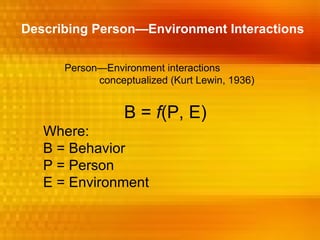
      Person—Environment interactions
            conceptualized (Kurt Lewin, 1936)


                  B = f(P, E)
   Where:
   B = Behavior
   P = Person
   E = Environment
Describing Person—Environment Interactions

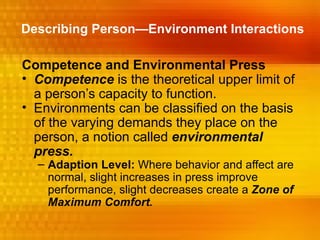
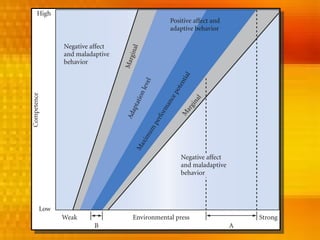
Competence and Environmental Press
• Competence is the theoretical upper limit of
  a person’s capacity to function.
• Environments can be classified on the basis
  of the varying demands they place on the
  person, a notion called environmental
  press.
  – Adaption Level: Where behavior and affect are
    normal, slight increases in press improve
    performance, slight decreases create a Zone of
    Maximum Comfort.
Describing Person—Environment Interactions
The Congruence Model
• According to Kahana’s (1982) congruence
  model, people with particular needs search
  for the environments that meet them best.
• Can you offer examples?

    1. A person without personal transportation seeks a
       house near a bus route.
    2. A handicapped person needs a home adapted to
       a wheelchair (no steps).
    3. An elderly person may need to relocate to an
       assisted-living facility.
Describing Person—Environment Interactions

Stress and Coping Framework
• Interaction with the environment can
  produce stress (Lazarus, 1984).
• Evaluating one’s situation and surroundings
  for potential threat value
  – Harmful
  – Beneficial
  – Irrelevant
• If harmful, what is the coping mechanism
  and response? Outcome positive or
  negative?
Describing Person—Environment Interactions

Common Theoretical Themes and
  Everyday Competence
• Everyday competence is a person’s
  potential ability to perform a wide range
  of activities considered essential for
  independent living.
  – Broader than just ADL or IADL
  – Necessary determinate for whether an
    elderly person can take care of themselves
The Ecology of Aging

Learning Objectives
• What is aging in place?
• How do people decide the best option?
• How can a home be modified to provide a
  supportive environment?
• What options and services are provided in adult day
  care?
• What is congregate housing?
• What are the characteristics of assisted living?
The Ecology of Aging

• Aging in Place
  – Balancing environment press and competence
    through selection and compensation.
  – How a place becomes a home.
  – Cluster housing.
The Ecology of Aging

• Deciding on the Best Option
  – Does the individual have significant cognitive or
    physical impairment requiring intervention?
     • What is the severity?
  – The individual needs to be an integral part of the
    decision making.
  – Get a physician’s diagnostic evaluation (required in
    many states).
The Ecology of Aging

• Home Modification
  – Helping people deal with tasks of daily living by
    modifying the environment
     •   Hook for car keys near the door
     •   Hand rails in bathrooms
     •   Door handles that are easier to grasp
     •   Widening doorways
     •   Lowering countertops
     •   Wheelchair ramps
The Ecology of Aging

• Adult Day Care
  – Designed to provide support, companionship, and
    certain services during the day
  – Goal is to delay placement in more formal care
    setting.
  – Three types of adult day care
    • Social services, meals, recreation, and minor health
      care
    • More intensive health care, therapy, for serious medical
      problems
    • Specialize care for dementia or developmental
      disabilities.

            Profit (22%) or non-profit (78%)
The Ecology of Aging

• Congregate Housing
  – Apartment complex for older adults
     • Shared meals
     • Affordable
  – Differs from assisted living in level of services
  – Residents must be capable of independent living
    and:
     •   Not require continual medical care
     •   Know where they are and oriented to time
     •   No evidence of disruptive behavior
     •   Able to make independent decisions
     •   Be able to follow specific service plans
The Ecology of Aging

• Assisted Living
    – Provides a supportive living arrangement for
      people who need assistance with personal
      care (bathing, taking medication) but are not
      physically or mentally impaired to require 24-
      hour care.
• Has three essential attributes
3. As much like a single family house as possible
4. Emphasizes personal control, choice, dignity, and autonomy
5. Should meet routine services and special needs
The Ecology of Aging

• Assisted Living (continued)
  – Utilize check list to ensure the selected
    facility meets specific requirements of the
    individual
  – Costs average about $35,000 per year.
  – Not offset by Medicare

• Specialty Care Assisted Living
Living in Nursing Homes

Learning Objectives
• What are the major types of nursing homes?
• Who is most likely to live in nursing homes?
• What are the key characteristics of nursing homes?
• What are special care units?
• How can a nursing home be a home?
• How should people communicate with nursing home
  residents?
• How is decision-making capacity assessed?
• What are some new directions for nursing homes?
Living in Nursing Homes


Types of Nursing Homes
• Two levels of care are defined in
  federal regulations.
  – Skilled nursing care consisting of 24-hour care,
    including medical and other health services
  – Intermediate care also 24-hour but at a less
    intensity
Living in Nursing Homes

Who is Likely to Live in Nursing Homes?
• Characteristics of People Most Likely to Be
  Placed in a Nursing Home
  –   Over age 85
  –   Female
  –   Recently admitted to a hospital
  –   Lives in retirement housing rather than being a
      homeowner
  –   Widowed or divorced
  –   Has no children or siblings nearby
  –   Has some cognitive impairment
  –   Has one or more problems with IADL
Living in Nursing Homes


Who is Likely to Live in Nursing Homes?
• Health issues and functional impairment
  – Average resident has significant mental and
    physical problems
  – Main reason for placement (80%)
  – One third of residents have mobility, eating or
    incontinence problems.
  – 30 to 40% show signs of clinical depression.
Living in Nursing Homes


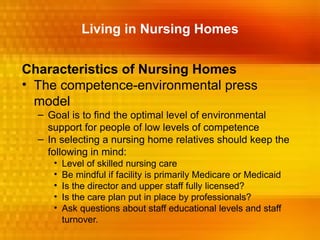
Characteristics of Nursing Homes
• The competence-environmental press
  model
  – Goal is to find the optimal level of environmental
    support for people of low levels of competence
  – In selecting a nursing home relatives should keep the
    following in mind:
     •   Level of skilled nursing care
     •   Be mindful if facility is primarily Medicare or Medicaid
     •   Is the director and upper staff fully licensed?
     •   Is the care plan put in place by professionals?
     •   Ask questions about staff educational levels and staff
         turnover.
Living in Nursing Homes


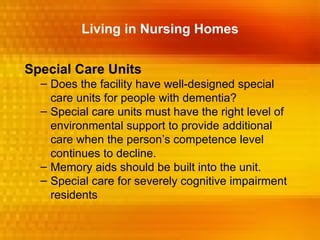
Special Care Units
  – Does the facility have well-designed special
    care units for people with dementia?
  – Special care units must have the right level of
    environmental support to provide additional
    care when the person’s competence level
    continues to decline.
  – Memory aids should be built into the unit.
  – Special care for severely cognitive impairment
    residents
Living in Nursing Homes


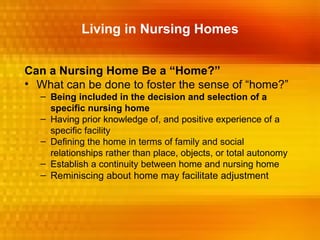
Can a Nursing Home Be a “Home?”
• What can be done to foster the sense of “home?”
  – Being included in the decision and selection of a
    specific nursing home
  – Having prior knowledge of, and positive experience of a
    specific facility
  – Defining the home in terms of family and social
    relationships rather than place, objects, or total autonomy
  – Establish a continuity between home and nursing home
  – Reminiscing about home may facilitate adjustment
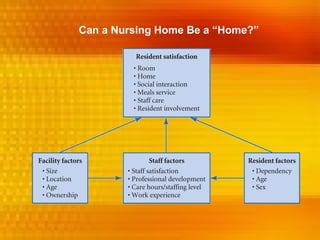
Can a Nursing Home Be a “Home?”
Living in Nursing Homes


How Not to Communicate with Residents
• Patronizing speech
• Infantilization or baby “talk”
• Inappropriate use of first names
• Terms of endearment—“Honey,” “Sweetie”
• Assumption of greater impairment than may
  be the case
• Cajoling to demand compliance
  to persuade with flattery or gentle urging especially in the face of reluctance
Living in Nursing Homes


Decision-Making Capacity and Individual
Choices
• How well can a nursing home resident
  make decisions regarding their care?
  – Cognitive impairment
  – Patient Self-Determination Act (PSDA)
  – Provide written information at time of admission
    concerning their right to make treatment decisions
  – Living will
  – Patients normally give the decision to family
    members.
Living in Nursing Homes


New Directions for Nursing Homes
• The Eden Alternative
  – The ten principles of the Eden Alternative.
  – Use of pets and other approaches seem to make
    stronger associations between current and former
    living situations.
     • Research (Coleman et al. 2002) does not
         support this view.
     • Quality of Life difficult to assess using
         traditional methods.
     • Further research needed in this area.
Living in Nursing Homes


New Directions for Nursing Homes
• Green House Project
  – Radical departure from the idea of large residential
    facilities
  – Encourages residents to participate in their care
    through helping with daily tasks
  – Personal dignity is maintained and quality of life is
    improved.
Living in Nursing Homes


New Directions for Nursing Homes
• The Pioneer Network
  –   Similar values
  –   Older persons are valuable to society.
  –   Treating all people with dignity
  –   Everyone deserves that.

5 HUS 133 Where People Live

  • 1.
    Adulthood and Aging,6e John C. Cavanaugh Fredda Blanchard-Fields Chapter five Where People Live: Person-Environment Interactions
  • 2.
    Describing Person—Environment Interactions LearningObjectives • What is the competence and environmental press model? • What is the congruence model? • What are the major aspects of stress and coping theory relating to person—environment interactions? • What are the common themes in the theories of person—environment interactions?
  • 3.
    Describing Person—Environment Interactions Person—Environment interactions conceptualized (Kurt Lewin, 1936) B = f(P, E) Where: B = Behavior P = Person E = Environment
  • 4.
    Describing Person—Environment Interactions Competenceand Environmental Press • Competence is the theoretical upper limit of a person’s capacity to function. • Environments can be classified on the basis of the varying demands they place on the person, a notion called environmental press. – Adaption Level: Where behavior and affect are normal, slight increases in press improve performance, slight decreases create a Zone of Maximum Comfort.
  • 6.
    Describing Person—Environment Interactions TheCongruence Model • According to Kahana’s (1982) congruence model, people with particular needs search for the environments that meet them best. • Can you offer examples? 1. A person without personal transportation seeks a house near a bus route. 2. A handicapped person needs a home adapted to a wheelchair (no steps). 3. An elderly person may need to relocate to an assisted-living facility.
  • 7.
    Describing Person—Environment Interactions Stressand Coping Framework • Interaction with the environment can produce stress (Lazarus, 1984). • Evaluating one’s situation and surroundings for potential threat value – Harmful – Beneficial – Irrelevant • If harmful, what is the coping mechanism and response? Outcome positive or negative?
  • 8.
    Describing Person—Environment Interactions CommonTheoretical Themes and Everyday Competence • Everyday competence is a person’s potential ability to perform a wide range of activities considered essential for independent living. – Broader than just ADL or IADL – Necessary determinate for whether an elderly person can take care of themselves
  • 9.
    The Ecology ofAging Learning Objectives • What is aging in place? • How do people decide the best option? • How can a home be modified to provide a supportive environment? • What options and services are provided in adult day care? • What is congregate housing? • What are the characteristics of assisted living?
  • 10.
    The Ecology ofAging • Aging in Place – Balancing environment press and competence through selection and compensation. – How a place becomes a home. – Cluster housing.
  • 11.
  • 12.
    The Ecology ofAging • Deciding on the Best Option – Does the individual have significant cognitive or physical impairment requiring intervention? • What is the severity? – The individual needs to be an integral part of the decision making. – Get a physician’s diagnostic evaluation (required in many states).
  • 13.
    The Ecology ofAging • Home Modification – Helping people deal with tasks of daily living by modifying the environment • Hook for car keys near the door • Hand rails in bathrooms • Door handles that are easier to grasp • Widening doorways • Lowering countertops • Wheelchair ramps
  • 14.
    The Ecology ofAging • Adult Day Care – Designed to provide support, companionship, and certain services during the day – Goal is to delay placement in more formal care setting. – Three types of adult day care • Social services, meals, recreation, and minor health care • More intensive health care, therapy, for serious medical problems • Specialize care for dementia or developmental disabilities. Profit (22%) or non-profit (78%)
  • 15.
    The Ecology ofAging • Congregate Housing – Apartment complex for older adults • Shared meals • Affordable – Differs from assisted living in level of services – Residents must be capable of independent living and: • Not require continual medical care • Know where they are and oriented to time • No evidence of disruptive behavior • Able to make independent decisions • Be able to follow specific service plans
  • 16.
    The Ecology ofAging • Assisted Living – Provides a supportive living arrangement for people who need assistance with personal care (bathing, taking medication) but are not physically or mentally impaired to require 24- hour care. • Has three essential attributes 3. As much like a single family house as possible 4. Emphasizes personal control, choice, dignity, and autonomy 5. Should meet routine services and special needs
  • 17.
    The Ecology ofAging • Assisted Living (continued) – Utilize check list to ensure the selected facility meets specific requirements of the individual – Costs average about $35,000 per year. – Not offset by Medicare • Specialty Care Assisted Living
  • 18.
    Living in NursingHomes Learning Objectives • What are the major types of nursing homes? • Who is most likely to live in nursing homes? • What are the key characteristics of nursing homes? • What are special care units? • How can a nursing home be a home? • How should people communicate with nursing home residents? • How is decision-making capacity assessed? • What are some new directions for nursing homes?
  • 19.
    Living in NursingHomes Types of Nursing Homes • Two levels of care are defined in federal regulations. – Skilled nursing care consisting of 24-hour care, including medical and other health services – Intermediate care also 24-hour but at a less intensity
  • 21.
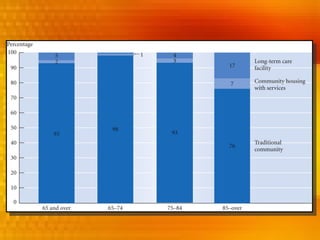
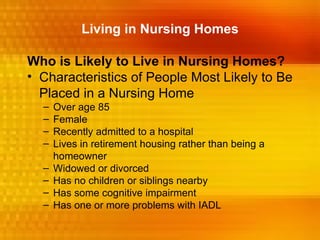
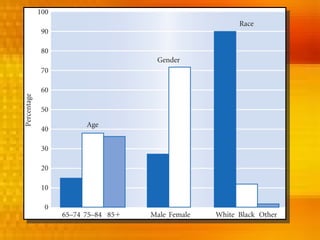
    Living in NursingHomes Who is Likely to Live in Nursing Homes? • Characteristics of People Most Likely to Be Placed in a Nursing Home – Over age 85 – Female – Recently admitted to a hospital – Lives in retirement housing rather than being a homeowner – Widowed or divorced – Has no children or siblings nearby – Has some cognitive impairment – Has one or more problems with IADL
  • 22.
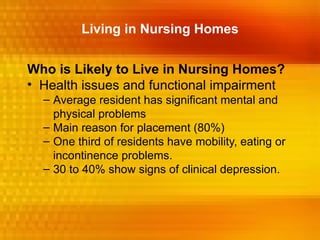
    Living in NursingHomes Who is Likely to Live in Nursing Homes? • Health issues and functional impairment – Average resident has significant mental and physical problems – Main reason for placement (80%) – One third of residents have mobility, eating or incontinence problems. – 30 to 40% show signs of clinical depression.
  • 24.
    Living in NursingHomes Characteristics of Nursing Homes • The competence-environmental press model – Goal is to find the optimal level of environmental support for people of low levels of competence – In selecting a nursing home relatives should keep the following in mind: • Level of skilled nursing care • Be mindful if facility is primarily Medicare or Medicaid • Is the director and upper staff fully licensed? • Is the care plan put in place by professionals? • Ask questions about staff educational levels and staff turnover.
  • 25.
    Living in NursingHomes Special Care Units – Does the facility have well-designed special care units for people with dementia? – Special care units must have the right level of environmental support to provide additional care when the person’s competence level continues to decline. – Memory aids should be built into the unit. – Special care for severely cognitive impairment residents
  • 26.
    Living in NursingHomes Can a Nursing Home Be a “Home?” • What can be done to foster the sense of “home?” – Being included in the decision and selection of a specific nursing home – Having prior knowledge of, and positive experience of a specific facility – Defining the home in terms of family and social relationships rather than place, objects, or total autonomy – Establish a continuity between home and nursing home – Reminiscing about home may facilitate adjustment
  • 27.
    Can a NursingHome Be a “Home?”
  • 28.
    Living in NursingHomes How Not to Communicate with Residents • Patronizing speech • Infantilization or baby “talk” • Inappropriate use of first names • Terms of endearment—“Honey,” “Sweetie” • Assumption of greater impairment than may be the case • Cajoling to demand compliance to persuade with flattery or gentle urging especially in the face of reluctance
  • 30.
    Living in NursingHomes Decision-Making Capacity and Individual Choices • How well can a nursing home resident make decisions regarding their care? – Cognitive impairment – Patient Self-Determination Act (PSDA) – Provide written information at time of admission concerning their right to make treatment decisions – Living will – Patients normally give the decision to family members.
  • 31.
    Living in NursingHomes New Directions for Nursing Homes • The Eden Alternative – The ten principles of the Eden Alternative. – Use of pets and other approaches seem to make stronger associations between current and former living situations. • Research (Coleman et al. 2002) does not support this view. • Quality of Life difficult to assess using traditional methods. • Further research needed in this area.
  • 32.
    Living in NursingHomes New Directions for Nursing Homes • Green House Project – Radical departure from the idea of large residential facilities – Encourages residents to participate in their care through helping with daily tasks – Personal dignity is maintained and quality of life is improved.
  • 33.
    Living in NursingHomes New Directions for Nursing Homes • The Pioneer Network – Similar values – Older persons are valuable to society. – Treating all people with dignity – Everyone deserves that.

Editor's Notes

  • #6 Figure 5.1 Behavior and emotional outcomes
  • #21 Figure 5.2 Percentage of Medicare enrollees
  • #24 Figure 5.3 Demographic characteristics of nursing home residents
  • #28 Figure 5.4 Major factors influencing resident satisfaction
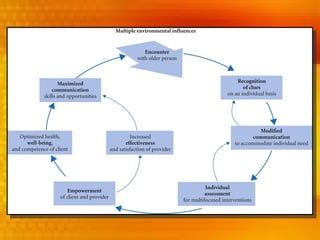
  • #30 Figure 5.5 The communication enhancement model