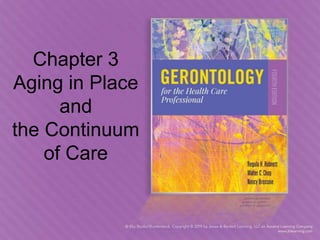
Chapter 3
Aging in Place
and
the Continuum
of Care
Objectives (1 of 2)
1. Define aging in place and describe the
benefits of aging in place.
2. Discuss the connection between housing,
health care, and least restrictive
environment.
3. Compare and contrast housing options
along the continuum of care.
4. Discuss the role of person-centered care
along the continuum of care.
Objectives (2 of 2)
5. Describe how technology has impacted
health care, especially for older adults.
6. Discuss ways that healthcare
professionals can support aging in place
and productive aging with their clients.
Aging in Place (1 of 5)
• Ability to remain in one’s own home or
community as one ages
• Can support the acute care needs and
compression of morbidity
• Critics argue that aging in place would be
detrimental to the health of some older
adults
– Aging in place is not limited to the current
residence or situation
Aging in Place (2 of 5)
• Independence
– Definition can vary
– Healthcare practitioners must facilitate the
independence of persons under their care
– Assistance with ADLs and IADLs should be
provided in the least restrictive environment
possible
Aging in Place (3 of 5)
• Productive aging
– Refers to making valued contributions to
one’s life by engaging in enjoyable,
meaningful, and useful activities
– Also associated with longevity
– Benefits the body, mind, and spirit
– Promotes successful aging
Aging in Place (4 of 5)
• Competency
– Professionals may find themselves
questioning a client’s behaviors and ability to
comprehend the consequences of their
actions
– Competency is a legal determination
• Only the court can determine if an individual is
incompetent to make their own decisions
Aging in Place (5 of 5)
• Person-centered care
– Providing care that meets the therapeutic
needs of the individual rather than engaging
in prescriptive care
– Many intake assessments utilize a
biopsychosocial approach to better
understand individuals’ needs
• First step to offering person-centered care services
in the least restrictive environment
Technology-Based Services
(1 of 2)
• Assistive technology (AT)
– Any product used to increase, maintain, or
improve the functional capabilities of
individuals needing specialized help
– Type used depends on the individual’s needs
– As functioning levels change, the AT should
also change so the individual can remain as
high functioning as possible
Technology-Based Services
(2 of 2)
• Gerontechnology
– Professional field that focuses on technology
specifically designed for supporting older
adults
– New innovations offer great promise, but:
• Products cannot replace social interactions that
emerge during direct contact with care providers
• Individuals may perceive being watched or listened
to continuously as intrusive
Universal Design (1 of 3)
• “Design and composition of an
environment so that it can be accessed,
understood and used to the greatest
extent possible by all people regardless
of their age, size, ability, or disability”
– Centre for Excellence in Universal Design,
2014a
Universal Design (2 of 3)
• Guided by seven principles:
– Equitable use
– Flexibility in use
– Simple and intuitive use
– Perceptible information
– Tolerance for error
– Low physical effort
– Size and space for approach and use
Universal Design (3 of 3)
• Buildings that incorporate universal
design include features such as access
ramps, one-story construction, and
nonslip floor finishes
• Universal design is not the same as
accessibility
– Accessibility is the ability to navigate through
the environment
Continuum of Care (1 of 11)
• Service delivery model that provides a
way to connect types of housing with
healthcare services in a way that
supports aging in place in the least
restrictive environments possible
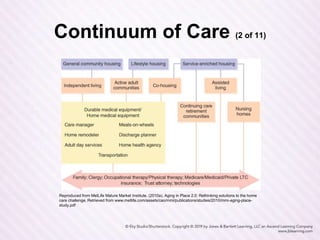
Continuum of Care (2 of 11)
Reproduced from MetLife Mature Market Institute. (2010a). Aging in Place 2.0: Rethinking solutions to the home
care challenge. Retrieved from www.metlife.com/assets/cao/mmi/publications/studies/2010/mmi-aging-place-
study.pdf
Continuum of Care (3 of 11)
• Independent living
– Ideally, the option to live independently should
exist for as long as possible
– Retirement communities cater specifically to
older adults and offer diverse housing options
• Acceptance is generally based on age or
retirement status
• First was Sun City, Arizona
Continuum of Care (4 of 11)
• Active adult communities
– Communities such as Sun City require that
residents have financial resources to
purchase their homes and pay fees
– Examples:
• Naturally occurring retirement communities
• Village model
• Subsidized senior housing
Continuum of Care (5 of 11)
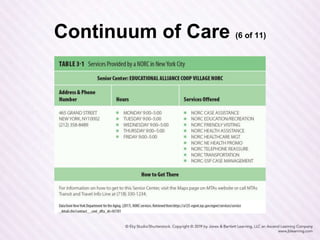
• Naturally occurring retirement community
(NORC)
– Neighborhood, multi-unit dwelling, or group of
buildings in which the majority of residents are
older adults
– Evolve from existing communities
– Tend to be located in densely populated
areas
– Small group efforts unite to form a NORC
program
Continuum of Care (6 of 11)
Continuum of Care (7 of 11)
• Village model
– Resident-governed community service and
support model
– Members live in their own homes, but work
with other Village members to coordinate
needed nonmedical services and care
– Funded by annual membership dues
– Members commit to collaborating with each
other
Continuum of Care (8 of 11)
• Subsidized senior housing
– Funded through HUD and implemented at
state and local levels
– Need has surpassed the number of available
units
– Apartments are restricted to residents age 62
years and older, who must meet income
eligibility requirements
– Drawbacks include long waiting lists, low
quality of apartments, and financial limitations
Continuum of Care (9 of 11)
• Congregate living arrangements
– May resemble any other apartment or house
– Usually offer group dining, housekeeping, and
socialization opportunities
– Provide at least a minimum level of
assistance in accessing personal assistance
or health services
– Examples include cohousing and shared
housing
Continuum of Care (10 of 11)
• Cohousing
– Type of collaborative housing in which
residents actively participate in the design and
operation of their own neighborhoods
– Intentional communities with private homes
and common facilities
– Operate using consensus governing, shared
responsibilities, and mutual assistance
Continuum of Care (11 of 11)
• Shared homes
– Less formal than cohousing
– May take place in any home in the community
– People might share expenses or exchange
services for rent
– Can be intergenerational
Community-Based
Services and Supports (1 of 7)
• Home and community-based services
(HCBS)
– One aspect of the larger system of long-term
care services and supports (LTCSS)
• Include an array of services and supports for
people who need assistance to function in
everyday life
• Services may be needed on a regular or
intermittent basis and may be delivered in a variety
of settings
Community-Based
Services and Supports (2 of 7)
• The need for long-term care is usually
measured by assessing limitation in an
individual’s capacity to perform or
manage ADLs and IADLs
• Most people who need LTCSS live at
home or in community settings, not in
institutions
• The majority of those receiving care
receive it at home from family caregivers
Community-Based
Services and Supports (3 of 7)
• Home health services
– Skilled care refers to services requiring a high
level of skill, which can only be provided by
credentialed professionals
– These services are included in a treatment
plan only when they are deemed medically
necessary
– Dramatically reduces health costs when
compared to providing care in a skilled care
facility
Community-Based
Services and Supports (4 of 7)
• Program of All-Inclusive Care for the
Elderly (PACE)
– Offers services to people age 55 and older
needing a level of care normally provided in a
nursing home
– PACE programs include meals, counseling,
respite, medication management,
transportation to and from the site, and an
adult day program
– Patient outcomes have been positive
Community-Based
Services and Supports (5 of 7)
• Aging network services
– Older Americans Act (OAA) provides federal
funds for nonmedical services to support older
adults meeting federal poverty guidelines
– nonmedical home care services
• Offer assistance such as daily care, housekeeping,
transportation, and companionship
• Consumers can often hire and manage the person
providing services
Community-Based
Services and Supports (6 of 7)
• Adult day services (ADS)
– Offer programs of activities, health monitoring,
socialization, and assistance with ADLs for
individuals requiring daily supervision and
oversight
– Allows individuals to continue living at home
and receive needed care in a community-
based setting
– Decreases caregiver stress
Community-Based
Services and Supports (7 of 7)
• HCBS also includes single use and long-
term use services such as:
– Transportation
– Meal services
– Chore services
– Telephone reassurance programs
Service-Enriched
Communities (1 of 4)
• Continuing Care Retirement Community
(CCRC)
– Provides a spectrum of lifetime care to
residents
– Generally involves initial and monthly fees
– Various housing options are available and
may be purchased or rented
– Services may include medical or nonmedical
– Out of the financial reach of most older adults
Service-Enriched
Communities (2 of 4)
• Assisted living facility (ALF)
– Broad term that describes several types of
congregate living arrangements
– For people who could live independently if
offered support with ADLs and IADLs
– Residents pay monthly rent and additional
fees
– Not covered by Medicare
– Some specialize in people with specific
conditions
Service-Enriched
Communities (3 of 4)
• Nursing facilities
– Provide around-the-clock care with the
services of RNs, LPNs, and nursing home
aids
– Services are shifting away from long-term
care toward rehabilitation therapies
– Subject to federal and state oversight
– Still a widespread fear and hatred of nursing
homes due to negative experiences in the
past
Service-Enriched
Communities (4 of 4)
• Rehabilitation
– Helping someone regain the highest possible
level of functioning after an injury or illness
– Rehabilitation therapists work with clients in a
variety of settings at different levels of
intensity, depending on the client’s needs
– Includes exercise, education, and training or
retraining in functional tasks
Person-Centered Approaches
to Institutional Care (1 of 6)
• Hogeweyk
– Village-styled nursing home near Amsterdam
specifically for persons with Alzheimer’s disease
– Offers 23 units, each decorated in a specific
style
– Each unit houses 6 or 7 residents and has a
caretaker that provides assistance
– Residents have access to the entire campus
– Promotes sense of normalcy
Person-Centered Approaches
to Institutional Care (2 of 6)
• Eden Alternative
– Developed by Bill Thomas in the 1990s
– Fought to bring live plants and animals into
the nursing care facility where he was medical
director
– Non-ambulatory people started walking so
they could “walk the dog”
– Number of prescriptions per resident
decreased by 50%
Person-Centered Approaches
to Institutional Care (3 of 6)
• Eden Alternative model principles
– Three plagues of loneliness, helplessness,
and boredom account for the bulk of suffering
– An Elder-centered community commits to
creating a Human Habitat where life revolves
around close, continuing contact with people
of all ages and abilities, as well as plants and
animals
– Loving companionship is the antidote to
loneliness
Person-Centered Approaches
to Institutional Care (4 of 6)
• Eden Alternative model principles
(continued)
– An Elder-centered community creates
opportunity to give as well as receive care
– An Elder-centered community imbues daily
life with variety and spontaneity by creating an
environment in which unexpected and
unpredictable interactions and happenings
can take place
Person-Centered Approaches
to Institutional Care (5 of 6)
• Eden Alternative model principles (continued)
– The opportunity to do things that we find meaningful
is essential to human health
– Medical treatment should be the servant of genuine
human caring, never its master
– An Elder-centered community honors its Elders by
de-emphasizing bureaucratic authority, seeking
instead to place the maximum possible decision-
making authority in the hands of the Elders
Person-Centered Approaches
to Institutional Care (6 of 6)
• Eden Alternative model principles
(continued)
– Creating an Elder-centered community is a
never-ending process; human growth must
never be separated from human life
– Wise leadership is the lifeblood of any
struggle against the three plagues
Special Topics and Issues (1 of 7)
• Telehealth
– Allows provider to visit with and monitor
patients using telecommunications and
modified physiological assessment devices
– Saves money for providers and patients
– When combined with in-home care as
needed, it may help prevent hospital
readmissions
– Potential for more uses in providing services
and supports
Special Topics and Issues (2 of 7)
• Paying for LTCSS
– Nearly half of all reimbursements are paid
through Medicare
– Medicaid can cover more HCBS service costs
than Medicare
– Some people are purchasing long-term care
insurance to pay for services they may need
in the future while protecting financial assets
Special Topics and Issues (3 of 7)
• Homelessness
– Homelessness rates of older adults are on the
rise
– When income and housing needs are
compounded by chronic health problems,
long-term homelessness results
– Healthcare practitioners can combat
homelessness by remaining attentive to each
client’s biopsychosocial needs
Special Topics and Issues (4 of 7)
• Home modifications
– Necessary for safety and comfort
– Physician should refer older adults with
debilitating health problems to an
occupational or physical therapist for a full
home evaluation
– Homeowner must secure a contractor
– May require extensive remodeling
– May be more cost effective to move
Special Topics and Issues (5 of 7)
• Smaller home modifications may include:
– Adding raised toilet seats and grab bars
– Stabilizing or eliminating scatter and area
rugs
– Improving lighting levels
– Using shower seats or bath transfer benches
– Removing door thresholds
– Moving commonly used items into easily
reached spaces
Special Topics and Issues (6 of 7)
• Occupational or physical therapist can help
the individual learn to:
– Transfer into and out of the tub or shower safely
– Use a walker or cane
– Use safe techniques with kitchen appliances
– Use joint protection and energy conservation
techniques
– Compensate for changes in eyesight, memory,
and hearing
Special Topics and Issues (7 of 7)
• Reverse mortgages
– Federally insured program in which borrowers
use their home as collateral, and the bank
sets up either an annuity or line of credit to be
drawn from as needed until the home is sold
or the loan repaid
– Program users can face bankruptcy if they
cannot pay monthly fees, overdraw on the
equity of their home, or outlive the equity
available

SWK-597-43W Chapter 3

  • 1.
    Chapter 3 Aging inPlace and the Continuum of Care
  • 2.
    Objectives (1 of2) 1. Define aging in place and describe the benefits of aging in place. 2. Discuss the connection between housing, health care, and least restrictive environment. 3. Compare and contrast housing options along the continuum of care. 4. Discuss the role of person-centered care along the continuum of care.
  • 3.
    Objectives (2 of2) 5. Describe how technology has impacted health care, especially for older adults. 6. Discuss ways that healthcare professionals can support aging in place and productive aging with their clients.
  • 4.
    Aging in Place(1 of 5) • Ability to remain in one’s own home or community as one ages • Can support the acute care needs and compression of morbidity • Critics argue that aging in place would be detrimental to the health of some older adults – Aging in place is not limited to the current residence or situation
  • 5.
    Aging in Place(2 of 5) • Independence – Definition can vary – Healthcare practitioners must facilitate the independence of persons under their care – Assistance with ADLs and IADLs should be provided in the least restrictive environment possible
  • 6.
    Aging in Place(3 of 5) • Productive aging – Refers to making valued contributions to one’s life by engaging in enjoyable, meaningful, and useful activities – Also associated with longevity – Benefits the body, mind, and spirit – Promotes successful aging
  • 7.
    Aging in Place(4 of 5) • Competency – Professionals may find themselves questioning a client’s behaviors and ability to comprehend the consequences of their actions – Competency is a legal determination • Only the court can determine if an individual is incompetent to make their own decisions
  • 8.
    Aging in Place(5 of 5) • Person-centered care – Providing care that meets the therapeutic needs of the individual rather than engaging in prescriptive care – Many intake assessments utilize a biopsychosocial approach to better understand individuals’ needs • First step to offering person-centered care services in the least restrictive environment
  • 9.
    Technology-Based Services (1 of2) • Assistive technology (AT) – Any product used to increase, maintain, or improve the functional capabilities of individuals needing specialized help – Type used depends on the individual’s needs – As functioning levels change, the AT should also change so the individual can remain as high functioning as possible
  • 10.
    Technology-Based Services (2 of2) • Gerontechnology – Professional field that focuses on technology specifically designed for supporting older adults – New innovations offer great promise, but: • Products cannot replace social interactions that emerge during direct contact with care providers • Individuals may perceive being watched or listened to continuously as intrusive
  • 11.
    Universal Design (1of 3) • “Design and composition of an environment so that it can be accessed, understood and used to the greatest extent possible by all people regardless of their age, size, ability, or disability” – Centre for Excellence in Universal Design, 2014a
  • 12.
    Universal Design (2of 3) • Guided by seven principles: – Equitable use – Flexibility in use – Simple and intuitive use – Perceptible information – Tolerance for error – Low physical effort – Size and space for approach and use
  • 13.
    Universal Design (3of 3) • Buildings that incorporate universal design include features such as access ramps, one-story construction, and nonslip floor finishes • Universal design is not the same as accessibility – Accessibility is the ability to navigate through the environment
  • 14.
    Continuum of Care(1 of 11) • Service delivery model that provides a way to connect types of housing with healthcare services in a way that supports aging in place in the least restrictive environments possible
  • 15.
    Continuum of Care(2 of 11) Reproduced from MetLife Mature Market Institute. (2010a). Aging in Place 2.0: Rethinking solutions to the home care challenge. Retrieved from www.metlife.com/assets/cao/mmi/publications/studies/2010/mmi-aging-place- study.pdf
  • 16.
    Continuum of Care(3 of 11) • Independent living – Ideally, the option to live independently should exist for as long as possible – Retirement communities cater specifically to older adults and offer diverse housing options • Acceptance is generally based on age or retirement status • First was Sun City, Arizona
  • 17.
    Continuum of Care(4 of 11) • Active adult communities – Communities such as Sun City require that residents have financial resources to purchase their homes and pay fees – Examples: • Naturally occurring retirement communities • Village model • Subsidized senior housing
  • 18.
    Continuum of Care(5 of 11) • Naturally occurring retirement community (NORC) – Neighborhood, multi-unit dwelling, or group of buildings in which the majority of residents are older adults – Evolve from existing communities – Tend to be located in densely populated areas – Small group efforts unite to form a NORC program
  • 19.
  • 20.
    Continuum of Care(7 of 11) • Village model – Resident-governed community service and support model – Members live in their own homes, but work with other Village members to coordinate needed nonmedical services and care – Funded by annual membership dues – Members commit to collaborating with each other
  • 21.
    Continuum of Care(8 of 11) • Subsidized senior housing – Funded through HUD and implemented at state and local levels – Need has surpassed the number of available units – Apartments are restricted to residents age 62 years and older, who must meet income eligibility requirements – Drawbacks include long waiting lists, low quality of apartments, and financial limitations
  • 22.
    Continuum of Care(9 of 11) • Congregate living arrangements – May resemble any other apartment or house – Usually offer group dining, housekeeping, and socialization opportunities – Provide at least a minimum level of assistance in accessing personal assistance or health services – Examples include cohousing and shared housing
  • 23.
    Continuum of Care(10 of 11) • Cohousing – Type of collaborative housing in which residents actively participate in the design and operation of their own neighborhoods – Intentional communities with private homes and common facilities – Operate using consensus governing, shared responsibilities, and mutual assistance
  • 24.
    Continuum of Care(11 of 11) • Shared homes – Less formal than cohousing – May take place in any home in the community – People might share expenses or exchange services for rent – Can be intergenerational
  • 25.
    Community-Based Services and Supports(1 of 7) • Home and community-based services (HCBS) – One aspect of the larger system of long-term care services and supports (LTCSS) • Include an array of services and supports for people who need assistance to function in everyday life • Services may be needed on a regular or intermittent basis and may be delivered in a variety of settings
  • 26.
    Community-Based Services and Supports(2 of 7) • The need for long-term care is usually measured by assessing limitation in an individual’s capacity to perform or manage ADLs and IADLs • Most people who need LTCSS live at home or in community settings, not in institutions • The majority of those receiving care receive it at home from family caregivers
  • 27.
    Community-Based Services and Supports(3 of 7) • Home health services – Skilled care refers to services requiring a high level of skill, which can only be provided by credentialed professionals – These services are included in a treatment plan only when they are deemed medically necessary – Dramatically reduces health costs when compared to providing care in a skilled care facility
  • 28.
    Community-Based Services and Supports(4 of 7) • Program of All-Inclusive Care for the Elderly (PACE) – Offers services to people age 55 and older needing a level of care normally provided in a nursing home – PACE programs include meals, counseling, respite, medication management, transportation to and from the site, and an adult day program – Patient outcomes have been positive
  • 29.
    Community-Based Services and Supports(5 of 7) • Aging network services – Older Americans Act (OAA) provides federal funds for nonmedical services to support older adults meeting federal poverty guidelines – nonmedical home care services • Offer assistance such as daily care, housekeeping, transportation, and companionship • Consumers can often hire and manage the person providing services
  • 30.
    Community-Based Services and Supports(6 of 7) • Adult day services (ADS) – Offer programs of activities, health monitoring, socialization, and assistance with ADLs for individuals requiring daily supervision and oversight – Allows individuals to continue living at home and receive needed care in a community- based setting – Decreases caregiver stress
  • 31.
    Community-Based Services and Supports(7 of 7) • HCBS also includes single use and long- term use services such as: – Transportation – Meal services – Chore services – Telephone reassurance programs
  • 32.
    Service-Enriched Communities (1 of4) • Continuing Care Retirement Community (CCRC) – Provides a spectrum of lifetime care to residents – Generally involves initial and monthly fees – Various housing options are available and may be purchased or rented – Services may include medical or nonmedical – Out of the financial reach of most older adults
  • 33.
    Service-Enriched Communities (2 of4) • Assisted living facility (ALF) – Broad term that describes several types of congregate living arrangements – For people who could live independently if offered support with ADLs and IADLs – Residents pay monthly rent and additional fees – Not covered by Medicare – Some specialize in people with specific conditions
  • 34.
    Service-Enriched Communities (3 of4) • Nursing facilities – Provide around-the-clock care with the services of RNs, LPNs, and nursing home aids – Services are shifting away from long-term care toward rehabilitation therapies – Subject to federal and state oversight – Still a widespread fear and hatred of nursing homes due to negative experiences in the past
  • 35.
    Service-Enriched Communities (4 of4) • Rehabilitation – Helping someone regain the highest possible level of functioning after an injury or illness – Rehabilitation therapists work with clients in a variety of settings at different levels of intensity, depending on the client’s needs – Includes exercise, education, and training or retraining in functional tasks
  • 36.
    Person-Centered Approaches to InstitutionalCare (1 of 6) • Hogeweyk – Village-styled nursing home near Amsterdam specifically for persons with Alzheimer’s disease – Offers 23 units, each decorated in a specific style – Each unit houses 6 or 7 residents and has a caretaker that provides assistance – Residents have access to the entire campus – Promotes sense of normalcy
  • 37.
    Person-Centered Approaches to InstitutionalCare (2 of 6) • Eden Alternative – Developed by Bill Thomas in the 1990s – Fought to bring live plants and animals into the nursing care facility where he was medical director – Non-ambulatory people started walking so they could “walk the dog” – Number of prescriptions per resident decreased by 50%
  • 38.
    Person-Centered Approaches to InstitutionalCare (3 of 6) • Eden Alternative model principles – Three plagues of loneliness, helplessness, and boredom account for the bulk of suffering – An Elder-centered community commits to creating a Human Habitat where life revolves around close, continuing contact with people of all ages and abilities, as well as plants and animals – Loving companionship is the antidote to loneliness
  • 39.
    Person-Centered Approaches to InstitutionalCare (4 of 6) • Eden Alternative model principles (continued) – An Elder-centered community creates opportunity to give as well as receive care – An Elder-centered community imbues daily life with variety and spontaneity by creating an environment in which unexpected and unpredictable interactions and happenings can take place
  • 40.
    Person-Centered Approaches to InstitutionalCare (5 of 6) • Eden Alternative model principles (continued) – The opportunity to do things that we find meaningful is essential to human health – Medical treatment should be the servant of genuine human caring, never its master – An Elder-centered community honors its Elders by de-emphasizing bureaucratic authority, seeking instead to place the maximum possible decision- making authority in the hands of the Elders
  • 41.
    Person-Centered Approaches to InstitutionalCare (6 of 6) • Eden Alternative model principles (continued) – Creating an Elder-centered community is a never-ending process; human growth must never be separated from human life – Wise leadership is the lifeblood of any struggle against the three plagues
  • 42.
    Special Topics andIssues (1 of 7) • Telehealth – Allows provider to visit with and monitor patients using telecommunications and modified physiological assessment devices – Saves money for providers and patients – When combined with in-home care as needed, it may help prevent hospital readmissions – Potential for more uses in providing services and supports
  • 43.
    Special Topics andIssues (2 of 7) • Paying for LTCSS – Nearly half of all reimbursements are paid through Medicare – Medicaid can cover more HCBS service costs than Medicare – Some people are purchasing long-term care insurance to pay for services they may need in the future while protecting financial assets
  • 44.
    Special Topics andIssues (3 of 7) • Homelessness – Homelessness rates of older adults are on the rise – When income and housing needs are compounded by chronic health problems, long-term homelessness results – Healthcare practitioners can combat homelessness by remaining attentive to each client’s biopsychosocial needs
  • 45.
    Special Topics andIssues (4 of 7) • Home modifications – Necessary for safety and comfort – Physician should refer older adults with debilitating health problems to an occupational or physical therapist for a full home evaluation – Homeowner must secure a contractor – May require extensive remodeling – May be more cost effective to move
  • 46.
    Special Topics andIssues (5 of 7) • Smaller home modifications may include: – Adding raised toilet seats and grab bars – Stabilizing or eliminating scatter and area rugs – Improving lighting levels – Using shower seats or bath transfer benches – Removing door thresholds – Moving commonly used items into easily reached spaces
  • 47.
    Special Topics andIssues (6 of 7) • Occupational or physical therapist can help the individual learn to: – Transfer into and out of the tub or shower safely – Use a walker or cane – Use safe techniques with kitchen appliances – Use joint protection and energy conservation techniques – Compensate for changes in eyesight, memory, and hearing
  • 48.
    Special Topics andIssues (7 of 7) • Reverse mortgages – Federally insured program in which borrowers use their home as collateral, and the bank sets up either an annuity or line of credit to be drawn from as needed until the home is sold or the loan repaid – Program users can face bankruptcy if they cannot pay monthly fees, overdraw on the equity of their home, or outlive the equity available