JudiciaryJudiciary
Supreme Courts and High CourtsSupreme Courts and High Courts
of Indiaof India
Role of JudiciaryRole of Judiciary
 Rule of law implies that all
individuals — rich and poor, men or
women, forward or backward
castes — are subjected to the
same law.
 Judiciary protects rule of law and
ensure supremacy of law.
 It safeguards rights of the
individual, settles disputes in
accordance with the law and
 It ensures that democracy
Supreme Court of IndiaSupreme Court of India
 India has a single integrated System ofIndia has a single integrated System of
Judiciary in view of a Single Constitution.Judiciary in view of a Single Constitution.
 At the top is the Supreme Court of IndiaAt the top is the Supreme Court of India
 Supreme Court consists of one ChiefSupreme Court consists of one Chief
Justice and Judges appointed President.Justice and Judges appointed President.
 Usually, the senior-most judge of theUsually, the senior-most judge of the
Supreme Court is appointed as the ChiefSupreme Court is appointed as the Chief
Justice of India.Justice of India.
 In case of other Judges, the Chief JusticeIn case of other Judges, the Chief Justice
recommends names of persons to berecommends names of persons to be
appointed in consultation with four senior-appointed in consultation with four senior-
most judges of the Court.most judges of the Court.
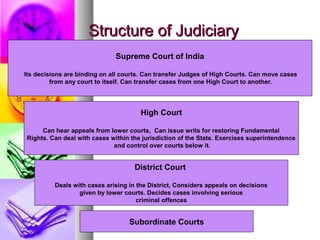
Structure of JudiciaryStructure of Judiciary
Supreme Court of India
Its decisions are binding on all courts. Can transfer Judges of High Courts. Can move cases
from any court to itself. Can transfer cases from one High Court to another.
High Court
Can hear appeals from lower courts, Can issue writs for restoring Fundamental
Rights. Can deal with cases within the jurisdiction of the State. Exercises superintendence
and control over courts below it.
District Court
Deals with cases arising in the District, Considers appeals on decisions
given by lower courts. Decides cases involving serious
criminal offences
Subordinate Courts
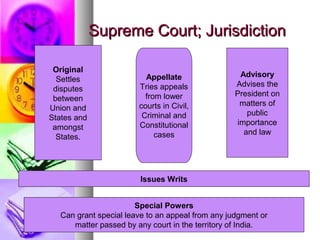
Supreme Court; JurisdictionSupreme Court; Jurisdiction
Original
Settles
disputes
between
Union and
States and
amongst
States.
Appellate
Tries appeals
from lower
courts in Civil,
Criminal and
Constitutional
cases
Advisory
Advises the
President on
matters of
public
importance
and law
Special Powers
Can grant special leave to an appeal from any judgment or
matter passed by any court in the territory of India.
Issues Writs
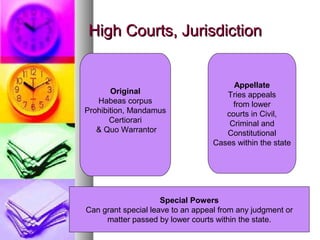
High Courts, JurisdictionHigh Courts, Jurisdiction
Appellate
Tries appeals
from lower
courts in Civil,
Criminal and
Constitutional
Cases within the state
Special Powers
Can grant special leave to an appeal from any judgment or
matter passed by lower courts within the state.
Original
Habeas corpus
Prohibition, Mandamus
Certiorari
& Quo Warrantor
Independence of JudiciaryIndependence of Judiciary
 Independence of Judiciary means
that the other organs of the
government must not restrain the
functioning of the judiciary in such a
way that it is unable to do justice.
 other organs of the government
should not interfere with its decision
 Judges must be able to perform their
functions without fear or favour.
How is it ensured?How is it ensured?
 Judges are appointed by the President of IndiaJudges are appointed by the President of India
 They enjoy a fixed tenureThey enjoy a fixed tenure
 Removal is through a difficult process ofRemoval is through a difficult process of
impeachmentimpeachment
 It is financially independentIt is financially independent
 Actions and decisions of the judges are immuneActions and decisions of the judges are immune
from personal criticisms.from personal criticisms.
 Power to penalise contempt of courtPower to penalise contempt of court
 Parliament cannot discuss the conduct of theParliament cannot discuss the conduct of the
judgesjudges

Judiciary in India

  • 1.
    JudiciaryJudiciary Supreme Courts andHigh CourtsSupreme Courts and High Courts of Indiaof India
  • 2.
    Role of JudiciaryRoleof Judiciary  Rule of law implies that all individuals — rich and poor, men or women, forward or backward castes — are subjected to the same law.  Judiciary protects rule of law and ensure supremacy of law.  It safeguards rights of the individual, settles disputes in accordance with the law and  It ensures that democracy
  • 3.
    Supreme Court ofIndiaSupreme Court of India  India has a single integrated System ofIndia has a single integrated System of Judiciary in view of a Single Constitution.Judiciary in view of a Single Constitution.  At the top is the Supreme Court of IndiaAt the top is the Supreme Court of India  Supreme Court consists of one ChiefSupreme Court consists of one Chief Justice and Judges appointed President.Justice and Judges appointed President.  Usually, the senior-most judge of theUsually, the senior-most judge of the Supreme Court is appointed as the ChiefSupreme Court is appointed as the Chief Justice of India.Justice of India.  In case of other Judges, the Chief JusticeIn case of other Judges, the Chief Justice recommends names of persons to berecommends names of persons to be appointed in consultation with four senior-appointed in consultation with four senior- most judges of the Court.most judges of the Court.
  • 4.
    Structure of JudiciaryStructureof Judiciary Supreme Court of India Its decisions are binding on all courts. Can transfer Judges of High Courts. Can move cases from any court to itself. Can transfer cases from one High Court to another. High Court Can hear appeals from lower courts, Can issue writs for restoring Fundamental Rights. Can deal with cases within the jurisdiction of the State. Exercises superintendence and control over courts below it. District Court Deals with cases arising in the District, Considers appeals on decisions given by lower courts. Decides cases involving serious criminal offences Subordinate Courts
  • 5.
    Supreme Court; JurisdictionSupremeCourt; Jurisdiction Original Settles disputes between Union and States and amongst States. Appellate Tries appeals from lower courts in Civil, Criminal and Constitutional cases Advisory Advises the President on matters of public importance and law Special Powers Can grant special leave to an appeal from any judgment or matter passed by any court in the territory of India. Issues Writs
  • 6.
    High Courts, JurisdictionHighCourts, Jurisdiction Appellate Tries appeals from lower courts in Civil, Criminal and Constitutional Cases within the state Special Powers Can grant special leave to an appeal from any judgment or matter passed by lower courts within the state. Original Habeas corpus Prohibition, Mandamus Certiorari & Quo Warrantor
  • 7.
    Independence of JudiciaryIndependenceof Judiciary  Independence of Judiciary means that the other organs of the government must not restrain the functioning of the judiciary in such a way that it is unable to do justice.  other organs of the government should not interfere with its decision  Judges must be able to perform their functions without fear or favour.
  • 8.
    How is itensured?How is it ensured?  Judges are appointed by the President of IndiaJudges are appointed by the President of India  They enjoy a fixed tenureThey enjoy a fixed tenure  Removal is through a difficult process ofRemoval is through a difficult process of impeachmentimpeachment  It is financially independentIt is financially independent  Actions and decisions of the judges are immuneActions and decisions of the judges are immune from personal criticisms.from personal criticisms.  Power to penalise contempt of courtPower to penalise contempt of court  Parliament cannot discuss the conduct of theParliament cannot discuss the conduct of the judgesjudges