


Presented to:
Presented to:
“Ma,am Sania Zara”.
Presented by:
Ghazala Arif”
Judiciary.
Judiciary
The Judiciary (also known as the
judicial system or court system) is
the system of courts that interprets
and applies the law in the name of
the state.
Organization.
 Judicial structure is built on different principles.
 It has hierarchal stages with lower courts at the bottom
and the supreme or high court at the top..
 Different types of courts are involved in the
administration of justice in the modern states.
Courts.
 Civil or criminal court.
 Administrative court.
 Special court.
Civil or Criminal Court.
 Common courts settle the disputes arising among the
individuals in civil and criminal cases.
 In criminal proceedings, generally jury trial is adopted
though it is adopted in certain civil cases as well.
 In some countries both civil and criminal cases are tried
in the same courts while in other countries including
Pakistan separate courts are established for hearing
civil and criminal cases.
Administrative Court.
 In most of the European States, especially in France,
separate administrative courts decide the cases
involving administrative matters and the branches of
such courts exist in almost all important administrative
departments. These courts settle the disputes arising
among public officials and the disputes in which any
public official and private individuals are parties.
 In the beginning the administrative officials used toe
exercise judicial powers, later regular courts were
established.
Special Courts.
 Special courts are established to decide special cases.
Example: Military courts, work in most of the countries to
settle disputes arising among the military personnel.
 In America and Britain , circuit courts are also part of the
judiciary. These courts have no permanent seat but hold
their sessions at different places.
 In Pakistan however, there exists a single judicial
hierarchy.
Independence of Judiciary
 Its mean that the judges should be free from all the
pressure to decide the cases neutral according to their
conscience.
 Different rules and regulation are:
1. Method of appointment.
2. Election.
3. Nomination and selection.
4. Duration of service.
5. Removal.
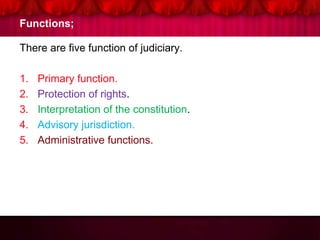
Functions;
There are five function of judiciary.
1. Primary function.
2. Protection of rights.
3. Interpretation of the constitution.
4. Advisory jurisdiction.
5. Administrative functions.
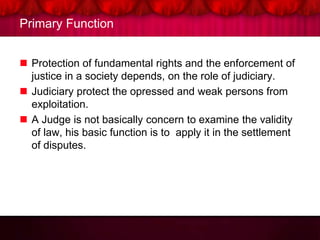
Primary Function
 Protection of fundamental rights and the enforcement of
justice in a society depends, on the role of judiciary.
 Judiciary protect the opressed and weak persons from
exploitation.
 A Judge is not basically concern to examine the validity
of law, his basic function is to apply it in the settlement
of disputes.
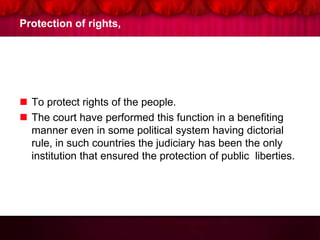
Protection of rights,
 To protect rights of the people.
 The court have performed this function in a benefiting
manner even in some political system having dictorial
rule, in such countries the judiciary has been the only
institution that ensured the protection of public liberties.
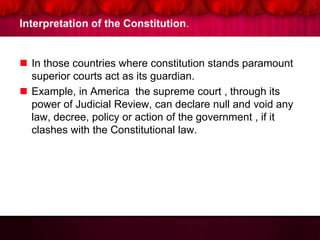
Interpretation of the Constitution.
 In those countries where constitution stands paramount
superior courts act as its guardian.
 Example, in America the supreme court , through its
power of Judicial Review, can declare null and void any
law, decree, policy or action of the government , if it
clashes with the Constitutional law.
Advisory Jurisdiction.
 Superior courts in some countries advise the
government on points of law, and can also give
declaratory judgement in which the courts point out the
intention of the law.
 Under the constitution of Pakistan, the president
authorized to get the advice of the courts in legal matters
whereas in America the courts can neither give
declaratory judgement nor issue any advice.
Administrative Function
 The function of the courts are not restricted to the
settlement of disputes, they perform some administrative
duties as well. This includes the appointment of judicial
staff, issuance of license persons, supervision of wills
and of the property of insane appointment of receivers
for bankrupt persons and institutions.
Relation with Executive.
They have relation with executive in two types.
a) Executive Control.
b) Supremacy of judiciary.
Executive Control
 In ancient societies the executive had unlimited judicial
powers as well. With the development of democratic
ideals and the advancement of civilization , judiciary
gradually became to a greater extent independent of
executive control. The executive still exercises some
judicial powers in most of the states
 Example; Chief Executive, appoints the judges of
superior courts and thereby the executive can bring
changes in the organization of judiciary.
Supremacy of Judiciary
 The courts have generally upper hand on the
administrative setup.
 In those states where judicial procedure is based on
RULE OF LAW, public officials are tried in the same
courts along with the private persons for all offences.
 In independence of judiciary is an accepted doctrine in
order to save public liberties from the encroachment of
public officials.
Relation with Legislature.
 Judiciary applies the laws enacted by the legislature.
 In america and britian, the upper legislative chamber
have certain judicial powers as well. Judges are elected
by the legislatures in some countries and can also be
impeached.
Judicial supremacy:
Being an independent branch of the government judiciary
enjoys a privileged position over legislature.
Judicial supremacy.
Being an independent branch of the government
judiciary enjoys a privileged position over
legislature, under most of the federal constitution,
supreme court as the guardian of the constitution
can declared void the enactment of the legislature as
are against the constitution.
This power of JUDICIAL REVIEW was not explicitly wriiten
in the American constituions but was later asserted as
implied power by chief justice Marshall in the case of
Marbury/ Madisson of 1803.
The court exercise the power of JUDICIAL REVIEW only
when an issue is brought in the form of a case or
controversy.
Judiciary

Judiciary

  • 2.
    Presented to: Presented to: “Ma,amSania Zara”. Presented by: Ghazala Arif”
  • 3.
  • 4.
    Judiciary The Judiciary (alsoknown as the judicial system or court system) is the system of courts that interprets and applies the law in the name of the state.
  • 5.
    Organization.  Judicial structureis built on different principles.  It has hierarchal stages with lower courts at the bottom and the supreme or high court at the top..  Different types of courts are involved in the administration of justice in the modern states.
  • 6.
    Courts.  Civil orcriminal court.  Administrative court.  Special court.
  • 7.
    Civil or CriminalCourt.  Common courts settle the disputes arising among the individuals in civil and criminal cases.  In criminal proceedings, generally jury trial is adopted though it is adopted in certain civil cases as well.  In some countries both civil and criminal cases are tried in the same courts while in other countries including Pakistan separate courts are established for hearing civil and criminal cases.
  • 8.
    Administrative Court.  Inmost of the European States, especially in France, separate administrative courts decide the cases involving administrative matters and the branches of such courts exist in almost all important administrative departments. These courts settle the disputes arising among public officials and the disputes in which any public official and private individuals are parties.  In the beginning the administrative officials used toe exercise judicial powers, later regular courts were established.
  • 9.
    Special Courts.  Specialcourts are established to decide special cases. Example: Military courts, work in most of the countries to settle disputes arising among the military personnel.  In America and Britain , circuit courts are also part of the judiciary. These courts have no permanent seat but hold their sessions at different places.  In Pakistan however, there exists a single judicial hierarchy.
  • 10.
    Independence of Judiciary Its mean that the judges should be free from all the pressure to decide the cases neutral according to their conscience.  Different rules and regulation are: 1. Method of appointment. 2. Election. 3. Nomination and selection. 4. Duration of service. 5. Removal.
  • 11.
    Functions; There are fivefunction of judiciary. 1. Primary function. 2. Protection of rights. 3. Interpretation of the constitution. 4. Advisory jurisdiction. 5. Administrative functions.
  • 12.
    Primary Function  Protectionof fundamental rights and the enforcement of justice in a society depends, on the role of judiciary.  Judiciary protect the opressed and weak persons from exploitation.  A Judge is not basically concern to examine the validity of law, his basic function is to apply it in the settlement of disputes.
  • 13.
    Protection of rights, To protect rights of the people.  The court have performed this function in a benefiting manner even in some political system having dictorial rule, in such countries the judiciary has been the only institution that ensured the protection of public liberties.
  • 14.
    Interpretation of theConstitution.  In those countries where constitution stands paramount superior courts act as its guardian.  Example, in America the supreme court , through its power of Judicial Review, can declare null and void any law, decree, policy or action of the government , if it clashes with the Constitutional law.
  • 15.
    Advisory Jurisdiction.  Superiorcourts in some countries advise the government on points of law, and can also give declaratory judgement in which the courts point out the intention of the law.  Under the constitution of Pakistan, the president authorized to get the advice of the courts in legal matters whereas in America the courts can neither give declaratory judgement nor issue any advice.
  • 16.
    Administrative Function  Thefunction of the courts are not restricted to the settlement of disputes, they perform some administrative duties as well. This includes the appointment of judicial staff, issuance of license persons, supervision of wills and of the property of insane appointment of receivers for bankrupt persons and institutions.
  • 17.
    Relation with Executive. Theyhave relation with executive in two types. a) Executive Control. b) Supremacy of judiciary.
  • 18.
    Executive Control  Inancient societies the executive had unlimited judicial powers as well. With the development of democratic ideals and the advancement of civilization , judiciary gradually became to a greater extent independent of executive control. The executive still exercises some judicial powers in most of the states  Example; Chief Executive, appoints the judges of superior courts and thereby the executive can bring changes in the organization of judiciary.
  • 19.
    Supremacy of Judiciary The courts have generally upper hand on the administrative setup.  In those states where judicial procedure is based on RULE OF LAW, public officials are tried in the same courts along with the private persons for all offences.  In independence of judiciary is an accepted doctrine in order to save public liberties from the encroachment of public officials.
  • 20.
    Relation with Legislature. Judiciary applies the laws enacted by the legislature.  In america and britian, the upper legislative chamber have certain judicial powers as well. Judges are elected by the legislatures in some countries and can also be impeached. Judicial supremacy: Being an independent branch of the government judiciary enjoys a privileged position over legislature.
  • 21.
    Judicial supremacy. Being anindependent branch of the government judiciary enjoys a privileged position over legislature, under most of the federal constitution, supreme court as the guardian of the constitution can declared void the enactment of the legislature as are against the constitution.
  • 22.
    This power ofJUDICIAL REVIEW was not explicitly wriiten in the American constituions but was later asserted as implied power by chief justice Marshall in the case of Marbury/ Madisson of 1803. The court exercise the power of JUDICIAL REVIEW only when an issue is brought in the form of a case or controversy.