Presentation for the ITFMA Seminar Low or Zero Carbon Housing Timber Frame’s Role  21 st  May 2008   ___________________________________ Timber Frame Housing Technology Options 2008 and onwards Bill Quigley NuTech Renewables Ltd
 
  Carbon emissions and Energy Supply in the World Is there a problem? In the UK, the Stern Report had been commissioned by the then Deputy Prime Minister Gordon Browne and was launched by him with Tony Blair with huge media attention in April 2007 – he called for immediate action One of the main conclusions was: … ..’failure to act on CO2 emissions could mean a radical change in life on this planet as we know it’  That’s a problem!
  Possible effects on Ireland? Montreal is the same Latitude as: …… ..LYON!!!! Ireland is the same Latitude as Hudson Bay in Canada If the North Atlantic Drift switches off OR weakens then  … .. That will be a really serious problem! This happened before  - there was a mini ice age in Shakespeare’s time
  Carbon emissions and Energy Supply in Ireland The Irish Government also has a serious problem in terms of the Security of Supply issue – 87% of our energy will be imported for the next 20 years (Source: SEI) Oil Prices are now regularly in excess of 100 $ per barrel (125 $ per barrel last week) – that’s a problem also!)
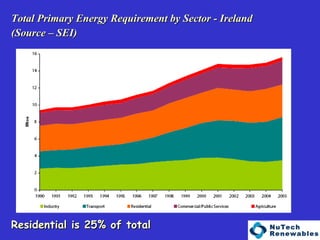
  Total Primary Energy Requirement by Sector - Ireland  (Source – SEI)     Residential is 25% of total
  A time of change is a time of opportunity Can the Timber Frame Industry provide a genuine Low Energy solution? We believe it can and should
  Energy Use for space heating, ventilation and hot water in Housing in Ireland In a typical Irish house built to satisfy the requirements of TGD L of the 2005 Building Regulations, it is worthwhile looking at how energy is used and heat is lost in housing. Simply put: 1/3 is heat lost through the fabric of the building 1/3 is heat lost caused by air infiltration and necessary air for ventilation 1/3 goes to energy to provide domestic hot water Extra insulation can only save a certain amount of energy   Focus on air infiltration and the domestic hot water load
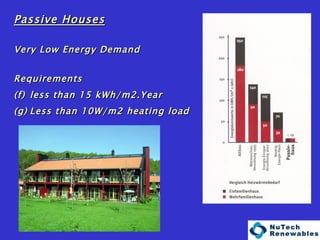
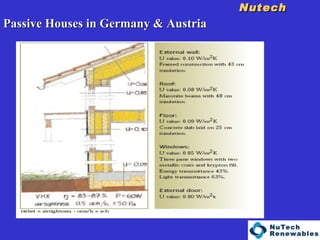
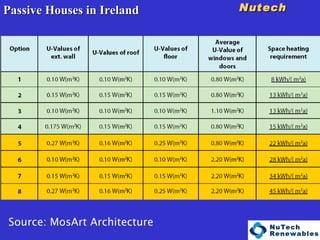
Passive Houses Very Low Energy Demand Requirements less than 15 kWh/m2.Year Less than 10W/m2 heating load
Nutech    Passive Houses in Germany & Austria
Nutech    Passive Houses in Ireland Source: MosArt Architecture
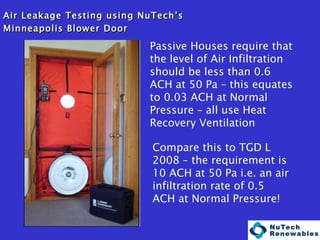
  Air Leakage Testing using NuTech’s Minneapolis Blower Door Passive Houses require that the level of Air Infiltration should be less than 0.6 ACH at 50 Pa – this equates to 0.03 ACH at Normal Pressure – all use Heat Recovery Ventilation Compare this to TGD L 2008 – the requirement is 10 ACH at 50 Pa i.e. an air infiltration rate of 0.5 ACH at Normal Pressure!
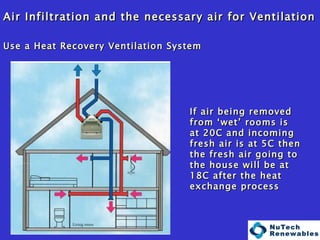
  Air Infiltration and the necessary air for Ventilation Use a Heat Recovery Ventilation System If air being removed from ‘wet’ rooms is at 20C and incoming fresh air is at 5C then the fresh air going to the house will be at 18C after the heat exchange process
  Air Infiltration and the necessary air for Ventilation Passive Houses  –  Air Infiltration = 0.03 ACH at Normal Pressure - HRV system provides 0.3 ACH of fresh air NuTech Design - Air Infiltration = less than 0.1 ACH - HRV system complies with UK Part F 2006 - HRV will give 12 litres of fresh air per person    per second. This equates to approx 0.7 - 0.9    ACH on average
Air Leakage Testing using NuTech’s Minneapolis Blower Door These are actual test results for low energy houses that are reasonably airtight. This house has an air leakage rate of 1.84 Air Changes per Hour at 50 Pa. This equates to an air leakage rate of 0.092 ACH at normal atmospheric pressure (divide the 50 Pa rate by 20 is the accepted rule)
  Is there another way to achieve a very Low Energy House? We believe there is Use much more standard levels of insulation in timber frame construction  - U-Value of 0.16 to 0.20 W/m2.K in the walls - U-Value of 0.16 in the floor - U-Value of 0.14 in the roof - DG windows with a U-Value of 1.3 to 1.4 (care regards    the % of window to floor area Achieve reasonably attainable levels of airtightness (Less than 0.1 ACH at Normal Pressure) Use technology to achieve the energy savings!
Standard Timber frame 140mm + 140mm HD FG U-Value = 0.27 W/m2.K Timber Frame – Achieving the U-Value
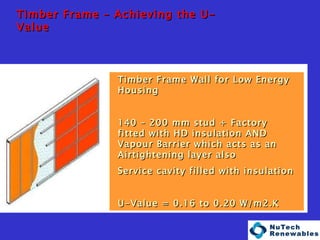
Timber Frame Wall for Low Energy Housing 140 – 200 mm stud + Factory fitted with HD insulation AND Vapour Barrier which acts as an Airtightening layer also Service cavity filled with insulation U-Value = 0.16 to 0.20 W/m2.K Timber Frame – Achieving the U-Value
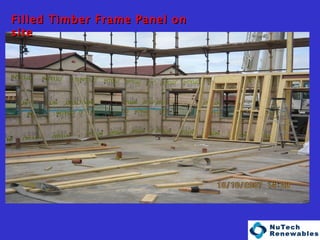
Filled Timber Frame Panel on site
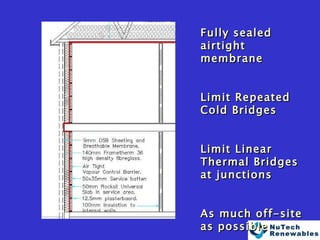
Fully sealed airtight membrane Limit Repeated Cold Bridges Limit Linear Thermal Bridges at junctions As much off-site as possible
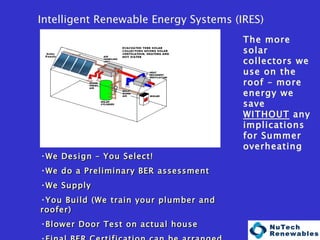
                                                              Intelligent Renewable Energy Systems (IRES) We Design – You Select! We do a Preliminary BER assessment We Supply You Build (We train your plumber and roofer) Blower Door Test on actual house Final BER Certification can be arranged The more solar collectors we use on the roof – more energy we save  WITHOUT  any implications for Summer overheating
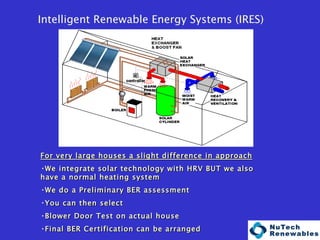
                                                              Intelligent Renewable Energy Systems (IRES) For very large houses a slight difference in approach We integrate solar technology with HRV BUT we also have a normal heating system We do a Preliminary BER assessment You can then select Blower Door Test on actual house Final BER Certification can be arranged
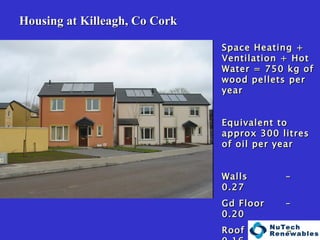
  Housing at Killeagh, Co Cork Space Heating + Ventilation + Hot Water = 750 kg of wood pellets per year Equivalent to approx 300 litres of oil per year Walls  – 0.27 Gd Floor  – 0.20 Roof - 0.16 Windows  - 1.90
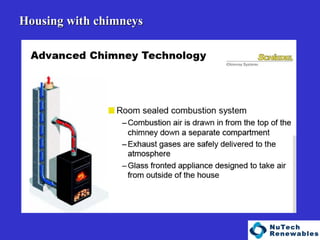
  Housing with chimneys
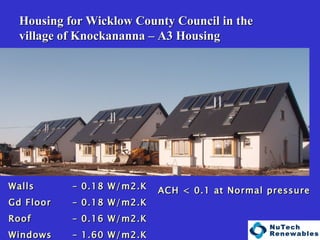
  Housing for Wicklow County Council in the village of Knockananna – A3 Housing Walls  – 0.18 W/m2.K Gd Floor  – 0.18 W/m2.K Roof  – 0.16 W/m2.K Windows  – 1.60 W/m2.K ACH < 0.1 at Normal pressure
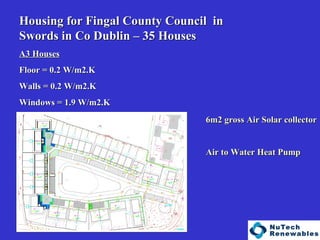
  Housing for Fingal County Council  in Swords in Co Dublin – 35 Houses A3 Houses Floor = 0.2 W/m2.K Walls = 0.2 W/m2.K Windows = 1.9 W/m2.K 6m2 gross Air Solar collector Air to Water Heat Pump
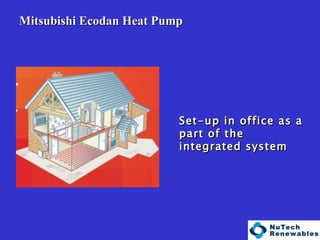
  Mitsubishi Ecodan Heat Pump Set-up in office as a part of the integrated system
  Mitsubishi Ecodan Heat Pump Set-up in office as a part of the integrated system
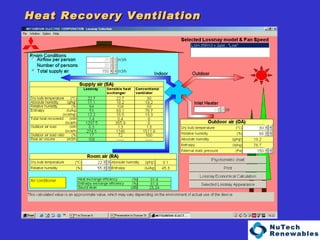
  Heat Recovery Ventilation
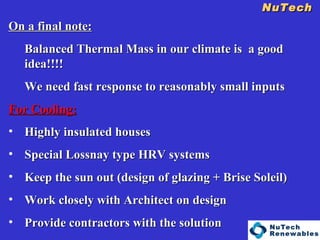
NuTech    On a final note: Balanced Thermal Mass in our climate is  a good idea!!!! We need fast response to reasonably small inputs For Cooling: Highly insulated houses Special Lossnay type HRV systems Keep the sun out (design of glazing + Brise Soleil) Work closely with Architect on design Provide contractors with the solution
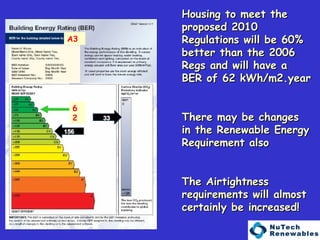
62 A3 Housing to meet the proposed 2010 Regulations will be 60% better than the 2006 Regs and will have a BER of 62 kWh/m2.year There may be changes in the Renewable Energy Requirement also The Airtightness requirements will almost certainly be increased!
To Achieve a house to satisfy the 2010 Regs an A3 House Use a wall U-Value = to or < 0.20 W/m2.K] Ground Floor U-Value = to or < 0.16 W/m2.K Roof U-Value = 0.12 W/m2.K Windows – use DG, Soft Low-E  [U-Value = or < 1.4] Air Infiltration rate = 0.1 Air Changes per Hour [Blower Door Tested] Heat Recovery Ventilation [ Efficiency = 86% and Spec Fan Power = 1.12] 92% efficient Boiler + room sealed log fireplace with combustion air from outside Electric Lighting by CFL’s NuTech Solar H&V with HRV and Solar Hot Water RESULT = 62 kWh/m2.Year [ An A3 House ] RESULT = With Heat Pump and ‘Tweaking’ can be    49 kWh/m2.year [An A2 House –close to Passive]
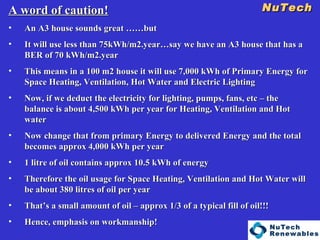
NuTech    A word of caution! An A3 house sounds great ……but It will use less than 75kWh/m2.year…say we have an A3 house that has a BER of 70 kWh/m2.year This means in a 100 m2 house it will use 7,000 kWh of Primary Energy for Space Heating, Ventilation, Hot Water and Electric Lighting Now, if we deduct the electricity for lighting, pumps, fans, etc – the balance is about 4,500 kWh per year for Heating, Ventilation and Hot water Now change that from primary Energy to delivered Energy and the total becomes approx 4,000 kWh per year 1 litre of oil contains approx 10.5 kWh of energy Therefore the oil usage for Space Heating, Ventilation and Hot Water will be about 380 litres of oil per year That’s a small amount of oil – approx 1/3 of a typical fill of oil!!! Hence, emphasis on workmanship!
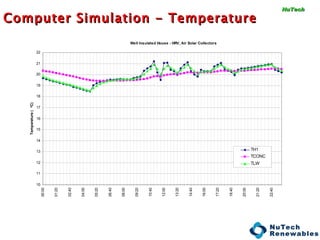
  NuTech  Computer Simulation - Temperature
NuTech    In Conclusion We can achieve Low Energy and Near Zero CO2 houses using factory filled and fitted Timber Frame panels We must use Integrated Solar and HRV technology to achieve this Low Energy Solution (Reduce Energy Demand and then Efficient Energy Supply) A2 and A1 houses will require site generated electricity by way of photovoltaic panels or similar renewable energy electricity
Thank you for listening…… Bill Quigley NuTech Renewables Tel:  01. 663 63 72 Fax: 01. 663 63 73 Mobile: 086 88 363 99 e-mail:  [email_address] WEB: www.nutechrenewables.com Factory / Showroom: Tel: 048 4175 30 31   Fax: 048 4175 41 51

Presentation Itfma Seminar 21 May08

  • 1.
    Presentationfor the ITFMA Seminar Low or Zero Carbon Housing Timber Frame’s Role 21 st May 2008 ___________________________________ Timber Frame Housing Technology Options 2008 and onwards Bill Quigley NuTech Renewables Ltd
  • 2.
  • 3.
    Carbonemissions and Energy Supply in the World Is there a problem? In the UK, the Stern Report had been commissioned by the then Deputy Prime Minister Gordon Browne and was launched by him with Tony Blair with huge media attention in April 2007 – he called for immediate action One of the main conclusions was: … ..’failure to act on CO2 emissions could mean a radical change in life on this planet as we know it’ That’s a problem!
  • 4.
    Possibleeffects on Ireland? Montreal is the same Latitude as: …… ..LYON!!!! Ireland is the same Latitude as Hudson Bay in Canada If the North Atlantic Drift switches off OR weakens then … .. That will be a really serious problem! This happened before - there was a mini ice age in Shakespeare’s time
  • 5.
    Carbonemissions and Energy Supply in Ireland The Irish Government also has a serious problem in terms of the Security of Supply issue – 87% of our energy will be imported for the next 20 years (Source: SEI) Oil Prices are now regularly in excess of 100 $ per barrel (125 $ per barrel last week) – that’s a problem also!)
  • 6.
    TotalPrimary Energy Requirement by Sector - Ireland (Source – SEI)     Residential is 25% of total
  • 7.
    Atime of change is a time of opportunity Can the Timber Frame Industry provide a genuine Low Energy solution? We believe it can and should
  • 8.
    EnergyUse for space heating, ventilation and hot water in Housing in Ireland In a typical Irish house built to satisfy the requirements of TGD L of the 2005 Building Regulations, it is worthwhile looking at how energy is used and heat is lost in housing. Simply put: 1/3 is heat lost through the fabric of the building 1/3 is heat lost caused by air infiltration and necessary air for ventilation 1/3 goes to energy to provide domestic hot water Extra insulation can only save a certain amount of energy Focus on air infiltration and the domestic hot water load
  • 9.
    Passive Houses VeryLow Energy Demand Requirements less than 15 kWh/m2.Year Less than 10W/m2 heating load
  • 10.
    Nutech  Passive Houses in Germany & Austria
  • 11.
    Nutech  Passive Houses in Ireland Source: MosArt Architecture
  • 12.
    AirLeakage Testing using NuTech’s Minneapolis Blower Door Passive Houses require that the level of Air Infiltration should be less than 0.6 ACH at 50 Pa – this equates to 0.03 ACH at Normal Pressure – all use Heat Recovery Ventilation Compare this to TGD L 2008 – the requirement is 10 ACH at 50 Pa i.e. an air infiltration rate of 0.5 ACH at Normal Pressure!
  • 13.
    AirInfiltration and the necessary air for Ventilation Use a Heat Recovery Ventilation System If air being removed from ‘wet’ rooms is at 20C and incoming fresh air is at 5C then the fresh air going to the house will be at 18C after the heat exchange process
  • 14.
    AirInfiltration and the necessary air for Ventilation Passive Houses – Air Infiltration = 0.03 ACH at Normal Pressure - HRV system provides 0.3 ACH of fresh air NuTech Design - Air Infiltration = less than 0.1 ACH - HRV system complies with UK Part F 2006 - HRV will give 12 litres of fresh air per person per second. This equates to approx 0.7 - 0.9 ACH on average
  • 15.
    Air Leakage Testingusing NuTech’s Minneapolis Blower Door These are actual test results for low energy houses that are reasonably airtight. This house has an air leakage rate of 1.84 Air Changes per Hour at 50 Pa. This equates to an air leakage rate of 0.092 ACH at normal atmospheric pressure (divide the 50 Pa rate by 20 is the accepted rule)
  • 16.
    Isthere another way to achieve a very Low Energy House? We believe there is Use much more standard levels of insulation in timber frame construction - U-Value of 0.16 to 0.20 W/m2.K in the walls - U-Value of 0.16 in the floor - U-Value of 0.14 in the roof - DG windows with a U-Value of 1.3 to 1.4 (care regards the % of window to floor area Achieve reasonably attainable levels of airtightness (Less than 0.1 ACH at Normal Pressure) Use technology to achieve the energy savings!
  • 17.
    Standard Timber frame140mm + 140mm HD FG U-Value = 0.27 W/m2.K Timber Frame – Achieving the U-Value
  • 18.
    Timber Frame Wallfor Low Energy Housing 140 – 200 mm stud + Factory fitted with HD insulation AND Vapour Barrier which acts as an Airtightening layer also Service cavity filled with insulation U-Value = 0.16 to 0.20 W/m2.K Timber Frame – Achieving the U-Value
  • 19.
    Filled Timber FramePanel on site
  • 20.
    Fully sealed airtightmembrane Limit Repeated Cold Bridges Limit Linear Thermal Bridges at junctions As much off-site as possible
  • 21.
                                                                 Intelligent Renewable Energy Systems (IRES) We Design – You Select! We do a Preliminary BER assessment We Supply You Build (We train your plumber and roofer) Blower Door Test on actual house Final BER Certification can be arranged The more solar collectors we use on the roof – more energy we save WITHOUT any implications for Summer overheating
  • 22.
                                                                 Intelligent Renewable Energy Systems (IRES) For very large houses a slight difference in approach We integrate solar technology with HRV BUT we also have a normal heating system We do a Preliminary BER assessment You can then select Blower Door Test on actual house Final BER Certification can be arranged
  • 23.
      Housing atKilleagh, Co Cork Space Heating + Ventilation + Hot Water = 750 kg of wood pellets per year Equivalent to approx 300 litres of oil per year Walls – 0.27 Gd Floor – 0.20 Roof - 0.16 Windows - 1.90
  • 24.
  • 25.
      Housing forWicklow County Council in the village of Knockananna – A3 Housing Walls – 0.18 W/m2.K Gd Floor – 0.18 W/m2.K Roof – 0.16 W/m2.K Windows – 1.60 W/m2.K ACH < 0.1 at Normal pressure
  • 26.
      Housing forFingal County Council in Swords in Co Dublin – 35 Houses A3 Houses Floor = 0.2 W/m2.K Walls = 0.2 W/m2.K Windows = 1.9 W/m2.K 6m2 gross Air Solar collector Air to Water Heat Pump
  • 27.
      Mitsubishi EcodanHeat Pump Set-up in office as a part of the integrated system
  • 28.
      Mitsubishi EcodanHeat Pump Set-up in office as a part of the integrated system
  • 29.
      Heat RecoveryVentilation
  • 30.
    NuTech  On a final note: Balanced Thermal Mass in our climate is a good idea!!!! We need fast response to reasonably small inputs For Cooling: Highly insulated houses Special Lossnay type HRV systems Keep the sun out (design of glazing + Brise Soleil) Work closely with Architect on design Provide contractors with the solution
  • 31.
    62 A3 Housingto meet the proposed 2010 Regulations will be 60% better than the 2006 Regs and will have a BER of 62 kWh/m2.year There may be changes in the Renewable Energy Requirement also The Airtightness requirements will almost certainly be increased!
  • 32.
    To Achieve ahouse to satisfy the 2010 Regs an A3 House Use a wall U-Value = to or < 0.20 W/m2.K] Ground Floor U-Value = to or < 0.16 W/m2.K Roof U-Value = 0.12 W/m2.K Windows – use DG, Soft Low-E [U-Value = or < 1.4] Air Infiltration rate = 0.1 Air Changes per Hour [Blower Door Tested] Heat Recovery Ventilation [ Efficiency = 86% and Spec Fan Power = 1.12] 92% efficient Boiler + room sealed log fireplace with combustion air from outside Electric Lighting by CFL’s NuTech Solar H&V with HRV and Solar Hot Water RESULT = 62 kWh/m2.Year [ An A3 House ] RESULT = With Heat Pump and ‘Tweaking’ can be 49 kWh/m2.year [An A2 House –close to Passive]
  • 33.
    NuTech  A word of caution! An A3 house sounds great ……but It will use less than 75kWh/m2.year…say we have an A3 house that has a BER of 70 kWh/m2.year This means in a 100 m2 house it will use 7,000 kWh of Primary Energy for Space Heating, Ventilation, Hot Water and Electric Lighting Now, if we deduct the electricity for lighting, pumps, fans, etc – the balance is about 4,500 kWh per year for Heating, Ventilation and Hot water Now change that from primary Energy to delivered Energy and the total becomes approx 4,000 kWh per year 1 litre of oil contains approx 10.5 kWh of energy Therefore the oil usage for Space Heating, Ventilation and Hot Water will be about 380 litres of oil per year That’s a small amount of oil – approx 1/3 of a typical fill of oil!!! Hence, emphasis on workmanship!
  • 34.
    NuTech Computer Simulation - Temperature
  • 35.
    NuTech  In Conclusion We can achieve Low Energy and Near Zero CO2 houses using factory filled and fitted Timber Frame panels We must use Integrated Solar and HRV technology to achieve this Low Energy Solution (Reduce Energy Demand and then Efficient Energy Supply) A2 and A1 houses will require site generated electricity by way of photovoltaic panels or similar renewable energy electricity
  • 36.
    Thank you forlistening…… Bill Quigley NuTech Renewables Tel: 01. 663 63 72 Fax: 01. 663 63 73 Mobile: 086 88 363 99 e-mail: [email_address] WEB: www.nutechrenewables.com Factory / Showroom: Tel: 048 4175 30 31 Fax: 048 4175 41 51