QA/QC in the Lab
Rob De Hayr
Science Leader Chemistry Centre, Qld, Aus
Vice Chair GLOSOLAN
Co-Chair Pillar 5 Pacific Soil Partnership
Queensland Representative ASPAC Executive Committee
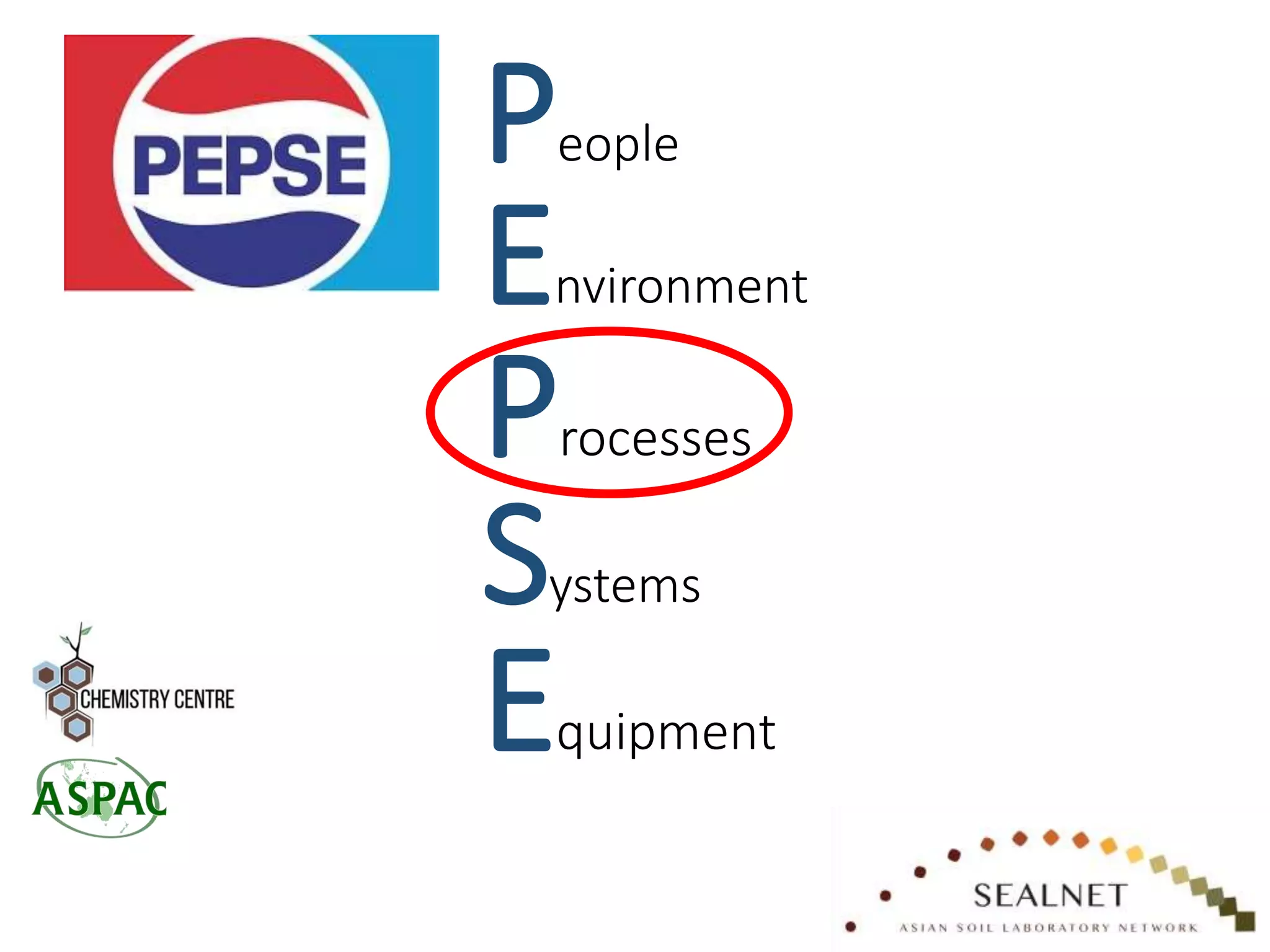
People
Environment
Processes
Systems
Equipment
The Quality Management System (QMS) is
the over arching system that a laboratory (or
other business) puts in place.
Quality Assurance (QA) is the planned and
systematic implementation of that QMS.
Quality Control (QC) procedures to ensure
the lab methods are performing as expected =
confidence in results
Laboratory QA/QC definitions
Internal Quality Control
Rob De Hayr
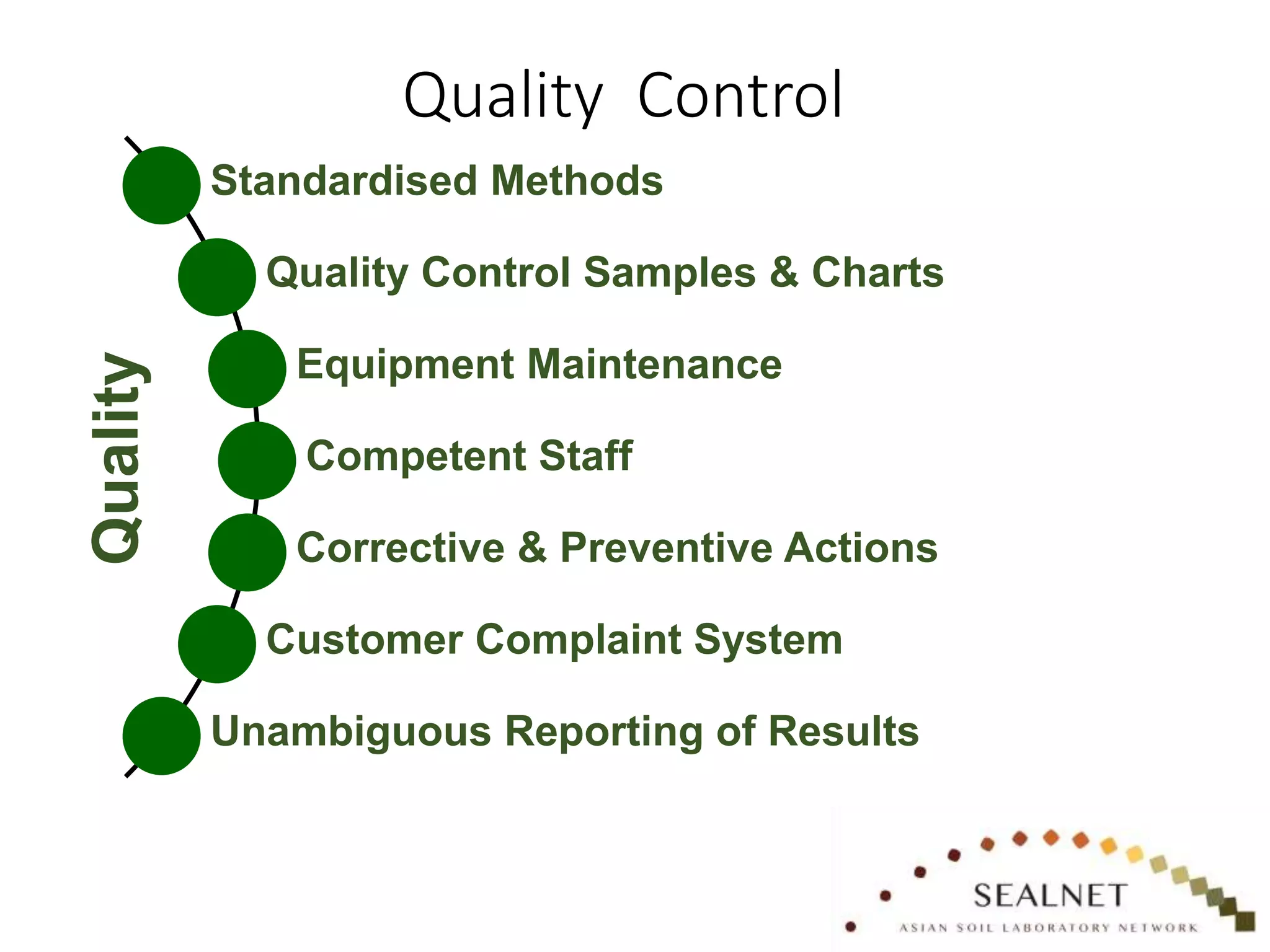
Standardised Methods
Quality Control Samples & Charts
Equipment Maintenance
Competent Staff
Corrective & Preventive Actions
Customer Complaint System
Unambiguous Reporting of Results
Quality Quality Control
Inter-laboratory Proficiency Testing
Method Validation/Verification
Auditing
Data Management (LIMS)
Root Cause Analysis
Reference Materials
Equipment Calibrations & Checks
Quality Quality Control
Quality Control
• QC is applied to the specific tests performed by the
laboratory, on an ongoing basis.
• QC tools normally used in agricultural testing Laboratories
are:
• Run blanks
• In house QC samples
• Replicate analyses
• Certified Reference Materials (CRM’s)
• Inter laboratory Comparison Programmes ILCP’s)
• Sample Exchanges
Standard solutions
• Best made from purchased 1,000 ppm solutions
• If not pure chemicals properly dried (weighed
accurately)
• Marked with a ‘use by’ date
• New ones always compared with old (even if out-of-
date)
Blanks
• Always have method blanks (should go through the
entire process)
• Likely different to standard blank or zero standard
• Do two at least per run
• When the blank is significant (>2 X PQL) blank correction
may be necessary
• If same, use mean
• If different use low one
Duplicates & Repeats
• Duplicates selected from the same run and/or
• Repeats from a previous run
• Suggest at least 2 samples duplicated per 40 samples
• Essential if no control sample available
• Possible acceptance criteria:
• Same run (repeatability) – use 0.7 times Uncertainty estimate.
• Different run (reproducibility) – use 1.4 times Uncertainty
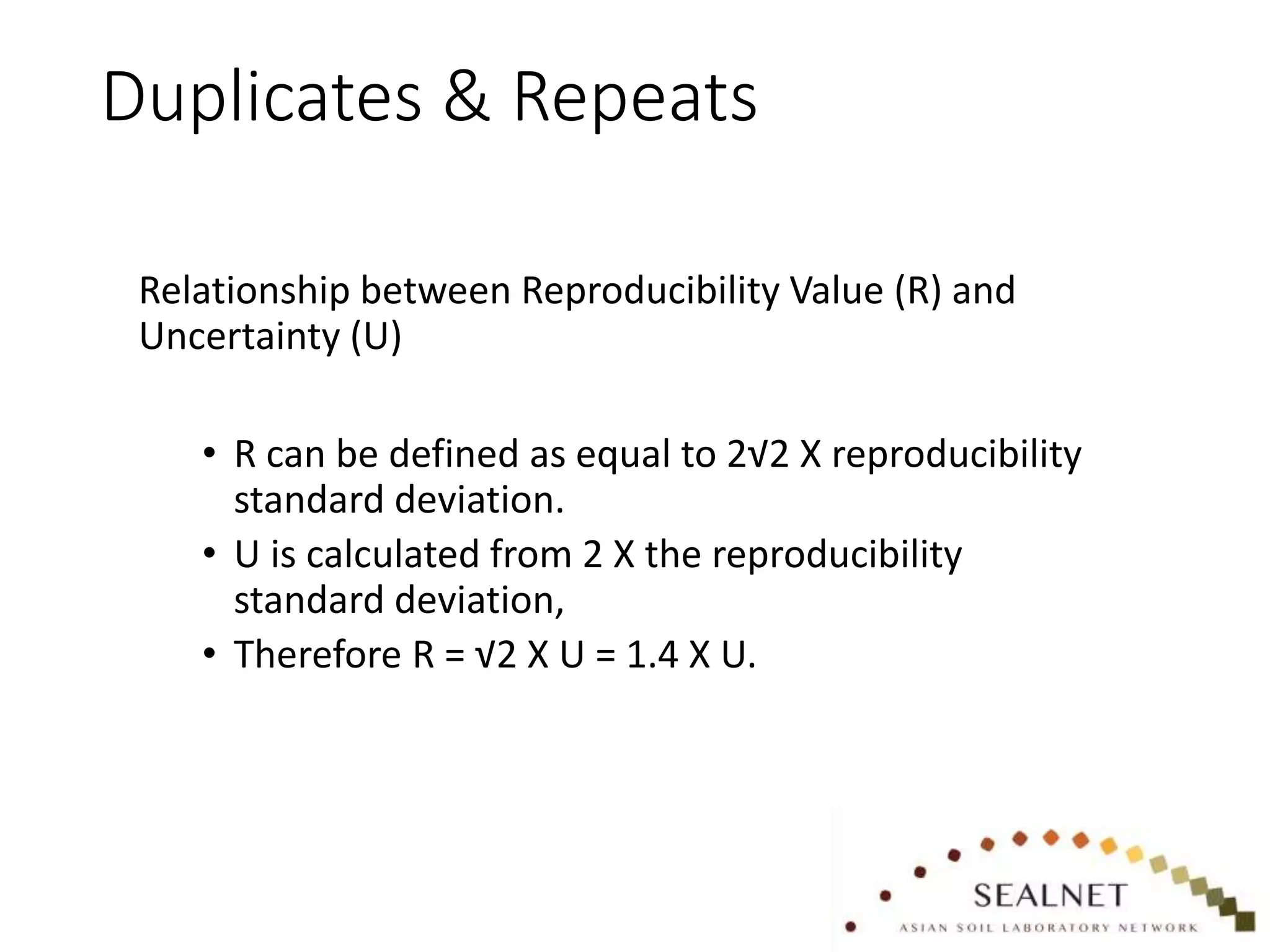
Duplicates & Repeats
Relationship between Reproducibility Value (R) and
Uncertainty (U)
• R can be defined as equal to 2√2 X reproducibility
standard deviation.
• U is calculated from 2 X the reproducibility
standard deviation,
• Therefore R = √2 X U = 1.4 X U.
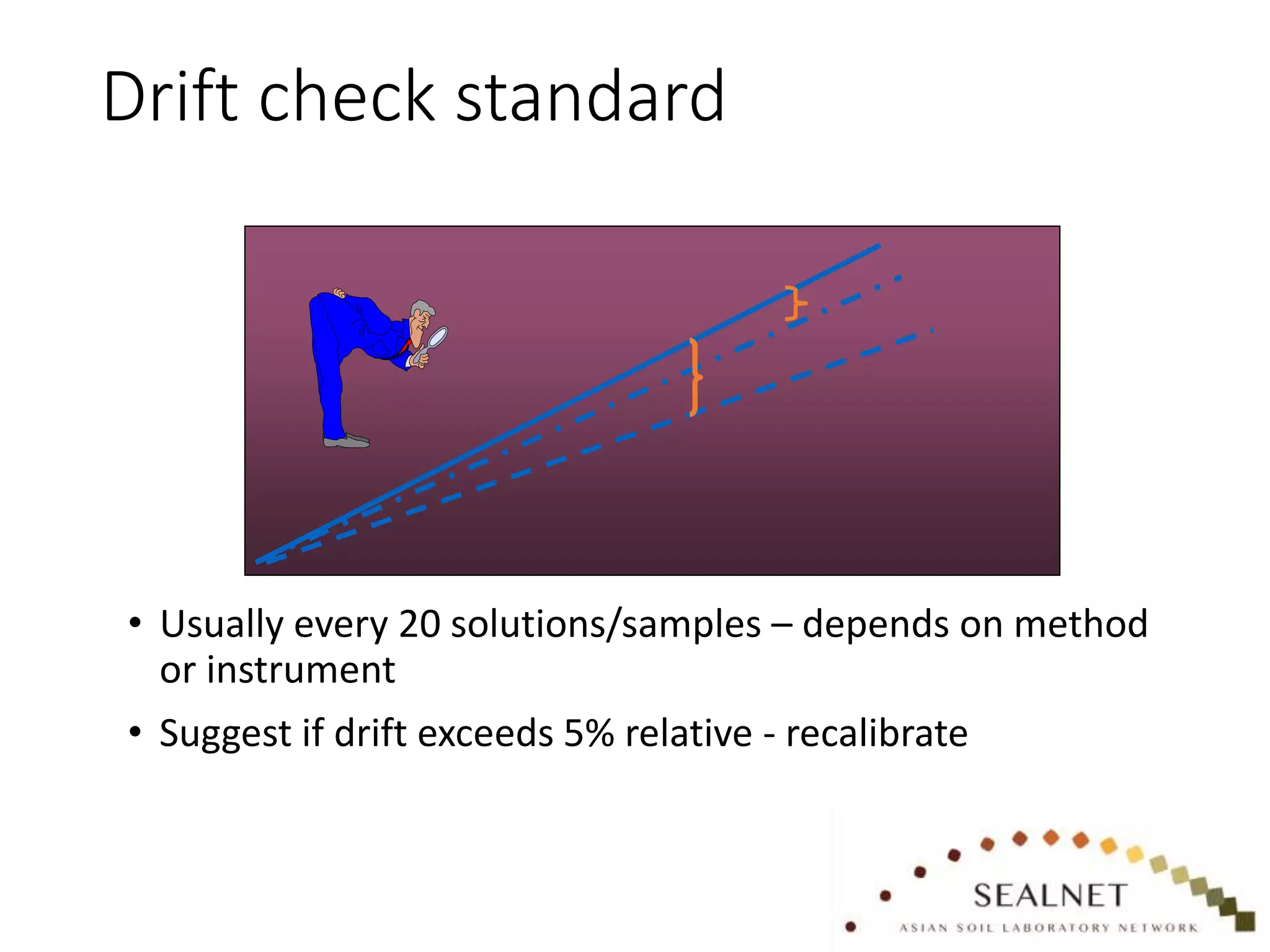
Drift check standard
• Usually every 20 solutions/samples – depends on method
or instrument
• Suggest if drift exceeds 5% relative - recalibrate
Recovery spikes
• Depends on method
• Not often used in soil and plant analysis
• More useful for analyses near detection limit.
Reference Materials
• Certified Reference Material (can be very costly)
• Secondary Reference Material (can also be costly)
• In-house Reference Material
• Run with every batch of samples and chart
results
Reference Materials (CRMs, SRMs)
• May or may not be Certified.
(Certified means it is metrologically traceable
back to primary standards).
• Sourced from a certified external provider.
• Come with stated Consensus or Certified analyte
levels, usually with Uncertainty Limits.
• An excellent external check on the laboratory
performance (accuracy).
In-house QC samples
• Bulk samples usually prepared in-house
• From relatively uniform sampling area
• Thoroughly mixed
• Packed in manageable containers (e.g.500 mL)
• Establish Warning and Control Limits
• Run with every batch of samples.
• Monitoring long-term stability.
In-house QC samples (cont.)
• Normally, two different QC samples per batch.
• Replicated at least every 20 - 40 samples
• Results compared with acceptability criteria
• May also be at the end of the run to monitor any
drift
Some acceptance criteria for verification checks
Chemistry Centre, Qld, Australia
Check Acceptance Criteria
Instrument QC ICPOES
- two monthly repeatability check
- two monthly limit of quantitation
check
- fortnightly check of sensitivity
- %RSD < 5%
- <50% change from month to
month
- if >30% change in sensitivity
of any one analyte
investigate causes.
Ion chromatograph
- repeatability check
- monitoring of system pressure, total
conductivity & retention time
- %RSD < 5%
- Retention Time ± 1 min
Calibration of
Instrument
Most instruments R2 > 0.99
Old vs new
standards
Normal concentration
Ultra-trace concentrations
< 3% at mid-range (25%-70% of
calibration range)
< 10% at mid-range (25%-70% of
calibration range)
Blanks < 2 times PQL
Duplicates (of
full method)
Minimum frequency = 1 in 20 - Difference < uncertainty (same run)
- Difference < 1.4 times x uncertainty
(different runs)
Recovery Spikes %Recovery at ultra-trace concentrations
= [Spiked Conc–Sample Conc] x 100
Spiked Conc
100% ± 20%
Thanks for your attention
Guidelines for Quality Management in Soil and
Plant Laboratories. (FAO Soils Bulletin - 74)
ISO 17025:2017 General requirements for the
competence of testing and calibration
laboratories

4th SEALNET meeting, item 8: Training on internal quality control - Overview of internal quality control measures

  • 1.
    QA/QC in theLab Rob De Hayr Science Leader Chemistry Centre, Qld, Aus Vice Chair GLOSOLAN Co-Chair Pillar 5 Pacific Soil Partnership Queensland Representative ASPAC Executive Committee
  • 2.
  • 3.
    The Quality ManagementSystem (QMS) is the over arching system that a laboratory (or other business) puts in place. Quality Assurance (QA) is the planned and systematic implementation of that QMS. Quality Control (QC) procedures to ensure the lab methods are performing as expected = confidence in results Laboratory QA/QC definitions
  • 4.
  • 5.
    Standardised Methods Quality ControlSamples & Charts Equipment Maintenance Competent Staff Corrective & Preventive Actions Customer Complaint System Unambiguous Reporting of Results Quality Quality Control
  • 6.
    Inter-laboratory Proficiency Testing MethodValidation/Verification Auditing Data Management (LIMS) Root Cause Analysis Reference Materials Equipment Calibrations & Checks Quality Quality Control
  • 7.
    Quality Control • QCis applied to the specific tests performed by the laboratory, on an ongoing basis. • QC tools normally used in agricultural testing Laboratories are: • Run blanks • In house QC samples • Replicate analyses • Certified Reference Materials (CRM’s) • Inter laboratory Comparison Programmes ILCP’s) • Sample Exchanges
  • 8.
    Standard solutions • Bestmade from purchased 1,000 ppm solutions • If not pure chemicals properly dried (weighed accurately) • Marked with a ‘use by’ date • New ones always compared with old (even if out-of- date)
  • 9.
    Blanks • Always havemethod blanks (should go through the entire process) • Likely different to standard blank or zero standard • Do two at least per run • When the blank is significant (>2 X PQL) blank correction may be necessary • If same, use mean • If different use low one
  • 10.
    Duplicates & Repeats •Duplicates selected from the same run and/or • Repeats from a previous run • Suggest at least 2 samples duplicated per 40 samples • Essential if no control sample available • Possible acceptance criteria: • Same run (repeatability) – use 0.7 times Uncertainty estimate. • Different run (reproducibility) – use 1.4 times Uncertainty
  • 11.
    Duplicates & Repeats Relationshipbetween Reproducibility Value (R) and Uncertainty (U) • R can be defined as equal to 2√2 X reproducibility standard deviation. • U is calculated from 2 X the reproducibility standard deviation, • Therefore R = √2 X U = 1.4 X U.
  • 12.
    Drift check standard •Usually every 20 solutions/samples – depends on method or instrument • Suggest if drift exceeds 5% relative - recalibrate
  • 13.
    Recovery spikes • Dependson method • Not often used in soil and plant analysis • More useful for analyses near detection limit.
  • 14.
    Reference Materials • CertifiedReference Material (can be very costly) • Secondary Reference Material (can also be costly) • In-house Reference Material • Run with every batch of samples and chart results
  • 15.
    Reference Materials (CRMs,SRMs) • May or may not be Certified. (Certified means it is metrologically traceable back to primary standards). • Sourced from a certified external provider. • Come with stated Consensus or Certified analyte levels, usually with Uncertainty Limits. • An excellent external check on the laboratory performance (accuracy).
  • 16.
    In-house QC samples •Bulk samples usually prepared in-house • From relatively uniform sampling area • Thoroughly mixed • Packed in manageable containers (e.g.500 mL) • Establish Warning and Control Limits • Run with every batch of samples. • Monitoring long-term stability.
  • 17.
    In-house QC samples(cont.) • Normally, two different QC samples per batch. • Replicated at least every 20 - 40 samples • Results compared with acceptability criteria • May also be at the end of the run to monitor any drift
  • 18.
    Some acceptance criteriafor verification checks Chemistry Centre, Qld, Australia Check Acceptance Criteria Instrument QC ICPOES - two monthly repeatability check - two monthly limit of quantitation check - fortnightly check of sensitivity - %RSD < 5% - <50% change from month to month - if >30% change in sensitivity of any one analyte investigate causes. Ion chromatograph - repeatability check - monitoring of system pressure, total conductivity & retention time - %RSD < 5% - Retention Time ± 1 min Calibration of Instrument Most instruments R2 > 0.99 Old vs new standards Normal concentration Ultra-trace concentrations < 3% at mid-range (25%-70% of calibration range) < 10% at mid-range (25%-70% of calibration range) Blanks < 2 times PQL Duplicates (of full method) Minimum frequency = 1 in 20 - Difference < uncertainty (same run) - Difference < 1.4 times x uncertainty (different runs) Recovery Spikes %Recovery at ultra-trace concentrations = [Spiked Conc–Sample Conc] x 100 Spiked Conc 100% ± 20%
  • 19.
    Thanks for yourattention Guidelines for Quality Management in Soil and Plant Laboratories. (FAO Soils Bulletin - 74) ISO 17025:2017 General requirements for the competence of testing and calibration laboratories