Preparing material for
Internal Quality Control
Rob De Hayr
Uses for internal Quality Control (QC)
samples
• Preparation of QC charts for monitoring and
demonstrating that the test is in control or confirm
the laboratory’s QC processes are effective over time.
• Comparing results between batches
• Validation of method development
• Repeatability and reproducibility studies through use
over time including changes in operators and
instruments.
• Inter-laboratory checking
• Impacts of changes in environmental conditions in the
laboratory.
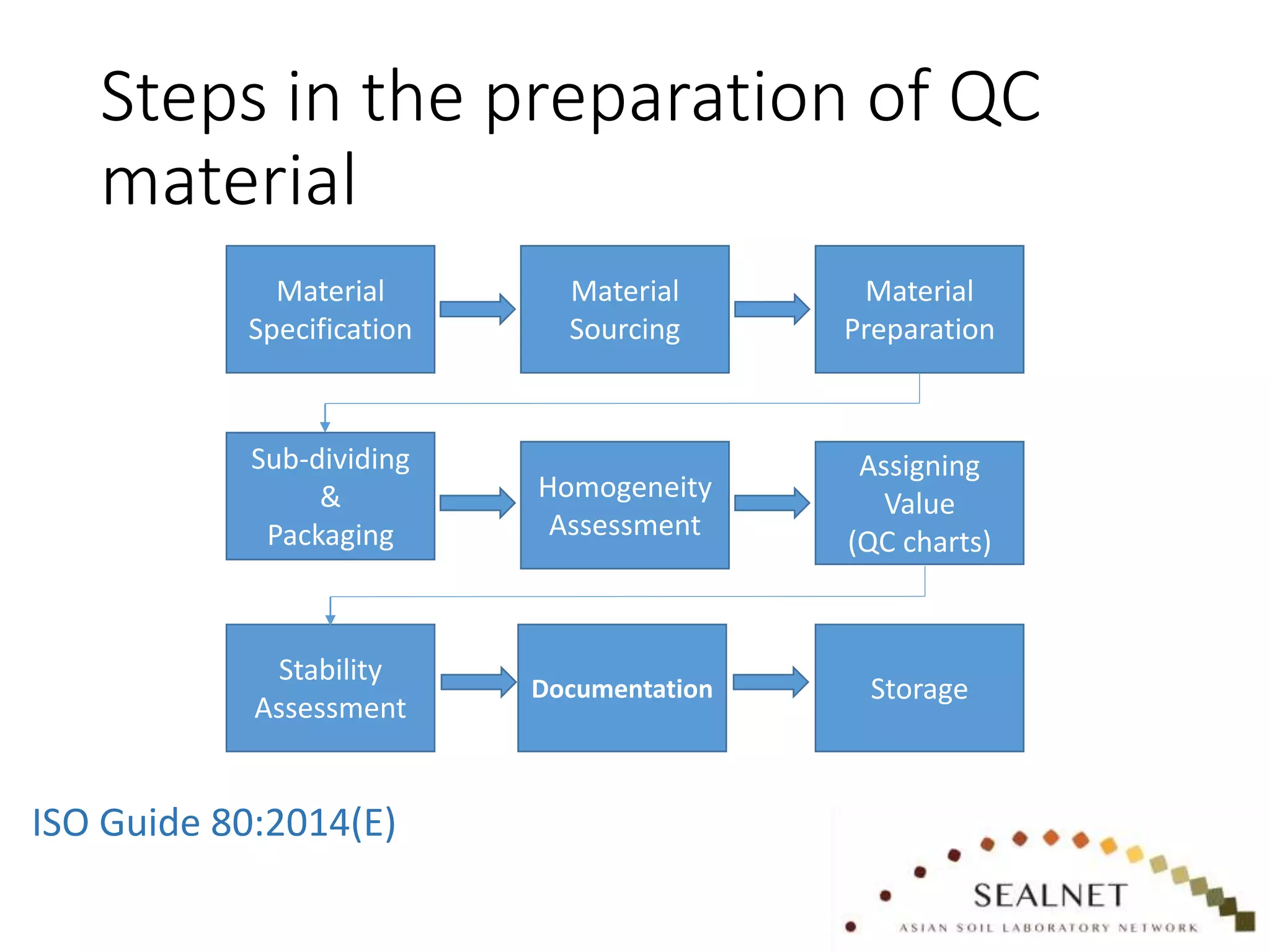
Steps in the preparation of QC
material
Sub-dividing
&
Packaging
Homogeneity
Assessment
Assigning
Value
(QC charts)
Stability
Assessment
Documentation Storage
Material
Specification
Material
Sourcing
Material
Preparation
ISO Guide 80:2014(E)
Sourcing and Selecting Bulk Material
• representative of the soils most commonly analysed by the
laboratory
• collect sufficient material depending on the turn-over of the
sample material, the expected stability and the amount that
can be handled during preparation. Thus, amounts may
range from a few kilos to hundred kilos
• reflects the range of commonly expected values for the test
being performed (i.e. selecting a reference soil with a
concentration towards the low end and another towards
the higher end of normally expected values)
• For convenience and efficiency it would be advantageous to
select soils that will be useful for a number of different
analyses
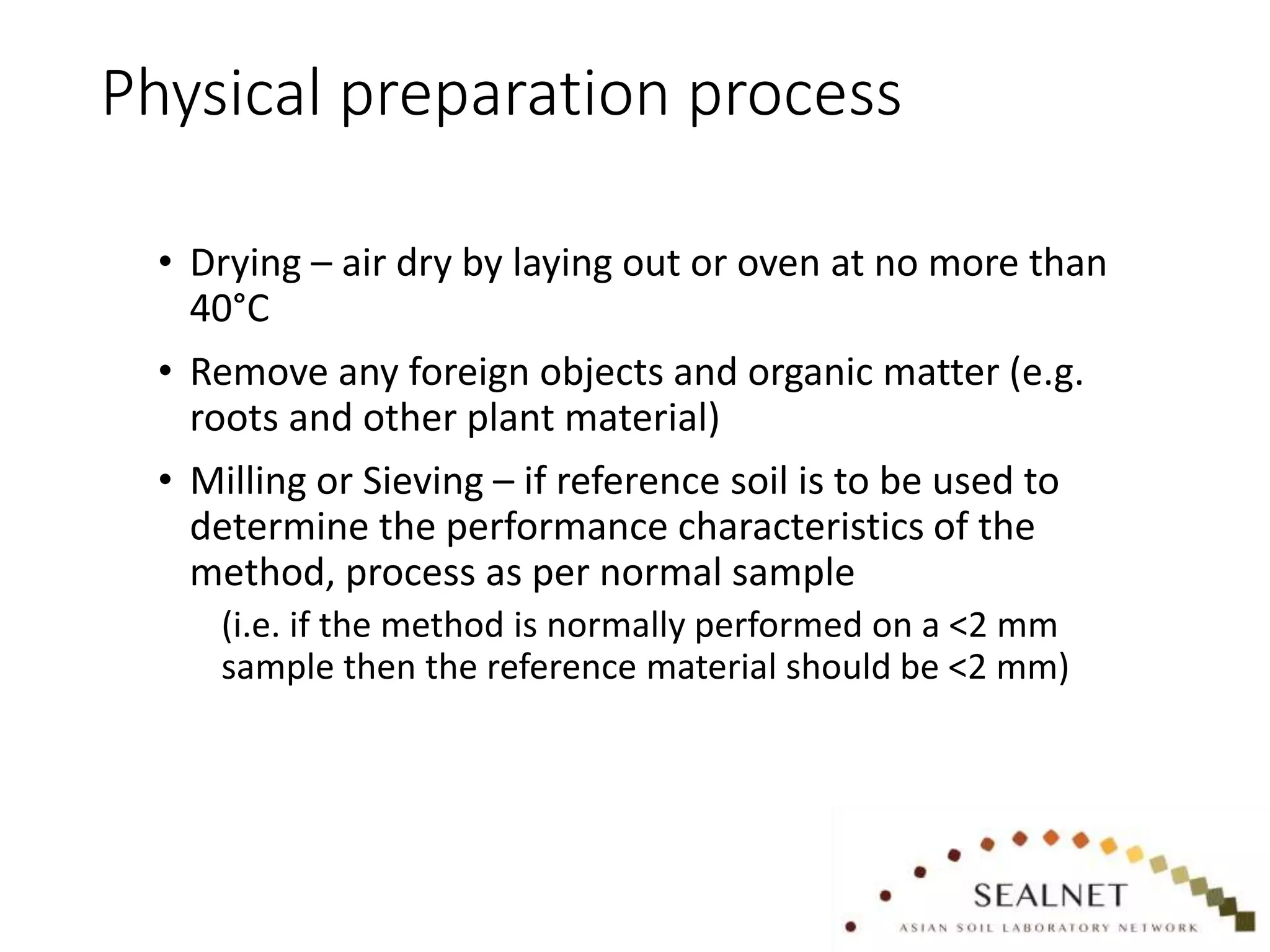
Physical preparation process
• Drying – air dry by laying out or oven at no more than
40°C
• Remove any foreign objects and organic matter (e.g.
roots and other plant material)
• Milling or Sieving – if reference soil is to be used to
determine the performance characteristics of the
method, process as per normal sample
(i.e. if the method is normally performed on a <2 mm
sample then the reference material should be <2 mm)
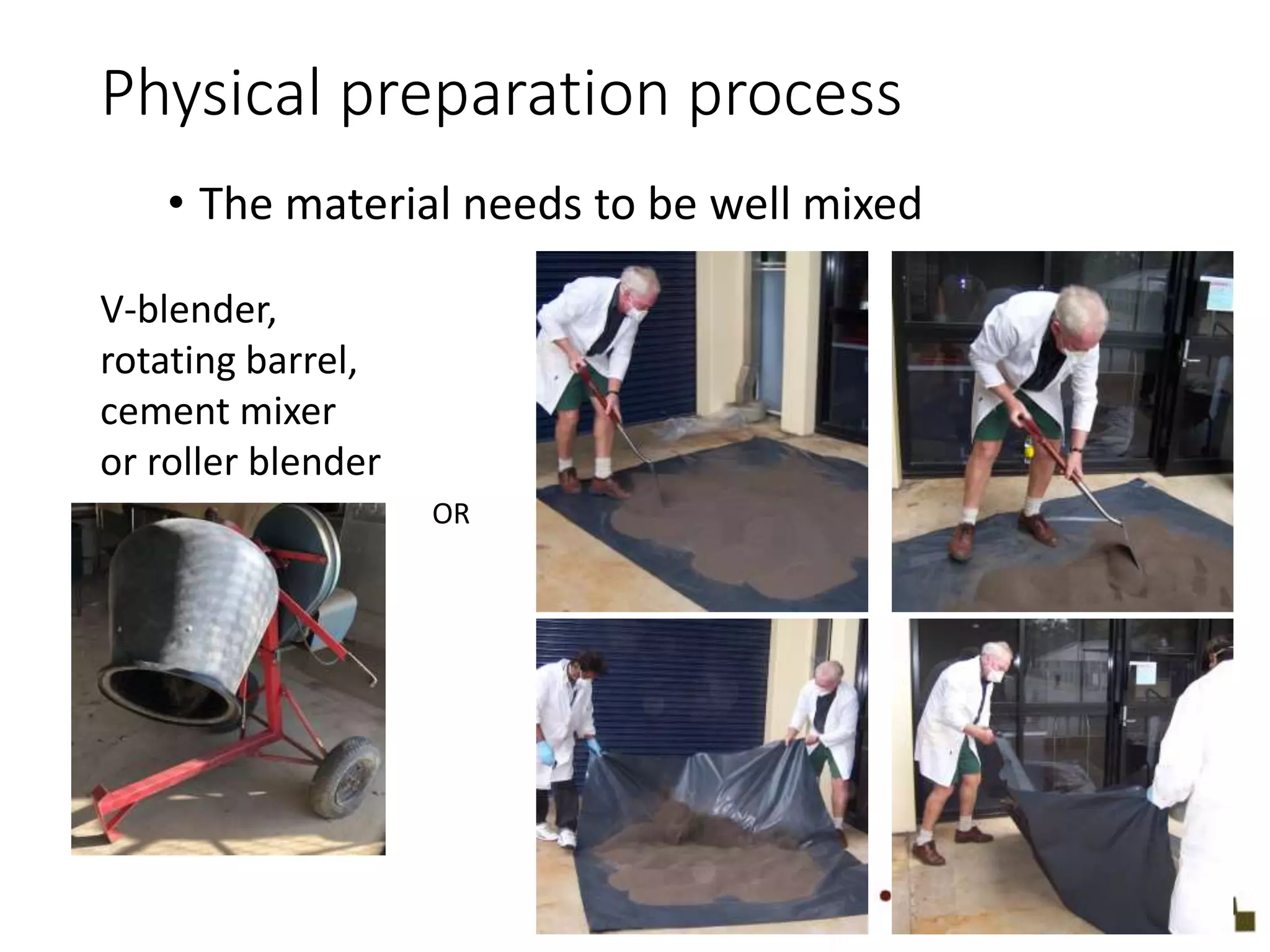
Physical preparation process
• The material needs to be well mixed
V-blender,
rotating barrel,
cement mixer
or roller blender
OR
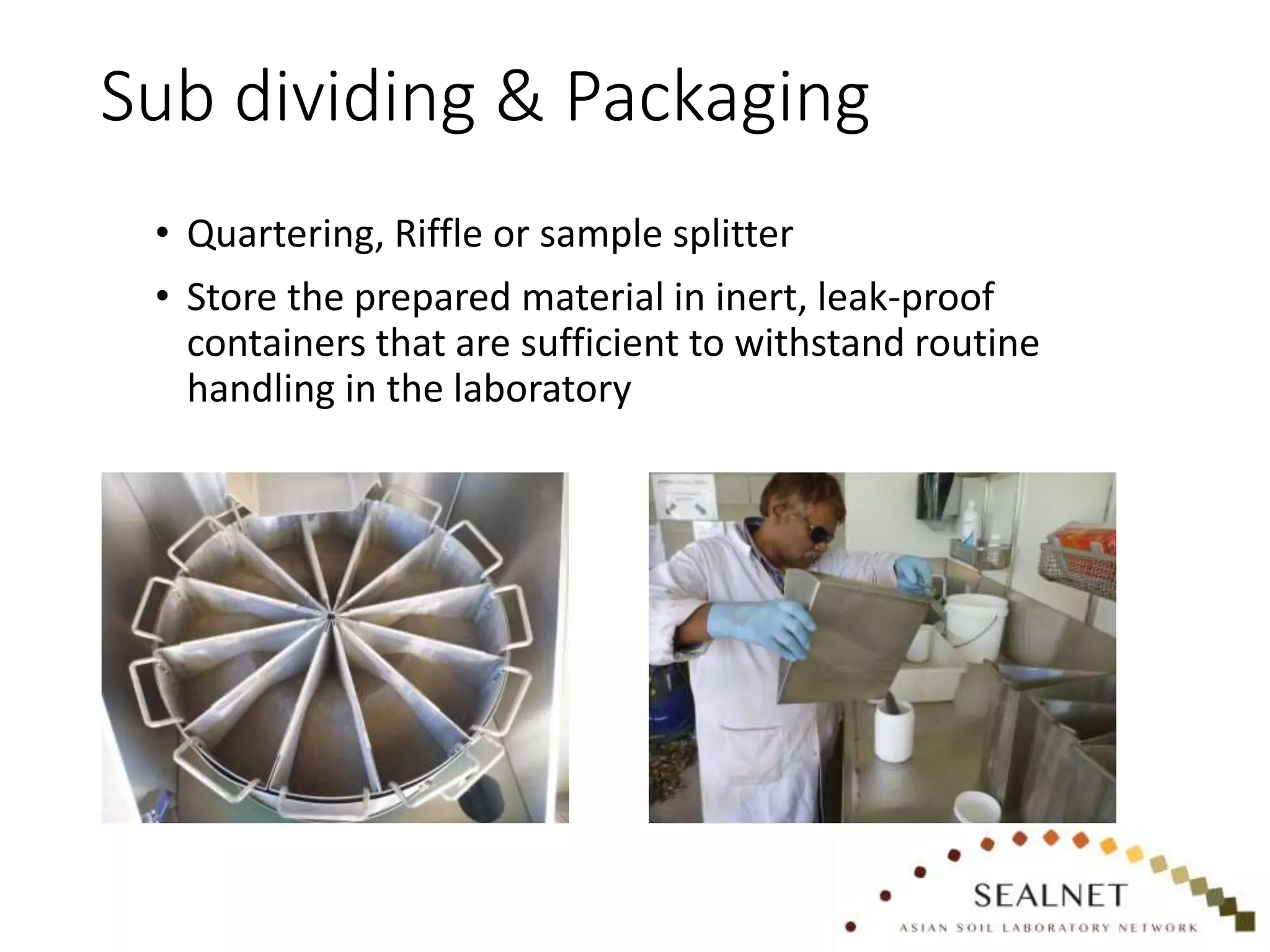
Sub dividing & Packaging
• Quartering, Riffle or sample splitter
• Store the prepared material in inert, leak-proof
containers that are sufficient to withstand routine
handling in the laboratory
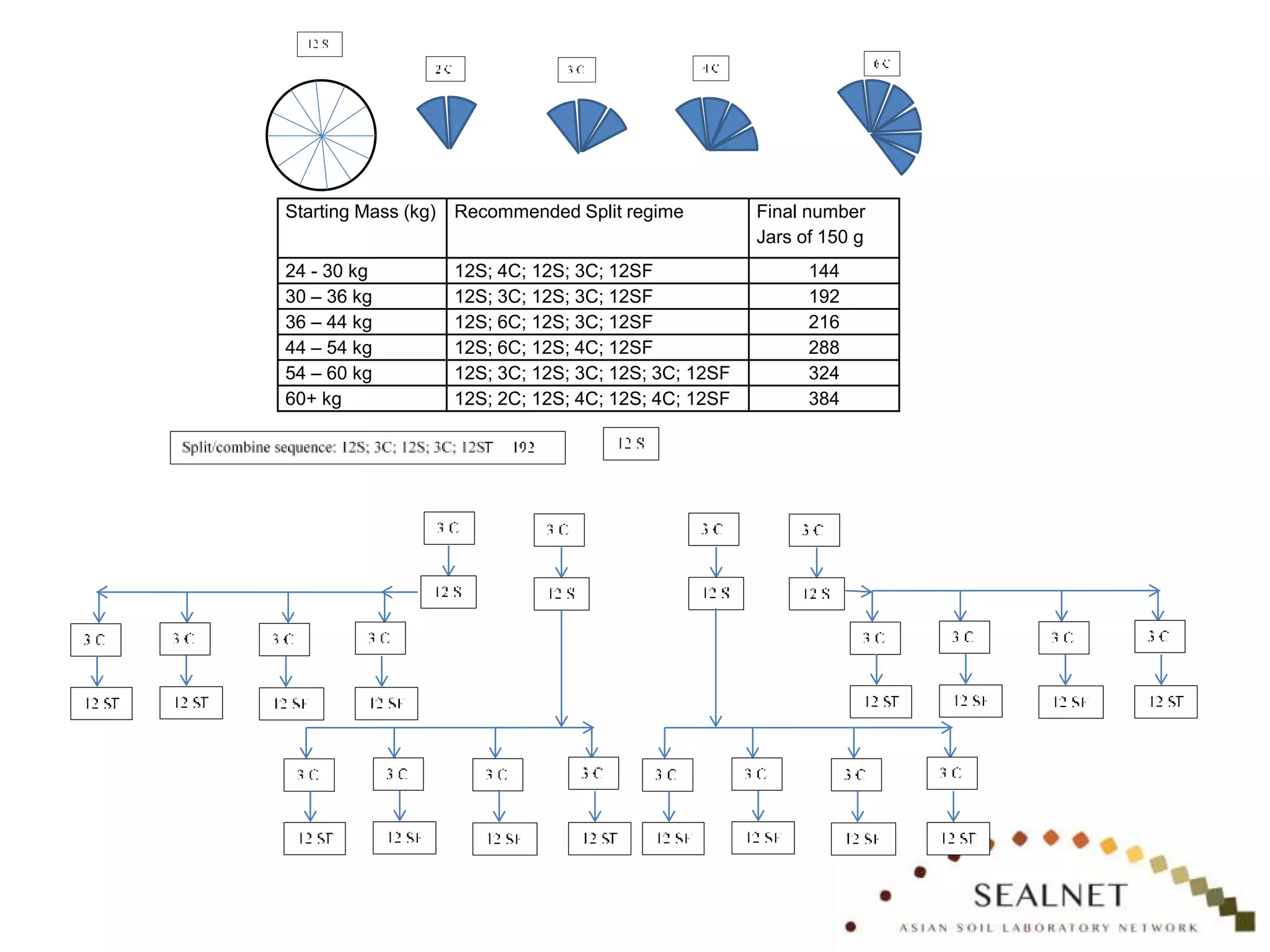
Starting Mass (kg) Recommended Split regime Final number
Jars of 150 g
24 - 30 kg 12S; 4C; 12S; 3C; 12SF 144
30 – 36 kg 12S; 3C; 12S; 3C; 12SF 192
36 – 44 kg 12S; 6C; 12S; 3C; 12SF 216
44 – 54 kg 12S; 6C; 12S; 4C; 12SF 288
54 – 60 kg 12S; 3C; 12S; 3C; 12S; 3C; 12SF 324
60+ kg 12S; 2C; 12S; 4C; 12S; 4C; 12SF 384
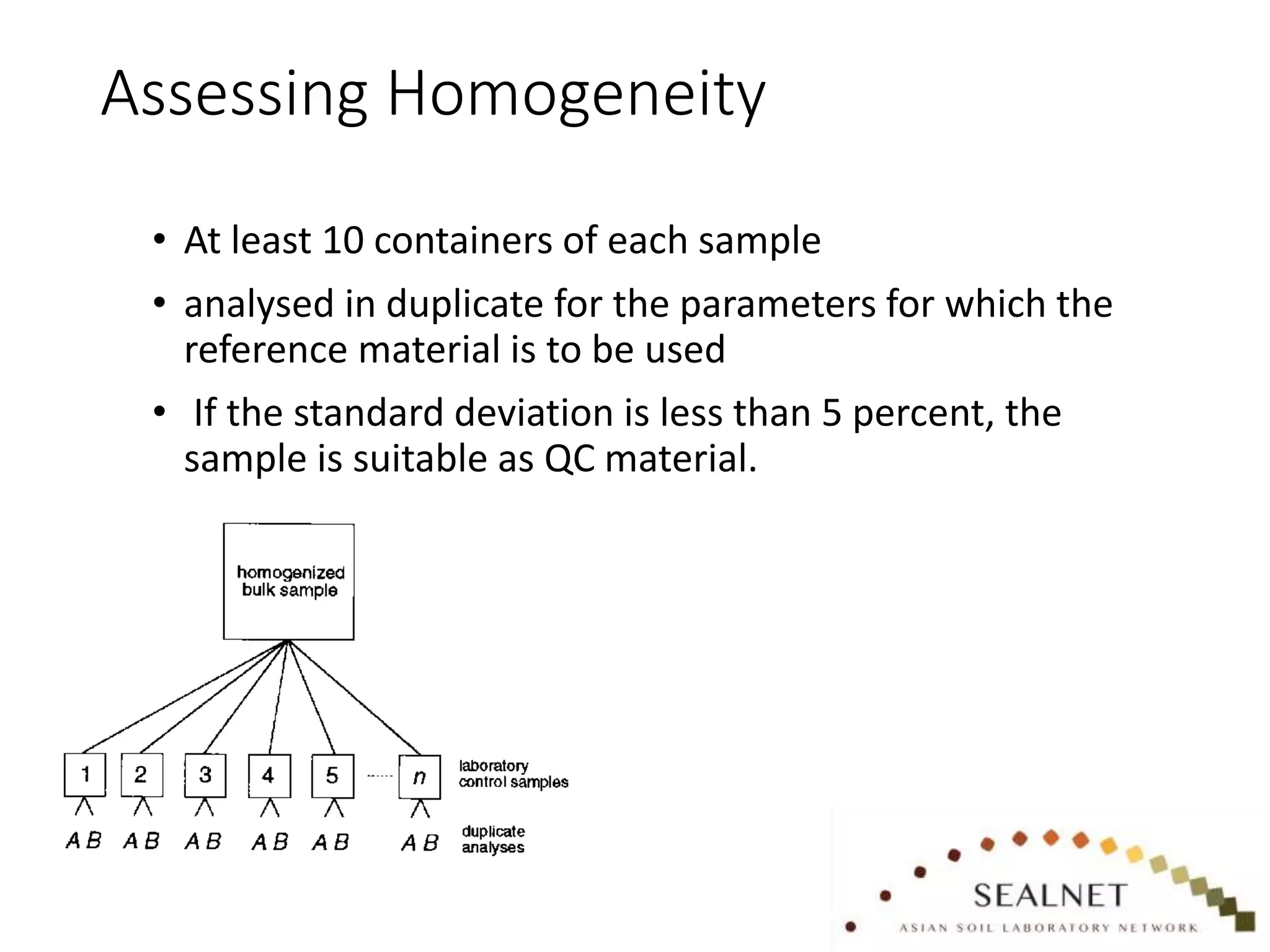
Assessing Homogeneity
• At least 10 containers of each sample
• analysed in duplicate for the parameters for which the
reference material is to be used
• If the standard deviation is less than 5 percent, the
sample is suitable as QC material.
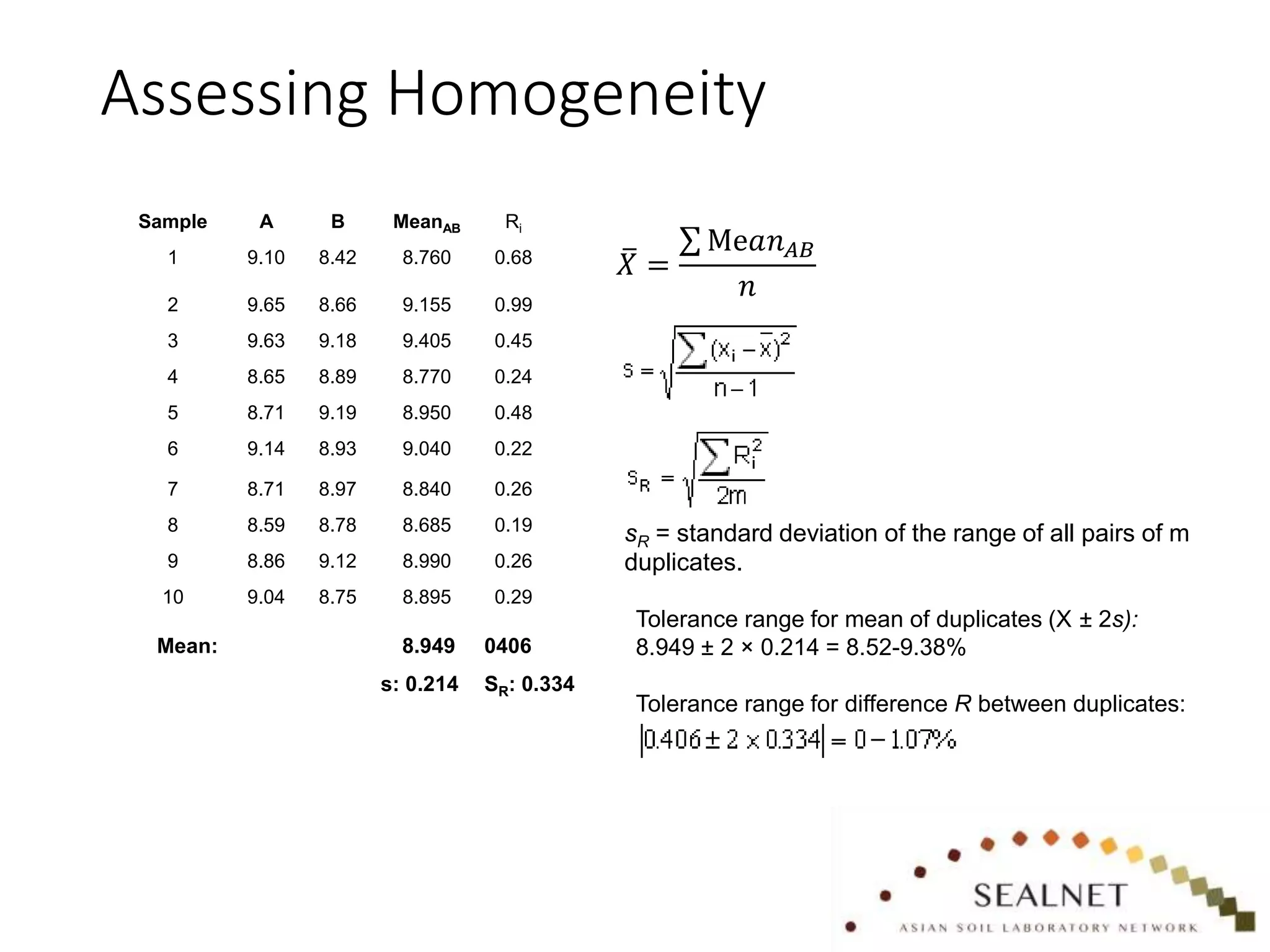
Assessing Homogeneity
Sample A B
1 9.10 8.42
2 9.65 8.66
3 9.63 9.18
4 8.65 8.89
5 8.71 9.19
6 9.14 8.93
7 8.71 8.97
8 8.59 8.78
9 8.86 9.12
10 9.04 8.75
Mean: 8.949 0406
s: 0.214 SR: 0.334
Tolerance range for mean of duplicates (X ± 2s):
8.949 ± 2 × 0.214 = 8.52-9.38%
Tolerance range for difference R between duplicates:
sR = standard deviation of the range of all pairs of m
duplicates.
MeanAB Ri
8.760 0.68
9.155 0.99
9.405 0.45
8.770 0.24
8.950 0.48
9.040 0.22
8.840 0.26
8.685 0.19
8.990 0.26
8.895 0.29
𝑋 =
Mⅇ𝑎𝑛 𝐴𝐵
𝑛
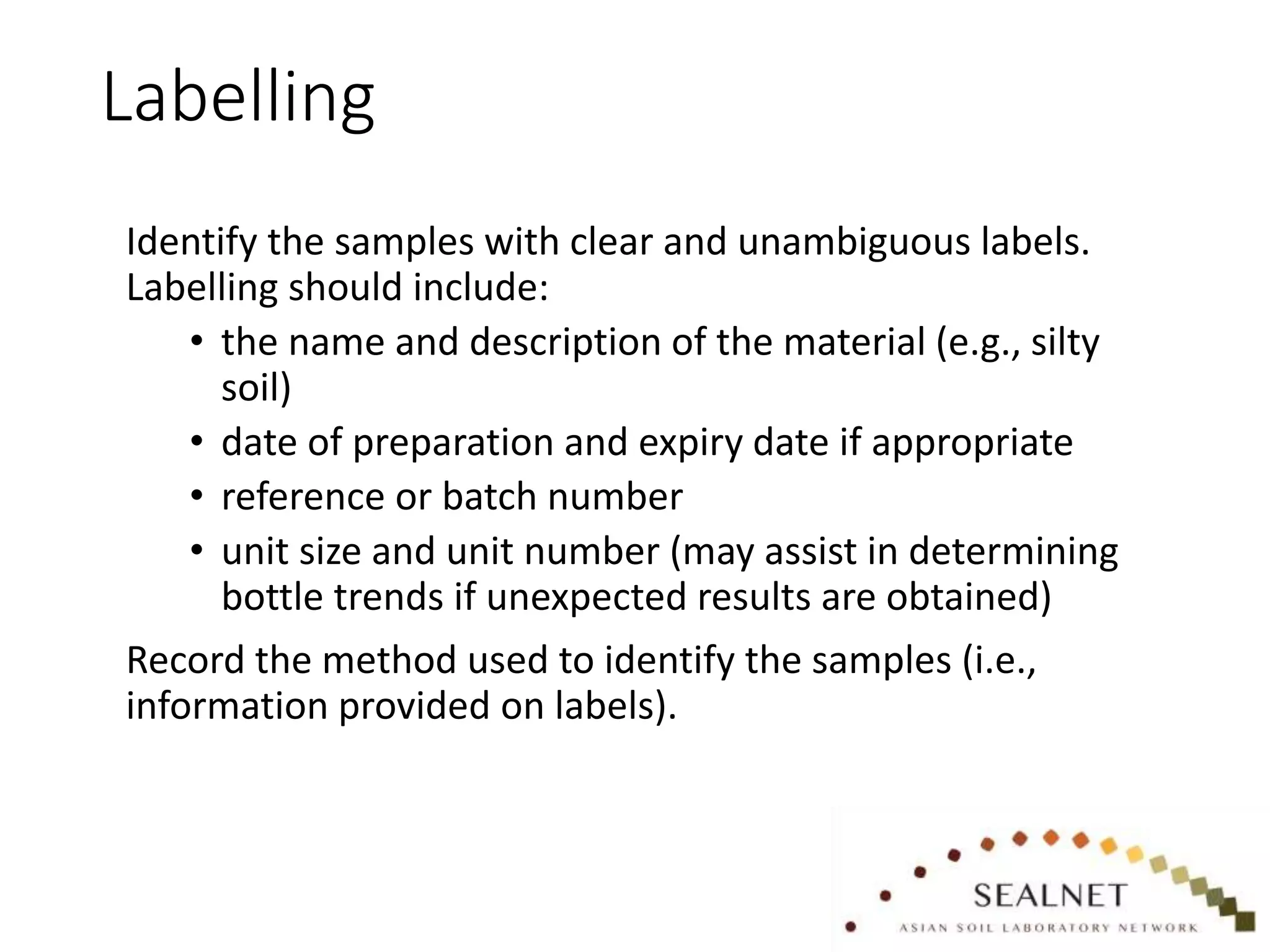
Labelling
Identify the samples with clear and unambiguous labels.
Labelling should include:
• the name and description of the material (e.g., silty
soil)
• date of preparation and expiry date if appropriate
• reference or batch number
• unit size and unit number (may assist in determining
bottle trends if unexpected results are obtained)
Record the method used to identify the samples (i.e.,
information provided on labels).
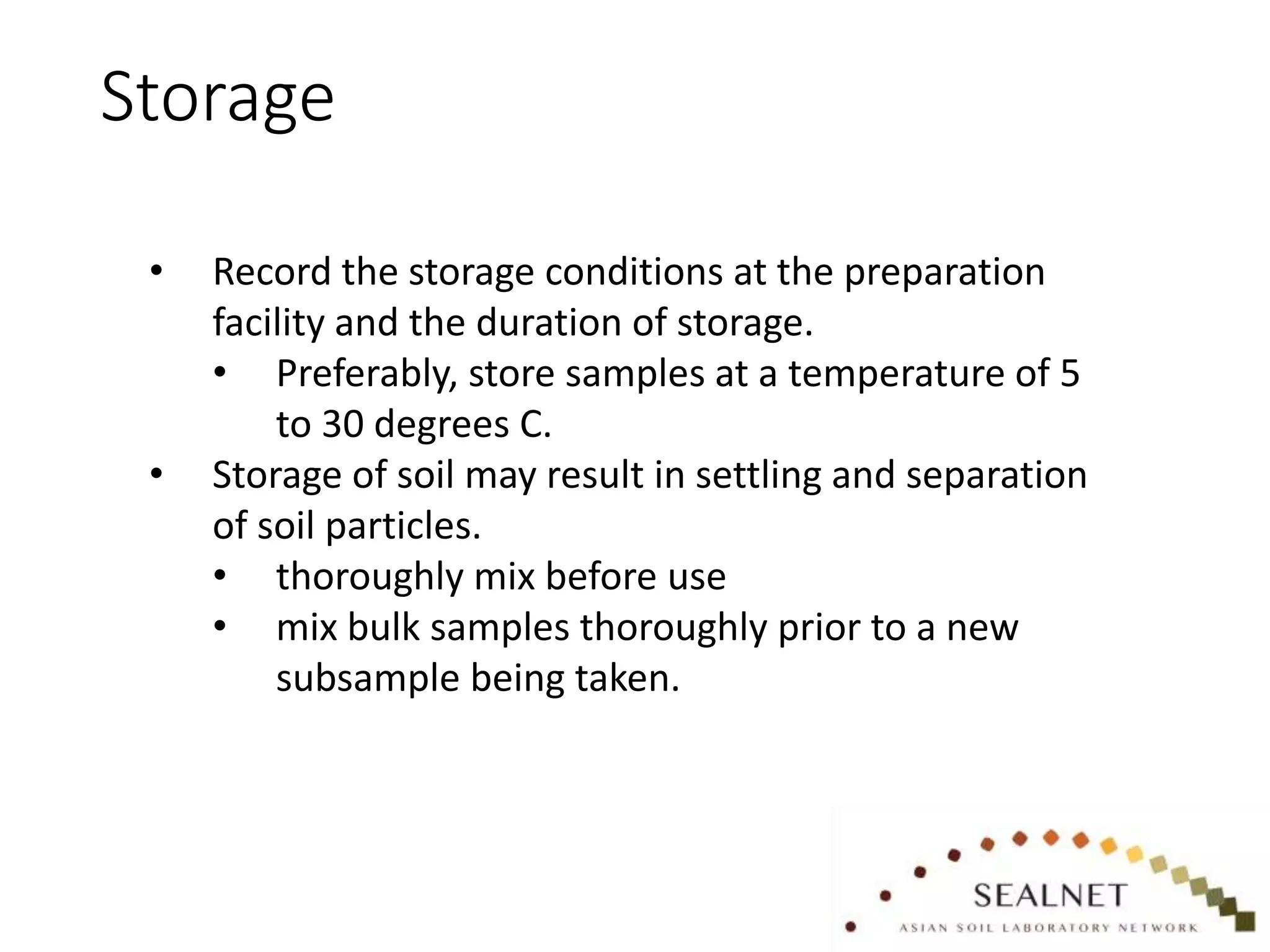
Storage
• Record the storage conditions at the preparation
facility and the duration of storage.
• Preferably, store samples at a temperature of 5
to 30 degrees C.
• Storage of soil may result in settling and separation
of soil particles.
• thoroughly mix before use
• mix bulk samples thoroughly prior to a new
subsample being taken.
Documentation
• The following information should be readily available
to the QCM user:
– name and description of the material;
– reference number and/or batch number;
– date of preparation;
– intended use of the material and any special instructions
for its use (e.g. specific drying procedures)
– indicative value(s), if applicable;
– storage instructions;
– information on expected shelf-life;
– any special safety precautions to be applied by users
Documentation
Information relating to the preparation of the QCM
• query arises regarding the material during use,
• new batch of the material has to be produced.
– source and preparation of the bulk material;
– types of containers used for the individual units;
– sub-division procedures used;
– any special treatments used to stabilize or sterilize the
material;
– supplementary data on the material (e.g. particle size,
moisture content, etc.);
– full details of all methods used to produce the material;
– specific experience useful to avoid pitfalls and costly errors
during preparation of new batches or related QCMs.
What analysis do I use to test
homogeneity ?
Thanks for your attention
Guidelines for Quality Management in Soil and Plant Laboratories.
(FAO Soils Bulletin - 74)
ISO Guide 80:2014(E) Guidance for the in-house preparation of
quality control material (QCMs)
Michael Thompson, Stephen L. R. Ellison, Roger Wood. The
International Harmonized Protocol for the Proficiency Testing of
Analytical Chemistry Laboratories, Pure Appl. Chem. 78, 145 (2006).
DOI: https://doi.org/10.1351/pac200678010145

4th SEALNET meeting, item 8: Training on internal quality control - Preparing material for Internal Quality Control

  • 1.
    Preparing material for InternalQuality Control Rob De Hayr
  • 2.
    Uses for internalQuality Control (QC) samples • Preparation of QC charts for monitoring and demonstrating that the test is in control or confirm the laboratory’s QC processes are effective over time. • Comparing results between batches • Validation of method development • Repeatability and reproducibility studies through use over time including changes in operators and instruments. • Inter-laboratory checking • Impacts of changes in environmental conditions in the laboratory.
  • 3.
    Steps in thepreparation of QC material Sub-dividing & Packaging Homogeneity Assessment Assigning Value (QC charts) Stability Assessment Documentation Storage Material Specification Material Sourcing Material Preparation ISO Guide 80:2014(E)
  • 4.
    Sourcing and SelectingBulk Material • representative of the soils most commonly analysed by the laboratory • collect sufficient material depending on the turn-over of the sample material, the expected stability and the amount that can be handled during preparation. Thus, amounts may range from a few kilos to hundred kilos • reflects the range of commonly expected values for the test being performed (i.e. selecting a reference soil with a concentration towards the low end and another towards the higher end of normally expected values) • For convenience and efficiency it would be advantageous to select soils that will be useful for a number of different analyses
  • 5.
    Physical preparation process •Drying – air dry by laying out or oven at no more than 40°C • Remove any foreign objects and organic matter (e.g. roots and other plant material) • Milling or Sieving – if reference soil is to be used to determine the performance characteristics of the method, process as per normal sample (i.e. if the method is normally performed on a <2 mm sample then the reference material should be <2 mm)
  • 6.
    Physical preparation process •The material needs to be well mixed V-blender, rotating barrel, cement mixer or roller blender OR
  • 7.
    Sub dividing &Packaging • Quartering, Riffle or sample splitter • Store the prepared material in inert, leak-proof containers that are sufficient to withstand routine handling in the laboratory
  • 8.
    Starting Mass (kg)Recommended Split regime Final number Jars of 150 g 24 - 30 kg 12S; 4C; 12S; 3C; 12SF 144 30 – 36 kg 12S; 3C; 12S; 3C; 12SF 192 36 – 44 kg 12S; 6C; 12S; 3C; 12SF 216 44 – 54 kg 12S; 6C; 12S; 4C; 12SF 288 54 – 60 kg 12S; 3C; 12S; 3C; 12S; 3C; 12SF 324 60+ kg 12S; 2C; 12S; 4C; 12S; 4C; 12SF 384
  • 9.
    Assessing Homogeneity • Atleast 10 containers of each sample • analysed in duplicate for the parameters for which the reference material is to be used • If the standard deviation is less than 5 percent, the sample is suitable as QC material.
  • 10.
    Assessing Homogeneity Sample AB 1 9.10 8.42 2 9.65 8.66 3 9.63 9.18 4 8.65 8.89 5 8.71 9.19 6 9.14 8.93 7 8.71 8.97 8 8.59 8.78 9 8.86 9.12 10 9.04 8.75 Mean: 8.949 0406 s: 0.214 SR: 0.334 Tolerance range for mean of duplicates (X ± 2s): 8.949 ± 2 × 0.214 = 8.52-9.38% Tolerance range for difference R between duplicates: sR = standard deviation of the range of all pairs of m duplicates. MeanAB Ri 8.760 0.68 9.155 0.99 9.405 0.45 8.770 0.24 8.950 0.48 9.040 0.22 8.840 0.26 8.685 0.19 8.990 0.26 8.895 0.29 𝑋 = Mⅇ𝑎𝑛 𝐴𝐵 𝑛
  • 11.
    Labelling Identify the sampleswith clear and unambiguous labels. Labelling should include: • the name and description of the material (e.g., silty soil) • date of preparation and expiry date if appropriate • reference or batch number • unit size and unit number (may assist in determining bottle trends if unexpected results are obtained) Record the method used to identify the samples (i.e., information provided on labels).
  • 12.
    Storage • Record thestorage conditions at the preparation facility and the duration of storage. • Preferably, store samples at a temperature of 5 to 30 degrees C. • Storage of soil may result in settling and separation of soil particles. • thoroughly mix before use • mix bulk samples thoroughly prior to a new subsample being taken.
  • 13.
    Documentation • The followinginformation should be readily available to the QCM user: – name and description of the material; – reference number and/or batch number; – date of preparation; – intended use of the material and any special instructions for its use (e.g. specific drying procedures) – indicative value(s), if applicable; – storage instructions; – information on expected shelf-life; – any special safety precautions to be applied by users
  • 14.
    Documentation Information relating tothe preparation of the QCM • query arises regarding the material during use, • new batch of the material has to be produced. – source and preparation of the bulk material; – types of containers used for the individual units; – sub-division procedures used; – any special treatments used to stabilize or sterilize the material; – supplementary data on the material (e.g. particle size, moisture content, etc.); – full details of all methods used to produce the material; – specific experience useful to avoid pitfalls and costly errors during preparation of new batches or related QCMs.
  • 15.
    What analysis doI use to test homogeneity ?
  • 16.
    Thanks for yourattention Guidelines for Quality Management in Soil and Plant Laboratories. (FAO Soils Bulletin - 74) ISO Guide 80:2014(E) Guidance for the in-house preparation of quality control material (QCMs) Michael Thompson, Stephen L. R. Ellison, Roger Wood. The International Harmonized Protocol for the Proficiency Testing of Analytical Chemistry Laboratories, Pure Appl. Chem. 78, 145 (2006). DOI: https://doi.org/10.1351/pac200678010145