TRANSITIONAL SIGNALS

NAMA KELOMPOK :
NIKEN
NURHIDAYATI SASMITA
NURLATIPAH
NURMALITA DEWI
RESSY ZULHAIJJAH
TRANSITIONAL
           SIGNALS


Transition signals are connecting
words or phrases that act like
bridges between parts of your
writing. They link your sentences
and paragraphs together smoothly
so that there are no abrupt jumps or
breaks between ideas.
Transition signals act like signposts to
indicate to the reader the order and flow of
your writing and ideas. They strengthen
the internal cohesion of your writing.
Using transitions makes it easier for the
reader to follow your ideas. They help
carry over a thought from one sentence to
another, from one paragraph to another,
or from one idea to another.
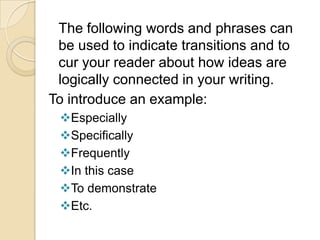
The following words and phrases can
 be used to indicate transitions and to
 cur your reader about how ideas are
 logically connected in your writing.
To introduce an example:
 Especially
 Specifically
 Frequently
 In this case
 To demonstrate
 Etc.
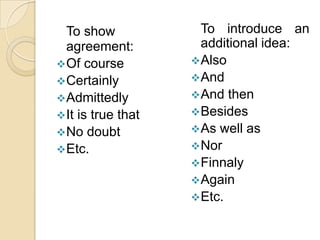
To show             To introduce an
  agreement:          additional idea:
 Of course          Also
 Certainly          And
 Admittedly         And then
 It is true that    Besides
 No doubt           As well as
 Etc.               Nor
                     Finnaly
                     Again
                     Etc.
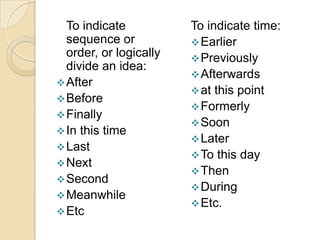
To indicate           To indicate time:
  sequence or            Earlier
  order, or logically    Previously
  divide an idea:
                         Afterwards
 After
                         at this point
 Before
                         Formerly
 Finally
                         Soon
 In this time
                         Later
 Last
                         To this day
 Next
                         Then
 Second
                         During
 Meanwhile
                         Etc.
 Etc
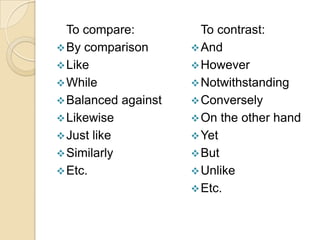
To compare:          To contrast:
 By comparison       And
 Like                However
 While               Notwithstanding
 Balanced against    Conversely
 Likewise            On the other hand
 Just like           Yet
 Similarly           But
 Etc.                Unlike
                      Etc.
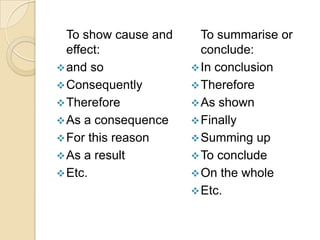
To show cause and     To summarise or
  effect:               conclude:
 and so               In conclusion
 Consequently         Therefore
 Therefore            As shown
 As a consequence     Finally
 For this reason      Summing up
 As a result          To conclude
 Etc.                 On the whole
                       Etc.
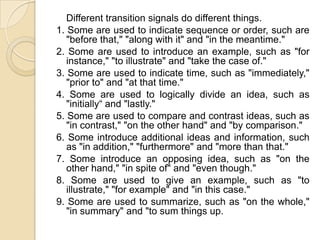
Different transition signals do different things.
1. Some are used to indicate sequence or order, such are
   "before that," "along with it" and "in the meantime."
2. Some are used to introduce an example, such as "for
   instance," "to illustrate" and "take the case of."
3. Some are used to indicate time, such as "immediately,"
   "prior to" and "at that time."
4. Some are used to logically divide an idea, such as
   "initially“ and "lastly."
5. Some are used to compare and contrast ideas, such as
   "in contrast," "on the other hand" and "by comparison."
6. Some introduce additional ideas and information, such
   as "in addition," "furthermore" and "more than that."
7. Some introduce an opposing idea, such as "on the
   other hand," "in spite of" and "even though."
8. Some are used to give an example, such as "to
   illustrate," "for example" and "in this case."
9. Some are used to summarize, such as "on the whole,"
   "in summary" and "to sum things up.
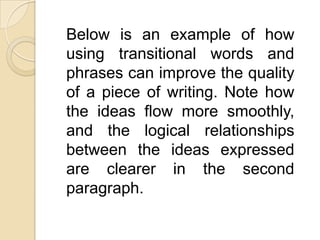
Below is an example of how
using transitional words and
phrases can improve the quality
of a piece of writing. Note how
the ideas flow more smoothly,
and the logical relationships
between the ideas expressed
are clearer in the second
paragraph.
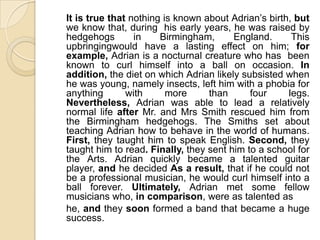
It is true that nothing is known about Adrian’s birth, but
we know that, during his early years, he was raised by
hedgehogs        in    Birmingham,      England.      This
upbringingwould have a lasting effect on him; for
example, Adrian is a nocturnal creature who has been
known to curl himself into a ball on occasion. In
addition, the diet on which Adrian likely subsisted when
he was young, namely insects, left him with a phobia for
anything       with      more     than      four     legs.
Nevertheless, Adrian was able to lead a relatively
normal life after Mr. and Mrs Smith rescued him from
the Birmingham hedgehogs. The Smiths set about
teaching Adrian how to behave in the world of humans.
First, they taught him to speak English. Second, they
taught him to read. Finally, they sent him to a school for
the Arts. Adrian quickly became a talented guitar
player, and he decided As a result, that if he could not
be a professional musician, he would curl himself into a
ball forever. Ultimately, Adrian met some fellow
musicians who, in comparison, were as talented as
he, and they soon formed a band that became a huge
success.

4th group ( transitional signal )

  • 1.
    TRANSITIONAL SIGNALS NAMA KELOMPOK: NIKEN NURHIDAYATI SASMITA NURLATIPAH NURMALITA DEWI RESSY ZULHAIJJAH
  • 2.
    TRANSITIONAL SIGNALS Transition signals are connecting words or phrases that act like bridges between parts of your writing. They link your sentences and paragraphs together smoothly so that there are no abrupt jumps or breaks between ideas.
  • 3.
    Transition signals actlike signposts to indicate to the reader the order and flow of your writing and ideas. They strengthen the internal cohesion of your writing. Using transitions makes it easier for the reader to follow your ideas. They help carry over a thought from one sentence to another, from one paragraph to another, or from one idea to another.
  • 4.
    The following wordsand phrases can be used to indicate transitions and to cur your reader about how ideas are logically connected in your writing. To introduce an example: Especially Specifically Frequently In this case To demonstrate Etc.
  • 5.
    To show To introduce an agreement: additional idea:  Of course  Also  Certainly  And  Admittedly  And then  It is true that  Besides  No doubt  As well as  Etc.  Nor  Finnaly  Again  Etc.
  • 6.
    To indicate To indicate time: sequence or  Earlier order, or logically  Previously divide an idea:  Afterwards  After  at this point  Before  Formerly  Finally  Soon  In this time  Later  Last  To this day  Next  Then  Second  During  Meanwhile  Etc.  Etc
  • 7.
    To compare: To contrast:  By comparison  And  Like  However  While  Notwithstanding  Balanced against  Conversely  Likewise  On the other hand  Just like  Yet  Similarly  But  Etc.  Unlike  Etc.
  • 8.
    To show causeand To summarise or effect: conclude:  and so  In conclusion  Consequently  Therefore  Therefore  As shown  As a consequence  Finally  For this reason  Summing up  As a result  To conclude  Etc.  On the whole  Etc.
  • 9.
    Different transition signalsdo different things. 1. Some are used to indicate sequence or order, such are "before that," "along with it" and "in the meantime." 2. Some are used to introduce an example, such as "for instance," "to illustrate" and "take the case of." 3. Some are used to indicate time, such as "immediately," "prior to" and "at that time." 4. Some are used to logically divide an idea, such as "initially“ and "lastly." 5. Some are used to compare and contrast ideas, such as "in contrast," "on the other hand" and "by comparison." 6. Some introduce additional ideas and information, such as "in addition," "furthermore" and "more than that." 7. Some introduce an opposing idea, such as "on the other hand," "in spite of" and "even though." 8. Some are used to give an example, such as "to illustrate," "for example" and "in this case." 9. Some are used to summarize, such as "on the whole," "in summary" and "to sum things up.
  • 10.
    Below is anexample of how using transitional words and phrases can improve the quality of a piece of writing. Note how the ideas flow more smoothly, and the logical relationships between the ideas expressed are clearer in the second paragraph.
  • 11.
    It is truethat nothing is known about Adrian’s birth, but we know that, during his early years, he was raised by hedgehogs in Birmingham, England. This upbringingwould have a lasting effect on him; for example, Adrian is a nocturnal creature who has been known to curl himself into a ball on occasion. In addition, the diet on which Adrian likely subsisted when he was young, namely insects, left him with a phobia for anything with more than four legs. Nevertheless, Adrian was able to lead a relatively normal life after Mr. and Mrs Smith rescued him from the Birmingham hedgehogs. The Smiths set about teaching Adrian how to behave in the world of humans. First, they taught him to speak English. Second, they taught him to read. Finally, they sent him to a school for the Arts. Adrian quickly became a talented guitar player, and he decided As a result, that if he could not be a professional musician, he would curl himself into a ball forever. Ultimately, Adrian met some fellow musicians who, in comparison, were as talented as he, and they soon formed a band that became a huge success.