Happy
Wednesday!
Let’s enjoy while learning!
Checking of Attendance
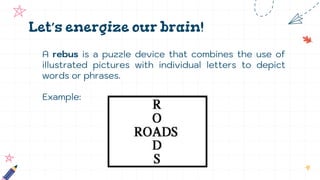
Let’s energize our brain!
A rebus is a puzzle device that combines the use of
illustrated pictures with individual letters to depict
words or phrases.
Example:
Recognizing
Positive and
Negative
Messages
English 8
Learning Competencies
● Discern positive and negative messages
conveyed in a text (MELC)
● Identify the Elements of Recognizing Positive
and Negative Messages
● Recognize how emotion and word choice
contribute to the message of the text
● Construct sentences using words and
expressions conveying positive and negative
message.
Let’s have a review (week 6)
● What was our topic all about?
● What is comparing and contrasting?
Comparing and contrasting are ways of exploring the
similarities and differences between two things. ...
Generally speaking, comparing is showing the similarities,
and contrasting is showing differences between two
things that are related in some way.
● Can you give an example of a sentence that compare
and contrast?
● What was your most important learning from the
lesson?
Activity
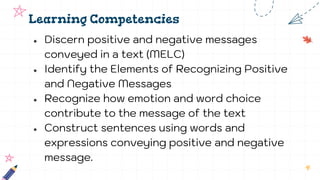
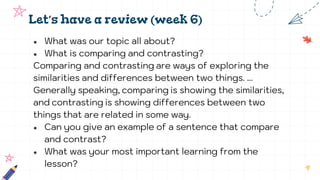
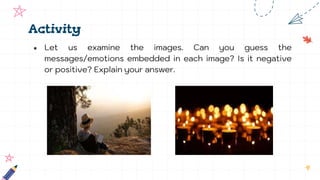
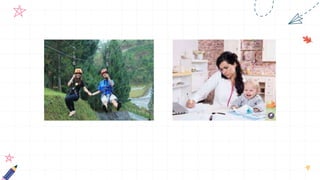
● Let us examine the images. Can you guess the
messages/emotions embedded in each image? Is it negative
or positive? Explain your answer.
A picture is
worth a
thousand words.
-Albert Einstein-
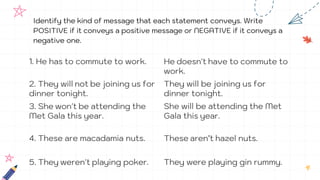
Identify the kind of message that each statement conveys. Write
POSITIVE if it conveys a positive message or NEGATIVE if it conveys a
negative one.
1. He has to commute to work. He doesn't have to commute to
work.
2. They will not be joining us for
dinner tonight.
They will be joining us for
dinner tonight.
3. She won't be attending the
Met Gala this year.
She will be attending the Met
Gala this year.
4. These are macadamia nuts. These aren’t hazel nuts.
5. They weren't playing poker. They were playing gin rummy.
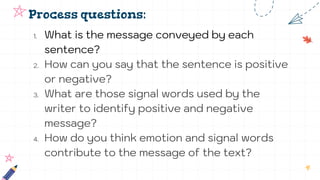
Process questions:
1. What is the message conveyed by each
sentence?
2. How can you say that the sentence is positive
or negative?
3. What are those signal words used by the
writer to identify positive and negative
message?
4. How do you think emotion and signal words
contribute to the message of the text?
Positive and Negative
Messages
What is the importance of
recognizing positive and
negative message?
● Recognizing positive and negative messages
in text is important for understanding the
impact of delivery and composition on the
audience. Positive messages convey good
news, acceptance, and congratulations, while
negative messages convey unpleasant
information likely to disappoint, upset, or
anger the reader.
Application
Learning Task 3
Construct a short essay about the
following topics. Use positive and
negative messages.
1. Use of cellphones
2. Advance technology
Evaluation
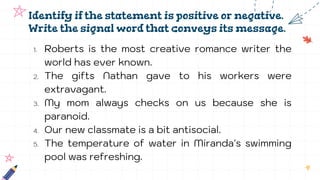
Identify if the statement is positive or negative.
Write the signal word that conveys its message.
1. Roberts is the most creative romance writer the
world has ever known.
2. The gifts Nathan gave to his workers were
extravagant.
3. My mom always checks on us because she is
paranoid.
4. Our new classmate is a bit antisocial.
5. The temperature of water in Miranda's swimming
pool was refreshing.
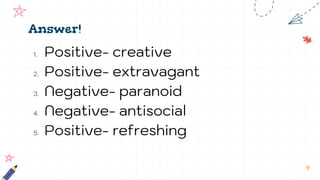
Answer!
1. Positive- creative
2. Positive- extravagant
3. Negative- paranoid
4. Negative- antisocial
5. Positive- refreshing
Thank you
and enjoy
your day!!

Recognizing Positive and Negative Messages.pptx

  • 1.
  • 2.
  • 3.
    Let’s energize ourbrain! A rebus is a puzzle device that combines the use of illustrated pictures with individual letters to depict words or phrases. Example:
  • 5.
  • 6.
    Learning Competencies ● Discernpositive and negative messages conveyed in a text (MELC) ● Identify the Elements of Recognizing Positive and Negative Messages ● Recognize how emotion and word choice contribute to the message of the text ● Construct sentences using words and expressions conveying positive and negative message.
  • 7.
    Let’s have areview (week 6) ● What was our topic all about? ● What is comparing and contrasting? Comparing and contrasting are ways of exploring the similarities and differences between two things. ... Generally speaking, comparing is showing the similarities, and contrasting is showing differences between two things that are related in some way. ● Can you give an example of a sentence that compare and contrast? ● What was your most important learning from the lesson?
  • 8.
    Activity ● Let usexamine the images. Can you guess the messages/emotions embedded in each image? Is it negative or positive? Explain your answer.
  • 10.
    A picture is wortha thousand words. -Albert Einstein-
  • 11.
    Identify the kindof message that each statement conveys. Write POSITIVE if it conveys a positive message or NEGATIVE if it conveys a negative one. 1. He has to commute to work. He doesn't have to commute to work. 2. They will not be joining us for dinner tonight. They will be joining us for dinner tonight. 3. She won't be attending the Met Gala this year. She will be attending the Met Gala this year. 4. These are macadamia nuts. These aren’t hazel nuts. 5. They weren't playing poker. They were playing gin rummy.
  • 12.
    Process questions: 1. Whatis the message conveyed by each sentence? 2. How can you say that the sentence is positive or negative? 3. What are those signal words used by the writer to identify positive and negative message? 4. How do you think emotion and signal words contribute to the message of the text?
  • 13.
  • 15.
    What is theimportance of recognizing positive and negative message?
  • 16.
    ● Recognizing positiveand negative messages in text is important for understanding the impact of delivery and composition on the audience. Positive messages convey good news, acceptance, and congratulations, while negative messages convey unpleasant information likely to disappoint, upset, or anger the reader.
  • 17.
  • 18.
    Learning Task 3 Constructa short essay about the following topics. Use positive and negative messages. 1. Use of cellphones 2. Advance technology
  • 20.
  • 21.
    Identify if thestatement is positive or negative. Write the signal word that conveys its message. 1. Roberts is the most creative romance writer the world has ever known. 2. The gifts Nathan gave to his workers were extravagant. 3. My mom always checks on us because she is paranoid. 4. Our new classmate is a bit antisocial. 5. The temperature of water in Miranda's swimming pool was refreshing.
  • 22.
    Answer! 1. Positive- creative 2.Positive- extravagant 3. Negative- paranoid 4. Negative- antisocial 5. Positive- refreshing
  • 23.