Transitions
Transitions are:
 words or phrases that connect
  ideas, sentences, and paragraphs.
 like a bridge filling in the gap from one
  idea to another.
 Important for organized writing.
Transitions help:
 create unity in a piece of writing.
 paragraphs work together
 continue an idea, indicate a contrast or
  sum up a thought.
 papers flow from thought to thought.
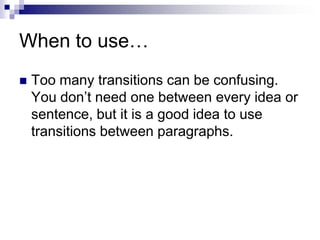
When to use…
   Too many transitions can be confusing.
    You don’t need one between every idea or
    sentence, but it is a good idea to use
    transitions between paragraphs.
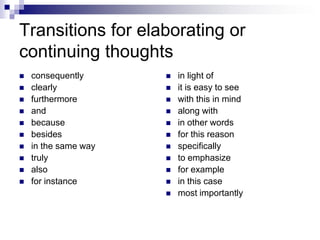
Transitions for elaborating or
continuing thoughts
   consequently         in light of
   clearly              it is easy to see
   furthermore          with this in mind
   and                  along with
   because              in other words
   besides              for this reason
   in the same way      specifically
   truly                to emphasize
   also                 for example
   for instance         in this case
                         most importantly
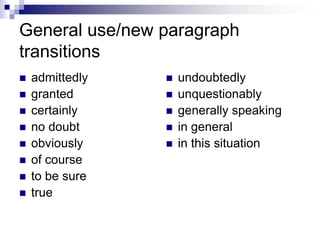
General use/new paragraph
transitions
   admittedly      undoubtedly
   granted         unquestionably
   certainly       generally speaking
   no doubt        in general
   obviously       in this situation
   of course
   to be sure
   true
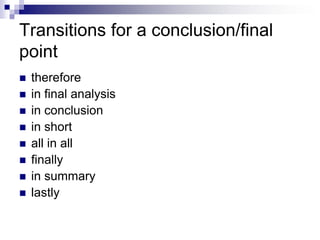
Transitions for a conclusion/final
point
   therefore
   in final analysis
   in conclusion
   in short
   all in all
   finally
   in summary
   lastly
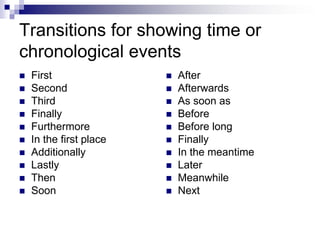
Transitions for showing time or
chronological events
   First                   After
   Second                  Afterwards
   Third                   As soon as
   Finally                 Before
   Furthermore             Before long
   In the first place      Finally
   Additionally            In the meantime
   Lastly                  Later
   Then                    Meanwhile
   Soon                    Next
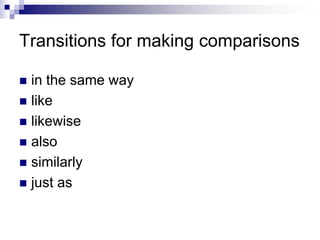
Transitions for making comparisons

 in the same way
 like
 likewise
 also
 similarly
 just as
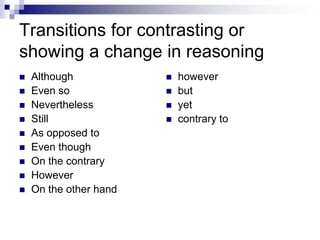
Transitions for contrasting or
showing a change in reasoning
   Although               however
   Even so                but
   Nevertheless           yet
   Still                  contrary to
   As opposed to
   Even though
   On the contrary
   However
   On the other hand

Transitions (2)

  • 1.
  • 2.
    Transitions are:  wordsor phrases that connect ideas, sentences, and paragraphs.  like a bridge filling in the gap from one idea to another.  Important for organized writing.
  • 3.
    Transitions help:  createunity in a piece of writing.  paragraphs work together  continue an idea, indicate a contrast or sum up a thought.  papers flow from thought to thought.
  • 4.
    When to use…  Too many transitions can be confusing. You don’t need one between every idea or sentence, but it is a good idea to use transitions between paragraphs.
  • 5.
    Transitions for elaboratingor continuing thoughts  consequently  in light of  clearly  it is easy to see  furthermore  with this in mind  and  along with  because  in other words  besides  for this reason  in the same way  specifically  truly  to emphasize  also  for example  for instance  in this case  most importantly
  • 6.
    General use/new paragraph transitions  admittedly  undoubtedly  granted  unquestionably  certainly  generally speaking  no doubt  in general  obviously  in this situation  of course  to be sure  true
  • 7.
    Transitions for aconclusion/final point  therefore  in final analysis  in conclusion  in short  all in all  finally  in summary  lastly
  • 8.
    Transitions for showingtime or chronological events  First  After  Second  Afterwards  Third  As soon as  Finally  Before  Furthermore  Before long  In the first place  Finally  Additionally  In the meantime  Lastly  Later  Then  Meanwhile  Soon  Next
  • 9.
    Transitions for makingcomparisons  in the same way  like  likewise  also  similarly  just as
  • 10.
    Transitions for contrastingor showing a change in reasoning  Although  however  Even so  but  Nevertheless  yet  Still  contrary to  As opposed to  Even though  On the contrary  However  On the other hand