4TH GEN MICROPROCESSOR
VLSI 1971-PRESENT
AVANTIKA
SAKSHI
STANLEY
VANSHIKA
INIKA
MICROPROCESSORS ARE THE START OF MODERN COMPUTERS
Introduction to modern
day computers by
basically being a
computer's entire Central
Processing Unit (CPU) on
one integrated circuit. .
The idea of computer
technology took a big
turn with the invention
of microprocessors and
VLSI technology (very
large scale integration).
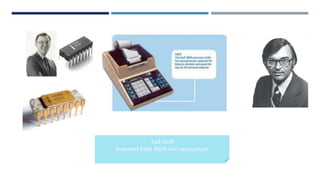
Invented in 1971 by Ted
Hoff
Named:-Intel 4004
1st computer on a chip
to fit in a desktop.
Also known as a central processing
unit in which numbers of
peripherals’ are fabricated on a
single chip.
It has ALU (arithmetic and logic
unit), a control unit, registers, bus
systems, and a clock to perform
computational tasks.
Ted Hoff
Invented Intel 4004 microprocessor
FEATURES
Fourth generation VLSI
microprocessor based
High language were used
in this generation-
C,C++,BBASE
VLSI circuits-5k transistors,
other circuit elements and
their associated circuits on
a single chip made -
microcomputers of 4th
gen.
More powerful, reliable,
compact, reliable and
affordable.
Thousands of integrated
circuits were built onto a
single silicon strip.
Personal computers raised.
Time sharing, real time
,networks ,distributed
operating systems were
used.
COMPUTERS OF THE 4TH GENERATION INCLUDE
It's fine to celebrate success, but it is more important
to heed the lessons of failure.“
-Bill Gates, Cofounder of Microsoft
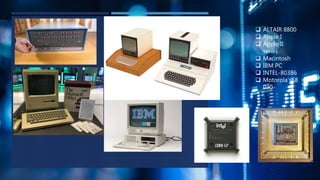
 ALTAIR 8800
 Apple I
 Apple II series
 Macintosh
 IBM PC
Developed 32-bit
microprocessors by
using HCMOS
fabrication.
Famous processors
 INTEL-80386
 Motorola’s68020/6
8030
 ALTAIR 8800
 Apple I
 Apple II
series
 Macintosh
 IBM PC
 INTEL-80386
 Motorola’s68
030
ALTAIR 8800; THE FIRST PERSONAL COMPUTER
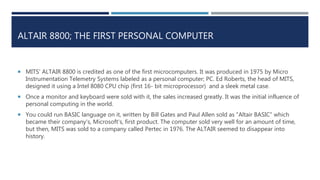
 MITS' ALTAIR 8800 is credited as one of the first microcomputers. It was produced in 1975 by Micro
Instrumentation Telemetry Systems labeled as a personal computer; PC. Ed Roberts, the head of MITS,
designed it using a Intel 8080 CPU chip (first 16- bit microprocessor) and a sleek metal case.
 Once a monitor and keyboard were sold with it, the sales increased greatly. It was the initial influence of
personal computing in the world.
 You could run BASIC language on it, written by Bill Gates and Paul Allen sold as "Altair BASIC" which
became their company's, Microsoft's, first product. The computer sold very well for an amount of time,
but then, MITS was sold to a company called Pertec in 1976. The ALTAIR seemed to disappear into
history.
APPLE COMPUTERS
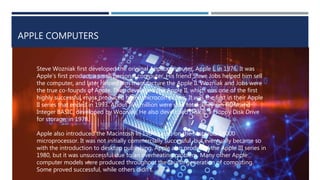
Steve Wozniak first developed the original Apple computer, Apple I, in 1976. It was
Apple's first product; a small personal computer. His friend Steve Jobs helped him sell
the computer, and later helped him manufacture the Apple II. Wozniak and Jobs were
the true co-founds of Apple. They developed the Apple II, which was one of the first
highly successful, mass produced home microcomputers. It was the first in their Apple
II series that ended in 1993. About five million were sold total. They ran ROM and
Integer BASIC, developed by Wozniak. He also developed Disk II, a Floppy Disk Drive
for storage, in 1978.
Apple also introduced the Macintosh in 1984 based on the Motorola 68000
microprocessor. It was not initially commercially successful, but eventually became so
with the introduction to desktop publishing. Apple also produced the Apple III series in
1980, but it was unsuccessful due to an overheating problem. Many other Apple
computer models were produced throughout the fourth generation of computing.
Some proved successful, while others didn't.
THE BEGINNINGS OF "MICRO-SOFT"
The founders of Microsoft, Paul Allen and Bill Gates, began working with computers by writing BASIC in a
partnership with MITS for the ALTAIR 8800.
Name micro-soft as in "Micro processing Software."
They started out with mostly making operating systems and programming languages. DOS, Disk Operating
System, brought in much success for the company.
Partnership with IBM lead to the release of the IBM PC DOS in 1981. The company upheld many other
collaborations, creating systems for different computers during that era.
In 1985, they released a retail version of Windows 1.0, a 16- bit graphical operating environment. They also
released a operating system called OS/2 with IBM, which was quite successful.
A program for word processing, database, and spreadsheet was also released, which was named Microsoft Works
in 1986.
As the release of Windows 3.0 came about, OS/2 sales greatly declined, and Microsoft abandoned the
partnership with IBM.
They began the transition from MS-DOS to Windows. "Microsoft Windows" truly became its own computer
company.
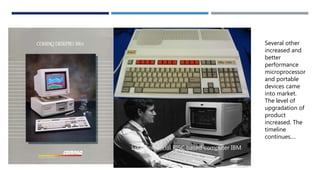
1st commercial RISC based computer IBM
Several other
increased and
better
performance
microprocessor
and portable
devices came
into market.
The level of
upgradation of
product
increased. The
timeline
continues….
STORY OF
INTEL4004
THANK YOU

4th gen microprocessor

  • 1.
    4TH GEN MICROPROCESSOR VLSI1971-PRESENT AVANTIKA SAKSHI STANLEY VANSHIKA INIKA
  • 2.
    MICROPROCESSORS ARE THESTART OF MODERN COMPUTERS Introduction to modern day computers by basically being a computer's entire Central Processing Unit (CPU) on one integrated circuit. . The idea of computer technology took a big turn with the invention of microprocessors and VLSI technology (very large scale integration). Invented in 1971 by Ted Hoff Named:-Intel 4004 1st computer on a chip to fit in a desktop. Also known as a central processing unit in which numbers of peripherals’ are fabricated on a single chip. It has ALU (arithmetic and logic unit), a control unit, registers, bus systems, and a clock to perform computational tasks.
  • 3.
    Ted Hoff Invented Intel4004 microprocessor
  • 4.
    FEATURES Fourth generation VLSI microprocessorbased High language were used in this generation- C,C++,BBASE VLSI circuits-5k transistors, other circuit elements and their associated circuits on a single chip made - microcomputers of 4th gen. More powerful, reliable, compact, reliable and affordable. Thousands of integrated circuits were built onto a single silicon strip. Personal computers raised. Time sharing, real time ,networks ,distributed operating systems were used.
  • 5.
    COMPUTERS OF THE4TH GENERATION INCLUDE It's fine to celebrate success, but it is more important to heed the lessons of failure.“ -Bill Gates, Cofounder of Microsoft  ALTAIR 8800  Apple I  Apple II series  Macintosh  IBM PC Developed 32-bit microprocessors by using HCMOS fabrication. Famous processors  INTEL-80386  Motorola’s68020/6 8030
  • 6.
     ALTAIR 8800 Apple I  Apple II series  Macintosh  IBM PC  INTEL-80386  Motorola’s68 030
  • 7.
    ALTAIR 8800; THEFIRST PERSONAL COMPUTER  MITS' ALTAIR 8800 is credited as one of the first microcomputers. It was produced in 1975 by Micro Instrumentation Telemetry Systems labeled as a personal computer; PC. Ed Roberts, the head of MITS, designed it using a Intel 8080 CPU chip (first 16- bit microprocessor) and a sleek metal case.  Once a monitor and keyboard were sold with it, the sales increased greatly. It was the initial influence of personal computing in the world.  You could run BASIC language on it, written by Bill Gates and Paul Allen sold as "Altair BASIC" which became their company's, Microsoft's, first product. The computer sold very well for an amount of time, but then, MITS was sold to a company called Pertec in 1976. The ALTAIR seemed to disappear into history.
  • 8.
    APPLE COMPUTERS Steve Wozniakfirst developed the original Apple computer, Apple I, in 1976. It was Apple's first product; a small personal computer. His friend Steve Jobs helped him sell the computer, and later helped him manufacture the Apple II. Wozniak and Jobs were the true co-founds of Apple. They developed the Apple II, which was one of the first highly successful, mass produced home microcomputers. It was the first in their Apple II series that ended in 1993. About five million were sold total. They ran ROM and Integer BASIC, developed by Wozniak. He also developed Disk II, a Floppy Disk Drive for storage, in 1978. Apple also introduced the Macintosh in 1984 based on the Motorola 68000 microprocessor. It was not initially commercially successful, but eventually became so with the introduction to desktop publishing. Apple also produced the Apple III series in 1980, but it was unsuccessful due to an overheating problem. Many other Apple computer models were produced throughout the fourth generation of computing. Some proved successful, while others didn't.
  • 9.
    THE BEGINNINGS OF"MICRO-SOFT" The founders of Microsoft, Paul Allen and Bill Gates, began working with computers by writing BASIC in a partnership with MITS for the ALTAIR 8800. Name micro-soft as in "Micro processing Software." They started out with mostly making operating systems and programming languages. DOS, Disk Operating System, brought in much success for the company. Partnership with IBM lead to the release of the IBM PC DOS in 1981. The company upheld many other collaborations, creating systems for different computers during that era. In 1985, they released a retail version of Windows 1.0, a 16- bit graphical operating environment. They also released a operating system called OS/2 with IBM, which was quite successful. A program for word processing, database, and spreadsheet was also released, which was named Microsoft Works in 1986. As the release of Windows 3.0 came about, OS/2 sales greatly declined, and Microsoft abandoned the partnership with IBM. They began the transition from MS-DOS to Windows. "Microsoft Windows" truly became its own computer company.
  • 10.
    1st commercial RISCbased computer IBM Several other increased and better performance microprocessor and portable devices came into market. The level of upgradation of product increased. The timeline continues….
  • 11.
  • 12.