Project Management
1
Prepared by - Niranjana K R for Alliance
University
Chapter 4: Project Integration Management
Faculty: Niranjana K R
B.E., QA Professional, Six Sigma Black Belt, LA for ISO 9001 and AS 9100 Rev C, Member of PMI & QCFI
Chapter 4: Topics
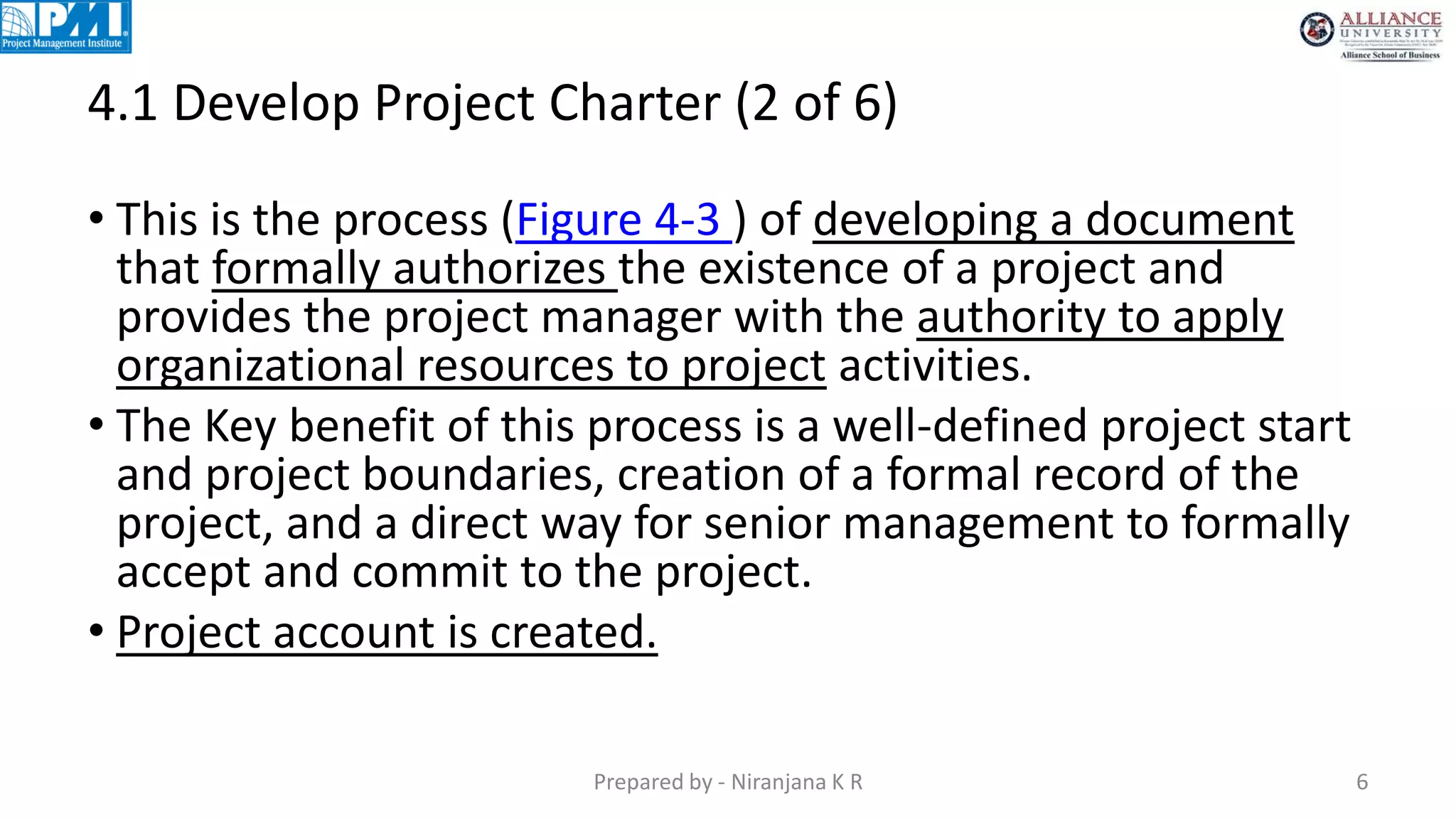
Introduction to Project Integration Management
4.1 Develop Project Charter – Inputs, Tools and Techniques, Outputs
4.2 Develop Project Management Plan – Inputs, Tools and Techniques, Outputs
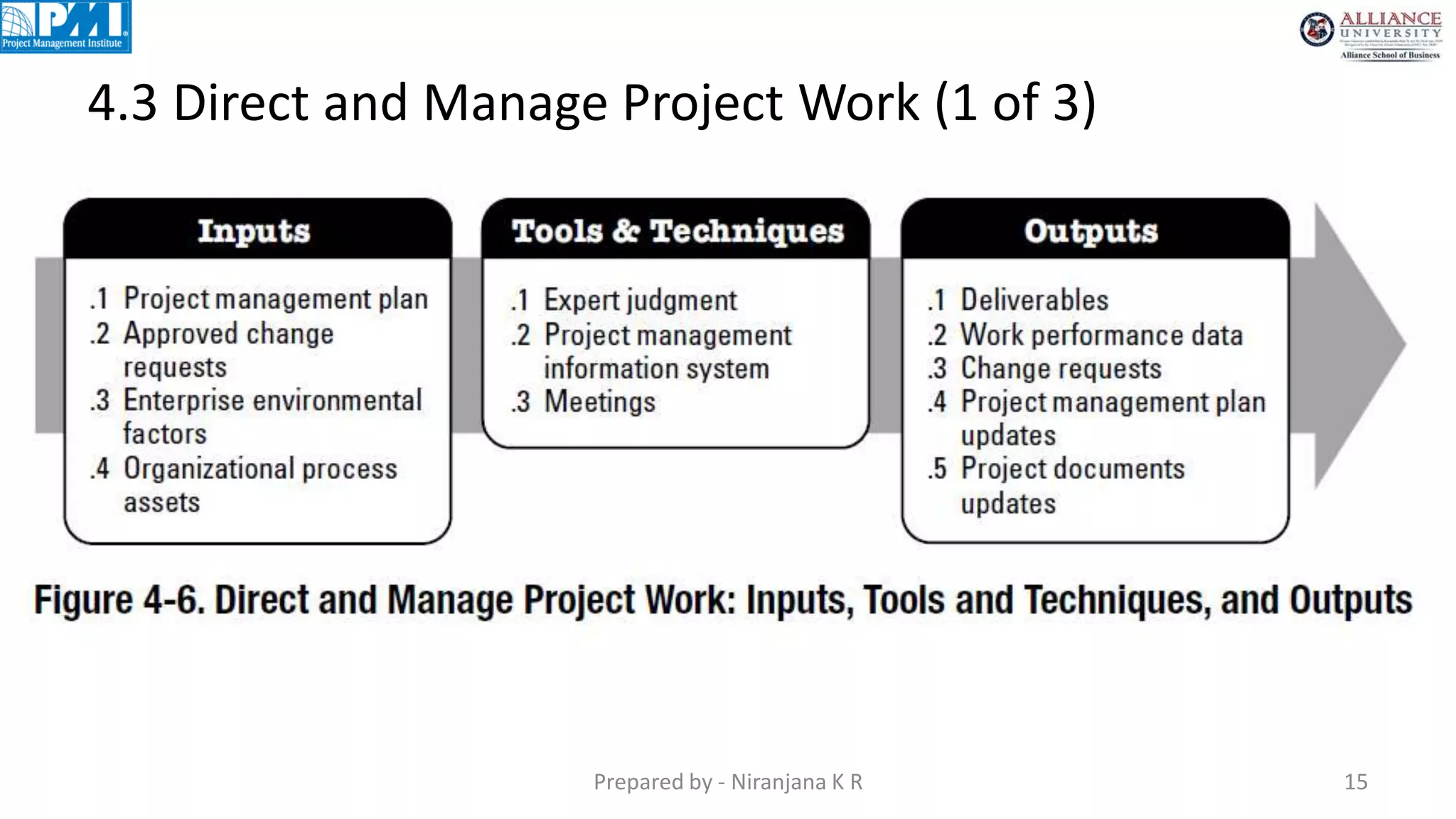
4.3 Direct and Manage Project Work – Inputs, Tools and Techniques, Outputs
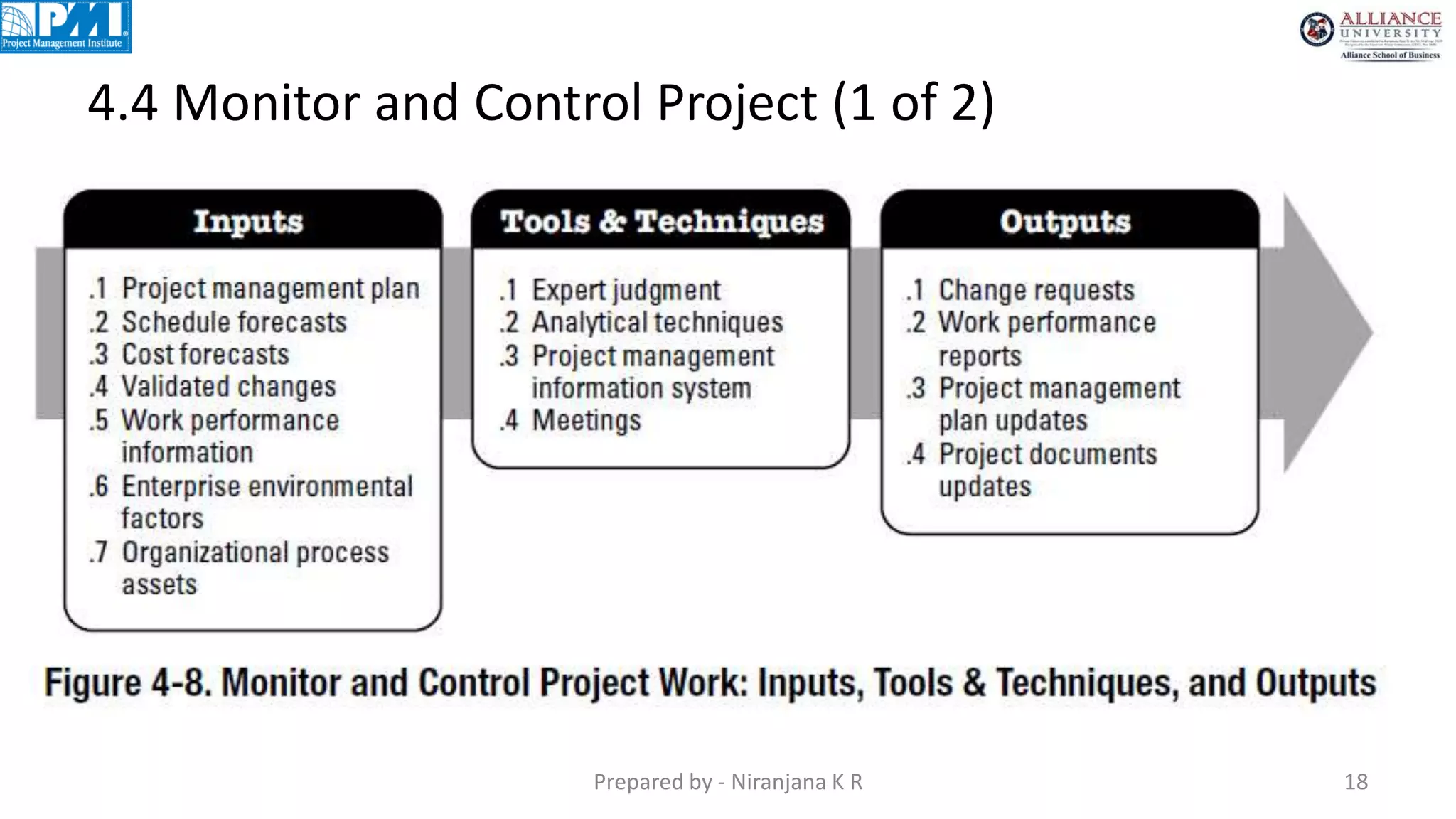
4.4 Monitor and Control Project Work – Inputs, Tools and Techniques, Outputs
4.5 Perform Integrated Change Control – Inputs, Tools and Techniques, Outputs
4.6 Close Project or Phase – Inputs, Tools and Techniques, Outputs
Refer : Annex A1 – The Standard for Project Management of a Project – P 417 –
461 to understand interactions between these processes and other knowledge
areas.
Prepared by - Niranjana K R 2
4 Project Integration Management (1 of 2)
• Project Integration Management covers the processes and activities to
identify, define, combine, unify and coordinate the various processes and
project management activities with the Project Management Process
Group.
• In the Project Management context, Integration includes characteristics of
unification, consolidation, communication, and integrate actions that are
crucial to controlled project execution through completion, successfully
managing stakeholder expectations, and meeting requirements.
• This also includes making choices about resource allocation, making trade-
offs among competing objectives and alternatives, and managing the
interdependencies among the project management knowledge areas.
Prepared by - Niranjana K R 3
4 Project Integration Management (2 of 2)
• Figure 4-1 provides an overview of the Project Integration
Management Processes, which are:
– Develop Project Charter
– Develop Project Management Plan
– Direct and Manage Project Work
– Monitor and Control Project Work
– Perform Integrated Change Control
– Close Project or Phase
Prepared by - Niranjana K R 4
4.1 Develop Project Charter (1 of 6)
Prepared by - Niranjana K R 5
4.1 Develop Project Charter (2 of 6)
Prepared by - Niranjana K R 6
• This is the process (Figure 4-3 ) of developing a document
that formally authorizes the existence of a project and
provides the project manager with the authority to apply
organizational resources to project activities.
• The Key benefit of this process is a well-defined project start
and project boundaries, creation of a formal record of the
project, and a direct way for senior management to formally
accept and commit to the project.
• Project account is created.
4.1 Develop Project Charter (3 of 6)
Prepared by - Niranjana K R 7
• The project charter establishes a partnership between the
performing and requesting organizations.
• In the case of external projects, a formal contract is the preferred
way to establish an agreement.
• A project charter is also used to establish internal agreements
within an organization and acts as a formal agreement between the
project sponsor and the project organization.
• A project is initiated based on an approved charter.
• A Project Manager is assigned even before a charter is developed.
4.1 Develop Project Charter (4 of 6)
Prepared by – Niranjana K R 8
• The project charter provides the project manager with the authority to plan
and execute the project.
• During the project charter development, the project manager will develop a
foundational understanding of the project requirements.
• This understanding will better allow for efficient resources allocation to
project activities.
• Projects are initiated by an entity external to the project, such as a sponsor,
business development, program or project management office (PMO) etc.
• The project initiator or sponsor should be at the level that is appropriate to
procure funding and commit resources to the project.
4.1 Develop Project Charter (5 of 6)
Prepared by – Niranjana K R 9
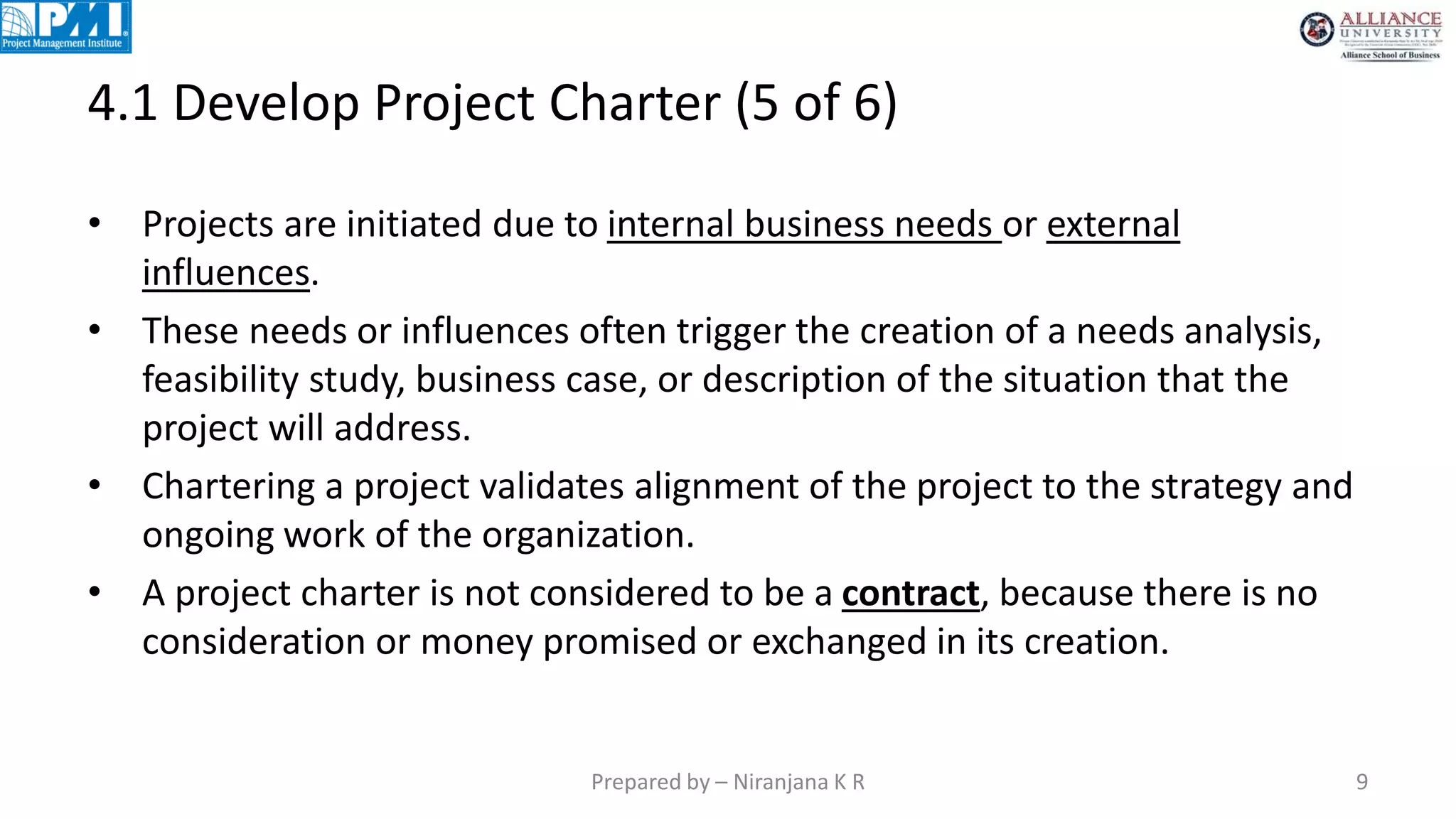
• Projects are initiated due to internal business needs or external
influences.
• These needs or influences often trigger the creation of a needs analysis,
feasibility study, business case, or description of the situation that the
project will address.
• Chartering a project validates alignment of the project to the strategy and
ongoing work of the organization.
• A project charter is not considered to be a contract, because there is no
consideration or money promised or exchanged in its creation.
4.1 Develop Project Charter (6 of 6)
Prepared by – Niranjana K R 10
• Inputs:
– Project statement of Work (SOW) : Is a narrative description of products, services, or results to be
delivered by a project. For external projects, the SOW is issued by the customer as part of a bid
document , e.g., RFP, RFI or RFB, or as part of the contract.
– Business Case : Describes the necessary information from a business standpoint to determine
whether or not the project is worth the required investment.
– Agreements : Used to define initial intentions for a project. Ex: Contract, MOUs, SLAs, Letters of
agreement, letters of intent etc.
– Enterprise Environmental Factors : Govt. Std., Industry Std., Quality Std., Regulations
– Organizational Process Assets : Org. Std. Processes, policies, and Process Definitions, Guidelines,
Templates etc.
• Tools and Techniques – Expert Judgement, Facilitation Techniques
• Outputs - Project Charter (For TOC, Refer P 71-72 PMBOK)
4.2 Develop Project Management Plan (1 of 4)
Prepared by - Niranjana K R 11
4.2 Develop Project Management Plan (2 of 4)
Prepared by - Niranjana K R 12
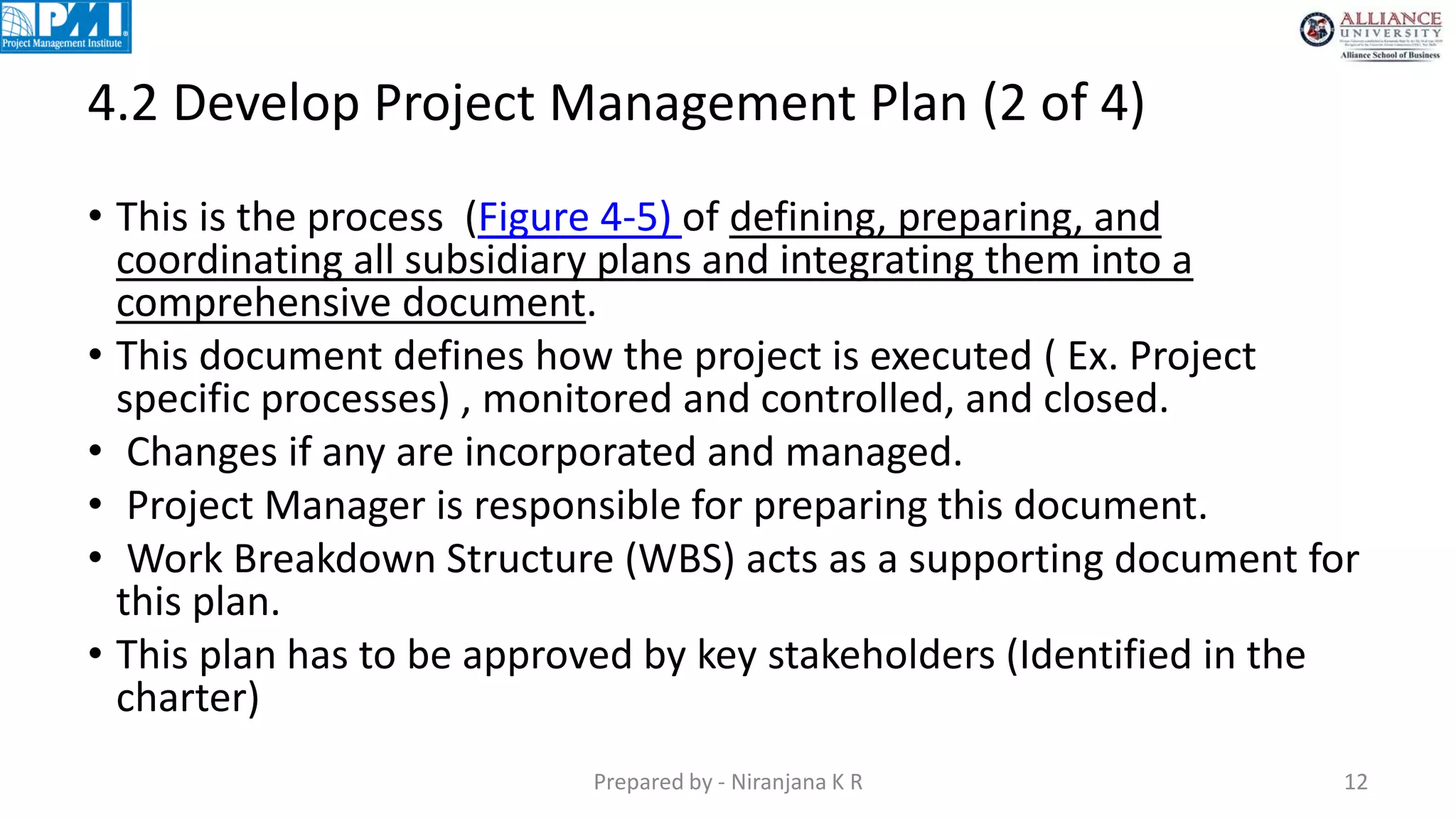
• This is the process (Figure 4-5) of defining, preparing, and
coordinating all subsidiary plans and integrating them into a
comprehensive document.
• This document defines how the project is executed ( Ex. Project
specific processes) , monitored and controlled, and closed.
• Changes if any are incorporated and managed.
• Project Manager is responsible for preparing this document.
• Work Breakdown Structure (WBS) acts as a supporting document for
this plan.
• This plan has to be approved by key stakeholders (Identified in the
charter)
4.2 Develop Project Management Plan (3 of 4)
Prepared by - Niranjana K R 13
• Inputs :
– Project Charter, Output from other processes, Enterprise Environmental
Factors, Org. Process Assets.
• Tools and Techniques: Expert Judgment, Facilitation Techniques,
• Outputs: “The Project Management Plan”
– One of the Primary documents
– It is the document that describes how the project will be executed, monitored,
and controlled. It integrates and consolidates all of the subsidiary plans and
baselines from the planning process.
– Refer Page 76-77 PMBOK
4.2 Develop Project Management Plan (4 of 4)
Prepared by - Niranjana K R 14
4.3 Direct and Manage Project Work (1 of 3)
Prepared by - Niranjana K R 15
4.3 Direct and Manage Project Work (2 of 3)
Prepared by - Niranjana K R 16
• This is the process (Figure 4-7 ) of leading and performing the work defined
in the project Management plan and implementing approved changes to
achieve the project’s objectives.
• Work activities include:
– Perform activities to accomplish project objectives;
– Create project deliverables to meet the planned project work;
– Provide, train, and manage the team members assigned to the project;
– Obtain, manage, and use resources including materials, tools, equipment, and facilities;
– Implement the planned methods and standards; Etc.
• Key is to manage and control interactions with other Knowledge areas to
deliver outputs.
4.3 Direct and Manage Project Work (3 of 3)
Prepared by - Niranjana K R 17
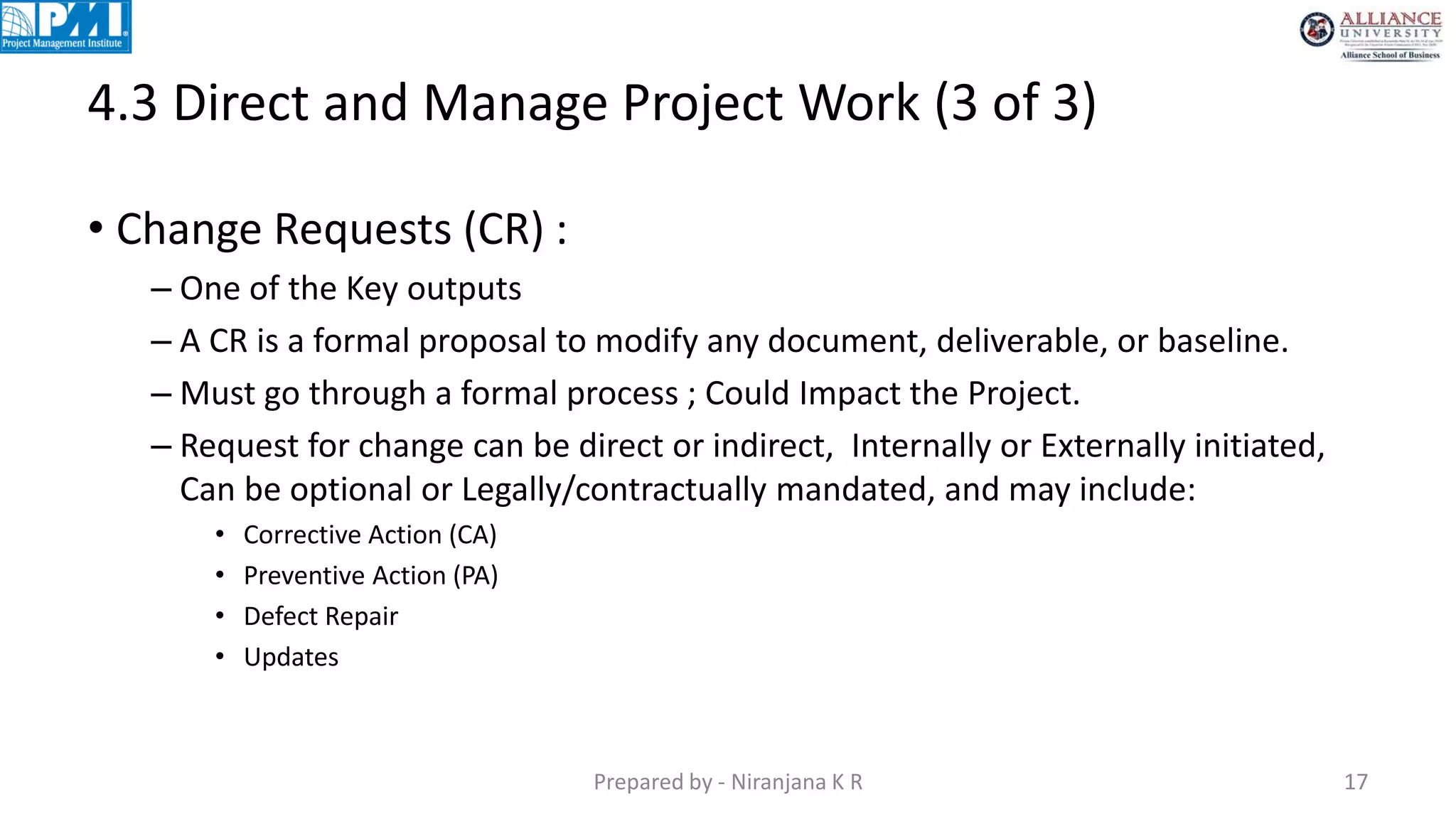
• Change Requests (CR) :
– One of the Key outputs
– A CR is a formal proposal to modify any document, deliverable, or baseline.
– Must go through a formal process ; Could Impact the Project.
– Request for change can be direct or indirect, Internally or Externally initiated,
Can be optional or Legally/contractually mandated, and may include:
• Corrective Action (CA)
• Preventive Action (PA)
• Defect Repair
• Updates
4.4 Monitor and Control Project (1 of 2)
Prepared by - Niranjana K R 18
4.4 Monitor and Control Project (2 of 2)
Prepared by - Niranjana K R 19
• This is the process (Figure 4-9 ) of tracking, reviewing, and reporting the
progress to meet the performance objectives defined in the project
management plan.
• The key benefit of this process is that, it allows stakeholders to understand
the current state of the project, the steps taken, the budget, schedule, and
scope forecast.
• This process is performed throughout the project in order to:
– Compare Planned vs. Actual
– Assess progress and initiate CA and PA
– Status update to sponsor and stakeholders etc.
– Monitor & Control budget.
4.5 Perform Integrated Change Control (1 of 2)
Prepared by - Niranjana K R 20
4.5 Perform Integrated Change Control (2 of 2)
Prepared by - Niranjana K R 21
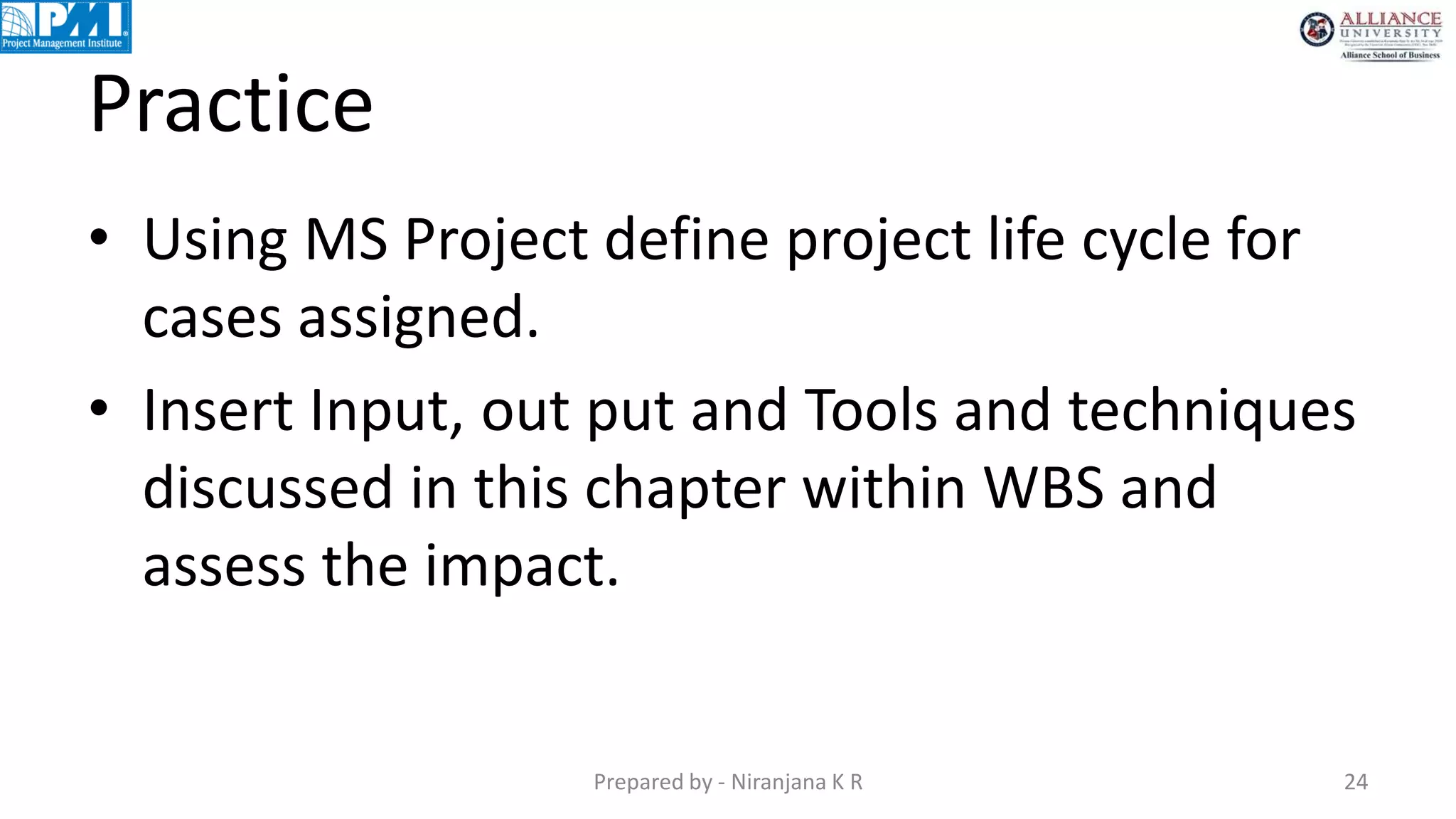
• This is the process (Figure 4-11) of Reviewing all change requests; approving
changes and managing changes to deliverables:
– organizational process assets, project documents, and the project management plan
– Communicate their dispositions.
– Review all change requests or modifications to project documents: deliverables,
baselines, or the project management plan
– Approves or Rejects the changes.
• Key benefit – allows changes within the project to be considered in an integrated fashion while
reducing project risk.
4.6 Close Project or Phase (1 of 2)
Prepared by - Niranjana K R 22
4.6 Close Project or Phase (2 of 2)
Prepared by - Niranjana K R 23
• This is the process (Figure 4-13) where all activities across all of the Project
Management Process Groups to formally complete the project or phase.
• Key benefit : It provides lessons learned, the formal ending of the project
work, and the release of organization’s resources to pursue new
endeavours.
• When closing the project, PM reviews all prior information to ensure all
project work is completed, met objectives.
• Review scope baseline against the Project Management Plan.
• During Termination of project - Investigate and document reasons for
actions taken etc.
Practice
• Using MS Project define project life cycle for
cases assigned.
• Insert Input, out put and Tools and techniques
discussed in this chapter within WBS and
assess the impact.
Prepared by - Niranjana K R 24
Prepared by - Niranjana K R 25

4.project integrationmanagement

  • 1.
    Project Management 1 Prepared by- Niranjana K R for Alliance University Chapter 4: Project Integration Management Faculty: Niranjana K R B.E., QA Professional, Six Sigma Black Belt, LA for ISO 9001 and AS 9100 Rev C, Member of PMI & QCFI
  • 2.
    Chapter 4: Topics Introductionto Project Integration Management 4.1 Develop Project Charter – Inputs, Tools and Techniques, Outputs 4.2 Develop Project Management Plan – Inputs, Tools and Techniques, Outputs 4.3 Direct and Manage Project Work – Inputs, Tools and Techniques, Outputs 4.4 Monitor and Control Project Work – Inputs, Tools and Techniques, Outputs 4.5 Perform Integrated Change Control – Inputs, Tools and Techniques, Outputs 4.6 Close Project or Phase – Inputs, Tools and Techniques, Outputs Refer : Annex A1 – The Standard for Project Management of a Project – P 417 – 461 to understand interactions between these processes and other knowledge areas. Prepared by - Niranjana K R 2
  • 3.
    4 Project IntegrationManagement (1 of 2) • Project Integration Management covers the processes and activities to identify, define, combine, unify and coordinate the various processes and project management activities with the Project Management Process Group. • In the Project Management context, Integration includes characteristics of unification, consolidation, communication, and integrate actions that are crucial to controlled project execution through completion, successfully managing stakeholder expectations, and meeting requirements. • This also includes making choices about resource allocation, making trade- offs among competing objectives and alternatives, and managing the interdependencies among the project management knowledge areas. Prepared by - Niranjana K R 3
  • 4.
    4 Project IntegrationManagement (2 of 2) • Figure 4-1 provides an overview of the Project Integration Management Processes, which are: – Develop Project Charter – Develop Project Management Plan – Direct and Manage Project Work – Monitor and Control Project Work – Perform Integrated Change Control – Close Project or Phase Prepared by - Niranjana K R 4
  • 5.
    4.1 Develop ProjectCharter (1 of 6) Prepared by - Niranjana K R 5
  • 6.
    4.1 Develop ProjectCharter (2 of 6) Prepared by - Niranjana K R 6 • This is the process (Figure 4-3 ) of developing a document that formally authorizes the existence of a project and provides the project manager with the authority to apply organizational resources to project activities. • The Key benefit of this process is a well-defined project start and project boundaries, creation of a formal record of the project, and a direct way for senior management to formally accept and commit to the project. • Project account is created.
  • 7.
    4.1 Develop ProjectCharter (3 of 6) Prepared by - Niranjana K R 7 • The project charter establishes a partnership between the performing and requesting organizations. • In the case of external projects, a formal contract is the preferred way to establish an agreement. • A project charter is also used to establish internal agreements within an organization and acts as a formal agreement between the project sponsor and the project organization. • A project is initiated based on an approved charter. • A Project Manager is assigned even before a charter is developed.
  • 8.
    4.1 Develop ProjectCharter (4 of 6) Prepared by – Niranjana K R 8 • The project charter provides the project manager with the authority to plan and execute the project. • During the project charter development, the project manager will develop a foundational understanding of the project requirements. • This understanding will better allow for efficient resources allocation to project activities. • Projects are initiated by an entity external to the project, such as a sponsor, business development, program or project management office (PMO) etc. • The project initiator or sponsor should be at the level that is appropriate to procure funding and commit resources to the project.
  • 9.
    4.1 Develop ProjectCharter (5 of 6) Prepared by – Niranjana K R 9 • Projects are initiated due to internal business needs or external influences. • These needs or influences often trigger the creation of a needs analysis, feasibility study, business case, or description of the situation that the project will address. • Chartering a project validates alignment of the project to the strategy and ongoing work of the organization. • A project charter is not considered to be a contract, because there is no consideration or money promised or exchanged in its creation.
  • 10.
    4.1 Develop ProjectCharter (6 of 6) Prepared by – Niranjana K R 10 • Inputs: – Project statement of Work (SOW) : Is a narrative description of products, services, or results to be delivered by a project. For external projects, the SOW is issued by the customer as part of a bid document , e.g., RFP, RFI or RFB, or as part of the contract. – Business Case : Describes the necessary information from a business standpoint to determine whether or not the project is worth the required investment. – Agreements : Used to define initial intentions for a project. Ex: Contract, MOUs, SLAs, Letters of agreement, letters of intent etc. – Enterprise Environmental Factors : Govt. Std., Industry Std., Quality Std., Regulations – Organizational Process Assets : Org. Std. Processes, policies, and Process Definitions, Guidelines, Templates etc. • Tools and Techniques – Expert Judgement, Facilitation Techniques • Outputs - Project Charter (For TOC, Refer P 71-72 PMBOK)
  • 11.
    4.2 Develop ProjectManagement Plan (1 of 4) Prepared by - Niranjana K R 11
  • 12.
    4.2 Develop ProjectManagement Plan (2 of 4) Prepared by - Niranjana K R 12 • This is the process (Figure 4-5) of defining, preparing, and coordinating all subsidiary plans and integrating them into a comprehensive document. • This document defines how the project is executed ( Ex. Project specific processes) , monitored and controlled, and closed. • Changes if any are incorporated and managed. • Project Manager is responsible for preparing this document. • Work Breakdown Structure (WBS) acts as a supporting document for this plan. • This plan has to be approved by key stakeholders (Identified in the charter)
  • 13.
    4.2 Develop ProjectManagement Plan (3 of 4) Prepared by - Niranjana K R 13 • Inputs : – Project Charter, Output from other processes, Enterprise Environmental Factors, Org. Process Assets. • Tools and Techniques: Expert Judgment, Facilitation Techniques, • Outputs: “The Project Management Plan” – One of the Primary documents – It is the document that describes how the project will be executed, monitored, and controlled. It integrates and consolidates all of the subsidiary plans and baselines from the planning process. – Refer Page 76-77 PMBOK
  • 14.
    4.2 Develop ProjectManagement Plan (4 of 4) Prepared by - Niranjana K R 14
  • 15.
    4.3 Direct andManage Project Work (1 of 3) Prepared by - Niranjana K R 15
  • 16.
    4.3 Direct andManage Project Work (2 of 3) Prepared by - Niranjana K R 16 • This is the process (Figure 4-7 ) of leading and performing the work defined in the project Management plan and implementing approved changes to achieve the project’s objectives. • Work activities include: – Perform activities to accomplish project objectives; – Create project deliverables to meet the planned project work; – Provide, train, and manage the team members assigned to the project; – Obtain, manage, and use resources including materials, tools, equipment, and facilities; – Implement the planned methods and standards; Etc. • Key is to manage and control interactions with other Knowledge areas to deliver outputs.
  • 17.
    4.3 Direct andManage Project Work (3 of 3) Prepared by - Niranjana K R 17 • Change Requests (CR) : – One of the Key outputs – A CR is a formal proposal to modify any document, deliverable, or baseline. – Must go through a formal process ; Could Impact the Project. – Request for change can be direct or indirect, Internally or Externally initiated, Can be optional or Legally/contractually mandated, and may include: • Corrective Action (CA) • Preventive Action (PA) • Defect Repair • Updates
  • 18.
    4.4 Monitor andControl Project (1 of 2) Prepared by - Niranjana K R 18
  • 19.
    4.4 Monitor andControl Project (2 of 2) Prepared by - Niranjana K R 19 • This is the process (Figure 4-9 ) of tracking, reviewing, and reporting the progress to meet the performance objectives defined in the project management plan. • The key benefit of this process is that, it allows stakeholders to understand the current state of the project, the steps taken, the budget, schedule, and scope forecast. • This process is performed throughout the project in order to: – Compare Planned vs. Actual – Assess progress and initiate CA and PA – Status update to sponsor and stakeholders etc. – Monitor & Control budget.
  • 20.
    4.5 Perform IntegratedChange Control (1 of 2) Prepared by - Niranjana K R 20
  • 21.
    4.5 Perform IntegratedChange Control (2 of 2) Prepared by - Niranjana K R 21 • This is the process (Figure 4-11) of Reviewing all change requests; approving changes and managing changes to deliverables: – organizational process assets, project documents, and the project management plan – Communicate their dispositions. – Review all change requests or modifications to project documents: deliverables, baselines, or the project management plan – Approves or Rejects the changes. • Key benefit – allows changes within the project to be considered in an integrated fashion while reducing project risk.
  • 22.
    4.6 Close Projector Phase (1 of 2) Prepared by - Niranjana K R 22
  • 23.
    4.6 Close Projector Phase (2 of 2) Prepared by - Niranjana K R 23 • This is the process (Figure 4-13) where all activities across all of the Project Management Process Groups to formally complete the project or phase. • Key benefit : It provides lessons learned, the formal ending of the project work, and the release of organization’s resources to pursue new endeavours. • When closing the project, PM reviews all prior information to ensure all project work is completed, met objectives. • Review scope baseline against the Project Management Plan. • During Termination of project - Investigate and document reasons for actions taken etc.
  • 24.
    Practice • Using MSProject define project life cycle for cases assigned. • Insert Input, out put and Tools and techniques discussed in this chapter within WBS and assess the impact. Prepared by - Niranjana K R 24
  • 25.
    Prepared by -Niranjana K R 25