PMBoK ed.5
Process Flow Perspective
Cheat-sheet & tools
Compiled by
Oleksiy.Rudenko@gmail.com,
© 2015
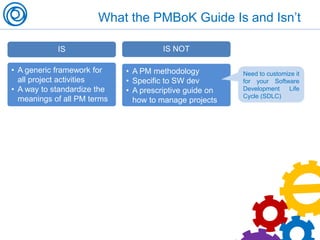
What the PMBoK Guide Is and Isn’t
IS IS NOT
• A generic framework for
all project activities
• A way to standardize the
meanings of all PM terms
• A PM methodology
• Specific to SW dev
• A prescriptive guide on
how to manage projects
Need to customize it
for your Software
Development Life
Cycle (SDLC)
Shortenings
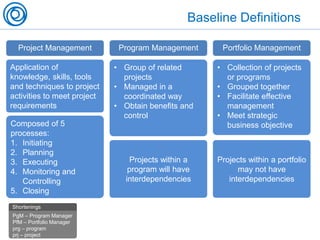
Baseline Definitions
Project Management
Application of
knowledge, skills, tools
and techniques to project
activities to meet project
requirements
Composed of 5
processes:
1. Initiating
2. Planning
3. Executing
4. Monitoring and
Controlling
5. Closing
Portfolio Management
• Collection of projects
or programs
• Grouped together
• Facilitate effective
management
• Meet strategic
business objective
Projects within a portfolio
may not have
interdependencies
Program Management
• Group of related
projects
• Managed in a
coordinated way
• Obtain benefits and
control
Projects within a
program will have
interdependencies
PgM – Program Manager
PfM – Portfolio Manager
prg – program
prj – project
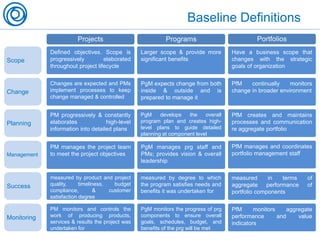
Baseline Definitions
Projects
Defined objectives. Scope is
progressively elaborated
throughout project lifecycle
PortfoliosPrograms
Scope
Change
Planning
Management
Success
Monitoring
Larger scope & provide more
significant benefits
Have a business scope that
changes with the strategic
goals of organization
Changes are expected and PMs
implement processes to keep
change managed & controlled
PgM expects change from both
inside & outside and is
prepared to manage it
PfM continually monitors
change in broader environment
PM progressively & constantly
elaborates high-level
information into detailed plans
PgM develops the overall
program plan and creates high-
level plans to guide detailed
planning at component level
PfM creates and maintains
processes and communication
re aggregate portfolio
PM manages the project team
to meet the project objectives
PgM manages prg staff and
PMs; provides vision & overall
leadership
PfM manages and coordinates
portfolio management staff
measured by product and project
quality, timeliness, budget
compliance, & customer
satisfaction degree
measured by degree to which
the program satisfies needs and
benefits it was undertaken for
measured in terms of
aggregate performance of
portfolio components
PM monitors and controls the
work of producing products,
services & results the project was
undertaken for
PgM monitors the progress of prg
components to ensure overall
goals, schedules, budget, and
benefits of the prg will be met
PfM monitors aggregate
performance and value
indicators
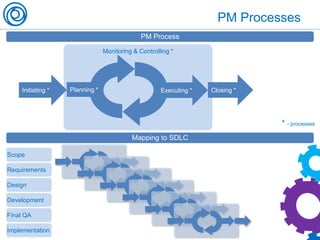
Monitoring & Controlling *
PM Processes
Initiating * Closing *Planning * Executing *
* - processes
Mapping to SDLC
Scope
Requirements
Design
Development
Final QA
Implementation
PM Process
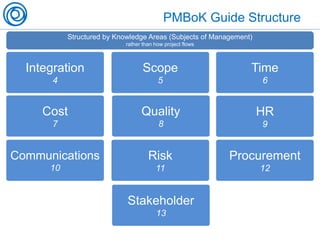
PMBoK Guide Structure
Structured by Knowledge Areas (Subjects of Management)
rather than how project flows
Integration
4
Scope
5
Time
6
Cost
7
Quality
8
HR
9
Communications
10
Risk
11
Procurement
12
Stakeholder
13
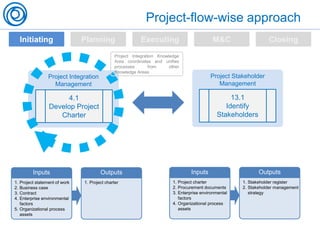
Project-flow-wise approach
Initiating Planning Executing M&C Closing
Project Integration
Management
4.1
Develop Project
Charter
Project Stakeholder
Management
13.1
Identify
Stakeholders
Project Integration Knowledge
Area coordinates and unifies
processes from other
Knowledge Areas
Inputs
1. Project statement of work
2. Business case
3. Contract
4. Enterprise environmental
factors
5. Organizational process
assets
Outputs
1. Project charter
Inputs
1. Project charter
2. Procurement documents
3. Enterprise environmental
factors
4. Organizational process
assets
Outputs
1. Stakeholder register
2. Stakeholder management
strategy
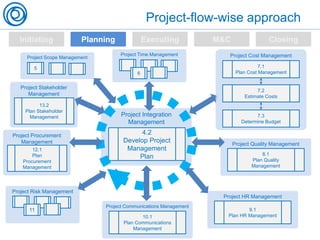
Project-flow-wise approach
Initiating Planning Executing M&C Closing
Project Integration
Management
4.2
Develop Project
Management
Plan
Project Quality Management
8.1
Plan Quality
Management
Project HR Management
9.1
Plan HR Management
Project Communications Management
10.1
Plan Communications
Management
Project Procurement
Management
12.1
Plan
Procurement
Management
Project Risk Management
11
Project Scope Management
5
Project Time Management
6
Project Cost Management
7.1
Plan Cost Management
7.2
Estimate Costs
7.3
Determine Budget
Project Stakeholder
Management
13.2
Plan Stakeholder
Management
Project Risk Management
11
Project Scope Management
5
Project Time Management
6
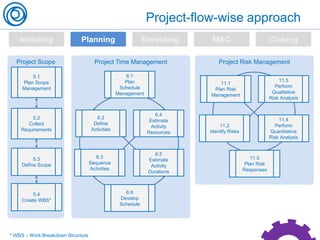
Project-flow-wise approach
Initiating Planning Executing M&C Closing
* WBS – Work Breakdown Structure
Project Risk Management
11.1
Plan Risk
Management
11.3
Perform
Qualitative
Risk Analysis
11.2
Identify Risks
11.4
Perform
Quantitative
Risk Analysis
11.5
Plan Risk
Responses
Project Scope
Management
5.2
Collect
Requirements
5.3
Define Scope
5.4
Create WBS*
5.1
Plan Scope
Management
Project Time Management
6.2
Define
Activities
6.4
Estimate
Activity
Resources
6.3
Sequence
Activities
6.5
Estimate
Activity
Durations
6.6
Develop
Schedule
6.1
Plan
Schedule
Management
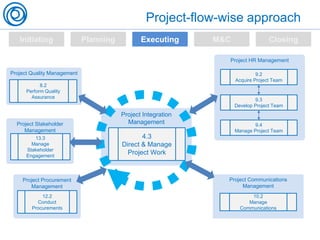
Project-flow-wise approach
Initiating Planning Executing M&C Closing
Project Integration
Management
4.3
Direct & Manage
Project Work
Project Quality Management
8.2
Perform Quality
Assurance
Project Procurement
Management
12.2
Conduct
Procurements
Project Communications
Management
10.2
Manage
Communications
Project HR Management
9.2
Acquire Project Team
9.3
Develop Project Team
9.4
Manage Project Team
Project Stakeholder
Management
13.3
Manage
Stakeholder
Engagement
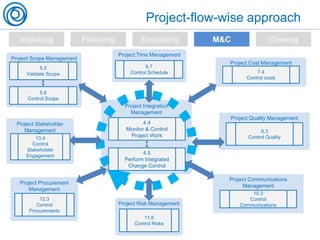
Project-flow-wise approach
Initiating Planning Executing M&C Closing
Project Integration
Management
4.4
Monitor & Control
Project Work
Project Procurement
Management
12.3
Control
Procurements
Project Communications
Management
10.3
Control
Communications
4.5
Perform Integrated
Change Control
Project Scope Management
5.5
Validate Scope
5.6
Control Scope
Project Risk Management
11.6
Control Risks
Project Time Management
6.7
Control Schedule
Project Cost Management
7.4
Control costs
Project Quality Management
8.3
Control Quality
Project Stakeholder
Management
13.4
Control
Stakeholder
Engagement
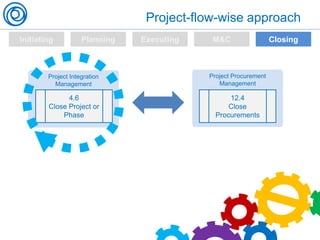
Project-flow-wise approach
Initiating Planning Executing M&C Closing
Project Integration
Management
4.6
Close Project or
Phase
Project Procurement
Management
12.4
Close
Procurements
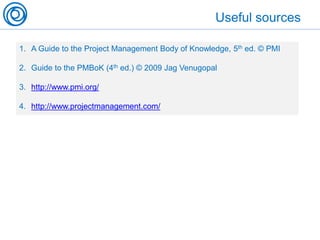
Useful sources
1. A Guide to the Project Management Body of Knowledge, 5th ed. © PMI
2. Guide to the PMBoK (4th ed.) © 2009 Jag Venugopal
3. http://www.pmi.org/
4. http://www.projectmanagement.com/
Author
Major expertise:
Business development
Areas of specific expertise:
Leadership, Project Management
Latest employments:
UNIQA Insurance Group member company
since August 2009
“Efficient tuition is reinforced with practical tools.”
“If a project lacks IT-related component it is then
doomed to fail.”
Oleksiy Rudenko
LL.M., M.Ec.
Please, feel free contacting me via
oleksiy.rudenko@gmail.com
http://fb.com/oleksiy.rudenko.5
http://linkedin.com/in/oleksiyrudenko
This work is licensed under a Creative Commons Attribution-NonCommercial-ShareAlike 4.0 International License.
Find more on Project Management from Oleksiy on Google Drive and SlideShare

PMBoK ed.5 brief overview

  • 1.
    PMBoK ed.5 Process FlowPerspective Cheat-sheet & tools Compiled by Oleksiy.Rudenko@gmail.com, © 2015
  • 2.
    What the PMBoKGuide Is and Isn’t IS IS NOT • A generic framework for all project activities • A way to standardize the meanings of all PM terms • A PM methodology • Specific to SW dev • A prescriptive guide on how to manage projects Need to customize it for your Software Development Life Cycle (SDLC)
  • 3.
    Shortenings Baseline Definitions Project Management Applicationof knowledge, skills, tools and techniques to project activities to meet project requirements Composed of 5 processes: 1. Initiating 2. Planning 3. Executing 4. Monitoring and Controlling 5. Closing Portfolio Management • Collection of projects or programs • Grouped together • Facilitate effective management • Meet strategic business objective Projects within a portfolio may not have interdependencies Program Management • Group of related projects • Managed in a coordinated way • Obtain benefits and control Projects within a program will have interdependencies PgM – Program Manager PfM – Portfolio Manager prg – program prj – project
  • 4.
    Baseline Definitions Projects Defined objectives.Scope is progressively elaborated throughout project lifecycle PortfoliosPrograms Scope Change Planning Management Success Monitoring Larger scope & provide more significant benefits Have a business scope that changes with the strategic goals of organization Changes are expected and PMs implement processes to keep change managed & controlled PgM expects change from both inside & outside and is prepared to manage it PfM continually monitors change in broader environment PM progressively & constantly elaborates high-level information into detailed plans PgM develops the overall program plan and creates high- level plans to guide detailed planning at component level PfM creates and maintains processes and communication re aggregate portfolio PM manages the project team to meet the project objectives PgM manages prg staff and PMs; provides vision & overall leadership PfM manages and coordinates portfolio management staff measured by product and project quality, timeliness, budget compliance, & customer satisfaction degree measured by degree to which the program satisfies needs and benefits it was undertaken for measured in terms of aggregate performance of portfolio components PM monitors and controls the work of producing products, services & results the project was undertaken for PgM monitors the progress of prg components to ensure overall goals, schedules, budget, and benefits of the prg will be met PfM monitors aggregate performance and value indicators
  • 5.
    Monitoring & Controlling* PM Processes Initiating * Closing *Planning * Executing * * - processes Mapping to SDLC Scope Requirements Design Development Final QA Implementation PM Process
  • 6.
    PMBoK Guide Structure Structuredby Knowledge Areas (Subjects of Management) rather than how project flows Integration 4 Scope 5 Time 6 Cost 7 Quality 8 HR 9 Communications 10 Risk 11 Procurement 12 Stakeholder 13
  • 7.
    Project-flow-wise approach Initiating PlanningExecuting M&C Closing Project Integration Management 4.1 Develop Project Charter Project Stakeholder Management 13.1 Identify Stakeholders Project Integration Knowledge Area coordinates and unifies processes from other Knowledge Areas Inputs 1. Project statement of work 2. Business case 3. Contract 4. Enterprise environmental factors 5. Organizational process assets Outputs 1. Project charter Inputs 1. Project charter 2. Procurement documents 3. Enterprise environmental factors 4. Organizational process assets Outputs 1. Stakeholder register 2. Stakeholder management strategy
  • 8.
    Project-flow-wise approach Initiating PlanningExecuting M&C Closing Project Integration Management 4.2 Develop Project Management Plan Project Quality Management 8.1 Plan Quality Management Project HR Management 9.1 Plan HR Management Project Communications Management 10.1 Plan Communications Management Project Procurement Management 12.1 Plan Procurement Management Project Risk Management 11 Project Scope Management 5 Project Time Management 6 Project Cost Management 7.1 Plan Cost Management 7.2 Estimate Costs 7.3 Determine Budget Project Stakeholder Management 13.2 Plan Stakeholder Management
  • 9.
    Project Risk Management 11 ProjectScope Management 5 Project Time Management 6 Project-flow-wise approach Initiating Planning Executing M&C Closing * WBS – Work Breakdown Structure Project Risk Management 11.1 Plan Risk Management 11.3 Perform Qualitative Risk Analysis 11.2 Identify Risks 11.4 Perform Quantitative Risk Analysis 11.5 Plan Risk Responses Project Scope Management 5.2 Collect Requirements 5.3 Define Scope 5.4 Create WBS* 5.1 Plan Scope Management Project Time Management 6.2 Define Activities 6.4 Estimate Activity Resources 6.3 Sequence Activities 6.5 Estimate Activity Durations 6.6 Develop Schedule 6.1 Plan Schedule Management
  • 10.
    Project-flow-wise approach Initiating PlanningExecuting M&C Closing Project Integration Management 4.3 Direct & Manage Project Work Project Quality Management 8.2 Perform Quality Assurance Project Procurement Management 12.2 Conduct Procurements Project Communications Management 10.2 Manage Communications Project HR Management 9.2 Acquire Project Team 9.3 Develop Project Team 9.4 Manage Project Team Project Stakeholder Management 13.3 Manage Stakeholder Engagement
  • 11.
    Project-flow-wise approach Initiating PlanningExecuting M&C Closing Project Integration Management 4.4 Monitor & Control Project Work Project Procurement Management 12.3 Control Procurements Project Communications Management 10.3 Control Communications 4.5 Perform Integrated Change Control Project Scope Management 5.5 Validate Scope 5.6 Control Scope Project Risk Management 11.6 Control Risks Project Time Management 6.7 Control Schedule Project Cost Management 7.4 Control costs Project Quality Management 8.3 Control Quality Project Stakeholder Management 13.4 Control Stakeholder Engagement
  • 12.
    Project-flow-wise approach Initiating PlanningExecuting M&C Closing Project Integration Management 4.6 Close Project or Phase Project Procurement Management 12.4 Close Procurements
  • 13.
    Useful sources 1. AGuide to the Project Management Body of Knowledge, 5th ed. © PMI 2. Guide to the PMBoK (4th ed.) © 2009 Jag Venugopal 3. http://www.pmi.org/ 4. http://www.projectmanagement.com/
  • 14.
    Author Major expertise: Business development Areasof specific expertise: Leadership, Project Management Latest employments: UNIQA Insurance Group member company since August 2009 “Efficient tuition is reinforced with practical tools.” “If a project lacks IT-related component it is then doomed to fail.” Oleksiy Rudenko LL.M., M.Ec. Please, feel free contacting me via oleksiy.rudenko@gmail.com http://fb.com/oleksiy.rudenko.5 http://linkedin.com/in/oleksiyrudenko This work is licensed under a Creative Commons Attribution-NonCommercial-ShareAlike 4.0 International License. Find more on Project Management from Oleksiy on Google Drive and SlideShare