PUBLIC RELATIONS 471 Let’s build a foundation January 9, 2012
GIVE ME SOME ROPE I’M PULLING FOR YOU
FOUNDATION FOR THE WHOLE CLASS RESEARCH OBJECTIVES PROGRAMMING EVALUATION
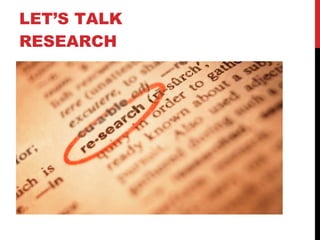
LET’S TALK RESEARCH
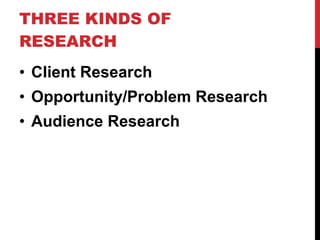
THREE KINDS OF  RESEARCH Client Research Opportunity/Problem Research Audience Research
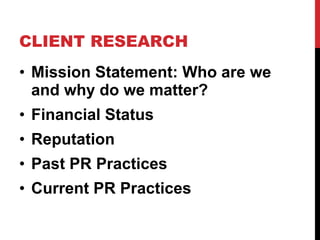
CLIENT RESEARCH Mission Statement: Who are we and why do we matter? Financial Status Reputation Past PR Practices Current PR Practices
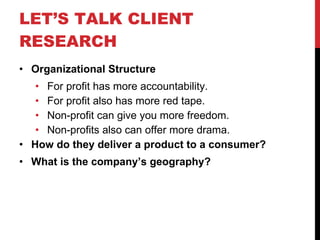
LET’S TALK CLIENT RESEARCH Organizational Structure For profit has more accountability. For profit also has more red tape. Non-profit can give you more freedom. Non-profits also can offer more drama. How do they deliver a product to a consumer? What is the company’s geography?
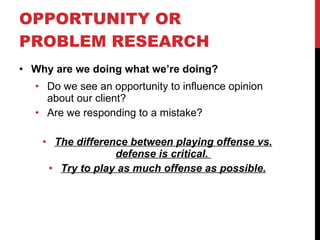
OPPORTUNITY OR PROBLEM RESEARCH  Why are we doing what we’re doing? Do we see an opportunity to influence opinion about our client? Are we responding to a mistake? The difference between playing offense vs. defense is critical.  Try to play as much offense as possible.
LET’S TALK OPPORTUNITY OR PROBLEM RESEARCH  Proactive Programs  arise out of opportunity. These are long range. These are rooted in more strategy. These are harder to sell to people not in PR.
LET’S TALK OPPORTUNITY OR PROBLEM RESEARCH  Reactive Programs  arise out of problems. These are short term. These are rooted in survival. These are what people not in PR tend to remember.
AUDIENCE RESEARCH  Every audience breaks down into  two core groups. General Specific Each genre of PR has specific audiences within these groups we’ll talk about this quarter.
LET’S TALK  AUDIENCE RESEARCH  Regardless of the public or audience, you’ll need to remember these four questions. Who are they? Why do they matter? How active are they? Which public is most important to us?
LET’S TALK  AUDIENCE RESEARCH  Once you figure that out, now you can gather data. How much media do they consume? Where to they get said media? Who’s in their ear?
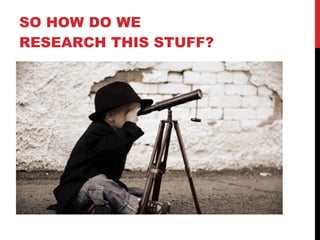
SO HOW DO WE RESEARCH THIS STUFF?
LET’S TALK RESEARCH METHODS There are two kinds of research Nonquanitative. I’ve also heard this called qualitative. This is research that has already been done that you find Quantitative: This is you putting on the journalism hat and getting new information.

SIX NONQUANITATIVE RESEARCH TOOLS Client records (financial reports, annual reports) Published material about them (news articles or trade publications) Published material from them (speeches  PowerPoint, marketing material)
LET’S TALK SIX NONQUANITATIVE RESEARCH TOOLS Feedback from previous customers Talking to potential customers Focus Group
LET’S TALK THREE QUANTITATIVE RESEARCH TOOLS Sample surveys Email Mail Phone Personal Interview Experiments Content analysis  These are usually done by professional firms. Most agencies and businesses will subcontract this kind of work out.
OBJECTIVES
LET’S TALK OBJECTIVES  Objectives are the most important part of the PR process. Here are two golden rules for a good objective. Make it an singular infinitive phrase. To publicize random special event To stimulate interest in political candidate Objectives must be verifiable. How will we quantify How will be meet the due date?
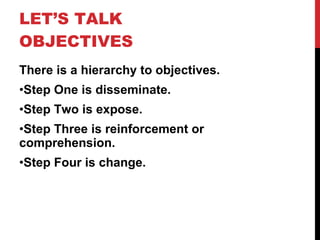
LET’S TALK OBJECTIVES  There is a hierarchy to objectives. Step One is disseminate. Step Two is expose. Step Three is reinforcement or comprehension. Step Four is change.
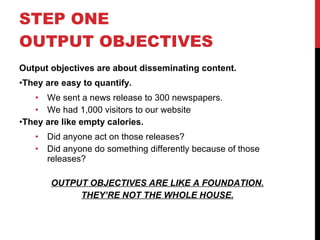
STEP ONE OUTPUT OBJECTIVES  Output objectives are about disseminating content. They are easy to quantify. We sent a news release to 300 newspapers. We had 1,000 visitors to our website They are like empty calories.  Did anyone act on those releases? Did anyone do something differently because of those releases? OUTPUT OBJECTIVES ARE LIKE A FOUNDATION. THEY’RE NOT THE WHOLE HOUSE.
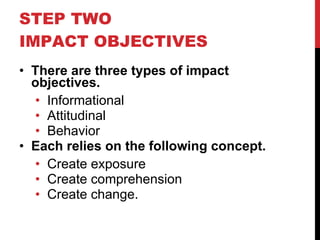
STEP TWO IMPACT OBJECTIVES There are three types of impact objectives. Informational Attitudinal Behavior Each relies on the following concept. Create exposure Create comprehension Create change.
PROGRAMMING
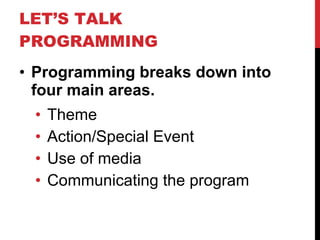
LET’S TALK PROGRAMMING Programming breaks down into four main areas. Theme Action/Special Event Use of media Communicating the program
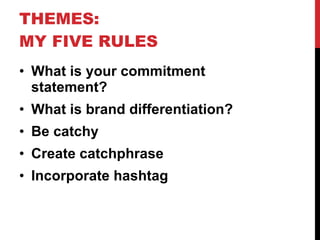
THEMES: MY FIVE RULES What is your commitment statement? What is brand differentiation? Be catchy Create catchphrase Incorporate hashtag
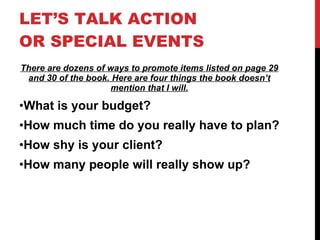
LET’S TALK ACTION OR SPECIAL EVENTS There are dozens of ways to promote items listed on page 29 and 30 of the book. Here are four things the book doesn’t mention that I will. What is your budget? How much time do you really have to plan? How shy is your client? How many people will really show up?
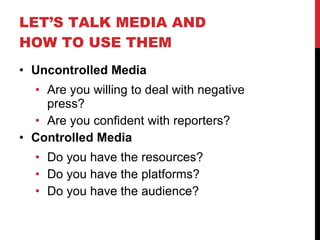
LET’S TALK MEDIA AND HOW TO USE THEM Uncontrolled Media Are you willing to deal with negative press? Are you confident with reporters? Controlled Media Do you have the resources? Do you have the platforms? Do you have the audience?
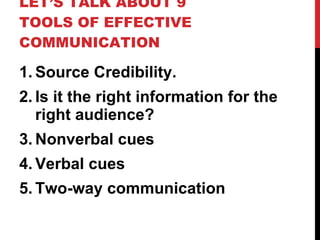
LET’S TALK ABOUT 9 TOOLS OF EFFECTIVE COMMUNICATION Source Credibility. Is it the right information for the right audience? Nonverbal cues Verbal cues Two-way communication
LET’S TALK ABOUT 9 TOOLS OF EFFECTIVE COMMUNICATION 6. Opinion leaders 7. Group influence 8. Selective exposure 9. Audience participation
WHAT WE FORGET ABOUT NONVERBAL COMMUNICATION Does the mood fit the objective? If you’re trying to calm someone down, having it in a loud area with dozens of reporters screaming questions doesn’t work. Are you dressed appropriately? Is the backdrop right? Are the guest comfortable? Is everyone represented?
EVALUATION
LET’S TALK ABOUT INFORMATIONAL OBJECTIVE EVALUATION Message exposure is measured through programs like Cision and Vocus. Website analytics also help. Message comprehension is measured through software that tests how easy it is to swallow the words. Website analytics also help. Message retention can be measured through surveys. Website analytics can also help.
LET’S TALK ABOUT ATTITUDINAL OBJECTIVE EVALUATION Surveys
LET’S TALK ABOUT BEHAVIOR OBJECTIVE EVALUATION Surveys Are people doing what you want them to do? Are smoking numbers down? Are people wearing seatbelts? Are people eating more vegetables?
LET’S TALK ABOUT OUTPUT OBJECTIVE EVALUATION Check your numbers

471_Chapter 2

  • 1.
    PUBLIC RELATIONS 471Let’s build a foundation January 9, 2012
  • 2.
    GIVE ME SOMEROPE I’M PULLING FOR YOU
  • 3.
    FOUNDATION FOR THEWHOLE CLASS RESEARCH OBJECTIVES PROGRAMMING EVALUATION
  • 4.
  • 5.
    THREE KINDS OF RESEARCH Client Research Opportunity/Problem Research Audience Research
  • 6.
    CLIENT RESEARCH MissionStatement: Who are we and why do we matter? Financial Status Reputation Past PR Practices Current PR Practices
  • 7.
    LET’S TALK CLIENTRESEARCH Organizational Structure For profit has more accountability. For profit also has more red tape. Non-profit can give you more freedom. Non-profits also can offer more drama. How do they deliver a product to a consumer? What is the company’s geography?
  • 8.
    OPPORTUNITY OR PROBLEMRESEARCH Why are we doing what we’re doing? Do we see an opportunity to influence opinion about our client? Are we responding to a mistake? The difference between playing offense vs. defense is critical. Try to play as much offense as possible.
  • 9.
    LET’S TALK OPPORTUNITYOR PROBLEM RESEARCH Proactive Programs arise out of opportunity. These are long range. These are rooted in more strategy. These are harder to sell to people not in PR.
  • 10.
    LET’S TALK OPPORTUNITYOR PROBLEM RESEARCH Reactive Programs arise out of problems. These are short term. These are rooted in survival. These are what people not in PR tend to remember.
  • 11.
    AUDIENCE RESEARCH Every audience breaks down into two core groups. General Specific Each genre of PR has specific audiences within these groups we’ll talk about this quarter.
  • 12.
    LET’S TALK AUDIENCE RESEARCH Regardless of the public or audience, you’ll need to remember these four questions. Who are they? Why do they matter? How active are they? Which public is most important to us?
  • 13.
    LET’S TALK AUDIENCE RESEARCH Once you figure that out, now you can gather data. How much media do they consume? Where to they get said media? Who’s in their ear?
  • 14.
    SO HOW DOWE RESEARCH THIS STUFF?
  • 15.
    LET’S TALK RESEARCHMETHODS There are two kinds of research Nonquanitative. I’ve also heard this called qualitative. This is research that has already been done that you find Quantitative: This is you putting on the journalism hat and getting new information.
  • 16.
    SIX NONQUANITATIVE RESEARCHTOOLS Client records (financial reports, annual reports) Published material about them (news articles or trade publications) Published material from them (speeches PowerPoint, marketing material)
  • 17.
    LET’S TALK SIXNONQUANITATIVE RESEARCH TOOLS Feedback from previous customers Talking to potential customers Focus Group
  • 18.
    LET’S TALK THREEQUANTITATIVE RESEARCH TOOLS Sample surveys Email Mail Phone Personal Interview Experiments Content analysis These are usually done by professional firms. Most agencies and businesses will subcontract this kind of work out.
  • 19.
  • 20.
    LET’S TALK OBJECTIVES Objectives are the most important part of the PR process. Here are two golden rules for a good objective. Make it an singular infinitive phrase. To publicize random special event To stimulate interest in political candidate Objectives must be verifiable. How will we quantify How will be meet the due date?
  • 21.
    LET’S TALK OBJECTIVES There is a hierarchy to objectives. Step One is disseminate. Step Two is expose. Step Three is reinforcement or comprehension. Step Four is change.
  • 22.
    STEP ONE OUTPUTOBJECTIVES Output objectives are about disseminating content. They are easy to quantify. We sent a news release to 300 newspapers. We had 1,000 visitors to our website They are like empty calories. Did anyone act on those releases? Did anyone do something differently because of those releases? OUTPUT OBJECTIVES ARE LIKE A FOUNDATION. THEY’RE NOT THE WHOLE HOUSE.
  • 23.
    STEP TWO IMPACTOBJECTIVES There are three types of impact objectives. Informational Attitudinal Behavior Each relies on the following concept. Create exposure Create comprehension Create change.
  • 24.
  • 25.
    LET’S TALK PROGRAMMINGProgramming breaks down into four main areas. Theme Action/Special Event Use of media Communicating the program
  • 26.
    THEMES: MY FIVERULES What is your commitment statement? What is brand differentiation? Be catchy Create catchphrase Incorporate hashtag
  • 27.
    LET’S TALK ACTIONOR SPECIAL EVENTS There are dozens of ways to promote items listed on page 29 and 30 of the book. Here are four things the book doesn’t mention that I will. What is your budget? How much time do you really have to plan? How shy is your client? How many people will really show up?
  • 28.
    LET’S TALK MEDIAAND HOW TO USE THEM Uncontrolled Media Are you willing to deal with negative press? Are you confident with reporters? Controlled Media Do you have the resources? Do you have the platforms? Do you have the audience?
  • 29.
    LET’S TALK ABOUT9 TOOLS OF EFFECTIVE COMMUNICATION Source Credibility. Is it the right information for the right audience? Nonverbal cues Verbal cues Two-way communication
  • 30.
    LET’S TALK ABOUT9 TOOLS OF EFFECTIVE COMMUNICATION 6. Opinion leaders 7. Group influence 8. Selective exposure 9. Audience participation
  • 31.
    WHAT WE FORGETABOUT NONVERBAL COMMUNICATION Does the mood fit the objective? If you’re trying to calm someone down, having it in a loud area with dozens of reporters screaming questions doesn’t work. Are you dressed appropriately? Is the backdrop right? Are the guest comfortable? Is everyone represented?
  • 32.
  • 33.
    LET’S TALK ABOUTINFORMATIONAL OBJECTIVE EVALUATION Message exposure is measured through programs like Cision and Vocus. Website analytics also help. Message comprehension is measured through software that tests how easy it is to swallow the words. Website analytics also help. Message retention can be measured through surveys. Website analytics can also help.
  • 34.
    LET’S TALK ABOUTATTITUDINAL OBJECTIVE EVALUATION Surveys
  • 35.
    LET’S TALK ABOUTBEHAVIOR OBJECTIVE EVALUATION Surveys Are people doing what you want them to do? Are smoking numbers down? Are people wearing seatbelts? Are people eating more vegetables?
  • 36.
    LET’S TALK ABOUTOUTPUT OBJECTIVE EVALUATION Check your numbers