JOURNALISM 370
 FEBRUARY 27, 2012
LAW, ETHICS AND AND OP ED
Comma Use via @markraganceo
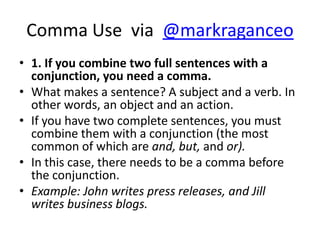
• 1. If you combine two full sentences with a
  conjunction, you need a comma.
• What makes a sentence? A subject and a verb. In
  other words, an object and an action.
• If you have two complete sentences, you must
  combine them with a conjunction (the most
  common of which are and, but, and or).
• In this case, there needs to be a comma before
  the conjunction.
• Example: John writes press releases, and Jill
  writes business blogs.
Comma Use via @markraganceo
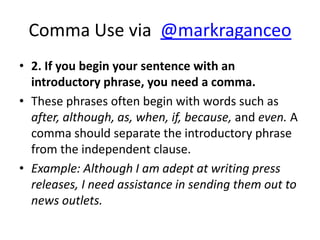
• 2. If you begin your sentence with an
  introductory phrase, you need a comma.
• These phrases often begin with words such as
  after, although, as, when, if, because, and even. A
  comma should separate the introductory phrase
  from the independent clause.
• Example: Although I am adept at writing press
  releases, I need assistance in sending them out to
  news outlets.
Comma Use via @markraganceo
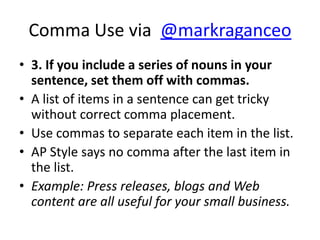
• 3. If you include a series of nouns in your
  sentence, set them off with commas.
• A list of items in a sentence can get tricky
  without correct comma placement.
• Use commas to separate each item in the list.
• AP Style says no comma after the last item in
  the list.
• Example: Press releases, blogs and Web
  content are all useful for your small business.
Comma Use via @markraganceo
• 4. If you include extra information, set it off with
  commas.
• Sometimes you will include extra description of a
  noun in your sentence.
• I call it "extra" because it simply is not necessary.
  If you removed it, you'd still have a good, sensible
  sentence.
• Set this information off with commas.
• Example: Bill, who is a pretty decent writer,
  handles all my business blogging needs.
Comma Use via @markraganceo
• 5. If you have a quotation in a sentence, you
  need a comma.
• Some people have a habit of just adding quotes in
  the middle of a sentence without setting them off
  with commas. This doesn't work.
• If your quote calls for a comma at the end, make
  sure it's inside the quotes.
• Example A: Bill told his friend, "Business blogging
  is all about thinking outside the box."
• Example B: "I really need to get this press release
  sent out," Bill said.
OP ED
       A GOOD WAY TO FORMAT
What is the problem?
What is your opinion on the problem?
What is your supporting information?
What is the solution?
Why should the reader care?
Feature Thoughts
• You need quotes.
• You need context.
• You need reactions
  – Why are people doing this?
  – How did they get started?
  – The best features had great details.
  – The ones that struggled didn’t.
  – This is the journalism part of J370.
HOW CAN YOU GET SUED
• Writing misleading press releases
• Making misleading or false product/service
  claims
• Creating front groups
• Insider trading
• Invasion of privacy
• Misrepresenting earnings
• Conspiracy
REAL WORLD BACKGROUND I WISH
   I KNEW WHEN I WAS IN SCHOOL
• The key is avoiding lawsuits.
• You may be legally correct. It might not
  matter.
• Lawsuits are costly…even if you win.
• Waivers are your friend.
• Written correspondence is your friend
• When in doubt, ask.
Libel and Defamation
• Here’s how you prove it.
  – Statement was broadcast or published.
  – You can ID who wrote it.
  – Actual injury occurred…that includes losing cash.
  – Publisher was negligent or acted with malice.
Libel and Defamation
• Different proofs required for “public figures”
• Corporations are considered public figures
• Truth is defense against defamation charge
FAIR COMMENT…
      GET OUT OF TROUBLE CARD
• Opinions are protected as long as criticism is
  done with honest intention and a lack of
  malice.
• Protects critical comments of executives.
• Protect yourself when writing criticism.
  – Accompany opinion with facts on which it’s based.
  – Attribute quoted opinion to an individual.
  – Review context of surrounding language for
    defamation.
AVOIDING DEFAMATION SUITS
• #1 rule: Watch your language
• Choose innocuous language when talking
  about personnel issues.
  – We wish them well in their future endeavors.
• Avoid unflattering representations of
  competitors.
INVASION OF PRIVACY
• Employees don’t waive their right to privacy
• Employee newsletters
  – Avoid anything that might embarrass employees
  – Focus on organization-related activities
• Photos of employees
  – Implied consent for “news” use, not promotion
  – Maintain photo records
INVASION OF PRIVACY
• Use of photos/quotes in publicity or
  advertising
  – Need signed consent to use photos or quotes in
    promotional materials
INVASION OF PRIVACY
• Media inquiries about employees
  – Only provide confirmation of employment, title
    and job description, date of employment
    beginning and end
  – Don’t provide address, marital status, number of
    kids, job performance or salary
  – Serve as liaison between reporter and employee
INVASION OF PRIVACY
• Employee blogs
  – Prohibit comments about other employees and
    confidential product information
  – Employee guidelines for virtual online
    communities
COPYRIGHT LAW
• Protection of “fixed” works in any “tangible
  medium.” Yes, this includes digital.
• Work is automatically copyrighted the
  moment it is “fixed.”
COPYRIGHT LAW
             HOW TO BE SAFE
• Fair use allows you to quote part of a
  copyrighted article, but brief enough not to
  harm the original work
• Social Media makes this an evolving jungle.
• When in doubt, ask.
• When in doubt, have a waiver.
COPYRIGHT LAW
             HOW TO BE SAFE
• You can’t copyright ideas.
• You can copyright the expression of those
  ideas.
• Copyright your PR content. That’s why you
  hire lawyers.

370 libel op_ed

  • 1.
    JOURNALISM 370 FEBRUARY27, 2012 LAW, ETHICS AND AND OP ED
  • 2.
    Comma Use via@markraganceo • 1. If you combine two full sentences with a conjunction, you need a comma. • What makes a sentence? A subject and a verb. In other words, an object and an action. • If you have two complete sentences, you must combine them with a conjunction (the most common of which are and, but, and or). • In this case, there needs to be a comma before the conjunction. • Example: John writes press releases, and Jill writes business blogs.
  • 3.
    Comma Use via@markraganceo • 2. If you begin your sentence with an introductory phrase, you need a comma. • These phrases often begin with words such as after, although, as, when, if, because, and even. A comma should separate the introductory phrase from the independent clause. • Example: Although I am adept at writing press releases, I need assistance in sending them out to news outlets.
  • 4.
    Comma Use via@markraganceo • 3. If you include a series of nouns in your sentence, set them off with commas. • A list of items in a sentence can get tricky without correct comma placement. • Use commas to separate each item in the list. • AP Style says no comma after the last item in the list. • Example: Press releases, blogs and Web content are all useful for your small business.
  • 5.
    Comma Use via@markraganceo • 4. If you include extra information, set it off with commas. • Sometimes you will include extra description of a noun in your sentence. • I call it "extra" because it simply is not necessary. If you removed it, you'd still have a good, sensible sentence. • Set this information off with commas. • Example: Bill, who is a pretty decent writer, handles all my business blogging needs.
  • 6.
    Comma Use via@markraganceo • 5. If you have a quotation in a sentence, you need a comma. • Some people have a habit of just adding quotes in the middle of a sentence without setting them off with commas. This doesn't work. • If your quote calls for a comma at the end, make sure it's inside the quotes. • Example A: Bill told his friend, "Business blogging is all about thinking outside the box." • Example B: "I really need to get this press release sent out," Bill said.
  • 7.
    OP ED A GOOD WAY TO FORMAT What is the problem? What is your opinion on the problem? What is your supporting information? What is the solution? Why should the reader care?
  • 8.
    Feature Thoughts • Youneed quotes. • You need context. • You need reactions – Why are people doing this? – How did they get started? – The best features had great details. – The ones that struggled didn’t. – This is the journalism part of J370.
  • 9.
    HOW CAN YOUGET SUED • Writing misleading press releases • Making misleading or false product/service claims • Creating front groups • Insider trading • Invasion of privacy • Misrepresenting earnings • Conspiracy
  • 10.
    REAL WORLD BACKGROUNDI WISH I KNEW WHEN I WAS IN SCHOOL • The key is avoiding lawsuits. • You may be legally correct. It might not matter. • Lawsuits are costly…even if you win. • Waivers are your friend. • Written correspondence is your friend • When in doubt, ask.
  • 11.
    Libel and Defamation •Here’s how you prove it. – Statement was broadcast or published. – You can ID who wrote it. – Actual injury occurred…that includes losing cash. – Publisher was negligent or acted with malice.
  • 12.
    Libel and Defamation •Different proofs required for “public figures” • Corporations are considered public figures • Truth is defense against defamation charge
  • 13.
    FAIR COMMENT… GET OUT OF TROUBLE CARD • Opinions are protected as long as criticism is done with honest intention and a lack of malice. • Protects critical comments of executives. • Protect yourself when writing criticism. – Accompany opinion with facts on which it’s based. – Attribute quoted opinion to an individual. – Review context of surrounding language for defamation.
  • 14.
    AVOIDING DEFAMATION SUITS •#1 rule: Watch your language • Choose innocuous language when talking about personnel issues. – We wish them well in their future endeavors. • Avoid unflattering representations of competitors.
  • 15.
    INVASION OF PRIVACY •Employees don’t waive their right to privacy • Employee newsletters – Avoid anything that might embarrass employees – Focus on organization-related activities • Photos of employees – Implied consent for “news” use, not promotion – Maintain photo records
  • 16.
    INVASION OF PRIVACY •Use of photos/quotes in publicity or advertising – Need signed consent to use photos or quotes in promotional materials
  • 17.
    INVASION OF PRIVACY •Media inquiries about employees – Only provide confirmation of employment, title and job description, date of employment beginning and end – Don’t provide address, marital status, number of kids, job performance or salary – Serve as liaison between reporter and employee
  • 18.
    INVASION OF PRIVACY •Employee blogs – Prohibit comments about other employees and confidential product information – Employee guidelines for virtual online communities
  • 19.
    COPYRIGHT LAW • Protectionof “fixed” works in any “tangible medium.” Yes, this includes digital. • Work is automatically copyrighted the moment it is “fixed.”
  • 20.
    COPYRIGHT LAW HOW TO BE SAFE • Fair use allows you to quote part of a copyrighted article, but brief enough not to harm the original work • Social Media makes this an evolving jungle. • When in doubt, ask. • When in doubt, have a waiver.
  • 21.
    COPYRIGHT LAW HOW TO BE SAFE • You can’t copyright ideas. • You can copyright the expression of those ideas. • Copyright your PR content. That’s why you hire lawyers.