1
Anatomy of
Public Relations
from
The Public Relations
Practitioner’s Playbook
M. Larry Litwin, APR, Fellow PRSA
© 2010
2
Or…
Why We Do What We Do
And
How To Do It Better!
3
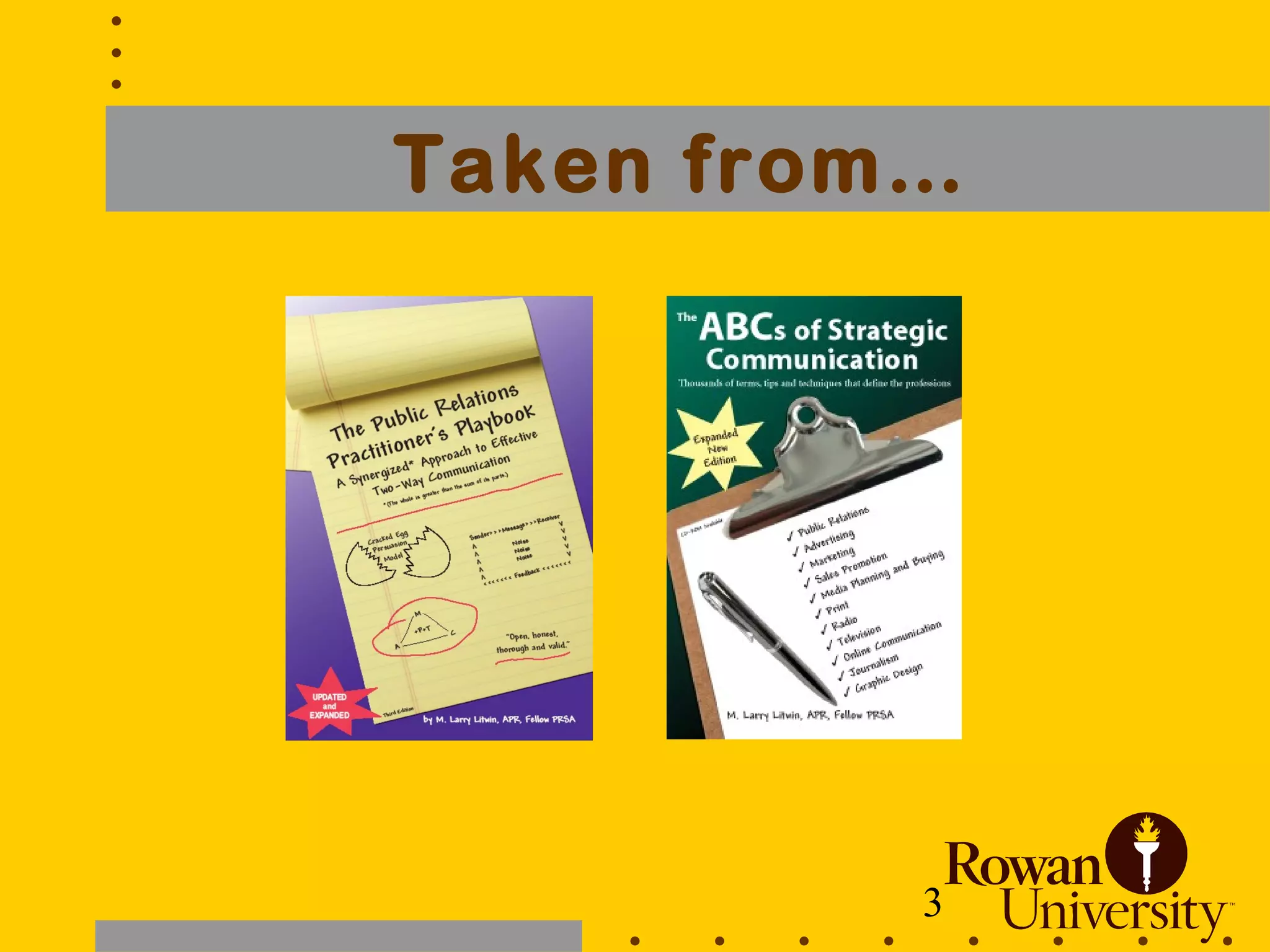
Taken from…
4
THIS PowerPoint
Available on:
slideshare.net
Search – Larry Litwin
5
PR Is...
• “This is who we are;
• What we think about ourselves;
• What we want to do; and
• Why we deserve your support.”
6
7
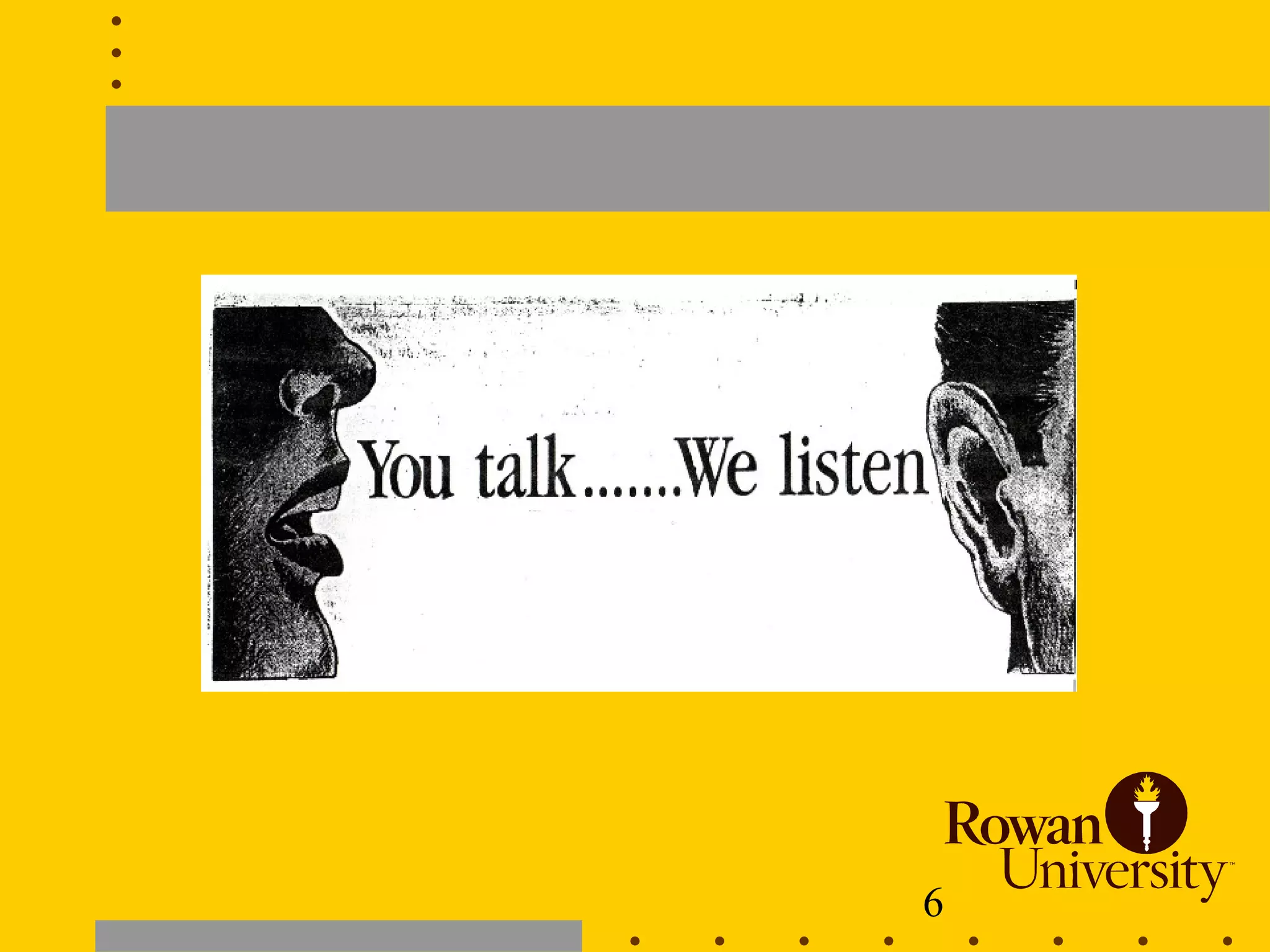
You Talk – We Listen
Hearing vs. Listening
There is a reason why we have two ears and
one mouth – we must listen twice as
much as we speak.
8
Public Communication
• Public communication is at the heart of our economy,
society and politics. Studios use it to promote their
films. Politicians use it to get elected. Businesses use
it to burnish their image. Advocates use it to promote
social causes.
• It is a field built on ideas and images, persuasion and
information, strategy and tactics. No policy or product
can succeed without a smart (strategic) message
targeted to the right audience in creative and
innovative ways at the ideal time using the proper
channel. The ability to communicate this way – to
communicate strategically – is what Public
Communication is all about.
9
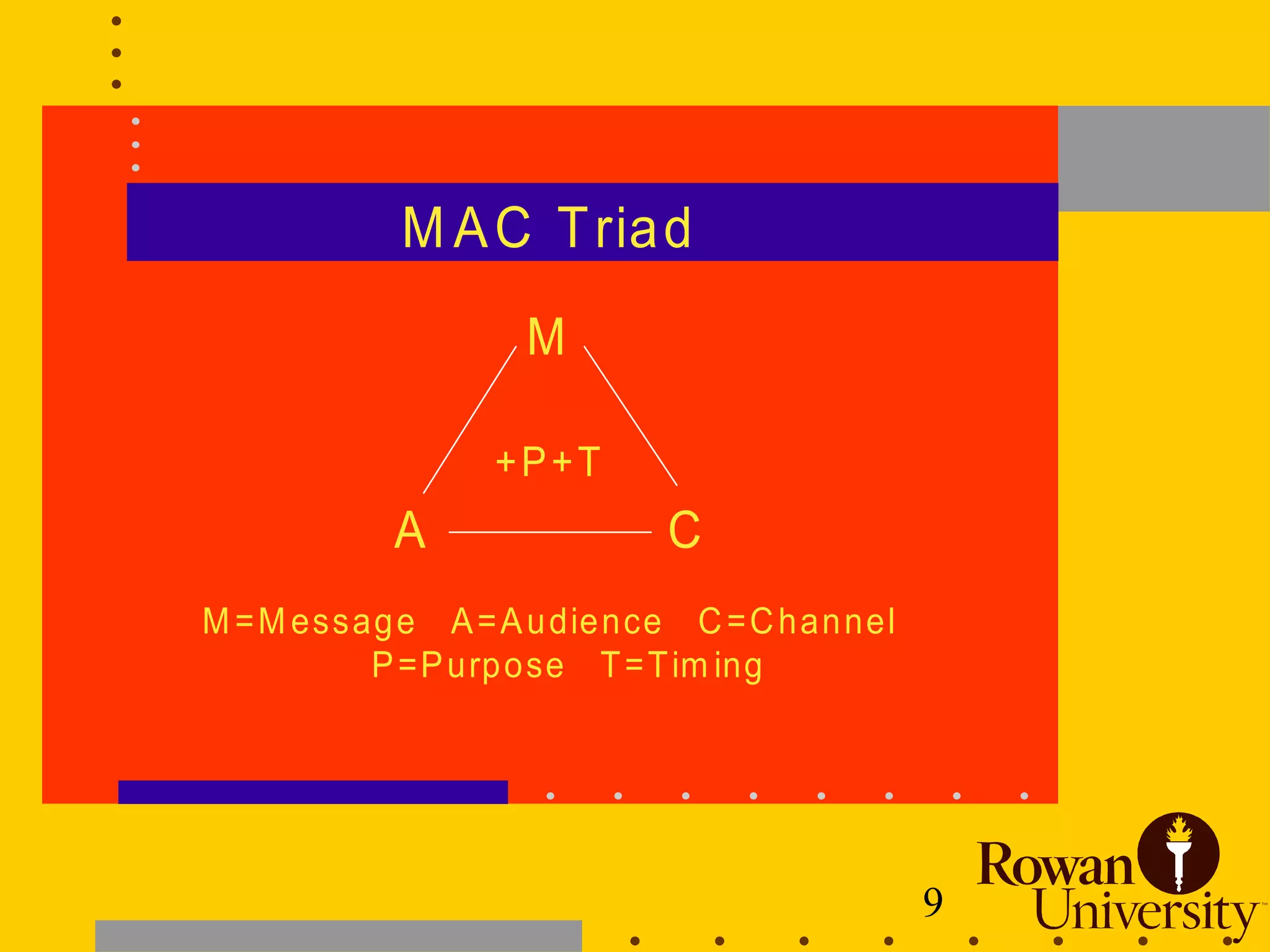
M AC Triad
M
+P+T
A C
M=Message A=Audience C=Channel
P=Purpose T=Tim ing
10
MAC Triad Plus cont.
• Informization
– Disseminating information (message) to
target audience through the proper channel
at the best possible time.
11
Advertising is Synergy
12
Public Relations…
(Not paid – Uncontrolled)
13
Public Relations…
A tool of leadership!
[more later…]
14
Public Relations 101
• Management and counseling function
• Enables organizations to build and maintain
relationships
• Through an understanding of audience
attitudes, opinions and values
• Planned, deliberate and two-way
• Conscience of organization
• Overseer of brand/reputation
• Relationship management
15
Public Relations
A management function that
helps organizations and their
publics mutually adapt to one
another.
16
Advertising 101
• Paid
• (Non)-personal communication
• From identified sponsor
• Using (mass) media
• To persuade or influence
• Audience
(Paid – Controlled)
17
Marketing 101
Determine what people need (and
want) and give it to them.
18
PR Practitioners
are…
Strategic AdvisorsStrategic Advisors
19
Edward Bernays’
Public Relations
Functions
• To interpret the client to the public, which
means promoting the client
• To interpret the public to the client, which
means operating the company in such a way
as to gain the approval of the public
• To act as a public service
• To promote new ideas and progress
• To build a public conscience
Crystallizing Public Opinion – 1923
20
Ivy Ledbetter Lee’s
Public Relations
Principles
1. Tell the truth
2. Provide accurate facts
3. Give the public relations director
access to top management so that
he/she can influence decisions
21
PR Counselors must
possess…
• Loyalty
• Judgment
• Trust
• Ethics
• Integrity
22
Managing Public
Opinion
Public relations practitioners…
– Assess public opinion
– Influence public opinion
It is our responsibility to MANAGE
public opinion!
23
ABCs of Strategic
Communication
• Anticipate
• Be Prepared
• Communicate Clearly, Concisely,
Consistently, Calculatingly,
Completely (Specifically and Simply)
Open, Honest, Thorough, Valid
24
Double Bottom Line
• First Bottom Line
–Build Relationships
• Second Bottom Line
–Profit – or, accomplish your Goal
25
Triple Bottom Line
• Pat Jackson’s DBL – plus:
• Third Bottom Line
–Revenue>Controlled Costs=Profit
26
Fraser Seitel’s “Real” Bottom Line
of PR
• “Our fundamental role in PR is to defend and
promote and enhance and sustain the
reputation of our organizations.”
• “Our job in PR is to help ensure that that
objective is achieved…through proper
performance – effectively communicated.”
27
How are Bottom Lines
Achieved?
? ? ?
28
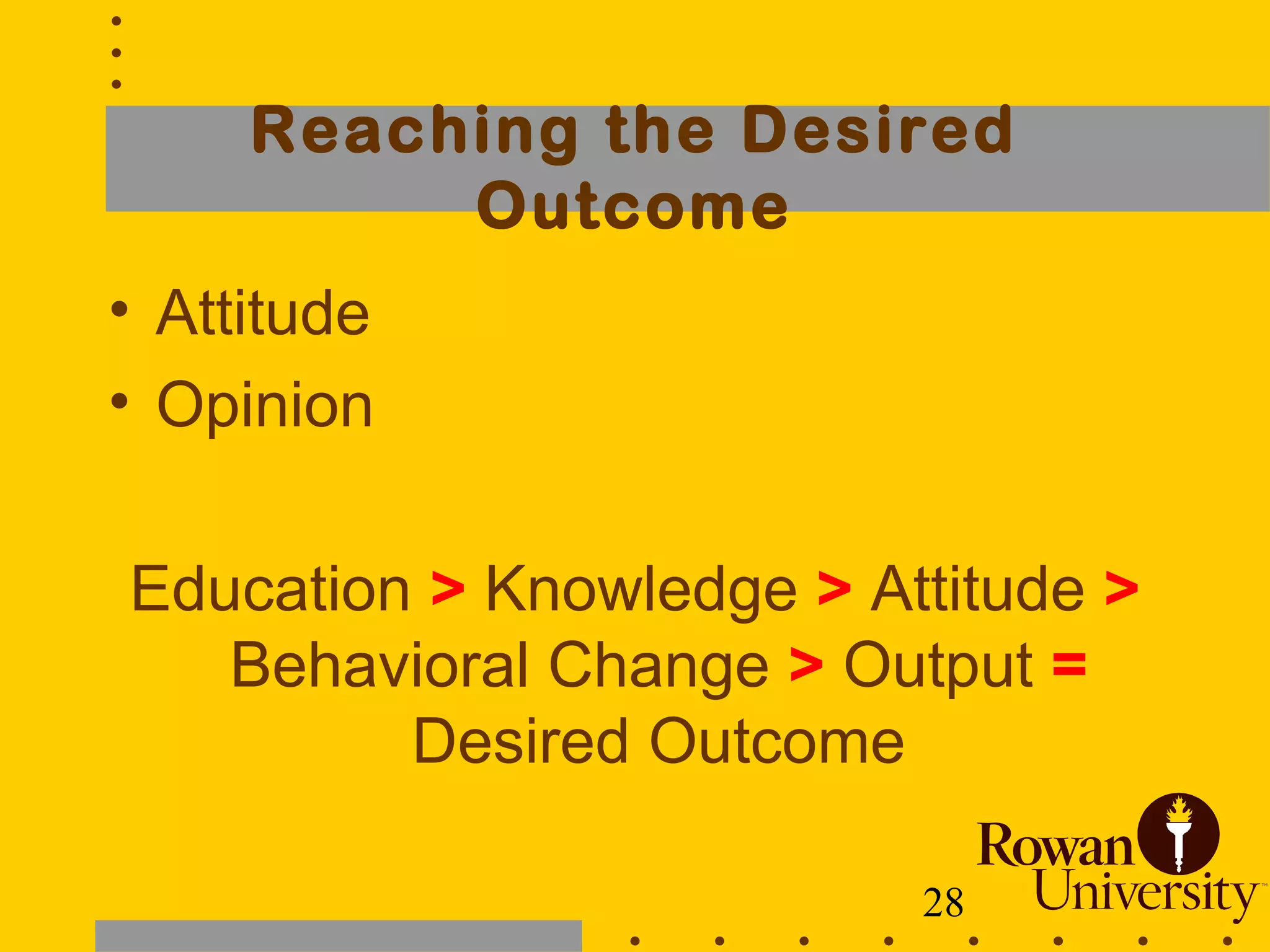
Reaching the Desired
Outcome
• Attitude
• Opinion
Education > Knowledge > Attitude >
Behavioral Change > Output =
Desired Outcome
29
Public Relations is
Synergy
30
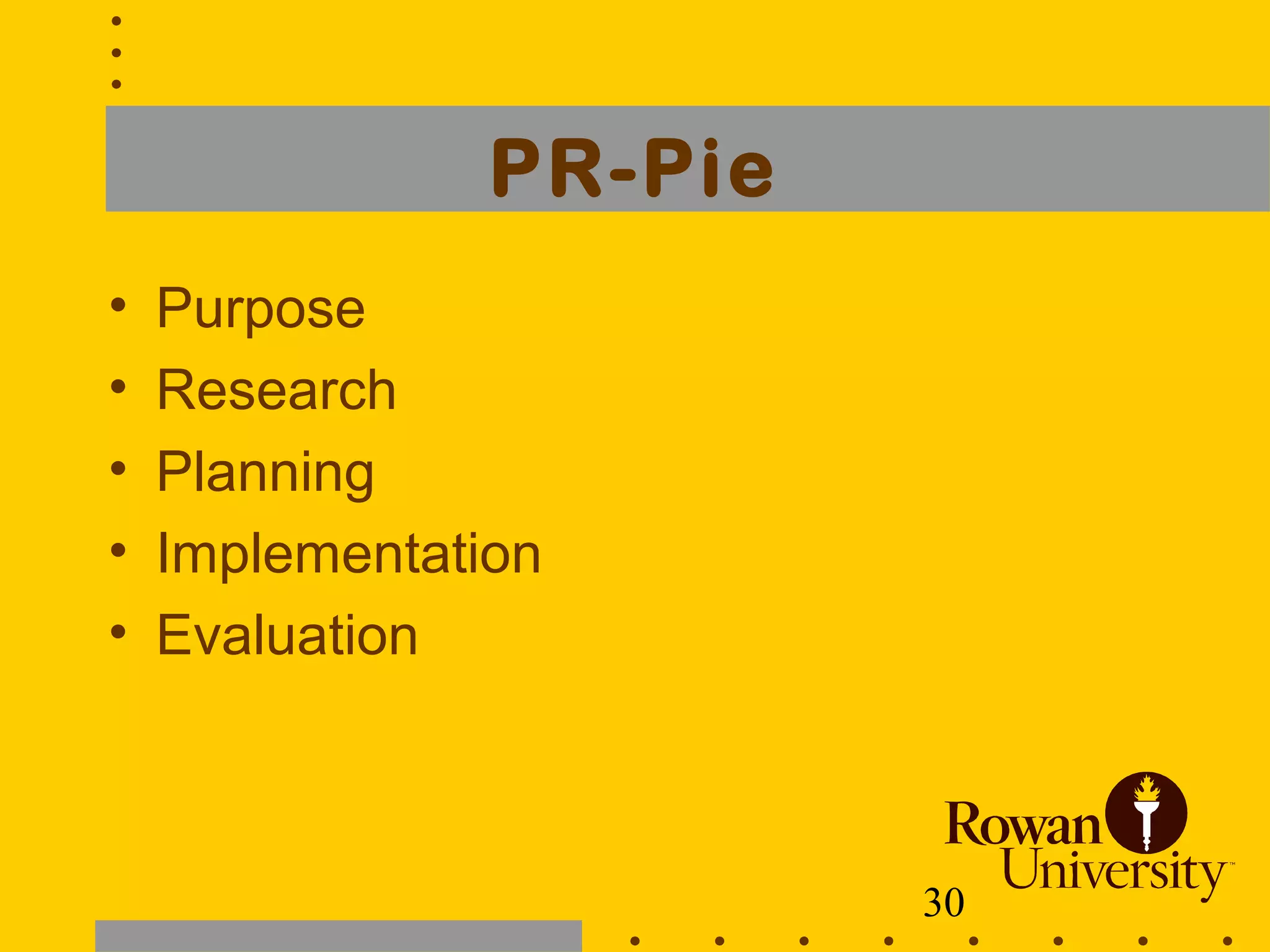
PR-Pie
• Purpose
• Research
• Planning
• Implementation
• Evaluation
31
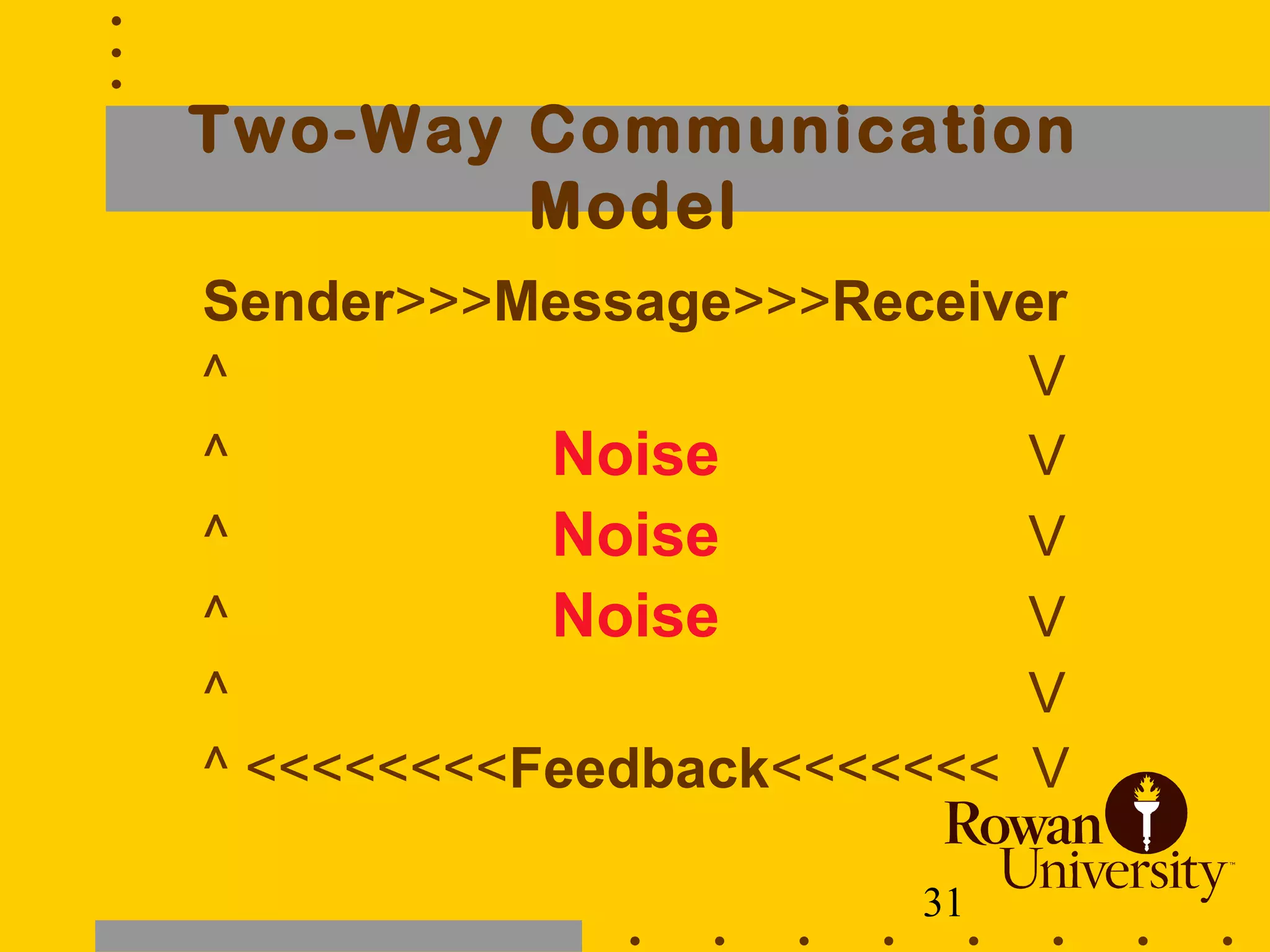
Two-Way Communication
Model
Sender>>>Message>>>Receiver
^ V
^ Noise V
^ Noise V
^ Noise V
^ V
^ <<<<<<<<Feedback<<<<<<< V
32
Communication
• …is shared comprehension (two way)
• Four Essential Elements/Communication Model
– Initiator (Sender/Encoder)
– Carrier (Message)
– Receiver (Decoder)
– Feedback (Is clarity being achieved?)
[If the message is not being received as intended,
it is your fault. Leaders whose messages are not
changing behavior are not true leaders.]
33
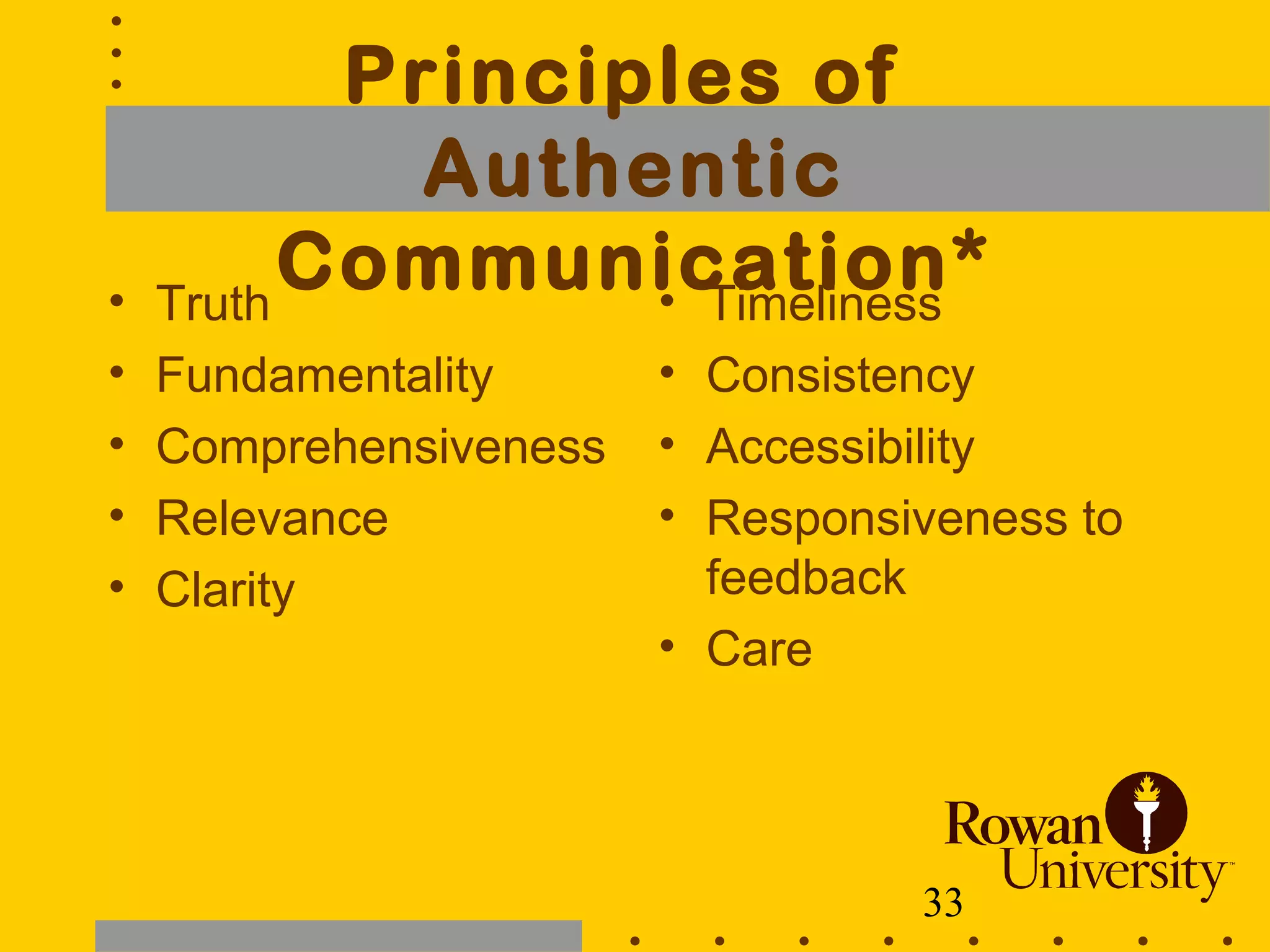
Principles of
Authentic
Communication*• Truth
• Fundamentality
• Comprehensiveness
• Relevance
• Clarity
• Timeliness
• Consistency
• Accessibility
• Responsiveness to
feedback
• Care
34
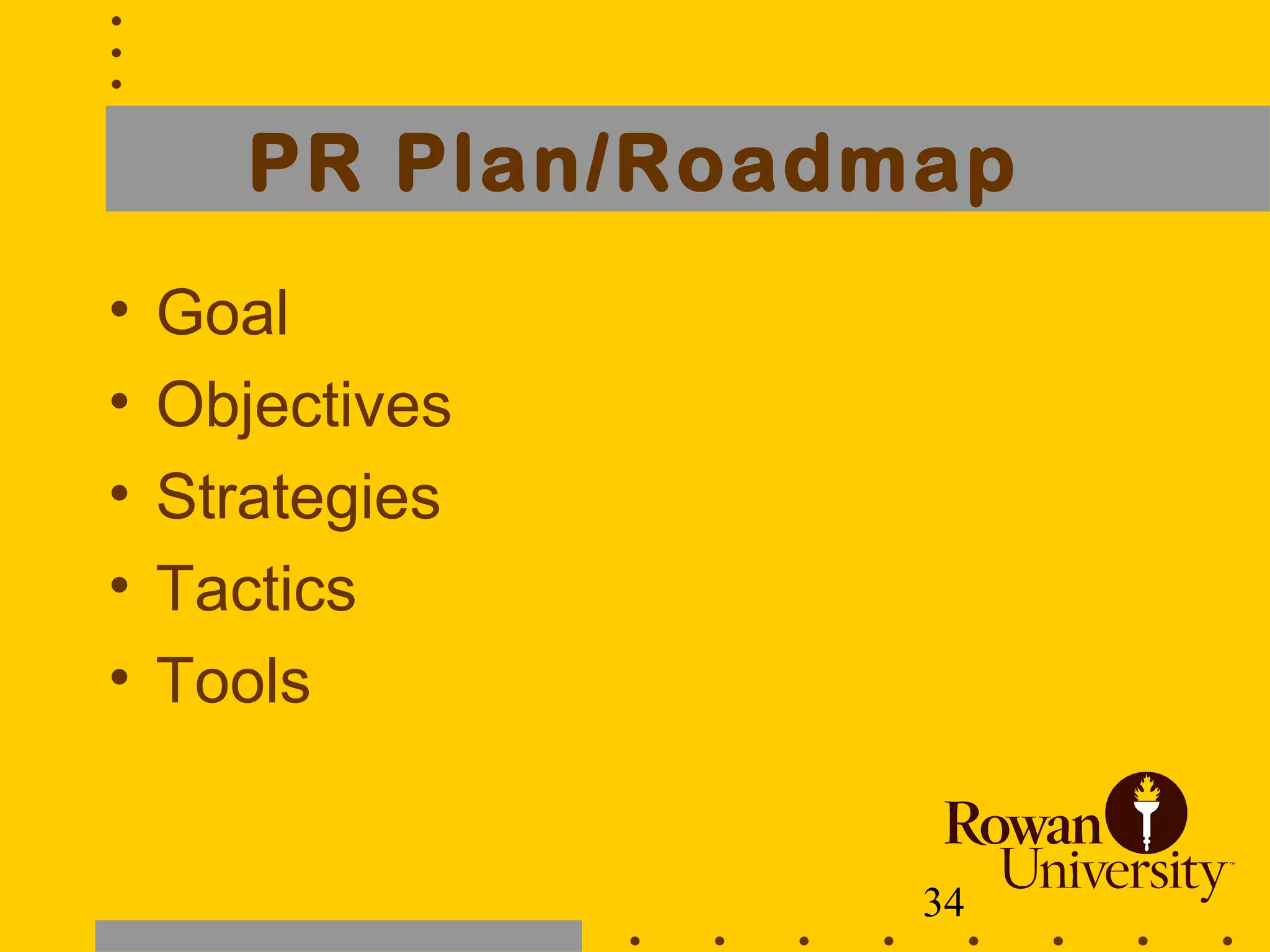
PR Plan/Roadmap
• Goal
• Objectives
• Strategies
• Tactics
• Tools
35
Superior tactics cannot
overcome a bad
(business) strategy.
36
No Planning = No Plan =
No Hope
37
Synergy
The whole is greater than
the sum of its parts
or
The whole works better than
any one of its parts.
[To achieve our goal, we should
achieve synergy.]
38
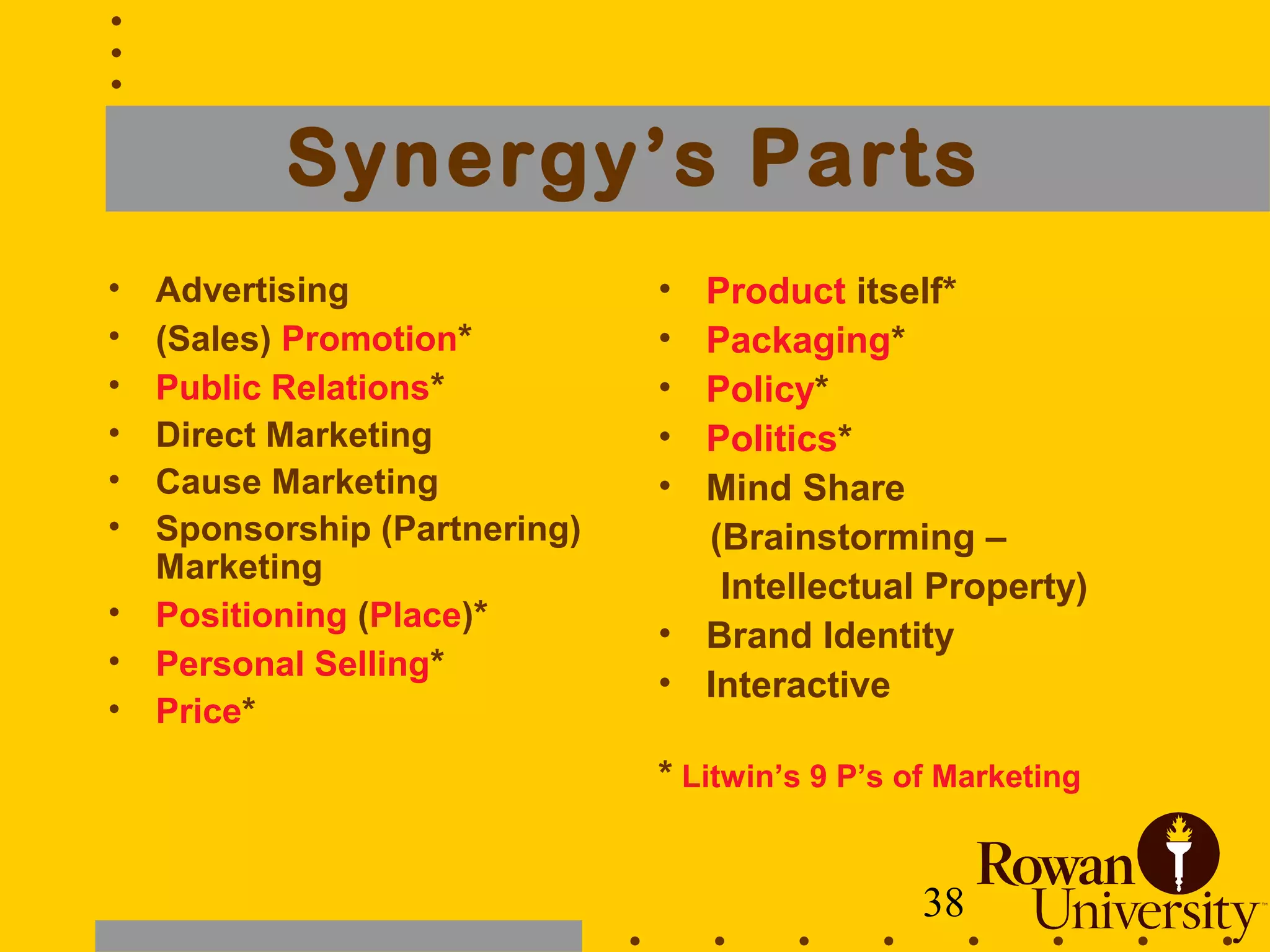
Synergy’s Parts
• Advertising
• (Sales) Promotion*
• Public Relations*
• Direct Marketing
• Cause Marketing
• Sponsorship (Partnering)
Marketing
• Positioning (Place)*
• Personal Selling*
• Price*
• Product itself*
• Packaging*
• Policy*
• Politics*
• Mind Share
(Brainstorming –
Intellectual Property)
• Brand Identity
• Interactive
* Litwin’s 9 P’s of Marketing
39
Public Relations is
Synergy
40
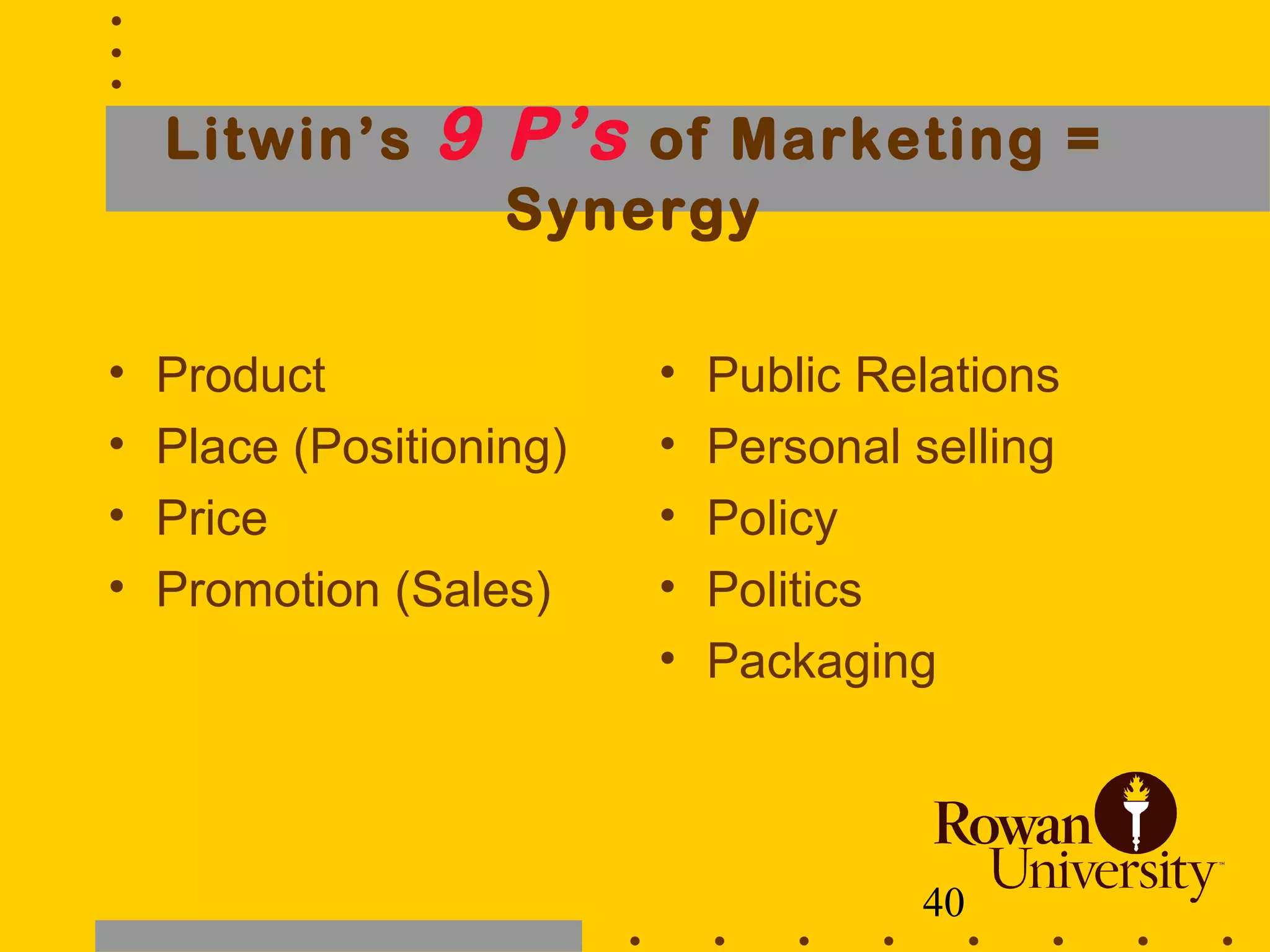
Litwin’s 9 P’s of Marketing =
Synergy
• Product
• Place (Positioning)
• Price
• Promotion (Sales)
• Public Relations
• Personal selling
• Policy
• Politics
• Packaging
41
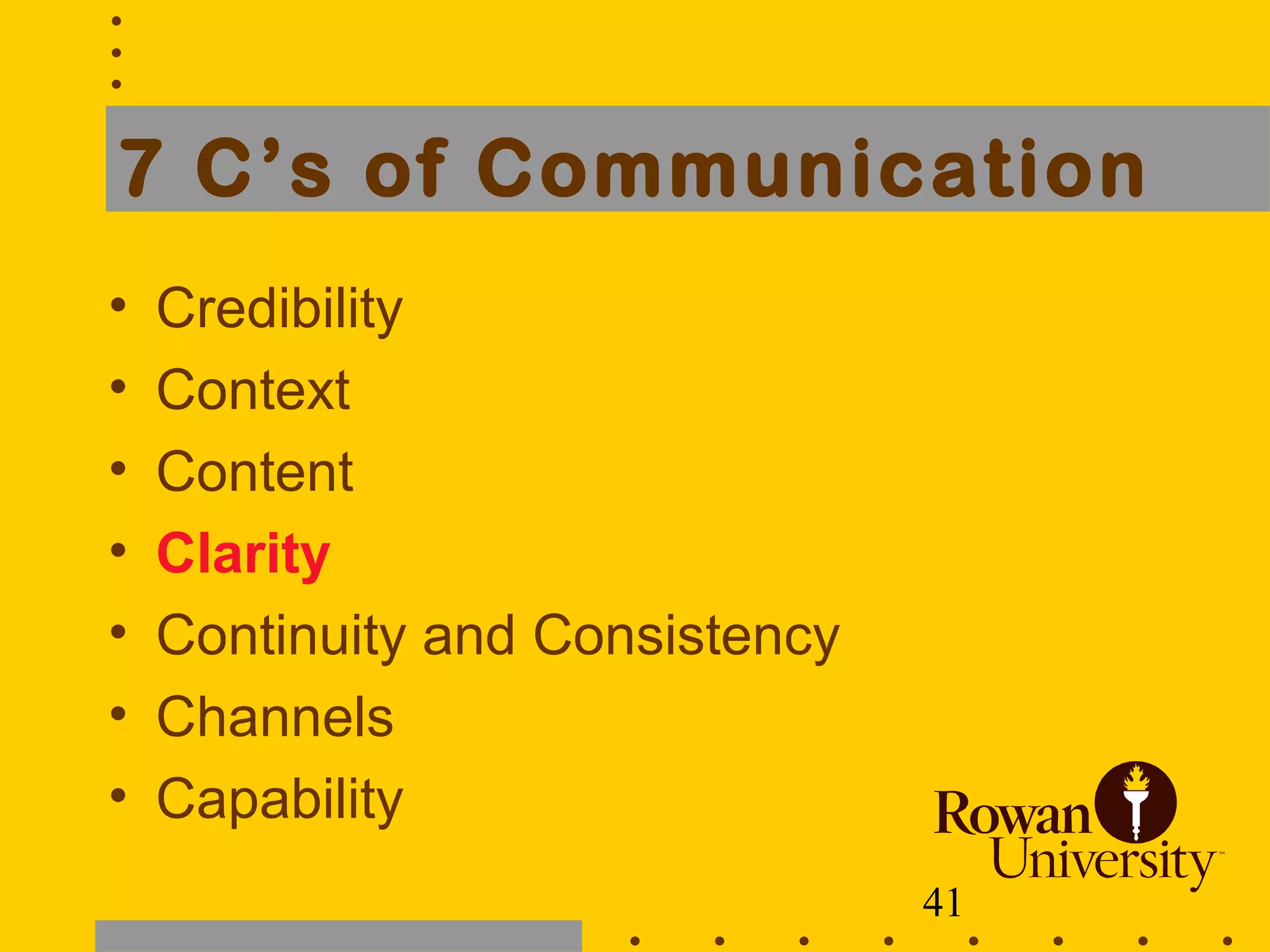
7 C’s of Communication
• Credibility
• Context
• Content
• Clarity
• Continuity and Consistency
• Channels
• Capability
42
Content is crucial…
but the medium is part of the
message, too!
(Marshal McLuhan)
43
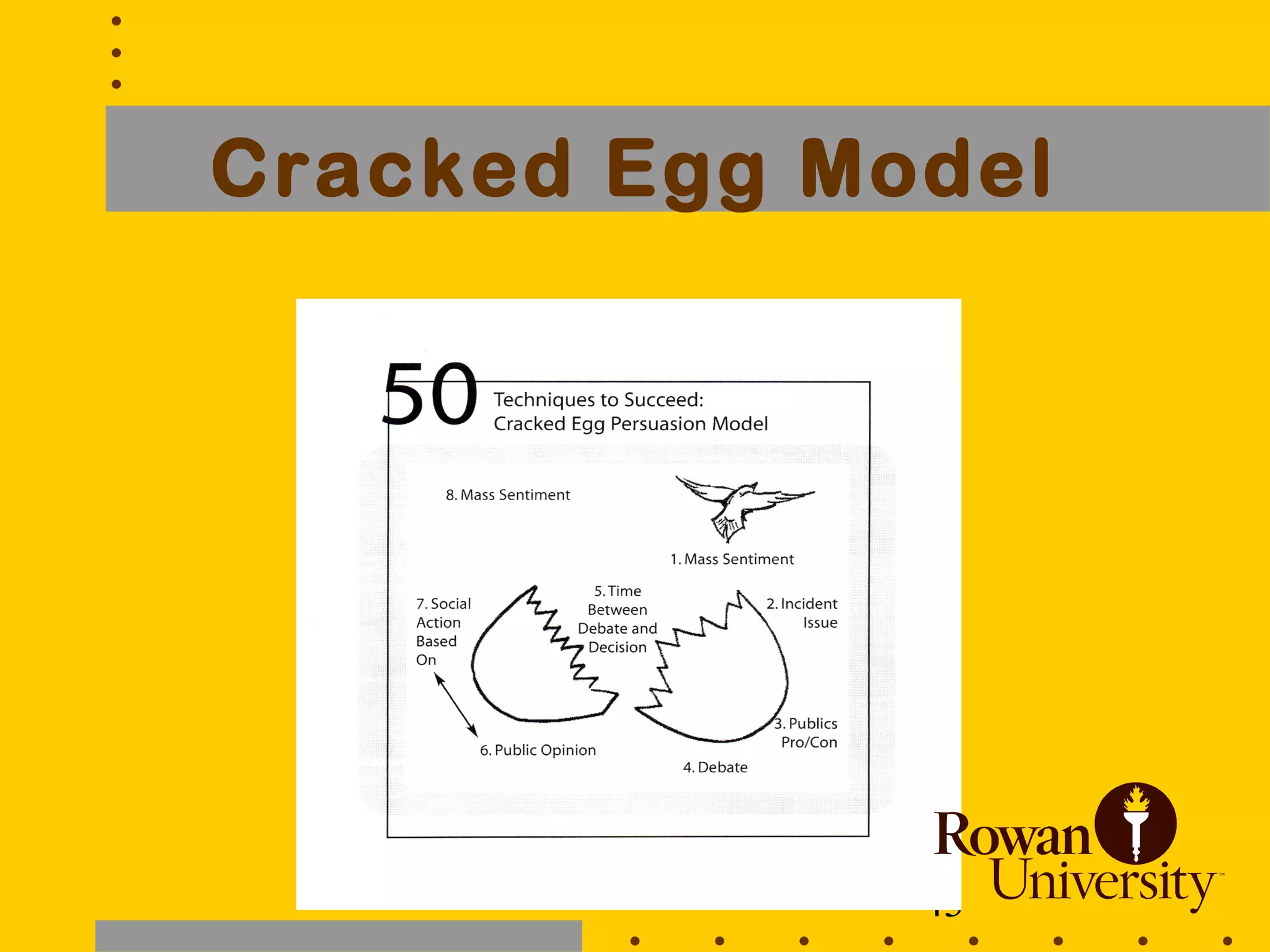
Cracked Egg Model
44
Audiences (ISPR)
• Identify
• Segment/Fragment
• Demographically
• Psychographically
• Geodemographically
• Behavioristically
• Benefits
• Profile
• Rank
– Audience Power Structure
• Elite (Key Communicators)
• Pluralistic or Diffused
• Amorphous/Latent
45
Target vs. Niche
Target
• Audience you want
to reach
e.g. High school
students
Niche
• Narrowly defined
audience
e.g. White, high school
girls of divorced
parents
46
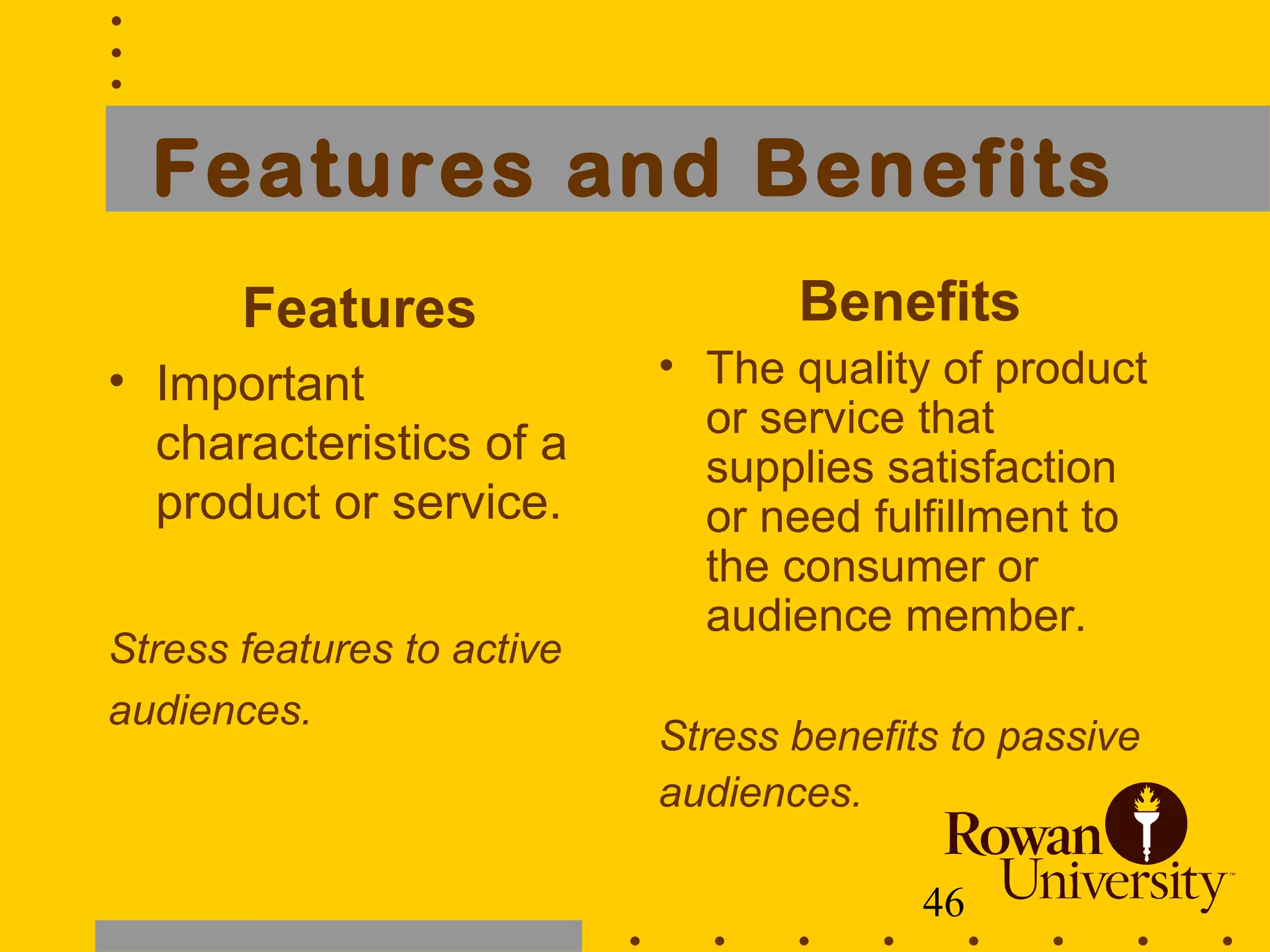
Features and Benefits
Features
• Important
characteristics of a
product or service.
Stress features to active
audiences.
Benefits
• The quality of product
or service that
supplies satisfaction
or need fulfillment to
the consumer or
audience member.
Stress benefits to passive
audiences.
47
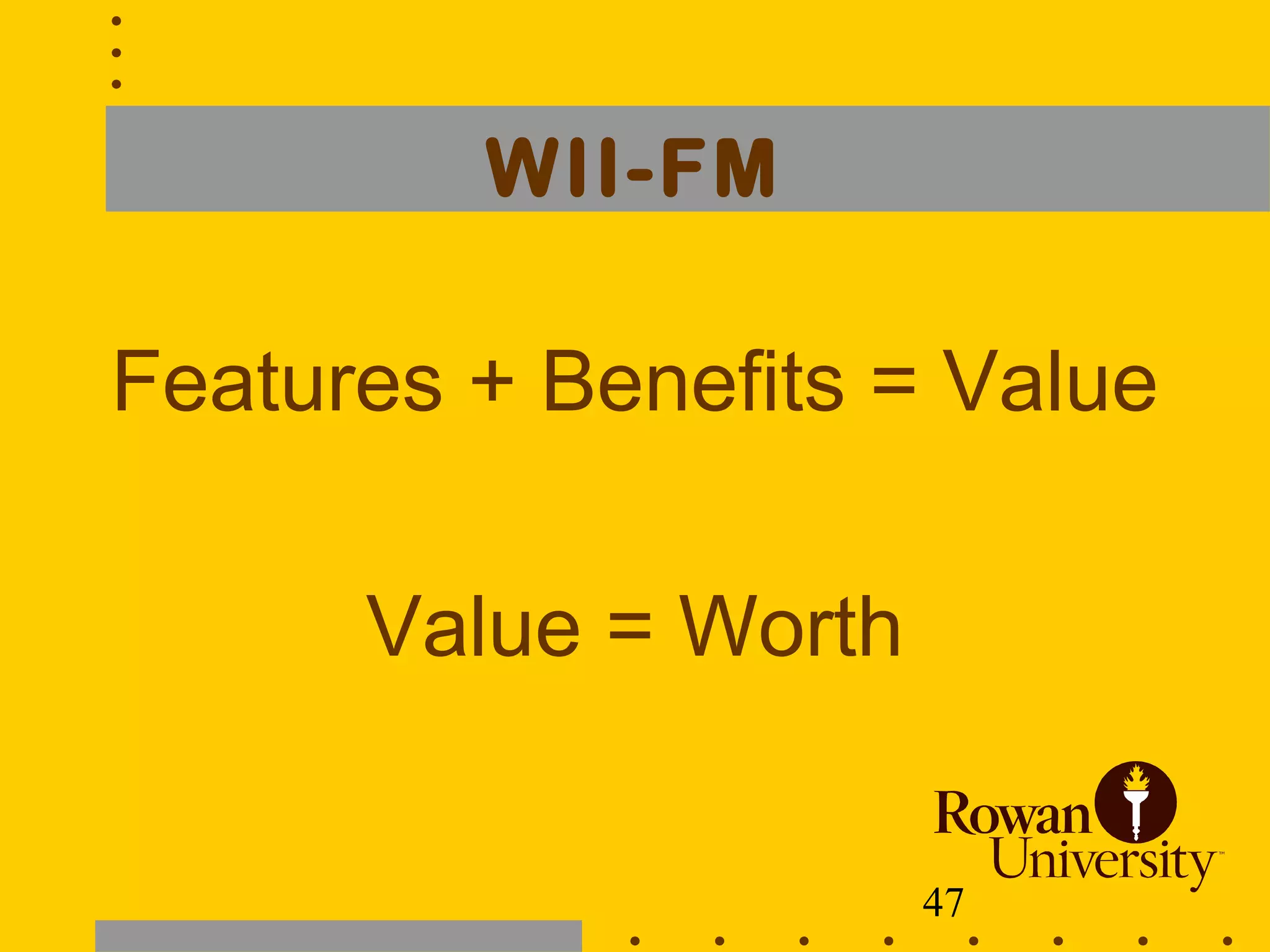
WII-FM
Features + Benefits = Value
Value = Worth
48
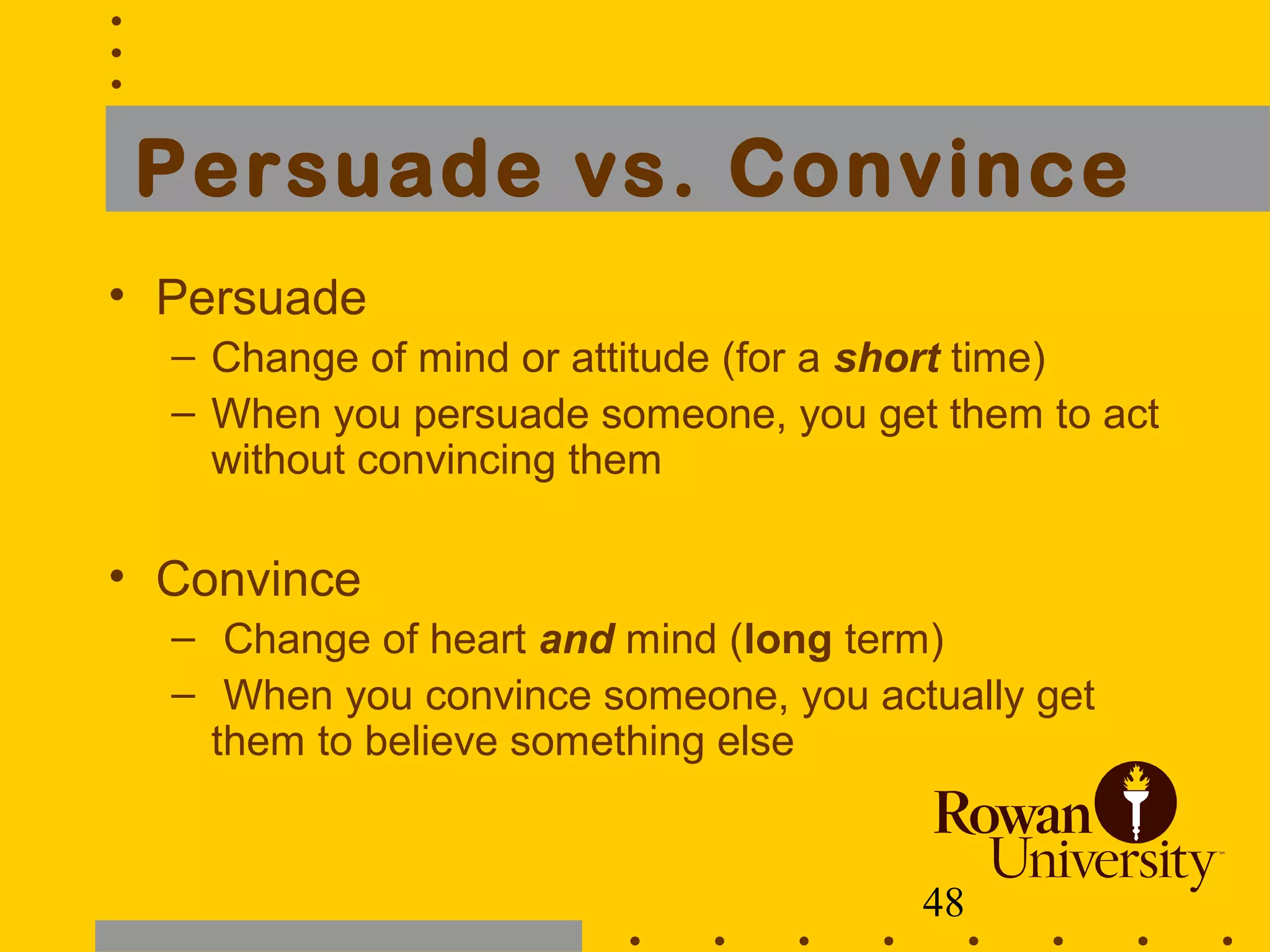
Persuade vs. Convince
• Persuade
– Change of mind or attitude (for a short time)
– When you persuade someone, you get them to act
without convincing them
• Convince
– Change of heart and mind (long term)
– When you convince someone, you actually get
them to believe something else
49
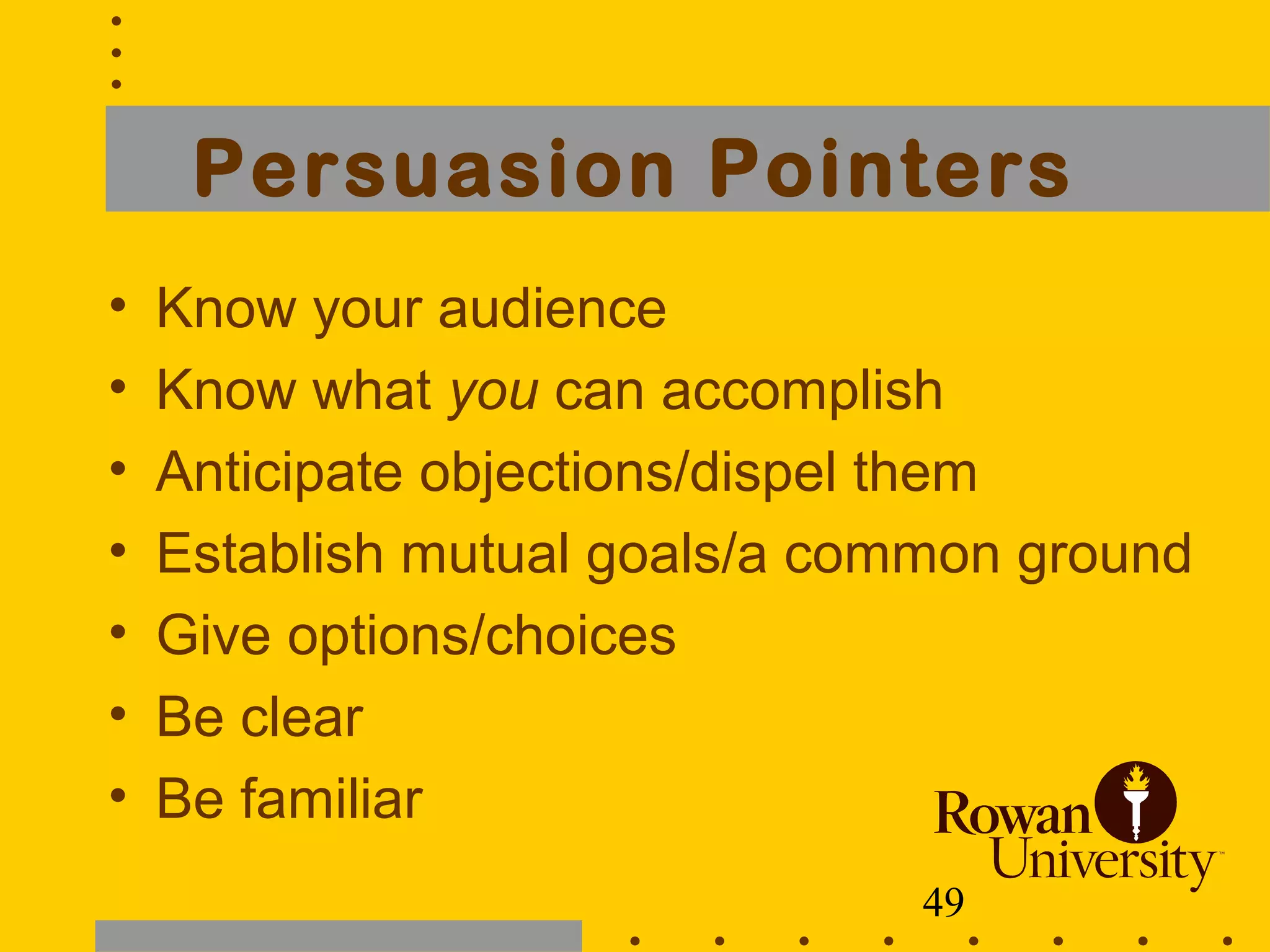
Persuasion Pointers
• Know your audience
• Know what you can accomplish
• Anticipate objections/dispel them
• Establish mutual goals/a common ground
• Give options/choices
• Be clear
• Be familiar
50
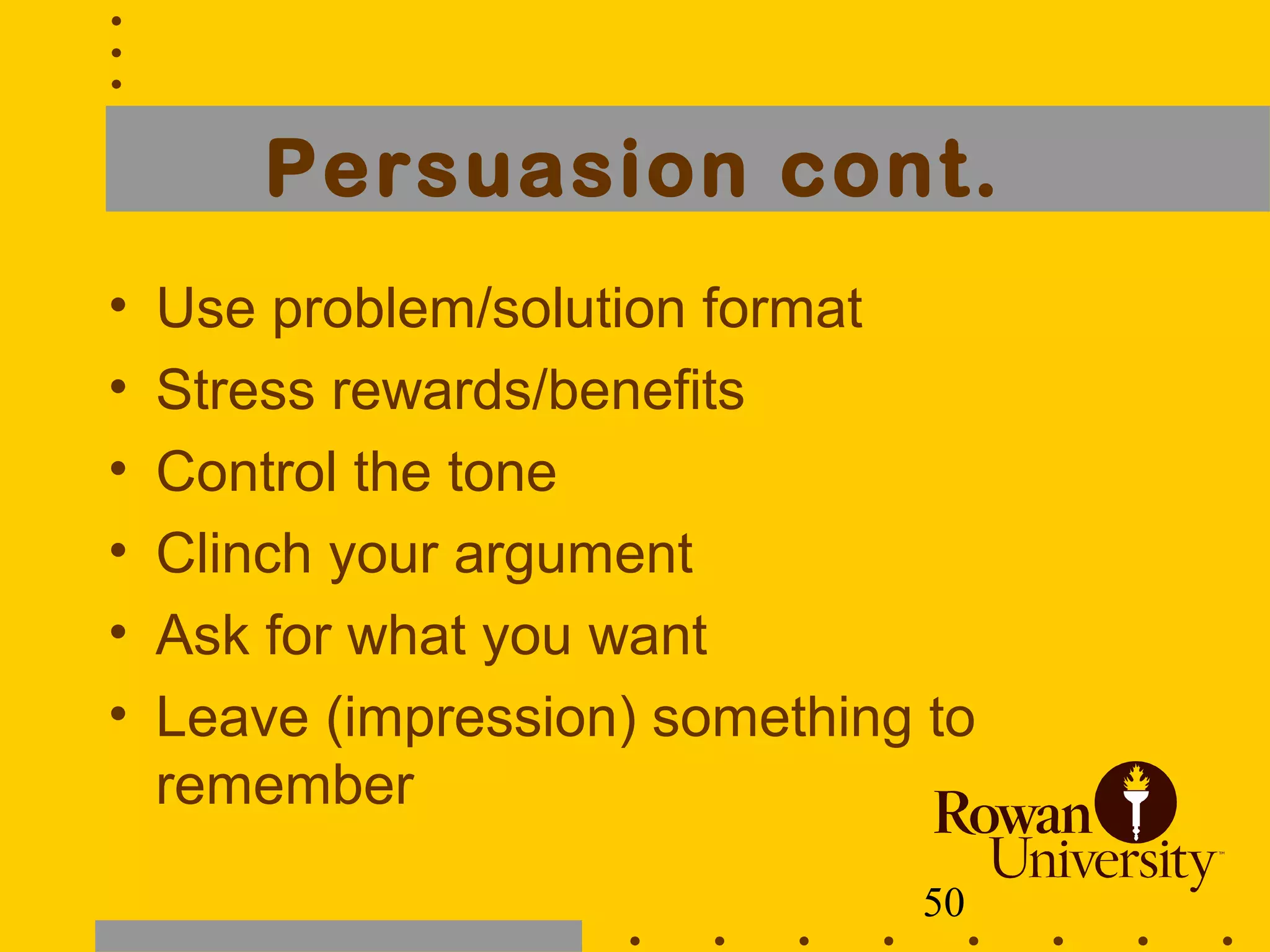
Persuasion cont.
• Use problem/solution format
• Stress rewards/benefits
• Control the tone
• Clinch your argument
• Ask for what you want
• Leave (impression) something to
remember
51
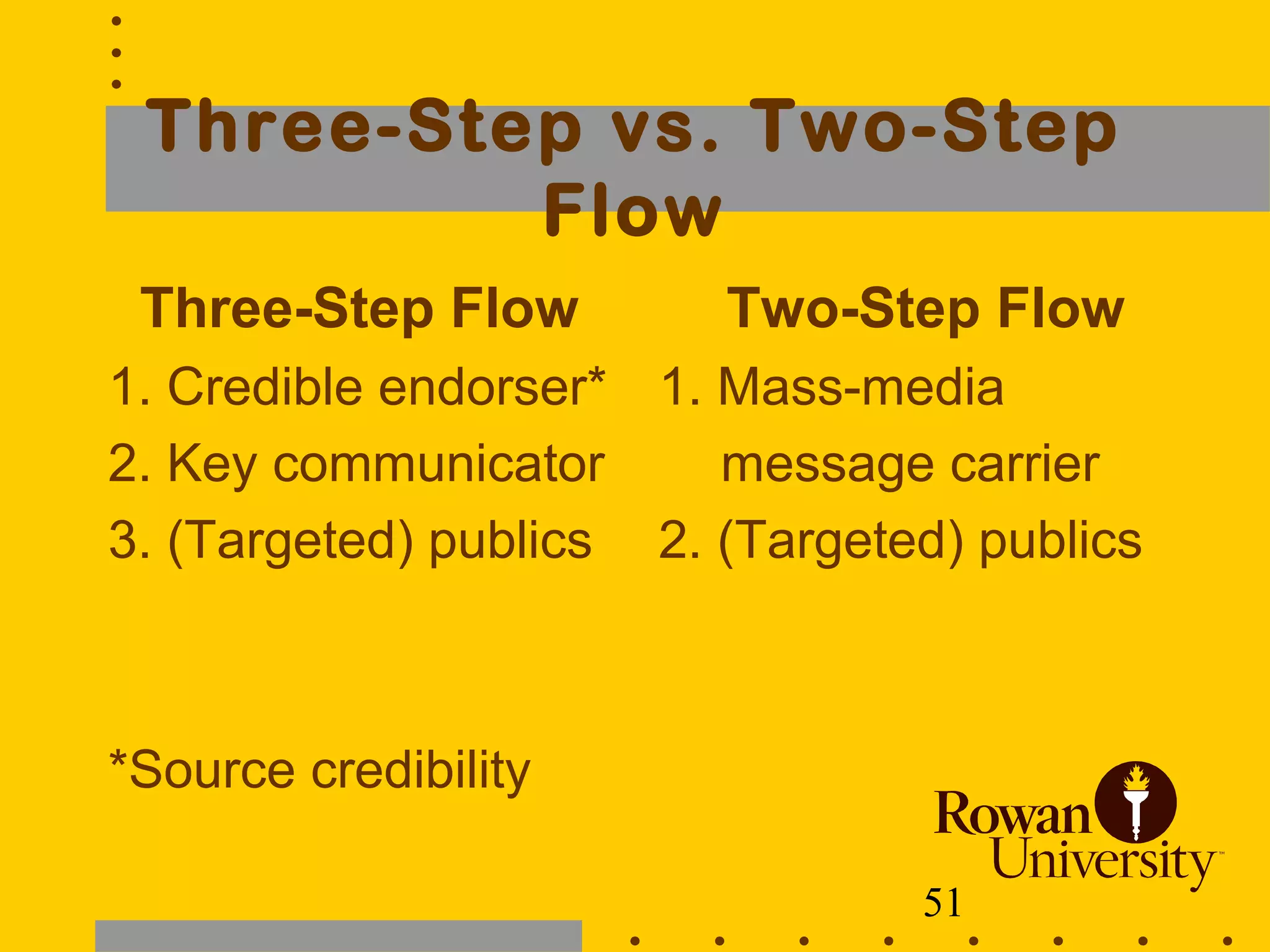
Three-Step vs. Two-Step
Flow
Three-Step Flow
1. Credible endorser*
2. Key communicator
3. (Targeted) publics
*Source credibility
Two-Step Flow
1. Mass-media
message carrier
2. (Targeted) publics
52
Three-Step vs. Two-Step
vs. One-Step Flow
One-Step Flow – One-to-One
1. From organization directly to
(Targeted) publics
53
Third Party Endorser
• Endorsement
• Testimonial
[Know the difference]
54
Questions ???
M. Larry Litwin, APR, Fellow PRSA
larry@larrylitwin.com
www.larrylitwin.com
© 2009

Holtzman Public relatio class 110110

  • 1.
    1 Anatomy of Public Relations from ThePublic Relations Practitioner’s Playbook M. Larry Litwin, APR, Fellow PRSA © 2010
  • 2.
    2 Or… Why We DoWhat We Do And How To Do It Better!
  • 3.
  • 4.
  • 5.
    5 PR Is... • “Thisis who we are; • What we think about ourselves; • What we want to do; and • Why we deserve your support.”
  • 6.
  • 7.
    7 You Talk –We Listen Hearing vs. Listening There is a reason why we have two ears and one mouth – we must listen twice as much as we speak.
  • 8.
    8 Public Communication • Publiccommunication is at the heart of our economy, society and politics. Studios use it to promote their films. Politicians use it to get elected. Businesses use it to burnish their image. Advocates use it to promote social causes. • It is a field built on ideas and images, persuasion and information, strategy and tactics. No policy or product can succeed without a smart (strategic) message targeted to the right audience in creative and innovative ways at the ideal time using the proper channel. The ability to communicate this way – to communicate strategically – is what Public Communication is all about.
  • 9.
    9 M AC Triad M +P+T AC M=Message A=Audience C=Channel P=Purpose T=Tim ing
  • 10.
    10 MAC Triad Pluscont. • Informization – Disseminating information (message) to target audience through the proper channel at the best possible time.
  • 11.
  • 12.
  • 13.
    13 Public Relations… A toolof leadership! [more later…]
  • 14.
    14 Public Relations 101 •Management and counseling function • Enables organizations to build and maintain relationships • Through an understanding of audience attitudes, opinions and values • Planned, deliberate and two-way • Conscience of organization • Overseer of brand/reputation • Relationship management
  • 15.
    15 Public Relations A managementfunction that helps organizations and their publics mutually adapt to one another.
  • 16.
    16 Advertising 101 • Paid •(Non)-personal communication • From identified sponsor • Using (mass) media • To persuade or influence • Audience (Paid – Controlled)
  • 17.
    17 Marketing 101 Determine whatpeople need (and want) and give it to them.
  • 18.
  • 19.
    19 Edward Bernays’ Public Relations Functions •To interpret the client to the public, which means promoting the client • To interpret the public to the client, which means operating the company in such a way as to gain the approval of the public • To act as a public service • To promote new ideas and progress • To build a public conscience Crystallizing Public Opinion – 1923
  • 20.
    20 Ivy Ledbetter Lee’s PublicRelations Principles 1. Tell the truth 2. Provide accurate facts 3. Give the public relations director access to top management so that he/she can influence decisions
  • 21.
    21 PR Counselors must possess… •Loyalty • Judgment • Trust • Ethics • Integrity
  • 22.
    22 Managing Public Opinion Public relationspractitioners… – Assess public opinion – Influence public opinion It is our responsibility to MANAGE public opinion!
  • 23.
    23 ABCs of Strategic Communication •Anticipate • Be Prepared • Communicate Clearly, Concisely, Consistently, Calculatingly, Completely (Specifically and Simply) Open, Honest, Thorough, Valid
  • 24.
    24 Double Bottom Line •First Bottom Line –Build Relationships • Second Bottom Line –Profit – or, accomplish your Goal
  • 25.
    25 Triple Bottom Line •Pat Jackson’s DBL – plus: • Third Bottom Line –Revenue>Controlled Costs=Profit
  • 26.
    26 Fraser Seitel’s “Real”Bottom Line of PR • “Our fundamental role in PR is to defend and promote and enhance and sustain the reputation of our organizations.” • “Our job in PR is to help ensure that that objective is achieved…through proper performance – effectively communicated.”
  • 27.
    27 How are BottomLines Achieved? ? ? ?
  • 28.
    28 Reaching the Desired Outcome •Attitude • Opinion Education > Knowledge > Attitude > Behavioral Change > Output = Desired Outcome
  • 29.
  • 30.
    30 PR-Pie • Purpose • Research •Planning • Implementation • Evaluation
  • 31.
    31 Two-Way Communication Model Sender>>>Message>>>Receiver ^ V ^Noise V ^ Noise V ^ Noise V ^ V ^ <<<<<<<<Feedback<<<<<<< V
  • 32.
    32 Communication • …is sharedcomprehension (two way) • Four Essential Elements/Communication Model – Initiator (Sender/Encoder) – Carrier (Message) – Receiver (Decoder) – Feedback (Is clarity being achieved?) [If the message is not being received as intended, it is your fault. Leaders whose messages are not changing behavior are not true leaders.]
  • 33.
    33 Principles of Authentic Communication*• Truth •Fundamentality • Comprehensiveness • Relevance • Clarity • Timeliness • Consistency • Accessibility • Responsiveness to feedback • Care
  • 34.
    34 PR Plan/Roadmap • Goal •Objectives • Strategies • Tactics • Tools
  • 35.
    35 Superior tactics cannot overcomea bad (business) strategy.
  • 36.
    36 No Planning =No Plan = No Hope
  • 37.
    37 Synergy The whole isgreater than the sum of its parts or The whole works better than any one of its parts. [To achieve our goal, we should achieve synergy.]
  • 38.
    38 Synergy’s Parts • Advertising •(Sales) Promotion* • Public Relations* • Direct Marketing • Cause Marketing • Sponsorship (Partnering) Marketing • Positioning (Place)* • Personal Selling* • Price* • Product itself* • Packaging* • Policy* • Politics* • Mind Share (Brainstorming – Intellectual Property) • Brand Identity • Interactive * Litwin’s 9 P’s of Marketing
  • 39.
  • 40.
    40 Litwin’s 9 P’sof Marketing = Synergy • Product • Place (Positioning) • Price • Promotion (Sales) • Public Relations • Personal selling • Policy • Politics • Packaging
  • 41.
    41 7 C’s ofCommunication • Credibility • Context • Content • Clarity • Continuity and Consistency • Channels • Capability
  • 42.
    42 Content is crucial… butthe medium is part of the message, too! (Marshal McLuhan)
  • 43.
  • 44.
    44 Audiences (ISPR) • Identify •Segment/Fragment • Demographically • Psychographically • Geodemographically • Behavioristically • Benefits • Profile • Rank – Audience Power Structure • Elite (Key Communicators) • Pluralistic or Diffused • Amorphous/Latent
  • 45.
    45 Target vs. Niche Target •Audience you want to reach e.g. High school students Niche • Narrowly defined audience e.g. White, high school girls of divorced parents
  • 46.
    46 Features and Benefits Features •Important characteristics of a product or service. Stress features to active audiences. Benefits • The quality of product or service that supplies satisfaction or need fulfillment to the consumer or audience member. Stress benefits to passive audiences.
  • 47.
    47 WII-FM Features + Benefits= Value Value = Worth
  • 48.
    48 Persuade vs. Convince •Persuade – Change of mind or attitude (for a short time) – When you persuade someone, you get them to act without convincing them • Convince – Change of heart and mind (long term) – When you convince someone, you actually get them to believe something else
  • 49.
    49 Persuasion Pointers • Knowyour audience • Know what you can accomplish • Anticipate objections/dispel them • Establish mutual goals/a common ground • Give options/choices • Be clear • Be familiar
  • 50.
    50 Persuasion cont. • Useproblem/solution format • Stress rewards/benefits • Control the tone • Clinch your argument • Ask for what you want • Leave (impression) something to remember
  • 51.
    51 Three-Step vs. Two-Step Flow Three-StepFlow 1. Credible endorser* 2. Key communicator 3. (Targeted) publics *Source credibility Two-Step Flow 1. Mass-media message carrier 2. (Targeted) publics
  • 52.
    52 Three-Step vs. Two-Step vs.One-Step Flow One-Step Flow – One-to-One 1. From organization directly to (Targeted) publics
  • 53.
    53 Third Party Endorser •Endorsement • Testimonial [Know the difference]
  • 54.
    54 Questions ??? M. LarryLitwin, APR, Fellow PRSA larry@larrylitwin.com www.larrylitwin.com © 2009