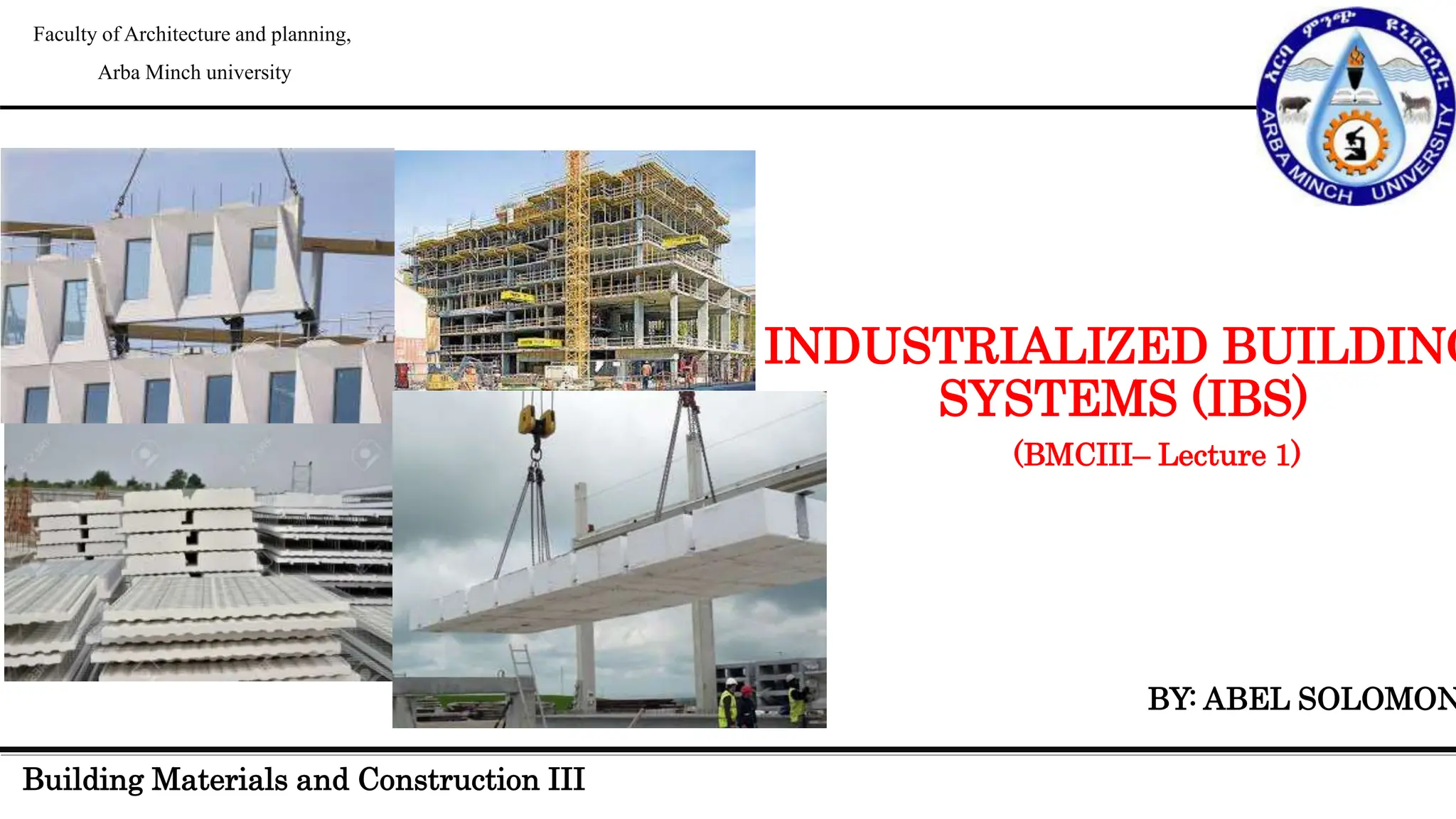
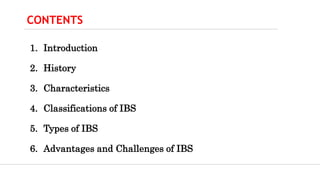
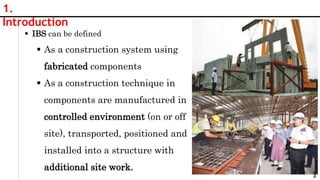
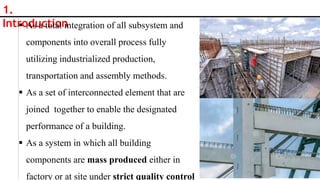
(BMCIII– Lecture 1)
BY: ABEL SOLOMON
Faculty of Architecture and planning,
Arba Minch university
Building Materials and Construction III
INDUSTRIALIZED BUILDING
SYSTEMS (IBS)
CONTENTS
1. Introduction
2. History
3. Characteristics
4. Classifications of IBS
5. Types of IBS
6. Advantages and Challenges of IBS
3
1.
Introduction
 IBS can be defined
 As a construction system using
fabricated components
 As a construction technique in
components are manufactured in
controlled environment (on or off
site), transported, positioned and
installed into a structure with
additional site work.
4
1.
Introduction
 As a total integration of all subsystem and
components into overall process fully
utilizing industrialized production,
transportation and assembly methods.
 As a set of interconnected element that are
joined together to enable the designated
performance of a building.
 As a system in which all building
components are mass produced either in
factory or at site under strict quality control
5
2. History
 Originated as early as the 17th
century
 Panelized timber houses were
shipped from England to north
America in 1624.
 1700s, The Industrial Revolution
Revolution provided the
construction industry with
technological boost.
 In 1851, modular-dimensioned
Crystal Palace in Hyde Park,
London.
 In the 1880s prefabrication started
to flourish
 In 1889, the Eiffel Tower in Paris
 Modern era characterized by high
level of prefabrication and
automation
6
2. History
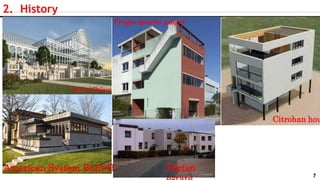
 Joseph Paxton --- Crystal Palace
 Frank Lloyd Wright ---American System Built Homes
 Le Corbusier --- mass production ideas in the Modern Frugés Quarter
Quarter project
--- Citrohan house
 Walter Gropius ---Törten estate (sub-assemblies)
 Konrad Wachsmann --- factory-produced panel and space frame
frame systems
 In 1962 John Habraken --- innovated the open system
7
2. History
Crystal Palace
American System Built Homes
Frugés Quarter project
Citrohan hou
Törten
8
2. Characteristics
of IBS
1. Open System
 Allows greater flexibility and architectural
2. Integration
 High-level of coordination exists between
3. Modular Coordination
 Allows easy adoption of prefabricated building
9
2. Characteristics
of IBS
4. Standardization and Tolerances
 All components must be standardized for modular
coordination to take place
5. Mass Production
 Economy is justified by high amount of production
6. Specialization
 Requires only specialist personnel and systems
10
3. Classification
of IBS
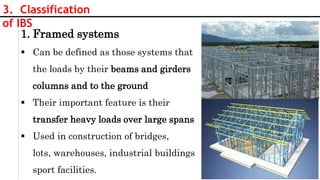
1. Framed systems
 Can be defined as those systems that
the loads by their beams and girders
columns and to the ground
 Their important feature is their
transfer heavy loads over large spans
 Used in construction of bridges,
lots, warehouses, industrial buildings
sport facilities.
11
3. Classification
of IBS
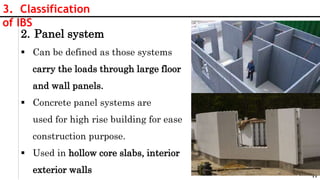
2. Panel system
 Can be defined as those systems
carry the loads through large floor
and wall panels.
 Concrete panel systems are
used for high rise building for ease
construction purpose.
 Used in hollow core slabs, interior
exterior walls
12
3. Classification
of IBS
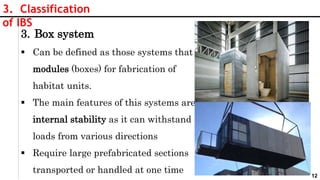
3. Box system
 Can be defined as those systems that
modules (boxes) for fabrication of
habitat units.
 The main features of this systems are
internal stability as it can withstand
loads from various directions
 Require large prefabricated sections
transported or handled at one time
13
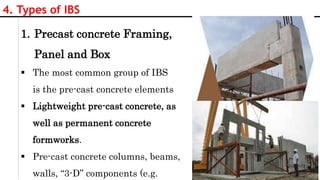
4. Types of IBS
1. Precast concrete Framing,
Panel and Box
 The most common group of IBS
is the pre-cast concrete elements
 Lightweight pre-cast concrete, as
well as permanent concrete
formworks.
 Pre-cast concrete columns, beams,
walls, “3-D” components (e.g.
14
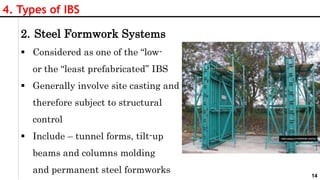
4. Types of IBS
2. Steel Formwork Systems
 Considered as one of the “low-
or the “least prefabricated” IBS
 Generally involve site casting and
therefore subject to structural
control
 Include – tunnel forms, tilt-up
beams and columns molding
and permanent steel formworks
15
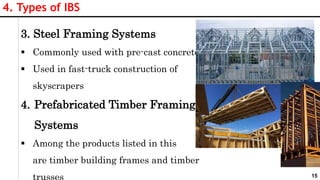
4. Types of IBS
3. Steel Framing Systems
 Commonly used with pre-cast concrete
 Used in fast-truck construction of
skyscrapers
4. Prefabricated Timber Framing
Systems
 Among the products listed in this
are timber building frames and timber
16
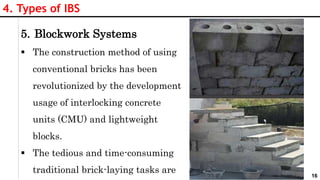
4. Types of IBS
5. Blockwork Systems
 The construction method of using
conventional bricks has been
revolutionized by the development
usage of interlocking concrete
units (CMU) and lightweight
blocks.
 The tedious and time-consuming
traditional brick-laying tasks are
17
5. Advantages and
Challenges of IBS
ADVANTAGES OF IBS
 Reduction of unskilled
workers
 Reduce wastage
 Increase in quality
 Safer working environment in
construction site
18
5. Advantages and
Challenges of IBS
CHALLENGES OF IBS
 High initial investment capital
 Cost a lot of money in terms of
standardization
 Market monopoly
 Infrastructure dependent
 Tedious transportation of building
19
Next: IBS
COMPONENTS

Lecture - 1 (building material c III).pptx

  • 1.
    (BMCIII– Lecture 1) BY:ABEL SOLOMON Faculty of Architecture and planning, Arba Minch university Building Materials and Construction III INDUSTRIALIZED BUILDING SYSTEMS (IBS)
  • 2.
    CONTENTS 1. Introduction 2. History 3.Characteristics 4. Classifications of IBS 5. Types of IBS 6. Advantages and Challenges of IBS
  • 3.
    3 1. Introduction  IBS canbe defined  As a construction system using fabricated components  As a construction technique in components are manufactured in controlled environment (on or off site), transported, positioned and installed into a structure with additional site work.
  • 4.
    4 1. Introduction  As atotal integration of all subsystem and components into overall process fully utilizing industrialized production, transportation and assembly methods.  As a set of interconnected element that are joined together to enable the designated performance of a building.  As a system in which all building components are mass produced either in factory or at site under strict quality control
  • 5.
    5 2. History  Originatedas early as the 17th century  Panelized timber houses were shipped from England to north America in 1624.  1700s, The Industrial Revolution Revolution provided the construction industry with technological boost.  In 1851, modular-dimensioned Crystal Palace in Hyde Park, London.  In the 1880s prefabrication started to flourish  In 1889, the Eiffel Tower in Paris  Modern era characterized by high level of prefabrication and automation
  • 6.
    6 2. History  JosephPaxton --- Crystal Palace  Frank Lloyd Wright ---American System Built Homes  Le Corbusier --- mass production ideas in the Modern Frugés Quarter Quarter project --- Citrohan house  Walter Gropius ---Törten estate (sub-assemblies)  Konrad Wachsmann --- factory-produced panel and space frame frame systems  In 1962 John Habraken --- innovated the open system
  • 7.
    7 2. History Crystal Palace AmericanSystem Built Homes Frugés Quarter project Citrohan hou Törten
  • 8.
    8 2. Characteristics of IBS 1.Open System  Allows greater flexibility and architectural 2. Integration  High-level of coordination exists between 3. Modular Coordination  Allows easy adoption of prefabricated building
  • 9.
    9 2. Characteristics of IBS 4.Standardization and Tolerances  All components must be standardized for modular coordination to take place 5. Mass Production  Economy is justified by high amount of production 6. Specialization  Requires only specialist personnel and systems
  • 10.
    10 3. Classification of IBS 1.Framed systems  Can be defined as those systems that the loads by their beams and girders columns and to the ground  Their important feature is their transfer heavy loads over large spans  Used in construction of bridges, lots, warehouses, industrial buildings sport facilities.
  • 11.
    11 3. Classification of IBS 2.Panel system  Can be defined as those systems carry the loads through large floor and wall panels.  Concrete panel systems are used for high rise building for ease construction purpose.  Used in hollow core slabs, interior exterior walls
  • 12.
    12 3. Classification of IBS 3.Box system  Can be defined as those systems that modules (boxes) for fabrication of habitat units.  The main features of this systems are internal stability as it can withstand loads from various directions  Require large prefabricated sections transported or handled at one time
  • 13.
    13 4. Types ofIBS 1. Precast concrete Framing, Panel and Box  The most common group of IBS is the pre-cast concrete elements  Lightweight pre-cast concrete, as well as permanent concrete formworks.  Pre-cast concrete columns, beams, walls, “3-D” components (e.g.
  • 14.
    14 4. Types ofIBS 2. Steel Formwork Systems  Considered as one of the “low- or the “least prefabricated” IBS  Generally involve site casting and therefore subject to structural control  Include – tunnel forms, tilt-up beams and columns molding and permanent steel formworks
  • 15.
    15 4. Types ofIBS 3. Steel Framing Systems  Commonly used with pre-cast concrete  Used in fast-truck construction of skyscrapers 4. Prefabricated Timber Framing Systems  Among the products listed in this are timber building frames and timber
  • 16.
    16 4. Types ofIBS 5. Blockwork Systems  The construction method of using conventional bricks has been revolutionized by the development usage of interlocking concrete units (CMU) and lightweight blocks.  The tedious and time-consuming traditional brick-laying tasks are
  • 17.
    17 5. Advantages and Challengesof IBS ADVANTAGES OF IBS  Reduction of unskilled workers  Reduce wastage  Increase in quality  Safer working environment in construction site
  • 18.
    18 5. Advantages and Challengesof IBS CHALLENGES OF IBS  High initial investment capital  Cost a lot of money in terms of standardization  Market monopoly  Infrastructure dependent  Tedious transportation of building
  • 19.

Editor's Notes

  • #18 Reduces the dependency on semi-skilled labor for construction purposes (40%- 50%). Wastage is reduced in construction projects due to modularized characteristics of IBS Quality of construction is secured due to strict quality control during production. IBS provide better safety in construction sites and are less harmful for the environment Construction period can be shortened using IBS; therefore indirect costs of construction can be minimized
  • #19 for the purchase of machineries, steel mold, technology, transportation and the wages of skilled workers