Building Industrialization and
Maintenance
(CENG 6109)
Denamo Addissie
April 19/2019
Transportation
and erection
Prefabricated and pre-
stressed concrete
Basics of building
prefabrication
Overview
Introduction to the
course
April 19/2019 CENG 6109 2
• Full name
• Academic background
• Professional background
• Expectations from this course
• Future plans/vision
April 19/2019 CENG 6109 3
April 19/2019 CENG 6109 4
CHAPTER ONE:
PREFABRICATION OF BUILDING
COMPONENTS
Prefabricated construction/ The Industrialised Building
System (IBS) :
• the practice of assembling a variety of components of a
structure at a manufacturing site and transporting those
sub-assemblies to the location of the construction job site.
• a mass production of building components either in a
factory or at the site according to the specification with
standard shape and dimensions, and transport to the
construction site to be re-arranged according to a certain
standard to form a building (Chung and Kadir, 2007)
• is a construction process that utilises techniques, products,
components, or building systems which involve
prefabricated components and on-site installation (CIBD,
2003)
April 19/2019 CENG 6109 5
April 19/2019 CENG 6109 6
Why Prefabricated construction/ Industrialised Building
System (IBS) ?
• compared to other sectors the construction industry suffers
from low productivity, safety and quality control
• due to the traditional labor-intensive practices, the 3- D
Syndrome (Dirty, Difficult & Dangerous) has always been
associated with the construction industry
• it is a good solution for these kind of problems of the
construction industry- messy sites, high wastages, labor
intensive works, low quality work, delays.
April 19/2019 CENG 6109 7
Why modern construction technology?
April 19/2019 CENG 6109 8
• “…there is more to the construction process than
just management…there is more to the
construction process than just structural design or
geotechnical evaluation…we need to create
better methods for construction…” Robert Harris
• Technology innovation can result in revolution
advancement in construction practice that
traditional management techniques and other
skills are not be able to achieve.
Why modern construction
technology?
April 19/2019 CENG 6109 9
• The construction industry is repeatedly
criticized for being inefficient and slow to
innovate. The basic methods of construction,
techniques and technologies have changed
little since Roman times.
Why modern construction
technology?
April 19/2019 CENG 6109 10
• The term 'advanced/modern construction
technology' covers a wide range of modern
techniques and practices that encompass
the latest developments in materials
technology, design procedures, quantity
surveying, facilities management,
services, structural analysis and design,
and management studies.
Why modern construction
technology?
April 19/2019 CENG 6109 11
• Incorporating advanced construction
technology into practice can increase levels
of quality, efficiency, safety, sustainability
and value for money. However, there is
often a conflict between traditional industry
methods and innovative new practices, and
this is often blamed for the relatively slow
rate of technology transfer within the
industry.
Why modern construction
technology?
April 19/2019 CENG 6109 12
• The adoption of advanced construction
technology requires an appropriate design,
commitment from the whole project team,
suitable procurement strategies, good
quality control, appropriate training and
careful commissioning.
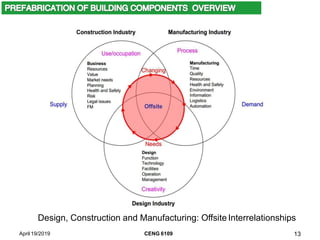
Design, Construction and Manufacturing: OffsiteInterrelationships
April 19/2019 CENG 6109 13
April 19/2019 CENG 6109 14
April 19/2019 CENG 6109 15
Prefabricated construction in Ethiopia
Patriarch Palace, A.A. CMC Apartment, A.A.
April 19/2019 CENG 6109 16
Prefabricated construction in Ethiopia
Mina Building,A.A. Water and Sewerage Authority, A.A.
April 19/2019 CENG 6109 17
Prefabricated and pre-stressed concrete to be
dealt with in Concrete Construction course
April 19/2019 CENG 6109 18
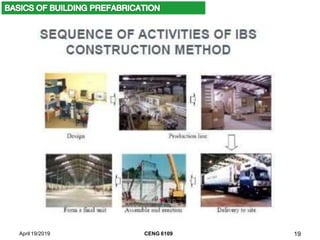
April 19/2019 CENG 6109 19
Characteristics of IBS/prefabricated construction:
• Industrial production of components through
prefabrication, “OR” sometimes highly mechanized in-situ
processes i.e. permanent steel formworks, tunnel forms …
• Reduced labor during prefabrication of components and
site works.
• Modern design and manufacturing methods involving
• ICT usage - Computer Aided design (CAD) and Computer
Aided Manufacturing (CAM)
• Systematic Quality Control i.e ISO 9000 principles
• Open Building Concept- permitting hybrid applications,
and adaptable to standardization and MC (Modular
Coordination)
April 19/2019 CENG 6109 20
Characteristics of IBS/prefabricated construction:
• Industrial production of components through
prefabrication, “OR” sometimes highly mechanized in-situ
processes i.e. permanent steel formworks, tunnel forms …
• Reduced labor during prefabrication of components and
site works.
• Modern design and manufacturing methods involving
• ICT usage - Computer Aided design (CAD) and Computer
Aided Manufacturing (CAM)
• Systematic Quality Control i.e ISO 9000 principles
• Open Building Concept- permitting hybrid applications,
and adaptable to standardization and MC (Modular
Coordination)
April 19/2019 CENG 6109 21
Benefits of prefabricated construction:
• Eco-friendly: energy efficiency, sustainable, less waste,
waste recycled in-house, more accurate construction,
tighter joints and better air filtration, better wall insulaton
• Financial savings: mass production
• Flexibility: can be easily disassembled and relocated,
minimizes expended time, decreases overall time, limitless
design options, neutral aesthetics
• Consistent quality: occurs in a controlled environment,
follows specified standards, uniform quality, built by an
experience crew, multiple quality checks, use of precise
equipment
April 19/2019 CENG 6109 22
Benefits of prefabricated construction … :
• Reduced site disruption:
• Shorter construction time:
• Safety
• Reduction of site labor
• Less site material
• Cleaner environment
April 19/2019 CENG 6109 23
Disadvantages of prefabricated construction:
• Handling and transportation may cause breakages of
members during the transit and extra provision is to be
made.
• Difficulty in connecting precast units so as to produce same
effect as monolithic. This leads to non-monolithic
construction.
• They are to be exactly placed in position, otherwise the
loads coming on them are likely to get changed and the
member may be affected
April 19/2019 CENG 6109 24
Disadvantages of prefabricated construction … :
• High transport cost
• Need of erection equipment
• Skilled labour and supervision is required.
April 19/2019 CENG 6109 25
Classification of IBS/prefabricated construction – Based on
materials used:
• Prefabricated Timber Constructions
April 19/2019 CENG 6109 26
Classification of IBS/prefabricated construction – Based on
materials used:
• Prefabricated Steel Construction
April 19/2019 CENG 6109 27
Classification of IBS/prefabricated construction – Based on
materials used:
• Prefabricated Concrete Construction
April 19/2019 CENG 6109 28
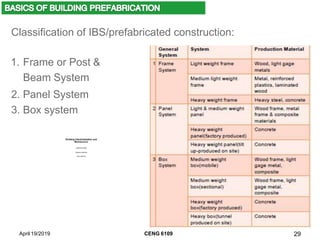
Classification of IBS/prefabricated construction:
1. Frame or Post &
Beam System
2. Panel System
3. Box system
April 19/2019 CENG 6109 29
Classification of IBS/prefabricated construction:
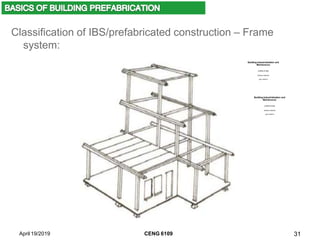
• Frame structures may be defined as those structures that
carry the loads through their beams and girders to column
and to the ground.
• Their important feature is the capacity to transfer heavy
loads over large spans.
• Used in the construction of bridges, parking lots,
warehouses, industrial buildings, sport facilities and so on.
April 19/2019 CENG 6109 30
Classification of IBS/prefabricated construction – Frame
system:
April 19/2019 CENG 6109 31
Classification of IBS/prefabricated construction – Panel
system:
• Panel system may be defined as those structures that carry
the load through large floor and wall panels.
• Concrete panel systems are extensively used in Europe for
high rise building for ease of construction purpose.
• Used in Hollow core slabs, Interior & Exterior Wall.
April 19/2019 CENG 6109 32
Classification of IBS/prefabricated construction – Panel
system:
April 19/2019 CENG 6109 33
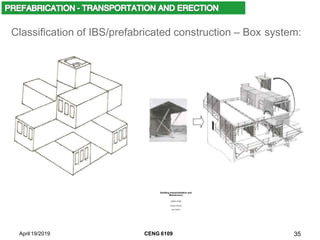
Classification of IBS/prefabricated construction – Box system:
• Box system may be defined as those systems that use 3D
modules (or boxes) for fabrication of habitat units.
• The main features of this system are in the internal stability
as it can withstand load from various directions.
• Require only large prefabricated sections to be transported
or handled at one time.
April 19/2019 CENG 6109 34
Classification of IBS/prefabricated construction – Box system:
April 19/2019 CENG 6109 35
Foundation work:
April 19/2019 CENG 6109 36
Column erection
April 19/2019 CENG 6109 37
Erection of slab elements
April 19/2019 CENG 6109 38
Pre-stressing
April 19/2019 CENG 6109 39
Column-column connection
April 19/2019 CENG 6109 40
Beam-column connection
April 19/2019 CENG 6109 41
Slab-beam connection
April 19/2019 CENG 6109 42
Barriers of IBS/prefabricated construction:
• Poor skill and knowledge, cost and financial issues, lack of
awareness and negative perception (IBS Steering
Committee, 2006; Thanoon et al., 2003 and Haron et al.,
2005).
• Lack of communication and integration among
professionals or disciplines during the design stage (Kamar
et al, 2009; Hamid et al, 2008; CIMP, 2007).
April 19/2019 CENG 6109 43
Thank you!

Chapter 01_2019_04_19.pptx

  • 1.
    Building Industrialization and Maintenance (CENG6109) Denamo Addissie April 19/2019
  • 2.
    Transportation and erection Prefabricated andpre- stressed concrete Basics of building prefabrication Overview Introduction to the course April 19/2019 CENG 6109 2
  • 3.
    • Full name •Academic background • Professional background • Expectations from this course • Future plans/vision April 19/2019 CENG 6109 3
  • 4.
    April 19/2019 CENG6109 4 CHAPTER ONE: PREFABRICATION OF BUILDING COMPONENTS
  • 5.
    Prefabricated construction/ TheIndustrialised Building System (IBS) : • the practice of assembling a variety of components of a structure at a manufacturing site and transporting those sub-assemblies to the location of the construction job site. • a mass production of building components either in a factory or at the site according to the specification with standard shape and dimensions, and transport to the construction site to be re-arranged according to a certain standard to form a building (Chung and Kadir, 2007) • is a construction process that utilises techniques, products, components, or building systems which involve prefabricated components and on-site installation (CIBD, 2003) April 19/2019 CENG 6109 5
  • 6.
  • 7.
    Why Prefabricated construction/Industrialised Building System (IBS) ? • compared to other sectors the construction industry suffers from low productivity, safety and quality control • due to the traditional labor-intensive practices, the 3- D Syndrome (Dirty, Difficult & Dangerous) has always been associated with the construction industry • it is a good solution for these kind of problems of the construction industry- messy sites, high wastages, labor intensive works, low quality work, delays. April 19/2019 CENG 6109 7
  • 8.
    Why modern constructiontechnology? April 19/2019 CENG 6109 8 • “…there is more to the construction process than just management…there is more to the construction process than just structural design or geotechnical evaluation…we need to create better methods for construction…” Robert Harris • Technology innovation can result in revolution advancement in construction practice that traditional management techniques and other skills are not be able to achieve.
  • 9.
    Why modern construction technology? April19/2019 CENG 6109 9 • The construction industry is repeatedly criticized for being inefficient and slow to innovate. The basic methods of construction, techniques and technologies have changed little since Roman times.
  • 10.
    Why modern construction technology? April19/2019 CENG 6109 10 • The term 'advanced/modern construction technology' covers a wide range of modern techniques and practices that encompass the latest developments in materials technology, design procedures, quantity surveying, facilities management, services, structural analysis and design, and management studies.
  • 11.
    Why modern construction technology? April19/2019 CENG 6109 11 • Incorporating advanced construction technology into practice can increase levels of quality, efficiency, safety, sustainability and value for money. However, there is often a conflict between traditional industry methods and innovative new practices, and this is often blamed for the relatively slow rate of technology transfer within the industry.
  • 12.
    Why modern construction technology? April19/2019 CENG 6109 12 • The adoption of advanced construction technology requires an appropriate design, commitment from the whole project team, suitable procurement strategies, good quality control, appropriate training and careful commissioning.
  • 13.
    Design, Construction andManufacturing: OffsiteInterrelationships April 19/2019 CENG 6109 13
  • 14.
  • 15.
  • 16.
    Prefabricated construction inEthiopia Patriarch Palace, A.A. CMC Apartment, A.A. April 19/2019 CENG 6109 16
  • 17.
    Prefabricated construction inEthiopia Mina Building,A.A. Water and Sewerage Authority, A.A. April 19/2019 CENG 6109 17
  • 18.
    Prefabricated and pre-stressedconcrete to be dealt with in Concrete Construction course April 19/2019 CENG 6109 18
  • 19.
  • 20.
    Characteristics of IBS/prefabricatedconstruction: • Industrial production of components through prefabrication, “OR” sometimes highly mechanized in-situ processes i.e. permanent steel formworks, tunnel forms … • Reduced labor during prefabrication of components and site works. • Modern design and manufacturing methods involving • ICT usage - Computer Aided design (CAD) and Computer Aided Manufacturing (CAM) • Systematic Quality Control i.e ISO 9000 principles • Open Building Concept- permitting hybrid applications, and adaptable to standardization and MC (Modular Coordination) April 19/2019 CENG 6109 20
  • 21.
    Characteristics of IBS/prefabricatedconstruction: • Industrial production of components through prefabrication, “OR” sometimes highly mechanized in-situ processes i.e. permanent steel formworks, tunnel forms … • Reduced labor during prefabrication of components and site works. • Modern design and manufacturing methods involving • ICT usage - Computer Aided design (CAD) and Computer Aided Manufacturing (CAM) • Systematic Quality Control i.e ISO 9000 principles • Open Building Concept- permitting hybrid applications, and adaptable to standardization and MC (Modular Coordination) April 19/2019 CENG 6109 21
  • 22.
    Benefits of prefabricatedconstruction: • Eco-friendly: energy efficiency, sustainable, less waste, waste recycled in-house, more accurate construction, tighter joints and better air filtration, better wall insulaton • Financial savings: mass production • Flexibility: can be easily disassembled and relocated, minimizes expended time, decreases overall time, limitless design options, neutral aesthetics • Consistent quality: occurs in a controlled environment, follows specified standards, uniform quality, built by an experience crew, multiple quality checks, use of precise equipment April 19/2019 CENG 6109 22
  • 23.
    Benefits of prefabricatedconstruction … : • Reduced site disruption: • Shorter construction time: • Safety • Reduction of site labor • Less site material • Cleaner environment April 19/2019 CENG 6109 23
  • 24.
    Disadvantages of prefabricatedconstruction: • Handling and transportation may cause breakages of members during the transit and extra provision is to be made. • Difficulty in connecting precast units so as to produce same effect as monolithic. This leads to non-monolithic construction. • They are to be exactly placed in position, otherwise the loads coming on them are likely to get changed and the member may be affected April 19/2019 CENG 6109 24
  • 25.
    Disadvantages of prefabricatedconstruction … : • High transport cost • Need of erection equipment • Skilled labour and supervision is required. April 19/2019 CENG 6109 25
  • 26.
    Classification of IBS/prefabricatedconstruction – Based on materials used: • Prefabricated Timber Constructions April 19/2019 CENG 6109 26
  • 27.
    Classification of IBS/prefabricatedconstruction – Based on materials used: • Prefabricated Steel Construction April 19/2019 CENG 6109 27
  • 28.
    Classification of IBS/prefabricatedconstruction – Based on materials used: • Prefabricated Concrete Construction April 19/2019 CENG 6109 28
  • 29.
    Classification of IBS/prefabricatedconstruction: 1. Frame or Post & Beam System 2. Panel System 3. Box system April 19/2019 CENG 6109 29
  • 30.
    Classification of IBS/prefabricatedconstruction: • Frame structures may be defined as those structures that carry the loads through their beams and girders to column and to the ground. • Their important feature is the capacity to transfer heavy loads over large spans. • Used in the construction of bridges, parking lots, warehouses, industrial buildings, sport facilities and so on. April 19/2019 CENG 6109 30
  • 31.
    Classification of IBS/prefabricatedconstruction – Frame system: April 19/2019 CENG 6109 31
  • 32.
    Classification of IBS/prefabricatedconstruction – Panel system: • Panel system may be defined as those structures that carry the load through large floor and wall panels. • Concrete panel systems are extensively used in Europe for high rise building for ease of construction purpose. • Used in Hollow core slabs, Interior & Exterior Wall. April 19/2019 CENG 6109 32
  • 33.
    Classification of IBS/prefabricatedconstruction – Panel system: April 19/2019 CENG 6109 33
  • 34.
    Classification of IBS/prefabricatedconstruction – Box system: • Box system may be defined as those systems that use 3D modules (or boxes) for fabrication of habitat units. • The main features of this system are in the internal stability as it can withstand load from various directions. • Require only large prefabricated sections to be transported or handled at one time. April 19/2019 CENG 6109 34
  • 35.
    Classification of IBS/prefabricatedconstruction – Box system: April 19/2019 CENG 6109 35
  • 36.
  • 37.
  • 38.
    Erection of slabelements April 19/2019 CENG 6109 38
  • 39.
  • 40.
  • 41.
  • 42.
  • 43.
    Barriers of IBS/prefabricatedconstruction: • Poor skill and knowledge, cost and financial issues, lack of awareness and negative perception (IBS Steering Committee, 2006; Thanoon et al., 2003 and Haron et al., 2005). • Lack of communication and integration among professionals or disciplines during the design stage (Kamar et al, 2009; Hamid et al, 2008; CIMP, 2007). April 19/2019 CENG 6109 43
  • 44.