THE ORIGIN
OF OUR
REPUBLIC
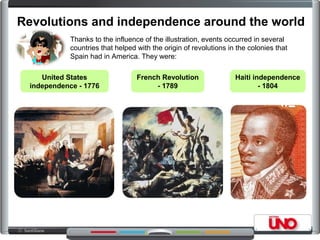
Revolutions and independence around the world
Thanks to the influence of the illustration, events occurred in several
countries that helped with the origin of revolutions in the colonies that
Spain had in America. They were:
United States
independence - 1776
French Revolution
- 1789
Haiti independence
- 1804
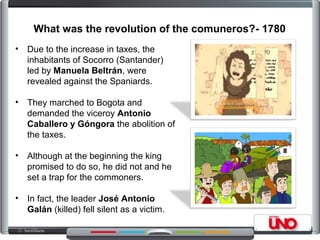
What was the revolution of the comuneros?- 1780
• Due to the increase in taxes, the
inhabitants of Socorro (Santander)
led by Manuela Beltrán, were
revealed against the Spaniards.
• They marched to Bogota and
demanded the viceroy Antonio
Caballero y Góngora the abolition of
the taxes.
• Although at the beginning the king
promised to do so, he did not and he
set a trap for the commoners.
• In fact, the leader José Antonio
Galán (killed) fell silent as a victim.
The ideas in the Viceroyalty of New Granada
During the eighteenth century, education was very important for society. The Bourbons,
through their reforms, supported education, culture, scientific expeditions and the
creation of libraries and educational centers. Some of the most important events in the
field of ideas were:
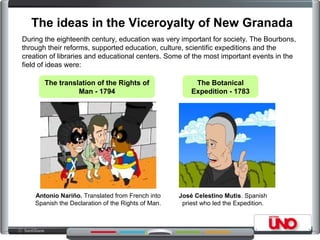
The translation of the Rights of
Man - 1794
The Botanical
Expedition - 1783
José Celestino Mutis. Spanish
priest who led the Expedition.
Antonio Nariño. Translated from French into
Spanish the Declaration of the Rights of Man.
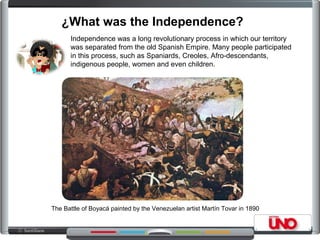
¿What was the Independence?
Independence was a long revolutionary process in which our territory
was separated from the old Spanish Empire. Many people participated
in this process, such as Spaniards, Creoles, Afro-descendants,
indigenous people, women and even children.
The Battle of Boyacá painted by the Venezuelan artist Martín Tovar in 1890
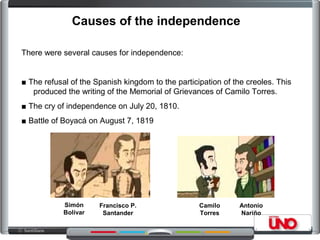
There were several causes for independence:
■ The refusal of the Spanish kingdom to the participation of the creoles. This
produced the writing of the Memorial of Grievances of Camilo Torres.
■ The cry of independence on July 20, 1810.
■ Battle of Boyacá on August 7, 1819
Simón
Bolívar
Francisco P.
Santander
Camilo
Torres
Antonio
Nariño
Causes of the independence
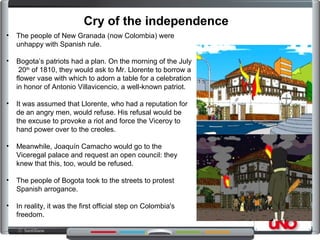
• The people of New Granada (now Colombia) were
unhappy with Spanish rule.
• Bogota’s patriots had a plan. On the morning of the July
20th
of 1810, they would ask to Mr. Llorente to borrow a
flower vase with which to adorn a table for a celebration
in honor of Antonio Villavicencio, a well-known patriot.
• It was assumed that Llorente, who had a reputation for
de an angry men, would refuse. His refusal would be
the excuse to provoke a riot and force the Viceroy to
hand power over to the creoles.
• Meanwhile, Joaquín Camacho would go to the
Viceregal palace and request an open council: they
knew that this, too, would be refused.
• The people of Bogota took to the streets to protest
Spanish arrogance.
• In reality, it was the first official step on Colombia's
freedom.
Cry of the independence
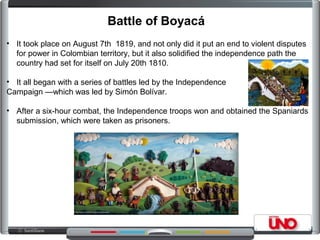
• It took place on August 7th 1819, and not only did it put an end to violent disputes
for power in Colombian territory, but it also solidified the independence path the
country had set for itself on July 20th 1810.
• It all began with a series of battles led by the Independence
Campaign —which was led by Simón Bolívar.
• After a six-hour combat, the Independence troops won and obtained the Spaniards
submission, which were taken as prisoners.
Battle of Boyacá
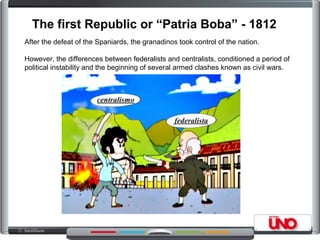
The first Republic or “Patria Boba” - 1812
After the defeat of the Spaniards, the granadinos took control of the nation.
However, the differences between federalists and centralists, conditioned a period of
political instability and the beginning of several armed clashes known as civil wars.
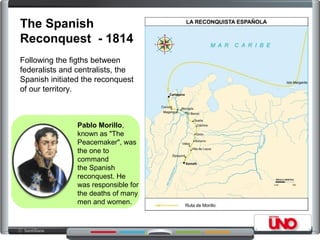
The Spanish
Reconquest - 1814
Following the figths between
federalists and centralists, the
Spanish initiated the reconquest
of our territory.
Pablo Morillo,
known as "The
Peacemaker", was
the one to
command
the Spanish
reconquest. He
was responsible for
the deaths of many
men and women.
Activity
Present the possible effects of historical continuity of the independence
through a TV news. Make groups of 3 students
•Revolutions and independence around the world
•Revolution of the comuneros
•Ideas in the Viceroyalty of New Granada
•The cry of independence on July 20, 1810
•The first Republic or “Patria Boba”
•The Spanish Reconquest
•Battle of Boyacá on August 7, 1819

4.2.4 independence

  • 1.
  • 2.
    Revolutions and independencearound the world Thanks to the influence of the illustration, events occurred in several countries that helped with the origin of revolutions in the colonies that Spain had in America. They were: United States independence - 1776 French Revolution - 1789 Haiti independence - 1804
  • 3.
    What was therevolution of the comuneros?- 1780 • Due to the increase in taxes, the inhabitants of Socorro (Santander) led by Manuela Beltrán, were revealed against the Spaniards. • They marched to Bogota and demanded the viceroy Antonio Caballero y Góngora the abolition of the taxes. • Although at the beginning the king promised to do so, he did not and he set a trap for the commoners. • In fact, the leader José Antonio Galán (killed) fell silent as a victim.
  • 4.
    The ideas inthe Viceroyalty of New Granada During the eighteenth century, education was very important for society. The Bourbons, through their reforms, supported education, culture, scientific expeditions and the creation of libraries and educational centers. Some of the most important events in the field of ideas were: The translation of the Rights of Man - 1794 The Botanical Expedition - 1783 José Celestino Mutis. Spanish priest who led the Expedition. Antonio Nariño. Translated from French into Spanish the Declaration of the Rights of Man.
  • 5.
    ¿What was theIndependence? Independence was a long revolutionary process in which our territory was separated from the old Spanish Empire. Many people participated in this process, such as Spaniards, Creoles, Afro-descendants, indigenous people, women and even children. The Battle of Boyacá painted by the Venezuelan artist Martín Tovar in 1890
  • 6.
    There were severalcauses for independence: ■ The refusal of the Spanish kingdom to the participation of the creoles. This produced the writing of the Memorial of Grievances of Camilo Torres. ■ The cry of independence on July 20, 1810. ■ Battle of Boyacá on August 7, 1819 Simón Bolívar Francisco P. Santander Camilo Torres Antonio Nariño Causes of the independence
  • 7.
    • The peopleof New Granada (now Colombia) were unhappy with Spanish rule. • Bogota’s patriots had a plan. On the morning of the July 20th of 1810, they would ask to Mr. Llorente to borrow a flower vase with which to adorn a table for a celebration in honor of Antonio Villavicencio, a well-known patriot. • It was assumed that Llorente, who had a reputation for de an angry men, would refuse. His refusal would be the excuse to provoke a riot and force the Viceroy to hand power over to the creoles. • Meanwhile, Joaquín Camacho would go to the Viceregal palace and request an open council: they knew that this, too, would be refused. • The people of Bogota took to the streets to protest Spanish arrogance. • In reality, it was the first official step on Colombia's freedom. Cry of the independence
  • 8.
    • It tookplace on August 7th 1819, and not only did it put an end to violent disputes for power in Colombian territory, but it also solidified the independence path the country had set for itself on July 20th 1810. • It all began with a series of battles led by the Independence Campaign —which was led by Simón Bolívar. • After a six-hour combat, the Independence troops won and obtained the Spaniards submission, which were taken as prisoners. Battle of Boyacá
  • 9.
    The first Republicor “Patria Boba” - 1812 After the defeat of the Spaniards, the granadinos took control of the nation. However, the differences between federalists and centralists, conditioned a period of political instability and the beginning of several armed clashes known as civil wars.
  • 10.
    The Spanish Reconquest -1814 Following the figths between federalists and centralists, the Spanish initiated the reconquest of our territory. Pablo Morillo, known as "The Peacemaker", was the one to command the Spanish reconquest. He was responsible for the deaths of many men and women.
  • 11.
    Activity Present the possibleeffects of historical continuity of the independence through a TV news. Make groups of 3 students •Revolutions and independence around the world •Revolution of the comuneros •Ideas in the Viceroyalty of New Granada •The cry of independence on July 20, 1810 •The first Republic or “Patria Boba” •The Spanish Reconquest •Battle of Boyacá on August 7, 1819