1810 Colombian
Independence.
Daniel Fernando Calle.
Daniela Agudelo Largo.
2015.
New Granada
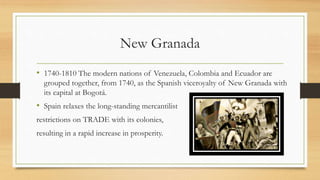
• 1740-1810 The modern nations of Venezuela, Colombia and Ecuador are
grouped together, from 1740, as the Spanish viceroyalty of New Granada with
its capital at Bogotá.
• Spain relaxes the long-standing mercantilist
restrictions on TRADE with its colonies,
resulting in a rapid increase in prosperity.
Bolívar and Gran Colombia: 1810-1822
Simón Bolívar, Venezuelan by birth and the central figure in the
story of the independence movements of Latin America, is a
young officer in Caracas in 1810.
For the next twelve years Bolívar's efforts are directed single-
mindedly towards liberating the whole of New Granada from
Spanish rule.
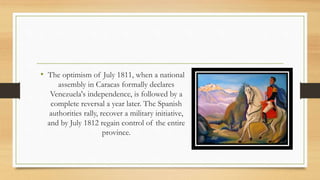
• The optimism of July 1811, when a national
assembly in Caracas formally declares
Venezuela's independence, is followed by a
complete reversal a year later. The Spanish
authorities rally, recover a military initiative,
and by July 1812 regain control of the entire
province.
Gran Colombia: 1822-1830
• Gran Colombia only has eight years as a
functioning state, and they are
increasingly turbulent. Bolívar technically
remains president even during the period
(1823-6) when he is away controlling the
campaign in Peru. In his absence the
acting president is one of his trusted
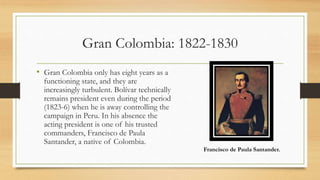
commanders, Francisco de Paula
Santander, a native of Colombia.
Francisco de Paula Santander.
Colombia's Independence Day
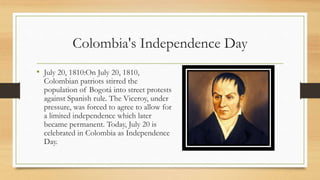
• July 20, 1810:On July 20, 1810,
Colombian patriots stirred the
population of Bogotá into street protests
against Spanish rule. The Viceroy, under
pressure, was forced to agree to allow for
a limited independence which later
became permanent. Today, July 20 is
celebrated in Colombia as Independence
Day.
Conspiracies and Flower Vases
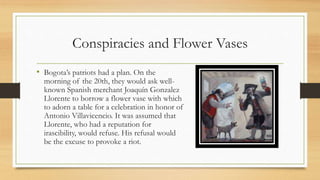
• Bogota’s patriots had a plan. On the
morning of the 20th, they would ask well-
known Spanish merchant Joaquín Gonzalez
Llorente to borrow a flower vase with which
to adorn a table for a celebration in honor of
Antonio Villavicencio. It was assumed that
Llorente, who had a reputation for
irascibility, would refuse. His refusal would
be the excuse to provoke a riot.
Thank you!
Anglophone Civilization
Licenciatura en Lengua Inglesa.
Universidad Tecnológica de Pereira.

Colombian Independence.

  • 1.
    1810 Colombian Independence. Daniel FernandoCalle. Daniela Agudelo Largo. 2015.
  • 2.
    New Granada • 1740-1810The modern nations of Venezuela, Colombia and Ecuador are grouped together, from 1740, as the Spanish viceroyalty of New Granada with its capital at Bogotá. • Spain relaxes the long-standing mercantilist restrictions on TRADE with its colonies, resulting in a rapid increase in prosperity.
  • 3.
    Bolívar and GranColombia: 1810-1822 Simón Bolívar, Venezuelan by birth and the central figure in the story of the independence movements of Latin America, is a young officer in Caracas in 1810. For the next twelve years Bolívar's efforts are directed single- mindedly towards liberating the whole of New Granada from Spanish rule.
  • 4.
    • The optimismof July 1811, when a national assembly in Caracas formally declares Venezuela's independence, is followed by a complete reversal a year later. The Spanish authorities rally, recover a military initiative, and by July 1812 regain control of the entire province.
  • 5.
    Gran Colombia: 1822-1830 •Gran Colombia only has eight years as a functioning state, and they are increasingly turbulent. Bolívar technically remains president even during the period (1823-6) when he is away controlling the campaign in Peru. In his absence the acting president is one of his trusted commanders, Francisco de Paula Santander, a native of Colombia. Francisco de Paula Santander.
  • 6.
    Colombia's Independence Day •July 20, 1810:On July 20, 1810, Colombian patriots stirred the population of Bogotá into street protests against Spanish rule. The Viceroy, under pressure, was forced to agree to allow for a limited independence which later became permanent. Today, July 20 is celebrated in Colombia as Independence Day.
  • 7.
    Conspiracies and FlowerVases • Bogota’s patriots had a plan. On the morning of the 20th, they would ask well- known Spanish merchant Joaquín Gonzalez Llorente to borrow a flower vase with which to adorn a table for a celebration in honor of Antonio Villavicencio. It was assumed that Llorente, who had a reputation for irascibility, would refuse. His refusal would be the excuse to provoke a riot.
  • 8.
    Thank you! Anglophone Civilization Licenciaturaen Lengua Inglesa. Universidad Tecnológica de Pereira.