Bioreactor Monitoring & Control
• Basic principles of process control
Basic principles of process control
• Fermentation monitoring
Di l d
– Dissolved oxygen
– pH
– Temperature
– Offgas monitoring
– Substrate (glucose)
Useful references
Useful references
• Ogunnaike, B.A., and Ray, W.H., Process Dynamics,
g y y
Modeling, and Control, Oxford University Press,
1994.
• Vogel H C Todaro C L eds Fermentation &
Vogel, H.C., Todaro, C.L., eds., Fermentation &
Biochemical Engineering Handbook 2nd Ed., Elsevier
1996.
Sh l M L d K i F Bi E i i
• Shuler, M.L. and Kargi, F., Bioprocess Engineering:
Basic Concepts 2nd Ed., Prentice Hall, 2001.
• Van Impe, J.F.M., Vanrollegham P.A.,and Iserentant,
p , , g , ,
D.I., eds., Advanced Instrumentation, Data
Interpretation, and Control of Biotechnological
Processes, Kluwer Academic Publishers, 1998.
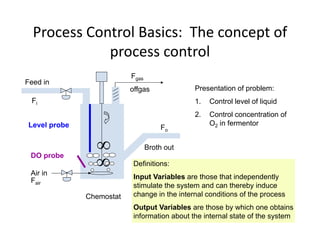
Process Control Basics: The concept of
l
process control
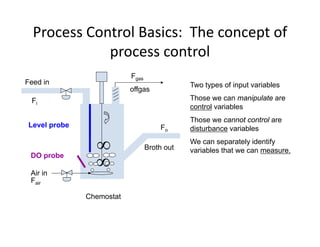
F
offgas
Feed in
Fi
Fgas
Presentation of problem:
1. Control level of liquid
Fo
2. Control concentration of
O2 in fermentor
Level probe
∞
∞ Broth out
Definitions:
DO probe
Air in
Chemostat
Fair
Input Variables are those that independently
stimulate the system and can thereby induce
change in the internal conditions of the process
Output Variables are those by which one obtains
information about the internal state of the system
Process Control Basics: The concept of
l
process control
F
offgas
Feed in
Fi
Fgas
Two types of input variables
Those we can manipulate are
control variables
Fo
control variables
Those we cannot control are
disturbance variables
W t l id tif
Level probe
∞
∞ Broth out
We can separately identify
variables that we can measure.
DO probe
Air in
Chemostat
Fair
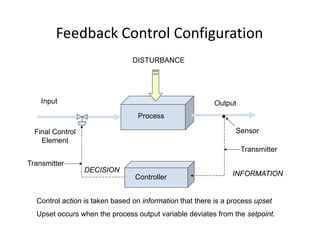
Feedback Control Configuration
DISTURBANCE
Input Output
Final Control
El t
Process
Sensor
Element
Transmitter
DECISION
Transmitter
INFORMATION
DECISION
Controller
Control action is taken based on information that there is a process upset
Upset occurs when the process output variable deviates from the setpoint.
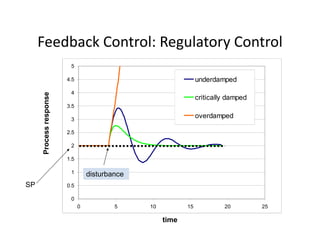
Feedback Control: Regulatory Control
5
Feedback Control: Regulatory Control
3.5
4
4.5 underdamped
critically damped
onse
2.5
3
3 5
overdamped
cess
respo
1.5
2
Proc
0
0.5
1
SP
disturbance
0 5 10 15 20 25
time
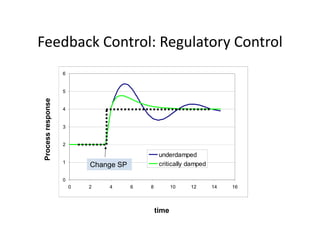
Feedback Control: Regulatory Control
6
Feedback Control: Regulatory Control
4
5
nse
3
4
ss
respon
1
2
underdamped
critically damped
Change SP
Proces
0
0 2 4 6 8 10 12 14 16
time
Standard Feedback Controllers
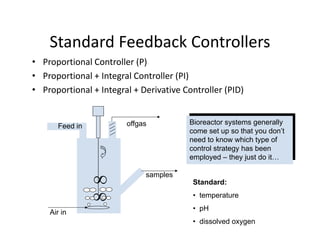
• Proportional Controller (P)
• Proportional + Integral Controller (PI)
Proportional + Integral Controller (PI)
• Proportional + Integral + Derivative Controller (PID)
offgas
Feed in
Bioreactor systems generally
come set up so that you don’t
need to know which type of
control strategy has been
employed – they just do it…
∞
∞ samples
Standard:
• temperature
Air in
• pH
• dissolved oxygen
Process Monitoring: Hardware Sensors
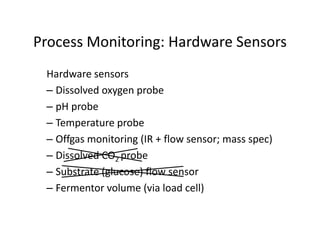
Hardware sensors
Hardware sensors
– Dissolved oxygen probe
– pH probe
pH probe
– Temperature probe
Offgas monitoring (IR + flow sensor; mass spec)
– Offgas monitoring (IR + flow sensor; mass spec)
– Dissolved CO2 probe
Substrate (glucose) flow sensor
– Substrate (glucose) flow sensor
– Fermentor volume (via load cell)
Bioreactor Control: Nonlinear Process
• PI or PID control strategies can be used for
PI or PID control strategies can be used for
simply managing process variables such as
temperature and pressure.
• pH is somewhat more sophisticated to avoid
oscillation and offset
• DO is managed by cascade control
• Critical variables, such as nutrient feed rate(s)
Critical variables, such as nutrient feed rate(s)
may not have simple hardware sensors
available (glucose monitoring)
We will begin with oxygen
g yg
• Oxygen is needed for respiration for aerobic cultures.
• Strict aerobes will die without sufficient O2
• Facultative aerobes will not die in the absence of O2 but will
produce byproducts due to the need to transfer electrons to
metabolites when O2 is not present to do the job.
d b d l d b
• Oxygen is monitored by a dissolved oxygen probe
• Oxygen is fed as a gas but can only be utilized in the liquid
phase
phase
The E. coli we use in the 194 lab is a facultative aerobe and therefore grows
best with oxygen but can grow also without it. In the absence of O2,
however, it will produce byproducts that inhibit the growth. Thus, we aim
to avoid an oxygen-limited situation in the process.
Challenges with DO control
• Oxygen will dissolve in water up to
yg p
[DO]sat'd ~ 7 ppm (= 7 mg/L) at 30ºC.
• This concentration is sufficient for
bugs to grow, what is limiting is the
g g g
rate of transfer from the air bubble to
the liquid.
T 0C x (mol O2/mol H2O) [O2] mg O2/l H2O
10 0 0000064 11 377
10 0.0000064 11.377
20 0.0000052 9.277
30 0.0000044 7.832
40 0.0000039 6.954
50 0.0000036 6.327
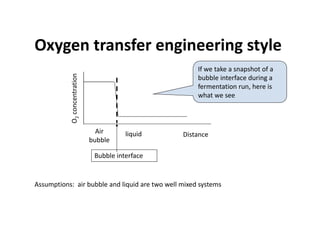
Oxygen transfer engineering style
If we take a snapshot of a
bubble interface during a
fermentation run, here is
what we see
Distance
Air
bubble
liquid
bubble
Bubble interface
Assumptions: air bubble and liquid are two well mixed systems
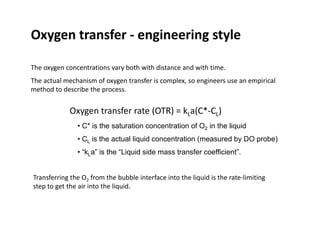
Oxygen transfer ‐ engineering style
The oxygen concentrations vary both with distance and with time.
The actual mechanism of oxygen transfer is complex, so engineers use an empirical
method to describe the process.
O f (OTR) k (C* C )
Oxygen transfer rate (OTR) = kLa(C*‐CL)
• C* is the saturation concentration of O2 in the liquid
• C is the actual liquid concentration (measured by DO probe)
• CL is the actual liquid concentration (measured by DO probe)
• “kLa” is the “Liquid side mass transfer coefficient”.
Transferring the O2 from the bubble interface into the liquid is the rate‐limiting
step to get the air into the liquid.
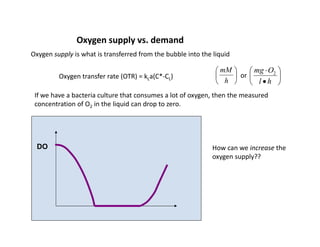
Oxygen supply vs. demand
Oxygen transfer rate (OTR) = k a(C*‐C )
Oxygen supply is what is transferred from the bubble into the liquid



 O
mg 2



 mM
or
Oxygen transfer rate (OTR) = kLa(C ‐CL)
If we have a bacteria culture that consumes a lot of oxygen, then the measured
concentration of O2 in the liquid can drop to zero.



  h
l



 h
or
2
How can we increase the
oxygen supply??
DO
Oxygen supply vs. demand
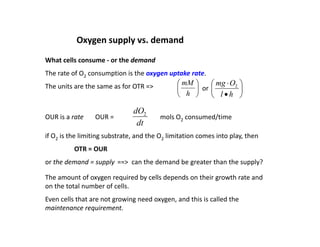
What cells consume ‐ or the demand
The rate of O2 consumption is the oxygen uptake rate.
2 p yg p
The units are the same as for OTR => 







h
l
O
mg 2






h
mM
or
dO
OUR is a rate OUR =
dt
dO2
mols O2 consumed/time
if O2 is the limiting substrate, and the O2 limitation comes into play, then
2 g , 2 p y,
OTR = OUR
or the demand = supply ==> can the demand be greater than the supply?
The amount of oxygen required by cells depends on their growth rate and
on the total number of cells.
Even cells that are not growing need oxygen, and this is called the
maintenance requirement.
Oxygen supply vs. demand
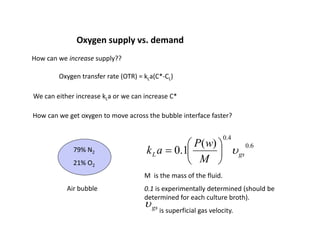
How can we increase supply??
Oxygen transfer rate (OTR) = k a(C*‐C )
We can either increase kLa or we can increase C*
Oxygen transfer rate (OTR) = kLa(C ‐CL)
How can we get oxygen to move across the bubble interface faster?
4
0
)
( 

79% N2
21% O2
6
.
0
4
.
0
)
(
1
.
0 gs
L
M
w
P
a
k 







Air bubble
M is the mass of the fluid.
0.1 is experimentally determined (should be
determined for each culture broth).
gs

is superficial gas velocity.
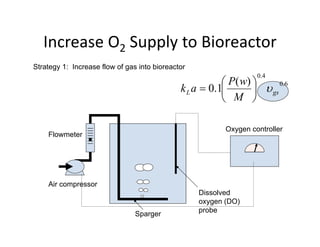
Increase O2 Supply to Bioreactor
Strategy 1: Increase flow of gas into bioreactor
Increase O2 Supply to Bioreactor
4
0

 6
.
0
4
.
0
)
(
1
.
0 gs
L
M
w
P
a
k 







Oxygen controller
Flowmeter
Dissolved
oxygen (DO)
Air compressor
oxygen (DO)
probe
Sparger
Increase O2 Supply to Bioreactor
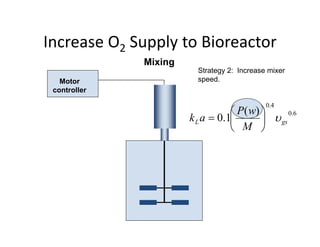
Mixing
Strategy 2: Increase mixer
d
Increase O2 Supply to Bioreactor
Motor
controller
speed.
4
.
0
)
(
P 
 6
.
0
)
(
1
.
0 gs
L
M
w
P
a
k 







Increase O2 Supply to Bioreactor
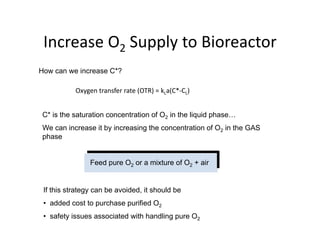
How can we increase C*?
Oxygen transfer rate (OTR) = kLa(C*‐CL)
C* is the saturation concentration of O2 in the liquid phase…
We can increase it by increasing the concentration of O2 in the GAS
phase
p ase
Feed pure O2 or a mixture of O2 + air
If this strategy can be avoided, it should be
dd d t t h ifi d O
• added cost to purchase purified O2
• safety issues associated with handling pure O2
Increase O Supply to Bioreactor
Increase O2 Supply to Bioreactor
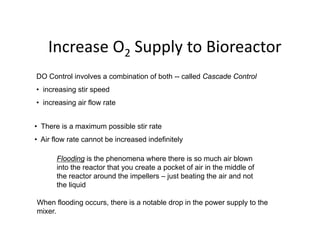
DO Control involves a combination of both -- called Cascade Control
• increasing stir speed
• increasing air flow rate
• There is a maximum possible stir rate
• Air flow rate cannot be increased indefinitely
Flooding is the phenomena where there is so much air blown
into the reactor that you create a pocket of air in the middle of
y p
the reactor around the impellers – just beating the air and not
the liquid
When flooding occurs there is a notable drop in the power supply to the
When flooding occurs, there is a notable drop in the power supply to the
mixer.
pH
pH
What is pH
What is pH
Pure water dissociates to yield 10-7 moles/L of H+ at 250C:
H2O <----> H+ + OH-
Since water dissociates to produce one OH- ion for each H+ ion, it is
obvious that
obvious that
10-7 OH- ions are produced simultaneously.
The product of [H+] and [OH-] always remains constant. When the value for
one of the species changes the other also changes accordingly.
[H+] x [OH-] = 10-14
[H ] x [OH ] 10
The concentration of H+ ions can be increased when compounds are added
which release H+ ions such as H2SO4:
H2SO4 <----> 2H+ + SO4
2-
Control of pH in Bioreactor
Calculate the concentration of hydrogen ions
from the pH
[H+] (molar concentration) = 10-pH
eg for pH = 7.0 and 7.2
[H+] = 10-7 molar or 0 0000001
[H+] 10 molar or 0.0000001
[H+] = 10-7.2 molar or 0.0000000631
ti th t i i th H b 0 2 d th [H ] b 37%
notice that increasing the pH by 0.2 decreases the [H+] by 37%
Control of pH in Bioreactor
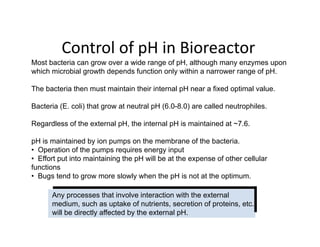
Most bacteria can grow over a wide range of pH, although many enzymes upon
which microbial growth depends function only within a narrower range of pH.
Control of pH in Bioreactor
The bacteria then must maintain their internal pH near a fixed optimal value.
Bacteria (E. coli) that grow at neutral pH (6.0-8.0) are called neutrophiles.
Bacteria (E. coli) that grow at neutral pH (6.0 8.0) are called neutrophiles.
Regardless of the external pH, the internal pH is maintained at ~7.6.
H i i t i d b i th b f th b t i
pH is maintained by ion pumps on the membrane of the bacteria.
• Operation of the pumps requires energy input
• Effort put into maintaining the pH will be at the expense of other cellular
functions
• Bugs tend to grow more slowly when the pH is not at the optimum.
Any processes that involve interaction with the external
di h t k f t i t ti f t i t
medium, such as uptake of nutrients, secretion of proteins, etc.
will be directly affected by the external pH.
H t l
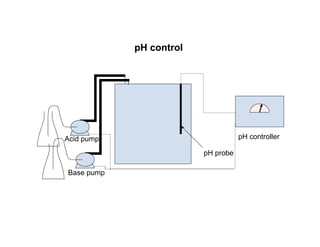
pH control
pH controller
Acid pump p co t o e
pH probe
Acid pump
B
Base pump
What causes the pH to change?
• Overfeeding substrate can cause the cells to produce
Overfeeding substrate can cause the cells to produce
organic acids, such as acetate – pH drops
• Lack of carbohydrate substrate causes the cells to
y
consume protein in the media – producing NH3 
NH4OH – pH rises
• When producing a protein product, cells consume
ammonia from the media from the cellular demand
f h l f
for more nitrogen – causes the release of a proton –
pH drops.
pH control in CHE 194 process
• We use NH4OH for base to control the pH
We use NH4OH for base to control the pH.
• We don’t need any acid because the process
control is designed to avoid overshooting
control is designed to avoid overshooting.
• We wait for a pH spike (production of base)
d h h l f d
and then we turn on the glucose feed pump.
A very slow glucose feed is used to enable
h f b i d id
growth of bacteria and avoid oxygen
limitation. (explained later in this
i )
presentation)
Temperature Control
Temperature Control
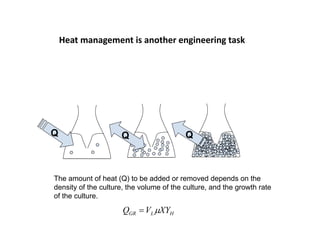
Heat management is another engineering task
Q Q Q
Q
The amount of heat (Q) to be added or removed depends on the
density of the culture, the volume of the culture, and the growth rate
of the culture.
H
L
GR XY
V
Q 

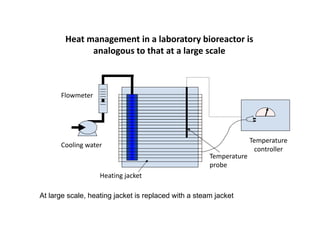
Heat management in a laboratory bioreactor is
analogous to that at a large scale
Flowmeter
T t
Temperature
controller
Cooling water
Temperature
probe
Heating jacket
At large scale, heating jacket is replaced with a steam jacket
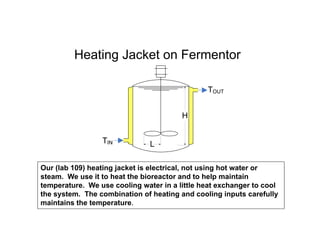
Heating Jacket on Fermentor
Our (lab 109) heating jacket is electrical, not using hot water or
steam. We use it to heat the bioreactor and to help maintain
temperature. We use cooling water in a little heat exchanger to cool
the system. The combination of heating and cooling inputs carefully
maintains the temperat re
maintains the temperature.
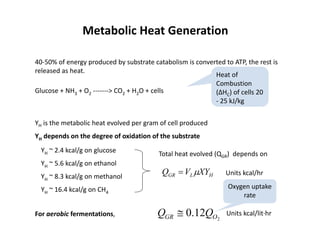
Metabolic Heat Generation
40‐50% of energy produced by substrate catabolism is converted to ATP, the rest is
released as heat.
Heat of
Glucose + NH3 + O2 ‐‐‐‐‐‐‐> CO2 + H2O + cells
Heat of
Combustion
(ΔHC) of cells 20
‐ 25 kJ/kg
YH is the metabolic heat evolved per gram of cell produced
YH depends on the degree of oxidation of the substrate
YH ~ 2.4 kcal/g on glucose
YH ~ 5.6 kcal/g on ethanol
H p g
Total heat evolved (QGR) depends on
XY
V
Q k l/h
YH ~ 8.3 kcal/g on methanol
YH ~ 16.4 kcal/g on CH4
Oxygen uptake
rate
H
L
GR XY
V
Q 
 Units kcal/hr
For aerobic fermentations,
2
12
.
0 O
GR Q
Q  Units kcal/lit∙hr
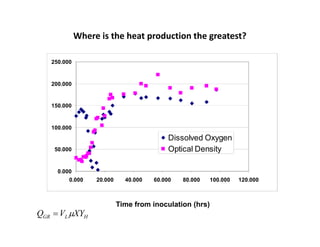
Where is the heat production the greatest?
250.000
150.000
200.000
100.000
Dissolved Oxygen
0 000
50.000
Dissolved Oxygen
Optical Density
0.000
0.000 20.000 40.000 60.000 80.000 100.000 120.000
H
L
GR XY
V
Q 

Time from inoculation (hrs)
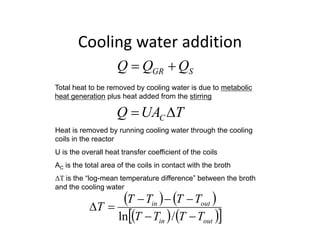
Cooling water addition
S
GR Q
Q
Q 

Total heat to be removed by cooling water is due to metabolic
heat generation plus heat added from the stirring
T
UA
Q T
UA
Q C 

Heat is removed by running cooling water through the cooling
coils in the reactor
U is the overall heat transfer coefficient of the coils
AC is the total area of the coils in contact with the broth
ΔT is the “log-mean temperature difference” between the broth
and the cooling water
   
i T
T
T
T 


   
   
 
out
in
out
in
T
T
T
T
T
T
T
T
T




/
ln
Offgas Analysis
Offgas Analysis
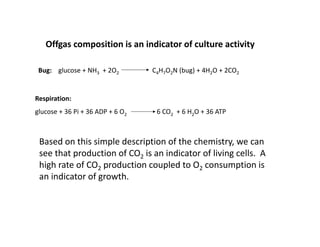
Offgas composition is an indicator of culture activity
Bug: glucose + NH3 + 2O2 C4H7O2N (bug) + 4H2O + 2CO2
Respiration:
glucose + 36 Pi + 36 ADP + 6 O2 6 CO2 + 6 H2O + 36 ATP
B d thi i l d i ti f th h i t
Based on this simple description of the chemistry, we can
see that production of CO2 is an indicator of living cells. A
high rate of CO2 production coupled to O2 consumption is
2 2
an indicator of growth.
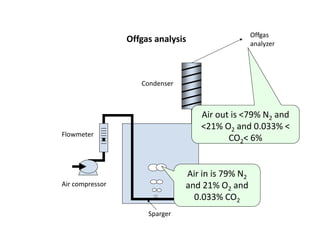
Offgas analysis Offgas
analyzer
analyzer
Condenser
Flowmeter
Air out is <79% N2 and
<21% O2 and 0.033% <
CO < 6%
CO2< 6%
Air compressor
Air in is 79% N2
and 21% O2 and
0.033% CO2
Sparger
2
Offgas composition is an indicator of culture activity
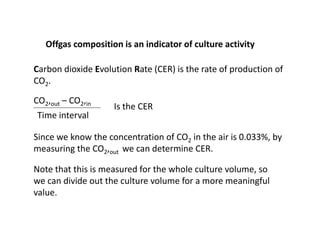
Carbon dioxide Evolution Rate (CER) is the rate of production of
CO2.
CO2,out – CO2,in
Is the CER
Time interval
Is the CER
Since we know the concentration of CO2 in the air is 0.033%, by
measuring the CO2,out we can determine CER.
Note that this is measured for the whole culture volume so
Note that this is measured for the whole culture volume, so
we can divide out the culture volume for a more meaningful
value.
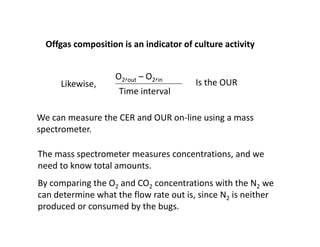
Offgas composition is an indicator of culture activity
O – O
Time interval
O2,out – O2,in
Is the OUR
Likewise,
We can measure the CER and OUR on‐line using a mass
spectrometer.
The mass spectrometer measures concentrations, and we
need to know total amounts.
By comparing the O2 and CO2 concentrations with the N2 we
can determine what the flow rate out is, since N2 is neither
produced or consumed by the bugs.
Calculation of OUR & CER
• Handout – example problem
Handout example problem
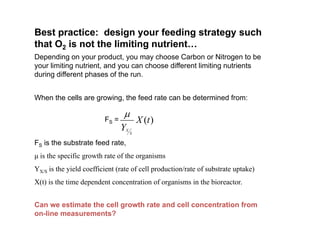
Best practice: design your feeding strategy such
that O2 is not the limiting nutrient
that O2 is not the limiting nutrient…
Depending on your product, you may choose Carbon or Nitrogen to be
your limiting nutrient, and you can choose different limiting nutrients
during different phases of the run.
When the cells are growing, the feed rate can be determined from:
)
(t
X
Y S
X

FS =
FS is the substrate feed rate,
μ is the specific growth rate of the organisms
YX/S is the yield coefficient (rate of cell production/rate of substrate uptake)
X(t) is the time dependent concentration of organisms in the bioreactor.
Can we estimate the cell growth rate and cell concentration from
on-line measurements?
Best practice: design your feeding strategy such
that O2 is not the limiting nutrient cont’d
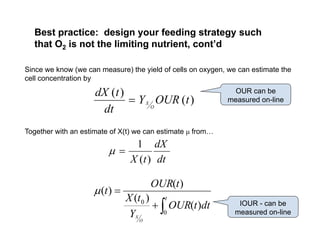
Since we know (we can measure) the yield of cells on oxygen, we can estimate the
ll t ti b
that O2 is not the limiting nutrient, cont d
cell concentration by
)
(
)
(
t
OUR
Y
dt
t
dX
O
X

OUR can be
measured on-line
dt O
Together with an estimate of X(t) we can estimate μ from…
dt
dX
t
X )
(
1




t
d
OUR
t
X
t
OUR
t
0
)
(
)
(
)
(
)
(

IOUR b

 dt
t
OUR
Y
t
O
X
0
0
)
(
)
( IOUR - can be
measured on-line
Best practice: design your feeding strategy such
that O2 is not the limiting nutrient cont’d
that O2 is not the limiting nutrient, cont d
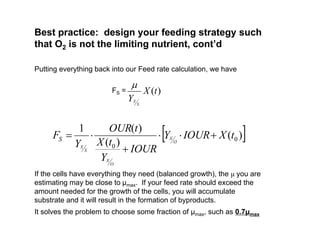
Putting everything back into our Feed rate calculation, we have
)
(t
X
Y S
X

FS =
 
)
(
)
(
)
(
1
0
t
X
IOUR
Y
X
t
OUR
F X
S 



  
)
(
)
( 0
0
IOUR
Y
t
X
Y O
X
O
X
S
X
S

If the cells have everything they need (balanced growth), the μ you are
estimating may be close to μmax. If your feed rate should exceed the
amount needed for the growth of the cells, you will accumulate
substrate and it will result in the formation of byproducts
substrate and it will result in the formation of byproducts.
It solves the problem to choose some fraction of μmax, such as 0.7μmax
Off-line analysis methods used
for fermentation
Off‐line analysis
Off line analysis
• Advantages:
– No interfacing required
– Flexibility
– Low cost
– Small sample volumes
• Disadvantages:
– Requires removing samples
q g p
– Requires tracking the sampling time
– Requires operator interaction, potential for bias
Requires operator interaction, potential for bias
error from operator
Offline Analysis Methods
Glucose
• Glucose concentration is measured by a glucose analyzer. For E. coli
f t ti l h ld b k t b b t 5 /lit d b l
fermentations, glucose should be kept above about 5 g/liter and below
about 20 g/liter for optimum growth.
• The Yellow Springs Instruments (YSI) Bioanalyzer is a standard
instrument for fermentation analysis It can measure other sugars ethanol
instrument for fermentation analysis. It can measure other sugars, ethanol
and methanol, as well.
• A small sample from the fermentor is centrifuged to settle the bacteria
and the supernatant is fed through a sipper tube into the analyzer It is
and the supernatant is fed through a sipper tube into the analyzer. It is
automatically calibrated.
High Performance Liquid Chromatography (HPLC)
• HPLC is useful for measuring fermentation by-products, such as ethanol,
organic acids – acetic acid, succinic acid, lactate, etc., and specific amino
acids and virtually all small molecules and proteins.
• Each molecule should have a specific method to be analyzed.
Offline Analysis Methods
Determining cell mass concentration
Di t th d
Direct methods:
•Dry Weight
→ Solids-free medium.
•Packed Cell Volume
•Optical Density Method
→ Spectrophotometer.
→ 550 or 600 nm wavelengths.
→ light absorbance cell mass/volume
→ OD ≤ 0.3 → need to measure dry-weight of the cells.
Typical Off‐line analyses
Typical Off line analyses
• Optical density (OD) analysis of cell
Optical density (OD) analysis of cell
concentration
• Glucose can be measured off line
• Glucose can be measured off‐line
• NH3 can be measured by chemical analysis
• Phosphate and other macro‐nutrients
• Protein activity assays
y y
• HPLC – everything else…

Bioreactor_Control.pdf

  • 1.
    Bioreactor Monitoring &Control Bioreactor Monitoring & Control
  • 2.
    Bioreactor Monitoring &Control Bioreactor Monitoring & Control • Basic principles of process control Basic principles of process control • Fermentation monitoring Di l d – Dissolved oxygen – pH – Temperature – Offgas monitoring – Substrate (glucose)
  • 3.
    Useful references Useful references •Ogunnaike, B.A., and Ray, W.H., Process Dynamics, g y y Modeling, and Control, Oxford University Press, 1994. • Vogel H C Todaro C L eds Fermentation & Vogel, H.C., Todaro, C.L., eds., Fermentation & Biochemical Engineering Handbook 2nd Ed., Elsevier 1996. Sh l M L d K i F Bi E i i • Shuler, M.L. and Kargi, F., Bioprocess Engineering: Basic Concepts 2nd Ed., Prentice Hall, 2001. • Van Impe, J.F.M., Vanrollegham P.A.,and Iserentant, p , , g , , D.I., eds., Advanced Instrumentation, Data Interpretation, and Control of Biotechnological Processes, Kluwer Academic Publishers, 1998. Processes, Kluwer Academic Publishers, 1998.
  • 4.
    Process Control Basics:The concept of l process control F offgas Feed in Fi Fgas Presentation of problem: 1. Control level of liquid Fo 2. Control concentration of O2 in fermentor Level probe ∞ ∞ Broth out Definitions: DO probe Air in Chemostat Fair Input Variables are those that independently stimulate the system and can thereby induce change in the internal conditions of the process Output Variables are those by which one obtains information about the internal state of the system
  • 5.
    Process Control Basics:The concept of l process control F offgas Feed in Fi Fgas Two types of input variables Those we can manipulate are control variables Fo control variables Those we cannot control are disturbance variables W t l id tif Level probe ∞ ∞ Broth out We can separately identify variables that we can measure. DO probe Air in Chemostat Fair
  • 6.
    Feedback Control Configuration DISTURBANCE InputOutput Final Control El t Process Sensor Element Transmitter DECISION Transmitter INFORMATION DECISION Controller Control action is taken based on information that there is a process upset Control action is taken based on information that there is a process upset Upset occurs when the process output variable deviates from the setpoint.
  • 7.
    Feedback Control: RegulatoryControl 5 Feedback Control: Regulatory Control 3.5 4 4.5 underdamped critically damped onse 2.5 3 3 5 overdamped cess respo 1.5 2 Proc 0 0.5 1 SP disturbance 0 5 10 15 20 25 time
  • 8.
    Feedback Control: RegulatoryControl 6 Feedback Control: Regulatory Control 4 5 nse 3 4 ss respon 1 2 underdamped critically damped Change SP Proces 0 0 2 4 6 8 10 12 14 16 time
  • 9.
    Standard Feedback Controllers StandardFeedback Controllers • Proportional Controller (P) • Proportional + Integral Controller (PI) Proportional + Integral Controller (PI) • Proportional + Integral + Derivative Controller (PID) offgas Feed in Bioreactor systems generally come set up so that you don’t need to know which type of need to know which type of control strategy has been employed – they just do it… ∞ ∞ samples Standard: • temperature Air in • pH • dissolved oxygen
  • 10.
    Process Monitoring: HardwareSensors Process Monitoring: Hardware Sensors Hardware sensors Hardware sensors – Dissolved oxygen probe – pH probe pH probe – Temperature probe Offgas monitoring (IR + flow sensor; mass spec) – Offgas monitoring (IR + flow sensor; mass spec) – Dissolved CO2 probe Substrate (glucose) flow sensor – Substrate (glucose) flow sensor – Fermentor volume (via load cell)
  • 11.
    Bioreactor Control: NonlinearProcess Bioreactor Control: Nonlinear Process • PI or PID control strategies can be used for PI or PID control strategies can be used for simply managing process variables such as temperature and pressure. • pH is somewhat more sophisticated to avoid oscillation and offset • DO is managed by cascade control • Critical variables, such as nutrient feed rate(s) Critical variables, such as nutrient feed rate(s) may not have simple hardware sensors available (glucose monitoring)
  • 12.
    We will beginwith oxygen g yg • Oxygen is needed for respiration for aerobic cultures. • Strict aerobes will die without sufficient O2 • Facultative aerobes will not die in the absence of O2 but will produce byproducts due to the need to transfer electrons to metabolites when O2 is not present to do the job. d b d l d b • Oxygen is monitored by a dissolved oxygen probe • Oxygen is fed as a gas but can only be utilized in the liquid phase phase The E. coli we use in the 194 lab is a facultative aerobe and therefore grows best with oxygen but can grow also without it. In the absence of O2, best with oxygen but can grow also without it. In the absence of O2, however, it will produce byproducts that inhibit the growth. Thus, we aim to avoid an oxygen-limited situation in the process.
  • 13.
    Challenges with DOcontrol Challenges with DO control • Oxygen will dissolve in water up to yg p [DO]sat'd ~ 7 ppm (= 7 mg/L) at 30ºC. • This concentration is sufficient for bugs to grow, what is limiting is the g g g rate of transfer from the air bubble to the liquid. T 0C x (mol O2/mol H2O) [O2] mg O2/l H2O 10 0 0000064 11 377 10 0.0000064 11.377 20 0.0000052 9.277 30 0.0000044 7.832 40 0.0000039 6.954 50 0.0000036 6.327
  • 14.
    Oxygen transfer engineeringstyle Oxygen transfer engineering style If we take a snapshot of a bubble interface during a bubble interface during a fermentation run, here is what we see Distance Air bubble liquid bubble Bubble interface Assumptions: air bubble and liquid are two well mixed systems
  • 15.
    Oxygen transfer ‐engineering style The oxygen concentrations vary both with distance and with time. The actual mechanism of oxygen transfer is complex, so engineers use an empirical method to describe the process. O f (OTR) k (C* C ) Oxygen transfer rate (OTR) = kLa(C*‐CL) • C* is the saturation concentration of O2 in the liquid • C is the actual liquid concentration (measured by DO probe) • CL is the actual liquid concentration (measured by DO probe) • “kLa” is the “Liquid side mass transfer coefficient”. Transferring the O2 from the bubble interface into the liquid is the rate‐limiting step to get the air into the liquid.
  • 16.
    Oxygen supply vs.demand Oxygen transfer rate (OTR) = k a(C*‐C ) Oxygen supply is what is transferred from the bubble into the liquid     O mg 2     mM or Oxygen transfer rate (OTR) = kLa(C ‐CL) If we have a bacteria culture that consumes a lot of oxygen, then the measured concentration of O2 in the liquid can drop to zero.      h l     h or 2 How can we increase the oxygen supply?? DO
  • 17.
    Oxygen supply vs.demand What cells consume ‐ or the demand The rate of O2 consumption is the oxygen uptake rate. 2 p yg p The units are the same as for OTR =>         h l O mg 2       h mM or dO OUR is a rate OUR = dt dO2 mols O2 consumed/time if O2 is the limiting substrate, and the O2 limitation comes into play, then 2 g , 2 p y, OTR = OUR or the demand = supply ==> can the demand be greater than the supply? The amount of oxygen required by cells depends on their growth rate and on the total number of cells. Even cells that are not growing need oxygen, and this is called the Even cells that are not growing need oxygen, and this is called the maintenance requirement.
  • 18.
    Oxygen supply vs.demand How can we increase supply?? Oxygen transfer rate (OTR) = k a(C*‐C ) We can either increase kLa or we can increase C* Oxygen transfer rate (OTR) = kLa(C ‐CL) How can we get oxygen to move across the bubble interface faster? 4 0 ) (   79% N2 21% O2 6 . 0 4 . 0 ) ( 1 . 0 gs L M w P a k         Air bubble M is the mass of the fluid. 0.1 is experimentally determined (should be determined for each culture broth). gs  is superficial gas velocity.
  • 19.
    Increase O2 Supplyto Bioreactor Strategy 1: Increase flow of gas into bioreactor Increase O2 Supply to Bioreactor 4 0   6 . 0 4 . 0 ) ( 1 . 0 gs L M w P a k         Oxygen controller Flowmeter Dissolved oxygen (DO) Air compressor oxygen (DO) probe Sparger
  • 20.
    Increase O2 Supplyto Bioreactor Mixing Strategy 2: Increase mixer d Increase O2 Supply to Bioreactor Motor controller speed. 4 . 0 ) ( P   6 . 0 ) ( 1 . 0 gs L M w P a k        
  • 21.
    Increase O2 Supplyto Bioreactor Increase O2 Supply to Bioreactor How can we increase C*? Oxygen transfer rate (OTR) = kLa(C*‐CL) C* is the saturation concentration of O2 in the liquid phase… We can increase it by increasing the concentration of O2 in the GAS phase p ase Feed pure O2 or a mixture of O2 + air If this strategy can be avoided, it should be dd d t t h ifi d O • added cost to purchase purified O2 • safety issues associated with handling pure O2
  • 22.
    Increase O Supplyto Bioreactor Increase O2 Supply to Bioreactor DO Control involves a combination of both -- called Cascade Control DO Control involves a combination of both -- called Cascade Control • increasing stir speed • increasing air flow rate • There is a maximum possible stir rate • Air flow rate cannot be increased indefinitely • Air flow rate cannot be increased indefinitely Flooding is the phenomena where there is so much air blown into the reactor that you create a pocket of air in the middle of y p the reactor around the impellers – just beating the air and not the liquid When flooding occurs there is a notable drop in the power supply to the When flooding occurs, there is a notable drop in the power supply to the mixer.
  • 23.
  • 24.
    What is pH Whatis pH Pure water dissociates to yield 10-7 moles/L of H+ at 250C: H2O <----> H+ + OH- Since water dissociates to produce one OH- ion for each H+ ion, it is obvious that obvious that 10-7 OH- ions are produced simultaneously. The product of [H+] and [OH-] always remains constant. When the value for one of the species changes the other also changes accordingly. [H+] x [OH-] = 10-14 [H ] x [OH ] 10 The concentration of H+ ions can be increased when compounds are added which release H+ ions such as H2SO4: H2SO4 <----> 2H+ + SO4 2-
  • 25.
    Control of pHin Bioreactor Control of pH in Bioreactor Calculate the concentration of hydrogen ions from the pH [H+] (molar concentration) = 10-pH eg for pH = 7.0 and 7.2 [H+] = 10-7 molar or 0 0000001 [H+] 10 molar or 0.0000001 [H+] = 10-7.2 molar or 0.0000000631 ti th t i i th H b 0 2 d th [H ] b 37% notice that increasing the pH by 0.2 decreases the [H+] by 37%
  • 26.
    Control of pHin Bioreactor Most bacteria can grow over a wide range of pH, although many enzymes upon which microbial growth depends function only within a narrower range of pH. Control of pH in Bioreactor The bacteria then must maintain their internal pH near a fixed optimal value. Bacteria (E. coli) that grow at neutral pH (6.0-8.0) are called neutrophiles. Bacteria (E. coli) that grow at neutral pH (6.0 8.0) are called neutrophiles. Regardless of the external pH, the internal pH is maintained at ~7.6. H i i t i d b i th b f th b t i pH is maintained by ion pumps on the membrane of the bacteria. • Operation of the pumps requires energy input • Effort put into maintaining the pH will be at the expense of other cellular functions • Bugs tend to grow more slowly when the pH is not at the optimum. Any processes that involve interaction with the external di h t k f t i t ti f t i t medium, such as uptake of nutrients, secretion of proteins, etc. will be directly affected by the external pH.
  • 27.
    H t l pHcontrol pH controller Acid pump p co t o e pH probe Acid pump B Base pump
  • 28.
    What causes thepH to change? What causes the pH to change? • Overfeeding substrate can cause the cells to produce Overfeeding substrate can cause the cells to produce organic acids, such as acetate – pH drops • Lack of carbohydrate substrate causes the cells to y consume protein in the media – producing NH3  NH4OH – pH rises • When producing a protein product, cells consume ammonia from the media from the cellular demand f h l f for more nitrogen – causes the release of a proton – pH drops.
  • 29.
    pH control inCHE 194 process pH control in CHE 194 process • We use NH4OH for base to control the pH We use NH4OH for base to control the pH. • We don’t need any acid because the process control is designed to avoid overshooting control is designed to avoid overshooting. • We wait for a pH spike (production of base) d h h l f d and then we turn on the glucose feed pump. A very slow glucose feed is used to enable h f b i d id growth of bacteria and avoid oxygen limitation. (explained later in this i ) presentation)
  • 30.
  • 31.
    Heat management isanother engineering task Q Q Q Q The amount of heat (Q) to be added or removed depends on the density of the culture, the volume of the culture, and the growth rate of the culture. H L GR XY V Q  
  • 32.
    Heat management ina laboratory bioreactor is analogous to that at a large scale Flowmeter T t Temperature controller Cooling water Temperature probe Heating jacket At large scale, heating jacket is replaced with a steam jacket
  • 33.
    Heating Jacket onFermentor Our (lab 109) heating jacket is electrical, not using hot water or Our (lab 109) heating jacket is electrical, not using hot water or steam. We use it to heat the bioreactor and to help maintain temperature. We use cooling water in a little heat exchanger to cool the system. The combination of heating and cooling inputs carefully maintains the temperat re maintains the temperature.
  • 34.
    Metabolic Heat Generation 40‐50%of energy produced by substrate catabolism is converted to ATP, the rest is released as heat. Heat of Glucose + NH3 + O2 ‐‐‐‐‐‐‐> CO2 + H2O + cells Heat of Combustion (ΔHC) of cells 20 ‐ 25 kJ/kg YH is the metabolic heat evolved per gram of cell produced YH depends on the degree of oxidation of the substrate YH ~ 2.4 kcal/g on glucose YH ~ 5.6 kcal/g on ethanol H p g Total heat evolved (QGR) depends on XY V Q k l/h YH ~ 8.3 kcal/g on methanol YH ~ 16.4 kcal/g on CH4 Oxygen uptake rate H L GR XY V Q   Units kcal/hr For aerobic fermentations, 2 12 . 0 O GR Q Q  Units kcal/lit∙hr
  • 35.
    Where is theheat production the greatest? 250.000 150.000 200.000 100.000 Dissolved Oxygen 0 000 50.000 Dissolved Oxygen Optical Density 0.000 0.000 20.000 40.000 60.000 80.000 100.000 120.000 H L GR XY V Q   Time from inoculation (hrs)
  • 36.
    Cooling water addition Coolingwater addition S GR Q Q Q   Total heat to be removed by cooling water is due to metabolic heat generation plus heat added from the stirring T UA Q T UA Q C   Heat is removed by running cooling water through the cooling coils in the reactor coils in the reactor U is the overall heat transfer coefficient of the coils AC is the total area of the coils in contact with the broth ΔT is the “log-mean temperature difference” between the broth and the cooling water     i T T T T              out in out in T T T T T T T T T     / ln
  • 37.
  • 38.
    Offgas composition isan indicator of culture activity Offgas composition is an indicator of culture activity Bug: glucose + NH3 + 2O2 C4H7O2N (bug) + 4H2O + 2CO2 Respiration: glucose + 36 Pi + 36 ADP + 6 O2 6 CO2 + 6 H2O + 36 ATP B d thi i l d i ti f th h i t Based on this simple description of the chemistry, we can see that production of CO2 is an indicator of living cells. A high rate of CO2 production coupled to O2 consumption is 2 2 an indicator of growth.
  • 39.
    Offgas analysis Offgas analyzer analyzer Condenser Flowmeter Airout is <79% N2 and <21% O2 and 0.033% < CO < 6% CO2< 6% Air compressor Air in is 79% N2 and 21% O2 and 0.033% CO2 Sparger 2
  • 40.
    Offgas composition isan indicator of culture activity Offgas composition is an indicator of culture activity Carbon dioxide Evolution Rate (CER) is the rate of production of CO2. CO2,out – CO2,in Is the CER Time interval Is the CER Since we know the concentration of CO2 in the air is 0.033%, by Since we know the concentration of CO2 in the air is 0.033%, by measuring the CO2,out we can determine CER. Note that this is measured for the whole culture volume so Note that this is measured for the whole culture volume, so we can divide out the culture volume for a more meaningful value.
  • 41.
    Offgas composition isan indicator of culture activity Offgas composition is an indicator of culture activity O – O Time interval O2,out – O2,in Is the OUR Likewise, We can measure the CER and OUR on‐line using a mass spectrometer. The mass spectrometer measures concentrations, and we need to know total amounts. By comparing the O2 and CO2 concentrations with the N2 we can determine what the flow rate out is, since N2 is neither produced or consumed by the bugs.
  • 42.
    Calculation of OUR& CER Calculation of OUR & CER • Handout – example problem Handout example problem
  • 43.
    Best practice: designyour feeding strategy such that O2 is not the limiting nutrient that O2 is not the limiting nutrient… Depending on your product, you may choose Carbon or Nitrogen to be your limiting nutrient, and you can choose different limiting nutrients during different phases of the run. during different phases of the run. When the cells are growing, the feed rate can be determined from: ) (t X Y S X  FS = FS is the substrate feed rate, μ is the specific growth rate of the organisms YX/S is the yield coefficient (rate of cell production/rate of substrate uptake) YX/S is the yield coefficient (rate of cell production/rate of substrate uptake) X(t) is the time dependent concentration of organisms in the bioreactor. Can we estimate the cell growth rate and cell concentration from on-line measurements?
  • 44.
    Best practice: designyour feeding strategy such that O2 is not the limiting nutrient cont’d Since we know (we can measure) the yield of cells on oxygen, we can estimate the ll t ti b that O2 is not the limiting nutrient, cont d cell concentration by ) ( ) ( t OUR Y dt t dX O X  OUR can be measured on-line dt O Together with an estimate of X(t) we can estimate μ from… dt dX t X ) ( 1     t d OUR t X t OUR t 0 ) ( ) ( ) ( ) (  IOUR b   dt t OUR Y t O X 0 0 ) ( ) ( IOUR - can be measured on-line
  • 45.
    Best practice: designyour feeding strategy such that O2 is not the limiting nutrient cont’d that O2 is not the limiting nutrient, cont d Putting everything back into our Feed rate calculation, we have ) (t X Y S X  FS =   ) ( ) ( ) ( 1 0 t X IOUR Y X t OUR F X S        ) ( ) ( 0 0 IOUR Y t X Y O X O X S X S  If the cells have everything they need (balanced growth), the μ you are estimating may be close to μmax. If your feed rate should exceed the amount needed for the growth of the cells, you will accumulate substrate and it will result in the formation of byproducts substrate and it will result in the formation of byproducts. It solves the problem to choose some fraction of μmax, such as 0.7μmax
  • 47.
    Off-line analysis methodsused for fermentation
  • 48.
    Off‐line analysis Off lineanalysis • Advantages: – No interfacing required – Flexibility – Low cost – Small sample volumes • Disadvantages: – Requires removing samples q g p – Requires tracking the sampling time – Requires operator interaction, potential for bias Requires operator interaction, potential for bias error from operator
  • 49.
    Offline Analysis Methods OfflineAnalysis Methods Glucose • Glucose concentration is measured by a glucose analyzer. For E. coli f t ti l h ld b k t b b t 5 /lit d b l fermentations, glucose should be kept above about 5 g/liter and below about 20 g/liter for optimum growth. • The Yellow Springs Instruments (YSI) Bioanalyzer is a standard instrument for fermentation analysis It can measure other sugars ethanol instrument for fermentation analysis. It can measure other sugars, ethanol and methanol, as well. • A small sample from the fermentor is centrifuged to settle the bacteria and the supernatant is fed through a sipper tube into the analyzer It is and the supernatant is fed through a sipper tube into the analyzer. It is automatically calibrated. High Performance Liquid Chromatography (HPLC) • HPLC is useful for measuring fermentation by-products, such as ethanol, organic acids – acetic acid, succinic acid, lactate, etc., and specific amino acids and virtually all small molecules and proteins. • Each molecule should have a specific method to be analyzed.
  • 50.
    Offline Analysis Methods OfflineAnalysis Methods Determining cell mass concentration Di t th d Direct methods: •Dry Weight → Solids-free medium. •Packed Cell Volume •Optical Density Method → Spectrophotometer. → 550 or 600 nm wavelengths. → light absorbance cell mass/volume → light absorbance cell mass/volume → OD ≤ 0.3 → need to measure dry-weight of the cells.
  • 51.
    Typical Off‐line analyses TypicalOff line analyses • Optical density (OD) analysis of cell Optical density (OD) analysis of cell concentration • Glucose can be measured off line • Glucose can be measured off‐line • NH3 can be measured by chemical analysis • Phosphate and other macro‐nutrients • Protein activity assays y y • HPLC – everything else…