COURSE:
MARKETING STRATEGY
Course Code:408MKT
Unit 3 :Offensive and Defensive Competitive Strategies
Session 1
Offensive & defensive
strategies
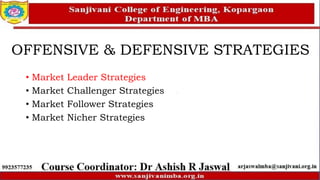
OFFENSIVE & DEFENSIVE STRATEGIES
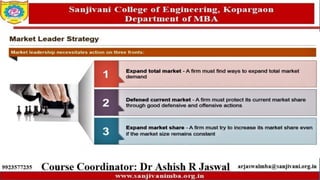
• Market Leader Strategies
• Market Challenger Strategies
• Market Follower Strategies
• Market Nicher Strategies
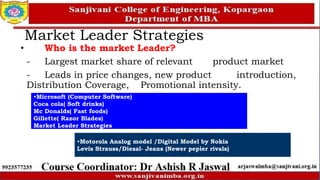
Market Leader Strategies
• Who is the market Leader?
- Largest market share of relevant product market
- Leads in price changes, new product introduction,
Distribution Coverage, Promotional intensity.
•Microsoft (Computer Software)
Coca cola( Soft drinks)
Mc Donalds( Fast foods)
Gillette( Razor Blades)
Market Leader Strategies
•Motorola Analog model /Digital Model by Nokia
Levis Strauss/Diesal- Jeans (Newer pepier rivals)
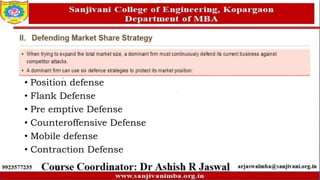
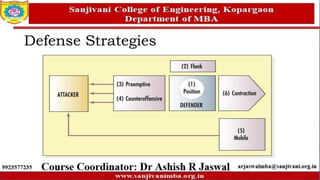
DEFENSE STRATEGIES
• Position defense
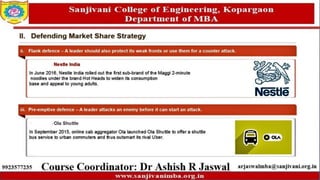
• Flank Defense
• Pre emptive Defense
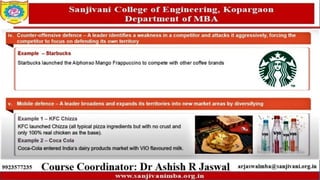
• Counteroffensive Defense
• Mobile defense
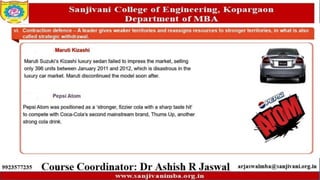
• Contraction Defense
Defense Strategies
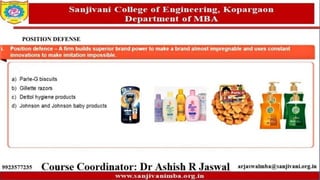
POSITION DEFENSE
COURSE:
MARKETING STRATEGY
Course Code:408MKT
Unit 3 :Offensive and Defensive Competitive Strategies
Session 2
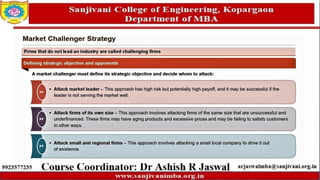
• MARKET CHALLENGER STRATEGIES
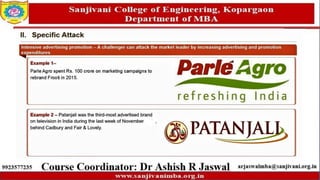
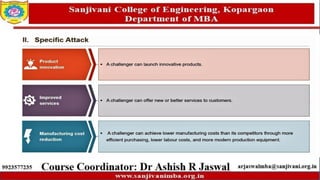
A market challenger is a runner-up firm in an industry which is fighting hard to increase
its market share. Usually, aggressive competitive tactics are used for this, aimed at the
market leader.
Market challengers may not be the most powerful ones in an industry, but can still be the most
dangerous ones due to their aggressiveness.
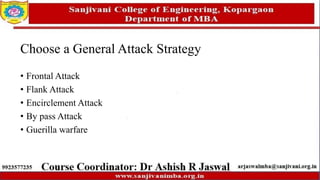
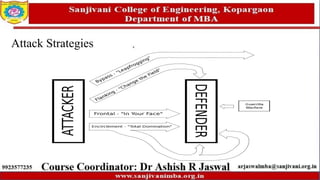
Choose a General Attack Strategy
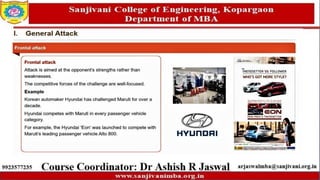
• Frontal Attack
• Flank Attack
• Encirclement Attack
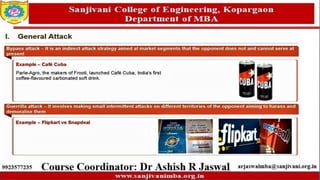
• By pass Attack
• Guerilla warfare
Attack Strategies
COURSE:
MARKETING STRATEGY
Course Code:408MKT
Unit 3 :Offensive and Defensive Competitive Strategies
Session 3
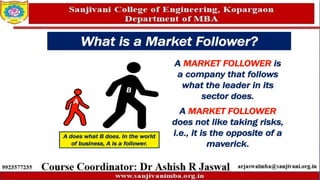
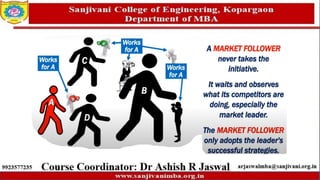
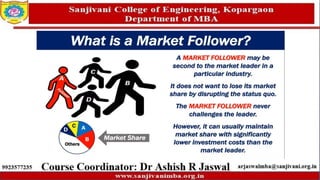
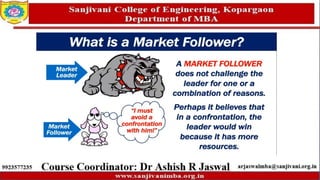
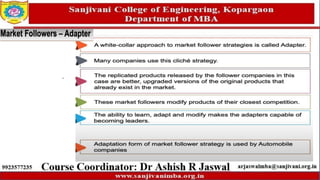
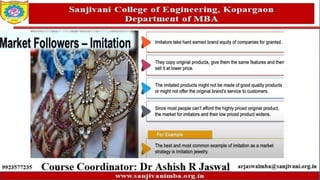
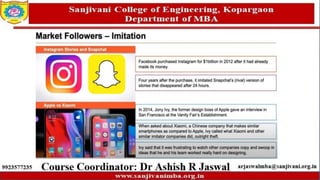
• MARKET FOLLOWER AND NICHER STRATEGIES
COURSE:
MARKETING STRATEGY
Course Code:408MKT
Unit 3 :Offensive and Defensive Competitive Strategies
Session 3
• NICHER STRATEGIES
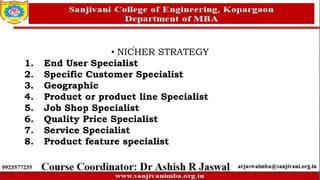
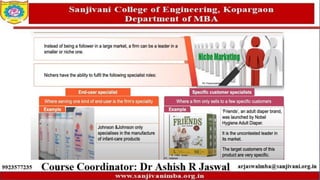
• NICHER STRATEGY
1. End User Specialist
2. Specific Customer Specialist
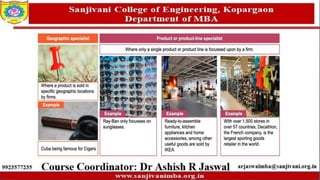
3. Geographic
4. Product or product line Specialist
5. Job Shop Specialist
6. Quality Price Specialist
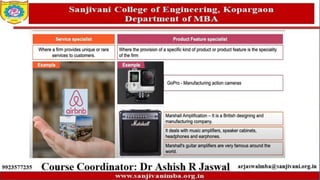
7. Service Specialist
8. Product feature specialist
COURSE:
MARKETING STRATEGY
Course Code:408MKT
Unit 3 :Offensive and Defensive Competitive Strategies
Session 5
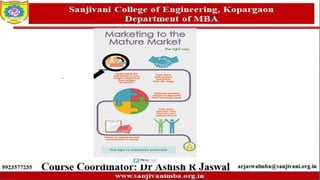
MARKETING STRATEGIES FOR MATURE MARKETS
SESSION OUTCOME
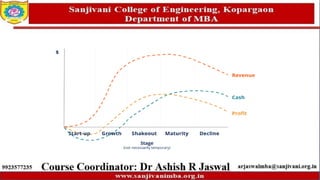
1. INDUSTRY LIFE CYCLE
2. WHAT IS MATURE MARKET?
3. DOMINANT ISSUES IN MATURE MARKET
4. FUNDAMENTAL CHANGES
5. CHALLENGES OF A MATURE MARKET
6. OPPORTUNITIES OF A MATURE MARKET
7. STRATEGY OPTIONS
8. RECAP
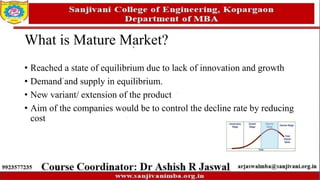
What is Mature Market?
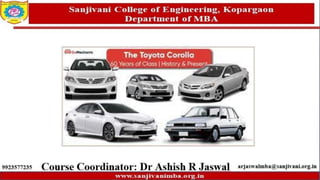
• Reached a state of equilibrium due to lack of innovation and growth
• Demand and supply in equilibrium.
• New variant/ extension of the product
• Aim of the companies would be to control the decline rate by reducing
cost
Maturing Market
• Understand the meaning and nature of a maturing industry.
• Growth slackens significantly
• Saturation
• Thompson and strickland, a maturing industry is an industry that is
moving from rapid growth to significantly lower growth
DOMINANT ISSUES IN MATURE MARKET
1. Nearly all potential buyers are already users
2. Market demand consists mainly of replacement sales to existing
users
3. Growth in the industry depends ability to attract new buyers and
motivate existing buyers to increase their use of products.
FUNDAMENTAL CHANGES
1.Growth in buyer demand slows down.
2. Buyers become more sophisticated.
3.Competition produces a greater emphasis on cost and service.
4.The industry experiences a slowdown in capacity expansion because of
slow growth.
5.It becomes difficult for the producers to create new product innovations
6. International competition increases
7.Industry profitability falls temporarily or permanently.
8.Competition becomes very stiff.
CHALLENGES OF A MATURE MARKET
Growth in market share can be expensive
There is one business which has a monopoly-like hold on the market
Customers who already have expectations in place with regards to
price
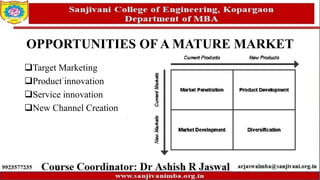
OPPORTUNITIES OF A MATURE MARKET
Target Marketing
Product innovation
Service innovation
New Channel Creation
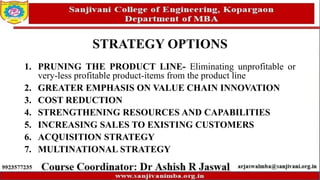
STRATEGY OPTIONS
1. PRUNING THE PRODUCT LINE- Eliminating unprofitable or
very-less profitable product-items from the product line
2. GREATER EMPHASIS ON VALUE CHAIN INNOVATION
3. COST REDUCTION
4. STRENGTHENING RESOURCES AND CAPABILITIES
5. INCREASING SALES TO EXISTING CUSTOMERS
6. ACQUISITION STRATEGY
7. MULTINATIONAL STRATEGY
COURSE:
MARKETING STRATEGY
Course Code:408MKT
Unit 3 :Offensive and Defensive Competitive Strategies
Session 6
MARKETING STRATEGIES FOR DECLINING MARKETS
SESSION OUTCOME
1. CHARACTERISTICS OF DECLINING MARKET
2. ROUTES TO REVITALISE A STAGNANT MARKET
3. STRATEGIC ALTERNATIVES
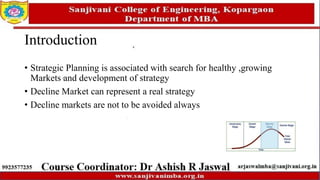
Introduction
• Strategic Planning is associated with search for healthy ,growing
Markets and development of strategy
• Decline Market can represent a real strategy
• Decline markets are not to be avoided always
CHARACTERISTICS OF DECLINE MARKET
• Fall in Demand
• Caused by external event
• Change in customers need
• Shift in Govt policy
• Obtain SCA and compete Successfully
• Market is characterised by zero or negative
• Milking or exiting is considered
CREATING GROWTH IN DECLINING INDUSTRIES
• Full Exploitation of the Market potential of the declining Market is
done
• If untrue- dramatic opportunity exist
• REVITALIZING THE INDUSTRY
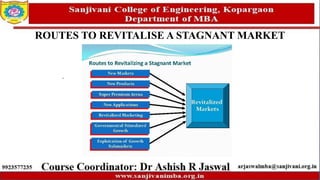
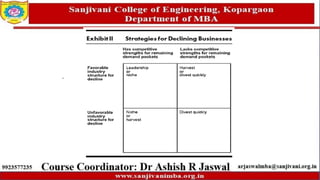
ROUTES TO REVITALISE A STAGNANT MARKET
STRATEGIC ALTERNATIVES
1. Create a Growth context by revitalizing the industry
2. Be a profitable survivor in the industry
3. Milk or harvest
4. Exit or liquidate
MILK OR HARVEST
1. Aim is to generate cash flow by reducing investment and operating
expenses, even if that causes sales and market share to decrease.
2. Harvesting calls for gradually reducing a product or business's costs while
trying to maintain sales.
3. The first step is to cut R&D costs and plant and equipment investment.
The company might also reduce product quality, sales force size, marginal
services, and advertising expenditures.
4. Harvesting is difficult to execute. Yet many mature products warrant this
strategy. Harvesting can substantially increase the company's current cash
flow
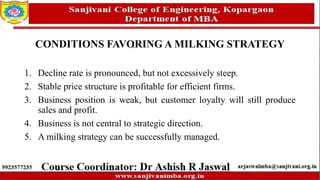
CONDITIONS FAVORING A MILKING STRATEGY
1. Decline rate is pronounced, but not excessively steep.
2. Stable price structure is profitable for efficient firms.
3. Business position is weak, but customer loyalty will still produce
sales and profit.
4. Business is not central to strategic direction.
5. A milking strategy can be successfully managed.
MARKETING STRATEGIES FOR HOSTILE MARKETS
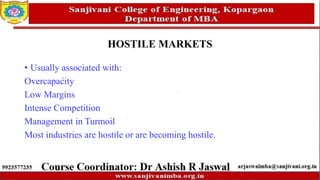
HOSTILE MARKETS
• Usually associated with:
Overcapacity
Low Margins
Intense Competition
Management in Turmoil
Most industries are hostile or are becoming hostile.
SIX PHASES OF HOSTILITY
• Phase 1 -Margin pressure
• Phase 2 -Share shifts – 1- 5% annually
• Phase 3 - Product proliferation
• Phase 4 - Self-defeating cost reduction
• Phase 5 - Consolidation and shakeout
• 1. Internal Reductions
• 2. Mergers & Acquisitions
• 3. Global Players Combining
• Phase 6 - Rescue
SIX PHASES OF HOSTILITY
• Phase 1 -Margin pressure
• Phase 2 -Share shifts – 1- 5% annually
• Phase 3 - Product proliferation
• Phase 4 - Self-defeating cost reduction
• Phase 5 - Consolidation and shakeout
• 1. Internal Reductions
• 2. Mergers & Acquisitions
• 3. Global Players Combining
• Phase 6 - Rescue
STRATEGIES THAT WIN IN HOSTILE MARKETS
• Focus on large customers
• Differentiate on reliability
• Cover broad spectrum of price points
• Turn price into a commodity
• Have an effective cost structure
COURSE:
MARKETING STRATEGY
Course Code:408MKT
Unit 3 :Offensive and Defensive Competitive Strategies
Session 6
MARKETING STRATEGIES FOR HOSTILE MARKETS
HOSTILE MARKETS
• Usually associated with:
Overcapacity
Low Margins
Intense Competition
Management in Turmoil
Most industries are hostile or are becoming hostile.
SIX PHASES OF HOSTILITY
Windmere
• Phase 1 -Margin pressure
• Phase 2 -Share shifts – 1- 5% annually
• Phase 3 - Product proliferation
• Phase 4 - Self-defeating cost reduction
• Phase 5 - Consolidation and shakeout
• 1. Internal Reductions
• 2. Mergers & Acquisitions
• 3. Global Players Combining
• Phase 6 - Rescue
STRATEGIES THAT WIN IN HOSTILE MARKETS
• Focus on large customers
• Differentiate on reliability
• Cover broad spectrum of price points
• Turn price into a commodity
• Have an effective cost structure
Conclusion
• Hostile Markets are caused by too many competitors as well as
declining demand, typically goes through 6 phases
• Strategies to gain above average returns are
• Gold: Number :one or two firm with Economies of scale
• Silver: Three or four firm focus on Smaller Market

408 marketing strategy unit 3

  • 1.
    COURSE: MARKETING STRATEGY Course Code:408MKT Unit3 :Offensive and Defensive Competitive Strategies Session 1
  • 2.
  • 3.
    OFFENSIVE & DEFENSIVESTRATEGIES • Market Leader Strategies • Market Challenger Strategies • Market Follower Strategies • Market Nicher Strategies
  • 4.
    Market Leader Strategies •Who is the market Leader? - Largest market share of relevant product market - Leads in price changes, new product introduction, Distribution Coverage, Promotional intensity. •Microsoft (Computer Software) Coca cola( Soft drinks) Mc Donalds( Fast foods) Gillette( Razor Blades) Market Leader Strategies •Motorola Analog model /Digital Model by Nokia Levis Strauss/Diesal- Jeans (Newer pepier rivals)
  • 9.
    DEFENSE STRATEGIES • Positiondefense • Flank Defense • Pre emptive Defense • Counteroffensive Defense • Mobile defense • Contraction Defense
  • 10.
  • 11.
  • 16.
    COURSE: MARKETING STRATEGY Course Code:408MKT Unit3 :Offensive and Defensive Competitive Strategies Session 2
  • 17.
    • MARKET CHALLENGERSTRATEGIES A market challenger is a runner-up firm in an industry which is fighting hard to increase its market share. Usually, aggressive competitive tactics are used for this, aimed at the market leader. Market challengers may not be the most powerful ones in an industry, but can still be the most dangerous ones due to their aggressiveness.
  • 19.
    Choose a GeneralAttack Strategy • Frontal Attack • Flank Attack • Encirclement Attack • By pass Attack • Guerilla warfare
  • 20.
  • 29.
    COURSE: MARKETING STRATEGY Course Code:408MKT Unit3 :Offensive and Defensive Competitive Strategies Session 3
  • 30.
    • MARKET FOLLOWERAND NICHER STRATEGIES
  • 45.
    COURSE: MARKETING STRATEGY Course Code:408MKT Unit3 :Offensive and Defensive Competitive Strategies Session 3
  • 46.
  • 47.
    • NICHER STRATEGY 1.End User Specialist 2. Specific Customer Specialist 3. Geographic 4. Product or product line Specialist 5. Job Shop Specialist 6. Quality Price Specialist 7. Service Specialist 8. Product feature specialist
  • 53.
    COURSE: MARKETING STRATEGY Course Code:408MKT Unit3 :Offensive and Defensive Competitive Strategies Session 5
  • 54.
  • 55.
    SESSION OUTCOME 1. INDUSTRYLIFE CYCLE 2. WHAT IS MATURE MARKET? 3. DOMINANT ISSUES IN MATURE MARKET 4. FUNDAMENTAL CHANGES 5. CHALLENGES OF A MATURE MARKET 6. OPPORTUNITIES OF A MATURE MARKET 7. STRATEGY OPTIONS 8. RECAP
  • 57.
    What is MatureMarket? • Reached a state of equilibrium due to lack of innovation and growth • Demand and supply in equilibrium. • New variant/ extension of the product • Aim of the companies would be to control the decline rate by reducing cost
  • 59.
    Maturing Market • Understandthe meaning and nature of a maturing industry. • Growth slackens significantly • Saturation • Thompson and strickland, a maturing industry is an industry that is moving from rapid growth to significantly lower growth

  • 60.
    DOMINANT ISSUES INMATURE MARKET 1. Nearly all potential buyers are already users 2. Market demand consists mainly of replacement sales to existing users 3. Growth in the industry depends ability to attract new buyers and motivate existing buyers to increase their use of products.
  • 61.
    FUNDAMENTAL CHANGES 1.Growth inbuyer demand slows down. 2. Buyers become more sophisticated. 3.Competition produces a greater emphasis on cost and service. 4.The industry experiences a slowdown in capacity expansion because of slow growth. 5.It becomes difficult for the producers to create new product innovations 6. International competition increases 7.Industry profitability falls temporarily or permanently. 8.Competition becomes very stiff.
  • 62.
    CHALLENGES OF AMATURE MARKET Growth in market share can be expensive There is one business which has a monopoly-like hold on the market Customers who already have expectations in place with regards to price
  • 63.
    OPPORTUNITIES OF AMATURE MARKET Target Marketing Product innovation Service innovation New Channel Creation
  • 64.
    STRATEGY OPTIONS 1. PRUNINGTHE PRODUCT LINE- Eliminating unprofitable or very-less profitable product-items from the product line 2. GREATER EMPHASIS ON VALUE CHAIN INNOVATION 3. COST REDUCTION 4. STRENGTHENING RESOURCES AND CAPABILITIES 5. INCREASING SALES TO EXISTING CUSTOMERS 6. ACQUISITION STRATEGY 7. MULTINATIONAL STRATEGY
  • 67.
    COURSE: MARKETING STRATEGY Course Code:408MKT Unit3 :Offensive and Defensive Competitive Strategies Session 6
  • 68.
    MARKETING STRATEGIES FORDECLINING MARKETS
  • 69.
    SESSION OUTCOME 1. CHARACTERISTICSOF DECLINING MARKET 2. ROUTES TO REVITALISE A STAGNANT MARKET 3. STRATEGIC ALTERNATIVES
  • 70.
    Introduction • Strategic Planningis associated with search for healthy ,growing Markets and development of strategy • Decline Market can represent a real strategy • Decline markets are not to be avoided always
  • 71.
    CHARACTERISTICS OF DECLINEMARKET • Fall in Demand • Caused by external event • Change in customers need • Shift in Govt policy • Obtain SCA and compete Successfully • Market is characterised by zero or negative • Milking or exiting is considered
  • 72.
    CREATING GROWTH INDECLINING INDUSTRIES • Full Exploitation of the Market potential of the declining Market is done • If untrue- dramatic opportunity exist • REVITALIZING THE INDUSTRY
  • 73.
    ROUTES TO REVITALISEA STAGNANT MARKET
  • 74.
    STRATEGIC ALTERNATIVES 1. Createa Growth context by revitalizing the industry 2. Be a profitable survivor in the industry 3. Milk or harvest 4. Exit or liquidate
  • 75.
    MILK OR HARVEST 1.Aim is to generate cash flow by reducing investment and operating expenses, even if that causes sales and market share to decrease. 2. Harvesting calls for gradually reducing a product or business's costs while trying to maintain sales. 3. The first step is to cut R&D costs and plant and equipment investment. The company might also reduce product quality, sales force size, marginal services, and advertising expenditures. 4. Harvesting is difficult to execute. Yet many mature products warrant this strategy. Harvesting can substantially increase the company's current cash flow
  • 76.
    CONDITIONS FAVORING AMILKING STRATEGY 1. Decline rate is pronounced, but not excessively steep. 2. Stable price structure is profitable for efficient firms. 3. Business position is weak, but customer loyalty will still produce sales and profit. 4. Business is not central to strategic direction. 5. A milking strategy can be successfully managed.
  • 78.
    MARKETING STRATEGIES FORHOSTILE MARKETS
  • 79.
    HOSTILE MARKETS • Usuallyassociated with: Overcapacity Low Margins Intense Competition Management in Turmoil Most industries are hostile or are becoming hostile.
  • 80.
    SIX PHASES OFHOSTILITY • Phase 1 -Margin pressure • Phase 2 -Share shifts – 1- 5% annually • Phase 3 - Product proliferation • Phase 4 - Self-defeating cost reduction • Phase 5 - Consolidation and shakeout • 1. Internal Reductions • 2. Mergers & Acquisitions • 3. Global Players Combining • Phase 6 - Rescue
  • 81.
    SIX PHASES OFHOSTILITY • Phase 1 -Margin pressure • Phase 2 -Share shifts – 1- 5% annually • Phase 3 - Product proliferation • Phase 4 - Self-defeating cost reduction • Phase 5 - Consolidation and shakeout • 1. Internal Reductions • 2. Mergers & Acquisitions • 3. Global Players Combining • Phase 6 - Rescue
  • 82.
    STRATEGIES THAT WININ HOSTILE MARKETS • Focus on large customers • Differentiate on reliability • Cover broad spectrum of price points • Turn price into a commodity • Have an effective cost structure
  • 83.
    COURSE: MARKETING STRATEGY Course Code:408MKT Unit3 :Offensive and Defensive Competitive Strategies Session 6
  • 84.
    MARKETING STRATEGIES FORHOSTILE MARKETS
  • 85.
    HOSTILE MARKETS • Usuallyassociated with: Overcapacity Low Margins Intense Competition Management in Turmoil Most industries are hostile or are becoming hostile.
  • 86.
    SIX PHASES OFHOSTILITY Windmere • Phase 1 -Margin pressure • Phase 2 -Share shifts – 1- 5% annually • Phase 3 - Product proliferation • Phase 4 - Self-defeating cost reduction • Phase 5 - Consolidation and shakeout • 1. Internal Reductions • 2. Mergers & Acquisitions • 3. Global Players Combining • Phase 6 - Rescue
  • 87.
    STRATEGIES THAT WININ HOSTILE MARKETS • Focus on large customers • Differentiate on reliability • Cover broad spectrum of price points • Turn price into a commodity • Have an effective cost structure
  • 88.
    Conclusion • Hostile Marketsare caused by too many competitors as well as declining demand, typically goes through 6 phases • Strategies to gain above average returns are • Gold: Number :one or two firm with Economies of scale • Silver: Three or four firm focus on Smaller Market