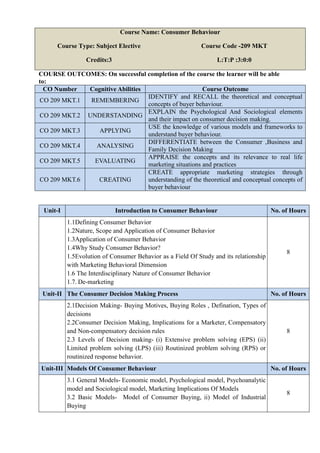
COURSE OUTCOMES: On successful completion of the course the learner will be able
to:
CO Number Cognitive Abilities Course Outcome
CO 209 MKT.1 REMEMBERING
IDENTIFY and RECALL the theoretical and conceptual
concepts of buyer behaviour.
CO 209 MKT.2 UNDERSTANDING
EXPLAIN the Psychological And Sociological elements
and their impact on consumer decision making.
CO 209 MKT.3 APPLYING
USE the knowledge of various models and frameworks to
understand buyer behaviour.
CO 209 MKT.4 ANALYSING
DIFFERENTIATE between the Consumer ,Business and
Family Decision Making
CO 209 MKT.5 EVALUATING
APPRAISE the concepts and its relevance to real life
marketing situations and practices
CO 209 MKT.6 CREATING
CREATE appropriate marketing strategies through
understanding of the theoretical and conceptual concepts of
buyer behaviour
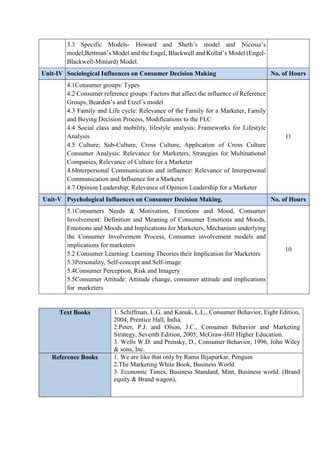
Unit-I Introduction to Consumer Behaviour No. of Hours
1.1Defining Consumer Behavior
1.2Nature, Scope and Application of Consumer Behavior
1.3Application of Consumer Behavior
1.4Why Study Consumer Behavior?
1.5Evolution of Consumer Behavior as a Field Of Study and its relationship
with Marketing Behavioral Dimension
1.6 The Interdisciplinary Nature of Consumer Behavior
1.7. De-marketing
8
Unit-II The Consumer Decision Making Process No. of Hours
2.1Decision Making- Buying Motives, Buying Roles , Defination, Types of
decisions
2.2Consumer Decision Making, Implications for a Marketer, Compensatory
and Non-compensatory decision rules
2.3 Levels of Decision making- (i) Extensive problem solving (EPS) (ii)
Limited problem solving (LPS) (iii) Routinized problem solving (RPS) or
routinized response behavior.
8
Unit-III Models Of Consumer Behaviour No. of Hours
3.1 General Models- Economic model, Psychological model, Psychoanalytic
model and Sociological model, Marketing Implications Of Models
3.2 Basic Models- Model of Consumer Buying, ii) Model of Industrial
Buying
8
Course Name: Consumer Behaviour
Course Type: Subject Elective Course Code -209 MKT
Credits:3 L:T:P :3:0:0
3.3 Specific Models- Howard and Sheth’s model and Nicosia’s
model,Bettman’s Model and the Engel, Blackwell and Kollat’s Model (Engel-
Blackwell-Miniard) Model.
Unit-IV Sociological Influences on Consumer Decision Making No. of Hours
4.1Consumer groups: Types
4.2 Consumer reference groups: Factors that affect the influence of Reference
Groups, Bearden’s and Etzel’s model
4.3 Family and Life cycle: Relevance of the Family for a Marketer, Family
and Buying Decision Process, Modifications to the FLC
4.4 Social class and mobility, lifestyle analysis: Frameworks for Lifestyle
Analysis
4.5 Culture; Sub-Culture, Cross Culture, Application of Cross Culture
Consumer Analysis: Relevance for Marketers, Strategies for Multinational
Companies, Relevance of Culture for a Marketer
4.6Interpersonal Communication and influence: Relevance of Interpersonal
Communication and Influence for a Marketer
4.7 Opinion Leadership; Relevance of Opinion Leadership for a Marketer
11
Unit-V Psychological Influences on Consumer Decision Making. No. of Hours
5.1Consumers Needs & Motivation, Emotions and Mood, Consumer
Involvement: Definition and Meaning of Consumer Emotions and Moods,
Emotions and Moods and Implications for Marketers, Mechanism underlying
the Consumer Involvement Process, Consumer involvement models and
implications for marketers
5.2 Consumer Learning: Learning Theories their Implication for Marketers
5.3Personality, Self-concept and Self-image
5.4Consumer Perception, Risk and Imagery
5.5Consumer Attitude: Attitude change, consumer attitude and implications
for marketers
10
Text Books 1. Schiffman, L.G. and Kanuk, L.L., Consumer Behavior, Eight Edition,
2004, Prentice Hall, India.
2.Peter, P.J. and Olson, J.C., Consumer Behavior and Marketing
Strategy, Seventh Edition, 2005, McGraw-Hill Higher Education.
3. Wells W.D. and Prensky, D., Consumer Behavior, 1996, John Wiley
& sons, Inc.
Reference Books 1. We are like that only by Rama Bijapurkar, Penguin
2.The Marketing White Book, Business World
3. Economic Times, Business Standard, Mint, Business world. (Brand
equity & Brand wagon),
Course Name: Consumer Behaviour
Course Type: Subject Elective
Course Code -209 MKT
Session-2
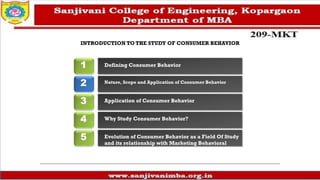
INTRODUCTION TO THE STUDY OF CONSUMER BEHAVIOR
2
3
4
5
1 Defining Consumer Behavior
Nature, Scope and Application of Consumer Behavior
Application of Consumer Behavior
Why Study Consumer Behavior?
Evolution of Consumer Behavior as a Field Of Study
and its relationship with Marketing Behavioral
Dimension
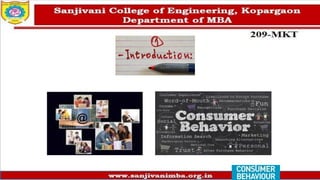
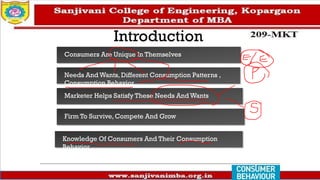
Introduction
Consumers Are Unique In Themselves
Needs And Wants, Different Consumption Patterns ,
Consumption Behavior
Marketer Helps Satisfy These Needs And Wants
Firm To Survive, Compete And Grow
Knowledge Of Consumers And Their Consumption
Behavior
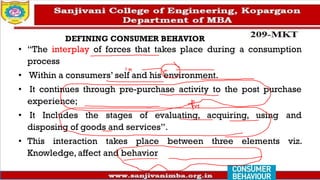
DEFINING CONSUMER BEHAVIOR
• “The interplay of forces that takes place during a consumption
process
• Within a consumers’ self and his environment.
• It continues through pre-purchase activity to the post purchase
experience;
• It Includes the stages of evaluating, acquiring, using and
disposing of goods and services”.
• This interaction takes place between three elements viz.
Knowledge, affect and behavior
What is Consumer behavior
• Explains the reasons and logic that underlie purchasing decisions
and consumption patterns
• It explains the processes through which buyers make decisions.
Cognition, Affect, Behavior
• Cognition
❑Knowledge, information processing and thinking”
❑ Includes mental processes
❑ Involved in processing of information, thinking and
interpretation of stimuli
❑ Stimuli:People, objects, things, places and events
Cognition, Affect, Behavior
• Affect
❑ “ Feelings” part.
❑Includes the favorable or unfavorable feelings and
corresponding emotions towards a stimuli
❑ Vary in direction, intensity and persistence.
Cognition, Affect, Behavior
• Behavior
❑“Visible” part.
❑ To buy or not a buy
Schiffman and Kanuk
“The behavior that consumers display
in
Searching for, Purchasing,
Using,
Evaluating
and
Disposing of products and services
that
they expect will satisfy their needs.”
SPUED
Engel, Blackwell, Miniard
Those actions directly involved
in
Obtaining,
Consuming and
Disposing of products and services
including
the Decision Processes
that PRECEDE and FOLLOW these
actions”.
American Marketing Association
“The dynamic interaction
of
Affect and cognition, behavior
and
the environment
by which human beings conduct the exchange aspects of
their lives”
Course Name: Consumer Behaviour
Course Type: Subject Elective
Course Code -209 MKT
Session-3
Session outcome:
1. Nature of CB
2. Scope of CB
Nature of Consumer Behavior
• Study is descriptive and also analytical/ interpretive.
• It is descriptive as it explains consumer decision
making and behavior in the context of individual
determinants and environmental influences.
• It is analytical/ interpretive, as against a backdrop of
theories borrowed various disciplines the study
analyzes consumption behavior of individuals alone
and in groups.
Nature of Consumer Behavior
• It is a science as well as an art.
• It uses both, theories borrowed from social sciences to understand
consumption behavior, and quantitative and qualitative tools and
techniques to predict consumer behavior
Scope of Consumer Behavior
The study of consumer behavior
deals with
Understanding consumption patterns
And
behavior.
Scope of Consumer Behavior
❑ What’ the consumers buy: Goods And Services
❑ ‘Why’ they buy it: Need And Want
❑ ‘When’ do they buy it: time: Day,Week, Month,Year, Occasions Etc.
❑ ‘Where’ they buy it: Place
❑ ‘How often they buy’ it:Time Interval
❑ ‘How often they use’ it: Frequency Of Use
Course Name: Consumer Behaviour
Course Type: Subject Elective
Course Code -209 MKT
Session-4
1.Consumer Behavior includes within its ambit, only the actual
purchasing of products and services.
a) True
b) False
2. The “consumer” includes both personal consumers and
business/industrial /organizational consumers.
a) True
b) False
3. The environmental factors affect the decision process
indirectly.
a) True
b) False
1. Consumer Behavior may be defined as:
a) the interplay of forces that takes place during a
consumption process, within a consumers’ self and
his environment.
b) decision process and physical activity during
consumption process.
c) A study that analyzes the stages of evaluating,
acquiring, using and disposing of goods and services
d) All of the above
2. The study includes within its purview, the interplay
between cognition, _____________and behavior.
a) Affect
b) Affection
c) Assurance
d) Effect
3. The study of Consumer Behavior is both a science
and an _________________..
a) art
b) Anthropology
c) Psychology
d) Sociology
Session Outcome:
1. Basic Components of CB
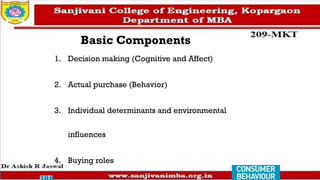
Basic Components
1. Decision making (Cognitive and Affect)
2. Actual purchase (Behavior)
3. Individual determinants and environmental
influences
4. Buying roles
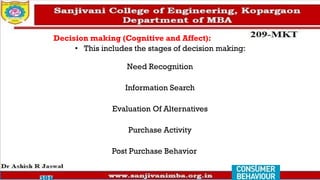
Decision making (Cognitive and Affect):
• This includes the stages of decision making:
Need Recognition
Information Search
Evaluation Of Alternatives
Purchase Activity
Post Purchase Behavior
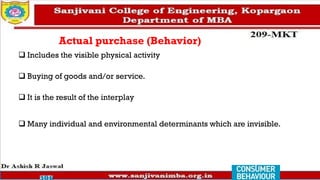
Actual purchase (Behavior)
❑ Includes the visible physical activity
❑ Buying of goods and/or service.
❑ It is the result of the interplay
❑ Many individual and environmental determinants which are invisible.
Individual Determinants And Environmental Influences
• The environmental factors affect the decision process indirectly, through
way of affecting individual determinants.
Buying Roles
• Five buying roles - Initiator, Influencer, Decider, User,
Buyer.
• Initiator is the person who identifies that there exists a
need or want
• Influencer is the one who influences the purchase
decision, the actual purchase activity and/or the use of
the product or service;
• Decider is the one who decides whether to buy, what to
buy, when to buy, from where to buy, and how to buy
• Buyer is the one who makes the actual purchase; and,
the user is the person (s) who use the product or
service
A child goes to a kindergarten school. She
comes back home and asks her parents to
buy her a set of color pencils and crayons.
1. Initiator: the child in nursery school
2. Influencer: a fellow classmate
3. Decider: the father or the mother
4. Buyer: the father or the mother
5. User: the child
• Components of Consumer Behavior
• Buying Roles
• The lady of a house who is a housewife and spends her day at home doing household
chores watches TV in her free time. That is her only source of entertainment. The TV
at home is giving problem. She desires a new TV set, and says that she wants an
LCD plasma TV
1 Initiator:
2. Influencer:
3. Decider:
4. Buyer:
5. User:
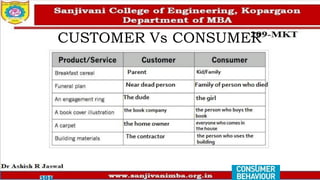
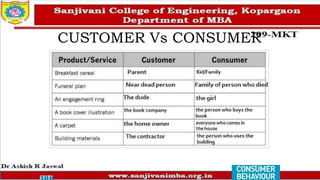
• CUSTOMER Vs CONSUMER
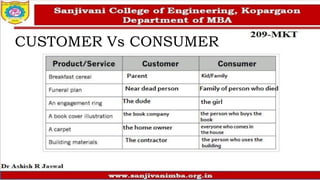
CUSTOMER Vs CONSUMER
Course Name: Consumer Behaviour
Course Type: Subject Elective
Course Code -209 MKT
Session-5
• The person who identifies that there exists a
need or want
a) Initiator:
b) Influencer:
c) Decider:
d) Buyer:
e) User:
• One who influences the purchase decision, the actual
purchase activity and/or the use of the product or service;
a) Initiator:
b) Influencer:
c) Decider:
d) Buyer:
e) User
• • One who decides whether to buy, what to buy, when to
buy, from where to buy, and how to buy
• a) Initiator:
• b) Influencer:
• c) Decider:
• d) Buyer:
• e) User:
• • One who makes the actual purchase;
and, the user is the person (s) who use the
product or service
• •
• a) Initiator:
• b) Influencer:
• c) Decider:
• d) Buyer:
Session Outcome:
1. Applications of CB
(Why Study Consumer Behavior ?)
Application of Consumer Behavior
• Is Understanding of consumer behavior is necessary for long term
success and survival of a firm?
• Marketing Concept
– determine needs and wants of the target segment and provide product and
service offerings
– customer-centered philosophy
– - “make what you can sell” rather than “sell what you make.”
Application of Consumer Behavior
1. Analysing the environment: identifying opportunities and fighting
threats.
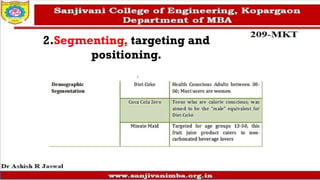
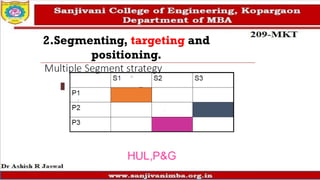
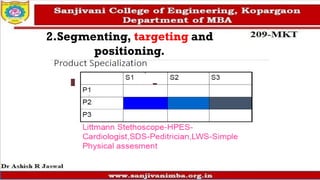
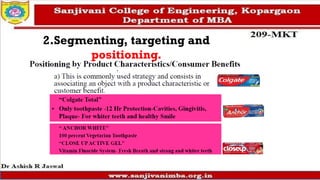
2. Segmenting, targeting and positioning.
3. Designing the marketing strategy
4. Designing the marketing-mix.
5. Governmental and Non-profit Organization and Social Marketing.
Analysing the environment: identifying
opportunities and fighting threats.
1. A time or set of circumstances that makes it possible to do
something.
a) Opportunity
b) Threat
2. A person or thing likely to cause damage or danger
a) Opportunity
b) Threat
Analysing the environment: identifying
opportunities and fighting threats.
1.The knowledge of consumer behavior can be applied to help identify
opportunities and fight threats
a) True
b) False
2. Newer customers, newer markets, unfulfilled needs and wants
a) Opportunity
b) Threat
Analysing the environment: identifying
opportunities and fighting threats.
1. Environmental is always uncertainty
a) True
b) False
2.What relates to how quickly the changes take place in the
environment
a) Dynamism
b) Complexity
2.Segmenting, targeting and
positioning.
2.Segmenting, targeting and
positioning.
2.Segmenting, targeting and
positioning.
Designing the Marketing Strategy.
• There exists interrelatedness between the Consumer, the
Environment and the Marketing strategy
Designing the Marketing Mix.
• 4 Ps
Application in Governmental and Non-profit
Organizations and Social Marketing.
• Is it relevant?
Why Study Consumer Behavior ?
• Edifice of the marketing concept
• Understand and predict the consumption patterns and consumption
behaviors
• Gain insights
• a) Analysing the environment: identifying opportunities and fighting
threats.
• b) Segmenting, targeting and positioning.
• c) Designing the marketing-mix.
• d) Designing the marketing strategy.
• e) Governmental and Non-profit Organization and Social Marketing.
Course Name: Consumer Behaviour
Course Type: Subject Elective
Course Code -209 MKT
Session-6
Application of Consumer Behavior
1. Analysing the environment: identifying opportunities and fighting
threats.
2. Segmenting, targeting and positioning.
3. Designing the marketing strategy
4. Designing the marketing-mix.
5. Governmental and Non-profit Organization and Social Marketing.
Designing the Marketing Strategy.
• There exists interrelatedness between the Consumer, the
Environment and the Marketing strategy
Designing the Marketing Mix.
• 4 Ps
Application in Governmental and Non-profit
Organizations and Social Marketing.
• Is it relevant?
Why Study Consumer Behavior ?
• Edifice of the marketing concept
• Understand and predict the consumption patterns and consumption
behaviors
• Gain insights
• a) Analysing the environment: identifying opportunities and fighting
threats.
• b) Segmenting, targeting and positioning.
• c) Designing the marketing-mix.
• d) Designing the marketing strategy.
• e) Governmental and Non-profit Organization and Social Marketing.
The Interdisciplinary Nature of Consumer Behavior
• Psychology: this includes the study of the individual as well as the
individual determinants in buying behavior
• Sociology: this includes the study of groups as well as the group
dynamics in buying behavior
• Social psychology: this includes the study of how an individual
operates in group/groups and its effects on buying behavior
• Anthropology: this is the influence of society on the individual viz.,
Cultural and cross-cultural issues in buying behavior
• Economics:This is the study of income and purchasing power, and its
impact on consumer behavior.
1. The study of the individual as well as the individual determinants in
buying behavior
a) Psychology
b) Sociology
c) Social psychology
d) Anthropology
e) Economics
2. study of groups as well as the group dynamics in buying behavior
a) Psychology
b) Sociology
c) Social psychology
d) Anthropology
3.study of how an individual operates in group/groups and its effects on
buying behavior
a) Sociology
b) Social psychology
c) Anthropology
d) Economics
4.The influence of society on the individual viz., Cultural and cross-cultural
issues in buying behavior in buying behavior
a) Psychology
b) Sociology
c) Social psychology
d) Anthropology
a) Consumer Behaviour Interdisciplinary in Nature?
True
False
Evolution of Consumer Behavior as a Field of Study and Its
Relationship with Marketing Behavioral Dimension
• Its roots in the “marketing concept
• Emerged as a separate field of study -1960
• Marketers’ attempts to study the causes of consumer behavior
• Positivism
• Interpretivism
CUSTOMER Vs CONSUMER
• CONSUMERISM
CONSUMERISM
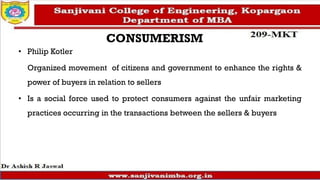
• Philip Kotler
Organized movement of citizens and government to enhance the rights &
power of buyers in relation to sellers
• Is a social force used to protect consumers against the unfair marketing
practices occurring in the transactions between the sellers & buyers
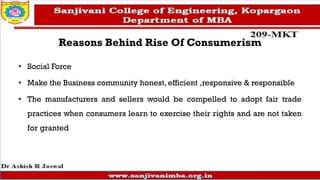
Reasons Behind Rise Of Consumerism
• Social Force
• Make the Business community honest, efficient ,responsive & responsible
• The manufacturers and sellers would be compelled to adopt fair trade
practices when consumers learn to exercise their rights and are not taken
for granted
Reasons Behind Rise of consumerism
• Viewed as an opportunity for businessman to serve the consumers in a
better and efficient manner
• Ensure that the government takes the necessary measures to protect
consumers interest by guarantying their legitimate rights
Benefits Of Consumersim
• Consumer Education
consumers need to be educated to enable them to make wise purchase
decisions
• Liaison between government & producer
• Product Research & Inform the consumers
Product Research helps in generation of more product knowledge in terms
of information related to price, ingredients, competiting Brands
❖De-Marketing
Meaning
Types
Tools
De-Marketing
• Is a strategy in which marketers intentionally try to bring down the demand of a product.
• Effort is made to decrease and not to destroy the demand.
• When the demand is more than production capacity of the company
• Demarketing is done in a particular region when that market is unprofitable
• To achieve a lowered demand, marketers use methods like raising prices, providing lesser
margins, decreasing advertising and promotion spends or introduction of new packaging.
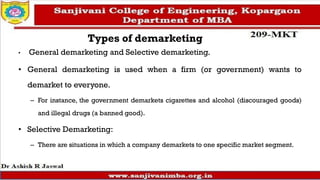
Types of demarketing
• General demarketing and Selective demarketing.
• General demarketing is used when a firm (or government) wants to
demarket to everyone.
– For instance, the government demarkets cigarettes and alcohol (discouraged goods)
and illegal drugs (a banned good).
• Selective Demarketing:
– There are situations in which a company demarkets to one specific market segment.
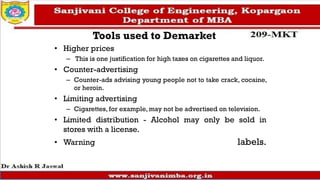
Tools used to Demarket
• Higher prices
– This is one justification for high taxes on cigarettes and liquor.
• Counter-advertising
– Counter-ads advising young people not to take crack, cocaine,
or heroin.
• Limiting advertising
– Cigarettes, for example, may not be advertised on television.
• Limited distribution - Alcohol may only be sold in
stores with a license.
• Warning labels.
Course Name: Consumer Behaviour
Course Type: Subject Elective
Course Code -209 MKT
Session-7
Session-7
• The Interdisciplinary Nature of Consumer Behavior
• Evolution of Consumer Behavior as a Field of Study and Its
Relationship with Marketing Behavioral Dimension
• CUSTOMER Vs CONSUMER
The Interdisciplinary Nature of Consumer Behavior
• Psychology: this includes the study of the individual as well as the
individual determinants in buying behavior
• Sociology: this includes the study of groups as well as the group
dynamics in buying behavior
• Social psychology: this includes the study of how an individual
operates in group/groups and its effects on buying behavior
• Anthropology: this is the influence of society on the individual viz.,
Cultural and cross-cultural issues in buying behavior
• Economics:This is the study of income and purchasing power, and its
impact on consumer behavior.
1. The study of the individual as well as the individual determinants in
buying behavior
a) Psychology
b) Sociology
c) Social psychology
d) Anthropology
e) Economics
2. study of groups as well as the group dynamics in buying behavior
a) Psychology
b) Sociology
c) Social psychology
d) Anthropology
3.study of how an individual operates in group/groups and its effects on
buying behavior
a) Sociology
b) Social psychology
c) Anthropology
d) Economics
4.The influence of society on the individual viz., Cultural and cross-cultural
issues in buying behavior in buying behavior
a) Psychology
b) Sociology
c) Social psychology
d) Anthropology
a) Consumer Behaviour Interdisciplinary in Nature?
True
False
Evolution of Consumer Behavior as a Field of Study and Its
Relationship with Marketing Behavioral Dimension
• Its roots in the “marketing concept
• Emerged as a separate field of study -1960
• Marketers’ attempts to study the causes of consumer behavior
• Positivism
• Interpretivism
CUSTOMER Vs CONSUMER
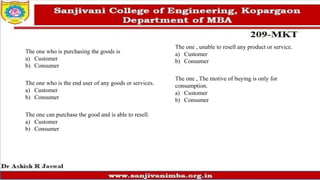
The one who is purchasing the goods is
a) Customer
b) Consumer
The one who is the end user of any goods or services.
a) Customer
b) Consumer
The one can purchase the good and is able to resell.
a) Customer
b) Consumer
The one , unable to resell any product or service.
a) Customer
b) Consumer
The one , The motive of buying is only for
consumption.
a) Customer
b) Consumer
TYPES OF CUSTOMERS
• Loyal Customer
• Discount Customers
• Impulsive Customers
• Need-Based Customers
• Wandering Customers
TYPES OF CONSUMERS
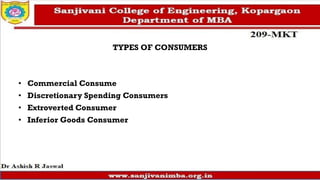
• Commercial Consume
• Discretionary Spending Consumers
• Extroverted Consumer
• Inferior Goods Consumer
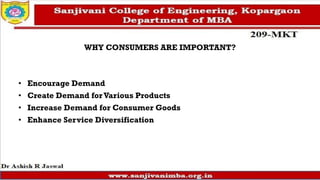
WHY CONSUMERS ARE IMPORTANT?
• Encourage Demand
• Create Demand forVarious Products
• Increase Demand for Consumer Goods
• Enhance Service Diversification
Course Name: Consumer Behaviour
Course Type: Subject Elective
Course Code -209 MKT
Session-8
Session-8
• Consumerism
• Demarketing
CONSUMERISM
• Philip Kotler
Organized movement of citizens and government to enhance the rights &
power of buyers in relation to sellers
• Is a social force used to protect consumers against the unfair marketing
practices occurring in the transactions between the sellers & buyers
Reasons Behind Rise Of Consumerism
• Social Force
• Make the Business community honest, efficient ,responsive & responsible
• The manufacturers and sellers would be compelled to adopt fair trade
practices when consumers learn to exercise their rights and are not taken
for granted
Reasons Behind Rise of consumerism
• Viewed as an opportunity for businessman to serve the consumers in a
better and efficient manner
• Ensure that the government takes the necessary measures to protect
consumers interest by guarantying their legitimate rights
Benefits Of Consumersim
• Consumer Education
consumers need to be educated to enable them to make wise purchase
decisions
• Liaison between government & producer
• Product Research & Inform the consumers
Product Research helps in generation of more product knowledge in terms
of information related to price, ingredients, competiting Brands
❖De-Marketing
Meaning
Types
Tools
De-Marketing
• Is a strategy in which marketers intentionally try to bring down the demand of a product.
• Effort is made to decrease and not to destroy the demand.
• When the demand is more than production capacity of the company
• Demarketing is done in a particular region when that market is unprofitable
• To achieve a lowered demand, marketers use methods like raising prices, providing lesser
margins, decreasing advertising and promotion spends or introduction of new packaging.
Types of demarketing
• General demarketing and Selective demarketing.
• General demarketing is used when a firm (or government) wants to
demarket to everyone.
– For instance, the government demarkets cigarettes and alcohol (discouraged goods)
and illegal drugs (a banned good).
• Selective Demarketing:
– There are situations in which a company demarkets to one specific market segment.
Tools used to Demarket
• Higher prices
– This is one justification for high taxes on cigarettes and liquor.
• Counter-advertising
– Counter-ads advising young people not to take crack, cocaine,
or heroin.
• Limiting advertising
– Cigarettes, for example, may not be advertised on television.
• Limited distribution - Alcohol may only be sold in
stores with a license.
• Warning labels.

Unit 1 209 MKT CONSUMER BEHAVIOUR

  • 1.
    COURSE OUTCOMES: Onsuccessful completion of the course the learner will be able to: CO Number Cognitive Abilities Course Outcome CO 209 MKT.1 REMEMBERING IDENTIFY and RECALL the theoretical and conceptual concepts of buyer behaviour. CO 209 MKT.2 UNDERSTANDING EXPLAIN the Psychological And Sociological elements and their impact on consumer decision making. CO 209 MKT.3 APPLYING USE the knowledge of various models and frameworks to understand buyer behaviour. CO 209 MKT.4 ANALYSING DIFFERENTIATE between the Consumer ,Business and Family Decision Making CO 209 MKT.5 EVALUATING APPRAISE the concepts and its relevance to real life marketing situations and practices CO 209 MKT.6 CREATING CREATE appropriate marketing strategies through understanding of the theoretical and conceptual concepts of buyer behaviour Unit-I Introduction to Consumer Behaviour No. of Hours 1.1Defining Consumer Behavior 1.2Nature, Scope and Application of Consumer Behavior 1.3Application of Consumer Behavior 1.4Why Study Consumer Behavior? 1.5Evolution of Consumer Behavior as a Field Of Study and its relationship with Marketing Behavioral Dimension 1.6 The Interdisciplinary Nature of Consumer Behavior 1.7. De-marketing 8 Unit-II The Consumer Decision Making Process No. of Hours 2.1Decision Making- Buying Motives, Buying Roles , Defination, Types of decisions 2.2Consumer Decision Making, Implications for a Marketer, Compensatory and Non-compensatory decision rules 2.3 Levels of Decision making- (i) Extensive problem solving (EPS) (ii) Limited problem solving (LPS) (iii) Routinized problem solving (RPS) or routinized response behavior. 8 Unit-III Models Of Consumer Behaviour No. of Hours 3.1 General Models- Economic model, Psychological model, Psychoanalytic model and Sociological model, Marketing Implications Of Models 3.2 Basic Models- Model of Consumer Buying, ii) Model of Industrial Buying 8 Course Name: Consumer Behaviour Course Type: Subject Elective Course Code -209 MKT Credits:3 L:T:P :3:0:0
  • 2.
    3.3 Specific Models-Howard and Sheth’s model and Nicosia’s model,Bettman’s Model and the Engel, Blackwell and Kollat’s Model (Engel- Blackwell-Miniard) Model. Unit-IV Sociological Influences on Consumer Decision Making No. of Hours 4.1Consumer groups: Types 4.2 Consumer reference groups: Factors that affect the influence of Reference Groups, Bearden’s and Etzel’s model 4.3 Family and Life cycle: Relevance of the Family for a Marketer, Family and Buying Decision Process, Modifications to the FLC 4.4 Social class and mobility, lifestyle analysis: Frameworks for Lifestyle Analysis 4.5 Culture; Sub-Culture, Cross Culture, Application of Cross Culture Consumer Analysis: Relevance for Marketers, Strategies for Multinational Companies, Relevance of Culture for a Marketer 4.6Interpersonal Communication and influence: Relevance of Interpersonal Communication and Influence for a Marketer 4.7 Opinion Leadership; Relevance of Opinion Leadership for a Marketer 11 Unit-V Psychological Influences on Consumer Decision Making. No. of Hours 5.1Consumers Needs & Motivation, Emotions and Mood, Consumer Involvement: Definition and Meaning of Consumer Emotions and Moods, Emotions and Moods and Implications for Marketers, Mechanism underlying the Consumer Involvement Process, Consumer involvement models and implications for marketers 5.2 Consumer Learning: Learning Theories their Implication for Marketers 5.3Personality, Self-concept and Self-image 5.4Consumer Perception, Risk and Imagery 5.5Consumer Attitude: Attitude change, consumer attitude and implications for marketers 10 Text Books 1. Schiffman, L.G. and Kanuk, L.L., Consumer Behavior, Eight Edition, 2004, Prentice Hall, India. 2.Peter, P.J. and Olson, J.C., Consumer Behavior and Marketing Strategy, Seventh Edition, 2005, McGraw-Hill Higher Education. 3. Wells W.D. and Prensky, D., Consumer Behavior, 1996, John Wiley & sons, Inc. Reference Books 1. We are like that only by Rama Bijapurkar, Penguin 2.The Marketing White Book, Business World 3. Economic Times, Business Standard, Mint, Business world. (Brand equity & Brand wagon),
  • 3.
    Course Name: ConsumerBehaviour Course Type: Subject Elective Course Code -209 MKT Session-2
  • 5.
    INTRODUCTION TO THESTUDY OF CONSUMER BEHAVIOR 2 3 4 5 1 Defining Consumer Behavior Nature, Scope and Application of Consumer Behavior Application of Consumer Behavior Why Study Consumer Behavior? Evolution of Consumer Behavior as a Field Of Study and its relationship with Marketing Behavioral Dimension
  • 6.
    Introduction Consumers Are UniqueIn Themselves Needs And Wants, Different Consumption Patterns , Consumption Behavior Marketer Helps Satisfy These Needs And Wants Firm To Survive, Compete And Grow Knowledge Of Consumers And Their Consumption Behavior
  • 7.
    DEFINING CONSUMER BEHAVIOR •“The interplay of forces that takes place during a consumption process • Within a consumers’ self and his environment. • It continues through pre-purchase activity to the post purchase experience; • It Includes the stages of evaluating, acquiring, using and disposing of goods and services”. • This interaction takes place between three elements viz. Knowledge, affect and behavior
  • 8.
    What is Consumerbehavior • Explains the reasons and logic that underlie purchasing decisions and consumption patterns • It explains the processes through which buyers make decisions.
  • 9.
    Cognition, Affect, Behavior •Cognition ❑Knowledge, information processing and thinking” ❑ Includes mental processes ❑ Involved in processing of information, thinking and interpretation of stimuli ❑ Stimuli:People, objects, things, places and events
  • 10.
    Cognition, Affect, Behavior •Affect ❑ “ Feelings” part. ❑Includes the favorable or unfavorable feelings and corresponding emotions towards a stimuli ❑ Vary in direction, intensity and persistence.
  • 11.
    Cognition, Affect, Behavior •Behavior ❑“Visible” part. ❑ To buy or not a buy
  • 12.
    Schiffman and Kanuk “Thebehavior that consumers display in Searching for, Purchasing, Using, Evaluating and Disposing of products and services that they expect will satisfy their needs.” SPUED
  • 13.
    Engel, Blackwell, Miniard Thoseactions directly involved in Obtaining, Consuming and Disposing of products and services including the Decision Processes that PRECEDE and FOLLOW these actions”.
  • 14.
    American Marketing Association “Thedynamic interaction of Affect and cognition, behavior and the environment by which human beings conduct the exchange aspects of their lives”
  • 15.
    Course Name: ConsumerBehaviour Course Type: Subject Elective Course Code -209 MKT Session-3
  • 16.
    Session outcome: 1. Natureof CB 2. Scope of CB
  • 17.
    Nature of ConsumerBehavior • Study is descriptive and also analytical/ interpretive. • It is descriptive as it explains consumer decision making and behavior in the context of individual determinants and environmental influences. • It is analytical/ interpretive, as against a backdrop of theories borrowed various disciplines the study analyzes consumption behavior of individuals alone and in groups.
  • 18.
    Nature of ConsumerBehavior • It is a science as well as an art. • It uses both, theories borrowed from social sciences to understand consumption behavior, and quantitative and qualitative tools and techniques to predict consumer behavior
  • 19.
    Scope of ConsumerBehavior The study of consumer behavior deals with Understanding consumption patterns And behavior.
  • 20.
    Scope of ConsumerBehavior ❑ What’ the consumers buy: Goods And Services ❑ ‘Why’ they buy it: Need And Want ❑ ‘When’ do they buy it: time: Day,Week, Month,Year, Occasions Etc. ❑ ‘Where’ they buy it: Place ❑ ‘How often they buy’ it:Time Interval ❑ ‘How often they use’ it: Frequency Of Use
  • 21.
    Course Name: ConsumerBehaviour Course Type: Subject Elective Course Code -209 MKT Session-4
  • 22.
    1.Consumer Behavior includeswithin its ambit, only the actual purchasing of products and services. a) True b) False 2. The “consumer” includes both personal consumers and business/industrial /organizational consumers. a) True b) False 3. The environmental factors affect the decision process indirectly. a) True b) False
  • 23.
    1. Consumer Behaviormay be defined as: a) the interplay of forces that takes place during a consumption process, within a consumers’ self and his environment. b) decision process and physical activity during consumption process. c) A study that analyzes the stages of evaluating, acquiring, using and disposing of goods and services d) All of the above 2. The study includes within its purview, the interplay between cognition, _____________and behavior. a) Affect b) Affection c) Assurance d) Effect 3. The study of Consumer Behavior is both a science and an _________________.. a) art b) Anthropology c) Psychology d) Sociology
  • 24.
    Session Outcome: 1. BasicComponents of CB
  • 25.
    Basic Components 1. Decisionmaking (Cognitive and Affect) 2. Actual purchase (Behavior) 3. Individual determinants and environmental influences 4. Buying roles
  • 26.
    Decision making (Cognitiveand Affect): • This includes the stages of decision making: Need Recognition Information Search Evaluation Of Alternatives Purchase Activity Post Purchase Behavior
  • 27.
    Actual purchase (Behavior) ❑Includes the visible physical activity ❑ Buying of goods and/or service. ❑ It is the result of the interplay ❑ Many individual and environmental determinants which are invisible.
  • 28.
    Individual Determinants AndEnvironmental Influences • The environmental factors affect the decision process indirectly, through way of affecting individual determinants.
  • 29.
    Buying Roles • Fivebuying roles - Initiator, Influencer, Decider, User, Buyer. • Initiator is the person who identifies that there exists a need or want • Influencer is the one who influences the purchase decision, the actual purchase activity and/or the use of the product or service; • Decider is the one who decides whether to buy, what to buy, when to buy, from where to buy, and how to buy • Buyer is the one who makes the actual purchase; and, the user is the person (s) who use the product or service
  • 30.
    A child goesto a kindergarten school. She comes back home and asks her parents to buy her a set of color pencils and crayons. 1. Initiator: the child in nursery school 2. Influencer: a fellow classmate 3. Decider: the father or the mother 4. Buyer: the father or the mother 5. User: the child
  • 31.
    • Components ofConsumer Behavior • Buying Roles
  • 32.
    • The ladyof a house who is a housewife and spends her day at home doing household chores watches TV in her free time. That is her only source of entertainment. The TV at home is giving problem. She desires a new TV set, and says that she wants an LCD plasma TV 1 Initiator: 2. Influencer: 3. Decider: 4. Buyer: 5. User:
  • 33.
  • 34.
  • 35.
    Course Name: ConsumerBehaviour Course Type: Subject Elective Course Code -209 MKT Session-5
  • 36.
    • The personwho identifies that there exists a need or want a) Initiator: b) Influencer: c) Decider: d) Buyer: e) User:
  • 37.
    • One whoinfluences the purchase decision, the actual purchase activity and/or the use of the product or service; a) Initiator: b) Influencer: c) Decider: d) Buyer: e) User
  • 38.
    • • Onewho decides whether to buy, what to buy, when to buy, from where to buy, and how to buy • a) Initiator: • b) Influencer: • c) Decider: • d) Buyer: • e) User:
  • 39.
    • • Onewho makes the actual purchase; and, the user is the person (s) who use the product or service • • • a) Initiator: • b) Influencer: • c) Decider: • d) Buyer:
  • 40.
    Session Outcome: 1. Applicationsof CB (Why Study Consumer Behavior ?)
  • 41.
    Application of ConsumerBehavior • Is Understanding of consumer behavior is necessary for long term success and survival of a firm? • Marketing Concept – determine needs and wants of the target segment and provide product and service offerings – customer-centered philosophy – - “make what you can sell” rather than “sell what you make.”
  • 42.
    Application of ConsumerBehavior 1. Analysing the environment: identifying opportunities and fighting threats. 2. Segmenting, targeting and positioning. 3. Designing the marketing strategy 4. Designing the marketing-mix. 5. Governmental and Non-profit Organization and Social Marketing.
  • 43.
    Analysing the environment:identifying opportunities and fighting threats. 1. A time or set of circumstances that makes it possible to do something. a) Opportunity b) Threat 2. A person or thing likely to cause damage or danger a) Opportunity b) Threat
  • 44.
    Analysing the environment:identifying opportunities and fighting threats. 1.The knowledge of consumer behavior can be applied to help identify opportunities and fight threats a) True b) False 2. Newer customers, newer markets, unfulfilled needs and wants a) Opportunity b) Threat
  • 45.
    Analysing the environment:identifying opportunities and fighting threats. 1. Environmental is always uncertainty a) True b) False 2.What relates to how quickly the changes take place in the environment a) Dynamism b) Complexity
  • 46.
  • 47.
  • 49.
  • 50.
    Designing the MarketingStrategy. • There exists interrelatedness between the Consumer, the Environment and the Marketing strategy
  • 51.
  • 52.
    Application in Governmentaland Non-profit Organizations and Social Marketing. • Is it relevant? Why Study Consumer Behavior ?
  • 53.
    Why Study ConsumerBehavior ? • Edifice of the marketing concept • Understand and predict the consumption patterns and consumption behaviors • Gain insights • a) Analysing the environment: identifying opportunities and fighting threats. • b) Segmenting, targeting and positioning. • c) Designing the marketing-mix. • d) Designing the marketing strategy. • e) Governmental and Non-profit Organization and Social Marketing.
  • 54.
    Course Name: ConsumerBehaviour Course Type: Subject Elective Course Code -209 MKT Session-6
  • 55.
    Application of ConsumerBehavior 1. Analysing the environment: identifying opportunities and fighting threats. 2. Segmenting, targeting and positioning. 3. Designing the marketing strategy 4. Designing the marketing-mix. 5. Governmental and Non-profit Organization and Social Marketing.
  • 56.
    Designing the MarketingStrategy. • There exists interrelatedness between the Consumer, the Environment and the Marketing strategy
  • 57.
  • 58.
    Application in Governmentaland Non-profit Organizations and Social Marketing. • Is it relevant? Why Study Consumer Behavior ?
  • 59.
    Why Study ConsumerBehavior ? • Edifice of the marketing concept • Understand and predict the consumption patterns and consumption behaviors • Gain insights • a) Analysing the environment: identifying opportunities and fighting threats. • b) Segmenting, targeting and positioning. • c) Designing the marketing-mix. • d) Designing the marketing strategy. • e) Governmental and Non-profit Organization and Social Marketing.
  • 60.
    The Interdisciplinary Natureof Consumer Behavior • Psychology: this includes the study of the individual as well as the individual determinants in buying behavior • Sociology: this includes the study of groups as well as the group dynamics in buying behavior • Social psychology: this includes the study of how an individual operates in group/groups and its effects on buying behavior • Anthropology: this is the influence of society on the individual viz., Cultural and cross-cultural issues in buying behavior • Economics:This is the study of income and purchasing power, and its impact on consumer behavior.
  • 61.
    1. The studyof the individual as well as the individual determinants in buying behavior a) Psychology b) Sociology c) Social psychology d) Anthropology e) Economics 2. study of groups as well as the group dynamics in buying behavior a) Psychology b) Sociology c) Social psychology d) Anthropology
  • 62.
    3.study of howan individual operates in group/groups and its effects on buying behavior a) Sociology b) Social psychology c) Anthropology d) Economics 4.The influence of society on the individual viz., Cultural and cross-cultural issues in buying behavior in buying behavior a) Psychology b) Sociology c) Social psychology d) Anthropology
  • 63.
    a) Consumer BehaviourInterdisciplinary in Nature? True False
  • 64.
    Evolution of ConsumerBehavior as a Field of Study and Its Relationship with Marketing Behavioral Dimension • Its roots in the “marketing concept • Emerged as a separate field of study -1960 • Marketers’ attempts to study the causes of consumer behavior • Positivism • Interpretivism
  • 65.
  • 66.
  • 67.
    CONSUMERISM • Philip Kotler Organizedmovement of citizens and government to enhance the rights & power of buyers in relation to sellers • Is a social force used to protect consumers against the unfair marketing practices occurring in the transactions between the sellers & buyers
  • 68.
    Reasons Behind RiseOf Consumerism • Social Force • Make the Business community honest, efficient ,responsive & responsible • The manufacturers and sellers would be compelled to adopt fair trade practices when consumers learn to exercise their rights and are not taken for granted
  • 69.
    Reasons Behind Riseof consumerism • Viewed as an opportunity for businessman to serve the consumers in a better and efficient manner • Ensure that the government takes the necessary measures to protect consumers interest by guarantying their legitimate rights
  • 70.
    Benefits Of Consumersim •Consumer Education consumers need to be educated to enable them to make wise purchase decisions • Liaison between government & producer • Product Research & Inform the consumers Product Research helps in generation of more product knowledge in terms of information related to price, ingredients, competiting Brands
  • 71.
  • 72.
    De-Marketing • Is astrategy in which marketers intentionally try to bring down the demand of a product. • Effort is made to decrease and not to destroy the demand. • When the demand is more than production capacity of the company • Demarketing is done in a particular region when that market is unprofitable • To achieve a lowered demand, marketers use methods like raising prices, providing lesser margins, decreasing advertising and promotion spends or introduction of new packaging.
  • 73.
    Types of demarketing •General demarketing and Selective demarketing. • General demarketing is used when a firm (or government) wants to demarket to everyone. – For instance, the government demarkets cigarettes and alcohol (discouraged goods) and illegal drugs (a banned good). • Selective Demarketing: – There are situations in which a company demarkets to one specific market segment.
  • 74.
    Tools used toDemarket • Higher prices – This is one justification for high taxes on cigarettes and liquor. • Counter-advertising – Counter-ads advising young people not to take crack, cocaine, or heroin. • Limiting advertising – Cigarettes, for example, may not be advertised on television. • Limited distribution - Alcohol may only be sold in stores with a license. • Warning labels.
  • 75.
    Course Name: ConsumerBehaviour Course Type: Subject Elective Course Code -209 MKT Session-7
  • 76.
    Session-7 • The InterdisciplinaryNature of Consumer Behavior • Evolution of Consumer Behavior as a Field of Study and Its Relationship with Marketing Behavioral Dimension • CUSTOMER Vs CONSUMER
  • 77.
    The Interdisciplinary Natureof Consumer Behavior • Psychology: this includes the study of the individual as well as the individual determinants in buying behavior • Sociology: this includes the study of groups as well as the group dynamics in buying behavior • Social psychology: this includes the study of how an individual operates in group/groups and its effects on buying behavior • Anthropology: this is the influence of society on the individual viz., Cultural and cross-cultural issues in buying behavior • Economics:This is the study of income and purchasing power, and its impact on consumer behavior.
  • 78.
    1. The studyof the individual as well as the individual determinants in buying behavior a) Psychology b) Sociology c) Social psychology d) Anthropology e) Economics 2. study of groups as well as the group dynamics in buying behavior a) Psychology b) Sociology c) Social psychology d) Anthropology
  • 79.
    3.study of howan individual operates in group/groups and its effects on buying behavior a) Sociology b) Social psychology c) Anthropology d) Economics 4.The influence of society on the individual viz., Cultural and cross-cultural issues in buying behavior in buying behavior a) Psychology b) Sociology c) Social psychology d) Anthropology
  • 80.
    a) Consumer BehaviourInterdisciplinary in Nature? True False
  • 81.
    Evolution of ConsumerBehavior as a Field of Study and Its Relationship with Marketing Behavioral Dimension • Its roots in the “marketing concept • Emerged as a separate field of study -1960 • Marketers’ attempts to study the causes of consumer behavior • Positivism • Interpretivism
  • 82.
  • 83.
    The one whois purchasing the goods is a) Customer b) Consumer The one who is the end user of any goods or services. a) Customer b) Consumer The one can purchase the good and is able to resell. a) Customer b) Consumer The one , unable to resell any product or service. a) Customer b) Consumer The one , The motive of buying is only for consumption. a) Customer b) Consumer
  • 84.
    TYPES OF CUSTOMERS •Loyal Customer • Discount Customers • Impulsive Customers • Need-Based Customers • Wandering Customers
  • 85.
    TYPES OF CONSUMERS •Commercial Consume • Discretionary Spending Consumers • Extroverted Consumer • Inferior Goods Consumer
  • 86.
    WHY CONSUMERS AREIMPORTANT? • Encourage Demand • Create Demand forVarious Products • Increase Demand for Consumer Goods • Enhance Service Diversification
  • 87.
    Course Name: ConsumerBehaviour Course Type: Subject Elective Course Code -209 MKT Session-8
  • 88.
  • 89.
    CONSUMERISM • Philip Kotler Organizedmovement of citizens and government to enhance the rights & power of buyers in relation to sellers • Is a social force used to protect consumers against the unfair marketing practices occurring in the transactions between the sellers & buyers
  • 90.
    Reasons Behind RiseOf Consumerism • Social Force • Make the Business community honest, efficient ,responsive & responsible • The manufacturers and sellers would be compelled to adopt fair trade practices when consumers learn to exercise their rights and are not taken for granted
  • 91.
    Reasons Behind Riseof consumerism • Viewed as an opportunity for businessman to serve the consumers in a better and efficient manner • Ensure that the government takes the necessary measures to protect consumers interest by guarantying their legitimate rights
  • 92.
    Benefits Of Consumersim •Consumer Education consumers need to be educated to enable them to make wise purchase decisions • Liaison between government & producer • Product Research & Inform the consumers Product Research helps in generation of more product knowledge in terms of information related to price, ingredients, competiting Brands
  • 93.
  • 94.
    De-Marketing • Is astrategy in which marketers intentionally try to bring down the demand of a product. • Effort is made to decrease and not to destroy the demand. • When the demand is more than production capacity of the company • Demarketing is done in a particular region when that market is unprofitable • To achieve a lowered demand, marketers use methods like raising prices, providing lesser margins, decreasing advertising and promotion spends or introduction of new packaging.
  • 95.
    Types of demarketing •General demarketing and Selective demarketing. • General demarketing is used when a firm (or government) wants to demarket to everyone. – For instance, the government demarkets cigarettes and alcohol (discouraged goods) and illegal drugs (a banned good). • Selective Demarketing: – There are situations in which a company demarkets to one specific market segment.
  • 96.
    Tools used toDemarket • Higher prices – This is one justification for high taxes on cigarettes and liquor. • Counter-advertising – Counter-ads advising young people not to take crack, cocaine, or heroin. • Limiting advertising – Cigarettes, for example, may not be advertised on television. • Limited distribution - Alcohol may only be sold in stores with a license. • Warning labels.