Download to read offline
![Journal of Electronics and Communication Engineering & Technology (JECET) ISSN
2347–4181 (Print), ISSN 2347 – 419X (Online), Volume 1, Issue 1, July-December(2013)
21
CCLVR: COOPERATIVE CHANNEL LOAD AWARE VOIP ROUTING
TOPOLOGY FOR 802.11 WLAN
Mohammed Sirajuddin1,
Dr D. Rajya Lakshmi2
and Dr Syed Abdul Sattar3
1
Royal Institute of Technology and Science, Chevella, Hyderabad, India.
2
Gitam Institute of Technology, Gitam University, Vizag, India.
3
Royal Institute of Technology and Science, Chevella, Hyderabad, India.
ABSTRACT
In this paper, we propose a new cooperative channel load aware VoIP routing topology
for 802.11 WLAN networks. Cooperative Channel based 802.11 WLAN networks have been
proposed as an addition to the conventional single-hop 802.11 WLAN networks by joining the
fixed cellular infrastructure with the Cooperative Channel transmitting technology that is
frequently used in ad hoc networks. Due to the potential of the Cooperative Channel
transmitting to enhance coverage, ability and flexibility, the Cooperative Channel based 802.11
WLAN networks have been drawing considerable notice. This approach of augmenting cellular
communication with Cooperative Channel transmitting was also used in the consistency effort to
include the Cooperative Channel transmitting into the third-generation (3G) mobile
communication systems [1].
Keyword: 802.11, WLAN, congestion control, ad hoc network, QoS and CCLVR
1. INTRODUCTION
The main advantage of the Cooperative Channel transmitting arrives from the reduction
in the overall path loss among a Base node (BN) and a Receiving node (RN) [2]. The
simultaneous transmission [3] can improve the system capacity of the Cooperative Channel
based 802.11 WLAN networks. Furthermore, more than a few studies accounted that it is not
easy to improve the capacity of code-division multiple-access (CDMA) systems by utilize of the
Cooperative Channel transmitting [5, 6, 7, 8, and 9]. In 802.11 WLAN networks, there is a
transaction difficulty between system throughput and QoS fairness [4]. Since the received signal
quality depends on the user location, it is not easy to give an even QoS over the entire cell
service region and to maximize the system throughput at the similar time. The Cooperative
Channel transmitting technology has been future as one of the key technologies for the self-
configuring 802.11 WLAN networks [10], [11], there have been merely little numerical results
clarifying how the self-configuring feature achieved during the Cooperative Channel
transmitting can develop the system ability for non consistently distributed traffic case.
Journal of Electronics and Communication Engineering &
Technology (JECET)
ISSN 2347-4181 (Print)
ISSN 2347-419X (Online)
Volume 1, Issue 1, July-December (2013), pp. 21-26
© IAEME: http://www.iaeme.com/JECET.asp
JECET
© I A E M E](https://image.slidesharecdn.com/40520130101003-131011025308-phpapp02/85/40520130101003-1-320.jpg)
![Journal of Electronics and Communication Engineering & Technology (JECET) ISSN
2347–4181 (Print), ISSN 2347 – 419X (Online), Volume 1, Issue 1, July-December(2013)
21
CCLVR: COOPERATIVE CHANNEL LOAD AWARE VOIP ROUTING
TOPOLOGY FOR 802.11 WLAN
Mohammed Sirajuddin1,
Dr D. Rajya Lakshmi2
and Dr Syed Abdul Sattar3
1
Royal Institute of Technology and Science, Chevella, Hyderabad, India.
2
Gitam Institute of Technology, Gitam University, Vizag, India.
3
Royal Institute of Technology and Science, Chevella, Hyderabad, India.
ABSTRACT
In this paper, we propose a new cooperative channel load aware VoIP routing topology
for 802.11 WLAN networks. Cooperative Channel based 802.11 WLAN networks have been
proposed as an addition to the conventional single-hop 802.11 WLAN networks by joining the
fixed cellular infrastructure with the Cooperative Channel transmitting technology that is
frequently used in ad hoc networks. Due to the potential of the Cooperative Channel
transmitting to enhance coverage, ability and flexibility, the Cooperative Channel based 802.11
WLAN networks have been drawing considerable notice. This approach of augmenting cellular
communication with Cooperative Channel transmitting was also used in the consistency effort to
include the Cooperative Channel transmitting into the third-generation (3G) mobile
communication systems [1].
Keyword: 802.11, WLAN, congestion control, ad hoc network, QoS and CCLVR
1. INTRODUCTION
The main advantage of the Cooperative Channel transmitting arrives from the reduction
in the overall path loss among a Base node (BN) and a Receiving node (RN) [2]. The
simultaneous transmission [3] can improve the system capacity of the Cooperative Channel
based 802.11 WLAN networks. Furthermore, more than a few studies accounted that it is not
easy to improve the capacity of code-division multiple-access (CDMA) systems by utilize of the
Cooperative Channel transmitting [5, 6, 7, 8, and 9]. In 802.11 WLAN networks, there is a
transaction difficulty between system throughput and QoS fairness [4]. Since the received signal
quality depends on the user location, it is not easy to give an even QoS over the entire cell
service region and to maximize the system throughput at the similar time. The Cooperative
Channel transmitting technology has been future as one of the key technologies for the self-
configuring 802.11 WLAN networks [10], [11], there have been merely little numerical results
clarifying how the self-configuring feature achieved during the Cooperative Channel
transmitting can develop the system ability for non consistently distributed traffic case.
Journal of Electronics and Communication Engineering &
Technology (JECET)
ISSN 2347-4181 (Print)
ISSN 2347-419X (Online)
Volume 1, Issue 1, July-December (2013), pp. 21-26
© IAEME: http://www.iaeme.com/JECET.asp
JECET
© I A E M E](https://image.slidesharecdn.com/40520130101003-131011025308-phpapp02/75/40520130101003-1-2048.jpg)
![Journal of Electronics and Communication Engineering & Technology (JECET) ISSN
2347–4181 (Print), ISSN 2347 – 419X (Online), Volume 1, Issue 1, July-December(2013)
22
Although Wu et al.[12] evaluated the capacity of the Cooperative Channel system with non
consistent traffic, such that when the traffic among adjacent cells is unstable, that chapter
focused only on the channel borrowing between adjacent cells through Cooperative Channel
transmitting.
The paper is organized as follows: Section 2 briefly describes the Network
Architecture and challenges. Section 3 describes Detection of Concurrent Transmission
Scenarios Section 4 briefly describes Defining and Deriving the Greedy Approach Section 5
describes the Implementation methodology and results Section 6 concludes the paper.
2. NETWORK ARCHITECTURE AND CHALLENGES
In an 802.11 WLAN networks with frame-based transmissions, base Station attach to
transmission node and/or receiving node, and every transmission node can attach further to
additional transmission node and/or receiving node. Relay node only forwards traffic to
receiving node and produce no traffic of its own. Relay node is visible to a receiving node, and
receiving node does not engage in routing packets for additional receiving node. Base node,
transmission node, and receiving node all share the similar spectrum, thus no additional
hardware such as a second physical interface is required. Base node needs to meet the downlink
real time queue range of its related transmission node and this queue information is sent to the
base node with uplink bandwidth. The resulting signaling change due to uplink queue status
report is unimportant, and the matching uplink bandwidth consumption is neglect able. After
gathering transmission node queue
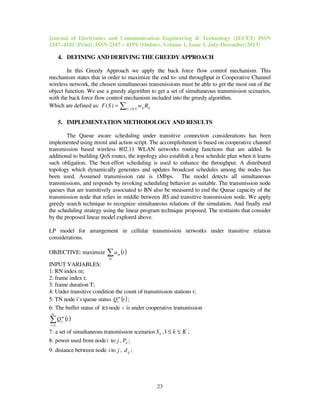
Implementation of Scheduling Algorithm under Linear Programming:
A linear programming model to implement the scheduling algorithm for 802.11 WLAN
Cooperative Channel transmission network. The main advantages of this algorithm are
Restraint 1: Derives the throughput for Mobile Station node in border, informative the
simultaneous broadcast nature of the multi hops 802.11 WLAN networks.
Restraint 2: Indicates the queue consciousness of the proposed preparation algorithm by
monitoring
Restraint 3: The dynamic TN queue status and this queue consciousness are not addressed by the
associated work. The capacity restraint of a link in situation Sk.
Restraint 4: Applies Shannon’s Theorem to compute the upper bound of link data rate with
thought of the obstruction caused by simultaneous transmissions.
Restraint 5: The time moderation of all simultaneous scenarios in a frame is stated by this
restraint, suggestive of the frame-based characteristic of this approach.
Restraint 6: Transitive relation between BN and TN will be careful and this restraint power the
real delay calculated at TN that connected directly to the BN.
3. DETECTION OF CONCURRENT TRANSMISSION SCENARIOS
The number of links grows non-linearly with the number of nodes in the network; it is
unpractical to use a comprehensive algorithm to search for all probable scenarios. We use a
linear programming model confirmed to compute the transmission schedules for all
simultaneous transmission scenarios, aiming at maximizing the throughput in each frame. Here
we consider the transmission schedules those subjective by the transitive relations between BN
and TN.](https://image.slidesharecdn.com/40520130101003-131011025308-phpapp02/85/40520130101003-2-320.jpg)
![Journal of Electronics and Communication Engineering & Technology (JECET) ISSN
2347–4181 (Print), ISSN 2347 – 419X (Online), Volume 1, Issue 1, July-December(2013)
25
Figure 2: Fairness Comparison report
6. CONCLUSION
We have offered a Transitive relation aware scheduling algorithm for Cooperative
Channel transmission 802.11 WLAN networks. Through our analysis, we dispute that following
a centralized approach for building cellular transmission networks best reflects the interest of the
802.11 WLAN networks. This central approach implies that transmission stations and receiving
nodes do not form ad hoc networks and they are under the control of the base node. Other choices
of building transmission 802.11 WLAN networks we follow include using in-band spectrum of
transmission stations, not permit receiving nodes to provide as transmission stations, and
applying a centralized scheduling algorithm. An essential scheduling algorithm is developed and
all BS will run this. In this algorithm, initially a set of simultaneous transmission scenarios is
resting and then it is used as input for a linear programming model that decide the transmission
schedules for the cooperative channel transmission network. The linear programming model aims
at maximizing the overall throughput of the all the receiving nodes, while taking into attention the
frame-based environment of 802.11 WLAN networks and the dynamic queue modify in the
transmission stations. The features of frame-based and queue-awareness of the scheduling
algorithm are the single assistance that has not been addressed by previous efforts. Simulations
evaluate performance metrics such as throughput and equality of the proposed scheduling
algorithm. Two extra scheduling algorithms are evaluated with our approach via simulations. One
is scheduling for straight transmission only, and the other is scheduling with no buffer in the
transmission nodes. The efficiency of our approach is validated by the simulation results.
REFERENCES
[1] 3GPP TR25.924, “Opportunity driven multiple access,” 3GPP, ver. 1.0.0, Dec. 1999.
[2] TR 101 146, “UMTS; UTRA; Concept evaluation (UMTS 30.06),” ETSI, ver. 3.0.0, Dec.
1997.
[3] S. Toumpis and A. Goldsmith, “Capacity regions for wireless ad hoc networks,” in Proc.
IEEE ICC 2002, New York, Apr. 2002, pp. 3168–3173.
[4] M. Airy and K. Rohani, “QoS and fairness for CDMA packer data,” in Proc. IEEE
Vehicular Technology Conf. 2000 Spring, Tokyo, Japan, May 2000, pp. 450–454.](https://image.slidesharecdn.com/40520130101003-131011025308-phpapp02/85/40520130101003-5-320.jpg)
![Journal of Electronics and Communication Engineering & Technology (JECET) ISSN
2347–4181 (Print), ISSN 2347 – 419X (Online), Volume 1, Issue 1, July-December(2013)
26
[5] A. Fujiwara et al., “Area coverage and capacity enhancement by multi hop connection of
CDMA cellular network,” in Proc. IEEE Vehicular Technology Conf. 2002 Fall,
Vancouver, BC, Canada, Sept. 2002, pp. 2371–2374.
[6] A. N. Zadeh and B. Jabbari, “Performance analysis of multi hop packet CDMA cellular
networks,” in Proc. IEEE GLOBECOM 2001, San Antonio, TX, Nov. 2001, pp. 2875–
2879.
[7] T. J. Harrold and A. R. Nix, “Performance analysis of intelligent relaying in UTRA TDD,”
in Proc. IEEE Vehicular Technology Conf. 2002 Fall, Vancouver, BC, Canada, Sept. 2002,
pp. 1374–1378.
[8] T. Rouse, S. McLaughlin, and H. Haas, “Coverage-capacity analysis of opportunity driven
multiple access (ODMA) in UTRA TDD,” in Proc. IEE 3G Mobile Communication
Technologies, Mar. 2001, pp. 252–256.
[9] T. Rouse, I. Band, and S. McLaughlin, “Capacity and power investigation of opportunity
driven multiple access (ODMA) networks in TDDCDMA based systems,” in Proc. IEEE
ICC 2002, New York, Apr. 2002, pp. 3202–3206.
[10] A. G. Spilling, A. R. Nix, M. A. Beach, and T. J. Harrold, “Self-organization in future
mobile communications,” Electron. Commun. Eng. J., pp. 133–147, June 2000.
[11] R. Becher,M. Dillinger,M. Haardt, andW. Mohr, “Broad-band wireless access and future
communication networks,” Proc. IEEE, vol. 89, pp. 58–75, Jan. 2001.
[12] H. Wu, C. Qiao, W. De, and O. Tonguz, “Integrated cellular and ad hoc relaying systems:
iCAR,” IEEE J. Select. Areas Commun., vol. 19, pp. 2105–2115, Oct. 2001.](https://image.slidesharecdn.com/40520130101003-131011025308-phpapp02/85/40520130101003-6-320.jpg)

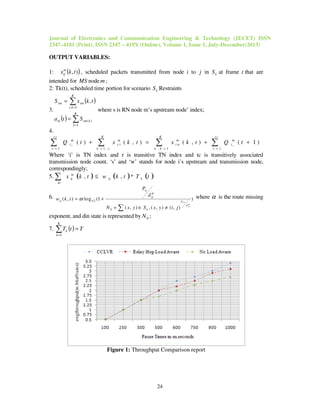
This document summarizes a research paper that proposes a new cooperative channel load aware VoIP routing topology for 802.11 WLAN networks. It introduces the concept of cooperative channel transmitting technology for 802.11 WLAN networks and discusses some of the challenges in providing quality of service guarantees. It then presents a linear programming model and scheduling algorithm to implement cooperative channel transmissions while considering queue status and transitive node relationships to maximize throughput. Simulation results show that the proposed scheduling algorithm improves throughput and fairness compared to alternatives.


![4..[26 36]signal strength based congestion control in manet](https://cdn.slidesharecdn.com/ss_thumbnails/4-26-36signalstrengthbasedcongestioncontrolinmanet-111207105132-phpapp01-thumbnail.jpg?width=640&height=640&fit=bounds)


