Secondary Traumatic Stress
Impact on Mental Health Workers
History and Issue Development
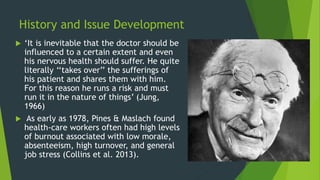
 ‘It is inevitable that the doctor should be
influenced to a certain extent and even
his nervous health should suffer. He quite
literally ‘‘takes over’’ the sufferings of
his patient and shares them with him.
For this reason he runs a risk and must
run it in the nature of things’ (Jung,
1966)
 As early as 1978, Pines & Maslach found
health-care workers often had high levels
of burnout associated with low morale,
absenteeism, high turnover, and general
job stress (Collins et al. 2013).
History and Issue Development
 McCann & Pearlman (1990) described Vicarious Traumatization
as “the transformation in the inner experience of the therapist
that comes about as a result of empathetic engagement with
clients’ trauma material.”
 Figley (1995) described Secondary Traumatic Stress as the
natural consequent behaviors and emotions resulting from
knowing about a traumatizing event experienced by a
significant other – the stress resulting from helping or
wanting to help a traumatized or suffering person”
 Since the creation of this concept, development has been
limited by unclear definitions, a lack of research, and a focus
too specifically on selective groups of trauma therapists
(Dunkley and Whelan, 2006).
Plurality of terms
 Secondary Traumatic Stress: PTSD symptoms in caregivers, likely connected
to the patient’s experience rather than that of the caregiver (Figley 1995) He
later changed the name to Compassion Fatigue.
 Vicarious Traumatization: the enduring psychological consequences for
therapists of exposure to the traumatic experiences of victim clients
(Schauben & Frazier 1995).
Symptoms
 Symptoms much like PTSD, changes in frame of
reference, identity, sense of safety, ability to
trust, self-esteem, intimacy, and a sense of
control (Bloom)
 Also includes somatic complaints, like sleep
difficulty, headaches or gastrointestinal distress
(Herman 1992, Figley 1995)
 Chose to focus on STS because it tends to have
more outward, easily diagnosable symptoms rather
than internal cognitive shifts that may be difficult
to recognize
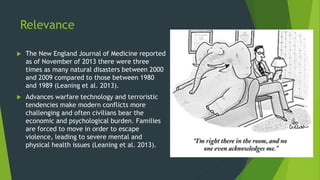
Relevance
 The New England Journal of Medicine reported
as of November of 2013 there were three
times as many natural disasters between 2000
and 2009 compared to those between 1980
and 1989 (Leaning et al. 2013).
 Advances warfare technology and terroristic
tendencies make modern conflicts more
challenging and often civilians bear the
economic and psychological burden. Families
are forced to move in order to escape
violence, leading to severe mental and
physical health issues (Leaning et al. 2013).
Hazard Assessment
A hazard is defined as "Condition, event, or circumstance that could lead to or
contribute to an unplanned or undesirable event", such as the development of
disease or disorder.
The primary reason for assessing hazards is to attempt to prevent them from
happening.
Hazard Assessment
(1) Having a personal history of trauma is linked to the development of VT. Level-
of-evidence: Persuasive (Camerlengo, 2002; Dickes, 1998; Pearlman & MacIan,
1995; Schauben & Frazier, 1995; Trippany, 2000; Young, 1999).
(2) Having a personal history of trauma is linked to the development of STS. Level-
of-evidence: Reasonable (Allt, 1999; Dickes, 1998; Nelson-Gardell & Harris, 2003;
Price, 2001).
(3) Having a personal trauma history is not linked to the development of STS.
Level-of-evidence: Reasonable (Creamer, 2002; Follette, Polusny, & Milbeck;
1994; Simonds, 1996).
Hazard Assessment
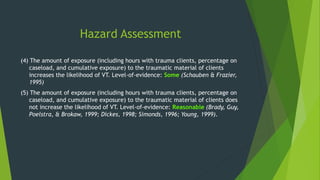
(4) The amount of exposure (including hours with trauma clients, percentage on
caseload, and cumulative exposure) to the traumatic material of clients
increases the likelihood of VT. Level-of-evidence: Some (Schauben & Frazier,
1995)
(5) The amount of exposure (including hours with trauma clients, percentage on
caseload, and cumulative exposure) to the traumatic material of clients does
not increase the likelihood of VT. Level-of-evidence: Reasonable (Brady, Guy,
Poelstra, & Brokaw, 1999; Dickes, 1998; Simonds, 1996; Young, 1999).
Hazard Assessment
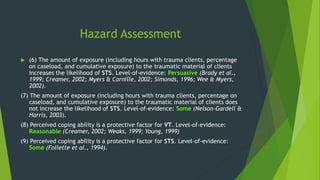
 (6) The amount of exposure (including hours with trauma clients, percentage
on caseload, and cumulative exposure) to the traumatic material of clients
increases the likelihood of STS. Level-of-evidence: Persuasive (Brady et al.,
1999; Creamer, 2002; Myers & Cornille, 2002; Simonds, 1996; Wee & Myers,
2002).
(7) The amount of exposure (including hours with trauma clients, percentage on
caseload, and cumulative exposure) to the traumatic material of clients does
not increase the likelihood of STS. Level-of-evidence: Some (Nelson-Gardell &
Harris, 2003).
(8) Perceived coping ability is a protective factor for VT. Level-of-evidence:
Reasonable (Creamer, 2002; Weaks, 1999; Young, 1999)
(9) Perceived coping ability is a protective factor for STS. Level-of-evidence:
Some (Follette et al., 1994).
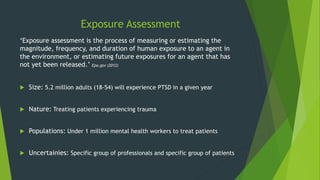
Exposure Assessment
‘Exposure assessment is the process of measuring or estimating the
magnitude, frequency, and duration of human exposure to an agent in
the environment, or estimating future exposures for an agent that has
not yet been released.’ Epa.gov (2012)
 Size: 5.2 million adults (18-54) will experience PTSD in a given year
 Nature: Treating patients experiencing trauma
 Populations: Under 1 million mental health workers to treat patients
 Uncertainies: Specific group of professionals and specific group of patients
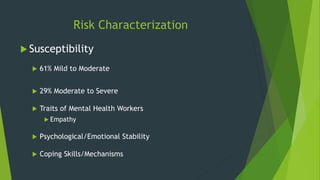
Risk Characterization
 Susceptibility
 61% Mild to Moderate
 29% Moderate to Severe
 Traits of Mental Health Workers
 Empathy
 Psychological/Emotional Stability
 Coping Skills/Mechanisms
Risk Characterization
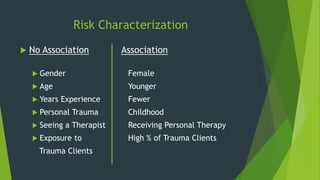
 No Association Association
 Gender Female
 Age Younger
 Years Experience Fewer
 Personal Trauma Childhood
 Seeing a Therapist Receiving Personal Therapy
 Exposure to High % of Trauma Clients
Trauma Clients
Risk Characterization
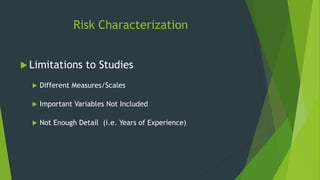
 Limitations to Studies
 Different Measures/Scales
 Important Variables Not Included
 Not Enough Detail (i.e. Years of Experience)
Risk Characterization
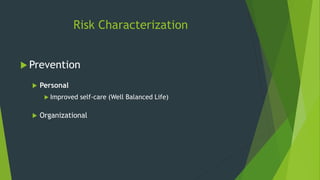
 Prevention
 Personal
 Improved self-care (Well Balanced Life)
 Organizational
Policy/Regulatory/Legal Solutions
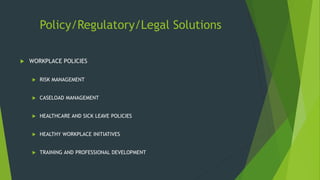
 WORKPLACE POLICIES
 RISK MANAGEMENT
 CASELOAD MANAGEMENT
 HEALTHCARE AND SICK LEAVE POLICIES
 HEALTHY WORKPLACE INITIATIVES
 TRAINING AND PROFESSIONAL DEVELOPMENT
POLICY/REGULATORY/LEGAL SOLUTIONS
CONTINUED
 LAWS AND REGULATIONS
 MENTAL HEALTH PARITY AND ADDICTION EQUITY ACT AND STATE PARITY LAWS
 WORKERS COMPENSATION
 AMERICANS WITH DISABILITIES ACT
 FAMILY MEDICAL LEAVE ACT
 AFFORDABLE CARE ACT
GAPS IN SOLUTIONS
 OVERLAPPING AND INCONSISTENT DEFINITIONS
 QUANTITATIVE STUDIES
 AGREED UPON TREATMENT OPTIONS
 INCLUSION IN THE DIAGNOSTIC STATISTICAL MANUAL OF MENTAL DISORDERS (DSM)
 BIAS AND STIGMA RECOGNIZING AND TREATING MENTAL HEALTH ISSUES
UNINTENDED CONSEQUENCES
COUNSELORS MUST PERSONALLY ENDURE REPEATED EXPOSURE TO DISTRESS AND
USE THEIR OWN FEELINGS OF SORROW AS TOOLS FOR THERAPY. AS SUCH, IT IS
IMPOSSIBLE TO ESACPE THIS KIND OF WORK WITHOUT PERSONAL CONSEQUENCES.
(CAMPBELL, 2002)

4 secondary traumatic stress

  • 1.
    Secondary Traumatic Stress Impacton Mental Health Workers
  • 2.
    History and IssueDevelopment  ‘It is inevitable that the doctor should be influenced to a certain extent and even his nervous health should suffer. He quite literally ‘‘takes over’’ the sufferings of his patient and shares them with him. For this reason he runs a risk and must run it in the nature of things’ (Jung, 1966)  As early as 1978, Pines & Maslach found health-care workers often had high levels of burnout associated with low morale, absenteeism, high turnover, and general job stress (Collins et al. 2013).
  • 3.
    History and IssueDevelopment  McCann & Pearlman (1990) described Vicarious Traumatization as “the transformation in the inner experience of the therapist that comes about as a result of empathetic engagement with clients’ trauma material.”  Figley (1995) described Secondary Traumatic Stress as the natural consequent behaviors and emotions resulting from knowing about a traumatizing event experienced by a significant other – the stress resulting from helping or wanting to help a traumatized or suffering person”  Since the creation of this concept, development has been limited by unclear definitions, a lack of research, and a focus too specifically on selective groups of trauma therapists (Dunkley and Whelan, 2006).
  • 4.
    Plurality of terms Secondary Traumatic Stress: PTSD symptoms in caregivers, likely connected to the patient’s experience rather than that of the caregiver (Figley 1995) He later changed the name to Compassion Fatigue.  Vicarious Traumatization: the enduring psychological consequences for therapists of exposure to the traumatic experiences of victim clients (Schauben & Frazier 1995).
  • 5.
    Symptoms  Symptoms muchlike PTSD, changes in frame of reference, identity, sense of safety, ability to trust, self-esteem, intimacy, and a sense of control (Bloom)  Also includes somatic complaints, like sleep difficulty, headaches or gastrointestinal distress (Herman 1992, Figley 1995)  Chose to focus on STS because it tends to have more outward, easily diagnosable symptoms rather than internal cognitive shifts that may be difficult to recognize
  • 6.
    Relevance  The NewEngland Journal of Medicine reported as of November of 2013 there were three times as many natural disasters between 2000 and 2009 compared to those between 1980 and 1989 (Leaning et al. 2013).  Advances warfare technology and terroristic tendencies make modern conflicts more challenging and often civilians bear the economic and psychological burden. Families are forced to move in order to escape violence, leading to severe mental and physical health issues (Leaning et al. 2013).
  • 7.
    Hazard Assessment A hazardis defined as "Condition, event, or circumstance that could lead to or contribute to an unplanned or undesirable event", such as the development of disease or disorder. The primary reason for assessing hazards is to attempt to prevent them from happening.
  • 8.
    Hazard Assessment (1) Havinga personal history of trauma is linked to the development of VT. Level- of-evidence: Persuasive (Camerlengo, 2002; Dickes, 1998; Pearlman & MacIan, 1995; Schauben & Frazier, 1995; Trippany, 2000; Young, 1999). (2) Having a personal history of trauma is linked to the development of STS. Level- of-evidence: Reasonable (Allt, 1999; Dickes, 1998; Nelson-Gardell & Harris, 2003; Price, 2001). (3) Having a personal trauma history is not linked to the development of STS. Level-of-evidence: Reasonable (Creamer, 2002; Follette, Polusny, & Milbeck; 1994; Simonds, 1996).
  • 9.
    Hazard Assessment (4) Theamount of exposure (including hours with trauma clients, percentage on caseload, and cumulative exposure) to the traumatic material of clients increases the likelihood of VT. Level-of-evidence: Some (Schauben & Frazier, 1995) (5) The amount of exposure (including hours with trauma clients, percentage on caseload, and cumulative exposure) to the traumatic material of clients does not increase the likelihood of VT. Level-of-evidence: Reasonable (Brady, Guy, Poelstra, & Brokaw, 1999; Dickes, 1998; Simonds, 1996; Young, 1999).
  • 10.
    Hazard Assessment  (6)The amount of exposure (including hours with trauma clients, percentage on caseload, and cumulative exposure) to the traumatic material of clients increases the likelihood of STS. Level-of-evidence: Persuasive (Brady et al., 1999; Creamer, 2002; Myers & Cornille, 2002; Simonds, 1996; Wee & Myers, 2002). (7) The amount of exposure (including hours with trauma clients, percentage on caseload, and cumulative exposure) to the traumatic material of clients does not increase the likelihood of STS. Level-of-evidence: Some (Nelson-Gardell & Harris, 2003). (8) Perceived coping ability is a protective factor for VT. Level-of-evidence: Reasonable (Creamer, 2002; Weaks, 1999; Young, 1999) (9) Perceived coping ability is a protective factor for STS. Level-of-evidence: Some (Follette et al., 1994).
  • 11.
    Exposure Assessment ‘Exposure assessmentis the process of measuring or estimating the magnitude, frequency, and duration of human exposure to an agent in the environment, or estimating future exposures for an agent that has not yet been released.’ Epa.gov (2012)  Size: 5.2 million adults (18-54) will experience PTSD in a given year  Nature: Treating patients experiencing trauma  Populations: Under 1 million mental health workers to treat patients  Uncertainies: Specific group of professionals and specific group of patients
  • 12.
    Risk Characterization  Susceptibility 61% Mild to Moderate  29% Moderate to Severe  Traits of Mental Health Workers  Empathy  Psychological/Emotional Stability  Coping Skills/Mechanisms
  • 13.
    Risk Characterization  NoAssociation Association  Gender Female  Age Younger  Years Experience Fewer  Personal Trauma Childhood  Seeing a Therapist Receiving Personal Therapy  Exposure to High % of Trauma Clients Trauma Clients
  • 14.
    Risk Characterization  Limitationsto Studies  Different Measures/Scales  Important Variables Not Included  Not Enough Detail (i.e. Years of Experience)
  • 15.
    Risk Characterization  Prevention Personal  Improved self-care (Well Balanced Life)  Organizational
  • 16.
    Policy/Regulatory/Legal Solutions  WORKPLACEPOLICIES  RISK MANAGEMENT  CASELOAD MANAGEMENT  HEALTHCARE AND SICK LEAVE POLICIES  HEALTHY WORKPLACE INITIATIVES  TRAINING AND PROFESSIONAL DEVELOPMENT
  • 17.
    POLICY/REGULATORY/LEGAL SOLUTIONS CONTINUED  LAWSAND REGULATIONS  MENTAL HEALTH PARITY AND ADDICTION EQUITY ACT AND STATE PARITY LAWS  WORKERS COMPENSATION  AMERICANS WITH DISABILITIES ACT  FAMILY MEDICAL LEAVE ACT  AFFORDABLE CARE ACT
  • 18.
    GAPS IN SOLUTIONS OVERLAPPING AND INCONSISTENT DEFINITIONS  QUANTITATIVE STUDIES  AGREED UPON TREATMENT OPTIONS  INCLUSION IN THE DIAGNOSTIC STATISTICAL MANUAL OF MENTAL DISORDERS (DSM)  BIAS AND STIGMA RECOGNIZING AND TREATING MENTAL HEALTH ISSUES
  • 19.
    UNINTENDED CONSEQUENCES COUNSELORS MUSTPERSONALLY ENDURE REPEATED EXPOSURE TO DISTRESS AND USE THEIR OWN FEELINGS OF SORROW AS TOOLS FOR THERAPY. AS SUCH, IT IS IMPOSSIBLE TO ESACPE THIS KIND OF WORK WITHOUT PERSONAL CONSEQUENCES. (CAMPBELL, 2002)