Integrating a Trauma-Informed
Approach in Behavioral Health
Settings
Understanding the Impact
of Trauma
Week 1
Self Care is Important
The Series
• WEEK 1 – Understanding the Impact of Trauma
• WEEK 2 – The Effect of Trauma on the Lifespan
• WEEK 3 – The Effect of Trauma on the Body and Brain
• WEEK 4 – Body and Brain Connections for Staff
• WEEK 5 – Effects of Stress & Trauma on Organizations
• WEEK 6 - Integrating TIC Approach in Behavioral Health Settings
• Toolbox – Handouts
• Weekly Homework
Week 1
• Understanding the Impact of Trauma
A trauma-informed approach to the
delivery of behavioral health services
includes an understanding of trauma and
an awareness of the impact it can have
across settings, services, and populations.
It involves viewing trauma through an
ecological and cultural lens and
recognizing that context plays a
significant role in how individuals
perceive and process traumatic events,
whether acute or chronic.
Three key elements of a trauma-
informed approach:
• Realizing the prevalence of trauma;
• Recognizing how trauma affects all
individuals involved with the
program, organization, or system,
including its own workforce; and
• Responding by putting this
knowledge into practice
Creating Cultures of Trauma-Informed Care
CCTIC
Procedures
and
Settings
Formal
Services
Policies
Identifying &
Serving
Survivors
Support
from the
Top
Staff Training
and
Education
Human
Resources
Practices
(Fallot and Harris, 2009)
Definition of Trauma
Individual trauma results from:
• an event
• series of events or
• set of circumstances
experienced by an individual
as physically or emotionally
harmful or life-threatening with
lasting adverse effects on the
individual’s functioning and
mental, physical, social,
emotional, or spiritual well-
being.
The Pervasiveness of Trauma
• National community-based surveys find that between 55
and 90% of us have experienced at least one traumatic
event.
• Average - Individuals report that they have experienced
nearly five traumatic events in their lifetimes.
• Trauma is not the rare exception it was once considered. It
is our social reality.
(Fallot and Harris, 2009)
Understanding the Impact of Trauma
May be one-time, multiple, or
long-lasting repetitive events
Affects individuals differently
Many individuals will exhibit
resilient responses, brief
subclinical symptoms or
consequences that fall outside of
diagnostic criteria
Not all stressful experiences
involve trauma
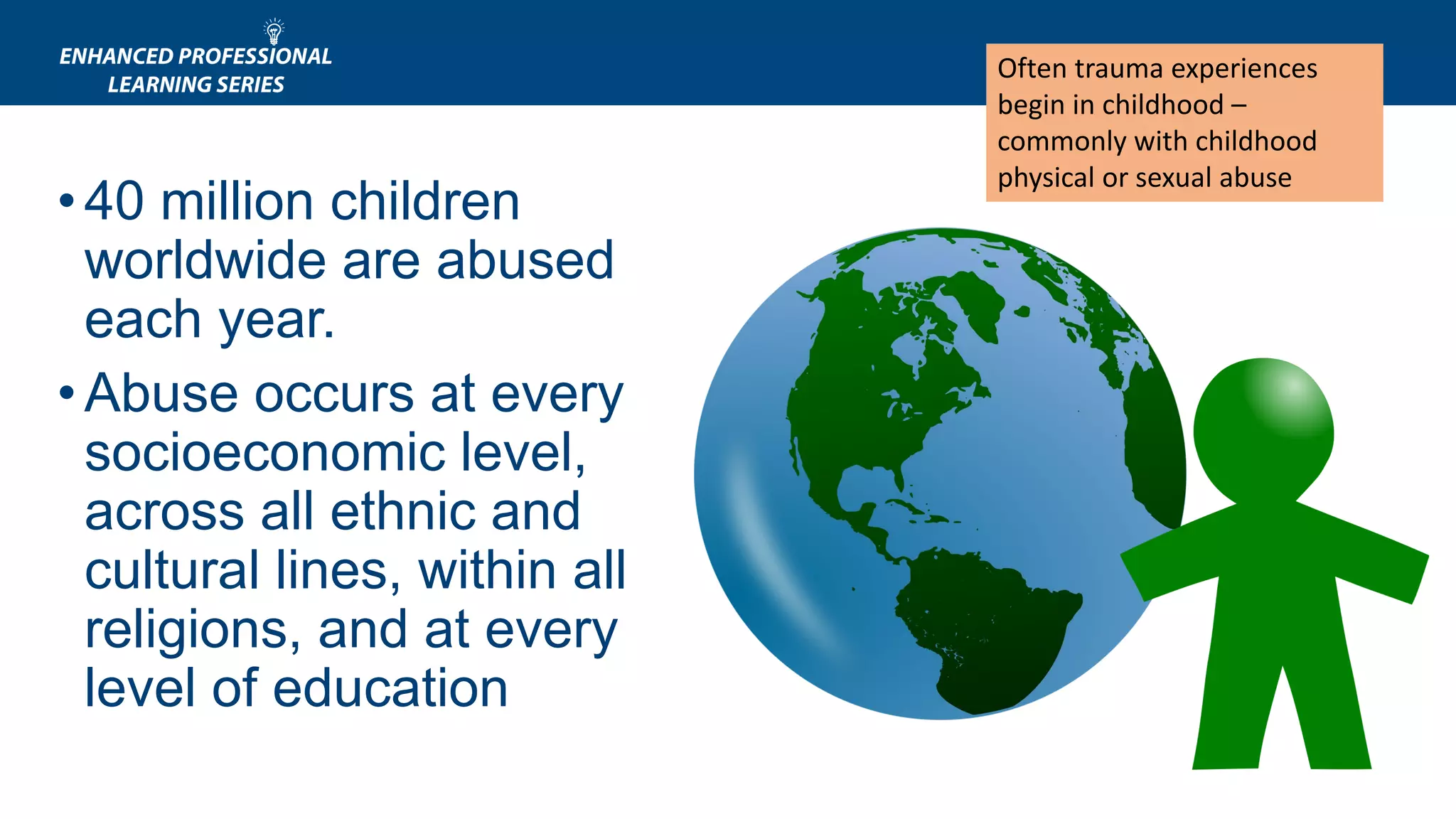
•40 million children
worldwide are abused
each year.
•Abuse occurs at every
socioeconomic level,
across all ethnic and
cultural lines, within all
religions, and at every
level of education
Often trauma experiences
begin in childhood –
commonly with childhood
physical or sexual abuse
Long Term Health Consequences of Child
Physical, Emotional, and Neglect
• Evidence suggests a causal relationship between non-sexual child
maltreatment and a range of mental disorders:
• drug use,
• suicide attempts,
• sexually transmitted infections,
• risky sexual behavior
All forms of child maltreatment should be considered important risks to health
with a sizeable impact on major contributors to the burden of disease in all
parts of the world.
Examples of Possible Traumatic Experiences
• Physical abuse
• Emotional abuse
• Sexual abuse
• Hate Crimes
• Domestic abuse
• Gender-based violence
• Accidents/Injuries
• Crime (e.g. robbery)
• Terrorism
• War related experiences
• Natural Disasters
DISCUSSION – Chat Box
•In the individuals in your practice, what
percentage have experienced trauma
beginning in childhood?
•Physical
•Sexual
•Emotional and Psychological
•Neglect
Initial Reactions
Indicators of More
Severe Responses
• Continuous distress without
periods of relative calm or rest
• Severe dissociation symptoms
• Intense intrusive recollections
that continue despite a return
to safety
May Include:
• Exhaustion
• Confusion
• Sadness
• Anxiety, agitation
• Numbness, dissociation
• Physical arousal/somatization
• Blunted affect
SAMHSA TIP 57 –pp. 62-63, https://store.samhsa.gov/system/files/sma14-4816.pdf
Big “T” and Little “t” Trauma
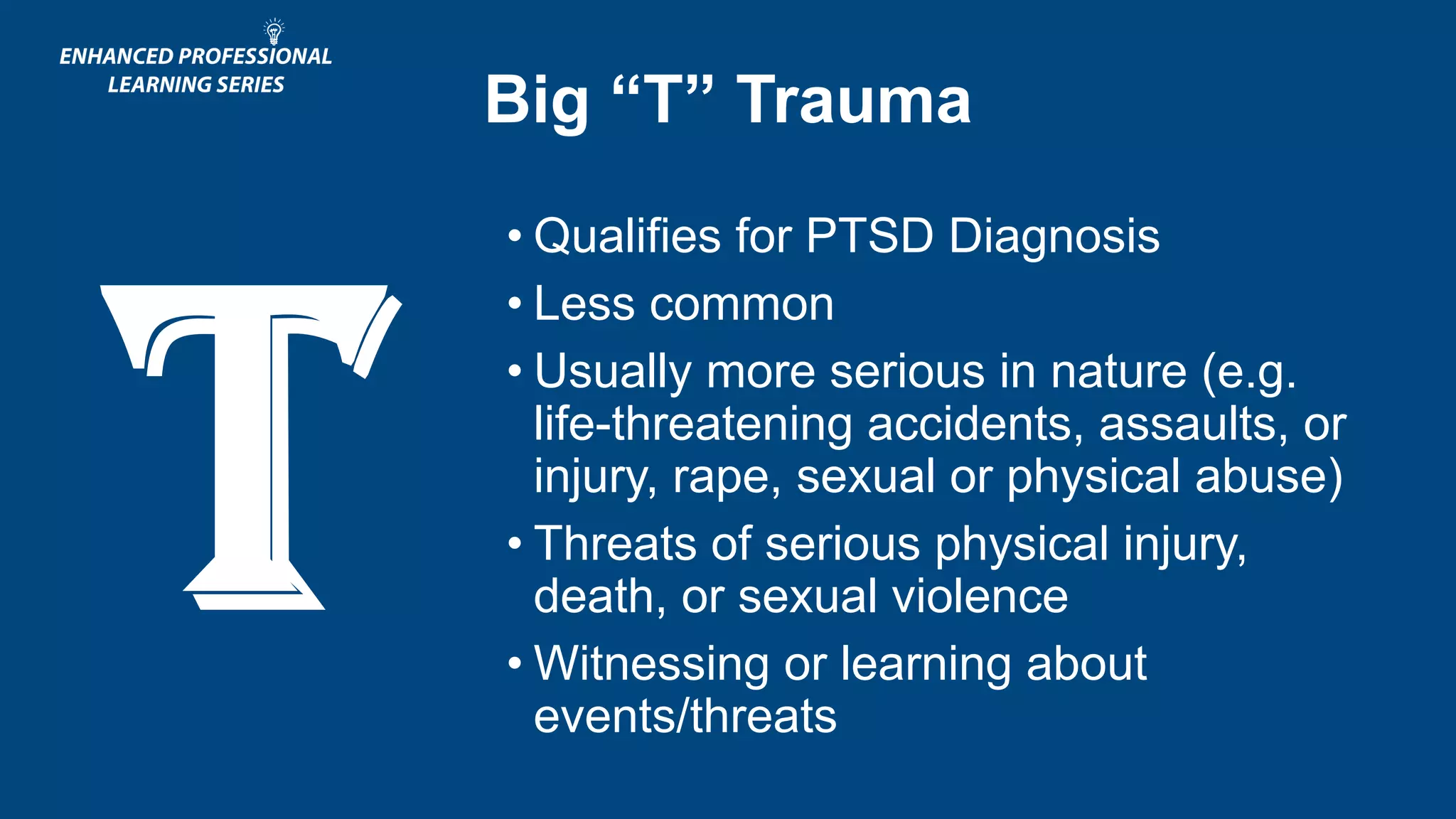
Big “T” Trauma
• Qualifies for PTSD Diagnosis
• Less common
• Usually more serious in nature (e.g.
life-threatening accidents, assaults, or
injury, rape, sexual or physical abuse)
• Threats of serious physical injury,
death, or sexual violence
• Witnessing or learning about
events/threats
Little “t” Trauma
• Will not qualify for PTSD diagnosis
• Can still be scary or traumatic (e.g.
exposure to an abuser or substance
user in the family, legal issues,
divorce, conflicts with others, some
bullying/harassment)
• Not life-threatening for self or
another person
Acute
Stress
Disorder
(ASD)
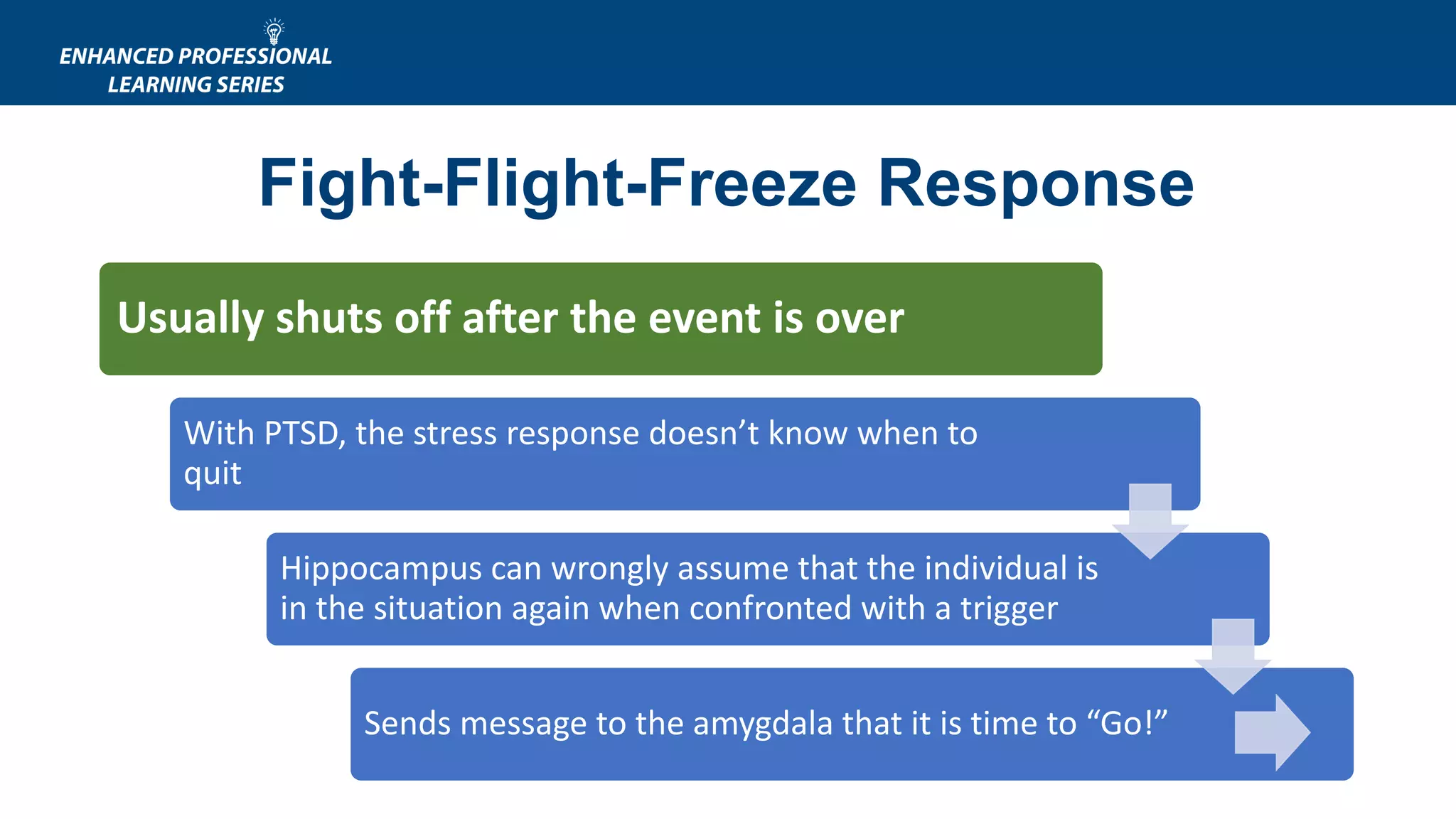
Fight-Flight-Freeze Response
Usually shuts off after the event is over
With PTSD, the stress response doesn’t know when to
quit
Hippocampus can wrongly assume that the individual is
in the situation again when confronted with a trigger
Sends message to the amygdala that it is time to “Go!”
Big “T” Trauma:
Exposures and Factors
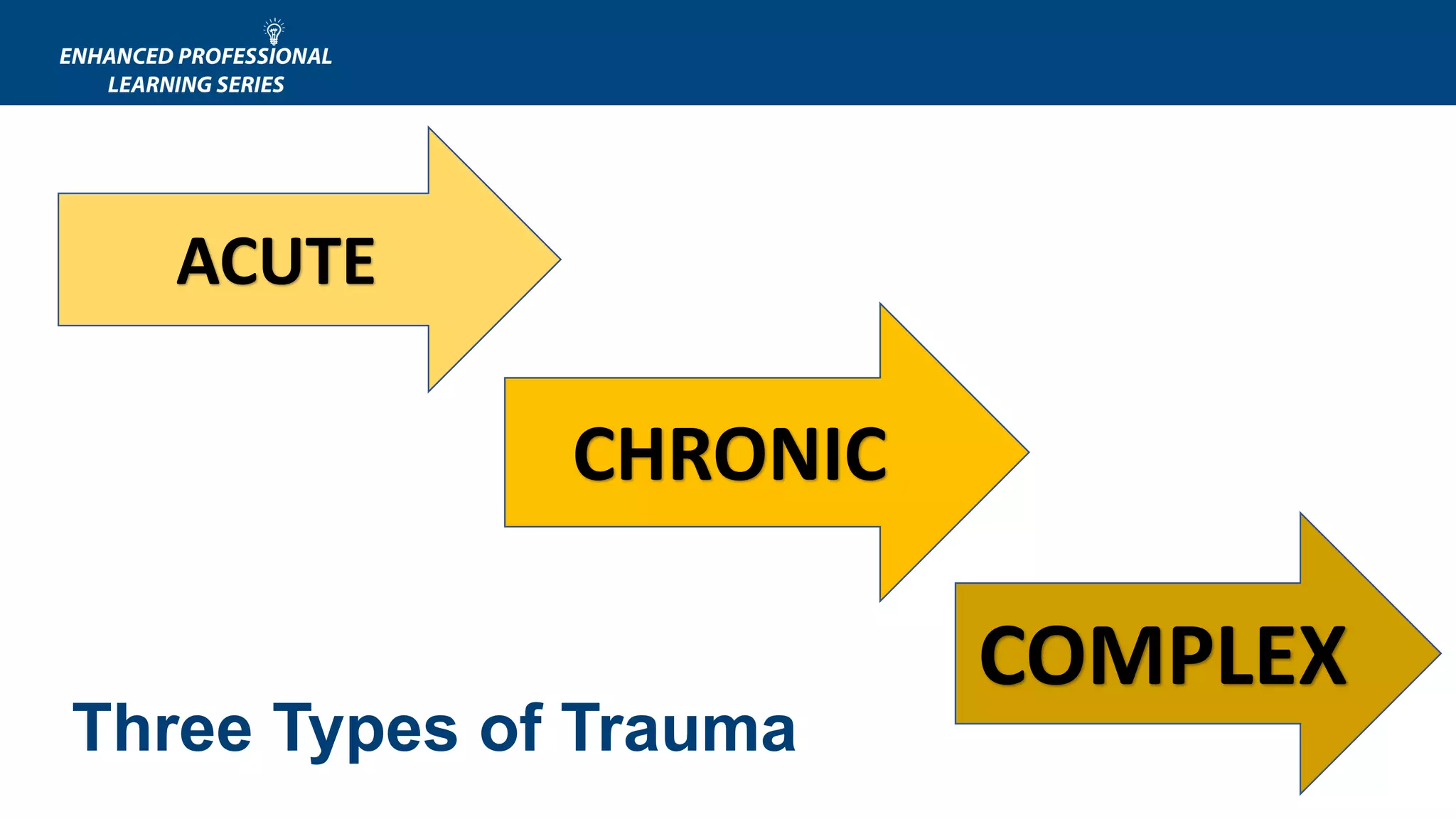
Three Types of Trauma
ACUTE
CHRONIC
COMPLEX
ACUTE
One-time traumatic incident:
Car accident
Robbery
Rape
Natural disaster
CHRONIC
Event may occur over and
over; or layers of different
types of trauma
Domestic violence
Ongoing abuse
Human trafficking
Abuse, then a robbery,
then a car accident,
then….
COMPLEX
Multiple events
Wide-ranging, long-
term effects
Can disrupt many
aspects of child
development
Often interferes with
secure attachments
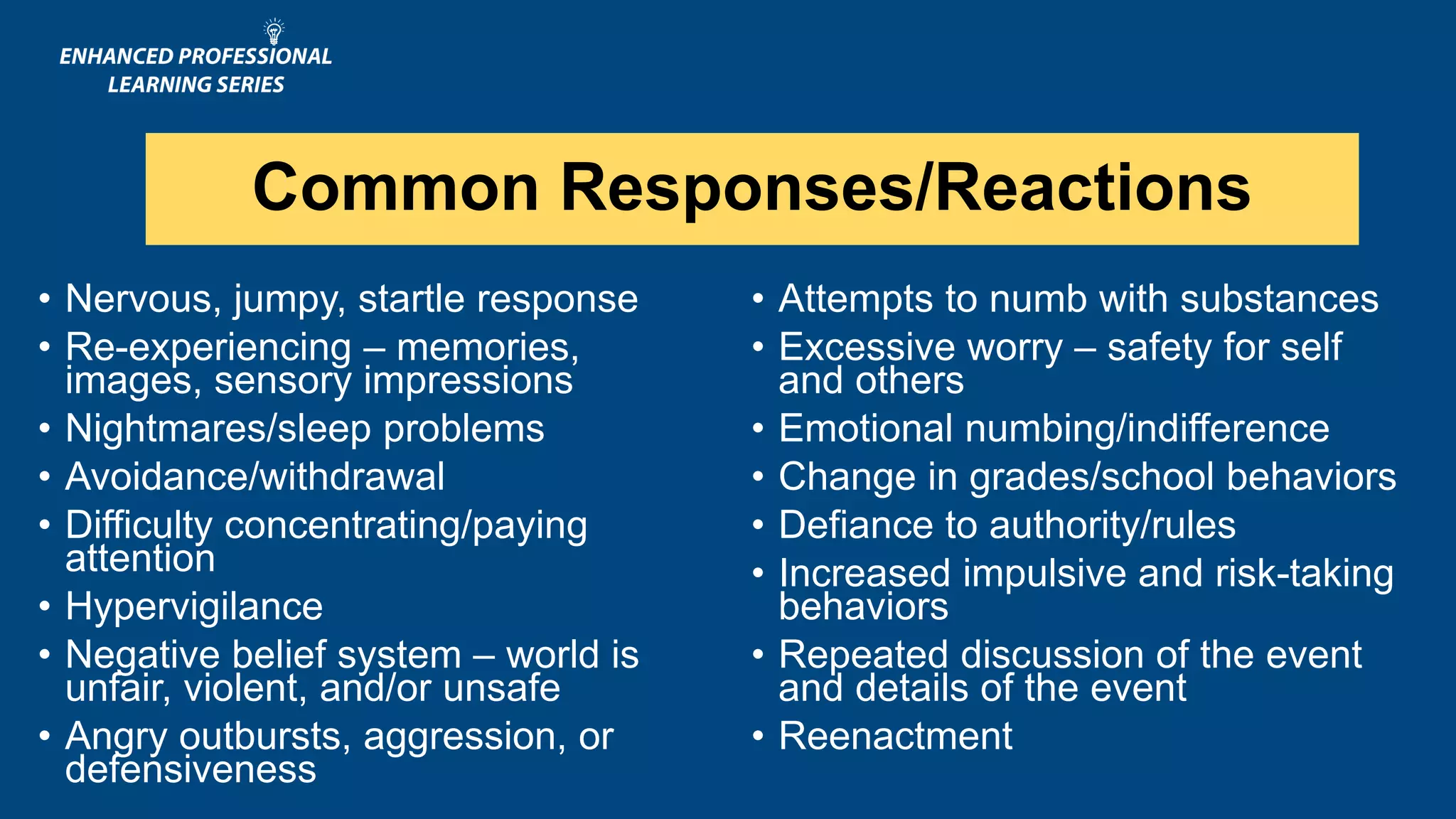
Common Responses/Reactions
• Nervous, jumpy, startle response
• Re-experiencing – memories,
images, sensory impressions
• Nightmares/sleep problems
• Avoidance/withdrawal
• Difficulty concentrating/paying
attention
• Hypervigilance
• Negative belief system – world is
unfair, violent, and/or unsafe
• Angry outbursts, aggression, or
defensiveness
• Attempts to numb with substances
• Excessive worry – safety for self
and others
• Emotional numbing/indifference
• Change in grades/school behaviors
• Defiance to authority/rules
• Increased impulsive and risk-taking
behaviors
• Repeated discussion of the event
and details of the event
• Reenactment
DISCUSSION
•Identify at least 2 of the Common
Responses to Trauma that you
address in your practice frequently.
PTSD Diagnosis - DSM 5
Relocated from anxiety disorders category to:
Trauma and Stressor-related Disorders
Entails multiple other emotions – shame, guilt, anger
Criterion A – exposure to death, threatened death, actual or
threatened serious injury, or actual or threatened sexual violence
• Non-immediate, non-catastrophic life-threatening illness (e.g.
terminal cancer or medical incidents involving natural causes such
as a heart attack) no longer qualify as trauma, regardless of how
stressful or severe it is.
• Symptoms must be connected to a traumatic event to qualify for
PTSD - Begin or worsen due to the event
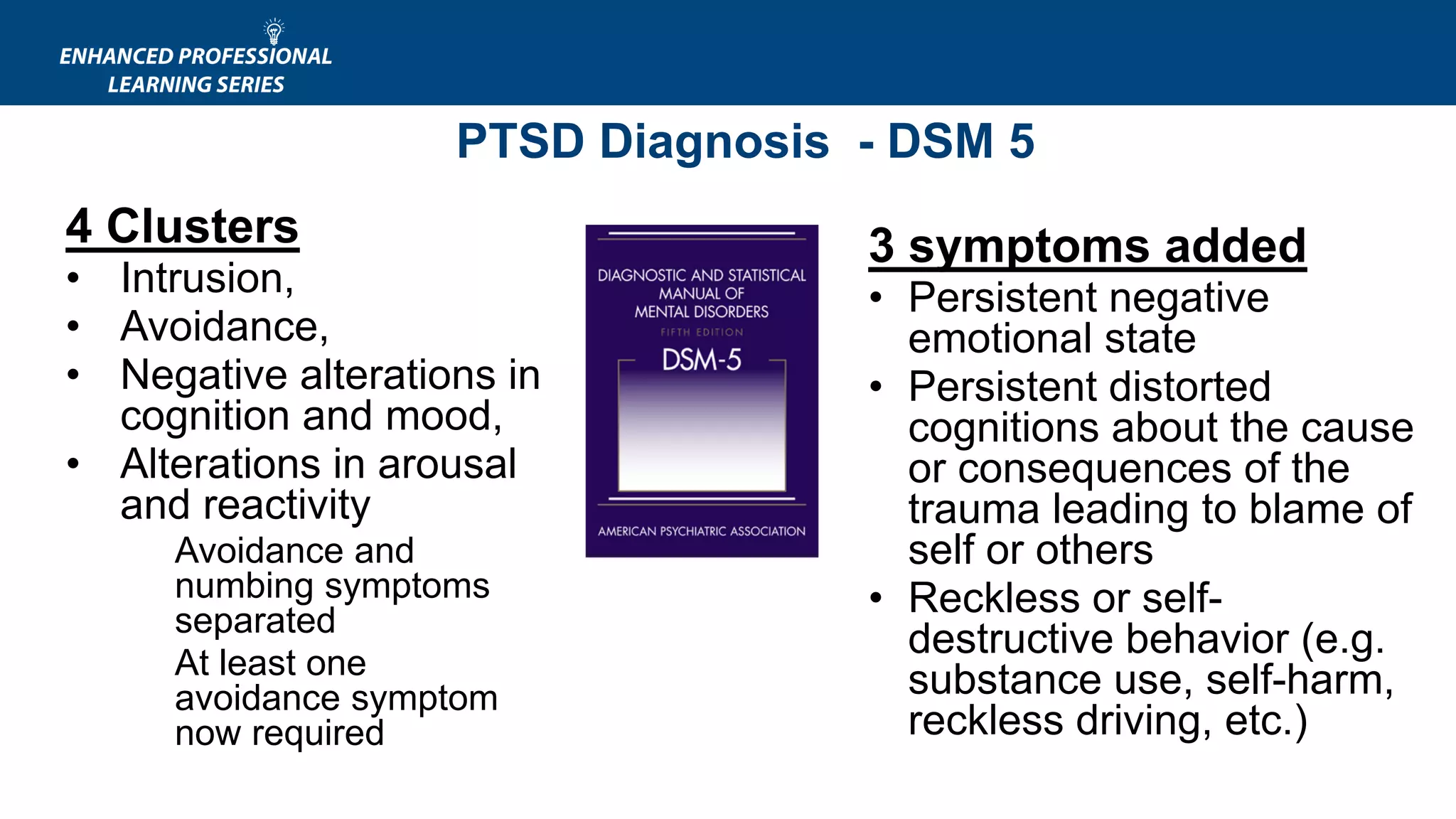
PTSD Diagnosis - DSM 5
4 Clusters
• Intrusion,
• Avoidance,
• Negative alterations in
cognition and mood,
• Alterations in arousal
and reactivity
Avoidance and
numbing symptoms
separated
At least one
avoidance symptom
now required
3 symptoms added
• Persistent negative
emotional state
• Persistent distorted
cognitions about the cause
or consequences of the
trauma leading to blame of
self or others
• Reckless or self-
destructive behavior (e.g.
substance use, self-harm,
reckless driving, etc.)
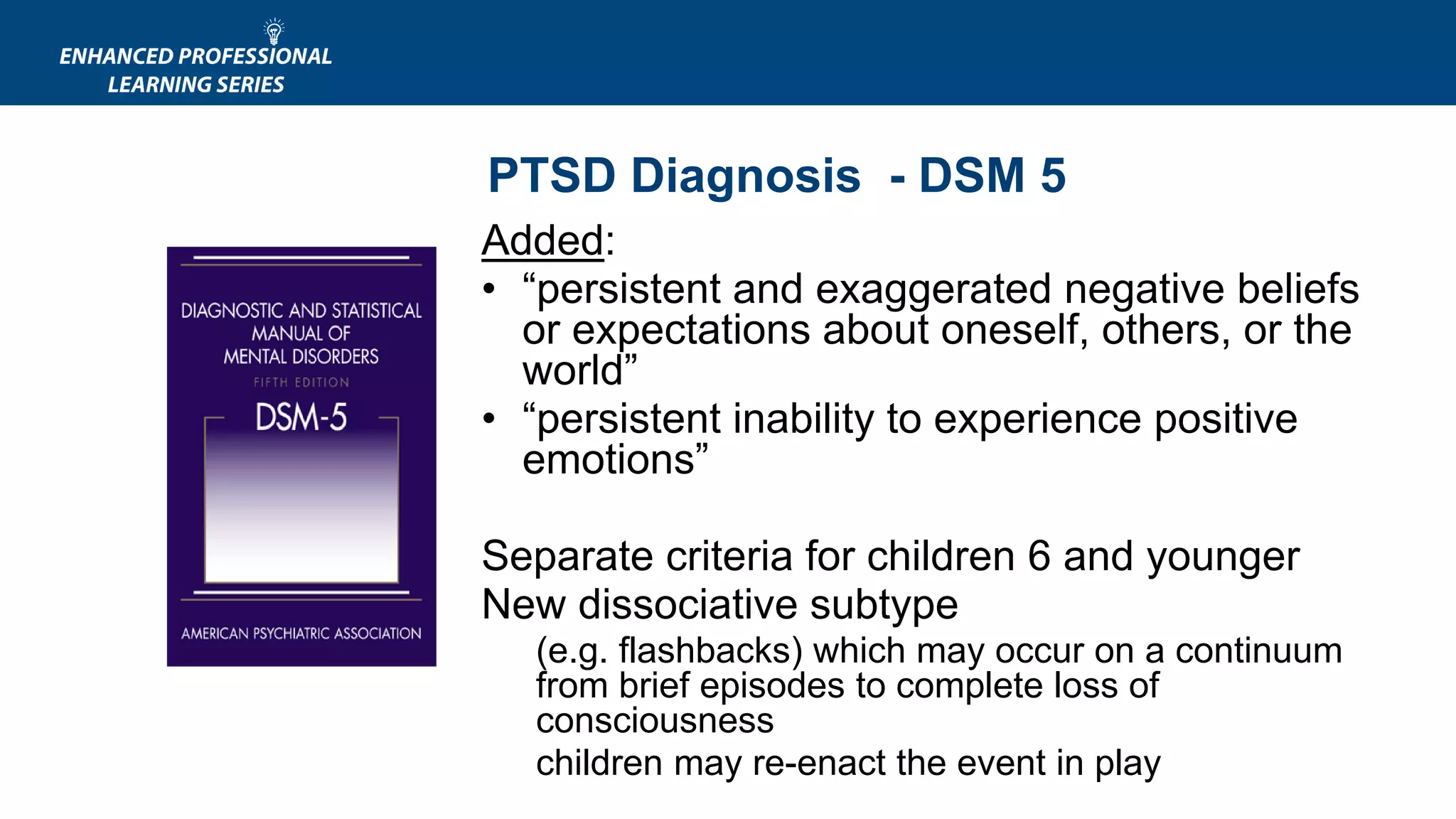
PTSD Diagnosis - DSM 5
Added:
• “persistent and exaggerated negative beliefs
or expectations about oneself, others, or the
world”
• “persistent inability to experience positive
emotions”
Separate criteria for children 6 and younger
New dissociative subtype
(e.g. flashbacks) which may occur on a continuum
from brief episodes to complete loss of
consciousness
children may re-enact the event in play
B. Involuntary Intrusive Symptoms- Need 1-5 symptoms
Images, thoughts, memories – dual
awareness is maintained
Dissociative Flashbacks – dual awareness
is not maintained
Dreams/Nightmares – may be difficult to
recognize the content
C. Avoidance Symptoms- 1 - 2 needed
Persistent effortful avoidance of distressing
trauma-related stimuli after the event
• Emotional avoidance
• Behavioral avoidance
Indicators of avoidance may include:
• Withdrawal/isolation
• Substance use
• Dissociating/suppressing memories
• Engagement in problematic behaviors Denial
D. Negative alterations in cognitions and mood that began or worsened after
the traumatic event (2/7 symptoms needed)
• Inability to recall key
features of the traumatic
event (not due to head
injury, alcohol or drugs)
• Persistent distorted negative
beliefs and expectations
• Persistent distorted blame
of self or others
• Persistent negative trauma-
related emotions
• Markedly diminished
interest in (pre-traumatic)
significant activities
• Feeling alienated from
others
• Constricted affect
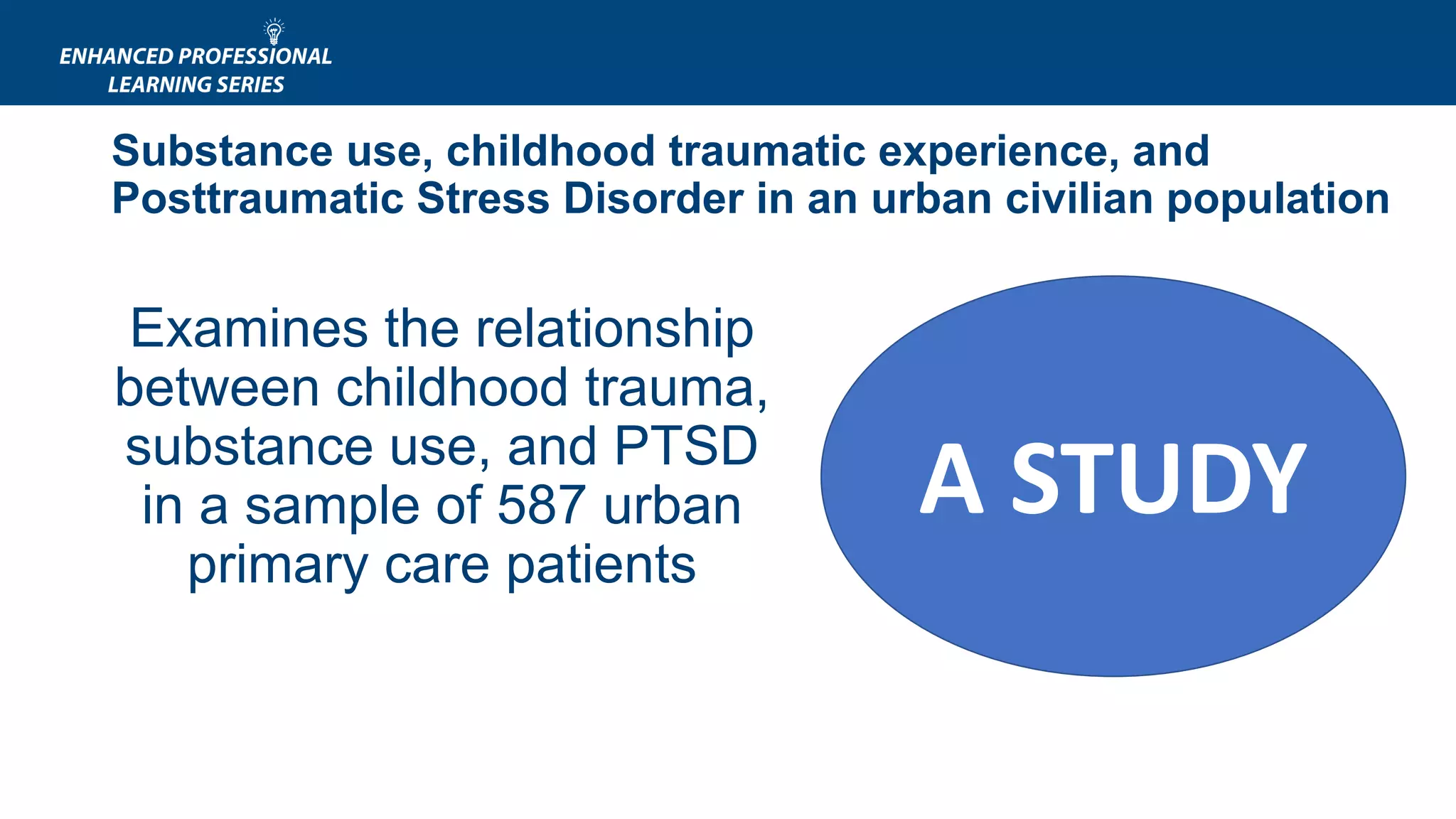
Substance use, childhood traumatic experience, and
Posttraumatic Stress Disorder in an urban civilian population
Examines the relationship
between childhood trauma,
substance use, and PTSD
in a sample of 587 urban
primary care patients
3Khoury et al, 20109% alcohol
34.1% cocaine
6.2% heroin/opiates
44.8% marijuana
A STUDY
Assumptions, Overgeneralizations &
Shattered Assumptions
• The world is benevolent – goodness in the
world
• The world is meaningful – the world makes
sense
• The self is worthy – good, capable, and moral
individuals
Janoff-Bulman, R, (1992) Shattered Assumptions –Towards a New Psychology of Trauma, Free Press
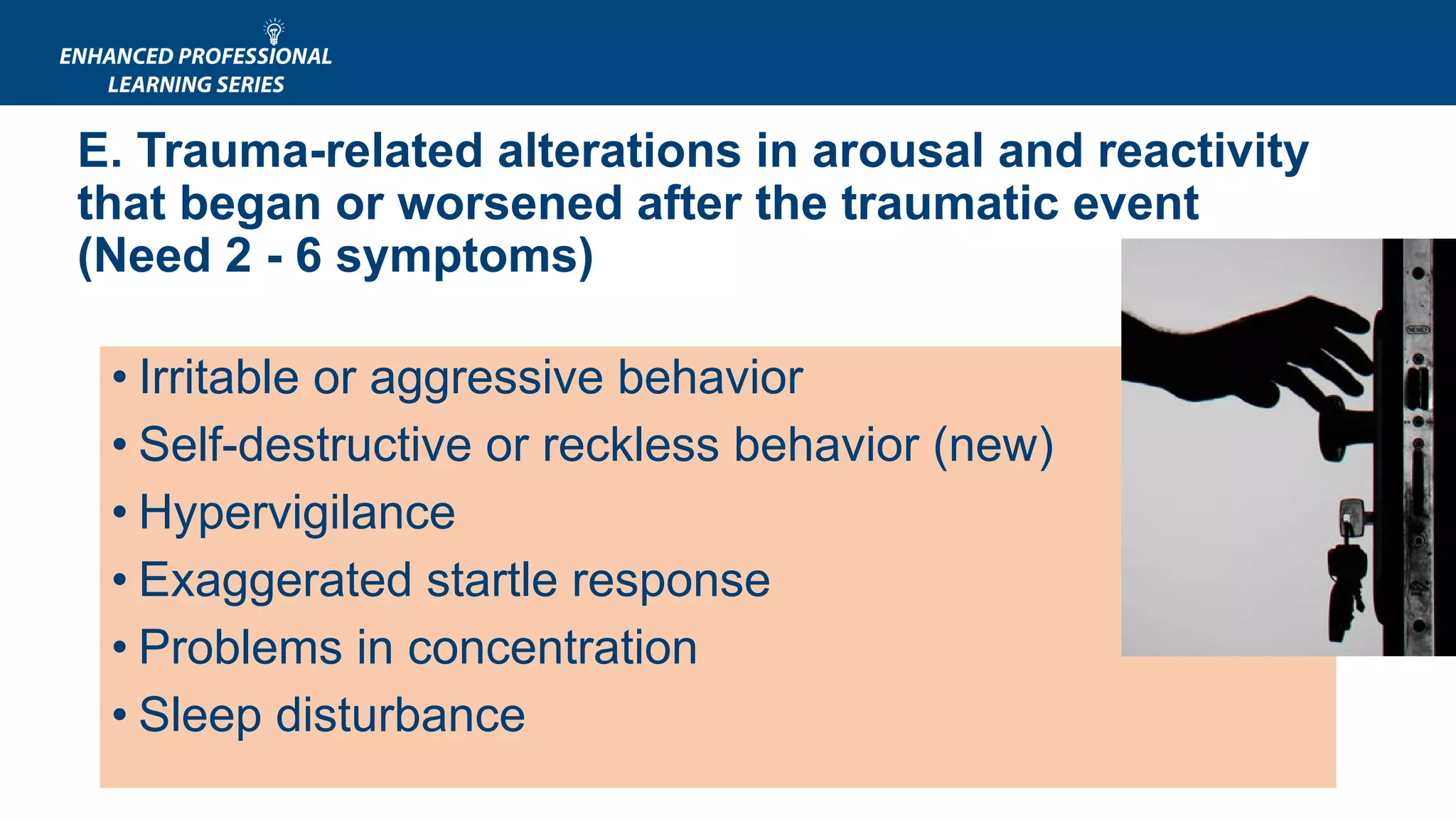
E. Trauma-related alterations in arousal and reactivity
that began or worsened after the traumatic event
(Need 2 - 6 symptoms)
• Irritable or aggressive behavior
• Self-destructive or reckless behavior (new)
• Hypervigilance
• Exaggerated startle response
• Problems in concentration
• Sleep disturbance
REMEMBER…
Many self-destructive behaviors can be
understood as symbolic or literal re-enactments of
the abuse or adaptations over time
Najavits – Normal responses to abnormal
events
Herman – Normal responses to extreme
circumstances
Moving from “What’s wrong with you” to “What
happened to you?
Disguised Presentations
• Physical symptoms
• Chronic insomnia
• Chronic anxiety
• Intractable depression
• Problematic relationships
• Substance use
• Memory gaps
• Eating disorders
• Impulsive risk taking
Prolonged, repeated
traumas = more difficult to
identify and assess,
especially if the traumas
began in childhood
Dissociative Subtype of PTSD
• Individual experiences high levels of
depersonalization or derealization (not due
to substances or medical issues)
• Depersonalization – outside observer of mind or
body, feeling like one is in a dream, sense of
unreality of self or body, time moving slowly
• Derealization – environment appears unreal,
dreamlike, distant, or distorted
• Not related to substance use or medical
conditions
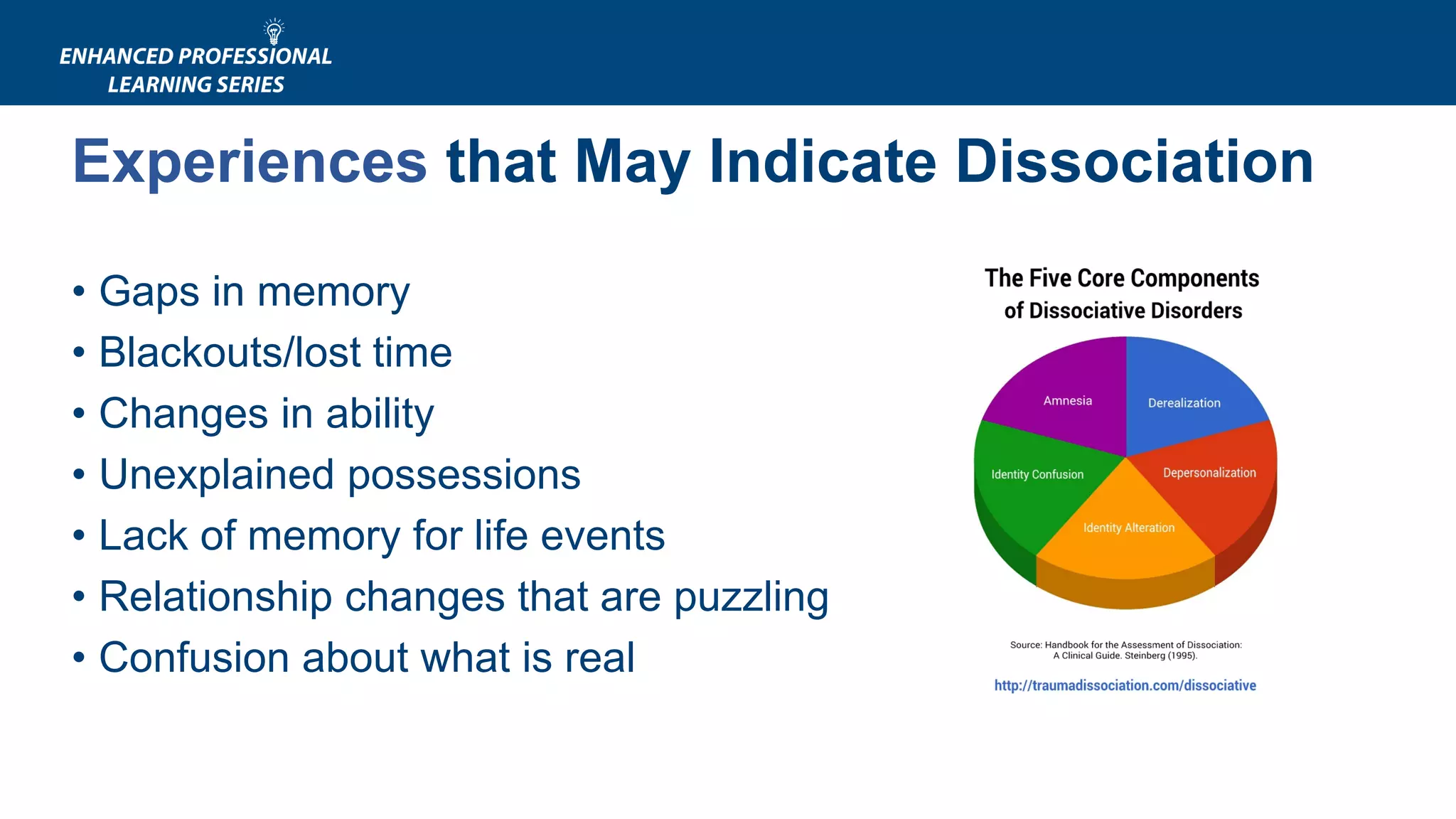
Experiences that May Indicate Dissociation
• Gaps in memory
• Blackouts/lost time
• Changes in ability
• Unexplained possessions
• Lack of memory for life events
• Relationship changes that are puzzling
• Confusion about what is real
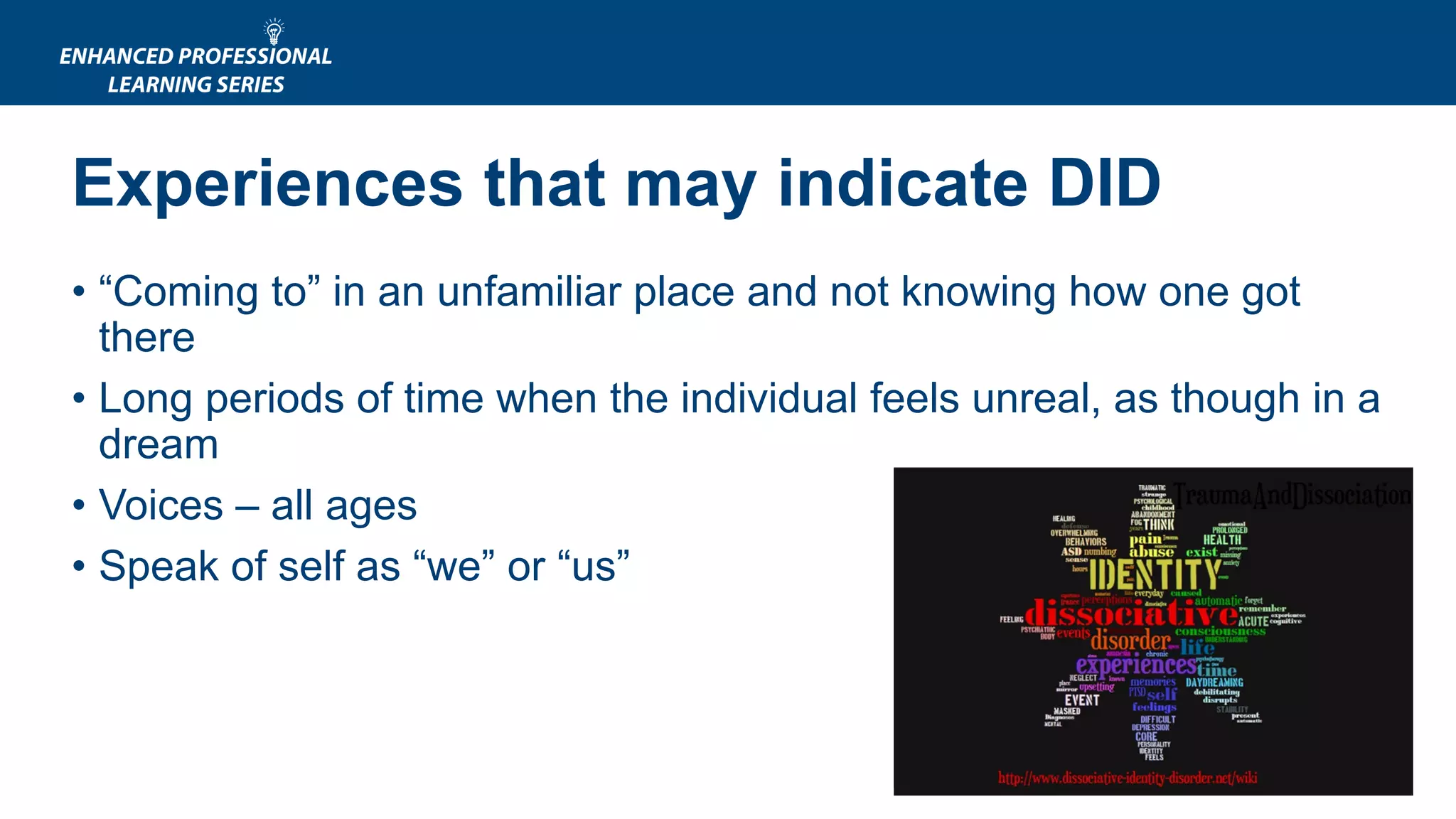
Experiences that may indicate DID
• “Coming to” in an unfamiliar place and not knowing how one got
there
• Long periods of time when the individual feels unreal, as though in a
dream
• Voices – all ages
• Speak of self as “we” or “us”
DES-II and DES Taxon
DES-II
http://traumadissociation.com/downloads/information/dissociativeexperiencesscale-ii.pdf
DES Taxon
https://www.isst-d.org › uploads › 2019/06 › DES-Taxon-scorer
Item # DES DES-T Depersonal/Dereal Amnesia Absorption/Imagination
Name: T 1
Date: 3/13/2018 0:00 2 0
3 0 0
INSTRUCTIONS 4 0
5 0 0
6 0
7 0 0
8 0 0
9
10 0
11 0
12 0 0
13 0 0
14 0
15 0
16 0
17 0
18 0
19
20 0
21
22 0 0
23 0
24
25 0
26 0
27 0 0
28 0
Average: #DIV/0! 0
Probability of taxon given X o Pt_x 0.00040 0.00 0 0.00
This spreadsheet calculates a single test-taker's score on the
Dissociative Experiences Scale (DES). It also caculates the
Bayesian probability that the test-taker belongs in the DES Taxon.
Cell E30 computes the DES score by taking the mean of all the DES
item scores. Cell F30, which is labeled as the "average DES-T," is
actually the sum of the scores on the eight taxon items, divided by
the DES score in Cell E30. This spreadsheet was written by Darryl
Perry, who specified that it is to remain in the public domain and that
its source code is to be distributed for free. The caculations in this
workshop are a translation of the SAS computer program that may be
found in the following article: Waller, N. G., & Ross, C. A. (1997). The
prevalence and biometric structure of pathological dissociation in the
general population: Taxometric and behavior genetic findings. Journal
of Abnormal Psychology, 106(4), 499-510.
Enter DES item scores in column E.
Results will automatically be calculated.
These three categories help furthertease outthe likelihood
of a dissociativedisorder. Those with amnesiaand
symptoms of intrusions of dissociative parts are more likely
to have a dissociative disorderthan are those who score
highermostly on absorption items.
Judith Herman - 1997
Recent Acute Trauma
Diagnosis – fairly straightforward:
• Hyperarousal
• Intrusive symptoms
• Numbing
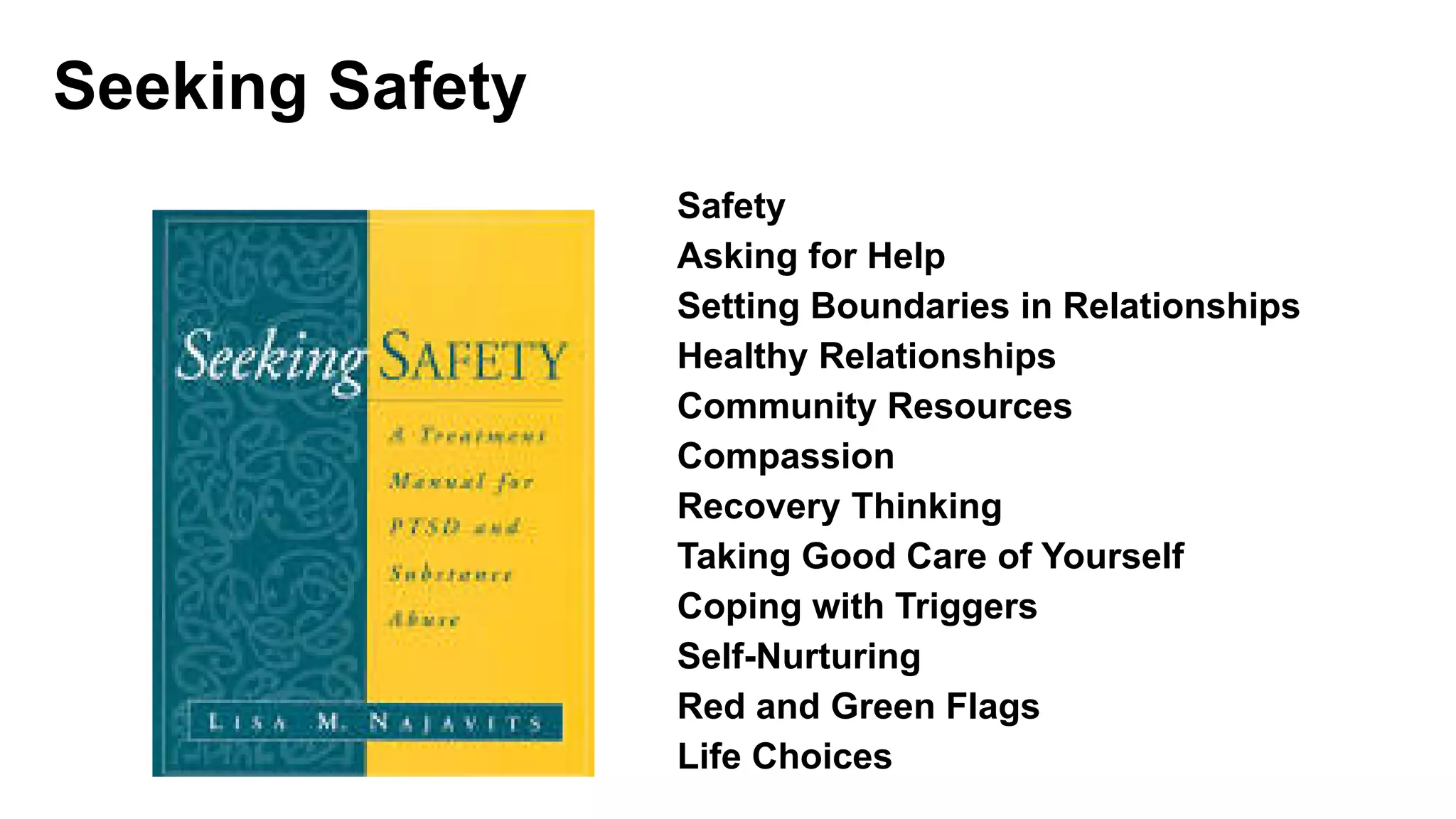
Seeking Safety 25 Topics
Safety
Asking for Help
Setting Boundaries in Relationships
Healthy Relationships
Community Resources
Compassion
Recovery Thinking
Taking Good Care of Yourself
Coping with Triggers
Self-Nurturing
Red and Green Flags
Life Choices
Week 1 Learning Activity
Refer to the Handout and answer the following
questions:
1. How do you notice that someone has trauma
symptoms in your practice?
2. Why do you think it may be important to
understand trauma as a behavioral health
professional?
Resources
• Fallot and Harris, 2009
• Seeking Safety - Lisa Najavets
• Trauma & Recovery - Judith Herman
• Shattered Assumptions –Towards a New Psychology of Trauma -
Janoff-Bulman, R, (1992)
Acknowledgments
Kate Speck, Kate Speck, PhD MAC LADC
Pam Oltman, MS LIMHP LADC
Mountain Plains Addiction Technology Transfer Center (MPATTC)

1. tia epl week 1

  • 1.
    Integrating a Trauma-Informed Approachin Behavioral Health Settings
  • 2.
  • 3.
    Self Care isImportant
  • 4.
    The Series • WEEK1 – Understanding the Impact of Trauma • WEEK 2 – The Effect of Trauma on the Lifespan • WEEK 3 – The Effect of Trauma on the Body and Brain • WEEK 4 – Body and Brain Connections for Staff • WEEK 5 – Effects of Stress & Trauma on Organizations • WEEK 6 - Integrating TIC Approach in Behavioral Health Settings • Toolbox – Handouts • Weekly Homework
  • 5.
    Week 1 • Understandingthe Impact of Trauma
  • 6.
    A trauma-informed approachto the delivery of behavioral health services includes an understanding of trauma and an awareness of the impact it can have across settings, services, and populations. It involves viewing trauma through an ecological and cultural lens and recognizing that context plays a significant role in how individuals perceive and process traumatic events, whether acute or chronic.
  • 7.
    Three key elementsof a trauma- informed approach: • Realizing the prevalence of trauma; • Recognizing how trauma affects all individuals involved with the program, organization, or system, including its own workforce; and • Responding by putting this knowledge into practice
  • 8.
    Creating Cultures ofTrauma-Informed Care CCTIC Procedures and Settings Formal Services Policies Identifying & Serving Survivors Support from the Top Staff Training and Education Human Resources Practices (Fallot and Harris, 2009)
  • 9.
    Definition of Trauma Individualtrauma results from: • an event • series of events or • set of circumstances experienced by an individual as physically or emotionally harmful or life-threatening with lasting adverse effects on the individual’s functioning and mental, physical, social, emotional, or spiritual well- being.
  • 10.
    The Pervasiveness ofTrauma • National community-based surveys find that between 55 and 90% of us have experienced at least one traumatic event. • Average - Individuals report that they have experienced nearly five traumatic events in their lifetimes. • Trauma is not the rare exception it was once considered. It is our social reality. (Fallot and Harris, 2009)
  • 11.
    Understanding the Impactof Trauma May be one-time, multiple, or long-lasting repetitive events Affects individuals differently Many individuals will exhibit resilient responses, brief subclinical symptoms or consequences that fall outside of diagnostic criteria Not all stressful experiences involve trauma
  • 12.
    •40 million children worldwideare abused each year. •Abuse occurs at every socioeconomic level, across all ethnic and cultural lines, within all religions, and at every level of education Often trauma experiences begin in childhood – commonly with childhood physical or sexual abuse
  • 13.
    Long Term HealthConsequences of Child Physical, Emotional, and Neglect • Evidence suggests a causal relationship between non-sexual child maltreatment and a range of mental disorders: • drug use, • suicide attempts, • sexually transmitted infections, • risky sexual behavior All forms of child maltreatment should be considered important risks to health with a sizeable impact on major contributors to the burden of disease in all parts of the world.
  • 14.
    Examples of PossibleTraumatic Experiences • Physical abuse • Emotional abuse • Sexual abuse • Hate Crimes • Domestic abuse • Gender-based violence • Accidents/Injuries • Crime (e.g. robbery) • Terrorism • War related experiences • Natural Disasters
  • 15.
    DISCUSSION – ChatBox •In the individuals in your practice, what percentage have experienced trauma beginning in childhood? •Physical •Sexual •Emotional and Psychological •Neglect
  • 16.
    Initial Reactions Indicators ofMore Severe Responses • Continuous distress without periods of relative calm or rest • Severe dissociation symptoms • Intense intrusive recollections that continue despite a return to safety May Include: • Exhaustion • Confusion • Sadness • Anxiety, agitation • Numbness, dissociation • Physical arousal/somatization • Blunted affect SAMHSA TIP 57 –pp. 62-63, https://store.samhsa.gov/system/files/sma14-4816.pdf
  • 17.
    Big “T” andLittle “t” Trauma
  • 18.
    Big “T” Trauma •Qualifies for PTSD Diagnosis • Less common • Usually more serious in nature (e.g. life-threatening accidents, assaults, or injury, rape, sexual or physical abuse) • Threats of serious physical injury, death, or sexual violence • Witnessing or learning about events/threats
  • 19.
    Little “t” Trauma •Will not qualify for PTSD diagnosis • Can still be scary or traumatic (e.g. exposure to an abuser or substance user in the family, legal issues, divorce, conflicts with others, some bullying/harassment) • Not life-threatening for self or another person
  • 20.
  • 21.
    Fight-Flight-Freeze Response Usually shutsoff after the event is over With PTSD, the stress response doesn’t know when to quit Hippocampus can wrongly assume that the individual is in the situation again when confronted with a trigger Sends message to the amygdala that it is time to “Go!”
  • 22.
  • 23.
    Three Types ofTrauma ACUTE CHRONIC COMPLEX
  • 24.
    ACUTE One-time traumatic incident: Caraccident Robbery Rape Natural disaster CHRONIC Event may occur over and over; or layers of different types of trauma Domestic violence Ongoing abuse Human trafficking Abuse, then a robbery, then a car accident, then…. COMPLEX Multiple events Wide-ranging, long- term effects Can disrupt many aspects of child development Often interferes with secure attachments
  • 25.
    Common Responses/Reactions • Nervous,jumpy, startle response • Re-experiencing – memories, images, sensory impressions • Nightmares/sleep problems • Avoidance/withdrawal • Difficulty concentrating/paying attention • Hypervigilance • Negative belief system – world is unfair, violent, and/or unsafe • Angry outbursts, aggression, or defensiveness • Attempts to numb with substances • Excessive worry – safety for self and others • Emotional numbing/indifference • Change in grades/school behaviors • Defiance to authority/rules • Increased impulsive and risk-taking behaviors • Repeated discussion of the event and details of the event • Reenactment
  • 26.
    DISCUSSION •Identify at least2 of the Common Responses to Trauma that you address in your practice frequently.
  • 27.
    PTSD Diagnosis -DSM 5 Relocated from anxiety disorders category to: Trauma and Stressor-related Disorders Entails multiple other emotions – shame, guilt, anger Criterion A – exposure to death, threatened death, actual or threatened serious injury, or actual or threatened sexual violence • Non-immediate, non-catastrophic life-threatening illness (e.g. terminal cancer or medical incidents involving natural causes such as a heart attack) no longer qualify as trauma, regardless of how stressful or severe it is. • Symptoms must be connected to a traumatic event to qualify for PTSD - Begin or worsen due to the event
  • 28.
    PTSD Diagnosis -DSM 5 4 Clusters • Intrusion, • Avoidance, • Negative alterations in cognition and mood, • Alterations in arousal and reactivity Avoidance and numbing symptoms separated At least one avoidance symptom now required 3 symptoms added • Persistent negative emotional state • Persistent distorted cognitions about the cause or consequences of the trauma leading to blame of self or others • Reckless or self- destructive behavior (e.g. substance use, self-harm, reckless driving, etc.)
  • 29.
    PTSD Diagnosis -DSM 5 Added: • “persistent and exaggerated negative beliefs or expectations about oneself, others, or the world” • “persistent inability to experience positive emotions” Separate criteria for children 6 and younger New dissociative subtype (e.g. flashbacks) which may occur on a continuum from brief episodes to complete loss of consciousness children may re-enact the event in play
  • 30.
    B. Involuntary IntrusiveSymptoms- Need 1-5 symptoms Images, thoughts, memories – dual awareness is maintained Dissociative Flashbacks – dual awareness is not maintained Dreams/Nightmares – may be difficult to recognize the content
  • 31.
    C. Avoidance Symptoms-1 - 2 needed Persistent effortful avoidance of distressing trauma-related stimuli after the event • Emotional avoidance • Behavioral avoidance Indicators of avoidance may include: • Withdrawal/isolation • Substance use • Dissociating/suppressing memories • Engagement in problematic behaviors Denial
  • 32.
    D. Negative alterationsin cognitions and mood that began or worsened after the traumatic event (2/7 symptoms needed) • Inability to recall key features of the traumatic event (not due to head injury, alcohol or drugs) • Persistent distorted negative beliefs and expectations • Persistent distorted blame of self or others • Persistent negative trauma- related emotions • Markedly diminished interest in (pre-traumatic) significant activities • Feeling alienated from others • Constricted affect
  • 33.
    Substance use, childhoodtraumatic experience, and Posttraumatic Stress Disorder in an urban civilian population Examines the relationship between childhood trauma, substance use, and PTSD in a sample of 587 urban primary care patients 3Khoury et al, 20109% alcohol 34.1% cocaine 6.2% heroin/opiates 44.8% marijuana A STUDY
  • 34.
    Assumptions, Overgeneralizations & ShatteredAssumptions • The world is benevolent – goodness in the world • The world is meaningful – the world makes sense • The self is worthy – good, capable, and moral individuals Janoff-Bulman, R, (1992) Shattered Assumptions –Towards a New Psychology of Trauma, Free Press
  • 35.
    E. Trauma-related alterationsin arousal and reactivity that began or worsened after the traumatic event (Need 2 - 6 symptoms) • Irritable or aggressive behavior • Self-destructive or reckless behavior (new) • Hypervigilance • Exaggerated startle response • Problems in concentration • Sleep disturbance
  • 36.
    REMEMBER… Many self-destructive behaviorscan be understood as symbolic or literal re-enactments of the abuse or adaptations over time Najavits – Normal responses to abnormal events Herman – Normal responses to extreme circumstances Moving from “What’s wrong with you” to “What happened to you?
  • 37.
    Disguised Presentations • Physicalsymptoms • Chronic insomnia • Chronic anxiety • Intractable depression • Problematic relationships • Substance use • Memory gaps • Eating disorders • Impulsive risk taking Prolonged, repeated traumas = more difficult to identify and assess, especially if the traumas began in childhood
  • 38.
    Dissociative Subtype ofPTSD • Individual experiences high levels of depersonalization or derealization (not due to substances or medical issues) • Depersonalization – outside observer of mind or body, feeling like one is in a dream, sense of unreality of self or body, time moving slowly • Derealization – environment appears unreal, dreamlike, distant, or distorted • Not related to substance use or medical conditions
  • 39.
    Experiences that MayIndicate Dissociation • Gaps in memory • Blackouts/lost time • Changes in ability • Unexplained possessions • Lack of memory for life events • Relationship changes that are puzzling • Confusion about what is real
  • 40.
    Experiences that mayindicate DID • “Coming to” in an unfamiliar place and not knowing how one got there • Long periods of time when the individual feels unreal, as though in a dream • Voices – all ages • Speak of self as “we” or “us”
  • 41.
    DES-II and DESTaxon DES-II http://traumadissociation.com/downloads/information/dissociativeexperiencesscale-ii.pdf DES Taxon https://www.isst-d.org › uploads › 2019/06 › DES-Taxon-scorer
  • 42.
    Item # DESDES-T Depersonal/Dereal Amnesia Absorption/Imagination Name: T 1 Date: 3/13/2018 0:00 2 0 3 0 0 INSTRUCTIONS 4 0 5 0 0 6 0 7 0 0 8 0 0 9 10 0 11 0 12 0 0 13 0 0 14 0 15 0 16 0 17 0 18 0 19 20 0 21 22 0 0 23 0 24 25 0 26 0 27 0 0 28 0 Average: #DIV/0! 0 Probability of taxon given X o Pt_x 0.00040 0.00 0 0.00 This spreadsheet calculates a single test-taker's score on the Dissociative Experiences Scale (DES). It also caculates the Bayesian probability that the test-taker belongs in the DES Taxon. Cell E30 computes the DES score by taking the mean of all the DES item scores. Cell F30, which is labeled as the "average DES-T," is actually the sum of the scores on the eight taxon items, divided by the DES score in Cell E30. This spreadsheet was written by Darryl Perry, who specified that it is to remain in the public domain and that its source code is to be distributed for free. The caculations in this workshop are a translation of the SAS computer program that may be found in the following article: Waller, N. G., & Ross, C. A. (1997). The prevalence and biometric structure of pathological dissociation in the general population: Taxometric and behavior genetic findings. Journal of Abnormal Psychology, 106(4), 499-510. Enter DES item scores in column E. Results will automatically be calculated. These three categories help furthertease outthe likelihood of a dissociativedisorder. Those with amnesiaand symptoms of intrusions of dissociative parts are more likely to have a dissociative disorderthan are those who score highermostly on absorption items.
  • 43.
    Judith Herman -1997 Recent Acute Trauma Diagnosis – fairly straightforward: • Hyperarousal • Intrusive symptoms • Numbing
  • 44.
    Seeking Safety 25Topics Safety Asking for Help Setting Boundaries in Relationships Healthy Relationships Community Resources Compassion Recovery Thinking Taking Good Care of Yourself Coping with Triggers Self-Nurturing Red and Green Flags Life Choices
  • 45.
    Week 1 LearningActivity Refer to the Handout and answer the following questions: 1. How do you notice that someone has trauma symptoms in your practice? 2. Why do you think it may be important to understand trauma as a behavioral health professional?
  • 46.
    Resources • Fallot andHarris, 2009 • Seeking Safety - Lisa Najavets • Trauma & Recovery - Judith Herman • Shattered Assumptions –Towards a New Psychology of Trauma - Janoff-Bulman, R, (1992)
  • 47.
    Acknowledgments Kate Speck, KateSpeck, PhD MAC LADC Pam Oltman, MS LIMHP LADC Mountain Plains Addiction Technology Transfer Center (MPATTC)