Simple and Complex Trauma: Assessment and Treatment Kevin J. Drab, M.A., M.Ed., LPC, NBCCH, CAACD, CEMDRT Behavioral Counseling & Training, 418 Stump Road,  Suite #208, Montgomeryville, PA 18936 Tel: (215) 527-2904  Fax: (215) 699-3382 e-mail:  [email_address]   web site:  http://BCTPRO.com
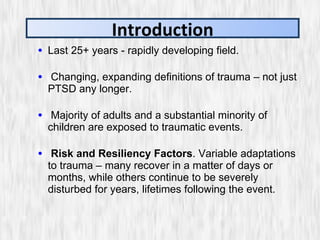
Last 25+ years - rapidly developing field. Changing, expanding definitions of trauma – not just PTSD any longer. Majority of adults and a substantial minority of children are exposed to traumatic events. Risk and Resiliency Factors . Variable adaptations to trauma – many recover in a matter of days or months, while others continue to be severely disturbed for years, lifetimes following the event. Introduction
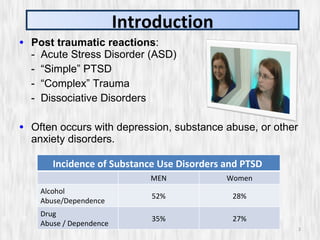
Post traumatic reactions : -  Acute Stress Disorder (ASD) -  “Simple” PTSD -  “Complex” Trauma -  Dissociative Disorders Often occurs with depression, substance abuse, or other anxiety disorders. Incidence of Substance Use Disorders and PTSD  MEN Women Alcohol Abuse/Dependence 52% 28% Drug  Abuse / Dependence 35% 27% Introduction
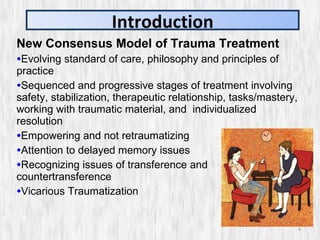
New Consensus Model of Trauma Treatment Evolving standard of care, philosophy and principles of practice Sequenced and progressive stages of treatment involving safety, stabilization, therapeutic relationship, tasks/mastery, working with traumatic material, and  individualized resolution Empowering and not retraumatizing Attention to delayed memory issues Recognizing issues of transference and countertransference Vicarious Traumatization Introduction
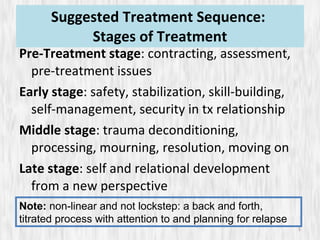
Suggested Treatment Sequence:  Stages of Treatment Pre-Treatment stage : contracting, assessment, pre-treatment issues Early stage : safety, stabilization, skill-building, self-management, security in tx relationship Middle stage : trauma deconditioning, processing, mourning, resolution, moving on Late stage : self and relational development from a new perspective Note:  non-linear and not lockstep: a back and forth, titrated process with attention to and planning for relapse
Trauma Sensitive or Informed Treatment Program This type of program is not designed to treat trauma but rather to provide services in a manner that is welcoming and appropriate for the needs of clients who have experienced trauma Staff is trained in nature of trauma, assessment processes, and being comfortable working with behaviors related to trauma Holistic and integrated treatment planning and delivery Accommodating the vulnerabilities of trauma survivors and allows program services to be delivered in a fashion that facilitates client participation and reduces chance of revictimization
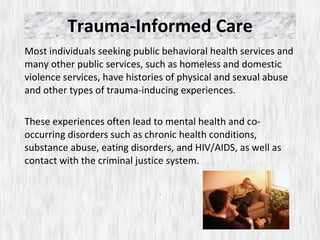
Trauma-Informed Care Most individuals seeking public behavioral health services and many other public services, such as homeless and domestic violence services, have histories of physical and sexual abuse and other types of trauma-inducing experiences.  These experiences often lead to mental health and co-occurring disorders such as chronic health conditions, substance abuse, eating disorders, and HIV/AIDS, as well as contact with the criminal justice system. .
Trauma-Informed Care When a human service program takes the step to become trauma-informed, every part of its organization, management, and service delivery system is assessed and potentially modified to include a basic understanding of how trauma affects the life of an individual seeking services.  Trauma-informed organizations, programs, and services are based on an understanding of the vulnerabilities or triggers of trauma survivors that traditional service delivery approaches may exacerbate, so that these services and programs can be more supportive and avoid re-traumatization
The impact of creating such a trauma-informed culture should be observable and measurable •  Less emotional dysregulation, reenactment behavior, resistance and physical, verbal, or emotional forms of violence due to effective recognition and response to trauma-related symptoms •  Systemic understanding of complex biopsychosocial and developmental impact of trauma and abuse with implications for response •  Less victim-blaming; less punitive and judgmental responses •  Clearer more consistent and appropriate boundaries, higher expectations, linked rights and responsibilities •  Better ability to articulate goals, create strategies for change, justify need for holistic approach
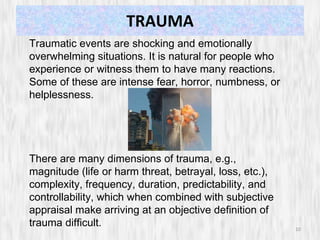
TRAUMA Traumatic events are shocking and emotionally overwhelming situations. It is natural for people who experience or witness them to have many reactions. Some of these are intense fear, horror, numbness, or helplessness.  There are many dimensions of trauma, e.g., magnitude (life or harm threat, betrayal, loss, etc.), complexity, frequency, duration, predictability, and controllability, which when combined with subjective appraisal make arriving at an objective definition of trauma difficult.
Trauma Psychological trauma can be defined as a person’s unique experience of an event in which: Their ability to integrate the emotional experience is overwhelmed, or They experience (subjectively) a threat to their life, bodily integrity or emotional stability. Therefore, reactions to traumatic events vary considerably, ranging from relatively mild, creating minor disruptions in the person's life, to severe and debilitating.
Trauma It is very common for people to experience anxiety, terror, shock, and upset, as well as emotional numbness and personal or social disconnection.  People often cannot remember significant parts of what happened, yet may be plagued by parts of memories that return in physical and psychological flashbacks.  Nightmares of the traumatic event are  common, as are depression, irritability,  Sleep disturbance, dissociation, and feeling jumpy.
Trauma Some of the problems people encounter after traumatic events are part of the diagnosis of Acute Stress Disorder (ASD).  ASD describes experiences of  dissociation  (e.g., feelings of unreality or disconnection),  intrusive thoughts and images ,  efforts to avoid reminders of the traumatic experiences , and  anxiety  that may occur in the month following the end of the events.  When these experiences  last more than 1 month  after traumatic experiences have stopped, they are described by the diagnosis of Post-Traumatic Stress disorder (PTSD).   ASD is highly predictive of subsequent PTSD, and its validity as an actual discrete diagnosis (from PTSD) is very much in question.
Trauma Other equally uncomfortable problems or symptoms may exist with or instead of PTSD.  SAFETY . For example, a traumatic event often challenges the person's sense of personal safety and control, leaving them feeling less secure and more vulnerable.  Physical health may suffer as well, and individuals may notice increased feelings of fatigue, headaches, and other physical symptoms.  Many people traumatized in childhood also experience revictimization (being harmed again) or aggression, identity disturbance (a feeling that you don't know who you are), bodily problems such as illnesses or aches and pains without detectable physical cause (somatization), difficulty staying on an even keel emotionally, and relationship problems.
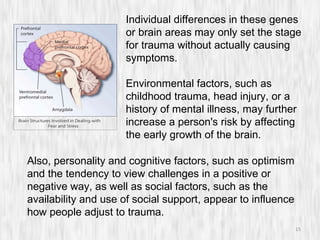
Individual differences in these genes or brain areas may only set the stage for trauma without actually causing symptoms.  Environmental factors, such as childhood trauma, head injury, or a history of mental illness, may further increase a person's risk by affecting the early growth of the brain.  Also, personality and cognitive factors, such as optimism and the tendency to view challenges in a positive or negative way, as well as social factors, such as the availability and use of social support, appear to influence how people adjust to trauma.
Traumatic events take many forms: Type I: Single-Incident Trauma , e.g., an event “out of the blue” and thus unexpected, such as accident, natural disaster, single episode of abuse or assault, witnessing violence. Type II: Complex or Repetitive Trauma , e.g., ongoing abuse, domestic violence, betrayal, community violence, war, chronic pain, addiction, attachment shock, chronic disease, etc. often involving being trapped emotionally and/or physically
Adriana – Rawadan genocide survivor
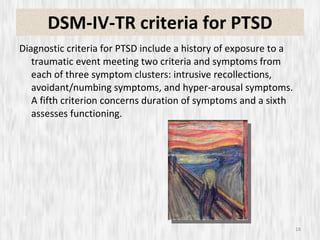
DSM-IV-TR criteria for PTSD Diagnostic criteria for PTSD include a history of exposure to a traumatic event meeting two criteria and symptoms from each of three symptom clusters: intrusive recollections, avoidant/numbing symptoms, and hyper-arousal symptoms. A fifth criterion concerns duration of symptoms and a sixth assesses functioning.
Criterion A: stressor The person has been exposed to a traumatic event in which both of the following have been present: The person has experienced, witnessed, or been confronted with an event or events that involve actual or threatened death or serious injury, or a threat to the physical integrity of oneself or others. 2. The person's response involved intense fear, helplessness, or horror. Note: in children, it may be expressed instead by disorganized or agitated behavior.
Criterion B: intrusive recollection The traumatic event is persistently re-experienced in at least one of the following ways: Recurrent and intrusive distressing recollections of the event, including images, thoughts, or perceptions. Note: in young children, repetitive play may occur in which themes or aspects of the trauma are expressed. 2. Recurrent distressing dreams of the event. Note: in children, there may be frightening dreams without recognizable content
Criterion B: Intrusive Recollection 3. Acting or feeling as if the traumatic event were recurring (includes a sense of reliving the experience, illusions, hallucinations, and dissociative flashback episodes, including those that occur upon awakening or when intoxicated). Note: in children, trauma-specific reenactment may occur. 4. Intense psychological distress at exposure to internal or external cues that symbolize or resemble an aspect of the traumatic event. 5. Physiologic reactivity upon exposure to internal or external cues that symbolize or resemble an aspect of the traumatic event
Criterion C: avoidant/numbing Persistent avoidance of stimuli associated with the trauma and numbing of general responsiveness (not present before the trauma), as indicated by at least three of the following: 1. Efforts to avoid thoughts, feelings, or conversations associated with the trauma 2. Efforts to avoid activities, places, or people that arouse recollections of the trauma 3. Inability to recall an important aspect of the trauma 4. Markedly diminished interest or participation in significant activities 5. Feeling of detachment or estrangement from others 6. Restricted range of affect (e.g., unable to have loving feelings) 7. Sense of foreshortened future (e.g., does not expect to have a career, marriage, children, or a normal life span)
Criterion D: hyper-arousal Persistent symptoms of increasing arousal (not present before the trauma), indicated by at least two of the following: 1. Difficulty falling or staying asleep 2. Irritability or outbursts of anger 3. Difficulty concentrating 4. Hyper-vigilance 5. Exaggerated startle response
Criterion E: duration Duration of the disturbance (symptoms in B, C, and D) is more than one month. Criterion F: functional significance The disturbance causes clinically significant distress or impairment in social, occupational, or other important areas of functioning. Specify if: Acute: if duration of symptoms is less than three months Chronic: if duration of symptoms is three months or more Specify if: With or Without delay onset: Onset of symptoms at least six months after the stressor
Limitations of PTSD Diagnosis Conceptualized from a limited perspective Identified as diagnosis via Vietnam vets and adult rape victims Focuses on single event traumas (Type I) Fails to recognize chronic/multiple/ongoing (Type II) traumas Is not developmentally sensitive Most traumatized children do not meet full diagnostic criteria
Type II or Complex Trauma Current PTSD diagnosis often does not capture the severe psychological harm that occurs with such prolonged, repeated trauma. For example, ordinary, healthy people who experience chronic trauma can experience changes in their self-concept and the way they adapt to stressful events.  The term Complex PTSD has been proposed as a diagnosis to describe the symptoms of long-term trauma. Another name sometimes used to describe this cluster of symptoms is: Disorders of Extreme Stress Not Otherwise Specified (DESNOS).
More prevalent than previously recognized (i.e., affecting 1 in 7 to 1 in 10 children) More often occurs in combination or cumulatively (i.e., “polyvictimization”) Can involve a fundamental betrayal of trust in primary relationships – Attachment Theory casts considerable light on this issue Associated with much higher risk of development of PTSD than is Type I trauma May compromise or alter psychobiological and socioemotional development when occurs at critical developmental periods Type II or Complex Trauma
Gina – Iraqi veteran, childhood trauma
Proposed Diagnostic Criteria for  Complex Trauma 1.  Alterations in regulation of affect and impulses -  may include symptoms such as:  a) Persistent, untreatable anxiety and/or depression  b) Explosive or inhibited anger.  c) Affect intensity - easily triggered, slow to calm d) Emotion reducing behaviors – Substance Abuse, self injury, compulsive sexual behavior e) Suicidal preoccupation f) Excessive risk taking g) Avoid thinking and talking about trauma-related topics because the feelings associated with the trauma are often overwhelming
2.  Alterations in attention or consciousness  - such as forgetting traumatic events, reliving traumatic events, or having episodes of dissociation (during which one feels detached from one's mental processes or body) 3.  Alterations in self-perception  – may include a sense of helplessness, shame, guilt, stigma, and a sense of being completely different than other human beings 4.  Alterations in relations with others  - including isolation, revictimization (“reenactment”), victimizing others, distrust, deep fear of abandonment, or a repeated search for a rescuer.
5.  Somatization  – may be unexplained chronic pain or other symptoms with no origin, repeat doctor visits, digestive complaints, cardiopulmonary symptoms, sleep problems 6.  Alterations in systems of meaning  - may include a loss of sustaining beliefs, sense of hopelessness and despair, foreshortened future, no sense of justice and fairness “ Borderline” symptomatology is common, such as affect dysregulation, identity disturbance, relational disturbance without meeting Borderline Personality Disorder diagnoses.
Dissociation A term that has been used in a variety of ways, both to refer to enduring mechanisms producing distortions in how the mind handles trauma-related information, to clear alterations in one’s mental state including depersonalization, loss of time, intrusions of past memories as being in present, or numbing or “spacing out”.  Current formal definition : The separation of ideas, feelings, information, identity, or memories that would normally go together. Dissociation exists on a continuum: At one end are mild dissociative experiences common to most people (such as daydreaming or highway hypnosis) and at the other extreme is severe chronic dissociation, such as DID (MPD) and other dissociative disorders. Dissociation appears to be a normal process used to handle trauma that over time becomes reinforced and develops into maladaptive coping.
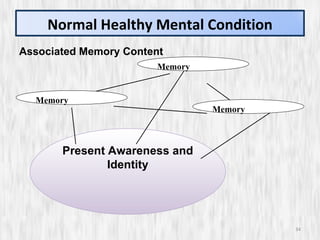
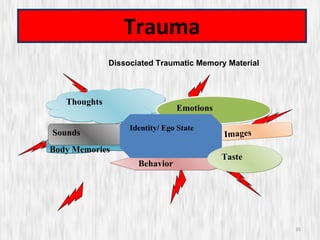
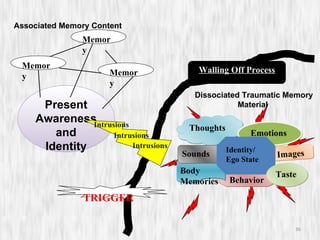
Dissociation The mind attempts to “wall off” traumatic memories, and consequently has never processed them.  The wall is highly permeable and many different stimuli/cues can act as triggers causing portions of trauma material to seep into or intrude into awareness, e.g., emotions, thoughts, ego states, body memories. All forms of treatment focus, in some form, on integrating the trauma material into present awareness, long-term memory, and identity.
Normal Healthy Mental Condition Present Awareness and Identity Memory Memory Memory Associated Memory Content
Trauma Behavior Images Thoughts Body Memories Emotions Sounds Identity/ Ego State Taste Dissociated Traumatic Memory Material
TRIGGER Present Awareness and Identity Memory Memory Memory Associated Memory Content Behavior Images Thoughts Body Memories Emotions Sounds Identity/ Ego State Taste Dissociated Traumatic Memory Material  Walling Off Process Intrusions Intrusions Intrusions
Structural Dissociation in Individual’s Personality Apparently Normal part of personality (ANP)  – “as if personality,” presents as functional and whole, but is not. Emotional Part of Personality  (EP) – also referred to as “survivor mode.” Trapped in traumatic memories and reactions. There can be more than one EP. Different, more or less divided psychobiological systems that are not sufficiently cohesive or coordinated within an individual’s personality.
Short Screening Scale for PTSD In your life, have you ever had any experience that was so frightening, horrible, or upsetting that,  in the past month , you... 1. Have had nightmares about it or thought about it when you did not want to?  [ ] YES  [ ] NO 2. Tried hard not to think about it or went out of your way to avoid situations that reminded you of it? [ ] YES  [ ] NO 3. Were constantly on guard, watchful, or easily startled?  [ ] YES  [ ] NO 4. Felt numb or detached from others, activities, or your surroundings?  [ ] YES  [ ] NO
A, B, C, D and E of Trauma Assessment A:  Actively support the client – build alliance B:  Behavioral descriptions, not value judgments C:  Contain the client’s narrative – avoid detail D:  Don’t avoid  E:  Expect more – clients often hold back information, e.g., leave out the worst Contact with history can disturb a client. If they avoid certain details, there's probably a good reason. In seeking additional information, respect reluctance to disclose, and note this as a very good sign that there's something painful being hidden. It's best to show obvious carefulness and compassion.
Six Domains of Assessment 1. Trauma History: Some things to look for: Client/patient report of an event which was a "big deal" for them at the time.  Client/patient report of an event which YOU think ought to have been a "big deal" for them at the time.  Report of an event in client/patient records which suggests emotional trauma.  History of adult victimization.  History of substance abuse or dependence of any kind.  History of instability in intimacy or work relationships. History of overt self-abuse attempts or acts.
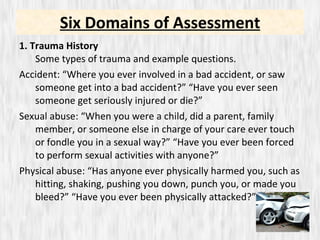
1. Trauma History  Some types of trauma and example questions. Accident: “Where you ever involved in a bad accident, or saw someone get into a bad accident?” “Have you ever seen someone get seriously injured or die?” Sexual abuse: “When you were a child, did a parent, family member, or someone else in charge of your care ever touch or fondle you in a sexual way?” “Have you ever been forced to perform sexual activities with anyone?”  Physical abuse: “Has anyone ever physically harmed you, such as hitting, shaking, pushing you down, punch you, or made you bleed?” “Have you ever been physically attacked?” Six Domains of Assessment
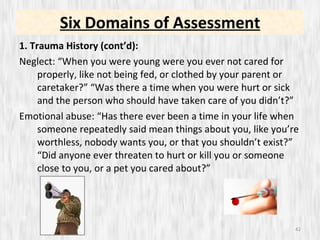
Six Domains of Assessment 1. Trauma History (cont’d): Neglect: “When you were young were you ever not cared for properly, like not being fed, or clothed by your parent or caretaker?” “Was there a time when you were hurt or sick and the person who should have taken care of you didn’t?” Emotional abuse: “Has there ever been a time in your life when someone repeatedly said mean things about you, like you’re worthless, nobody wants you, or that you shouldn’t exist?” “Did anyone ever threaten to hurt or kill you or someone close to you, or a pet you cared about?”
2. PTSD Symptoms: Using various instruments, e.g., CAPS, PLC, TEC, Trauma History Screen, etc. Reexperiencing symptoms Avoidance and Numbing Symptoms Hyperarousal Focus on symptom(s) which are most distressing or difficult at this time Six Domains of Assessment
3. Emotion regulation problems Common to fluctuate between being overwhelmed by emotions and feeling nothing or “numb.” Become upset easily and can’t come back down Emotion-phobic, poor distress tolerance Self-harming, substance abuse, aggression against self Common problems are anger, depression, severe anxiety 4. Interpersonal problems and role dysfunction Lack of trust, intimacy Feelings interfere with close and social relationships  Six Domains of Assessment
5. Harmful/Risky Behaviors and Comorbidity Imminent suicide Alcohol or drug dependence Severely disordered eating behaviors Severe dissociative disorder Other severe mental disorders Medical conditions 6. Resilience and Coping Strategies Assessing for resilient domains of functioning and successful coping strategies Six Domains of Assessment
Possible Considerations in Placement Severity of one or more problems requiring intensive interventions prior to entering treatment, e.g., suicidality, dissociative disorder, substance abuse Readiness for treatment – motivation, resources Prior treatment history – progress made, successful interventions, client’s experience Client expectations and goals Appropriate for direct entry into Middle Stage treatment, or refer to program with Early Stage interventions – e.g., can client tolerate trauma-focused interventions Six Domains of Assessment
Treatment An overall goal of therapy for those suffering from trauma disorders is to dissipate the ever-repeating cycles of stagnation in order to help victims to move from being haunted by the past and interpreting subsequent emotionally arousing stimuli as a return of the trauma, to being present in the here and now, capable of responding to current exigencies to their fullest potential. Tim – Recovering from trauma of MVA
The Sanctuary Model The S.E.L.F. framework is a trauma-informed tool that helps to orient staff and clients around the tasks necessary to heal.  S.E.L.F. is an acronym that represents the four interactive key aspects of recovery from bad experiences, providing a cognitive behavioral therapeutic approach for facilitating client movement through the four critical aspects of recovery: Safety  (attaining safety in self, relationships, and  environment) Emotional management  (identifying levels of affect and modulating affect  in response to memories, persons, events); Loss  (feeling grief and dealing with personal  losses) Future  (trying out new roles, ways of relating and behaving as a “survivor”  to ensure personal safety and help others)
Sanctuary Model Using S.E.L.F., the clients and staff are able to embrace a shared, non-technical and non-pejorative language that allows them all to see the larger recovery process in perspective.  The accessible language demystifies what sometimes is seen as confusing and even insulting clinical or psychological terminology that often confounds clients and line-staff, while still focusing on the aspects of pathological adjustment that pose the greatest problems for any treatment environment
Some Notes on Treatment Approaches Couple/Family therapies  for PTSD continue to lack empirical support; however, data suggests in some cases improving communication, problem solving, coping and mutual support may be of help to all members involved including survivor. Co-Occurring Disorders : With some exceptions, most therapies focus only on trauma. Only one co-occurring psychosocial model has been established as effective for PTSD and a comorbid disorder - Seeking Safety. Co-Occurring Integrated treatment has the most general support for usefulness in treating PTSD and SUDs.  Research into the most efficacious treatment for simple PTSD is far more extensive and definitive than what works for complex PTSD.
Some Notes on Treatment Approaches Psychological Debriefing , done immediately after a traumatic event and involving emotional processing through ventilation and normalization of reactions in group and individual settings has not been shown to be effective in either significantly reducing distress or preventing long-term psychopathology. Early Intervention CBT , (5 to 12 weekly sessions) has considerable support for its efficacy in preventing or decreasing the development of chronic PTSD. The CBT methods used mirror those used for chronic PTSD in tertiary care, e.g., psychoeducation, stress management skills, cognitive therapy, and exposure therapy. Interventions were collaborative and experiential, and utilized homework and  in vivo  application of strategies learned in face-to-face therapy.
Seeking Safety Specialized program for treating clients with PTSD and substance abuse issues. Can also be used with clients who have just one disorder (PTSD or SUD), or are subthreshold One of few treatment approaches which stays focused in early stage  Only co-occurring PTSD model which has strong empirical support for its efficacy. A present-focused CBT that provides psychoeducation and coping skills to help clients attain greater safety in their lives. Designed for group or individual format; men or women; diverse settings (e.g., outpt, inpt, res); and all types of trauma and substances Offers 25 safe coping skills such as Asking for Help and Healing Anger.
Trauma Recovery and Empowerment Model (TREM) Integrative therapy originally designed for women, now adapted for men, with chronic traumatic stress, and comorbid psychiatric and substance abuse problems.  Combination of therapeutic methods from interpersonal, relational, client-centered, cognitive-behavioral, and psychodynamic models. Components include: 1) psychoeducation about psychological trauma; 2) teaching of skills for cognitive reappraisal, self-efficacy, mood and arousal regulation, and interpersonal effectiveness; 3) mobilizing peer validation and support; and 4) assisting clients in developing an understanding of their lives and foster hope and change.
Sensorimotor Psychotherapy “ Trauma treatment must restore a sense of safety in the body and complete the unfinished past.” – van der Kolk Model specifically designed to treat effects of PTSD and complex trauma, as well as associated attachment and developmental disturbances via somatic and cognitive interventions. Therapist carefully attends to client’s narrative, empathically interrupting tendencies toward hyper- or hypo-arousal before either causes dysregulation, and encouraging alternative physical actions that challenge habitual, trauma-related reactions. Over time, the trauma-related feelings and cognitions begin to reorganize as clients experience new physical responses and the sense of mastery in physical control.
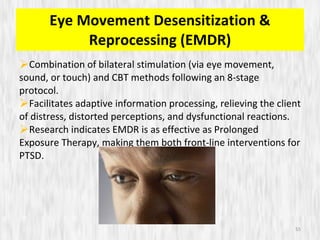
Eye Movement Desensitization & Reprocessing (EMDR) Combination of bilateral stimulation (via eye movement, sound, or touch) and CBT methods following an 8-stage protocol. Facilitates adaptive information processing, relieving the client of distress, distorted perceptions, and dysfunctional reactions. Research indicates EMDR is as effective as Prolonged Exposure Therapy, making them both front-line interventions for PTSD.
CBT: Exposure Therapy Has the most support of any approach for efficacy with PTSD Involves several different means of creating prolonged exposure to anxiety-provoking stimuli without relaxation or other anxiety-reducing methods. Methods include “flooding,” “imaginal,” in vivo and “directed.” Typically begins with development of an anxiety hierarchy. Methods share common feature of confrontation with frightening yet realistically safe stimuli that continues until the anxiety is reduced. Continuous exposure to stimulus results in diminishing anxiety, leading to decrease in the escape and avoidance behaviors maintained via negative reinforcement. Can involve psychoeducation and cognitive restructuring.
CBT Treatment of Complex Trauma Generalized process followed by many CBT approaches including DBT and STAIR-MPE. Begin with identifying all symptoms and problematic behaviors, clear identification of strengths, including coping skills. Phase I: Safety/Stablization, Emotion Regulation, and Interpersonal Self-Regulation  – psychoeducation, therapeutic alliance/”secure attachment,” identifying and learning to manage emotions instead of dissociating, developing interpersonal skills which includes separating past from current relationships. Phase II: Emotional Processing of Traumatic Memories  – repeated exposure to traumatic memories through storytelling, tape-recorded, and/or narrative writing. Attending to and integrating all aspects of the experience, creating sense of self, independence, and reconstructing what happened.
Psychopharmacotherapy Medication tx is viable approach to PTSD, particularly in view of probable neurobiologhical mechanisms, overlap with anxiety and depression, and comorbidity with many other mental illnesses.  However, research has found no med is as effective as CBT approaches. Best is psychotherapy and psychopharmacology. Positive symptoms (e.g., re-experiencing, hyperarousal) often respond to medications, while negative symptoms (e.g., avoidance, numbing) respond poorly. Medications have little or no effect on dissociative defensive process.
Preferred choices : SSRIs: Sertraline (Zoloft); Paroxetine (Paxil); Fluoxetine (Prozac) SNRI: Venlafaxine (Effexor) Augmentation with Atypical Antipsychotics:   Resperidone (Risperdal), Olanzapine (Zyprexa), and Quetiapine (Seroquel) has good evidence MAOIs : Phenelzine (Nardil) is moderately effective Tricylclics (TCAs) :  Imipramine (Tofranil), Amitriptyline (Elavil), Desipramine Norpramin) have mildly effective results Antiadrenergic Agents :  Pazosin, Propranolol, Clonidine – appear to reduce arousal, reexperiencing, and possible dissociative symptoms, but results have been inconsistent in clinical trials. Avoid, unless absolutely necessary! Benzodiazepines. All mood altering substances, e.g., alcohol, marijuana, opiates, etc.
Resources Publications Cloitre, M., Cohen, L. R., & Koenen, K. C. (2006).  Treating survivors of childhood abuse: Psychotherapy for the interrupted life . NY: Guilford. Courtois, C. A., & Ford, J. D. (Eds.). (2009).  Treating complex traumatic stress disorder: An evidence-based guide.  NY: Guilford. I cannot recommend this book enough.  Foa, E. B., Keane, T. M., Friedman, M. J., & Cohen, J. A. (2009).  Effective treatments for PTSD: Practice guidelines from the International Society for Traumatic Stress Studies  (2 nd . ed.). NY: Guilford. This is the most up-to-date examination of evidence-based practices – the bible of the field right now. Greenwald, R. (2009).  Treating problem behaviors: A trauma-informed approach.  NY: Routledge. Klein, R.H., & Schermer, V.L. (Eds.). (2000).  Group therapy for psychological traum a. NY: Guilford. Paulsen, S. (2009).  Looking through the eyes of trauma and dissociation: An illustrated guide for EMDR therapists and clients.  BookSurge Publishing. Levine, P. A. (1997).  Waking the tiger – Healing trauma: The innate capacity to transform overwhelming experiences . Berkeley, CA: North Atlantic Books. This is the key book to sensorimotor therapy. Rothschild, B. (2000).  The body remembers: The psychophysiology of trauma and trauma treatment.  NY: Norton.  There is a workbook with this. Schiraldi, G. (2009).  The Post-Traumatic Stress Disorder sourcebook: A guide to healing, recovery, and growth,  (2 nd  ed.). NY: McGraw-Hill. Matsakis, A. (1996).  I can’t get over it: A handbook for trauma survivors  (2 nd . ed.). Oakland, CA: New Harbinger. A bit old, but still good material for clients. Williams, M.B., & Poijula, S. (2002).  The PTSD workbook: Simple, effective techniques for overcoming traumatic stress symptoms.  Oakland, CA: New Harbinger. Very, very good. Copy sections for your clients. Follette, V. M., & Pistorello, J. (2007).  Finding life beyond trauma: Using Acceptance and Commitment Therapy to Heal from Post-Traumatic Stress and trauma-related problems.  Oakland, CA: New Harbinger.
Resources Publications Rothbaum, B. O., Foa, E. B., & Hembree, E. A. (2007).  Reclaiming your life from a traumatic experience: A prolonged exposure treatment program workbook ( Treatments That Work). NY: Oxford University Press. Foa, E. B., Hembree, E. A., & Rothbaum, B. O. (2007).  Prolonged Exposure Therapy for PTSD: Emotional processing of traumatic experiences therapist guide  (Treatments That Work). NY: Oxford University Press. Spradlin, S. E. (2003).  Don't let your emotions run your life: How Dialectical Behavior Therapy can put you in control.  Oakland, CA: New Harbinger. This is a book that’s excellent for everyone. Get it, use it and give it to your clients. Najavits, L. M. (2001).  Seeking Safety: A treatment manual for PTSD and Substance Abuse.  NY: Guilford. The modules for skills training is gold! Get it and use it! Internet   About.com: Post-Traumatic Stress :  http://ptsd.about.com/ You  can go to the website which is packed with info, and subscribe for free to a regular e-newsletter on PTSD research and clinical applications. Very well done. Definitely look into it.   Adult PTSD Self-Report Scales   http://www.ncptsd.org/treatment/assessment/adult_self_report.html National Center for PTSD provides this list of self-report scales for assessing PTSD in adults; some with author contact info. Anxiety Disorders Association of America (ADAA ):  http://www.adaa.org/understanding-anxiety/posttraumatic-stress-disorder-ptsd   Association for Behavioral and Cognitive Therapies   http://www.abct.org/dHome/ The Association for Behavioral and Cognitive Therapies is an interdisciplinary organization committed to the advancement of a scientific approach to the understanding and amelioration of problems of the human condition. These aims are achieved through the investigation and application of behavioral, cognitive, and other evidence-based principles to assessment, prevention, and treatment.
The Association of Traumatic Stress Specialists :  http://www.atss.info/ An international organization offering three distinct certifications to individuals providing support, education, intervention and treatment in the field of traumatic stress EMDR International Association (EMDRIA ):   http://www.emdria.org/ EMDR International Association (EMDRIA) is a membership organization of mental health professionals dedicated to the highest standards of excellence and integrity in Eye Movement Desensitization and Reprocessing (EMDR). International Society for the Study of Trauma and Dissociation   http://www.issd.org/ A not-for-profit professional organization promoting research and training in the identification of dissociative states International Society for Traumatic Stress Studies :   http://www.istss.org/ A membership organization providing a forum for the sharing of research, clinical strategies, public policy concerns and theoretical formulations on trauma in the United States and around the world. Mood and Anxiety Disorders Program, National Ins t itute of Mental Health :  http://intramural.nimh.nih.gov/mood/ A nonprofit clinical trial site  National Center for PTSD:  http://www.ncptsd.va.gov/ncmain/index.jsp Research and education on PTSD; includes the  PILOTS Database,  an electronic index to PTSD literature. Assessment Instruments at   http://www.ncptsd.org/treatment/assessment/  has detailed information about a variety of trauma-related scales and interviews for adults and children, from the NC-PTSD's site. Enables you to order various instruments including the Clinician-Administered PTSD Scale (CAPS). National Center for Victims of Crime:   http://www.ncvc.org/ncvc/Main.aspx Provides services and resources to crime victims and advocates for laws that secure victims' rights. Sidran Traumatic Stress Foundation:   http://www.sidran.org/ Non-profit organization which provides resources and publications on trauma and dissociation, including pamphlets on DID, traumatic memories, and a DID glossary.  Trauma Info Pages:   http://www.trauma-pages.com/ Site maintained by Oregon psychologist David Baldwin, Ph.D.  Resources

Simple And Complex Trauma

  • 1.
    Simple and ComplexTrauma: Assessment and Treatment Kevin J. Drab, M.A., M.Ed., LPC, NBCCH, CAACD, CEMDRT Behavioral Counseling & Training, 418 Stump Road, Suite #208, Montgomeryville, PA 18936 Tel: (215) 527-2904 Fax: (215) 699-3382 e-mail: [email_address] web site: http://BCTPRO.com
  • 2.
    Last 25+ years- rapidly developing field. Changing, expanding definitions of trauma – not just PTSD any longer. Majority of adults and a substantial minority of children are exposed to traumatic events. Risk and Resiliency Factors . Variable adaptations to trauma – many recover in a matter of days or months, while others continue to be severely disturbed for years, lifetimes following the event. Introduction
  • 3.
    Post traumatic reactions: - Acute Stress Disorder (ASD) - “Simple” PTSD - “Complex” Trauma - Dissociative Disorders Often occurs with depression, substance abuse, or other anxiety disorders. Incidence of Substance Use Disorders and PTSD MEN Women Alcohol Abuse/Dependence 52% 28% Drug Abuse / Dependence 35% 27% Introduction
  • 4.
    New Consensus Modelof Trauma Treatment Evolving standard of care, philosophy and principles of practice Sequenced and progressive stages of treatment involving safety, stabilization, therapeutic relationship, tasks/mastery, working with traumatic material, and individualized resolution Empowering and not retraumatizing Attention to delayed memory issues Recognizing issues of transference and countertransference Vicarious Traumatization Introduction
  • 5.
    Suggested Treatment Sequence: Stages of Treatment Pre-Treatment stage : contracting, assessment, pre-treatment issues Early stage : safety, stabilization, skill-building, self-management, security in tx relationship Middle stage : trauma deconditioning, processing, mourning, resolution, moving on Late stage : self and relational development from a new perspective Note: non-linear and not lockstep: a back and forth, titrated process with attention to and planning for relapse
  • 6.
    Trauma Sensitive orInformed Treatment Program This type of program is not designed to treat trauma but rather to provide services in a manner that is welcoming and appropriate for the needs of clients who have experienced trauma Staff is trained in nature of trauma, assessment processes, and being comfortable working with behaviors related to trauma Holistic and integrated treatment planning and delivery Accommodating the vulnerabilities of trauma survivors and allows program services to be delivered in a fashion that facilitates client participation and reduces chance of revictimization
  • 7.
    Trauma-Informed Care Mostindividuals seeking public behavioral health services and many other public services, such as homeless and domestic violence services, have histories of physical and sexual abuse and other types of trauma-inducing experiences. These experiences often lead to mental health and co-occurring disorders such as chronic health conditions, substance abuse, eating disorders, and HIV/AIDS, as well as contact with the criminal justice system. .
  • 8.
    Trauma-Informed Care Whena human service program takes the step to become trauma-informed, every part of its organization, management, and service delivery system is assessed and potentially modified to include a basic understanding of how trauma affects the life of an individual seeking services. Trauma-informed organizations, programs, and services are based on an understanding of the vulnerabilities or triggers of trauma survivors that traditional service delivery approaches may exacerbate, so that these services and programs can be more supportive and avoid re-traumatization
  • 9.
    The impact ofcreating such a trauma-informed culture should be observable and measurable • Less emotional dysregulation, reenactment behavior, resistance and physical, verbal, or emotional forms of violence due to effective recognition and response to trauma-related symptoms • Systemic understanding of complex biopsychosocial and developmental impact of trauma and abuse with implications for response • Less victim-blaming; less punitive and judgmental responses • Clearer more consistent and appropriate boundaries, higher expectations, linked rights and responsibilities • Better ability to articulate goals, create strategies for change, justify need for holistic approach
  • 10.
    TRAUMA Traumatic eventsare shocking and emotionally overwhelming situations. It is natural for people who experience or witness them to have many reactions. Some of these are intense fear, horror, numbness, or helplessness. There are many dimensions of trauma, e.g., magnitude (life or harm threat, betrayal, loss, etc.), complexity, frequency, duration, predictability, and controllability, which when combined with subjective appraisal make arriving at an objective definition of trauma difficult.
  • 11.
    Trauma Psychological traumacan be defined as a person’s unique experience of an event in which: Their ability to integrate the emotional experience is overwhelmed, or They experience (subjectively) a threat to their life, bodily integrity or emotional stability. Therefore, reactions to traumatic events vary considerably, ranging from relatively mild, creating minor disruptions in the person's life, to severe and debilitating.
  • 12.
    Trauma It isvery common for people to experience anxiety, terror, shock, and upset, as well as emotional numbness and personal or social disconnection. People often cannot remember significant parts of what happened, yet may be plagued by parts of memories that return in physical and psychological flashbacks. Nightmares of the traumatic event are common, as are depression, irritability, Sleep disturbance, dissociation, and feeling jumpy.
  • 13.
    Trauma Some ofthe problems people encounter after traumatic events are part of the diagnosis of Acute Stress Disorder (ASD). ASD describes experiences of dissociation (e.g., feelings of unreality or disconnection), intrusive thoughts and images , efforts to avoid reminders of the traumatic experiences , and anxiety that may occur in the month following the end of the events. When these experiences last more than 1 month after traumatic experiences have stopped, they are described by the diagnosis of Post-Traumatic Stress disorder (PTSD). ASD is highly predictive of subsequent PTSD, and its validity as an actual discrete diagnosis (from PTSD) is very much in question.
  • 14.
    Trauma Other equallyuncomfortable problems or symptoms may exist with or instead of PTSD. SAFETY . For example, a traumatic event often challenges the person's sense of personal safety and control, leaving them feeling less secure and more vulnerable. Physical health may suffer as well, and individuals may notice increased feelings of fatigue, headaches, and other physical symptoms. Many people traumatized in childhood also experience revictimization (being harmed again) or aggression, identity disturbance (a feeling that you don't know who you are), bodily problems such as illnesses or aches and pains without detectable physical cause (somatization), difficulty staying on an even keel emotionally, and relationship problems.
  • 15.
    Individual differences inthese genes or brain areas may only set the stage for trauma without actually causing symptoms. Environmental factors, such as childhood trauma, head injury, or a history of mental illness, may further increase a person's risk by affecting the early growth of the brain. Also, personality and cognitive factors, such as optimism and the tendency to view challenges in a positive or negative way, as well as social factors, such as the availability and use of social support, appear to influence how people adjust to trauma.
  • 16.
    Traumatic events takemany forms: Type I: Single-Incident Trauma , e.g., an event “out of the blue” and thus unexpected, such as accident, natural disaster, single episode of abuse or assault, witnessing violence. Type II: Complex or Repetitive Trauma , e.g., ongoing abuse, domestic violence, betrayal, community violence, war, chronic pain, addiction, attachment shock, chronic disease, etc. often involving being trapped emotionally and/or physically
  • 17.
    Adriana – Rawadangenocide survivor
  • 18.
    DSM-IV-TR criteria forPTSD Diagnostic criteria for PTSD include a history of exposure to a traumatic event meeting two criteria and symptoms from each of three symptom clusters: intrusive recollections, avoidant/numbing symptoms, and hyper-arousal symptoms. A fifth criterion concerns duration of symptoms and a sixth assesses functioning.
  • 19.
    Criterion A: stressorThe person has been exposed to a traumatic event in which both of the following have been present: The person has experienced, witnessed, or been confronted with an event or events that involve actual or threatened death or serious injury, or a threat to the physical integrity of oneself or others. 2. The person's response involved intense fear, helplessness, or horror. Note: in children, it may be expressed instead by disorganized or agitated behavior.
  • 20.
    Criterion B: intrusiverecollection The traumatic event is persistently re-experienced in at least one of the following ways: Recurrent and intrusive distressing recollections of the event, including images, thoughts, or perceptions. Note: in young children, repetitive play may occur in which themes or aspects of the trauma are expressed. 2. Recurrent distressing dreams of the event. Note: in children, there may be frightening dreams without recognizable content
  • 21.
    Criterion B: IntrusiveRecollection 3. Acting or feeling as if the traumatic event were recurring (includes a sense of reliving the experience, illusions, hallucinations, and dissociative flashback episodes, including those that occur upon awakening or when intoxicated). Note: in children, trauma-specific reenactment may occur. 4. Intense psychological distress at exposure to internal or external cues that symbolize or resemble an aspect of the traumatic event. 5. Physiologic reactivity upon exposure to internal or external cues that symbolize or resemble an aspect of the traumatic event
  • 22.
    Criterion C: avoidant/numbingPersistent avoidance of stimuli associated with the trauma and numbing of general responsiveness (not present before the trauma), as indicated by at least three of the following: 1. Efforts to avoid thoughts, feelings, or conversations associated with the trauma 2. Efforts to avoid activities, places, or people that arouse recollections of the trauma 3. Inability to recall an important aspect of the trauma 4. Markedly diminished interest or participation in significant activities 5. Feeling of detachment or estrangement from others 6. Restricted range of affect (e.g., unable to have loving feelings) 7. Sense of foreshortened future (e.g., does not expect to have a career, marriage, children, or a normal life span)
  • 23.
    Criterion D: hyper-arousalPersistent symptoms of increasing arousal (not present before the trauma), indicated by at least two of the following: 1. Difficulty falling or staying asleep 2. Irritability or outbursts of anger 3. Difficulty concentrating 4. Hyper-vigilance 5. Exaggerated startle response
  • 24.
    Criterion E: durationDuration of the disturbance (symptoms in B, C, and D) is more than one month. Criterion F: functional significance The disturbance causes clinically significant distress or impairment in social, occupational, or other important areas of functioning. Specify if: Acute: if duration of symptoms is less than three months Chronic: if duration of symptoms is three months or more Specify if: With or Without delay onset: Onset of symptoms at least six months after the stressor
  • 25.
    Limitations of PTSDDiagnosis Conceptualized from a limited perspective Identified as diagnosis via Vietnam vets and adult rape victims Focuses on single event traumas (Type I) Fails to recognize chronic/multiple/ongoing (Type II) traumas Is not developmentally sensitive Most traumatized children do not meet full diagnostic criteria
  • 26.
    Type II orComplex Trauma Current PTSD diagnosis often does not capture the severe psychological harm that occurs with such prolonged, repeated trauma. For example, ordinary, healthy people who experience chronic trauma can experience changes in their self-concept and the way they adapt to stressful events. The term Complex PTSD has been proposed as a diagnosis to describe the symptoms of long-term trauma. Another name sometimes used to describe this cluster of symptoms is: Disorders of Extreme Stress Not Otherwise Specified (DESNOS).
  • 27.
    More prevalent thanpreviously recognized (i.e., affecting 1 in 7 to 1 in 10 children) More often occurs in combination or cumulatively (i.e., “polyvictimization”) Can involve a fundamental betrayal of trust in primary relationships – Attachment Theory casts considerable light on this issue Associated with much higher risk of development of PTSD than is Type I trauma May compromise or alter psychobiological and socioemotional development when occurs at critical developmental periods Type II or Complex Trauma
  • 28.
    Gina – Iraqiveteran, childhood trauma
  • 29.
    Proposed Diagnostic Criteriafor Complex Trauma 1. Alterations in regulation of affect and impulses - may include symptoms such as: a) Persistent, untreatable anxiety and/or depression b) Explosive or inhibited anger. c) Affect intensity - easily triggered, slow to calm d) Emotion reducing behaviors – Substance Abuse, self injury, compulsive sexual behavior e) Suicidal preoccupation f) Excessive risk taking g) Avoid thinking and talking about trauma-related topics because the feelings associated with the trauma are often overwhelming
  • 30.
    2. Alterationsin attention or consciousness - such as forgetting traumatic events, reliving traumatic events, or having episodes of dissociation (during which one feels detached from one's mental processes or body) 3. Alterations in self-perception – may include a sense of helplessness, shame, guilt, stigma, and a sense of being completely different than other human beings 4. Alterations in relations with others - including isolation, revictimization (“reenactment”), victimizing others, distrust, deep fear of abandonment, or a repeated search for a rescuer.
  • 31.
    5. Somatization – may be unexplained chronic pain or other symptoms with no origin, repeat doctor visits, digestive complaints, cardiopulmonary symptoms, sleep problems 6. Alterations in systems of meaning - may include a loss of sustaining beliefs, sense of hopelessness and despair, foreshortened future, no sense of justice and fairness “ Borderline” symptomatology is common, such as affect dysregulation, identity disturbance, relational disturbance without meeting Borderline Personality Disorder diagnoses.
  • 32.
    Dissociation A termthat has been used in a variety of ways, both to refer to enduring mechanisms producing distortions in how the mind handles trauma-related information, to clear alterations in one’s mental state including depersonalization, loss of time, intrusions of past memories as being in present, or numbing or “spacing out”. Current formal definition : The separation of ideas, feelings, information, identity, or memories that would normally go together. Dissociation exists on a continuum: At one end are mild dissociative experiences common to most people (such as daydreaming or highway hypnosis) and at the other extreme is severe chronic dissociation, such as DID (MPD) and other dissociative disorders. Dissociation appears to be a normal process used to handle trauma that over time becomes reinforced and develops into maladaptive coping.
  • 33.
    Dissociation The mindattempts to “wall off” traumatic memories, and consequently has never processed them. The wall is highly permeable and many different stimuli/cues can act as triggers causing portions of trauma material to seep into or intrude into awareness, e.g., emotions, thoughts, ego states, body memories. All forms of treatment focus, in some form, on integrating the trauma material into present awareness, long-term memory, and identity.
  • 34.
    Normal Healthy MentalCondition Present Awareness and Identity Memory Memory Memory Associated Memory Content
  • 35.
    Trauma Behavior ImagesThoughts Body Memories Emotions Sounds Identity/ Ego State Taste Dissociated Traumatic Memory Material
  • 36.
    TRIGGER Present Awarenessand Identity Memory Memory Memory Associated Memory Content Behavior Images Thoughts Body Memories Emotions Sounds Identity/ Ego State Taste Dissociated Traumatic Memory Material Walling Off Process Intrusions Intrusions Intrusions
  • 37.
    Structural Dissociation inIndividual’s Personality Apparently Normal part of personality (ANP) – “as if personality,” presents as functional and whole, but is not. Emotional Part of Personality (EP) – also referred to as “survivor mode.” Trapped in traumatic memories and reactions. There can be more than one EP. Different, more or less divided psychobiological systems that are not sufficiently cohesive or coordinated within an individual’s personality.
  • 38.
    Short Screening Scalefor PTSD In your life, have you ever had any experience that was so frightening, horrible, or upsetting that, in the past month , you... 1. Have had nightmares about it or thought about it when you did not want to? [ ] YES [ ] NO 2. Tried hard not to think about it or went out of your way to avoid situations that reminded you of it? [ ] YES [ ] NO 3. Were constantly on guard, watchful, or easily startled? [ ] YES [ ] NO 4. Felt numb or detached from others, activities, or your surroundings? [ ] YES [ ] NO
  • 39.
    A, B, C,D and E of Trauma Assessment A: Actively support the client – build alliance B: Behavioral descriptions, not value judgments C: Contain the client’s narrative – avoid detail D: Don’t avoid E: Expect more – clients often hold back information, e.g., leave out the worst Contact with history can disturb a client. If they avoid certain details, there's probably a good reason. In seeking additional information, respect reluctance to disclose, and note this as a very good sign that there's something painful being hidden. It's best to show obvious carefulness and compassion.
  • 40.
    Six Domains ofAssessment 1. Trauma History: Some things to look for: Client/patient report of an event which was a "big deal" for them at the time. Client/patient report of an event which YOU think ought to have been a "big deal" for them at the time. Report of an event in client/patient records which suggests emotional trauma. History of adult victimization. History of substance abuse or dependence of any kind. History of instability in intimacy or work relationships. History of overt self-abuse attempts or acts.
  • 41.
    1. Trauma History Some types of trauma and example questions. Accident: “Where you ever involved in a bad accident, or saw someone get into a bad accident?” “Have you ever seen someone get seriously injured or die?” Sexual abuse: “When you were a child, did a parent, family member, or someone else in charge of your care ever touch or fondle you in a sexual way?” “Have you ever been forced to perform sexual activities with anyone?” Physical abuse: “Has anyone ever physically harmed you, such as hitting, shaking, pushing you down, punch you, or made you bleed?” “Have you ever been physically attacked?” Six Domains of Assessment
  • 42.
    Six Domains ofAssessment 1. Trauma History (cont’d): Neglect: “When you were young were you ever not cared for properly, like not being fed, or clothed by your parent or caretaker?” “Was there a time when you were hurt or sick and the person who should have taken care of you didn’t?” Emotional abuse: “Has there ever been a time in your life when someone repeatedly said mean things about you, like you’re worthless, nobody wants you, or that you shouldn’t exist?” “Did anyone ever threaten to hurt or kill you or someone close to you, or a pet you cared about?”
  • 43.
    2. PTSD Symptoms:Using various instruments, e.g., CAPS, PLC, TEC, Trauma History Screen, etc. Reexperiencing symptoms Avoidance and Numbing Symptoms Hyperarousal Focus on symptom(s) which are most distressing or difficult at this time Six Domains of Assessment
  • 44.
    3. Emotion regulationproblems Common to fluctuate between being overwhelmed by emotions and feeling nothing or “numb.” Become upset easily and can’t come back down Emotion-phobic, poor distress tolerance Self-harming, substance abuse, aggression against self Common problems are anger, depression, severe anxiety 4. Interpersonal problems and role dysfunction Lack of trust, intimacy Feelings interfere with close and social relationships Six Domains of Assessment
  • 45.
    5. Harmful/Risky Behaviorsand Comorbidity Imminent suicide Alcohol or drug dependence Severely disordered eating behaviors Severe dissociative disorder Other severe mental disorders Medical conditions 6. Resilience and Coping Strategies Assessing for resilient domains of functioning and successful coping strategies Six Domains of Assessment
  • 46.
    Possible Considerations inPlacement Severity of one or more problems requiring intensive interventions prior to entering treatment, e.g., suicidality, dissociative disorder, substance abuse Readiness for treatment – motivation, resources Prior treatment history – progress made, successful interventions, client’s experience Client expectations and goals Appropriate for direct entry into Middle Stage treatment, or refer to program with Early Stage interventions – e.g., can client tolerate trauma-focused interventions Six Domains of Assessment
  • 47.
    Treatment An overallgoal of therapy for those suffering from trauma disorders is to dissipate the ever-repeating cycles of stagnation in order to help victims to move from being haunted by the past and interpreting subsequent emotionally arousing stimuli as a return of the trauma, to being present in the here and now, capable of responding to current exigencies to their fullest potential. Tim – Recovering from trauma of MVA
  • 48.
    The Sanctuary ModelThe S.E.L.F. framework is a trauma-informed tool that helps to orient staff and clients around the tasks necessary to heal. S.E.L.F. is an acronym that represents the four interactive key aspects of recovery from bad experiences, providing a cognitive behavioral therapeutic approach for facilitating client movement through the four critical aspects of recovery: Safety (attaining safety in self, relationships, and environment) Emotional management (identifying levels of affect and modulating affect in response to memories, persons, events); Loss (feeling grief and dealing with personal losses) Future (trying out new roles, ways of relating and behaving as a “survivor” to ensure personal safety and help others)
  • 49.
    Sanctuary Model UsingS.E.L.F., the clients and staff are able to embrace a shared, non-technical and non-pejorative language that allows them all to see the larger recovery process in perspective. The accessible language demystifies what sometimes is seen as confusing and even insulting clinical or psychological terminology that often confounds clients and line-staff, while still focusing on the aspects of pathological adjustment that pose the greatest problems for any treatment environment
  • 50.
    Some Notes onTreatment Approaches Couple/Family therapies for PTSD continue to lack empirical support; however, data suggests in some cases improving communication, problem solving, coping and mutual support may be of help to all members involved including survivor. Co-Occurring Disorders : With some exceptions, most therapies focus only on trauma. Only one co-occurring psychosocial model has been established as effective for PTSD and a comorbid disorder - Seeking Safety. Co-Occurring Integrated treatment has the most general support for usefulness in treating PTSD and SUDs. Research into the most efficacious treatment for simple PTSD is far more extensive and definitive than what works for complex PTSD.
  • 51.
    Some Notes onTreatment Approaches Psychological Debriefing , done immediately after a traumatic event and involving emotional processing through ventilation and normalization of reactions in group and individual settings has not been shown to be effective in either significantly reducing distress or preventing long-term psychopathology. Early Intervention CBT , (5 to 12 weekly sessions) has considerable support for its efficacy in preventing or decreasing the development of chronic PTSD. The CBT methods used mirror those used for chronic PTSD in tertiary care, e.g., psychoeducation, stress management skills, cognitive therapy, and exposure therapy. Interventions were collaborative and experiential, and utilized homework and in vivo application of strategies learned in face-to-face therapy.
  • 52.
    Seeking Safety Specializedprogram for treating clients with PTSD and substance abuse issues. Can also be used with clients who have just one disorder (PTSD or SUD), or are subthreshold One of few treatment approaches which stays focused in early stage Only co-occurring PTSD model which has strong empirical support for its efficacy. A present-focused CBT that provides psychoeducation and coping skills to help clients attain greater safety in their lives. Designed for group or individual format; men or women; diverse settings (e.g., outpt, inpt, res); and all types of trauma and substances Offers 25 safe coping skills such as Asking for Help and Healing Anger.
  • 53.
    Trauma Recovery andEmpowerment Model (TREM) Integrative therapy originally designed for women, now adapted for men, with chronic traumatic stress, and comorbid psychiatric and substance abuse problems. Combination of therapeutic methods from interpersonal, relational, client-centered, cognitive-behavioral, and psychodynamic models. Components include: 1) psychoeducation about psychological trauma; 2) teaching of skills for cognitive reappraisal, self-efficacy, mood and arousal regulation, and interpersonal effectiveness; 3) mobilizing peer validation and support; and 4) assisting clients in developing an understanding of their lives and foster hope and change.
  • 54.
    Sensorimotor Psychotherapy “Trauma treatment must restore a sense of safety in the body and complete the unfinished past.” – van der Kolk Model specifically designed to treat effects of PTSD and complex trauma, as well as associated attachment and developmental disturbances via somatic and cognitive interventions. Therapist carefully attends to client’s narrative, empathically interrupting tendencies toward hyper- or hypo-arousal before either causes dysregulation, and encouraging alternative physical actions that challenge habitual, trauma-related reactions. Over time, the trauma-related feelings and cognitions begin to reorganize as clients experience new physical responses and the sense of mastery in physical control.
  • 55.
    Eye Movement Desensitization& Reprocessing (EMDR) Combination of bilateral stimulation (via eye movement, sound, or touch) and CBT methods following an 8-stage protocol. Facilitates adaptive information processing, relieving the client of distress, distorted perceptions, and dysfunctional reactions. Research indicates EMDR is as effective as Prolonged Exposure Therapy, making them both front-line interventions for PTSD.
  • 56.
    CBT: Exposure TherapyHas the most support of any approach for efficacy with PTSD Involves several different means of creating prolonged exposure to anxiety-provoking stimuli without relaxation or other anxiety-reducing methods. Methods include “flooding,” “imaginal,” in vivo and “directed.” Typically begins with development of an anxiety hierarchy. Methods share common feature of confrontation with frightening yet realistically safe stimuli that continues until the anxiety is reduced. Continuous exposure to stimulus results in diminishing anxiety, leading to decrease in the escape and avoidance behaviors maintained via negative reinforcement. Can involve psychoeducation and cognitive restructuring.
  • 57.
    CBT Treatment ofComplex Trauma Generalized process followed by many CBT approaches including DBT and STAIR-MPE. Begin with identifying all symptoms and problematic behaviors, clear identification of strengths, including coping skills. Phase I: Safety/Stablization, Emotion Regulation, and Interpersonal Self-Regulation – psychoeducation, therapeutic alliance/”secure attachment,” identifying and learning to manage emotions instead of dissociating, developing interpersonal skills which includes separating past from current relationships. Phase II: Emotional Processing of Traumatic Memories – repeated exposure to traumatic memories through storytelling, tape-recorded, and/or narrative writing. Attending to and integrating all aspects of the experience, creating sense of self, independence, and reconstructing what happened.
  • 58.
    Psychopharmacotherapy Medication txis viable approach to PTSD, particularly in view of probable neurobiologhical mechanisms, overlap with anxiety and depression, and comorbidity with many other mental illnesses. However, research has found no med is as effective as CBT approaches. Best is psychotherapy and psychopharmacology. Positive symptoms (e.g., re-experiencing, hyperarousal) often respond to medications, while negative symptoms (e.g., avoidance, numbing) respond poorly. Medications have little or no effect on dissociative defensive process.
  • 59.
    Preferred choices :SSRIs: Sertraline (Zoloft); Paroxetine (Paxil); Fluoxetine (Prozac) SNRI: Venlafaxine (Effexor) Augmentation with Atypical Antipsychotics: Resperidone (Risperdal), Olanzapine (Zyprexa), and Quetiapine (Seroquel) has good evidence MAOIs : Phenelzine (Nardil) is moderately effective Tricylclics (TCAs) : Imipramine (Tofranil), Amitriptyline (Elavil), Desipramine Norpramin) have mildly effective results Antiadrenergic Agents : Pazosin, Propranolol, Clonidine – appear to reduce arousal, reexperiencing, and possible dissociative symptoms, but results have been inconsistent in clinical trials. Avoid, unless absolutely necessary! Benzodiazepines. All mood altering substances, e.g., alcohol, marijuana, opiates, etc.
  • 60.
    Resources Publications Cloitre,M., Cohen, L. R., & Koenen, K. C. (2006). Treating survivors of childhood abuse: Psychotherapy for the interrupted life . NY: Guilford. Courtois, C. A., & Ford, J. D. (Eds.). (2009). Treating complex traumatic stress disorder: An evidence-based guide. NY: Guilford. I cannot recommend this book enough. Foa, E. B., Keane, T. M., Friedman, M. J., & Cohen, J. A. (2009). Effective treatments for PTSD: Practice guidelines from the International Society for Traumatic Stress Studies (2 nd . ed.). NY: Guilford. This is the most up-to-date examination of evidence-based practices – the bible of the field right now. Greenwald, R. (2009). Treating problem behaviors: A trauma-informed approach. NY: Routledge. Klein, R.H., & Schermer, V.L. (Eds.). (2000). Group therapy for psychological traum a. NY: Guilford. Paulsen, S. (2009). Looking through the eyes of trauma and dissociation: An illustrated guide for EMDR therapists and clients. BookSurge Publishing. Levine, P. A. (1997). Waking the tiger – Healing trauma: The innate capacity to transform overwhelming experiences . Berkeley, CA: North Atlantic Books. This is the key book to sensorimotor therapy. Rothschild, B. (2000). The body remembers: The psychophysiology of trauma and trauma treatment. NY: Norton. There is a workbook with this. Schiraldi, G. (2009). The Post-Traumatic Stress Disorder sourcebook: A guide to healing, recovery, and growth, (2 nd ed.). NY: McGraw-Hill. Matsakis, A. (1996). I can’t get over it: A handbook for trauma survivors (2 nd . ed.). Oakland, CA: New Harbinger. A bit old, but still good material for clients. Williams, M.B., & Poijula, S. (2002). The PTSD workbook: Simple, effective techniques for overcoming traumatic stress symptoms. Oakland, CA: New Harbinger. Very, very good. Copy sections for your clients. Follette, V. M., & Pistorello, J. (2007). Finding life beyond trauma: Using Acceptance and Commitment Therapy to Heal from Post-Traumatic Stress and trauma-related problems. Oakland, CA: New Harbinger.
  • 61.
    Resources Publications Rothbaum,B. O., Foa, E. B., & Hembree, E. A. (2007). Reclaiming your life from a traumatic experience: A prolonged exposure treatment program workbook ( Treatments That Work). NY: Oxford University Press. Foa, E. B., Hembree, E. A., & Rothbaum, B. O. (2007). Prolonged Exposure Therapy for PTSD: Emotional processing of traumatic experiences therapist guide (Treatments That Work). NY: Oxford University Press. Spradlin, S. E. (2003). Don't let your emotions run your life: How Dialectical Behavior Therapy can put you in control. Oakland, CA: New Harbinger. This is a book that’s excellent for everyone. Get it, use it and give it to your clients. Najavits, L. M. (2001). Seeking Safety: A treatment manual for PTSD and Substance Abuse. NY: Guilford. The modules for skills training is gold! Get it and use it! Internet About.com: Post-Traumatic Stress : http://ptsd.about.com/ You can go to the website which is packed with info, and subscribe for free to a regular e-newsletter on PTSD research and clinical applications. Very well done. Definitely look into it.   Adult PTSD Self-Report Scales http://www.ncptsd.org/treatment/assessment/adult_self_report.html National Center for PTSD provides this list of self-report scales for assessing PTSD in adults; some with author contact info. Anxiety Disorders Association of America (ADAA ): http://www.adaa.org/understanding-anxiety/posttraumatic-stress-disorder-ptsd   Association for Behavioral and Cognitive Therapies http://www.abct.org/dHome/ The Association for Behavioral and Cognitive Therapies is an interdisciplinary organization committed to the advancement of a scientific approach to the understanding and amelioration of problems of the human condition. These aims are achieved through the investigation and application of behavioral, cognitive, and other evidence-based principles to assessment, prevention, and treatment.
  • 62.
    The Association ofTraumatic Stress Specialists : http://www.atss.info/ An international organization offering three distinct certifications to individuals providing support, education, intervention and treatment in the field of traumatic stress EMDR International Association (EMDRIA ): http://www.emdria.org/ EMDR International Association (EMDRIA) is a membership organization of mental health professionals dedicated to the highest standards of excellence and integrity in Eye Movement Desensitization and Reprocessing (EMDR). International Society for the Study of Trauma and Dissociation http://www.issd.org/ A not-for-profit professional organization promoting research and training in the identification of dissociative states International Society for Traumatic Stress Studies : http://www.istss.org/ A membership organization providing a forum for the sharing of research, clinical strategies, public policy concerns and theoretical formulations on trauma in the United States and around the world. Mood and Anxiety Disorders Program, National Ins t itute of Mental Health : http://intramural.nimh.nih.gov/mood/ A nonprofit clinical trial site National Center for PTSD: http://www.ncptsd.va.gov/ncmain/index.jsp Research and education on PTSD; includes the PILOTS Database, an electronic index to PTSD literature. Assessment Instruments at http://www.ncptsd.org/treatment/assessment/ has detailed information about a variety of trauma-related scales and interviews for adults and children, from the NC-PTSD's site. Enables you to order various instruments including the Clinician-Administered PTSD Scale (CAPS). National Center for Victims of Crime: http://www.ncvc.org/ncvc/Main.aspx Provides services and resources to crime victims and advocates for laws that secure victims' rights. Sidran Traumatic Stress Foundation: http://www.sidran.org/ Non-profit organization which provides resources and publications on trauma and dissociation, including pamphlets on DID, traumatic memories, and a DID glossary. Trauma Info Pages: http://www.trauma-pages.com/ Site maintained by Oregon psychologist David Baldwin, Ph.D.  Resources