Persian War
499 BCE - 449 BCE
Persian War (499 – 449 BCE)
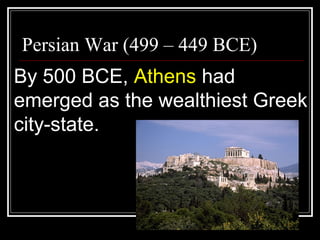
By 500 BCE, Athens had
emerged as the wealthiest Greek
city-state.
Persian War (499 – 449 BCE)
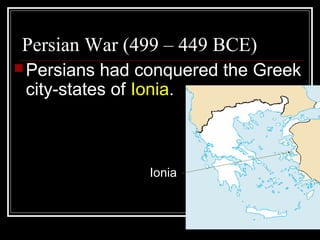
Persians had conquered the Greek
city-states of Ionia.
IoniaIonia
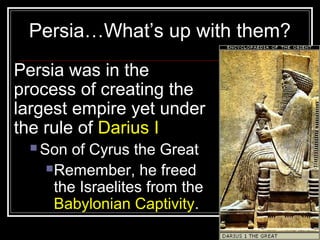
Persia was in the
process of creating the
largest empire yet under
the rule of Darius I
 Son of Cyrus the Great
Remember, he freed
the Israelites from the
Babylonian Captivity.
Persia…What’s up with them?
Persian War (499 – 449 BCE)
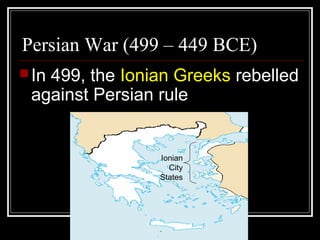
In 499, the Ionian Greeks rebelled
against Persian rule
Ionian
City
States
Persian War (499 – 449 BCE)
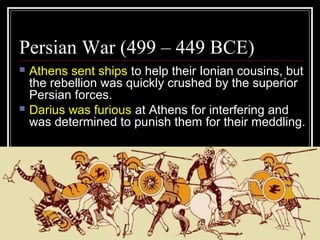
 Athens sent ships to help their Ionian cousins, but
the rebellion was quickly crushed by the superior
Persian forces.
 Darius was furious at Athens for interfering and
was determined to punish them for their meddling.
Battle of Marathon (490 BCE)
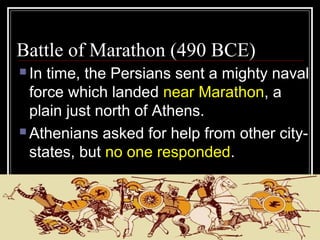
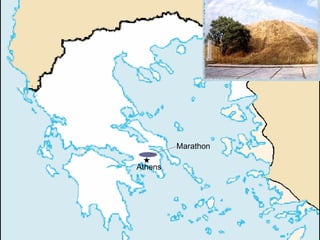
 In time, the Persians sent a mighty naval
force which landed near Marathon, a
plain just north of Athens.
 Athenians asked for help from other city-
states, but no one responded.
Athens
Marathon
Battle of Marathon
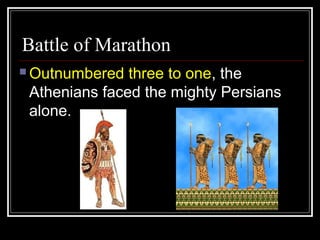
 Outnumbered three to one, the
Athenians faced the mighty Persians
alone.
Battle of Marathon
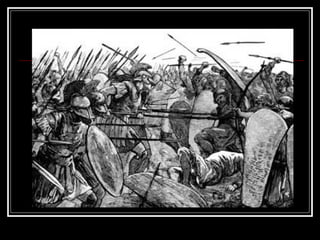
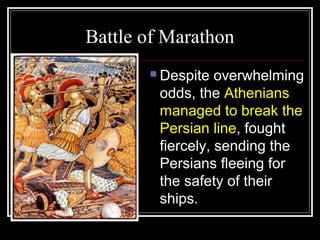
 Despite overwhelming
odds, the Athenians
managed to break the
Persian line, fought
fiercely, sending the
Persians fleeing for
the safety of their
ships.
Battle of Marathon
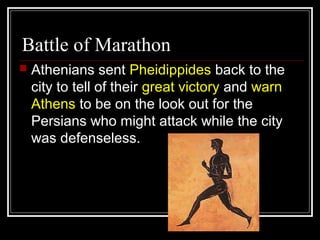
 Athenians sent Pheidippides back to the
city to tell of their great victory and warn
Athens to be on the look out for the
Persians who might attack while the city
was defenseless.
Battle of Marathon
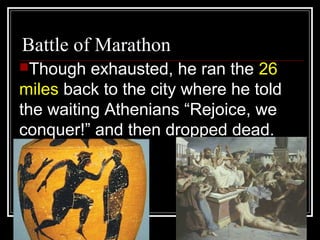
Though exhausted, he ran the 26
miles back to the city where he told
the waiting Athenians “Rejoice, we
conquer!” and then dropped dead.
Results Battle of Marathon
 Today we honor Pheidippides with
the sporting event - marathon of
26.2 miles.
Results of Battle of Marathon
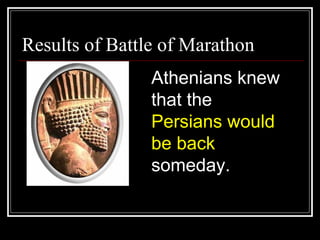
Athenians knew
that the
Persians would
be back
someday.
Results of Battle of Marathon
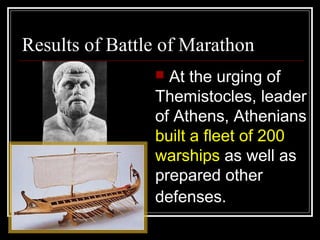
 At the urging of
Themistocles, leader
of Athens, Athenians
built a fleet of 200
warships as well as
prepared other
defenses.
Battle of Thermopylae
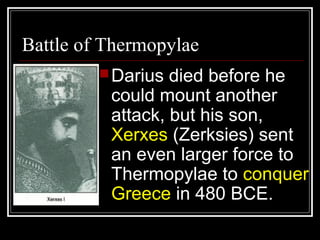
Darius died before he
could mount another
attack, but his son,
Xerxes (Zerksies) sent
an even larger force to
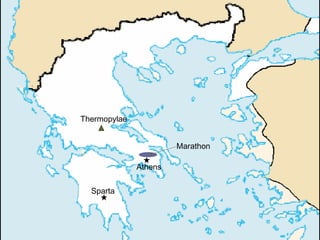
Thermopylae to conquer
Greece in 480 BCE.
Athens
Marathon
Sparta
Thermopylae
Battle of Thermopylae
This time, Athens had persuaded its
militaristic neighbor, Sparta and other
Greek city-states to join the fight against
Persia.
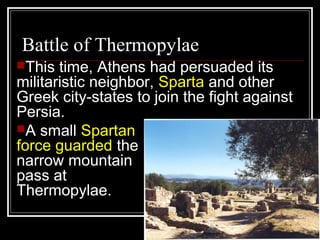
A small Spartan
force guarded the
narrow mountain
pass at
Thermopylae.
Battle of Thermopylae
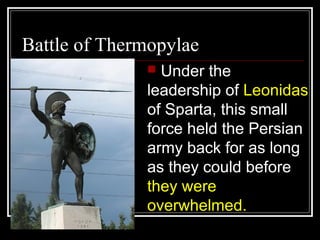
 Under the
leadership of Leonidas
of Sparta, this small
force held the Persian
army back for as long
as they could before
they were
overwhelmed.
Battle of Thermopylae
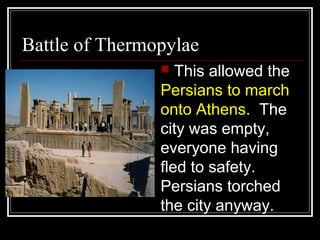
 This allowed the
Persians to march
onto Athens. The
city was empty,
everyone having
fled to safety.
Persians torched
the city anyway.
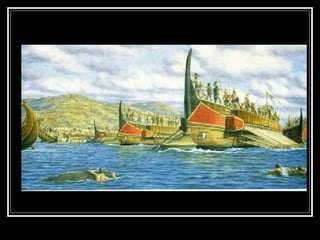
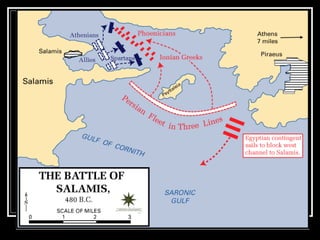
Battle of Salamis
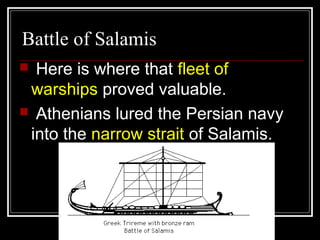
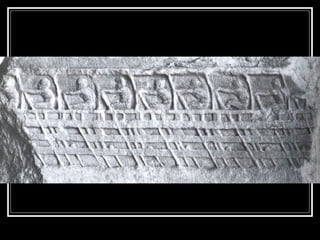
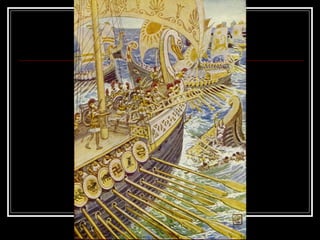
 Here is where that fleet of
warships proved valuable.
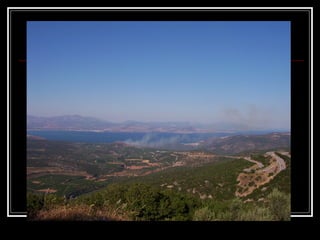
 Athenians lured the Persian navy
into the narrow strait of Salamis.
Battle of Salamis
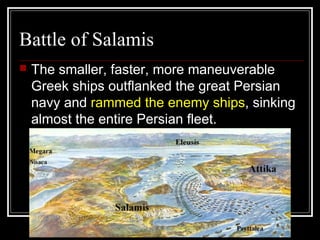
 The smaller, faster, more maneuverable
Greek ships outflanked the great Persian
navy and rammed the enemy ships, sinking
almost the entire Persian fleet.
Results of the Persian War
 Increased the Greeks sense of their own
uniqueness.
 Athens and Sparta united against the Persian
Empire.
 Athenian victories at Marathon and Salamis
left Greeks in control of the Aegean Sea
 Preserved their political independence and
continued innovations in government and
culture.
Delian League
 After the war, Athens was not only
the wealthiest city-state, it was
also the most powerful.
 To maintain that power and to
ensure that Persia would not pose
another threat, Athens organized
the Delian League, an alliance with
other Greek city-states.
Delian League
Of course, Athens was the
dominant city and used that
leadership position to its benefit.
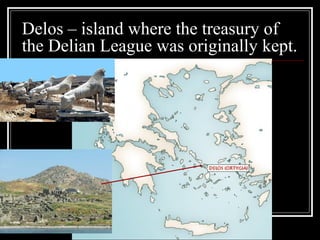
Delos – island where the treasury of
the Delian League was originally kept.
Delian League
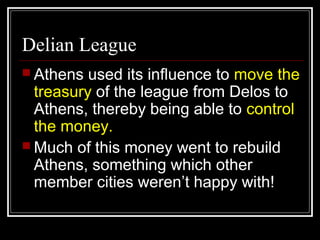
 Athens used its influence to move the
treasury of the league from Delos to
Athens, thereby being able to control
the money.
 Much of this money went to rebuild
Athens, something which other
member cities weren’t happy with!
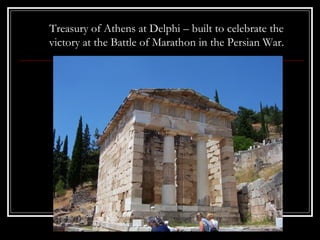
Treasury of Athens at Delphi – built to celebrate the
victory at the Battle of Marathon in the Persian War.
Delian League
When other city-states threatened
to leave, Athens used force to
make them remain in the
league.

4 persian war

  • 1.
  • 2.
    Persian War (499– 449 BCE) By 500 BCE, Athens had emerged as the wealthiest Greek city-state.
  • 3.
    Persian War (499– 449 BCE) Persians had conquered the Greek city-states of Ionia. IoniaIonia
  • 4.
    Persia was inthe process of creating the largest empire yet under the rule of Darius I  Son of Cyrus the Great Remember, he freed the Israelites from the Babylonian Captivity. Persia…What’s up with them?
  • 5.
    Persian War (499– 449 BCE) In 499, the Ionian Greeks rebelled against Persian rule Ionian City States
  • 6.
    Persian War (499– 449 BCE)  Athens sent ships to help their Ionian cousins, but the rebellion was quickly crushed by the superior Persian forces.  Darius was furious at Athens for interfering and was determined to punish them for their meddling.
  • 7.
    Battle of Marathon(490 BCE)  In time, the Persians sent a mighty naval force which landed near Marathon, a plain just north of Athens.  Athenians asked for help from other city- states, but no one responded.
  • 8.
  • 9.
    Battle of Marathon Outnumbered three to one, the Athenians faced the mighty Persians alone.
  • 11.
    Battle of Marathon Despite overwhelming odds, the Athenians managed to break the Persian line, fought fiercely, sending the Persians fleeing for the safety of their ships.
  • 12.
    Battle of Marathon Athenians sent Pheidippides back to the city to tell of their great victory and warn Athens to be on the look out for the Persians who might attack while the city was defenseless.
  • 13.
    Battle of Marathon Thoughexhausted, he ran the 26 miles back to the city where he told the waiting Athenians “Rejoice, we conquer!” and then dropped dead.
  • 14.
    Results Battle ofMarathon  Today we honor Pheidippides with the sporting event - marathon of 26.2 miles.
  • 15.
    Results of Battleof Marathon Athenians knew that the Persians would be back someday.
  • 16.
    Results of Battleof Marathon  At the urging of Themistocles, leader of Athens, Athenians built a fleet of 200 warships as well as prepared other defenses.
  • 17.
    Battle of Thermopylae Dariusdied before he could mount another attack, but his son, Xerxes (Zerksies) sent an even larger force to Thermopylae to conquer Greece in 480 BCE.
  • 18.
  • 19.
    Battle of Thermopylae Thistime, Athens had persuaded its militaristic neighbor, Sparta and other Greek city-states to join the fight against Persia. A small Spartan force guarded the narrow mountain pass at Thermopylae.
  • 20.
    Battle of Thermopylae Under the leadership of Leonidas of Sparta, this small force held the Persian army back for as long as they could before they were overwhelmed.
  • 21.
    Battle of Thermopylae This allowed the Persians to march onto Athens. The city was empty, everyone having fled to safety. Persians torched the city anyway.
  • 22.
    Battle of Salamis Here is where that fleet of warships proved valuable.  Athenians lured the Persian navy into the narrow strait of Salamis.
  • 25.
    Battle of Salamis The smaller, faster, more maneuverable Greek ships outflanked the great Persian navy and rammed the enemy ships, sinking almost the entire Persian fleet.
  • 29.
    Results of thePersian War  Increased the Greeks sense of their own uniqueness.  Athens and Sparta united against the Persian Empire.  Athenian victories at Marathon and Salamis left Greeks in control of the Aegean Sea  Preserved their political independence and continued innovations in government and culture.
  • 30.
    Delian League  Afterthe war, Athens was not only the wealthiest city-state, it was also the most powerful.  To maintain that power and to ensure that Persia would not pose another threat, Athens organized the Delian League, an alliance with other Greek city-states.
  • 31.
    Delian League Of course,Athens was the dominant city and used that leadership position to its benefit.
  • 32.
    Delos – islandwhere the treasury of the Delian League was originally kept.
  • 33.
    Delian League  Athensused its influence to move the treasury of the league from Delos to Athens, thereby being able to control the money.  Much of this money went to rebuild Athens, something which other member cities weren’t happy with!
  • 34.
    Treasury of Athensat Delphi – built to celebrate the victory at the Battle of Marathon in the Persian War.
  • 35.
    Delian League When othercity-states threatened to leave, Athens used force to make them remain in the league.