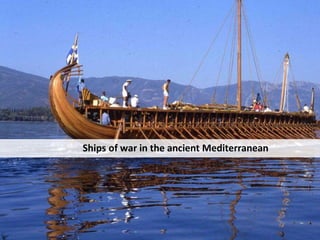

Ships of war in the ancient Mediterranean
By the 7th century BCE the Mediterranean had
become a contested sea, with conflicts inherent in
the commercial and imperial interests emanating
from the Levant, and from the Aegean and the
Italic peninsula
Part 1 of lecture: the ‘evolution’ of the warship from a troop transport
and fighting platform to a weapon
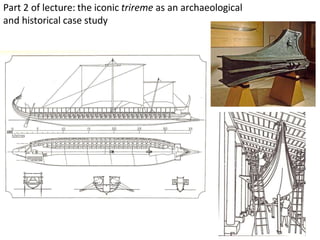
Part 2 of lecture: the iconic trireme as an archaeological
and historical case study
Earliest representations and records of ships in martial contexts:
evidence from Egypt
The navy of Ramses III decimatingthe
Sea Peoples’ fleet (ca. 1200BCE)
Campaigns of ThutmosisIII
into Syro-Palestine (ca. 1450BCE)
included mobilizing ships
(earliest unambiguous use ofships
in a military campaign)
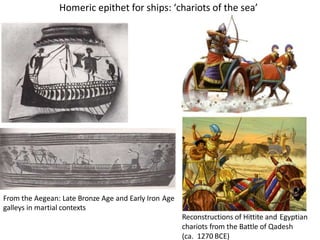
Homeric epithet for ships: ‘chariots of the sea’
From the Aegean: Late Bronze Age and Early Iron Age
galleys in martial contexts
Reconstructions of Hittite and Egyptian
chariots from the Battle of Qadesh
(ca. 1270 BCE)
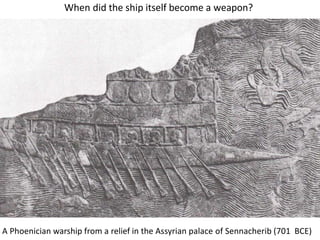
When did the ship itself become a weapon?
A Phoenician warship from a relief in the Assyrian palace of Sennacherib (701 BCE)
This (Phoenician) innovation in military technology…
may well have been inspired by this (Assyrian) one
From the palace of
King Ashurnasirpal II
(ca. 880-860 BCE)
Roughly contemporary evidence from the (late) Early Iron Age Aegean:
Are these accentuated bow projections rams or not?
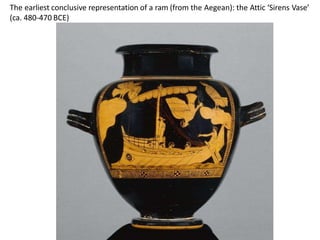
The earliest conclusive representation of a ram (from the Aegean): the Attic ‘Sirens Vase’
(ca. 480-470 BCE)
Herodotus in Histories (ca. 450-430 BCE) describes the
earliest use of the ram by Greek warships
535 BCE: A Phocaean (Greeks from Asia Minor) fleet of penteconters
engaged a combined fleet of Carthaginians and Etruscans: casualties
included ships ‘with their rams twisted off’
But it was the trireme in the Battle of Salamis (480 BCE) and not the
penteconter for which the ram is most well known
The trireme is the most extensively studied class of ship from the ancient world
The elusive (field) archaeology of warships of the ancient Mediterranean
Where are all the sunken galleys?
One ram has been recovered from underwater contexts
Athlit ram (Israel, 2nd century BCE
With very little shipwreck evidence how did John Coates and John Morrison (the naval architect
and classicist of the Olympias trireme project) arrive at this reconstruction?
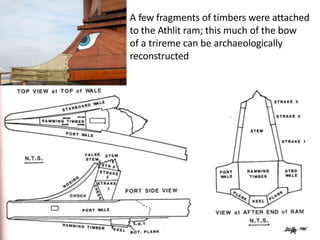
A few fragments of timbers were attached
to the Athlit ram; this much of the bow
of a trireme can be archaeologically
reconstructed
Before the invention of nails, ships were held together by mortise and tenon construction.
The hull’s planks (A) were fitted with an upper and lower row of holes and slots.
Smaller slats (B), also with holes, were placed into the slots of the lower plank, with their
holes lining up with the plank’s holes.
Pegs (C) were then put through the holes, locking the slats and plank in place.
The next plank was put in place over the lower plank, with the slats fitting into its lower slots
and its lower holes lined up with the upper holes of the slats.
Pegs were then put through the holes of the plank and upper holes of the slats, locking the
plank into place with the lower plank. pitch to make it watertight.
The remainder of the Olympias trireme was reconstructed withiconography,
statuary, texts, ship sheds, architectural intuition and remarkable scholarship
Lyndos rock relief (Rhodes) Nike of Samothrace
A rhyton (drinking cup)
An example of how a text can inform the reconstruction of a trireme:
(there is no detailed description of what these ships looked like)
Herodotus (Histories) describing Xerxes voyage home on a Phoenician
warship after his defeat at Salamis:
‘…he was rather severely tossed about, the ship being overloaded, with
the deck packed by a large number of Persians in his entourage…for if the
helmsman had really made this reply, the king would quite obviouslyhave
ordered the people on deck to gobelow…’
Reconstruction of ship sheds,
Piraeus, Athens (ca. 400 BCE)
Archaeological plan of ship sheds,
Piraeus, Athens (ca. 400 BCE)
Dimensions of ships sheds at Piraeus, the harbor of Athens: 37m x 6m
(length to beam 1:6)
Additional evidence from texts to assist in reconstructing a trireme:
**inventory of ship equipment (from the Decree of Themistocles, commander
of the Greek fleet at Salamis): each trireme fitted with 170 oars, and extras)
**two different classes of oarsmen (from several textual sources):
thalamioi (thalamos=the hold of the ship), thranites (position not clear, but
above the thalamioi)
A floating cargobox
under wind propulsion
A floating (battering) ram and fightingforce
under wind propulsion (cruising) and oar
propulsion(fighting)
The three most important construction and design considerations when building a trireme:
1) Speed (light, narrow length to beam)
2) Accommodating the source of speed
(without compromising lightness
and narrow length to beam)
3) Accommodating the weapon
Naval Tactics - The oar rake.
If a ship couldn’t get a clean shot at ramming an enemy ship, it might approach at an
oblique angle, shearing off the enemy oars with its ram, leaving the immobilized enemy
ship a sitting target to be rammed. One danger of this tactic was the attacking ship’s crew’s
failure to pull in its oars to avoid losing them as well when the two ships passed closely by
one another. Success in using either of these tactics depended primarily on the quality of
the crews involved. Therefore, despite the impression given in Hollywood epics, slave
crews were generally not used since they were unreliable.
The diekplus
The Periplus
The kyklos

Persian wars ships

  • 1.
    Ships of warin the ancient Mediterranean
  • 2.
    By the 7thcentury BCE the Mediterranean had become a contested sea, with conflicts inherent in the commercial and imperial interests emanating from the Levant, and from the Aegean and the Italic peninsula
  • 3.
    Part 1 oflecture: the ‘evolution’ of the warship from a troop transport and fighting platform to a weapon
  • 4.
    Part 2 oflecture: the iconic trireme as an archaeological and historical case study
  • 5.
    Earliest representations andrecords of ships in martial contexts: evidence from Egypt The navy of Ramses III decimatingthe Sea Peoples’ fleet (ca. 1200BCE) Campaigns of ThutmosisIII into Syro-Palestine (ca. 1450BCE) included mobilizing ships (earliest unambiguous use ofships in a military campaign)
  • 6.
    Homeric epithet forships: ‘chariots of the sea’ From the Aegean: Late Bronze Age and Early Iron Age galleys in martial contexts Reconstructions of Hittite and Egyptian chariots from the Battle of Qadesh (ca. 1270 BCE)
  • 7.
    When did theship itself become a weapon? A Phoenician warship from a relief in the Assyrian palace of Sennacherib (701 BCE)
  • 8.
    This (Phoenician) innovationin military technology… may well have been inspired by this (Assyrian) one From the palace of King Ashurnasirpal II (ca. 880-860 BCE)
  • 9.
    Roughly contemporary evidencefrom the (late) Early Iron Age Aegean: Are these accentuated bow projections rams or not?
  • 10.
    The earliest conclusiverepresentation of a ram (from the Aegean): the Attic ‘Sirens Vase’ (ca. 480-470 BCE)
  • 11.
    Herodotus in Histories(ca. 450-430 BCE) describes the earliest use of the ram by Greek warships 535 BCE: A Phocaean (Greeks from Asia Minor) fleet of penteconters engaged a combined fleet of Carthaginians and Etruscans: casualties included ships ‘with their rams twisted off’
  • 12.
    But it wasthe trireme in the Battle of Salamis (480 BCE) and not the penteconter for which the ram is most well known
  • 13.
    The trireme isthe most extensively studied class of ship from the ancient world
  • 14.
    The elusive (field)archaeology of warships of the ancient Mediterranean Where are all the sunken galleys?
  • 15.
    One ram hasbeen recovered from underwater contexts Athlit ram (Israel, 2nd century BCE
  • 16.
    With very littleshipwreck evidence how did John Coates and John Morrison (the naval architect and classicist of the Olympias trireme project) arrive at this reconstruction?
  • 17.
    A few fragmentsof timbers were attached to the Athlit ram; this much of the bow of a trireme can be archaeologically reconstructed
  • 18.
    Before the inventionof nails, ships were held together by mortise and tenon construction. The hull’s planks (A) were fitted with an upper and lower row of holes and slots. Smaller slats (B), also with holes, were placed into the slots of the lower plank, with their holes lining up with the plank’s holes. Pegs (C) were then put through the holes, locking the slats and plank in place. The next plank was put in place over the lower plank, with the slats fitting into its lower slots and its lower holes lined up with the upper holes of the slats. Pegs were then put through the holes of the plank and upper holes of the slats, locking the plank into place with the lower plank. pitch to make it watertight.
  • 19.
    The remainder ofthe Olympias trireme was reconstructed withiconography, statuary, texts, ship sheds, architectural intuition and remarkable scholarship Lyndos rock relief (Rhodes) Nike of Samothrace A rhyton (drinking cup)
  • 20.
    An example ofhow a text can inform the reconstruction of a trireme: (there is no detailed description of what these ships looked like) Herodotus (Histories) describing Xerxes voyage home on a Phoenician warship after his defeat at Salamis: ‘…he was rather severely tossed about, the ship being overloaded, with the deck packed by a large number of Persians in his entourage…for if the helmsman had really made this reply, the king would quite obviouslyhave ordered the people on deck to gobelow…’
  • 21.
    Reconstruction of shipsheds, Piraeus, Athens (ca. 400 BCE) Archaeological plan of ship sheds, Piraeus, Athens (ca. 400 BCE) Dimensions of ships sheds at Piraeus, the harbor of Athens: 37m x 6m (length to beam 1:6)
  • 22.
    Additional evidence fromtexts to assist in reconstructing a trireme: **inventory of ship equipment (from the Decree of Themistocles, commander of the Greek fleet at Salamis): each trireme fitted with 170 oars, and extras) **two different classes of oarsmen (from several textual sources): thalamioi (thalamos=the hold of the ship), thranites (position not clear, but above the thalamioi)
  • 23.
    A floating cargobox underwind propulsion A floating (battering) ram and fightingforce under wind propulsion (cruising) and oar propulsion(fighting)
  • 24.
    The three mostimportant construction and design considerations when building a trireme: 1) Speed (light, narrow length to beam) 2) Accommodating the source of speed (without compromising lightness and narrow length to beam) 3) Accommodating the weapon
  • 25.
    Naval Tactics -The oar rake. If a ship couldn’t get a clean shot at ramming an enemy ship, it might approach at an oblique angle, shearing off the enemy oars with its ram, leaving the immobilized enemy ship a sitting target to be rammed. One danger of this tactic was the attacking ship’s crew’s failure to pull in its oars to avoid losing them as well when the two ships passed closely by one another. Success in using either of these tactics depended primarily on the quality of the crews involved. Therefore, despite the impression given in Hollywood epics, slave crews were generally not used since they were unreliable.
  • 26.
  • 27.
  • 28.