PANIPAT INSTITUTE OF ENGINEERING & TECHNOLOGY
MODERN MANAGEMENT APPROACHES
AND CONCEPTS
Submitted to:
Ms. Sonu kumari
Assistant professor
Department of
Management Studies
Submitted by:
Vaishali 220238
Harjeet 220243
Sahil 220308
CONTENT
๏‚ง What is modern theory of management?
๏‚งBenefits of modern theory management.
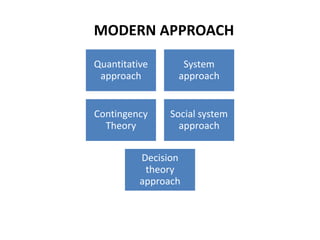
๏‚ง Types of modern management theories
1. Quantitative approach
2. Contingency approach
3. System approach
4.Social system approach
5.Decision theory approach
MODERN THEORY OF MANAGEMENT
Modern management theories started after 1950s.
The modern theory of organization uses
mathematical analysis combined with an objective
understanding of the range of human emotions and
motivation.
Benefits Of Modern Theory Of Management
Increases Productivity
The different theories of modern management educate leaders on maximizing the
value of their human resources .
Strengthens Decision-Making Abilities
When evaluating an organization or a department, managers can use modern
management theories as a guide. They can also use mathematical techniques to help
them come to final decisions and support their solutions.
Increases Employee Engagement
The concept of modern management looks at motivational elements other than
money as a result, employeesโ€™ morale and engagement will rise and theyโ€™ll be more
likely to stay on with the organization.
Increases Adaptability
Modern management theory understands that
organizations today frequently operate in
dynamic environments.
Quantitative
approach
System
approach
Contingency
Theory
Social system
approach
Decision
theory
approach
MODERN APPROACH
QUANTITATIVE APPROACH
Quantitative approach also called mathematical approach . It
emphasizes the use of statistical model and systematic
mathematical techniques to solving complex management
problems. It can only suggest the alternatives based on statistical
data. It cannot take final decisions.
It helps the management for improving the decision making by
increasing the number of alternatives and giving faster decisions
on problem. Management can easily calculate the benefits of
various actions.
Contributors in Quantitative Approach are-
Johan MacDonald
George R. Terry
Andrew Szilagyi
Quantitative Management Techniques
๏‚งTheory of Probability
๏‚งSampling Analysis
๏‚งCorrelation / Regression Analysis
๏‚งTime Series Analysis
๏‚งRatio Analysis
System approach to management
This theory was developed in late 1960 .
A system is defined as a number of interdependent parts functioning
as a whole for some purpose.
An organization is made up of numerous subsystems, such as different
departments. The system approach is based on the concept that an
organization is a system.
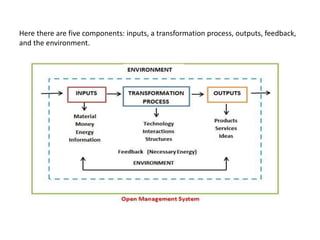
Here there are five components: inputs, a transformation process, outputs, feedback,
and the environment.
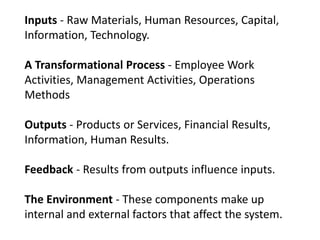
Inputs - Raw Materials, Human Resources, Capital,
Information, Technology.
A Transformational Process - Employee Work
Activities, Management Activities, Operations
Methods
Outputs - Products or Services, Financial Results,
Information, Human Results.
Feedback - Results from outputs influence inputs.
The Environment - These components make up
internal and external factors that affect the system.
Any management system within an organization can be
said to be "open" or "closed.โ€œ
An open systems interacts with other systems through
the free passing of information, whereas closed
systems operate on their own with little or no
influence from the outside world.
Characteristics of the System Approach to Management
Holism: A change in any part/component of a system
affects the whole system directly or indirectly.
Coordination: The grouped components and sub
components need coordination. Without
coordination the components will not be able to
work in a concerted manner and will lead to chaos.
Sub-Systems - Each organization is a system made
up of a combination of many sub-systems. These
sub-systems are inter-related.
Primary Contributors to Systems Theory
Chester Bernard
Herbert Simon
Ludwig von Bertalanffy
Contingency approach
The contingency approach, often called the
Situational Approach in 1980s it is recognized as a
key to effective management.
The contingency approach is a management theory
that suggests the most appropriate style of
management is dependent on the context of the
situation and that adopting a single, rigid style is
inefficient in the long term.
Features of Contingency approach
โ€ข It stresses that there is no one best way of doing things.
Management is situation, and managers should explain
objectives, design organizations and prepare strategies,
policies and plans according to prevailing circumstances.
โ€ข Managers should have sufficient human relations skill to
accommodate and stabilize change.
โ€ข It should apply the contingency model in designing the
organization, developing its information and communication
system, following proper leadership styles and preparing
suitable objectives, policies, strategies, programs and
practices.
Major contributor of this approach are
John Woodward
H.M. Carlisle
Lorsch
Lawrence
Social System Approach
โ€ข Social systems theory takes seriously that
in order to observe, think, or talk about
anything we must first โ€œdraw a distinction.โ€
Social systems theory, then, is all about
distinctions, and the first or most
important distinction drawn is between
system and environment.
Decision Theory Approach
โ€ข The Decision Theory Approach is the approach which
helps the manager to take the effective decision in order to
grow his business. Decision theory approach uses logical
concepts to take the decision. When managers will
calculate risks and uncertainties, that time he can take the
positive decision that will affect his business.
โ€ข The managers should take the decision on the basis of facts
as well as on the pros and cons. Because the facts help the
managers to understand the risks level, if the risks level is
high then the manager will not take that decision, if the
risks level is low then the manager can take the decision.
QUIZ
โ€ข Q1. What is the benefit of the modern theory of
management?
โ€ข 1) Increase productivity
โ€ข 2)Increase Adaptability
โ€ข 3)Increase Employee Engagement
โ€ข 4)All of the above
โ€ข Q2.How many components are there in Open Management
System?
โ€ข 1) 4
โ€ข 2)6
โ€ข 3)5
โ€ข 4)3
โ€ข Q3. Which of these contain in Input of Open System Env.
โ€ข 1) Product
โ€ข 2) Service
โ€ข 3) Material
โ€ข 4) All of the above
โ€ข Q4. Which of these are characteristics of the System
Approach?
โ€ข 1) Holism
โ€ข 2) Co-ordination
โ€ข 3) Ratio- Analysis
โ€ข 4) Both 1 & 2
โ€ข Q5. What is in the output of an Open Management System
โ€ข 1) Structure
โ€ข 2) Energy
โ€ข 3) Information
โ€ข 4) None Of These
โ€ข Q6. Management is dependent upon the context of the
situationโ€ According to which approach?
โ€ข 1) Quantitative Approach
โ€ข 2) System approach
โ€ข 3) Contingency Approach
โ€ข 4) None Of These
MPOB Edited.pptx

MPOB Edited.pptx

  • 1.
    PANIPAT INSTITUTE OFENGINEERING & TECHNOLOGY MODERN MANAGEMENT APPROACHES AND CONCEPTS Submitted to: Ms. Sonu kumari Assistant professor Department of Management Studies Submitted by: Vaishali 220238 Harjeet 220243 Sahil 220308
  • 2.
    CONTENT ๏‚ง What ismodern theory of management? ๏‚งBenefits of modern theory management. ๏‚ง Types of modern management theories 1. Quantitative approach 2. Contingency approach 3. System approach 4.Social system approach 5.Decision theory approach
  • 3.
    MODERN THEORY OFMANAGEMENT Modern management theories started after 1950s. The modern theory of organization uses mathematical analysis combined with an objective understanding of the range of human emotions and motivation.
  • 4.
    Benefits Of ModernTheory Of Management Increases Productivity The different theories of modern management educate leaders on maximizing the value of their human resources . Strengthens Decision-Making Abilities When evaluating an organization or a department, managers can use modern management theories as a guide. They can also use mathematical techniques to help them come to final decisions and support their solutions. Increases Employee Engagement The concept of modern management looks at motivational elements other than money as a result, employeesโ€™ morale and engagement will rise and theyโ€™ll be more likely to stay on with the organization.
  • 5.
    Increases Adaptability Modern managementtheory understands that organizations today frequently operate in dynamic environments.
  • 6.
  • 7.
    QUANTITATIVE APPROACH Quantitative approachalso called mathematical approach . It emphasizes the use of statistical model and systematic mathematical techniques to solving complex management problems. It can only suggest the alternatives based on statistical data. It cannot take final decisions. It helps the management for improving the decision making by increasing the number of alternatives and giving faster decisions on problem. Management can easily calculate the benefits of various actions.
  • 8.
    Contributors in QuantitativeApproach are- Johan MacDonald George R. Terry Andrew Szilagyi Quantitative Management Techniques ๏‚งTheory of Probability ๏‚งSampling Analysis ๏‚งCorrelation / Regression Analysis ๏‚งTime Series Analysis ๏‚งRatio Analysis
  • 9.
    System approach tomanagement This theory was developed in late 1960 . A system is defined as a number of interdependent parts functioning as a whole for some purpose. An organization is made up of numerous subsystems, such as different departments. The system approach is based on the concept that an organization is a system.
  • 10.
    Here there arefive components: inputs, a transformation process, outputs, feedback, and the environment.
  • 11.
    Inputs - RawMaterials, Human Resources, Capital, Information, Technology. A Transformational Process - Employee Work Activities, Management Activities, Operations Methods Outputs - Products or Services, Financial Results, Information, Human Results. Feedback - Results from outputs influence inputs. The Environment - These components make up internal and external factors that affect the system.
  • 12.
    Any management systemwithin an organization can be said to be "open" or "closed.โ€œ An open systems interacts with other systems through the free passing of information, whereas closed systems operate on their own with little or no influence from the outside world. Characteristics of the System Approach to Management Holism: A change in any part/component of a system affects the whole system directly or indirectly.
  • 13.
    Coordination: The groupedcomponents and sub components need coordination. Without coordination the components will not be able to work in a concerted manner and will lead to chaos. Sub-Systems - Each organization is a system made up of a combination of many sub-systems. These sub-systems are inter-related. Primary Contributors to Systems Theory Chester Bernard Herbert Simon Ludwig von Bertalanffy
  • 14.
    Contingency approach The contingencyapproach, often called the Situational Approach in 1980s it is recognized as a key to effective management. The contingency approach is a management theory that suggests the most appropriate style of management is dependent on the context of the situation and that adopting a single, rigid style is inefficient in the long term.
  • 15.
    Features of Contingencyapproach โ€ข It stresses that there is no one best way of doing things. Management is situation, and managers should explain objectives, design organizations and prepare strategies, policies and plans according to prevailing circumstances. โ€ข Managers should have sufficient human relations skill to accommodate and stabilize change. โ€ข It should apply the contingency model in designing the organization, developing its information and communication system, following proper leadership styles and preparing suitable objectives, policies, strategies, programs and practices.
  • 16.
    Major contributor ofthis approach are John Woodward H.M. Carlisle Lorsch Lawrence
  • 17.
    Social System Approach โ€ขSocial systems theory takes seriously that in order to observe, think, or talk about anything we must first โ€œdraw a distinction.โ€ Social systems theory, then, is all about distinctions, and the first or most important distinction drawn is between system and environment.
  • 18.
    Decision Theory Approach โ€ขThe Decision Theory Approach is the approach which helps the manager to take the effective decision in order to grow his business. Decision theory approach uses logical concepts to take the decision. When managers will calculate risks and uncertainties, that time he can take the positive decision that will affect his business. โ€ข The managers should take the decision on the basis of facts as well as on the pros and cons. Because the facts help the managers to understand the risks level, if the risks level is high then the manager will not take that decision, if the risks level is low then the manager can take the decision.
  • 19.
    QUIZ โ€ข Q1. Whatis the benefit of the modern theory of management? โ€ข 1) Increase productivity โ€ข 2)Increase Adaptability โ€ข 3)Increase Employee Engagement โ€ข 4)All of the above โ€ข Q2.How many components are there in Open Management System? โ€ข 1) 4 โ€ข 2)6 โ€ข 3)5 โ€ข 4)3
  • 20.
    โ€ข Q3. Whichof these contain in Input of Open System Env. โ€ข 1) Product โ€ข 2) Service โ€ข 3) Material โ€ข 4) All of the above โ€ข Q4. Which of these are characteristics of the System Approach? โ€ข 1) Holism โ€ข 2) Co-ordination โ€ข 3) Ratio- Analysis โ€ข 4) Both 1 & 2
  • 21.
    โ€ข Q5. Whatis in the output of an Open Management System โ€ข 1) Structure โ€ข 2) Energy โ€ข 3) Information โ€ข 4) None Of These โ€ข Q6. Management is dependent upon the context of the situationโ€ According to which approach? โ€ข 1) Quantitative Approach โ€ข 2) System approach โ€ข 3) Contingency Approach โ€ข 4) None Of These