Copyright © 2011 Pearson Education, Inc. Publishing as Prentice Hall
1–1
Introduction to
Management
and
Organizations
Chapter
1
Management
Stephen P. Robbins Mary Coulter
tenth edition
Copyright © 2011 Pearson Education, Inc. Publishing as Prentice Hall
1–2
Learning outcomes
Follow this learning outline as you read and study this
chapter.
1.1 Who are managers?
1.2 What is management?
1.3 What do managers do?
1.4 What is an organization?
1.5 Why study management?
Copyright © 2011 Pearson Education, Inc. Publishing as Prentice Hall
1–3
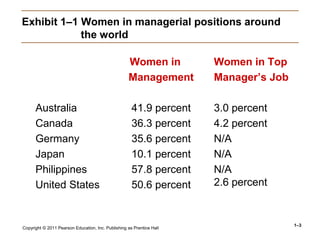
Exhibit 1–1 Women in managerial positions around
the world
Women in
Management
Australia 41.9 percent
Canada 36.3 percent
Germany 35.6 percent
Japan 10.1 percent
Philippines 57.8 percent
United States 50.6 percent
Women in Top
Manager’s Job
3.0 percent
4.2 percent
N/A
N/A
N/A
2.6 percent
Copyright © 2011 Pearson Education, Inc. Publishing as Prentice Hall
1–4
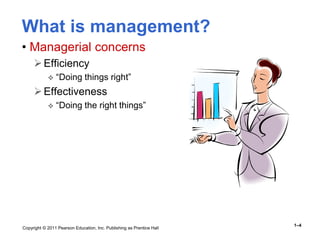
What is management?
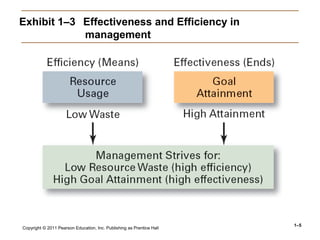
• Managerial concerns
Efficiency
 “Doing things right”
Effectiveness
 “Doing the right things”
Copyright © 2011 Pearson Education, Inc. Publishing as Prentice Hall
1–5
Exhibit 1–3 Effectiveness and Efficiency in
management
Copyright © 2011 Pearson Education, Inc. Publishing as Prentice Hall
1–6
What do managers do?
• Three approaches to defining what managers do
Functions they perform
Roles they play
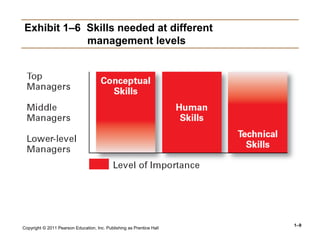
Skills they need
Copyright © 2011 Pearson Education, Inc. Publishing as Prentice Hall
1–7
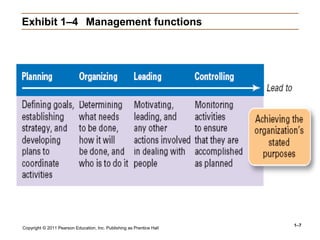
Exhibit 1–4 Management functions
Copyright © 2011 Pearson Education, Inc. Publishing as Prentice Hall
1–8
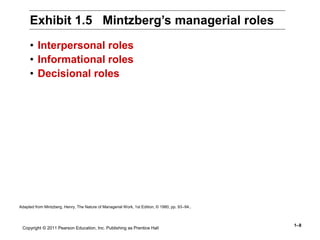
• Interpersonal roles
• Informational roles
• Decisional roles
Exhibit 1.5 Mintzberg’s managerial roles
Adapted from Mintzberg, Henry, The Nature of Managerial Work, 1st Edition, © 1980, pp. 93–94..
Copyright © 2011 Pearson Education, Inc. Publishing as Prentice Hall
1–9
Exhibit 1–6 Skills needed at different
management levels
Copyright © 2011 Pearson Education, Inc. Publishing as Prentice Hall
1–10
How is the manager’s job
changing?
• Increasing importance of customers
Customers
• Innovation
Doing things differently, exploring new territory, and
taking risks
Copyright © 2011 Pearson Education, Inc. Publishing as Prentice Hall
1–11
Why study management?
• Value of studying management
Universality of management
Reality of work
Rewards and challenges of being a manager
Copyright © 2011 Pearson Education, Inc. Publishing as Prentice Hall
2–12
Management
History
Chapter
2
Management
Stephen P. Robbins Mary Coulter
tenth edition
Copyright © 2011 Pearson Education, Inc. Publishing as Prentice Hall
2–13
Learning outcomes
Follow this learning outline as you read and study this
chapter.
2.1 Historical background of management
2.2 Classical approach
2.3 Quantitative approach
2.4 Behavioral approach
2.5 Contemporary approach
Copyright © 2011 Pearson Education, Inc. Publishing as Prentice Hall
2–14
Historical background of
management
• Ancient management
Egypt (pyramids) and China (Great Wall)
Venetians (floating warship assembly lines)
• Adam Smith
Published The Wealth of Nations in 1776
• Industrial revolution
Substituted machine power for human labor
Created large organizations in need of management
Copyright © 2011 Pearson Education, Inc. Publishing as Prentice Hall
2–15
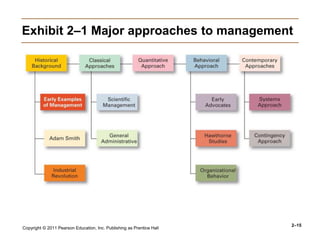
Exhibit 2–1 Major approaches to management
Copyright © 2011 Pearson Education, Inc. Publishing as Prentice Hall
2–16
Major approaches to
management
• Classical
• Quantitative
• Behavioral
• Contemporary
Copyright © 2011 Pearson Education, Inc. Publishing as Prentice Hall
2–17
Scientific management
• Fredrick Winslow Taylor
“Father” of scientific management
Published Principles of Scientific Management (1911)
 Theory of scientific management
– Using scientific methods to define the “one best way” for a
job to be done:
• Putting the right person on the job with the correct tools
and equipment
• Having a standardized method of doing the job
• Providing an economic incentive to the worker
Copyright © 2011 Pearson Education, Inc. Publishing as Prentice Hall
2–18
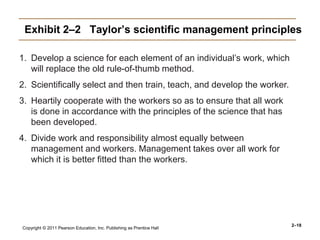
Exhibit 2–2 Taylor’s scientific management principles
1. Develop a science for each element of an individual’s work, which
will replace the old rule-of-thumb method.
2. Scientifically select and then train, teach, and develop the worker.
3. Heartily cooperate with the workers so as to ensure that all work
is done in accordance with the principles of the science that has
been developed.
4. Divide work and responsibility almost equally between
management and workers. Management takes over all work for
which it is better fitted than the workers.
Copyright © 2011 Pearson Education, Inc. Publishing as Prentice Hall
2–19
General administrative theory
• Henri Fayol
Believed that the practice of management was distinct
from other organizational functions
Developed principles of management that applied to
all organizational situations
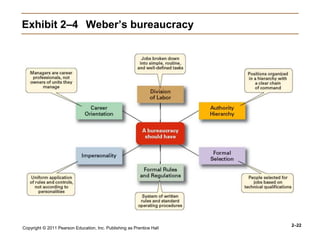
• Max Weber
Developed a theory of authority based on an ideal
type of organization (bureaucracy)
Copyright © 2011 Pearson Education, Inc. Publishing as Prentice Hall
2–20
Scientific management
• Frank and Lillian Gilbreth
Focused on increasing worker productivity through
the reduction of wasted motion
Developed the microchronometer to time worker
motions and optimize work performance
• How do today’s managers use scientific
management?
Use time and motion studies to increase productivity
Hire the best qualified employees
Design incentive systems based on output
Copyright © 2011 Pearson Education, Inc. Publishing as Prentice Hall
2–21
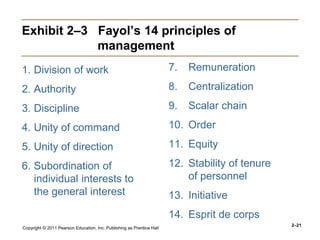
Exhibit 2–3 Fayol’s 14 principles of
management
1. Division of work
2. Authority
3. Discipline
4. Unity of command
5. Unity of direction
6. Subordination of
individual interests to
the general interest
7. Remuneration
8. Centralization
9. Scalar chain
10. Order
11. Equity
12. Stability of tenure
of personnel
13. Initiative
14. Esprit de corps
Copyright © 2011 Pearson Education, Inc. Publishing as Prentice Hall
2–22
Exhibit 2–4 Weber’s bureaucracy
Copyright © 2011 Pearson Education, Inc. Publishing as Prentice Hall
2–23
Quantitative approach to
management
• Quantitative approach
Also called operations research or management
science
Evolved from mathematical and statistical methods
developed to solve WWII military logistics and quality
control problems
Focuses on improving managerial decision making by
applying:
 Statistics, optimization models, information models, and
computer simulations
Copyright © 2011 Pearson Education, Inc. Publishing as Prentice Hall
2–24
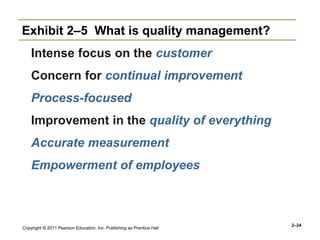
Exhibit 2–5 What is quality management?
Intense focus on the customer
Concern for continual improvement
Process-focused
Improvement in the quality of everything
Accurate measurement
Empowerment of employees
Copyright © 2011 Pearson Education, Inc. Publishing as Prentice Hall
2–25
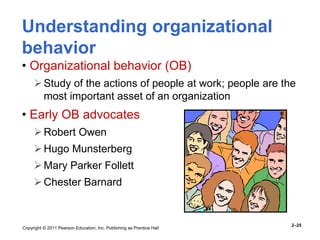
Understanding organizational
behavior
• Organizational behavior (OB)
Study of the actions of people at work; people are the
most important asset of an organization
• Early OB advocates
Robert Owen
Hugo Munsterberg
Mary Parker Follett
Chester Barnard
Copyright © 2011 Pearson Education, Inc. Publishing as Prentice Hall
2–26
•A series of productivity experiments conducted
at Western Electric from 1924 to 1932.
•Experimental findings
Productivity unexpectedly increased under imposed
adverse working conditions.
Effect of incentive plans was less than expected.
•Research conclusion
Social norms, group standards and attitudes more
strongly influence individual output and work behavior
than do monetary incentives.
Hawthorne Studies
Copyright © 2011 Pearson Education, Inc. Publishing as Prentice Hall
2–27
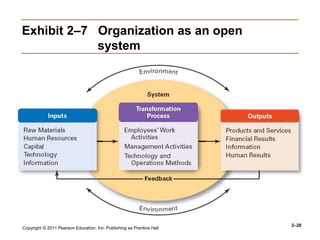
Systems approach
• System defined
A set of interrelated and interdependent parts
arranged in a manner that produces a unified whole.
• Basic types of systems
Closed systems
 Are not influenced by and do not interact with their
environment (all system input and output is internal).
Open systems
 Dynamically interact to their environments by taking in inputs
and transforming them into outputs that are distributed into
their environments.
Copyright © 2011 Pearson Education, Inc. Publishing as Prentice Hall
2–28
Exhibit 2–7 Organization as an open
system
Copyright © 2011 Pearson Education, Inc. Publishing as Prentice Hall
2–29
Implications of the systems
approach
• Coordination of the organization’s parts is
essential for proper functioning of the entire
organization.
• Decisions and actions taken in one area of the
organization will have an effect in other areas of
the organization.
• Organizations are not self-contained and,
therefore, must adapt to changes in their
external environment.
Copyright © 2011 Pearson Education, Inc. Publishing as Prentice Hall
2–30
Contingency approach
• Contingency approach defined
Also sometimes called the situational approach.
There is no one universally applicable set of
management principles (rules) by which to manage
organizations.
Organizations are individually different, face different
situations (contingency variables), and require
different ways of managing.
Copyright © 2011 Pearson Education, Inc. Publishing as Prentice Hall
2–31
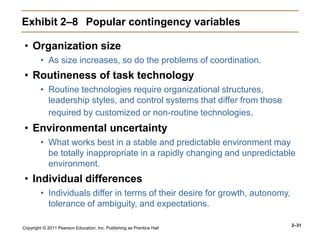
Exhibit 2–8 Popular contingency variables
• Organization size
• As size increases, so do the problems of coordination.
• Routineness of task technology
• Routine technologies require organizational structures,
leadership styles, and control systems that differ from those
required by customized or non-routine technologies.
• Environmental uncertainty
• What works best in a stable and predictable environment may
be totally inappropriate in a rapidly changing and unpredictable
environment.
• Individual differences
• Individuals differ in terms of their desire for growth, autonomy,
tolerance of ambiguity, and expectations.
Copyright © 2011 Pearson Education, Inc. Publishing as Prentice Hall
3–32
Organizational
Culture and
Environment
Chapter
3
Management
Stephen P. Robbins Mary Coulter
tenth edition
Copyright © 2011 Pearson Education, Inc. Publishing as Prentice Hall
3–33
Learning outcomes
Follow this learning outline as you read and
study this chapter.
3.1 The manager: omnipotent or symbolic?
3.2 Organizational culture
3.3. Current organizational culture issues
3.4 The environment
Copyright © 2011 Pearson Education, Inc. Publishing as Prentice Hall
3–34
Manager: Omnipotent or
Symbolic?
• Omnipotent view of management
Managers are directly responsible for an
organization’s success or failure.
Quality of the organization is determined by the
quality of its managers.
Managers are held accountable
for an organization’s performance,
yet it is difficult to attribute
good or poor performance
directly to their influence
on the organization.
Copyright © 2011 Pearson Education, Inc. Publishing as Prentice Hall
3–35
Manager: Omnipotent or
Symbolic?
• Symbolic view of management
Much of an organization’s success or failure is due to
external forces outside of managers’ control.
Ability of managers to affect outcomes is influenced
and constrained by external factors.
 Economy, customers, governmental policies, competitors,
industry conditions,
technology, and the actions of
previous managers
Managers symbolize control and
influence through their action.
Copyright © 2011 Pearson Education, Inc. Publishing as Prentice Hall
3–36
Organization’s culture
• Organizational culture
A system of shared meanings and common beliefs
held by organizational members that determines, in a
large degree, how they act towards each other.
“The way we do things around here.”
 Values, symbols, rituals, myths, and practices
Implications:
 Culture is a perception.
 Culture is shared.
 Culture is descriptive.
Copyright © 2011 Pearson Education, Inc. Publishing as Prentice Hall
3–37
Exhibit 3–2 Dimensions of organizational culture
Copyright © 2011 Pearson Education, Inc. Publishing as Prentice Hall
3–38
Strong versus Weak cultures
• Strong cultures
Are cultures in which key values are deeply and
widely held.
Have a strong influence on organizational members.
• Factors Influencing the strength of culture
Size of the organization
Age of the organization
Rate of employee turnover
Strength of the original culture
Clarity of cultural values and beliefs
Copyright © 2011 Pearson Education, Inc. Publishing as Prentice Hall
3–39
Benefits of a strong culture
• Creates a stronger employee commitment to the
organization.
• Aids in the recruitment and socialization of new
employees.
• Fosters higher organizational
performance by instilling and
promoting employee initiative.
Copyright © 2011 Pearson Education, Inc. Publishing as Prentice Hall
3–40
Organizational culture
• Sources of organizational culture
Organization’s founder
Past practices of the organization
Behavior of top management
• Continuation of the organizational culture
Recruitment of like-minded employees who “fit”
Socialization of new employees to help them adapt to
the culture
Copyright © 2011 Pearson Education, Inc. Publishing as Prentice Hall
3–41
How culture affects managers
• Cultural constraints on managers
Whatever managerial actions the organization
recognizes as proper or improper on its behalf
Whatever organizational activities the organization
values and encourages
Overall strength or weakness of the organizational
culture
Simple rule for getting ahead in an organization:
Find out what the organization rewards and act accordingly.
Copyright © 2011 Pearson Education, Inc. Publishing as Prentice Hall
3–42
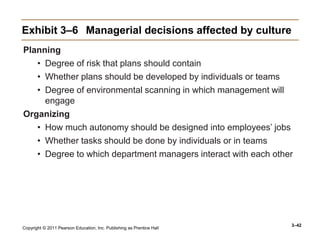
Exhibit 3–6 Managerial decisions affected by culture
Planning
• Degree of risk that plans should contain
• Whether plans should be developed by individuals or teams
• Degree of environmental scanning in which management will
engage
Organizing
• How much autonomy should be designed into employees’ jobs
• Whether tasks should be done by individuals or in teams
• Degree to which department managers interact with each other
Copyright © 2011 Pearson Education, Inc. Publishing as Prentice Hall
3–43
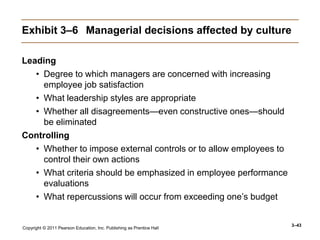
Exhibit 3–6 Managerial decisions affected by culture
Leading
• Degree to which managers are concerned with increasing
employee job satisfaction
• What leadership styles are appropriate
• Whether all disagreements—even constructive ones—should
be eliminated
Controlling
• Whether to impose external controls or to allow employees to
control their own actions
• What criteria should be emphasized in employee performance
evaluations
• What repercussions will occur from exceeding one’s budget
Copyright © 2011 Pearson Education, Inc. Publishing as Prentice Hall
3–44
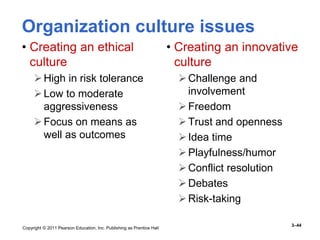
Organization culture issues
• Creating an ethical
culture
High in risk tolerance
Low to moderate
aggressiveness
Focus on means as
well as outcomes
• Creating an innovative
culture
Challenge and
involvement
Freedom
Trust and openness
Idea time
Playfulness/humor
Conflict resolution
Debates
Risk-taking
Copyright © 2011 Pearson Education, Inc. Publishing as Prentice Hall
3–45
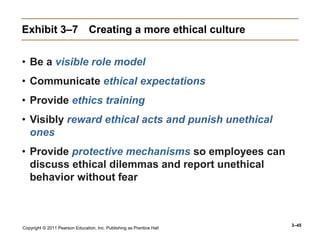
Exhibit 3–7 Creating a more ethical culture
• Be a visible role model
• Communicate ethical expectations
• Provide ethics training
• Visibly reward ethical acts and punish unethical
ones
• Provide protective mechanisms so employees can
discuss ethical dilemmas and report unethical
behavior without fear
Copyright © 2011 Pearson Education, Inc. Publishing as Prentice Hall
3–46
Defining the external
environment
• External environment
Those factors and forces outside the organization that
affect the organization’s performance.
• Components of the external environment
Specific environment
General environment
Copyright © 2011 Pearson Education, Inc. Publishing as Prentice Hall
3–47
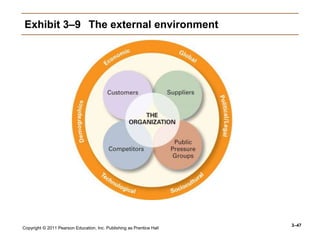
Exhibit 3–9 The external environment
Copyright © 2011 Pearson Education, Inc. Publishing as Prentice Hall
4–48
Managing in a
Global
Environment
Chapter
4
Management
Stephen P. Robbins Mary Coulter
tenth edition
Copyright © 2011 Pearson Education, Inc. Publishing as Prentice Hall
4–49
Learning outcomes
Follow this learning outline as you read and study this
chapter.
4.1 What’s your global perspective?
4.2 Understanding the global environment
4.3 Doing business globally
4.4 Managing in a global environment
Copyright © 2011 Pearson Education, Inc. Publishing as Prentice Hall
4–50
Global marketplace
• Opportunities and Challenges
Coping with the sudden appearance of new
competitors
Acknowledging cultural, political, and economic
differences
Dealing with increased uncertainty, fear, and anxiety
Adapting to changes in the global environment
Avoiding parochialism
Copyright © 2011 Pearson Education, Inc. Publishing as Prentice Hall
4–51
What’s your global
perspective?
• Parochialism
Is viewing the world solely through one’s own eyes
and perspectives.
Is not recognizing that others have different ways of
living and working.
Is a significant obstacle for managers working in a
global business world.
Is falling into the trap of ignoring others’ values and
customs and rigidly applying an attitude of “ours is
better than theirs” to foreign cultures.
Copyright © 2011 Pearson Education, Inc. Publishing as Prentice Hall
4–52
Adopting a global perspective
• Ethnocentric attitude
Parochialistic belief that the best work approaches
and practices are those of the home country.
• Polycentric attitude
The view that the managers in the host country know
the best work approaches and practices for running
their business.
• Geocentric attitude
A world-oriented view that focuses on using the best
approaches and people from around the globe.
Copyright © 2011 Pearson Education, Inc. Publishing as Prentice Hall
4–53
Different types of international
organizations
• Multinational Corporation (MNC)
• Multidomestic Corporation
• Global Company
• Transnational corporation (Borderless
organization)
Copyright © 2011 Pearson Education, Inc. Publishing as Prentice Hall
4–54
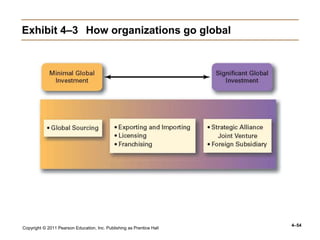
Exhibit 4–3 How organizations go global
Copyright © 2011 Pearson Education, Inc. Publishing as Prentice Hall
4–55
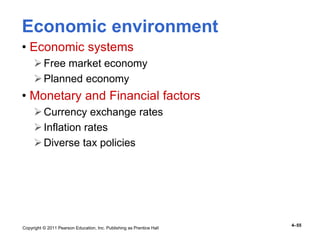
Economic environment
• Economic systems
Free market economy
Planned economy
• Monetary and Financial factors
Currency exchange rates
Inflation rates
Diverse tax policies
Copyright © 2011 Pearson Education, Inc. Publishing as Prentice Hall
4–56
Cultural environment
• National culture
Is the values and attitudes shared by individuals from
a specific country that shape their behavior and their
beliefs about what is important.
May have more influence on an organization than the
organization culture.
Copyright © 2011 Pearson Education, Inc. Publishing as Prentice Hall
4–57
Global management
in today’s world
• Challenges
Openness associated with globalization
Significant cultural differences (e.g., Americanization)
Adjusting leadership styles and management
approaches
• Risks
Loss of investments in unstable countries
Increased terrorism
Economic interdependence
Copyright © 2011 Pearson Education, Inc. Publishing as Prentice Hall
5–58
Social
Responsibility and
Managerial Ethics
Chapter
5
Management
Stephen P. Robbins Mary Coulter
tenth edition
Copyright © 2011 Pearson Education, Inc. Publishing as Prentice Hall
5–59
Learning outcomes
Follow this learning outline as you read and study this
chapter.
5.1 What is social responsibility?
5.2 Green management
5.3 Managers and ethical behavior
5.4 Encouraging ethical behavior
5.5 Social responsibility and ethics issues in
today’s world
Copyright © 2011 Pearson Education, Inc. Publishing as Prentice Hall
5–60
From obligation to
responsiveness to responsibility
• Social obligation
• Social responsiveness
• Social responsibility
Copyright © 2011 Pearson Education, Inc. Publishing as Prentice Hall
5–61
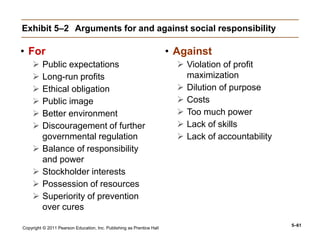
Exhibit 5–2 Arguments for and against social responsibility
• For
 Public expectations
 Long-run profits
 Ethical obligation
 Public image
 Better environment
 Discouragement of further
governmental regulation
 Balance of responsibility
and power
 Stockholder interests
 Possession of resources
 Superiority of prevention
over cures
• Against
 Violation of profit
maximization
 Dilution of purpose
 Costs
 Too much power
 Lack of skills
 Lack of accountability
Copyright © 2011 Pearson Education, Inc. Publishing as Prentice Hall
5–62
Does social responsibility pay?
• Studies appear to show a positive relationship
between social involvement and the economic
performance of firms.
• A general conclusion is that a firm’s social
actions do not harm its long-term performance.
Copyright © 2011 Pearson Education, Inc. Publishing as Prentice Hall
5–63
Greening of management
• Recognition of the close link between an
organization’s decision and activities and its
impact on the natural environment.
Global environmental problems facing managers:
 Air, water, and soil pollution from toxic wastes
 Global warming from greenhouse gas emissions
 Natural resource depletion
Copyright © 2011 Pearson Education, Inc. Publishing as Prentice Hall
5–64
How organizations go green
• Legal (or Light Green) approach
 Firms simply do what is legally required by obeying laws, rules,
and regulations willingly and without legal challenge.
• Market approach
 Firms respond to the preferences of their customers for
environmentally friendly products.
• Stakeholder approach
 Firms work to meet the environmental demands of multiple
stakeholders—employees, suppliers, and the community.
• Activist approach
 Firms look for ways to respect and preserve environment and be
actively socially responsible.
Copyright © 2011 Pearson Education, Inc. Publishing as Prentice Hall
5–65
Factors that affect employee
ethics
• Moral development
• Individual characteristics
• Structural variables
• Organization’s culture
• Intensity of the ethical issue
Copyright © 2011 Pearson Education, Inc. Publishing as Prentice Hall
5–66
How managers can improve
ethical behavior in an organization
1. Hire individuals with high ethical standards
2. Establish codes of ethics and decision rules
3. Lead by example
4. Set realistic job goals and include ethics in
performance appraisals
5. Provide ethics training
6. Conduct independent social audits
7. Provide support for individuals facing ethical
dilemmas
Copyright © 2011 Pearson Education, Inc. Publishing as Prentice Hall
5–67
Managing ethical lapses and
social irresponsibility
• Provide ethical leadership
• Protect employees who raise ethical issues
(whistle-blowers)
Copyright © 2011 Pearson Education, Inc. Publishing as Prentice Hall
5–68
Businesses promoting positive
social change
• Corporate philanthropy
Campaigns
Donations
Funding own foundations
• Employee volunteering efforts
Team volunteering
Individual volunteering during work hours
Copyright © 2011 Pearson Education, Inc. Publishing as Prentice Hall
6–69
Managers
as
Decision Makers
Chapter
6
Management
Stephen P. Robbins Mary Coulter
tenth edition
Copyright © 2011 Pearson Education, Inc. Publishing as Prentice Hall
6–70
Learning outcomes
Follow this learning outline as you read and
study this chapter.
6.1 The decision-making process
6.2 Managers making decisions
6.3 Types of decisions and decision-making
conditions
6.4 Decision-making styles
6.5 Effective decision making in today’s world
Copyright © 2011 Pearson Education, Inc. Publishing as Prentice Hall
6–71
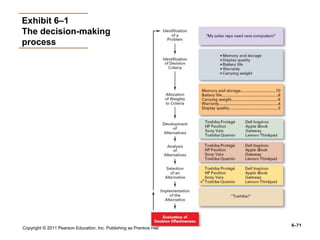
Exhibit 6–1
The decision-making
process
Copyright © 2011 Pearson Education, Inc. Publishing as Prentice Hall
6–72
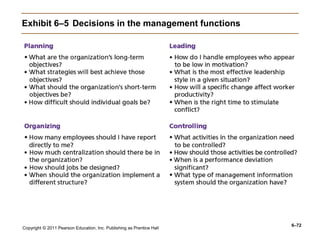
Exhibit 6–5 Decisions in the management functions
Copyright © 2011 Pearson Education, Inc. Publishing as Prentice Hall
6–73
Making decisions
• Rationality
Managers make consistent, value-maximizing choices
with specified constraints.
Assumptions are that decision makers:
 Are perfectly rational, fully objective, and logical.
 Have carefully defined the problem and identified all viable
alternatives.
 Have a clear and specific goal
 Will select the alternative that maximizes outcomes in the
organization’s interests rather than in their personal interests.
Copyright © 2011 Pearson Education, Inc. Publishing as Prentice Hall
6–74
Making decisions
• Bounded rationality
Managers make decisions rationally, but are limited
(bounded) by their ability to process information.
Assumptions are that decision makers:
 Will not seek out or have knowledge of all alternatives
 Will satisfice—choose the first alternative encountered that
satisfactorily solves the problem—rather than maximize the
outcome of their decision by considering all alternatives and
choosing the best.
Influence on decision making
 Escalation of commitment: an increased commitment to a
previous decision despite evidence that it may have been
wrong.
Copyright © 2011 Pearson Education, Inc. Publishing as Prentice Hall
6–75
Role of intuition
• Intuitive decision making
Making decisions on the basis of experience, feelings,
and accumulated judgment.
Copyright © 2011 Pearson Education, Inc. Publishing as Prentice Hall
6–76
Types of problems and decisions
• Structured problems
Involve goals that are clear.
Are familiar (have occurred before).
Are easily and completely defined—information about
the problem is available and complete.
• Programmed decision
A repetitive decision that can be handled by a routine
approach.
Copyright © 2011 Pearson Education, Inc. Publishing as Prentice Hall
6–77
Types of programmed decisions
• Procedure
A series of interrelated steps that a manager can use
to respond (applying a policy) to a structured problem.
• Rule
An explicit statement that limits what a manager or
employee can or cannot do.
• Policy
A general guideline for making a decision about a
structured problem.
Copyright © 2011 Pearson Education, Inc. Publishing as Prentice Hall
6–78
Policy, Procedure, and Rule
Examples
• Policy
Accept all customer-returned merchandise.
• Procedure
Follow all steps for completing merchandise return
documentation.
• Rules
Managers must approve all refunds over $50.00.
No credit purchases are refunded for cash.
Copyright © 2011 Pearson Education, Inc. Publishing as Prentice Hall
6–79
Problems and Decisions
• Unstructured problems
Problems that are new or unusual and for which
information is ambiguous or incomplete.
Problems that will require custom-made solutions.
• Nonprogrammed decisions
Decisions that are unique and nonrecurring.
Decisions that generate unique responses.
Copyright © 2011 Pearson Education, Inc. Publishing as Prentice Hall
6–80
Decision-making styles
• Linear thinking style
A person’s preference for using external data and
facts and processing this information through rational,
logical thinking
• Nonlinear thinking style
A person’s preference for internal sources of
information and processing this information with
internal insights, feelings, and hunches
Copyright © 2011 Pearson Education, Inc. Publishing as Prentice Hall
6–81
Decision-making biases and errors
• Heuristics
• Overconfidence bias
• Immediate gratification bias
• Anchoring effect
• Selective perception bias
• Confirmation bias
• Framing bias
• Availability bias
• Representation bias
• Randomness bias
• Sunk costs errors
• Self-serving bias
• Hindsight bias
Copyright © 2011 Pearson Education, Inc. Publishing as Prentice Hall
6–82
Decision making for today’s world
• Guidelines for making effective decisions:
Understand cultural differences.
Know when it’s time to call it quits.
Use an effective decision making process.
• Habits of highly reliable organizations (HROs)
Are not tricked by their success.
Defer to the experts on the front line.
Let unexpected circumstances provide the solution.
Embrace complexity.
Anticipate, but also anticipate their limits.
Copyright © 2011 Pearson Education, Inc. Publishing as Prentice Hall
6–83
Characteristics of an effective
decision-making process
• It focuses on what is important.
• It is logical and consistent.
• It acknowledges both subjective and objective thinking
and blends analytical with intuitive thinking.
• It requires only as much information and analysis as is
necessary to resolve a particular dilemma.
• It encourages and guides the gathering of relevant
information and informed opinion.
• It is straightforward, reliable, easy to use, and flexible.
Copyright © 2011 Pearson Education, Inc. Publishing as Prentice Hall
7–84
Foundations of
Planning
Chapter
7
Management
Stephen P. Robbins Mary Coulter
tenth edition
Copyright © 2011 Pearson Education, Inc. Publishing as Prentice Hall
7–85
Learning outcomes
Follow this learning outline as you read and study this
chapter.
7.1 The what and why of planning
7.2 Goals and plans
7.3 Setting goals and developing plans
7.4 Contemporary issues in planning
Copyright © 2011 Pearson Education, Inc. Publishing as Prentice Hall
7–86
Planning and Performance
• Relationship between planning and performance
Formal planning
Quality of planning and implementation affects
performance more than the extent of planning.
External environment can reduce the impact of
planning on performance.
Formal planning must be used for several years
before planning begins to affect performance.
Copyright © 2011 Pearson Education, Inc. Publishing as Prentice Hall
7–87
How do managers plan?
• Elements of planning
Goals (also Objectives)
 Desired outcomes for individuals, groups, or entire
organizations
 Provide direction and evaluation performance criteria
Plans
 Documents that outline how goals are to be accomplished
 Describe how resources are to be allocated and establish
activity schedules
Copyright © 2011 Pearson Education, Inc. Publishing as Prentice Hall
7–88
Types of goals
• Financial goals
• Strategic goals
• Stated goals versus real goals
• Strategic plans
• Operational plans
• Long-term plans
• Short-term plans
• Specific plans
• Directional plans
• Single-use plan
• Standing plans
Copyright © 2011 Pearson Education, Inc. Publishing as Prentice Hall
7–89
Setting goals and developing
plans
• Traditional goal setting
Broad goals are set at the top of the organization.
Goals are then broken into sub-goals for each
organizational level.
Assumes that top management knows best because
they can see the “big picture.”
Goals are intended to direct, guide, and constrain
from above.
Goals lose clarity and focus as lower-level managers
attempt to interpret and define the goals for their
areas of responsibility.
Copyright © 2011 Pearson Education, Inc. Publishing as Prentice Hall
7–90
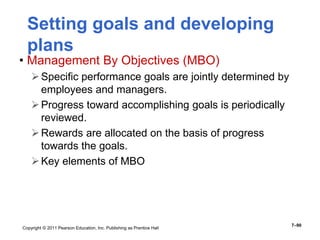
• Management By Objectives (MBO)
Specific performance goals are jointly determined by
employees and managers.
Progress toward accomplishing goals is periodically
reviewed.
Rewards are allocated on the basis of progress
towards the goals.
Key elements of MBO
Setting goals and developing
plans
Copyright © 2011 Pearson Education, Inc. Publishing as Prentice Hall
7–91
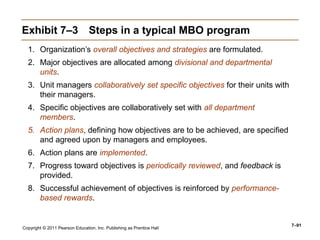
Exhibit 7–3 Steps in a typical MBO program
1. Organization’s overall objectives and strategies are formulated.
2. Major objectives are allocated among divisional and departmental
units.
3. Unit managers collaboratively set specific objectives for their units with
their managers.
4. Specific objectives are collaboratively set with all department
members.
5. Action plans, defining how objectives are to be achieved, are specified
and agreed upon by managers and employees.
6. Action plans are implemented.
7. Progress toward objectives is periodically reviewed, and feedback is
provided.
8. Successful achievement of objectives is reinforced by performance-
based rewards.
Copyright © 2011 Pearson Education, Inc. Publishing as Prentice Hall
7–92
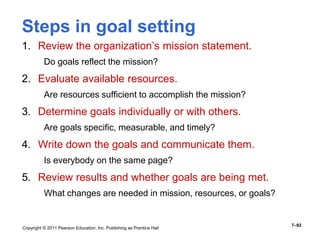
Steps in goal setting
1. Review the organization’s mission statement.
Do goals reflect the mission?
2. Evaluate available resources.
Are resources sufficient to accomplish the mission?
3. Determine goals individually or with others.
Are goals specific, measurable, and timely?
4. Write down the goals and communicate them.
Is everybody on the same page?
5. Review results and whether goals are being met.
What changes are needed in mission, resources, or goals?
Copyright © 2011 Pearson Education, Inc. Publishing as Prentice Hall
7–93
Developing plans
• Contingency factors in a manager’s planning
Manager’s level in the organization
 Strategic plans
 Operational plans
Degree of environmental uncertainty
 Stable environment
 Dynamic environment
Length of future commitments
 Commitment concept
Copyright © 2011 Pearson Education, Inc. Publishing as Prentice Hall
7–94
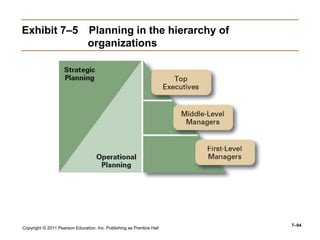
Exhibit 7–5 Planning in the hierarchy of
organizations
Copyright © 2011 Pearson Education, Inc. Publishing as Prentice Hall
7–95
Approaches to planning
• Establishing a formal planning department
A group of planning specialists who help managers
write organizational plans.
Planning is a function of management; it should never
become the sole responsibility of planners.
• Involving organizational members in the process
Plans are developed by members of organizational
units at various levels and then coordinated with other
units across the organization.
Copyright © 2011 Pearson Education, Inc. Publishing as Prentice Hall
7–96
Contemporary issues
in planning
• Criticisms of planning
Planning may create rigidity.
Plans cannot be developed for dynamic
environments.
Formal plans cannot replace intuition and creativity.
Planning focuses managers’ attention on today’s
competition not tomorrow’s survival.
Formal planning reinforces today’s success, which
may lead to tomorrow’s failure.
Just planning isn’t enough.
Copyright © 2011 Pearson Education, Inc. Publishing as Prentice Hall
7–97
Contemporary issues in
planning
• Effective planning in dynamic environments
Develop plans that are specific but flexible.
Understand that planning is an ongoing process.
Change plans when conditions warrant.
Persistence in planning eventually pay off.
Flatten the organizational hierarchy to foster the
development of planning skills at all organizational
levels.
Copyright © 2011 Pearson Education, Inc. Publishing as Prentice Hall
8–98
Strategic
Management
Chapter
8
Management
Stephen P. Robbins Mary Coulter
tenth edition
Copyright © 2011 Pearson Education, Inc. Publishing as Prentice Hall
8–99
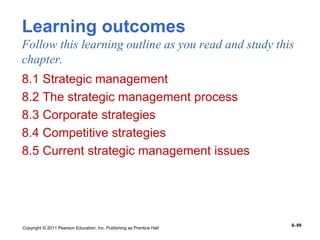
Learning outcomes
Follow this learning outline as you read and study this
chapter.
8.1 Strategic management
8.2 The strategic management process
8.3 Corporate strategies
8.4 Competitive strategies
8.5 Current strategic management issues
Copyright © 2011 Pearson Education, Inc. Publishing as Prentice Hall
8–100
Why is strategic management
important?
1. It results in higher organizational performance.
2. It requires that managers examine and adapt
to business environment changes.
3. It coordinates diverse organizational units,
helping them focus on organizational goals.
Copyright © 2011 Pearson Education, Inc. Publishing as Prentice Hall
8–101
Types of organizational
strategies
• Corporate strategies
Top management’s overall plan for the entire
organization and its strategic business units
• Types of corporate strategies
Growth
Stability
Renewal
Copyright © 2011 Pearson Education, Inc. Publishing as Prentice Hall
8–102
Corporate strategies
• Growth strategy
Seeking to increase the organization’s business by
expansion into new products and markets.
• Types of growth strategies
Concentration
Vertical integration
Horizontal integration
Diversification
Copyright © 2011 Pearson Education, Inc. Publishing as Prentice Hall
8–103
Corporate strategies
• Stability strategy
A strategy that seeks to maintain the status quo to
deal with the uncertainty of a dynamic environment,
when the industry is experiencing slow- or no-growth
conditions, or if the owners of the firm elect not to
grow for personal reasons.
Copyright © 2011 Pearson Education, Inc. Publishing as Prentice Hall
8–104
Corporate strategies
• Renewal strategies
Developing strategies to counter organization
weaknesses that are leading to performance declines.
 Retrenchment
 Turnaround
Copyright © 2011 Pearson Education, Inc. Publishing as Prentice Hall
8–105
Corporate portfolio analysis
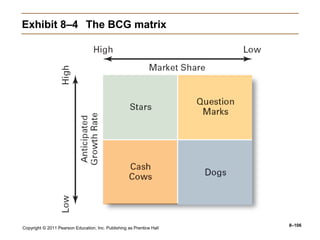
• Managers manage portfolio (or collection) of businesses
using a corporate portfolio matrix such as the BCG
Matrix.
• BCG matrix
 Developed by the Boston Consulting Group
 Considers market share and industry growth rate
 Classifies firms as:
 Cash cows
 Stars
 Question marks
 Dogs
Copyright © 2011 Pearson Education, Inc. Publishing as Prentice Hall
8–106
Exhibit 8–4 The BCG matrix
Copyright © 2011 Pearson Education, Inc. Publishing as Prentice Hall
8–107
Competitive strategies
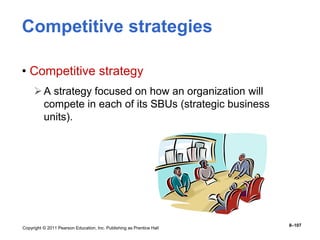
• Competitive strategy
A strategy focused on how an organization will
compete in each of its SBUs (strategic business
units).
Copyright © 2011 Pearson Education, Inc. Publishing as Prentice Hall
8–108
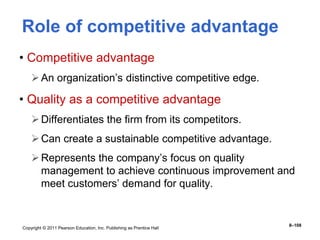
Role of competitive advantage
• Competitive advantage
An organization’s distinctive competitive edge.
• Quality as a competitive advantage
Differentiates the firm from its competitors.
Can create a sustainable competitive advantage.
Represents the company’s focus on quality
management to achieve continuous improvement and
meet customers’ demand for quality.
Copyright © 2011 Pearson Education, Inc. Publishing as Prentice Hall
8–109
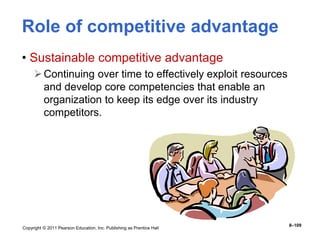
Role of competitive advantage
• Sustainable competitive advantage
Continuing over time to effectively exploit resources
and develop core competencies that enable an
organization to keep its edge over its industry
competitors.
Copyright © 2011 Pearson Education, Inc. Publishing as Prentice Hall
8–110
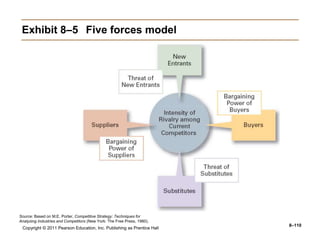
Exhibit 8–5 Five forces model
Source: Based on M.E. Porter, Competitive Strategy: Techniques for
Analyzing Industries and Competitors (New York: The Free Press, 1980).
Copyright © 2011 Pearson Education, Inc. Publishing as Prentice Hall
8–111
Types of competitive strategies
• Cost leadership strategy
• Differentiation strategy
• Focus strategy
Copyright © 2011 Pearson Education, Inc. Publishing as Prentice Hall
8–112
Strategic management today
• Strategic flexibility
• New directions in organizational strategies
E-business
Customer service
Innovation
Copyright © 2011 Pearson Education, Inc. Publishing as Prentice Hall
8–113
Strategies for applying
e-Business techniques
• Cost leadership
• Differentiation
• Focus
Copyright © 2011 Pearson Education, Inc. Publishing as Prentice Hall
8–114
Customer service strategies
• Giving the customers what they want.
• Communicating effectively with them.
• Providing employees with customer service
training.
Copyright © 2011 Pearson Education, Inc. Publishing as Prentice Hall
8–115
Innovation strategies
• Possible events
Radical breakthroughs in products
Application of existing technology to new uses
• Strategic decisions about innovation
Basic research
Product development
Process innovation
• First mover
An organization that brings a product innovation to
market or use a new process innovations
Copyright © 2011 Pearson Education, Inc. Publishing as Prentice Hall
9–116
Organizational
Structure and
Design
Chapter
9
Management
Stephen P. Robbins Mary Coulter
tenth edition
Copyright © 2011 Pearson Education, Inc. Publishing as Prentice Hall
9–117
Learning outcomes
Follow this learning outline as you read and study this
chapter.
9.1 Defining organizational structure
9.2 Mechanistic and Organic structures
9.3 Common organizational designs
Copyright © 2011 Pearson Education, Inc. Publishing as Prentice Hall
9–118
Designing organizational structure
• Organizing
 Arranging and structuring work to accomplish an organization’s
goals
• Organizational structure
 The formal arrangement of jobs within an organization
• Organizational design
 A process involving decisions about six key elements:
 Work specialization
 Departmentalization
 Chain of command
 Span of control
 Centralization and decentralization
 Formalization
Copyright © 2011 Pearson Education, Inc. Publishing as Prentice Hall
9–119
Exhibit 9–1 Purposes of organizing
• Divides work to be done into specific jobs and
departments.
• Assigns tasks and responsibilities associated with
individual jobs.
• Coordinates diverse organizational tasks.
• Clusters jobs into units.
• Establishes relationships among individuals, groups,
and departments.
• Establishes formal lines of authority.
• Allocates and deploys organizational resources.
Copyright © 2011 Pearson Education, Inc. Publishing as Prentice Hall
9–120
Organizational structure
• Chain of command
Continuous line of authority that extends from upper
levels of an organization to the lowest levels of the
organization and clarifies who reports to whom.
Copyright © 2011 Pearson Education, Inc. Publishing as Prentice Hall
9–121
Organizational structure
• Authority
Rights inherent in a managerial position to tell people
what to do and to expect them to do it.
• Responsibility
Obligation or expectation to perform.
• Unity of command
Concept that a person should have one boss and
should report only to that person.
Copyright © 2011 Pearson Education, Inc. Publishing as Prentice Hall
9–122
Organizational structure
• Span of control
 Number of employees who can be effectively and efficiently
supervised by a manager.
 Width of span is affected by:
 Skills and abilities of the manager
 Employee characteristics
 Characteristics of the work being done
 Similarity of tasks
 Complexity of tasks
 Physical proximity of subordinates
 Standardization of tasks
 Sophistication of the organization’s information system
 Strength of the organization’s culture
 Preferred style of the manager
Copyright © 2011 Pearson Education, Inc. Publishing as Prentice Hall
9–123
Organizational structure
• Centralization
Degree to which decision making is concentrated at
upper levels in the organization.
• Decentralization
Organizations in which decision making is pushed
down to the managers who are closest to the action.
• Employee empowerment
Increasing the decision-making authority (power) of
employees.
Copyright © 2011 Pearson Education, Inc. Publishing as Prentice Hall
9–124
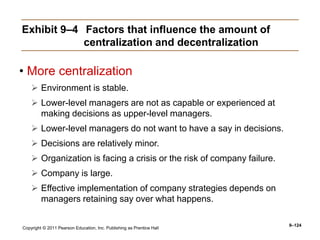
Exhibit 9–4 Factors that influence the amount of
centralization and decentralization
• More centralization
 Environment is stable.
 Lower-level managers are not as capable or experienced at
making decisions as upper-level managers.
 Lower-level managers do not want to have a say in decisions.
 Decisions are relatively minor.
 Organization is facing a crisis or the risk of company failure.
 Company is large.
 Effective implementation of company strategies depends on
managers retaining say over what happens.
Copyright © 2011 Pearson Education, Inc. Publishing as Prentice Hall
9–125
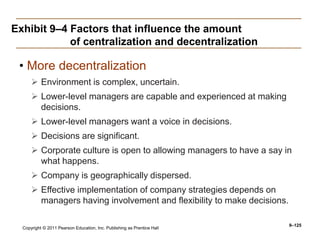
Exhibit 9–4 Factors that influence the amount
of centralization and decentralization
• More decentralization
 Environment is complex, uncertain.
 Lower-level managers are capable and experienced at making
decisions.
 Lower-level managers want a voice in decisions.
 Decisions are significant.
 Corporate culture is open to allowing managers to have a say in
what happens.
 Company is geographically dispersed.
 Effective implementation of company strategies depends on
managers having involvement and flexibility to make decisions.
Copyright © 2011 Pearson Education, Inc. Publishing as Prentice Hall
9–126
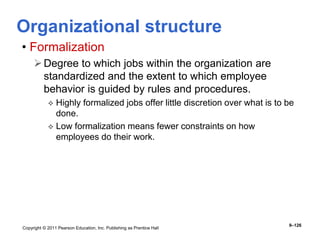
Organizational structure
• Formalization
Degree to which jobs within the organization are
standardized and the extent to which employee
behavior is guided by rules and procedures.
 Highly formalized jobs offer little discretion over what is to be
done.
 Low formalization means fewer constraints on how
employees do their work.
Copyright © 2011 Pearson Education, Inc. Publishing as Prentice Hall
9–127
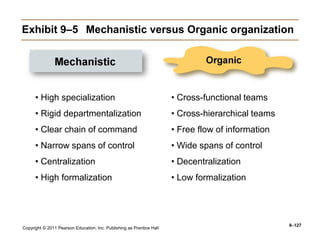
Exhibit 9–5 Mechanistic versus Organic organization
• High specialization
• Rigid departmentalization
• Clear chain of command
• Narrow spans of control
• Centralization
• High formalization
• Cross-functional teams
• Cross-hierarchical teams
• Free flow of information
• Wide spans of control
• Decentralization
• Low formalization
Copyright © 2011 Pearson Education, Inc. Publishing as Prentice Hall
9–128
Contingency factors
• Structural decisions are influenced by:
Overall strategy of the organization
Size of the organization
Technology use by the organization
Degree of environmental uncertainty
Copyright © 2011 Pearson Education, Inc. Publishing as Prentice Hall
9–129
Contingency factors
• Strategy frameworks:
Innovation
 Pursuing competitive advantage through meaningful and
unique innovations favors an organic structuring.
Cost minimization
 Focusing on tightly controlling costs requires a mechanistic
structure for the organization.
Copyright © 2011 Pearson Education, Inc. Publishing as Prentice Hall
9–130
Contingency factors
• Strategy and structure
Achievement of strategic goals is facilitated by
changes in organizational structure that
accommodate and support change.
• Size and structure
As an organization grows larger, its structure tends to
change from organic to mechanistic with increased
specialization, departmentalization, centralization,
and rules and regulations.
Copyright © 2011 Pearson Education, Inc. Publishing as Prentice Hall
9–131
Contingency factors
• Technology and structure
Organizations adapt their structures to their
technology.
Woodward’s classification of firms based on the
complexity of the technology employed:
 Unit production
 Mass production
 Process production
Routine technology = mechanistic organizations
Non-routine technology = organic organizations
Copyright © 2011 Pearson Education, Inc. Publishing as Prentice Hall
9–132
Contingency factors
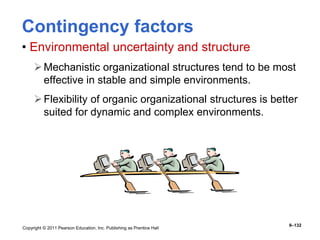
• Environmental uncertainty and structure
Mechanistic organizational structures tend to be most
effective in stable and simple environments.
Flexibility of organic organizational structures is better
suited for dynamic and complex environments.
Copyright © 2011 Pearson Education, Inc. Publishing as Prentice Hall
9–133
Common organizational designs
• Traditional designs
Simple structure
Functional structure
Divisional structure
• Contemporary organizational designs
Team structures
Matrix and project structures
Boundaryless organization
Copyright © 2011 Pearson Education, Inc. Publishing as Prentice Hall
9–134
Removing external boundaries
• Virtual organization
 An organization that consists of a small core of full-time
employees and that temporarily hires specialists to work on
opportunities that arise.
• Network organization
 A small core organization that outsources its major business
functions in order to concentrate on what it does best.
• Modular organization
 A manufacturing organization that uses outside suppliers to
provide product components for its final assembly operations.
Copyright © 2011 Pearson Education, Inc. Publishing as Prentice Hall
9–135
Today’s organizational design
challenges
• Keeping Employees Connected
Widely dispersed and mobile employees
• Building a Learning Organization
• Managing Global Structural Issues
Cultural implications of design elements
Copyright © 2011 Pearson Education, Inc. Publishing as Prentice Hall
9–136
Organizational designs
• Learning organization
An organization that has developed the capacity to
continuously learn, adapt, and change through the
practice of knowledge management by employees.
Characteristics of a learning organization:
 An open team-based organization design that empowers
employees
 Extensive and open information sharing
 Leadership that provides a shared vision of the organization’s
future.
 A strong culture of shared values, trust, openness, and a
sense of community.
Copyright © 2011 Pearson Education, Inc. Publishing as Prentice Hall
10–137
Managing
Human
Resources
Chapter
10
Management
Stephen P. Robbins Mary Coulter
tenth edition
Copyright © 2011 Pearson Education, Inc. Publishing as Prentice Hall
10–138
Learning outcomes
Follow this learning outline as you read and study this
chapter.
10.1 The human resource management process
10.2 Identifying and selecting competent employees
10.3 Providing employees with needed skills
and knowledge
10.4 Retaining competent, high performing employees
10.5 Contemporary issues in managing human
resources
Copyright © 2011 Pearson Education, Inc. Publishing as Prentice Hall
10–139
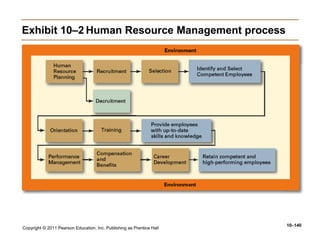
HRM process
• Functions of the HRM process
Ensuring that competent employees are identified and
selected.
Providing employees with up-to-date knowledge and
skills to do their jobs.
Ensuring that the organization retains competent and
high-performing employees.
Copyright © 2011 Pearson Education, Inc. Publishing as Prentice Hall
10–140
Exhibit 10–2 Human Resource Management process
Copyright © 2011 Pearson Education, Inc. Publishing as Prentice Hall
10–141
Environmental factors affecting
HRM
• Employee labor unions
Organizations that represent workers and seek to
protect their interests through collective bargaining.
• Governmental laws and regulations
Limit managerial discretion in hiring, promoting, and
discharging employees.
Copyright © 2011 Pearson Education, Inc. Publishing as Prentice Hall
10–142
Managing Human Resources
• Human Resource (HR) planning
Process by which managers ensure that they have
the right number and kinds of people in the right
places, and at the right times, who are capable of
effectively and efficiently performing their tasks.
Helps avoid sudden talent shortages and surpluses.
Steps in HR planning
Copyright © 2011 Pearson Education, Inc. Publishing as Prentice Hall
10–143
Recruitment and Decruitment
• Recruitment
Process of locating, identifying, and attracting capable
applicants to an organization
• Decruitment
Process of reducing a surplus of employees in the
workforce of an organization
• Online recruiting
Recruitment of employees through the Internet
Copyright © 2011 Pearson Education, Inc. Publishing as Prentice Hall
10–144
Selection
• Selection process
Process of screening job applicants to ensure that the
most appropriate candidates are hired.
• What is selection?
An exercise in predicting which applicants, if hired,
will be (or will not be) successful in performing well on
the criteria the organization uses to evaluate
performance.
Selection errors
Copyright © 2011 Pearson Education, Inc. Publishing as Prentice Hall
10–145
Validity and Reliability
• Validity (of prediction)
Proven relationship between the selection device
used and some relevant criterion for successful
performance in an organization.
• Reliability (of prediction)
Degree of consistency with which a selection device
measures the same thing.
Copyright © 2011 Pearson Education, Inc. Publishing as Prentice Hall
10–146
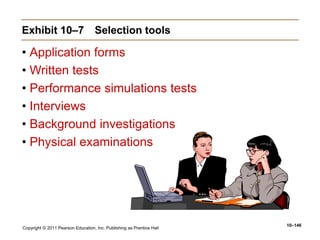
Exhibit 10–7 Selection tools
• Application forms
• Written tests
• Performance simulations tests
• Interviews
• Background investigations
• Physical examinations
Copyright © 2011 Pearson Education, Inc. Publishing as Prentice Hall
10–147
Employee performance
management
• Performance management system
A process of establishing performance standards and
appraising employee performance.
Copyright © 2011 Pearson Education, Inc. Publishing as Prentice Hall
10–148
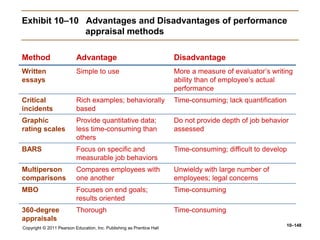
Exhibit 10–10 Advantages and Disadvantages of performance
appraisal methods
Method Advantage Disadvantage
Written
essays
Simple to use More a measure of evaluator’s writing
ability than of employee’s actual
performance
Critical
incidents
Rich examples; behaviorally
based
Time-consuming; lack quantification
Graphic
rating scales
Provide quantitative data;
less time-consuming than
others
Do not provide depth of job behavior
assessed
BARS Focus on specific and
measurable job behaviors
Time-consuming; difficult to develop
Multiperson
comparisons
Compares employees with
one another
Unwieldy with large number of
employees; legal concerns
MBO Focuses on end goals;
results oriented
Time-consuming
360-degree
appraisals
Thorough Time-consuming
Copyright © 2011 Pearson Education, Inc. Publishing as Prentice Hall
10–149
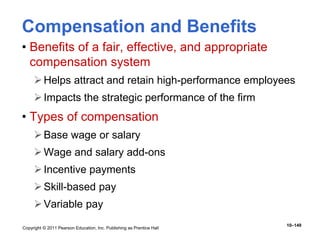
Compensation and Benefits
• Benefits of a fair, effective, and appropriate
compensation system
Helps attract and retain high-performance employees
Impacts the strategic performance of the firm
• Types of compensation
Base wage or salary
Wage and salary add-ons
Incentive payments
Skill-based pay
Variable pay
Copyright © 2011 Pearson Education, Inc. Publishing as Prentice Hall
10–150
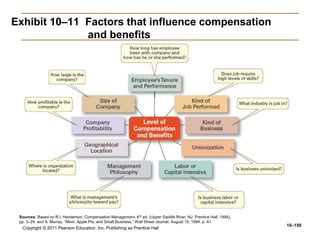
Exhibit 10–11 Factors that influence compensation
and benefits
Sources: Based on R.I. Henderson, Compensation Management, 6th ed. (Upper Saddle River, NJ: Prentice Hall, 1994),
pp. 3–24; and A. Murray, “Mom, Apple Pie, and Small Business,” Wall Street Journal, August 15, 1994, p. A1
Copyright © 2011 Pearson Education, Inc. Publishing as Prentice Hall
10–151
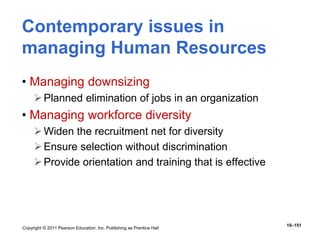
Contemporary issues in
managing Human Resources
• Managing downsizing
Planned elimination of jobs in an organization
• Managing workforce diversity
Widen the recruitment net for diversity
Ensure selection without discrimination
Provide orientation and training that is effective
Copyright © 2011 Pearson Education, Inc. Publishing as Prentice Hall
10–152
Exhibit 10–12 Tips for managing downsizing
• Communicate openly and honestly
• Follow any laws regulating severance pay or benefits
• Provide support/counseling for surviving employees
• Reassign roles according to individuals’ talents and
backgrounds
• Focus on boosting morale
Copyright © 2011 Pearson Education, Inc. Publishing as Prentice Hall
11–153
Managing
Teams
Chapter
11
Management
Stephen P. Robbins Mary Coulter
tenth edition
Copyright © 2011 Pearson Education, Inc. Publishing as Prentice Hall
11–154
Learning outcomes
Follow this learning outline as you read and study this
chapter.
11.1 Groups and group development
11.2 Work group performance and satisfaction
11.3 Turning groups into effective teams
11.4 Current challenges in managing teams
Copyright © 2011 Pearson Education, Inc. Publishing as Prentice Hall
11–155
Exhibit 11–1 Examples of formal groups
• Command groups
Groups that are determined by the organization chart
and composed of individuals who report directly to a
given manager.
• Task groups
Groups composed of individuals brought together to
complete a specific job task; their existence is often
temporary because once the task is completed, the
group disbands.
Copyright © 2011 Pearson Education, Inc. Publishing as Prentice Hall
11–156
Exhibit 11–1 Examples of formal groups
• Cross-functional teams
Groups that bring together the knowledge and skills of
individuals from various work areas or groups whose
members have been trained to do each others’ jobs.
• Self-managed teams
Groups that are essentially independent and in
addition to their own tasks, take on traditional
responsibilities such as hiring, planning and
scheduling, and performance evaluations.
Copyright © 2011 Pearson Education, Inc. Publishing as Prentice Hall
11–157
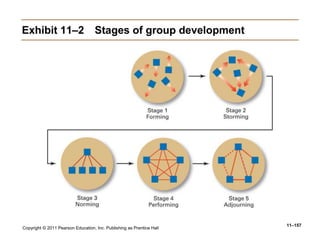
Exhibit 11–2 Stages of group development
Copyright © 2011 Pearson Education, Inc. Publishing as Prentice Hall
11–158
External conditions imposed on
the group
 Organization’s strategy
 Authority relationships
 Formal regulations
 Available organizational resources
 Employee selection criteria
 Performance management (appraisal) system
 Organizational culture
 General physical layout of work space
Copyright © 2011 Pearson Education, Inc. Publishing as Prentice Hall
11–159
Group member resources
• Knowledge
• Skills
• Abilities
• Personality traits
Copyright © 2011 Pearson Education, Inc. Publishing as Prentice Hall
11–160
Group structure
• Role
Set of expected behavior patterns attributed to
someone who occupies a given position in a social
unit that assists the group in task accomplishment or
maintaining group member satisfaction.
Role conflict
Role ambiguity
Copyright © 2011 Pearson Education, Inc. Publishing as Prentice Hall
11–161
Group structure
• Norms
Acceptable standards or expectations that are shared
by the group’s members.
• Common types of norms
Effort and performance
Dress
Loyalty
Copyright © 2011 Pearson Education, Inc. Publishing as Prentice Hall
11–162
Group structure
• Conformity
Individuals conform in order to be accepted by
groups.
Group pressures can have an effect on an individual
member’s judgment and attitudes.
Effect of conformity is not as strong as it once was,
although still a powerful force.
Groupthink
 Extensive pressure of others in a strongly cohesive or
threatened group that causes individual members to change
their opinions to conform to that of the group.
Copyright © 2011 Pearson Education, Inc. Publishing as Prentice Hall
11–163
Group structure
• Status system
Formal or informal prestige grading, position, or
ranking system for members of a group that serves as
recognition for individual contributions to the group
and as a behavioral motivator.
 Formal status systems are effective when the perceived
ranking of an individual and the status symbols accorded that
individual are congruent.
Copyright © 2011 Pearson Education, Inc. Publishing as Prentice Hall
11–164
Group structure: Group size
• Small groups
 Complete tasks faster than
larger groups.
 Make more effective use of
facts.
• Large groups
 Solve problems better than
small groups.
 Are good for getting diverse
input.
 Are more effective in fact-
finding.
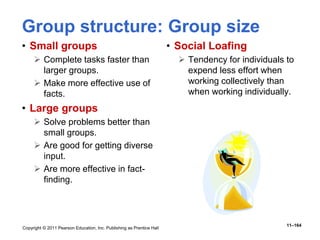
• Social Loafing
 Tendency for individuals to
expend less effort when
working collectively than
when working individually.
Copyright © 2011 Pearson Education, Inc. Publishing as Prentice Hall
11–165
Group structure
• Group cohesiveness
Degree to which members are attracted to a group
and share the group’s goals.
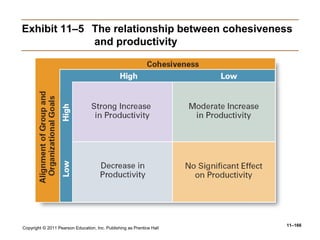
 Highly cohesive groups are more effective and productive
than less cohesive groups when their goals aligned with
organizational goals.
Copyright © 2011 Pearson Education, Inc. Publishing as Prentice Hall
11–166
Exhibit 11–5 The relationship between cohesiveness
and productivity
Copyright © 2011 Pearson Education, Inc. Publishing as Prentice Hall
11–167
Group processes: Conflict
management
• Conflict
Perceived incompatible differences in a group
resulting in some form of interference with or
opposition to its assigned tasks.
 Traditional view
 Human relations view
 Interactionist view
Copyright © 2011 Pearson Education, Inc. Publishing as Prentice Hall
11–168
Group processes: Conflict
management
• Categories of conflict
Functional conflicts are constructive.
Dysfunctional conflicts are destructive.
• Types of conflict
Task conflict
Relationship conflict
Process conflict
Copyright © 2011 Pearson Education, Inc. Publishing as Prentice Hall
11–169
Group processes: Conflict
management
• Techniques to manage conflict:
Avoidance
Accommodation
Forcing
Compromise
Collaboration
Copyright © 2011 Pearson Education, Inc. Publishing as Prentice Hall
11–170
Group tasks and group
effectiveness
• Highly complex and interdependent tasks
require:
Effective communications
Controlled conflict
Copyright © 2011 Pearson Education, Inc. Publishing as Prentice Hall
11–171
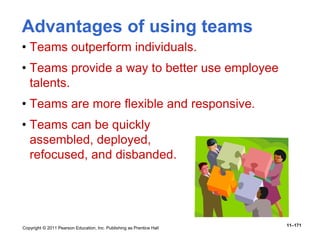
Advantages of using teams
• Teams outperform individuals.
• Teams provide a way to better use employee
talents.
• Teams are more flexible and responsive.
• Teams can be quickly
assembled, deployed,
refocused, and disbanded.
Copyright © 2011 Pearson Education, Inc. Publishing as Prentice Hall
11–172
What is a work team?
• Work team
A group whose members work intensely on a specific
common goal using their positive synergy, individual
and mutual accountability, and complementary skills.
• Types of teams
Problem-solving teams
Self-managed work teams
Cross-functional teams
Virtual teams
Copyright © 2011 Pearson Education, Inc. Publishing as Prentice Hall
11–173
Types of teams
• Problem-solving teams
Employees from the same department and functional
area who are involved in efforts to improve work
activities or to solve specific problems.
• Self-managed work teams
A formal group of employees who operate without a
manager and responsible for a complete work
process or segment.
Copyright © 2011 Pearson Education, Inc. Publishing as Prentice Hall
11–174
Types of teams
• Cross-functional teams
A hybrid grouping of individuals who are experts in
various specialties and who work together on various
tasks.
• Virtual teams
Teams that use computer technology to link
physically dispersed members in order to achieve a
common goal.
Copyright © 2011 Pearson Education, Inc. Publishing as Prentice Hall
11–175
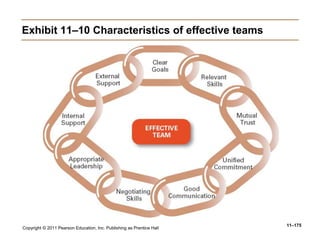
Exhibit 11–10 Characteristics of effective teams
Copyright © 2011 Pearson Education, Inc. Publishing as Prentice Hall
11–176
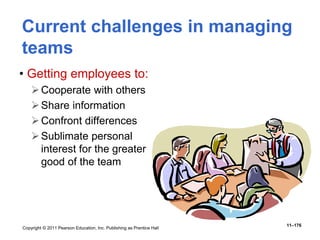
Current challenges in managing
teams
• Getting employees to:
Cooperate with others
Share information
Confront differences
Sublimate personal
interest for the greater
good of the team
Copyright © 2011 Pearson Education, Inc. Publishing as Prentice Hall
11–177
Managing global teams
• Group member resources
 Unique cultural characteristics of team members
 Avoiding stereotyping
• Group structure
 Conformity—less groupthink
 Status—varies in importance among cultures
 Social loafing—predominately a Western bias
 Cohesiveness—more difficult to achieve
• Group processes—capitalize on diverse ideas.
• Manager’s role—a communicator sensitive to the type of
global team to use.
Copyright © 2011 Pearson Education, Inc. Publishing as Prentice Hall
11–178
Understanding social networks
• Social network
Patterns of informal connections among individuals
within groups.
• Importance of social networks
Relationships can help or hinder team effectiveness.
Relationships improve team goal attainment and
increase member commitment to the team.
Copyright © 2011 Pearson Education, Inc. Publishing as Prentice Hall
12–179
Managing Change
and
Innovation
Chapter
12
Management
Stephen P. Robbins Mary Coulter
tenth edition
Copyright © 2011 Pearson Education, Inc. Publishing as Prentice Hall
12–180
Learning outcomes
Follow this learning outline as you read and study this
chapter.
12.1 The change process
12.2 Managing organizational change
12.3 Managing resistance to change
12.4 Contemporary issues in managing change
12.5 Stimulating innovation
Copyright © 2011 Pearson Education, Inc. Publishing as Prentice Hall
12–181
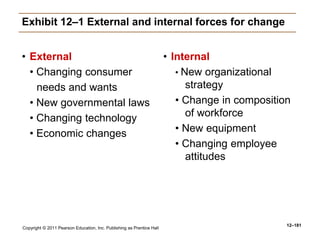
Exhibit 12–1 External and internal forces for change
• External
• Changing consumer
needs and wants
• New governmental laws
• Changing technology
• Economic changes
• Internal
• New organizational
strategy
• Change in composition
of workforce
• New equipment
• Changing employee
attitudes
Copyright © 2011 Pearson Education, Inc. Publishing as Prentice Hall
12–182
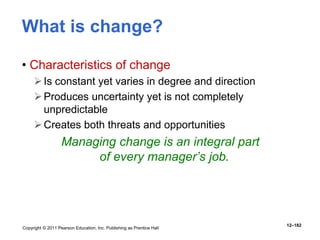
What is change?
• Characteristics of change
Is constant yet varies in degree and direction
Produces uncertainty yet is not completely
unpredictable
Creates both threats and opportunities
Managing change is an integral part
of every manager’s job.
Copyright © 2011 Pearson Education, Inc. Publishing as Prentice Hall
12–183
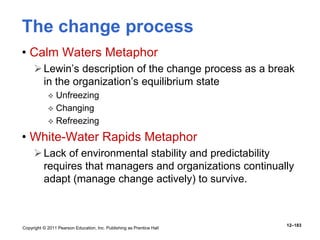
The change process
• Calm Waters Metaphor
Lewin’s description of the change process as a break
in the organization’s equilibrium state
 Unfreezing
 Changing
 Refreezing
• White-Water Rapids Metaphor
Lack of environmental stability and predictability
requires that managers and organizations continually
adapt (manage change actively) to survive.
Copyright © 2011 Pearson Education, Inc. Publishing as Prentice Hall
12–184
Organizational change and
change agents
• Organizational change
Any alterations in the people, structure, or technology
of an organization
• Change agents
Persons who act as catalysts and assume the
responsibility for managing the change process.
• Types of change agents
Managers
Nonmanagers
Outside consultants
Copyright © 2011 Pearson Education, Inc. Publishing as Prentice Hall
12–185
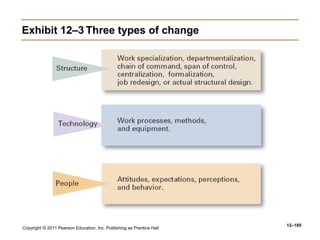
Exhibit 12–3 Three types of change
Copyright © 2011 Pearson Education, Inc. Publishing as Prentice Hall
12–186
Types of change
• Structure
 Changing an organization’s structural components or its
structural design
• Technology
 Adopting new equipment, tools, or operating methods that
displace old skills and require new ones
• People
 Changing attitudes, expectations, perceptions, and behaviors
of the workforce
Copyright © 2011 Pearson Education, Inc. Publishing as Prentice Hall
12–187
Managing resistance to change
• Why people resist change?
Ambiguity and uncertainty that change introduces
Comfort of old habits
A concern over personal loss of status, money,
authority, friendships, and personal convenience
Perception that change is incompatible with the goals
and interest of the organization
Copyright © 2011 Pearson Education, Inc. Publishing as Prentice Hall
12–188
Issues in managing change
• Changing organizational cultures
Cultures are naturally resistant to change.
Conditions that facilitate cultural change:
 Occurrence of a dramatic crisis
 Leadership changing hands
 A young, flexible, and small organization
 A weak organizational culture
Copyright © 2011 Pearson Education, Inc. Publishing as Prentice Hall
12–189
Exhibit 12–6 Strategies for managing cultural change
• Set the tone through management behavior; top managers,
particularly, need to be positive role models.
• Create new stories, symbols, and rituals to replace those currently in
use.
• Select, promote, and support employees who adopt the new values.
• Redesign socialization processes to align with the new values.
• Encourage acceptance of the new values, change the reward
system.
• Replace unwritten norms with clearly specified expectations.
• Shake up current subcultures through job transfers, job rotation,
and/or terminations.
• Work to get consensus through employee participation and creating
a climate with a high level of trust.
Copyright © 2011 Pearson Education, Inc. Publishing as Prentice Hall
12–190
Issues in managing change
• Handling employee stress
Stress
 Adverse reaction people have to excessive pressure placed
on them from extraordinary demands, constraints, or
opportunities.
 Functional Stress
How potential stress becomes actual stress
 When there is uncertainty over the outcome.
 When the outcome is important.
Copyright © 2011 Pearson Education, Inc. Publishing as Prentice Hall
12–191
Issues in managing change
• Reducing stress
Engage in proper employee selection
Use realistic job interviews for reduce ambiguity
Improve organizational communications
Develop a performance planning program
Use job redesign
Provide a counseling program
Offer time planning management assistance
Sponsor wellness programs
Copyright © 2011 Pearson Education, Inc. Publishing as Prentice Hall
12–192
Issues in managing change
• Making change happen successfully
Embrace change—become a change-capable
organization.
Create a simple, compelling message explaining why
change is necessary.
Communicate constantly and honestly.
Foster as much employee participation as possible—
get all employees committed.
Encourage employees to be flexible.
Remove those who resist and cannot be changed.
Copyright © 2011 Pearson Education, Inc. Publishing as Prentice Hall
12–193
Exhibit 12–8 Characteristics of change-capable
organizations
• Link the present and
the future
• Make learning a way of
life
• Actively support and
encourage day-to-day
improvements and
changes
• Ensure diverse teams
• Encourage mavericks
• Shelter breakthroughs
• Integrate technology
• Build and deepen trust
Copyright © 2011 Pearson Education, Inc. Publishing as Prentice Hall
12–194
Stimulating innovation
• Creativity
Ability to combine ideas in a unique way or to make
an unusual association.
• Innovation
Turning the outcomes of the creative process into
useful products, services, or work methods.
Copyright © 2011 Pearson Education, Inc. Publishing as Prentice Hall
12–195
Stimulating innovation
• Structural variables
Adopt an organic structure
Make available plentiful resources
Engage in frequent inter-unit communication
Minimize extreme time pressures on creative
activities
Provide explicit support for creativity
Copyright © 2011 Pearson Education, Inc. Publishing as Prentice Hall
12–196
Stimulating innovation
• Cultural variables
Accept ambiguity
Tolerate the impractical
Have low external controls
Tolerate risk taking
Tolerate conflict
Focus on ends rather than means
Develop an open-system focus
Provide positive feedback
Copyright © 2011 Pearson Education, Inc. Publishing as Prentice Hall
12–197
Stimulating innovation
• Human resource variables
Actively promote training and development to keep
employees’ skills current.
Offer high job security to encourage risk taking.
Encourage individual to be “champions” of change.
• Idea champion
Dynamic self-confident leaders who actively and
enthusiastically inspire support for new ideas, build
support, overcome resistance, and ensure that
innovations are implemented.
Copyright © 2011 Pearson Education, Inc. Publishing as Prentice Hall
13–198
Understanding
Individual
Behavior
Chapter
13
Management
Stephen P. Robbins Mary Coulter
tenth edition
Copyright © 2011 Pearson Education, Inc. Publishing as Prentice Hall
13–199
Learning outcomes
Follow this learning outline as you read and study this
chapter.
13.1 Focus and goals of individual behavior
13.2 Attitudes and performance
13.3 Personality
13.4 Learning
13.5 Contemporary OB issues
Copyright © 2011 Pearson Education, Inc. Publishing as Prentice Hall
13–200
Focus and goals of individual
behavior
• Organizational behavior (OB)
Actions of people at work
• Focus of organizational behavior
Individual behavior
 Attitudes, personality, perception, learning, and motivation
Group behavior
 Norms, roles, team building, leadership, and conflict
Organizational
 Structure, culture, and human resource policies and practices
Copyright © 2011 Pearson Education, Inc. Publishing as Prentice Hall
13–201
Goals of organizational behavior
To explain, predict and influence behavior
• Employee Productivity
A performance measure of both efficiency and
effectiveness
• Absenteeism
Failure to report to work when expected
• Turnover
Voluntary and involuntary
permanent withdrawal from
an organization
Copyright © 2011 Pearson Education, Inc. Publishing as Prentice Hall
13–202
Important employee behaviors
• Organizational citizenship behavior (OCB)
Discretionary behavior that is not a part of an
employee’s formal job requirements, but which
promotes the effective functioning of the organization.
• Job satisfaction
Individual’s general attitude
toward his or her job
Copyright © 2011 Pearson Education, Inc. Publishing as Prentice Hall
13–203
Important employee behaviors
• Workplace misbehavior
Any intentional employee behavior that has negative
consequences for the organization or individuals
within the organization.
Types of misbehavior
 Deviance
 Aggression
 Antisocial behavior
 Violence
Copyright © 2011 Pearson Education, Inc. Publishing as Prentice Hall
13–204
Psychological factors affecting
employee behavior
• Attitudes
• Personality
• Perception
• Learning
• Employee
Productivity
• Absenteeism
• Turnover
• Organizational
Citizenship
• Job Satisfaction
• Workplace
Misbehavior
Copyright © 2011 Pearson Education, Inc. Publishing as Prentice Hall
13–205
Psychological factors – attitudes
• Attitudes
Evaluative statements—either favorable or
unfavorable—concerning objects, people, or events
• Components of an attitude
Cognitive component
Affective component
Behavioral component
Copyright © 2011 Pearson Education, Inc. Publishing as Prentice Hall
13–206
• Job satisfaction
Job satisfaction is affected by level of income earned
and by the type of job a worker does.
• Job satisfaction and productivity
Correlation between satisfaction and productivity is
fairly strong.
Organizations with more satisfied employees are
more effective than those with fewer satisfied
employees.
Psychological factors – attitudes
Copyright © 2011 Pearson Education, Inc. Publishing as Prentice Hall
13–207
• Job satisfaction and absenteeism
Satisfied employees tend to have lower levels of
absenteeism, although satisfied employees are bound
to take company approved days off (e.g. sick days)
• Job satisfaction and turnover
Satisfied employees have lower levels of turnover;
dissatisfied employees have higher levels of turnover.
Turnover is affected by the level of employee
performance.
Psychological factors – attitudes
Copyright © 2011 Pearson Education, Inc. Publishing as Prentice Hall
13–208
• Job satisfaction and customer satisfaction
Level of job satisfaction for frontline employees is
related to increased customer satisfaction and loyalty.
Interaction with dissatisfied customers can increase
an employee’s job dissatisfaction.
Actions to increase job satisfaction for customer
service workers
Psychological factors – attitudes
Copyright © 2011 Pearson Education, Inc. Publishing as Prentice Hall
13–209
• Job satisfaction and organizational citizenship
behavior (OCB)
Relationship between job satisfaction and OCB is
tempered by perceptions of fairness
Individual OCB is influenced by work group OCB
• Job satisfaction and workplace misbehavior
Dissatisfied employees will respond somehow
Not easy to predict exactly how they’ll respond
Psychological factors – attitudes
Copyright © 2011 Pearson Education, Inc. Publishing as Prentice Hall
13–210
• Job involvement
Degree to which an employee identifies with his or
her job, actively participates in it, and considers his or
her performance to be important to his or her self-
worth.
Psychological factors – attitudes
Copyright © 2011 Pearson Education, Inc. Publishing as Prentice Hall
13–211
• Organizational commitment
Is the degree to which an employee identifies with a
particular organization and its goals and wishes to
maintain membership in the organization.
Leads to lower levels of both absenteeism and
turnover.
Could be becoming an outmoded measure as the
number of workers who change employers increases.
Psychological factors – attitudes
Copyright © 2011 Pearson Education, Inc. Publishing as Prentice Hall
13–212
• Perceived organizational support
Is the general belief of employees that their
organization values their contribution and cares about
their well-being.
Represents the commitment of the organization to the
employee.
Providing high levels of support increases job
satisfaction and lower turnover.
Psychological factors – attitudes
Copyright © 2011 Pearson Education, Inc. Publishing as Prentice Hall
13–213
Attitudes and Insistency
• People seek consistency in two ways:
Consistency among their attitudes.
Consistency between their attitudes and behaviors.
• If an inconsistency arises, individuals:
Alter their attitudes or
Alter their behavior or
Develop a rationalization for the inconsistency
Copyright © 2011 Pearson Education, Inc. Publishing as Prentice Hall
13–214
Cognitive dissonance theory
• Cognitive dissonance
Any incompatibility or inconsistency between attitudes
or between behavior and attitudes.
 Any form of inconsistency is uncomfortable and individuals
will try to reduce the dissonance.
Intensity of the desire to reduce the dissonance is
influenced by:
 Importance of the factors creating the dissonance.
 Degree to which an individual believes that the factors
causing the dissonance are controllable.
 Rewards available to compensate for the dissonance.
Copyright © 2011 Pearson Education, Inc. Publishing as Prentice Hall
13–215
Attitude surveys
• Attitude surveys
A instrument/document that presents employees with
a set of statements or questions eliciting how they
feel about their jobs, work groups, supervisors, or
their organization.
Provide management with feedback on employee
perceptions of the organization and their jobs.
Copyright © 2011 Pearson Education, Inc. Publishing as Prentice Hall
13–216
Exhibit 13–3 Sample employee survey
• To measure employee attitudes, some KFC and
Long John Silver’s restaurants ask employees
to react to statements such as:
• My restaurant is a great place to work.
• People on my team help out, even if it is not their job.
• I am told whether I am doing good work or not.
• I understand the employee benefits that are available
to me.
Copyright © 2011 Pearson Education, Inc. Publishing as Prentice Hall
13–217
Importance of attitudes
• Implication for managers
Attitudes warn of potential behavioral problems
Attitudes influence behaviors of employees
Employees will try to reduce dissonance unless:
 Managers identify the external sources of dissonance.
 Managers provide rewards compensating for the dissonance.
Copyright © 2011 Pearson Education, Inc. Publishing as Prentice Hall
13–218
• Personality
Unique combination of emotional, thought and
behavioral patterns that affect how a person reacts
and interacts with others.
Psychological factors –
personality
Copyright © 2011 Pearson Education, Inc. Publishing as Prentice Hall
13–219
Classifying personality traits
• Myers Briggs Type Indicator (MBTI®)
A general personality assessment tool that
measures the personality of an individual using four
categories:
 Social interaction: Extrovert or Introvert (E or I)
 Preference for gathering data: Sensing or Intuitive (S or N)
 Preference for decision making: Feeling or Thinking (F or T)
 Style of decision making: Perceptive or Judgmental (P or J)
Copyright © 2011 Pearson Education, Inc. Publishing as Prentice Hall
13–220
Big-Five Model
• Extraversion
 Sociable, talkative, and
assertive
• Agreeableness
 Good-natured, cooperative,
and trusting
• Conscientiousness
 Responsible, dependable,
persistent, and
achievement oriented
• Emotional Stability
 Calm, enthusiastic, and
secure or tense, nervous,
and insecure
• Openness to Experience
 Imaginative, artistically
sensitive, and intellectual
Copyright © 2011 Pearson Education, Inc. Publishing as Prentice Hall
13–221
Additional personality insights
• Locus of control
Internal locus
External locus
• Machiavellianism (Mach)
Degree to which an individual is pragmatic, maintains
emotional distance, and seeks to gain and manipulate
power—ends can justify means.
Copyright © 2011 Pearson Education, Inc. Publishing as Prentice Hall
13–222
• Self-esteem (SE)
Degree to which people like or dislike themselves
High SEs
 Believe in themselves and expect success.
 Take more risks and use unconventional approaches.
 Are more satisfied with their jobs than low SEs.
Low SEs
 Are more susceptible to external influences.
 Depend on positive evaluations from others.
 Are more prone to conform than high SEs.
Additional personality
insights
Copyright © 2011 Pearson Education, Inc. Publishing as Prentice Hall
13–223
• Self-monitoring
An individual’s ability to adjust his or her behavior to
external, situational factors.
High self-monitors:
 Are sensitive to external cues and behave differently in
different situations.
 Can present contradictory public persona and private
selves—impression management.
Low self-monitors
 Do not adjust their behavior to the situation.
 Are behaviorally consistent in public and private.
Additional personality
insights
Copyright © 2011 Pearson Education, Inc. Publishing as Prentice Hall
13–224
• Risk taking
Propensity (or willingness) to take risks.
 High risk-takers take less time and require less information
than low risk-takers when making a decision.
Organizational effectiveness is maximized when the
risk-taking propensity of a manager is aligned with
the specific demands of the job assigned to the
manager.
Additional personality
insights
Copyright © 2011 Pearson Education, Inc. Publishing as Prentice Hall
13–225
Personality types in different
cultures
• Big Five model is used in cross-cultural studies.
Differences are found in the emphasis of dimensions.
• No common personality types for a given
country
A country’s culture influences the dominant
personality characteristics of its people.
• Global managers need to understand
personality trait differences from the perspective
of each culture.
Copyright © 2011 Pearson Education, Inc. Publishing as Prentice Hall
13–226
Emotions
• Emotions
Intense feelings (reactions) that are directed at
specific objects (someone or something)
Universal emotions:
 Anger
 Fear
 Sadness
 Happiness
 Disgust
 Surprise
Copyright © 2011 Pearson Education, Inc. Publishing as Prentice Hall
13–227
Emotional intelligence
• Emotional intelligence (EI)
Ability to notice and to manage emotional cues and
information.
Dimensions of EI:
 Self-awareness
 Self-management
 Self-motivation
 Empathy
 Social skills
Copyright © 2011 Pearson Education, Inc. Publishing as Prentice Hall
13–228
Implications for managers
• Employee selection
Holland’s Personality-Job Fit Theory
• Helps in understanding employee behavior(s)
• By understanding others’ behavior(s), can work
better with them
Copyright © 2011 Pearson Education, Inc. Publishing as Prentice Hall
13–229
Understanding personality
differences
• Personality Job Fit Theory (Holland)
An employee’s job satisfaction and likelihood of
turnover depends on the compatibility of the
employee’s personality and occupation.
Key points of the theory:
 There are differences in personalities.
 There are different types of jobs.
 Job satisfaction and turnover are related to the match
between personality and job for an individual.
Copyright © 2011 Pearson Education, Inc. Publishing as Prentice Hall
13–230
• Perception
A process by which individuals give meaning (reality)
to their environment by organizing and interpreting
their sensory impressions.
• Factors influencing perception:
Perceiver’s personal characteristics—interests,
biases and expectations
Target’s characteristics—distinctiveness, contrast,
and similarity
Situation (context) factors—place, time, location—
draw attention or distract from the target
Psychological factors – perception
Copyright © 2011 Pearson Education, Inc. Publishing as Prentice Hall
13–231
Exhibit 13.6 Perception challenges: What do you see?
Copyright © 2011 Pearson Education, Inc. Publishing as Prentice Hall
13–232
How we perceive people
• Attribution theory
How the actions of individuals are perceived by others
depends on what meaning (causation) we attribute to
a given behavior.
 Internally caused behavior
 Externally caused behavior
Determining the source of behaviors:
 Distinctiveness
 Consensus
 Consistency
Copyright © 2011 Pearson Education, Inc. Publishing as Prentice Hall
13–233
Exhibit 13.7 Attribution theory
Copyright © 2011 Pearson Education, Inc. Publishing as Prentice Hall
13–234
How we perceive people
• Attribution theory – errors and biases
Fundamental attribution error
 Tendency to underestimate the influence of external factors
and to overestimate the influence of internal or personal
factors.
Self-serving bias
 Tendency of individuals to attribute their successes to internal
factors while blaming personal failures on external factors.
Copyright © 2011 Pearson Education, Inc. Publishing as Prentice Hall
13–235
Shortcuts used in judging
others
• Assumed similarity
Assuming that others are more like us than they
actually are.
• Stereotyping
Judging someone on the basis of our perception of a
group he or she is a part of.
• Halo effect
Forming a general impression of a person on the
basis of a single characteristic of that person.
Copyright © 2011 Pearson Education, Inc. Publishing as Prentice Hall
13–236
Implications for managers
• Employees react to perceptions
• Pay close attention to how employees perceive
their jobs and management actions
Copyright © 2011 Pearson Education, Inc. Publishing as Prentice Hall
13–237
• Learning
Any relatively permanent change in behavior that
occurs as a result of experience.
 Almost all complex behavior is learned.
 Learning is a continuous, life-long process.
 The principles of learning can be used to shape behavior.
• Theories of learning:
Operant conditioning
Social learning
Psychological factors – learning
Copyright © 2011 Pearson Education, Inc. Publishing as Prentice Hall
13–238
Learning
• Operant conditioning (B.F. Skinner)
Theory that behavior is a function of its consequences
and is learned through experience.
Operant behavior: voluntary or learned behaviors
 Behaviors are learned by making rewards contingent to
behaviors.
 Behavior that is rewarded (positively reinforced) is likely to be
repeated.
 Behavior that is punished or ignored is less likely to be
repeated.
Copyright © 2011 Pearson Education, Inc. Publishing as Prentice Hall
13–239
Learning
• Social learning
Theory that individuals learn through their
observations of others and through their direct
experiences.
Attributes of models that influence learning:
 Attentional
 Retention
 Motor reproduction
 Reinforcement
Copyright © 2011 Pearson Education, Inc. Publishing as Prentice Hall
13–240
Shaping: A managerial tool
• Shaping behavior
Attempting to “mold” individuals by guiding their
learning in graduated steps such that they learn to
behave in ways that most benefit the organization.
Shaping methods:
 Positive reinforcement
 Negative reinforcement
 Punishment
 Extinction
Copyright © 2011 Pearson Education, Inc. Publishing as Prentice Hall
13–241
Implications for
managers
• If managers want behavior A but reward
behavior B, employees will engage in behavior
B.
• Employees will look to managers as models.
Good manager behavior will promote good
employee behavior.
Copyright © 2011 Pearson Education, Inc. Publishing as Prentice Hall
13–242
Contemporary issues in OB
• Managing generational differences in the
workplace
Gen Y: individuals born after 1978
 Bring new attitudes to the workplace that reflect wide arrays
of experiences and opportunities
 Want to work, but don’t want work to be their life
 Challenge the status quo
 Have grown up with technology
Copyright © 2011 Pearson Education, Inc. Publishing as Prentice Hall
13–243
Contemporary issues in OB
• Managing negative behavior in the workplace
Tolerating negative behavior sends the wrong
message to other employees
Both preventive and responsive actions to negative
behaviors are needed:
 Screening potential employees
 Responding immediately and decisively to unacceptable
behavior
 Paying attention to employee attitudes
Copyright © 2011 Pearson Education, Inc. Publishing as Prentice Hall
14–244
Managers
and
Communications
Chapter
14
Management
Stephen P. Robbins Mary Coulter
tenth edition
Copyright © 2011 Pearson Education, Inc. Publishing as Prentice Hall
14–245
Learning outcomes
Follow this learning outline as you read and study this
chapter.
14.1 The nature and function of communication
14.2 Methods of interpersonal communication
14.3 Effective interpersonal communication
14.4 Organizational communication
14.5 Information technology and communication
14.6 Communication issues in today’s organization
Copyright © 2011 Pearson Education, Inc. Publishing as Prentice Hall
14–246
Four functions of
communication
Functions of
communication
Control Motivation
Emotional
expression
Information
Copyright © 2010 Pearson Education, Inc. Publishing as Prentice Hall
14–247
Exhibit 14–1 Interpersonal Communication
Process
Copyright © 2011 Pearson Education, Inc. Publishing as Prentice Hall
14–248
Interpersonal communication
methods
• Face-to-face
• Telephone
• Group meetings
• Formal presentations
• Memos
• Traditional Mail
• Fax machines
• Employee publications
• Bulletin boards
• Audio- and videotapes
• Hotlines
• E-mail
• Computer conferencing
• Voice mail
• Teleconferences
• Videoconferences
Copyright © 2011 Pearson Education, Inc. Publishing as Prentice Hall
14–249
Evaluating communication
methods
• Feedback
• Complexity capacity
• Breadth potential
• Confidentiality
• Encoding ease
• Decoding ease
• Time-space constraint
• Cost
• Interpersonal warmth
• Formality
• Scanability
• Time consumption
Copyright © 2011 Pearson Education, Inc. Publishing as Prentice Hall
14–250
Interpersonal communication
• Nonverbal communication
Communication that is transmitted without words
Body language
Verbal intonation
Copyright © 2011 Pearson Education, Inc. Publishing as Prentice Hall
14–251
Interpersonal communication
barriers
Defensiveness
National
culture Emotions
Information
overload
Interpersonal
communication
Language
Filtering
Copyright © 2011 Pearson Education, Inc. Publishing as Prentice Hall
14–252
Exhibit 14–3 Active listening behaviors
Source: Based on P.L. Hunsaker, Training in Management
Skills (Upper Saddle River, NJ: Prentice Hall, 2001).
Copyright © 2011 Pearson Education, Inc. Publishing as Prentice Hall
14–253
Types of organizational
communication
• Formal communication
Communication that follows the official chain of
command or is part of the communication required to
do one’s job.
• Informal communication
Communication that is not defined by the
organization’s structural hierarchy.
Copyright © 2011 Pearson Education, Inc. Publishing as Prentice Hall
14–254
Types of organizational
communication networks
• Chain network
Communication flows according to the formal chain of
command, both upward and downward.
• Wheel network
All communication flows in and out through the group
leader (hub) to others in the group.
• All-channel network
Communications flow freely among all members of
the work team.
Copyright © 2011 Pearson Education, Inc. Publishing as Prentice Hall
14–255
Grapevine
• An informal organizational communication
network that is active in almost every
organization.
Provides a channel for issues not suitable for formal
communication channels.
Impact of information passed along the grapevine can
be countered by open and honest communication
with employees.
Copyright © 2011 Pearson Education, Inc. Publishing as Prentice Hall
14–256
Understanding information
technology
• Benefits of information technology (IT)
Increased ability to monitor individual and team
performance
Better decision making based on more complete
information
More collaboration and
sharing of information
Greater accessibility
to coworkers
Copyright © 2011 Pearson Education, Inc. Publishing as Prentice Hall
14–257
How IT affects organization
• Removes the constraints of time and distance
• Provides for the sharing of information
• Integrates decision making and work
• Creates problems of constant accessibility to
employees
Copyright © 2011 Pearson Education, Inc. Publishing as Prentice Hall
14–258
Current communication issues
• Managing communication in an Internet world
Legal and security issues
Lack of personal interaction
• Managing the organization’s knowledge
resources
Build online information databases that employees
can access.
Create “communities of practice” for groups of people
who share a concern, share expertise, and interact
with each other.
Copyright © 2011 Pearson Education, Inc. Publishing as Prentice Hall
14–259
Communication and customer
service
• Communicating effectively with customers
Recognize the three components of the customer
service delivery process
Develop a strong service culture focused on the
personalization of service to each customer.
Copyright © 2011 Pearson Education, Inc. Publishing as Prentice Hall
14–260
“Politically correct”
communication
• Do not use words or phrases that stereotype,
intimidate, or offend individuals based on their
differences.
• However, choose words carefully to maintain as
much clarity as possible in communications.
Copyright © 2011 Pearson Education, Inc. Publishing as Prentice Hall
15–261
Motivating
Employees
Chapter
15
Management
Stephen P. Robbins Mary Coulter
tenth edition
Copyright © 2011 Pearson Education, Inc. Publishing as Prentice Hall
15–262
Learning outcomes
Follow this learning outline as you read and study this
chapter.
15.1 What is motivation?
15.2 Early theories of motivation
15.3 Contemporary theories of motivation
15.4 Current issues in motivation
Copyright © 2011 Pearson Education, Inc. Publishing as Prentice Hall
15–263
Early theories of motivation
• Maslow’s Hierarchy of Needs
• McGregor’s Theories X and Y
• Herzberg’s Two-Factor Theory
• McClelland’s Three Needs Theory
Copyright © 2011 Pearson Education, Inc. Publishing as Prentice Hall
15–264
Early theories of motivation
• Maslow’s Hierarchy of Needs Theory
Needs were categorized as five levels of lower- to
higher-order needs.
 Individuals must satisfy lower-order needs before they can
satisfy higher order needs.
 Satisfied needs will no longer motivate.
 Motivating a person depends on knowing at what level that
person is on the hierarchy.
Hierarchy of needs
 Lower-order (external)
 Higher-order (internal)
Copyright © 2011 Pearson Education, Inc. Publishing as Prentice Hall
15–265
Early theories of motivation
• McGregor’s Theory X and Theory Y
Theory X
 Assumes that workers have little ambition, dislike work, avoid
responsibility, and require close supervision.
Theory Y
 Assumes that workers can exercise self-direction, desire
responsibility, and like to work.
Assumption:
 Motivation is maximized by participative decision making,
interesting jobs, and good group relations.
Copyright © 2011 Pearson Education, Inc. Publishing as Prentice Hall
15–266
Early theories of motivation
• Herzberg’s Motivation-Hygiene Theory
Job satisfaction and job dissatisfaction are created by
different factors.
 Hygiene factors
 Motivators
Attempted to explain why job satisfaction does not
result in increased performance.
 Opposite of satisfaction is not dissatisfaction, but rather no
satisfaction.
Copyright © 2011 Pearson Education, Inc. Publishing as Prentice Hall
15–267
Exhibit 15–2 Herzberg’s Motivation-Hygiene Theory
Copyright © 2011 Pearson Education, Inc. Publishing as Prentice Hall
15–268
Exhibit 15–3 Contrasting views of satisfaction-
dissatisfaction
Copyright © 2011 Pearson Education, Inc. Publishing as Prentice Hall
15–269
Motivation and needs
• Three-Needs Theory (McClelland)
There are three major acquired needs that are major
motives in work.
 Need for achievement (nAch)
 Need for power (nPow)
 Need of affiliation (nAff)
Copyright © 2011 Pearson Education, Inc. Publishing as Prentice Hall
15–270
Contemporary theories of
motivation
• Goal-setting theory
• Reinforcement theory
• Designing motivating jobs
• Equity theory
• Expectancy theory
Copyright © 2011 Pearson Education, Inc. Publishing as Prentice Hall
15–271
Motivation and goals
• Goal-setting theory
Proposes that setting goals that are accepted,
specific, and challenging yet achievable will result in
higher performance than having no or easy goals.
Is culture bound to the U.S. and Canada.
• Benefits of participation in goal-setting
Increases the acceptance of goals.
Fosters commitment to difficult, public goals.
Provides for self-feedback (internal locus of control)
that guides behavior and motivates performance (self-
efficacy).
Copyright © 2011 Pearson Education, Inc. Publishing as Prentice Hall
15–272
Motivation and behavior
• Reinforcement theory
Assumes that a desired behavior is a function of its
consequences, is externally caused, and if reinforced,
is likely to be repeated.
 Positive reinforcement is preferred for its long-term effects on
performance.
 Ignoring undesired behavior is better than punishment which
may create additional dysfunctional behaviors.
Copyright © 2011 Pearson Education, Inc. Publishing as Prentice Hall
15–273
Designing motivating jobs
• Job design
Way into which tasks can be combined to form
complete jobs.
Factors influencing job design
Job enlargement
Job enrichment
Copyright © 2011 Pearson Education, Inc. Publishing as Prentice Hall
15–274
Designing motivating jobs
• Job Characteristics Model (JCM)
A conceptual framework for designing motivating jobs
that create meaningful work experiences that satisfy
employees’ growth needs.
Five primary job characteristics:
 Skill variety
 Task identity
 Task significance
 Autonomy
 Feedback
Copyright © 2011 Pearson Education, Inc. Publishing as Prentice Hall
15–275
Designing motivating jobs
• Suggestions for using the JCM
Combine tasks (job enlargement) to create more
meaningful work.
Create natural work units to make employees’ work
important and whole.
Establish external and internal client relationships to
provide feedback.
Expand jobs vertically (job enrichment) by giving
employees more autonomy.
Open feedback channels to let employees know how
well they are doing.
Copyright © 2011 Pearson Education, Inc. Publishing as Prentice Hall
15–276
Equity theory
Proposes that employees perceive what they get from
a job situation (outcomes) in relation to what they put
in (inputs) and then compare their inputs-outcomes
ratio with the inputs-outcomes ratios of relevant
others.
Employee responses to perceived inequities
Employees are concerned with both the absolute and
relative nature of organizational rewards.
Copyright © 2011 Pearson Education, Inc. Publishing as Prentice Hall
15–277
Expectancy theory
States that an individual tends to act in a certain way
based on the expectation that the act will be followed
by a given outcome and on the attractiveness of that
outcome to the individual.
Key to the theory is understanding and managing
employee goals and the linkages among and
between effort, performance and rewards.
 Effort
 Performance
 Rewards (goals)
Copyright © 2011 Pearson Education, Inc. Publishing as Prentice Hall
15–278
Expectancy theory
• Expectancy relationships
Expectancy (effort-performance linkage)
 Perceived probability that an individual’s effort will result in a
certain level of performance.
Instrumentality
 Perception that a particular level of performance will result in
the attaining a desired outcome (reward).
Valence
 Attractiveness/Importance of the performance reward
(outcome) to the individual.
Copyright © 2011 Pearson Education, Inc. Publishing as Prentice Hall
15–279
Current issues in motivation
• Cross-cultural challenges
Motivational programs are most applicable in cultures
where individualism and achievement are cultural
characteristics
 Uncertainty avoidance of some cultures inverts Maslow’s
needs hierarchy.
 Need for achievement (nAch) is lacking in other cultures.
 Collectivist cultures view rewards as “entitlements” to be
distributed based on individual needs, not individual
performance.
Cross-Cultural Consistencies
 Interesting work is widely desired, as is growth, achievement,
and responsibility.
Copyright © 2011 Pearson Education, Inc. Publishing as Prentice Hall
15–280
• Motivating diverse workforce
Motivating a diverse workforce through flexibility:
 Men desire more autonomy than do women.
 Women desire learning opportunities, flexible work
schedules, and good interpersonal relations.
Motivating unique groups
of workers
Copyright © 2011 Pearson Education, Inc. Publishing as Prentice Hall
15–281
Motivating unique groups
of workers
• Motivating diverse workforce
Compressed workweek
Flexible work hours (flextime)
Job sharing
Telecommuting
• Motivating professionals
Characteristics of professionals
Motivators for professionals
Copyright © 2011 Pearson Education, Inc. Publishing as Prentice Hall
15–282
• Motivating contingent workers
Opportunity to become a permanent employee
Opportunity for training
Equity in compensation and benefits
• Motivating low-skilled, minimum-wage
employees
Employee recognition programs
Provision of sincere praise
Motivating unique groups
of workers
Copyright © 2011 Pearson Education, Inc. Publishing as Prentice Hall
15–283
• Designing appropriate rewards programs
Open-book management
Employee recognition programs
Pay-for-performance
Stock option programs
Current issues in
motivation
Copyright © 2011 Pearson Education, Inc. Publishing as Prentice Hall
15–284
From theory to practice:
guidelines for motivating
employees
• Recognize individual
differences
• Match people to jobs
• Use goals
• Ensure that goals are
perceived as attainable
• Individualize rewards
• Link rewards to
performance
• Check the system for
equity
• Use recognition
• Show care and concern
for employees
• Don’t ignore money
Copyright © 2011 Pearson Education, Inc. Publishing as Prentice Hall
16–285
Managers As
Leaders
Chapter
16
Management
Stephen P. Robbins Mary Coulter
tenth edition
Copyright © 2011 Pearson Education, Inc. Publishing as Prentice Hall
16–286
Learning outcomes
Follow this learning outline as you read and study this
chapter.
16.1 Who are leaders and what is leadership
16.2 Early leadership theories
16.3 Contingency theories of leadership
16.4 Contemporary views of leadership
16.5 Leadership issues in the twenty-first
century
Copyright © 2011 Pearson Education, Inc. Publishing as Prentice Hall
16–287
Early leadership theories
• Trait Theories (1920s -1930s)
Research focused on identifying personal
characteristics that differentiated leaders from non-
leaders was unsuccessful.
Later research on the leadership process identified
seven traits associated with successful leadership:
 Drive, the desire to lead, honesty and integrity, self-
confidence, intelligence, job-relevant knowledge, and
extraversion.
Copyright © 2011 Pearson Education, Inc. Publishing as Prentice Hall
16–288
Early leadership theories
• Behavioral theories
University of Iowa studies (Kurt Lewin)
 Identified three leadership styles:
– Autocratic style
– Democratic style
– Laissez faire style
 Research findings: mixed results
– No specific style was consistently better for producing
better performance.
– Employees were more satisfied under a democratic leader
than an autocratic leader.
Copyright © 2011 Pearson Education, Inc. Publishing as Prentice Hall
16–289
Early leadership theories
• Behavioral theories
Ohio State Studies
 Identified two dimensions of leader behavior:
– Initiating structure
– Consideration
 Research findings: mixed results
– High-high leaders generally, but not always, achieved high
group task performance and satisfaction.
– Evidence indicated that situational factors appeared to
strongly influence leadership effectiveness.
Copyright © 2011 Pearson Education, Inc. Publishing as Prentice Hall
16–290
Early leadership theories
• Behavioral theories
University of Michigan Studies
 Identified two dimensions of leader behavior:
– Employee oriented
– Production oriented
 Research findings:
– Leaders who are employee oriented are strongly
associated with high group productivity and high job
satisfaction.
Copyright © 2011 Pearson Education, Inc. Publishing as Prentice Hall
16–291
Managerial grid
• Managerial grid
Appraises leadership styles using two dimensions:
 Concern for people
 Concern for production
Places managerial styles in five categories:
 Impoverished management
 Task management
 Middle-of-the-road management
 Country club management
 Team management
Copyright © 2011 Pearson Education, Inc. Publishing as Prentice Hall
16–292
Exhibit 16–3
Managerial
grid
Source: Reprinted by permission of Harvard Business Review. An exhibit from “Breakthrough in Organization Development” by Robert R. Blake, Jane S. Mouton,
Louis B. Barnes, and Larry E. Greiner, November–December 1964, p. 136. Copyright © 1964 by the President and Fellows of Harvard College. All rights reserved.
Copyright © 2011 Pearson Education, Inc. Publishing as Prentice Hall
16–293
Contingency theories of
leadership
• Fiedler Model
Proposes that effective group performance depends
upon the proper match between the leader’s style of
interacting with followers and the degree to which the
situation allows the leader to control and influence.
Assumptions:
 A certain leadership style should be most effective in different
types of situations.
 Leaders do not readily change leadership styles.
Copyright © 2011 Pearson Education, Inc. Publishing as Prentice Hall
16–294
Contingency theories of
leadership
• Fiedler Model
Least-preferred co-worker (LPC) questionnaire
 Determines leadership style by measuring responses to 18
pairs of contrasting adjectives.
– High score
– Low score
Situational factors in matching leader to the situation:
 Leader-member relations
 Task structure
 Position power
Copyright © 2011 Pearson Education, Inc. Publishing as Prentice Hall
16–295
Contingency theories of
leadership
• Hersey and Blanchard’s situational leadership
theory (SLT)
Argues that successful leadership is achieved by
selecting the right leadership style which is contingent
on the level of the followers’ readiness.
 Acceptance
 Readiness
Leaders must relinquish control over and contact with
followers as they become more competent.
Copyright © 2011 Pearson Education, Inc. Publishing as Prentice Hall
16–296
Contingency theories of
leadership
• Hersey and Blanchard’s situational leadership
theory (SLT)
Creates four specific leadership styles incorporating
Fiedler’s two leadership dimensions:
 Telling
 Selling
 Participating
 Delegating
Copyright © 2011 Pearson Education, Inc. Publishing as Prentice Hall
16–297
Contingency theories of
leadership
• Hersey and Blanchard’s situational leadership
theory (SLT)
Posits four stages follower readiness:
 R1: followers are unable and unwilling
 R2: followers are unable but willing
 R3: followers are able but unwilling
 R4: followers are able and willing
Copyright © 2011 Pearson Education, Inc. Publishing as Prentice Hall
16–298
Contingency theories of
leadership
• Path-Goal Model
States that the leader’s job is to assist his or her
followers in attaining their goals and to provide
direction or support to ensure their goals are
compatible with organizational goals.
Leaders assume different leadership styles at
different times depending on the situation:
 Directive leader
 Supportive leader
 Participative leader
 Achievement oriented leader
Copyright © 2011 Pearson Education, Inc. Publishing as Prentice Hall
16–299
Exhibit 16–5 Path-Goal Theory
Copyright © 2011 Pearson Education, Inc. Publishing as Prentice Hall
16–300
Contemporary views of
leadership
• Transactional leadership
Leaders who guide or motivate their followers in the
direction of established goals by clarifying role and
task requirements.
• Transformational leadership
Leaders who inspire followers to transcend their own
self-interests for the good of the organization by
clarifying role and task requirements.
Copyright © 2011 Pearson Education, Inc. Publishing as Prentice Hall
16–301
Contemporary views of
leadership
• Charismatic leadership
An enthusiastic, self-confident leader whose
personality and actions influence people to behave in
certain ways.
Characteristics of charismatic leaders:
 Have a vision.
 Are able to articulate the vision.
 Are willing to take risks to achieve the vision.
 Are sensitive to the environment and follower needs.
 Exhibit behaviors that are out of the ordinary.
Copyright © 2011 Pearson Education, Inc. Publishing as Prentice Hall
16–302
Contemporary views of
leadership
• Visionary leadership
A leader who creates and articulates a realistic,
credible, and attractive vision of the future that
improves upon the present situation.
• Visionary leaders have the ability to:
Explain the vision to others.
Express the vision not just verbally but through
behavior.
Extend or apply the vision to different leadership
contexts.
Copyright © 2011 Pearson Education, Inc. Publishing as Prentice Hall
16–303
Contemporary views of
leadership
• Team leadership characteristics
Having patience to share information
Being able to trust others and to give up authority
Understanding when to intervene
• Team leader’s job
Managing the team’s external boundary
Facilitating the team process
 Coaching, facilitating, handling disciplinary problems,
reviewing team and individual performance, training, and
communication
Copyright © 2011 Pearson Education, Inc. Publishing as Prentice Hall
16–304
Leadership issues in the 21st
century
• Managing power
 Legitimate power
 Power a leader has as a
result of his or her position.
 Coercive power
 Power a leader has to
punish or control.
 Reward power
 Power to give positive
benefits or rewards.
 Expert power
 Influence a leader can
exert as a result of his or
her expertise, skills, or
knowledge.
 Referent power
 Power of a leader that arise
because of a person’s
desirable resources or
admired personal traits.
Copyright © 2011 Pearson Education, Inc. Publishing as Prentice Hall
16–305
Developing trust
• Credibility (of a Leader)
Assessment of a leader’s honesty, competence, and
ability to inspire by his or her followers
• Trust
Is the belief of followers and others in the integrity,
character, and ability of a leader
 Dimensions of trust: integrity, competence, consistency,
loyalty, and openness
Is related to increases in job performance,
organizational citizenship behaviors, job satisfaction,
and organization commitment
Copyright © 2011 Pearson Education, Inc. Publishing as Prentice Hall
16–306
Empowering employees
• Empowerment
Involves increasing the decision-making discretion of
workers such that teams can make key operating
decisions in develop budgets, scheduling workloads,
controlling inventories, and solving quality problems
Why empower employees?
 Quicker responses problems and faster decisions
 Addresses the problem of increased spans of control in
relieving managers to work on other problems
Copyright © 2011 Pearson Education, Inc. Publishing as Prentice Hall
16–307
Cross-cultural leadership
• Universal elements of
effective leadership
Vision
Foresight
Providing encouragement
Trustworthiness
Dynamism
Positiveness
Proactiveness
Copyright © 2011 Pearson Education, Inc. Publishing as Prentice Hall
16–308
Gender differences and
leadership
• Research findings
Males and females use different styles:
 Women tend to adopt a more democratic or participative style
unless in a male-dominated job.
 Women tend to use transformational leadership.
 Men tend to use transactional leadership.
Copyright © 2011 Pearson Education, Inc. Publishing as Prentice Hall
16–309
Leader training
More likely to be successful with individuals who are
high self-monitors than with low self-monitors.
Individuals with higher levels of motivation to lead are
more receptive to leadership development
opportunities
• Can teach:
Implementation skills
Trust-building
Mentoring
Situational analysis
Copyright © 2011 Pearson Education, Inc. Publishing as Prentice Hall
16–310
Substitutes for leadership
• Follower characteristics
Experience, training, professional orientation, or the
need for independence
• Job characteristics
Routine, unambiguous, and satisfying jobs
• Organization characteristics
Explicit formalized goals, rigid rules and procedures,
or cohesive work groups
Copyright © 2011 Pearson Education, Inc. Publishing as Prentice Hall
17–311
Introduction
to
Controlling
Chapter
17
Management
Stephen P. Robbins Mary Coulter
tenth edition
Copyright © 2011 Pearson Education, Inc. Publishing as Prentice Hall
17–312
Learning outcomes
Follow this learning outline as you read and study this
chapter.
17.1 What is control and why is it important?
17.2 The control process
17.3 Controlling organizational performance
17.4 Tools for measuring organizational
performance
17.5 Contemporary issues in control
Copyright © 2011 Pearson Education, Inc. Publishing as Prentice Hall
17–313
Why is control important?
• As the final link in management functions:
Planning
 Controls let managers know whether their goals and plans
are on target and what future actions to take.
Empowering employees
 Control systems provide managers with information and
feedback on employee performance.
Protecting the workplace
 Controls enhance physical security and help minimize
workplace disruptions.
Copyright © 2011 Pearson Education, Inc. Publishing as Prentice Hall
17–314
Control process
• Process of control
1. Measuring actual
performance
2. Comparing actual
performance against a
standard
3. Taking action to correct
deviations or inadequate
standards
Copyright © 2011 Pearson Education, Inc. Publishing as Prentice Hall
17–315
Exhibit 17–2 Control process
Copyright © 2011 Pearson Education, Inc. Publishing as Prentice Hall
17–316
Measuring: how and what we
measure
• Sources of
information (How)
Personal observation
Statistical reports
Oral reports
Written reports
• Control criteria
(What)
Employees
 Satisfaction
 Turnover
 Absenteeism
Budgets
 Costs
 Output
 Sales
Copyright © 2011 Pearson Education, Inc. Publishing as Prentice Hall
17–317
Comparing
• Determining the degree of variation between
actual performance and the standard.
Significance of variation is determined by:
 Acceptable range of variation from the standard (forecast or
budget).
 Size (large or small) and direction (over or under) of the
variation from the standard (forecast or budget).
Copyright © 2011 Pearson Education, Inc. Publishing as Prentice Hall
17–318
Taking managerial action
• Courses of action
“Doing nothing”
 Only if deviation is judged to be insignificant.
Correcting actual (current) performance
 Immediate corrective action to correct the problem at once.
 Basic corrective action to locate and to correct the source of
the deviation.
 Corrective Actions
– Change strategy, structure, compensation scheme, or
training programs; redesign jobs; or fire employees
Copyright © 2011 Pearson Education, Inc. Publishing as Prentice Hall
17–319
Taking managerial action
• Courses of action
Revising the standard
 Examining the standard to ascertain whether or not the
standard is realistic, fair, and achievable.
– Upholding the validity of the standard.
– Resetting goals that were initially set too low or too high.
Copyright © 2011 Pearson Education, Inc. Publishing as Prentice Hall
17–320
Controlling for organizational
performance
• What is performance?
End result of an activity
• What is organizational
performance?
Accumulated end results of all of the organization’s
work processes and activities
Copyright © 2011 Pearson Education, Inc. Publishing as Prentice Hall
17–321
Organizational performance
measures
• Organizational productivity
Productivity: overall output of goods and/or services
divided by the inputs needed to generate that output.
 Output
 Inputs
Ultimately, productivity is a measure of how efficiently
employees do their work.
Copyright © 2011 Pearson Education, Inc. Publishing as Prentice Hall
17–322
Organizational performance
measures
• Organizational effectiveness
Measuring how appropriate organizational goals are
and how well the organization is achieving its goals.
 Systems resource model
 Process model
 Multiple constituencies model
Copyright © 2011 Pearson Education, Inc. Publishing as Prentice Hall
17–323
Industry and company rankings
• Industry rankings on:
 Profits
 Return on revenue
 Return on shareholders’
equity
 Growth in profits
 Revenues per employee
 Revenues per dollar of
assets
 Revenues per dollar of
equity
• Corporate Culture
Audits
• Compensation and
benefits surveys
• Customer satisfaction
surveys
Copyright © 2011 Pearson Education, Inc. Publishing as Prentice Hall
17–324
Tools for measuring
organizational performance
• Feedforward control
A control that prevents anticipated problems before
actual occurrences of the problem.
 Building in quality through design.
 Requiring suppliers conform to ISO 9002.
• Concurrent control
A control that takes place while the monitored activity
is in progress.
 Direct supervision: management by walking around.
Copyright © 2011 Pearson Education, Inc. Publishing as Prentice Hall
17–325
Tools for measuring
organizational performance
• Feedback control
A control that takes place after an activity is done.
 Corrective action is after-the-fact, when the problem has
already occurred.
Advantages of feedback controls:
 Provide managers with information on the effectiveness of
their planning efforts.
 Enhance employee motivation by providing them with
information on how well they are doing.
Copyright © 2011 Pearson Education, Inc. Publishing as Prentice Hall
17–326
Exhibit 17–8 Types of control
Copyright © 2011 Pearson Education, Inc. Publishing as Prentice Hall
17–327
Tools for measuring organizational
performance
• Balanced scorecard
Is a measurement tool that uses goals set by
managers in four areas to measure a company’s
performance:
 Financial
 Customer
 Internal processes
 People/innovation/growth assets
Is intended to emphasize that all of these areas are
important to an organization’s success and that there
should be a balance among them.
Copyright © 2011 Pearson Education, Inc. Publishing as Prentice Hall
17–328
Information controls
• Purposes of information controls
As a tool to help managers control other
organizational activities.
 Managers need the right information at the right time and in
the right amount.
As an organizational area that managers need to
control.
 Managers must have comprehensive and secure controls in
place to protect the organization’s important information.
Copyright © 2011 Pearson Education, Inc. Publishing as Prentice Hall
17–329
Information controls
• Management information systems (MIS)
A system used to provide management with needed
information on a regular basis.
 Data
 Information
Copyright © 2011 Pearson Education, Inc. Publishing as Prentice Hall
17–330
Benchmarking of best practices
• Benchmark
Standard of excellence against which to measure and
compare.
• Benchmarking
Is the search for the best practices among
competitors or noncompetitors that lead to their
superior performance.
Is a control tool for identifying and measuring specific
performance gaps and areas for improvement.
Copyright © 2011 Pearson Education, Inc. Publishing as Prentice Hall
17–331
Contemporary issues in control
• Cross-cultural issues
Use of technology to increase direct corporate control
of local operations
Legal constraints on corrective actions in foreign
countries
Difficulty with the comparability of data collected from
operations in different countries
Copyright © 2011 Pearson Education, Inc. Publishing as Prentice Hall
17–332
Contemporary issues in control
• Workplace concerns
Workplace privacy versus workplace monitoring
Employee theft
Workplace violence
Copyright © 2011 Pearson Education, Inc. Publishing as Prentice Hall
17–333
Contemporary issues in control
• Customer interactions
Service profit chain
Service capability affects service value which impacts
on customer satisfaction that, in turn, leads to
customer loyalty in the form of repeat business
(profit).
Copyright © 2011 Pearson Education, Inc. Publishing as Prentice Hall
17–334
Contemporary issues in control
• Corporate governance
System used to govern a corporation so that the
interests of the corporate owners are protected.
 Changes in the role of boards of directors
 Increased scrutiny of financial reporting (Sarbanes-Oxley Act
of 2002)
– More disclosure and transparency of corporate financial
information
– Certification of financial results by senior management
Copyright © 2011 Pearson Education, Inc. Publishing as Prentice Hall
18–335
Managing
Operations
Chapter
18
Management
Stephen P. Robbins Mary Coulter
tenth edition
Copyright © 2011 Pearson Education, Inc. Publishing as Prentice Hall
18–336
Learning outcomes
Follow this learning outline as you read and study this
chapter.
18.1 The role of operations management
18.2 What is value chain management and why is
it important?
18.3 Managing operations by using value chain
management
18.4 Current issues in operations management
Copyright © 2011 Pearson Education, Inc. Publishing as Prentice Hall
18–337
What is operations management?
• Operations management
Design, operation, and control of the transformation
process that converts such resources as labor and
raw materials into goods and services that are sold to
customers.
• Importance of operations management
It encompasses both services and manufacturing.
It is important in effectively and efficiently managing
productivity.
It plays a strategic role in an organization’s
competitive success.
Copyright © 2011 Pearson Education, Inc. Publishing as Prentice Hall
18–338
Exhibit 18–1 The operations system
Copyright © 2011 Pearson Education, Inc. Publishing as Prentice Hall
18–339
Manufacturing and services
• Manufacturing organizations
Use operations management in the transformation
process of turning raw materials into physical goods.
• Service organizations
Use operations management in creating nonphysical
outputs in the form of services (the activities of
employees interacting with customers).
Copyright © 2011 Pearson Education, Inc. Publishing as Prentice Hall
18–340
Managing productivity
• Productivity
Overall output of goods or services produced divided
by the inputs needed to generate that output.
A composite of people and operations variables.
• Benefits of increased productivity
Economic growth and development
Higher wages and profits without inflation
Increased competitive capability due to lower costs
Copyright © 2011 Pearson Education, Inc. Publishing as Prentice Hall
18–341
Exhibit 18–2 Deming’s 14 points for improving
productivity
• Plan for the long-term future.
• Never be complacent concerning the
quality of your product.
• Establish statistical control over your
production processes and require your
suppliers to do so as well.
• Deal with the best and fewest number
of suppliers.
• Find out whether your problems are
confined to particular parts of the
production process or stem from the
overall process itself.
• Train workers for the job that you are
asking them to perform.
• Raise the quality of your line
supervisors.
• Drive out fear.
• Encourage departments to work closely
together rather than to concentrate on
departmental or divisional distinctions.
• Do not adopt strictly numerical goals.
• Require your workers to do quality
work.
• Train your employees to understand
statistical methods.
• Train your employees in new skills as
the need arises.
• Make top managers responsible for
implementing these principles.
Source: W.E. Deming, “Improvement of Quality and Productivity Through
Action by Management,” National Productivity Review, Winter 1981–1982,
pp. 12–22. With permission. Copyright 1981 by Executive Enterprises, Inc.,
22 West 21st St., New York, NY 10010-6904. All rights reserved.
Copyright © 2011 Pearson Education, Inc. Publishing as Prentice Hall
18–342
Value chain management
• Value
Performance characteristics, features and attributes,
and any other aspects of goods and services for
which customers are willing to give up resources (i.e.,
spend money).
• Value chain
Entire series of organizational work activities that add
value at each step beginning with the processing of
raw materials and ending with the finished product in
the hands of end users.
Copyright © 2011 Pearson Education, Inc. Publishing as Prentice Hall
18–343
Value chain management
• What is value chain management?
Process of managing the entire sequence of
integrated activities and information about product
flows along the entire value chain.
• Goal of value chain management
To create a value chain strategy that fully integrates
all members into a seamless chain that meets and
exceeds customers’ needs and creates the highest
value for the customer.
Copyright © 2011 Pearson Education, Inc. Publishing as Prentice Hall
18–344
Exhibit 18–3 Value chain strategy requirements
Copyright © 2011 Pearson Education, Inc. Publishing as Prentice Hall
18–345
Value chain management
• Requirements for value chain management
A new business model incorporating:
 Coordination and collaboration
 Investment in information technology
 Changes in organizational processes
 Committed leadership
 Flexible jobs and adaptable, capable employees
 A supportive organizational culture and attitudes
Copyright © 2011 Pearson Education, Inc. Publishing as Prentice Hall
18–346
Exhibit 18–4 Obstacles to successful value chain
management
Copyright © 2011 Pearson Education, Inc. Publishing as Prentice Hall
18–347
Current issues in managing
operations
• Technology’s role in manufacturing
• Concept of quality
• Quality initiatives
• Quality goals
Copyright © 2011 Pearson Education, Inc. Publishing as Prentice Hall
18–348
Exhibit 18–5 Product quality dimensions
1. Performance—Operating characteristics
2. Features—Important special characteristics
3. Flexibility—Meeting operating specifications over some period of
time
4. Durability—Amount of use before performance deteriorates
5. Conformance—Match with preestablished standards
6. Serviceability—Ease and speed of repair or normal service
7. Aesthetics—How a product looks and feels
8. Perceived quality—Subjective assessment of characteristics
(product image)
Sources: Adapted from J.W. Dean, Jr., and J.R. Evans, Total Quality: Management, Organization and Society (St. Paul, MN: West Publishing Company,
1994); H.V. Roberts and B.F. Sergesketter, Quality is Personal (New York: The Free Press, 1993): D. Garvin, Managed Quality: The Strategic and Competitive
Edge (New York: The Free Press, 1988); and M.A. Hitt, R.D. Ireland, and R.E. Hoskisson, Strategic Management, 4th ed. (Cincinnati, OH: SouthWestern,
2001), p. 211.
Copyright © 2011 Pearson Education, Inc. Publishing as Prentice Hall
18–349
Exhibit 18–5 Service quality dimensions
1. Timeliness—Performed in promised period of time
2. Courtesy—Performed cheerfully
3. Consistency—Giving all customers similar experiences each time
4. Convenience—Accessibility to customers
5. Completeness—Fully serviced, as required
6. Accuracy—Performed correctly each time
Sources: Adapted from J.W. Dean, Jr., and J.R. Evans, Total Quality: Management, Organization and Society (St. Paul, MN: West Publishing Company,
1994); H.V. Roberts and B.F. Sergesketter, Quality is Personal (New York: The Free Press, 1993): D. Garvin, Managed Quality: The Strategic and Competitive
Edge (New York: The Free Press, 1988); and M.A. Hitt, R.D. Ireland, and R.E. Hoskisson, Strategic Management, 4th ed. (Cincinnati, OH: SouthWestern,
2001), p. 211.
Copyright © 2011 Pearson Education, Inc. Publishing as Prentice Hall
18–350
Current issues in managing
operations
• Mass customization
Is a design-to-order concept that provides consumers
with a product when, where, and how they want it.
Makes heavy use of technology (flexible manufacturing
techniques) and engages in a continual dialogue with
customers.
• Benefits of mass customization
Creates an important relationship between the firm and
the customer in providing loyalty-building value to the
customer and in garnering valuable market information
for the firm.

SMANAGEMENT2019.ppt

  • 1.
    Copyright © 2011Pearson Education, Inc. Publishing as Prentice Hall 1–1 Introduction to Management and Organizations Chapter 1 Management Stephen P. Robbins Mary Coulter tenth edition
  • 2.
    Copyright © 2011Pearson Education, Inc. Publishing as Prentice Hall 1–2 Learning outcomes Follow this learning outline as you read and study this chapter. 1.1 Who are managers? 1.2 What is management? 1.3 What do managers do? 1.4 What is an organization? 1.5 Why study management?
  • 3.
    Copyright © 2011Pearson Education, Inc. Publishing as Prentice Hall 1–3 Exhibit 1–1 Women in managerial positions around the world Women in Management Australia 41.9 percent Canada 36.3 percent Germany 35.6 percent Japan 10.1 percent Philippines 57.8 percent United States 50.6 percent Women in Top Manager’s Job 3.0 percent 4.2 percent N/A N/A N/A 2.6 percent
  • 4.
    Copyright © 2011Pearson Education, Inc. Publishing as Prentice Hall 1–4 What is management? • Managerial concerns Efficiency  “Doing things right” Effectiveness  “Doing the right things”
  • 5.
    Copyright © 2011Pearson Education, Inc. Publishing as Prentice Hall 1–5 Exhibit 1–3 Effectiveness and Efficiency in management
  • 6.
    Copyright © 2011Pearson Education, Inc. Publishing as Prentice Hall 1–6 What do managers do? • Three approaches to defining what managers do Functions they perform Roles they play Skills they need
  • 7.
    Copyright © 2011Pearson Education, Inc. Publishing as Prentice Hall 1–7 Exhibit 1–4 Management functions
  • 8.
    Copyright © 2011Pearson Education, Inc. Publishing as Prentice Hall 1–8 • Interpersonal roles • Informational roles • Decisional roles Exhibit 1.5 Mintzberg’s managerial roles Adapted from Mintzberg, Henry, The Nature of Managerial Work, 1st Edition, © 1980, pp. 93–94..
  • 9.
    Copyright © 2011Pearson Education, Inc. Publishing as Prentice Hall 1–9 Exhibit 1–6 Skills needed at different management levels
  • 10.
    Copyright © 2011Pearson Education, Inc. Publishing as Prentice Hall 1–10 How is the manager’s job changing? • Increasing importance of customers Customers • Innovation Doing things differently, exploring new territory, and taking risks
  • 11.
    Copyright © 2011Pearson Education, Inc. Publishing as Prentice Hall 1–11 Why study management? • Value of studying management Universality of management Reality of work Rewards and challenges of being a manager
  • 12.
    Copyright © 2011Pearson Education, Inc. Publishing as Prentice Hall 2–12 Management History Chapter 2 Management Stephen P. Robbins Mary Coulter tenth edition
  • 13.
    Copyright © 2011Pearson Education, Inc. Publishing as Prentice Hall 2–13 Learning outcomes Follow this learning outline as you read and study this chapter. 2.1 Historical background of management 2.2 Classical approach 2.3 Quantitative approach 2.4 Behavioral approach 2.5 Contemporary approach
  • 14.
    Copyright © 2011Pearson Education, Inc. Publishing as Prentice Hall 2–14 Historical background of management • Ancient management Egypt (pyramids) and China (Great Wall) Venetians (floating warship assembly lines) • Adam Smith Published The Wealth of Nations in 1776 • Industrial revolution Substituted machine power for human labor Created large organizations in need of management
  • 15.
    Copyright © 2011Pearson Education, Inc. Publishing as Prentice Hall 2–15 Exhibit 2–1 Major approaches to management
  • 16.
    Copyright © 2011Pearson Education, Inc. Publishing as Prentice Hall 2–16 Major approaches to management • Classical • Quantitative • Behavioral • Contemporary
  • 17.
    Copyright © 2011Pearson Education, Inc. Publishing as Prentice Hall 2–17 Scientific management • Fredrick Winslow Taylor “Father” of scientific management Published Principles of Scientific Management (1911)  Theory of scientific management – Using scientific methods to define the “one best way” for a job to be done: • Putting the right person on the job with the correct tools and equipment • Having a standardized method of doing the job • Providing an economic incentive to the worker
  • 18.
    Copyright © 2011Pearson Education, Inc. Publishing as Prentice Hall 2–18 Exhibit 2–2 Taylor’s scientific management principles 1. Develop a science for each element of an individual’s work, which will replace the old rule-of-thumb method. 2. Scientifically select and then train, teach, and develop the worker. 3. Heartily cooperate with the workers so as to ensure that all work is done in accordance with the principles of the science that has been developed. 4. Divide work and responsibility almost equally between management and workers. Management takes over all work for which it is better fitted than the workers.
  • 19.
    Copyright © 2011Pearson Education, Inc. Publishing as Prentice Hall 2–19 General administrative theory • Henri Fayol Believed that the practice of management was distinct from other organizational functions Developed principles of management that applied to all organizational situations • Max Weber Developed a theory of authority based on an ideal type of organization (bureaucracy)
  • 20.
    Copyright © 2011Pearson Education, Inc. Publishing as Prentice Hall 2–20 Scientific management • Frank and Lillian Gilbreth Focused on increasing worker productivity through the reduction of wasted motion Developed the microchronometer to time worker motions and optimize work performance • How do today’s managers use scientific management? Use time and motion studies to increase productivity Hire the best qualified employees Design incentive systems based on output
  • 21.
    Copyright © 2011Pearson Education, Inc. Publishing as Prentice Hall 2–21 Exhibit 2–3 Fayol’s 14 principles of management 1. Division of work 2. Authority 3. Discipline 4. Unity of command 5. Unity of direction 6. Subordination of individual interests to the general interest 7. Remuneration 8. Centralization 9. Scalar chain 10. Order 11. Equity 12. Stability of tenure of personnel 13. Initiative 14. Esprit de corps
  • 22.
    Copyright © 2011Pearson Education, Inc. Publishing as Prentice Hall 2–22 Exhibit 2–4 Weber’s bureaucracy
  • 23.
    Copyright © 2011Pearson Education, Inc. Publishing as Prentice Hall 2–23 Quantitative approach to management • Quantitative approach Also called operations research or management science Evolved from mathematical and statistical methods developed to solve WWII military logistics and quality control problems Focuses on improving managerial decision making by applying:  Statistics, optimization models, information models, and computer simulations
  • 24.
    Copyright © 2011Pearson Education, Inc. Publishing as Prentice Hall 2–24 Exhibit 2–5 What is quality management? Intense focus on the customer Concern for continual improvement Process-focused Improvement in the quality of everything Accurate measurement Empowerment of employees
  • 25.
    Copyright © 2011Pearson Education, Inc. Publishing as Prentice Hall 2–25 Understanding organizational behavior • Organizational behavior (OB) Study of the actions of people at work; people are the most important asset of an organization • Early OB advocates Robert Owen Hugo Munsterberg Mary Parker Follett Chester Barnard
  • 26.
    Copyright © 2011Pearson Education, Inc. Publishing as Prentice Hall 2–26 •A series of productivity experiments conducted at Western Electric from 1924 to 1932. •Experimental findings Productivity unexpectedly increased under imposed adverse working conditions. Effect of incentive plans was less than expected. •Research conclusion Social norms, group standards and attitudes more strongly influence individual output and work behavior than do monetary incentives. Hawthorne Studies
  • 27.
    Copyright © 2011Pearson Education, Inc. Publishing as Prentice Hall 2–27 Systems approach • System defined A set of interrelated and interdependent parts arranged in a manner that produces a unified whole. • Basic types of systems Closed systems  Are not influenced by and do not interact with their environment (all system input and output is internal). Open systems  Dynamically interact to their environments by taking in inputs and transforming them into outputs that are distributed into their environments.
  • 28.
    Copyright © 2011Pearson Education, Inc. Publishing as Prentice Hall 2–28 Exhibit 2–7 Organization as an open system
  • 29.
    Copyright © 2011Pearson Education, Inc. Publishing as Prentice Hall 2–29 Implications of the systems approach • Coordination of the organization’s parts is essential for proper functioning of the entire organization. • Decisions and actions taken in one area of the organization will have an effect in other areas of the organization. • Organizations are not self-contained and, therefore, must adapt to changes in their external environment.
  • 30.
    Copyright © 2011Pearson Education, Inc. Publishing as Prentice Hall 2–30 Contingency approach • Contingency approach defined Also sometimes called the situational approach. There is no one universally applicable set of management principles (rules) by which to manage organizations. Organizations are individually different, face different situations (contingency variables), and require different ways of managing.
  • 31.
    Copyright © 2011Pearson Education, Inc. Publishing as Prentice Hall 2–31 Exhibit 2–8 Popular contingency variables • Organization size • As size increases, so do the problems of coordination. • Routineness of task technology • Routine technologies require organizational structures, leadership styles, and control systems that differ from those required by customized or non-routine technologies. • Environmental uncertainty • What works best in a stable and predictable environment may be totally inappropriate in a rapidly changing and unpredictable environment. • Individual differences • Individuals differ in terms of their desire for growth, autonomy, tolerance of ambiguity, and expectations.
  • 32.
    Copyright © 2011Pearson Education, Inc. Publishing as Prentice Hall 3–32 Organizational Culture and Environment Chapter 3 Management Stephen P. Robbins Mary Coulter tenth edition
  • 33.
    Copyright © 2011Pearson Education, Inc. Publishing as Prentice Hall 3–33 Learning outcomes Follow this learning outline as you read and study this chapter. 3.1 The manager: omnipotent or symbolic? 3.2 Organizational culture 3.3. Current organizational culture issues 3.4 The environment
  • 34.
    Copyright © 2011Pearson Education, Inc. Publishing as Prentice Hall 3–34 Manager: Omnipotent or Symbolic? • Omnipotent view of management Managers are directly responsible for an organization’s success or failure. Quality of the organization is determined by the quality of its managers. Managers are held accountable for an organization’s performance, yet it is difficult to attribute good or poor performance directly to their influence on the organization.
  • 35.
    Copyright © 2011Pearson Education, Inc. Publishing as Prentice Hall 3–35 Manager: Omnipotent or Symbolic? • Symbolic view of management Much of an organization’s success or failure is due to external forces outside of managers’ control. Ability of managers to affect outcomes is influenced and constrained by external factors.  Economy, customers, governmental policies, competitors, industry conditions, technology, and the actions of previous managers Managers symbolize control and influence through their action.
  • 36.
    Copyright © 2011Pearson Education, Inc. Publishing as Prentice Hall 3–36 Organization’s culture • Organizational culture A system of shared meanings and common beliefs held by organizational members that determines, in a large degree, how they act towards each other. “The way we do things around here.”  Values, symbols, rituals, myths, and practices Implications:  Culture is a perception.  Culture is shared.  Culture is descriptive.
  • 37.
    Copyright © 2011Pearson Education, Inc. Publishing as Prentice Hall 3–37 Exhibit 3–2 Dimensions of organizational culture
  • 38.
    Copyright © 2011Pearson Education, Inc. Publishing as Prentice Hall 3–38 Strong versus Weak cultures • Strong cultures Are cultures in which key values are deeply and widely held. Have a strong influence on organizational members. • Factors Influencing the strength of culture Size of the organization Age of the organization Rate of employee turnover Strength of the original culture Clarity of cultural values and beliefs
  • 39.
    Copyright © 2011Pearson Education, Inc. Publishing as Prentice Hall 3–39 Benefits of a strong culture • Creates a stronger employee commitment to the organization. • Aids in the recruitment and socialization of new employees. • Fosters higher organizational performance by instilling and promoting employee initiative.
  • 40.
    Copyright © 2011Pearson Education, Inc. Publishing as Prentice Hall 3–40 Organizational culture • Sources of organizational culture Organization’s founder Past practices of the organization Behavior of top management • Continuation of the organizational culture Recruitment of like-minded employees who “fit” Socialization of new employees to help them adapt to the culture
  • 41.
    Copyright © 2011Pearson Education, Inc. Publishing as Prentice Hall 3–41 How culture affects managers • Cultural constraints on managers Whatever managerial actions the organization recognizes as proper or improper on its behalf Whatever organizational activities the organization values and encourages Overall strength or weakness of the organizational culture Simple rule for getting ahead in an organization: Find out what the organization rewards and act accordingly.
  • 42.
    Copyright © 2011Pearson Education, Inc. Publishing as Prentice Hall 3–42 Exhibit 3–6 Managerial decisions affected by culture Planning • Degree of risk that plans should contain • Whether plans should be developed by individuals or teams • Degree of environmental scanning in which management will engage Organizing • How much autonomy should be designed into employees’ jobs • Whether tasks should be done by individuals or in teams • Degree to which department managers interact with each other
  • 43.
    Copyright © 2011Pearson Education, Inc. Publishing as Prentice Hall 3–43 Exhibit 3–6 Managerial decisions affected by culture Leading • Degree to which managers are concerned with increasing employee job satisfaction • What leadership styles are appropriate • Whether all disagreements—even constructive ones—should be eliminated Controlling • Whether to impose external controls or to allow employees to control their own actions • What criteria should be emphasized in employee performance evaluations • What repercussions will occur from exceeding one’s budget
  • 44.
    Copyright © 2011Pearson Education, Inc. Publishing as Prentice Hall 3–44 Organization culture issues • Creating an ethical culture High in risk tolerance Low to moderate aggressiveness Focus on means as well as outcomes • Creating an innovative culture Challenge and involvement Freedom Trust and openness Idea time Playfulness/humor Conflict resolution Debates Risk-taking
  • 45.
    Copyright © 2011Pearson Education, Inc. Publishing as Prentice Hall 3–45 Exhibit 3–7 Creating a more ethical culture • Be a visible role model • Communicate ethical expectations • Provide ethics training • Visibly reward ethical acts and punish unethical ones • Provide protective mechanisms so employees can discuss ethical dilemmas and report unethical behavior without fear
  • 46.
    Copyright © 2011Pearson Education, Inc. Publishing as Prentice Hall 3–46 Defining the external environment • External environment Those factors and forces outside the organization that affect the organization’s performance. • Components of the external environment Specific environment General environment
  • 47.
    Copyright © 2011Pearson Education, Inc. Publishing as Prentice Hall 3–47 Exhibit 3–9 The external environment
  • 48.
    Copyright © 2011Pearson Education, Inc. Publishing as Prentice Hall 4–48 Managing in a Global Environment Chapter 4 Management Stephen P. Robbins Mary Coulter tenth edition
  • 49.
    Copyright © 2011Pearson Education, Inc. Publishing as Prentice Hall 4–49 Learning outcomes Follow this learning outline as you read and study this chapter. 4.1 What’s your global perspective? 4.2 Understanding the global environment 4.3 Doing business globally 4.4 Managing in a global environment
  • 50.
    Copyright © 2011Pearson Education, Inc. Publishing as Prentice Hall 4–50 Global marketplace • Opportunities and Challenges Coping with the sudden appearance of new competitors Acknowledging cultural, political, and economic differences Dealing with increased uncertainty, fear, and anxiety Adapting to changes in the global environment Avoiding parochialism
  • 51.
    Copyright © 2011Pearson Education, Inc. Publishing as Prentice Hall 4–51 What’s your global perspective? • Parochialism Is viewing the world solely through one’s own eyes and perspectives. Is not recognizing that others have different ways of living and working. Is a significant obstacle for managers working in a global business world. Is falling into the trap of ignoring others’ values and customs and rigidly applying an attitude of “ours is better than theirs” to foreign cultures.
  • 52.
    Copyright © 2011Pearson Education, Inc. Publishing as Prentice Hall 4–52 Adopting a global perspective • Ethnocentric attitude Parochialistic belief that the best work approaches and practices are those of the home country. • Polycentric attitude The view that the managers in the host country know the best work approaches and practices for running their business. • Geocentric attitude A world-oriented view that focuses on using the best approaches and people from around the globe.
  • 53.
    Copyright © 2011Pearson Education, Inc. Publishing as Prentice Hall 4–53 Different types of international organizations • Multinational Corporation (MNC) • Multidomestic Corporation • Global Company • Transnational corporation (Borderless organization)
  • 54.
    Copyright © 2011Pearson Education, Inc. Publishing as Prentice Hall 4–54 Exhibit 4–3 How organizations go global
  • 55.
    Copyright © 2011Pearson Education, Inc. Publishing as Prentice Hall 4–55 Economic environment • Economic systems Free market economy Planned economy • Monetary and Financial factors Currency exchange rates Inflation rates Diverse tax policies
  • 56.
    Copyright © 2011Pearson Education, Inc. Publishing as Prentice Hall 4–56 Cultural environment • National culture Is the values and attitudes shared by individuals from a specific country that shape their behavior and their beliefs about what is important. May have more influence on an organization than the organization culture.
  • 57.
    Copyright © 2011Pearson Education, Inc. Publishing as Prentice Hall 4–57 Global management in today’s world • Challenges Openness associated with globalization Significant cultural differences (e.g., Americanization) Adjusting leadership styles and management approaches • Risks Loss of investments in unstable countries Increased terrorism Economic interdependence
  • 58.
    Copyright © 2011Pearson Education, Inc. Publishing as Prentice Hall 5–58 Social Responsibility and Managerial Ethics Chapter 5 Management Stephen P. Robbins Mary Coulter tenth edition
  • 59.
    Copyright © 2011Pearson Education, Inc. Publishing as Prentice Hall 5–59 Learning outcomes Follow this learning outline as you read and study this chapter. 5.1 What is social responsibility? 5.2 Green management 5.3 Managers and ethical behavior 5.4 Encouraging ethical behavior 5.5 Social responsibility and ethics issues in today’s world
  • 60.
    Copyright © 2011Pearson Education, Inc. Publishing as Prentice Hall 5–60 From obligation to responsiveness to responsibility • Social obligation • Social responsiveness • Social responsibility
  • 61.
    Copyright © 2011Pearson Education, Inc. Publishing as Prentice Hall 5–61 Exhibit 5–2 Arguments for and against social responsibility • For  Public expectations  Long-run profits  Ethical obligation  Public image  Better environment  Discouragement of further governmental regulation  Balance of responsibility and power  Stockholder interests  Possession of resources  Superiority of prevention over cures • Against  Violation of profit maximization  Dilution of purpose  Costs  Too much power  Lack of skills  Lack of accountability
  • 62.
    Copyright © 2011Pearson Education, Inc. Publishing as Prentice Hall 5–62 Does social responsibility pay? • Studies appear to show a positive relationship between social involvement and the economic performance of firms. • A general conclusion is that a firm’s social actions do not harm its long-term performance.
  • 63.
    Copyright © 2011Pearson Education, Inc. Publishing as Prentice Hall 5–63 Greening of management • Recognition of the close link between an organization’s decision and activities and its impact on the natural environment. Global environmental problems facing managers:  Air, water, and soil pollution from toxic wastes  Global warming from greenhouse gas emissions  Natural resource depletion
  • 64.
    Copyright © 2011Pearson Education, Inc. Publishing as Prentice Hall 5–64 How organizations go green • Legal (or Light Green) approach  Firms simply do what is legally required by obeying laws, rules, and regulations willingly and without legal challenge. • Market approach  Firms respond to the preferences of their customers for environmentally friendly products. • Stakeholder approach  Firms work to meet the environmental demands of multiple stakeholders—employees, suppliers, and the community. • Activist approach  Firms look for ways to respect and preserve environment and be actively socially responsible.
  • 65.
    Copyright © 2011Pearson Education, Inc. Publishing as Prentice Hall 5–65 Factors that affect employee ethics • Moral development • Individual characteristics • Structural variables • Organization’s culture • Intensity of the ethical issue
  • 66.
    Copyright © 2011Pearson Education, Inc. Publishing as Prentice Hall 5–66 How managers can improve ethical behavior in an organization 1. Hire individuals with high ethical standards 2. Establish codes of ethics and decision rules 3. Lead by example 4. Set realistic job goals and include ethics in performance appraisals 5. Provide ethics training 6. Conduct independent social audits 7. Provide support for individuals facing ethical dilemmas
  • 67.
    Copyright © 2011Pearson Education, Inc. Publishing as Prentice Hall 5–67 Managing ethical lapses and social irresponsibility • Provide ethical leadership • Protect employees who raise ethical issues (whistle-blowers)
  • 68.
    Copyright © 2011Pearson Education, Inc. Publishing as Prentice Hall 5–68 Businesses promoting positive social change • Corporate philanthropy Campaigns Donations Funding own foundations • Employee volunteering efforts Team volunteering Individual volunteering during work hours
  • 69.
    Copyright © 2011Pearson Education, Inc. Publishing as Prentice Hall 6–69 Managers as Decision Makers Chapter 6 Management Stephen P. Robbins Mary Coulter tenth edition
  • 70.
    Copyright © 2011Pearson Education, Inc. Publishing as Prentice Hall 6–70 Learning outcomes Follow this learning outline as you read and study this chapter. 6.1 The decision-making process 6.2 Managers making decisions 6.3 Types of decisions and decision-making conditions 6.4 Decision-making styles 6.5 Effective decision making in today’s world
  • 71.
    Copyright © 2011Pearson Education, Inc. Publishing as Prentice Hall 6–71 Exhibit 6–1 The decision-making process
  • 72.
    Copyright © 2011Pearson Education, Inc. Publishing as Prentice Hall 6–72 Exhibit 6–5 Decisions in the management functions
  • 73.
    Copyright © 2011Pearson Education, Inc. Publishing as Prentice Hall 6–73 Making decisions • Rationality Managers make consistent, value-maximizing choices with specified constraints. Assumptions are that decision makers:  Are perfectly rational, fully objective, and logical.  Have carefully defined the problem and identified all viable alternatives.  Have a clear and specific goal  Will select the alternative that maximizes outcomes in the organization’s interests rather than in their personal interests.
  • 74.
    Copyright © 2011Pearson Education, Inc. Publishing as Prentice Hall 6–74 Making decisions • Bounded rationality Managers make decisions rationally, but are limited (bounded) by their ability to process information. Assumptions are that decision makers:  Will not seek out or have knowledge of all alternatives  Will satisfice—choose the first alternative encountered that satisfactorily solves the problem—rather than maximize the outcome of their decision by considering all alternatives and choosing the best. Influence on decision making  Escalation of commitment: an increased commitment to a previous decision despite evidence that it may have been wrong.
  • 75.
    Copyright © 2011Pearson Education, Inc. Publishing as Prentice Hall 6–75 Role of intuition • Intuitive decision making Making decisions on the basis of experience, feelings, and accumulated judgment.
  • 76.
    Copyright © 2011Pearson Education, Inc. Publishing as Prentice Hall 6–76 Types of problems and decisions • Structured problems Involve goals that are clear. Are familiar (have occurred before). Are easily and completely defined—information about the problem is available and complete. • Programmed decision A repetitive decision that can be handled by a routine approach.
  • 77.
    Copyright © 2011Pearson Education, Inc. Publishing as Prentice Hall 6–77 Types of programmed decisions • Procedure A series of interrelated steps that a manager can use to respond (applying a policy) to a structured problem. • Rule An explicit statement that limits what a manager or employee can or cannot do. • Policy A general guideline for making a decision about a structured problem.
  • 78.
    Copyright © 2011Pearson Education, Inc. Publishing as Prentice Hall 6–78 Policy, Procedure, and Rule Examples • Policy Accept all customer-returned merchandise. • Procedure Follow all steps for completing merchandise return documentation. • Rules Managers must approve all refunds over $50.00. No credit purchases are refunded for cash.
  • 79.
    Copyright © 2011Pearson Education, Inc. Publishing as Prentice Hall 6–79 Problems and Decisions • Unstructured problems Problems that are new or unusual and for which information is ambiguous or incomplete. Problems that will require custom-made solutions. • Nonprogrammed decisions Decisions that are unique and nonrecurring. Decisions that generate unique responses.
  • 80.
    Copyright © 2011Pearson Education, Inc. Publishing as Prentice Hall 6–80 Decision-making styles • Linear thinking style A person’s preference for using external data and facts and processing this information through rational, logical thinking • Nonlinear thinking style A person’s preference for internal sources of information and processing this information with internal insights, feelings, and hunches
  • 81.
    Copyright © 2011Pearson Education, Inc. Publishing as Prentice Hall 6–81 Decision-making biases and errors • Heuristics • Overconfidence bias • Immediate gratification bias • Anchoring effect • Selective perception bias • Confirmation bias • Framing bias • Availability bias • Representation bias • Randomness bias • Sunk costs errors • Self-serving bias • Hindsight bias
  • 82.
    Copyright © 2011Pearson Education, Inc. Publishing as Prentice Hall 6–82 Decision making for today’s world • Guidelines for making effective decisions: Understand cultural differences. Know when it’s time to call it quits. Use an effective decision making process. • Habits of highly reliable organizations (HROs) Are not tricked by their success. Defer to the experts on the front line. Let unexpected circumstances provide the solution. Embrace complexity. Anticipate, but also anticipate their limits.
  • 83.
    Copyright © 2011Pearson Education, Inc. Publishing as Prentice Hall 6–83 Characteristics of an effective decision-making process • It focuses on what is important. • It is logical and consistent. • It acknowledges both subjective and objective thinking and blends analytical with intuitive thinking. • It requires only as much information and analysis as is necessary to resolve a particular dilemma. • It encourages and guides the gathering of relevant information and informed opinion. • It is straightforward, reliable, easy to use, and flexible.
  • 84.
    Copyright © 2011Pearson Education, Inc. Publishing as Prentice Hall 7–84 Foundations of Planning Chapter 7 Management Stephen P. Robbins Mary Coulter tenth edition
  • 85.
    Copyright © 2011Pearson Education, Inc. Publishing as Prentice Hall 7–85 Learning outcomes Follow this learning outline as you read and study this chapter. 7.1 The what and why of planning 7.2 Goals and plans 7.3 Setting goals and developing plans 7.4 Contemporary issues in planning
  • 86.
    Copyright © 2011Pearson Education, Inc. Publishing as Prentice Hall 7–86 Planning and Performance • Relationship between planning and performance Formal planning Quality of planning and implementation affects performance more than the extent of planning. External environment can reduce the impact of planning on performance. Formal planning must be used for several years before planning begins to affect performance.
  • 87.
    Copyright © 2011Pearson Education, Inc. Publishing as Prentice Hall 7–87 How do managers plan? • Elements of planning Goals (also Objectives)  Desired outcomes for individuals, groups, or entire organizations  Provide direction and evaluation performance criteria Plans  Documents that outline how goals are to be accomplished  Describe how resources are to be allocated and establish activity schedules
  • 88.
    Copyright © 2011Pearson Education, Inc. Publishing as Prentice Hall 7–88 Types of goals • Financial goals • Strategic goals • Stated goals versus real goals • Strategic plans • Operational plans • Long-term plans • Short-term plans • Specific plans • Directional plans • Single-use plan • Standing plans
  • 89.
    Copyright © 2011Pearson Education, Inc. Publishing as Prentice Hall 7–89 Setting goals and developing plans • Traditional goal setting Broad goals are set at the top of the organization. Goals are then broken into sub-goals for each organizational level. Assumes that top management knows best because they can see the “big picture.” Goals are intended to direct, guide, and constrain from above. Goals lose clarity and focus as lower-level managers attempt to interpret and define the goals for their areas of responsibility.
  • 90.
    Copyright © 2011Pearson Education, Inc. Publishing as Prentice Hall 7–90 • Management By Objectives (MBO) Specific performance goals are jointly determined by employees and managers. Progress toward accomplishing goals is periodically reviewed. Rewards are allocated on the basis of progress towards the goals. Key elements of MBO Setting goals and developing plans
  • 91.
    Copyright © 2011Pearson Education, Inc. Publishing as Prentice Hall 7–91 Exhibit 7–3 Steps in a typical MBO program 1. Organization’s overall objectives and strategies are formulated. 2. Major objectives are allocated among divisional and departmental units. 3. Unit managers collaboratively set specific objectives for their units with their managers. 4. Specific objectives are collaboratively set with all department members. 5. Action plans, defining how objectives are to be achieved, are specified and agreed upon by managers and employees. 6. Action plans are implemented. 7. Progress toward objectives is periodically reviewed, and feedback is provided. 8. Successful achievement of objectives is reinforced by performance- based rewards.
  • 92.
    Copyright © 2011Pearson Education, Inc. Publishing as Prentice Hall 7–92 Steps in goal setting 1. Review the organization’s mission statement. Do goals reflect the mission? 2. Evaluate available resources. Are resources sufficient to accomplish the mission? 3. Determine goals individually or with others. Are goals specific, measurable, and timely? 4. Write down the goals and communicate them. Is everybody on the same page? 5. Review results and whether goals are being met. What changes are needed in mission, resources, or goals?
  • 93.
    Copyright © 2011Pearson Education, Inc. Publishing as Prentice Hall 7–93 Developing plans • Contingency factors in a manager’s planning Manager’s level in the organization  Strategic plans  Operational plans Degree of environmental uncertainty  Stable environment  Dynamic environment Length of future commitments  Commitment concept
  • 94.
    Copyright © 2011Pearson Education, Inc. Publishing as Prentice Hall 7–94 Exhibit 7–5 Planning in the hierarchy of organizations
  • 95.
    Copyright © 2011Pearson Education, Inc. Publishing as Prentice Hall 7–95 Approaches to planning • Establishing a formal planning department A group of planning specialists who help managers write organizational plans. Planning is a function of management; it should never become the sole responsibility of planners. • Involving organizational members in the process Plans are developed by members of organizational units at various levels and then coordinated with other units across the organization.
  • 96.
    Copyright © 2011Pearson Education, Inc. Publishing as Prentice Hall 7–96 Contemporary issues in planning • Criticisms of planning Planning may create rigidity. Plans cannot be developed for dynamic environments. Formal plans cannot replace intuition and creativity. Planning focuses managers’ attention on today’s competition not tomorrow’s survival. Formal planning reinforces today’s success, which may lead to tomorrow’s failure. Just planning isn’t enough.
  • 97.
    Copyright © 2011Pearson Education, Inc. Publishing as Prentice Hall 7–97 Contemporary issues in planning • Effective planning in dynamic environments Develop plans that are specific but flexible. Understand that planning is an ongoing process. Change plans when conditions warrant. Persistence in planning eventually pay off. Flatten the organizational hierarchy to foster the development of planning skills at all organizational levels.
  • 98.
    Copyright © 2011Pearson Education, Inc. Publishing as Prentice Hall 8–98 Strategic Management Chapter 8 Management Stephen P. Robbins Mary Coulter tenth edition
  • 99.
    Copyright © 2011Pearson Education, Inc. Publishing as Prentice Hall 8–99 Learning outcomes Follow this learning outline as you read and study this chapter. 8.1 Strategic management 8.2 The strategic management process 8.3 Corporate strategies 8.4 Competitive strategies 8.5 Current strategic management issues
  • 100.
    Copyright © 2011Pearson Education, Inc. Publishing as Prentice Hall 8–100 Why is strategic management important? 1. It results in higher organizational performance. 2. It requires that managers examine and adapt to business environment changes. 3. It coordinates diverse organizational units, helping them focus on organizational goals.
  • 101.
    Copyright © 2011Pearson Education, Inc. Publishing as Prentice Hall 8–101 Types of organizational strategies • Corporate strategies Top management’s overall plan for the entire organization and its strategic business units • Types of corporate strategies Growth Stability Renewal
  • 102.
    Copyright © 2011Pearson Education, Inc. Publishing as Prentice Hall 8–102 Corporate strategies • Growth strategy Seeking to increase the organization’s business by expansion into new products and markets. • Types of growth strategies Concentration Vertical integration Horizontal integration Diversification
  • 103.
    Copyright © 2011Pearson Education, Inc. Publishing as Prentice Hall 8–103 Corporate strategies • Stability strategy A strategy that seeks to maintain the status quo to deal with the uncertainty of a dynamic environment, when the industry is experiencing slow- or no-growth conditions, or if the owners of the firm elect not to grow for personal reasons.
  • 104.
    Copyright © 2011Pearson Education, Inc. Publishing as Prentice Hall 8–104 Corporate strategies • Renewal strategies Developing strategies to counter organization weaknesses that are leading to performance declines.  Retrenchment  Turnaround
  • 105.
    Copyright © 2011Pearson Education, Inc. Publishing as Prentice Hall 8–105 Corporate portfolio analysis • Managers manage portfolio (or collection) of businesses using a corporate portfolio matrix such as the BCG Matrix. • BCG matrix  Developed by the Boston Consulting Group  Considers market share and industry growth rate  Classifies firms as:  Cash cows  Stars  Question marks  Dogs
  • 106.
    Copyright © 2011Pearson Education, Inc. Publishing as Prentice Hall 8–106 Exhibit 8–4 The BCG matrix
  • 107.
    Copyright © 2011Pearson Education, Inc. Publishing as Prentice Hall 8–107 Competitive strategies • Competitive strategy A strategy focused on how an organization will compete in each of its SBUs (strategic business units).
  • 108.
    Copyright © 2011Pearson Education, Inc. Publishing as Prentice Hall 8–108 Role of competitive advantage • Competitive advantage An organization’s distinctive competitive edge. • Quality as a competitive advantage Differentiates the firm from its competitors. Can create a sustainable competitive advantage. Represents the company’s focus on quality management to achieve continuous improvement and meet customers’ demand for quality.
  • 109.
    Copyright © 2011Pearson Education, Inc. Publishing as Prentice Hall 8–109 Role of competitive advantage • Sustainable competitive advantage Continuing over time to effectively exploit resources and develop core competencies that enable an organization to keep its edge over its industry competitors.
  • 110.
    Copyright © 2011Pearson Education, Inc. Publishing as Prentice Hall 8–110 Exhibit 8–5 Five forces model Source: Based on M.E. Porter, Competitive Strategy: Techniques for Analyzing Industries and Competitors (New York: The Free Press, 1980).
  • 111.
    Copyright © 2011Pearson Education, Inc. Publishing as Prentice Hall 8–111 Types of competitive strategies • Cost leadership strategy • Differentiation strategy • Focus strategy
  • 112.
    Copyright © 2011Pearson Education, Inc. Publishing as Prentice Hall 8–112 Strategic management today • Strategic flexibility • New directions in organizational strategies E-business Customer service Innovation
  • 113.
    Copyright © 2011Pearson Education, Inc. Publishing as Prentice Hall 8–113 Strategies for applying e-Business techniques • Cost leadership • Differentiation • Focus
  • 114.
    Copyright © 2011Pearson Education, Inc. Publishing as Prentice Hall 8–114 Customer service strategies • Giving the customers what they want. • Communicating effectively with them. • Providing employees with customer service training.
  • 115.
    Copyright © 2011Pearson Education, Inc. Publishing as Prentice Hall 8–115 Innovation strategies • Possible events Radical breakthroughs in products Application of existing technology to new uses • Strategic decisions about innovation Basic research Product development Process innovation • First mover An organization that brings a product innovation to market or use a new process innovations
  • 116.
    Copyright © 2011Pearson Education, Inc. Publishing as Prentice Hall 9–116 Organizational Structure and Design Chapter 9 Management Stephen P. Robbins Mary Coulter tenth edition
  • 117.
    Copyright © 2011Pearson Education, Inc. Publishing as Prentice Hall 9–117 Learning outcomes Follow this learning outline as you read and study this chapter. 9.1 Defining organizational structure 9.2 Mechanistic and Organic structures 9.3 Common organizational designs
  • 118.
    Copyright © 2011Pearson Education, Inc. Publishing as Prentice Hall 9–118 Designing organizational structure • Organizing  Arranging and structuring work to accomplish an organization’s goals • Organizational structure  The formal arrangement of jobs within an organization • Organizational design  A process involving decisions about six key elements:  Work specialization  Departmentalization  Chain of command  Span of control  Centralization and decentralization  Formalization
  • 119.
    Copyright © 2011Pearson Education, Inc. Publishing as Prentice Hall 9–119 Exhibit 9–1 Purposes of organizing • Divides work to be done into specific jobs and departments. • Assigns tasks and responsibilities associated with individual jobs. • Coordinates diverse organizational tasks. • Clusters jobs into units. • Establishes relationships among individuals, groups, and departments. • Establishes formal lines of authority. • Allocates and deploys organizational resources.
  • 120.
    Copyright © 2011Pearson Education, Inc. Publishing as Prentice Hall 9–120 Organizational structure • Chain of command Continuous line of authority that extends from upper levels of an organization to the lowest levels of the organization and clarifies who reports to whom.
  • 121.
    Copyright © 2011Pearson Education, Inc. Publishing as Prentice Hall 9–121 Organizational structure • Authority Rights inherent in a managerial position to tell people what to do and to expect them to do it. • Responsibility Obligation or expectation to perform. • Unity of command Concept that a person should have one boss and should report only to that person.
  • 122.
    Copyright © 2011Pearson Education, Inc. Publishing as Prentice Hall 9–122 Organizational structure • Span of control  Number of employees who can be effectively and efficiently supervised by a manager.  Width of span is affected by:  Skills and abilities of the manager  Employee characteristics  Characteristics of the work being done  Similarity of tasks  Complexity of tasks  Physical proximity of subordinates  Standardization of tasks  Sophistication of the organization’s information system  Strength of the organization’s culture  Preferred style of the manager
  • 123.
    Copyright © 2011Pearson Education, Inc. Publishing as Prentice Hall 9–123 Organizational structure • Centralization Degree to which decision making is concentrated at upper levels in the organization. • Decentralization Organizations in which decision making is pushed down to the managers who are closest to the action. • Employee empowerment Increasing the decision-making authority (power) of employees.
  • 124.
    Copyright © 2011Pearson Education, Inc. Publishing as Prentice Hall 9–124 Exhibit 9–4 Factors that influence the amount of centralization and decentralization • More centralization  Environment is stable.  Lower-level managers are not as capable or experienced at making decisions as upper-level managers.  Lower-level managers do not want to have a say in decisions.  Decisions are relatively minor.  Organization is facing a crisis or the risk of company failure.  Company is large.  Effective implementation of company strategies depends on managers retaining say over what happens.
  • 125.
    Copyright © 2011Pearson Education, Inc. Publishing as Prentice Hall 9–125 Exhibit 9–4 Factors that influence the amount of centralization and decentralization • More decentralization  Environment is complex, uncertain.  Lower-level managers are capable and experienced at making decisions.  Lower-level managers want a voice in decisions.  Decisions are significant.  Corporate culture is open to allowing managers to have a say in what happens.  Company is geographically dispersed.  Effective implementation of company strategies depends on managers having involvement and flexibility to make decisions.
  • 126.
    Copyright © 2011Pearson Education, Inc. Publishing as Prentice Hall 9–126 Organizational structure • Formalization Degree to which jobs within the organization are standardized and the extent to which employee behavior is guided by rules and procedures.  Highly formalized jobs offer little discretion over what is to be done.  Low formalization means fewer constraints on how employees do their work.
  • 127.
    Copyright © 2011Pearson Education, Inc. Publishing as Prentice Hall 9–127 Exhibit 9–5 Mechanistic versus Organic organization • High specialization • Rigid departmentalization • Clear chain of command • Narrow spans of control • Centralization • High formalization • Cross-functional teams • Cross-hierarchical teams • Free flow of information • Wide spans of control • Decentralization • Low formalization
  • 128.
    Copyright © 2011Pearson Education, Inc. Publishing as Prentice Hall 9–128 Contingency factors • Structural decisions are influenced by: Overall strategy of the organization Size of the organization Technology use by the organization Degree of environmental uncertainty
  • 129.
    Copyright © 2011Pearson Education, Inc. Publishing as Prentice Hall 9–129 Contingency factors • Strategy frameworks: Innovation  Pursuing competitive advantage through meaningful and unique innovations favors an organic structuring. Cost minimization  Focusing on tightly controlling costs requires a mechanistic structure for the organization.
  • 130.
    Copyright © 2011Pearson Education, Inc. Publishing as Prentice Hall 9–130 Contingency factors • Strategy and structure Achievement of strategic goals is facilitated by changes in organizational structure that accommodate and support change. • Size and structure As an organization grows larger, its structure tends to change from organic to mechanistic with increased specialization, departmentalization, centralization, and rules and regulations.
  • 131.
    Copyright © 2011Pearson Education, Inc. Publishing as Prentice Hall 9–131 Contingency factors • Technology and structure Organizations adapt their structures to their technology. Woodward’s classification of firms based on the complexity of the technology employed:  Unit production  Mass production  Process production Routine technology = mechanistic organizations Non-routine technology = organic organizations
  • 132.
    Copyright © 2011Pearson Education, Inc. Publishing as Prentice Hall 9–132 Contingency factors • Environmental uncertainty and structure Mechanistic organizational structures tend to be most effective in stable and simple environments. Flexibility of organic organizational structures is better suited for dynamic and complex environments.
  • 133.
    Copyright © 2011Pearson Education, Inc. Publishing as Prentice Hall 9–133 Common organizational designs • Traditional designs Simple structure Functional structure Divisional structure • Contemporary organizational designs Team structures Matrix and project structures Boundaryless organization
  • 134.
    Copyright © 2011Pearson Education, Inc. Publishing as Prentice Hall 9–134 Removing external boundaries • Virtual organization  An organization that consists of a small core of full-time employees and that temporarily hires specialists to work on opportunities that arise. • Network organization  A small core organization that outsources its major business functions in order to concentrate on what it does best. • Modular organization  A manufacturing organization that uses outside suppliers to provide product components for its final assembly operations.
  • 135.
    Copyright © 2011Pearson Education, Inc. Publishing as Prentice Hall 9–135 Today’s organizational design challenges • Keeping Employees Connected Widely dispersed and mobile employees • Building a Learning Organization • Managing Global Structural Issues Cultural implications of design elements
  • 136.
    Copyright © 2011Pearson Education, Inc. Publishing as Prentice Hall 9–136 Organizational designs • Learning organization An organization that has developed the capacity to continuously learn, adapt, and change through the practice of knowledge management by employees. Characteristics of a learning organization:  An open team-based organization design that empowers employees  Extensive and open information sharing  Leadership that provides a shared vision of the organization’s future.  A strong culture of shared values, trust, openness, and a sense of community.
  • 137.
    Copyright © 2011Pearson Education, Inc. Publishing as Prentice Hall 10–137 Managing Human Resources Chapter 10 Management Stephen P. Robbins Mary Coulter tenth edition
  • 138.
    Copyright © 2011Pearson Education, Inc. Publishing as Prentice Hall 10–138 Learning outcomes Follow this learning outline as you read and study this chapter. 10.1 The human resource management process 10.2 Identifying and selecting competent employees 10.3 Providing employees with needed skills and knowledge 10.4 Retaining competent, high performing employees 10.5 Contemporary issues in managing human resources
  • 139.
    Copyright © 2011Pearson Education, Inc. Publishing as Prentice Hall 10–139 HRM process • Functions of the HRM process Ensuring that competent employees are identified and selected. Providing employees with up-to-date knowledge and skills to do their jobs. Ensuring that the organization retains competent and high-performing employees.
  • 140.
    Copyright © 2011Pearson Education, Inc. Publishing as Prentice Hall 10–140 Exhibit 10–2 Human Resource Management process
  • 141.
    Copyright © 2011Pearson Education, Inc. Publishing as Prentice Hall 10–141 Environmental factors affecting HRM • Employee labor unions Organizations that represent workers and seek to protect their interests through collective bargaining. • Governmental laws and regulations Limit managerial discretion in hiring, promoting, and discharging employees.
  • 142.
    Copyright © 2011Pearson Education, Inc. Publishing as Prentice Hall 10–142 Managing Human Resources • Human Resource (HR) planning Process by which managers ensure that they have the right number and kinds of people in the right places, and at the right times, who are capable of effectively and efficiently performing their tasks. Helps avoid sudden talent shortages and surpluses. Steps in HR planning
  • 143.
    Copyright © 2011Pearson Education, Inc. Publishing as Prentice Hall 10–143 Recruitment and Decruitment • Recruitment Process of locating, identifying, and attracting capable applicants to an organization • Decruitment Process of reducing a surplus of employees in the workforce of an organization • Online recruiting Recruitment of employees through the Internet
  • 144.
    Copyright © 2011Pearson Education, Inc. Publishing as Prentice Hall 10–144 Selection • Selection process Process of screening job applicants to ensure that the most appropriate candidates are hired. • What is selection? An exercise in predicting which applicants, if hired, will be (or will not be) successful in performing well on the criteria the organization uses to evaluate performance. Selection errors
  • 145.
    Copyright © 2011Pearson Education, Inc. Publishing as Prentice Hall 10–145 Validity and Reliability • Validity (of prediction) Proven relationship between the selection device used and some relevant criterion for successful performance in an organization. • Reliability (of prediction) Degree of consistency with which a selection device measures the same thing.
  • 146.
    Copyright © 2011Pearson Education, Inc. Publishing as Prentice Hall 10–146 Exhibit 10–7 Selection tools • Application forms • Written tests • Performance simulations tests • Interviews • Background investigations • Physical examinations
  • 147.
    Copyright © 2011Pearson Education, Inc. Publishing as Prentice Hall 10–147 Employee performance management • Performance management system A process of establishing performance standards and appraising employee performance.
  • 148.
    Copyright © 2011Pearson Education, Inc. Publishing as Prentice Hall 10–148 Exhibit 10–10 Advantages and Disadvantages of performance appraisal methods Method Advantage Disadvantage Written essays Simple to use More a measure of evaluator’s writing ability than of employee’s actual performance Critical incidents Rich examples; behaviorally based Time-consuming; lack quantification Graphic rating scales Provide quantitative data; less time-consuming than others Do not provide depth of job behavior assessed BARS Focus on specific and measurable job behaviors Time-consuming; difficult to develop Multiperson comparisons Compares employees with one another Unwieldy with large number of employees; legal concerns MBO Focuses on end goals; results oriented Time-consuming 360-degree appraisals Thorough Time-consuming
  • 149.
    Copyright © 2011Pearson Education, Inc. Publishing as Prentice Hall 10–149 Compensation and Benefits • Benefits of a fair, effective, and appropriate compensation system Helps attract and retain high-performance employees Impacts the strategic performance of the firm • Types of compensation Base wage or salary Wage and salary add-ons Incentive payments Skill-based pay Variable pay
  • 150.
    Copyright © 2011Pearson Education, Inc. Publishing as Prentice Hall 10–150 Exhibit 10–11 Factors that influence compensation and benefits Sources: Based on R.I. Henderson, Compensation Management, 6th ed. (Upper Saddle River, NJ: Prentice Hall, 1994), pp. 3–24; and A. Murray, “Mom, Apple Pie, and Small Business,” Wall Street Journal, August 15, 1994, p. A1
  • 151.
    Copyright © 2011Pearson Education, Inc. Publishing as Prentice Hall 10–151 Contemporary issues in managing Human Resources • Managing downsizing Planned elimination of jobs in an organization • Managing workforce diversity Widen the recruitment net for diversity Ensure selection without discrimination Provide orientation and training that is effective
  • 152.
    Copyright © 2011Pearson Education, Inc. Publishing as Prentice Hall 10–152 Exhibit 10–12 Tips for managing downsizing • Communicate openly and honestly • Follow any laws regulating severance pay or benefits • Provide support/counseling for surviving employees • Reassign roles according to individuals’ talents and backgrounds • Focus on boosting morale
  • 153.
    Copyright © 2011Pearson Education, Inc. Publishing as Prentice Hall 11–153 Managing Teams Chapter 11 Management Stephen P. Robbins Mary Coulter tenth edition
  • 154.
    Copyright © 2011Pearson Education, Inc. Publishing as Prentice Hall 11–154 Learning outcomes Follow this learning outline as you read and study this chapter. 11.1 Groups and group development 11.2 Work group performance and satisfaction 11.3 Turning groups into effective teams 11.4 Current challenges in managing teams
  • 155.
    Copyright © 2011Pearson Education, Inc. Publishing as Prentice Hall 11–155 Exhibit 11–1 Examples of formal groups • Command groups Groups that are determined by the organization chart and composed of individuals who report directly to a given manager. • Task groups Groups composed of individuals brought together to complete a specific job task; their existence is often temporary because once the task is completed, the group disbands.
  • 156.
    Copyright © 2011Pearson Education, Inc. Publishing as Prentice Hall 11–156 Exhibit 11–1 Examples of formal groups • Cross-functional teams Groups that bring together the knowledge and skills of individuals from various work areas or groups whose members have been trained to do each others’ jobs. • Self-managed teams Groups that are essentially independent and in addition to their own tasks, take on traditional responsibilities such as hiring, planning and scheduling, and performance evaluations.
  • 157.
    Copyright © 2011Pearson Education, Inc. Publishing as Prentice Hall 11–157 Exhibit 11–2 Stages of group development
  • 158.
    Copyright © 2011Pearson Education, Inc. Publishing as Prentice Hall 11–158 External conditions imposed on the group  Organization’s strategy  Authority relationships  Formal regulations  Available organizational resources  Employee selection criteria  Performance management (appraisal) system  Organizational culture  General physical layout of work space
  • 159.
    Copyright © 2011Pearson Education, Inc. Publishing as Prentice Hall 11–159 Group member resources • Knowledge • Skills • Abilities • Personality traits
  • 160.
    Copyright © 2011Pearson Education, Inc. Publishing as Prentice Hall 11–160 Group structure • Role Set of expected behavior patterns attributed to someone who occupies a given position in a social unit that assists the group in task accomplishment or maintaining group member satisfaction. Role conflict Role ambiguity
  • 161.
    Copyright © 2011Pearson Education, Inc. Publishing as Prentice Hall 11–161 Group structure • Norms Acceptable standards or expectations that are shared by the group’s members. • Common types of norms Effort and performance Dress Loyalty
  • 162.
    Copyright © 2011Pearson Education, Inc. Publishing as Prentice Hall 11–162 Group structure • Conformity Individuals conform in order to be accepted by groups. Group pressures can have an effect on an individual member’s judgment and attitudes. Effect of conformity is not as strong as it once was, although still a powerful force. Groupthink  Extensive pressure of others in a strongly cohesive or threatened group that causes individual members to change their opinions to conform to that of the group.
  • 163.
    Copyright © 2011Pearson Education, Inc. Publishing as Prentice Hall 11–163 Group structure • Status system Formal or informal prestige grading, position, or ranking system for members of a group that serves as recognition for individual contributions to the group and as a behavioral motivator.  Formal status systems are effective when the perceived ranking of an individual and the status symbols accorded that individual are congruent.
  • 164.
    Copyright © 2011Pearson Education, Inc. Publishing as Prentice Hall 11–164 Group structure: Group size • Small groups  Complete tasks faster than larger groups.  Make more effective use of facts. • Large groups  Solve problems better than small groups.  Are good for getting diverse input.  Are more effective in fact- finding. • Social Loafing  Tendency for individuals to expend less effort when working collectively than when working individually.
  • 165.
    Copyright © 2011Pearson Education, Inc. Publishing as Prentice Hall 11–165 Group structure • Group cohesiveness Degree to which members are attracted to a group and share the group’s goals.  Highly cohesive groups are more effective and productive than less cohesive groups when their goals aligned with organizational goals.
  • 166.
    Copyright © 2011Pearson Education, Inc. Publishing as Prentice Hall 11–166 Exhibit 11–5 The relationship between cohesiveness and productivity
  • 167.
    Copyright © 2011Pearson Education, Inc. Publishing as Prentice Hall 11–167 Group processes: Conflict management • Conflict Perceived incompatible differences in a group resulting in some form of interference with or opposition to its assigned tasks.  Traditional view  Human relations view  Interactionist view
  • 168.
    Copyright © 2011Pearson Education, Inc. Publishing as Prentice Hall 11–168 Group processes: Conflict management • Categories of conflict Functional conflicts are constructive. Dysfunctional conflicts are destructive. • Types of conflict Task conflict Relationship conflict Process conflict
  • 169.
    Copyright © 2011Pearson Education, Inc. Publishing as Prentice Hall 11–169 Group processes: Conflict management • Techniques to manage conflict: Avoidance Accommodation Forcing Compromise Collaboration
  • 170.
    Copyright © 2011Pearson Education, Inc. Publishing as Prentice Hall 11–170 Group tasks and group effectiveness • Highly complex and interdependent tasks require: Effective communications Controlled conflict
  • 171.
    Copyright © 2011Pearson Education, Inc. Publishing as Prentice Hall 11–171 Advantages of using teams • Teams outperform individuals. • Teams provide a way to better use employee talents. • Teams are more flexible and responsive. • Teams can be quickly assembled, deployed, refocused, and disbanded.
  • 172.
    Copyright © 2011Pearson Education, Inc. Publishing as Prentice Hall 11–172 What is a work team? • Work team A group whose members work intensely on a specific common goal using their positive synergy, individual and mutual accountability, and complementary skills. • Types of teams Problem-solving teams Self-managed work teams Cross-functional teams Virtual teams
  • 173.
    Copyright © 2011Pearson Education, Inc. Publishing as Prentice Hall 11–173 Types of teams • Problem-solving teams Employees from the same department and functional area who are involved in efforts to improve work activities or to solve specific problems. • Self-managed work teams A formal group of employees who operate without a manager and responsible for a complete work process or segment.
  • 174.
    Copyright © 2011Pearson Education, Inc. Publishing as Prentice Hall 11–174 Types of teams • Cross-functional teams A hybrid grouping of individuals who are experts in various specialties and who work together on various tasks. • Virtual teams Teams that use computer technology to link physically dispersed members in order to achieve a common goal.
  • 175.
    Copyright © 2011Pearson Education, Inc. Publishing as Prentice Hall 11–175 Exhibit 11–10 Characteristics of effective teams
  • 176.
    Copyright © 2011Pearson Education, Inc. Publishing as Prentice Hall 11–176 Current challenges in managing teams • Getting employees to: Cooperate with others Share information Confront differences Sublimate personal interest for the greater good of the team
  • 177.
    Copyright © 2011Pearson Education, Inc. Publishing as Prentice Hall 11–177 Managing global teams • Group member resources  Unique cultural characteristics of team members  Avoiding stereotyping • Group structure  Conformity—less groupthink  Status—varies in importance among cultures  Social loafing—predominately a Western bias  Cohesiveness—more difficult to achieve • Group processes—capitalize on diverse ideas. • Manager’s role—a communicator sensitive to the type of global team to use.
  • 178.
    Copyright © 2011Pearson Education, Inc. Publishing as Prentice Hall 11–178 Understanding social networks • Social network Patterns of informal connections among individuals within groups. • Importance of social networks Relationships can help or hinder team effectiveness. Relationships improve team goal attainment and increase member commitment to the team.
  • 179.
    Copyright © 2011Pearson Education, Inc. Publishing as Prentice Hall 12–179 Managing Change and Innovation Chapter 12 Management Stephen P. Robbins Mary Coulter tenth edition
  • 180.
    Copyright © 2011Pearson Education, Inc. Publishing as Prentice Hall 12–180 Learning outcomes Follow this learning outline as you read and study this chapter. 12.1 The change process 12.2 Managing organizational change 12.3 Managing resistance to change 12.4 Contemporary issues in managing change 12.5 Stimulating innovation
  • 181.
    Copyright © 2011Pearson Education, Inc. Publishing as Prentice Hall 12–181 Exhibit 12–1 External and internal forces for change • External • Changing consumer needs and wants • New governmental laws • Changing technology • Economic changes • Internal • New organizational strategy • Change in composition of workforce • New equipment • Changing employee attitudes
  • 182.
    Copyright © 2011Pearson Education, Inc. Publishing as Prentice Hall 12–182 What is change? • Characteristics of change Is constant yet varies in degree and direction Produces uncertainty yet is not completely unpredictable Creates both threats and opportunities Managing change is an integral part of every manager’s job.
  • 183.
    Copyright © 2011Pearson Education, Inc. Publishing as Prentice Hall 12–183 The change process • Calm Waters Metaphor Lewin’s description of the change process as a break in the organization’s equilibrium state  Unfreezing  Changing  Refreezing • White-Water Rapids Metaphor Lack of environmental stability and predictability requires that managers and organizations continually adapt (manage change actively) to survive.
  • 184.
    Copyright © 2011Pearson Education, Inc. Publishing as Prentice Hall 12–184 Organizational change and change agents • Organizational change Any alterations in the people, structure, or technology of an organization • Change agents Persons who act as catalysts and assume the responsibility for managing the change process. • Types of change agents Managers Nonmanagers Outside consultants
  • 185.
    Copyright © 2011Pearson Education, Inc. Publishing as Prentice Hall 12–185 Exhibit 12–3 Three types of change
  • 186.
    Copyright © 2011Pearson Education, Inc. Publishing as Prentice Hall 12–186 Types of change • Structure  Changing an organization’s structural components or its structural design • Technology  Adopting new equipment, tools, or operating methods that displace old skills and require new ones • People  Changing attitudes, expectations, perceptions, and behaviors of the workforce
  • 187.
    Copyright © 2011Pearson Education, Inc. Publishing as Prentice Hall 12–187 Managing resistance to change • Why people resist change? Ambiguity and uncertainty that change introduces Comfort of old habits A concern over personal loss of status, money, authority, friendships, and personal convenience Perception that change is incompatible with the goals and interest of the organization
  • 188.
    Copyright © 2011Pearson Education, Inc. Publishing as Prentice Hall 12–188 Issues in managing change • Changing organizational cultures Cultures are naturally resistant to change. Conditions that facilitate cultural change:  Occurrence of a dramatic crisis  Leadership changing hands  A young, flexible, and small organization  A weak organizational culture
  • 189.
    Copyright © 2011Pearson Education, Inc. Publishing as Prentice Hall 12–189 Exhibit 12–6 Strategies for managing cultural change • Set the tone through management behavior; top managers, particularly, need to be positive role models. • Create new stories, symbols, and rituals to replace those currently in use. • Select, promote, and support employees who adopt the new values. • Redesign socialization processes to align with the new values. • Encourage acceptance of the new values, change the reward system. • Replace unwritten norms with clearly specified expectations. • Shake up current subcultures through job transfers, job rotation, and/or terminations. • Work to get consensus through employee participation and creating a climate with a high level of trust.
  • 190.
    Copyright © 2011Pearson Education, Inc. Publishing as Prentice Hall 12–190 Issues in managing change • Handling employee stress Stress  Adverse reaction people have to excessive pressure placed on them from extraordinary demands, constraints, or opportunities.  Functional Stress How potential stress becomes actual stress  When there is uncertainty over the outcome.  When the outcome is important.
  • 191.
    Copyright © 2011Pearson Education, Inc. Publishing as Prentice Hall 12–191 Issues in managing change • Reducing stress Engage in proper employee selection Use realistic job interviews for reduce ambiguity Improve organizational communications Develop a performance planning program Use job redesign Provide a counseling program Offer time planning management assistance Sponsor wellness programs
  • 192.
    Copyright © 2011Pearson Education, Inc. Publishing as Prentice Hall 12–192 Issues in managing change • Making change happen successfully Embrace change—become a change-capable organization. Create a simple, compelling message explaining why change is necessary. Communicate constantly and honestly. Foster as much employee participation as possible— get all employees committed. Encourage employees to be flexible. Remove those who resist and cannot be changed.
  • 193.
    Copyright © 2011Pearson Education, Inc. Publishing as Prentice Hall 12–193 Exhibit 12–8 Characteristics of change-capable organizations • Link the present and the future • Make learning a way of life • Actively support and encourage day-to-day improvements and changes • Ensure diverse teams • Encourage mavericks • Shelter breakthroughs • Integrate technology • Build and deepen trust
  • 194.
    Copyright © 2011Pearson Education, Inc. Publishing as Prentice Hall 12–194 Stimulating innovation • Creativity Ability to combine ideas in a unique way or to make an unusual association. • Innovation Turning the outcomes of the creative process into useful products, services, or work methods.
  • 195.
    Copyright © 2011Pearson Education, Inc. Publishing as Prentice Hall 12–195 Stimulating innovation • Structural variables Adopt an organic structure Make available plentiful resources Engage in frequent inter-unit communication Minimize extreme time pressures on creative activities Provide explicit support for creativity
  • 196.
    Copyright © 2011Pearson Education, Inc. Publishing as Prentice Hall 12–196 Stimulating innovation • Cultural variables Accept ambiguity Tolerate the impractical Have low external controls Tolerate risk taking Tolerate conflict Focus on ends rather than means Develop an open-system focus Provide positive feedback
  • 197.
    Copyright © 2011Pearson Education, Inc. Publishing as Prentice Hall 12–197 Stimulating innovation • Human resource variables Actively promote training and development to keep employees’ skills current. Offer high job security to encourage risk taking. Encourage individual to be “champions” of change. • Idea champion Dynamic self-confident leaders who actively and enthusiastically inspire support for new ideas, build support, overcome resistance, and ensure that innovations are implemented.
  • 198.
    Copyright © 2011Pearson Education, Inc. Publishing as Prentice Hall 13–198 Understanding Individual Behavior Chapter 13 Management Stephen P. Robbins Mary Coulter tenth edition
  • 199.
    Copyright © 2011Pearson Education, Inc. Publishing as Prentice Hall 13–199 Learning outcomes Follow this learning outline as you read and study this chapter. 13.1 Focus and goals of individual behavior 13.2 Attitudes and performance 13.3 Personality 13.4 Learning 13.5 Contemporary OB issues
  • 200.
    Copyright © 2011Pearson Education, Inc. Publishing as Prentice Hall 13–200 Focus and goals of individual behavior • Organizational behavior (OB) Actions of people at work • Focus of organizational behavior Individual behavior  Attitudes, personality, perception, learning, and motivation Group behavior  Norms, roles, team building, leadership, and conflict Organizational  Structure, culture, and human resource policies and practices
  • 201.
    Copyright © 2011Pearson Education, Inc. Publishing as Prentice Hall 13–201 Goals of organizational behavior To explain, predict and influence behavior • Employee Productivity A performance measure of both efficiency and effectiveness • Absenteeism Failure to report to work when expected • Turnover Voluntary and involuntary permanent withdrawal from an organization
  • 202.
    Copyright © 2011Pearson Education, Inc. Publishing as Prentice Hall 13–202 Important employee behaviors • Organizational citizenship behavior (OCB) Discretionary behavior that is not a part of an employee’s formal job requirements, but which promotes the effective functioning of the organization. • Job satisfaction Individual’s general attitude toward his or her job
  • 203.
    Copyright © 2011Pearson Education, Inc. Publishing as Prentice Hall 13–203 Important employee behaviors • Workplace misbehavior Any intentional employee behavior that has negative consequences for the organization or individuals within the organization. Types of misbehavior  Deviance  Aggression  Antisocial behavior  Violence
  • 204.
    Copyright © 2011Pearson Education, Inc. Publishing as Prentice Hall 13–204 Psychological factors affecting employee behavior • Attitudes • Personality • Perception • Learning • Employee Productivity • Absenteeism • Turnover • Organizational Citizenship • Job Satisfaction • Workplace Misbehavior
  • 205.
    Copyright © 2011Pearson Education, Inc. Publishing as Prentice Hall 13–205 Psychological factors – attitudes • Attitudes Evaluative statements—either favorable or unfavorable—concerning objects, people, or events • Components of an attitude Cognitive component Affective component Behavioral component
  • 206.
    Copyright © 2011Pearson Education, Inc. Publishing as Prentice Hall 13–206 • Job satisfaction Job satisfaction is affected by level of income earned and by the type of job a worker does. • Job satisfaction and productivity Correlation between satisfaction and productivity is fairly strong. Organizations with more satisfied employees are more effective than those with fewer satisfied employees. Psychological factors – attitudes
  • 207.
    Copyright © 2011Pearson Education, Inc. Publishing as Prentice Hall 13–207 • Job satisfaction and absenteeism Satisfied employees tend to have lower levels of absenteeism, although satisfied employees are bound to take company approved days off (e.g. sick days) • Job satisfaction and turnover Satisfied employees have lower levels of turnover; dissatisfied employees have higher levels of turnover. Turnover is affected by the level of employee performance. Psychological factors – attitudes
  • 208.
    Copyright © 2011Pearson Education, Inc. Publishing as Prentice Hall 13–208 • Job satisfaction and customer satisfaction Level of job satisfaction for frontline employees is related to increased customer satisfaction and loyalty. Interaction with dissatisfied customers can increase an employee’s job dissatisfaction. Actions to increase job satisfaction for customer service workers Psychological factors – attitudes
  • 209.
    Copyright © 2011Pearson Education, Inc. Publishing as Prentice Hall 13–209 • Job satisfaction and organizational citizenship behavior (OCB) Relationship between job satisfaction and OCB is tempered by perceptions of fairness Individual OCB is influenced by work group OCB • Job satisfaction and workplace misbehavior Dissatisfied employees will respond somehow Not easy to predict exactly how they’ll respond Psychological factors – attitudes
  • 210.
    Copyright © 2011Pearson Education, Inc. Publishing as Prentice Hall 13–210 • Job involvement Degree to which an employee identifies with his or her job, actively participates in it, and considers his or her performance to be important to his or her self- worth. Psychological factors – attitudes
  • 211.
    Copyright © 2011Pearson Education, Inc. Publishing as Prentice Hall 13–211 • Organizational commitment Is the degree to which an employee identifies with a particular organization and its goals and wishes to maintain membership in the organization. Leads to lower levels of both absenteeism and turnover. Could be becoming an outmoded measure as the number of workers who change employers increases. Psychological factors – attitudes
  • 212.
    Copyright © 2011Pearson Education, Inc. Publishing as Prentice Hall 13–212 • Perceived organizational support Is the general belief of employees that their organization values their contribution and cares about their well-being. Represents the commitment of the organization to the employee. Providing high levels of support increases job satisfaction and lower turnover. Psychological factors – attitudes
  • 213.
    Copyright © 2011Pearson Education, Inc. Publishing as Prentice Hall 13–213 Attitudes and Insistency • People seek consistency in two ways: Consistency among their attitudes. Consistency between their attitudes and behaviors. • If an inconsistency arises, individuals: Alter their attitudes or Alter their behavior or Develop a rationalization for the inconsistency
  • 214.
    Copyright © 2011Pearson Education, Inc. Publishing as Prentice Hall 13–214 Cognitive dissonance theory • Cognitive dissonance Any incompatibility or inconsistency between attitudes or between behavior and attitudes.  Any form of inconsistency is uncomfortable and individuals will try to reduce the dissonance. Intensity of the desire to reduce the dissonance is influenced by:  Importance of the factors creating the dissonance.  Degree to which an individual believes that the factors causing the dissonance are controllable.  Rewards available to compensate for the dissonance.
  • 215.
    Copyright © 2011Pearson Education, Inc. Publishing as Prentice Hall 13–215 Attitude surveys • Attitude surveys A instrument/document that presents employees with a set of statements or questions eliciting how they feel about their jobs, work groups, supervisors, or their organization. Provide management with feedback on employee perceptions of the organization and their jobs.
  • 216.
    Copyright © 2011Pearson Education, Inc. Publishing as Prentice Hall 13–216 Exhibit 13–3 Sample employee survey • To measure employee attitudes, some KFC and Long John Silver’s restaurants ask employees to react to statements such as: • My restaurant is a great place to work. • People on my team help out, even if it is not their job. • I am told whether I am doing good work or not. • I understand the employee benefits that are available to me.
  • 217.
    Copyright © 2011Pearson Education, Inc. Publishing as Prentice Hall 13–217 Importance of attitudes • Implication for managers Attitudes warn of potential behavioral problems Attitudes influence behaviors of employees Employees will try to reduce dissonance unless:  Managers identify the external sources of dissonance.  Managers provide rewards compensating for the dissonance.
  • 218.
    Copyright © 2011Pearson Education, Inc. Publishing as Prentice Hall 13–218 • Personality Unique combination of emotional, thought and behavioral patterns that affect how a person reacts and interacts with others. Psychological factors – personality
  • 219.
    Copyright © 2011Pearson Education, Inc. Publishing as Prentice Hall 13–219 Classifying personality traits • Myers Briggs Type Indicator (MBTI®) A general personality assessment tool that measures the personality of an individual using four categories:  Social interaction: Extrovert or Introvert (E or I)  Preference for gathering data: Sensing or Intuitive (S or N)  Preference for decision making: Feeling or Thinking (F or T)  Style of decision making: Perceptive or Judgmental (P or J)
  • 220.
    Copyright © 2011Pearson Education, Inc. Publishing as Prentice Hall 13–220 Big-Five Model • Extraversion  Sociable, talkative, and assertive • Agreeableness  Good-natured, cooperative, and trusting • Conscientiousness  Responsible, dependable, persistent, and achievement oriented • Emotional Stability  Calm, enthusiastic, and secure or tense, nervous, and insecure • Openness to Experience  Imaginative, artistically sensitive, and intellectual
  • 221.
    Copyright © 2011Pearson Education, Inc. Publishing as Prentice Hall 13–221 Additional personality insights • Locus of control Internal locus External locus • Machiavellianism (Mach) Degree to which an individual is pragmatic, maintains emotional distance, and seeks to gain and manipulate power—ends can justify means.
  • 222.
    Copyright © 2011Pearson Education, Inc. Publishing as Prentice Hall 13–222 • Self-esteem (SE) Degree to which people like or dislike themselves High SEs  Believe in themselves and expect success.  Take more risks and use unconventional approaches.  Are more satisfied with their jobs than low SEs. Low SEs  Are more susceptible to external influences.  Depend on positive evaluations from others.  Are more prone to conform than high SEs. Additional personality insights
  • 223.
    Copyright © 2011Pearson Education, Inc. Publishing as Prentice Hall 13–223 • Self-monitoring An individual’s ability to adjust his or her behavior to external, situational factors. High self-monitors:  Are sensitive to external cues and behave differently in different situations.  Can present contradictory public persona and private selves—impression management. Low self-monitors  Do not adjust their behavior to the situation.  Are behaviorally consistent in public and private. Additional personality insights
  • 224.
    Copyright © 2011Pearson Education, Inc. Publishing as Prentice Hall 13–224 • Risk taking Propensity (or willingness) to take risks.  High risk-takers take less time and require less information than low risk-takers when making a decision. Organizational effectiveness is maximized when the risk-taking propensity of a manager is aligned with the specific demands of the job assigned to the manager. Additional personality insights
  • 225.
    Copyright © 2011Pearson Education, Inc. Publishing as Prentice Hall 13–225 Personality types in different cultures • Big Five model is used in cross-cultural studies. Differences are found in the emphasis of dimensions. • No common personality types for a given country A country’s culture influences the dominant personality characteristics of its people. • Global managers need to understand personality trait differences from the perspective of each culture.
  • 226.
    Copyright © 2011Pearson Education, Inc. Publishing as Prentice Hall 13–226 Emotions • Emotions Intense feelings (reactions) that are directed at specific objects (someone or something) Universal emotions:  Anger  Fear  Sadness  Happiness  Disgust  Surprise
  • 227.
    Copyright © 2011Pearson Education, Inc. Publishing as Prentice Hall 13–227 Emotional intelligence • Emotional intelligence (EI) Ability to notice and to manage emotional cues and information. Dimensions of EI:  Self-awareness  Self-management  Self-motivation  Empathy  Social skills
  • 228.
    Copyright © 2011Pearson Education, Inc. Publishing as Prentice Hall 13–228 Implications for managers • Employee selection Holland’s Personality-Job Fit Theory • Helps in understanding employee behavior(s) • By understanding others’ behavior(s), can work better with them
  • 229.
    Copyright © 2011Pearson Education, Inc. Publishing as Prentice Hall 13–229 Understanding personality differences • Personality Job Fit Theory (Holland) An employee’s job satisfaction and likelihood of turnover depends on the compatibility of the employee’s personality and occupation. Key points of the theory:  There are differences in personalities.  There are different types of jobs.  Job satisfaction and turnover are related to the match between personality and job for an individual.
  • 230.
    Copyright © 2011Pearson Education, Inc. Publishing as Prentice Hall 13–230 • Perception A process by which individuals give meaning (reality) to their environment by organizing and interpreting their sensory impressions. • Factors influencing perception: Perceiver’s personal characteristics—interests, biases and expectations Target’s characteristics—distinctiveness, contrast, and similarity Situation (context) factors—place, time, location— draw attention or distract from the target Psychological factors – perception
  • 231.
    Copyright © 2011Pearson Education, Inc. Publishing as Prentice Hall 13–231 Exhibit 13.6 Perception challenges: What do you see?
  • 232.
    Copyright © 2011Pearson Education, Inc. Publishing as Prentice Hall 13–232 How we perceive people • Attribution theory How the actions of individuals are perceived by others depends on what meaning (causation) we attribute to a given behavior.  Internally caused behavior  Externally caused behavior Determining the source of behaviors:  Distinctiveness  Consensus  Consistency
  • 233.
    Copyright © 2011Pearson Education, Inc. Publishing as Prentice Hall 13–233 Exhibit 13.7 Attribution theory
  • 234.
    Copyright © 2011Pearson Education, Inc. Publishing as Prentice Hall 13–234 How we perceive people • Attribution theory – errors and biases Fundamental attribution error  Tendency to underestimate the influence of external factors and to overestimate the influence of internal or personal factors. Self-serving bias  Tendency of individuals to attribute their successes to internal factors while blaming personal failures on external factors.
  • 235.
    Copyright © 2011Pearson Education, Inc. Publishing as Prentice Hall 13–235 Shortcuts used in judging others • Assumed similarity Assuming that others are more like us than they actually are. • Stereotyping Judging someone on the basis of our perception of a group he or she is a part of. • Halo effect Forming a general impression of a person on the basis of a single characteristic of that person.
  • 236.
    Copyright © 2011Pearson Education, Inc. Publishing as Prentice Hall 13–236 Implications for managers • Employees react to perceptions • Pay close attention to how employees perceive their jobs and management actions
  • 237.
    Copyright © 2011Pearson Education, Inc. Publishing as Prentice Hall 13–237 • Learning Any relatively permanent change in behavior that occurs as a result of experience.  Almost all complex behavior is learned.  Learning is a continuous, life-long process.  The principles of learning can be used to shape behavior. • Theories of learning: Operant conditioning Social learning Psychological factors – learning
  • 238.
    Copyright © 2011Pearson Education, Inc. Publishing as Prentice Hall 13–238 Learning • Operant conditioning (B.F. Skinner) Theory that behavior is a function of its consequences and is learned through experience. Operant behavior: voluntary or learned behaviors  Behaviors are learned by making rewards contingent to behaviors.  Behavior that is rewarded (positively reinforced) is likely to be repeated.  Behavior that is punished or ignored is less likely to be repeated.
  • 239.
    Copyright © 2011Pearson Education, Inc. Publishing as Prentice Hall 13–239 Learning • Social learning Theory that individuals learn through their observations of others and through their direct experiences. Attributes of models that influence learning:  Attentional  Retention  Motor reproduction  Reinforcement
  • 240.
    Copyright © 2011Pearson Education, Inc. Publishing as Prentice Hall 13–240 Shaping: A managerial tool • Shaping behavior Attempting to “mold” individuals by guiding their learning in graduated steps such that they learn to behave in ways that most benefit the organization. Shaping methods:  Positive reinforcement  Negative reinforcement  Punishment  Extinction
  • 241.
    Copyright © 2011Pearson Education, Inc. Publishing as Prentice Hall 13–241 Implications for managers • If managers want behavior A but reward behavior B, employees will engage in behavior B. • Employees will look to managers as models. Good manager behavior will promote good employee behavior.
  • 242.
    Copyright © 2011Pearson Education, Inc. Publishing as Prentice Hall 13–242 Contemporary issues in OB • Managing generational differences in the workplace Gen Y: individuals born after 1978  Bring new attitudes to the workplace that reflect wide arrays of experiences and opportunities  Want to work, but don’t want work to be their life  Challenge the status quo  Have grown up with technology
  • 243.
    Copyright © 2011Pearson Education, Inc. Publishing as Prentice Hall 13–243 Contemporary issues in OB • Managing negative behavior in the workplace Tolerating negative behavior sends the wrong message to other employees Both preventive and responsive actions to negative behaviors are needed:  Screening potential employees  Responding immediately and decisively to unacceptable behavior  Paying attention to employee attitudes
  • 244.
    Copyright © 2011Pearson Education, Inc. Publishing as Prentice Hall 14–244 Managers and Communications Chapter 14 Management Stephen P. Robbins Mary Coulter tenth edition
  • 245.
    Copyright © 2011Pearson Education, Inc. Publishing as Prentice Hall 14–245 Learning outcomes Follow this learning outline as you read and study this chapter. 14.1 The nature and function of communication 14.2 Methods of interpersonal communication 14.3 Effective interpersonal communication 14.4 Organizational communication 14.5 Information technology and communication 14.6 Communication issues in today’s organization
  • 246.
    Copyright © 2011Pearson Education, Inc. Publishing as Prentice Hall 14–246 Four functions of communication Functions of communication Control Motivation Emotional expression Information
  • 247.
    Copyright © 2010Pearson Education, Inc. Publishing as Prentice Hall 14–247 Exhibit 14–1 Interpersonal Communication Process
  • 248.
    Copyright © 2011Pearson Education, Inc. Publishing as Prentice Hall 14–248 Interpersonal communication methods • Face-to-face • Telephone • Group meetings • Formal presentations • Memos • Traditional Mail • Fax machines • Employee publications • Bulletin boards • Audio- and videotapes • Hotlines • E-mail • Computer conferencing • Voice mail • Teleconferences • Videoconferences
  • 249.
    Copyright © 2011Pearson Education, Inc. Publishing as Prentice Hall 14–249 Evaluating communication methods • Feedback • Complexity capacity • Breadth potential • Confidentiality • Encoding ease • Decoding ease • Time-space constraint • Cost • Interpersonal warmth • Formality • Scanability • Time consumption
  • 250.
    Copyright © 2011Pearson Education, Inc. Publishing as Prentice Hall 14–250 Interpersonal communication • Nonverbal communication Communication that is transmitted without words Body language Verbal intonation
  • 251.
    Copyright © 2011Pearson Education, Inc. Publishing as Prentice Hall 14–251 Interpersonal communication barriers Defensiveness National culture Emotions Information overload Interpersonal communication Language Filtering
  • 252.
    Copyright © 2011Pearson Education, Inc. Publishing as Prentice Hall 14–252 Exhibit 14–3 Active listening behaviors Source: Based on P.L. Hunsaker, Training in Management Skills (Upper Saddle River, NJ: Prentice Hall, 2001).
  • 253.
    Copyright © 2011Pearson Education, Inc. Publishing as Prentice Hall 14–253 Types of organizational communication • Formal communication Communication that follows the official chain of command or is part of the communication required to do one’s job. • Informal communication Communication that is not defined by the organization’s structural hierarchy.
  • 254.
    Copyright © 2011Pearson Education, Inc. Publishing as Prentice Hall 14–254 Types of organizational communication networks • Chain network Communication flows according to the formal chain of command, both upward and downward. • Wheel network All communication flows in and out through the group leader (hub) to others in the group. • All-channel network Communications flow freely among all members of the work team.
  • 255.
    Copyright © 2011Pearson Education, Inc. Publishing as Prentice Hall 14–255 Grapevine • An informal organizational communication network that is active in almost every organization. Provides a channel for issues not suitable for formal communication channels. Impact of information passed along the grapevine can be countered by open and honest communication with employees.
  • 256.
    Copyright © 2011Pearson Education, Inc. Publishing as Prentice Hall 14–256 Understanding information technology • Benefits of information technology (IT) Increased ability to monitor individual and team performance Better decision making based on more complete information More collaboration and sharing of information Greater accessibility to coworkers
  • 257.
    Copyright © 2011Pearson Education, Inc. Publishing as Prentice Hall 14–257 How IT affects organization • Removes the constraints of time and distance • Provides for the sharing of information • Integrates decision making and work • Creates problems of constant accessibility to employees
  • 258.
    Copyright © 2011Pearson Education, Inc. Publishing as Prentice Hall 14–258 Current communication issues • Managing communication in an Internet world Legal and security issues Lack of personal interaction • Managing the organization’s knowledge resources Build online information databases that employees can access. Create “communities of practice” for groups of people who share a concern, share expertise, and interact with each other.
  • 259.
    Copyright © 2011Pearson Education, Inc. Publishing as Prentice Hall 14–259 Communication and customer service • Communicating effectively with customers Recognize the three components of the customer service delivery process Develop a strong service culture focused on the personalization of service to each customer.
  • 260.
    Copyright © 2011Pearson Education, Inc. Publishing as Prentice Hall 14–260 “Politically correct” communication • Do not use words or phrases that stereotype, intimidate, or offend individuals based on their differences. • However, choose words carefully to maintain as much clarity as possible in communications.
  • 261.
    Copyright © 2011Pearson Education, Inc. Publishing as Prentice Hall 15–261 Motivating Employees Chapter 15 Management Stephen P. Robbins Mary Coulter tenth edition
  • 262.
    Copyright © 2011Pearson Education, Inc. Publishing as Prentice Hall 15–262 Learning outcomes Follow this learning outline as you read and study this chapter. 15.1 What is motivation? 15.2 Early theories of motivation 15.3 Contemporary theories of motivation 15.4 Current issues in motivation
  • 263.
    Copyright © 2011Pearson Education, Inc. Publishing as Prentice Hall 15–263 Early theories of motivation • Maslow’s Hierarchy of Needs • McGregor’s Theories X and Y • Herzberg’s Two-Factor Theory • McClelland’s Three Needs Theory
  • 264.
    Copyright © 2011Pearson Education, Inc. Publishing as Prentice Hall 15–264 Early theories of motivation • Maslow’s Hierarchy of Needs Theory Needs were categorized as five levels of lower- to higher-order needs.  Individuals must satisfy lower-order needs before they can satisfy higher order needs.  Satisfied needs will no longer motivate.  Motivating a person depends on knowing at what level that person is on the hierarchy. Hierarchy of needs  Lower-order (external)  Higher-order (internal)
  • 265.
    Copyright © 2011Pearson Education, Inc. Publishing as Prentice Hall 15–265 Early theories of motivation • McGregor’s Theory X and Theory Y Theory X  Assumes that workers have little ambition, dislike work, avoid responsibility, and require close supervision. Theory Y  Assumes that workers can exercise self-direction, desire responsibility, and like to work. Assumption:  Motivation is maximized by participative decision making, interesting jobs, and good group relations.
  • 266.
    Copyright © 2011Pearson Education, Inc. Publishing as Prentice Hall 15–266 Early theories of motivation • Herzberg’s Motivation-Hygiene Theory Job satisfaction and job dissatisfaction are created by different factors.  Hygiene factors  Motivators Attempted to explain why job satisfaction does not result in increased performance.  Opposite of satisfaction is not dissatisfaction, but rather no satisfaction.
  • 267.
    Copyright © 2011Pearson Education, Inc. Publishing as Prentice Hall 15–267 Exhibit 15–2 Herzberg’s Motivation-Hygiene Theory
  • 268.
    Copyright © 2011Pearson Education, Inc. Publishing as Prentice Hall 15–268 Exhibit 15–3 Contrasting views of satisfaction- dissatisfaction
  • 269.
    Copyright © 2011Pearson Education, Inc. Publishing as Prentice Hall 15–269 Motivation and needs • Three-Needs Theory (McClelland) There are three major acquired needs that are major motives in work.  Need for achievement (nAch)  Need for power (nPow)  Need of affiliation (nAff)
  • 270.
    Copyright © 2011Pearson Education, Inc. Publishing as Prentice Hall 15–270 Contemporary theories of motivation • Goal-setting theory • Reinforcement theory • Designing motivating jobs • Equity theory • Expectancy theory
  • 271.
    Copyright © 2011Pearson Education, Inc. Publishing as Prentice Hall 15–271 Motivation and goals • Goal-setting theory Proposes that setting goals that are accepted, specific, and challenging yet achievable will result in higher performance than having no or easy goals. Is culture bound to the U.S. and Canada. • Benefits of participation in goal-setting Increases the acceptance of goals. Fosters commitment to difficult, public goals. Provides for self-feedback (internal locus of control) that guides behavior and motivates performance (self- efficacy).
  • 272.
    Copyright © 2011Pearson Education, Inc. Publishing as Prentice Hall 15–272 Motivation and behavior • Reinforcement theory Assumes that a desired behavior is a function of its consequences, is externally caused, and if reinforced, is likely to be repeated.  Positive reinforcement is preferred for its long-term effects on performance.  Ignoring undesired behavior is better than punishment which may create additional dysfunctional behaviors.
  • 273.
    Copyright © 2011Pearson Education, Inc. Publishing as Prentice Hall 15–273 Designing motivating jobs • Job design Way into which tasks can be combined to form complete jobs. Factors influencing job design Job enlargement Job enrichment
  • 274.
    Copyright © 2011Pearson Education, Inc. Publishing as Prentice Hall 15–274 Designing motivating jobs • Job Characteristics Model (JCM) A conceptual framework for designing motivating jobs that create meaningful work experiences that satisfy employees’ growth needs. Five primary job characteristics:  Skill variety  Task identity  Task significance  Autonomy  Feedback
  • 275.
    Copyright © 2011Pearson Education, Inc. Publishing as Prentice Hall 15–275 Designing motivating jobs • Suggestions for using the JCM Combine tasks (job enlargement) to create more meaningful work. Create natural work units to make employees’ work important and whole. Establish external and internal client relationships to provide feedback. Expand jobs vertically (job enrichment) by giving employees more autonomy. Open feedback channels to let employees know how well they are doing.
  • 276.
    Copyright © 2011Pearson Education, Inc. Publishing as Prentice Hall 15–276 Equity theory Proposes that employees perceive what they get from a job situation (outcomes) in relation to what they put in (inputs) and then compare their inputs-outcomes ratio with the inputs-outcomes ratios of relevant others. Employee responses to perceived inequities Employees are concerned with both the absolute and relative nature of organizational rewards.
  • 277.
    Copyright © 2011Pearson Education, Inc. Publishing as Prentice Hall 15–277 Expectancy theory States that an individual tends to act in a certain way based on the expectation that the act will be followed by a given outcome and on the attractiveness of that outcome to the individual. Key to the theory is understanding and managing employee goals and the linkages among and between effort, performance and rewards.  Effort  Performance  Rewards (goals)
  • 278.
    Copyright © 2011Pearson Education, Inc. Publishing as Prentice Hall 15–278 Expectancy theory • Expectancy relationships Expectancy (effort-performance linkage)  Perceived probability that an individual’s effort will result in a certain level of performance. Instrumentality  Perception that a particular level of performance will result in the attaining a desired outcome (reward). Valence  Attractiveness/Importance of the performance reward (outcome) to the individual.
  • 279.
    Copyright © 2011Pearson Education, Inc. Publishing as Prentice Hall 15–279 Current issues in motivation • Cross-cultural challenges Motivational programs are most applicable in cultures where individualism and achievement are cultural characteristics  Uncertainty avoidance of some cultures inverts Maslow’s needs hierarchy.  Need for achievement (nAch) is lacking in other cultures.  Collectivist cultures view rewards as “entitlements” to be distributed based on individual needs, not individual performance. Cross-Cultural Consistencies  Interesting work is widely desired, as is growth, achievement, and responsibility.
  • 280.
    Copyright © 2011Pearson Education, Inc. Publishing as Prentice Hall 15–280 • Motivating diverse workforce Motivating a diverse workforce through flexibility:  Men desire more autonomy than do women.  Women desire learning opportunities, flexible work schedules, and good interpersonal relations. Motivating unique groups of workers
  • 281.
    Copyright © 2011Pearson Education, Inc. Publishing as Prentice Hall 15–281 Motivating unique groups of workers • Motivating diverse workforce Compressed workweek Flexible work hours (flextime) Job sharing Telecommuting • Motivating professionals Characteristics of professionals Motivators for professionals
  • 282.
    Copyright © 2011Pearson Education, Inc. Publishing as Prentice Hall 15–282 • Motivating contingent workers Opportunity to become a permanent employee Opportunity for training Equity in compensation and benefits • Motivating low-skilled, minimum-wage employees Employee recognition programs Provision of sincere praise Motivating unique groups of workers
  • 283.
    Copyright © 2011Pearson Education, Inc. Publishing as Prentice Hall 15–283 • Designing appropriate rewards programs Open-book management Employee recognition programs Pay-for-performance Stock option programs Current issues in motivation
  • 284.
    Copyright © 2011Pearson Education, Inc. Publishing as Prentice Hall 15–284 From theory to practice: guidelines for motivating employees • Recognize individual differences • Match people to jobs • Use goals • Ensure that goals are perceived as attainable • Individualize rewards • Link rewards to performance • Check the system for equity • Use recognition • Show care and concern for employees • Don’t ignore money
  • 285.
    Copyright © 2011Pearson Education, Inc. Publishing as Prentice Hall 16–285 Managers As Leaders Chapter 16 Management Stephen P. Robbins Mary Coulter tenth edition
  • 286.
    Copyright © 2011Pearson Education, Inc. Publishing as Prentice Hall 16–286 Learning outcomes Follow this learning outline as you read and study this chapter. 16.1 Who are leaders and what is leadership 16.2 Early leadership theories 16.3 Contingency theories of leadership 16.4 Contemporary views of leadership 16.5 Leadership issues in the twenty-first century
  • 287.
    Copyright © 2011Pearson Education, Inc. Publishing as Prentice Hall 16–287 Early leadership theories • Trait Theories (1920s -1930s) Research focused on identifying personal characteristics that differentiated leaders from non- leaders was unsuccessful. Later research on the leadership process identified seven traits associated with successful leadership:  Drive, the desire to lead, honesty and integrity, self- confidence, intelligence, job-relevant knowledge, and extraversion.
  • 288.
    Copyright © 2011Pearson Education, Inc. Publishing as Prentice Hall 16–288 Early leadership theories • Behavioral theories University of Iowa studies (Kurt Lewin)  Identified three leadership styles: – Autocratic style – Democratic style – Laissez faire style  Research findings: mixed results – No specific style was consistently better for producing better performance. – Employees were more satisfied under a democratic leader than an autocratic leader.
  • 289.
    Copyright © 2011Pearson Education, Inc. Publishing as Prentice Hall 16–289 Early leadership theories • Behavioral theories Ohio State Studies  Identified two dimensions of leader behavior: – Initiating structure – Consideration  Research findings: mixed results – High-high leaders generally, but not always, achieved high group task performance and satisfaction. – Evidence indicated that situational factors appeared to strongly influence leadership effectiveness.
  • 290.
    Copyright © 2011Pearson Education, Inc. Publishing as Prentice Hall 16–290 Early leadership theories • Behavioral theories University of Michigan Studies  Identified two dimensions of leader behavior: – Employee oriented – Production oriented  Research findings: – Leaders who are employee oriented are strongly associated with high group productivity and high job satisfaction.
  • 291.
    Copyright © 2011Pearson Education, Inc. Publishing as Prentice Hall 16–291 Managerial grid • Managerial grid Appraises leadership styles using two dimensions:  Concern for people  Concern for production Places managerial styles in five categories:  Impoverished management  Task management  Middle-of-the-road management  Country club management  Team management
  • 292.
    Copyright © 2011Pearson Education, Inc. Publishing as Prentice Hall 16–292 Exhibit 16–3 Managerial grid Source: Reprinted by permission of Harvard Business Review. An exhibit from “Breakthrough in Organization Development” by Robert R. Blake, Jane S. Mouton, Louis B. Barnes, and Larry E. Greiner, November–December 1964, p. 136. Copyright © 1964 by the President and Fellows of Harvard College. All rights reserved.
  • 293.
    Copyright © 2011Pearson Education, Inc. Publishing as Prentice Hall 16–293 Contingency theories of leadership • Fiedler Model Proposes that effective group performance depends upon the proper match between the leader’s style of interacting with followers and the degree to which the situation allows the leader to control and influence. Assumptions:  A certain leadership style should be most effective in different types of situations.  Leaders do not readily change leadership styles.
  • 294.
    Copyright © 2011Pearson Education, Inc. Publishing as Prentice Hall 16–294 Contingency theories of leadership • Fiedler Model Least-preferred co-worker (LPC) questionnaire  Determines leadership style by measuring responses to 18 pairs of contrasting adjectives. – High score – Low score Situational factors in matching leader to the situation:  Leader-member relations  Task structure  Position power
  • 295.
    Copyright © 2011Pearson Education, Inc. Publishing as Prentice Hall 16–295 Contingency theories of leadership • Hersey and Blanchard’s situational leadership theory (SLT) Argues that successful leadership is achieved by selecting the right leadership style which is contingent on the level of the followers’ readiness.  Acceptance  Readiness Leaders must relinquish control over and contact with followers as they become more competent.
  • 296.
    Copyright © 2011Pearson Education, Inc. Publishing as Prentice Hall 16–296 Contingency theories of leadership • Hersey and Blanchard’s situational leadership theory (SLT) Creates four specific leadership styles incorporating Fiedler’s two leadership dimensions:  Telling  Selling  Participating  Delegating
  • 297.
    Copyright © 2011Pearson Education, Inc. Publishing as Prentice Hall 16–297 Contingency theories of leadership • Hersey and Blanchard’s situational leadership theory (SLT) Posits four stages follower readiness:  R1: followers are unable and unwilling  R2: followers are unable but willing  R3: followers are able but unwilling  R4: followers are able and willing
  • 298.
    Copyright © 2011Pearson Education, Inc. Publishing as Prentice Hall 16–298 Contingency theories of leadership • Path-Goal Model States that the leader’s job is to assist his or her followers in attaining their goals and to provide direction or support to ensure their goals are compatible with organizational goals. Leaders assume different leadership styles at different times depending on the situation:  Directive leader  Supportive leader  Participative leader  Achievement oriented leader
  • 299.
    Copyright © 2011Pearson Education, Inc. Publishing as Prentice Hall 16–299 Exhibit 16–5 Path-Goal Theory
  • 300.
    Copyright © 2011Pearson Education, Inc. Publishing as Prentice Hall 16–300 Contemporary views of leadership • Transactional leadership Leaders who guide or motivate their followers in the direction of established goals by clarifying role and task requirements. • Transformational leadership Leaders who inspire followers to transcend their own self-interests for the good of the organization by clarifying role and task requirements.
  • 301.
    Copyright © 2011Pearson Education, Inc. Publishing as Prentice Hall 16–301 Contemporary views of leadership • Charismatic leadership An enthusiastic, self-confident leader whose personality and actions influence people to behave in certain ways. Characteristics of charismatic leaders:  Have a vision.  Are able to articulate the vision.  Are willing to take risks to achieve the vision.  Are sensitive to the environment and follower needs.  Exhibit behaviors that are out of the ordinary.
  • 302.
    Copyright © 2011Pearson Education, Inc. Publishing as Prentice Hall 16–302 Contemporary views of leadership • Visionary leadership A leader who creates and articulates a realistic, credible, and attractive vision of the future that improves upon the present situation. • Visionary leaders have the ability to: Explain the vision to others. Express the vision not just verbally but through behavior. Extend or apply the vision to different leadership contexts.
  • 303.
    Copyright © 2011Pearson Education, Inc. Publishing as Prentice Hall 16–303 Contemporary views of leadership • Team leadership characteristics Having patience to share information Being able to trust others and to give up authority Understanding when to intervene • Team leader’s job Managing the team’s external boundary Facilitating the team process  Coaching, facilitating, handling disciplinary problems, reviewing team and individual performance, training, and communication
  • 304.
    Copyright © 2011Pearson Education, Inc. Publishing as Prentice Hall 16–304 Leadership issues in the 21st century • Managing power  Legitimate power  Power a leader has as a result of his or her position.  Coercive power  Power a leader has to punish or control.  Reward power  Power to give positive benefits or rewards.  Expert power  Influence a leader can exert as a result of his or her expertise, skills, or knowledge.  Referent power  Power of a leader that arise because of a person’s desirable resources or admired personal traits.
  • 305.
    Copyright © 2011Pearson Education, Inc. Publishing as Prentice Hall 16–305 Developing trust • Credibility (of a Leader) Assessment of a leader’s honesty, competence, and ability to inspire by his or her followers • Trust Is the belief of followers and others in the integrity, character, and ability of a leader  Dimensions of trust: integrity, competence, consistency, loyalty, and openness Is related to increases in job performance, organizational citizenship behaviors, job satisfaction, and organization commitment
  • 306.
    Copyright © 2011Pearson Education, Inc. Publishing as Prentice Hall 16–306 Empowering employees • Empowerment Involves increasing the decision-making discretion of workers such that teams can make key operating decisions in develop budgets, scheduling workloads, controlling inventories, and solving quality problems Why empower employees?  Quicker responses problems and faster decisions  Addresses the problem of increased spans of control in relieving managers to work on other problems
  • 307.
    Copyright © 2011Pearson Education, Inc. Publishing as Prentice Hall 16–307 Cross-cultural leadership • Universal elements of effective leadership Vision Foresight Providing encouragement Trustworthiness Dynamism Positiveness Proactiveness
  • 308.
    Copyright © 2011Pearson Education, Inc. Publishing as Prentice Hall 16–308 Gender differences and leadership • Research findings Males and females use different styles:  Women tend to adopt a more democratic or participative style unless in a male-dominated job.  Women tend to use transformational leadership.  Men tend to use transactional leadership.
  • 309.
    Copyright © 2011Pearson Education, Inc. Publishing as Prentice Hall 16–309 Leader training More likely to be successful with individuals who are high self-monitors than with low self-monitors. Individuals with higher levels of motivation to lead are more receptive to leadership development opportunities • Can teach: Implementation skills Trust-building Mentoring Situational analysis
  • 310.
    Copyright © 2011Pearson Education, Inc. Publishing as Prentice Hall 16–310 Substitutes for leadership • Follower characteristics Experience, training, professional orientation, or the need for independence • Job characteristics Routine, unambiguous, and satisfying jobs • Organization characteristics Explicit formalized goals, rigid rules and procedures, or cohesive work groups
  • 311.
    Copyright © 2011Pearson Education, Inc. Publishing as Prentice Hall 17–311 Introduction to Controlling Chapter 17 Management Stephen P. Robbins Mary Coulter tenth edition
  • 312.
    Copyright © 2011Pearson Education, Inc. Publishing as Prentice Hall 17–312 Learning outcomes Follow this learning outline as you read and study this chapter. 17.1 What is control and why is it important? 17.2 The control process 17.3 Controlling organizational performance 17.4 Tools for measuring organizational performance 17.5 Contemporary issues in control
  • 313.
    Copyright © 2011Pearson Education, Inc. Publishing as Prentice Hall 17–313 Why is control important? • As the final link in management functions: Planning  Controls let managers know whether their goals and plans are on target and what future actions to take. Empowering employees  Control systems provide managers with information and feedback on employee performance. Protecting the workplace  Controls enhance physical security and help minimize workplace disruptions.
  • 314.
    Copyright © 2011Pearson Education, Inc. Publishing as Prentice Hall 17–314 Control process • Process of control 1. Measuring actual performance 2. Comparing actual performance against a standard 3. Taking action to correct deviations or inadequate standards
  • 315.
    Copyright © 2011Pearson Education, Inc. Publishing as Prentice Hall 17–315 Exhibit 17–2 Control process
  • 316.
    Copyright © 2011Pearson Education, Inc. Publishing as Prentice Hall 17–316 Measuring: how and what we measure • Sources of information (How) Personal observation Statistical reports Oral reports Written reports • Control criteria (What) Employees  Satisfaction  Turnover  Absenteeism Budgets  Costs  Output  Sales
  • 317.
    Copyright © 2011Pearson Education, Inc. Publishing as Prentice Hall 17–317 Comparing • Determining the degree of variation between actual performance and the standard. Significance of variation is determined by:  Acceptable range of variation from the standard (forecast or budget).  Size (large or small) and direction (over or under) of the variation from the standard (forecast or budget).
  • 318.
    Copyright © 2011Pearson Education, Inc. Publishing as Prentice Hall 17–318 Taking managerial action • Courses of action “Doing nothing”  Only if deviation is judged to be insignificant. Correcting actual (current) performance  Immediate corrective action to correct the problem at once.  Basic corrective action to locate and to correct the source of the deviation.  Corrective Actions – Change strategy, structure, compensation scheme, or training programs; redesign jobs; or fire employees
  • 319.
    Copyright © 2011Pearson Education, Inc. Publishing as Prentice Hall 17–319 Taking managerial action • Courses of action Revising the standard  Examining the standard to ascertain whether or not the standard is realistic, fair, and achievable. – Upholding the validity of the standard. – Resetting goals that were initially set too low or too high.
  • 320.
    Copyright © 2011Pearson Education, Inc. Publishing as Prentice Hall 17–320 Controlling for organizational performance • What is performance? End result of an activity • What is organizational performance? Accumulated end results of all of the organization’s work processes and activities
  • 321.
    Copyright © 2011Pearson Education, Inc. Publishing as Prentice Hall 17–321 Organizational performance measures • Organizational productivity Productivity: overall output of goods and/or services divided by the inputs needed to generate that output.  Output  Inputs Ultimately, productivity is a measure of how efficiently employees do their work.
  • 322.
    Copyright © 2011Pearson Education, Inc. Publishing as Prentice Hall 17–322 Organizational performance measures • Organizational effectiveness Measuring how appropriate organizational goals are and how well the organization is achieving its goals.  Systems resource model  Process model  Multiple constituencies model
  • 323.
    Copyright © 2011Pearson Education, Inc. Publishing as Prentice Hall 17–323 Industry and company rankings • Industry rankings on:  Profits  Return on revenue  Return on shareholders’ equity  Growth in profits  Revenues per employee  Revenues per dollar of assets  Revenues per dollar of equity • Corporate Culture Audits • Compensation and benefits surveys • Customer satisfaction surveys
  • 324.
    Copyright © 2011Pearson Education, Inc. Publishing as Prentice Hall 17–324 Tools for measuring organizational performance • Feedforward control A control that prevents anticipated problems before actual occurrences of the problem.  Building in quality through design.  Requiring suppliers conform to ISO 9002. • Concurrent control A control that takes place while the monitored activity is in progress.  Direct supervision: management by walking around.
  • 325.
    Copyright © 2011Pearson Education, Inc. Publishing as Prentice Hall 17–325 Tools for measuring organizational performance • Feedback control A control that takes place after an activity is done.  Corrective action is after-the-fact, when the problem has already occurred. Advantages of feedback controls:  Provide managers with information on the effectiveness of their planning efforts.  Enhance employee motivation by providing them with information on how well they are doing.
  • 326.
    Copyright © 2011Pearson Education, Inc. Publishing as Prentice Hall 17–326 Exhibit 17–8 Types of control
  • 327.
    Copyright © 2011Pearson Education, Inc. Publishing as Prentice Hall 17–327 Tools for measuring organizational performance • Balanced scorecard Is a measurement tool that uses goals set by managers in four areas to measure a company’s performance:  Financial  Customer  Internal processes  People/innovation/growth assets Is intended to emphasize that all of these areas are important to an organization’s success and that there should be a balance among them.
  • 328.
    Copyright © 2011Pearson Education, Inc. Publishing as Prentice Hall 17–328 Information controls • Purposes of information controls As a tool to help managers control other organizational activities.  Managers need the right information at the right time and in the right amount. As an organizational area that managers need to control.  Managers must have comprehensive and secure controls in place to protect the organization’s important information.
  • 329.
    Copyright © 2011Pearson Education, Inc. Publishing as Prentice Hall 17–329 Information controls • Management information systems (MIS) A system used to provide management with needed information on a regular basis.  Data  Information
  • 330.
    Copyright © 2011Pearson Education, Inc. Publishing as Prentice Hall 17–330 Benchmarking of best practices • Benchmark Standard of excellence against which to measure and compare. • Benchmarking Is the search for the best practices among competitors or noncompetitors that lead to their superior performance. Is a control tool for identifying and measuring specific performance gaps and areas for improvement.
  • 331.
    Copyright © 2011Pearson Education, Inc. Publishing as Prentice Hall 17–331 Contemporary issues in control • Cross-cultural issues Use of technology to increase direct corporate control of local operations Legal constraints on corrective actions in foreign countries Difficulty with the comparability of data collected from operations in different countries
  • 332.
    Copyright © 2011Pearson Education, Inc. Publishing as Prentice Hall 17–332 Contemporary issues in control • Workplace concerns Workplace privacy versus workplace monitoring Employee theft Workplace violence
  • 333.
    Copyright © 2011Pearson Education, Inc. Publishing as Prentice Hall 17–333 Contemporary issues in control • Customer interactions Service profit chain Service capability affects service value which impacts on customer satisfaction that, in turn, leads to customer loyalty in the form of repeat business (profit).
  • 334.
    Copyright © 2011Pearson Education, Inc. Publishing as Prentice Hall 17–334 Contemporary issues in control • Corporate governance System used to govern a corporation so that the interests of the corporate owners are protected.  Changes in the role of boards of directors  Increased scrutiny of financial reporting (Sarbanes-Oxley Act of 2002) – More disclosure and transparency of corporate financial information – Certification of financial results by senior management
  • 335.
    Copyright © 2011Pearson Education, Inc. Publishing as Prentice Hall 18–335 Managing Operations Chapter 18 Management Stephen P. Robbins Mary Coulter tenth edition
  • 336.
    Copyright © 2011Pearson Education, Inc. Publishing as Prentice Hall 18–336 Learning outcomes Follow this learning outline as you read and study this chapter. 18.1 The role of operations management 18.2 What is value chain management and why is it important? 18.3 Managing operations by using value chain management 18.4 Current issues in operations management
  • 337.
    Copyright © 2011Pearson Education, Inc. Publishing as Prentice Hall 18–337 What is operations management? • Operations management Design, operation, and control of the transformation process that converts such resources as labor and raw materials into goods and services that are sold to customers. • Importance of operations management It encompasses both services and manufacturing. It is important in effectively and efficiently managing productivity. It plays a strategic role in an organization’s competitive success.
  • 338.
    Copyright © 2011Pearson Education, Inc. Publishing as Prentice Hall 18–338 Exhibit 18–1 The operations system
  • 339.
    Copyright © 2011Pearson Education, Inc. Publishing as Prentice Hall 18–339 Manufacturing and services • Manufacturing organizations Use operations management in the transformation process of turning raw materials into physical goods. • Service organizations Use operations management in creating nonphysical outputs in the form of services (the activities of employees interacting with customers).
  • 340.
    Copyright © 2011Pearson Education, Inc. Publishing as Prentice Hall 18–340 Managing productivity • Productivity Overall output of goods or services produced divided by the inputs needed to generate that output. A composite of people and operations variables. • Benefits of increased productivity Economic growth and development Higher wages and profits without inflation Increased competitive capability due to lower costs
  • 341.
    Copyright © 2011Pearson Education, Inc. Publishing as Prentice Hall 18–341 Exhibit 18–2 Deming’s 14 points for improving productivity • Plan for the long-term future. • Never be complacent concerning the quality of your product. • Establish statistical control over your production processes and require your suppliers to do so as well. • Deal with the best and fewest number of suppliers. • Find out whether your problems are confined to particular parts of the production process or stem from the overall process itself. • Train workers for the job that you are asking them to perform. • Raise the quality of your line supervisors. • Drive out fear. • Encourage departments to work closely together rather than to concentrate on departmental or divisional distinctions. • Do not adopt strictly numerical goals. • Require your workers to do quality work. • Train your employees to understand statistical methods. • Train your employees in new skills as the need arises. • Make top managers responsible for implementing these principles. Source: W.E. Deming, “Improvement of Quality and Productivity Through Action by Management,” National Productivity Review, Winter 1981–1982, pp. 12–22. With permission. Copyright 1981 by Executive Enterprises, Inc., 22 West 21st St., New York, NY 10010-6904. All rights reserved.
  • 342.
    Copyright © 2011Pearson Education, Inc. Publishing as Prentice Hall 18–342 Value chain management • Value Performance characteristics, features and attributes, and any other aspects of goods and services for which customers are willing to give up resources (i.e., spend money). • Value chain Entire series of organizational work activities that add value at each step beginning with the processing of raw materials and ending with the finished product in the hands of end users.
  • 343.
    Copyright © 2011Pearson Education, Inc. Publishing as Prentice Hall 18–343 Value chain management • What is value chain management? Process of managing the entire sequence of integrated activities and information about product flows along the entire value chain. • Goal of value chain management To create a value chain strategy that fully integrates all members into a seamless chain that meets and exceeds customers’ needs and creates the highest value for the customer.
  • 344.
    Copyright © 2011Pearson Education, Inc. Publishing as Prentice Hall 18–344 Exhibit 18–3 Value chain strategy requirements
  • 345.
    Copyright © 2011Pearson Education, Inc. Publishing as Prentice Hall 18–345 Value chain management • Requirements for value chain management A new business model incorporating:  Coordination and collaboration  Investment in information technology  Changes in organizational processes  Committed leadership  Flexible jobs and adaptable, capable employees  A supportive organizational culture and attitudes
  • 346.
    Copyright © 2011Pearson Education, Inc. Publishing as Prentice Hall 18–346 Exhibit 18–4 Obstacles to successful value chain management
  • 347.
    Copyright © 2011Pearson Education, Inc. Publishing as Prentice Hall 18–347 Current issues in managing operations • Technology’s role in manufacturing • Concept of quality • Quality initiatives • Quality goals
  • 348.
    Copyright © 2011Pearson Education, Inc. Publishing as Prentice Hall 18–348 Exhibit 18–5 Product quality dimensions 1. Performance—Operating characteristics 2. Features—Important special characteristics 3. Flexibility—Meeting operating specifications over some period of time 4. Durability—Amount of use before performance deteriorates 5. Conformance—Match with preestablished standards 6. Serviceability—Ease and speed of repair or normal service 7. Aesthetics—How a product looks and feels 8. Perceived quality—Subjective assessment of characteristics (product image) Sources: Adapted from J.W. Dean, Jr., and J.R. Evans, Total Quality: Management, Organization and Society (St. Paul, MN: West Publishing Company, 1994); H.V. Roberts and B.F. Sergesketter, Quality is Personal (New York: The Free Press, 1993): D. Garvin, Managed Quality: The Strategic and Competitive Edge (New York: The Free Press, 1988); and M.A. Hitt, R.D. Ireland, and R.E. Hoskisson, Strategic Management, 4th ed. (Cincinnati, OH: SouthWestern, 2001), p. 211.
  • 349.
    Copyright © 2011Pearson Education, Inc. Publishing as Prentice Hall 18–349 Exhibit 18–5 Service quality dimensions 1. Timeliness—Performed in promised period of time 2. Courtesy—Performed cheerfully 3. Consistency—Giving all customers similar experiences each time 4. Convenience—Accessibility to customers 5. Completeness—Fully serviced, as required 6. Accuracy—Performed correctly each time Sources: Adapted from J.W. Dean, Jr., and J.R. Evans, Total Quality: Management, Organization and Society (St. Paul, MN: West Publishing Company, 1994); H.V. Roberts and B.F. Sergesketter, Quality is Personal (New York: The Free Press, 1993): D. Garvin, Managed Quality: The Strategic and Competitive Edge (New York: The Free Press, 1988); and M.A. Hitt, R.D. Ireland, and R.E. Hoskisson, Strategic Management, 4th ed. (Cincinnati, OH: SouthWestern, 2001), p. 211.
  • 350.
    Copyright © 2011Pearson Education, Inc. Publishing as Prentice Hall 18–350 Current issues in managing operations • Mass customization Is a design-to-order concept that provides consumers with a product when, where, and how they want it. Makes heavy use of technology (flexible manufacturing techniques) and engages in a continual dialogue with customers. • Benefits of mass customization Creates an important relationship between the firm and the customer in providing loyalty-building value to the customer and in garnering valuable market information for the firm.