Pickett Plot
Pickett plot
• The Pickett plot is a visual representation of the Archie equation
• The Pickett method is on the observation that true resistivity (Rt) is a function of porosity, Water
saturation(Sw) and cementation exponent (m).
• The plot is named after G.R. Pickett.
• The plot is based on taking the logarithm of the Archie equation.
𝑅𝑡 =
𝑎 × 𝑅 𝑤
∅ 𝑚 × 𝑆 𝑤
𝑛
• Taking the logarithm of the equation produces:
log 𝑅𝑡 = log(𝑎 × 𝑅 𝑤)-mlog(∅) − 𝑛𝑙𝑜𝑔(𝑆 𝑤)
• If the zone is water bearing 𝑆 𝑤= 1, log 𝑆 𝑤 = 0 𝑎𝑛𝑑 𝑒𝑞𝑢𝑎𝑡𝑖𝑜𝑛 𝑟𝑒𝑑𝑢𝑐𝑒𝑠 𝑡𝑜
Log(𝑅𝑡) = log 𝑎 × 𝑅 𝑤 − 𝑚𝑙𝑜𝑔(∅)
• In practice (𝑅𝑡) is usually plotted on the x-axis and the porosity on the y-axis.
• This technique estimates water saturation and can also help determine
• Formation water Resistivity (𝑅 𝑤)
• Matrix parameter for sonic and density logs (∆𝑡 𝑚𝑎 & 𝜌 𝑚𝑎)
𝑅 𝑤 𝑐𝑎𝑙𝑐𝑢𝑙𝑎𝑡𝑖𝑜𝑛 𝑓𝑟𝑜𝑚 𝑝𝑖𝑐𝑘𝑒𝑡𝑡 𝑝𝑙𝑜𝑡
• Formation Water Resistivity (𝑅 𝑤) can be determined from the following equation :
𝑹 𝒘 =
𝑹 𝒐 × ∅ 𝒎
𝒂
• The following equation is derived by using Archie’s Equation as below:
𝑆 𝑤
𝑛
=
𝑎 × 𝑅 𝑤
𝑅𝑡 × ∅ 𝑚
• Rearranging the above equation
𝑎
𝑅𝑡
=
𝑆 𝑤
𝑛
𝑅 𝑤
× ∅ 𝑚
• When 𝑆 𝑤 = 1 𝑠𝑜 𝑅𝑡 = 𝑅 𝑜 and thus the equation would become
𝑎
𝑅 𝑜
=
1
𝑅 𝑤
× ∅ 𝑚
• After Rearranging
𝑅 𝑤 =
𝑅 𝑜 × ∅ 𝑚
𝑎
Example 𝑅 𝑤 𝑐𝑎𝑙𝑐𝑢𝑙𝑎𝑡𝑖𝑜𝑛 𝑓𝑟𝑜𝑚 𝑝𝑖𝑐𝑘𝑒𝑡𝑡 𝑝𝑙𝑜𝑡
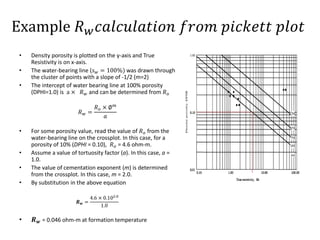
• Density porosity is plotted on the y-axis and True
Resistivity is on x-axis.
• The water-bearing line (𝑠 𝑤 = 100%) was drawn through
the cluster of points with a slope of -1/2 (m=2)
• The intercept of water bearing line at 100% porosity
(DPHI=1.0) is a × 𝑅 𝑤 and can be determined from 𝑅 𝑜
𝑅 𝑤 =
𝑅 𝑜 × ∅ 𝑚
𝑎
• For some porosity value, read the value of 𝑅 𝑜 from the
water-bearing line on the crossplot. In this case, for a
porosity of 10% (DPHI = 0.10), 𝑅 𝑜 = 4.6 ohm-m.
• Assume a value of tortuosity factor (a). In this case, a =
1.0.
• The value of cementation exponent (m) is determined
from the crossplot. In this case, m = 2.0.
• By substitution in the above equation
𝑹 𝒘 =
4.6 × 0.102.0
1.0
• 𝑹 𝒘 = 0.046 ohm-m at formation temperature
Construction of Pickett Plot
• Picket plot can be constructed if we have a value of Rw & m.
• The procedure for making a Pickett plot consists of five steps, detailed below.
1. Plot points of matching porosity and true resistivity (Rt ) on log-log paper.
2. Plot Rw point on the Rt scale.
3. Determine m using the table of values.
4. Plot the 100% Sw line.
5. Plot the lines representing lower values of Sw .
• These points are explained one by one for better understanding.
Construction of Pickett Plot
Step 01:Plot points
• Plot points of matching porosity and true
resistivity (Rt) values.
• Use the x-axis for the resistivity (Rt) scale and
the y-axis for the porosity (Φ) scale.
Construction of Pickett Plot
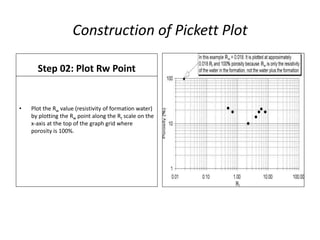
Step 02: Plot Rw Point
• Plot the Rw value (resistivity of formation water)
by plotting the Rw point along the Rt scale on the
x-axis at the top of the graph grid where
porosity is 100%.
Construction of Pickett Plot
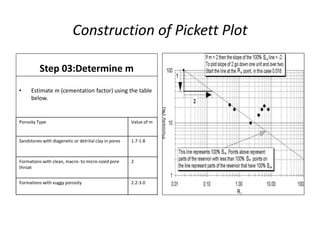
Step 03:Determine m
• Estimate m (cementation factor) using the table
below.
Porosity Type Value of m
Sandstones with diagenetic or detrital clay in pores 1.7-1.8
Formations with clean, macro- to micro-sized pore
throat
2
Formations with vuggy porosity 2.2-3.0
Construction of Pickett Plot
Step 04:Plot the 100% Sw line
• On a pickett plot,the value of m determines the
slope of the S
• The first Sw line plotted on a Pickett plot is the
100% Sw line.
• To plot this line, draw a line with a negative
slope equal to m that begins at the Rw point.
• Use a linear scale to measure the slope; for
example, go down 1 in. and over 2 in.
Construction of Pickett Plot
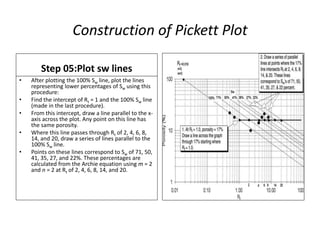
Step 05:Plot sw lines
• After plotting the 100% Sw line, plot the lines
representing lower percentages of Sw using this
procedure:
• Find the intercept of Rt = 1 and the 100% Sw line
(made in the last procedure).
• From this intercept, draw a line parallel to the x-
axis across the plot. Any point on this line has
the same porosity.
• Where this line passes through Rt of 2, 4, 6, 8,
14, and 20, draw a series of lines parallel to the
100% Sw line.
• Points on these lines correspond to Sw of 71, 50,
41, 35, 27, and 22%. These percentages are
calculated from the Archie equation using m = 2
and n = 2 at Rt of 2, 4, 6, 8, 14, and 20.
Advantages of Pickett Plot
• Water saturation can be predicted without prior knowledge of Rw, a, or m.
• Rw is directly predicted (if tortuosity factor (a) is known or estimated) from the intercept of the water
bearingline at a porosity of 1 (porosity = 100%)
• The advantage of Picket Plot is that similar water saturation values will plot a straight line even if the
porosity and resistivity values vary.
• This allows one to easily separate the formation into zones based on their calculated water saturation or in
gas saturation
• Picket Plot is better because it is good for low porosity formation where small variation of m cause large
variations in Sw.
Limitations of Pickett Plot
• One of the weaknesses of the Pickett plot is its inability to handle shaly formation
• Values for pma and ∆tma must be assumed (although in cases with a wide range of porosities in the water
bearing zone.
• A wide range of porosity must be present to positively determine a water-bearing line.
• Formation lithology and water resistivity must be constant over the intervals compared in the plot.
Distinguish between Pay zone & Water Leg
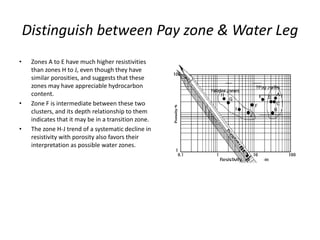
• The Pickett plot can be illustrated with the
hypothetical data set of resistivity and porosity
values logged, with “Archie rock” properties and
a simple reservoir profile
• The example consists of a pay section at
irreducible water saturation (zones A-E), a
transition zone (Zone F), above a water leg (zones
G-J).
Distinguish between Pay zone & Water Leg
• Zones A to E have much higher resistivities
than zones H to J, even though they have
similar porosities, and suggests that these
zones may have appreciable hydrocarbon
content.
• Zone F is intermediate between these two
clusters, and its depth relationship to them
indicates that it may be in a transition zone.
• The zone H-J trend of a systematic decline in
resistivity with porosity also favors their
interpretation as possible water zones.
References
• Basic Well Log Analysis (2nd Edition) By George Asquith & Daniel Krygowski
• http://wiki.aapg.org/Pickett_plot_construction
• http://www.glossary.oilfield.slb.com/Terms/p/pickett_plot.aspx
• http://www.kgs.ku.edu/software/PfEFFER-java/HELP/PfEFFER/Pfeffer-theory3.html

Presantation picket plot

  • 1.
  • 2.
    Pickett plot • ThePickett plot is a visual representation of the Archie equation • The Pickett method is on the observation that true resistivity (Rt) is a function of porosity, Water saturation(Sw) and cementation exponent (m). • The plot is named after G.R. Pickett. • The plot is based on taking the logarithm of the Archie equation. 𝑅𝑡 = 𝑎 × 𝑅 𝑤 ∅ 𝑚 × 𝑆 𝑤 𝑛 • Taking the logarithm of the equation produces: log 𝑅𝑡 = log(𝑎 × 𝑅 𝑤)-mlog(∅) − 𝑛𝑙𝑜𝑔(𝑆 𝑤) • If the zone is water bearing 𝑆 𝑤= 1, log 𝑆 𝑤 = 0 𝑎𝑛𝑑 𝑒𝑞𝑢𝑎𝑡𝑖𝑜𝑛 𝑟𝑒𝑑𝑢𝑐𝑒𝑠 𝑡𝑜 Log(𝑅𝑡) = log 𝑎 × 𝑅 𝑤 − 𝑚𝑙𝑜𝑔(∅) • In practice (𝑅𝑡) is usually plotted on the x-axis and the porosity on the y-axis. • This technique estimates water saturation and can also help determine • Formation water Resistivity (𝑅 𝑤) • Matrix parameter for sonic and density logs (∆𝑡 𝑚𝑎 & 𝜌 𝑚𝑎)
  • 3.
    𝑅 𝑤 𝑐𝑎𝑙𝑐𝑢𝑙𝑎𝑡𝑖𝑜𝑛𝑓𝑟𝑜𝑚 𝑝𝑖𝑐𝑘𝑒𝑡𝑡 𝑝𝑙𝑜𝑡 • Formation Water Resistivity (𝑅 𝑤) can be determined from the following equation : 𝑹 𝒘 = 𝑹 𝒐 × ∅ 𝒎 𝒂 • The following equation is derived by using Archie’s Equation as below: 𝑆 𝑤 𝑛 = 𝑎 × 𝑅 𝑤 𝑅𝑡 × ∅ 𝑚 • Rearranging the above equation 𝑎 𝑅𝑡 = 𝑆 𝑤 𝑛 𝑅 𝑤 × ∅ 𝑚 • When 𝑆 𝑤 = 1 𝑠𝑜 𝑅𝑡 = 𝑅 𝑜 and thus the equation would become 𝑎 𝑅 𝑜 = 1 𝑅 𝑤 × ∅ 𝑚 • After Rearranging 𝑅 𝑤 = 𝑅 𝑜 × ∅ 𝑚 𝑎
  • 4.
    Example 𝑅 𝑤𝑐𝑎𝑙𝑐𝑢𝑙𝑎𝑡𝑖𝑜𝑛 𝑓𝑟𝑜𝑚 𝑝𝑖𝑐𝑘𝑒𝑡𝑡 𝑝𝑙𝑜𝑡 • Density porosity is plotted on the y-axis and True Resistivity is on x-axis. • The water-bearing line (𝑠 𝑤 = 100%) was drawn through the cluster of points with a slope of -1/2 (m=2) • The intercept of water bearing line at 100% porosity (DPHI=1.0) is a × 𝑅 𝑤 and can be determined from 𝑅 𝑜 𝑅 𝑤 = 𝑅 𝑜 × ∅ 𝑚 𝑎 • For some porosity value, read the value of 𝑅 𝑜 from the water-bearing line on the crossplot. In this case, for a porosity of 10% (DPHI = 0.10), 𝑅 𝑜 = 4.6 ohm-m. • Assume a value of tortuosity factor (a). In this case, a = 1.0. • The value of cementation exponent (m) is determined from the crossplot. In this case, m = 2.0. • By substitution in the above equation 𝑹 𝒘 = 4.6 × 0.102.0 1.0 • 𝑹 𝒘 = 0.046 ohm-m at formation temperature
  • 5.
    Construction of PickettPlot • Picket plot can be constructed if we have a value of Rw & m. • The procedure for making a Pickett plot consists of five steps, detailed below. 1. Plot points of matching porosity and true resistivity (Rt ) on log-log paper. 2. Plot Rw point on the Rt scale. 3. Determine m using the table of values. 4. Plot the 100% Sw line. 5. Plot the lines representing lower values of Sw . • These points are explained one by one for better understanding.
  • 6.
    Construction of PickettPlot Step 01:Plot points • Plot points of matching porosity and true resistivity (Rt) values. • Use the x-axis for the resistivity (Rt) scale and the y-axis for the porosity (Φ) scale.
  • 7.
    Construction of PickettPlot Step 02: Plot Rw Point • Plot the Rw value (resistivity of formation water) by plotting the Rw point along the Rt scale on the x-axis at the top of the graph grid where porosity is 100%.
  • 8.
    Construction of PickettPlot Step 03:Determine m • Estimate m (cementation factor) using the table below. Porosity Type Value of m Sandstones with diagenetic or detrital clay in pores 1.7-1.8 Formations with clean, macro- to micro-sized pore throat 2 Formations with vuggy porosity 2.2-3.0
  • 9.
    Construction of PickettPlot Step 04:Plot the 100% Sw line • On a pickett plot,the value of m determines the slope of the S • The first Sw line plotted on a Pickett plot is the 100% Sw line. • To plot this line, draw a line with a negative slope equal to m that begins at the Rw point. • Use a linear scale to measure the slope; for example, go down 1 in. and over 2 in.
  • 10.
    Construction of PickettPlot Step 05:Plot sw lines • After plotting the 100% Sw line, plot the lines representing lower percentages of Sw using this procedure: • Find the intercept of Rt = 1 and the 100% Sw line (made in the last procedure). • From this intercept, draw a line parallel to the x- axis across the plot. Any point on this line has the same porosity. • Where this line passes through Rt of 2, 4, 6, 8, 14, and 20, draw a series of lines parallel to the 100% Sw line. • Points on these lines correspond to Sw of 71, 50, 41, 35, 27, and 22%. These percentages are calculated from the Archie equation using m = 2 and n = 2 at Rt of 2, 4, 6, 8, 14, and 20.
  • 11.
    Advantages of PickettPlot • Water saturation can be predicted without prior knowledge of Rw, a, or m. • Rw is directly predicted (if tortuosity factor (a) is known or estimated) from the intercept of the water bearingline at a porosity of 1 (porosity = 100%) • The advantage of Picket Plot is that similar water saturation values will plot a straight line even if the porosity and resistivity values vary. • This allows one to easily separate the formation into zones based on their calculated water saturation or in gas saturation • Picket Plot is better because it is good for low porosity formation where small variation of m cause large variations in Sw.
  • 12.
    Limitations of PickettPlot • One of the weaknesses of the Pickett plot is its inability to handle shaly formation • Values for pma and ∆tma must be assumed (although in cases with a wide range of porosities in the water bearing zone. • A wide range of porosity must be present to positively determine a water-bearing line. • Formation lithology and water resistivity must be constant over the intervals compared in the plot.
  • 13.
    Distinguish between Payzone & Water Leg • The Pickett plot can be illustrated with the hypothetical data set of resistivity and porosity values logged, with “Archie rock” properties and a simple reservoir profile • The example consists of a pay section at irreducible water saturation (zones A-E), a transition zone (Zone F), above a water leg (zones G-J).
  • 14.
    Distinguish between Payzone & Water Leg • Zones A to E have much higher resistivities than zones H to J, even though they have similar porosities, and suggests that these zones may have appreciable hydrocarbon content. • Zone F is intermediate between these two clusters, and its depth relationship to them indicates that it may be in a transition zone. • The zone H-J trend of a systematic decline in resistivity with porosity also favors their interpretation as possible water zones.
  • 15.
    References • Basic WellLog Analysis (2nd Edition) By George Asquith & Daniel Krygowski • http://wiki.aapg.org/Pickett_plot_construction • http://www.glossary.oilfield.slb.com/Terms/p/pickett_plot.aspx • http://www.kgs.ku.edu/software/PfEFFER-java/HELP/PfEFFER/Pfeffer-theory3.html

Editor's Notes

  • #8 Determine Rw by: SP, water catalog, clean formation with Rt=Ro, F=Ro/Rw
  • #13 Aguilera (1990) demonstrated that laminas, dispersed and total shale can be analyzed by using log-log cross plots of porosity versus true resistivity as affected by a shale group (Ash).