Decision Making & Basic Programs
Md. Alamgir Hossain
Lecturer,
Dept. of CSE, Prime University
Mail: alamgir.cse14.just@gmail.com
Decision Making
There come situations in real life when we need to make some decisions and
based on these decisions, we decide what should we do next.
Similar situations arise in programming also where we need to make some
decisions and based on these decisions we will execute the next block of code.
Decision Making
Decision making statements in programming languages decide the direction of
flow of program execution. Decision making statements available in C or C++ are:
1. if statement
2. if..else statements
3. nested if statements
4. if-else-if ladder
5. switch statements
6. Jump Statements:
I. break
II. continue
III. goto
IV. return
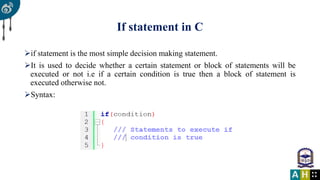
If statement in C
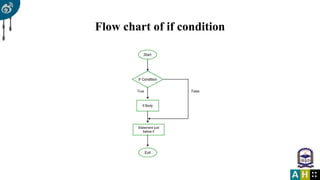
if statement is the most simple decision making statement.
It is used to decide whether a certain statement or block of statements will be
executed or not i.e if a certain condition is true then a block of statement is
executed otherwise not.
Syntax:
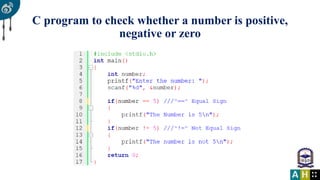
Logic for checking whether a number is 5 or not
Input a number from user in some variable say number.
1. Check if(number == 5), then number is 5.
2. Check if(number != 5), then number is not 5.
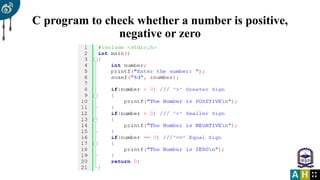
C program to check whether a number is positive,
negative or zero
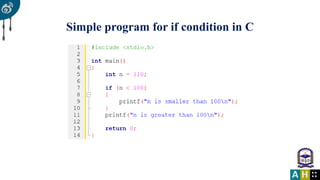
Simple program for if condition in C
Flow chart of if condition
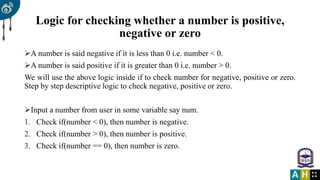
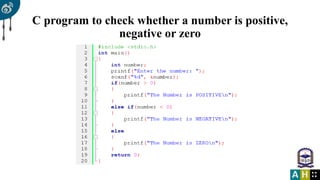
Logic for checking whether a number is positive,
negative or zero
A number is said negative if it is less than 0 i.e. number < 0.
A number is said positive if it is greater than 0 i.e. number > 0.
We will use the above logic inside if to check number for negative, positive or zero.
Step by step descriptive logic to check negative, positive or zero.
Input a number from user in some variable say num.
1. Check if(number < 0), then number is negative.
2. Check if(number > 0), then number is positive.
3. Check if(number == 0), then number is zero.
C program to check whether a number is positive,
negative or zero
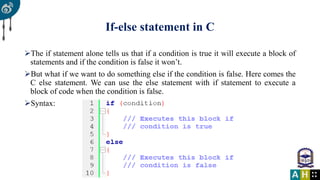
If-else statement in C
The if statement alone tells us that if a condition is true it will execute a block of
statements and if the condition is false it won’t.
But what if we want to do something else if the condition is false. Here comes the
C else statement. We can use the else statement with if statement to execute a
block of code when the condition is false.
Syntax:
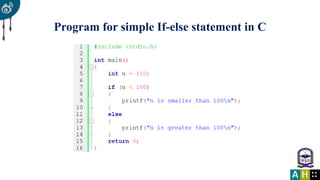
Program for simple If-else statement in C
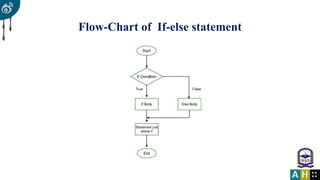
Flow-Chart of If-else statement
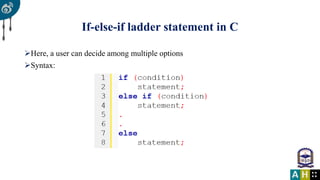
If-else-if ladder statement in C
Here, a user can decide among multiple options
Syntax:
Program for simple If-else-if statement in C
C program to check whether a number is positive,
negative or zero
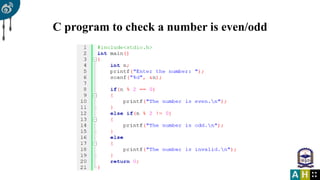
C program to check a number is even/odd
Homework
1. Write a C program to check whether a number is divisible by 7 and 12 or not.
2. Write a C program to find the maximum between two numbers.
Thank You

4. decision making and some basic problem

  • 1.
    Decision Making &Basic Programs Md. Alamgir Hossain Lecturer, Dept. of CSE, Prime University Mail: alamgir.cse14.just@gmail.com
  • 2.
    Decision Making There comesituations in real life when we need to make some decisions and based on these decisions, we decide what should we do next. Similar situations arise in programming also where we need to make some decisions and based on these decisions we will execute the next block of code.
  • 3.
    Decision Making Decision makingstatements in programming languages decide the direction of flow of program execution. Decision making statements available in C or C++ are: 1. if statement 2. if..else statements 3. nested if statements 4. if-else-if ladder 5. switch statements 6. Jump Statements: I. break II. continue III. goto IV. return
  • 4.
    If statement inC if statement is the most simple decision making statement. It is used to decide whether a certain statement or block of statements will be executed or not i.e if a certain condition is true then a block of statement is executed otherwise not. Syntax:
  • 5.
    Logic for checkingwhether a number is 5 or not Input a number from user in some variable say number. 1. Check if(number == 5), then number is 5. 2. Check if(number != 5), then number is not 5.
  • 6.
    C program tocheck whether a number is positive, negative or zero
  • 7.
    Simple program forif condition in C
  • 8.
    Flow chart ofif condition
  • 9.
    Logic for checkingwhether a number is positive, negative or zero A number is said negative if it is less than 0 i.e. number < 0. A number is said positive if it is greater than 0 i.e. number > 0. We will use the above logic inside if to check number for negative, positive or zero. Step by step descriptive logic to check negative, positive or zero. Input a number from user in some variable say num. 1. Check if(number < 0), then number is negative. 2. Check if(number > 0), then number is positive. 3. Check if(number == 0), then number is zero.
  • 10.
    C program tocheck whether a number is positive, negative or zero
  • 11.
    If-else statement inC The if statement alone tells us that if a condition is true it will execute a block of statements and if the condition is false it won’t. But what if we want to do something else if the condition is false. Here comes the C else statement. We can use the else statement with if statement to execute a block of code when the condition is false. Syntax:
  • 12.
    Program for simpleIf-else statement in C
  • 13.
  • 14.
    If-else-if ladder statementin C Here, a user can decide among multiple options Syntax:
  • 15.
    Program for simpleIf-else-if statement in C
  • 16.
    C program tocheck whether a number is positive, negative or zero
  • 17.
    C program tocheck a number is even/odd
  • 18.
    Homework 1. Write aC program to check whether a number is divisible by 7 and 12 or not. 2. Write a C program to find the maximum between two numbers.
  • 19.