Prof. Neeraj Bhargava
Vishal Dutt
Department of Computer Science, School of
Engineering & System Sciences
MDS University, Ajmer
Introduction
• Decision making is anticipation of conditions
occurring while execution of the program and
specifying actions taken according to the
conditions.
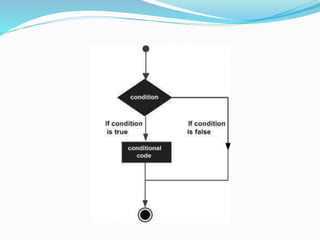
• Decision structures evaluate multiple expressions
which produce TRUE or FALSE as outcome. You
need to determine which action to take and which
statements to execute if outcome is TRUE or FALSE
otherwise.
If Statement
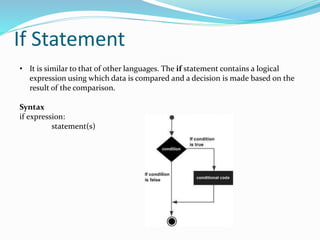
• It is similar to that of other languages. The if statement contains a logical
expression using which data is compared and a decision is made based on the
result of the comparison.
Syntax
if expression:
statement(s)
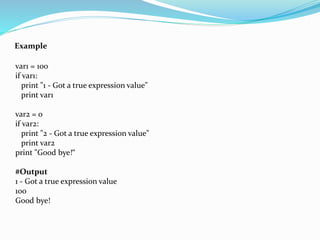
Example
var1 = 100
if var1:
print "1 - Got a true expression value"
print var1
var2 = 0
if var2:
print "2 - Got a true expression value"
print var2
print "Good bye!“
#Output
1 - Got a true expression value
100
Good bye!
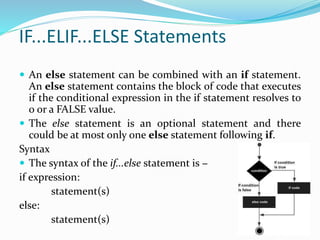
IF...ELIF...ELSE Statements
 An else statement can be combined with an if statement.
An else statement contains the block of code that executes
if the conditional expression in the if statement resolves to
0 or a FALSE value.
 The else statement is an optional statement and there
could be at most only one else statement following if.
Syntax
 The syntax of the if...else statement is −
if expression:
statement(s)
else:
statement(s)
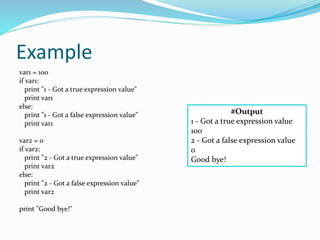
Example
var1 = 100
if var1:
print "1 - Got a true expression value"
print var1
else:
print "1 - Got a false expression value"
print var1
var2 = 0
if var2:
print "2 - Got a true expression value"
print var2
else:
print "2 - Got a false expression value"
print var2
print "Good bye!"
#Output
1 - Got a true expression value
100
2 - Got a false expression value
0
Good bye!
The elif Statement
 The elif statement allows you to check multiple
expressions for TRUE and execute a block of code as
soon as one of the conditions evaluates to TRUE.
 Similar to the else, the elif statement is optional.
However, unlike else, for which there can be at most
one statement, there can be an arbitrary number
of elif statements following an if.
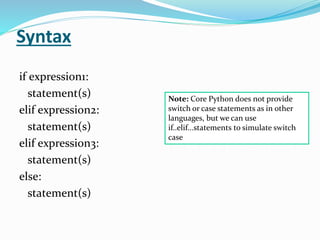
Syntax
if expression1:
statement(s)
elif expression2:
statement(s)
elif expression3:
statement(s)
else:
statement(s)
Note: Core Python does not provide
switch or case statements as in other
languages, but we can use
if..elif...statements to simulate switch
case
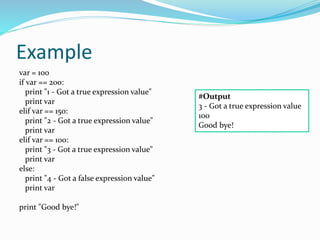
Example
var = 100
if var == 200:
print "1 - Got a true expression value"
print var
elif var == 150:
print "2 - Got a true expression value"
print var
elif var == 100:
print "3 - Got a true expression value"
print var
else:
print "4 - Got a false expression value"
print var
print "Good bye!"
#Output
3 - Got a true expression value
100
Good bye!

Python decision making part4

  • 1.
    Prof. Neeraj Bhargava VishalDutt Department of Computer Science, School of Engineering & System Sciences MDS University, Ajmer
  • 2.
    Introduction • Decision makingis anticipation of conditions occurring while execution of the program and specifying actions taken according to the conditions. • Decision structures evaluate multiple expressions which produce TRUE or FALSE as outcome. You need to determine which action to take and which statements to execute if outcome is TRUE or FALSE otherwise.
  • 4.
    If Statement • Itis similar to that of other languages. The if statement contains a logical expression using which data is compared and a decision is made based on the result of the comparison. Syntax if expression: statement(s)
  • 5.
    Example var1 = 100 ifvar1: print "1 - Got a true expression value" print var1 var2 = 0 if var2: print "2 - Got a true expression value" print var2 print "Good bye!“ #Output 1 - Got a true expression value 100 Good bye!
  • 6.
    IF...ELIF...ELSE Statements  Anelse statement can be combined with an if statement. An else statement contains the block of code that executes if the conditional expression in the if statement resolves to 0 or a FALSE value.  The else statement is an optional statement and there could be at most only one else statement following if. Syntax  The syntax of the if...else statement is − if expression: statement(s) else: statement(s)
  • 7.
    Example var1 = 100 ifvar1: print "1 - Got a true expression value" print var1 else: print "1 - Got a false expression value" print var1 var2 = 0 if var2: print "2 - Got a true expression value" print var2 else: print "2 - Got a false expression value" print var2 print "Good bye!" #Output 1 - Got a true expression value 100 2 - Got a false expression value 0 Good bye!
  • 8.
    The elif Statement The elif statement allows you to check multiple expressions for TRUE and execute a block of code as soon as one of the conditions evaluates to TRUE.  Similar to the else, the elif statement is optional. However, unlike else, for which there can be at most one statement, there can be an arbitrary number of elif statements following an if.
  • 9.
    Syntax if expression1: statement(s) elif expression2: statement(s) elifexpression3: statement(s) else: statement(s) Note: Core Python does not provide switch or case statements as in other languages, but we can use if..elif...statements to simulate switch case
  • 10.
    Example var = 100 ifvar == 200: print "1 - Got a true expression value" print var elif var == 150: print "2 - Got a true expression value" print var elif var == 100: print "3 - Got a true expression value" print var else: print "4 - Got a false expression value" print var print "Good bye!" #Output 3 - Got a true expression value 100 Good bye!