Intrapersonal and Interpersonal
Communication
Let’s define
• I am ………………
• I am ………………
• I am ………………
• I am ………………
• I am ………………
• I am ………………
Identity
Self Concept
• Direct Definitions
6
Identity
Scripts
Direct
Definitions
Reflected
Appraisals
Attachment
Styles
Self Concept
Self Concept
7
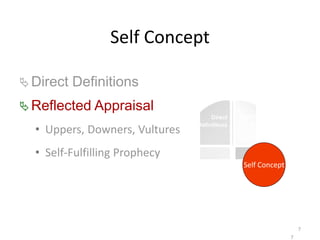
 Direct Definitions
 Reflected Appraisal
• Uppers, Downers, Vultures
• Self-Fulfilling Prophecy
Identity
Scripts
Direct
Definitions
Reflected
Appraisals
Attachment
Styles
7
Identity
Scripts
Direct
Definitions
Reflected
Appraisals
Attachment
Styles
Self Concept
• Self-fulfilling prophecy
– Pygmalion effect
• Empson, L., (2021), The Emperor’s New Clothes:
How Our Fear of Seeming Stupid Became a Self-
Fulfilling Prophecy, Academy of Management
Learning and Education
• Watson, A., Obal, M., & Kannan, R. (2021). Expect
Success, Get Success: How Self-fulfilling Prophecy
Can Impact New Product Development Leaders
who help their product development teams build
and sustain confidence can create expectations of
success that translate into improved success of new
products. Research-Technology Management,
64(4), 29-36.
9
10
Self Concept
• Direct Definitions
• Reflected Appraisal
• Identity Scripts
Identity
Scripts
Direct
Definitions
Reflected
Appraisals
Attachment
Styles
Self Concept
11
Identity
Scripts
Direct
Definitions
Reflected
Appraisals
Attachment
Styles
Self Concept
• Direct Definitions
• Reflected Appraisal
• Uppers, Downers, Vultures
• Self-Fulfilling Prophecy
• Identity Scripts
• Attachment Styles
Self Concept
Self Concept
Attachment Styles
• Secure
• Fearful
• Dismissive
• Anxious/Ambivalent
12
The Generalized Other
Views Held by Society
• Race / Caste
• Gender
• Sexual Orientation
• Socioeconomic Class
• Social Comparison
13
The Self is Multidimensional
Views Held by Self
• Physical Self
• Cognitive Self
• Emotional Self
• Social Self
14
Johari Window
Copyright © Wadsworth 2007 17
Johari Window
http://www.cps.usfca.edu/324sh/johari.htm
Johari Window
Copyright © Wadsworth 2007 18
Johari Window
Copyright © Wadsworth 2007 19
Johari Window
Copyright © Wadsworth 2007 20
Johari Window
Copyright © Wadsworth 2007 21
Copyright © Wadsworth 2007
22
23
Lisa Nicholas 
25
Behavior and Communication
Styles
Aggression – why?
Aggression – impact (on self)
• Short term (pretty pleasant)
Aggression – impact (on self)
• Feeling guilt or shame
• Apologizing profusely or being-
overhelpful
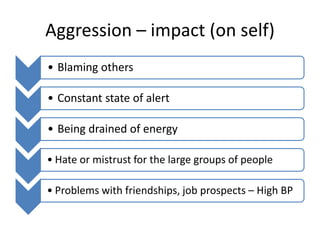
Aggression – impact (on self)
• Blaming others
• Constant state of alert
• Being drained of energy
• Hate or mistrust for the large groups of people
• Problems with friendships, job prospects – High BP
Aggression – impact (on others)
Passivity – why?
Impact of passivity (on self)
• Short-term effect
– Reduction in anxiety because of avoiding a
potential conflict
Impact of passivity (on self)
Loss of self-
esteem
Increase in
anger, hurt
or self-pity
More
internal
tensions
Increased inability
to act assertively /
Psychosomatic
problems
Impact of passivity (on others)
Behavioral bidding
• Silence
– Natural passivity
– Perceived incompetence in the other person
3.pptx

3.pptx

Editor's Notes

  • #4 Individualized identity Familial identity Spiritual identity The sense of self as independent and self-reliant. The sense of self as always connected to family and others.
  • #11 Identity scripts are another way family members communicate who we are and should be. Psychologists define identity scripts as rules for how we are supposed to live and who we are supposed to be (Berne, 1964; Harris, 1969). Like the scripts for plays, identity scripts define our roles, how we are to play them, and basic elements in the plot we are supposed to have for our lives. Usually, identity scripts reflect the values and heritage of our families. Think back to your childhood to identify some of the principal scripts that operated in your family. Did you learn, “We are responsible people,” “Save your money for a rainy day,” “Always help others,” “Look out for yourself,” or “Live by God’s word”? These are examples of identity scripts people learn in families.