By and large, language is a tool for concealing the truth.
- George Carlin
NONVERBAL
COMMUNICATION
What you are speaks so loudly that I can’t hear what you
say.
- R. W. Emerson
Non-verbal Communication
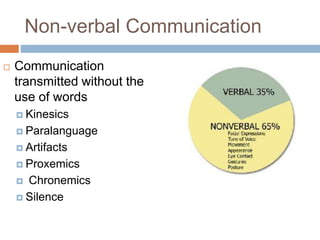
 Communication
transmitted without the
use of words
 Kinesics
 Paralanguage
 Artifacts
 Proxemics
 Chronemics
 Silence
Functions of Non-verbal
Communication
 Substitute
 Repeat
 Complement
 Accentuate
 Contradict
Characteristics of Non-verbal
Communication
 Verbal and non-verbal clues co-exist
 Carry cultural bias
 Should be interpreted in context
 Can be affected
 Non-verbal clues are more reliable than verbal
clues
Relational aspects
Paralanguage
 Tone
 Pitch
 Pace
 Pauses
 Stress
Price, S. M., Seiler, M. J., & Shen, J. (2017). Do
investors infer vocal cues from CEOs during
quarterly REIT conference calls?. The Journal of
Real Estate Finance and Economics, 54(4), 515-
557.
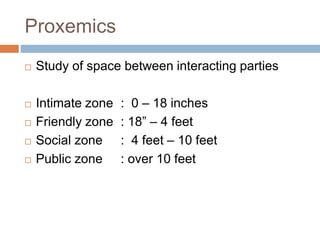
Proxemics
 Study of space between interacting parties
 Intimate zone : 0 – 18 inches
 Friendly zone : 18” – 4 feet
 Social zone : 4 feet – 10 feet
 Public zone : over 10 feet
Artifactual Communication
 Communication through personal appearance
 Dress and accessories
 Social experiment - a child seeking help with different
artifacts
 Physical setting of office
 Fixed
 Semi-fixed
 Non-fixed
Structure and design
 Space, privacy and locational positioning of
Senior vs. Junior Employees
 Design in deciding approachability of Senior
officials
 Dormitories, hotels, hostels, residences can be
planned to encourage / discourage the occupants
to have an opportunities for social exchange and
communication.
 Bars, schools, jails etc. are being re-examined in
the light of these nputs.
 Designs at a nursing station
 Through the door
 Over a glass barricade
 Open access
 The more inaccessible setting decreased
interaction frequency and increased task-
oriented messages; the more accessible
setting increased interaction frequency and
increased the amount of small talk.
Chronemics
 Study of time and how people handle it
 Indian / German
 Time factors while dialing somebody
 Punctuality / habitual late
Silence
 Many a times considered to be more eloquent
than words
 Has contextual meanings
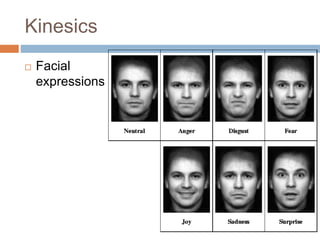
Kinesics
 Facial
expressions
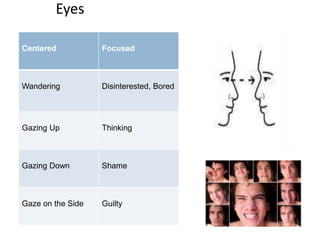
Eyes
Centered Focused
Wandering Disinterested, Bored
Gazing Up Thinking
Gazing Down Shame
Gaze on the Side Guilty
 Postures
 Body movements
 Eye contact
 Haptics
 Gestures
Points to ponder
 Are you able to gaze a few items in the
settings of your colleagues’ office / house that
give you some extra inputs about that person?
 Analyse the architect of your own apartment
and office – Are you able to catch some unsaid
messages there? Are you able to trace the
reasons behind a few apparently strange
factors?
Thank you.

2.pptx

  • 1.
    By and large,language is a tool for concealing the truth. - George Carlin
  • 2.
  • 3.
    What you arespeaks so loudly that I can’t hear what you say. - R. W. Emerson
  • 4.
    Non-verbal Communication  Communication transmittedwithout the use of words  Kinesics  Paralanguage  Artifacts  Proxemics  Chronemics  Silence
  • 5.
    Functions of Non-verbal Communication Substitute  Repeat  Complement  Accentuate  Contradict
  • 6.
    Characteristics of Non-verbal Communication Verbal and non-verbal clues co-exist  Carry cultural bias  Should be interpreted in context  Can be affected  Non-verbal clues are more reliable than verbal clues
  • 7.
  • 8.
    Paralanguage  Tone  Pitch Pace  Pauses  Stress
  • 9.
    Price, S. M.,Seiler, M. J., & Shen, J. (2017). Do investors infer vocal cues from CEOs during quarterly REIT conference calls?. The Journal of Real Estate Finance and Economics, 54(4), 515- 557.
  • 10.
    Proxemics  Study ofspace between interacting parties  Intimate zone : 0 – 18 inches  Friendly zone : 18” – 4 feet  Social zone : 4 feet – 10 feet  Public zone : over 10 feet
  • 11.
    Artifactual Communication  Communicationthrough personal appearance  Dress and accessories  Social experiment - a child seeking help with different artifacts  Physical setting of office  Fixed  Semi-fixed  Non-fixed
  • 12.
    Structure and design Space, privacy and locational positioning of Senior vs. Junior Employees  Design in deciding approachability of Senior officials  Dormitories, hotels, hostels, residences can be planned to encourage / discourage the occupants to have an opportunities for social exchange and communication.  Bars, schools, jails etc. are being re-examined in the light of these nputs.
  • 13.
     Designs ata nursing station  Through the door  Over a glass barricade  Open access  The more inaccessible setting decreased interaction frequency and increased task- oriented messages; the more accessible setting increased interaction frequency and increased the amount of small talk.
  • 14.
    Chronemics  Study oftime and how people handle it  Indian / German  Time factors while dialing somebody  Punctuality / habitual late
  • 15.
    Silence  Many atimes considered to be more eloquent than words  Has contextual meanings
  • 16.
  • 17.
    Eyes Centered Focused Wandering Disinterested,Bored Gazing Up Thinking Gazing Down Shame Gaze on the Side Guilty
  • 18.
     Postures  Bodymovements  Eye contact  Haptics  Gestures
  • 21.
    Points to ponder Are you able to gaze a few items in the settings of your colleagues’ office / house that give you some extra inputs about that person?  Analyse the architect of your own apartment and office – Are you able to catch some unsaid messages there? Are you able to trace the reasons behind a few apparently strange factors?
  • 22.

Editor's Notes

  • #6 1 I don’t know vs. shrugged shoulder 2. Right and pointing towards right direction 2. I don’t want to see you again + frown and threathening glare 4. I love you 5. Yeah – m fine (but trembeling but just on the verge of tears.