Learning Outcomes
1. Ableto identify the different sources of selecting an appropriate
research topic/problem area.
2. Able to describe/explain the guidelines to choosing a research
topic.
3. Able to discuss/explain what is a research problem and its sources.
4. Able to explain the factors to consider in selecting a research
problem.
5. Able to discuss/explain ways/approaches to write problem
statement
3.
Choosing an AppropriateArea of
Study/Topic of Study (Problem Area)
■ Choosing an appropriate research topic is important but it
can be a challenging process.
■ It is helpful to start with a broad topic and narrow it down
to a theoretically and empirically interesting research
question.
■ Developing a research topic can take several months,
therefore being passionate about a research topic can
help to ease the process.
4.
Selecting A Topic:Sources
■ How do you select a topic for a research study?
■ The first place to look is your daily life – your work, family,
friends, community, country.
– What are you curious (interested) about?
– What is or has happened at work that puzzles you?
– Why are things the way they are?
5.
Selecting A Topic:Sources
■ What happens when something changes at work, in your
family, in your neighborhood. Look around.
■ What is interesting to you that you do not quite
understand?
■ What puzzles (perplex/baffle/confuse) you?
■ What are you curious about?
6.
Selecting A Topic:Sources
■ In the fields of practice such as defence, security,
strategic studies, management, social work, health
professions, and so on, the vast majority of research
topics come from one’s personal interest in the field and
from the work setting itself.
■ Thus out of personal practical experience can come
research questions.
7.
Selecting A Topic:Sources
■ A research topic can also come from other sources.
– Current social and political issues offer numerous
possibilities.
– A topic might come from the literature, especially
previous research or theory in an area.
– Completed research studies are a good source
because nearly every research study has a section
with suggestions for future research.
8.
Selecting A Topic:Sources
■ Theory might also suggest topics.
– A research topic/problem can be derived from a theory
by questioning whether a particular theory can be
sustained (endured) or valid in practice.
■ So research topics most often come from observing and
asking questions about your everyday activities.
■ They can also come from social an political issues, from
the literature on a topic, or from theory.
■ These areas of course intersect (cross), as for example
there are always social and political issues embedded in
one’s work setting
9.
Selecting A Topic:The Crucial Factor
■ A crucial factor in deciding what topic you would like to
research is to be genuinely curious and interested in
finding the answers to your questions.
■ This interest, even passion (desire), will carry you
through the process more than any other single factor.
10.
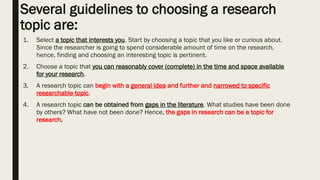
Several guidelines tochoosing a research
topic are:
1. Select a topic that interests you. Start by choosing a topic that you like or curious about.
Since the researcher is going to spend considerable amount of time on the research,
hence, finding and choosing an interesting topic is pertinent.
2. Choose a topic that you can reasonably cover (complete) in the time and space available
for your research.
3. A research topic can begin with a general idea and further and narrowed to specific
researchable topic.
4. A research topic can be obtained from gaps in the literature. What studies have been done
by others? What have not been done? Hence, the gaps in research can be a topic for
research.
11.
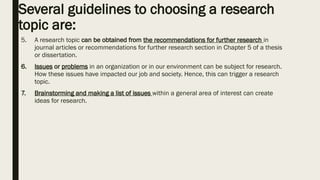
Several guidelines tochoosing a research
topic are:
5. A research topic can be obtained from the recommendations for further research in
journal articles or recommendations for further research section in Chapter 5 of a thesis
or dissertation.
6. Issues or problems in an organization or in our environment can be subject for research.
How these issues have impacted our job and society. Hence, this can trigger a research
topic.
7. Brainstorming and making a list of issues within a general area of interest can create
ideas for research.
12.
Once you havea topic, the next
step is to shape it into a
research problem.
13.
The Research Problem
AsMerriam (2009) points out:
It would be a fruitless undertaking to embark on
a research journey without first identifying a
research problem. (p. 58)
14.
The Research Problem
■Most people understand what it means to have a
“problem.”
■ A problem in the conventional sense is a matter
involving doubt, uncertainty, or difficulty.
■ A person with a problem usually seeks/finds a
solution, some clarification, or a decision.
■ So, too, with a research problem.
■ For Dewey (1933), a problem is anything that
“perplexes (membingungkan) and challenges
(mencabar) the mind (fikiran) so that it makes belief
…… uncertain” (p.13).
15.
What is aResearch problem?
■There are many different ways to define a
research problem.
16.
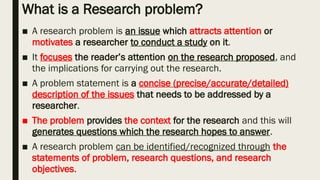
What is aResearch problem?
■ A research problem is an issue which attracts attention or
motivates a researcher to conduct a study on it.
■ It focuses the reader’s attention on the research proposed, and
the implications for carrying out the research.
■ A problem statement is a concise (precise/accurate/detailed)
description of the issues that needs to be addressed by a
researcher.
■ The problem provides the context for the research and this will
generates questions which the research hopes to answer.
■ A research problem can be identified/recognized through the
statements of problem, research questions, and research
objectives.
17.
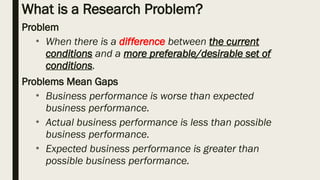
What is aResearch Problem?
Problem
• When there is a difference between the current
conditions and a more preferable/desirable set of
conditions.
Problems Mean Gaps
• Business performance is worse than expected
business performance.
• Actual business performance is less than possible
business performance.
• Expected business performance is greater than
possible business performance.
18.
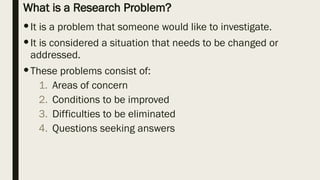
What is aResearch Problem?
It is a problem that someone would like to investigate.
It is considered a situation that needs to be changed or
addressed.
These problems consist of:
1. Areas of concern
2. Conditions to be improved
3. Difficulties to be eliminated
4. Questions seeking answers
19.
The sources ofresearch problems
1. Interest and experience of researcher: The researcher intends to further his/her
knowledge in the aspect that interests him/her.
2. Existing theory: When doubts arise over existing theory and the researcher wants to test
the theory.
3. Replication of previous research: To conduct the same research on different subjects in
different locations (based on the prediction that there may be different results if the
same research is carried out).
4. Contradictory results of past research: Contradictory (inconsistent/varying) results from
several studies on a specific topic.
20.
Factors to considerin Selecting a Research
Problem
1. The topic should be important
(significant)
Writing a thesis or dissertation is an
exercise to learn how to conduct research.
21.
More Factors toConsider…
2. Consider the feasibility of the project.
■ How much time do you have available
– Do you really want to do a longitudinal study
that will take 5 years to complete for a Ph. D
degree?
■ How difficult is it. Are data available?
■ How much will it cost?
Factors to Considerin Selecting a
Research Problem
4. You should have a personal interest in the topic.
■ By the time you are done, you may really be tired
of the topic
24.
More Factors toConsider…
5. The “newness” of the topic may hold you interest longer,
however there is some value in repeating previous
research.
25.
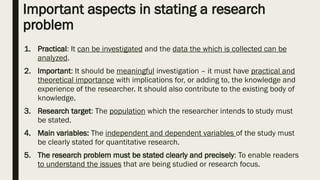
Important aspects instating a research
problem
1. Practical: It can be investigated and the data the which is collected can be
analyzed.
2. Important: It should be meaningful investigation – it must have practical and
theoretical importance with implications for, or adding to, the knowledge and
experience of the researcher. It should also contribute to the existing body of
knowledge.
3. Research target: The population which the researcher intends to study must
be stated.
4. Main variables: The independent and dependent variables of the study must
be clearly stated for quantitative research.
5. The research problem must be stated clearly and precisely: To enable readers
to understand the issues that are being studied or research focus.
26.
What makes agood problem statement?
■ Three key criteria to assess the quality of a good
problem statement: It should be –
1. Relevant
2. Feasible, and
3. Interesting
27.
1. Relevant
■ Aproblem statement is relevant if it is meaningful from
managerial perspective, an academic perspective, or
both.
28.
From a managerialperspective:
■ Research is relevant if it relates to:
1. A problem that currently exists in an organizational
setting or
2. And that manager believes needs to be improved in
the organization
29.
From an academicperspective
■ Research is relevant if:
1. Nothing is known about a topic,
2. Much is known about the topic, but the knowledge is
scattered and not integrated,
3. Must research on the topic is available, but the
results are (partly) contradictory, or
4. Established relationships do not hold in certain
situation.
■ You have to prove that the about claim is right
30.
2. Feasible
■ Aproblem is feasible if you are able to answer the
problem statement within the restrictions of the research
project.
■ These restrictions are possibly related to time and money,
but also the availability of the respondents, the expertise
of the researcher, etc.
31.
3. Interesting
■ A3rd
characteristics of a good problem statement is that
it is interesting to you.
■ It is vital that you are genuinely interested in the problem
statement you are trying to answer, so that you can stay
motivated throughout the entire research process.
32.
Ways/Approaches to writeproblem statement
Many different ways of stating/writing/formulating problem
statement.
1. The Gap Approach,
2. The Four-Step Method [Chua Yan Piaw, (2012):
Mastering Research methods, McGraw Hill], and
3. The Three-Statement Approach
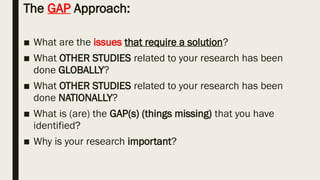
The GAP Approach:
■What are the issues that require a solution?
■ What OTHER STUDIES related to your research has been
done GLOBALLY?
■ What OTHER STUDIES related to your research has been
done NATIONALLY?
■ What is (are) the GAP(s) (things missing) that you have
identified?
■ Why is your research important?
35.
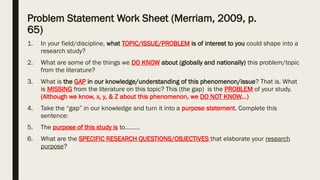
Problem Statement WorkSheet (Merriam, 2009, p.
65)
1. In your field/discipline, what TOPIC/ISSUE/PROBLEM is of interest to you could shape into a
research study?
2. What are some of the things we DO KNOW about (globally and nationally) this problem/topic
from the literature?
3. What is the GAP in our knowledge/understanding of this phenomenon/issue? That is. What
is MISSING from the literature on this topic? This (the gap) is the PROBLEM of your study.
(Although we know, x, y, & Z about this phenomenon, we DO NOT KNOW…)
4. Take the “gap” in our knowledge and turn it into a purpose statement. Complete this
sentence:
5. The purpose of this study is to………
6. What are the SPECIFIC RESEARCH QUESTIONS/OBJECTIVES that elaborate your research
purpose?
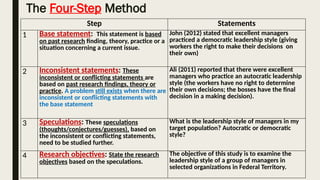
The Four-Step Method
StepStatements
1 Base statement: This statement is based
on past research finding, theory, practice or a
situation concerning a current issue.
John (2012) stated that excellent managers
practiced a democratic leadership style (giving
workers the right to make their decisions on
their own)
2 Inconsistent statements: These
inconsistent or conflicting statements are
based on past research findings, theory or
practice. A problem still exists when there are
inconsistent or conflicting statements with
the base statement
Ali (2011) reported that there were excellent
managers who practice an autocratic leadership
style (the workers have no right to determine
their own decisions; the bosses have the final
decision in a making decision).
3 Speculations: These speculations
(thoughts/conjectures/guesses), based on
the inconsistent or conflicting statements,
need to be studied further.
What is the leadership style of managers in my
target population? Autocratic or democratic
style?
4 Research objectives: State the research
objectives based on the speculations.
The objective of this study is to examine the
leadership style of a group of managers in
selected organizations in Federal Territory.
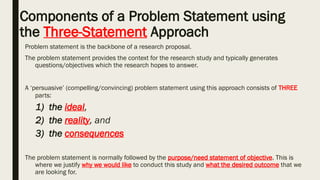
Components of aProblem Statement using
the Three-Statement Approach
Problem statement is the backbone of a research proposal.
The problem statement provides the context for the research study and typically generates
questions/objectives which the research hopes to answer.
A ‘persuasive’ (compelling/convincing) problem statement using this approach consists of THREE
parts:
1) the ideal,
2) the reality, and
3) the consequences
The problem statement is normally followed by the purpose/need statement of objective. This is
where we justify why we would like to conduct this study and what the desired outcome that we
are looking for.
40.
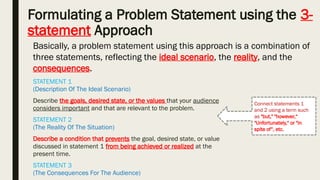
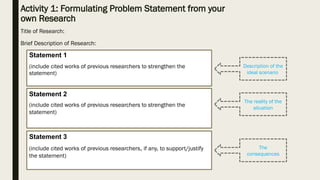
Formulating a ProblemStatement using the 3-
statement Approach
STATEMENT 1
(Description Of The Ideal Scenario)
Describe the goals, desired state, or the values that your audience
considers important and that are relevant to the problem.
STATEMENT 2
(The Reality Of The Situation)
Describe a condition that prevents the goal, desired state, or value
discussed in statement 1 from being achieved or realized at the
present time.
STATEMENT 3
(The Consequences For The Audience)
Connect statements 1
and 2 using a term such
as "but," "however,“
"Unfortunately," or "in
spite of“, etc.
Basically, a problem statement using this approach is a combination of
three statements, reflecting the ideal scenario, the reality, and the
consequences.
41.
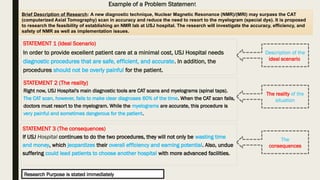
Example of aProblem Statement
STATEMENT 1 (Ideal Scenario)
In order to provide excellent patient care at a minimal cost, USJ Hospital needs
diagnostic procedures that are safe, efficient, and accurate. In addition, the
procedures should not be overly painful for the patient.
STATEMENT 2 (The reality)
Right now, USJ Hospital's main diagnostic tools are CAT scans and myelograms (spinal taps).
The CAT scan, however, fails to make clear diagnoses 60% of the time. When the CAT scan fails,
doctors must resort to the myelogram. While the myelograms are accurate, this procedure is
very painful and sometimes dangerous for the patient.
STATEMENT 3 (The consequences)
If USJ Hospital continues to do the two procedures, they will not only be wasting time
and money, which jeopardizes their overall efficiency and earning potential. Also, undue
suffering could lead patients to choose another hospital with more advanced facilities.
Description of the
ideal scenario
The reality of the
situation
The
consequences
Brief Description of Research: A new diagnostic technique, Nuclear Magnetic Resonance (NMR)/(MRI) may surpass the CAT
(computerized Axial Tomography) scan in accuracy and reduce the need to resort to the myelogram (special dye). It is proposed
to research the feasibility of establishing an NMR lab at USJ hospital. The research will investigate the accuracy, efficiency, and
safety of NMR as well as implementation issues.
Research Purpose is stated immediately
42.
Activity 1: FormulatingProblem Statement from your
own Research
Statement 1
(include cited works of previous researchers to strengthen the
statement)
Statement 2
(include cited works of previous researchers to strengthen the
statement)
Statement 3
(include cited works of previous researchers, if any, to support/justify
the statement)
Description of the
ideal scenario
The reality of the
situation
The
consequences
Title of Research:
Brief Description of Research:



![Ways/Approaches to write problem statement
Many different ways of stating/writing/formulating problem
statement.
1. The Gap Approach,
2. The Four-Step Method [Chua Yan Piaw, (2012):
Mastering Research methods, McGraw Hill], and
3. The Three-Statement Approach](https://image.slidesharecdn.com/unit3problemstatement-250417094931-4e1c71ab/85/problem-statement-with-the-thesis-for-masters-32-320.jpg)