COMMUNICATION
AND
GLOBALIZATION
LEARNING OUTCOMES:
During the learning engagements, the learners are able to:
1. define and identify elements of interpersonal communication,
culture, cultural systems and global communication;
2. explain how cultural and global issues affect communication;
3. present ideas on the impact of communication on society and
the world.
WHAT IS
GLOBALIZATION?
GLOBALIZATION
The process of interaction and
integration among people, companies
and governments worldwide.
Globalization is a term used to
describe how trade and technology
have made the world into a more
connected and interdependent
place. Globalization also captures in
its scope the economic and social
changes that have come about as a
result.
GLOBALIZATION
Interdependent – they are not
totalle independent they are
sharing to each other
The main purpose of globalization
is the international trade or
investment is all about the
business.
We are able to connect with all the
people across the globe.
GLOBALIZATION ON COMMUNICATION
Globalization creates a global
communication system, reflecting the
new reality where everybody is
connected to everybody and everybody
depends on and is responsible for
everybody.
With the use of internet,
technology. We have access to all
over the world that’s the effect of
globalization.
HOW GLOBALIZATION
WORKS?
IT WORKS BY MOVING GOODS AND SERVICES ACROSS
BOARDERS
IT HAS BROUGHT MANY BENEFITS TO MANY PEOPLE, BUT
NOT TO EVERYONE.
WE HAVE PRONS AND CONS OF GLOBALIZATION
PRONS:
1. COUNTRIES WERE LFITED OUT OF POVERTY
2. IT HELPS LOCAL BUSINESSES AND RURAL WORKS
3. IT HELPS TO LEARN NEW CULTURE AND PRODUCTS
CONS:
1. SOME JOBS HAVE FLOUNDERED
2. EVERY NEW TECHNOLOGY BRINGS NEW DANGER
3. NOT EVERYBODY BENEFIT AND GET LIFTED OUT OF
POVERTY
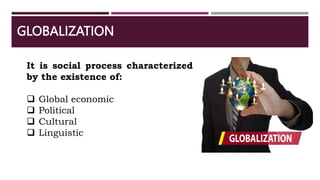
GLOBALIZATION
It is social process characterized
by the existence of:
 Global economic
 Political
 Cultural
 Linguistic
GLOBALIZATION
It is social process characterized by the existence of:
 Global economic – it is the sum of activities that take place both within a country
and between different countries. Each country is a separate unit with its own
industrial production, labor market, financial market, resources and environment
that we called global economic.
 Political – relating to the government or the public affairs of a country
 Cultural – relating to ideas, customs and social behavior of a society
 Linguistic – relating to a language that can we used
PRIMARY CHARACTERISTIC OF GLOBALIZATION
1. Free trade
2. Liberalisation
3. Connectivity
4. Economic Globalization
5. Cultural Globalization
6. Political Globalization
7. Opportunity
8. Learning
9. Product advantage
PRIMARY CHARACTERISTIC OF GLOBALIZATION
1. Free trade – is a pact between two or more nations to reduce barriers to imports and exports
of product and services to different country. Under a free trade policy, goods and services can be
bought and sold across international borders
2. Liberalisation – How does liberalization help globalization? Of course it helps in the growth of
globalization by relaxing the rules and regulations performing trade between countries. It allows
freedom and exposure to the countries and promotes development of trade, technology and
improving foreign investment.
3. Connectivity – it is being connected or interconnected
4. Economic Globalization – it is improves the efficiency of enterprises and plays a great role in
increasing the size of economy of every country.
5. Cultural Globalization – it contributes to the exchange of cultural values of different countries,
the traditions and beliefs.
6. Political Globalization – the development and growing influence of international organizations.
Ex. UN or WHO means government action takes place at international level.
7. Opportunity – a chance for employment or promotion, allows companies to find lower-cost
ways to produce their products.
8. Learning
9. Product advantage
THE EFFECTS OF GLOBALIZATION ON GLOBAL COMMUNICATION
 Increased Business Opportunities
Many companies today hire employees that are
located in other countries. Using communication vehicles
such as video calling make it simple to converse with
colleagues across the globe, almost making it feel as if
they are in the same room. Technology also makes it easier to
connect with suppliers and customers all over the world, and to streamline
relationship through improved ordering, shipment tracking and so on. With
this kind of communication technology, many businesses are able to take
advantage of opportunities in different countries or cities, improving the
economic outlook on a global level.
THE EFFECTS OF GLOBALIZATION ON GLOBAL COMMUNICATION
 Increased Business Opportunities
Working at home his or her clients is from abroad. Thanks to
global communication, information itself can be transferred as a
valuable business asset from one country to another it makes
everyone operation more modern and efficient and easily regardless
of where they are located, wherever you are in the country. The
technology makes easier to connect.
Ex. BPO Companies
Sending emails, meeting thru video call, interview, sell
online that’s how a powerful the technology it is
THE EFFECTS OF GLOBALIZATION ON GLOBAL COMMUNICATION
 Fewer Cultural Barriers
Many people perceive culture to be the root of
communication challenges. When people from two
different cultures try to exchange information, the way
they speak, their body language or their mannerisms can
be interpreted differently by the other person. The way
people approach problems and how they participate in
communities is all influenced by culture.
THE EFFECTS OF GLOBALIZATION ON GLOBAL COMMUNICATION
 Fewer Cultural Barriers
When we say culture different language. Different ways of
life, different ways of living, different believes.
Globalization has made it possible, for example, for someone in
Japan to understand how someone in the U.S. goes about their
day. With television and movies, cultural barriers are becoming
less prevalent. Being able to communicate effectively and
frequently with colleagues or friends across the planet helps
people understand each other‘s cultures a little better. Because
of we aware their culture we understand them instead of
judging them.
CREATION OF GLOBAL VILLAGE
coined by theorist Marshall
McLuhan. Affected both by globalization
and global communication, the global
village is created when distance and
isolation no longer matter because
people are connected by technology.
CREATION OF GLOBAL VILLAGE
It refer to the world emphasize that all the different parts
of the world form one community linked together by electronic
communications, especially the internet. It can be thought of as
a process by which countries come closer together through
increasing contact, communication, and trade, to create a single
global system in which developments in one part of the world
influence individuals and communities elsewhere in the world.
WHAT IS A GLOBAL VILLAGE EXAMPLE?
One easy example of the global village
concept is the internet. Having the internet on
phones and access to free internet at libraries
and cafes, people are easily able to connect via
social media or email to people around the world.
WHAT IS A GLOBAL VILLAGE EXAMPLE?
Wide-spread telephone and internet access have been life-changing for
many people across the world, especially those in developing countries. Like in
Philippines like being away in the family is not a problem anymore because we
can communicate to them with our smartphone, social media and we can be
see them real time. Many are now enrolling in universities across the world
without having to leave their desk chair. Virtual assistant jobs are becoming
commonplace maybe they are familiar to you , where employees from developing
countries work with companies in North America or Europe, providing
administrative support and other business services that can easily be
conducted over the phone or via the internet
CULTURAL BARRIERS
When people of different cultures are unable to
understand each others’ customs, resulting in
inconveniences and difficulties.
WHY IS THE WORLD
BECOMING A GLOBAL
VILLAGE?
WORLD HAS BECOME A GLOBAL VILLAGE DUE TO THE
TRANSPORT AND COMMUNICATION. THE PEOPLE ALL
OVER THE WORLD ARE INTERCONNECTED WITH EACH
OTHER WITH THE HELP OF TRANSPORT AND
COMMUNICATION MEANS.
EYE CONTACT:
North Americans view direct eye contact
as a sign of honesty.
Asians view direct eye contact as a form
of disrespect.
DO YOU KNOW?
GLOBALIZATION
CHARACTERISTIC OF EXISTENCE OF GLOBALIZATION
PRIMARY CHARACTERISTIC OF GLOBALIZATION
EFFECT OF GLOBAL COMMUNICATION
CULTURAL BARRIERS
GLOBAL VILLAGE
LOCAL AND GLOBAL COMMUNICATION IN
MULTICULTURAL SETTING
IT IS THE WAY ON HOW WE COMMUNICATE TO OTHER. BY USING OUR OWN
LANGUAGES AND AN ENGLISH LANGUAGE, WE CAN MAKE A CONVERSATION
LOCALLY OR GLOBALLY. THE MAIN PURPOSE OF THIS IS TO HAVE AN IDEA ON
HOW CAN WE APPLY WHAT WE LEARNED FROM THEM FOR OURSELVES AND FOR
OUR COMMUNITY. IT CAN ALSO BE THE WAY FOR OUR COUNTRY TO HAVE
SUFFICIENT KNOWLEDGE TO MAKE IT MORE OUTSTANDING.
LOCAL AND GLOBAL COMMUNICATION
LEARNING OUTCOMES:
During the learning engagements, the learners are able to:
1. define and identify elements of interpersonal communication,
culture, cultural systems and global communication;
2. explain how cultural and global issues affect communication;
3. present ideas on the impact of communication on society and
the world.
MULTICULTURALISM
Multiculturalism refers to the presence of people with several
cultures in a specific setting. It is the co-existence of diverse
cultures, where culture includes racial, religious, or cultural
groups and is manifested in customary behaviors, cultural
assumptions and values, patterns of thinking, and communicative
styles.
MULTICULTURALISM
The world today is characterized by ever growing compacts resulting in communication between
people with different linguistic and cultural background.
One of the most common forms of global communication is an email. A person in one country types a
message and clicks the send button. The message is then encoded into packets which are sent
across the internet to the recipient. In another country, the receiver logs in and decodes the message
by opening the email, and retrieves the message.
Global communication becomes more complicated when there are multiple recipients from different
cultures with different languages all receiving the same message, as well as when there are more
layers added to the channel. For example, if a world leader makes a speech broadcast across the
globe, people from one region may rejoice at the news, while others may find it offensive. In this case,
the channel itself can involve many different layers, as translators, news, editors and commentators
each interpret the message differently before passing it on to the intended audiences.
LOCAL AND GLOBAL
COMMUNICATION
LOCAL AND GLOBAL COMMUNICATION
It is the way on how we communicate to other. By using our own
languages and an English language, we can make a conversation
locally or globally. The main purpose of this is to have an idea on
how can we apply what we learned from them for ourselves and for
our community. It can also be the way for our country to have
sufficient knowledge to make it more outstanding.
LOCAL COMMUNICATION
Local communication is being able to
communicate with the members of your
local area. It can either be in your local
language (mother tongue), or a common
language that you speak within your town.
GLOBAL COMMUNICATION
The study of global communication is an interdisciplinary
field focusing on global communication, or the ways that people
connect, share, relate and mobilize across geographic, political,
economic, social and cultural divides.
MULTICULTURAL
Multicultural education refers to any form of education or
teaching that incorporates the histories, texts, values, beliefs, and
perspectives of people from different cultural backgrounds.
MULTICULTURAL
What are the difference between local and global?
On one hand, the local is delineated by social integration, i.e. face-to-face
interaction or interaction between individuals physically co-present. On the
other hand, the global is a function of system integration or interaction
between individuals away from each other in time or space or both.
Multicultural relating to or constituting several cultural or ethnic groups
within a society. Consisting of or relating to people of many different
nationalities and cultures.
COMMUNICATING ACROSS CULTURES
Communicating across cultures is challenging. Each culture has
set rules that its members take for granted. Few of us are aware of our
own cultural biases because cultural imprinting is begun at a very
early age. And while some of culture‘s knowledge, rules, beliefs, values,
phobias, and anxieties are taught explicitly, most of the information is
absorbed subconsciously.
The challenge for multinational communication has never been
greater. Worldwide business organizations have discovered that
intercultural communication is a subject importance not just because
of increased globalization, but also because their domestic workforce is
growing more and more diverse.
INTERCULTURAL COMMUNICATION
It is a discipline that studies
communication across different cultures
and social groups, or how culture affects
communication. It describes the wide range of
communication processes and problems that
naturally appear within an organization or
social context made up of individuals from
different religious, social, ethnic, and
educational backgrounds. When we say
intercultural is refers to the communication
between people from two different cultures. In
this sense it seeks to understand how
people from different countries and
cultures act, communicate and perceive
the world around them.
CULTURES AND CO-CULTURES
CULTURES
A culture is the
system of knowledge,
beliefs, values, customs,
behaviors, and artifacts
that are acquired
shared, and used by its
members during daily
living.
CO- CULTURES
Within a culture as a
whole are co-cultures,
these are composed of
members of the same
general culture who differ
in some ethnic or
sociological way from the
parent culture.
CULTURES AND CO-CULTURES
CULTURES
Culture is language,
values, beliefs, traditions,
and customs that are
shared and learned.
Culture is a matter of
perception and definition.
CO- CULTURES
Co-culture - the perception of
membership in a group that is part of an
encompassing culture. Co-cultures are composed
of members of the same general culture who
differ in some ethnic or sociological way from
the parent culture. Some co-cultures we
participate in by choice, while others we are born
into. Some examples of co-cultures
include: Jewish-Americans, Deaf Americans,
African- Americans, senior citizens, gays and
lesbians, even gang membership. High / Low
context, Human nature, Noncontact / contact
culture, etc.
BARRIERS TO LOCAL AND GLOBAL
COMMUNICATION IN
MULTICULTURAL SETTINGS
MULTICULTURAL
Multicultural refers to a society that contains several
cultural or ethnic groups. People live alongside one
another, but each cultural group does not necessarily have
engaging interactions with each other. For example, in a
multicultural neighborhood people may frequent ethnic
grocery stores and restaurants without really interacting
with their neighbors from other countries.
MULTICULTURAL
For example, in a multicultural neighborhood
people may frequent ethnic grocery stores and
restaurants without really interacting with their
neighbors from other countries.
CROSS-CULTURAL (INTERCULTURAL)
Cross-cultural (Intercultural) refers to the
comparison of different cultures. In cross- cultural
communication, differences are understood and
acknowledged, and can bring about individual change, but
not collective transformations. In cross-cultural societies,
one culture is often considered the norm and all other
cultures are compared or contrasted.
CROSS-CULTURAL (INTERCULTURAL)
Cross cultural communication thus refers to the
communication between people who have differences in any one
of the following: styles of working, age, nationality, ethnicity, race,
gender, sexual orientation, etc. Cross cultural communication can
also refer to the attempts that are made to exchange, negotiate
and mediate cultural differences by means of language, gestures
and body language. It is how people belonging to different
cultures communicate with each other.
CROSS-CULTURAL (INTERCULTURAL)
Effective cross-cultural communication is necessary to bridge potential divides in the
workplace, including differences in the following:
Language: Completely different languages, dialects of the same language—even heavy
regional accents
Cultural norms: For example, shaking hands vs. bowing when you meet someone
Geographic location: Different countries, but also different cities (or even neighborhoods!)
Time zone: Especially critical for businesses that rely heavily on remote communication, but
plays a role in any business that operates beyond the local level
Age: Including the particular values and points-of-view of different generations
Education: For example, business leaders with PhDs communicating with interns who are
working toward their bachelor’s degrees
Work culture: The different cultures of individual businesses, which can affect interactions
with various partners and vendors
WHAT IS THE DIFFERENCE
BETWEEN MULTICULTURAL AND
CROSS-CULTURAL OR
INTERCULTURAL?
WHILE THEY ALL MIGHT BE UNDER THE SAME
ROOF, THEY DESCRIBE ENTIRELY DIFFERENT
ROOMS. THE DIFFERENCES IN THE MEANINGS
HAVE TO DO WITH THE PERSPECTIVES WE TAKE
WHEN INTERACTING WITH PEOPLE FROM OTHER
CULTURES.
COPING WITH THE CHALLENGES OF
INTERCULTURAL COMMUNICATION
LEARNING OUTCOMES:
During the learning engagements, the students are able
to:
 Explain how cultural differences affect communication;
 Identify the barriers of Intercultural Communication;
 Formulate ways or approaches to overcome the
challenges of Intercultural Communication.
LEARN ABOUT IT!
Communicating to the people around us is crucial in
our everyday life. We convey and gather information,
thoughts, opinions, as well as ideas through
communication. Communication in other words is the act
of conveying meanings from one entity or group to
another through the use of mutually understood signs,
symbols, and semiotic rules.
Our culture affects the way of our
communication, which means that different
culture is equivalent to different communication
style. And one‘s way of communicating may have
the same or different interpretation to the other.
This may lead to miscommunication between the
participants involved.
Our culture affects the way of our
communication, which means that different
culture is equivalent to different communication
style. And one‘s way of communicating may have
the same or different interpretation to the other.
This may lead to miscommunication between the
participants involved.
What is Intercultural Communication?
Intercultural communication (or cross-cultural
communication) is a discipline that studies communication across
different cultures and social groups, or how culture affects
communication.
It describes the wide range of communication processes and
problems that naturally appear within an organization or social
context made up of individuals from different religious, social,
ethnic, and educational backgrounds. In this sense it seeks to
understand how people from different countries and cultures act,
communicate and perceive the world around them.
What is Intercultural Communication?
It is the communication between people from two different
cultures
FUNCTIONS OF
INTERCULTURAL
COMMUNICATION
Functions of Intercultural Communication:
Private Function - are functions that indicated
communication through the communication behavior
originating from an individual.
1. Express Social Identity - in the process of intercultural
communication are some of the communication behavior of
individuals who used to express the behavior of social identity is
expressed through the act of speaking both verbal and non-verbal
of language behavior that is knowable and social identity.
Functions of Intercultural Communication:
1. Express Social Identity - Social identity groups are usually defined
by some physical, social, and mental characteristics of individuals.
Examples of social identities are race/ethnicity, gender, social
class/socioeconomic status, sexual orientation, (dis)abilities, and
religion/religious beliefs.
Functions of Intercultural Communication:
2. Declares The Social Integration - core concept of
social integration is to accept the unity between
individuals, between groups but still recognizes the
differences of every element. It should be understood
that one of the goals of communication is to give the
same meaning for the message shared between the
communicator and the communicant.
Functions of Intercultural Communication:
2. Declares The Social Integration - Social integration
is the process of creating unity, inclusion and
participation at all levels of society within the diversity
personal attributes so that every person is free to be the
person she wants to be
Functions of Intercultural Communication:
3. To the Knowledge - often interpersonal
and intercultural communication increase
knowledge together, to learn the culture of
each.
Functions of Intercultural Communication:
Social Function - means the relation between social action
and the systems of which the action is a part, alternatively,
as the result of social action.
1. Supervision - practice intercultural communication
between different communicators and communicant culture
of mutual monitoring functions. In any process of
intercultural communication function is useful to inform the
"development" of the environment.
Functions of Intercultural Communication:
1. Supervision – A purpose of supervision is to enhance the
social worker's professional skills, knowledge, and attitudes in
to achieve competency in providing quality care. It aids in
professional growth and development and improves outcomes.
Functions of Intercultural Communication:
2. Connection Between Culture - in the process of
intercultural communication, the communication
function is carried out between two people of
different cultures was a bridge over the differences
between them.
Functions of Intercultural Communication:
2. Connection Between Culture - The bridging
functions can be controlled via messages they
exchanged, the two are explaining the differences of
interpretation on a message that produces the
same meaning. because their culture is different it
becomes a way for everyone to have communication.
Functions of Intercultural Communication:
3. Value Socialization - socialization function is a
function to teach and introduce the cultural values of a
society to another society.
4. Entertainment - entertaining functions are often
performed in the process of intercultural communication.
Functions of Intercultural Communication:
3. Value Socialization - Socialization prepares people to
participate in a social group by teaching them its norms and
expectations.
4. Entertainment - For example, the arrival of outside
artists shows the differences between their cultures so that
people learn the language and follow their style.
THANK YOU FOR
LISTENNING!
BARRIERS TO
INTERCULTURAL
COMMUNICATION
Barriers to Intercultural Communication:
1. Anxiety - when you are anxious because of not knowing what
you are expected to do, it is only natural to focus on that
feeling and not be totally present in the communication
transaction.
For example, you may have experienced anxiety on your
very first day on a new college campus or in a new job. You may
be so conscious of being new— and out of place—and focus so
much of your attention on that feeling that you make common
mistakes and appear awkward to others.
Barriers to Intercultural Communication:
2. Assuming Similarity Instead Of
Dissimilarity - when people are acting in a home
manner in the different culture it might cause a
lot of problems. In order to prepare yourself for
various circumstances it is very important to
assume laws, habits, and attitudes of another
society.
Barriers to Intercultural Communication:
2. Ethnocentrism – ethnocentrism or negatively judging aspects of another
culture by the standards of one‘s own culture. To be ethnocentric is to believe in
the superiority of one‘s own culture. Everything in a culture is consistent to that
culture and makes sense if you understood that culture.
For example, assume that global warming is a fact and, as a result,
assume that summers in the United States average 43° C (109° F). It would be
logical to make adjustments: Rather than air condition buildings all day, you
might close schools and businesses in the afternoons to conserve energy. Such
adjustments would make sense. Why then do some people attribute sensible
midday siestas in hot climates to laziness?
Barriers to Intercultural Communication:
3. Language Problems - according to Jandt (2000) the definition of
language is the set of symbols shared by a community to
communicate meanings and experiences.
There are five actual factors that generally produce the
difficulties in the translation. They are lack of equivalences in
vocabulary, idioms, grammar and syntax, experiences, and concepts.
Indonesian students are having a lot of inconveniences with studying
foreign languages for the reason that in Indonesian language there is
no gender rules. That is very complicated for them to understand why
for example the French word―une table‖ is feminine.
Barriers to Intercultural Communication:
5. Nonverbal Misinterpretations - as another barrier to
communication, it can be stated that in a conversation this is more
problematical to understand the nonverbal symbols without sharing
the same nonverbal codes.
There are more than a few types of nonverbal interaction:
proxemics, kinesics, chronemics, paralanguage, olfactics, clothing
appearance, haptics, oculesics, etc. All of them are very different in
every culture. As an example, in a society where people don‘t kiss
when they great each other, a kissing person might be judged as a
vulgar and without manners.
Barriers to Intercultural Communication:
6. Stereotypes and Prejudices – both of them are to make a judgment about individuals
according to group membership. Stereotypes are the perceptions about that certain people
have particular qualities or abilities because they belong to a particular race, sex, or social
class.
They can be positive and negative. Usually they are based on half-truths.
Positive examples of stereotyping are: Japanese people are good in mathematical sciences;
French are the gods in the kitchen. Negative: Russians– Mafia–Vodka– Prostitution –Cold
winter; the Arabs are terrorists. Prejudice can be defined as an unreasonable dislike and
distrust of people who are different from you in some way, especially because of their race,
sex, religion, etc. For instance, talking about Indian people in Arabic countries, it can be
affirmed that Indians do get less salary than other nationalities. The reason for this is that
Middle Eastern people are sure that the Indian race does not deserve something more,
because it is Indian.
Challenges of Intercultural Communication
Any moment that we‘re dealing with people different from
ourselves, the likelihood is that they carry a similar list of hopes and
fears in their back pocket. Culture" is often at the root of
communication challenges. Our culture influences how we approach
problems, and how we participate in groups and in communities.
When we participate in groups we are often surprised at how
differently people approach their work together. Our culture
influences how we approach problems, and how we participate in
groups and in communities.
SIX FUNDAMENTAL PATTERNS
OF CULTURAL DIFFERENCES
Six Fundamental Patterns of Cultural Differences
1. Different Decision Making Styles. The roles individuals play in
decision-making vary widely from culture to culture.
For example, in the U.S., decisions are frequently delegated.
In many Southern European and Latin American countries, there is
a strong value placed on holding decision-making responsibilities
oneself. Be aware that individuals' expectations about their own
roles in shaping a decision may be influenced by their cultural
frame.
Six Fundamental Patterns of Cultural Differences
2. Different Attitudes towards Disclosure. In some
cultures it is not appropriate to be frank about emotions,
about the reasons behind a conflict or a misunderstanding,
or about personal information. Variation among cultures in
attitudes toward disclosure is also something to consider
before you conclude that you have an accurate reading of
the views, experiences, and goals of the people with whom
you are working.
Six Fundamental Patterns of Cultural Differences
3. Different Approaches to Knowing. Notable differences occur among cultural
groups when it comes to the ways people come to know things. European cultures
tend to consider information acquired through cognitive means, such as counting
and measuring, more valid than other ways of coming to know things. Compare
that to African cultures preference for affective ways of knowing, including
symbolic imagery and rhythm. These different approaches to knowing could affect
ways of analyzing a community problem or finding ways to resolve it. Some
members of your group may want to do library research to understand a shared
problem better and identify possible solutions. Others may prefer to visit places
and people who have experienced challenges like the ones you are facing, and get
a feeling for what has worked elsewhere. These are ways in which cultures, as
a whole, tend to vary from one another.
Six Fundamental Patterns of Cultural Differences
4. Different Communication Styles. The way people
communicate varies widely between, and even within,
cultures. Across cultures, some words and phrases are
used in different ways. For example, even in countries that
share the English language, the meaning of "yes" varies
from "maybe, I'll consider it" to "definitely so," with many
shades in between.
Six Fundamental Patterns of Cultural Differences
5. Different Attitudes toward Conflict. Some
cultures view conflict as a positive thing, while
others view it as something to be avoided in many
Eastern countries, open conflict is experienced as
embarrassing or demeaning; as a rule, differences
are best worked out quietly.
Six Fundamental Patterns of Cultural Differences
6. Different Approaches toward Completing Tasks. From culture
to culture, there are different ways that people move toward
completing tasks. Asian and Hispanic cultures tend to attach more
value to developing relationships at the beginning of a shared project
and more emphasis on task completion toward the end as compared
with European-Americans. European-Americans tend to focus
immediately on the task at hand, and let relationships develop as
they work on the task. This does not mean that people from any one
of these cultural backgrounds are more or less committed to
accomplishing the task, or value relationships more or less; it means
they may pursue them differently.
Respecting Our Differences and Working Together
An appreciation of patterns of cultural difference can assist us in
processing what it means to be different in ways that are respectful
of others, not faultfinding or damaging. We can learn to collaborate
across cultural lines as individuals and as a society. Being aware of
cultural differences doesn‘t have to divide us but should instead
help us communicate with each other more effectively.
Communicating with people who are different from us, gives us hope
and energizes us to take on the challenge of improving our
communities and world as a whole.
Guidelines for Multi-Cultural Collaboration
As we set to work on multicultural collaboration in our communities, we should
keep the following guidelines in mind:
 Learn from generalizations about other cultures, but don't use those
generalizations to stereotype, or oversimplify your ideas about another person.
 Don‘t assume that there‘s only one write way (yours) to communicate.
 Listen actively and empathetically.
 Respect other‘s choices about whether they would like to engage in
communication with you.
 Suspend judgment and try and look at the situation as an outsider.
 Develop an understanding from the other person‘s point of view.
 Be aware of current power imbalances.

purposive - LESSON.pptx

  • 1.
  • 2.
    LEARNING OUTCOMES: During thelearning engagements, the learners are able to: 1. define and identify elements of interpersonal communication, culture, cultural systems and global communication; 2. explain how cultural and global issues affect communication; 3. present ideas on the impact of communication on society and the world.
  • 3.
  • 4.
    GLOBALIZATION The process ofinteraction and integration among people, companies and governments worldwide. Globalization is a term used to describe how trade and technology have made the world into a more connected and interdependent place. Globalization also captures in its scope the economic and social changes that have come about as a result.
  • 5.
    GLOBALIZATION Interdependent – theyare not totalle independent they are sharing to each other The main purpose of globalization is the international trade or investment is all about the business. We are able to connect with all the people across the globe.
  • 6.
    GLOBALIZATION ON COMMUNICATION Globalizationcreates a global communication system, reflecting the new reality where everybody is connected to everybody and everybody depends on and is responsible for everybody. With the use of internet, technology. We have access to all over the world that’s the effect of globalization.
  • 7.
  • 8.
    IT WORKS BYMOVING GOODS AND SERVICES ACROSS BOARDERS IT HAS BROUGHT MANY BENEFITS TO MANY PEOPLE, BUT NOT TO EVERYONE. WE HAVE PRONS AND CONS OF GLOBALIZATION
  • 9.
    PRONS: 1. COUNTRIES WERELFITED OUT OF POVERTY 2. IT HELPS LOCAL BUSINESSES AND RURAL WORKS 3. IT HELPS TO LEARN NEW CULTURE AND PRODUCTS
  • 10.
    CONS: 1. SOME JOBSHAVE FLOUNDERED 2. EVERY NEW TECHNOLOGY BRINGS NEW DANGER 3. NOT EVERYBODY BENEFIT AND GET LIFTED OUT OF POVERTY
  • 11.
    GLOBALIZATION It is socialprocess characterized by the existence of:  Global economic  Political  Cultural  Linguistic
  • 12.
    GLOBALIZATION It is socialprocess characterized by the existence of:  Global economic – it is the sum of activities that take place both within a country and between different countries. Each country is a separate unit with its own industrial production, labor market, financial market, resources and environment that we called global economic.  Political – relating to the government or the public affairs of a country  Cultural – relating to ideas, customs and social behavior of a society  Linguistic – relating to a language that can we used
  • 13.
    PRIMARY CHARACTERISTIC OFGLOBALIZATION 1. Free trade 2. Liberalisation 3. Connectivity 4. Economic Globalization 5. Cultural Globalization 6. Political Globalization 7. Opportunity 8. Learning 9. Product advantage
  • 14.
    PRIMARY CHARACTERISTIC OFGLOBALIZATION 1. Free trade – is a pact between two or more nations to reduce barriers to imports and exports of product and services to different country. Under a free trade policy, goods and services can be bought and sold across international borders 2. Liberalisation – How does liberalization help globalization? Of course it helps in the growth of globalization by relaxing the rules and regulations performing trade between countries. It allows freedom and exposure to the countries and promotes development of trade, technology and improving foreign investment. 3. Connectivity – it is being connected or interconnected 4. Economic Globalization – it is improves the efficiency of enterprises and plays a great role in increasing the size of economy of every country. 5. Cultural Globalization – it contributes to the exchange of cultural values of different countries, the traditions and beliefs. 6. Political Globalization – the development and growing influence of international organizations. Ex. UN or WHO means government action takes place at international level. 7. Opportunity – a chance for employment or promotion, allows companies to find lower-cost ways to produce their products. 8. Learning 9. Product advantage
  • 15.
    THE EFFECTS OFGLOBALIZATION ON GLOBAL COMMUNICATION  Increased Business Opportunities Many companies today hire employees that are located in other countries. Using communication vehicles such as video calling make it simple to converse with colleagues across the globe, almost making it feel as if they are in the same room. Technology also makes it easier to connect with suppliers and customers all over the world, and to streamline relationship through improved ordering, shipment tracking and so on. With this kind of communication technology, many businesses are able to take advantage of opportunities in different countries or cities, improving the economic outlook on a global level.
  • 16.
    THE EFFECTS OFGLOBALIZATION ON GLOBAL COMMUNICATION  Increased Business Opportunities Working at home his or her clients is from abroad. Thanks to global communication, information itself can be transferred as a valuable business asset from one country to another it makes everyone operation more modern and efficient and easily regardless of where they are located, wherever you are in the country. The technology makes easier to connect. Ex. BPO Companies Sending emails, meeting thru video call, interview, sell online that’s how a powerful the technology it is
  • 17.
    THE EFFECTS OFGLOBALIZATION ON GLOBAL COMMUNICATION  Fewer Cultural Barriers Many people perceive culture to be the root of communication challenges. When people from two different cultures try to exchange information, the way they speak, their body language or their mannerisms can be interpreted differently by the other person. The way people approach problems and how they participate in communities is all influenced by culture.
  • 18.
    THE EFFECTS OFGLOBALIZATION ON GLOBAL COMMUNICATION  Fewer Cultural Barriers When we say culture different language. Different ways of life, different ways of living, different believes. Globalization has made it possible, for example, for someone in Japan to understand how someone in the U.S. goes about their day. With television and movies, cultural barriers are becoming less prevalent. Being able to communicate effectively and frequently with colleagues or friends across the planet helps people understand each other‘s cultures a little better. Because of we aware their culture we understand them instead of judging them.
  • 19.
    CREATION OF GLOBALVILLAGE coined by theorist Marshall McLuhan. Affected both by globalization and global communication, the global village is created when distance and isolation no longer matter because people are connected by technology.
  • 20.
    CREATION OF GLOBALVILLAGE It refer to the world emphasize that all the different parts of the world form one community linked together by electronic communications, especially the internet. It can be thought of as a process by which countries come closer together through increasing contact, communication, and trade, to create a single global system in which developments in one part of the world influence individuals and communities elsewhere in the world.
  • 21.
    WHAT IS AGLOBAL VILLAGE EXAMPLE? One easy example of the global village concept is the internet. Having the internet on phones and access to free internet at libraries and cafes, people are easily able to connect via social media or email to people around the world.
  • 22.
    WHAT IS AGLOBAL VILLAGE EXAMPLE? Wide-spread telephone and internet access have been life-changing for many people across the world, especially those in developing countries. Like in Philippines like being away in the family is not a problem anymore because we can communicate to them with our smartphone, social media and we can be see them real time. Many are now enrolling in universities across the world without having to leave their desk chair. Virtual assistant jobs are becoming commonplace maybe they are familiar to you , where employees from developing countries work with companies in North America or Europe, providing administrative support and other business services that can easily be conducted over the phone or via the internet
  • 23.
    CULTURAL BARRIERS When peopleof different cultures are unable to understand each others’ customs, resulting in inconveniences and difficulties.
  • 24.
    WHY IS THEWORLD BECOMING A GLOBAL VILLAGE?
  • 25.
    WORLD HAS BECOMEA GLOBAL VILLAGE DUE TO THE TRANSPORT AND COMMUNICATION. THE PEOPLE ALL OVER THE WORLD ARE INTERCONNECTED WITH EACH OTHER WITH THE HELP OF TRANSPORT AND COMMUNICATION MEANS.
  • 26.
    EYE CONTACT: North Americansview direct eye contact as a sign of honesty. Asians view direct eye contact as a form of disrespect. DO YOU KNOW?
  • 27.
    GLOBALIZATION CHARACTERISTIC OF EXISTENCEOF GLOBALIZATION PRIMARY CHARACTERISTIC OF GLOBALIZATION EFFECT OF GLOBAL COMMUNICATION CULTURAL BARRIERS GLOBAL VILLAGE
  • 28.
    LOCAL AND GLOBALCOMMUNICATION IN MULTICULTURAL SETTING
  • 29.
    IT IS THEWAY ON HOW WE COMMUNICATE TO OTHER. BY USING OUR OWN LANGUAGES AND AN ENGLISH LANGUAGE, WE CAN MAKE A CONVERSATION LOCALLY OR GLOBALLY. THE MAIN PURPOSE OF THIS IS TO HAVE AN IDEA ON HOW CAN WE APPLY WHAT WE LEARNED FROM THEM FOR OURSELVES AND FOR OUR COMMUNITY. IT CAN ALSO BE THE WAY FOR OUR COUNTRY TO HAVE SUFFICIENT KNOWLEDGE TO MAKE IT MORE OUTSTANDING. LOCAL AND GLOBAL COMMUNICATION
  • 30.
    LEARNING OUTCOMES: During thelearning engagements, the learners are able to: 1. define and identify elements of interpersonal communication, culture, cultural systems and global communication; 2. explain how cultural and global issues affect communication; 3. present ideas on the impact of communication on society and the world.
  • 31.
    MULTICULTURALISM Multiculturalism refers tothe presence of people with several cultures in a specific setting. It is the co-existence of diverse cultures, where culture includes racial, religious, or cultural groups and is manifested in customary behaviors, cultural assumptions and values, patterns of thinking, and communicative styles.
  • 32.
    MULTICULTURALISM The world todayis characterized by ever growing compacts resulting in communication between people with different linguistic and cultural background. One of the most common forms of global communication is an email. A person in one country types a message and clicks the send button. The message is then encoded into packets which are sent across the internet to the recipient. In another country, the receiver logs in and decodes the message by opening the email, and retrieves the message. Global communication becomes more complicated when there are multiple recipients from different cultures with different languages all receiving the same message, as well as when there are more layers added to the channel. For example, if a world leader makes a speech broadcast across the globe, people from one region may rejoice at the news, while others may find it offensive. In this case, the channel itself can involve many different layers, as translators, news, editors and commentators each interpret the message differently before passing it on to the intended audiences.
  • 33.
  • 34.
    LOCAL AND GLOBALCOMMUNICATION It is the way on how we communicate to other. By using our own languages and an English language, we can make a conversation locally or globally. The main purpose of this is to have an idea on how can we apply what we learned from them for ourselves and for our community. It can also be the way for our country to have sufficient knowledge to make it more outstanding.
  • 35.
    LOCAL COMMUNICATION Local communicationis being able to communicate with the members of your local area. It can either be in your local language (mother tongue), or a common language that you speak within your town.
  • 36.
    GLOBAL COMMUNICATION The studyof global communication is an interdisciplinary field focusing on global communication, or the ways that people connect, share, relate and mobilize across geographic, political, economic, social and cultural divides.
  • 37.
    MULTICULTURAL Multicultural education refersto any form of education or teaching that incorporates the histories, texts, values, beliefs, and perspectives of people from different cultural backgrounds.
  • 38.
    MULTICULTURAL What are thedifference between local and global? On one hand, the local is delineated by social integration, i.e. face-to-face interaction or interaction between individuals physically co-present. On the other hand, the global is a function of system integration or interaction between individuals away from each other in time or space or both. Multicultural relating to or constituting several cultural or ethnic groups within a society. Consisting of or relating to people of many different nationalities and cultures.
  • 39.
    COMMUNICATING ACROSS CULTURES Communicatingacross cultures is challenging. Each culture has set rules that its members take for granted. Few of us are aware of our own cultural biases because cultural imprinting is begun at a very early age. And while some of culture‘s knowledge, rules, beliefs, values, phobias, and anxieties are taught explicitly, most of the information is absorbed subconsciously. The challenge for multinational communication has never been greater. Worldwide business organizations have discovered that intercultural communication is a subject importance not just because of increased globalization, but also because their domestic workforce is growing more and more diverse.
  • 40.
    INTERCULTURAL COMMUNICATION It isa discipline that studies communication across different cultures and social groups, or how culture affects communication. It describes the wide range of communication processes and problems that naturally appear within an organization or social context made up of individuals from different religious, social, ethnic, and educational backgrounds. When we say intercultural is refers to the communication between people from two different cultures. In this sense it seeks to understand how people from different countries and cultures act, communicate and perceive the world around them.
  • 41.
    CULTURES AND CO-CULTURES CULTURES Aculture is the system of knowledge, beliefs, values, customs, behaviors, and artifacts that are acquired shared, and used by its members during daily living. CO- CULTURES Within a culture as a whole are co-cultures, these are composed of members of the same general culture who differ in some ethnic or sociological way from the parent culture.
  • 42.
    CULTURES AND CO-CULTURES CULTURES Cultureis language, values, beliefs, traditions, and customs that are shared and learned. Culture is a matter of perception and definition. CO- CULTURES Co-culture - the perception of membership in a group that is part of an encompassing culture. Co-cultures are composed of members of the same general culture who differ in some ethnic or sociological way from the parent culture. Some co-cultures we participate in by choice, while others we are born into. Some examples of co-cultures include: Jewish-Americans, Deaf Americans, African- Americans, senior citizens, gays and lesbians, even gang membership. High / Low context, Human nature, Noncontact / contact culture, etc.
  • 43.
    BARRIERS TO LOCALAND GLOBAL COMMUNICATION IN MULTICULTURAL SETTINGS
  • 44.
    MULTICULTURAL Multicultural refers toa society that contains several cultural or ethnic groups. People live alongside one another, but each cultural group does not necessarily have engaging interactions with each other. For example, in a multicultural neighborhood people may frequent ethnic grocery stores and restaurants without really interacting with their neighbors from other countries.
  • 45.
    MULTICULTURAL For example, ina multicultural neighborhood people may frequent ethnic grocery stores and restaurants without really interacting with their neighbors from other countries.
  • 46.
    CROSS-CULTURAL (INTERCULTURAL) Cross-cultural (Intercultural)refers to the comparison of different cultures. In cross- cultural communication, differences are understood and acknowledged, and can bring about individual change, but not collective transformations. In cross-cultural societies, one culture is often considered the norm and all other cultures are compared or contrasted.
  • 47.
    CROSS-CULTURAL (INTERCULTURAL) Cross culturalcommunication thus refers to the communication between people who have differences in any one of the following: styles of working, age, nationality, ethnicity, race, gender, sexual orientation, etc. Cross cultural communication can also refer to the attempts that are made to exchange, negotiate and mediate cultural differences by means of language, gestures and body language. It is how people belonging to different cultures communicate with each other.
  • 48.
    CROSS-CULTURAL (INTERCULTURAL) Effective cross-culturalcommunication is necessary to bridge potential divides in the workplace, including differences in the following: Language: Completely different languages, dialects of the same language—even heavy regional accents Cultural norms: For example, shaking hands vs. bowing when you meet someone Geographic location: Different countries, but also different cities (or even neighborhoods!) Time zone: Especially critical for businesses that rely heavily on remote communication, but plays a role in any business that operates beyond the local level Age: Including the particular values and points-of-view of different generations Education: For example, business leaders with PhDs communicating with interns who are working toward their bachelor’s degrees Work culture: The different cultures of individual businesses, which can affect interactions with various partners and vendors
  • 49.
    WHAT IS THEDIFFERENCE BETWEEN MULTICULTURAL AND CROSS-CULTURAL OR INTERCULTURAL?
  • 50.
    WHILE THEY ALLMIGHT BE UNDER THE SAME ROOF, THEY DESCRIBE ENTIRELY DIFFERENT ROOMS. THE DIFFERENCES IN THE MEANINGS HAVE TO DO WITH THE PERSPECTIVES WE TAKE WHEN INTERACTING WITH PEOPLE FROM OTHER CULTURES.
  • 51.
    COPING WITH THECHALLENGES OF INTERCULTURAL COMMUNICATION
  • 52.
    LEARNING OUTCOMES: During thelearning engagements, the students are able to:  Explain how cultural differences affect communication;  Identify the barriers of Intercultural Communication;  Formulate ways or approaches to overcome the challenges of Intercultural Communication.
  • 53.
    LEARN ABOUT IT! Communicatingto the people around us is crucial in our everyday life. We convey and gather information, thoughts, opinions, as well as ideas through communication. Communication in other words is the act of conveying meanings from one entity or group to another through the use of mutually understood signs, symbols, and semiotic rules.
  • 54.
    Our culture affectsthe way of our communication, which means that different culture is equivalent to different communication style. And one‘s way of communicating may have the same or different interpretation to the other. This may lead to miscommunication between the participants involved.
  • 55.
    Our culture affectsthe way of our communication, which means that different culture is equivalent to different communication style. And one‘s way of communicating may have the same or different interpretation to the other. This may lead to miscommunication between the participants involved.
  • 56.
    What is InterculturalCommunication? Intercultural communication (or cross-cultural communication) is a discipline that studies communication across different cultures and social groups, or how culture affects communication. It describes the wide range of communication processes and problems that naturally appear within an organization or social context made up of individuals from different religious, social, ethnic, and educational backgrounds. In this sense it seeks to understand how people from different countries and cultures act, communicate and perceive the world around them.
  • 57.
    What is InterculturalCommunication? It is the communication between people from two different cultures
  • 58.
  • 59.
    Functions of InterculturalCommunication: Private Function - are functions that indicated communication through the communication behavior originating from an individual. 1. Express Social Identity - in the process of intercultural communication are some of the communication behavior of individuals who used to express the behavior of social identity is expressed through the act of speaking both verbal and non-verbal of language behavior that is knowable and social identity.
  • 60.
    Functions of InterculturalCommunication: 1. Express Social Identity - Social identity groups are usually defined by some physical, social, and mental characteristics of individuals. Examples of social identities are race/ethnicity, gender, social class/socioeconomic status, sexual orientation, (dis)abilities, and religion/religious beliefs.
  • 61.
    Functions of InterculturalCommunication: 2. Declares The Social Integration - core concept of social integration is to accept the unity between individuals, between groups but still recognizes the differences of every element. It should be understood that one of the goals of communication is to give the same meaning for the message shared between the communicator and the communicant.
  • 62.
    Functions of InterculturalCommunication: 2. Declares The Social Integration - Social integration is the process of creating unity, inclusion and participation at all levels of society within the diversity personal attributes so that every person is free to be the person she wants to be
  • 63.
    Functions of InterculturalCommunication: 3. To the Knowledge - often interpersonal and intercultural communication increase knowledge together, to learn the culture of each.
  • 64.
    Functions of InterculturalCommunication: Social Function - means the relation between social action and the systems of which the action is a part, alternatively, as the result of social action. 1. Supervision - practice intercultural communication between different communicators and communicant culture of mutual monitoring functions. In any process of intercultural communication function is useful to inform the "development" of the environment.
  • 65.
    Functions of InterculturalCommunication: 1. Supervision – A purpose of supervision is to enhance the social worker's professional skills, knowledge, and attitudes in to achieve competency in providing quality care. It aids in professional growth and development and improves outcomes.
  • 66.
    Functions of InterculturalCommunication: 2. Connection Between Culture - in the process of intercultural communication, the communication function is carried out between two people of different cultures was a bridge over the differences between them.
  • 67.
    Functions of InterculturalCommunication: 2. Connection Between Culture - The bridging functions can be controlled via messages they exchanged, the two are explaining the differences of interpretation on a message that produces the same meaning. because their culture is different it becomes a way for everyone to have communication.
  • 68.
    Functions of InterculturalCommunication: 3. Value Socialization - socialization function is a function to teach and introduce the cultural values of a society to another society. 4. Entertainment - entertaining functions are often performed in the process of intercultural communication.
  • 69.
    Functions of InterculturalCommunication: 3. Value Socialization - Socialization prepares people to participate in a social group by teaching them its norms and expectations. 4. Entertainment - For example, the arrival of outside artists shows the differences between their cultures so that people learn the language and follow their style.
  • 70.
  • 71.
  • 72.
    Barriers to InterculturalCommunication: 1. Anxiety - when you are anxious because of not knowing what you are expected to do, it is only natural to focus on that feeling and not be totally present in the communication transaction. For example, you may have experienced anxiety on your very first day on a new college campus or in a new job. You may be so conscious of being new— and out of place—and focus so much of your attention on that feeling that you make common mistakes and appear awkward to others.
  • 73.
    Barriers to InterculturalCommunication: 2. Assuming Similarity Instead Of Dissimilarity - when people are acting in a home manner in the different culture it might cause a lot of problems. In order to prepare yourself for various circumstances it is very important to assume laws, habits, and attitudes of another society.
  • 74.
    Barriers to InterculturalCommunication: 2. Ethnocentrism – ethnocentrism or negatively judging aspects of another culture by the standards of one‘s own culture. To be ethnocentric is to believe in the superiority of one‘s own culture. Everything in a culture is consistent to that culture and makes sense if you understood that culture. For example, assume that global warming is a fact and, as a result, assume that summers in the United States average 43° C (109° F). It would be logical to make adjustments: Rather than air condition buildings all day, you might close schools and businesses in the afternoons to conserve energy. Such adjustments would make sense. Why then do some people attribute sensible midday siestas in hot climates to laziness?
  • 75.
    Barriers to InterculturalCommunication: 3. Language Problems - according to Jandt (2000) the definition of language is the set of symbols shared by a community to communicate meanings and experiences. There are five actual factors that generally produce the difficulties in the translation. They are lack of equivalences in vocabulary, idioms, grammar and syntax, experiences, and concepts. Indonesian students are having a lot of inconveniences with studying foreign languages for the reason that in Indonesian language there is no gender rules. That is very complicated for them to understand why for example the French word―une table‖ is feminine.
  • 76.
    Barriers to InterculturalCommunication: 5. Nonverbal Misinterpretations - as another barrier to communication, it can be stated that in a conversation this is more problematical to understand the nonverbal symbols without sharing the same nonverbal codes. There are more than a few types of nonverbal interaction: proxemics, kinesics, chronemics, paralanguage, olfactics, clothing appearance, haptics, oculesics, etc. All of them are very different in every culture. As an example, in a society where people don‘t kiss when they great each other, a kissing person might be judged as a vulgar and without manners.
  • 77.
    Barriers to InterculturalCommunication: 6. Stereotypes and Prejudices – both of them are to make a judgment about individuals according to group membership. Stereotypes are the perceptions about that certain people have particular qualities or abilities because they belong to a particular race, sex, or social class. They can be positive and negative. Usually they are based on half-truths. Positive examples of stereotyping are: Japanese people are good in mathematical sciences; French are the gods in the kitchen. Negative: Russians– Mafia–Vodka– Prostitution –Cold winter; the Arabs are terrorists. Prejudice can be defined as an unreasonable dislike and distrust of people who are different from you in some way, especially because of their race, sex, religion, etc. For instance, talking about Indian people in Arabic countries, it can be affirmed that Indians do get less salary than other nationalities. The reason for this is that Middle Eastern people are sure that the Indian race does not deserve something more, because it is Indian.
  • 78.
    Challenges of InterculturalCommunication Any moment that we‘re dealing with people different from ourselves, the likelihood is that they carry a similar list of hopes and fears in their back pocket. Culture" is often at the root of communication challenges. Our culture influences how we approach problems, and how we participate in groups and in communities. When we participate in groups we are often surprised at how differently people approach their work together. Our culture influences how we approach problems, and how we participate in groups and in communities.
  • 79.
    SIX FUNDAMENTAL PATTERNS OFCULTURAL DIFFERENCES
  • 80.
    Six Fundamental Patternsof Cultural Differences 1. Different Decision Making Styles. The roles individuals play in decision-making vary widely from culture to culture. For example, in the U.S., decisions are frequently delegated. In many Southern European and Latin American countries, there is a strong value placed on holding decision-making responsibilities oneself. Be aware that individuals' expectations about their own roles in shaping a decision may be influenced by their cultural frame.
  • 81.
    Six Fundamental Patternsof Cultural Differences 2. Different Attitudes towards Disclosure. In some cultures it is not appropriate to be frank about emotions, about the reasons behind a conflict or a misunderstanding, or about personal information. Variation among cultures in attitudes toward disclosure is also something to consider before you conclude that you have an accurate reading of the views, experiences, and goals of the people with whom you are working.
  • 82.
    Six Fundamental Patternsof Cultural Differences 3. Different Approaches to Knowing. Notable differences occur among cultural groups when it comes to the ways people come to know things. European cultures tend to consider information acquired through cognitive means, such as counting and measuring, more valid than other ways of coming to know things. Compare that to African cultures preference for affective ways of knowing, including symbolic imagery and rhythm. These different approaches to knowing could affect ways of analyzing a community problem or finding ways to resolve it. Some members of your group may want to do library research to understand a shared problem better and identify possible solutions. Others may prefer to visit places and people who have experienced challenges like the ones you are facing, and get a feeling for what has worked elsewhere. These are ways in which cultures, as a whole, tend to vary from one another.
  • 83.
    Six Fundamental Patternsof Cultural Differences 4. Different Communication Styles. The way people communicate varies widely between, and even within, cultures. Across cultures, some words and phrases are used in different ways. For example, even in countries that share the English language, the meaning of "yes" varies from "maybe, I'll consider it" to "definitely so," with many shades in between.
  • 84.
    Six Fundamental Patternsof Cultural Differences 5. Different Attitudes toward Conflict. Some cultures view conflict as a positive thing, while others view it as something to be avoided in many Eastern countries, open conflict is experienced as embarrassing or demeaning; as a rule, differences are best worked out quietly.
  • 85.
    Six Fundamental Patternsof Cultural Differences 6. Different Approaches toward Completing Tasks. From culture to culture, there are different ways that people move toward completing tasks. Asian and Hispanic cultures tend to attach more value to developing relationships at the beginning of a shared project and more emphasis on task completion toward the end as compared with European-Americans. European-Americans tend to focus immediately on the task at hand, and let relationships develop as they work on the task. This does not mean that people from any one of these cultural backgrounds are more or less committed to accomplishing the task, or value relationships more or less; it means they may pursue them differently.
  • 86.
    Respecting Our Differencesand Working Together An appreciation of patterns of cultural difference can assist us in processing what it means to be different in ways that are respectful of others, not faultfinding or damaging. We can learn to collaborate across cultural lines as individuals and as a society. Being aware of cultural differences doesn‘t have to divide us but should instead help us communicate with each other more effectively. Communicating with people who are different from us, gives us hope and energizes us to take on the challenge of improving our communities and world as a whole.
  • 87.
    Guidelines for Multi-CulturalCollaboration As we set to work on multicultural collaboration in our communities, we should keep the following guidelines in mind:  Learn from generalizations about other cultures, but don't use those generalizations to stereotype, or oversimplify your ideas about another person.  Don‘t assume that there‘s only one write way (yours) to communicate.  Listen actively and empathetically.  Respect other‘s choices about whether they would like to engage in communication with you.  Suspend judgment and try and look at the situation as an outsider.  Develop an understanding from the other person‘s point of view.  Be aware of current power imbalances.