ITU-T Recommendation
X.805 Security Architecture for
Systems Providing End-to-End
Communications
IETF 63 meeting
Zachary Zeltsan,
Bell Laboratories,
Lucent Technologies
Rapporteur of Question 5 SG 17
2
Outline
 Origin of the ITU-T Recommendation X.805 - Security
Architecture for Systems Providing End-to-End
Communications
 Three main issues that X.805 addresses
 Security Dimensions
 Security Layers
 Security Planes
 ITU-T X.805 Security Architecture
 ITU-T Recommendation X.805 as a base for security work in
FGNGN Security Capability WG
3
Origin of the ITU-T
Recommendation X.805
• ITU-T Recommendation X.805 Security architecture for
systems providing end-to-end communications had been
developed by ITU-T SG 17 (ITU-T Lead Study Group on
Telecommunication Security) and was published in
October 2003.
• The group has developed a set of the well-recognized
Recommendations on security. Among them are X.800
Series of Recommendations on security and X.509 -
Public-key and Attribute Certificate Frameworks.
4
Three main issues that X.805
addresses
The security architecture addresses three essential
issues:
1. What kind of protection is needed and against what
threats?
2. What are the distinct types of network equipment and
facility groupings that need to be protected?
3. What are the distinct types of network activities that
need to be protected?
5
ITU-T X.800 Threat Model
(simplified)
X
X
1 - Destruction (an attack on availability):
– Destruction of information and/or network
resources
2 - Corruption (an attack on integrity):
– Unauthorized tampering with an asset
3 - Removal (an attack on availability):
– Theft, removal or loss of information and/or
other resources
4 - Disclosure (an attack on confidentiality):
– Unauthorized access to an asset
5 - Interruption (an attack on availability):
– Interruption of services. Network becomes
unavailable or unusable
6
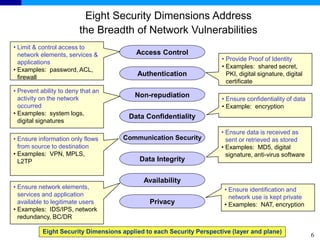
Access Control
Authentication
Non-repudiation
Data Confidentiality
Communication Security
Data Integrity
Availability
Privacy
• Limit & control access to
network elements, services &
applications
• Examples: password, ACL,
firewall
• Prevent ability to deny that an
activity on the network
occurred
• Examples: system logs,
digital signatures
• Ensure information only flows
from source to destination
• Examples: VPN, MPLS,
L2TP
• Ensure network elements,
services and application
available to legitimate users
• Examples: IDS/IPS, network
redundancy, BC/DR
• Provide Proof of Identity
• Examples: shared secret,
PKI, digital signature, digital
certificate
• Ensure confidentiality of data
• Example: encryption
• Ensure data is received as
sent or retrieved as stored
• Examples: MD5, digital
signature, anti-virus software
• Ensure identification and
network use is kept private
• Examples: NAT, encryption
Eight Security Dimensions Address
the Breadth of Network Vulnerabilities
Eight Security Dimensions applied to each Security Perspective (layer and plane)
7
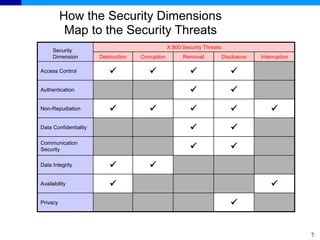
How the Security Dimensions
Map to the Security Threats
Security
Dimension
X.800 Security Threats
Destruction Corruption Removal Disclosure Interruption
Access Control    
Authentication  
Non-Repudiation     
Data Confidentiality  
Communication
Security  
Data Integrity  
Availability  
Privacy 
8
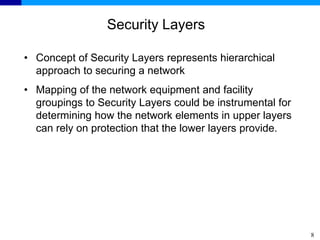
Security Layers
• Concept of Security Layers represents hierarchical
approach to securing a network
• Mapping of the network equipment and facility
groupings to Security Layers could be instrumental for
determining how the network elements in upper layers
can rely on protection that the lower layers provide.
9
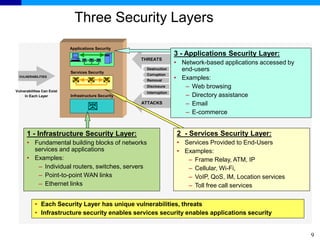
Three Security Layers
• Each Security Layer has unique vulnerabilities, threats
• Infrastructure security enables services security enables applications security
Infrastructure Security
Applications Security
Services Security
THREATS
VULNERABILITIES
ATTACKS
Destruction
Disclosure
Corruption
Removal
Infrastructure Security
Applications Security
Services Security
VULNERABILITIES
Interruption
Vulnerabilities Can Exist
In Each Layer
1 - Infrastructure Security Layer:
• Fundamental building blocks of networks
services and applications
• Examples:
– Individual routers, switches, servers
– Point-to-point WAN links
– Ethernet links
2 - Services Security Layer:
• Services Provided to End-Users
• Examples:
– Frame Relay, ATM, IP
– Cellular, Wi-Fi,
– VoIP, QoS, IM, Location services
– Toll free call services
3 - Applications Security Layer:
• Network-based applications accessed by
end-users
• Examples:
– Web browsing
– Directory assistance
– Email
– E-commerce
10
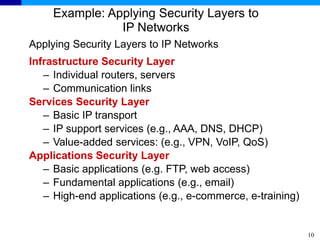
Example: Applying Security Layers to
IP Networks
Applying Security Layers to IP Networks
Infrastructure Security Layer
– Individual routers, servers
– Communication links
Services Security Layer
– Basic IP transport
– IP support services (e.g., AAA, DNS, DHCP)
– Value-added services: (e.g., VPN, VoIP, QoS)
Applications Security Layer
– Basic applications (e.g. FTP, web access)
– Fundamental applications (e.g., email)
– High-end applications (e.g., e-commerce, e-training)
11
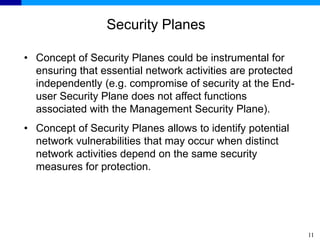
Security Planes
• Concept of Security Planes could be instrumental for
ensuring that essential network activities are protected
independently (e.g. compromise of security at the End-
user Security Plane does not affect functions
associated with the Management Security Plane).
• Concept of Security Planes allows to identify potential
network vulnerabilities that may occur when distinct
network activities depend on the same security
measures for protection.
12
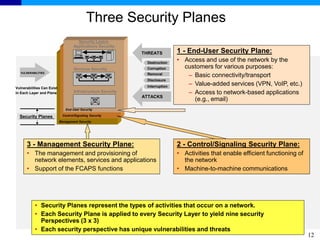
• Security Planes represent the types of activities that occur on a network.
• Each Security Plane is applied to every Security Layer to yield nine security
Perspectives (3 x 3)
• Each security perspective has unique vulnerabilities and threats
Three Security Planes
Infrastructure Security
Applications Security
Services Security
End User Security
Control/Signaling Security
Management Security
VULNERABILITIES
Security Layers
Security Planes
Infrastructure Security
Applications Security
Services Security
End User Security
Control/Signaling Security
Management Security
VULNERABILITIES
Security Layers
Security Planes
Vulnerabilities Can Exist
In Each Layer and Plane
THREATS
ATTACKS
Destruction
Disclosure
Corruption
Removal
Interruption
1 - End-User Security Plane:
• Access and use of the network by the
customers for various purposes:
– Basic connectivity/transport
– Value-added services (VPN, VoIP, etc.)
– Access to network-based applications
(e.g., email)
2 - Control/Signaling Security Plane:
• Activities that enable efficient functioning of
the network
• Machine-to-machine communications
3 - Management Security Plane:
• The management and provisioning of
network elements, services and applications
• Support of the FCAPS functions
13
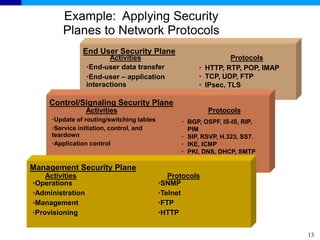
Example: Applying Security
Planes to Network Protocols
End User Security Plane
Activities
•End-user data transfer
•End-user – application
interactions
Protocols
• HTTP, RTP, POP, IMAP
• TCP, UDP, FTP
• IPsec, TLS
Control/Signaling Security Plane
Activities
•Update of routing/switching tables
•Service initiation, control, and
teardown
•Application control
Protocols
• BGP, OSPF, IS-IS, RIP,
PIM
• SIP, RSVP, H.323, SS7.
• IKE, ICMP
• PKI, DNS, DHCP, SMTP
Management Security Plane
•Operations
•Administration
•Management
•Provisioning
Activities Protocols
•SNMP
•Telnet
•FTP
•HTTP
14
Access
Management
Infrastructure Security
Applications Security
Services Security
End User Security
Control/Signaling Security
Management Security
8 Security Dimensions
Data
Confidentiality
Communication
Security
Integrity
Availability
Privacy
Authentication
Non-repudiation
Security Layers
Security Planes Access
Control
Infrastructure Security
Applications Security
Services Security
End User Security
Control/Signaling Security
Management Security
THREATS
VULNERABILITIES
8 Security Dimensions
ATTACKS
Data
Confidentiality
Communication
Security
Data
Integrity
Availability
Privacy
Authentication
Non-repudiation
Security Layers
Security Planes
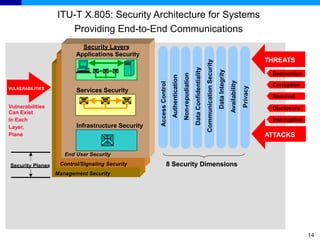
ITU-T X.805: Security Architecture for Systems
Providing End-to-End Communications
Vulnerabilities
Can Exist
In Each
Layer,
Plane
Destruction
Disclosure
Corruption
Removal
Interruption
15
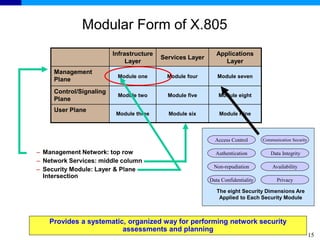
– Management Network: top row
– Network Services: middle column
– Security Module: Layer & Plane
Intersection
Access Control
Authentication
Non-repudiation
Data Confidentiality
Infrastructure
Layer
Services Layer
Applications
Layer
Management
Plane
Module one Module four Module seven
Control/Signaling
Plane
Module two Module five Module eight
User Plane
Module three Module six Module Nine
Communication Security
Data Integrity
Availability
Privacy
The eight Security Dimensions Are
Applied to Each Security Module
Modular Form of X.805
Provides a systematic, organized way for performing network security
assessments and planning
16
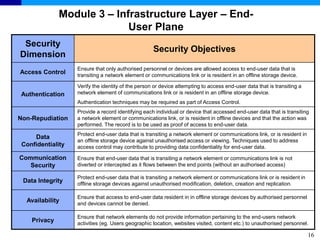
Module 3 – Infrastructure Layer – End-
User Plane
www.lucent.com/security
Security
Dimension
Security Objectives
Access Control
Ensure that only authorised personnel or devices are allowed access to end-user data that is
transiting a network element or communications link or is resident in an offline storage device.
Authentication
Verify the identity of the person or device attempting to access end-user data that is transiting a
network element of communications link or is resident in an offline storage device.
Authentication techniques may be required as part of Access Control.
Non-Repudiation
Provide a record identifying each individual or device that accessed end-user data that is transiting
a network element or communications link, or is resident in offline devices and that the action was
performed. The record is to be used as proof of access to end-user data.
Data
Confidentiality
Protect end-user data that is transiting a network element or communications link, or is resident in
an offline storage device against unauthorised access or viewing. Techniques used to address
access control may contribute to providing data confidentiality for end-user data.
Communication
Security
Ensure that end-user data that is transiting a network element or communications link is not
diverted or intercepted as it flows between the end points (without an authorised access)
Data Integrity
Protect end-user data that is transiting a network element or communications link or is resident in
offline storage devices against unauthorised modification, deletion, creation and replication.
Availability
Ensure that access to end-user data resident in in offline storage devices by authorised personnel
and devices cannot be denied.
Privacy
Ensure that network elements do not provide information pertaining to the end-users network
activities (eg. Users geographic location, websites visited, content etc.) to unauthorised personnel.
17
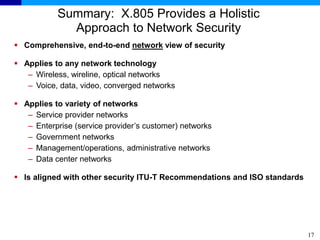
Summary: X.805 Provides a Holistic
Approach to Network Security
 Comprehensive, end-to-end network view of security
 Applies to any network technology
– Wireless, wireline, optical networks
– Voice, data, video, converged networks
 Applies to variety of networks
– Service provider networks
– Enterprise (service provider’s customer) networks
– Government networks
– Management/operations, administrative networks
– Data center networks
 Is aligned with other security ITU-T Recommendations and ISO standards
18
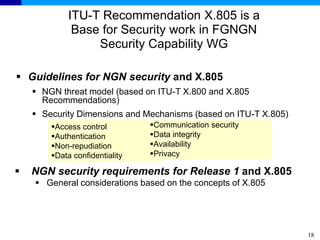
ITU-T Recommendation X.805 is a
Base for Security work in FGNGN
Security Capability WG
 Guidelines for NGN security and X.805
 NGN threat model (based on ITU-T X.800 and X.805
Recommendations)
 Security Dimensions and Mechanisms (based on ITU-T X.805)
Access control
Authentication
Non-repudiation
Data confidentiality
Communication security
Data integrity
Availability
Privacy
 NGN security requirements for Release 1 and X.805
 General considerations based on the concepts of X.805
19
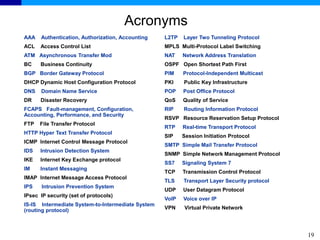
Acronyms
AAA Authentication, Authorization, Accounting
ACL Access Control List
ATM Asynchronous Transfer Mod
BC Business Continuity
BGP Border Gateway Protocol
DHCP Dynamic Host Configuration Protocol
DNS Domain Name Service
DR Disaster Recovery
FCAPS Fault-management, Configuration,
Accounting, Performance, and Security
FTP File Transfer Protocol
HTTP Hyper Text Transfer Protocol
ICMP Internet Control Message Protocol
IDS Intrusion Detection System
IKE Internet Key Exchange protocol
IM Instant Messaging
IMAP Internet Message Access Protocol
IPS Intrusion Prevention System
IPsec IP security (set of protocols)
IS-IS Intermediate System-to-Intermediate System
(routing protocol)
L2TP Layer Two Tunneling Protocol
MPLS Multi-Protocol Label Switching
NAT Network Address Translation
OSPF Open Shortest Path First
PIM Protocol-Independent Multicast
PKI Public Key Infrastructure
POP Post Office Protocol
QoS Quality of Service
RIP Routing Information Protocol
RSVP Resource Reservation Setup Protocol
RTP Real-time Transport Protocol
SIP Session Initiation Protocol
SMTP Simple Mail Transfer Protocol
SNMP Simple Network Management Protocol
SS7 Signaling System 7
TCP Transmission Control Protocol
TLS Transport Layer Security protocol
UDP User Datagram Protocol
VoIP Voice over IP
VPN Virtual Private Network
20
Thank you!

saag-3.ppt

  • 1.
    ITU-T Recommendation X.805 SecurityArchitecture for Systems Providing End-to-End Communications IETF 63 meeting Zachary Zeltsan, Bell Laboratories, Lucent Technologies Rapporteur of Question 5 SG 17
  • 2.
    2 Outline  Origin ofthe ITU-T Recommendation X.805 - Security Architecture for Systems Providing End-to-End Communications  Three main issues that X.805 addresses  Security Dimensions  Security Layers  Security Planes  ITU-T X.805 Security Architecture  ITU-T Recommendation X.805 as a base for security work in FGNGN Security Capability WG
  • 3.
    3 Origin of theITU-T Recommendation X.805 • ITU-T Recommendation X.805 Security architecture for systems providing end-to-end communications had been developed by ITU-T SG 17 (ITU-T Lead Study Group on Telecommunication Security) and was published in October 2003. • The group has developed a set of the well-recognized Recommendations on security. Among them are X.800 Series of Recommendations on security and X.509 - Public-key and Attribute Certificate Frameworks.
  • 4.
    4 Three main issuesthat X.805 addresses The security architecture addresses three essential issues: 1. What kind of protection is needed and against what threats? 2. What are the distinct types of network equipment and facility groupings that need to be protected? 3. What are the distinct types of network activities that need to be protected?
  • 5.
    5 ITU-T X.800 ThreatModel (simplified) X X 1 - Destruction (an attack on availability): – Destruction of information and/or network resources 2 - Corruption (an attack on integrity): – Unauthorized tampering with an asset 3 - Removal (an attack on availability): – Theft, removal or loss of information and/or other resources 4 - Disclosure (an attack on confidentiality): – Unauthorized access to an asset 5 - Interruption (an attack on availability): – Interruption of services. Network becomes unavailable or unusable
  • 6.
    6 Access Control Authentication Non-repudiation Data Confidentiality CommunicationSecurity Data Integrity Availability Privacy • Limit & control access to network elements, services & applications • Examples: password, ACL, firewall • Prevent ability to deny that an activity on the network occurred • Examples: system logs, digital signatures • Ensure information only flows from source to destination • Examples: VPN, MPLS, L2TP • Ensure network elements, services and application available to legitimate users • Examples: IDS/IPS, network redundancy, BC/DR • Provide Proof of Identity • Examples: shared secret, PKI, digital signature, digital certificate • Ensure confidentiality of data • Example: encryption • Ensure data is received as sent or retrieved as stored • Examples: MD5, digital signature, anti-virus software • Ensure identification and network use is kept private • Examples: NAT, encryption Eight Security Dimensions Address the Breadth of Network Vulnerabilities Eight Security Dimensions applied to each Security Perspective (layer and plane)
  • 7.
    7 How the SecurityDimensions Map to the Security Threats Security Dimension X.800 Security Threats Destruction Corruption Removal Disclosure Interruption Access Control     Authentication   Non-Repudiation      Data Confidentiality   Communication Security   Data Integrity   Availability   Privacy 
  • 8.
    8 Security Layers • Conceptof Security Layers represents hierarchical approach to securing a network • Mapping of the network equipment and facility groupings to Security Layers could be instrumental for determining how the network elements in upper layers can rely on protection that the lower layers provide.
  • 9.
    9 Three Security Layers •Each Security Layer has unique vulnerabilities, threats • Infrastructure security enables services security enables applications security Infrastructure Security Applications Security Services Security THREATS VULNERABILITIES ATTACKS Destruction Disclosure Corruption Removal Infrastructure Security Applications Security Services Security VULNERABILITIES Interruption Vulnerabilities Can Exist In Each Layer 1 - Infrastructure Security Layer: • Fundamental building blocks of networks services and applications • Examples: – Individual routers, switches, servers – Point-to-point WAN links – Ethernet links 2 - Services Security Layer: • Services Provided to End-Users • Examples: – Frame Relay, ATM, IP – Cellular, Wi-Fi, – VoIP, QoS, IM, Location services – Toll free call services 3 - Applications Security Layer: • Network-based applications accessed by end-users • Examples: – Web browsing – Directory assistance – Email – E-commerce
  • 10.
    10 Example: Applying SecurityLayers to IP Networks Applying Security Layers to IP Networks Infrastructure Security Layer – Individual routers, servers – Communication links Services Security Layer – Basic IP transport – IP support services (e.g., AAA, DNS, DHCP) – Value-added services: (e.g., VPN, VoIP, QoS) Applications Security Layer – Basic applications (e.g. FTP, web access) – Fundamental applications (e.g., email) – High-end applications (e.g., e-commerce, e-training)
  • 11.
    11 Security Planes • Conceptof Security Planes could be instrumental for ensuring that essential network activities are protected independently (e.g. compromise of security at the End- user Security Plane does not affect functions associated with the Management Security Plane). • Concept of Security Planes allows to identify potential network vulnerabilities that may occur when distinct network activities depend on the same security measures for protection.
  • 12.
    12 • Security Planesrepresent the types of activities that occur on a network. • Each Security Plane is applied to every Security Layer to yield nine security Perspectives (3 x 3) • Each security perspective has unique vulnerabilities and threats Three Security Planes Infrastructure Security Applications Security Services Security End User Security Control/Signaling Security Management Security VULNERABILITIES Security Layers Security Planes Infrastructure Security Applications Security Services Security End User Security Control/Signaling Security Management Security VULNERABILITIES Security Layers Security Planes Vulnerabilities Can Exist In Each Layer and Plane THREATS ATTACKS Destruction Disclosure Corruption Removal Interruption 1 - End-User Security Plane: • Access and use of the network by the customers for various purposes: – Basic connectivity/transport – Value-added services (VPN, VoIP, etc.) – Access to network-based applications (e.g., email) 2 - Control/Signaling Security Plane: • Activities that enable efficient functioning of the network • Machine-to-machine communications 3 - Management Security Plane: • The management and provisioning of network elements, services and applications • Support of the FCAPS functions
  • 13.
    13 Example: Applying Security Planesto Network Protocols End User Security Plane Activities •End-user data transfer •End-user – application interactions Protocols • HTTP, RTP, POP, IMAP • TCP, UDP, FTP • IPsec, TLS Control/Signaling Security Plane Activities •Update of routing/switching tables •Service initiation, control, and teardown •Application control Protocols • BGP, OSPF, IS-IS, RIP, PIM • SIP, RSVP, H.323, SS7. • IKE, ICMP • PKI, DNS, DHCP, SMTP Management Security Plane •Operations •Administration •Management •Provisioning Activities Protocols •SNMP •Telnet •FTP •HTTP
  • 14.
    14 Access Management Infrastructure Security Applications Security ServicesSecurity End User Security Control/Signaling Security Management Security 8 Security Dimensions Data Confidentiality Communication Security Integrity Availability Privacy Authentication Non-repudiation Security Layers Security Planes Access Control Infrastructure Security Applications Security Services Security End User Security Control/Signaling Security Management Security THREATS VULNERABILITIES 8 Security Dimensions ATTACKS Data Confidentiality Communication Security Data Integrity Availability Privacy Authentication Non-repudiation Security Layers Security Planes ITU-T X.805: Security Architecture for Systems Providing End-to-End Communications Vulnerabilities Can Exist In Each Layer, Plane Destruction Disclosure Corruption Removal Interruption
  • 15.
    15 – Management Network:top row – Network Services: middle column – Security Module: Layer & Plane Intersection Access Control Authentication Non-repudiation Data Confidentiality Infrastructure Layer Services Layer Applications Layer Management Plane Module one Module four Module seven Control/Signaling Plane Module two Module five Module eight User Plane Module three Module six Module Nine Communication Security Data Integrity Availability Privacy The eight Security Dimensions Are Applied to Each Security Module Modular Form of X.805 Provides a systematic, organized way for performing network security assessments and planning
  • 16.
    16 Module 3 –Infrastructure Layer – End- User Plane www.lucent.com/security Security Dimension Security Objectives Access Control Ensure that only authorised personnel or devices are allowed access to end-user data that is transiting a network element or communications link or is resident in an offline storage device. Authentication Verify the identity of the person or device attempting to access end-user data that is transiting a network element of communications link or is resident in an offline storage device. Authentication techniques may be required as part of Access Control. Non-Repudiation Provide a record identifying each individual or device that accessed end-user data that is transiting a network element or communications link, or is resident in offline devices and that the action was performed. The record is to be used as proof of access to end-user data. Data Confidentiality Protect end-user data that is transiting a network element or communications link, or is resident in an offline storage device against unauthorised access or viewing. Techniques used to address access control may contribute to providing data confidentiality for end-user data. Communication Security Ensure that end-user data that is transiting a network element or communications link is not diverted or intercepted as it flows between the end points (without an authorised access) Data Integrity Protect end-user data that is transiting a network element or communications link or is resident in offline storage devices against unauthorised modification, deletion, creation and replication. Availability Ensure that access to end-user data resident in in offline storage devices by authorised personnel and devices cannot be denied. Privacy Ensure that network elements do not provide information pertaining to the end-users network activities (eg. Users geographic location, websites visited, content etc.) to unauthorised personnel.
  • 17.
    17 Summary: X.805 Providesa Holistic Approach to Network Security  Comprehensive, end-to-end network view of security  Applies to any network technology – Wireless, wireline, optical networks – Voice, data, video, converged networks  Applies to variety of networks – Service provider networks – Enterprise (service provider’s customer) networks – Government networks – Management/operations, administrative networks – Data center networks  Is aligned with other security ITU-T Recommendations and ISO standards
  • 18.
    18 ITU-T Recommendation X.805is a Base for Security work in FGNGN Security Capability WG  Guidelines for NGN security and X.805  NGN threat model (based on ITU-T X.800 and X.805 Recommendations)  Security Dimensions and Mechanisms (based on ITU-T X.805) Access control Authentication Non-repudiation Data confidentiality Communication security Data integrity Availability Privacy  NGN security requirements for Release 1 and X.805  General considerations based on the concepts of X.805
  • 19.
    19 Acronyms AAA Authentication, Authorization,Accounting ACL Access Control List ATM Asynchronous Transfer Mod BC Business Continuity BGP Border Gateway Protocol DHCP Dynamic Host Configuration Protocol DNS Domain Name Service DR Disaster Recovery FCAPS Fault-management, Configuration, Accounting, Performance, and Security FTP File Transfer Protocol HTTP Hyper Text Transfer Protocol ICMP Internet Control Message Protocol IDS Intrusion Detection System IKE Internet Key Exchange protocol IM Instant Messaging IMAP Internet Message Access Protocol IPS Intrusion Prevention System IPsec IP security (set of protocols) IS-IS Intermediate System-to-Intermediate System (routing protocol) L2TP Layer Two Tunneling Protocol MPLS Multi-Protocol Label Switching NAT Network Address Translation OSPF Open Shortest Path First PIM Protocol-Independent Multicast PKI Public Key Infrastructure POP Post Office Protocol QoS Quality of Service RIP Routing Information Protocol RSVP Resource Reservation Setup Protocol RTP Real-time Transport Protocol SIP Session Initiation Protocol SMTP Simple Mail Transfer Protocol SNMP Simple Network Management Protocol SS7 Signaling System 7 TCP Transmission Control Protocol TLS Transport Layer Security protocol UDP User Datagram Protocol VoIP Voice over IP VPN Virtual Private Network
  • 20.