ASN.1:
Introduction
Zdeněk Říha
ASN.1
 Abstract Syntax Notation 1
 notation for describing abstract types and
values
 Defined in ITU-T X.680 … X.695
 Used in many file formats, including crypto
 Public keys, private keys
 Certificate requests, certificates
 Digital signatures, padding, encrypted files
ASN.1
 Allows format/storage/transmission of data
 Compatible among many applications
 Not dependent on HW platform
 E.g. little/big endian
 Not dependent on operating system
 Simple & Structured types
 Multiple encoding rules (methods)
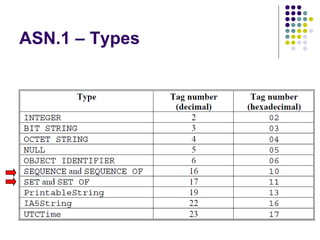
ASN.1 – Types
ASN.1 – simple types
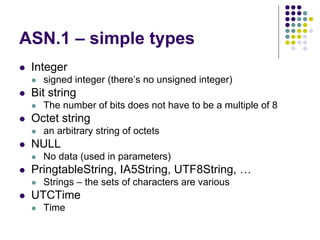
 Integer
 signed integer (there’s no unsigned integer)
 Bit string
 The number of bits does not have to be a multiple of 8
 Octet string
 an arbitrary string of octets
 NULL
 No data (used in parameters)
 PringtableString, IA5String, UTF8String, …
 Strings – the sets of characters are various
 UTCTime
 Time
ASN.1 – OID type
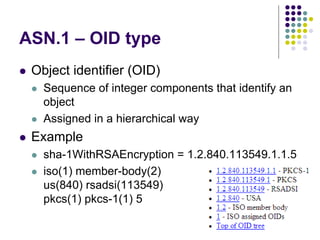
 Object identifier (OID)
 Sequence of integer components that identify an
object
 Assigned in a hierarchical way
 Example
 sha-1WithRSAEncryption = 1.2.840.113549.1.1.5
 iso(1) member-body(2)
us(840) rsadsi(113549)
pkcs(1) pkcs-1(1) 5
ASN.1 – structured types
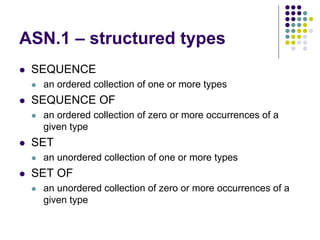
 SEQUENCE
 an ordered collection of one or more types
 SEQUENCE OF
 an ordered collection of zero or more occurrences of a
given type
 SET
 an unordered collection of one or more types
 SET OF
 an unordered collection of zero or more occurrences of a
given type
ASN.1 Encoding Rules
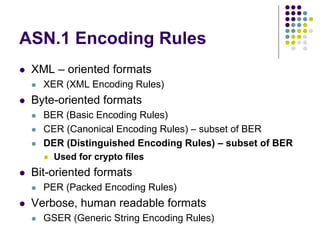
 XML – oriented formats
 XER (XML Encoding Rules)
 Byte-oriented formats
 BER (Basic Encoding Rules)
 CER (Canonical Encoding Rules) – subset of BER
 DER (Distinguished Encoding Rules) – subset of BER
 Used for crypto files
 Bit-oriented formats
 PER (Packed Encoding Rules)
 Verbose, human readable formats
 GSER (Generic String Encoding Rules)
BER encoding
 TLV – Tag Length Value
 All the data is encoded using a simple TLV format
 Tag – what kind of data it is
 Length – the length of the data
 Value – the data itself
 Example
 02 01 05 [hexadecimal values]
 Tag – Integer
 Length of data – 1 byte
 Data: (positive integer) 5
Nested data
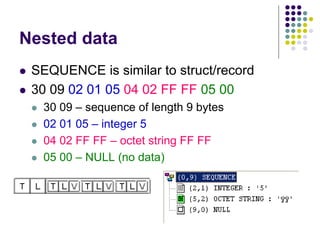
 SEQUENCE is similar to struct/record
 30 09 02 01 05 04 02 FF FF 05 00
 30 09 – sequence of length 9 bytes
 02 01 05 – integer 5
 04 02 FF FF – octet string FF FF
 05 00 – NULL (no data)
BER tags
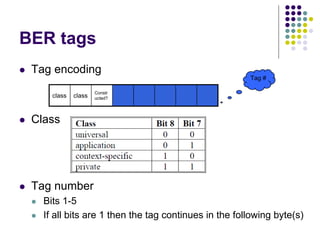
 Tag encoding
 Class
 Tag number
 Bits 1-5
 If all bits are 1 then the tag continues in the following byte(s)
class class
Constr
ucted?
Tag #
BER length
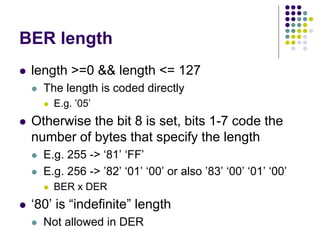
 length >=0 && length <= 127
 The length is coded directly
 E.g. ’05’
 Otherwise the bit 8 is set, bits 1-7 code the
number of bytes that specify the length
 E.g. 255 -> ‘81’ ‘FF’
 E.g. 256 -> ’82’ ‘01’ ‘00’ or also ’83’ ‘00’ ‘01’ ‘00’
 BER x DER
 ‘80’ is “indefinite” length
 Not allowed in DER
BER value
 The data itself
 Dependent on data type
 Integer: signed – e.g. 128 -> ’00 80’
 Octet string: directly the data
 Bit string: number of unused bits + padded bit
string to a multiple of 8 bits (padding is at the end)
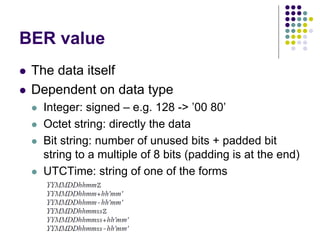
 UTCTime: string of one of the forms
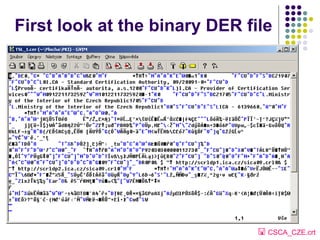
First look at the binary DER file
 CSCA_CZE.crt
DER vs. PEM
 PEM
 Privacy Enhanced Mail
 PEM as such not used, but formats still used
 Textual formats
 Practical for transport channels where full 8bit data can
be damaged
 PEM is base64 coded DER enveloped with
 -----BEGIN SOMETHING-----
 -----END SOMETHING-----
 Where SOMETHING is CERTIFICATE/PKCS7/KEY…
Sample PEM file
 CSCA_CZE.pem
ASN.1 viewers
 Unber (part of asn1c)
 Openssl asn1parse
 ASN.1 Editor
 …
OpenSSL asn1parse
 CSCA_CZE.crt
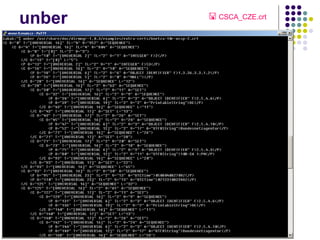
unber  CSCA_CZE.crt
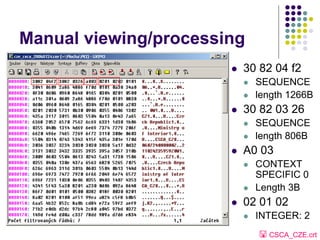
Manual viewing/processing
 30 82 04 f2
 SEQUENCE
 length 1266B
 30 82 03 26
 SEQUENCE
 length 806B
 A0 03
 CONTEXT
SPECIFIC 0
 Length 3B
 02 01 02
 INTEGER: 2
 CSCA_CZE.crt
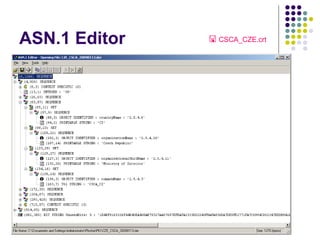
ASN.1 Editor  CSCA_CZE.crt
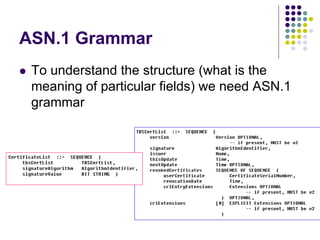
ASN.1 Grammar
 To understand the structure (what is the
meaning of particular fields) we need ASN.1
grammar

ASN1_intro.pdf

  • 1.
  • 2.
    ASN.1  Abstract SyntaxNotation 1  notation for describing abstract types and values  Defined in ITU-T X.680 … X.695  Used in many file formats, including crypto  Public keys, private keys  Certificate requests, certificates  Digital signatures, padding, encrypted files
  • 3.
    ASN.1  Allows format/storage/transmissionof data  Compatible among many applications  Not dependent on HW platform  E.g. little/big endian  Not dependent on operating system  Simple & Structured types  Multiple encoding rules (methods)
  • 4.
  • 5.
    ASN.1 – simpletypes  Integer  signed integer (there’s no unsigned integer)  Bit string  The number of bits does not have to be a multiple of 8  Octet string  an arbitrary string of octets  NULL  No data (used in parameters)  PringtableString, IA5String, UTF8String, …  Strings – the sets of characters are various  UTCTime  Time
  • 6.
    ASN.1 – OIDtype  Object identifier (OID)  Sequence of integer components that identify an object  Assigned in a hierarchical way  Example  sha-1WithRSAEncryption = 1.2.840.113549.1.1.5  iso(1) member-body(2) us(840) rsadsi(113549) pkcs(1) pkcs-1(1) 5
  • 7.
    ASN.1 – structuredtypes  SEQUENCE  an ordered collection of one or more types  SEQUENCE OF  an ordered collection of zero or more occurrences of a given type  SET  an unordered collection of one or more types  SET OF  an unordered collection of zero or more occurrences of a given type
  • 8.
    ASN.1 Encoding Rules XML – oriented formats  XER (XML Encoding Rules)  Byte-oriented formats  BER (Basic Encoding Rules)  CER (Canonical Encoding Rules) – subset of BER  DER (Distinguished Encoding Rules) – subset of BER  Used for crypto files  Bit-oriented formats  PER (Packed Encoding Rules)  Verbose, human readable formats  GSER (Generic String Encoding Rules)
  • 9.
    BER encoding  TLV– Tag Length Value  All the data is encoded using a simple TLV format  Tag – what kind of data it is  Length – the length of the data  Value – the data itself  Example  02 01 05 [hexadecimal values]  Tag – Integer  Length of data – 1 byte  Data: (positive integer) 5
  • 10.
    Nested data  SEQUENCEis similar to struct/record  30 09 02 01 05 04 02 FF FF 05 00  30 09 – sequence of length 9 bytes  02 01 05 – integer 5  04 02 FF FF – octet string FF FF  05 00 – NULL (no data)
  • 11.
    BER tags  Tagencoding  Class  Tag number  Bits 1-5  If all bits are 1 then the tag continues in the following byte(s) class class Constr ucted? Tag #
  • 12.
    BER length  length>=0 && length <= 127  The length is coded directly  E.g. ’05’  Otherwise the bit 8 is set, bits 1-7 code the number of bytes that specify the length  E.g. 255 -> ‘81’ ‘FF’  E.g. 256 -> ’82’ ‘01’ ‘00’ or also ’83’ ‘00’ ‘01’ ‘00’  BER x DER  ‘80’ is “indefinite” length  Not allowed in DER
  • 13.
    BER value  Thedata itself  Dependent on data type  Integer: signed – e.g. 128 -> ’00 80’  Octet string: directly the data  Bit string: number of unused bits + padded bit string to a multiple of 8 bits (padding is at the end)  UTCTime: string of one of the forms
  • 14.
    First look atthe binary DER file  CSCA_CZE.crt
  • 15.
    DER vs. PEM PEM  Privacy Enhanced Mail  PEM as such not used, but formats still used  Textual formats  Practical for transport channels where full 8bit data can be damaged  PEM is base64 coded DER enveloped with  -----BEGIN SOMETHING-----  -----END SOMETHING-----  Where SOMETHING is CERTIFICATE/PKCS7/KEY…
  • 16.
    Sample PEM file CSCA_CZE.pem
  • 17.
    ASN.1 viewers  Unber(part of asn1c)  Openssl asn1parse  ASN.1 Editor  …
  • 18.
  • 19.
  • 20.
    Manual viewing/processing  3082 04 f2  SEQUENCE  length 1266B  30 82 03 26  SEQUENCE  length 806B  A0 03  CONTEXT SPECIFIC 0  Length 3B  02 01 02  INTEGER: 2  CSCA_CZE.crt
  • 21.
    ASN.1 Editor CSCA_CZE.crt
  • 22.
    ASN.1 Grammar  Tounderstand the structure (what is the meaning of particular fields) we need ASN.1 grammar