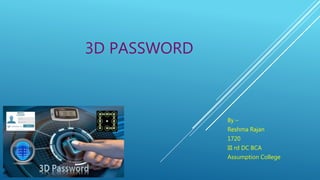
3D PASSWORD
By –
Reshma Rajan
1720
III rd DC BCA
Assumption College
CONTENTS
 Introduction
 Authentication Schemes
 Functionalities Required
 3D Password selection and Input
 Virtual Environment Design Guidelines
 Applications
 Security Analysis
 Attacks and Counter measures
 conclusion
INTRODUCTION
 Commonly used authentication schemes are textual
passwords, graphical passwords and biometrics.
 3D password is a multifactor authentication scheme.
 To be authenticated, we require a 3D virtual environment.
Combines recognition, recall, token and biometrics
based system.
Users choice to select the type of authentication
technique.
AUTHENTICATION SCHEMES
 KNOWLEDGE BASED
- Recall based
- Recognition based
 TOKEN BASED
e.g : smart card
 BIOMETRIC BASED
- Fingerprint, palm prints, hand geometry, face
recognition
 GRAPHICAL PASSWORD
- Recognition based
- Recall based
FUNCTIONALITIES REQUIRED
 New scheme should combine the existing authentication
schemes.
 Freedom to select the type of authentication technique.
 Should provide secrets that are easy to remember, difficult
to guess.
3D PASSWORD SELECTION AND INPUT
 3D environment space represented by the co-ordinates.
 User navigate into the 3D virtual environment using any
input device.
 The sequence of actions and interactions forms the users
3D password.
3D VIRTUAL ENVIRONMENT DESIGN
GUIDELINES
 Real-life similarity
 Object uniqueness and distinction
 Three-dimensional virtual environment
 System importance
APPLICATION
 Critical servers.
 Nuclear and military facilitics.
 Airplanes and jet fighter.
 ATM, desktop computers and laptops.
SECURITY ANALYSIS
 3D Password Space Size.
 3D Password Distribution Knowledge.
ATTACKS AND COUNTER MEASURES
 Brute Force Attack
 Well-Studied Attack
 Shoulder Surfing Attack
 Timing Attack
ADVANTAGES OF 3D PASSWORD
 Several authentication schemes
 Easy to memorize
 Designed according to protected system
 Highly flexible
 Extremely strong
 Provides secrets
 3D environment can be changed
 Password can change easily
 Difficult to crack
 Freedom to select
 Difficult to share
 3D graphical password has no limit
DISADVANTAGES
 Difficult for blind people to use this technology.
 Requires sophisticated computer technology.
 Expensive.
 A lot of program coding is required.
CONCLUSION
 3D password is a multi factor authentication scheme that
combines the various authentication schemes into a single
3D virtual environment.
 Designing a simple and easy to use 3D virtual environment
is a factor that leads to a higher user acceptability of a 3D
password system.
QUESTIONS??
THANK YOU!

3d password

  • 1.
    3D PASSWORD By – ReshmaRajan 1720 III rd DC BCA Assumption College
  • 2.
    CONTENTS  Introduction  AuthenticationSchemes  Functionalities Required  3D Password selection and Input  Virtual Environment Design Guidelines  Applications  Security Analysis  Attacks and Counter measures  conclusion
  • 3.
    INTRODUCTION  Commonly usedauthentication schemes are textual passwords, graphical passwords and biometrics.  3D password is a multifactor authentication scheme.  To be authenticated, we require a 3D virtual environment.
  • 4.
    Combines recognition, recall,token and biometrics based system. Users choice to select the type of authentication technique.
  • 5.
    AUTHENTICATION SCHEMES  KNOWLEDGEBASED - Recall based - Recognition based  TOKEN BASED e.g : smart card
  • 6.
     BIOMETRIC BASED -Fingerprint, palm prints, hand geometry, face recognition  GRAPHICAL PASSWORD - Recognition based - Recall based
  • 7.
    FUNCTIONALITIES REQUIRED  Newscheme should combine the existing authentication schemes.  Freedom to select the type of authentication technique.  Should provide secrets that are easy to remember, difficult to guess.
  • 8.
    3D PASSWORD SELECTIONAND INPUT  3D environment space represented by the co-ordinates.  User navigate into the 3D virtual environment using any input device.  The sequence of actions and interactions forms the users 3D password.
  • 9.
    3D VIRTUAL ENVIRONMENTDESIGN GUIDELINES  Real-life similarity  Object uniqueness and distinction  Three-dimensional virtual environment  System importance
  • 10.
    APPLICATION  Critical servers. Nuclear and military facilitics.  Airplanes and jet fighter.  ATM, desktop computers and laptops.
  • 11.
    SECURITY ANALYSIS  3DPassword Space Size.  3D Password Distribution Knowledge.
  • 12.
    ATTACKS AND COUNTERMEASURES  Brute Force Attack  Well-Studied Attack  Shoulder Surfing Attack  Timing Attack
  • 13.
    ADVANTAGES OF 3DPASSWORD  Several authentication schemes  Easy to memorize  Designed according to protected system  Highly flexible  Extremely strong  Provides secrets  3D environment can be changed  Password can change easily  Difficult to crack  Freedom to select  Difficult to share  3D graphical password has no limit
  • 14.
    DISADVANTAGES  Difficult forblind people to use this technology.  Requires sophisticated computer technology.  Expensive.  A lot of program coding is required.
  • 15.
    CONCLUSION  3D passwordis a multi factor authentication scheme that combines the various authentication schemes into a single 3D virtual environment.  Designing a simple and easy to use 3D virtual environment is a factor that leads to a higher user acceptability of a 3D password system.
  • 16.
  • 17.