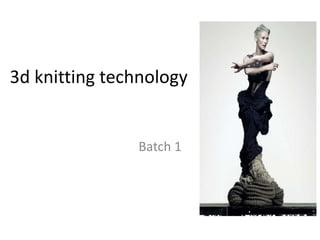
3d knitting technology
Batch 1
Introduction
• 3D knitting takes a digital design and turns it into
a piece of clothing.
• In its simplest form, you download a pattern from
the internet and size it digitally to fit the person it
is intended for.
• You then feed the machine with the yarn and let
it get on with its job.
• This is not the first time this type of technology
has been developed: in the 1960s and 1970s
many knitting machines entered the market from
companies such as Toyota, Brother and Singer.
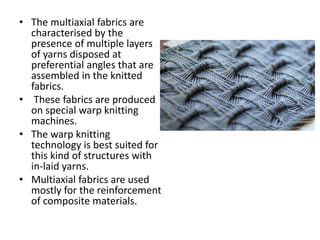
• The multiaxial fabrics are
characterised by the
presence of multiple layers
of yarns disposed at
preferential angles that are
assembled in the knitted
fabrics.
• These fabrics are produced
on special warp knitting
machines.
• The warp knitting
technology is best suited for
this kind of structures with
in-laid yarns.
• Multiaxial fabrics are used
mostly for the reinforcement
of composite materials.
• The different layers of yarns in the multiaxial warp knitted
fabrics are independent and the yarns fed under preset
angles: 00 (weft yarns), 900 (warp yarns) and any value
between these, like +/- 300 and +/- 450.
• The layers are united by the actual knitted fabric, using
pillar or tricot stitches, as exemplified in Fig. 10 (Raz, 1989).
• The preset angles correspond to the directions requiring
higher strength during use and are imposed by the
application.
• Currently, there are two main technologies adapted for the
production of multiaxial fabrics: the Karl Mayer technology
and the Liba technology
Karl Mayer technology
• The Karl Mayer machine uses four yarn systems – one to
produce the ground fabric, one to insert the warp yarns, one
for the weft yarns and the fourth for the yarns disposed under
a preset angle.
• The inclined yarns are fed with two guide bars that have a
rotational movement of 1 pitch every row.
• The guides are shogged in only one direction, passing from
one bar to the other, changing the yarn direction within the
fabric structure.
• The modified angle when changing direction in a Karl Mayer
multiaxial fabric .
• The advantages of the Karl Mayer system are: the accuracy of
the inclined yarns position, the fact that the needles do not
destroy these yarns and the high productivity.
LIBA technology
• The Liba technology is by far the best adapted to
produce multiaxial fabrics.
• The MAX 3 CNC machines use a Copcentra machine
that is preceded by a number of 3 zones where the
layers are formed with the help of carriers feeding the
yarns under the desired angle along the table:
• 00 for the weft yarns and 260 to 600 for the rest.
• The warp yarns (900) are introduced in the knitting
zone, using special guides.
• The layers are brought to the knitting zone and
connected using pillar or tricot stitches.
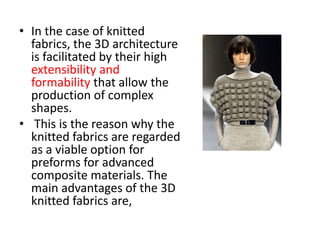
• In the case of knitted
fabrics, the 3D architecture
is facilitated by their high
extensibility and
formability that allow the
production of complex
shapes.
• This is the reason why the
knitted fabrics are regarded
as a viable option for
preforms for advanced
composite materials. The
main advantages of the 3D
knitted fabrics are,
advantages
• : a. the high formability of the fabrics,
especially due to their drape characteristics
• b. the high complexity of the shapes that can
be produced;
• c. the use of existing technology, without
major adaptations;
• d. knitted fabrics exhibit good impact
behaviour
problems related to their production
and their properties:
• a. the development of these fabrics is still at laboratory
stage;
• b. the mechanical characteristics of the resulting
composites are at a lower level and require
improvement;
• c. the specific properties and their prediction are not
yet well developed, mainly because of the complexity
of the knitted fabrics;
• d. the pretension of the perform before its
impregnation with resin determines a uneven
behaviour for the final composite due to fibre
migration in the stitches.
• The 3D knitted fabrics can be divided into
three main groups:
• multiaxial fabrics (multilayer),
• sandwich/spacer fabrics and
• knitted fabrics with spatial geometry (spatial
fashioned).
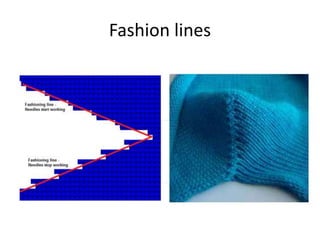
Fashioning lines
• It can be defined as the zones where the knitting will be carried out
on a variable number of needles, these zones generating the spatial
geometry.
• The lines have two components, corresponding to decreasing the
number of working needles and the other to increasing them.
• In the fabric, these two lines become one, the actual fashioning
line,.
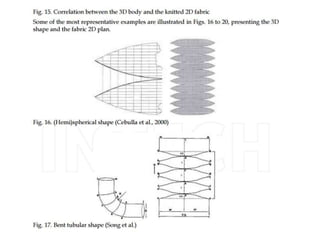
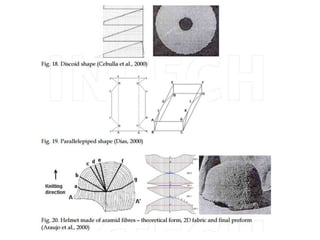
• Fashioning line - in the knitting programme and in the fabric
illustrates the correlation between the 3D shape of the product and
the 2D plan of the fabric, emphasising the most significant elements
for the knitting process design.
• The evolute of the 3D body is obtained using sectioning lines and is
the same with the 2D plan of the fabric that contains the fashioning
lines.
Fashion lines
Sandwich/spacer fabrics
• A sandwich/spacer fabric is a 3D construction made of two separate
fabrics, connected in between by yarns or knitted layers .
• The fabric thickness determined by length of the connecting
yarns/layers. When produced on warp machines, these fabrics are
known as spacers. They are obtained on double needle bar
machines, with 4 to 6 guide bars – 1 or 2 guide bars produce the
independent fabrics by knitting only on one bed and the middle
bars create the connection by working on both beds (forming
stitches or being in-laid).
• The fabric thickness depends on the distance between the two
beds
• . The fabrics present weft and warp in-lays that form the net
geometry and give the fabric strength on both directions
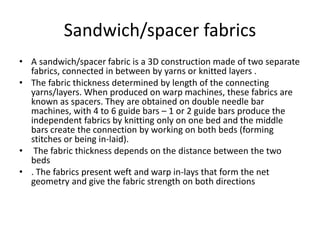
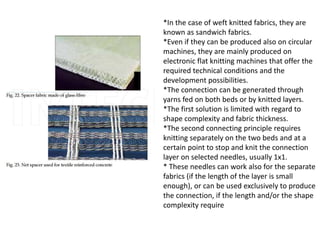
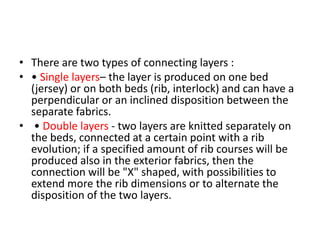
*In the case of weft knitted fabrics, they are
known as sandwich fabrics.
*Even if they can be produced also on circular
machines, they are mainly produced on
electronic flat knitting machines that offer the
required technical conditions and the
development possibilities.
*The connection can be generated through
yarns fed on both beds or by knitted layers.
*The first solution is limited with regard to
shape complexity and fabric thickness.
*The second connecting principle requires
knitting separately on the two beds and at a
certain point to stop and knit the connection
layer on selected needles, usually 1x1.
* These needles can work also for the separate
fabrics (if the length of the layer is small
enough), or can be used exclusively to produce
the connection, if the length and/or the shape
complexity require
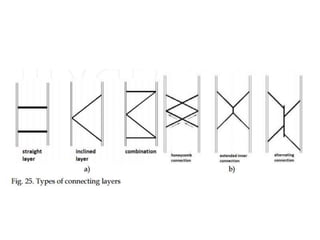
• There are two types of connecting layers :
• • Single layers– the layer is produced on one bed
(jersey) or on both beds (rib, interlock) and can have a
perpendicular or an inclined disposition between the
separate fabrics.
• • Double layers - two layers are knitted separately on
the beds, connected at a certain point with a rib
evolution; if a specified amount of rib courses will be
produced also in the exterior fabrics, then the
connection will be "X" shaped, with possibilities to
extend more the rib dimensions or to alternate the
disposition of the two layers.
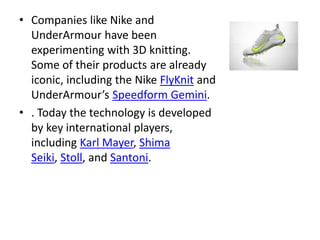
• Companies like Nike and
UnderArmour have been
experimenting with 3D knitting.
Some of their products are already
iconic, including the Nike FlyKnit and
UnderArmour’s Speedform Gemini.
• . Today the technology is developed
by key international players,
including Karl Mayer, Shima
Seiki, Stoll, and Santoni.
3d knit

3d knit

  • 1.
  • 2.
    Introduction • 3D knittingtakes a digital design and turns it into a piece of clothing. • In its simplest form, you download a pattern from the internet and size it digitally to fit the person it is intended for. • You then feed the machine with the yarn and let it get on with its job. • This is not the first time this type of technology has been developed: in the 1960s and 1970s many knitting machines entered the market from companies such as Toyota, Brother and Singer.
  • 3.
    • The multiaxialfabrics are characterised by the presence of multiple layers of yarns disposed at preferential angles that are assembled in the knitted fabrics. • These fabrics are produced on special warp knitting machines. • The warp knitting technology is best suited for this kind of structures with in-laid yarns. • Multiaxial fabrics are used mostly for the reinforcement of composite materials.
  • 4.
    • The differentlayers of yarns in the multiaxial warp knitted fabrics are independent and the yarns fed under preset angles: 00 (weft yarns), 900 (warp yarns) and any value between these, like +/- 300 and +/- 450. • The layers are united by the actual knitted fabric, using pillar or tricot stitches, as exemplified in Fig. 10 (Raz, 1989). • The preset angles correspond to the directions requiring higher strength during use and are imposed by the application. • Currently, there are two main technologies adapted for the production of multiaxial fabrics: the Karl Mayer technology and the Liba technology
  • 5.
    Karl Mayer technology •The Karl Mayer machine uses four yarn systems – one to produce the ground fabric, one to insert the warp yarns, one for the weft yarns and the fourth for the yarns disposed under a preset angle. • The inclined yarns are fed with two guide bars that have a rotational movement of 1 pitch every row. • The guides are shogged in only one direction, passing from one bar to the other, changing the yarn direction within the fabric structure. • The modified angle when changing direction in a Karl Mayer multiaxial fabric . • The advantages of the Karl Mayer system are: the accuracy of the inclined yarns position, the fact that the needles do not destroy these yarns and the high productivity.
  • 6.
    LIBA technology • TheLiba technology is by far the best adapted to produce multiaxial fabrics. • The MAX 3 CNC machines use a Copcentra machine that is preceded by a number of 3 zones where the layers are formed with the help of carriers feeding the yarns under the desired angle along the table: • 00 for the weft yarns and 260 to 600 for the rest. • The warp yarns (900) are introduced in the knitting zone, using special guides. • The layers are brought to the knitting zone and connected using pillar or tricot stitches.
  • 7.
    • In thecase of knitted fabrics, the 3D architecture is facilitated by their high extensibility and formability that allow the production of complex shapes. • This is the reason why the knitted fabrics are regarded as a viable option for preforms for advanced composite materials. The main advantages of the 3D knitted fabrics are,
  • 8.
    advantages • : a.the high formability of the fabrics, especially due to their drape characteristics • b. the high complexity of the shapes that can be produced; • c. the use of existing technology, without major adaptations; • d. knitted fabrics exhibit good impact behaviour
  • 9.
    problems related totheir production and their properties: • a. the development of these fabrics is still at laboratory stage; • b. the mechanical characteristics of the resulting composites are at a lower level and require improvement; • c. the specific properties and their prediction are not yet well developed, mainly because of the complexity of the knitted fabrics; • d. the pretension of the perform before its impregnation with resin determines a uneven behaviour for the final composite due to fibre migration in the stitches.
  • 10.
    • The 3Dknitted fabrics can be divided into three main groups: • multiaxial fabrics (multilayer), • sandwich/spacer fabrics and • knitted fabrics with spatial geometry (spatial fashioned).
  • 11.
    Fashioning lines • Itcan be defined as the zones where the knitting will be carried out on a variable number of needles, these zones generating the spatial geometry. • The lines have two components, corresponding to decreasing the number of working needles and the other to increasing them. • In the fabric, these two lines become one, the actual fashioning line,. • Fashioning line - in the knitting programme and in the fabric illustrates the correlation between the 3D shape of the product and the 2D plan of the fabric, emphasising the most significant elements for the knitting process design. • The evolute of the 3D body is obtained using sectioning lines and is the same with the 2D plan of the fabric that contains the fashioning lines.
  • 12.
  • 15.
    Sandwich/spacer fabrics • Asandwich/spacer fabric is a 3D construction made of two separate fabrics, connected in between by yarns or knitted layers . • The fabric thickness determined by length of the connecting yarns/layers. When produced on warp machines, these fabrics are known as spacers. They are obtained on double needle bar machines, with 4 to 6 guide bars – 1 or 2 guide bars produce the independent fabrics by knitting only on one bed and the middle bars create the connection by working on both beds (forming stitches or being in-laid). • The fabric thickness depends on the distance between the two beds • . The fabrics present weft and warp in-lays that form the net geometry and give the fabric strength on both directions
  • 16.
    *In the caseof weft knitted fabrics, they are known as sandwich fabrics. *Even if they can be produced also on circular machines, they are mainly produced on electronic flat knitting machines that offer the required technical conditions and the development possibilities. *The connection can be generated through yarns fed on both beds or by knitted layers. *The first solution is limited with regard to shape complexity and fabric thickness. *The second connecting principle requires knitting separately on the two beds and at a certain point to stop and knit the connection layer on selected needles, usually 1x1. * These needles can work also for the separate fabrics (if the length of the layer is small enough), or can be used exclusively to produce the connection, if the length and/or the shape complexity require
  • 17.
    • There aretwo types of connecting layers : • • Single layers– the layer is produced on one bed (jersey) or on both beds (rib, interlock) and can have a perpendicular or an inclined disposition between the separate fabrics. • • Double layers - two layers are knitted separately on the beds, connected at a certain point with a rib evolution; if a specified amount of rib courses will be produced also in the exterior fabrics, then the connection will be "X" shaped, with possibilities to extend more the rib dimensions or to alternate the disposition of the two layers.
  • 19.
    • Companies likeNike and UnderArmour have been experimenting with 3D knitting. Some of their products are already iconic, including the Nike FlyKnit and UnderArmour’s Speedform Gemini. • . Today the technology is developed by key international players, including Karl Mayer, Shima Seiki, Stoll, and Santoni.