360 DEGREE APPRAISAL
SYSTEM
WHAT IS 360 DEGREE APPRAISAL?
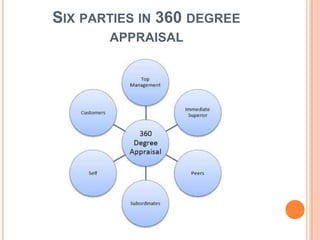
 An appraisal made by top management, immediate
superior, peers, subordinates, self and customers is
called 360 Degree Appraisal.
 This method is very reliable because evaluation is
done by many different parties.
 This method is mostly used to evaluate the
performance of the employees. However, it is also
used to evaluate other qualities such as talents,
behaviour, values, ethical standards, tempers,
loyalty, etc.
 360 degree appraisal was first developed by
General Electric (GE), USA in 1992.
SIX PARTIES IN 360 DEGREE
APPRAISAL
MULTI RATER 360 DEGREE
FEEDBACK
 People Metrics has a “multi-rater evaluation
technique”
 The multi rater evaluation technique helps
individual employees:
 To understand how others perceive them
To identify Developmental needs
 To facilitate Feedback, which is essential for
learning
 To manage their own performance and careers
 The multi rater evaluation technique helps the
team:
 To Increase communication between team
members
 To Support teamwork by involving team members in
the development process
 The multi rater evaluation technique helps
organization:
 To facilitate better career development for
employees
 To improve customer service by having customers
contribute to evaluation
 To drive training of employees and raise capability
of organization.
ACCURACY
 “Known for one to three years” are the most
accurate.
 “known for less than one year” are the more
accurate
 “known for three to five years” are the accurate
 “known for more than five years” are the least
accurate.
APPRAISAL SYSTEM OF
TATA MOTORS
 The appraisal model which is followed on annual
basis starting from the month of April till March has
been extremely effective for the employees of Tata
Motors.
 They have introduced a comprehensive system of
quarterly appraisals’ where an employee selects
his/her own goals or Key Result Area (KRAs) every
quarter and him/her self assesses his/her own
performance against these parameters.
 The appraisals are proportional to effort of the
individual, team and the department.
 TATA Motors have a goal setting model,
Goals can be established in a variety of ways. Best way is
to set by joint participation between the
employee and the supervisor. This
method often leads to employee commitment,
a crucial ingredient in effective goal setting.
 For this purpose, an online template is circulated in the
organization. Superiors fill out that form keeping in view the
performance of their subordinate over the year. This feedback
becomes the basis of the promotion of the employees.
⚫ Superior is responsible for categorizing the employess in
four category, namely –
⚫ A
⚫ B
⚫ C
⚫ D
 This categorization is done both on the basis of performance
and the goals they were given.
APPRAISAL SYSTEM OF HINDUSTAN
UNILEVER
 Performance management and reward processes.
 Tools and processes that drive transparency and
rigor in assessing and developing people.
 For example, employees are plotted on the
Leadership Differentiation Tool (LDT) which not only
evaluates the 'What' of their performance but also
the 'How' of their performance.
 360 degree feedback provide feedback from
superiors, peer groups and subordinates to provide
holistic and objective evaluation of the employees.
 Employees are individually communicated and
career paths are shared with them.
 Objective of the performance management.
ADVANTAGES OF 360 DEGREE
APPRAISAL
 Personal Development
 Team Development
 Change
 Self Directed Teams
 Learning Organizations
DISADVANTAGES OF 360 DEGREE
APPRAISAL
 With the increase in the number of raters it
becomes difficult to separate, calculate and
eliminate personal biasness and differences.
 It is often time consuming and difficult to analyze
the information gathered.
 360 degree feedback – as a process requires
commitment of top management and the HR,
resources(time, financial resources etc), planned
implementation and follow up.
 The results can be manipulated by the employees
towards their desired ratings with the help of the
raters.
A WORD OF CAUTION
 Feedback is almost always a sensitive subject.
People are often cautious, sometimes fearful, and
occasionally emotional about it. A good facilitator or
administrator recognizes and appreciates the
sensitive nature surrounding 360° feedback and
takes serious steps to insure the integrity of the
process and support of the individual.
 Once the process has been breached by any of the
above actions, it will be difficult to recover. Spend
the time up front doing the homework necessary to
make the process successful. The results will be
more than worth it.

360degree appraisal system.pptx

  • 1.
  • 2.
    WHAT IS 360DEGREE APPRAISAL?  An appraisal made by top management, immediate superior, peers, subordinates, self and customers is called 360 Degree Appraisal.  This method is very reliable because evaluation is done by many different parties.  This method is mostly used to evaluate the performance of the employees. However, it is also used to evaluate other qualities such as talents, behaviour, values, ethical standards, tempers, loyalty, etc.  360 degree appraisal was first developed by General Electric (GE), USA in 1992.
  • 3.
    SIX PARTIES IN360 DEGREE APPRAISAL
  • 4.
    MULTI RATER 360DEGREE FEEDBACK  People Metrics has a “multi-rater evaluation technique”  The multi rater evaluation technique helps individual employees:  To understand how others perceive them To identify Developmental needs  To facilitate Feedback, which is essential for learning  To manage their own performance and careers
  • 5.
     The multirater evaluation technique helps the team:  To Increase communication between team members  To Support teamwork by involving team members in the development process  The multi rater evaluation technique helps organization:  To facilitate better career development for employees  To improve customer service by having customers contribute to evaluation  To drive training of employees and raise capability of organization.
  • 7.
    ACCURACY  “Known forone to three years” are the most accurate.  “known for less than one year” are the more accurate  “known for three to five years” are the accurate  “known for more than five years” are the least accurate.
  • 8.
    APPRAISAL SYSTEM OF TATAMOTORS  The appraisal model which is followed on annual basis starting from the month of April till March has been extremely effective for the employees of Tata Motors.  They have introduced a comprehensive system of quarterly appraisals’ where an employee selects his/her own goals or Key Result Area (KRAs) every quarter and him/her self assesses his/her own performance against these parameters.  The appraisals are proportional to effort of the individual, team and the department.
  • 9.
     TATA Motorshave a goal setting model, Goals can be established in a variety of ways. Best way is to set by joint participation between the employee and the supervisor. This method often leads to employee commitment, a crucial ingredient in effective goal setting.  For this purpose, an online template is circulated in the organization. Superiors fill out that form keeping in view the performance of their subordinate over the year. This feedback becomes the basis of the promotion of the employees. ⚫ Superior is responsible for categorizing the employess in four category, namely – ⚫ A ⚫ B ⚫ C ⚫ D  This categorization is done both on the basis of performance and the goals they were given.
  • 10.
    APPRAISAL SYSTEM OFHINDUSTAN UNILEVER  Performance management and reward processes.  Tools and processes that drive transparency and rigor in assessing and developing people.  For example, employees are plotted on the Leadership Differentiation Tool (LDT) which not only evaluates the 'What' of their performance but also the 'How' of their performance.  360 degree feedback provide feedback from superiors, peer groups and subordinates to provide holistic and objective evaluation of the employees.  Employees are individually communicated and career paths are shared with them.  Objective of the performance management.
  • 12.
    ADVANTAGES OF 360DEGREE APPRAISAL  Personal Development  Team Development  Change  Self Directed Teams  Learning Organizations
  • 13.
    DISADVANTAGES OF 360DEGREE APPRAISAL  With the increase in the number of raters it becomes difficult to separate, calculate and eliminate personal biasness and differences.  It is often time consuming and difficult to analyze the information gathered.  360 degree feedback – as a process requires commitment of top management and the HR, resources(time, financial resources etc), planned implementation and follow up.  The results can be manipulated by the employees towards their desired ratings with the help of the raters.
  • 14.
    A WORD OFCAUTION  Feedback is almost always a sensitive subject. People are often cautious, sometimes fearful, and occasionally emotional about it. A good facilitator or administrator recognizes and appreciates the sensitive nature surrounding 360° feedback and takes serious steps to insure the integrity of the process and support of the individual.  Once the process has been breached by any of the above actions, it will be difficult to recover. Spend the time up front doing the homework necessary to make the process successful. The results will be more than worth it.