ARTIFICIAL
INTELLIGENCE TO
REACH TARGET
AUDIENCE
What is Artificial Intelligence?
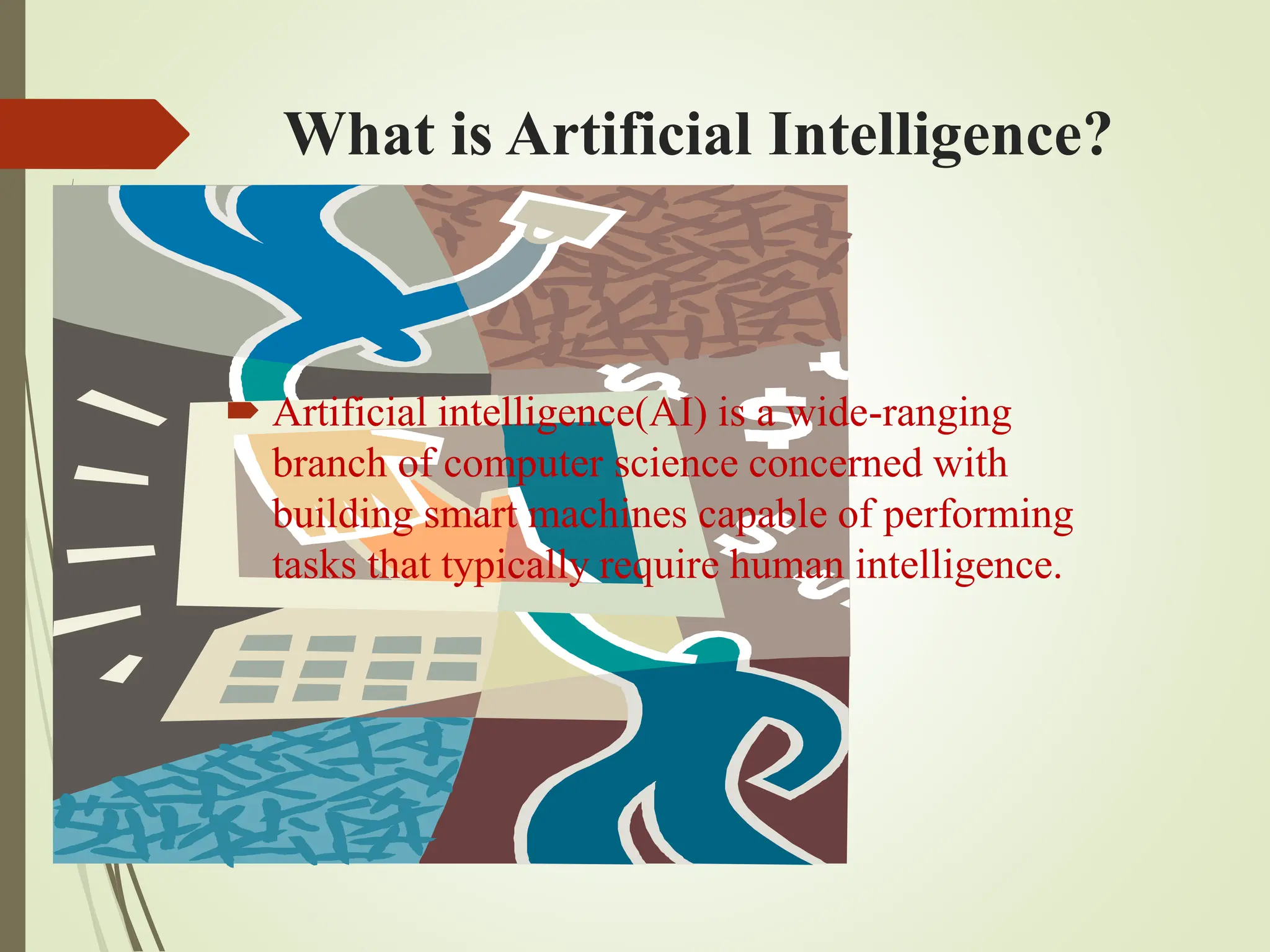
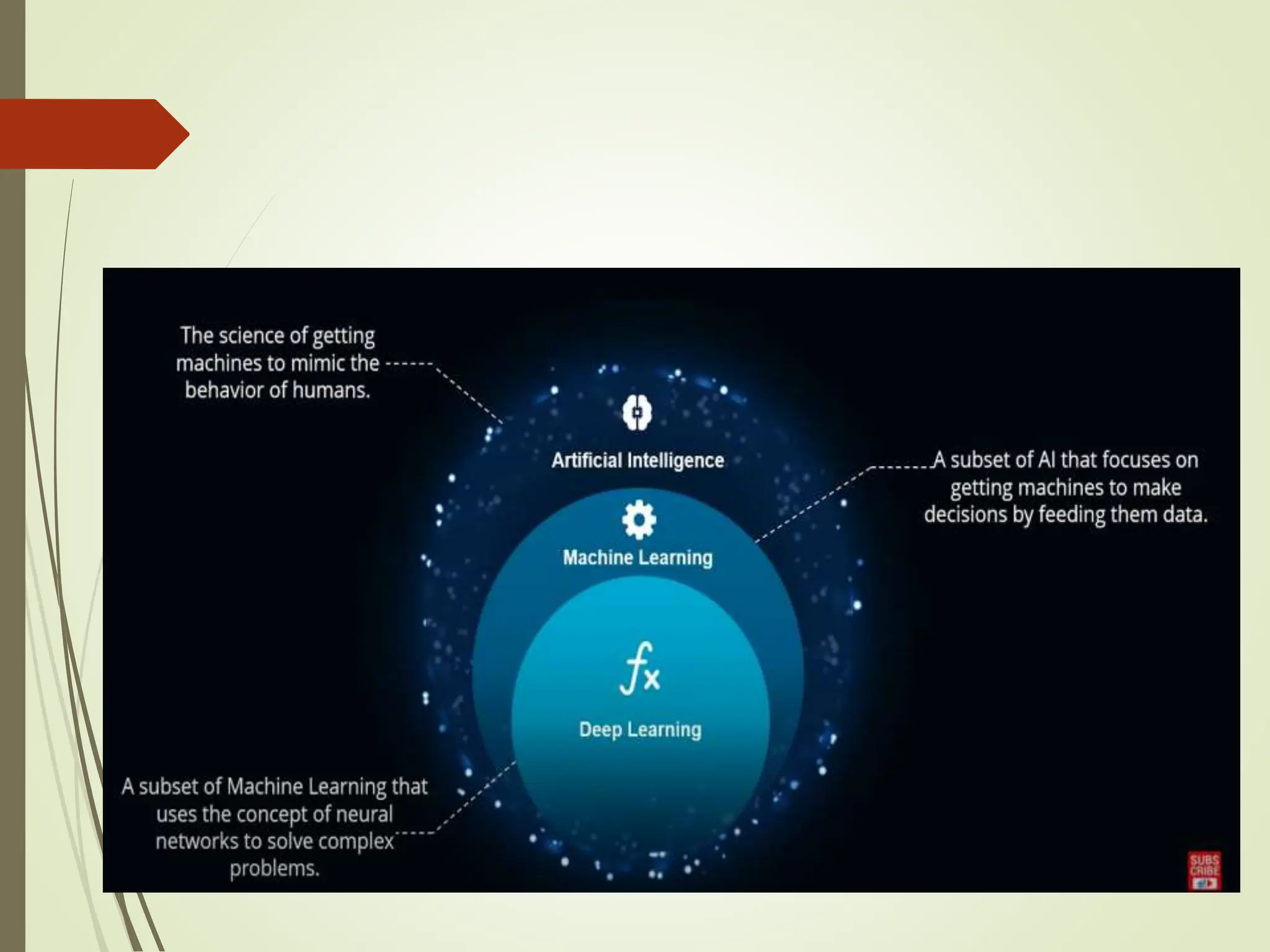
 Artificial intelligence(AI) is a wide-ranging
branch of computer science concerned with
building smart machines capable of performing
tasks that typically require human intelligence.
start of Artificial intelligence
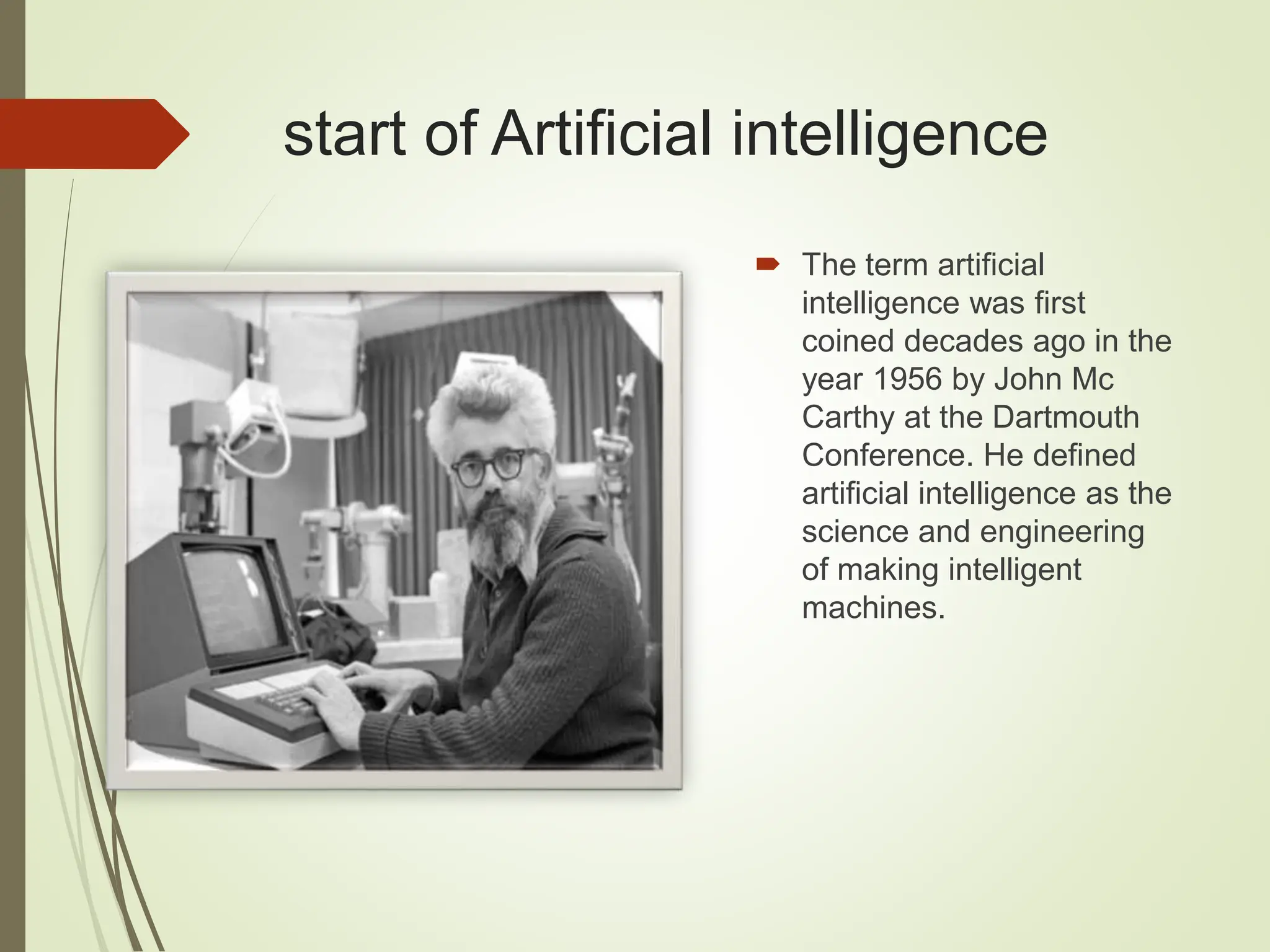
 The term artificial
intelligence was first
coined decades ago in the
year 1956 by John Mc
Carthy at the Dartmouth
Conference. He defined
artificial intelligence as the
science and engineering
of making intelligent
machines.
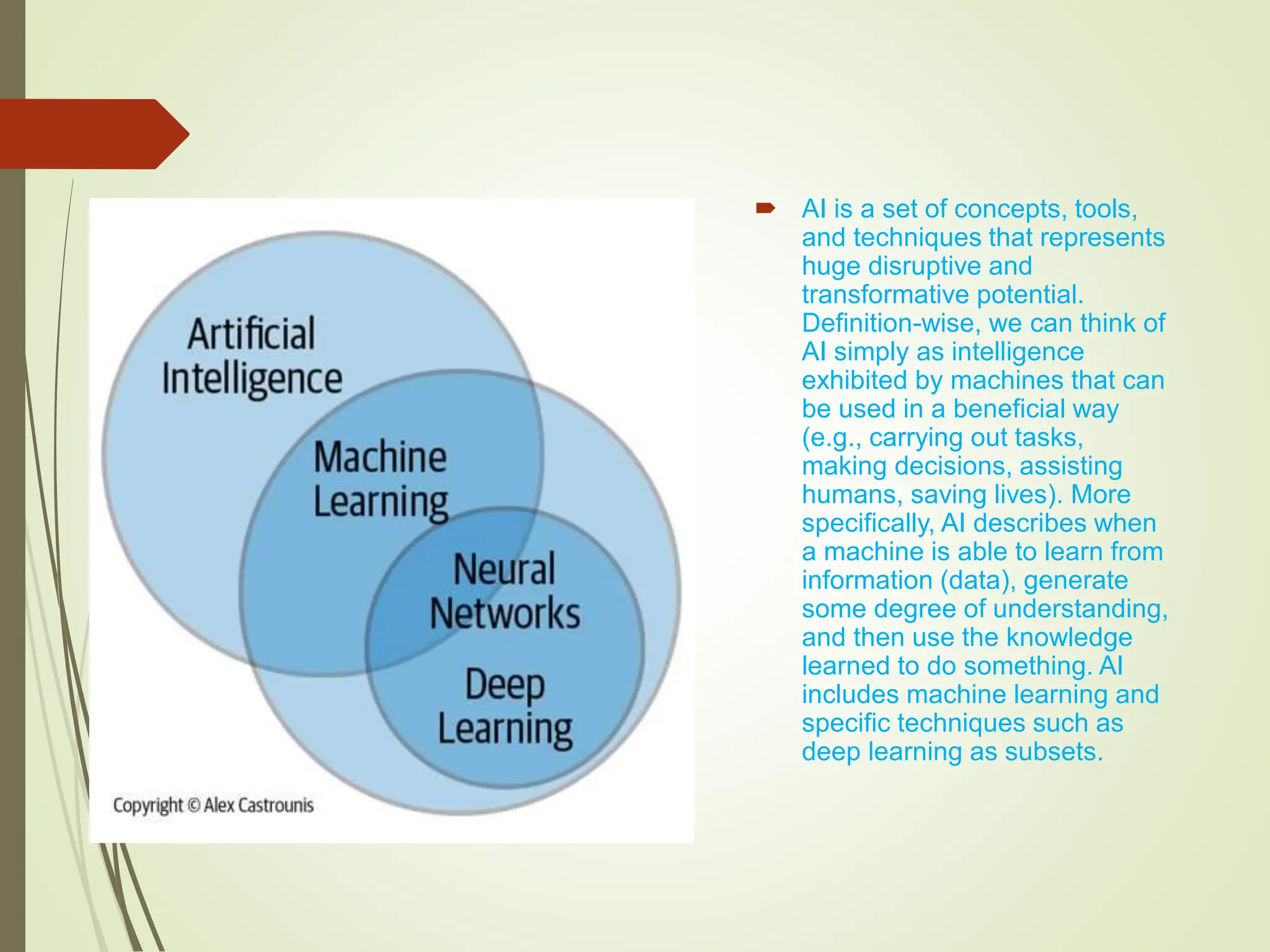
 AI is a set of concepts, tools,
and techniques that represents
huge disruptive and
transformative potential.
Definition-wise, we can think of
AI simply as intelligence
exhibited by machines that can
be used in a beneficial way
(e.g., carrying out tasks,
making decisions, assisting
humans, saving lives). More
specifically, AI describes when
a machine is able to learn from
information (data), generate
some degree of understanding,
and then use the knowledge
learned to do something. AI
includes machine learning and
specific techniques such as
deep learning as subsets.
Types of A.I
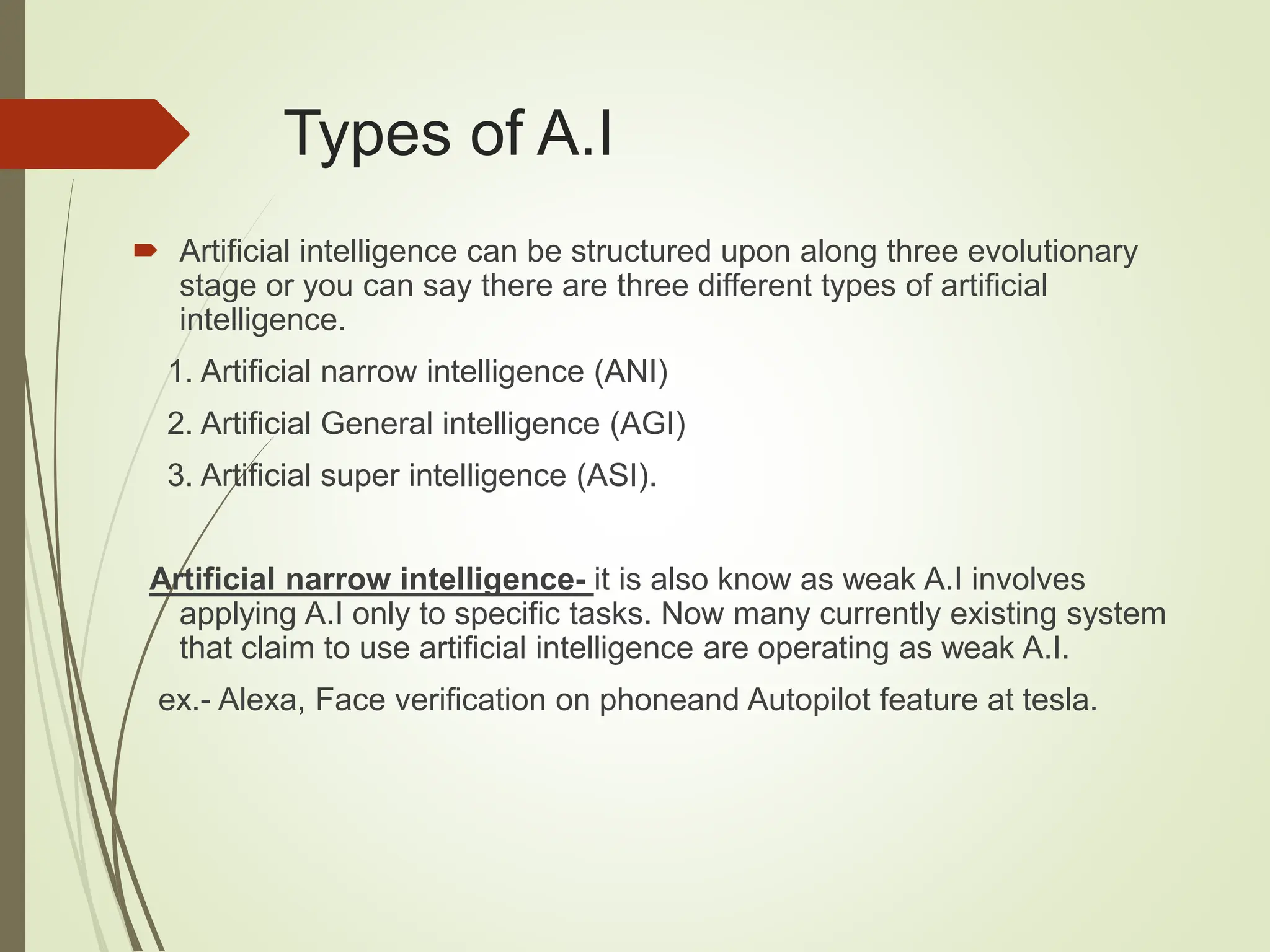
 Artificial intelligence can be structured upon along three evolutionary
stage or you can say there are three different types of artificial
intelligence.
1. Artificial narrow intelligence (ANI)
2. Artificial General intelligence (AGI)
3. Artificial super intelligence (ASI).
Artificial narrow intelligence- it is also know as weak A.I involves
applying A.I only to specific tasks. Now many currently existing system
that claim to use artificial intelligence are operating as weak A.I.
ex.- Alexa, Face verification on phoneand Autopilot feature at tesla.
 Artificial general intelligence- Also known as strong A.I,
involves machines that possess the ability to perform any
intellectual task that human being can.
 Artificial super intelligence- it is a term referring to the time
when the capability of computer will surpass humans.
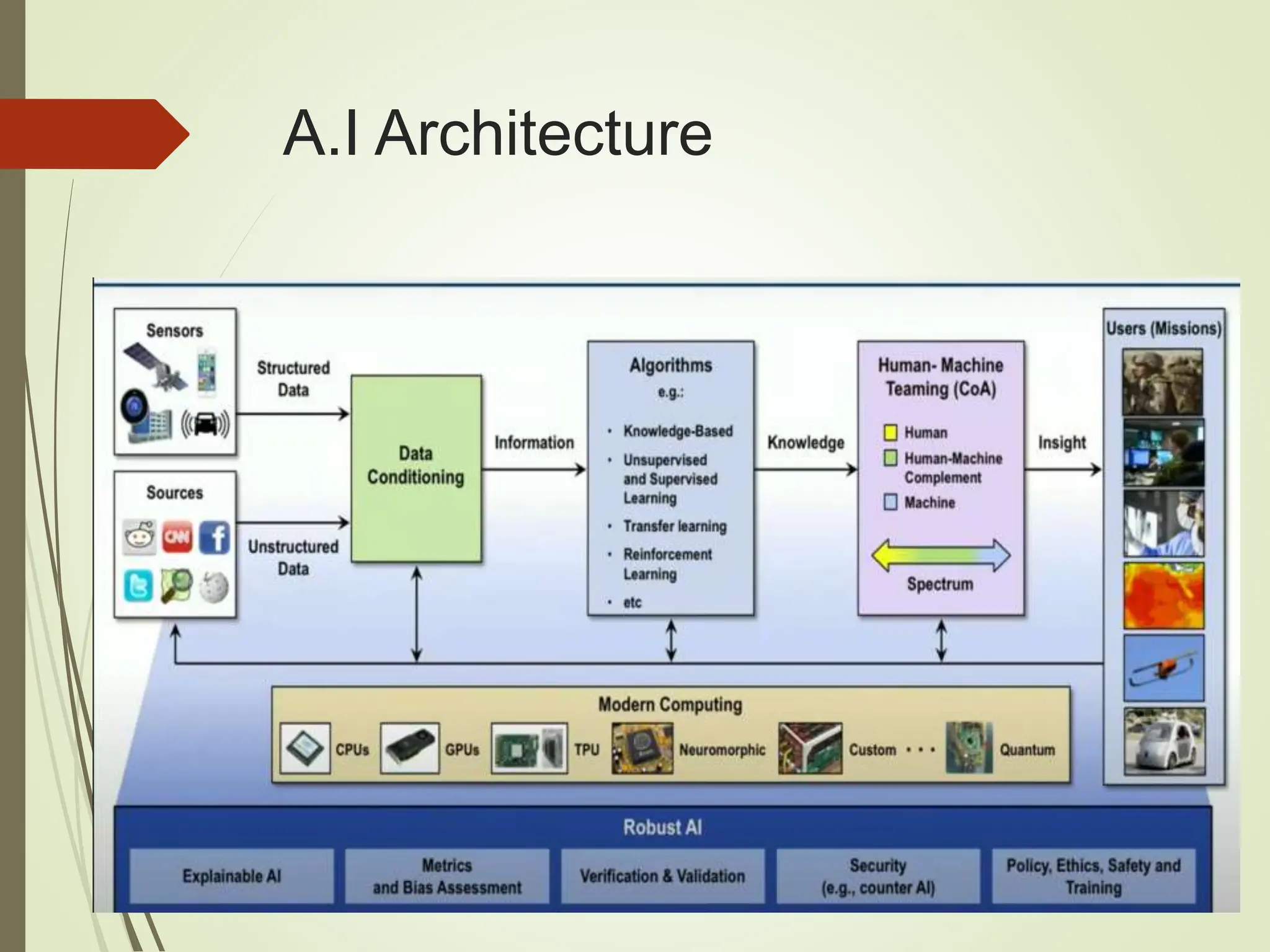
A.I Architecture
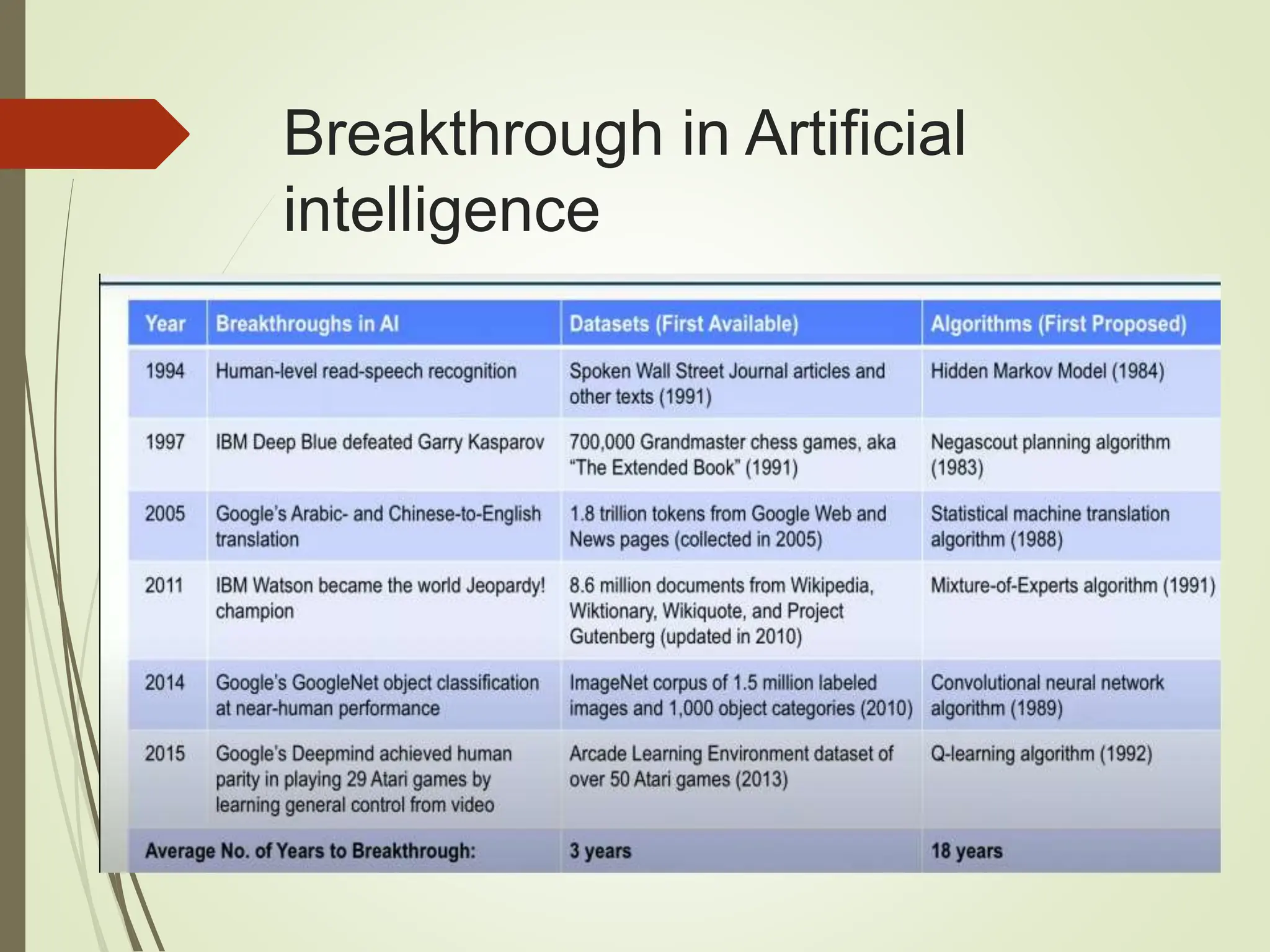
Breakthrough in Artificial
intelligence
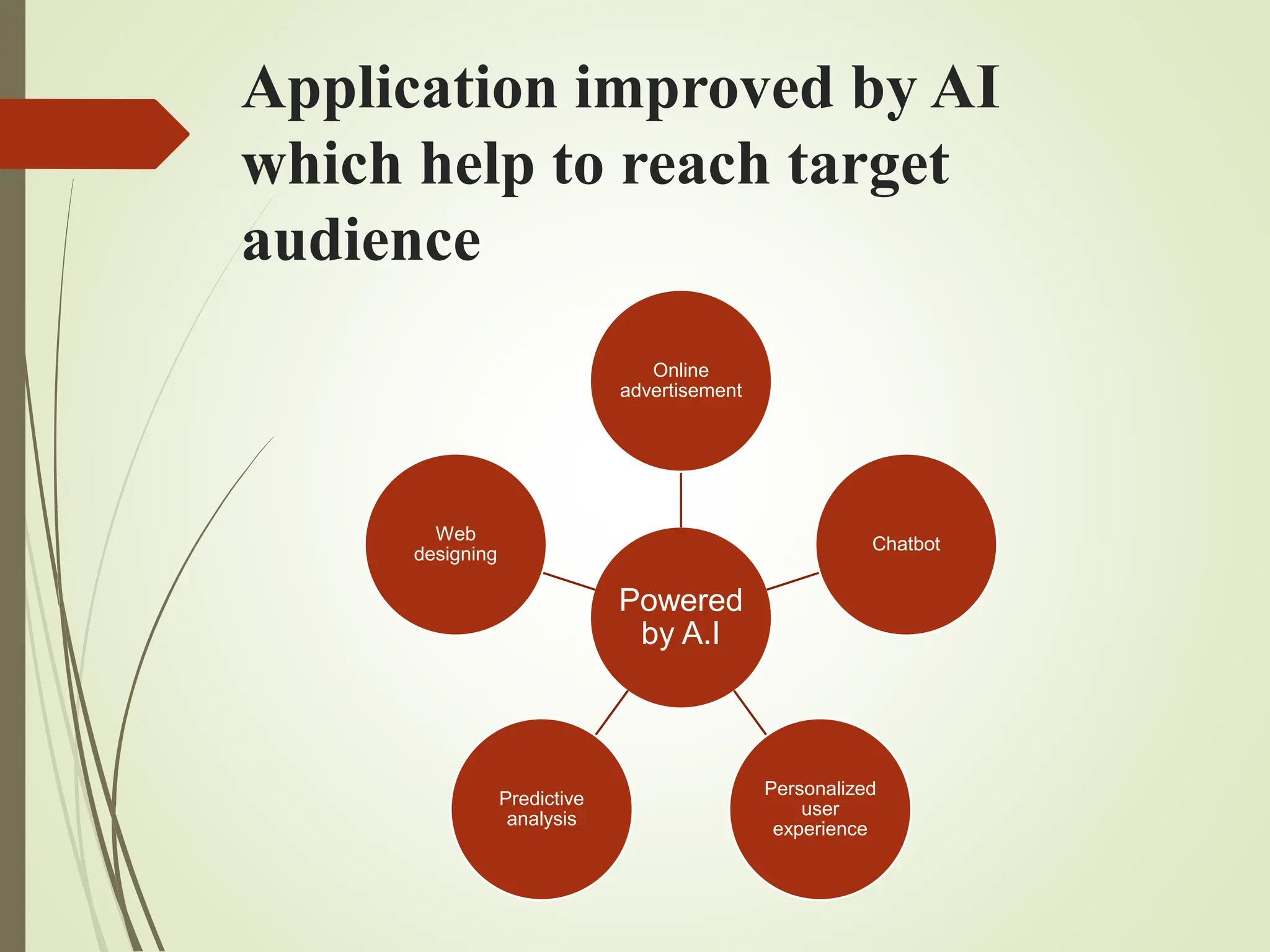
Application improved by AI
which help to reach target
audience
Powered
by A.I
Online
advertisement
Chatbot
Personalized
user
experience
Predictive
analysis
Web
designing
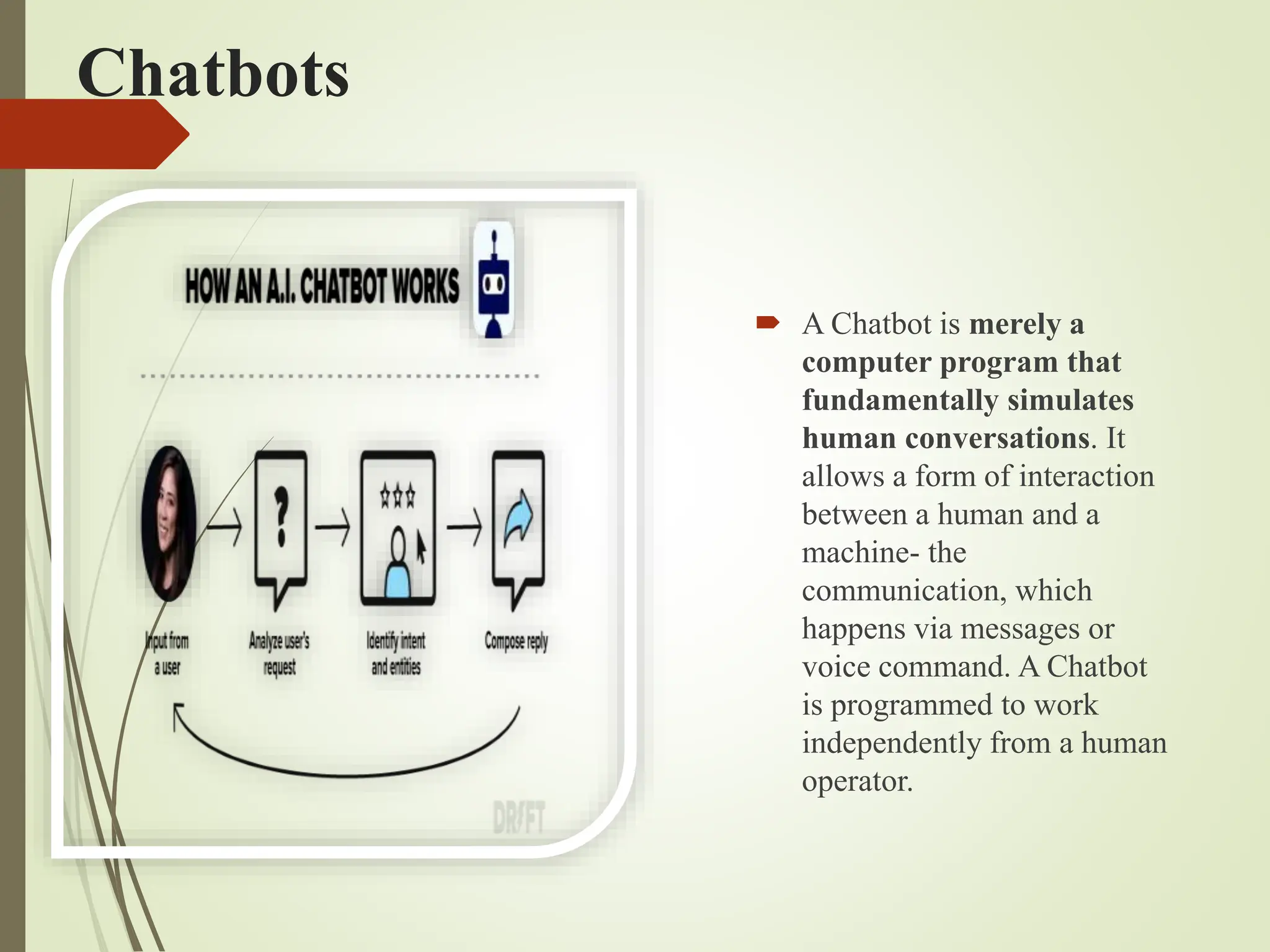
Chatbots
 A Chatbot is merely a
computer program that
fundamentally simulates
human conversations. It
allows a form of interaction
between a human and a
machine- the
communication, which
happens via messages or
voice command. A Chatbot
is programmed to work
independently from a human
operator.
EXAMPLE- DOMINO’S
.
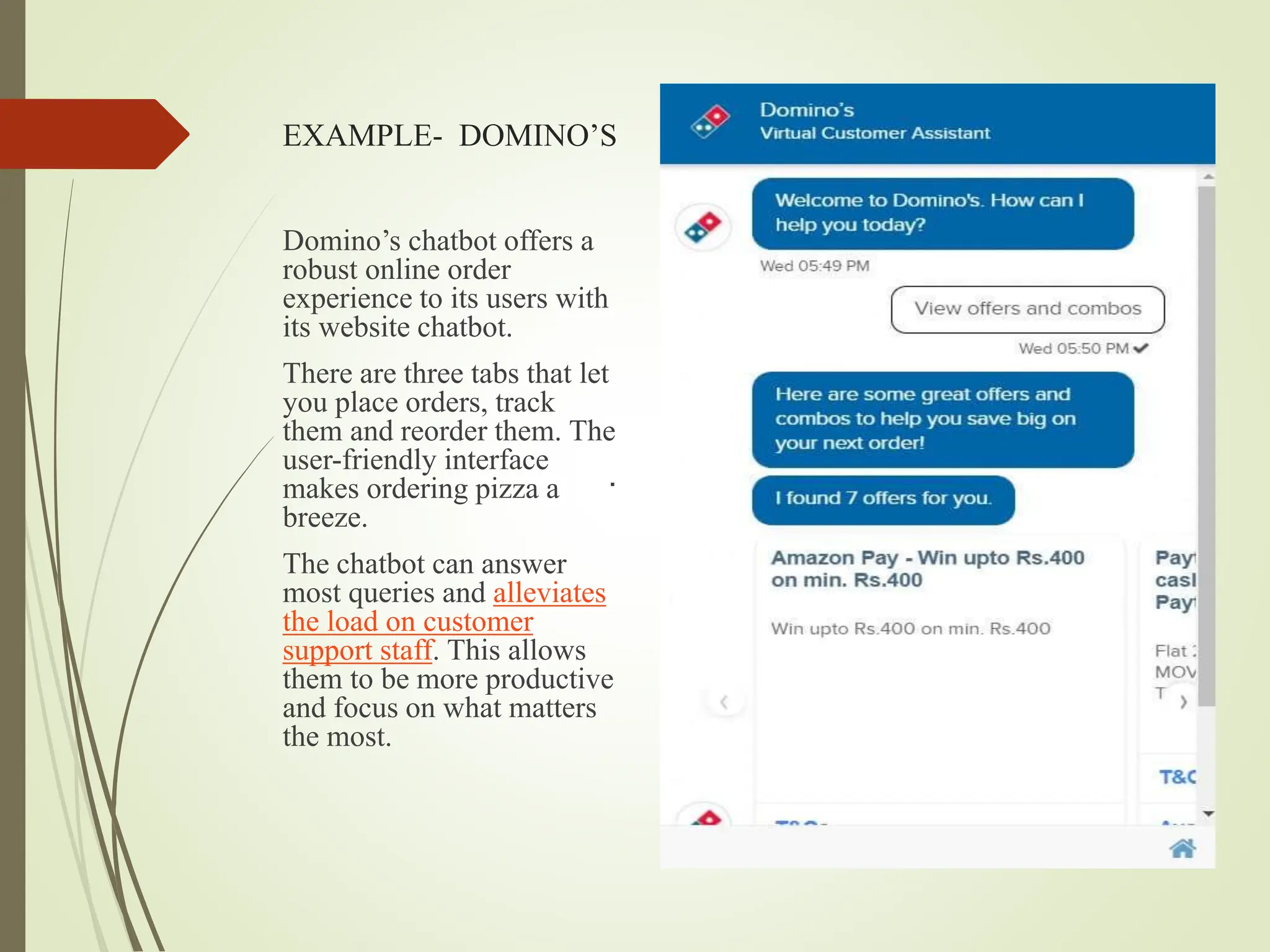
Domino’s chatbot offers a
robust online order
experience to its users with
its website chatbot.
There are three tabs that let
you place orders, track
them and reorder them. The
user-friendly interface
makes ordering pizza a
breeze.
The chatbot can answer
most queries and alleviates
the load on customer
support staff. This allows
them to be more productive
and focus on what matters
the most.
Online advertisement
 Artificial intelligence tools
exist today that
can automatically optimize
advertising spend and
targeting. AI can process
your ad spend and targeting
data, look at your results,
then learn what actions
(spending changes, targeting
changes, etc.) will drive
better performance.
Web designing
 AI in web development
would help the user to
automate various tasks that
would help the web
developers to find the
solution. AI helps the user to
create code from scratch that
allows the developers to
build up smarter apps and
ensures faster time to market
and quick turnaround time.
Personalized User Experience
 AI helps in giving more
useful content to the users. It
also helps in tracking user
interactions on a website.
So if you find the customers
struggling at a point, you can
change the design or design
a chatbot to help the
customer move further.
EXAMPLES
2. Airbnb — location and browsing history
Airbnb uses more personalization tools at once. It uses location and
geotargeting personalization. It suggests your accommodation near
you, or If you book a place in a certain city, the app will show you
the places you can visit, where to eat, party, etc. It also uses your
previous searches in order to recommend you places to visit.
3. Spotify — Browsing history and personalized features
Spotify, same as Apple Music, owns an enormous collection of music.
People can listen to all of them and sometimes they do not even know, that
they will love some song, which they wouldn’t even play. Personalization
helps people to discover the new songs. Both music services recommend
songs, albums or playlist according to the user’s browsing history.
However, Spotify contains a special personalized feature for runners. It
uses technology to discover the rhythm and then it plays the song that are in
tune with the runner’s tempo.
ROLE OF ARTIFICIAL INTELLIGENCE
IN REACHING TARGET AUDIENCE
EMAIL MARKETING /
PERSONALIZATION
Artificial intelligence is making email marketing even better, both
for the marketer and its customers. Personalization at scale is every
marketer’s dream – and Artificial intelligence makes it possible. Artificial
intelligence can use data to create personalized emails to every one of
the company subscribers, based on their previous interactions with the
brand. It can customize based on what content they’ve consumed, what’s
on their wish list, what pages they have spent the most time on, and
more.
For example, if one user always visits links to product pages in the
company’s email, but another skips those links and goes straight for
content, the Artificial intelligence can send different messaging with the
most relevant links for each user
AUGMENTED REALITY
 The Artificial knowledge which can possibly give better
consumer loyalty is Augmented Reality (AR). AR can
furnish the client with the alternative of seeing and feeling
the creation before the online buy, one case of this
innovation obviously on its underlying stage is Lenskart’s
3D preliminary, which permits clients to attempt the casing
they are keen on purchasing through their webcams sitting
at home. Fuse of such innovation can animate better and
quicker reaction from the client which at last will reflect in
the revenues.
AUTOMATIC SPEECH AND
IMAGE RECOGNITION
 Computers can be considered having vision just like
humans and it can be referred to as ‘computer vision’. This
vision can be used in attaining high - level understanding
from digital image or image. Computer vision employs
machine learning algorithms and pattern recognition to
acquire veridicality of human visual systems. Computer
vision is now extended to voice recognition also, which
makes them recognize the user's voice and interpret their
words they speak. Marketers can use image recognition for
better synchronization between store visits and online
content. Image recognition has enhanced customer
experience.
CHURN PREDICTIONS
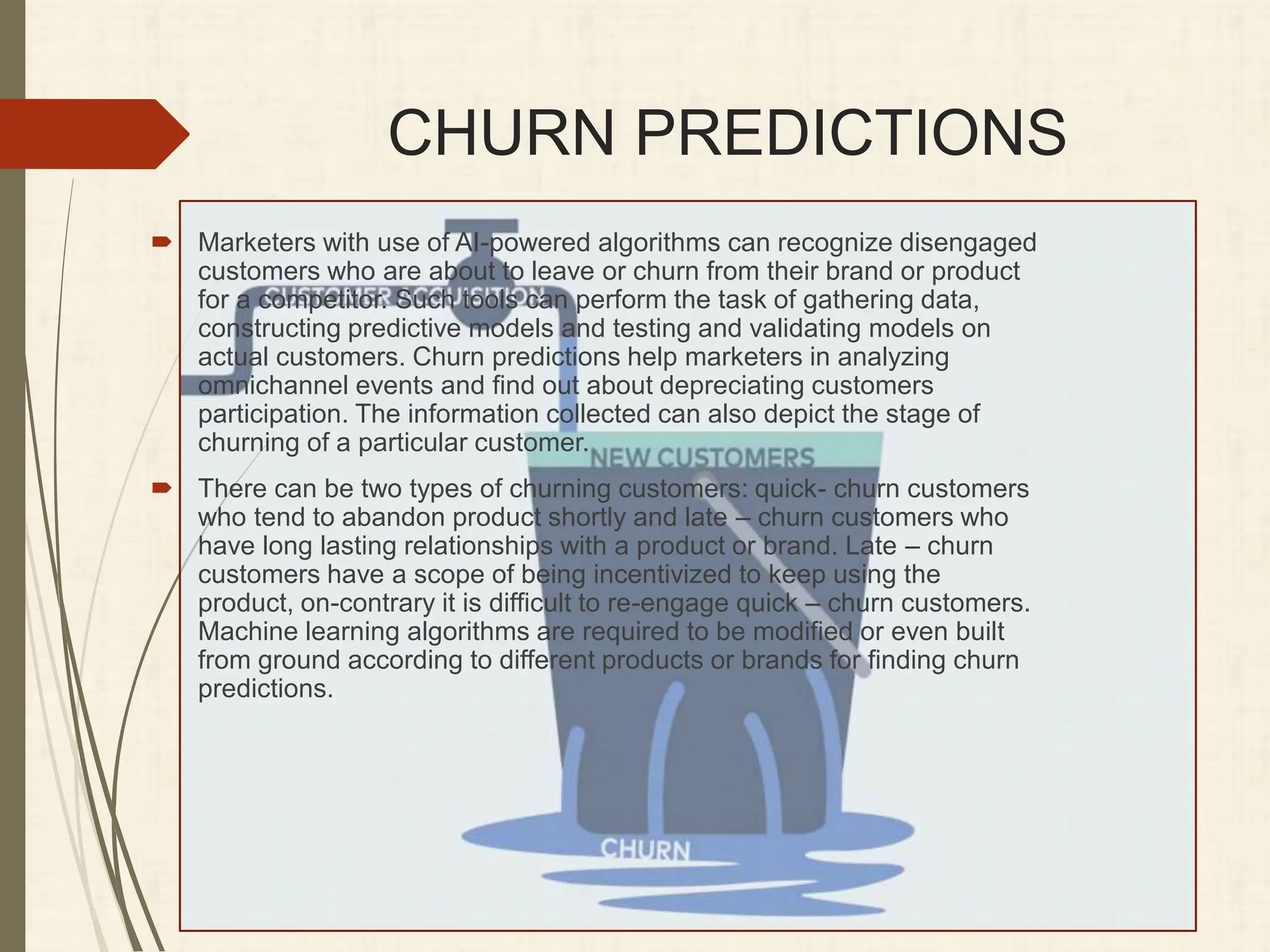
 Marketers with use of AI-powered algorithms can recognize disengaged
customers who are about to leave or churn from their brand or product
for a competitor. Such tools can perform the task of gathering data,
constructing predictive models and testing and validating models on
actual customers. Churn predictions help marketers in analyzing
omnichannel events and find out about depreciating customers
participation. The information collected can also depict the stage of
churning of a particular customer.
 There can be two types of churning customers: quick- churn customers
who tend to abandon product shortly and late – churn customers who
have long lasting relationships with a product or brand. Late – churn
customers have a scope of being incentivized to keep using the
product, on-contrary it is difficult to re-engage quick – churn customers.
Machine learning algorithms are required to be modified or even built
from ground according to different products or brands for finding churn
predictions.
AI POWERED CONTENT
GENERATION
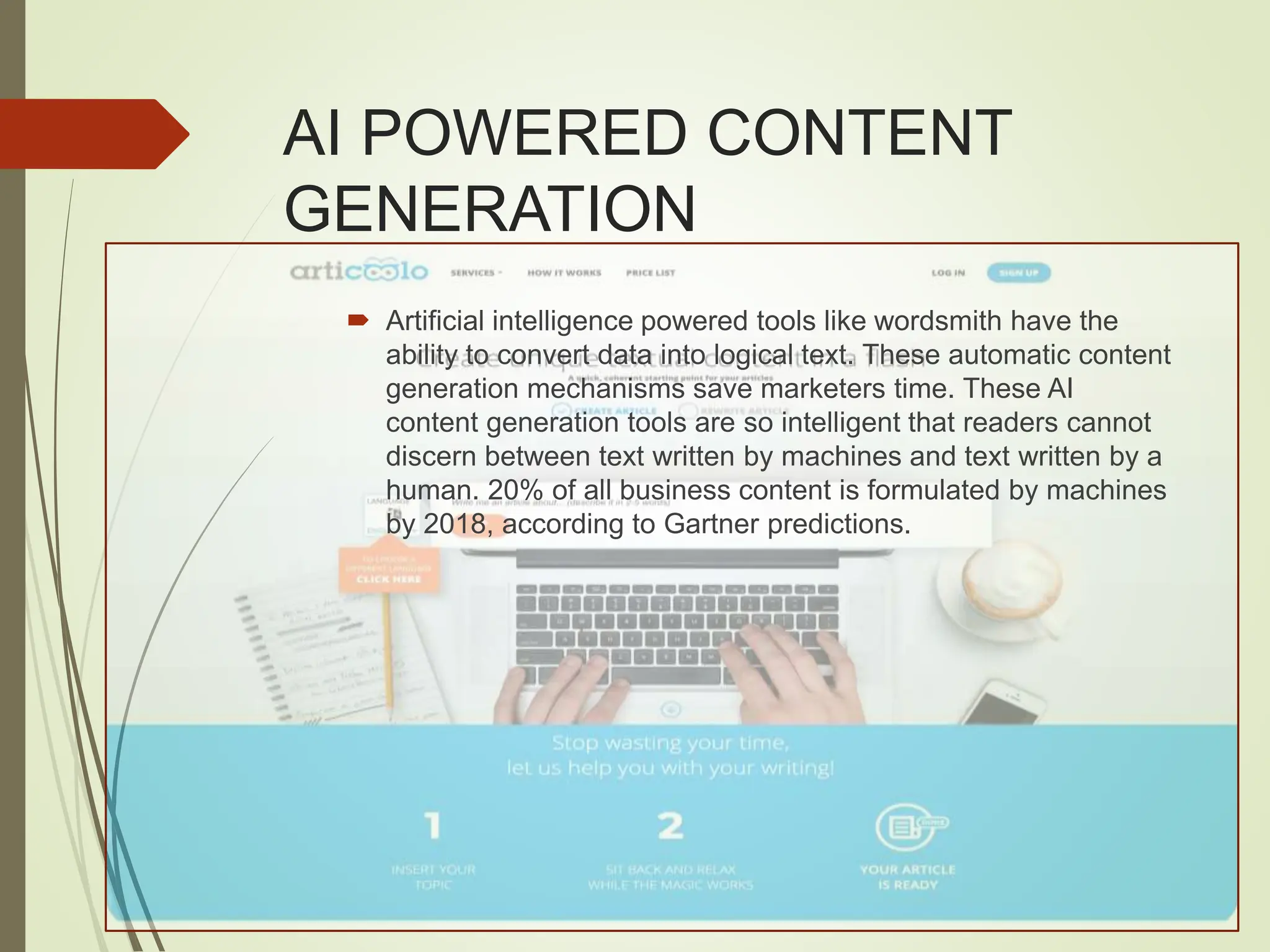
 Artificial intelligence powered tools like wordsmith have the
ability to convert data into logical text. These automatic content
generation mechanisms save marketers time. These AI
content generation tools are so intelligent that readers cannot
discern between text written by machines and text written by a
human. 20% of all business content is formulated by machines
by 2018, according to Gartner predictions.
AI POWERED CONTENT
CURATION
 AI-based curation refers to the use of algorithms to process
huge volumes of data, deciphering meaning and patterns.
AI works by analysing user data to make sense of user intent,
thereby helping marketers address consumers better.
ARTIFICIAL INTELLIGENCE
IN HEALTHCARE
 Artificial intelligence in healthcare refers to the use of complex
algorithms designed to perform certain tasks in an automated
fashion. When researchers, doctors and scientists inject data into
computers, the newly built algorithms can review, interpret and
even suggest solutions to complex medical problems.
Benefits of AI in Healthcare:
 Reduction in Human Mistakes
 Helpful in accurate decision making
 Virtual Health assistants
 Cost reduction
 Prevention of diseases
 Wearable Healthcare technology
ARTIFICIAL INTELLIGENCE
IN DEFENCE
 AI-equipped military systems are capable of handling volumes of data
efficiently. In addition to that, such systems have improved self-control, self-
regulation, and self-actuation due to its superior computing and decision-
making capabilities.
Leading countries consuming AI in Defence:
 United Nations and China
China is investing at least $ 7 billion through 2030, including $ 2 billion for a
research park in Beijing. The Chinese government foresees a $ 150 billion
artificial intelligence industry by that time, and has the most comprehensive
national plan to become a technology leader.
On the other hand, US do not have a central artificial intelligence policy, but
individual projects are financed by military departments.
 Israel
Despite the small size and the budget of Israel is about 4.5% of its
GDP is spent on research and development, almost twice as much as
the OECD average. For comparison, 30% of Israeli research and
development activity is spent on military products.
 Russia
The country spends about $ 12.5 million annually on AI, where many
of Russia’s artificial intelligence demonstrations are military in
nature, such as AI-assisted combat aircraft and automatic artillery.
 India
India joined the United States and China as one of the world’s largest
military expenditures. A multi-stakeholder task force on Strategic
Implementation of Artificial Intelligence for National Security and
Defense was constituted by the Ministry of Defense.
Artificial intelligence in
Business
 In the area of Finance sector JP Morgan’s Chase contract
intelligence(COiN) platform uses A.I , machine learning and
image recognition software to analyze contract
Artificial intelligence for
governs
 Now let us look into the domain of governance more
specifically how Indian government use A.I
 First such example is IRCTC’s artificial intelligence based
passenger service called “Ask Disha chatbot”.
 ASEEM portal by The Ministry of skill Development and
Entrepreneurship (MSDE).
 Also Artificial intelligence powered road safety project called
iRASTE launched by govt. of India.
Conclusion
 There’s no better time for marketers to begin testing how Artificial
Intelligence strategies can help create highly personalized experiences
for their consumers. With AI poised to continue growing across all
industries and segments, marketers should dedicate time and resources
to experiment with strategies and ensure their marketing organization is
set up for continued success, both now and in the future.
Sources of information
 Edureka platform.
 MIT Lincoln laboratory
 https://www.foreseemed.com/artificial-intelligence-in-healthcare
 https://analyticsindiamag.com/what-are-the-scope-and-challenges-of-using-
ai-in-military-operations/
 Info upon governs is taken from different govnernment websites.
THANK YOU !

Role of AI in reaching target audience.pptx

  • 1.
  • 2.
    What is ArtificialIntelligence?  Artificial intelligence(AI) is a wide-ranging branch of computer science concerned with building smart machines capable of performing tasks that typically require human intelligence.
  • 3.
    start of Artificialintelligence  The term artificial intelligence was first coined decades ago in the year 1956 by John Mc Carthy at the Dartmouth Conference. He defined artificial intelligence as the science and engineering of making intelligent machines.
  • 4.
     AI isa set of concepts, tools, and techniques that represents huge disruptive and transformative potential. Definition-wise, we can think of AI simply as intelligence exhibited by machines that can be used in a beneficial way (e.g., carrying out tasks, making decisions, assisting humans, saving lives). More specifically, AI describes when a machine is able to learn from information (data), generate some degree of understanding, and then use the knowledge learned to do something. AI includes machine learning and specific techniques such as deep learning as subsets.
  • 6.
    Types of A.I Artificial intelligence can be structured upon along three evolutionary stage or you can say there are three different types of artificial intelligence. 1. Artificial narrow intelligence (ANI) 2. Artificial General intelligence (AGI) 3. Artificial super intelligence (ASI). Artificial narrow intelligence- it is also know as weak A.I involves applying A.I only to specific tasks. Now many currently existing system that claim to use artificial intelligence are operating as weak A.I. ex.- Alexa, Face verification on phoneand Autopilot feature at tesla.
  • 7.
     Artificial generalintelligence- Also known as strong A.I, involves machines that possess the ability to perform any intellectual task that human being can.  Artificial super intelligence- it is a term referring to the time when the capability of computer will surpass humans.
  • 9.
  • 10.
  • 11.
    Application improved byAI which help to reach target audience Powered by A.I Online advertisement Chatbot Personalized user experience Predictive analysis Web designing
  • 12.
    Chatbots  A Chatbotis merely a computer program that fundamentally simulates human conversations. It allows a form of interaction between a human and a machine- the communication, which happens via messages or voice command. A Chatbot is programmed to work independently from a human operator.
  • 13.
    EXAMPLE- DOMINO’S . Domino’s chatbotoffers a robust online order experience to its users with its website chatbot. There are three tabs that let you place orders, track them and reorder them. The user-friendly interface makes ordering pizza a breeze. The chatbot can answer most queries and alleviates the load on customer support staff. This allows them to be more productive and focus on what matters the most.
  • 14.
    Online advertisement  Artificialintelligence tools exist today that can automatically optimize advertising spend and targeting. AI can process your ad spend and targeting data, look at your results, then learn what actions (spending changes, targeting changes, etc.) will drive better performance.
  • 15.
    Web designing  AIin web development would help the user to automate various tasks that would help the web developers to find the solution. AI helps the user to create code from scratch that allows the developers to build up smarter apps and ensures faster time to market and quick turnaround time.
  • 16.
    Personalized User Experience AI helps in giving more useful content to the users. It also helps in tracking user interactions on a website. So if you find the customers struggling at a point, you can change the design or design a chatbot to help the customer move further.
  • 17.
    EXAMPLES 2. Airbnb —location and browsing history Airbnb uses more personalization tools at once. It uses location and geotargeting personalization. It suggests your accommodation near you, or If you book a place in a certain city, the app will show you the places you can visit, where to eat, party, etc. It also uses your previous searches in order to recommend you places to visit.
  • 18.
    3. Spotify —Browsing history and personalized features Spotify, same as Apple Music, owns an enormous collection of music. People can listen to all of them and sometimes they do not even know, that they will love some song, which they wouldn’t even play. Personalization helps people to discover the new songs. Both music services recommend songs, albums or playlist according to the user’s browsing history. However, Spotify contains a special personalized feature for runners. It uses technology to discover the rhythm and then it plays the song that are in tune with the runner’s tempo.
  • 19.
    ROLE OF ARTIFICIALINTELLIGENCE IN REACHING TARGET AUDIENCE
  • 20.
    EMAIL MARKETING / PERSONALIZATION Artificialintelligence is making email marketing even better, both for the marketer and its customers. Personalization at scale is every marketer’s dream – and Artificial intelligence makes it possible. Artificial intelligence can use data to create personalized emails to every one of the company subscribers, based on their previous interactions with the brand. It can customize based on what content they’ve consumed, what’s on their wish list, what pages they have spent the most time on, and more. For example, if one user always visits links to product pages in the company’s email, but another skips those links and goes straight for content, the Artificial intelligence can send different messaging with the most relevant links for each user
  • 21.
    AUGMENTED REALITY  TheArtificial knowledge which can possibly give better consumer loyalty is Augmented Reality (AR). AR can furnish the client with the alternative of seeing and feeling the creation before the online buy, one case of this innovation obviously on its underlying stage is Lenskart’s 3D preliminary, which permits clients to attempt the casing they are keen on purchasing through their webcams sitting at home. Fuse of such innovation can animate better and quicker reaction from the client which at last will reflect in the revenues.
  • 22.
    AUTOMATIC SPEECH AND IMAGERECOGNITION  Computers can be considered having vision just like humans and it can be referred to as ‘computer vision’. This vision can be used in attaining high - level understanding from digital image or image. Computer vision employs machine learning algorithms and pattern recognition to acquire veridicality of human visual systems. Computer vision is now extended to voice recognition also, which makes them recognize the user's voice and interpret their words they speak. Marketers can use image recognition for better synchronization between store visits and online content. Image recognition has enhanced customer experience.
  • 23.
    CHURN PREDICTIONS  Marketerswith use of AI-powered algorithms can recognize disengaged customers who are about to leave or churn from their brand or product for a competitor. Such tools can perform the task of gathering data, constructing predictive models and testing and validating models on actual customers. Churn predictions help marketers in analyzing omnichannel events and find out about depreciating customers participation. The information collected can also depict the stage of churning of a particular customer.  There can be two types of churning customers: quick- churn customers who tend to abandon product shortly and late – churn customers who have long lasting relationships with a product or brand. Late – churn customers have a scope of being incentivized to keep using the product, on-contrary it is difficult to re-engage quick – churn customers. Machine learning algorithms are required to be modified or even built from ground according to different products or brands for finding churn predictions.
  • 24.
    AI POWERED CONTENT GENERATION Artificial intelligence powered tools like wordsmith have the ability to convert data into logical text. These automatic content generation mechanisms save marketers time. These AI content generation tools are so intelligent that readers cannot discern between text written by machines and text written by a human. 20% of all business content is formulated by machines by 2018, according to Gartner predictions.
  • 25.
    AI POWERED CONTENT CURATION AI-based curation refers to the use of algorithms to process huge volumes of data, deciphering meaning and patterns. AI works by analysing user data to make sense of user intent, thereby helping marketers address consumers better.
  • 26.
    ARTIFICIAL INTELLIGENCE IN HEALTHCARE Artificial intelligence in healthcare refers to the use of complex algorithms designed to perform certain tasks in an automated fashion. When researchers, doctors and scientists inject data into computers, the newly built algorithms can review, interpret and even suggest solutions to complex medical problems. Benefits of AI in Healthcare:  Reduction in Human Mistakes  Helpful in accurate decision making  Virtual Health assistants  Cost reduction  Prevention of diseases  Wearable Healthcare technology
  • 27.
    ARTIFICIAL INTELLIGENCE IN DEFENCE AI-equipped military systems are capable of handling volumes of data efficiently. In addition to that, such systems have improved self-control, self- regulation, and self-actuation due to its superior computing and decision- making capabilities. Leading countries consuming AI in Defence:  United Nations and China China is investing at least $ 7 billion through 2030, including $ 2 billion for a research park in Beijing. The Chinese government foresees a $ 150 billion artificial intelligence industry by that time, and has the most comprehensive national plan to become a technology leader. On the other hand, US do not have a central artificial intelligence policy, but individual projects are financed by military departments.
  • 28.
     Israel Despite thesmall size and the budget of Israel is about 4.5% of its GDP is spent on research and development, almost twice as much as the OECD average. For comparison, 30% of Israeli research and development activity is spent on military products.  Russia The country spends about $ 12.5 million annually on AI, where many of Russia’s artificial intelligence demonstrations are military in nature, such as AI-assisted combat aircraft and automatic artillery.  India India joined the United States and China as one of the world’s largest military expenditures. A multi-stakeholder task force on Strategic Implementation of Artificial Intelligence for National Security and Defense was constituted by the Ministry of Defense.
  • 29.
    Artificial intelligence in Business In the area of Finance sector JP Morgan’s Chase contract intelligence(COiN) platform uses A.I , machine learning and image recognition software to analyze contract
  • 30.
    Artificial intelligence for governs Now let us look into the domain of governance more specifically how Indian government use A.I  First such example is IRCTC’s artificial intelligence based passenger service called “Ask Disha chatbot”.  ASEEM portal by The Ministry of skill Development and Entrepreneurship (MSDE).  Also Artificial intelligence powered road safety project called iRASTE launched by govt. of India.
  • 31.
    Conclusion  There’s nobetter time for marketers to begin testing how Artificial Intelligence strategies can help create highly personalized experiences for their consumers. With AI poised to continue growing across all industries and segments, marketers should dedicate time and resources to experiment with strategies and ensure their marketing organization is set up for continued success, both now and in the future.
  • 32.
    Sources of information Edureka platform.  MIT Lincoln laboratory  https://www.foreseemed.com/artificial-intelligence-in-healthcare  https://analyticsindiamag.com/what-are-the-scope-and-challenges-of-using- ai-in-military-operations/  Info upon governs is taken from different govnernment websites.
  • 33.